30_ICS_7/04.p1
Colorado School of Mines California Institute of Technology
Solid-oxide fuel cells (SOFC) with
hydrocarbon and hydrocarbon-derived fuels
Robert J. Kee and Huayang Zhu
Engineering Division, Colorado School of Mines
Golden, CO 80401, USA
David G. Goodwin
Engineering and Applied Science, California Institute of Technology
Pasadena, CA 91125, USA
rjkee@mines.edu
(303) 273-3379
Presented:
International Symposium on Combustion
July 29, 2004
30_ICS_7/04.p2
Colorado School of Mines California Institute of Technology
Direct-oxidation fuel cells offer a number of
potentially important benefits
30_ICS_7/04.p3
Colorado School of Mines California Institute of Technology
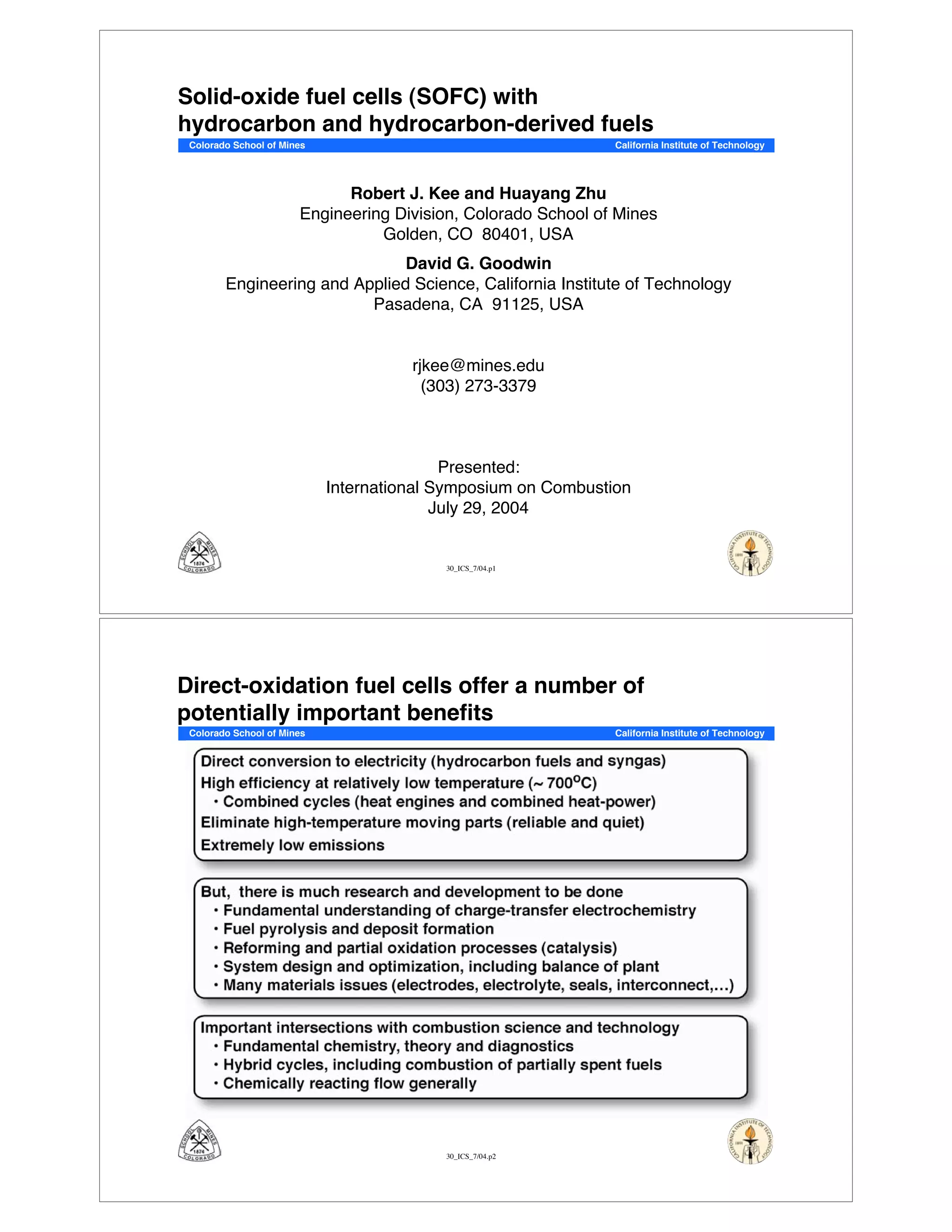
There is important fuel-cell physics and chemistry
spanning a great range of scales
30_ICS_7/04.p4
Colorado School of Mines California Institute of Technology
General SOFC resources
• “The Fuel Cell Handbook,” US Dept. of Energy, 6th Ed.,
DOE/NETL 2002/1179, available on the web, (2002).
• Singhal and Kendall, “High-temperature SOFC,” Elsevier, (2003).
• Minh and Takahashi, “Science and Technology of Ceramic Fuel Cells,”
Elsevier, (1995).
Seminal research on hydrocarbon-fueled SOFC
• E. Perry Murray, T. Tsai, and S.A. Barnett, “A direct-methane fuel cell
with a ceria-based anode,” Nature, 400:651-659 (1999)
• S. Park, J.M. Vohs, and R.J. Gorte, “Direct oxidation of hydrocarbons
in a solid-oxide fuel cell,” Nature, 404: 265-266 (2000)
Broad areas of research and literature
• Materials (electrolyte, electrodes, catalysts, interconnects, seals,…)
• Membrane-electrode assemblies
•!Fuel cell characterization and performance
• Fundamental electrochemical processes
• Systems and hybrid cycles
There is an extensive and growing literature in
fuel cells generally and SOFC particularly
30_ICS_7/04.p5
Colorado School of Mines California Institute of Technology
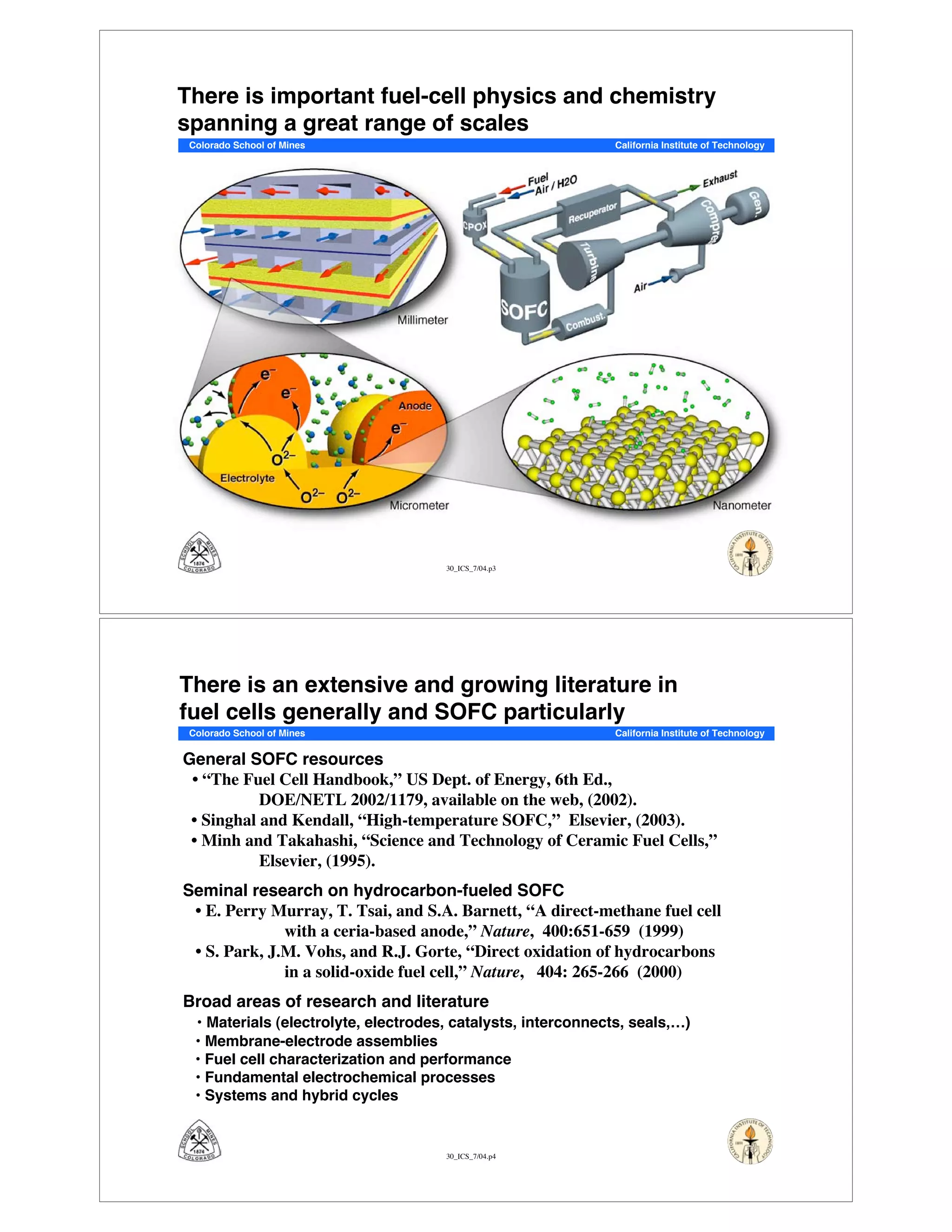
Solid-Oxide Fuel Cells enable direct electro-
chemical oxidation (DECO) of hydrocarbons
Planar architecture
• Membrane-electrode assembly
• Interconnect carries current
• Stacked layers build voltage
Electrolyte (e.g., YSZ)
• Polycrystalline ceramic
• O2- ion conductor
• Electrical insulator
• Impervious to gas flow
Electrodes
• Porous cermet composite
• Anode supports MEA
Interconnect
•!High electrical conductivity
• Maintains equal potential
Flow channels
• Formed in interconnect
Characteristic dimension: 1 mm
• Channel diameter
• Anode thickness
Characteristic temperature: 700˚C
30_ICS_7/04.p6
Colorado School of Mines California Institute of Technology
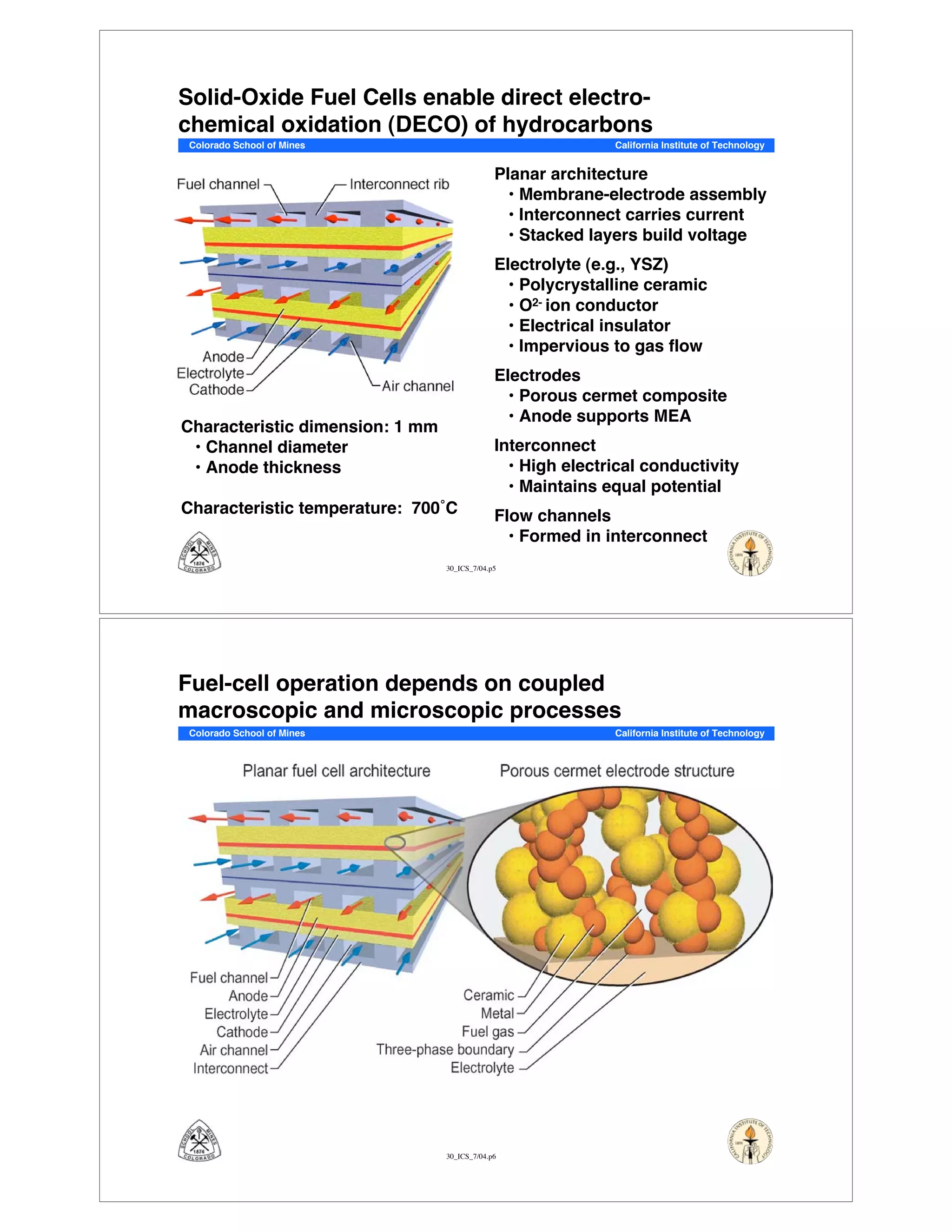
Fuel-cell operation depends on coupled
macroscopic and microscopic processes
30_ICS_7/04.p7
Colorado School of Mines California Institute of Technology
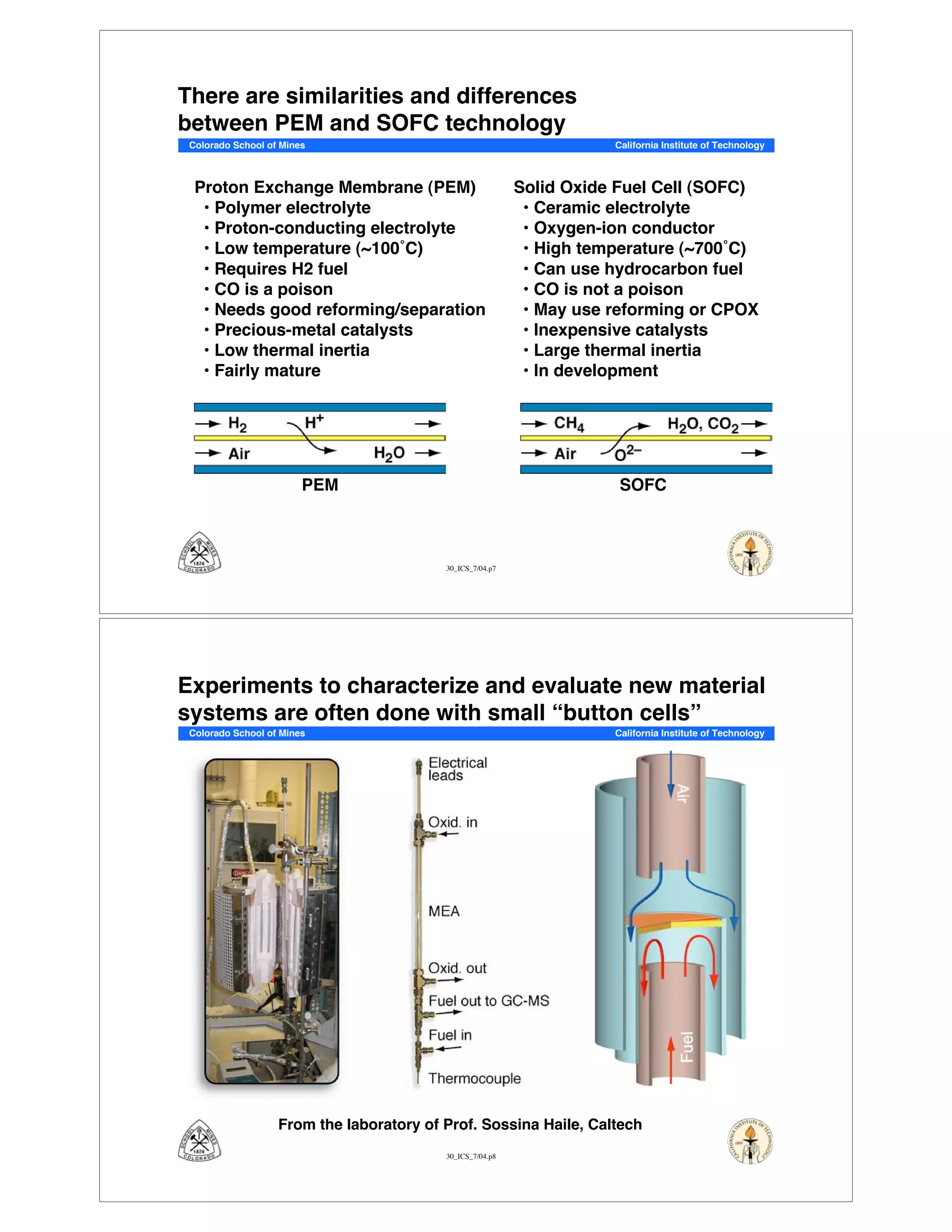
Proton Exchange Membrane (PEM)
• Polymer electrolyte
• Proton-conducting electrolyte
• Low temperature (~100˚C)
• Requires H2 fuel
• CO is a poison
• Needs good reforming/separation
• Precious-metal catalysts
• Low thermal inertia
• Fairly mature
Solid Oxide Fuel Cell (SOFC)
• Ceramic electrolyte
• Oxygen-ion conductor
• High temperature (~700˚C)
• Can use hydrocarbon fuel
• CO is not a poison
• May use reforming or CPOX
• Inexpensive catalysts
• Large thermal inertia
• In development
There are similarities and differences
between PEM and SOFC technology
PEM SOFC
30_ICS_7/04.p8
Colorado School of Mines California Institute of Technology
Experiments to characterize and evaluate new material
systems are often done with small “button cells”
From the laboratory of Prof. Sossina Haile, Caltech
30_ICS_7/04.p9
Colorado School of Mines California Institute of Technology
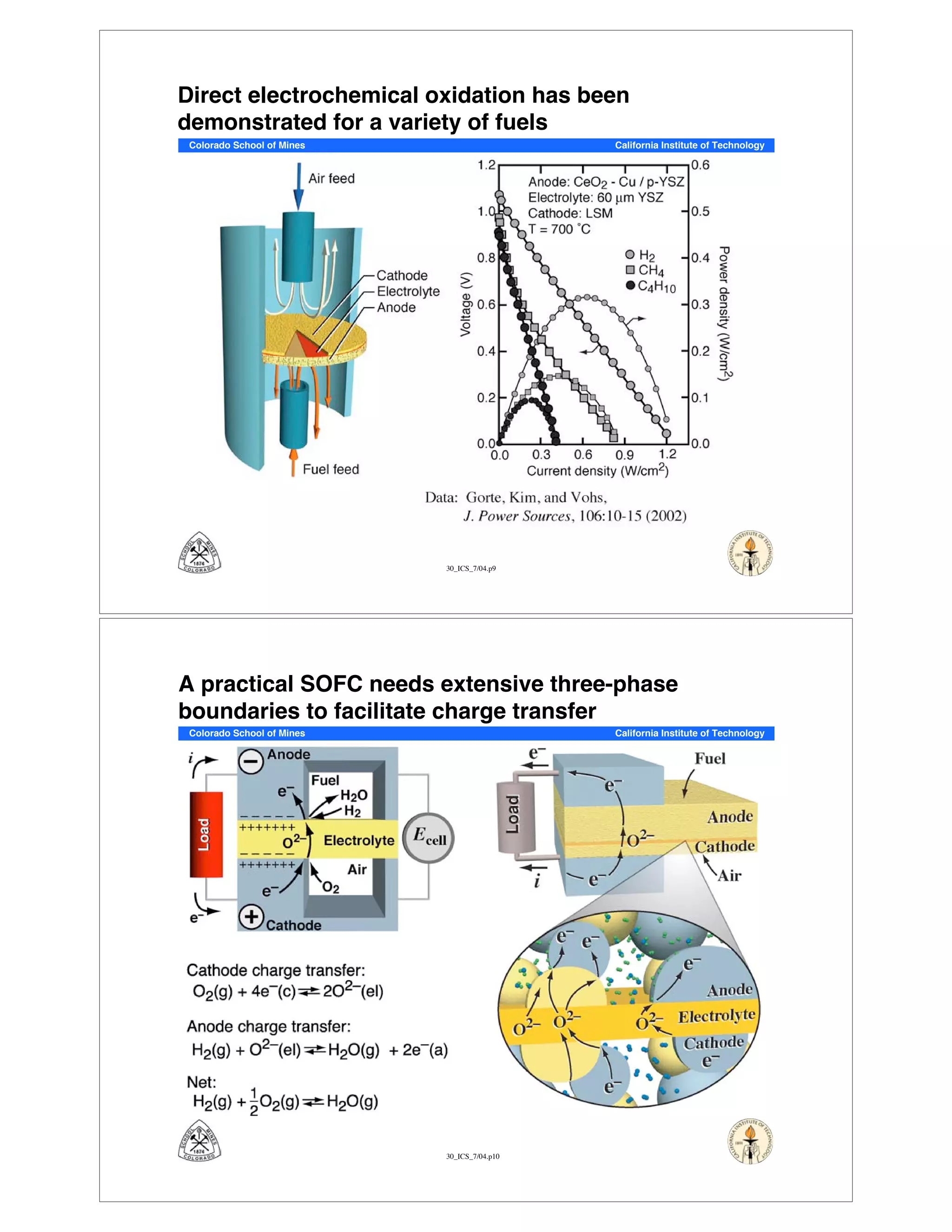
Direct electrochemical oxidation has been
demonstrated for a variety of fuels
30_ICS_7/04.p10
Colorado School of Mines California Institute of Technology
A practical SOFC needs extensive three-phase
boundaries to facilitate charge transfer
30_ICS_7/04.p11
Colorado School of Mines California Institute of Technology
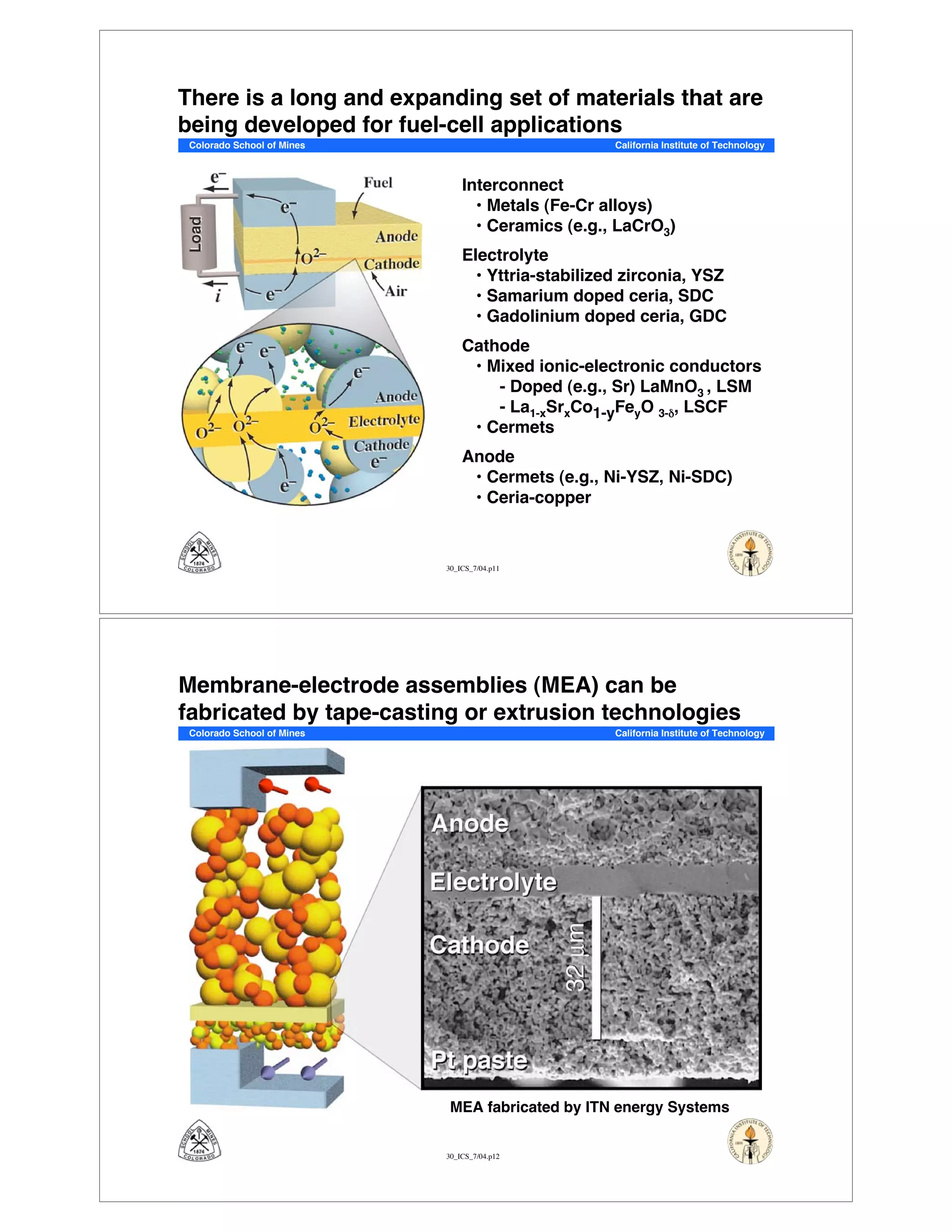
There is a long and expanding set of materials that are
being developed for fuel-cell applications
Interconnect
•!Metals (Fe-Cr alloys)
• Ceramics (e.g., LaCrO3)
Electrolyte
• Yttria-stabilized zirconia, YSZ
• Samarium doped ceria, SDC
• Gadolinium doped ceria, GDC
Cathode
• Mixed ionic-electronic conductors
- Doped (e.g., Sr) LaMnO3 , LSM
- La1-xSrxCo1-yFeyO 3-!, LSCF
• Cermets
Anode
• Cermets (e.g., Ni-YSZ, Ni-SDC)
• Ceria-copper
30_ICS_7/04.p12
Colorado School of Mines California Institute of Technology
Membrane-electrode assemblies (MEA) can be
fabricated by tape-casting or extrusion technologies
MEA fabricated by ITN energy Systems
30_ICS_7/04.p13
Colorado School of Mines California Institute of Technology
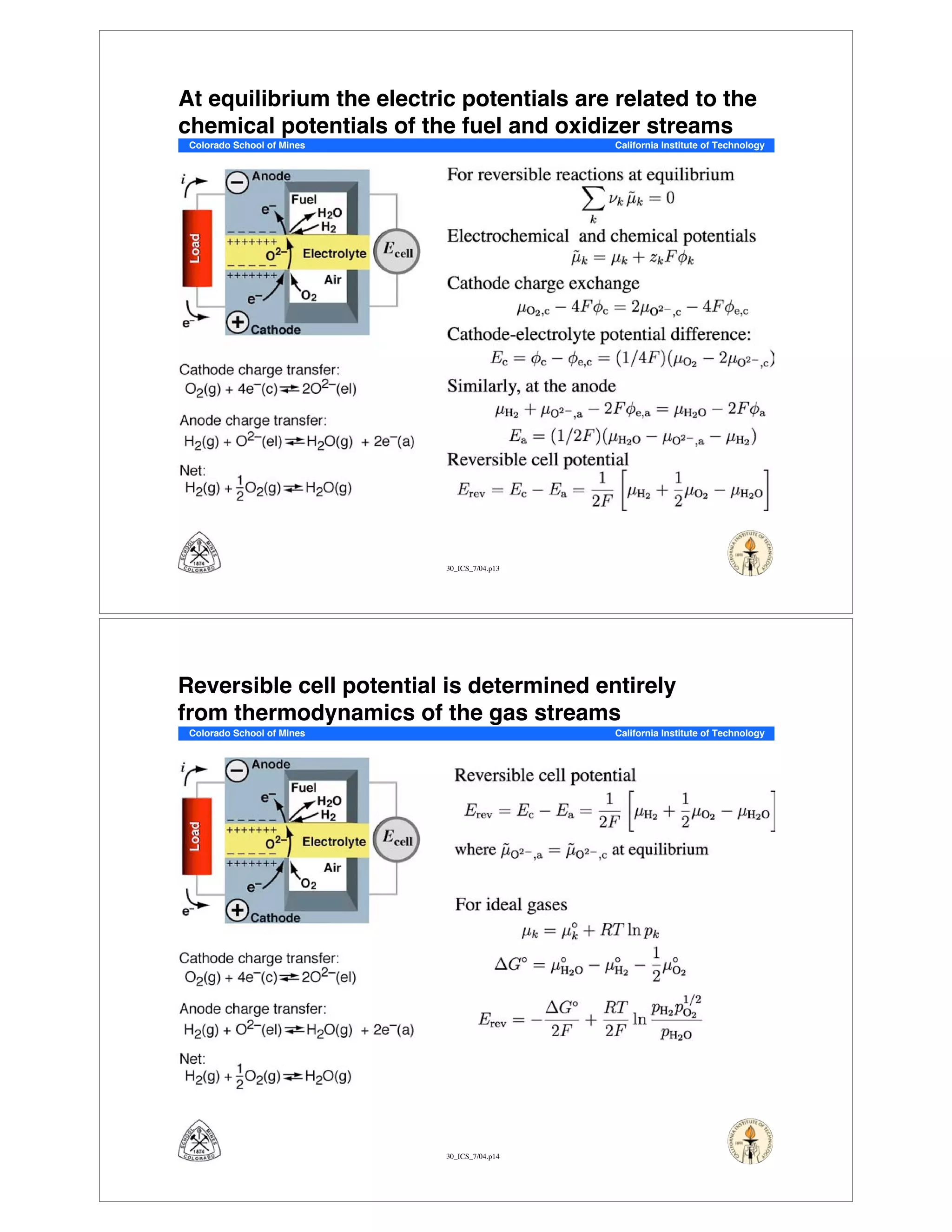
At equilibrium the electric potentials are related to the
chemical potentials of the fuel and oxidizer streams
30_ICS_7/04.p14
Colorado School of Mines California Institute of Technology
Reversible cell potential is determined entirely
from thermodynamics of the gas streams
30_ICS_7/04.p15
Colorado School of Mines California Institute of Technology
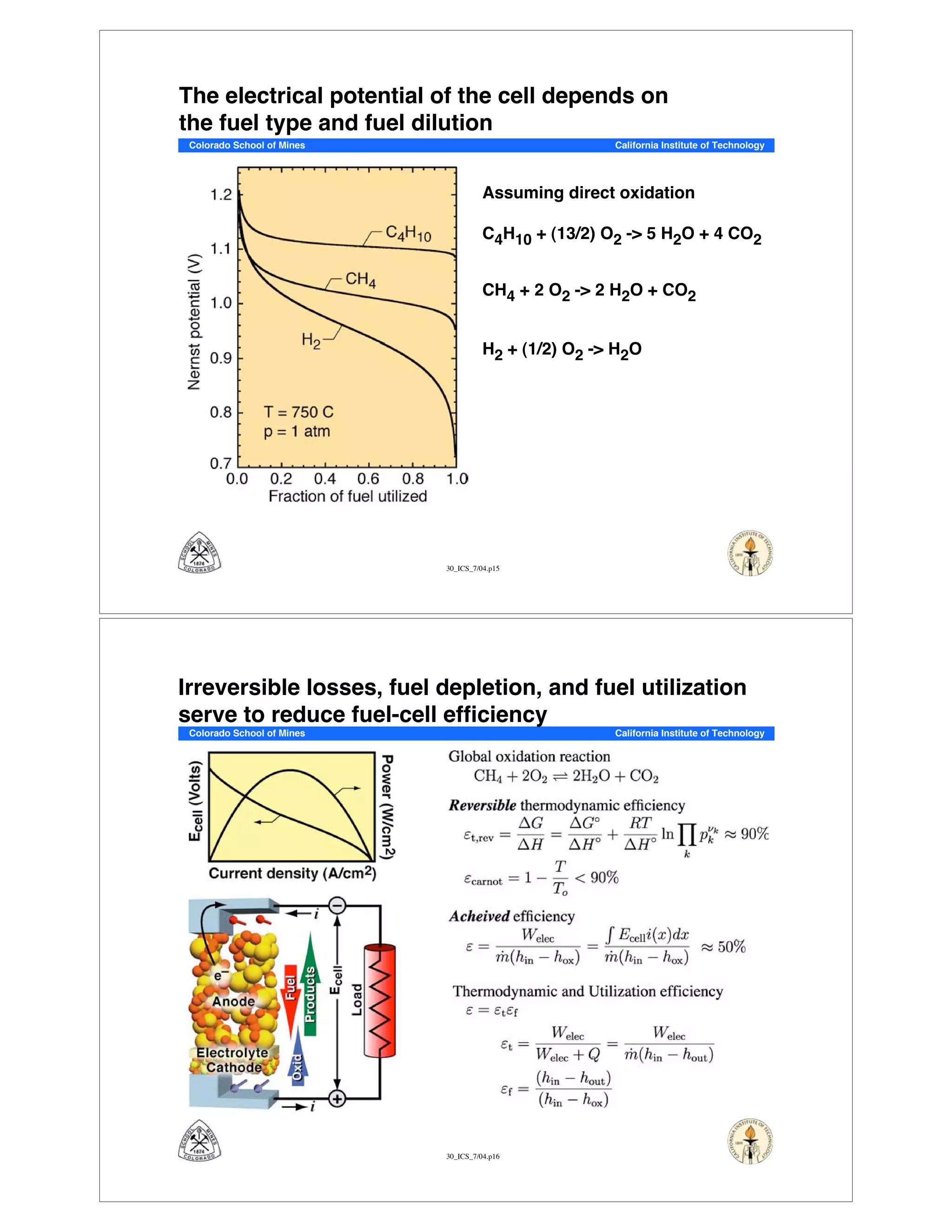
The electrical potential of the cell depends on
the fuel type and fuel dilution
Assuming direct oxidation
C4H10 + (13/2) O2 -> 5 H2O + 4 CO2
CH4 + 2 O2 -> 2 H2O + CO2
H2 + (1/2) O2 -> H2O
30_ICS_7/04.p16
Colorado School of Mines California Institute of Technology
Irreversible losses, fuel depletion, and fuel utilization
serve to reduce fuel-cell efficiency
30_ICS_7/04.p17
Colorado School of Mines California Institute of Technology
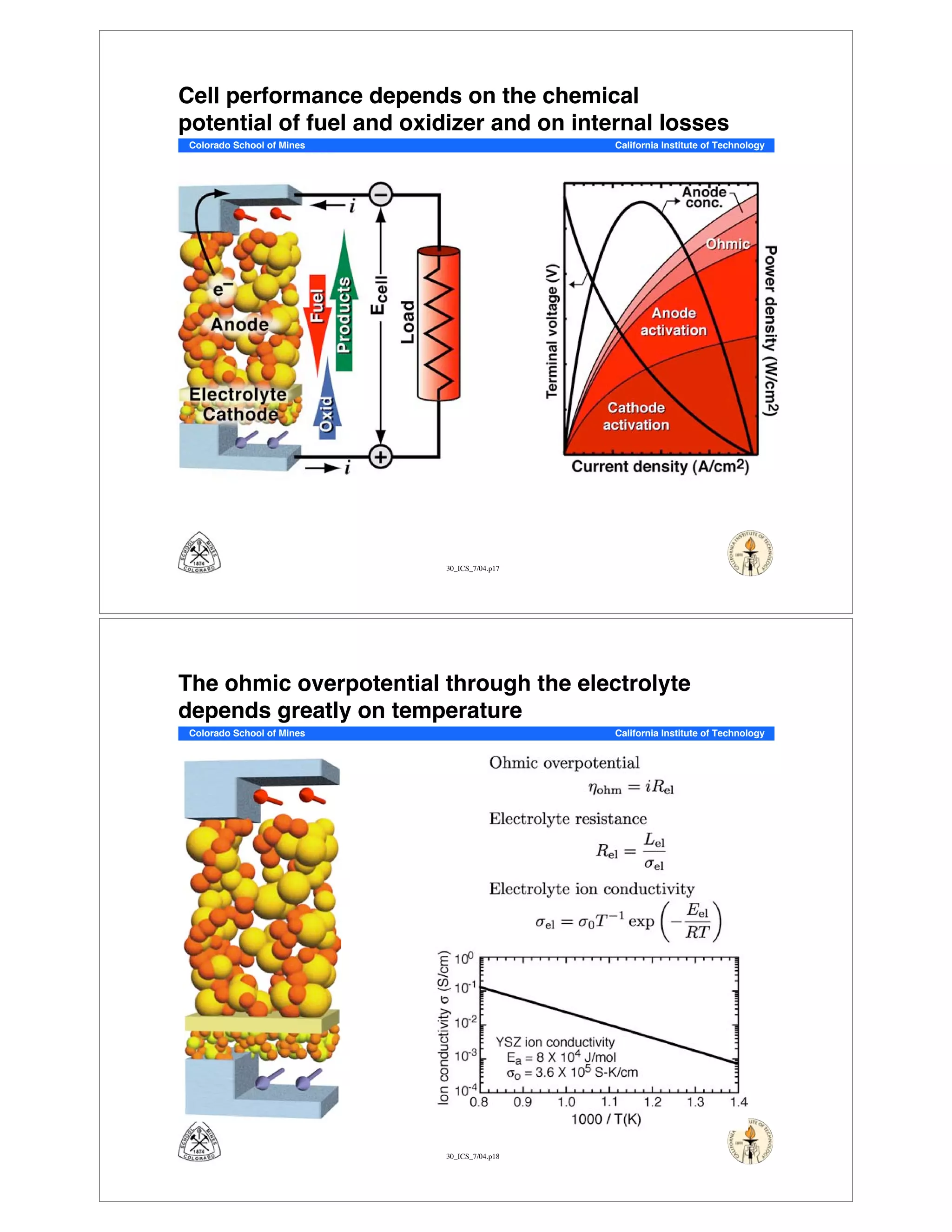
Cell performance depends on the chemical
potential of fuel and oxidizer and on internal losses
30_ICS_7/04.p18
Colorado School of Mines California Institute of Technology
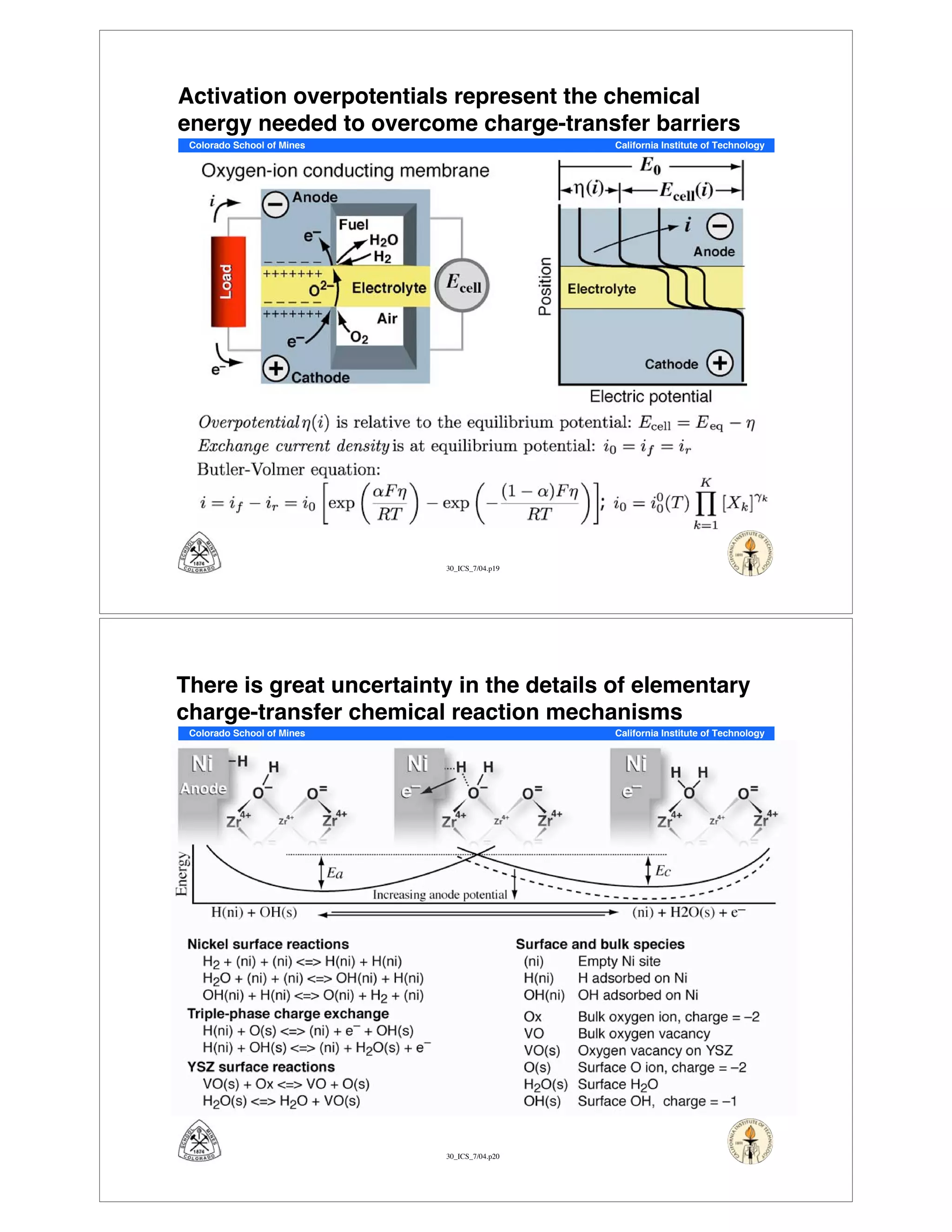
The ohmic overpotential through the electrolyte
depends greatly on temperature
30_ICS_7/04.p19
Colorado School of Mines California Institute of Technology
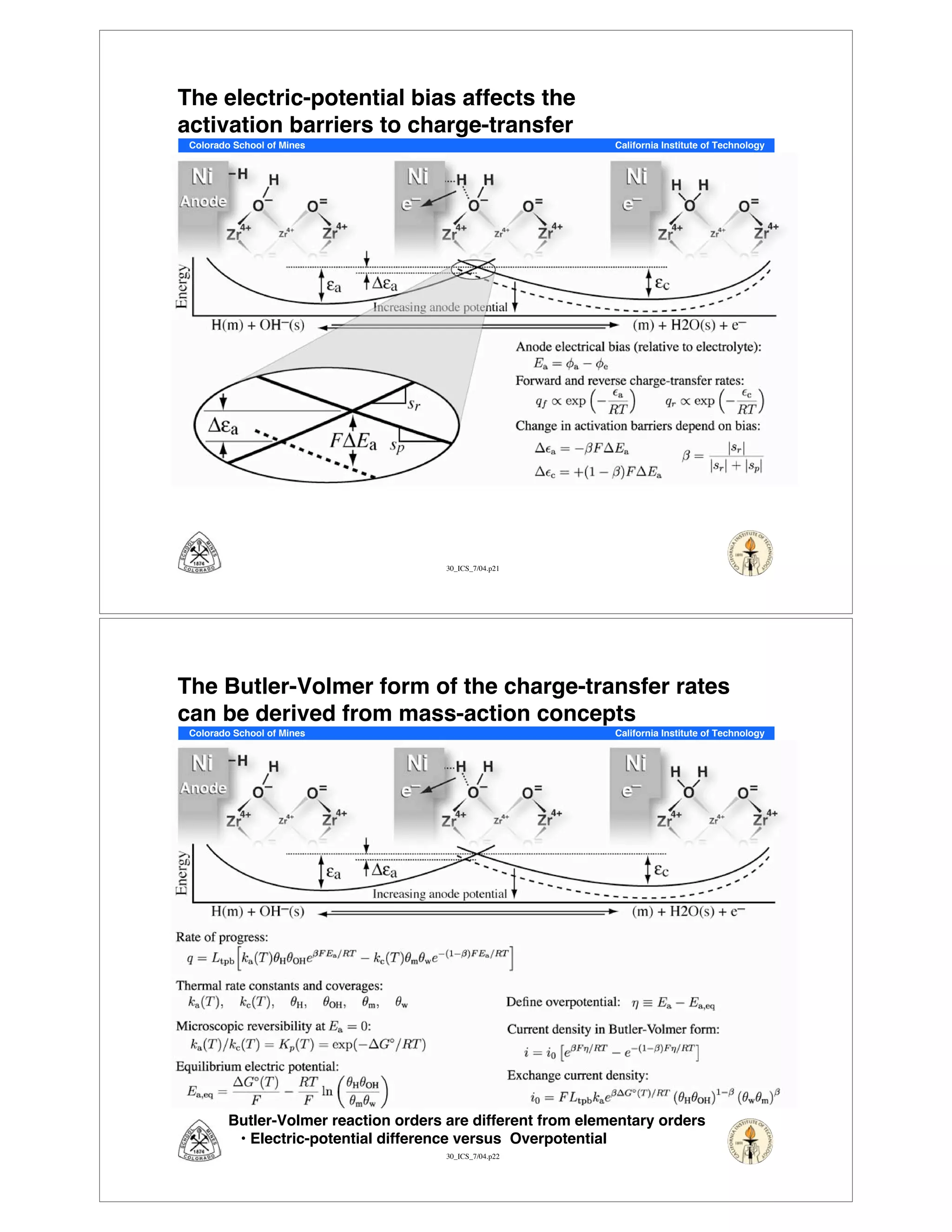
Activation overpotentials represent the chemical
energy needed to overcome charge-transfer barriers
30_ICS_7/04.p20
Colorado School of Mines California Institute of Technology
There is great uncertainty in the details of elementary
charge-transfer chemical reaction mechanisms
30_ICS_7/04.p21
Colorado School of Mines California Institute of Technology
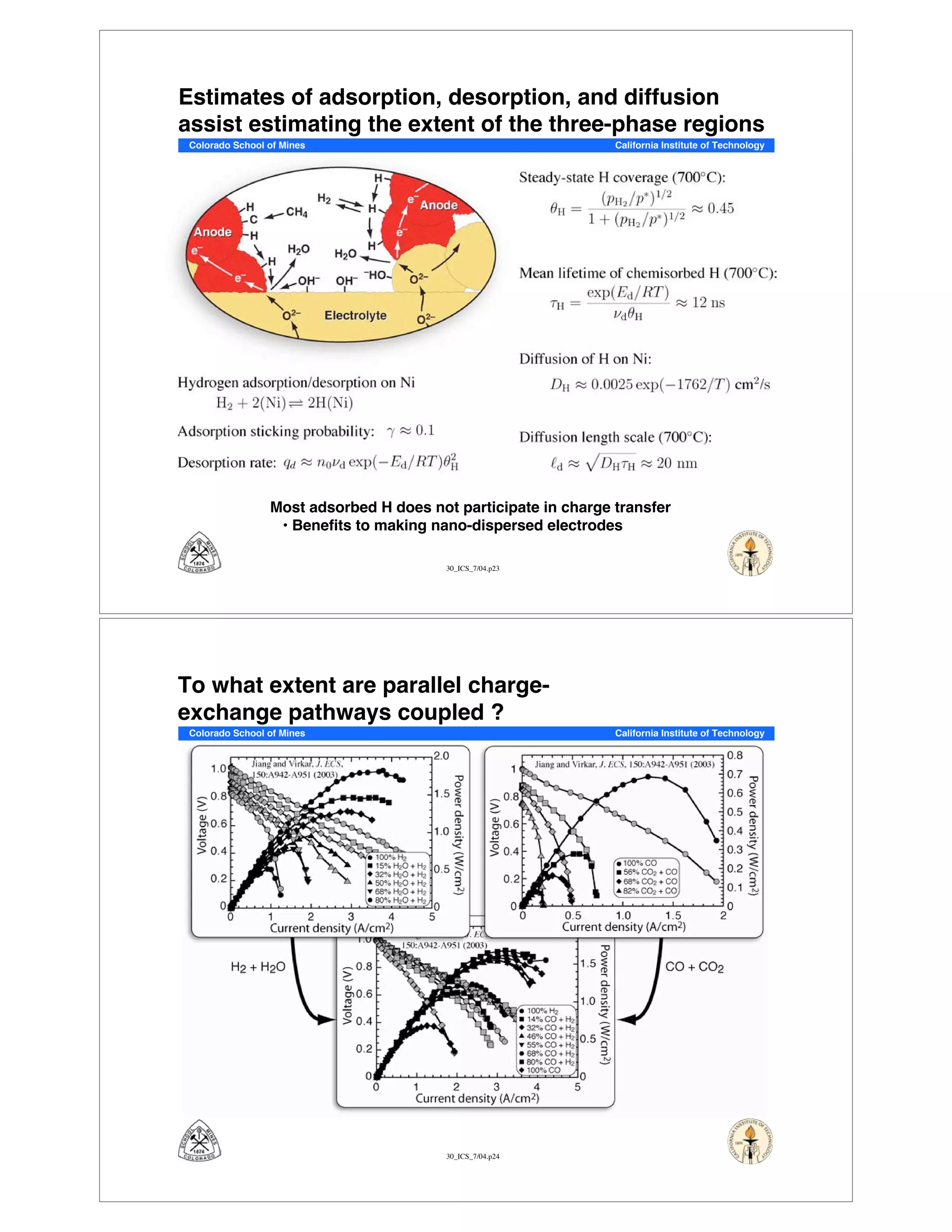
The electric-potential bias affects the
activation barriers to charge-transfer
30_ICS_7/04.p22
Colorado School of Mines California Institute of Technology
The Butler-Volmer form of the charge-transfer rates
can be derived from mass-action concepts
Butler-Volmer reaction orders are different from elementary orders
•!Electric-potential difference versus Overpotential
30_ICS_7/04.p23
Colorado School of Mines California Institute of Technology
Estimates of adsorption, desorption, and diffusion
assist estimating the extent of the three-phase regions
Most adsorbed H does not participate in charge transfer
• Benefits to making nano-dispersed electrodes
30_ICS_7/04.p24
Colorado School of Mines California Institute of Technology
To what extent are parallel charge-
exchange pathways coupled ?
30_ICS_7/04.p25
Colorado School of Mines California Institute of Technology
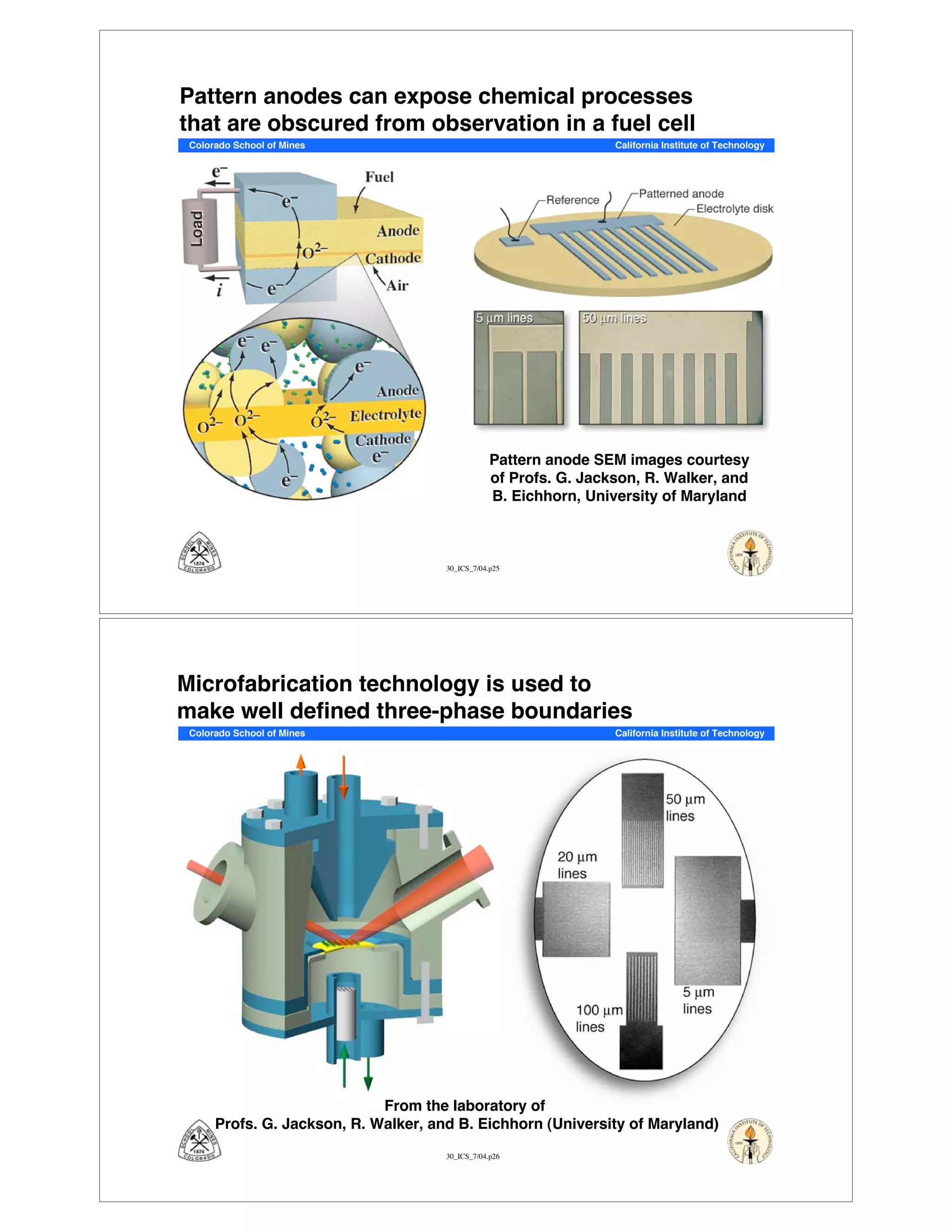
Pattern anodes can expose chemical processes
that are obscured from observation in a fuel cell
Pattern anode SEM images courtesy
of Profs. G. Jackson, R. Walker, and
B. Eichhorn, University of Maryland
30_ICS_7/04.p26
Colorado School of Mines California Institute of Technology
Microfabrication technology is used to
make well defined three-phase boundaries
From the laboratory of
Profs. G. Jackson, R. Walker, and B. Eichhorn (University of Maryland)
30_ICS_7/04.p27
Colorado School of Mines California Institute of Technology
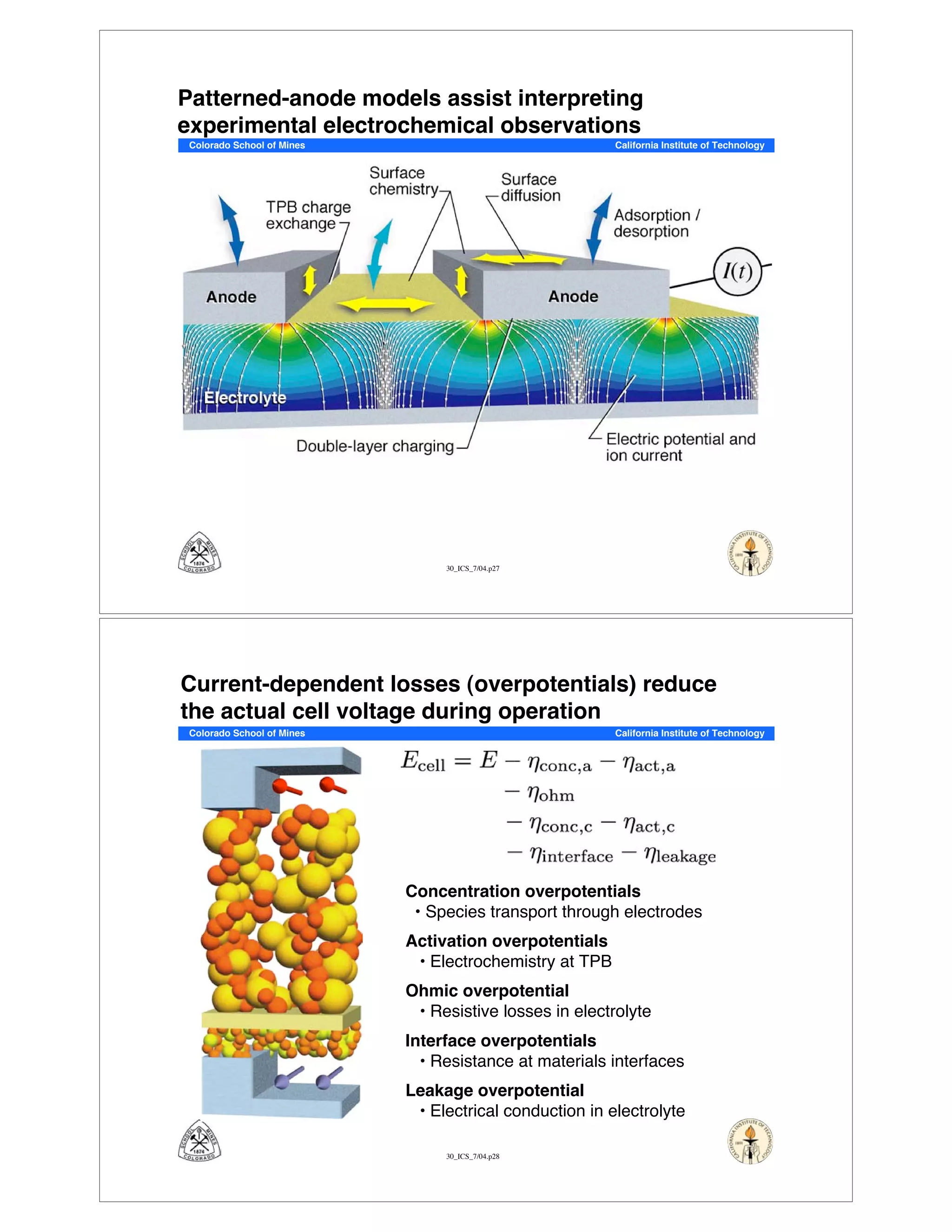
Patterned-anode models assist interpreting
experimental electrochemical observations
30_ICS_7/04.p28
Colorado School of Mines California Institute of Technology
Current-dependent losses (overpotentials) reduce
the actual cell voltage during operation
Concentration overpotentials
• Species transport through electrodes
Activation overpotentials
• Electrochemistry at TPB
Ohmic overpotential
• Resistive losses in electrolyte
Interface overpotentials
• Resistance at materials interfaces
Leakage overpotential
• Electrical conduction in electrolyte
30_ICS_7/04.p29
Colorado School of Mines California Institute of Technology
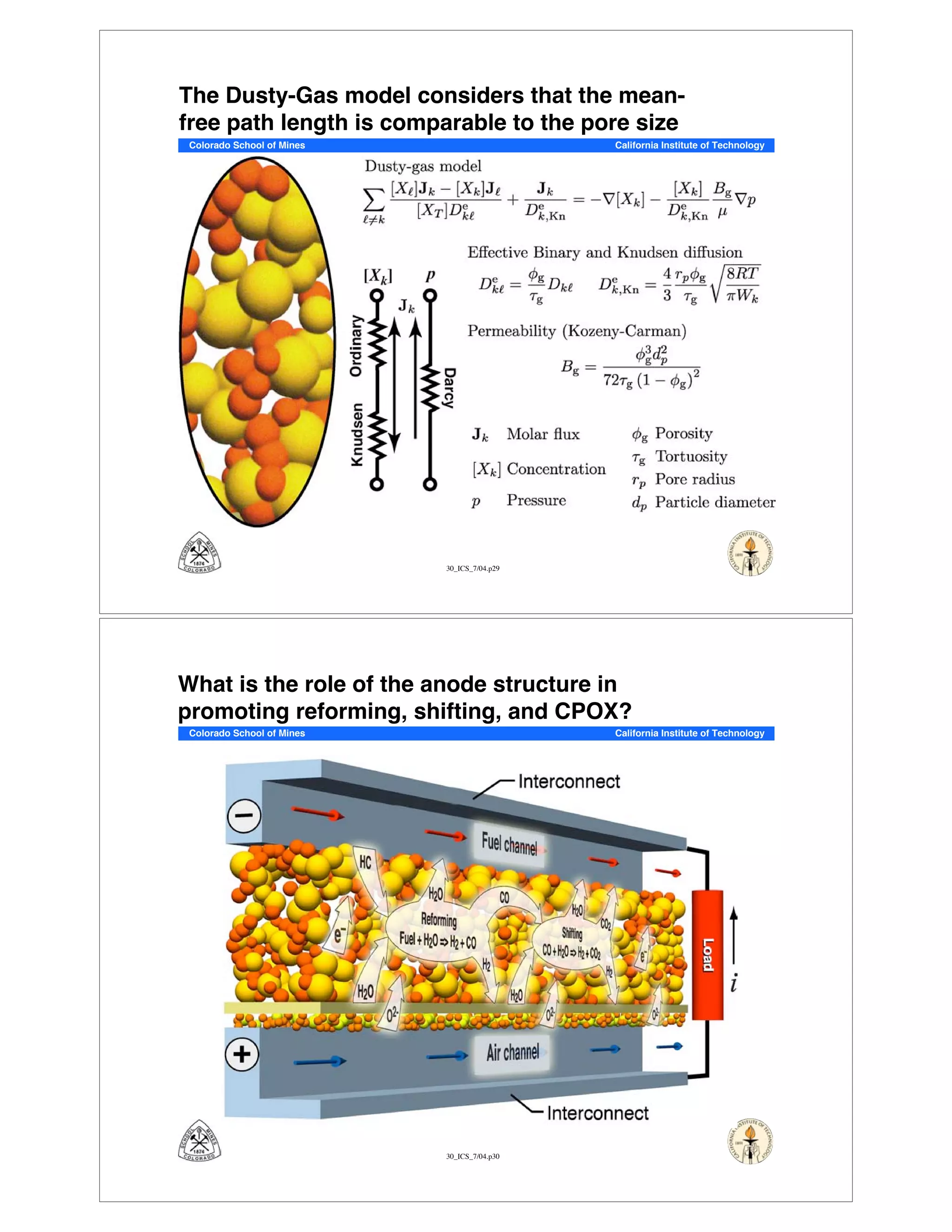
The Dusty-Gas model considers that the mean-
free path length is comparable to the pore size
30_ICS_7/04.p30
Colorado School of Mines California Institute of Technology
What is the role of the anode structure in
promoting reforming, shifting, and CPOX?
30_ICS_7/04.p31
Colorado School of Mines California Institute of Technology
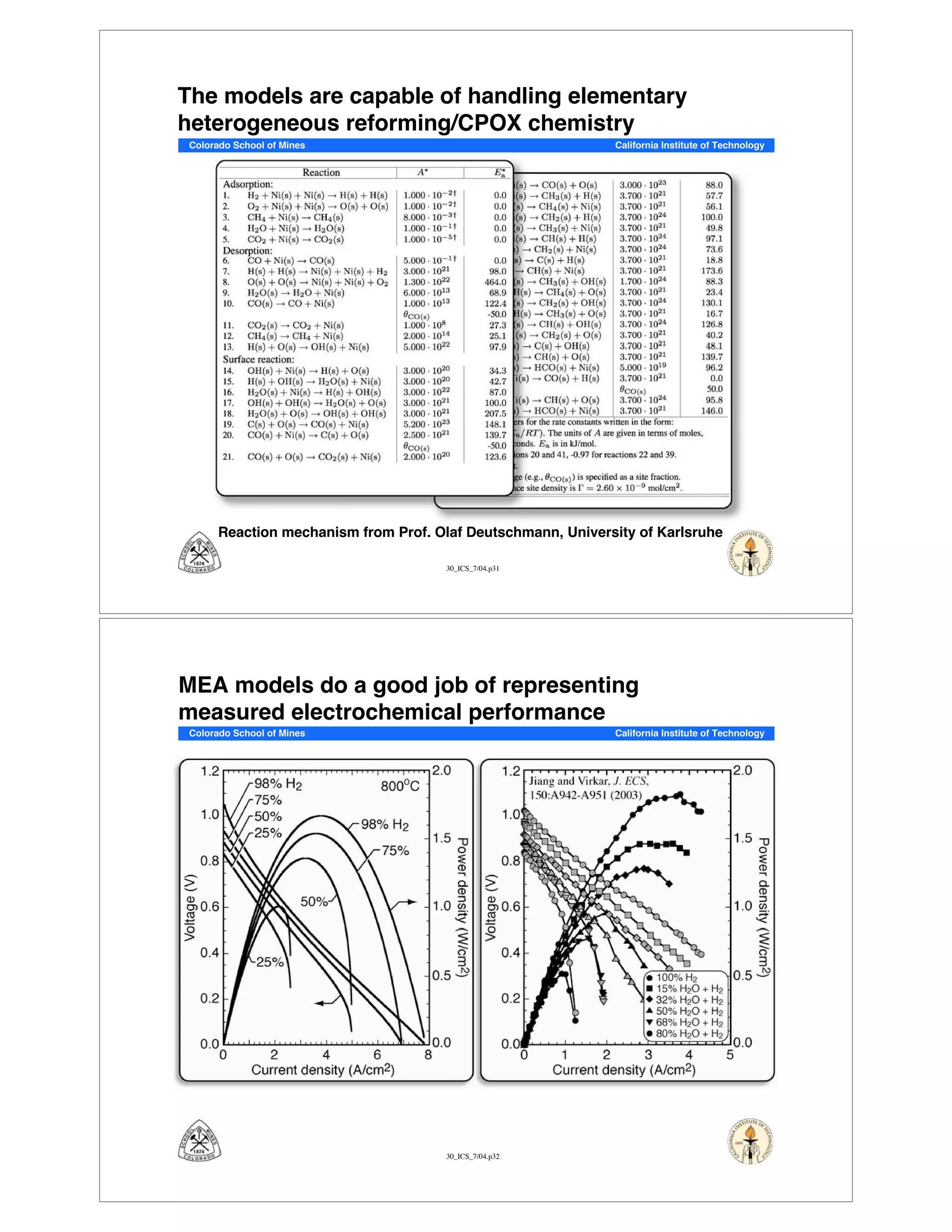
The models are capable of handling elementary
heterogeneous reforming/CPOX chemistry
Reaction mechanism from Prof. Olaf Deutschmann, University of Karlsruhe
30_ICS_7/04.p32
Colorado School of Mines California Institute of Technology
MEA models do a good job of representing
measured electrochemical performance
30_ICS_7/04.p33
Colorado School of Mines California Institute of Technology
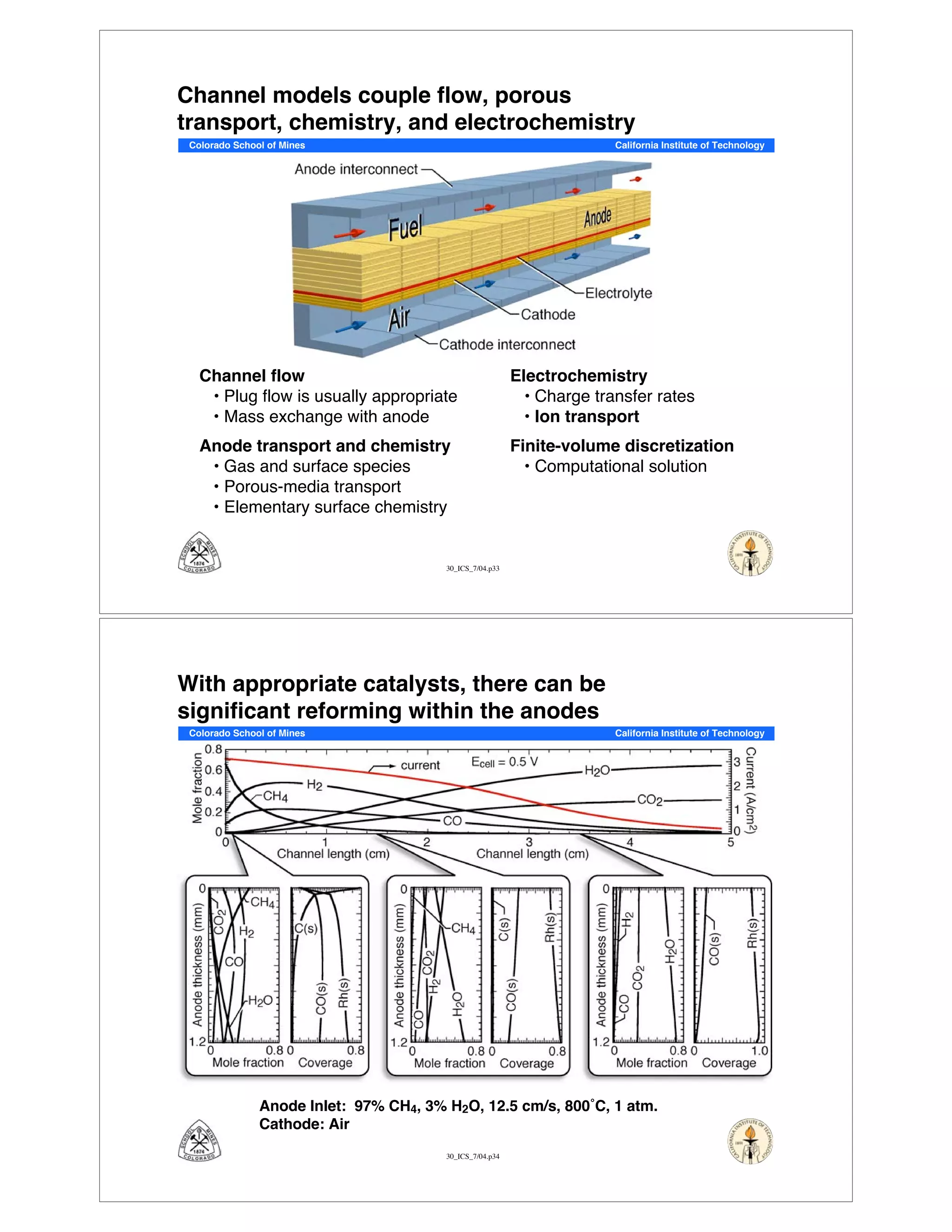
Channel models couple flow, porous
transport, chemistry, and electrochemistry
Channel flow
• Plug flow is usually appropriate
• Mass exchange with anode
Anode transport and chemistry
• Gas and surface species
• Porous-media transport
• Elementary surface chemistry
Electrochemistry
• Charge transfer rates
• Ion transport
Finite-volume discretization
• Computational solution
30_ICS_7/04.p34
Colorado School of Mines California Institute of Technology
With appropriate catalysts, there can be
significant reforming within the anodes
Anode lnlet: 97% CH4, 3% H2O, 12.5 cm/s, 800˚C, 1 atm.
Cathode: Air
30_ICS_7/04.p35
Colorado School of Mines California Institute of Technology
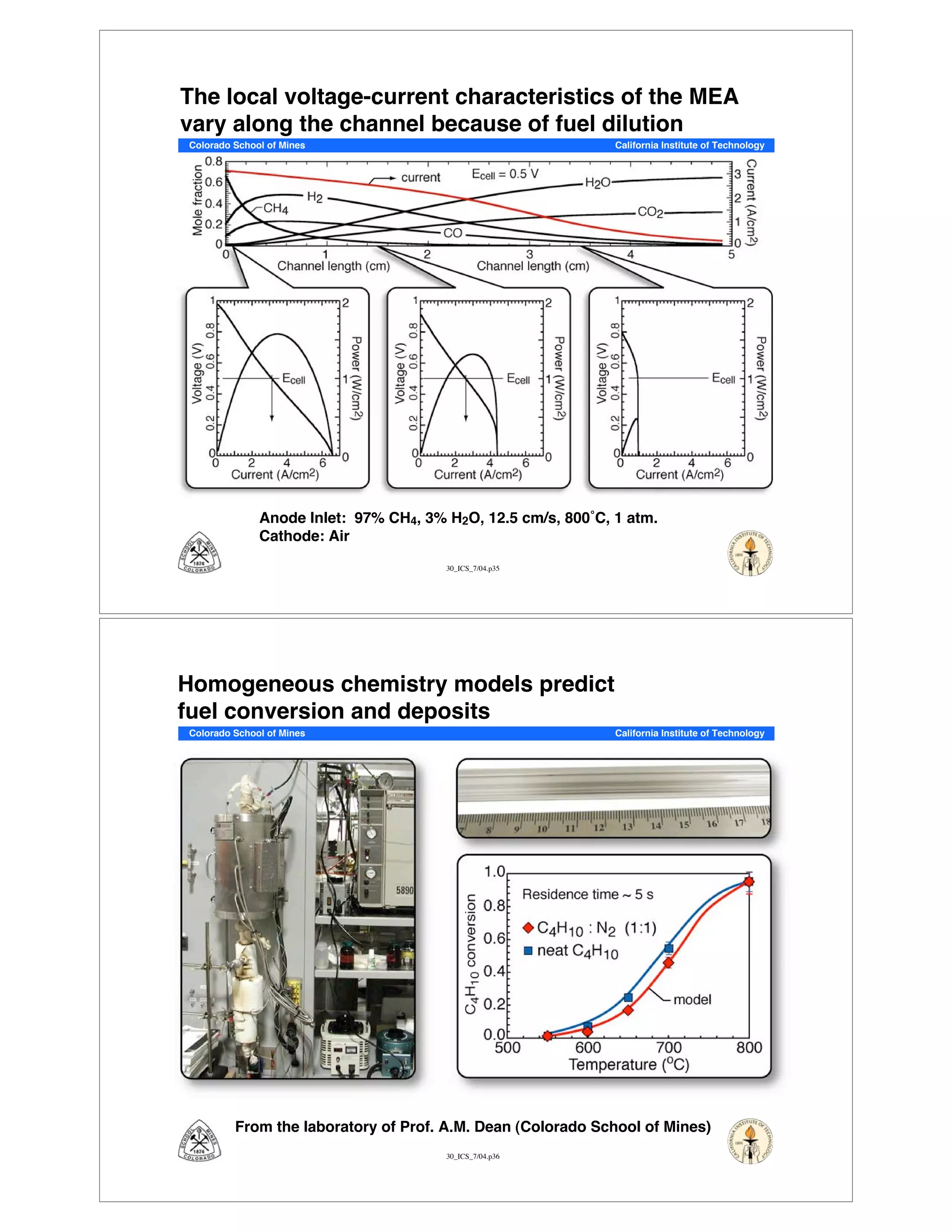
Anode lnlet: 97% CH4, 3% H2O, 12.5 cm/s, 800˚C, 1 atm.
Cathode: Air
The local voltage-current characteristics of the MEA
vary along the channel because of fuel dilution
30_ICS_7/04.p36
Colorado School of Mines California Institute of Technology
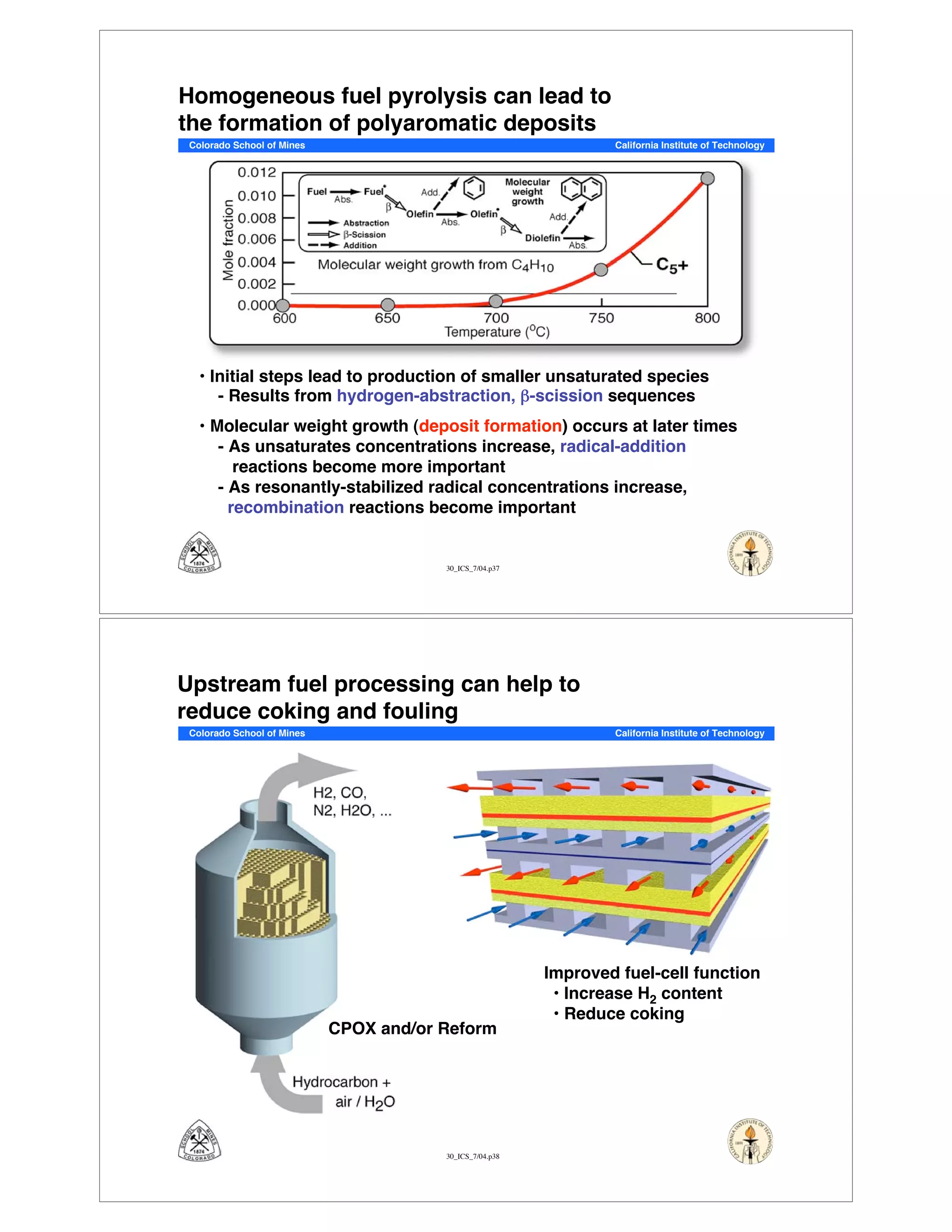
Homogeneous chemistry models predict
fuel conversion and deposits
From the laboratory of Prof. A.M. Dean (Colorado School of Mines)
30_ICS_7/04.p37
Colorado School of Mines California Institute of Technology
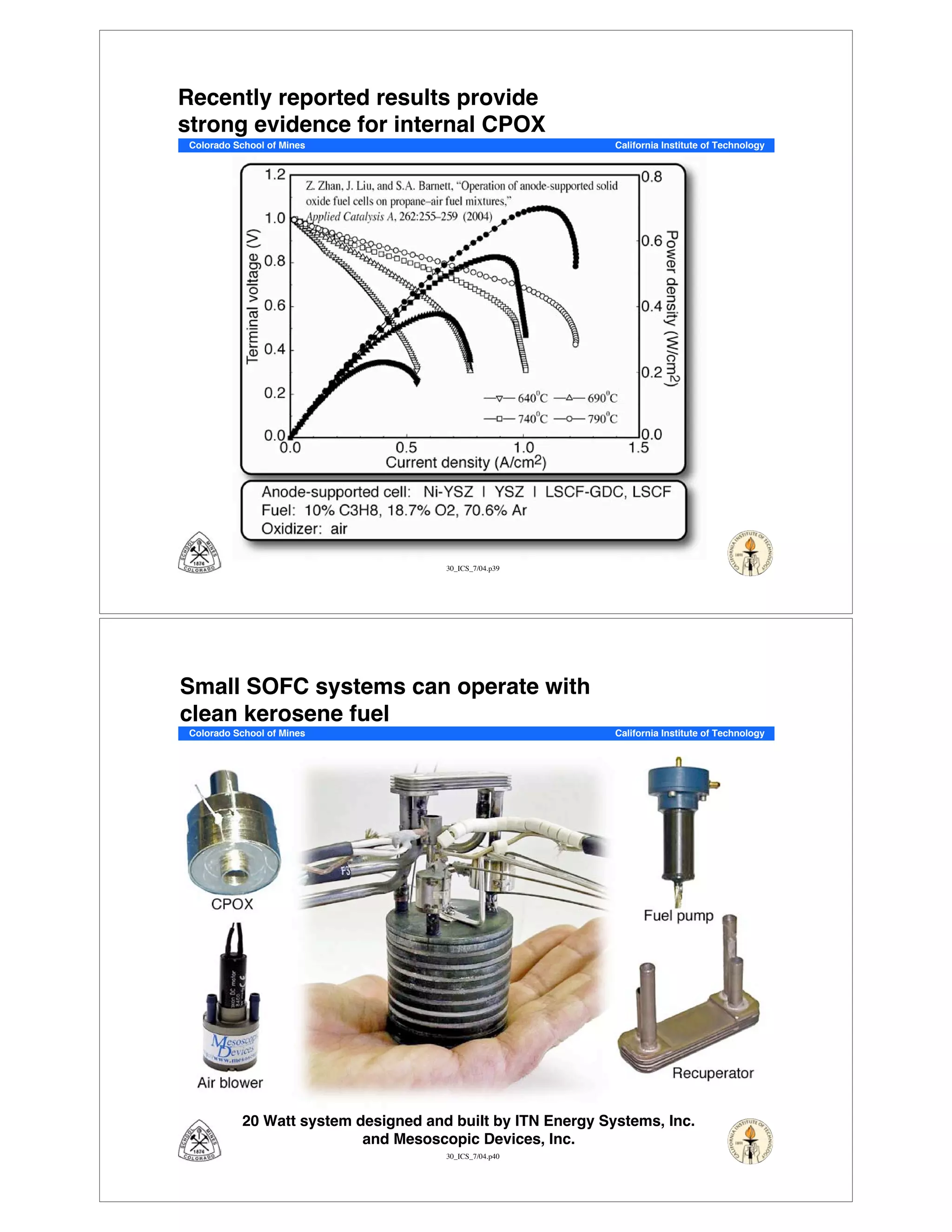
• Initial steps lead to production of smaller unsaturated species
- Results from hydrogen-abstraction, "-scission sequences
• Molecular weight growth (deposit formation) occurs at later times
- As unsaturates concentrations increase, radical-addition
reactions become more important
- As resonantly-stabilized radical concentrations increase,
recombination reactions become important
Homogeneous fuel pyrolysis can lead to
the formation of polyaromatic deposits
30_ICS_7/04.p38
Colorado School of Mines California Institute of Technology
Improved fuel-cell function
• Increase H2 content
• Reduce coking
Upstream fuel processing can help to
reduce coking and fouling
CPOX and/or Reform
30_ICS_7/04.p39
Colorado School of Mines California Institute of Technology
Recently reported results provide
strong evidence for internal CPOX
30_ICS_7/04.p40
Colorado School of Mines California Institute of Technology
Small SOFC systems can operate with
clean kerosene fuel
20 Watt system designed and built by ITN Energy Systems, Inc.
and Mesoscopic Devices, Inc.
30_ICS_7/04.p41
Colorado School of Mines California Institute of Technology
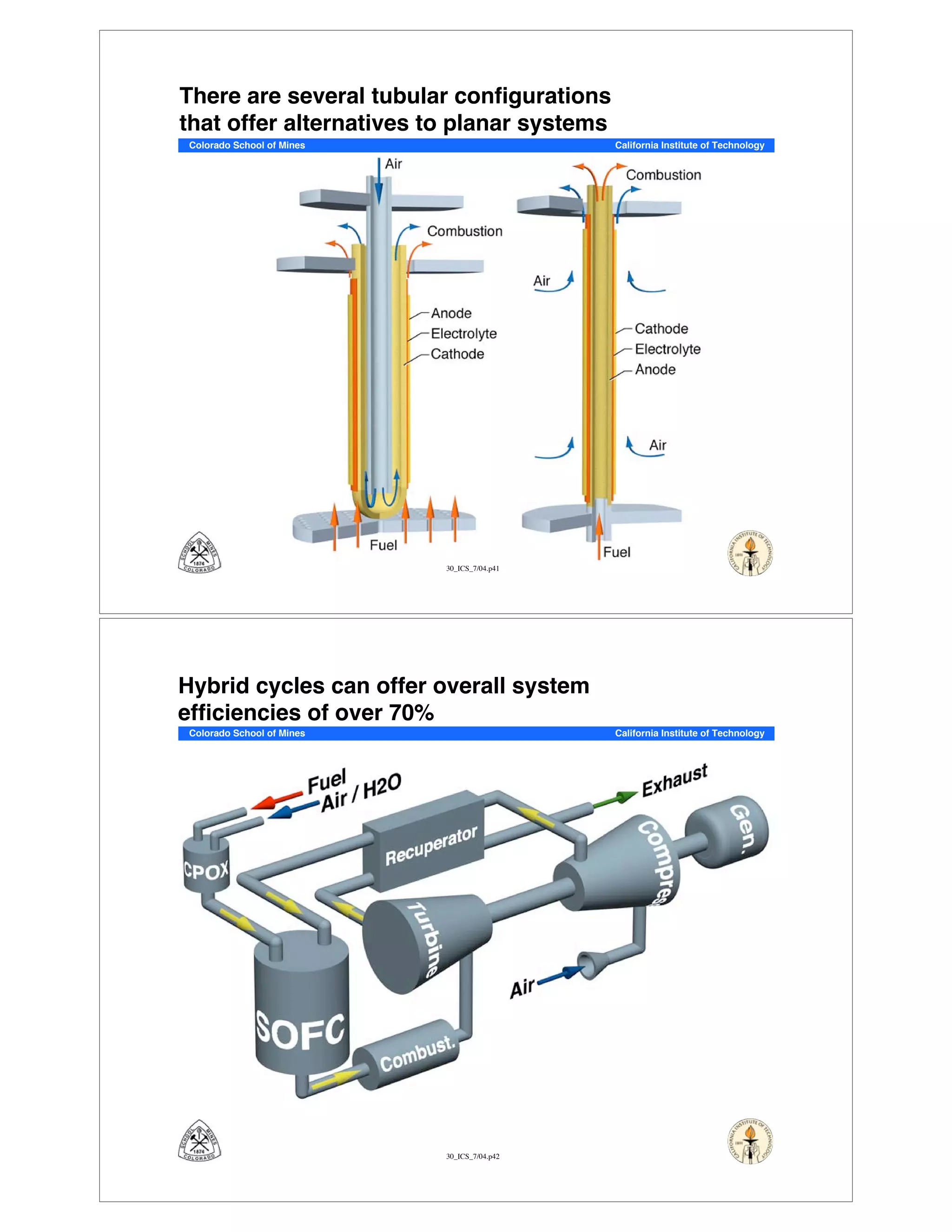
There are several tubular configurations
that offer alternatives to planar systems
30_ICS_7/04.p42
Colorado School of Mines California Institute of Technology
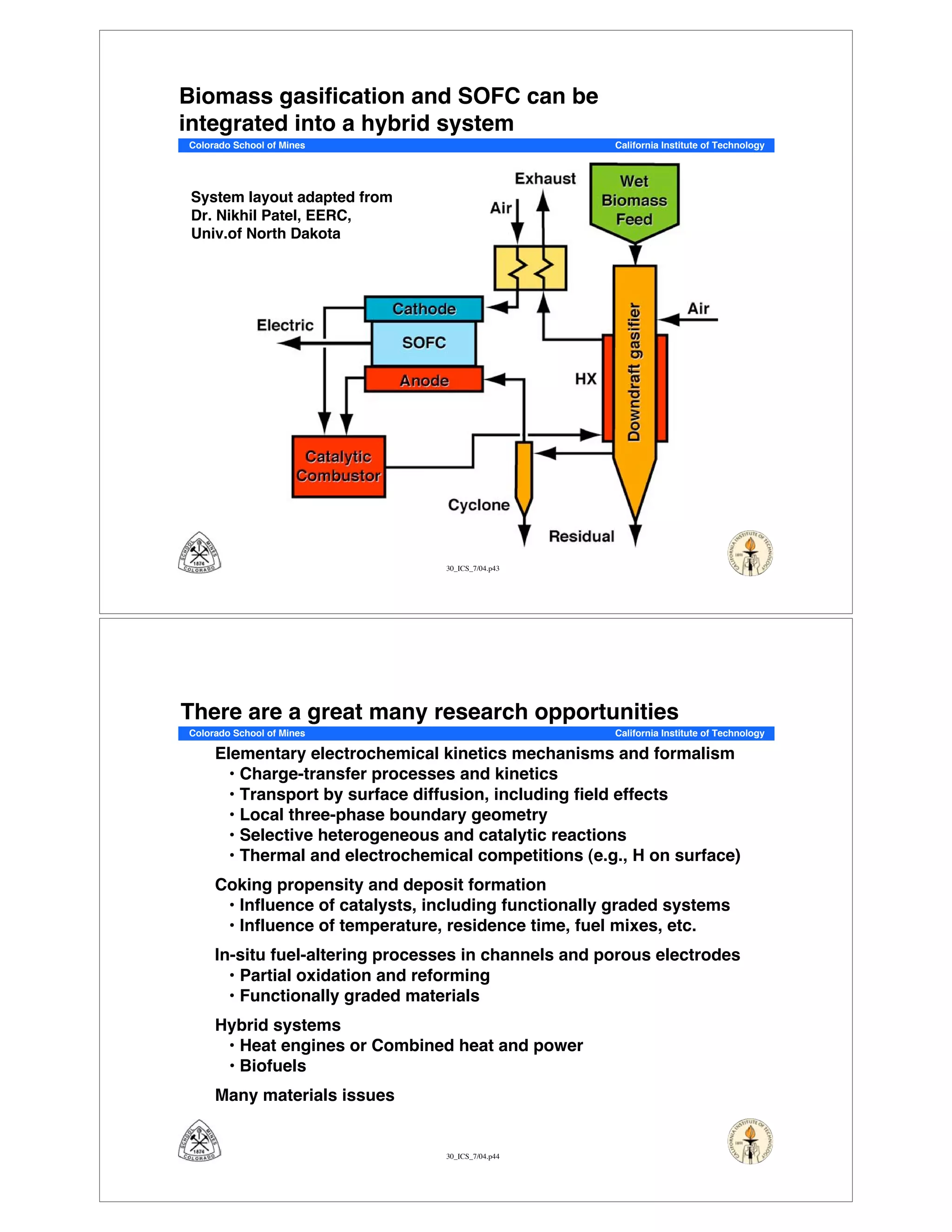
Hybrid cycles can offer overall system
efficiencies of over 70%
30_ICS_7/04.p43
Colorado School of Mines California Institute of Technology
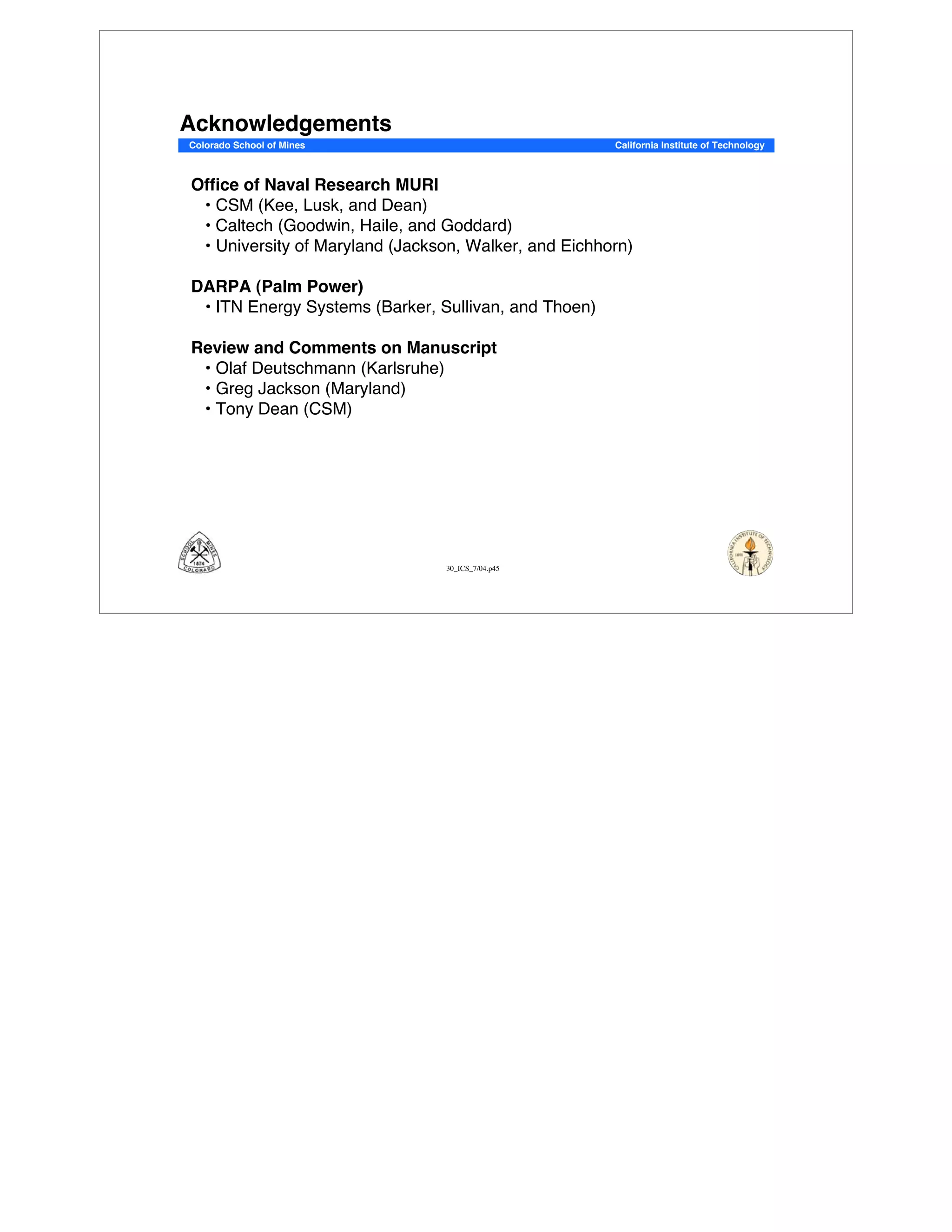
Biomass gasification and SOFC can be
integrated into a hybrid system
System layout adapted from
Dr. Nikhil Patel, EERC,
Univ.of North Dakota
30_ICS_7/04.p44
Colorado School of Mines California Institute of Technology
There are a great many research opportunities
Elementary electrochemical kinetics mechanisms and formalism
• Charge-transfer processes and kinetics
• Transport by surface diffusion, including field effects
• Local three-phase boundary geometry
• Selective heterogeneous and catalytic reactions
•!Thermal and electrochemical competitions (e.g., H on surface)
Coking propensity and deposit formation
• Influence of catalysts, including functionally graded systems
• Influence of temperature, residence time, fuel mixes, etc.
In-situ fuel-altering processes in channels and porous electrodes
• Partial oxidation and reforming
•!Functionally graded materials
Hybrid systems
• Heat engines or Combined heat and power
•!Biofuels
Many materials issues
30_ICS_7/04.p45
Colorado School of Mines California Institute of Technology
Acknowledgements
Office of Naval Research MURI
•!CSM (Kee, Lusk, and Dean)
• Caltech (Goodwin, Haile, and Goddard)
• University of Maryland (Jackson, Walker, and Eichhorn)
DARPA (Palm Power)
• ITN Energy Systems (Barker, Sullivan, and Thoen)
Review and Comments on Manuscript
• Olaf Deutschmann (Karlsruhe)
•!Greg Jackson (Maryland)
•!Tony Dean (CSM)

Fuel cell basics ppt

  • 1.
    30_ICS_7/04.p1 Colorado School ofMines California Institute of Technology Solid-oxide fuel cells (SOFC) with hydrocarbon and hydrocarbon-derived fuels Robert J. Kee and Huayang Zhu Engineering Division, Colorado School of Mines Golden, CO 80401, USA David G. Goodwin Engineering and Applied Science, California Institute of Technology Pasadena, CA 91125, USA rjkee@mines.edu (303) 273-3379 Presented: International Symposium on Combustion July 29, 2004 30_ICS_7/04.p2 Colorado School of Mines California Institute of Technology Direct-oxidation fuel cells offer a number of potentially important benefits
  • 2.
    30_ICS_7/04.p3 Colorado School ofMines California Institute of Technology There is important fuel-cell physics and chemistry spanning a great range of scales 30_ICS_7/04.p4 Colorado School of Mines California Institute of Technology General SOFC resources • “The Fuel Cell Handbook,” US Dept. of Energy, 6th Ed., DOE/NETL 2002/1179, available on the web, (2002). • Singhal and Kendall, “High-temperature SOFC,” Elsevier, (2003). • Minh and Takahashi, “Science and Technology of Ceramic Fuel Cells,” Elsevier, (1995). Seminal research on hydrocarbon-fueled SOFC • E. Perry Murray, T. Tsai, and S.A. Barnett, “A direct-methane fuel cell with a ceria-based anode,” Nature, 400:651-659 (1999) • S. Park, J.M. Vohs, and R.J. Gorte, “Direct oxidation of hydrocarbons in a solid-oxide fuel cell,” Nature, 404: 265-266 (2000) Broad areas of research and literature • Materials (electrolyte, electrodes, catalysts, interconnects, seals,…) • Membrane-electrode assemblies •!Fuel cell characterization and performance • Fundamental electrochemical processes • Systems and hybrid cycles There is an extensive and growing literature in fuel cells generally and SOFC particularly
  • 3.
    30_ICS_7/04.p5 Colorado School ofMines California Institute of Technology Solid-Oxide Fuel Cells enable direct electro- chemical oxidation (DECO) of hydrocarbons Planar architecture • Membrane-electrode assembly • Interconnect carries current • Stacked layers build voltage Electrolyte (e.g., YSZ) • Polycrystalline ceramic • O2- ion conductor • Electrical insulator • Impervious to gas flow Electrodes • Porous cermet composite • Anode supports MEA Interconnect •!High electrical conductivity • Maintains equal potential Flow channels • Formed in interconnect Characteristic dimension: 1 mm • Channel diameter • Anode thickness Characteristic temperature: 700˚C 30_ICS_7/04.p6 Colorado School of Mines California Institute of Technology Fuel-cell operation depends on coupled macroscopic and microscopic processes
  • 4.
    30_ICS_7/04.p7 Colorado School ofMines California Institute of Technology Proton Exchange Membrane (PEM) • Polymer electrolyte • Proton-conducting electrolyte • Low temperature (~100˚C) • Requires H2 fuel • CO is a poison • Needs good reforming/separation • Precious-metal catalysts • Low thermal inertia • Fairly mature Solid Oxide Fuel Cell (SOFC) • Ceramic electrolyte • Oxygen-ion conductor • High temperature (~700˚C) • Can use hydrocarbon fuel • CO is not a poison • May use reforming or CPOX • Inexpensive catalysts • Large thermal inertia • In development There are similarities and differences between PEM and SOFC technology PEM SOFC 30_ICS_7/04.p8 Colorado School of Mines California Institute of Technology Experiments to characterize and evaluate new material systems are often done with small “button cells” From the laboratory of Prof. Sossina Haile, Caltech
  • 5.
    30_ICS_7/04.p9 Colorado School ofMines California Institute of Technology Direct electrochemical oxidation has been demonstrated for a variety of fuels 30_ICS_7/04.p10 Colorado School of Mines California Institute of Technology A practical SOFC needs extensive three-phase boundaries to facilitate charge transfer
  • 6.
    30_ICS_7/04.p11 Colorado School ofMines California Institute of Technology There is a long and expanding set of materials that are being developed for fuel-cell applications Interconnect •!Metals (Fe-Cr alloys) • Ceramics (e.g., LaCrO3) Electrolyte • Yttria-stabilized zirconia, YSZ • Samarium doped ceria, SDC • Gadolinium doped ceria, GDC Cathode • Mixed ionic-electronic conductors - Doped (e.g., Sr) LaMnO3 , LSM - La1-xSrxCo1-yFeyO 3-!, LSCF • Cermets Anode • Cermets (e.g., Ni-YSZ, Ni-SDC) • Ceria-copper 30_ICS_7/04.p12 Colorado School of Mines California Institute of Technology Membrane-electrode assemblies (MEA) can be fabricated by tape-casting or extrusion technologies MEA fabricated by ITN energy Systems
  • 7.
    30_ICS_7/04.p13 Colorado School ofMines California Institute of Technology At equilibrium the electric potentials are related to the chemical potentials of the fuel and oxidizer streams 30_ICS_7/04.p14 Colorado School of Mines California Institute of Technology Reversible cell potential is determined entirely from thermodynamics of the gas streams
  • 8.
    30_ICS_7/04.p15 Colorado School ofMines California Institute of Technology The electrical potential of the cell depends on the fuel type and fuel dilution Assuming direct oxidation C4H10 + (13/2) O2 -> 5 H2O + 4 CO2 CH4 + 2 O2 -> 2 H2O + CO2 H2 + (1/2) O2 -> H2O 30_ICS_7/04.p16 Colorado School of Mines California Institute of Technology Irreversible losses, fuel depletion, and fuel utilization serve to reduce fuel-cell efficiency
  • 9.
    30_ICS_7/04.p17 Colorado School ofMines California Institute of Technology Cell performance depends on the chemical potential of fuel and oxidizer and on internal losses 30_ICS_7/04.p18 Colorado School of Mines California Institute of Technology The ohmic overpotential through the electrolyte depends greatly on temperature
  • 10.
    30_ICS_7/04.p19 Colorado School ofMines California Institute of Technology Activation overpotentials represent the chemical energy needed to overcome charge-transfer barriers 30_ICS_7/04.p20 Colorado School of Mines California Institute of Technology There is great uncertainty in the details of elementary charge-transfer chemical reaction mechanisms
  • 11.
    30_ICS_7/04.p21 Colorado School ofMines California Institute of Technology The electric-potential bias affects the activation barriers to charge-transfer 30_ICS_7/04.p22 Colorado School of Mines California Institute of Technology The Butler-Volmer form of the charge-transfer rates can be derived from mass-action concepts Butler-Volmer reaction orders are different from elementary orders •!Electric-potential difference versus Overpotential
  • 12.
    30_ICS_7/04.p23 Colorado School ofMines California Institute of Technology Estimates of adsorption, desorption, and diffusion assist estimating the extent of the three-phase regions Most adsorbed H does not participate in charge transfer • Benefits to making nano-dispersed electrodes 30_ICS_7/04.p24 Colorado School of Mines California Institute of Technology To what extent are parallel charge- exchange pathways coupled ?
  • 13.
    30_ICS_7/04.p25 Colorado School ofMines California Institute of Technology Pattern anodes can expose chemical processes that are obscured from observation in a fuel cell Pattern anode SEM images courtesy of Profs. G. Jackson, R. Walker, and B. Eichhorn, University of Maryland 30_ICS_7/04.p26 Colorado School of Mines California Institute of Technology Microfabrication technology is used to make well defined three-phase boundaries From the laboratory of Profs. G. Jackson, R. Walker, and B. Eichhorn (University of Maryland)
  • 14.
    30_ICS_7/04.p27 Colorado School ofMines California Institute of Technology Patterned-anode models assist interpreting experimental electrochemical observations 30_ICS_7/04.p28 Colorado School of Mines California Institute of Technology Current-dependent losses (overpotentials) reduce the actual cell voltage during operation Concentration overpotentials • Species transport through electrodes Activation overpotentials • Electrochemistry at TPB Ohmic overpotential • Resistive losses in electrolyte Interface overpotentials • Resistance at materials interfaces Leakage overpotential • Electrical conduction in electrolyte
  • 15.
    30_ICS_7/04.p29 Colorado School ofMines California Institute of Technology The Dusty-Gas model considers that the mean- free path length is comparable to the pore size 30_ICS_7/04.p30 Colorado School of Mines California Institute of Technology What is the role of the anode structure in promoting reforming, shifting, and CPOX?
  • 16.
    30_ICS_7/04.p31 Colorado School ofMines California Institute of Technology The models are capable of handling elementary heterogeneous reforming/CPOX chemistry Reaction mechanism from Prof. Olaf Deutschmann, University of Karlsruhe 30_ICS_7/04.p32 Colorado School of Mines California Institute of Technology MEA models do a good job of representing measured electrochemical performance
  • 17.
    30_ICS_7/04.p33 Colorado School ofMines California Institute of Technology Channel models couple flow, porous transport, chemistry, and electrochemistry Channel flow • Plug flow is usually appropriate • Mass exchange with anode Anode transport and chemistry • Gas and surface species • Porous-media transport • Elementary surface chemistry Electrochemistry • Charge transfer rates • Ion transport Finite-volume discretization • Computational solution 30_ICS_7/04.p34 Colorado School of Mines California Institute of Technology With appropriate catalysts, there can be significant reforming within the anodes Anode lnlet: 97% CH4, 3% H2O, 12.5 cm/s, 800˚C, 1 atm. Cathode: Air
  • 18.
    30_ICS_7/04.p35 Colorado School ofMines California Institute of Technology Anode lnlet: 97% CH4, 3% H2O, 12.5 cm/s, 800˚C, 1 atm. Cathode: Air The local voltage-current characteristics of the MEA vary along the channel because of fuel dilution 30_ICS_7/04.p36 Colorado School of Mines California Institute of Technology Homogeneous chemistry models predict fuel conversion and deposits From the laboratory of Prof. A.M. Dean (Colorado School of Mines)
  • 19.
    30_ICS_7/04.p37 Colorado School ofMines California Institute of Technology • Initial steps lead to production of smaller unsaturated species - Results from hydrogen-abstraction, "-scission sequences • Molecular weight growth (deposit formation) occurs at later times - As unsaturates concentrations increase, radical-addition reactions become more important - As resonantly-stabilized radical concentrations increase, recombination reactions become important Homogeneous fuel pyrolysis can lead to the formation of polyaromatic deposits 30_ICS_7/04.p38 Colorado School of Mines California Institute of Technology Improved fuel-cell function • Increase H2 content • Reduce coking Upstream fuel processing can help to reduce coking and fouling CPOX and/or Reform
  • 20.
    30_ICS_7/04.p39 Colorado School ofMines California Institute of Technology Recently reported results provide strong evidence for internal CPOX 30_ICS_7/04.p40 Colorado School of Mines California Institute of Technology Small SOFC systems can operate with clean kerosene fuel 20 Watt system designed and built by ITN Energy Systems, Inc. and Mesoscopic Devices, Inc.
  • 21.
    30_ICS_7/04.p41 Colorado School ofMines California Institute of Technology There are several tubular configurations that offer alternatives to planar systems 30_ICS_7/04.p42 Colorado School of Mines California Institute of Technology Hybrid cycles can offer overall system efficiencies of over 70%
  • 22.
    30_ICS_7/04.p43 Colorado School ofMines California Institute of Technology Biomass gasification and SOFC can be integrated into a hybrid system System layout adapted from Dr. Nikhil Patel, EERC, Univ.of North Dakota 30_ICS_7/04.p44 Colorado School of Mines California Institute of Technology There are a great many research opportunities Elementary electrochemical kinetics mechanisms and formalism • Charge-transfer processes and kinetics • Transport by surface diffusion, including field effects • Local three-phase boundary geometry • Selective heterogeneous and catalytic reactions •!Thermal and electrochemical competitions (e.g., H on surface) Coking propensity and deposit formation • Influence of catalysts, including functionally graded systems • Influence of temperature, residence time, fuel mixes, etc. In-situ fuel-altering processes in channels and porous electrodes • Partial oxidation and reforming •!Functionally graded materials Hybrid systems • Heat engines or Combined heat and power •!Biofuels Many materials issues
  • 23.
    30_ICS_7/04.p45 Colorado School ofMines California Institute of Technology Acknowledgements Office of Naval Research MURI •!CSM (Kee, Lusk, and Dean) • Caltech (Goodwin, Haile, and Goddard) • University of Maryland (Jackson, Walker, and Eichhorn) DARPA (Palm Power) • ITN Energy Systems (Barker, Sullivan, and Thoen) Review and Comments on Manuscript • Olaf Deutschmann (Karlsruhe) •!Greg Jackson (Maryland) •!Tony Dean (CSM)