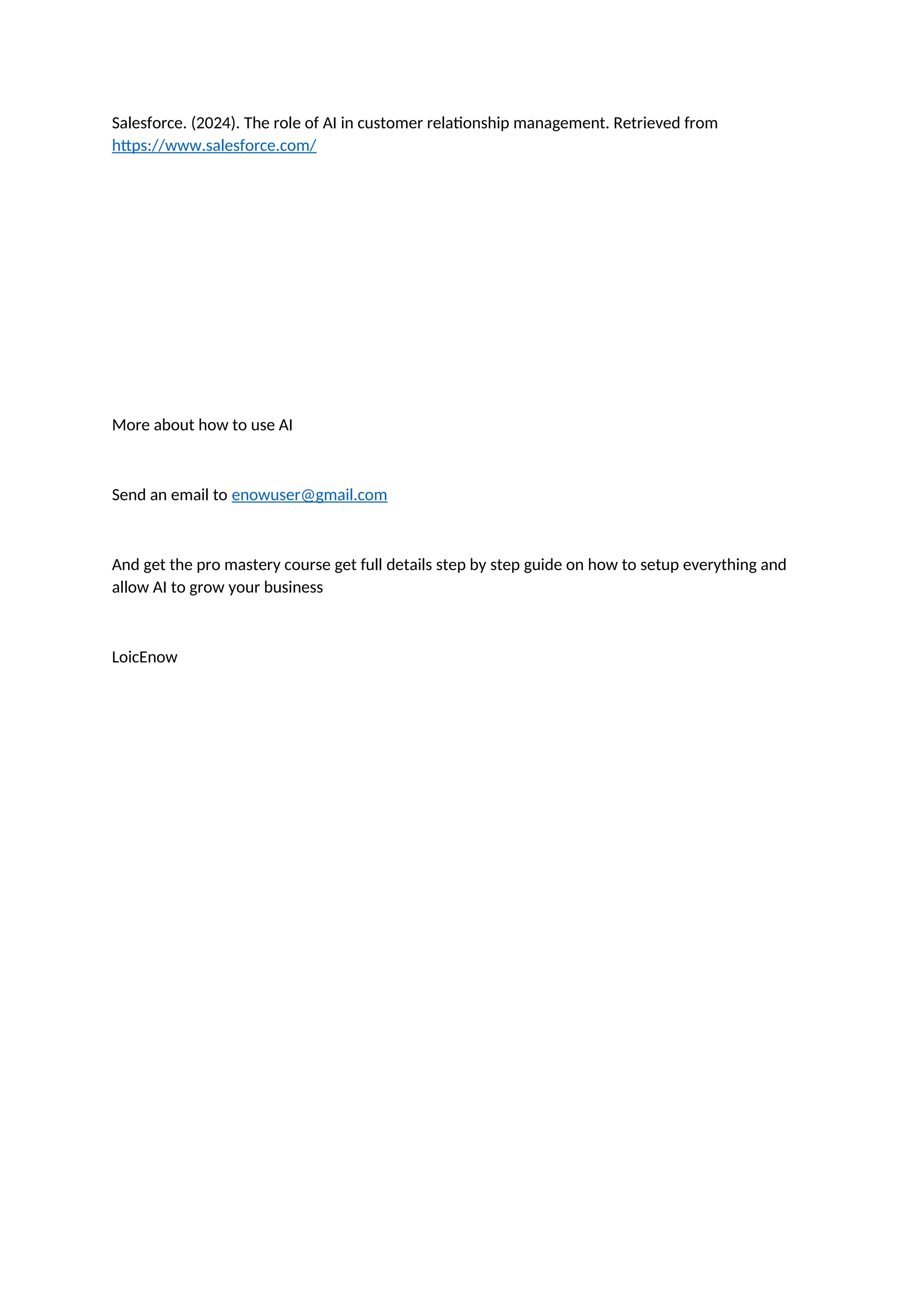
“AI Automation Mastery: How to Automate Your Business & Life for Maximum
Productivity”
Outline:
Chapter 1: The AI Automation Revolution
What is AI automation?
How businesses and individuals use AI to save time and money
Chapter 2: AI Tools for Automation
Best AI tools for business, marketing, and personal productivity
How to choose the right AI automation tools
Chapter 3: AI in Business & Marketing
How AI automates customer support (chatbots, email responses)
AI-powered content creation for blogs, videos, and social media
Automating email marketing with AI
Chapter 4: AI in Productivity & Time Management
How to use AI for scheduling and task automation
AI-powered note-taking and knowledge management
Chapter 5: AI for E-Commerce & Dropshipping
How AI automates product research and customer service
Using AI for sales forecasting and pricing optimization
Chapter 6: AI in Finance & Investing
AI-driven stock trading and crypto automation
How to automate budgeting and personal finance
Chapter 7: The Future of AI Automation
How AI will continue to evolve
How to stay ahead and leverage ai for success
Chapter 1: The AI Automation Revolution
Introduction
Artificial Intelligence (AI) is no longer just a futuristic concept—it’s transforming the way we work,
live, and do business today. From automating repetitive tasks to making intelligent decisions, AI-
powered automation is reshaping industries and increasing productivity at an unprecedented rate.
Whether you’re an entrepreneur, a freelancer, or a business owner, harnessing AI automation can
help you save time, reduce costs, and scale your operations effortlessly.
In this chapter, we will explore what AI automation is, how it works, and why it is revolutionizing the
way we do business and manage daily tasks.
What is AI Automation?
AI automation is the use of artificial intelligence to perform tasks and processes without human
intervention. It goes beyond traditional automation by enabling systems to learn, adapt, and make
data-driven decisions.
Traditional Automation vs. AI Automation
Traditional Automation: Follows predefined rules and scripts (e.g., automated emails, basic
chatbots).
AI Automation: Uses machine learning and natural language processing (NLP) to analyze data, make
predictions, and optimize workflows dynamically (e.g., AI-powered chatbots, smart assistants).
Key Features of AI Automation
✅ Self-learning – AI adapts to new data over time.
✅ Decision-making – AI analyzes patterns and makes intelligent choices.
✅ Task automation – AI handles repetitive, time-consuming tasks.
✅ Personalization – AI tailors content and experiences based on user behavior.
How Businesses and Individuals Use AI to Save Time and Money
AI automation is already integrated into many industries, helping both businesses and individuals
work more efficiently.
1. AI in Business & Marketing
AI-Powered Customer Support: Chatbots like ChatGPT, Jasper, and Drift handle customer inquiries
24/7, reducing the need for human agents.
Automated Content Creation: AI tools like Copy.ai and Writesonic generate blog posts, ad copy, and
email sequences in seconds.
Personalized Marketing: AI analyzes customer behavior to send targeted promotions, increasing
engagement and sales.
2. AI in Productivity & Task Management
Smart Scheduling: AI tools like Motion and Reclaim AI automatically organize calendars, schedule
meetings, and optimize daily workflows.
Automated Note-Taking: Apps like Otter.ai transcribe meetings and summarize important points
using AI.
AI-Powered To-Do Lists: AI assistants like Todoist and Notion suggest and prioritize tasks based on
deadlines and workload.
3. AI in Finance & Investing
AI Trading Bots: Automated trading platforms like Trade Ideas and Pionex analyze market trends and
execute trades for investors.
Smart Budgeting Apps: Tools like Cleo and YNAB use AI to track expenses and offer personalized
financial advice.
4. AI in E-Commerce & Dropshipping
AI Product Research: Platforms like Sell The Trend and Helium 10 use AI to find trending products
with high-profit potential.
Automated Customer Service: AI-powered chatbots handle returns, order tracking, and FAQs,
reducing workload for e-commerce owners.
5. AI in Personal Life
Voice Assistants: AI-powered assistants like Alexa, Siri, and Google Assistant help with daily tasks,
from setting reminders to playing music.
AI Health & Fitness Apps: Tools like MyFitnessPal and Fitbod use AI to create personalized diet and
workout plans.
Why AI Automation is the Future
The demand for AI automation is skyrocketing as businesses and individuals realize its potential.
Here’s why AI automation is shaping the future:
1. Saves Time & Boosts Productivity
AI eliminates repetitive tasks, allowing people to focus on higher-value activities. For example,
businesses that use AI chatbots can save 30-50% of customer service costs.
2. Reduces Costs & Increases Profitability
AI-powered automation reduces the need for large workforces, cutting operational costs while
increasing efficiency.
3. Enhances Customer Experience
AI personalization improves customer interactions, leading to higher satisfaction and retention rates.
4. Creates New Opportunities
AI automation isn’t just replacing jobs—it’s creating new ones. Entrepreneurs and businesses can
leverage AI to offer innovative products and services.
Chapter 2: AI Tools for Automation
Introduction
With AI rapidly evolving, a wide range of automation tools have emerged to help businesses and
individuals streamline tasks, boost efficiency, and save time. Whether you’re an entrepreneur,
freelancer, or corporate professional, using the right AI-powered tools can transform the way you
work and scale your productivity.
In this chapter, we’ll explore the best AI automation tools across different categories, including
business, marketing, content creation, finance, and personal productivity.
1. AI Tools for Business & Workflow Automation
Businesses can automate repetitive tasks, improve customer service, and optimize operations using
AI tools.
a) AI-Powered Chatbots & Virtual Assistants
These tools help businesses automate customer service, lead generation, and even sales.
✅ ChatGPT – AI-powered chatbot for customer support, content creation, and automation.
✅ Drift – A chatbot that helps businesses qualify leads and engage website visitors.
✅ ManyChat – Automates conversations on Messenger, WhatsApp, and Instagram.
b) AI Task & Workflow Automation
These tools help automate business processes, freeing up time for high-value tasks.
✅ Zapier – Connects apps and automates workflows without coding.
✅ Make (formerly Integromat) – Automates complex business workflows with AI-driven integrations.
✅ UiPath – A powerful AI-driven robotic process automation (RPA) tool for businesses.
2. AI Tools for Marketing & Sales Automation
AI can help businesses increase conversions, automate campaigns, and personalize customer
interactions.
a) AI-Powered Email Marketing
✅ ActiveCampaign – Uses AI to send personalized emails based on customer behavior.
✅ GetResponse – AI-powered email and funnel automation tool for businesses.
✅ HubSpot – AI-driven CRM with automated marketing and sales tools.
b) AI-Powered Copywriting & Content Creation
✅ Jasper AI – Generates blog posts, sales copy, and marketing content.
✅ Copy.ai – Creates persuasive ads, product descriptions, and emails using AI.
✅ Writesonic – AI-powered tool for writing articles, ad copies, and SEO content.
c) AI Social Media Management
✅ Lately AI – Uses AI to generate social media posts from long-form content.
✅ Ocoya – AI-powered platform for automating social media content creation.
✅ Predis.ai – AI tool that generates images, captions, and hashtags for social media.
3. AI Tools for Content Creation & Video Automation
AI is revolutionizing content creation, making it faster and more accessible.
a) AI Video Creation & Editing
✅ Pictory – AI-powered tool for turning blog posts into engaging videos.
✅ Synthesia – AI avatar-based video creation for business and marketing.
✅ Descript – AI-powered video and podcast editing tool with text-based editing.
b) AI Graphic Design & Image Generation
✅ Canva (AI Features) – AI-powered design templates and image generation.
✅ DALL·E 3 – AI-generated art and image creation.
✅ Runway ML – AI-powered visual content creation for designers and video editors.
4. AI Tools for Finance & Investing Automation
AI is transforming finance by automating investing, budgeting, and financial analysis.
a) AI-Powered Investing & Trading
✅ Trade Ideas – AI-driven stock trading and analysis platform.
✅ Pionex – Automated AI crypto trading bot for passive income.
✅ Zignaly – AI-driven trading bot that follows expert strategies.
b) AI for Personal Finance & Budgeting
✅ Cleo – AI-powered budgeting assistant that tracks spending and saves money.
✅ YNAB (You Need A Budget) – AI-driven budgeting app to help manage expenses.
✅ Trim – AI financial assistant that negotiates bills and tracks spending.
5. AI Tools for Personal Productivity & Time Management
AI-powered productivity tools help automate daily tasks and optimize workflows.
a) AI Note-Taking & Knowledge Management
✅ Notion AI – AI-powered writing assistant and knowledge organization tool.
✅ Otter.ai – AI tool for transcribing meetings and summarizing conversations.
✅ Mem AI – AI-powered note-taking tool that automatically organizes your thoughts.
b) AI Scheduling & Calendar Automation
✅ Motion – AI-driven calendar and task manager for productivity.
✅ Reclaim AI – AI-powered scheduling tool that optimizes daily tasks.
✅ Clockwise – AI tool that automatically rearranges your calendar to maximize focus time.
Conclusion
The AI automation revolution is already here, and leveraging the right tools can help you work
smarter, not harder. From marketing and sales automation to AI-powered content creation, finance,
and personal productivity, AI is transforming how we manage our businesses and daily lives.
Next Steps:
In the next chapter, we’ll dive into AI in Business & Marketing, where you’ll learn how to automate
customer
Chapter 3: AI in Business & Marketing
Introduction
Artificial intelligence is reshaping the landscape of business and marketing, providing companies
with innovative tools to automate customer interactions, optimize campaigns, and drive higher
levels of engagement and sales. AI-powered solutions enable businesses to scale efficiently and
remain competitive in a fast-evolving marketplace.
In this chapter, we will explore how AI can revolutionize your business operations and marketing
strategies, from automating customer support to creating personalized experiences for your
audience.
1. AI in Customer Service & Support
Customer service is one of the most vital aspects of any business, and AI is dramatically enhancing
how businesses interact with their customers. AI tools like chatbots and virtual assistants enable
businesses to provide fast, round-the-clock support while reducing costs and enhancing the
customer experience.
a) AI Chatbots for Customer Support
AI chatbots can instantly answer customer inquiries, process orders, resolve issues, and even
recommend products based on customer preferences. By automating these interactions, businesses
can provide immediate assistance, improving customer satisfaction and retention.
Popular AI Chatbot Tools:
✅ Drift – AI chatbot that engages customers, qualifies leads, and schedules meetings.
✅ Intercom – Combines AI with human support to offer personalized conversations.
✅ Zendesk – Uses AI to automate responses, manage tickets, and improve customer service
workflows.
b) AI-Powered Virtual Assistants
AI-powered virtual assistants, such as ChatGPT and Google Assistant, are able to handle complex
customer queries and perform tasks ranging from order tracking to troubleshooting product issues.
These assistants reduce the need for human intervention and streamline service delivery.
Popular AI Virtual Assistant Tools:
✅ Ada – Automates customer service workflows by handling repetitive inquiries and providing
personalized responses.
✅ LivePerson – AI chatbot for businesses with advanced natural language processing (NLP)
capabilities.
✅ ManyChat – Automates Facebook Messenger interactions for marketing, customer service, and
sales.
2. AI in Marketing Automation
AI has transformed how businesses approach marketing by allowing for more personalized, efficient,
and data-driven campaigns. AI tools enable businesses to segment their audience, create tailored
content, and optimize campaigns for maximum impact.
a) AI-Powered Email Marketing
AI can improve the effectiveness of email marketing campaigns by predicting customer behavior,
personalizing content, and optimizing send times. These tools help businesses engage with their
customers in a more meaningful way, resulting in higher open rates and conversions.
AI Email Marketing Tools:
✅ ActiveCampaign – Uses AI to send personalized emails based on past customer behavior.
✅ ConvertKit – AI-powered email automation that targets the right audience with the right message.
✅ Mailchimp – Offers AI-driven tools for audience segmentation, personalized recommendations,
and campaign optimization.
b) AI in Content Creation
Creating high-quality, engaging content is time-consuming, but AI is making this process faster and
easier. AI-powered content tools can generate blog posts, social media captions, emails, and more in
a fraction of the time it takes a human writer. These tools help marketers scale content production
and improve SEO rankings.
AI Content Creation Tools:
✅ Jasper AI – A content generation tool that writes blog posts, product descriptions, and social media
posts in seconds.
✅ Copy.ai – AI tool for generating marketing copy, such as emails, ads, and sales pages.
✅ Writesonic – AI-powered writing tool for creating SEO-friendly content across various formats.
c) AI for Social Media Management
Managing social media content and interactions can be time-consuming, but AI tools simplify the
process by automatically generating posts, scheduling content, and analyzing audience engagement.
AI helps businesses maintain a consistent social media presence and improve their content strategy.
AI Social Media Tools:
✅ Hootsuite – AI-powered social media management tool that schedules posts and analyzes
engagement data.
✅ Sprout Social – Uses AI to suggest optimal post times and track audience interactions.
✅ Lately AI – AI tool that generates social media content from long-form content like blogs or articles.
3. AI in Lead Generation & Sales Automation
AI is a game-changer when it comes to lead generation and sales. By automating the process of
collecting and nurturing leads, AI enables businesses to convert prospects into loyal customers faster
and with less effort.
a) AI Lead Scoring
AI can analyze customer data and behavior to determine which leads are most likely to convert. This
allows businesses to focus their efforts on the highest-quality leads, increasing the chances of sales
success.
AI Lead Scoring Tools:
✅ HubSpot – AI-powered CRM with lead scoring and sales automation features.
✅ Salesforce Einstein – AI-driven lead scoring that helps sales teams focus on the best opportunities.
✅ Infer – AI-powered predictive lead scoring that increases the efficiency of sales teams.
b) AI Sales Automation
AI tools automate repetitive sales tasks like follow-ups, scheduling meetings, and sending proposals.
Sales teams can use AI-powered tools to focus on high-value activities, improving overall
productivity and closing rates.
AI Sales Automation Tools:
✅ Outreach – AI-powered sales engagement platform that automates follow-ups and prioritizes
leads.
✅ PandaDoc – Automates proposal generation and contract management using AI.
✅ Xant.ai – AI-driven sales acceleration platform that automates key aspects of the sales process.
4. AI for Customer Personalization
One of the most powerful uses of AI in marketing is the ability to deliver personalized customer
experiences. By analyzing customer data, AI can help businesses create tailored messages,
recommendations, and promotions that resonate with individual consumers. This level of
personalization significantly boosts engagement and conversions.
a) AI-Powered Personalization Engines
These tools analyze customer behavior, preferences, and interactions to deliver highly targeted
content and offers.
AI Personalization Tools:
✅ Dynamic Yield – AI-driven platform that personalizes websites, apps, and emails based on user
behavior.
✅ Algolia – Uses AI to personalize search results and recommendations for e-commerce sites.
✅ Personyze – AI-powered personalization tool that optimizes user experiences across websites and
mobile apps.
Conclusion
AI is revolutionizing business and marketing by enabling companies to automate processes, improve
customer experiences, and increase profitability. Whether you’re looking to enhance your customer
service, automate email marketing, generate content at scale, or personalize your sales efforts, AI
tools are the key to working smarter and scaling faster.
In the next chapter, we’ll dive into AI in productivity and time management, where you’ll learn how
to optimize your daily tasks and enhance your efficiency using AI tools.
Chapter 4: AI in Productivity & Time Management
Introduction
In today’s fast-paced world, time is one of our most valuable resources. With growing
responsibilities, overwhelming to-do lists, and constant distractions, it can be difficult to stay
productive and focused. Luckily, AI offers powerful tools that help automate and optimize time
management, allowing us to work more efficiently and achieve more in less time.
In this chapter, we will explore how AI tools for productivity and time management can help you
streamline tasks, reduce inefficiencies, and free up your time for more important activities. From AI-
powered scheduling to smart task management, AI is transforming how we organize and execute our
daily workflows.
1. AI-Powered Scheduling & Calendar Management
Managing your time effectively begins with organizing your schedule. AI-powered scheduling tools
can automate meeting scheduling, optimize your calendar, and even suggest the best time slots for
tasks based on your workload and priorities.
a) Smart Scheduling Tools
AI-powered scheduling tools can automatically handle meeting invitations, reschedule events, and
manage conflicting appointments. These tools help eliminate the back-and-forth process of
scheduling and reduce the time spent on administrative tasks.
Popular AI Scheduling Tools:
✅ Motion – AI-driven tool that organizes your calendar, optimizes your schedule, and adapts as new
tasks arise.
✅ Reclaim AI – Uses AI to automatically organize your workday, prioritize tasks, and suggest time for
personal activities.
✅ Clockwise – AI-powered platform that optimizes your work calendar to maximize focus time and
reduce distractions.
b) Calendar Optimization
AI tools don’t just help you schedule meetings—they optimize your entire calendar. By analyzing
your preferences and workload, these tools ensure that you spend your time on the highest-priority
tasks.
Popular AI Calendar Tools:
✅ Cortex – AI-driven calendar tool that automatically prioritizes tasks and allocates time for
meetings, deep work, and personal life.
✅ X.ai – AI assistant that handles scheduling and rescheduling with minimal input from you.
✅ Google Calendar (AI Features) – Integrates AI to suggest optimal meeting times and detect
scheduling conflicts.
2. AI in Task Management & To-Do Lists
Keeping track of your tasks and staying organized can be challenging, especially with numerous
responsibilities on your plate. AI-powered task management tools can help you prioritize, delegate,
and automate tasks to improve focus and efficiency.
a) Smart Task Organizers
AI tools analyze your tasks, deadlines, and workload to suggest which tasks to prioritize and when to
tackle them. These tools adapt to your behavior and workflows, making them more effective over
time.
Popular AI Task Management Tools:
✅ Todoist – AI-enhanced task management tool that prioritizes tasks based on deadlines and
complexity.
✅ Notion AI – A smart productivity tool that helps with task organization, project management, and
notes with AI-driven insights.
✅ Trello (AI Features) – A visual project management tool that integrates AI to automate task
management and workflows.
b) Smart To-Do Lists
AI-powered to-do list apps can help automate your day, set reminders, and even suggest tasks based
on your productivity patterns. These tools help you focus on what’s important and eliminate
unnecessary distractions.
Popular AI To-Do List Tools:
✅ Any.do – AI-powered task management tool that provides reminders and organizes tasks based on
urgency and priority.
✅ Things 3 – Organizes tasks and suggests priorities based on your schedule and workload.
✅ TickTick – Uses AI to create effective to-do lists with smart reminders, task breakdowns, and habit
tracking.
3. AI for Time Tracking & Efficiency
Time tracking is essential for understanding how you spend your time and identifying areas for
improvement. AI time tracking tools can automatically track how you spend your day, analyze your
productivity, and provide actionable insights for optimizing your workflow.
a) Time Tracking Tools
AI-powered time tracking tools monitor your work habits and provide insights on how to improve
your time management. These tools can track activities automatically, reduce distractions, and
ensure you stay focused on your priorities.
Popular AI Time Tracking Tools:
✅ RescueTime – Automatically tracks your activities, categorizes them, and provides reports on how
you spend your time.
✅ Clockify – AI-driven time tracker that tracks billable hours and analyzes your work patterns to
improve productivity.
✅ Toggl Track – AI-powered time tracking tool that helps you measure time spent on specific projects
and tasks.
b) Focus & Productivity Tools
Some AI tools help minimize distractions and keep you focused on tasks for longer periods. By
analyzing your productivity habits, these tools can suggest breaks, optimal working hours, and ways
to avoid procrastination.
Popular AI Focus Tools:
✅ Forest – Uses AI to encourage you to stay focused by growing a virtual tree as you work
uninterrupted.
✅ Focus@Will – AI-powered music that enhances concentration and productivity through
personalized soundtracks.
✅ Brain.fm – AI-driven music designed to improve focus, relaxation, and sleep.
4. AI for Habit Formation & Personal Productivity
AI tools can also help you develop better personal habits, stay motivated, and improve your overall
productivity. By analyzing your daily routines, AI can provide recommendations on how to build and
maintain productive habits.
a) Habit Formation Tools
AI-powered habit formation tools suggest personalized actions and track your progress toward
building healthy habits. They help keep you accountable and provide insights into what works best
for you.
Popular AI Habit Tools:
✅ Streaks – Tracks your habits and suggests ways to improve your daily routines.
✅ Habitica – Gamifies your habit formation process, using AI to suggest tasks and rewards.
✅ Coach.me – AI-powered habit tracker and productivity coach that helps you stay on track with your
goals.
b) Personal Productivity Coaches
Some AI tools function as personal productivity coaches, helping you set goals, monitor your
progress, and offer advice on improving performance.
Popular AI Productivity Coach Tools:
✅ Fabulous – Uses AI to create personalized productivity plans, motivating you to achieve your goals.
✅ Focus Booster – Breaks down tasks into intervals and uses AI to suggest optimal work periods for
maximum focus.
✅ Lifetick – Tracks personal goals and provides AI-driven recommendations for success.
Conclusion
AI tools for productivity and time management offer a revolutionary way to streamline your daily
workflows, enhance efficiency, and reduce distractions. By automating scheduling, task
management, time tracking, and habit formation, these tools help you take control of your time and
focus on what truly matters.
In the next chapter, we’ll explore AI in e-commerce & dropshipping, where you’ll learn how to
leverage AI for product research, customer service automation, and sales forecasting to scale your
online business.
Chapter 5: AI in E-Commerce & Dropshipping
Introduction
E-commerce and dropshipping have transformed the way businesses operate, allowing
entrepreneurs to sell products worldwide without holding inventory. However, these businesses still
face challenges such as inventory management, customer acquisition, and logistics. The good news is
that AI is making it easier to tackle these challenges by automating key aspects of the e-commerce
process and helping businesses scale more efficiently.
In this chapter, we will explore how AI can revolutionize your e-commerce business and streamline
dropshipping operations, from product research and customer service automation to sales
forecasting and marketing optimization.
1. AI for Product Research & Sourcing
Finding profitable products to sell is one of the biggest challenges in e-commerce and dropshipping.
AI tools can automate product research, identify trending items, and analyze competitors, helping
you source high-demand products quickly.
a) AI-Powered Product Research Tools
AI tools can analyze market trends, search volumes, customer reviews, and competitor offerings to
suggest winning products. These tools give entrepreneurs access to real-time data and insights,
allowing them to make data-driven decisions.
Popular AI Product Research Tools:
✅ SaleHoo – AI-driven platform that analyzes trends and suggests products based on market demand
and profitability.
✅ Product Mafia – Uses AI to find profitable dropshipping products and suppliers, based on trending
data.
✅ Ecomhunt – AI tool for sourcing high-demand products, with daily updates on trending items.
b) AI for Supplier & Vendor Selection
AI tools can also help you select reliable suppliers and vendors for your dropshipping business. These
tools use data to evaluate supplier performance, delivery times, and customer satisfaction ratings to
ensure you partner with the best.
Popular AI Supplier Tools:
✅ Spocket – AI-powered supplier platform that connects you with reliable suppliers in the US and
Europe.
✅ Oberlo – AI-powered dropshipping tool that simplifies product sourcing from trusted suppliers.
✅ AliExpress Dropshipping Center – Uses AI to help you find trending products and high-quality
suppliers on AliExpress.
2. AI in Marketing Automation for E-Commerce
Marketing is the backbone of any successful e-commerce business, and AI is making it easier to
create targeted campaigns that resonate with your audience. From personalized email marketing to
AI-driven social media ads, AI tools can help you optimize your marketing strategies and boost
conversions.
a) AI-Powered Email Marketing for E-Commerce
Email marketing is one of the most effective ways to communicate with your customers. AI-driven
email tools can segment your audience, personalize your messages, and automate campaigns to
increase open rates and conversions.
Popular AI Email Marketing Tools:
✅ Klaviyo – AI-powered email marketing platform that automates campaigns based on customer
behavior.
✅ Omnisend – AI tool that automates e-commerce email campaigns and integrates with online stores
to personalize content.
✅ Mailchimp – Uses AI to create personalized email campaigns, segment audiences, and optimize
send times for higher engagement.
b) AI in Social Media Advertising
AI-driven advertising platforms can help you create highly targeted ad campaigns that reach the right
audience, at the right time, with the right message. These platforms use machine learning to
optimize ad placements, bids, and content for maximum ROI.
Popular AI Social Media Advertising Tools:
✅ Facebook Ads Manager – Uses AI to optimize ad targeting, placements, and bidding strategies on
Facebook and Instagram.
✅ AdRoll – AI-driven ad platform that automates retargeting, email campaigns, and social media ads.
✅ Criteo – AI-powered marketing platform for personalized retargeting ads that boost conversion
rates.
3. AI for Sales Forecasting & Demand Prediction
Accurate sales forecasting is essential for any business, especially in e-commerce, where trends and
demand can shift rapidly. AI-powered sales forecasting tools use historical data, market trends, and
customer behavior to predict future sales and demand, helping you make informed business
decisions.
a) AI Sales Forecasting Tools
AI tools can analyze large datasets to predict sales trends, helping businesses optimize inventory
levels and marketing strategies. Accurate forecasting ensures that you can meet demand without
overstocking or understocking products.
Popular AI Sales Forecasting Tools:
✅ Forecastly – AI-driven sales forecasting and inventory management tool for e-commerce
businesses.
✅ TradeGecko – Uses AI to help businesses manage their inventory and predict sales trends.
✅ QuickBooks Commerce – AI-powered tool that integrates with sales data to predict demand and
streamline inventory management.
b) AI for Pricing Optimization
AI tools can help e-commerce businesses optimize pricing by analyzing competitor prices, customer
behavior, and demand fluctuations. These tools ensure that you are offering the right price at the
right time to maximize profits.
Popular AI Pricing Tools:
✅ Prisync – AI-powered pricing optimization tool that tracks competitors and adjusts your prices in
real-time.
✅ Wiser – Uses AI to monitor competitor prices and adjust your pricing strategy to remain
competitive.
✅ Dynamic Pricing by Informed.co – AI-driven pricing tool that automatically adjusts product prices
based on market conditions.
4. AI for Customer Service Automation in E-Commerce
Providing excellent customer service is crucial for maintaining customer loyalty, but managing
inquiries and resolving issues can be time-consuming. AI-powered customer service tools can
automate many aspects of the customer support process, improving response times and customer
satisfaction.
a) AI Chatbots for E-Commerce Customer Service
AI chatbots can engage customers, answer common questions, track orders, and resolve simple
issues, allowing you to provide 24/7 support. These tools can be integrated with your website, social
media channels, and messaging apps for seamless communication.
Popular AI Chatbots for E-Commerce:
✅ Tidio – AI-powered chatbot that automates customer service on websites and social media
platforms.
✅ LiveChat – Provides AI-powered customer service through real-time chat and automated
responses.
✅ ManyChat – Automates customer service and marketing via Facebook Messenger, WhatsApp, and
other platforms.
b) AI for Order Tracking & Returns Management
AI tools can help customers track their orders in real-time and automate the returns process. These
tools reduce friction in the shopping experience, improving customer satisfaction and retention.
Popular AI Tools for Order Tracking:
✅ AfterShip – AI-powered tool for automating order tracking and returns for e-commerce businesses.
✅ Returnly – AI-driven returns management tool that helps streamline the returns process for
customers.
✅ Shippo – Automates shipping and tracking, providing real-time updates and streamlining returns.
5. AI for E-Commerce Personalization
AI can personalize the shopping experience for each customer, offering tailored product
recommendations, dynamic pricing, and personalized marketing messages. By analyzing customer
behavior and preferences, AI helps create a unique shopping experience that drives higher sales and
loyalty.
a) AI-Powered Product Recommendations
AI tools analyze past customer behavior, browsing history, and preferences to suggest products that
are most likely to interest them. Personalized recommendations increase the likelihood of customers
making additional purchases.
Popular AI Product Recommendation Tools:
✅ Algolia – AI-driven search and product recommendation platform for e-commerce websites.
✅ Dynamic Yield – Uses AI to deliver personalized recommendations based on user behavior.
✅ Recom.ai – AI-powered recommendation engine that suggests products to customers based on
their browsing habits.
Conclusion
AI is revolutionizing e-commerce and dropshipping by automating essential tasks such as product
research, marketing, sales forecasting, customer service, and personalization. By leveraging AI tools,
e-commerce businesses can scale faster, optimize operations, and improve the customer experience,
ultimately leading to higher profits.
In the next chapter, we’ll explore AI for content creation and video marketing, where you’ll learn
how to use AI tools for creating engaging content, automating video production, and improving
marketing performance.
Chapter 6: AI for Content Creation & Video Marketing
Introduction
Content creation and video marketing are essential components of any successful online business or
brand. However, the process of consistently producing high-quality content, managing video
production, and optimizing your marketing strategies can be time-consuming and resource-
intensive. AI is transforming how businesses create content, from automating writing and video
editing to personalizing marketing efforts, saving time, and increasing engagement.
In this chapter, we will dive into how AI tools can streamline content creation and enhance video
marketing efforts, making it easier to produce engaging and high-performing content at scale.
1. AI for Content Creation & Copywriting
Creating compelling written content is key to attracting and engaging your audience. AI-powered
writing tools can help automate the writing process, generate ideas, and improve content quality.
From blog posts to social media updates and product descriptions, AI can assist in crafting content
that resonates with your audience.
a) AI Copywriting Tools
AI copywriting tools are capable of generating high-quality content that matches your brand’s voice
and tone. These tools can create articles, product descriptions, social media posts, and even email
campaigns in a fraction of the time it would take to write manually.
Popular AI Copywriting Tools:
✅ Jasper (formerly Jarvis) – AI writing assistant that generates high-quality blog posts, ad copy, and
social media content.
✅ Copy.ai – Uses AI to create compelling marketing copy, from headlines to long-form content.
✅ Writesonic – AI-powered writing tool that generates SEO-optimized articles, product descriptions,
and more.
b) AI for SEO Optimization
AI tools are also great for improving the SEO of your content, ensuring it ranks higher on search
engines and attracts more organic traffic. These tools analyze keywords, competition, and audience
preferences to help you create SEO-optimized content effortlessly.
Popular AI SEO Tools:
✅ Surfer SEO – AI-powered SEO tool that analyzes content and suggests ways to optimize it for
search engines.
✅ Frase.io – Uses AI to create SEO-friendly content briefs, helping you improve rankings with high-
quality writing.
✅ Clearscope – AI tool that optimizes content for targeted keywords, improving content’s search
engine visibility.
2. AI for Video Content Creation & Editing
Video content is one of the most powerful ways to engage your audience, but creating high-quality
videos can be challenging and time-consuming. AI tools can automate video editing, enhance video
production quality, and even assist with scriptwriting. These tools help create engaging videos faster
and with less effort, perfect for businesses looking to scale their video marketing efforts.
a) AI Video Editing Tools
AI-powered video editing tools make it easy to edit videos, add transitions, music, and effects, and
even create video content from scratch. These tools reduce the manual effort involved in video
editing, allowing you to focus on the creative aspects of your video content.
Popular AI Video Editing Tools:
✅ Descript – AI-driven video editing tool that offers features like automatic transcription, text-based
editing, and video creation.
✅ Magisto – Uses AI to automate video editing and content creation by analyzing raw footage and
turning it into polished videos.
✅ Pictory – AI tool that converts text-based content (like blog posts or articles) into engaging video
content with minimal effort.
b) AI for Script Writing
Creating an engaging script is crucial for effective video content, and AI can assist in generating
ideas, outlines, and full scripts. AI-powered writing assistants can help you craft scripts that capture
your audience’s attention and drive engagement.
Popular AI Script Writing Tools:
✅ ChatGPT – Can be used to generate video scripts, outlines, and ideas based on specific topics or
goals.
✅ ShortlyAI – AI writing tool that generates creative scripts for videos, helping you produce engaging
content quickly.
✅ Writerly – Helps create content and video scripts with natural language generation, focusing on
clarity and engagement.
3. AI for Video Marketing Optimization
Once your video content is created, the next step is to ensure it reaches the right audience. AI tools
can help optimize your video marketing strategies, including video SEO, ad targeting, and
engagement analysis. These tools enable you to drive more views, engagement, and conversions
from your videos.
a) AI for Video SEO
Video SEO ensures that your videos rank well on platforms like YouTube, Google, and Vimeo, making
it easier for potential customers to discover your content. AI tools can help optimize your video
metadata, including titles, tags, descriptions, and even thumbnails to maximize visibility.
Popular AI Video SEO Tools:
✅ TubeBuddy – AI-powered tool that helps optimize YouTube videos by suggesting tags, titles, and
descriptions based on search trends.
✅ VidIQ – Uses AI to optimize YouTube videos, helping you target the right keywords and increase
video visibility.
✅ SEMrush – AI-driven tool that offers video SEO insights and strategies to help your content rank
better.
b) AI for Video Advertising & Ad Optimization
AI tools can also optimize your video advertising campaigns, ensuring that your ads reach the right
audience and maximize ROI. These tools use machine learning to analyze user behavior, suggest the
best ad placements, and adjust targeting in real time.
Popular AI Video Ad Optimization Tools:
✅ Google Ads – AI-driven platform that automates video ad campaigns, adjusts targeting, and
optimizes bidding strategies.
✅ AdRoll – Uses AI to optimize video ad campaigns, including retargeting, cross-channel ads, and
audience segmentation.
✅ Vidooly – Provides AI-driven insights to optimize video content for better audience targeting and
ad performance.
4. AI for Social Media Video Content
Social media platforms like Instagram, TikTok, and Facebook have become essential for video
marketing. AI tools can help you create and schedule social media videos, analyze engagement, and
optimize your video strategy across multiple platforms.
a) AI for Social Media Video Creation
AI tools can automate the creation of social media videos, helping you produce engaging content for
platforms with minimal effort. These tools provide templates, effects, and customization options for
creating platform-specific videos.
Popular AI Social Media Video Tools:
✅ InVideo – AI-powered platform that allows you to create professional videos for social media with
customizable templates.
✅ Lumen5 – Converts articles or blog posts into social media video content using AI, perfect for
boosting engagement.
✅ Promo – Helps create short-form videos for social media, with an AI-driven video creation process.
b) AI for Social Media Video Analytics
To improve your video marketing efforts, AI tools provide real-time analytics to measure video
performance on social media. These tools analyze viewer engagement, feedback, and conversion
data to help optimize your video content and strategy.
Popular AI Video Analytics Tools:
✅ Socialbakers – AI-driven platform that tracks social media performance and suggests strategies for
improving video content engagement.
✅ Hootsuite – Offers AI-powered video performance analytics and helps schedule videos for social
media platforms.
✅ Sprout Social – Uses AI to track social media video engagement and provides actionable insights
for optimization.
5. AI for Personalized Video Marketing
Personalization is a key factor in increasing video engagement. AI can analyze viewer behavior and
customize video content based on individual preferences, making your videos more relevant and
impactful.
a) AI-Powered Personalized Video Creation
AI tools can create personalized videos for individual viewers by incorporating their name,
preferences, and past behaviors into the content. This level of personalization increases engagement
and drives better results for businesses.
Popular AI Personalized Video Tools:
✅ Vidooly – Uses AI to personalize video content for viewers, creating dynamic, relevant videos
based on user data.
✅ Hyperise – AI-driven tool that creates personalized videos for email campaigns, landing pages, and
social media.
✅ Bonjoro – Offers personalized video creation for customer engagement, using AI to tailor messages
to individual viewers.
Conclusion
AI is revolutionizing content creation and video marketing by automating time-consuming tasks,
enhancing video quality, and providing data-driven insights. With AI tools for content generation,
video editing, SEO optimization, and personalized marketing, businesses can produce high-quality
content more efficiently, reach their target audience, and boost conversions.
In the next chapter, we will explore AI for customer relationship management (CRM) and how AI is
transforming customer interactions, loyalty programs, and sales.
Chapter 7: AI for Customer Relationship Management (CRM)
Introduction
Customer relationship management (CRM) is a critical component of any successful business
strategy. Building and maintaining strong relationships with customers can lead to repeat business,
customer loyalty, and positive word-of-mouth. However, managing customer interactions, feedback,
and personalized experiences can be challenging, especially as your customer base grows.
AI-powered CRM tools are changing the game by automating many aspects of customer
management, providing deeper insights into customer behavior, and allowing businesses to deliver
more personalized and efficient services. In this chapter, we will explore how AI can enhance your
CRM strategy, from automating customer interactions to predicting customer behavior and
improving customer satisfaction.
1. AI for Customer Data Collection & Analysis
To effectively manage customer relationships, businesses need to collect and analyze vast amounts
of customer data. AI tools can automate this process, helping businesses gain valuable insights into
customer behavior, preferences, and trends.
a) AI for Customer Segmentation
AI can segment customers based on various criteria, such as demographics, buying habits, and
engagement history. By analyzing this data, AI can create more effective customer profiles and
enable businesses to tailor marketing campaigns, product recommendations, and services to each
segment.
Popular AI Customer Segmentation Tools:
✅ HubSpot – Uses AI to segment your customer database, providing detailed insights into customer
behavior and preferences.
✅ Salesforce Einstein – AI-powered CRM tool that offers segmentation and predictive analytics for
personalized marketing.
✅ Zoho CRM – AI-driven platform that segments customers based on past purchases, engagement,
and behavior.
b) AI for Sentiment Analysis
AI can also help businesses understand customer emotions and satisfaction levels by analyzing
customer feedback, reviews, and interactions. Sentiment analysis tools use natural language
processing (NLP) to determine whether a customer’s sentiment is positive, negative, or neutral,
providing valuable insights into customer satisfaction.
Popular AI Sentiment Analysis Tools:
✅ MonkeyLearn – AI-powered tool for analyzing customer feedback and reviews to gauge sentiment
and identify areas for improvement.
✅ Lexalytics – Offers sentiment analysis for customer communications, providing actionable insights
for improving customer experiences.
✅ Clarabridge – AI-driven platform that analyzes customer interactions to understand sentiment and
improve customer service.
2. AI for Personalized Customer Experiences
Personalization is key to building strong customer relationships. AI enables businesses to deliver
tailored experiences by analyzing customer data and predicting what each customer wants or needs.
Personalized recommendations, emails, and website experiences can help improve customer
satisfaction and drive sales.
a) AI for Personalized Product Recommendations
AI tools can analyze past customer behavior, browsing history, and preferences to suggest
personalized products or services. This level of personalization increases the likelihood of customers
making purchases and enhances their overall shopping experience.
Popular AI Recommendation Tools:
✅ Dynamic Yield – AI-powered personalization platform that customizes product recommendations
based on customer data.
✅ Nosto – AI-driven tool that personalizes product recommendations on e-commerce websites based
on user behavior.
✅ Algolia – Uses AI to enhance search functionality and provide personalized search results for
customers.
b) AI for Personalized Marketing Campaigns
AI can help businesses deliver highly personalized marketing campaigns based on customer data,
ensuring that customers receive the right message at the right time. Whether through email, SMS, or
social media, AI helps create content that resonates with individual customers.
Popular AI Marketing Tools:
✅ Klaviyo – AI-powered email marketing platform that personalizes campaigns based on customer
behavior.
✅ Omnisend – Uses AI to send personalized messages and offers to customers through various
channels, including email and SMS.
✅ ActiveCampaign – AI-driven marketing automation tool that personalizes emails, segmentation,
and automation workflows.
3. AI for Customer Support Automation
Providing excellent customer support is essential to maintaining strong customer relationships. AI
can automate many aspects of customer support, such as answering frequently asked questions,
resolving simple issues, and managing ticketing systems. AI-powered chatbots and virtual assistants
can handle customer inquiries 24/7, improving response times and customer satisfaction.
a) AI Chatbots for Customer Support
AI chatbots can simulate human conversation and provide instant support for common customer
inquiries, such as order status, product details, and return policies. These bots can be integrated into
websites, social media channels, and mobile apps, ensuring that customers receive timely assistance.
Popular AI Chatbot Tools for Customer Support:
✅ Drift – AI-powered chatbot that automates lead generation, sales, and customer service inquiries.
✅ Zendesk – Offers AI-driven chatbots that help automate customer service tickets and live chat
interactions.
✅ Tidio – AI chatbot tool that integrates with websites and social media platforms to provide
automated customer service.
b) AI for Voice Assistants in Customer Support
In addition to chatbots, AI-powered voice assistants are becoming increasingly popular for customer
support. These voice assistants can handle customer inquiries over the phone, providing support and
assistance in a natural conversational tone.
Popular AI Voice Assistant Tools:
✅ Google Dialogflow – Uses AI to create voice-powered customer service solutions for phone and
digital assistants.
✅ Amazon Lex – AI-driven voice and chatbot service that automates customer support on various
platforms.
✅ Ada – AI-powered chatbot and voice assistant tool for automating customer support and self-
service.
4. AI for Customer Retention & Loyalty Programs
Customer retention is a key focus for businesses looking to maintain long-term profitability. AI can
help improve retention by predicting when customers are likely to churn, automating loyalty
programs, and delivering personalized incentives to encourage repeat purchases.
a) AI for Predictive Analytics & Churn Prevention
AI tools can analyze customer behavior patterns to predict when a customer is likely to leave your
brand. By identifying potential churn risks, businesses can take proactive steps to re-engage
customers, such as sending personalized offers or reminders.
Popular AI Churn Prediction Tools:
✅ HubSpot CRM – AI-powered CRM that provides predictive analytics to identify and prevent
customer churn.
✅ Zaius – AI-driven platform that predicts customer behavior and recommends retention strategies.
✅ ChurnZero – Uses AI to predict and prevent customer churn, providing automated engagement
tactics.
b) AI for Automated Loyalty Programs
AI can help businesses automate loyalty programs by tracking customer purchases, rewarding
frequent shoppers, and personalizing offers based on customer data. This automation reduces the
manual work involved in managing loyalty programs and ensures customers feel valued.
Popular AI Loyalty Program Tools:
✅ Smile.io – AI-powered loyalty program platform that automates reward points, referrals, and
customer engagement.
✅ LoyaltyLion – AI-driven loyalty program software that helps businesses create personalized
rewards for customers.
✅ Yotpo – Offers AI-powered reviews and loyalty program automation for enhancing customer
relationships.
5. AI for Sales Automation & Lead Generation
AI can significantly streamline your sales process, from lead generation to follow-up and conversion.
AI-powered CRM tools can automatically track leads, identify sales opportunities, and even handle
follow-up emails, freeing up time for your sales team to focus on high-priority tasks.
a) AI for Lead Scoring & Qualification
AI tools can automatically score leads based on their likelihood to convert, allowing your sales team
to prioritize high-potential prospects. These tools analyze historical data, engagement levels, and
customer profiles to assign lead scores that align with your sales goals.
Popular AI Lead Scoring Tools:
✅ Salesforce Einstein – AI-driven CRM that scores leads and helps prioritize sales efforts.
✅ Pardot – Uses AI to automate lead qualification, scoring, and nurturing for improved sales
outcomes.
✅ InsideSales.com – AI-powered lead scoring tool that predicts which leads are most likely to
convert.
b) AI for Automated Follow-Up & Outreach
AI can help automate follow-up emails and outreach to leads, ensuring that potential customers
don’t slip through the cracks. Personalized automated emails and messages are sent based on
customer behavior, helping businesses nurture leads at scale.
Popular AI Follow-Up Tools:
✅ Outreach – AI-driven platform that automates follow-up emails and tracks engagement for
improved lead conversion.
✅ Reply.io – Uses AI to automate outreach campaigns and follow-up sequences for sales teams.
✅ Mailshake – AI-powered email outreach platform that automates personalized follow-ups and lead
nurturing.
Conclusion
AI-powered CRM tools are transforming the way businesses manage customer relationships. From
collecting and analyzing customer data to automating support and improving customer retention, AI
is making CRM processes more efficient and personalized. By leveraging AI in your CRM strategy, you
can enhance customer experiences, increase satisfaction, and ultimately drive long-term success.
In the next chapter, we’ll explore AI in Financial Management & Accounting, where you’ll discover
how AI can streamline accounting tasks, predict cash flow, and optimize business finances for better
decision-making.
—
For a reference section, you can include citations for the sources of your information, research
studies, and industry reports that support the concepts discussed in your eBook. Since this is an AI
automation eBook, here is a sample reference list that you can format according to your preferred
citation style (APA, MLA, etc.).
References
1. Brynjolfsson, E., & McAfee, A. (2017). Machine, Platform, Crowd: Harnessing Our Digital
Future. W. W. Norton & Company.
2. Davenport, T., & Ronanki, R. (2018). Artificial Intelligence for the Real World. Harvard
Business Review. Retrieved from https://hbr.org/
3. Russell, S., & Norvig, P. (2021). Artificial Intelligence: A Modern Approach (4th
ed.). Pearson.
4. Chui, M., Manyika, J., & Miremadi, M. (2018). What AI Can and Can’t Do (Yet) for Your
Business. McKinsey & Company. Retrieved from https://www.mckinsey.com/
5. Marr, B. (2022). Artificial Intelligence in Practice: How 50 Companies Used AI and Machine
Learning to Solve Problems. Wiley.
6. OpenAI. (2023). The Capabilities of AI in Business Automation. Retrieved from
https://openai.com/
7. Salesforce. (2024). The Role of AI in Customer Relationship Management. Retrieved from
https://www.salesforce.com/
8. HubSpot. (2024). How AI is Revolutionizing Marketing Automation. Retrieved from
https://blog.hubspot.com/
9. Gartner. (2024). The Future of AI in Business Automation. Retrieved from
https://www.gartner.com/
10. Google AI. (2024). The Impact of AI in Digital Marketing and Content Creation. Retrieved
from https://ai.google/
AI is revolutionizing business automation by improving efficiency and reducing costs (Brynjolfsson &
McAfee, 2017).
According to Davenport and Ronanki (2018), businesses leveraging AI can improve decision-making.
AI-powered CRM tools help segment customers and provide personalized recommendations
(Salesforce, 2024).
Books:
Brynjolfsson, E., & McAfee, A. (2017). Machine, platform, crowd: Harnessing our digital future. W.
W. Norton & Company.
Marr, B. (2022). Artificial intelligence in practice: How 50 companies used AI and machine learning to
solve problems. Wiley.
Russell, S., & Norvig, P. (2021). Artificial intelligence: A modern approach (4th
ed.). Pearson.
Articles & Reports:
Davenport, T., & Ronanki, R. (2018). Artificial intelligence for the real world. Harvard Business
Review. Retrieved from https://hbr.org/
Chui, M., Manyika, J., & Miremadi, M. (2018). What AI can and can’t do (yet) for your business.
McKinsey & Company. Retrieved from https://www.mckinsey.com/
Gartner. (2024). The future of AI in business automation. Retrieved from https://www.gartner.com/
Web Sources:
Google AI. (2024). The impact of AI in digital marketing and content creation. Retrieved from
https://ai.google/
HubSpot. (2024). How AI is revolutionizing marketing automation. Retrieved from
https://blog.hubspot.com/
OpenAI. (2023). The capabilities of AI in business automation. Retrieved from https://openai.com/
Salesforce. (2024). The role of AI in customer relationship management. Retrieved from
https://www.salesforce.com/
More about how to use AI
Send an email to enowuser@gmail.com
And get the pro mastery course get full details step by step guide on how to setup everything and
allow AI to grow your business
LoicEnow
Free AI automation masters course for business growth

  • 1.
    “AI Automation Mastery:How to Automate Your Business & Life for Maximum Productivity” Outline: Chapter 1: The AI Automation Revolution What is AI automation? How businesses and individuals use AI to save time and money
  • 2.
    Chapter 2: AITools for Automation Best AI tools for business, marketing, and personal productivity How to choose the right AI automation tools Chapter 3: AI in Business & Marketing How AI automates customer support (chatbots, email responses) AI-powered content creation for blogs, videos, and social media Automating email marketing with AI
  • 3.
    Chapter 4: AIin Productivity & Time Management How to use AI for scheduling and task automation AI-powered note-taking and knowledge management Chapter 5: AI for E-Commerce & Dropshipping How AI automates product research and customer service Using AI for sales forecasting and pricing optimization Chapter 6: AI in Finance & Investing AI-driven stock trading and crypto automation
  • 4.
    How to automatebudgeting and personal finance Chapter 7: The Future of AI Automation How AI will continue to evolve How to stay ahead and leverage ai for success Chapter 1: The AI Automation Revolution Introduction Artificial Intelligence (AI) is no longer just a futuristic concept—it’s transforming the way we work, live, and do business today. From automating repetitive tasks to making intelligent decisions, AI- powered automation is reshaping industries and increasing productivity at an unprecedented rate.
  • 5.
    Whether you’re anentrepreneur, a freelancer, or a business owner, harnessing AI automation can help you save time, reduce costs, and scale your operations effortlessly. In this chapter, we will explore what AI automation is, how it works, and why it is revolutionizing the way we do business and manage daily tasks. What is AI Automation? AI automation is the use of artificial intelligence to perform tasks and processes without human intervention. It goes beyond traditional automation by enabling systems to learn, adapt, and make data-driven decisions. Traditional Automation vs. AI Automation Traditional Automation: Follows predefined rules and scripts (e.g., automated emails, basic chatbots).
  • 6.
    AI Automation: Usesmachine learning and natural language processing (NLP) to analyze data, make predictions, and optimize workflows dynamically (e.g., AI-powered chatbots, smart assistants). Key Features of AI Automation ✅ Self-learning – AI adapts to new data over time. ✅ Decision-making – AI analyzes patterns and makes intelligent choices. ✅ Task automation – AI handles repetitive, time-consuming tasks. ✅ Personalization – AI tailors content and experiences based on user behavior. How Businesses and Individuals Use AI to Save Time and Money AI automation is already integrated into many industries, helping both businesses and individuals work more efficiently.
  • 7.
    1. AI inBusiness & Marketing AI-Powered Customer Support: Chatbots like ChatGPT, Jasper, and Drift handle customer inquiries 24/7, reducing the need for human agents. Automated Content Creation: AI tools like Copy.ai and Writesonic generate blog posts, ad copy, and email sequences in seconds. Personalized Marketing: AI analyzes customer behavior to send targeted promotions, increasing engagement and sales. 2. AI in Productivity & Task Management Smart Scheduling: AI tools like Motion and Reclaim AI automatically organize calendars, schedule meetings, and optimize daily workflows. Automated Note-Taking: Apps like Otter.ai transcribe meetings and summarize important points using AI. AI-Powered To-Do Lists: AI assistants like Todoist and Notion suggest and prioritize tasks based on deadlines and workload.
  • 8.
    3. AI inFinance & Investing AI Trading Bots: Automated trading platforms like Trade Ideas and Pionex analyze market trends and execute trades for investors. Smart Budgeting Apps: Tools like Cleo and YNAB use AI to track expenses and offer personalized financial advice. 4. AI in E-Commerce & Dropshipping AI Product Research: Platforms like Sell The Trend and Helium 10 use AI to find trending products with high-profit potential. Automated Customer Service: AI-powered chatbots handle returns, order tracking, and FAQs, reducing workload for e-commerce owners.
  • 9.
    5. AI inPersonal Life Voice Assistants: AI-powered assistants like Alexa, Siri, and Google Assistant help with daily tasks, from setting reminders to playing music. AI Health & Fitness Apps: Tools like MyFitnessPal and Fitbod use AI to create personalized diet and workout plans. Why AI Automation is the Future The demand for AI automation is skyrocketing as businesses and individuals realize its potential. Here’s why AI automation is shaping the future: 1. Saves Time & Boosts Productivity
  • 10.
    AI eliminates repetitivetasks, allowing people to focus on higher-value activities. For example, businesses that use AI chatbots can save 30-50% of customer service costs. 2. Reduces Costs & Increases Profitability AI-powered automation reduces the need for large workforces, cutting operational costs while increasing efficiency. 3. Enhances Customer Experience AI personalization improves customer interactions, leading to higher satisfaction and retention rates. 4. Creates New Opportunities AI automation isn’t just replacing jobs—it’s creating new ones. Entrepreneurs and businesses can leverage AI to offer innovative products and services.
  • 11.
    Chapter 2: AITools for Automation Introduction With AI rapidly evolving, a wide range of automation tools have emerged to help businesses and individuals streamline tasks, boost efficiency, and save time. Whether you’re an entrepreneur, freelancer, or corporate professional, using the right AI-powered tools can transform the way you work and scale your productivity. In this chapter, we’ll explore the best AI automation tools across different categories, including business, marketing, content creation, finance, and personal productivity. 1. AI Tools for Business & Workflow Automation Businesses can automate repetitive tasks, improve customer service, and optimize operations using AI tools.
  • 12.
    a) AI-Powered Chatbots& Virtual Assistants These tools help businesses automate customer service, lead generation, and even sales. ✅ ChatGPT – AI-powered chatbot for customer support, content creation, and automation. ✅ Drift – A chatbot that helps businesses qualify leads and engage website visitors. ✅ ManyChat – Automates conversations on Messenger, WhatsApp, and Instagram. b) AI Task & Workflow Automation These tools help automate business processes, freeing up time for high-value tasks. ✅ Zapier – Connects apps and automates workflows without coding. ✅ Make (formerly Integromat) – Automates complex business workflows with AI-driven integrations. ✅ UiPath – A powerful AI-driven robotic process automation (RPA) tool for businesses.
  • 13.
    2. AI Toolsfor Marketing & Sales Automation AI can help businesses increase conversions, automate campaigns, and personalize customer interactions. a) AI-Powered Email Marketing ✅ ActiveCampaign – Uses AI to send personalized emails based on customer behavior. ✅ GetResponse – AI-powered email and funnel automation tool for businesses. ✅ HubSpot – AI-driven CRM with automated marketing and sales tools. b) AI-Powered Copywriting & Content Creation ✅ Jasper AI – Generates blog posts, sales copy, and marketing content. ✅ Copy.ai – Creates persuasive ads, product descriptions, and emails using AI. ✅ Writesonic – AI-powered tool for writing articles, ad copies, and SEO content. c) AI Social Media Management ✅ Lately AI – Uses AI to generate social media posts from long-form content.
  • 14.
    ✅ Ocoya –AI-powered platform for automating social media content creation. ✅ Predis.ai – AI tool that generates images, captions, and hashtags for social media. 3. AI Tools for Content Creation & Video Automation AI is revolutionizing content creation, making it faster and more accessible. a) AI Video Creation & Editing ✅ Pictory – AI-powered tool for turning blog posts into engaging videos. ✅ Synthesia – AI avatar-based video creation for business and marketing. ✅ Descript – AI-powered video and podcast editing tool with text-based editing. b) AI Graphic Design & Image Generation
  • 15.
    ✅ Canva (AIFeatures) – AI-powered design templates and image generation. ✅ DALL·E 3 – AI-generated art and image creation. ✅ Runway ML – AI-powered visual content creation for designers and video editors. 4. AI Tools for Finance & Investing Automation AI is transforming finance by automating investing, budgeting, and financial analysis. a) AI-Powered Investing & Trading ✅ Trade Ideas – AI-driven stock trading and analysis platform. ✅ Pionex – Automated AI crypto trading bot for passive income. ✅ Zignaly – AI-driven trading bot that follows expert strategies. b) AI for Personal Finance & Budgeting
  • 16.
    ✅ Cleo –AI-powered budgeting assistant that tracks spending and saves money. ✅ YNAB (You Need A Budget) – AI-driven budgeting app to help manage expenses. ✅ Trim – AI financial assistant that negotiates bills and tracks spending. 5. AI Tools for Personal Productivity & Time Management AI-powered productivity tools help automate daily tasks and optimize workflows. a) AI Note-Taking & Knowledge Management ✅ Notion AI – AI-powered writing assistant and knowledge organization tool. ✅ Otter.ai – AI tool for transcribing meetings and summarizing conversations. ✅ Mem AI – AI-powered note-taking tool that automatically organizes your thoughts. b) AI Scheduling & Calendar Automation
  • 17.
    ✅ Motion –AI-driven calendar and task manager for productivity. ✅ Reclaim AI – AI-powered scheduling tool that optimizes daily tasks. ✅ Clockwise – AI tool that automatically rearranges your calendar to maximize focus time. Conclusion The AI automation revolution is already here, and leveraging the right tools can help you work smarter, not harder. From marketing and sales automation to AI-powered content creation, finance, and personal productivity, AI is transforming how we manage our businesses and daily lives. Next Steps: In the next chapter, we’ll dive into AI in Business & Marketing, where you’ll learn how to automate customer
  • 18.
    Chapter 3: AIin Business & Marketing Introduction Artificial intelligence is reshaping the landscape of business and marketing, providing companies with innovative tools to automate customer interactions, optimize campaigns, and drive higher levels of engagement and sales. AI-powered solutions enable businesses to scale efficiently and remain competitive in a fast-evolving marketplace. In this chapter, we will explore how AI can revolutionize your business operations and marketing strategies, from automating customer support to creating personalized experiences for your audience. 1. AI in Customer Service & Support Customer service is one of the most vital aspects of any business, and AI is dramatically enhancing how businesses interact with their customers. AI tools like chatbots and virtual assistants enable businesses to provide fast, round-the-clock support while reducing costs and enhancing the customer experience. a) AI Chatbots for Customer Support
  • 19.
    AI chatbots caninstantly answer customer inquiries, process orders, resolve issues, and even recommend products based on customer preferences. By automating these interactions, businesses can provide immediate assistance, improving customer satisfaction and retention. Popular AI Chatbot Tools: ✅ Drift – AI chatbot that engages customers, qualifies leads, and schedules meetings. ✅ Intercom – Combines AI with human support to offer personalized conversations. ✅ Zendesk – Uses AI to automate responses, manage tickets, and improve customer service workflows. b) AI-Powered Virtual Assistants AI-powered virtual assistants, such as ChatGPT and Google Assistant, are able to handle complex customer queries and perform tasks ranging from order tracking to troubleshooting product issues. These assistants reduce the need for human intervention and streamline service delivery. Popular AI Virtual Assistant Tools: ✅ Ada – Automates customer service workflows by handling repetitive inquiries and providing personalized responses.
  • 20.
    ✅ LivePerson –AI chatbot for businesses with advanced natural language processing (NLP) capabilities. ✅ ManyChat – Automates Facebook Messenger interactions for marketing, customer service, and sales. 2. AI in Marketing Automation AI has transformed how businesses approach marketing by allowing for more personalized, efficient, and data-driven campaigns. AI tools enable businesses to segment their audience, create tailored content, and optimize campaigns for maximum impact. a) AI-Powered Email Marketing AI can improve the effectiveness of email marketing campaigns by predicting customer behavior, personalizing content, and optimizing send times. These tools help businesses engage with their customers in a more meaningful way, resulting in higher open rates and conversions. AI Email Marketing Tools:
  • 21.
    ✅ ActiveCampaign –Uses AI to send personalized emails based on past customer behavior. ✅ ConvertKit – AI-powered email automation that targets the right audience with the right message. ✅ Mailchimp – Offers AI-driven tools for audience segmentation, personalized recommendations, and campaign optimization. b) AI in Content Creation Creating high-quality, engaging content is time-consuming, but AI is making this process faster and easier. AI-powered content tools can generate blog posts, social media captions, emails, and more in a fraction of the time it takes a human writer. These tools help marketers scale content production and improve SEO rankings. AI Content Creation Tools: ✅ Jasper AI – A content generation tool that writes blog posts, product descriptions, and social media posts in seconds. ✅ Copy.ai – AI tool for generating marketing copy, such as emails, ads, and sales pages. ✅ Writesonic – AI-powered writing tool for creating SEO-friendly content across various formats. c) AI for Social Media Management
  • 22.
    Managing social mediacontent and interactions can be time-consuming, but AI tools simplify the process by automatically generating posts, scheduling content, and analyzing audience engagement. AI helps businesses maintain a consistent social media presence and improve their content strategy. AI Social Media Tools: ✅ Hootsuite – AI-powered social media management tool that schedules posts and analyzes engagement data. ✅ Sprout Social – Uses AI to suggest optimal post times and track audience interactions. ✅ Lately AI – AI tool that generates social media content from long-form content like blogs or articles. 3. AI in Lead Generation & Sales Automation AI is a game-changer when it comes to lead generation and sales. By automating the process of collecting and nurturing leads, AI enables businesses to convert prospects into loyal customers faster and with less effort. a) AI Lead Scoring
  • 23.
    AI can analyzecustomer data and behavior to determine which leads are most likely to convert. This allows businesses to focus their efforts on the highest-quality leads, increasing the chances of sales success. AI Lead Scoring Tools: ✅ HubSpot – AI-powered CRM with lead scoring and sales automation features. ✅ Salesforce Einstein – AI-driven lead scoring that helps sales teams focus on the best opportunities. ✅ Infer – AI-powered predictive lead scoring that increases the efficiency of sales teams. b) AI Sales Automation AI tools automate repetitive sales tasks like follow-ups, scheduling meetings, and sending proposals. Sales teams can use AI-powered tools to focus on high-value activities, improving overall productivity and closing rates. AI Sales Automation Tools: ✅ Outreach – AI-powered sales engagement platform that automates follow-ups and prioritizes leads. ✅ PandaDoc – Automates proposal generation and contract management using AI.
  • 24.
    ✅ Xant.ai –AI-driven sales acceleration platform that automates key aspects of the sales process. 4. AI for Customer Personalization One of the most powerful uses of AI in marketing is the ability to deliver personalized customer experiences. By analyzing customer data, AI can help businesses create tailored messages, recommendations, and promotions that resonate with individual consumers. This level of personalization significantly boosts engagement and conversions. a) AI-Powered Personalization Engines These tools analyze customer behavior, preferences, and interactions to deliver highly targeted content and offers. AI Personalization Tools: ✅ Dynamic Yield – AI-driven platform that personalizes websites, apps, and emails based on user behavior. ✅ Algolia – Uses AI to personalize search results and recommendations for e-commerce sites.
  • 25.
    ✅ Personyze –AI-powered personalization tool that optimizes user experiences across websites and mobile apps. Conclusion AI is revolutionizing business and marketing by enabling companies to automate processes, improve customer experiences, and increase profitability. Whether you’re looking to enhance your customer service, automate email marketing, generate content at scale, or personalize your sales efforts, AI tools are the key to working smarter and scaling faster. In the next chapter, we’ll dive into AI in productivity and time management, where you’ll learn how to optimize your daily tasks and enhance your efficiency using AI tools.
  • 26.
    Chapter 4: AIin Productivity & Time Management Introduction In today’s fast-paced world, time is one of our most valuable resources. With growing responsibilities, overwhelming to-do lists, and constant distractions, it can be difficult to stay productive and focused. Luckily, AI offers powerful tools that help automate and optimize time management, allowing us to work more efficiently and achieve more in less time. In this chapter, we will explore how AI tools for productivity and time management can help you streamline tasks, reduce inefficiencies, and free up your time for more important activities. From AI- powered scheduling to smart task management, AI is transforming how we organize and execute our daily workflows. 1. AI-Powered Scheduling & Calendar Management Managing your time effectively begins with organizing your schedule. AI-powered scheduling tools can automate meeting scheduling, optimize your calendar, and even suggest the best time slots for tasks based on your workload and priorities.
  • 27.
    a) Smart SchedulingTools AI-powered scheduling tools can automatically handle meeting invitations, reschedule events, and manage conflicting appointments. These tools help eliminate the back-and-forth process of scheduling and reduce the time spent on administrative tasks. Popular AI Scheduling Tools: ✅ Motion – AI-driven tool that organizes your calendar, optimizes your schedule, and adapts as new tasks arise. ✅ Reclaim AI – Uses AI to automatically organize your workday, prioritize tasks, and suggest time for personal activities. ✅ Clockwise – AI-powered platform that optimizes your work calendar to maximize focus time and reduce distractions. b) Calendar Optimization AI tools don’t just help you schedule meetings—they optimize your entire calendar. By analyzing your preferences and workload, these tools ensure that you spend your time on the highest-priority tasks. Popular AI Calendar Tools: ✅ Cortex – AI-driven calendar tool that automatically prioritizes tasks and allocates time for meetings, deep work, and personal life.
  • 28.
    ✅ X.ai –AI assistant that handles scheduling and rescheduling with minimal input from you. ✅ Google Calendar (AI Features) – Integrates AI to suggest optimal meeting times and detect scheduling conflicts. 2. AI in Task Management & To-Do Lists Keeping track of your tasks and staying organized can be challenging, especially with numerous responsibilities on your plate. AI-powered task management tools can help you prioritize, delegate, and automate tasks to improve focus and efficiency. a) Smart Task Organizers AI tools analyze your tasks, deadlines, and workload to suggest which tasks to prioritize and when to tackle them. These tools adapt to your behavior and workflows, making them more effective over time. Popular AI Task Management Tools:
  • 29.
    ✅ Todoist –AI-enhanced task management tool that prioritizes tasks based on deadlines and complexity. ✅ Notion AI – A smart productivity tool that helps with task organization, project management, and notes with AI-driven insights. ✅ Trello (AI Features) – A visual project management tool that integrates AI to automate task management and workflows. b) Smart To-Do Lists AI-powered to-do list apps can help automate your day, set reminders, and even suggest tasks based on your productivity patterns. These tools help you focus on what’s important and eliminate unnecessary distractions. Popular AI To-Do List Tools: ✅ Any.do – AI-powered task management tool that provides reminders and organizes tasks based on urgency and priority. ✅ Things 3 – Organizes tasks and suggests priorities based on your schedule and workload. ✅ TickTick – Uses AI to create effective to-do lists with smart reminders, task breakdowns, and habit tracking.
  • 30.
    3. AI forTime Tracking & Efficiency Time tracking is essential for understanding how you spend your time and identifying areas for improvement. AI time tracking tools can automatically track how you spend your day, analyze your productivity, and provide actionable insights for optimizing your workflow. a) Time Tracking Tools AI-powered time tracking tools monitor your work habits and provide insights on how to improve your time management. These tools can track activities automatically, reduce distractions, and ensure you stay focused on your priorities. Popular AI Time Tracking Tools: ✅ RescueTime – Automatically tracks your activities, categorizes them, and provides reports on how you spend your time. ✅ Clockify – AI-driven time tracker that tracks billable hours and analyzes your work patterns to improve productivity. ✅ Toggl Track – AI-powered time tracking tool that helps you measure time spent on specific projects and tasks. b) Focus & Productivity Tools
  • 31.
    Some AI toolshelp minimize distractions and keep you focused on tasks for longer periods. By analyzing your productivity habits, these tools can suggest breaks, optimal working hours, and ways to avoid procrastination. Popular AI Focus Tools: ✅ Forest – Uses AI to encourage you to stay focused by growing a virtual tree as you work uninterrupted. ✅ Focus@Will – AI-powered music that enhances concentration and productivity through personalized soundtracks. ✅ Brain.fm – AI-driven music designed to improve focus, relaxation, and sleep. 4. AI for Habit Formation & Personal Productivity AI tools can also help you develop better personal habits, stay motivated, and improve your overall productivity. By analyzing your daily routines, AI can provide recommendations on how to build and maintain productive habits.
  • 32.
    a) Habit FormationTools AI-powered habit formation tools suggest personalized actions and track your progress toward building healthy habits. They help keep you accountable and provide insights into what works best for you. Popular AI Habit Tools: ✅ Streaks – Tracks your habits and suggests ways to improve your daily routines. ✅ Habitica – Gamifies your habit formation process, using AI to suggest tasks and rewards. ✅ Coach.me – AI-powered habit tracker and productivity coach that helps you stay on track with your goals. b) Personal Productivity Coaches Some AI tools function as personal productivity coaches, helping you set goals, monitor your progress, and offer advice on improving performance. Popular AI Productivity Coach Tools: ✅ Fabulous – Uses AI to create personalized productivity plans, motivating you to achieve your goals.
  • 33.
    ✅ Focus Booster– Breaks down tasks into intervals and uses AI to suggest optimal work periods for maximum focus. ✅ Lifetick – Tracks personal goals and provides AI-driven recommendations for success. Conclusion AI tools for productivity and time management offer a revolutionary way to streamline your daily workflows, enhance efficiency, and reduce distractions. By automating scheduling, task management, time tracking, and habit formation, these tools help you take control of your time and focus on what truly matters. In the next chapter, we’ll explore AI in e-commerce & dropshipping, where you’ll learn how to leverage AI for product research, customer service automation, and sales forecasting to scale your online business. Chapter 5: AI in E-Commerce & Dropshipping Introduction
  • 34.
    E-commerce and dropshippinghave transformed the way businesses operate, allowing entrepreneurs to sell products worldwide without holding inventory. However, these businesses still face challenges such as inventory management, customer acquisition, and logistics. The good news is that AI is making it easier to tackle these challenges by automating key aspects of the e-commerce process and helping businesses scale more efficiently. In this chapter, we will explore how AI can revolutionize your e-commerce business and streamline dropshipping operations, from product research and customer service automation to sales forecasting and marketing optimization. 1. AI for Product Research & Sourcing Finding profitable products to sell is one of the biggest challenges in e-commerce and dropshipping. AI tools can automate product research, identify trending items, and analyze competitors, helping you source high-demand products quickly. a) AI-Powered Product Research Tools AI tools can analyze market trends, search volumes, customer reviews, and competitor offerings to suggest winning products. These tools give entrepreneurs access to real-time data and insights, allowing them to make data-driven decisions.
  • 35.
    Popular AI ProductResearch Tools: ✅ SaleHoo – AI-driven platform that analyzes trends and suggests products based on market demand and profitability. ✅ Product Mafia – Uses AI to find profitable dropshipping products and suppliers, based on trending data. ✅ Ecomhunt – AI tool for sourcing high-demand products, with daily updates on trending items. b) AI for Supplier & Vendor Selection AI tools can also help you select reliable suppliers and vendors for your dropshipping business. These tools use data to evaluate supplier performance, delivery times, and customer satisfaction ratings to ensure you partner with the best. Popular AI Supplier Tools: ✅ Spocket – AI-powered supplier platform that connects you with reliable suppliers in the US and Europe. ✅ Oberlo – AI-powered dropshipping tool that simplifies product sourcing from trusted suppliers. ✅ AliExpress Dropshipping Center – Uses AI to help you find trending products and high-quality suppliers on AliExpress.
  • 36.
    2. AI inMarketing Automation for E-Commerce Marketing is the backbone of any successful e-commerce business, and AI is making it easier to create targeted campaigns that resonate with your audience. From personalized email marketing to AI-driven social media ads, AI tools can help you optimize your marketing strategies and boost conversions. a) AI-Powered Email Marketing for E-Commerce Email marketing is one of the most effective ways to communicate with your customers. AI-driven email tools can segment your audience, personalize your messages, and automate campaigns to increase open rates and conversions. Popular AI Email Marketing Tools: ✅ Klaviyo – AI-powered email marketing platform that automates campaigns based on customer behavior. ✅ Omnisend – AI tool that automates e-commerce email campaigns and integrates with online stores to personalize content.
  • 37.
    ✅ Mailchimp –Uses AI to create personalized email campaigns, segment audiences, and optimize send times for higher engagement. b) AI in Social Media Advertising AI-driven advertising platforms can help you create highly targeted ad campaigns that reach the right audience, at the right time, with the right message. These platforms use machine learning to optimize ad placements, bids, and content for maximum ROI. Popular AI Social Media Advertising Tools: ✅ Facebook Ads Manager – Uses AI to optimize ad targeting, placements, and bidding strategies on Facebook and Instagram. ✅ AdRoll – AI-driven ad platform that automates retargeting, email campaigns, and social media ads. ✅ Criteo – AI-powered marketing platform for personalized retargeting ads that boost conversion rates. 3. AI for Sales Forecasting & Demand Prediction
  • 38.
    Accurate sales forecastingis essential for any business, especially in e-commerce, where trends and demand can shift rapidly. AI-powered sales forecasting tools use historical data, market trends, and customer behavior to predict future sales and demand, helping you make informed business decisions. a) AI Sales Forecasting Tools AI tools can analyze large datasets to predict sales trends, helping businesses optimize inventory levels and marketing strategies. Accurate forecasting ensures that you can meet demand without overstocking or understocking products. Popular AI Sales Forecasting Tools: ✅ Forecastly – AI-driven sales forecasting and inventory management tool for e-commerce businesses. ✅ TradeGecko – Uses AI to help businesses manage their inventory and predict sales trends. ✅ QuickBooks Commerce – AI-powered tool that integrates with sales data to predict demand and streamline inventory management. b) AI for Pricing Optimization AI tools can help e-commerce businesses optimize pricing by analyzing competitor prices, customer behavior, and demand fluctuations. These tools ensure that you are offering the right price at the right time to maximize profits.
  • 39.
    Popular AI PricingTools: ✅ Prisync – AI-powered pricing optimization tool that tracks competitors and adjusts your prices in real-time. ✅ Wiser – Uses AI to monitor competitor prices and adjust your pricing strategy to remain competitive. ✅ Dynamic Pricing by Informed.co – AI-driven pricing tool that automatically adjusts product prices based on market conditions. 4. AI for Customer Service Automation in E-Commerce Providing excellent customer service is crucial for maintaining customer loyalty, but managing inquiries and resolving issues can be time-consuming. AI-powered customer service tools can automate many aspects of the customer support process, improving response times and customer satisfaction. a) AI Chatbots for E-Commerce Customer Service AI chatbots can engage customers, answer common questions, track orders, and resolve simple issues, allowing you to provide 24/7 support. These tools can be integrated with your website, social media channels, and messaging apps for seamless communication.
  • 40.
    Popular AI Chatbotsfor E-Commerce: ✅ Tidio – AI-powered chatbot that automates customer service on websites and social media platforms. ✅ LiveChat – Provides AI-powered customer service through real-time chat and automated responses. ✅ ManyChat – Automates customer service and marketing via Facebook Messenger, WhatsApp, and other platforms. b) AI for Order Tracking & Returns Management AI tools can help customers track their orders in real-time and automate the returns process. These tools reduce friction in the shopping experience, improving customer satisfaction and retention. Popular AI Tools for Order Tracking: ✅ AfterShip – AI-powered tool for automating order tracking and returns for e-commerce businesses. ✅ Returnly – AI-driven returns management tool that helps streamline the returns process for customers. ✅ Shippo – Automates shipping and tracking, providing real-time updates and streamlining returns.
  • 41.
    5. AI forE-Commerce Personalization AI can personalize the shopping experience for each customer, offering tailored product recommendations, dynamic pricing, and personalized marketing messages. By analyzing customer behavior and preferences, AI helps create a unique shopping experience that drives higher sales and loyalty. a) AI-Powered Product Recommendations AI tools analyze past customer behavior, browsing history, and preferences to suggest products that are most likely to interest them. Personalized recommendations increase the likelihood of customers making additional purchases. Popular AI Product Recommendation Tools: ✅ Algolia – AI-driven search and product recommendation platform for e-commerce websites. ✅ Dynamic Yield – Uses AI to deliver personalized recommendations based on user behavior. ✅ Recom.ai – AI-powered recommendation engine that suggests products to customers based on their browsing habits.
  • 42.
    Conclusion AI is revolutionizinge-commerce and dropshipping by automating essential tasks such as product research, marketing, sales forecasting, customer service, and personalization. By leveraging AI tools, e-commerce businesses can scale faster, optimize operations, and improve the customer experience, ultimately leading to higher profits. In the next chapter, we’ll explore AI for content creation and video marketing, where you’ll learn how to use AI tools for creating engaging content, automating video production, and improving marketing performance. Chapter 6: AI for Content Creation & Video Marketing Introduction Content creation and video marketing are essential components of any successful online business or brand. However, the process of consistently producing high-quality content, managing video production, and optimizing your marketing strategies can be time-consuming and resource- intensive. AI is transforming how businesses create content, from automating writing and video editing to personalizing marketing efforts, saving time, and increasing engagement.
  • 43.
    In this chapter,we will dive into how AI tools can streamline content creation and enhance video marketing efforts, making it easier to produce engaging and high-performing content at scale. 1. AI for Content Creation & Copywriting Creating compelling written content is key to attracting and engaging your audience. AI-powered writing tools can help automate the writing process, generate ideas, and improve content quality. From blog posts to social media updates and product descriptions, AI can assist in crafting content that resonates with your audience. a) AI Copywriting Tools AI copywriting tools are capable of generating high-quality content that matches your brand’s voice and tone. These tools can create articles, product descriptions, social media posts, and even email campaigns in a fraction of the time it would take to write manually. Popular AI Copywriting Tools: ✅ Jasper (formerly Jarvis) – AI writing assistant that generates high-quality blog posts, ad copy, and social media content.
  • 44.
    ✅ Copy.ai –Uses AI to create compelling marketing copy, from headlines to long-form content. ✅ Writesonic – AI-powered writing tool that generates SEO-optimized articles, product descriptions, and more. b) AI for SEO Optimization AI tools are also great for improving the SEO of your content, ensuring it ranks higher on search engines and attracts more organic traffic. These tools analyze keywords, competition, and audience preferences to help you create SEO-optimized content effortlessly. Popular AI SEO Tools: ✅ Surfer SEO – AI-powered SEO tool that analyzes content and suggests ways to optimize it for search engines. ✅ Frase.io – Uses AI to create SEO-friendly content briefs, helping you improve rankings with high- quality writing. ✅ Clearscope – AI tool that optimizes content for targeted keywords, improving content’s search engine visibility.
  • 45.
    2. AI forVideo Content Creation & Editing Video content is one of the most powerful ways to engage your audience, but creating high-quality videos can be challenging and time-consuming. AI tools can automate video editing, enhance video production quality, and even assist with scriptwriting. These tools help create engaging videos faster and with less effort, perfect for businesses looking to scale their video marketing efforts. a) AI Video Editing Tools AI-powered video editing tools make it easy to edit videos, add transitions, music, and effects, and even create video content from scratch. These tools reduce the manual effort involved in video editing, allowing you to focus on the creative aspects of your video content. Popular AI Video Editing Tools: ✅ Descript – AI-driven video editing tool that offers features like automatic transcription, text-based editing, and video creation. ✅ Magisto – Uses AI to automate video editing and content creation by analyzing raw footage and turning it into polished videos. ✅ Pictory – AI tool that converts text-based content (like blog posts or articles) into engaging video content with minimal effort. b) AI for Script Writing
  • 46.
    Creating an engagingscript is crucial for effective video content, and AI can assist in generating ideas, outlines, and full scripts. AI-powered writing assistants can help you craft scripts that capture your audience’s attention and drive engagement. Popular AI Script Writing Tools: ✅ ChatGPT – Can be used to generate video scripts, outlines, and ideas based on specific topics or goals. ✅ ShortlyAI – AI writing tool that generates creative scripts for videos, helping you produce engaging content quickly. ✅ Writerly – Helps create content and video scripts with natural language generation, focusing on clarity and engagement. 3. AI for Video Marketing Optimization Once your video content is created, the next step is to ensure it reaches the right audience. AI tools can help optimize your video marketing strategies, including video SEO, ad targeting, and engagement analysis. These tools enable you to drive more views, engagement, and conversions from your videos. a) AI for Video SEO
  • 47.
    Video SEO ensuresthat your videos rank well on platforms like YouTube, Google, and Vimeo, making it easier for potential customers to discover your content. AI tools can help optimize your video metadata, including titles, tags, descriptions, and even thumbnails to maximize visibility. Popular AI Video SEO Tools: ✅ TubeBuddy – AI-powered tool that helps optimize YouTube videos by suggesting tags, titles, and descriptions based on search trends. ✅ VidIQ – Uses AI to optimize YouTube videos, helping you target the right keywords and increase video visibility. ✅ SEMrush – AI-driven tool that offers video SEO insights and strategies to help your content rank better. b) AI for Video Advertising & Ad Optimization AI tools can also optimize your video advertising campaigns, ensuring that your ads reach the right audience and maximize ROI. These tools use machine learning to analyze user behavior, suggest the best ad placements, and adjust targeting in real time. Popular AI Video Ad Optimization Tools: ✅ Google Ads – AI-driven platform that automates video ad campaigns, adjusts targeting, and optimizes bidding strategies.
  • 48.
    ✅ AdRoll –Uses AI to optimize video ad campaigns, including retargeting, cross-channel ads, and audience segmentation. ✅ Vidooly – Provides AI-driven insights to optimize video content for better audience targeting and ad performance. 4. AI for Social Media Video Content Social media platforms like Instagram, TikTok, and Facebook have become essential for video marketing. AI tools can help you create and schedule social media videos, analyze engagement, and optimize your video strategy across multiple platforms. a) AI for Social Media Video Creation AI tools can automate the creation of social media videos, helping you produce engaging content for platforms with minimal effort. These tools provide templates, effects, and customization options for creating platform-specific videos. Popular AI Social Media Video Tools:
  • 49.
    ✅ InVideo –AI-powered platform that allows you to create professional videos for social media with customizable templates. ✅ Lumen5 – Converts articles or blog posts into social media video content using AI, perfect for boosting engagement. ✅ Promo – Helps create short-form videos for social media, with an AI-driven video creation process. b) AI for Social Media Video Analytics To improve your video marketing efforts, AI tools provide real-time analytics to measure video performance on social media. These tools analyze viewer engagement, feedback, and conversion data to help optimize your video content and strategy. Popular AI Video Analytics Tools: ✅ Socialbakers – AI-driven platform that tracks social media performance and suggests strategies for improving video content engagement. ✅ Hootsuite – Offers AI-powered video performance analytics and helps schedule videos for social media platforms. ✅ Sprout Social – Uses AI to track social media video engagement and provides actionable insights for optimization.
  • 50.
    5. AI forPersonalized Video Marketing Personalization is a key factor in increasing video engagement. AI can analyze viewer behavior and customize video content based on individual preferences, making your videos more relevant and impactful. a) AI-Powered Personalized Video Creation AI tools can create personalized videos for individual viewers by incorporating their name, preferences, and past behaviors into the content. This level of personalization increases engagement and drives better results for businesses. Popular AI Personalized Video Tools: ✅ Vidooly – Uses AI to personalize video content for viewers, creating dynamic, relevant videos based on user data. ✅ Hyperise – AI-driven tool that creates personalized videos for email campaigns, landing pages, and social media. ✅ Bonjoro – Offers personalized video creation for customer engagement, using AI to tailor messages to individual viewers.
  • 51.
    Conclusion AI is revolutionizingcontent creation and video marketing by automating time-consuming tasks, enhancing video quality, and providing data-driven insights. With AI tools for content generation, video editing, SEO optimization, and personalized marketing, businesses can produce high-quality content more efficiently, reach their target audience, and boost conversions. In the next chapter, we will explore AI for customer relationship management (CRM) and how AI is transforming customer interactions, loyalty programs, and sales. Chapter 7: AI for Customer Relationship Management (CRM) Introduction Customer relationship management (CRM) is a critical component of any successful business strategy. Building and maintaining strong relationships with customers can lead to repeat business, customer loyalty, and positive word-of-mouth. However, managing customer interactions, feedback, and personalized experiences can be challenging, especially as your customer base grows. AI-powered CRM tools are changing the game by automating many aspects of customer management, providing deeper insights into customer behavior, and allowing businesses to deliver more personalized and efficient services. In this chapter, we will explore how AI can enhance your CRM strategy, from automating customer interactions to predicting customer behavior and improving customer satisfaction.
  • 52.
    1. AI forCustomer Data Collection & Analysis To effectively manage customer relationships, businesses need to collect and analyze vast amounts of customer data. AI tools can automate this process, helping businesses gain valuable insights into customer behavior, preferences, and trends. a) AI for Customer Segmentation AI can segment customers based on various criteria, such as demographics, buying habits, and engagement history. By analyzing this data, AI can create more effective customer profiles and enable businesses to tailor marketing campaigns, product recommendations, and services to each segment. Popular AI Customer Segmentation Tools: ✅ HubSpot – Uses AI to segment your customer database, providing detailed insights into customer behavior and preferences. ✅ Salesforce Einstein – AI-powered CRM tool that offers segmentation and predictive analytics for personalized marketing.
  • 53.
    ✅ Zoho CRM– AI-driven platform that segments customers based on past purchases, engagement, and behavior. b) AI for Sentiment Analysis AI can also help businesses understand customer emotions and satisfaction levels by analyzing customer feedback, reviews, and interactions. Sentiment analysis tools use natural language processing (NLP) to determine whether a customer’s sentiment is positive, negative, or neutral, providing valuable insights into customer satisfaction. Popular AI Sentiment Analysis Tools: ✅ MonkeyLearn – AI-powered tool for analyzing customer feedback and reviews to gauge sentiment and identify areas for improvement. ✅ Lexalytics – Offers sentiment analysis for customer communications, providing actionable insights for improving customer experiences. ✅ Clarabridge – AI-driven platform that analyzes customer interactions to understand sentiment and improve customer service.
  • 54.
    2. AI forPersonalized Customer Experiences Personalization is key to building strong customer relationships. AI enables businesses to deliver tailored experiences by analyzing customer data and predicting what each customer wants or needs. Personalized recommendations, emails, and website experiences can help improve customer satisfaction and drive sales. a) AI for Personalized Product Recommendations AI tools can analyze past customer behavior, browsing history, and preferences to suggest personalized products or services. This level of personalization increases the likelihood of customers making purchases and enhances their overall shopping experience. Popular AI Recommendation Tools: ✅ Dynamic Yield – AI-powered personalization platform that customizes product recommendations based on customer data. ✅ Nosto – AI-driven tool that personalizes product recommendations on e-commerce websites based on user behavior. ✅ Algolia – Uses AI to enhance search functionality and provide personalized search results for customers. b) AI for Personalized Marketing Campaigns
  • 55.
    AI can helpbusinesses deliver highly personalized marketing campaigns based on customer data, ensuring that customers receive the right message at the right time. Whether through email, SMS, or social media, AI helps create content that resonates with individual customers. Popular AI Marketing Tools: ✅ Klaviyo – AI-powered email marketing platform that personalizes campaigns based on customer behavior. ✅ Omnisend – Uses AI to send personalized messages and offers to customers through various channels, including email and SMS. ✅ ActiveCampaign – AI-driven marketing automation tool that personalizes emails, segmentation, and automation workflows. 3. AI for Customer Support Automation Providing excellent customer support is essential to maintaining strong customer relationships. AI can automate many aspects of customer support, such as answering frequently asked questions, resolving simple issues, and managing ticketing systems. AI-powered chatbots and virtual assistants can handle customer inquiries 24/7, improving response times and customer satisfaction. a) AI Chatbots for Customer Support
  • 56.
    AI chatbots cansimulate human conversation and provide instant support for common customer inquiries, such as order status, product details, and return policies. These bots can be integrated into websites, social media channels, and mobile apps, ensuring that customers receive timely assistance. Popular AI Chatbot Tools for Customer Support: ✅ Drift – AI-powered chatbot that automates lead generation, sales, and customer service inquiries. ✅ Zendesk – Offers AI-driven chatbots that help automate customer service tickets and live chat interactions. ✅ Tidio – AI chatbot tool that integrates with websites and social media platforms to provide automated customer service. b) AI for Voice Assistants in Customer Support In addition to chatbots, AI-powered voice assistants are becoming increasingly popular for customer support. These voice assistants can handle customer inquiries over the phone, providing support and assistance in a natural conversational tone. Popular AI Voice Assistant Tools: ✅ Google Dialogflow – Uses AI to create voice-powered customer service solutions for phone and digital assistants.
  • 57.
    ✅ Amazon Lex– AI-driven voice and chatbot service that automates customer support on various platforms. ✅ Ada – AI-powered chatbot and voice assistant tool for automating customer support and self- service. 4. AI for Customer Retention & Loyalty Programs Customer retention is a key focus for businesses looking to maintain long-term profitability. AI can help improve retention by predicting when customers are likely to churn, automating loyalty programs, and delivering personalized incentives to encourage repeat purchases. a) AI for Predictive Analytics & Churn Prevention AI tools can analyze customer behavior patterns to predict when a customer is likely to leave your brand. By identifying potential churn risks, businesses can take proactive steps to re-engage customers, such as sending personalized offers or reminders. Popular AI Churn Prediction Tools:
  • 58.
    ✅ HubSpot CRM– AI-powered CRM that provides predictive analytics to identify and prevent customer churn. ✅ Zaius – AI-driven platform that predicts customer behavior and recommends retention strategies. ✅ ChurnZero – Uses AI to predict and prevent customer churn, providing automated engagement tactics. b) AI for Automated Loyalty Programs AI can help businesses automate loyalty programs by tracking customer purchases, rewarding frequent shoppers, and personalizing offers based on customer data. This automation reduces the manual work involved in managing loyalty programs and ensures customers feel valued. Popular AI Loyalty Program Tools: ✅ Smile.io – AI-powered loyalty program platform that automates reward points, referrals, and customer engagement. ✅ LoyaltyLion – AI-driven loyalty program software that helps businesses create personalized rewards for customers. ✅ Yotpo – Offers AI-powered reviews and loyalty program automation for enhancing customer relationships.
  • 59.
    5. AI forSales Automation & Lead Generation AI can significantly streamline your sales process, from lead generation to follow-up and conversion. AI-powered CRM tools can automatically track leads, identify sales opportunities, and even handle follow-up emails, freeing up time for your sales team to focus on high-priority tasks. a) AI for Lead Scoring & Qualification AI tools can automatically score leads based on their likelihood to convert, allowing your sales team to prioritize high-potential prospects. These tools analyze historical data, engagement levels, and customer profiles to assign lead scores that align with your sales goals. Popular AI Lead Scoring Tools: ✅ Salesforce Einstein – AI-driven CRM that scores leads and helps prioritize sales efforts. ✅ Pardot – Uses AI to automate lead qualification, scoring, and nurturing for improved sales outcomes. ✅ InsideSales.com – AI-powered lead scoring tool that predicts which leads are most likely to convert. b) AI for Automated Follow-Up & Outreach AI can help automate follow-up emails and outreach to leads, ensuring that potential customers don’t slip through the cracks. Personalized automated emails and messages are sent based on customer behavior, helping businesses nurture leads at scale.
  • 60.
    Popular AI Follow-UpTools: ✅ Outreach – AI-driven platform that automates follow-up emails and tracks engagement for improved lead conversion. ✅ Reply.io – Uses AI to automate outreach campaigns and follow-up sequences for sales teams. ✅ Mailshake – AI-powered email outreach platform that automates personalized follow-ups and lead nurturing. Conclusion AI-powered CRM tools are transforming the way businesses manage customer relationships. From collecting and analyzing customer data to automating support and improving customer retention, AI is making CRM processes more efficient and personalized. By leveraging AI in your CRM strategy, you can enhance customer experiences, increase satisfaction, and ultimately drive long-term success. In the next chapter, we’ll explore AI in Financial Management & Accounting, where you’ll discover how AI can streamline accounting tasks, predict cash flow, and optimize business finances for better decision-making.
  • 61.
    — For a referencesection, you can include citations for the sources of your information, research studies, and industry reports that support the concepts discussed in your eBook. Since this is an AI automation eBook, here is a sample reference list that you can format according to your preferred citation style (APA, MLA, etc.). References 1. Brynjolfsson, E., & McAfee, A. (2017). Machine, Platform, Crowd: Harnessing Our Digital Future. W. W. Norton & Company. 2. Davenport, T., & Ronanki, R. (2018). Artificial Intelligence for the Real World. Harvard Business Review. Retrieved from https://hbr.org/
  • 62.
    3. Russell, S.,& Norvig, P. (2021). Artificial Intelligence: A Modern Approach (4th ed.). Pearson. 4. Chui, M., Manyika, J., & Miremadi, M. (2018). What AI Can and Can’t Do (Yet) for Your Business. McKinsey & Company. Retrieved from https://www.mckinsey.com/ 5. Marr, B. (2022). Artificial Intelligence in Practice: How 50 Companies Used AI and Machine Learning to Solve Problems. Wiley. 6. OpenAI. (2023). The Capabilities of AI in Business Automation. Retrieved from https://openai.com/ 7. Salesforce. (2024). The Role of AI in Customer Relationship Management. Retrieved from https://www.salesforce.com/ 8. HubSpot. (2024). How AI is Revolutionizing Marketing Automation. Retrieved from https://blog.hubspot.com/ 9. Gartner. (2024). The Future of AI in Business Automation. Retrieved from https://www.gartner.com/
  • 63.
    10. Google AI.(2024). The Impact of AI in Digital Marketing and Content Creation. Retrieved from https://ai.google/ AI is revolutionizing business automation by improving efficiency and reducing costs (Brynjolfsson & McAfee, 2017). According to Davenport and Ronanki (2018), businesses leveraging AI can improve decision-making. AI-powered CRM tools help segment customers and provide personalized recommendations (Salesforce, 2024). Books: Brynjolfsson, E., & McAfee, A. (2017). Machine, platform, crowd: Harnessing our digital future. W. W. Norton & Company. Marr, B. (2022). Artificial intelligence in practice: How 50 companies used AI and machine learning to solve problems. Wiley.
  • 64.
    Russell, S., &Norvig, P. (2021). Artificial intelligence: A modern approach (4th ed.). Pearson. Articles & Reports: Davenport, T., & Ronanki, R. (2018). Artificial intelligence for the real world. Harvard Business Review. Retrieved from https://hbr.org/ Chui, M., Manyika, J., & Miremadi, M. (2018). What AI can and can’t do (yet) for your business. McKinsey & Company. Retrieved from https://www.mckinsey.com/ Gartner. (2024). The future of AI in business automation. Retrieved from https://www.gartner.com/ Web Sources: Google AI. (2024). The impact of AI in digital marketing and content creation. Retrieved from https://ai.google/ HubSpot. (2024). How AI is revolutionizing marketing automation. Retrieved from https://blog.hubspot.com/ OpenAI. (2023). The capabilities of AI in business automation. Retrieved from https://openai.com/
  • 65.
    Salesforce. (2024). Therole of AI in customer relationship management. Retrieved from https://www.salesforce.com/ More about how to use AI Send an email to enowuser@gmail.com And get the pro mastery course get full details step by step guide on how to setup everything and allow AI to grow your business LoicEnow