1©	Cloudera,	Inc.	All	rights	reserved.
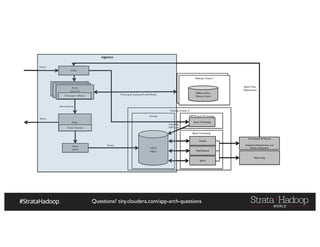
Hadoop	Application	
Architectures:	a	Fraud	Tutorial
Mark	Grover,	Cloudera	Developer	and	Author
Questions? tiny.cloudera.com/app-arch-questions
About the book
§@hadooparchbook
§hadooparchitecturebook.com
§github.com/hadooparchitecturebook
§slideshare.com/hadooparchbook
Questions? tiny.cloudera.com/app-arch-questions
About the presenter
§Software Engineer on
Spark at Cloudera
§Committer on Apache
Bigtop, PMC member on
Apache Sentry(incubating)
§Contributor to Apache
Spark, Hadoop, Hive,
Sqoop, Pig, Flume
Mark Grover
Case Study Overview
Fraud Detection
Questions? tiny.cloudera.com/app-arch-questions
Credit Card Transaction Fraud
Questions? tiny.cloudera.com/app-arch-questions
Health Insurance Fraud
Questions? tiny.cloudera.com/app-arch-questions
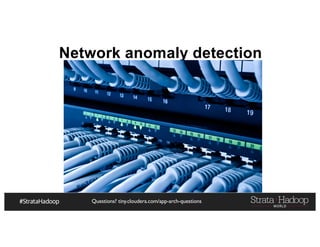
Network anomaly detection
Questions? tiny.cloudera.com/app-arch-questions
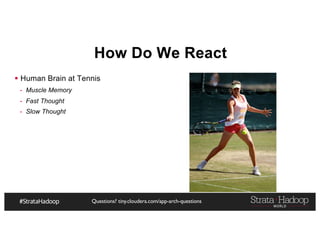
How Do We React
§ Human Brain at Tennis
- Muscle Memory
- Fast Thought
- Slow Thought
Questions? tiny.cloudera.com/app-arch-questions
§ Muscle memory – for quick action (e.g. reject events)
- Real time alerts
- Real time dashboard
§ Platform for automated learning and improvement
- Real time (fast thought)
- Batch (slow thought)
§ Slow thought
- Audit trail and analytics for human feedback
Back to network anomaly detection
Use case
Network Anomaly Detection
Questions? tiny.cloudera.com/app-arch-questions
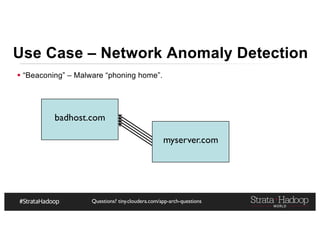
§ “Beaconing” – Malware “phoning home”.
Use Case – Network Anomaly Detection
myserver.com
badhost.com
Questions? tiny.cloudera.com/app-arch-questions
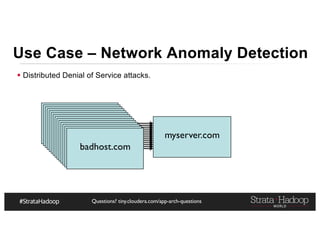
§ Distributed Denial of Service attacks.
Use Case – Network Anomaly Detection
myserver.com
badhost.combadhost.combadhost.combadhost.combadhost.combadhost.combadhost.combadhost.combadhost.combadhost.combadhost.combadhost.combadhost.combadhost.com
Questions? tiny.cloudera.com/app-arch-questions
Use Case – Network Anomaly Detection
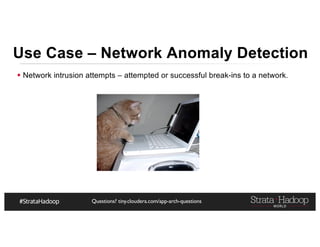
§ Network intrusion attempts – attempted or successful break-ins to a network.
Questions? tiny.cloudera.com/app-arch-questions
Use Case – Network Anomaly Detection
All of these require the ability to detect deviations from known patterns.
Questions? tiny.cloudera.com/app-arch-questions
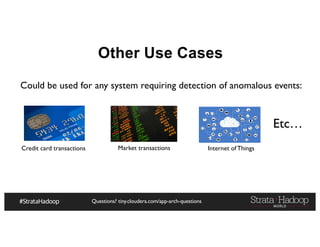
Other Use Cases
Could be used for any system requiring detection of anomalous events:
Credit card transactions Market transactions Internet of Things
Etc…
Questions? tiny.cloudera.com/app-arch-questions
§ Standard protocol defining a format for capturing network traffic flow through
routers.
§ Captures network data as flow records. These flow records provide information
on source and destination IP addresses, traffic volumes, ports, etc.
§ We can use this data to detect normal and anomalous patterns in network
traffic.
Input Data – NetFlow
Questions? tiny.cloudera.com/app-arch-questions
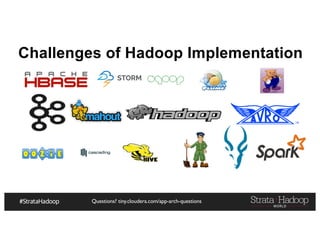
Challenges of Hadoop Implementation
Questions? tiny.cloudera.com/app-arch-questions
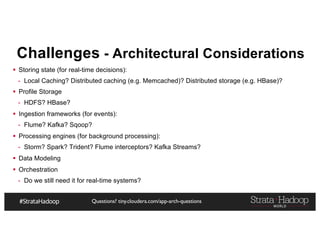
Challenges - Architectural Considerations
§ Storing state (for real-time decisions):
- Local Caching? Distributed caching (e.g. Memcached)? Distributed storage (e.g. HBase)?
§ Profile Storage
- HDFS? HBase?
§ Ingestion frameworks (for events):
- Flume? Kafka? Sqoop?
§ Processing engines (for background processing):
- Storm? Spark? Trident? Flume interceptors? Kafka Streams?
§ Data Modeling
§ Orchestration
- Do we still need it for real-time systems?
Case Study
Requirements
Overview
Questions? tiny.cloudera.com/app-arch-questions
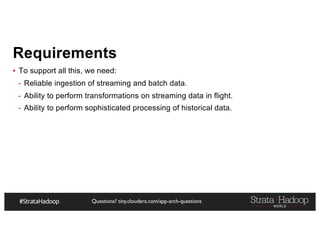
Requirements
▪ To support all this, we need:
- Reliable ingestion of streaming and batch data.
- Ability to perform transformations on streaming data in flight.
- Ability to perform sophisticated processing of historical data.
Questions? tiny.cloudera.com/app-arch-questions
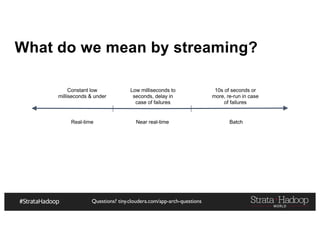
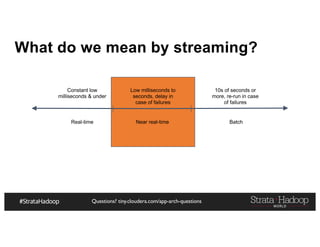
What do we mean by streaming?
Constant low
milliseconds & under
Low milliseconds to
seconds, delay in
case of failures
10s of seconds or
more, re-run in case
of failures
Real-time Near real-time Batch
Questions? tiny.cloudera.com/app-arch-questions
What do we mean by streaming?
Constant low
milliseconds & under
Low milliseconds to
seconds, delay in
case of failures
10s of seconds or
more, re-run in case
of failures
Real-time Near real-time Batch
Questions? tiny.cloudera.com/app-arch-questions
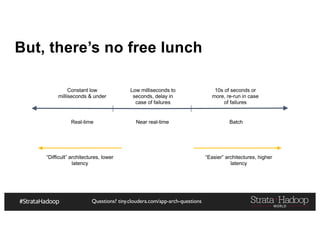
But, there’s no free lunch
Constant low
milliseconds & under
Low milliseconds to
seconds, delay in
case of failures
10s of seconds or
more, re-run in case
of failures
Real-time Near real-time Batch
“Difficult” architectures, lower
latency
“Easier” architectures, higher
latency
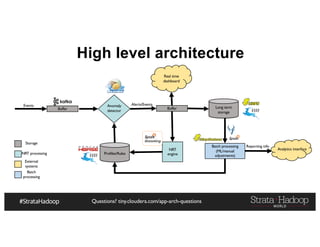
High level architecture
Questions? tiny.cloudera.com/app-arch-questions
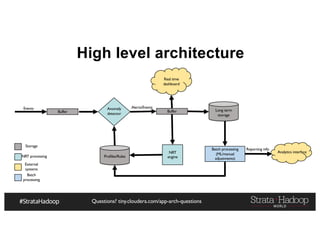
Events
Buffer
Anomaly
detector
Alerts/Events
Profiles/Rules
Long term
storage
Buffer
NRT
engine
Batch processing
(ML/manual
adjustments)
Reporting info
Analytics interface
Real time
dashboard
Storage
NRT processing
External
systems
Batch
processing
High level architecture
Questions? tiny.cloudera.com/app-arch-questions
High level architecture
Events
Buffer
Anomaly
detector
Alerts/Events
Profiles/Rules
Long term
storage
Buffer
NRT
engine
Batch processing
(ML/manual
adjustments)
Reporting info
Analytics interface
Real time
dashboard
Storage
NRT processing
External
systems
Batch
processing
Questions? tiny.cloudera.com/app-arch-questions
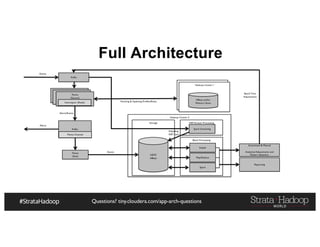
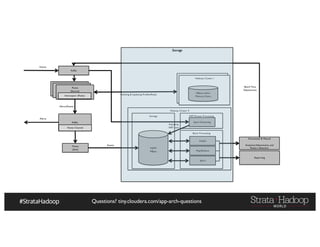
Hadoop Cluster II
Storage
Batch Processing
Hadoop Cluster I
Flume
(Sink)
HBase and/or
Memory Store
HDFS
HBase
Impala
Map/Reduce
Spark
Automated & Manual
Analytical Adjustments and
Pattern detection
Fetching & Updating Profiles/Rules
Batch Time
Adjustments
NRT/Stream Processing
Spark Streaming
Adjusting
NRT stats
Kafka
Events
Reporting
Flume
(Source)
Interceptor(Rules)
Flume
(Source)
Flume
(Source)
Interceptor (Rules)
Kafka
Alerts/Events
Flume Channel
Events
Alerts
Hadoop Cluster I
HBase and/or
Memory Store
Full Architecture
Storage Layer
Considerations
Questions? tiny.cloudera.com/app-arch-questions
Storage Layer Considerations
§Two likely choices for long-term storage of data:
Questions? tiny.cloudera.com/app-arch-questions
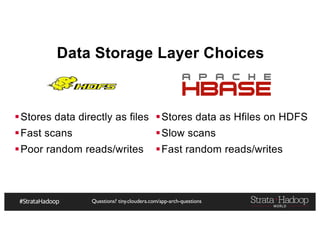
Data Storage Layer Choices
§Stores data directly as files
§Fast scans
§Poor random reads/writes
§Stores data as Hfiles on HDFS
§Slow scans
§Fast random reads/writes
Questions? tiny.cloudera.com/app-arch-questions
Storage Considerations
§ Batch processing and reporting requires access to all raw and processed data.
§ Stream processing and alerting requires quickly fetching and saving profiles.
Questions? tiny.cloudera.com/app-arch-questions
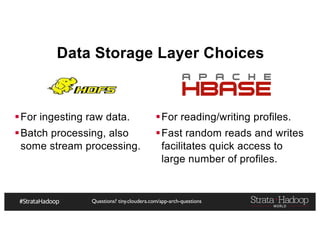
Data Storage Layer Choices
§For ingesting raw data.
§Batch processing, also
some stream processing.
§For reading/writing profiles.
§Fast random reads and writes
facilitates quick access to
large number of profiles.
Questions? tiny.cloudera.com/app-arch-questions
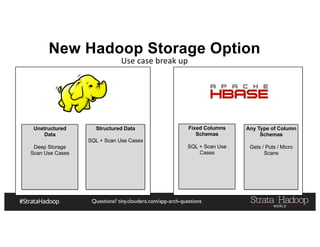
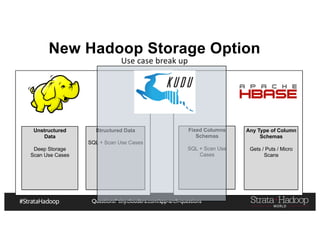
New Hadoop Storage Option
Use	case	break	up
Structured Data
SQL + Scan Use Cases
Unstructured
Data
Deep Storage
Scan Use Cases
Fixed Columns
Schemas
SQL + Scan Use
Cases
Any Type of Column
Schemas
Gets / Puts / Micro
Scans
Questions? tiny.cloudera.com/app-arch-questions
New Hadoop Storage Option
Use	case	break	up
Structured Data
SQL + Scan Use Cases
Unstructured
Data
Deep Storage
Scan Use Cases
Fixed Columns
Schemas
SQL + Scan Use
Cases
Any Type of Column
Schemas
Gets / Puts / Micro
Scans
Questions? tiny.cloudera.com/app-arch-questions
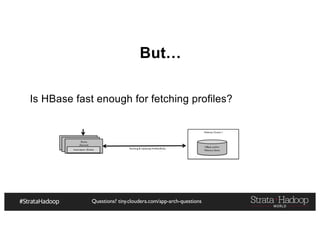
But…
Is HBase fast enough for fetching profiles?
HBase and/or
Memory StoreFetching & Updating Profiles/Rules
Flume
(Source)
Interceptor(Rules)
Flume
(Source)
Flume
(Source)
Interceptor (Rules)
Hadoop Cluster I
HBase and/or
Memory Store
Questions? tiny.cloudera.com/app-arch-questions
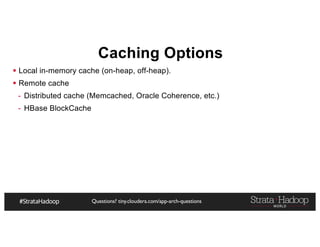
Caching Options
§ Local in-memory cache (on-heap, off-heap).
§ Remote cache
- Distributed cache (Memcached, Oracle Coherence, etc.)
- HBase BlockCache
Questions? tiny.cloudera.com/app-arch-questions
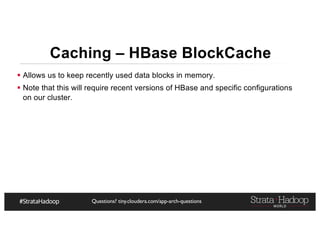
§ Allows us to keep recently used data blocks in memory.
§ Note that this will require recent versions of HBase and specific configurations
on our cluster.
Caching – HBase BlockCache
Questions? tiny.cloudera.com/app-arch-questions
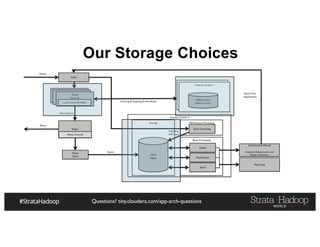
Hadoop Cluster II
Storage
Batch Processing
Hadoop Cluster I
Flume
(Sink)
HBase and/or
Memory Store
HDFS
HBase
Impala
Map/Reduce
Spark
Automated & Manual
Analytical Adjustments and
Pattern detection
Fetching & Updating Profiles/Rules
Batch Time
Adjustments
NRT/Stream Processing
Spark Streaming
Adjusting
NRT stats
Kafka
Events
Reporting
Flume
(Source)
Interceptor(Rules)
Flume
(Source)
Flume
(Source)
Local Cache (Profiles)
Kafka
Alerts/Events
Flume Channel
Events
Alerts
Hadoop Cluster I
HBase and/or
Memory Store
Our Storage Choices
Processing
Considerations
Questions? tiny.cloudera.com/app-arch-questions
Hadoop Cluster II
Storage
Batch Processing
Hadoop Cluster I
Flume
(Sink)
HBase and/or
Memory Store
HDFS
HBase
Impala
Map/Reduce
Spark
Automated & Manual
Analytical Adjustments and
Pattern detection
Fetching & Updating Profiles/Rules
Batch Time
Adjustments
NRT/Stream Processing
Spark Streaming
Adjusting
NRT stats
Kafka
Events
Reporting
Flume
(Source)
Interceptor(Rules)
Flume
(Source)
Flume
(Source)
Interceptor (Rules)
Kafka
Alerts/Events
Flume Channel
Events
Alerts
Hadoop Cluster I
HBase and/or
Memory Store
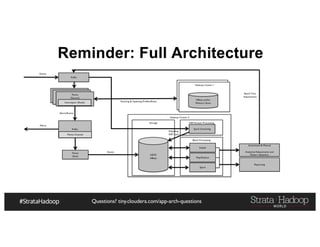
Reminder: Full Architecture
Questions? tiny.cloudera.com/app-arch-questions
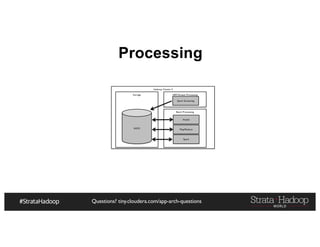
Processing
Hadoop Cluster II
Storage
Batch Processing
HDFS
Impala
Map/Reduce
Spark
NRT/Stream Processing
Spark Streaming
Questions? tiny.cloudera.com/app-arch-questions
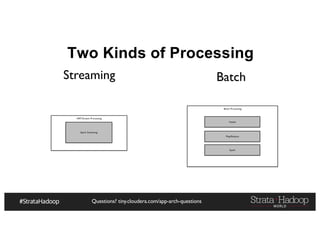
Two Kinds of Processing
Streaming Batch
NRT/Stream Processing
Spark Streaming
Batch Processing
Impala
Map/Reduce
Spark
Stream Processing
Considerations
Questions? tiny.cloudera.com/app-arch-questions
Streaming use-cases
Questions? tiny.cloudera.com/app-arch-questions
Streaming Use-cases
▪ Ingestion (most relevant in our use-case)
▪ Simple transformations
- Decision (e.g. anomaly detection)
- Enrichment (e.g. add a state based on zipcode)
▪ Advanced usage
- Machine Learning
- Windowing
Questions? tiny.cloudera.com/app-arch-questions
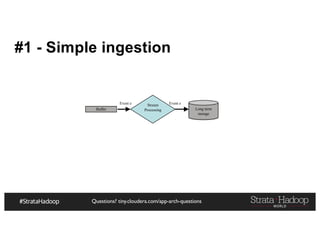
#1 - Simple ingestion
Buffer
Event e Stream
Processing Long term
storage
Event e
Questions? tiny.cloudera.com/app-arch-questions
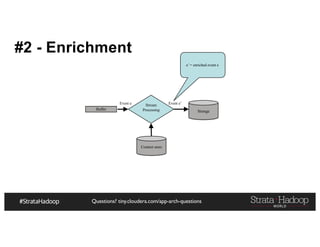
#2 - Enrichment
Buffer
Event e Stream
Processing Storage
Event e’
e’ = enriched event e
Context store
Questions? tiny.cloudera.com/app-arch-questions
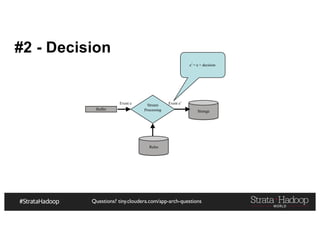
#2 - Decision
Buffer
Event e Stream
Processing Storage
Event e’
e’ = e + decision
Rules
Questions? tiny.cloudera.com/app-arch-questions
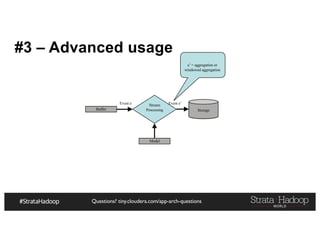
#3 – Advanced usage
Buffer
Event e Stream
Processing Storage
Event e’
e’ = aggregation or
windowed aggregation
Model
Questions? tiny.cloudera.com/app-arch-questions
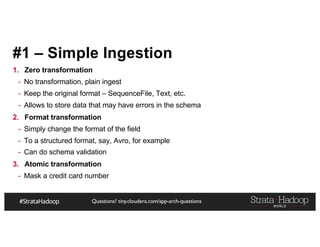
#1 – Simple Ingestion
1. Zero transformation
- No transformation, plain ingest
- Keep the original format – SequenceFile, Text, etc.
- Allows to store data that may have errors in the schema
2. Format transformation
- Simply change the format of the field
- To a structured format, say, Avro, for example
- Can do schema validation
3. Atomic transformation
- Mask a credit card number
Questions? tiny.cloudera.com/app-arch-questions
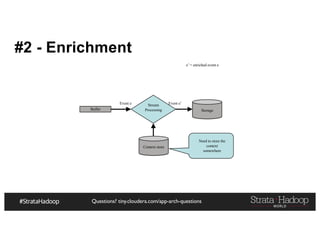
#2 - Enrichment
Buffer
Event e Stream
Processing Storage
Event e’
e’ = enriched event e
Context store
Need to store the
context
somewhere
Questions? tiny.cloudera.com/app-arch-questions
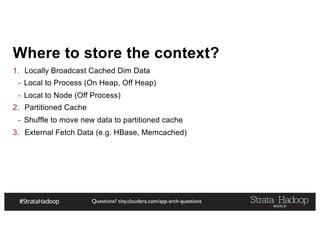
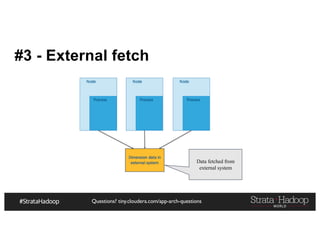
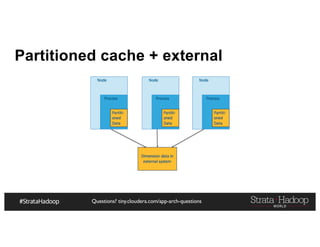
Where to store the context?
1. Locally Broadcast Cached Dim Data
- Local to Process (On Heap, Off Heap)
- Local to Node (Off Process)
2. Partitioned Cache
- Shuffle to move new data to partitioned cache
3. External Fetch Data (e.g. HBase, Memcached)
Questions? tiny.cloudera.com/app-arch-questions
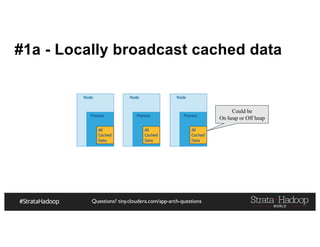
#1a - Locally broadcast cached data
Could be
On heap or Off heap
Questions? tiny.cloudera.com/app-arch-questions
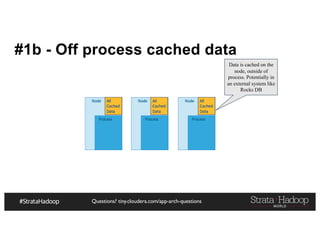
#1b - Off process cached data
Data is cached on the
node, outside of
process. Potentially in
an external system like
Rocks DB
Questions? tiny.cloudera.com/app-arch-questions
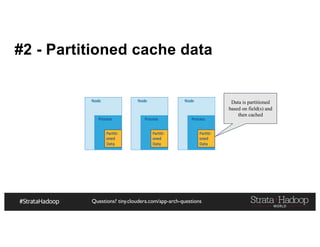
#2 - Partitioned cache data
Data is partitioned
based on field(s) and
then cached
Questions? tiny.cloudera.com/app-arch-questions
#3 - External fetch
Data fetched from
external system
Questions? tiny.cloudera.com/app-arch-questions
Partitioned cache + external
Questions? tiny.cloudera.com/app-arch-questions
Streaming semantics
Questions? tiny.cloudera.com/app-arch-questions
Delivery Types
▪ At most once
- Not good for many cases
- Only where performance/SLA is more important than accuracy
▪ Exactly once
- Expensive to achieve but desirable
▪ At least once
- Easiest to achieve
Questions? tiny.cloudera.com/app-arch-questions
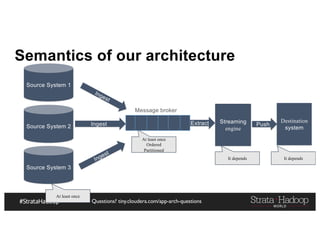
Semantics of our architecture
Source System 1
Destination
systemSource System 2
Source System 3
Ingest Extract Streaming
engine
Push
Message broker
Questions? tiny.cloudera.com/app-arch-questions
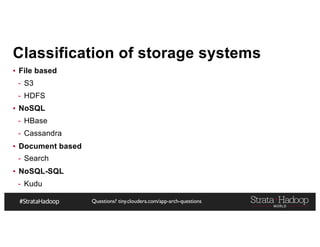
Classification of storage systems
▪ File based
- S3
- HDFS
▪ NoSQL
- HBase
- Cassandra
▪ Document based
- Search
▪ NoSQL-SQL
- Kudu
Questions? tiny.cloudera.com/app-arch-questions
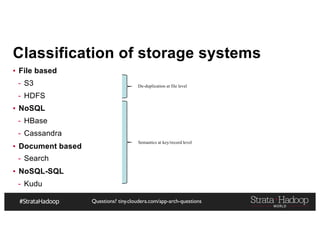
Classification of storage systems
▪ File based
- S3
- HDFS
▪ NoSQL
- HBase
- Cassandra
▪ Document based
- Search
▪ NoSQL-SQL
- Kudu
De-duplication at file level
Semantics at key/record level
Questions? tiny.cloudera.com/app-arch-questions
Which streaming
engine to choose?
Questions? tiny.cloudera.com/app-arch-questions
Spark Streaming
▪ Micro batch based architecture
▪ Allows stateful transformations
▪ Feature rich
- Windowing
- Sessionization
- ML
- SQL (Structured Streaming)
Questions? tiny.cloudera.com/app-arch-questions
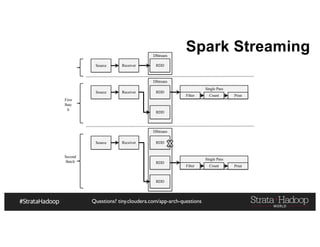
Spark Streaming
DStream
DStream
DStream
Single Pass
Source Receiver RDD
Source Receiver RDD
RDD
Filter Count Print
Source Receiver RDD
RDD
RDD
Single Pass
Filter Count Print
First
Batc
h
Second
Batch
Questions? tiny.cloudera.com/app-arch-questions
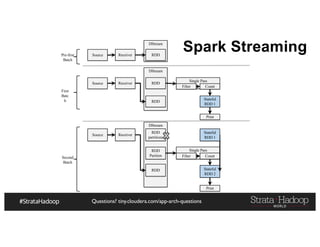
DStream
DStream
DStream
Single Pass
Source Receiver RDD
Source Receiver RDD
RDD
Filter Count
Print
Source Receiver
RDD
partitions
RDD
Parition
RDD
Single Pass
Filter Count
Pre-first
Batch
First
Batc
h
Second
Batch
Stateful
RDD 1
Print
Stateful
RDD 2
Stateful
RDD 1
Spark Streaming
Questions? tiny.cloudera.com/app-arch-questions
Spark Streaming Example
1. val conf = new SparkConf().setMaster("local[2]”)
2. val ssc = new StreamingContext(conf, Seconds(1))
3. val lines = ssc.socketTextStream("localhost", 9999)
4. val words = lines.flatMap(_.split(" "))
5. val pairs = words.map(word => (word, 1))
6. val wordCounts = pairs.reduceByKey(_ + _)
7. wordCounts.print()
8. SSC.start()
Questions? tiny.cloudera.com/app-arch-questions
Spark Streaming Example
1. val conf = new SparkConf().setMaster("local[2]”)
2. val sc = new SparkContext(conf)
3. val lines = sc.textFile(path, 2)
4. val words = lines.flatMap(_.split(" "))
5. val pairs = words.map(word => (word, 1))
6. val wordCounts = pairs.reduceByKey(_ + _)
7. wordCounts.print()
Questions? tiny.cloudera.com/app-arch-questions
Flink
▪ True “streaming” system, but not as feature rich as Spark
▪ Much better event time handling
▪ Good built-in backpressure support
▪ Allows stateful transformations
▪ Lower Latency
- No Micro Batching
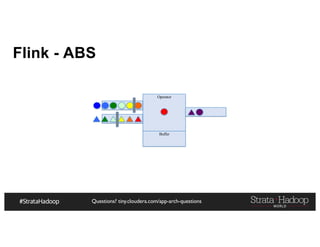
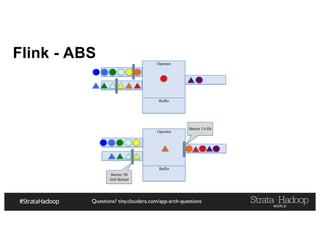
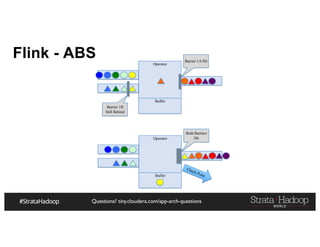
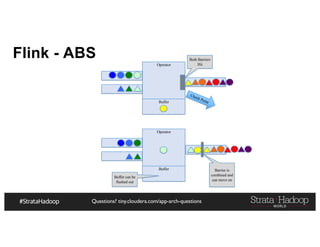
- Asynchronous Barrier Snapshotting (ABS)
Questions? tiny.cloudera.com/app-arch-questions
Flink - ABS
Operator
Buffer
Questions? tiny.cloudera.com/app-arch-questions
Operator
Buffer
Operator
Buffer
Flink - ABS
Barrier 1A Hit
Barrier 1B
Still Behind
Questions? tiny.cloudera.com/app-arch-questions
Operator
Buffer
Flink - ABS
Both Barriers
Hit
Operator
Buffer
Barrier 1A Hit
Barrier 1B
Still Behind
Questions? tiny.cloudera.com/app-arch-questions
Operator
Buffer
Flink - ABS Both Barriers
Hit
Operator
Buffer Barrier is
combined and
can move on
Buffer can be
flushed out
Questions? tiny.cloudera.com/app-arch-questions
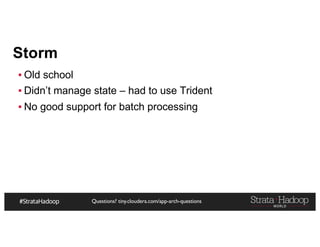
Storm
▪ Old school
▪ Didn’t manage state – had to use Trident
▪ No good support for batch processing
Questions? tiny.cloudera.com/app-arch-questions
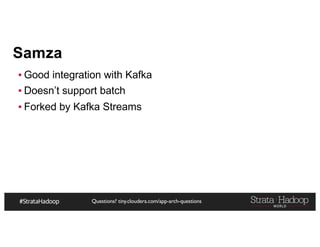
Samza
▪ Good integration with Kafka
▪ Doesn’t support batch
▪ Forked by Kafka Streams
Questions? tiny.cloudera.com/app-arch-questions
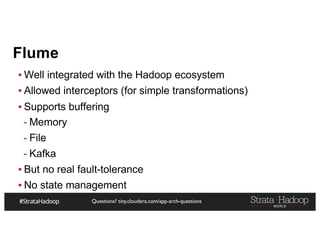
Flume
▪ Well integrated with the Hadoop ecosystem
▪ Allowed interceptors (for simple transformations)
▪ Supports buffering
- Memory
- File
- Kafka
▪ But no real fault-tolerance
▪ No state management
Questions? tiny.cloudera.com/app-arch-questions
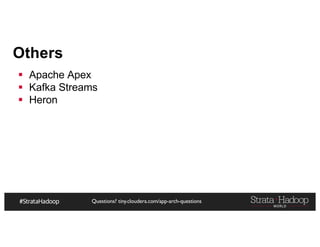
Others
§ Apache Apex
§ Kafka Streams
§ Heron
Questions? tiny.cloudera.com/app-arch-questions
Apache Beam
§ Abstraction on top of Streaming Engines
§ Best support for Google Dataflow
Questions? tiny.cloudera.com/app-arch-questions
Why Spark Streaming?
§ There’s one engine to know.
§ Micro-batching helps you scale reliably.
§ Exactly once counting
§ Hadoop ecosystem integration is baked in.
§ No risk of data loss.
§ It’s easy to debug and run.
§ State management
§ Huge eco-system backing
§ You have access to ML libraries.
§ You can use SQL where needed.
§ Wide-spread use and hardened
Processing
Batch
Questions? tiny.cloudera.com/app-arch-questions
Why batch in a NRT use case?
§For background processing
- To be later used for quick decision making
§Exploratory analysis
- Machine Learning
§Automated rule changes
- Based on new patterns
§Analytics
- Who’s attacking us?
Questions? tiny.cloudera.com/app-arch-questions
Spark
§ The New Kid that isn’t that New Anymore
§ Easily 10x less code
§ Extremely Easy and Powerful API
§ Very good for iterative processing (machine learning, graph processing, etc.)
§ Scala, Java, and Python support
§ RDDs
§ Has Graph, ML and SQL engines built on it
§ R integration (SparkR)
Questions? tiny.cloudera.com/app-arch-questions
Impala
§ MPP Style SQL Engine on top of Hadoop
§ Very Fast
§ High Concurrency
§ Analytical windowing functions
Batch processing in
our use-case
Questions? tiny.cloudera.com/app-arch-questions
Batch processing in fraud-detection
§ Reporting
- How many events come daily?
- How does it compare to last year?
§ Machine Learning
- Automated rules changes
§ Other processing
- Tracking device history and updating profiles
Questions? tiny.cloudera.com/app-arch-questions
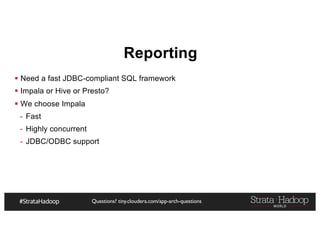
Reporting
§ Need a fast JDBC-compliant SQL framework
§ Impala or Hive or Presto?
§ We choose Impala
- Fast
- Highly concurrent
- JDBC/ODBC support
Questions? tiny.cloudera.com/app-arch-questions
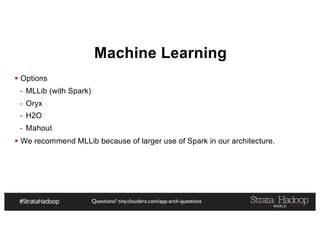
Machine Learning
§ Options
- MLLib (with Spark)
- Oryx
- H2O
- Mahout
§ We recommend MLLib because of larger use of Spark in our architecture.
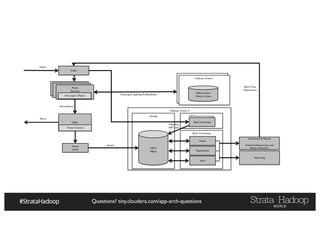
Overall Architecture
Overview
Questions? tiny.cloudera.com/app-arch-questions
Hadoop Cluster II
Storage
Batch Processing
Hadoop Cluster I
Flume
(Sink)
HBase and/or
Memory Store
HDFS
HBase
Impala
Map/Reduce
Spark
Automated & Manual
Analytical Adjustments and
Pattern detection
Fetching & Updating Profiles/Rules
Batch Time
Adjustments
NRT/Stream Processing
Spark Streaming
Adjusting
NRT stats
Kafka
Events
Reporting
Flume
(Source)
Interceptor(Rules)
Flume
(Source)
Flume
(Source)
Interceptor (Rules)
Kafka
Alerts/Events
Flume Channel
Events
Alerts
Hadoop Cluster I
HBase and/or
Memory Store
Questions? tiny.cloudera.com/app-arch-questions
Hadoop Cluster II
Storage
Batch Processing
Hadoop Cluster I
Flume
(Sink)
HBase and/or
Memory Store
HDFS
HBase
Impala
Map/Reduce
Spark
Automated & Manual
Analytical Adjustments and
Pattern detection
Fetching & Updating Profiles/Rules
Batch Time
Adjustments
NRT/Stream Processing
Spark Streaming
Adjusting
NRT stats
Kafka
Events
Reporting
Flume
(Source)
Interceptor(Rules)
Flume
(Source)
Flume
(Source)
Interceptor (Rules)
Kafka
Alerts/Events
Flume Channel
Events
Alerts
Hadoop Cluster I
HBase and/or
Memory Store
Storage
Questions? tiny.cloudera.com/app-arch-questions
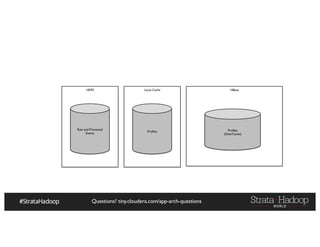
HDFS
Raw and Processed
Events
HBase
Profiles
(Disk/Cache)
Local Cache
Profiles
Questions? tiny.cloudera.com/app-arch-questions
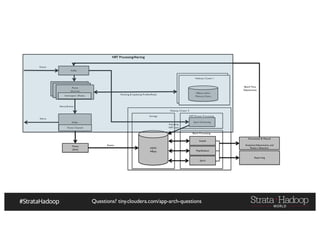
Hadoop Cluster II
Storage
Batch Processing
Hadoop Cluster I
Flume
(Sink)
HBase and/or
Memory Store
HDFS
HBase
Impala
Map/Reduce
Spark
Automated & Manual
Analytical Adjustments and
Pattern detection
Fetching & Updating Profiles/Rules
Batch Time
Adjustments
NRT/Stream Processing
Spark Streaming
Adjusting
NRT stats
Kafka
Events
Reporting
Flume
(Source)
Interceptor(Rules)
Flume
(Source)
Flume
(Source)
Interceptor (Rules)
Kafka
Alerts/Events
Flume Channel
Events
Alerts
Hadoop Cluster I
HBase and/or
Memory Store
NRT Processing/Alerting
Questions? tiny.cloudera.com/app-arch-questions
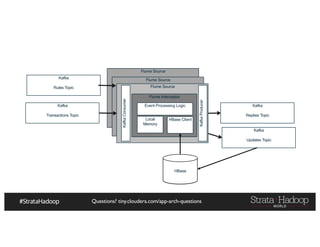
Flume Source
Flume Source
Kafka
Transactions Topic
Flume Source
Flume Interceptor
Event Processing Logic
Local
Memory
HBase Client
Kafka
Replies Topic
KafkaConsumer
KafkaProducer
HBase
Kafka
Updates Topic
Kafka
Rules Topic
Questions? tiny.cloudera.com/app-arch-questions
Hadoop Cluster II
Storage
Batch Processing
Hadoop Cluster I
Flume
(Sink)
HBase and/or
Memory Store
HDFS
HBase
Impala
Map/Reduce
Spark
Automated & Manual
Analytical Adjustments and
Pattern detection
Fetching & Updating Profiles/Rules
Batch Time
Adjustments
NRT/Stream Processing
Spark Streaming
Adjusting
NRT stats
Kafka
Events
Reporting
Flume
(Source)
Interceptor(Rules)
Flume
(Source)
Flume
(Source)
Interceptor (Rules)
Kafka
Alerts/Events
Flume Channel
Events
Alerts
Hadoop Cluster I
HBase and/or
Memory Store
Ingestion
Questions? tiny.cloudera.com/app-arch-questions
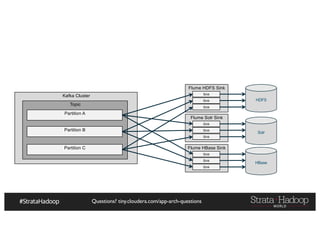
Flume HDFS Sink
Kafka Cluster
Topic
Partition A
Partition B
Partition C
Sink
Sink
Sink
HDFS
Flume Solr Sink
Sink
Sink
Sink
Solr
Flume HBase Sink
Sink
Sink
Sink
HBase
Questions? tiny.cloudera.com/app-arch-questions
Hadoop Cluster II
Storage
Batch Processing
Hadoop Cluster I
Flume
(Sink)
HBase and/or
Memory Store
HDFS
HBase
Impala
Map/Reduce
Spark
Automated & Manual
Analytical Adjustments and
Pattern detection
Fetching & Updating Profiles/Rules
Batch Time
Adjustments
NRT/Stream Processing
Spark Streaming
Adjusting
NRT stats
Kafka
Events
Reporting
Flume
(Source)
Interceptor(Rules)
Flume
(Source)
Flume
(Source)
Interceptor (Rules)
Kafka
Alerts/Events
Flume Channel
Events
Alerts
Hadoop Cluster I
HBase and/or
Memory Store
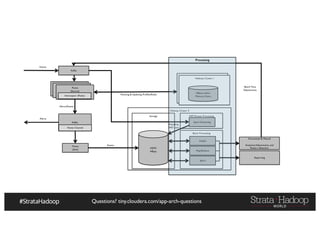
Processing
Questions? tiny.cloudera.com/app-arch-questions
Hadoop Cluster II
Storage
Batch Processing
HDFS
Impala
Map/Reduce
Spark
NRT/Stream Processing
Spark Streaming
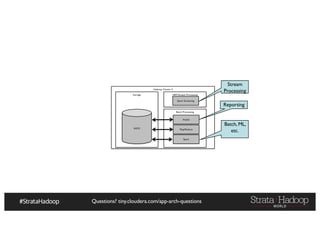
Reporting
Stream
Processing
Batch, ML,
etc.
Thank you!
Ingest and Near Real-
Time Alerting
Considerations
Questions? tiny.cloudera.com/app-arch-questions
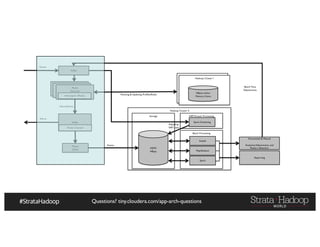
Hadoop Cluster II
Storage
Batch Processing
Hadoop Cluster I
Flume
(Sink)
HBase and/or
Memory Store
HDFS
HBase
Impala
Map/Reduce
Spark
Automated & Manual
Analytical Adjustments and
Pattern detection
Fetching & Updating Profiles/Rules
Batch Time
Adjustments
NRT/Stream Processing
Spark Streaming
Adjusting
NRT stats
Kafka
Events
Reporting
Flume
(Source)
Interceptor(Rules)
Flume
(Source)
Flume
(Source)
Interceptor (Rules)
Kafka
Alerts/Events
Flume Channel
Events
Alerts
Hadoop Cluster I
HBase and/or
Memory Store
Questions? tiny.cloudera.com/app-arch-questions
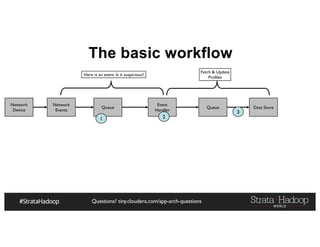
The basic workflow
Network
Device
Network
Events
Queue
Event
Handler
Data Store
Fetch & Update
Profiles
Here is an event. Is it suspicious?
Queue
1 2
3
Questions? tiny.cloudera.com/app-arch-questions
The Queue
§ What makes Apache Kafka a good choice?
- Low latency
- High throughput
- Partitioned and replicated
- Easy to plug to applications
1
Questions? tiny.cloudera.com/app-arch-questions
The Basics
§Messages are organized into topics
§Producers push messages
§Consumers pull messages
§Kafka runs in a cluster. Nodes are called brokers
Questions? tiny.cloudera.com/app-arch-questions
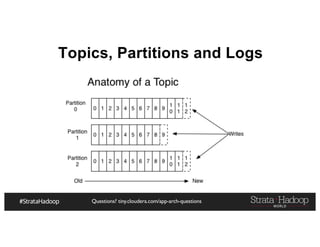
Topics, Partitions and Logs
Questions? tiny.cloudera.com/app-arch-questions
Consumers
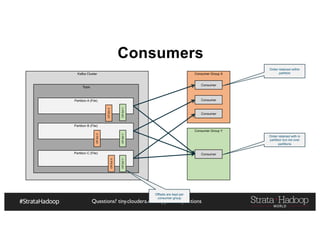
Consumer Group Y
Consumer Group X
Consumer
Kafka Cluster
Topic
Partition A (File)
Partition B (File)
Partition C (File)
Consumer
Consumer
Consumer
Order retained within
partition
Order retained with in
partition but not over
partitions
OffSetX
OffSetX
OffSetX
OffSetYOffSetYOffSetY
Offsets are kept per
consumer group
Questions? tiny.cloudera.com/app-arch-questions
In our use-case
§ Topic for profile updates
§ Topic for current events
§ Topic for alerts
§ Topic for rule updates
Partitioned by device ID
Questions? tiny.cloudera.com/app-arch-questions
Easier than you think
§ Kafka provides load balancing and availability
- Add processes when needed – they will get their share of partitions
- You control partition assignment strategy
- If a process crashes, partitions will get automatically reassigned
- You control when an event is “done”
- Send events safely and asynchronously
§ So you focus on the use-case, not the framework
Questions? tiny.cloudera.com/app-arch-questions
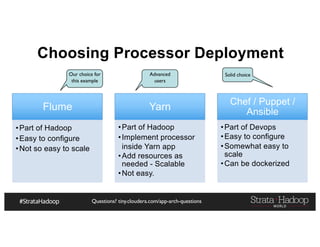
Choosing Processor Deployment
Flume
•Part of Hadoop
•Easy to configure
•Not so easy to scale
Yarn
•Part of Hadoop
•Implement processor
inside Yarn app
•Add resources as
needed - Scalable
•Not easy.
Chef / Puppet /
Ansible
•Part of Devops
•Easy to configure
•Somewhat easy to
scale
•Can be dockerized
Our choice for
this example
Solid choiceAdvanced
users
Questions? tiny.cloudera.com/app-arch-questions
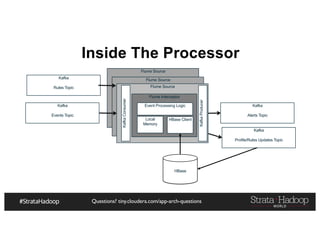
Inside The Processor
Flume Source
Flume Source
Kafka
Events Topic
Flume Source
Flume Interceptor
Event Processing Logic
Local
Memory
HBase Client
Kafka
Alerts Topic
KafkaConsumer
KafkaProducer
HBase
Kafka
Profile/Rules Updates Topic
Kafka
Rules Topic
Questions? tiny.cloudera.com/app-arch-questions
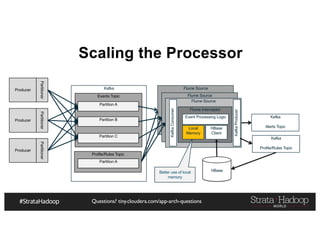
Scaling the Processor
Flume Source
Flume Source
Kafka
Initial Events Topic
Flume Source
Flume Interceptor
Event Processing Logic
Local
Memory
HBase
Client
Kafka
Alerts Topic
HBaseKafkaConsumer
KafkaProducer
Events Topic
Partition A
Partition B
Partition C
Producer
Partitioner
Producer
Partitioner
Producer
Partitioner
Better use of local
memory
Kafka
Profile/Rules Topic
Profile/Rules Topic
Partition A
Questions? tiny.cloudera.com/app-arch-questions
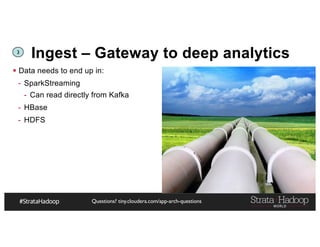
Ingest – Gateway to deep analytics
§ Data needs to end up in:
- SparkStreaming
- Can read directly from Kafka
- HBase
- HDFS
3
Questions? tiny.cloudera.com/app-arch-questions
Considerations for Ingest
§ Async – nothing can slow down the immediate reaction
- Always ingest the data from a queue in separate thread or process
to avoid write-latency
§ Useful end-points – integrates with variety of data sources and sinks
§ Supports standard formats and possibly some transformations
- Data format inside the queue can be different than in the data store
For example Avro -> Parquet
§ Cross data center
Questions? tiny.cloudera.com/app-arch-questions
More considerations - Safety
§ Reliable – data loss is not acceptable
- Either “at-least-once” or “exactly-once”
- When is “exactly-once” possible?
§ Error handling – reasonable reaction to unreasonable data
§ Security – Authentication, authorization, audit, lineage
Questions? tiny.cloudera.com/app-arch-questions
Anti-Pattern
Using complex event processing framework for ingest
Don’t do that. Ingest is different.
Questions? tiny.cloudera.com/app-arch-questions
Good Patterns
§ Ingest all things. Events, evidence, alerts
- It has potential value
- Especially when troubleshooting
- And for data scientists
§ Make sure you take your schema with you
- Yes, your data probably has a schema
- Everyone accessing the data (web apps, real time, stream, batch) will need to
know about it
- So make it accessible in a centralized schema registry
Questions? tiny.cloudera.com/app-arch-questions
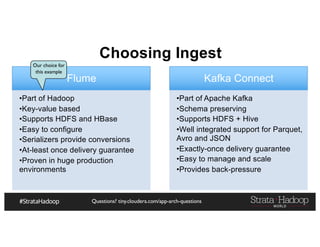
Choosing Ingest
Flume
•Part of Hadoop
•Key-value based
•Supports HDFS and HBase
•Easy to configure
•Serializers provide conversions
•At-least once delivery guarantee
•Proven in huge production
environments
Kafka Connect
•Part of Apache Kafka
•Schema preserving
•Supports HDFS + Hive
•Well integrated support for Parquet,
Avro and JSON
•Exactly-once delivery guarantee
•Easy to manage and scale
•Provides back-pressure
Our choice for
this example
Questions? tiny.cloudera.com/app-arch-questions
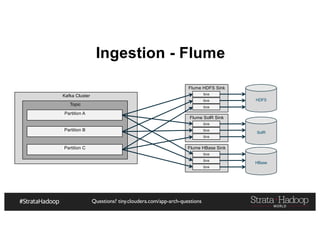
Ingestion - Flume
Flume HDFS Sink
Kafka Cluster
Topic
Partition A
Partition B
Partition C
Sink
Sink
Sink
HDFS
Flume SolR Sink
Sink
Sink
Sink
SolR
Flume HBase Sink
Sink
Sink
Sink
HBase

Fraud Detection with Hadoop