1
Workplace Innovation
for
quality jobs
and
organisational performance
Frank Pot
“Gipuzkoa Workplace Innovation”, San Sebastian, 7 May 2015
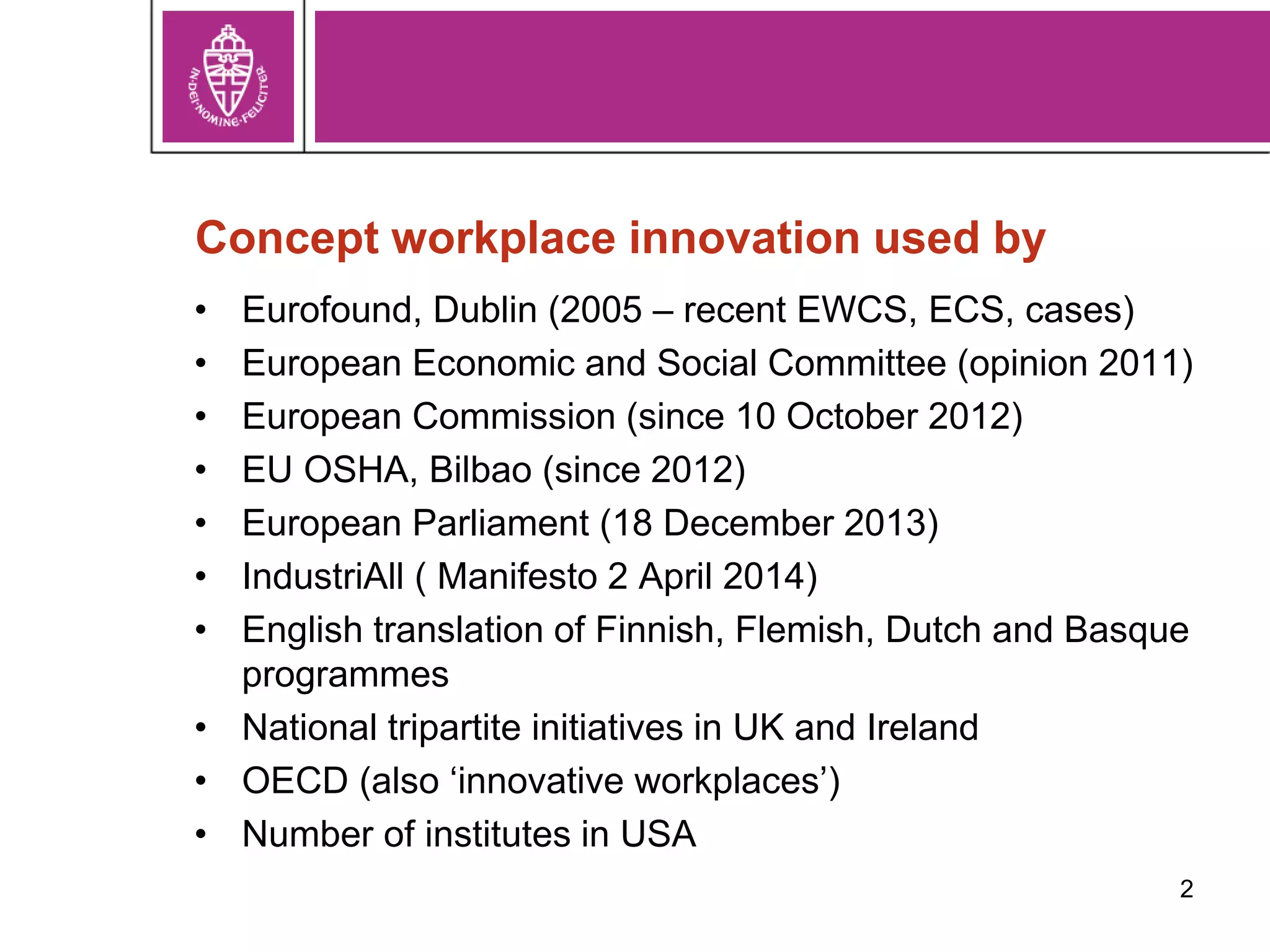
Concept workplace innovation used by
• Eurofound, Dublin (2005 – recent EWCS, ECS, cases)
• European Economic and Social Committee (opinion 2011)
• European Commission (since 10 October 2012)
• EU OSHA, Bilbao (since 2012)
• European Parliament (18 December 2013)
• IndustriAll ( Manifesto 2 April 2014)
• English translation of Finnish, Flemish, Dutch and Basque
programmes
• National tripartite initiatives in UK and Ireland
• OECD (also ‘innovative workplaces’)
• Number of institutes in USA
2
3
Societal relevance workplace innovation
• Competitive economy:
• Global competition and knowledge based economy 
development of competences and skills needed
• Future decreasing workforce  increasing labour
productivity needed
• General values
• Democratic and prosperous society, societal wellbeing,
good work
• Economic model based on the ‘high road’
• ‘National’ programmes in Finland, Germany, Belgium, the
Netherlands, Norway, UK, Ireland, Sweden, Basque
Country
Organisational relevance of workplace
innovation
• Workplace Innovation claims simultaneous improvement of
organisational performance (in particular productivity and
innovation capabilities) and quality of working life (learning
opportunities, wellbeing, stress prevention).
• Making new technology work through innovative work
organisation
• Workplace innovation explains a larger part of innovation
success than technological innovation does
• These claims are supported by a number of theories and
research projects Unfortunately there is no time today to
refer to those. The next slides give an impression.
4
5
Overlap of OSH and workplace innovation
Workplace
innovation
Health Wellbeing Performance
Work
organisation 
HRM 
Employment
relationship 
Ergonomics 
Working
times 
Job autonomy
Employability
Involvement
Comfort
Work-life-
balance
6
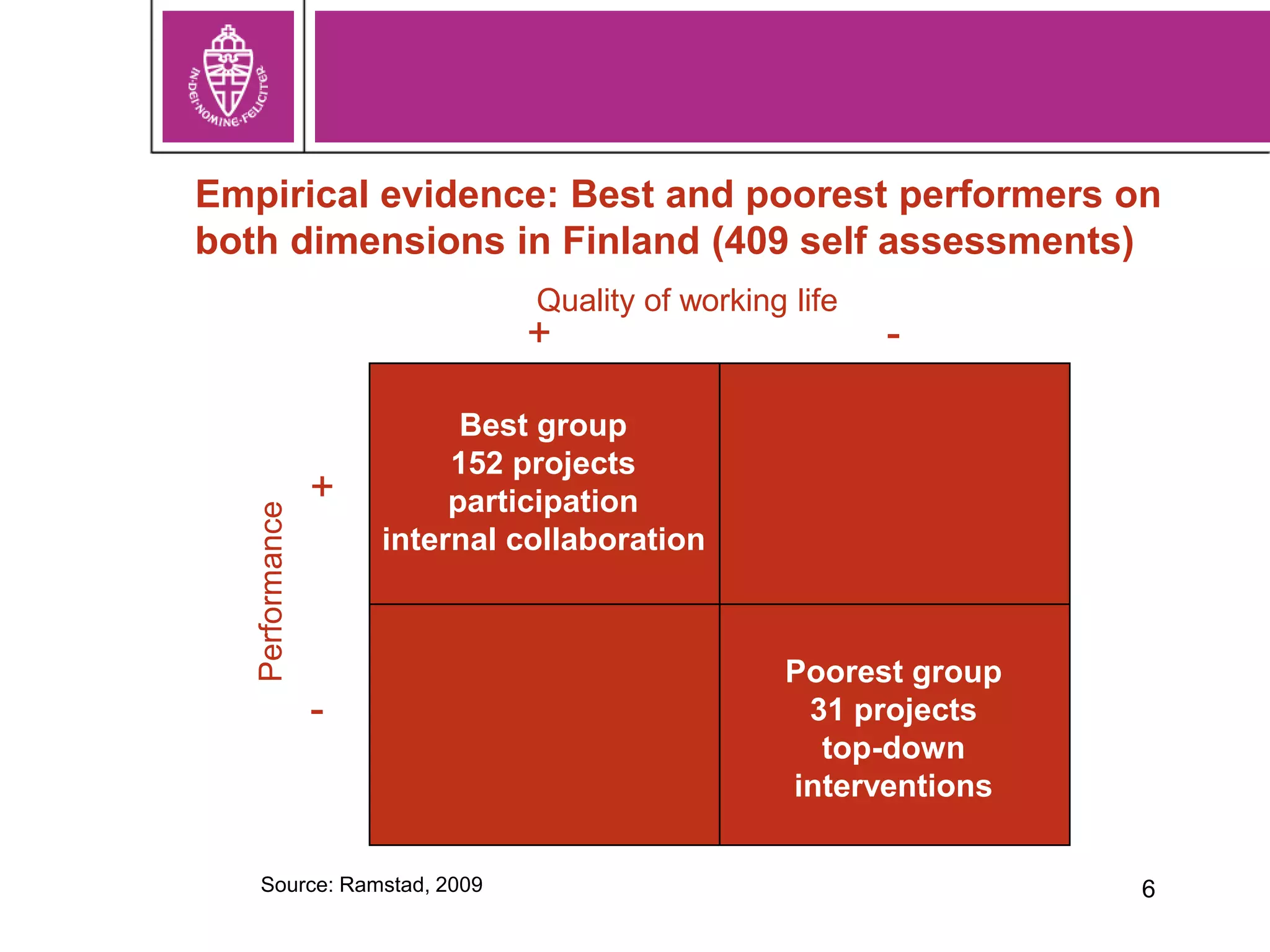
Empirical evidence: Best and poorest performers on
both dimensions in Finland (409 self assessments)
Poorest group
31 projects
top-down
interventions
Best group
152 projects
participation
internal collaboration
Performance
+
-
Source: Ramstad, 2009
Quality of working life
+ -
7
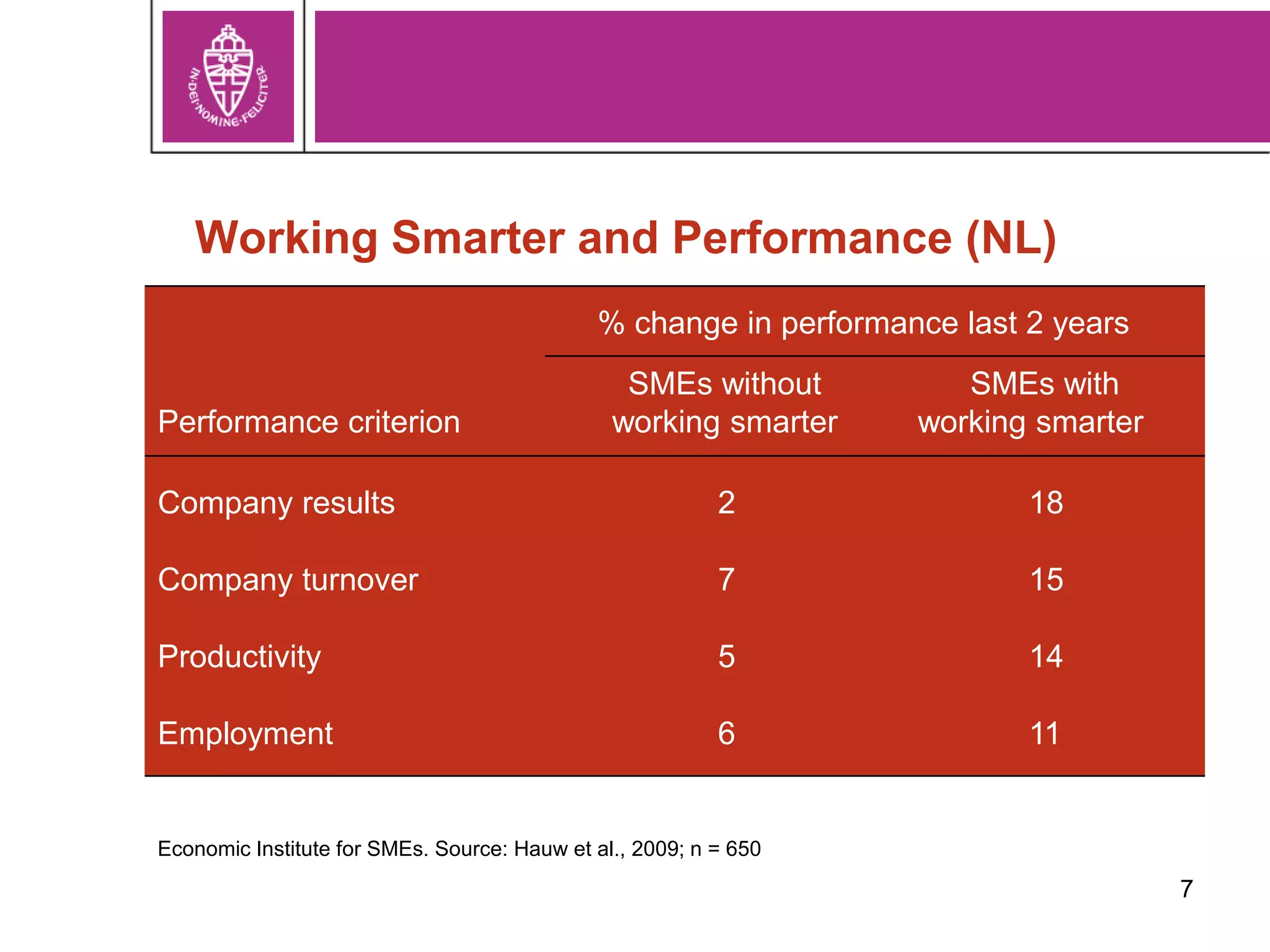
Working Smarter and Performance (NL)
Performance criterion
SMEs without
working smarter
SMEs with
working smarter
Company results 2 18
Company turnover 7 15
Productivity 5 14
Employment 6 11
Economic Institute for SMEs. Source: Hauw et al., 2009; n = 650
% change in performance last 2 years
8
Source: BISAM 2011/07, G.I.B. and G.I.B., 2013
5,7% 6 % (3,5)
37,4% 43,5 % (39)
65,7% 74,5 % (40,9)
58,1% 65 % (31,3)
12,1% 13,4 % (17,4)
17,4% 19,1 % (46,2)
17,8% 18,8 % (26)
13,5% 17,6 % (57,4)
20,9% 21,3 % (45,9)
19,1% 22,7 % (54,7)
31,5% 37,2 % (52,9)
34,7& 48,8% (56,8)
0% 25% 50% 75% 100%
Other
Higher product/service quality
Improved work organisation
Preserving employment
New technologies
Higher market share
New products/services
Higher profitability
Lower costs
Increased turnover
Increased productivity
Increased employability
Answers to the question about improvements as a result of
the potential-consultations
(consultations in Region NRW, Germany, 2010 actual, n=1.197and in
2012, n = 2.164) , actual and (expected)
Monitor Social Innovation Region Limburg
Maastricht University NL: Schumacher, Gerards, De Grip (2015)
• 141 organisations: in industry (56), commercial services
(62) and non commercial services (23); all sizes
• Pilllars/measurements: strategic orientation on social
innovation; speed of internal change; self-organising
capacity; talent development; investment in knowledge
base; employability
• Results: Social innovative organisations perform better:
 Higher growth of turnover
 Stronger development of new products and services
 A more comprehensive sustainability
 Lower sickness absenteeism
9
European Working Conditions Survey 2010
n = 2,048 (DK, IE, NL, FI, SE, UK). Source: Dhondt, Pot, Kraan 2014
10
11
Case Bronkhorst
Bronkhorst HIGH-TECH
in Ruurlo, the Netherlands
• Develops and produces thermal mass flow meters and
controllers (about 275 employees)
• Clients all over the world; surface treatment, process
industry, life sciences, automotive, bio-technology, etc.
• Continuous innovation of product technology and
manufacturing process
http://www.bronkhorst.com
12
Innovation of manufacturing process
• Demand flow
• Lean Manufacturing
• Workplace innovation
• Training on the job (developing
competences)
• Involvement
• Partner TNO
13
Results
• Productivity plus 20%
• Throughput time minus 30%
• More flexible work organisation
• Enthusiastic staff
Tourism SME’s in Catalonia
• Co-innovation results into increasing income and optimising
resources (n = 500).
• Co-innovative factors being:
 Internet use (input endowment and operational and
marketing activities
 Radically innovative products and services
 Work organisation factors (worker autonomy with regard to
proposing objectives and with regard to organising tasks,
teamwork and multi-role work practices
Source: Torrent, Ficapal-Cusi et al., 2015
14
Discussion
• Concept ‘workplace innovation’ has gained policy profile.
• Core characteristic: direct employee participation reflecting
combined interventions in work organisation, HRM, work
relations and supportive technologies
• All research shows wide variety of better performance
• Quality jobs contribute to competitiveness through higher
productivity and innovation capability. Win-win outcomes as
a creative convergence rather than a trade-off
• Research on organisational level focusses more on
performance than on QWL, which is mostly investigated on
individual level
• National or regional programmes can be supportive; social
partners should be leading, governments and research
institutes supporting
15
Next slides only if there is more time
16
17
Examples companies
SEMCO
18
SEMCO principles and values
• 6 Encourage creativity, giving support to the bold;
• 7 Encourage everyone's participation and question
decisions that are imposed from the top down;
• 8 Maintain an informal and pleasant environment, with a
professional attitude and free of preconceptions;
• 9 Maintain safe working conditions and control industrial
processes to protect our personnel and the environment;
• 10 Have the humility to recognize our errors and
understanding that we can always improve.
19
SEMCO survival manual
• Only people who respect their followers can be leaders
• It makes no difference whether someone has a high ranking
or a humble position. Philosophy is based on active
involvement, participation and trust.
• Whenever possible we rotate people: Some people change
area and other people change business unit. This is another
development opportunity
• The Semco Group believes that constant relationships with
unions are healthy for the company and the employees
• Flexible working hours where possible. Each person
controls their own working hours
• Occupational Safety is not only a company responsibility.
Keep your eyes open 20
Philips offices Bogota
21
From traditional to new work styles at Philips
• Slow, cumbersome
dissemination of knowledge.
• Complex, systematic,
orthodox and rigid work
structure
• Barriers separating units
and departments, even in
the same building.
• Communication forms: mail,
telephone, fax and e-mail.
•
• Face-to-face collaboration
• Instantaneous, multi access
knowledge sharing.
• Simple, flexible, mobile, fast
and unconventional work
structures
• Cross functional
collaboration and open
transparent spaces.
• Chat, group instant
messaging, video
conferencing and VoIP.
• Virtual teaming
22
Philips Workplace Innovation, world wide
• WPI Mission
• Contribute to accelerating growth by providing innovative,
effective and efficient work environments for Philips
employees supporting New Ways of Working.
• WPI Vision
• To deploy activity based working based on shared work
environments with
• cutting edge IT, a variety of work settings and to deliver on
our brand.
• “From control to trust. Output based empowerment”
23
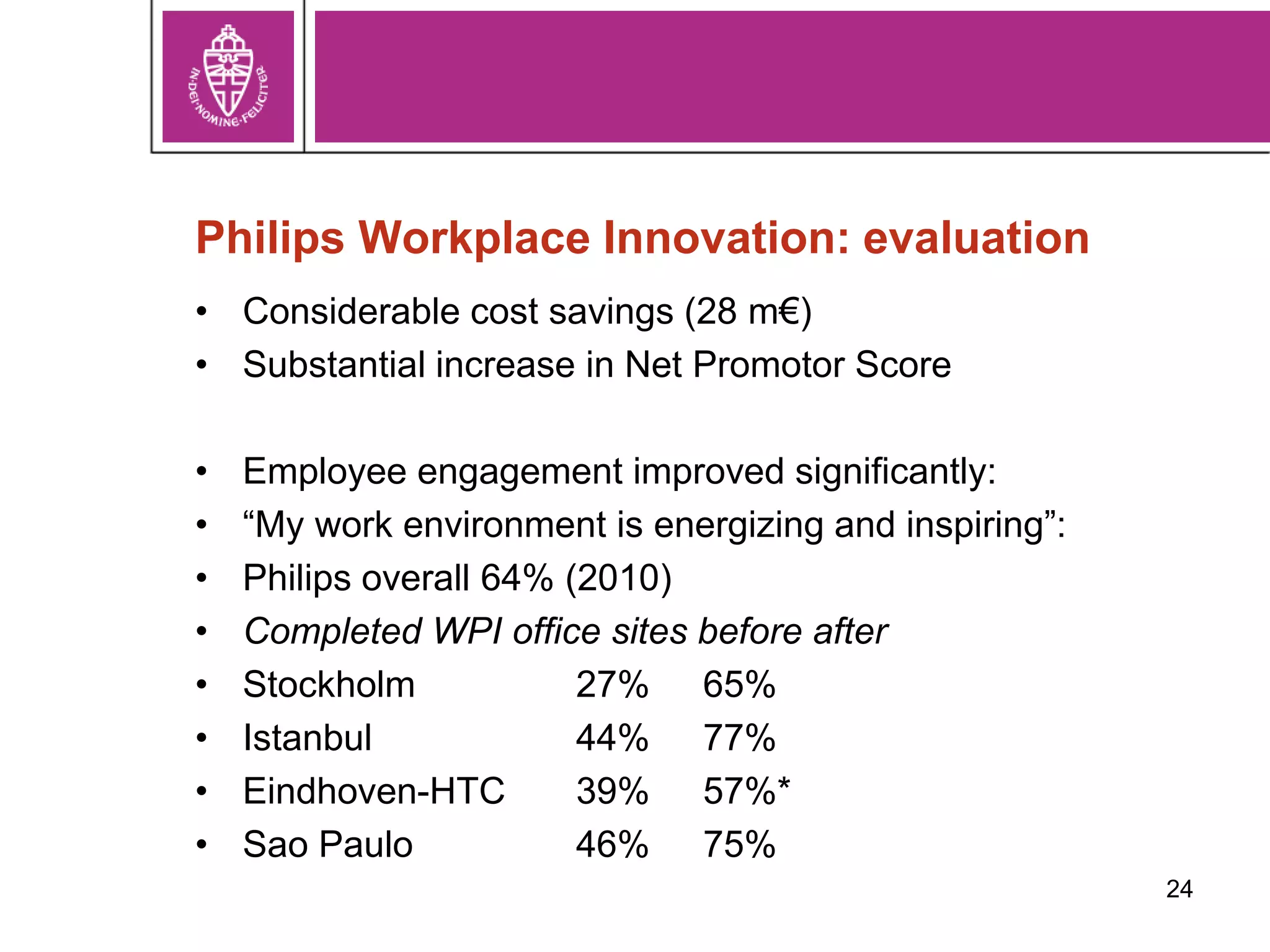
Philips Workplace Innovation: evaluation
• Considerable cost savings (28 m€)
• Substantial increase in Net Promotor Score
• Employee engagement improved significantly:
• “My work environment is energizing and inspiring”:
• Philips overall 64% (2010)
• Completed WPI office sites before after
• Stockholm 27% 65%
• Istanbul 44% 77%
• Eindhoven-HTC 39% 57%*
• Sao Paulo 46% 75%
24

Frank Pot_EUWIN

  • 1.
    1 Workplace Innovation for quality jobs and organisationalperformance Frank Pot “Gipuzkoa Workplace Innovation”, San Sebastian, 7 May 2015
  • 2.
    Concept workplace innovationused by • Eurofound, Dublin (2005 – recent EWCS, ECS, cases) • European Economic and Social Committee (opinion 2011) • European Commission (since 10 October 2012) • EU OSHA, Bilbao (since 2012) • European Parliament (18 December 2013) • IndustriAll ( Manifesto 2 April 2014) • English translation of Finnish, Flemish, Dutch and Basque programmes • National tripartite initiatives in UK and Ireland • OECD (also ‘innovative workplaces’) • Number of institutes in USA 2
  • 3.
    3 Societal relevance workplaceinnovation • Competitive economy: • Global competition and knowledge based economy  development of competences and skills needed • Future decreasing workforce  increasing labour productivity needed • General values • Democratic and prosperous society, societal wellbeing, good work • Economic model based on the ‘high road’ • ‘National’ programmes in Finland, Germany, Belgium, the Netherlands, Norway, UK, Ireland, Sweden, Basque Country
  • 4.
    Organisational relevance ofworkplace innovation • Workplace Innovation claims simultaneous improvement of organisational performance (in particular productivity and innovation capabilities) and quality of working life (learning opportunities, wellbeing, stress prevention). • Making new technology work through innovative work organisation • Workplace innovation explains a larger part of innovation success than technological innovation does • These claims are supported by a number of theories and research projects Unfortunately there is no time today to refer to those. The next slides give an impression. 4
  • 5.
    5 Overlap of OSHand workplace innovation Workplace innovation Health Wellbeing Performance Work organisation  HRM  Employment relationship  Ergonomics  Working times  Job autonomy Employability Involvement Comfort Work-life- balance
  • 6.
    6 Empirical evidence: Bestand poorest performers on both dimensions in Finland (409 self assessments) Poorest group 31 projects top-down interventions Best group 152 projects participation internal collaboration Performance + - Source: Ramstad, 2009 Quality of working life + -
  • 7.
    7 Working Smarter andPerformance (NL) Performance criterion SMEs without working smarter SMEs with working smarter Company results 2 18 Company turnover 7 15 Productivity 5 14 Employment 6 11 Economic Institute for SMEs. Source: Hauw et al., 2009; n = 650 % change in performance last 2 years
  • 8.
    8 Source: BISAM 2011/07,G.I.B. and G.I.B., 2013 5,7% 6 % (3,5) 37,4% 43,5 % (39) 65,7% 74,5 % (40,9) 58,1% 65 % (31,3) 12,1% 13,4 % (17,4) 17,4% 19,1 % (46,2) 17,8% 18,8 % (26) 13,5% 17,6 % (57,4) 20,9% 21,3 % (45,9) 19,1% 22,7 % (54,7) 31,5% 37,2 % (52,9) 34,7& 48,8% (56,8) 0% 25% 50% 75% 100% Other Higher product/service quality Improved work organisation Preserving employment New technologies Higher market share New products/services Higher profitability Lower costs Increased turnover Increased productivity Increased employability Answers to the question about improvements as a result of the potential-consultations (consultations in Region NRW, Germany, 2010 actual, n=1.197and in 2012, n = 2.164) , actual and (expected)
  • 9.
    Monitor Social InnovationRegion Limburg Maastricht University NL: Schumacher, Gerards, De Grip (2015) • 141 organisations: in industry (56), commercial services (62) and non commercial services (23); all sizes • Pilllars/measurements: strategic orientation on social innovation; speed of internal change; self-organising capacity; talent development; investment in knowledge base; employability • Results: Social innovative organisations perform better:  Higher growth of turnover  Stronger development of new products and services  A more comprehensive sustainability  Lower sickness absenteeism 9
  • 10.
    European Working ConditionsSurvey 2010 n = 2,048 (DK, IE, NL, FI, SE, UK). Source: Dhondt, Pot, Kraan 2014 10
  • 11.
    11 Case Bronkhorst Bronkhorst HIGH-TECH inRuurlo, the Netherlands • Develops and produces thermal mass flow meters and controllers (about 275 employees) • Clients all over the world; surface treatment, process industry, life sciences, automotive, bio-technology, etc. • Continuous innovation of product technology and manufacturing process http://www.bronkhorst.com
  • 12.
    12 Innovation of manufacturingprocess • Demand flow • Lean Manufacturing • Workplace innovation • Training on the job (developing competences) • Involvement • Partner TNO
  • 13.
    13 Results • Productivity plus20% • Throughput time minus 30% • More flexible work organisation • Enthusiastic staff
  • 14.
    Tourism SME’s inCatalonia • Co-innovation results into increasing income and optimising resources (n = 500). • Co-innovative factors being:  Internet use (input endowment and operational and marketing activities  Radically innovative products and services  Work organisation factors (worker autonomy with regard to proposing objectives and with regard to organising tasks, teamwork and multi-role work practices Source: Torrent, Ficapal-Cusi et al., 2015 14
  • 15.
    Discussion • Concept ‘workplaceinnovation’ has gained policy profile. • Core characteristic: direct employee participation reflecting combined interventions in work organisation, HRM, work relations and supportive technologies • All research shows wide variety of better performance • Quality jobs contribute to competitiveness through higher productivity and innovation capability. Win-win outcomes as a creative convergence rather than a trade-off • Research on organisational level focusses more on performance than on QWL, which is mostly investigated on individual level • National or regional programmes can be supportive; social partners should be leading, governments and research institutes supporting 15
  • 16.
    Next slides onlyif there is more time 16
  • 17.
  • 18.
  • 19.
    SEMCO principles andvalues • 6 Encourage creativity, giving support to the bold; • 7 Encourage everyone's participation and question decisions that are imposed from the top down; • 8 Maintain an informal and pleasant environment, with a professional attitude and free of preconceptions; • 9 Maintain safe working conditions and control industrial processes to protect our personnel and the environment; • 10 Have the humility to recognize our errors and understanding that we can always improve. 19
  • 20.
    SEMCO survival manual •Only people who respect their followers can be leaders • It makes no difference whether someone has a high ranking or a humble position. Philosophy is based on active involvement, participation and trust. • Whenever possible we rotate people: Some people change area and other people change business unit. This is another development opportunity • The Semco Group believes that constant relationships with unions are healthy for the company and the employees • Flexible working hours where possible. Each person controls their own working hours • Occupational Safety is not only a company responsibility. Keep your eyes open 20
  • 21.
  • 22.
    From traditional tonew work styles at Philips • Slow, cumbersome dissemination of knowledge. • Complex, systematic, orthodox and rigid work structure • Barriers separating units and departments, even in the same building. • Communication forms: mail, telephone, fax and e-mail. • • Face-to-face collaboration • Instantaneous, multi access knowledge sharing. • Simple, flexible, mobile, fast and unconventional work structures • Cross functional collaboration and open transparent spaces. • Chat, group instant messaging, video conferencing and VoIP. • Virtual teaming 22
  • 23.
    Philips Workplace Innovation,world wide • WPI Mission • Contribute to accelerating growth by providing innovative, effective and efficient work environments for Philips employees supporting New Ways of Working. • WPI Vision • To deploy activity based working based on shared work environments with • cutting edge IT, a variety of work settings and to deliver on our brand. • “From control to trust. Output based empowerment” 23
  • 24.
    Philips Workplace Innovation:evaluation • Considerable cost savings (28 m€) • Substantial increase in Net Promotor Score • Employee engagement improved significantly: • “My work environment is energizing and inspiring”: • Philips overall 64% (2010) • Completed WPI office sites before after • Stockholm 27% 65% • Istanbul 44% 77% • Eindhoven-HTC 39% 57%* • Sao Paulo 46% 75% 24