STEPHEN P. ROBBINS
PowerPoint Presentation by Charlie Cook
The University of West Alabama
MARY COULTER
© 2007 Prentice Hall, Inc.
All rights reserved.
Chapter
7 Foundations
of Planning
© 2007 Prentice Hall, Inc. All rights reserved. 7–2
What Is Planning?
• Planning
➢A primary managerial activity that involves:
❖ Defining the organization’s goals
❖ Establishing an overall strategy for achieving those goals
❖ Developing plans for organizational work activities.
➢Types of planning
❖ Informal: not written down, short-term focus; specific to an
organizational unit.
❖ Formal: written, specific, and long-term focus, involves
shared goals for the organization.
Why Do Managers Plan?
• Purposes of Planning
➢Provides direction
➢Reduces uncertainty
➢Minimizes waste and redundancy
➢Sets the standards for controlling
© 2007 Prentice Hall, Inc. All rights reserved. 7–3
© 2007 Prentice Hall, Inc. All rights reserved. 7–4
Planning and Performance
• The Relationship Between Planning And
Performance
➢Formal planning is associated with:
❖ Higher profits and returns on assets.
❖ Positive financial results.
➢The quality of planning and implementation affects
performance more than the extent of planning.
➢The external environment can reduce the impact of
planning on performance,
➢Formal planning must be used for several years
before planning begins to affect performance.
© 2007 Prentice Hall, Inc. All rights reserved. 7–5
How Do Managers Plan?
• Elements of Planning
➢Goals (also Objectives)
❖ Desired outcomes for individuals, groups, or entire
organizations
❖ Provide direction and evaluation performance criteria
➢Plans
❖ Documents that outline how goals are to be accomplished
❖ Describe how resources are to be allocated and establish
activity schedules
© 2007 Prentice Hall, Inc. All rights reserved. 7–6
Types of Goals
• Financial Goals
➢Are related to the expected internal financial
performance of the organization.
• Strategic Goals
➢Are related to the all other areas of an organization’s
performance.
• Stated Goals versus Real Goals
➢Official statements of what an organization says, what
it wants its shareholders to believe.
➢The goals an organization actually pursues, what
organizational members are doing.
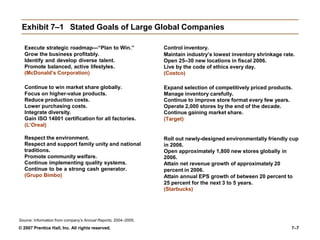
Exhibit 7–1 Stated Goals of Large Global Companies
Execute strategic roadmap—“Plan to Win.”
Grow the business profitably.
Identify and develop diverse talent.
Promote balanced, active lifestyles.
(McDonald’s Corporation)
Continue to win market share globally.
Focus on higher-value products.
Reduce production costs.
Lower purchasing costs.
Integrate diversity.
Gain ISO 14001 certification for all factories.
(L’Oreal)
Respect the environment.
Respect and support family unity and national
traditions.
Promote community welfare.
Continue implementing quality systems.
Continue to be a strong cash generator.
(Grupo Bimbo)
© 2007 Prentice Hall, Inc. All rights reserved. 7–7
Control inventory.
Maintain industry’s lowest inventory shrinkage rate.
Open 25–30 new locations in fiscal 2006.
Live by the code of ethics every day.
(Costco)
Expand selection of competitively priced products.
Manage inventory carefully.
Continue to improve store format every few years.
Operate 2,000 stores by the end of the decade.
Continue gaining market share.
(Target)
Roll out newly-designed environmentally friendly cup
in 2006.
Open approximately 1,800 new stores globally in
2006.
Attain net revenue growth of approximately 20
percent in 2006.
Attain annual EPS growth of between 20 percent to
25 percent for the next 3 to 5 years.
(Starbucks)
Source: Information from company’s Annual Reports, 2004–2005.
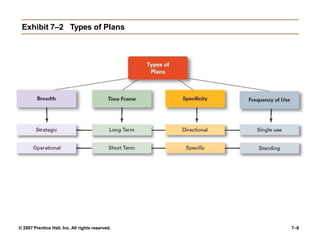
Exhibit 7–2 Types of Plans
© 2007 Prentice Hall, Inc. All rights reserved. 7–8
© 2007 Prentice Hall, Inc. All rights reserved. 7–9
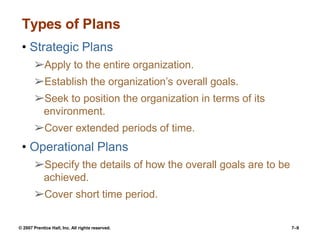
Types of Plans
• Strategic Plans
➢Apply to the entire organization.
➢Establish the organization’s overall goals.
➢Seek to position the organization in terms of its
environment.
➢Cover extended periods of time.
• Operational Plans
➢Specify the details of how the overall goals are to be
achieved.
➢Cover short time period.
© 2007 Prentice Hall, Inc. All rights reserved. 7–10
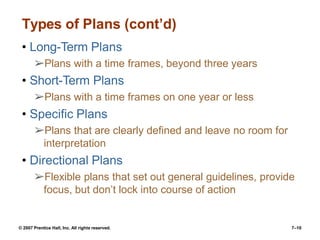
Types of Plans (cont’d)
• Long-Term Plans
➢Plans with a time frames, beyond three years
• Short-Term Plans
➢Plans with a time frames on one year or less
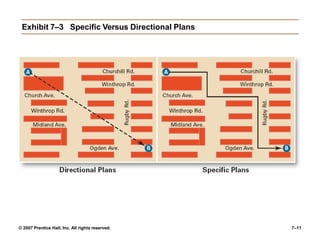
• Specific Plans
➢Plans that are clearly defined and leave no room for
interpretation
• Directional Plans
➢Flexible plans that set out general guidelines, provide
focus, but don’t lock into course of action
Exhibit 7–3 Specific Versus Directional Plans
© 2007 Prentice Hall, Inc. All rights reserved. 7–11
© 2007 Prentice Hall, Inc. All rights reserved. 7–12
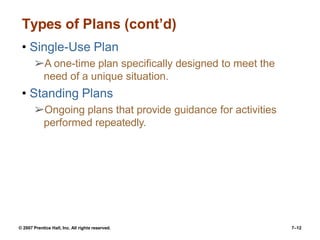
Types of Plans (cont’d)
• Single-Use Plan
➢A one-time plan specifically designed to meet the
need of a unique situation.
• Standing Plans
➢Ongoing plans that provide guidance for activities
performed repeatedly.
© 2007 Prentice Hall, Inc. All rights reserved. 7–13
Establishing Goals and
Developing Plans
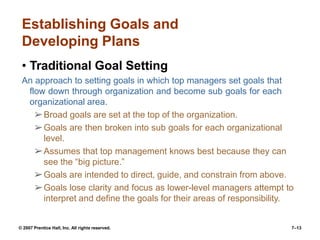
• Traditional Goal Setting
An approach to setting goals in which top managers set goals that
flow down through organization and become sub goals for each
organizational area.
➢Broad goals are set at the top of the organization.
➢Goals are then broken into sub goals for each organizational
level.
➢Assumes that top management knows best because they can
see the “big picture.”
➢Goals are intended to direct, guide, and constrain from above.
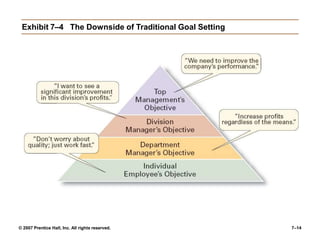
➢Goals lose clarity and focus as lower-level managers attempt to
interpret and define the goals for their areas of responsibility.
Exhibit 7–4 The Downside of Traditional Goal Setting
© 2007 Prentice Hall, Inc. All rights reserved. 7–14
© 2007 Prentice Hall, Inc. All rights reserved. 7–15
Establishing Goals and Developing
Plans (cont’d)
• Maintaining the Hierarchy of Goals
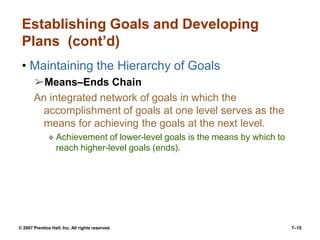
➢Means–Ends Chain
An integrated network of goals in which the
accomplishment of goals at one level serves as the
means for achieving the goals at the next level.
❖ Achievement of lower-level goals is the means by which to
reach higher-level goals (ends).
© 2007 Prentice Hall, Inc. All rights reserved. 7–16
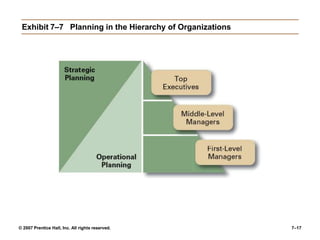
Developing Plans
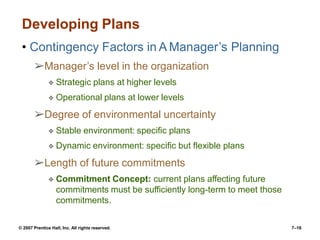
• Contingency Factors in A Manager’s Planning
➢Manager’s level in the organization
❖ Strategic plans at higher levels
❖ Operational plans at lower levels
➢Degree of environmental uncertainty
❖ Stable environment: specific plans
❖ Dynamic environment: specific but flexible plans
➢Length of future commitments
❖ Commitment Concept: current plans affecting future
commitments must be sufficiently long-term to meet those
commitments.
Exhibit 7–7 Planning in the Hierarchy of Organizations
© 2007 Prentice Hall, Inc. All rights reserved. 7–17
© 2007 Prentice Hall, Inc. All rights reserved. 7–18
Approaches to Planning
• Establishing a formal planning department
➢A group of planning specialists who help managers
write organizational plans.
➢Planning is a function of management; it should never
become the sole responsibility of planners.
• Involving organizational members in the process
➢Plans are developed by members of organizational
units at various levels and then coordinated with other
units across the organization.
© 2007 Prentice Hall, Inc. All rights reserved. 7–19
Contemporary Issues in Planning
• Criticisms of Planning
➢Planning may create rigidity.
➢Plans cannot be developed for dynamic
environments.
➢Formal plans cannot replace intuition and creativity.
➢Planning focuses managers’ attention on today’s
competition not tomorrow’s survival.
➢Formal planning reinforces today’s success, which
may lead to tomorrow’s failure.

Foundations of Planning.pptx

  • 1.
    STEPHEN P. ROBBINS PowerPointPresentation by Charlie Cook The University of West Alabama MARY COULTER © 2007 Prentice Hall, Inc. All rights reserved. Chapter 7 Foundations of Planning
  • 2.
    © 2007 PrenticeHall, Inc. All rights reserved. 7–2 What Is Planning? • Planning ➢A primary managerial activity that involves: ❖ Defining the organization’s goals ❖ Establishing an overall strategy for achieving those goals ❖ Developing plans for organizational work activities. ➢Types of planning ❖ Informal: not written down, short-term focus; specific to an organizational unit. ❖ Formal: written, specific, and long-term focus, involves shared goals for the organization.
  • 3.
    Why Do ManagersPlan? • Purposes of Planning ➢Provides direction ➢Reduces uncertainty ➢Minimizes waste and redundancy ➢Sets the standards for controlling © 2007 Prentice Hall, Inc. All rights reserved. 7–3
  • 4.
    © 2007 PrenticeHall, Inc. All rights reserved. 7–4 Planning and Performance • The Relationship Between Planning And Performance ➢Formal planning is associated with: ❖ Higher profits and returns on assets. ❖ Positive financial results. ➢The quality of planning and implementation affects performance more than the extent of planning. ➢The external environment can reduce the impact of planning on performance, ➢Formal planning must be used for several years before planning begins to affect performance.
  • 5.
    © 2007 PrenticeHall, Inc. All rights reserved. 7–5 How Do Managers Plan? • Elements of Planning ➢Goals (also Objectives) ❖ Desired outcomes for individuals, groups, or entire organizations ❖ Provide direction and evaluation performance criteria ➢Plans ❖ Documents that outline how goals are to be accomplished ❖ Describe how resources are to be allocated and establish activity schedules
  • 6.
    © 2007 PrenticeHall, Inc. All rights reserved. 7–6 Types of Goals • Financial Goals ➢Are related to the expected internal financial performance of the organization. • Strategic Goals ➢Are related to the all other areas of an organization’s performance. • Stated Goals versus Real Goals ➢Official statements of what an organization says, what it wants its shareholders to believe. ➢The goals an organization actually pursues, what organizational members are doing.
  • 7.
    Exhibit 7–1 StatedGoals of Large Global Companies Execute strategic roadmap—“Plan to Win.” Grow the business profitably. Identify and develop diverse talent. Promote balanced, active lifestyles. (McDonald’s Corporation) Continue to win market share globally. Focus on higher-value products. Reduce production costs. Lower purchasing costs. Integrate diversity. Gain ISO 14001 certification for all factories. (L’Oreal) Respect the environment. Respect and support family unity and national traditions. Promote community welfare. Continue implementing quality systems. Continue to be a strong cash generator. (Grupo Bimbo) © 2007 Prentice Hall, Inc. All rights reserved. 7–7 Control inventory. Maintain industry’s lowest inventory shrinkage rate. Open 25–30 new locations in fiscal 2006. Live by the code of ethics every day. (Costco) Expand selection of competitively priced products. Manage inventory carefully. Continue to improve store format every few years. Operate 2,000 stores by the end of the decade. Continue gaining market share. (Target) Roll out newly-designed environmentally friendly cup in 2006. Open approximately 1,800 new stores globally in 2006. Attain net revenue growth of approximately 20 percent in 2006. Attain annual EPS growth of between 20 percent to 25 percent for the next 3 to 5 years. (Starbucks) Source: Information from company’s Annual Reports, 2004–2005.
  • 8.
    Exhibit 7–2 Typesof Plans © 2007 Prentice Hall, Inc. All rights reserved. 7–8
  • 9.
    © 2007 PrenticeHall, Inc. All rights reserved. 7–9 Types of Plans • Strategic Plans ➢Apply to the entire organization. ➢Establish the organization’s overall goals. ➢Seek to position the organization in terms of its environment. ➢Cover extended periods of time. • Operational Plans ➢Specify the details of how the overall goals are to be achieved. ➢Cover short time period.
  • 10.
    © 2007 PrenticeHall, Inc. All rights reserved. 7–10 Types of Plans (cont’d) • Long-Term Plans ➢Plans with a time frames, beyond three years • Short-Term Plans ➢Plans with a time frames on one year or less • Specific Plans ➢Plans that are clearly defined and leave no room for interpretation • Directional Plans ➢Flexible plans that set out general guidelines, provide focus, but don’t lock into course of action
  • 11.
    Exhibit 7–3 SpecificVersus Directional Plans © 2007 Prentice Hall, Inc. All rights reserved. 7–11
  • 12.
    © 2007 PrenticeHall, Inc. All rights reserved. 7–12 Types of Plans (cont’d) • Single-Use Plan ➢A one-time plan specifically designed to meet the need of a unique situation. • Standing Plans ➢Ongoing plans that provide guidance for activities performed repeatedly.
  • 13.
    © 2007 PrenticeHall, Inc. All rights reserved. 7–13 Establishing Goals and Developing Plans • Traditional Goal Setting An approach to setting goals in which top managers set goals that flow down through organization and become sub goals for each organizational area. ➢Broad goals are set at the top of the organization. ➢Goals are then broken into sub goals for each organizational level. ➢Assumes that top management knows best because they can see the “big picture.” ➢Goals are intended to direct, guide, and constrain from above. ➢Goals lose clarity and focus as lower-level managers attempt to interpret and define the goals for their areas of responsibility.
  • 14.
    Exhibit 7–4 TheDownside of Traditional Goal Setting © 2007 Prentice Hall, Inc. All rights reserved. 7–14
  • 15.
    © 2007 PrenticeHall, Inc. All rights reserved. 7–15 Establishing Goals and Developing Plans (cont’d) • Maintaining the Hierarchy of Goals ➢Means–Ends Chain An integrated network of goals in which the accomplishment of goals at one level serves as the means for achieving the goals at the next level. ❖ Achievement of lower-level goals is the means by which to reach higher-level goals (ends).
  • 16.
    © 2007 PrenticeHall, Inc. All rights reserved. 7–16 Developing Plans • Contingency Factors in A Manager’s Planning ➢Manager’s level in the organization ❖ Strategic plans at higher levels ❖ Operational plans at lower levels ➢Degree of environmental uncertainty ❖ Stable environment: specific plans ❖ Dynamic environment: specific but flexible plans ➢Length of future commitments ❖ Commitment Concept: current plans affecting future commitments must be sufficiently long-term to meet those commitments.
  • 17.
    Exhibit 7–7 Planningin the Hierarchy of Organizations © 2007 Prentice Hall, Inc. All rights reserved. 7–17
  • 18.
    © 2007 PrenticeHall, Inc. All rights reserved. 7–18 Approaches to Planning • Establishing a formal planning department ➢A group of planning specialists who help managers write organizational plans. ➢Planning is a function of management; it should never become the sole responsibility of planners. • Involving organizational members in the process ➢Plans are developed by members of organizational units at various levels and then coordinated with other units across the organization.
  • 19.
    © 2007 PrenticeHall, Inc. All rights reserved. 7–19 Contemporary Issues in Planning • Criticisms of Planning ➢Planning may create rigidity. ➢Plans cannot be developed for dynamic environments. ➢Formal plans cannot replace intuition and creativity. ➢Planning focuses managers’ attention on today’s competition not tomorrow’s survival. ➢Formal planning reinforces today’s success, which may lead to tomorrow’s failure.