Formation of the Solar System

 1) The Nebular Theory: The theory that our solar
   system formed from a swirling mass of gas and dust.

    a. Nebula: Any large cloud of interstellar gas and dust.

    b. The Nebular theory was one of the first heliocentric
      theories for the formation of the solar system.


    c. In Nebular Theory, a nebula (called the solar nebula),
      collapsed in on its own gravity, forming a disc. Over time
      the disc developed Protoplanets in rings around a Protosun,
      a hot ball of gas well on its way to becoming the sun.
    d. Over time the material clumped together further to form the
      planets and eventually the sun.
e. What this Explained
  - Almost all objects formed in the same disc they all
    now revolve in the plane of the ecliptic
  - Almost objects rotate the same direction (except
    Venus) as the sun rotates on its axis.
  - Almost all objects revolve around the sun in the
    same direction the sun rotates
 f. What this didn't explain
   - Why the solar system is highly differentiated
   - The existence of the Asteroid Belt.
   - The existence of Comets
2. Condensation Theory: The modern version of the
  Nebular Theory.

        A. The solar system formed from a large
         spinning cloud of gas and dust, called the
         solar nebula.

        B. Once gravity pulled it to a diameter of less
         then 100au, the solar nebula had become a
         wide rotating disc.
C. Planet Formation

   1) Accretion: The process by which dust particles
   stick together to form larger partials, called
   planetesimals about the size of small moons.
      Imagine a snowball thrown through a blizzard.
      Getting larger as it hits other snowflakes

 2) Planetesimals collided and formed larger
   bodies called protoplanets.

3) The four largest protoplanets became the Jovian
  planets and the four smallest the Terrestrial Planets.
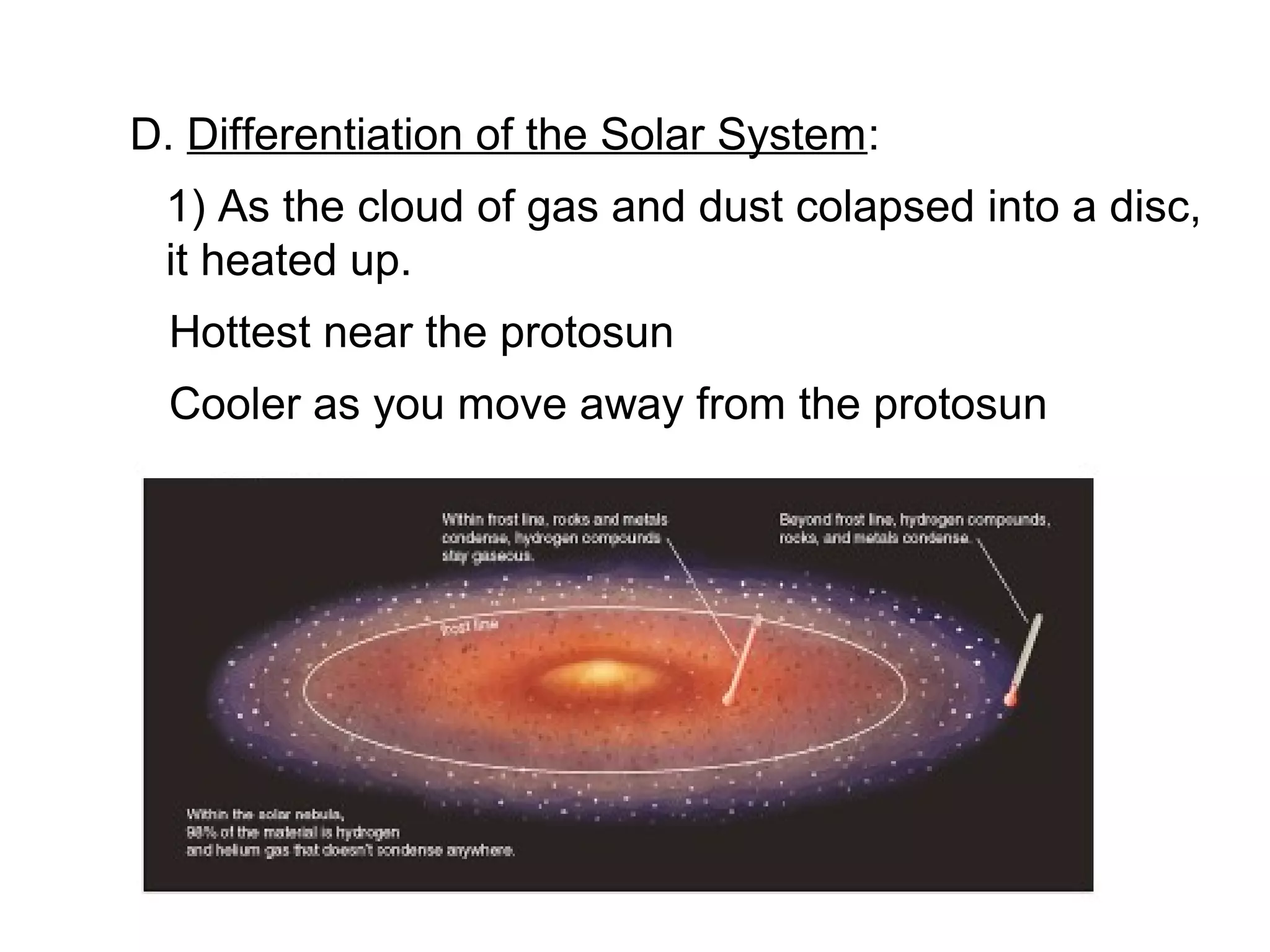
D. Differentiation of the Solar System:
 1) As the cloud of gas and dust colapsed into a disc,
 it heated up.
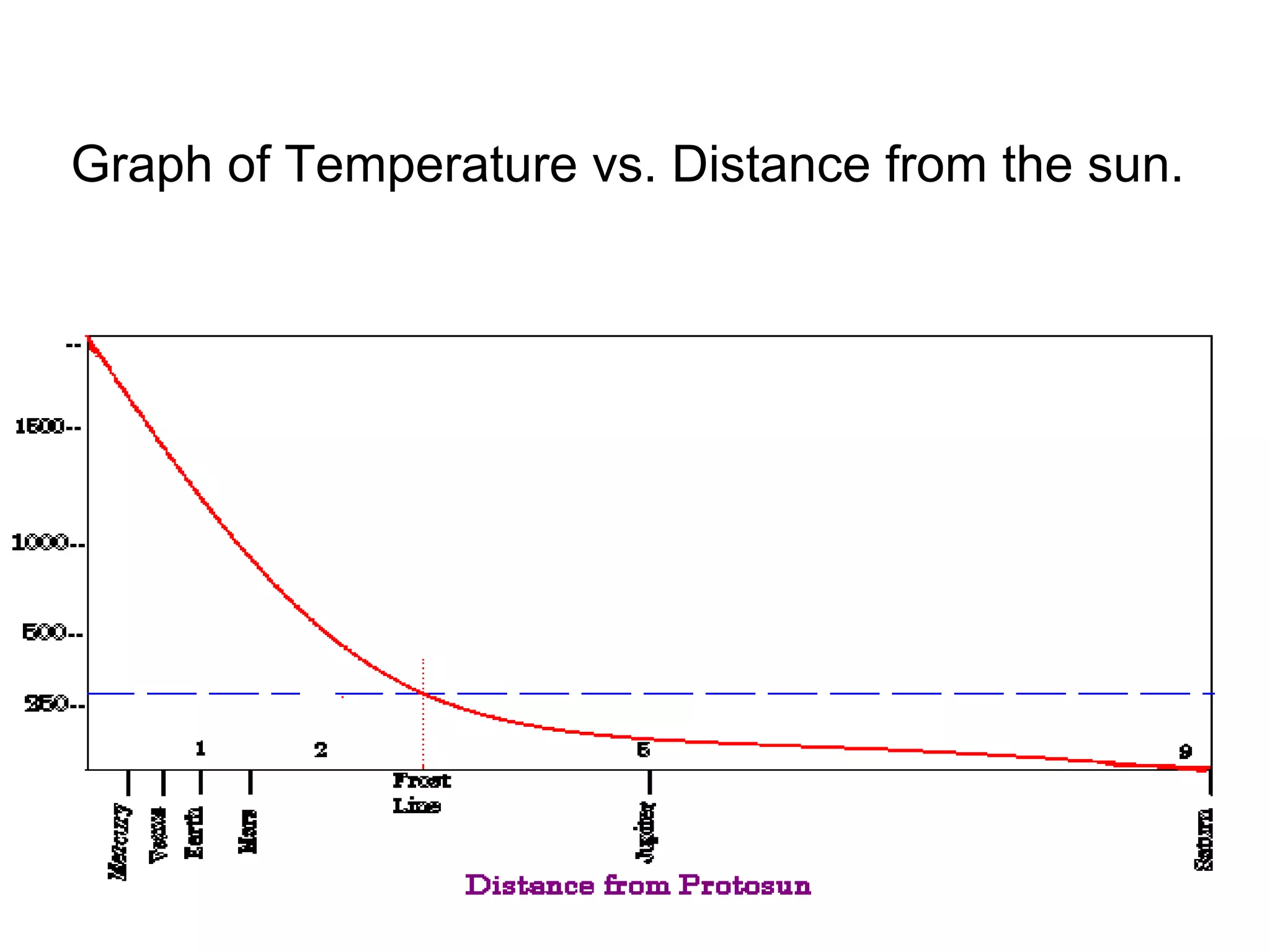
  Hottest near the protosun
  Cooler as you move away from the protosun
Graph of Temperature vs. Distance from the sun.
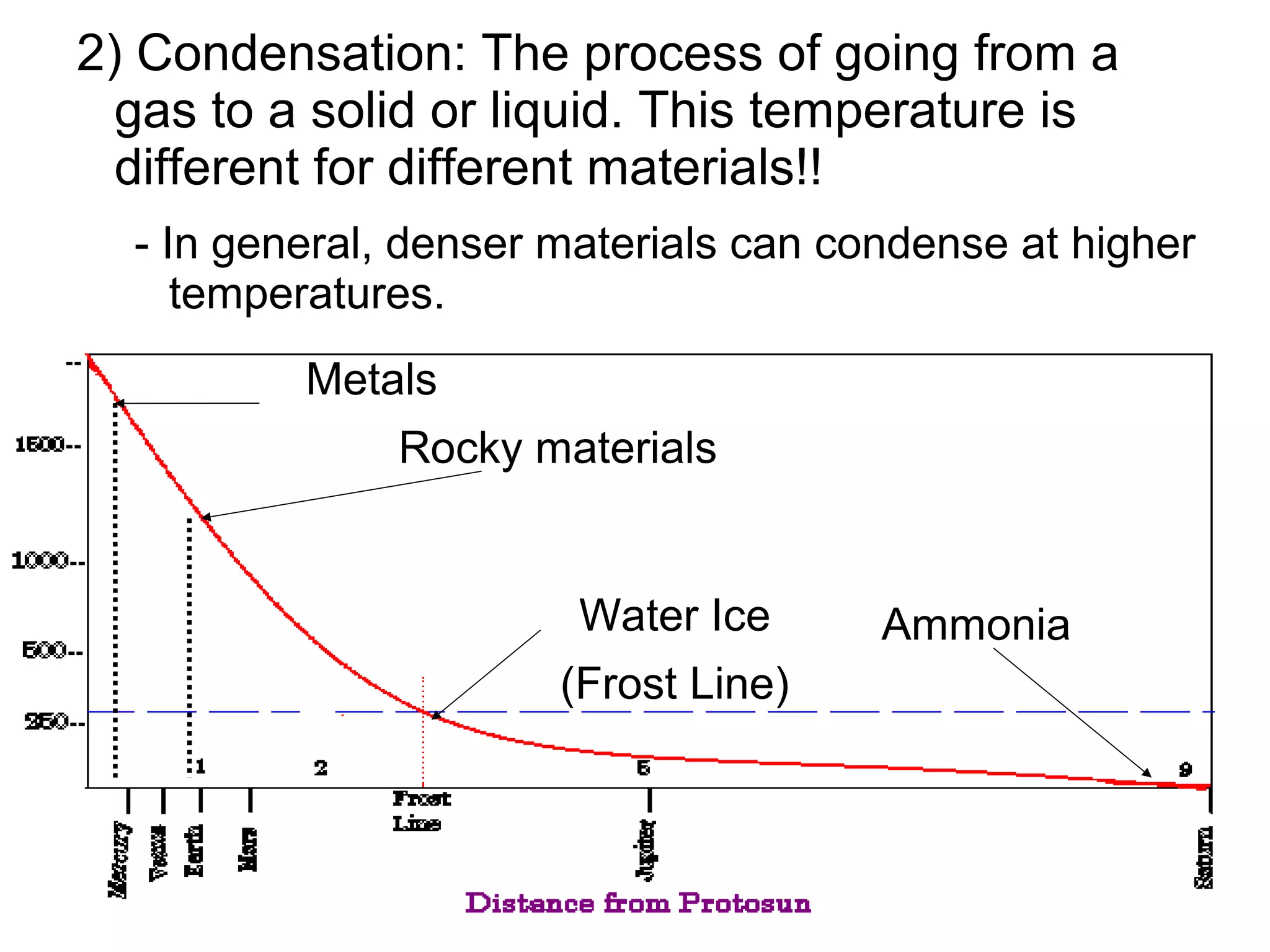
2) Condensation: The process of going from a
  gas to a solid or liquid. This temperature is
  different for different materials!!
  - In general, denser materials can condense at higher
     temperatures.
          Metals
               Rocky materials


                        Water Ice      Ammonia
                       (Frost Line)
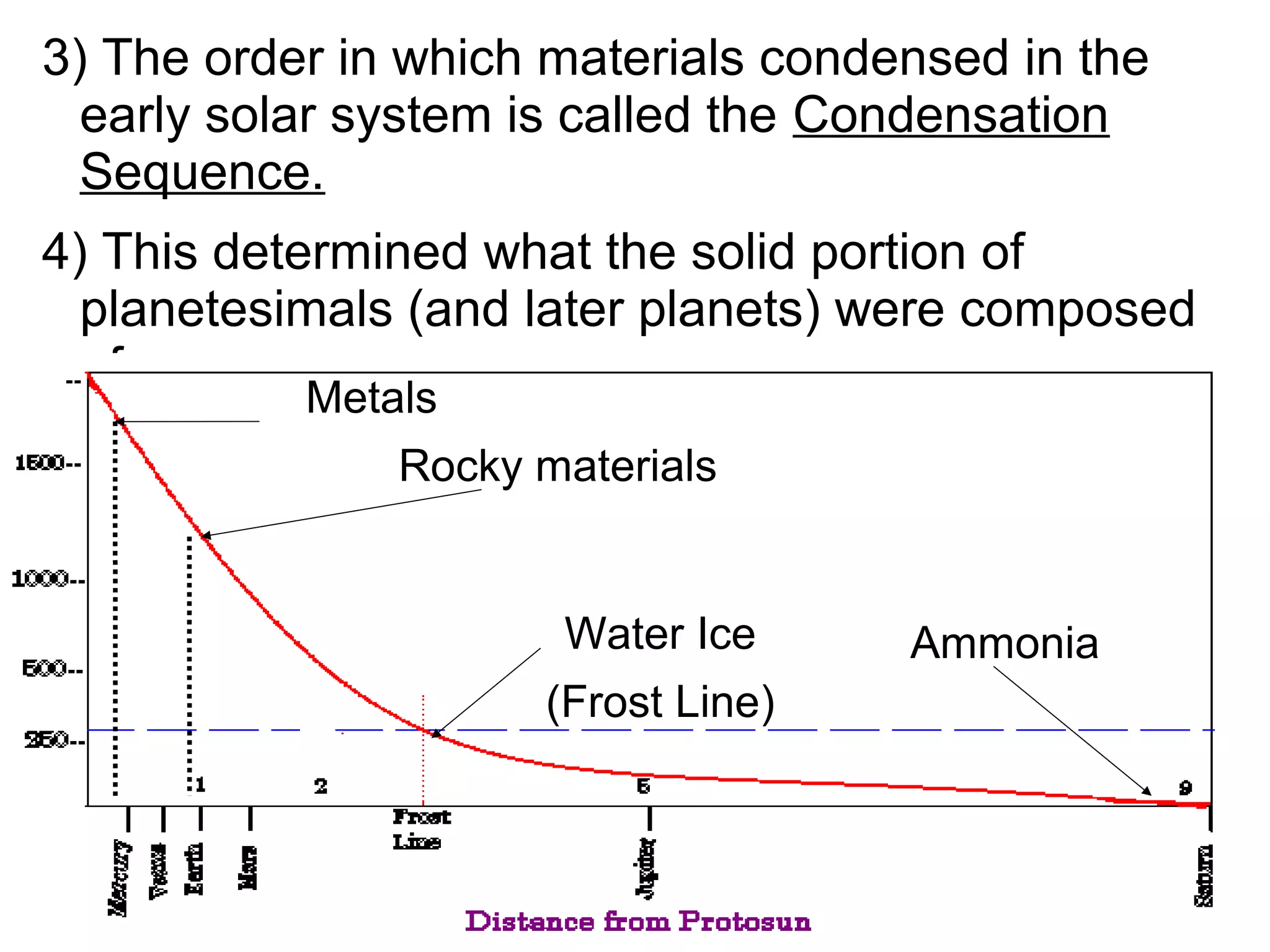
3) The order in which materials condensed in the
  early solar system is called the Condensation
  Sequence.
4) This determined what the solid portion of
  planetesimals (and later planets) were composed
  of.
           Metals
               Rocky materials


                      Water Ice      Ammonia
                     (Frost Line)
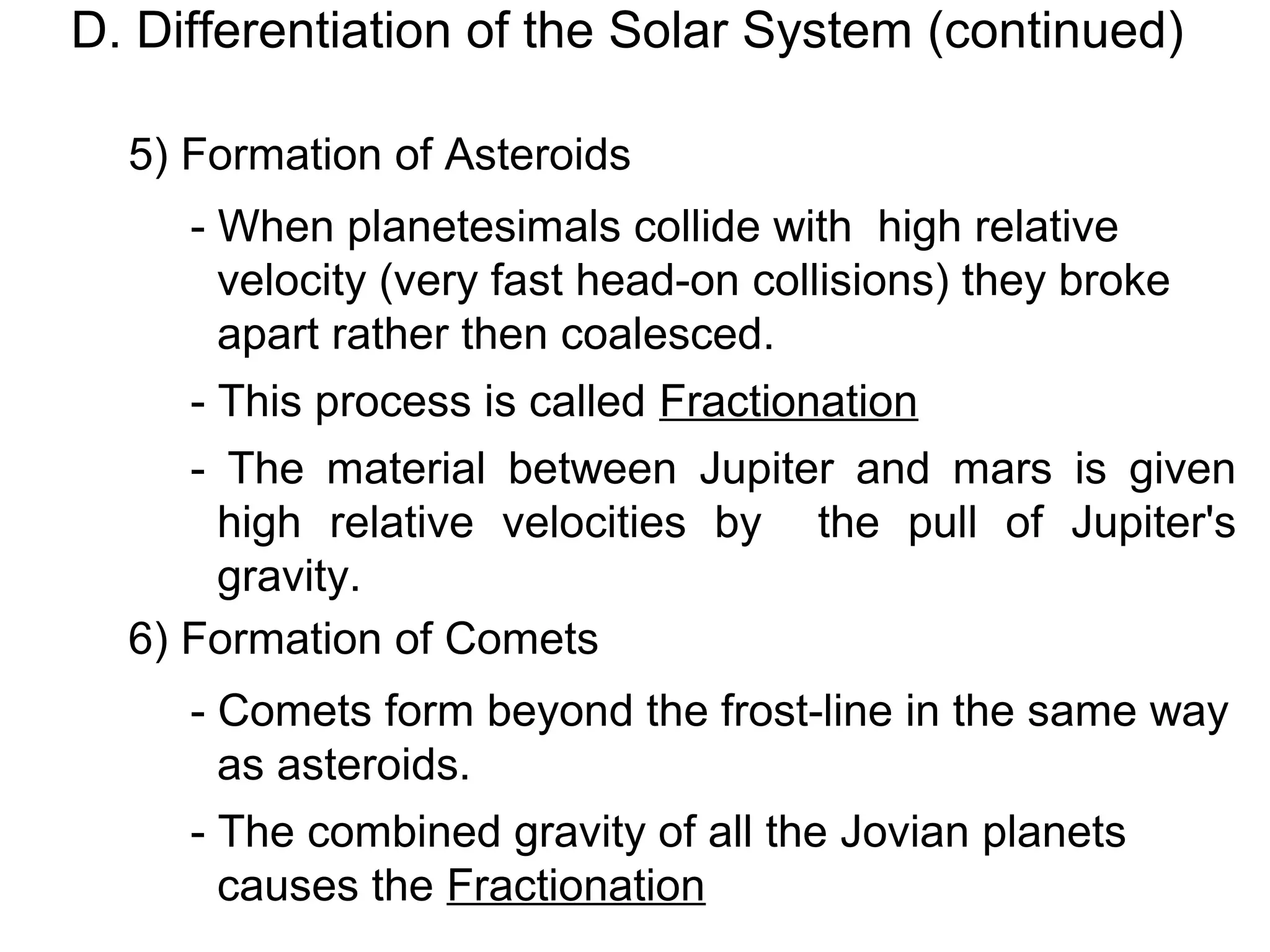
D. Differentiation of the Solar System (continued)

  5) Formation of Asteroids
     - When planetesimals collide with high relative
       velocity (very fast head-on collisions) they broke
       apart rather then coalesced.
     - This process is called Fractionation
     - The material between Jupiter and mars is given
       high relative velocities by the pull of Jupiter's
       gravity.
  6) Formation of Comets
     - Comets form beyond the frost-line in the same way
       as asteroids.
     - The combined gravity of all the Jovian planets
       causes the Fractionation
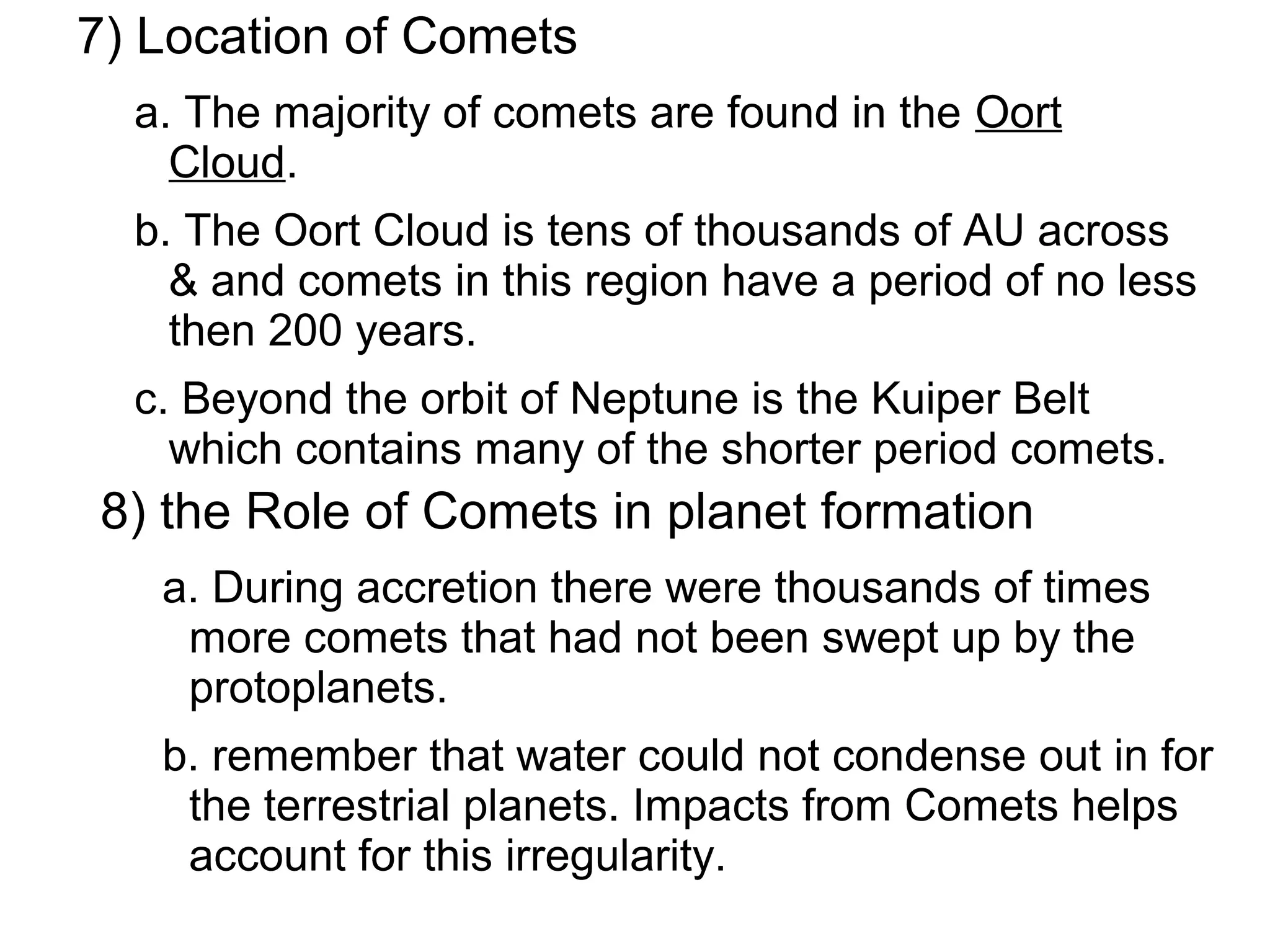
7) Location of Comets
  a. The majority of comets are found in the Oort
    Cloud.
  b. The Oort Cloud is tens of thousands of AU across
    & and comets in this region have a period of no less
    then 200 years.
  c. Beyond the orbit of Neptune is the Kuiper Belt
    which contains many of the shorter period comets.
8) the Role of Comets in planet formation
   a. During accretion there were thousands of times
    more comets that had not been swept up by the
    protoplanets.
   b. remember that water could not condense out in for
    the terrestrial planets. Impacts from Comets helps
    account for this irregularity.
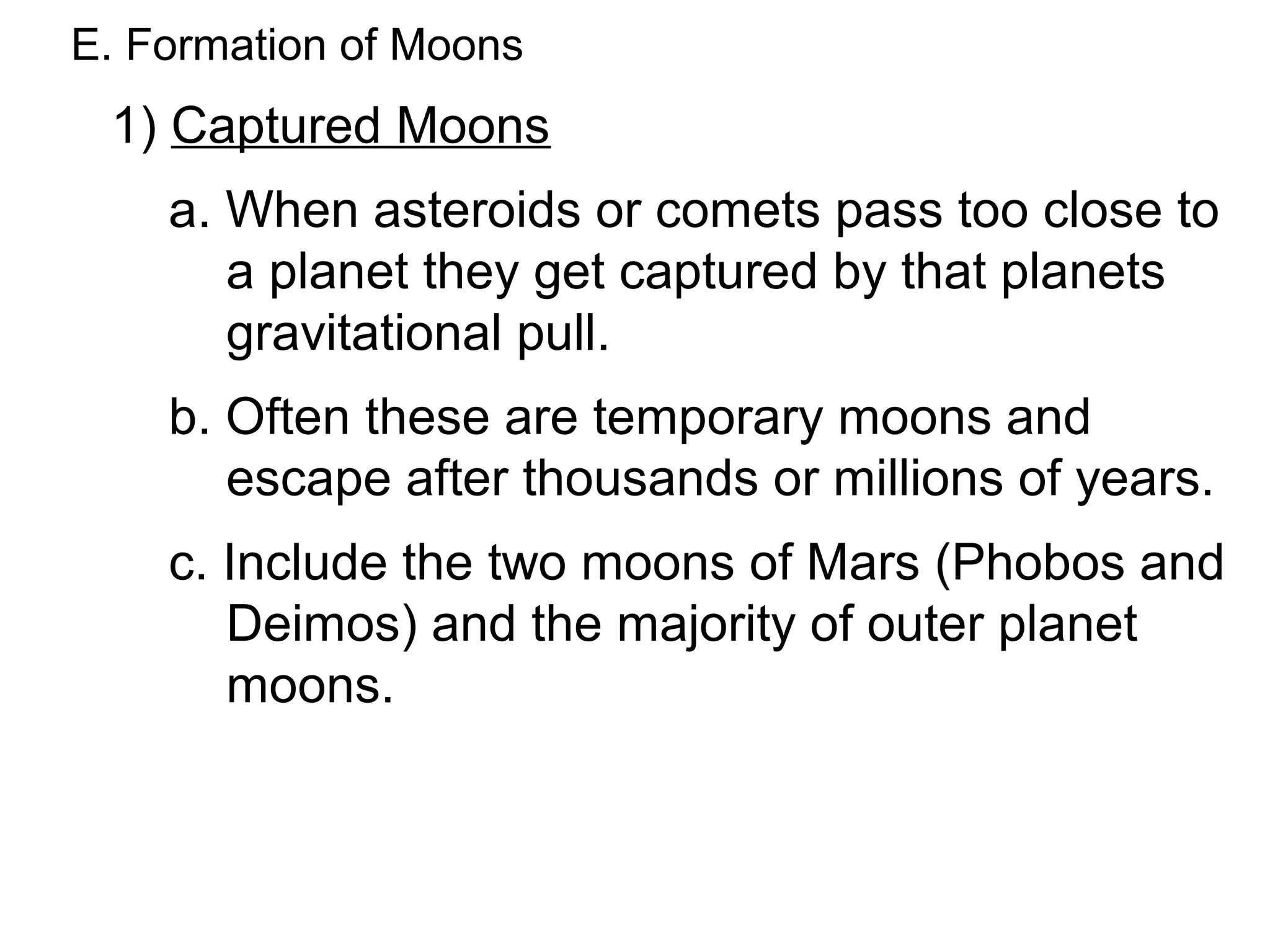
E. Formation of Moons
 1) Captured Moons
    a. When asteroids or comets pass too close to
       a planet they get captured by that planets
       gravitational pull.
    b. Often these are temporary moons and
       escape after thousands or millions of years.
    c. Include the two moons of Mars (Phobos and
       Deimos) and the majority of outer planet
       moons.
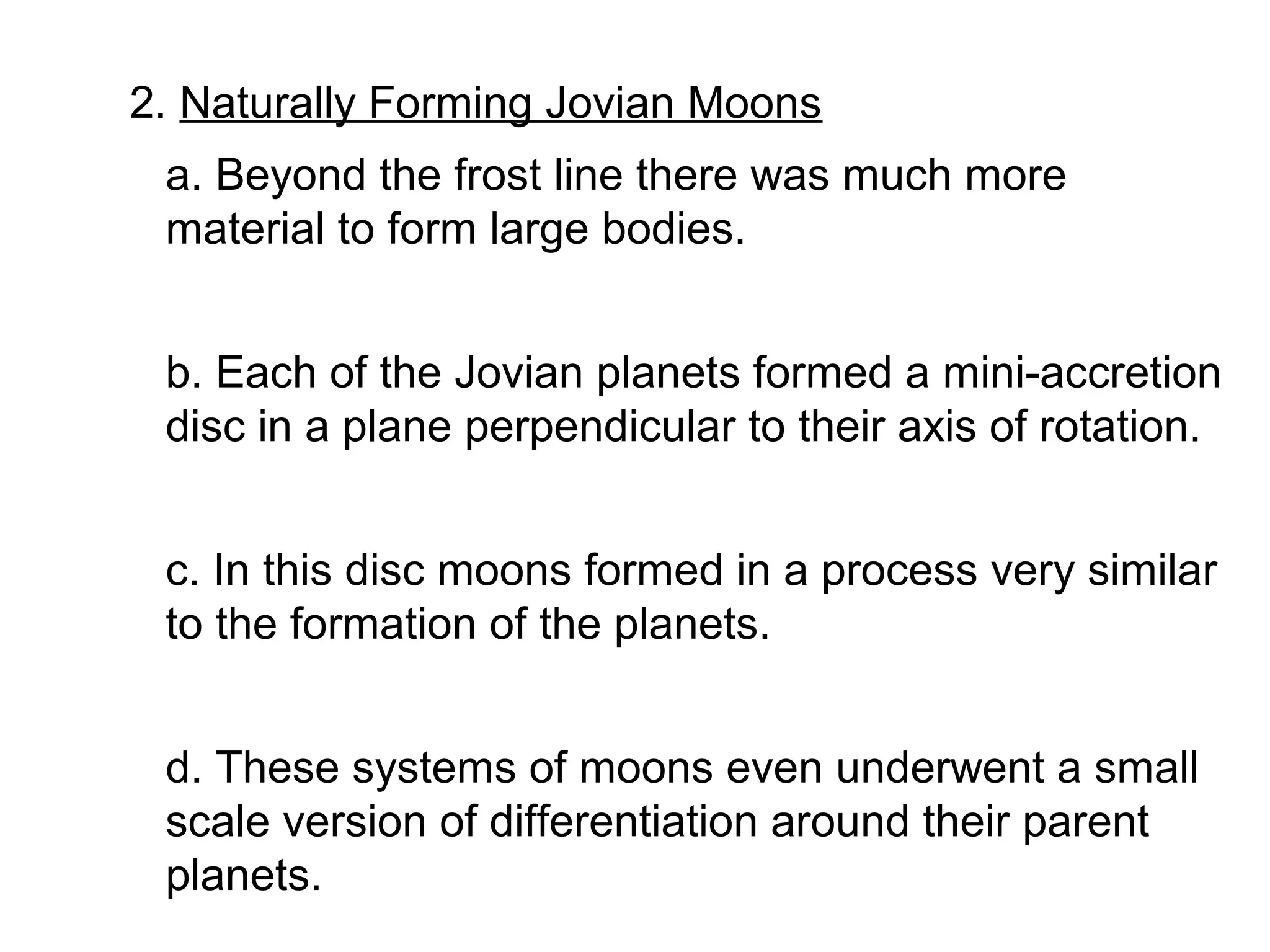
2. Naturally Forming Jovian Moons
 a. Beyond the frost line there was much more
 material to form large bodies.


 b. Each of the Jovian planets formed a mini-accretion
 disc in a plane perpendicular to their axis of rotation.


 c. In this disc moons formed in a process very similar
 to the formation of the planets.


 d. These systems of moons even underwent a small
 scale version of differentiation around their parent
 planets.
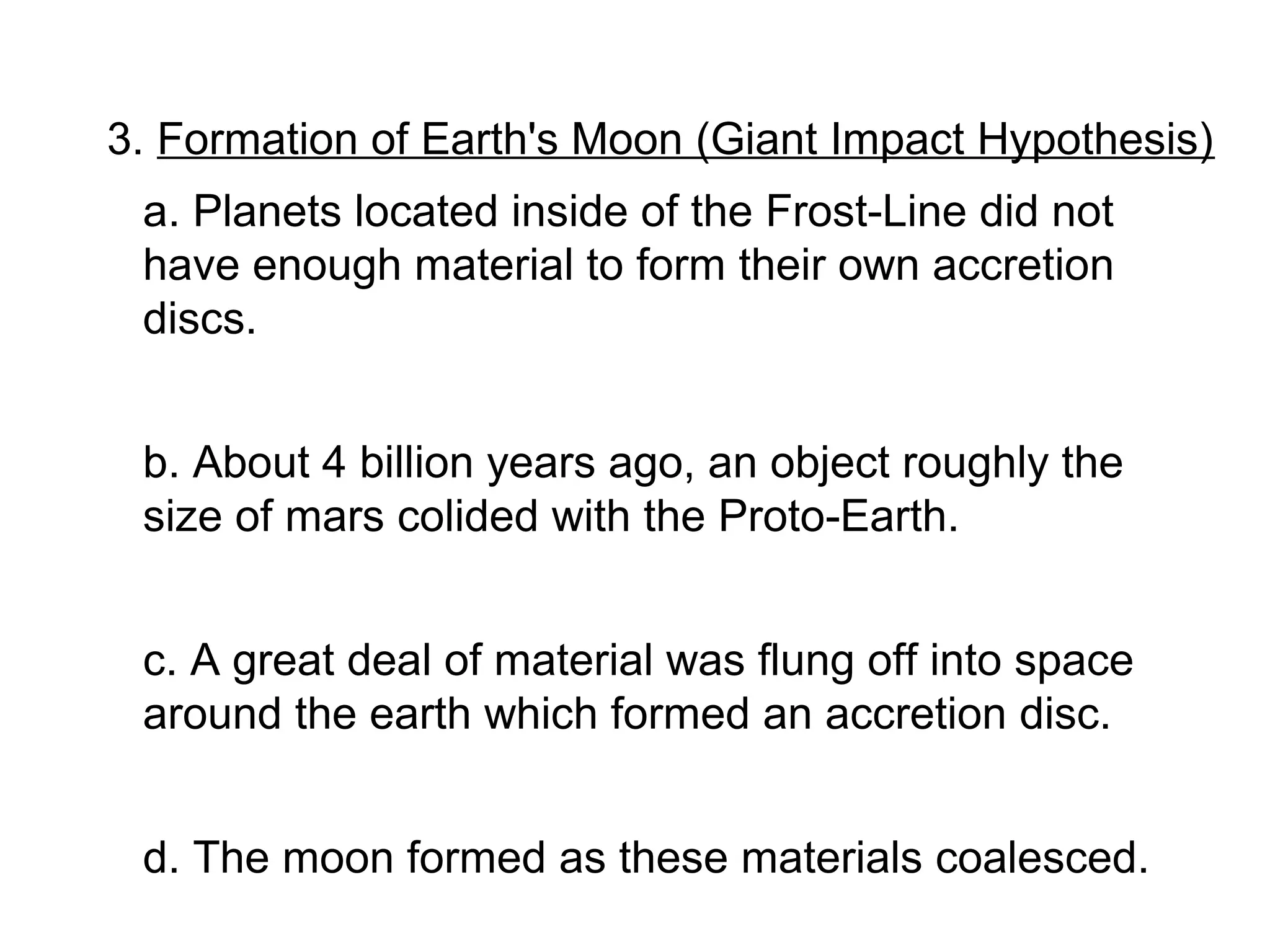
3. Formation of Earth's Moon (Giant Impact Hypothesis)
 a. Planets located inside of the Frost-Line did not
 have enough material to form their own accretion
 discs.


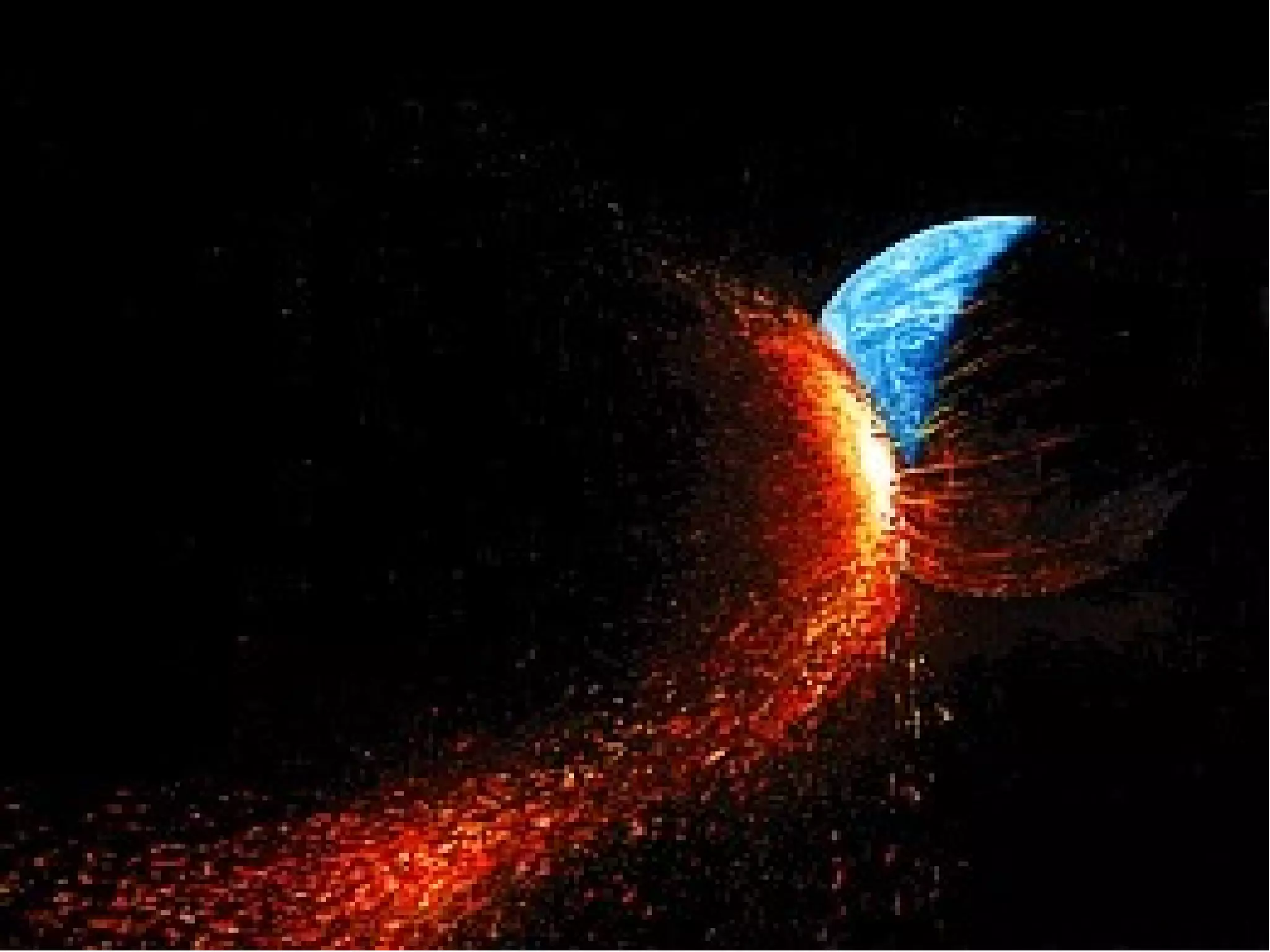
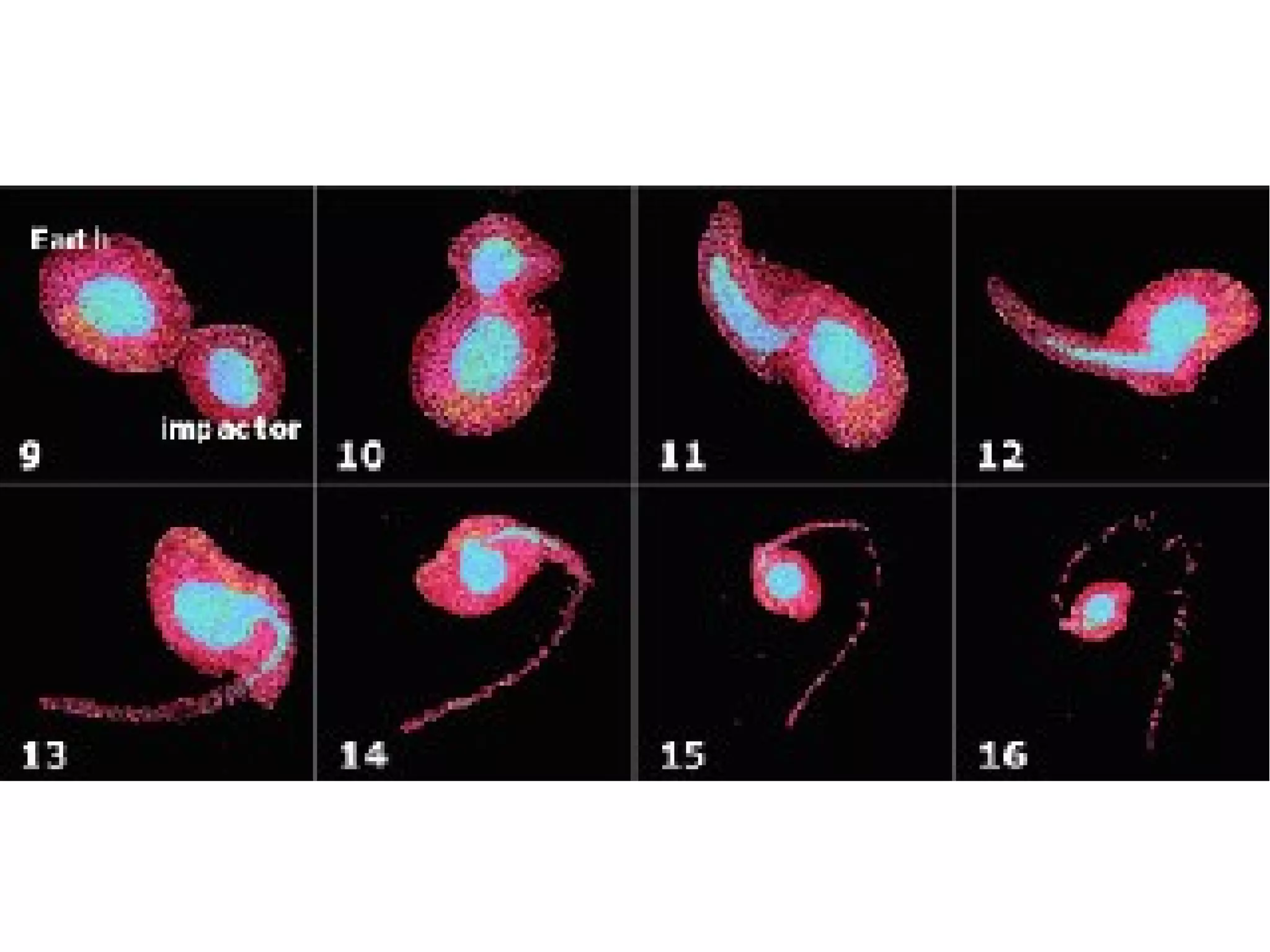
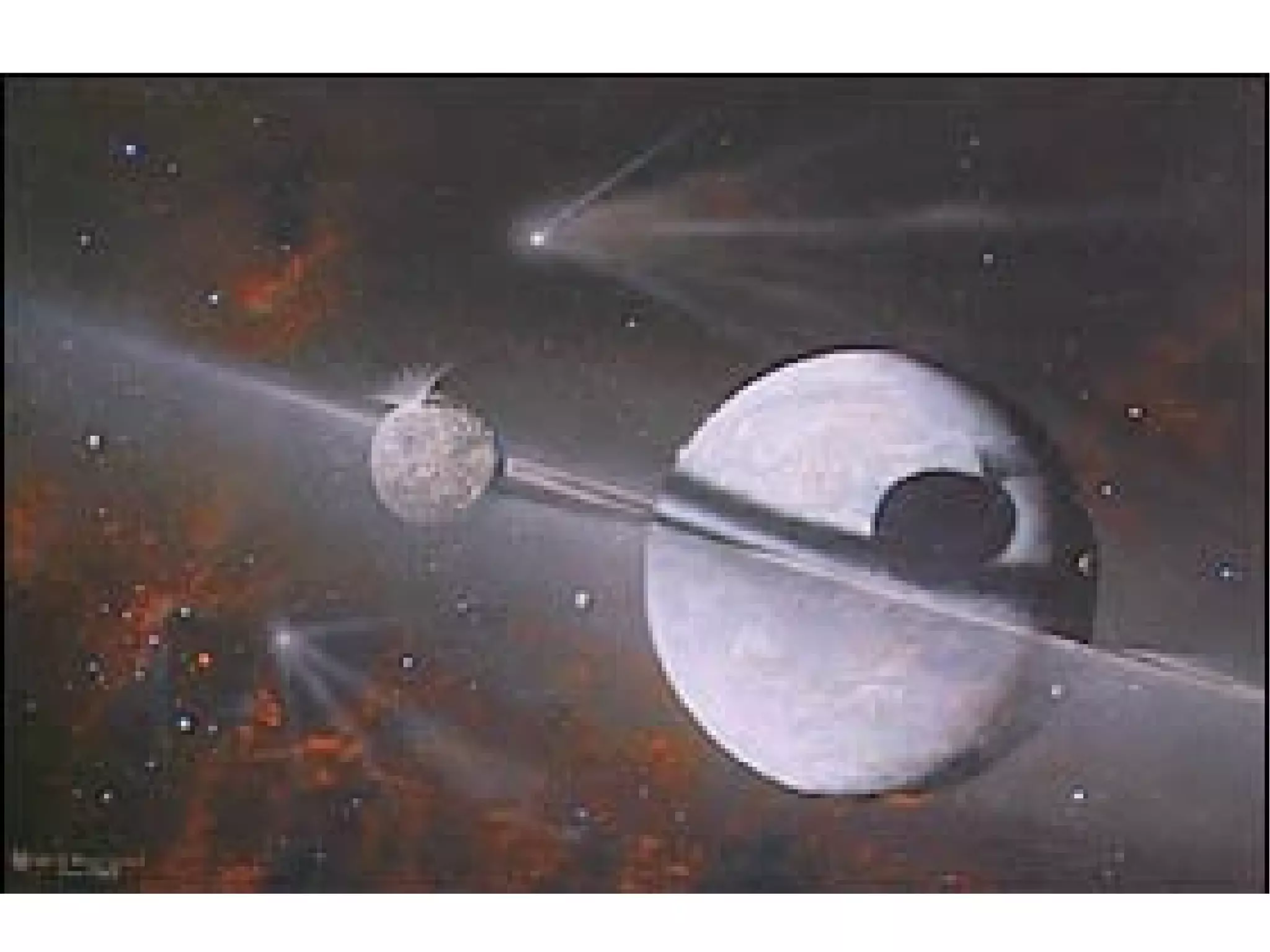
 b. About 4 billion years ago, an object roughly the
 size of mars colided with the Proto-Earth.


 c. A great deal of material was flung off into space
 around the earth which formed an accretion disc.


 d. The moon formed as these materials coalesced.
E. Survey of The Solar Systems Moons
  1. The Galilean Moons (Jupiter's first four)
           a. Io
           - The most volcanically active body in the solar system.
           - Heat is generated by the tidal forces between Jupiter and Io

           b. Europa
           - Has massive amounts of water in the form of ice covering the
             surface.
           - Some scientists have speculated that tidal forces may heat the
             interior to the point of having a liquid ocean.

           c. Ganymede
           - Largest moon in the solar system (slightly larger then Mercury)
           - Composed mostly of water and ammonia ices with a small rocky
             core.

           d. Callisto
           - Similar in composition to Ganymede
           - Most striking feature is a large crater surrounded by concentric
             circles.
2) Moons of Saturn & Neptune
  a. Titan (Saturn)
     - The largest of Saturn's moons
     - Similar in composition to Ganymede & Callisto
     - Has a thick Nitrogen-Argon atmosphere with traces of
       Methane.
     - Retains its atmosphere because of its low temperature


  b. Triton (Neptune)
     - Smallest of the 6 largest moons
     - Orbits retrograde around Neptune
     - Retrograde orbit may be the result of a large impact or
       Triton may be a captured moon.
2) Moons of Mars
  a. Deimos (Panic) & Phobos (Fear)
    - Deimos is about 28km long and 20km wide
    - Phobos is about 16km long and 10km wide
    - Named after the horses that pulled the chariot of the
      Roman god of war (Mars).
    - Very different in composition to Mars indicating that they
      did not form with the planet.
    - Most likely were asteroids that were slowed by the early
      Martian atmosphere and were captured.
F. Lunar History (Four Stages)
 1) Differentiation
    a. As the moon accreted it increased in
       temperature.
    b. The newborn moon was entirely liquid. This
       was supported by examining rocks brought
       back from the Apollo landings.
    c. Because it was liquid denser materials sank
       to the core lighter materials to the surface
       forming a crust.
    d. Unlike the earth, the moon has very little
       Iron in its core and has no magnetic field.
2. Lunar Cateclysm
 a. When the crust has solidified, it immediately
    became cratered by materials left over at the end
    of planet building.
 b. The crust was shattered to a depth of 10km which
    produced many deep, multi-ringed, craters.
 c. This period of heavy impacts took place over the
    course of 500 million years.
3. Flooding of the Maria
 a. During the Lunar Cateclysm, the interior of the
 moon was similar in temperature to that of the earth.


 b. When the impacts shattered the crust, magma from
 the mantle filled in the low lying areas to create the
 maria.


 c. Because of the tidal forces between the earth and
 moon, the crust of the moon is slightly thinner on the
 earth side. Thus there are many more maria on the
 side facing the earth and almost none on the opposite
 side.
3. Slow Surface Evolution
 a. Over time micro-meteorite impacts work to slightly
 erode some of the oldest features.


 b. Overall the surface features of the moon are fixed.


 c. There is no longer any internal heat, nor any
 atmosphere to shape the landscape.


 d. The only large scale changes take place when
 there is the occasional impact on the surface. None
 have been witnessed in human history.
G. Earth's History (Four Stages)
  1) Differentiation
    a. As the moon accreted it increased in
       temperature.
    b. Unlike the moon, the earth also received
       interior heat from the breakdown of
       radioactive metals.
    c. Because it was liquid denser materials sank
       to the core lighter materials to the surface
       forming a crust.
    d. This allowed the earth to separate into the
       current Crust, Mantle & Core.
2. Cratering
 a. When the moon went through the Lunar Cataclysm,
    the Earth also underwent a period of heavy
    cratering.
 b. The Crust of the earth was pulverized by the left
    over rocky and icy materials from planet formation.
 c. It was during this period that many comets hit the
     earth giving it a large portion of the water we enjoy
     today.
3. Flooding
 a. Radioactive heating warmed and softened the
 crust.


 b. During cratering the crust easily cracked down to
 the mantle magma to rise up and fill the craters.


 c. Additionally as the surface and atmosphere cooled,
 water began to precipitate out of the air. Water then
 filled the lowest basins creating the first oceans.


 d. Note that flooding on Earth involved both lava and
 water.
4. Slow Surface Evolution
 a. Over time heat from the Earth's interior has caused
 the crust to break into plates that slide on top of
 the mantle.
 - This results in Mountain Building, and Plate
 Destruction when one plate moves beneath
 another.
b. Wind and water also act to erode surface features.
c. The Earth's atmosphere prevents most small
  meteorites from having any effect on the surface.
d. For the most part the first billion years of Earth's
  history has been destroyed by these processes.
H. (mostly) Unique Features of the Earth
  1. Earth's Active Crust
     - Activity in the crust (volcanoes, earthquakes, etc) is
       driven by internal heat.
     - The interior of the other terrestrial planets have long since
       cooled to the point where they can no longer drive motion
       in the crust.
H. (mostly) Unique Features of the Earth
  2. Earth's Magnetic Field
     - Heat from the Earth's interior causes the molten metal
       core to convect and mix while the earth rotates on its
       axis.
     - This combination of hot spinning metal produces the
       earth's magnetic field.

                   - Gives us the north and south poles

                 - Deflects the Sun's solar wind around the
                  Earth, protecting us from the radiation.

                  - When solar wind particles get trapped in
                    the magnetic field at the poles they
                     produce the Northern & Southern Lights.
H. (mostly) Unique Features of the Earth
  3. Earth's Atmosphere
     - Earth is the only known atmosphere that contains
       significant amounts of oxygen gas (21%)
     - The majority of the atmosphere is Nitrogen Gas (70%).
       This is because Nitrogen gas is very nonreactive and
       does not break down easily.

                         - The atmosphere includes Carbon Dioxide
                          gas which plays an important role in
                          regulating the temperature of the planet.

                       - In the upper atmosphere there is a layer of
                       Ozone which helps protect living things
                       from UV radiation from the sun.
H. (mostly) Unique Features of the Earth
  1. Life
     - The only known planet to have living things.
     - On the whole, life works against the several accepted
       laws of the universe including the tendency towards
       entropy (disorder) and movement of matter to the lowest
       energy state.
                            - Living things are responsible for the
                               high concentration of very reactive
                               oxygen gas in the atmosphere.


                             - The Earth is located in what is called
                               the habitable zone. An area around the
                               sun with relatively small temperature
                               extremes and where liquid water can
                               exist.

Formation ofthe solar system notes

  • 1.
    Formation of theSolar System 1) The Nebular Theory: The theory that our solar system formed from a swirling mass of gas and dust. a. Nebula: Any large cloud of interstellar gas and dust. b. The Nebular theory was one of the first heliocentric theories for the formation of the solar system. c. In Nebular Theory, a nebula (called the solar nebula), collapsed in on its own gravity, forming a disc. Over time the disc developed Protoplanets in rings around a Protosun, a hot ball of gas well on its way to becoming the sun. d. Over time the material clumped together further to form the planets and eventually the sun.
  • 2.
    e. What thisExplained - Almost all objects formed in the same disc they all now revolve in the plane of the ecliptic - Almost objects rotate the same direction (except Venus) as the sun rotates on its axis. - Almost all objects revolve around the sun in the same direction the sun rotates f. What this didn't explain - Why the solar system is highly differentiated - The existence of the Asteroid Belt. - The existence of Comets
  • 3.
    2. Condensation Theory:The modern version of the Nebular Theory. A. The solar system formed from a large spinning cloud of gas and dust, called the solar nebula. B. Once gravity pulled it to a diameter of less then 100au, the solar nebula had become a wide rotating disc.
  • 4.
    C. Planet Formation 1) Accretion: The process by which dust particles stick together to form larger partials, called planetesimals about the size of small moons. Imagine a snowball thrown through a blizzard. Getting larger as it hits other snowflakes 2) Planetesimals collided and formed larger bodies called protoplanets. 3) The four largest protoplanets became the Jovian planets and the four smallest the Terrestrial Planets.
  • 5.
    D. Differentiation ofthe Solar System: 1) As the cloud of gas and dust colapsed into a disc, it heated up. Hottest near the protosun Cooler as you move away from the protosun
  • 6.
    Graph of Temperaturevs. Distance from the sun.
  • 7.
    2) Condensation: Theprocess of going from a gas to a solid or liquid. This temperature is different for different materials!! - In general, denser materials can condense at higher temperatures. Metals Rocky materials Water Ice Ammonia (Frost Line)
  • 8.
    3) The orderin which materials condensed in the early solar system is called the Condensation Sequence. 4) This determined what the solid portion of planetesimals (and later planets) were composed of. Metals Rocky materials Water Ice Ammonia (Frost Line)
  • 9.
    D. Differentiation ofthe Solar System (continued) 5) Formation of Asteroids - When planetesimals collide with high relative velocity (very fast head-on collisions) they broke apart rather then coalesced. - This process is called Fractionation - The material between Jupiter and mars is given high relative velocities by the pull of Jupiter's gravity. 6) Formation of Comets - Comets form beyond the frost-line in the same way as asteroids. - The combined gravity of all the Jovian planets causes the Fractionation
  • 10.
    7) Location ofComets a. The majority of comets are found in the Oort Cloud. b. The Oort Cloud is tens of thousands of AU across & and comets in this region have a period of no less then 200 years. c. Beyond the orbit of Neptune is the Kuiper Belt which contains many of the shorter period comets. 8) the Role of Comets in planet formation a. During accretion there were thousands of times more comets that had not been swept up by the protoplanets. b. remember that water could not condense out in for the terrestrial planets. Impacts from Comets helps account for this irregularity.
  • 11.
    E. Formation ofMoons 1) Captured Moons a. When asteroids or comets pass too close to a planet they get captured by that planets gravitational pull. b. Often these are temporary moons and escape after thousands or millions of years. c. Include the two moons of Mars (Phobos and Deimos) and the majority of outer planet moons.
  • 12.
    2. Naturally FormingJovian Moons a. Beyond the frost line there was much more material to form large bodies. b. Each of the Jovian planets formed a mini-accretion disc in a plane perpendicular to their axis of rotation. c. In this disc moons formed in a process very similar to the formation of the planets. d. These systems of moons even underwent a small scale version of differentiation around their parent planets.
  • 13.
    3. Formation ofEarth's Moon (Giant Impact Hypothesis) a. Planets located inside of the Frost-Line did not have enough material to form their own accretion discs. b. About 4 billion years ago, an object roughly the size of mars colided with the Proto-Earth. c. A great deal of material was flung off into space around the earth which formed an accretion disc. d. The moon formed as these materials coalesced.
  • 17.
    E. Survey ofThe Solar Systems Moons 1. The Galilean Moons (Jupiter's first four) a. Io - The most volcanically active body in the solar system. - Heat is generated by the tidal forces between Jupiter and Io b. Europa - Has massive amounts of water in the form of ice covering the surface. - Some scientists have speculated that tidal forces may heat the interior to the point of having a liquid ocean. c. Ganymede - Largest moon in the solar system (slightly larger then Mercury) - Composed mostly of water and ammonia ices with a small rocky core. d. Callisto - Similar in composition to Ganymede - Most striking feature is a large crater surrounded by concentric circles.
  • 18.
    2) Moons ofSaturn & Neptune a. Titan (Saturn) - The largest of Saturn's moons - Similar in composition to Ganymede & Callisto - Has a thick Nitrogen-Argon atmosphere with traces of Methane. - Retains its atmosphere because of its low temperature b. Triton (Neptune) - Smallest of the 6 largest moons - Orbits retrograde around Neptune - Retrograde orbit may be the result of a large impact or Triton may be a captured moon.
  • 19.
    2) Moons ofMars a. Deimos (Panic) & Phobos (Fear) - Deimos is about 28km long and 20km wide - Phobos is about 16km long and 10km wide - Named after the horses that pulled the chariot of the Roman god of war (Mars). - Very different in composition to Mars indicating that they did not form with the planet. - Most likely were asteroids that were slowed by the early Martian atmosphere and were captured.
  • 20.
    F. Lunar History(Four Stages) 1) Differentiation a. As the moon accreted it increased in temperature. b. The newborn moon was entirely liquid. This was supported by examining rocks brought back from the Apollo landings. c. Because it was liquid denser materials sank to the core lighter materials to the surface forming a crust. d. Unlike the earth, the moon has very little Iron in its core and has no magnetic field.
  • 21.
    2. Lunar Cateclysm a. When the crust has solidified, it immediately became cratered by materials left over at the end of planet building. b. The crust was shattered to a depth of 10km which produced many deep, multi-ringed, craters. c. This period of heavy impacts took place over the course of 500 million years.
  • 22.
    3. Flooding ofthe Maria a. During the Lunar Cateclysm, the interior of the moon was similar in temperature to that of the earth. b. When the impacts shattered the crust, magma from the mantle filled in the low lying areas to create the maria. c. Because of the tidal forces between the earth and moon, the crust of the moon is slightly thinner on the earth side. Thus there are many more maria on the side facing the earth and almost none on the opposite side.
  • 23.
    3. Slow SurfaceEvolution a. Over time micro-meteorite impacts work to slightly erode some of the oldest features. b. Overall the surface features of the moon are fixed. c. There is no longer any internal heat, nor any atmosphere to shape the landscape. d. The only large scale changes take place when there is the occasional impact on the surface. None have been witnessed in human history.
  • 24.
    G. Earth's History(Four Stages) 1) Differentiation a. As the moon accreted it increased in temperature. b. Unlike the moon, the earth also received interior heat from the breakdown of radioactive metals. c. Because it was liquid denser materials sank to the core lighter materials to the surface forming a crust. d. This allowed the earth to separate into the current Crust, Mantle & Core.
  • 25.
    2. Cratering a.When the moon went through the Lunar Cataclysm, the Earth also underwent a period of heavy cratering. b. The Crust of the earth was pulverized by the left over rocky and icy materials from planet formation. c. It was during this period that many comets hit the earth giving it a large portion of the water we enjoy today.
  • 26.
    3. Flooding a.Radioactive heating warmed and softened the crust. b. During cratering the crust easily cracked down to the mantle magma to rise up and fill the craters. c. Additionally as the surface and atmosphere cooled, water began to precipitate out of the air. Water then filled the lowest basins creating the first oceans. d. Note that flooding on Earth involved both lava and water.
  • 27.
    4. Slow SurfaceEvolution a. Over time heat from the Earth's interior has caused the crust to break into plates that slide on top of the mantle. - This results in Mountain Building, and Plate Destruction when one plate moves beneath another. b. Wind and water also act to erode surface features. c. The Earth's atmosphere prevents most small meteorites from having any effect on the surface. d. For the most part the first billion years of Earth's history has been destroyed by these processes.
  • 28.
    H. (mostly) UniqueFeatures of the Earth 1. Earth's Active Crust - Activity in the crust (volcanoes, earthquakes, etc) is driven by internal heat. - The interior of the other terrestrial planets have long since cooled to the point where they can no longer drive motion in the crust.
  • 29.
    H. (mostly) UniqueFeatures of the Earth 2. Earth's Magnetic Field - Heat from the Earth's interior causes the molten metal core to convect and mix while the earth rotates on its axis. - This combination of hot spinning metal produces the earth's magnetic field. - Gives us the north and south poles - Deflects the Sun's solar wind around the Earth, protecting us from the radiation. - When solar wind particles get trapped in the magnetic field at the poles they produce the Northern & Southern Lights.
  • 30.
    H. (mostly) UniqueFeatures of the Earth 3. Earth's Atmosphere - Earth is the only known atmosphere that contains significant amounts of oxygen gas (21%) - The majority of the atmosphere is Nitrogen Gas (70%). This is because Nitrogen gas is very nonreactive and does not break down easily. - The atmosphere includes Carbon Dioxide gas which plays an important role in regulating the temperature of the planet. - In the upper atmosphere there is a layer of Ozone which helps protect living things from UV radiation from the sun.
  • 31.
    H. (mostly) UniqueFeatures of the Earth 1. Life - The only known planet to have living things. - On the whole, life works against the several accepted laws of the universe including the tendency towards entropy (disorder) and movement of matter to the lowest energy state. - Living things are responsible for the high concentration of very reactive oxygen gas in the atmosphere. - The Earth is located in what is called the habitable zone. An area around the sun with relatively small temperature extremes and where liquid water can exist.