“Form follows function”
DIRE DAWA UNIVERSITY
INSTITUTE OF TECHNOLOGY
DEPARTMENT OF ARCHITECTURE
THEORY OF ARCHITECTURE II
( ARCH 4101 )
CASE STUDY 1
BY :ZEREYACOB AMBACHEW
1-INTRODUCTION
2-Historical Background
3-WHAT IS the theory FORM FOLLOWS FUNCTION ?
4-WHY FORM FOLLOW FUNCTION ?
(THE IDEA BEHIND THE PHILOSOPHY )
5-LITERATURE REVIEW
6-CASE STUDY
7-ANALYSIS
8-RECOMMENDATION
9-BIBLOOGRAPHY
You’ve likely heard the phrase “form follows function,”
but have you really thought about what it means or where it came
from?
The phrase “form follows function” was coined by
American architect Louis Sullivan.
Louis Henry Sullivan was an American architect circa 1870-
1920′s who has been called the father of modernism and the
father of skyscrapers. Born September 3, 1856
Boston, Massachusetts, U.S.
Died April 14, 1924 (aged 67)
Chicago, Illinois, U.S.
Occupation Architect
After graduating from high school, Sullivan studied architecture
briefly at the Massachusetts Institute of Technology.
He is considered by many as the creator of the modern
skyscraper, was an influential architect and critic of the Chicago
School.
Sullivan first presented his arguments that form follows function in his 1896 essay The Tall Office Building Artistically
Considered.3 Sullivan’s objective in the essay was to answer the question: How do you give form to something that has
never existed before? He did not mean give form to a specific building or an individual design project but to a
functional building type – the modern high-rise office building (i.e., the skyscraper). Sullivan thought that social
conditions had granted architecture a historic privilege, a task worthy of the architects who first built the Greek temples
or Gothic cathedrals, and equal only to architecture as a living art.4 What factors had come to bear in Sullivan’s time
upon the form of an office building? Sullivan’s answer to this modern problem relied on what he believed to be a
universal principle – form follows function.
Sullivan argued that form follows function is a matter of nature. Forms imbue
each thing in nature with a part of its identity. We distinguish one thing from
another through their forms – a human is distinguished from a tree, a tree
from a bird, and so on.5 But forms don’t just help us to distinguish one living
being from another, they also tell us something of how they live their lives.
Sullivan explains, »Speaking generally, outward appearances resemble inner
purposes.«6 A bird flies, a fish swims, and a plant rises from and is rooted to
the ground. As such, so is each of their forms. Likewise, Sullivan believed that
buildings should naturally follow suit in that their forms follow their functions,
regardless that buildings are not in themselves organic things. They do not
grow as an animal or a plant does. They do not reproduce. Instead, they are
made. No matter, Sullivan insisted
Historical Background
The Wainwright building in St. Louis
»It is the prevailing law of all things organic, and inorganic, of all things
physical and metaphysical, of all things human and all things superhuman,
of all true manifestations of the head, of the heart, of the soul, that the
life is recognizable in its expression, that form ever follows function. This
is the law.«
Thus, the declaration that form ever follows function asserts that all manner
of expressions, all manner of beings, and all forms are predicated upon their
function, their purpose, and their way of being. As Sullivan lays it out, for example,
a tall office building’s way of being is characterized in part by its spatial
organization, which has been a model for many skyscrapers since his time – a
prominent ground floor, multiple floors of offices, and a special-purpose top
floor or floors (in Sullivan’s scheme, a space for mechanical services).But its
organization is only a natural consequence of the building’s practical concerns.
Sullivan’s notion of architecture as a living art and as form follows function
insisted upon more. It insisted that those practical concerns were only a part of
a functional-essential whole, »or a unit without a single dissenting line.«The
full essence of a tall office building was characterized by its spatial organization
and its height. The grid of offices in a tall office building easily spoke to its
spatial organization. Its soaring height, if properly expressed, enlivened it. Its
natural form emerged from both.
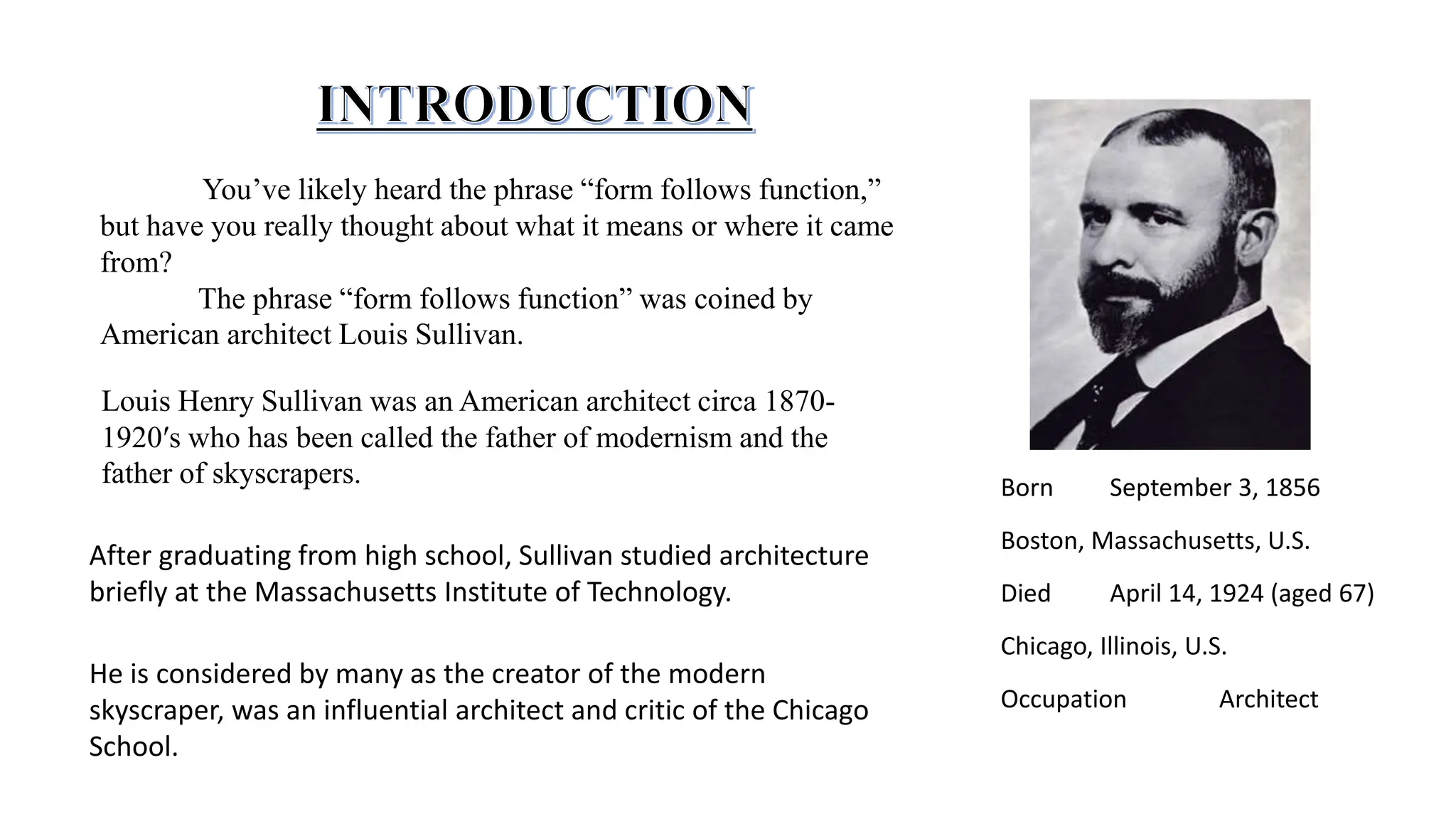
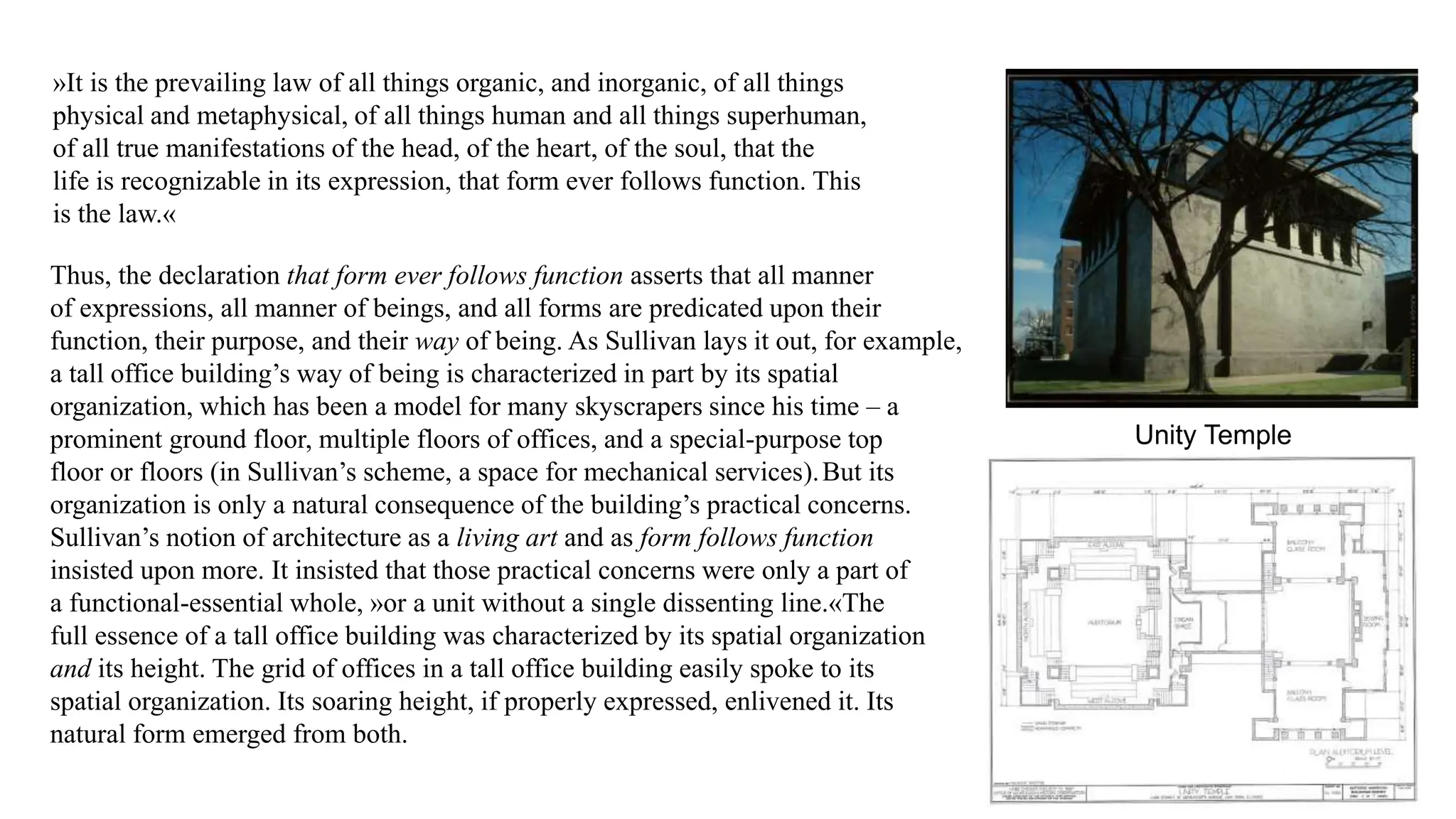
Unity Temple
Wright accepted Sullivan’s rationale with the certainty of scientific fact. He
acknowledges, »Already it has been said – lieber meister declared it – and
biology knows and shows us that form follows function.«Wright also felt,
however, that the idea was detrimental if it was applied unthinkingly; such
an approach reduces form follows function to cant terms learned by rote and
mere dogma.The solution to this dilemma lay in Wright’s belief that Sullivan’s
ideas had merit but they also required further examination and development.
Thinking back on his experiences in Sullivan’s office, Wright thought that an
individual could only influence architecture to a limited degree during a lifetime.
An architect takes on what others have left subsequent generations
In a similar way, Sullivan’s principle that form follows function continued to
evolve in Wright’s mind and in his work. Over time, Wright rephrased the statement
itself into a new definition that demanded reconsideration: Form and
function are one. Wright explained,
»Not until we raise the dictum, now a dogma, to the realm of thought, and
say: Form and function are one, have we stated the case for architecture.
That abstract saying Form and function are one is the center line of architecture,
organic. It places us in line with nature and enables us sensibly
to go to work.«
With these words, Wright acknowledged form follows function as a wider perspective on nature and a starting point for his own
architectural theories. As such, the statement is a crucial bridge between Sullivan and Wright. Form follows function courses
through Wright’s organic architecture as form and function are one. As such, we must delve further upon Wright’s ideas.
Unity Temple interior.
WHAT IS the theory Form follows function ?
Form follows function is a principle associated with modernist
architecture and industrial design in the 20th century. The
principle is that the shape of a building or object should be
primarily based upon its intended function or purpose.
Interpreting “Form Follows Function”
There are two ways to interpret the phrase “form follows
function”:
 Descriptive: beauty results from purity of function;
 Prescriptive: aesthetic considerations in design should be
secondary to functional considerations.
Louis Sullivan, mentor to Frank Lloyd Wright, once noted that, in
architecture, form should follow function; a building should be
designed to suit its purpose. When designing a home for a family,
for example, it makes sense to create open spaces for gathering
and to provide ample storage.
These choices encourage family interaction and maintain some
semblance of order in the midst and bustle of life.
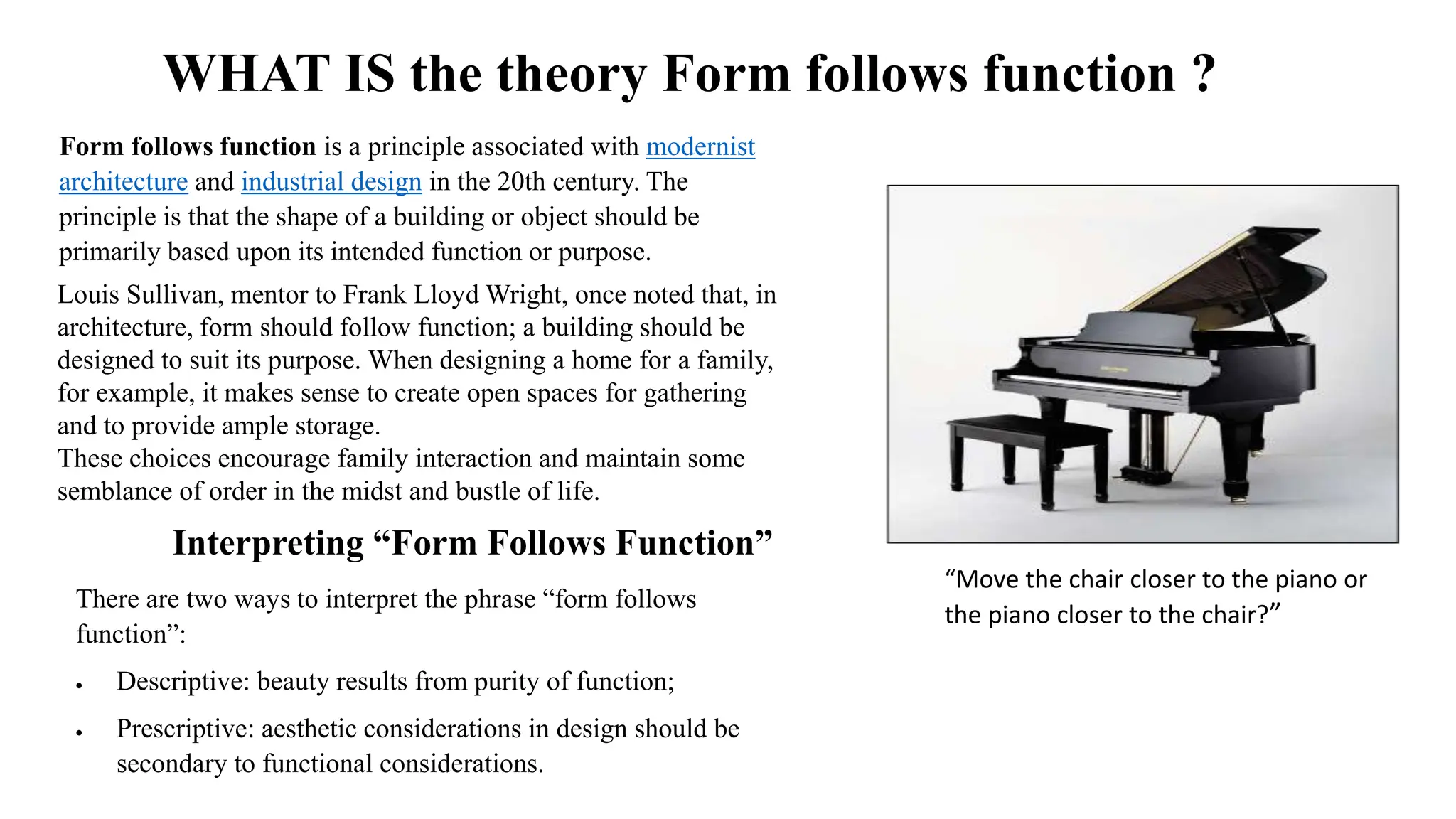
“Move the chair closer to the piano or
the piano closer to the chair?”
Why form follows function ?
(THE IDEA BEHIND THIS PHILOSOPHY)
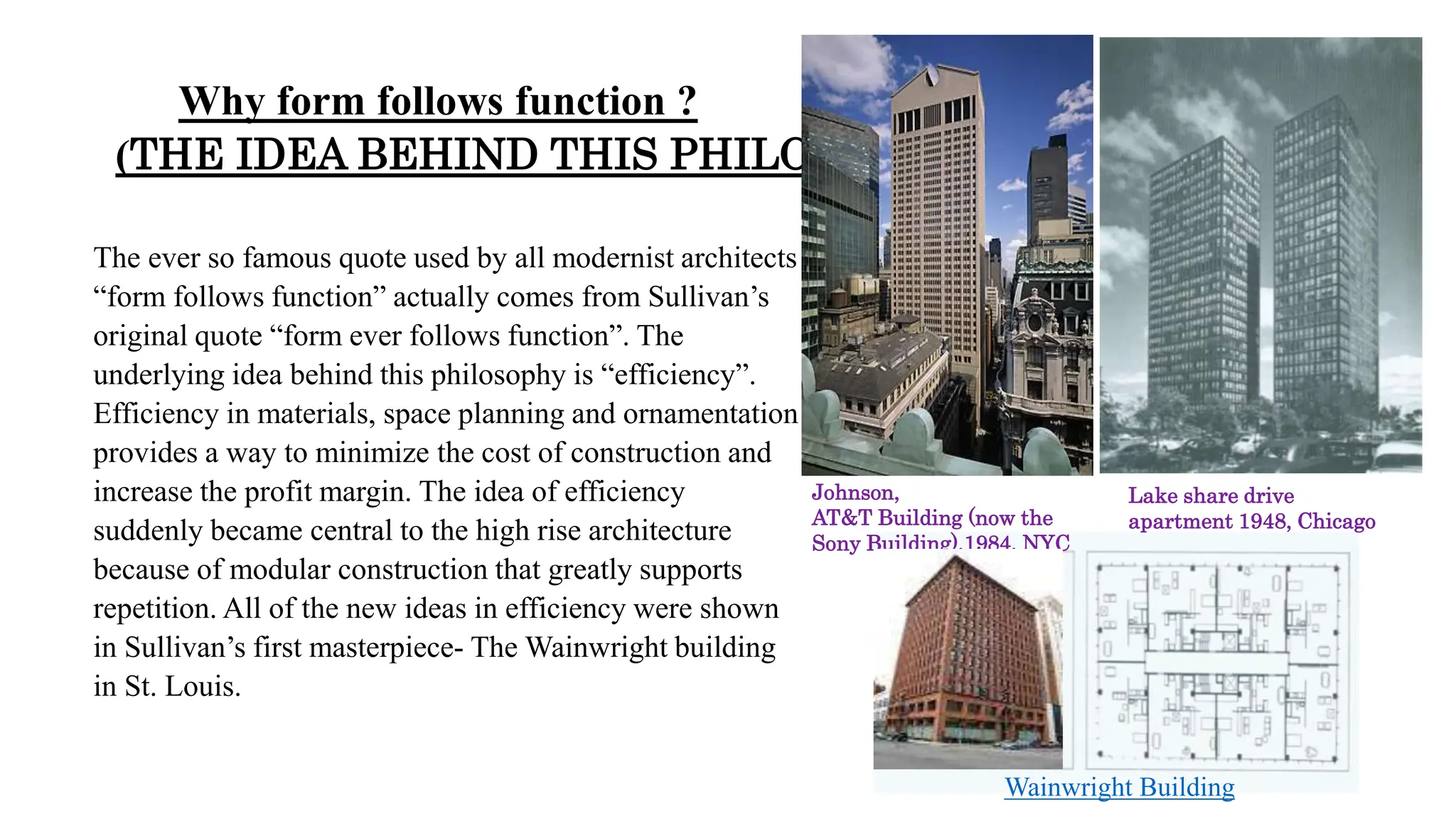
The ever so famous quote used by all modernist architects
“form follows function” actually comes from Sullivan’s
original quote “form ever follows function”. The
underlying idea behind this philosophy is “efficiency”.
Efficiency in materials, space planning and ornamentation
provides a way to minimize the cost of construction and
increase the profit margin. The idea of efficiency
suddenly became central to the high rise architecture
because of modular construction that greatly supports
repetition. All of the new ideas in efficiency were shown
in Sullivan’s first masterpiece- The Wainwright building
in St. Louis.
Johnson,
AT&T Building (now the
Sony Building),1984, NYC
Lake share drive
apartment 1948, Chicago
Wainwright Building
While sometimes attributed to sculptor Horatio Greenough, the
phrase “form follows function” was coined by American
architect Louis Sullivan. In his 1896 article, “The Tall Office
Building Artistically Considered,” Sullivan wrote:
“It is the pervading law of all things organic and inorganic, of
all things physical and metaphysical, of all things human and all
things superhuman, of all true manifestations of the head, of the
heart, of the soul, that the life is recognizable in its expression,
that form ever follows function. This is the law.”
At the time, technology, tastes and economics were rapidly
changing. The forms of late-19th century buildings were still
being worked out, based on innovation going all the way back
to ancient Greek and Roman architecture. It was clear to
Sullivan that a new form for buildings was needed, and he
thought that form ought to come from the function of a building,
not historical precedent.
This new form became the modern structural steel skyscraper.
Wainwright Building by Louis Sullivan
Literature Review
Frank Lloyd Wright, who was then Sullivan’s assistant, adopted
the phrase “form follows function” and further promoted it. The
Guggenheim Museum is a good example of Wright’s
application of the principle. It’s spiral shape was intended to
allow visitors to easily view the artwork within.
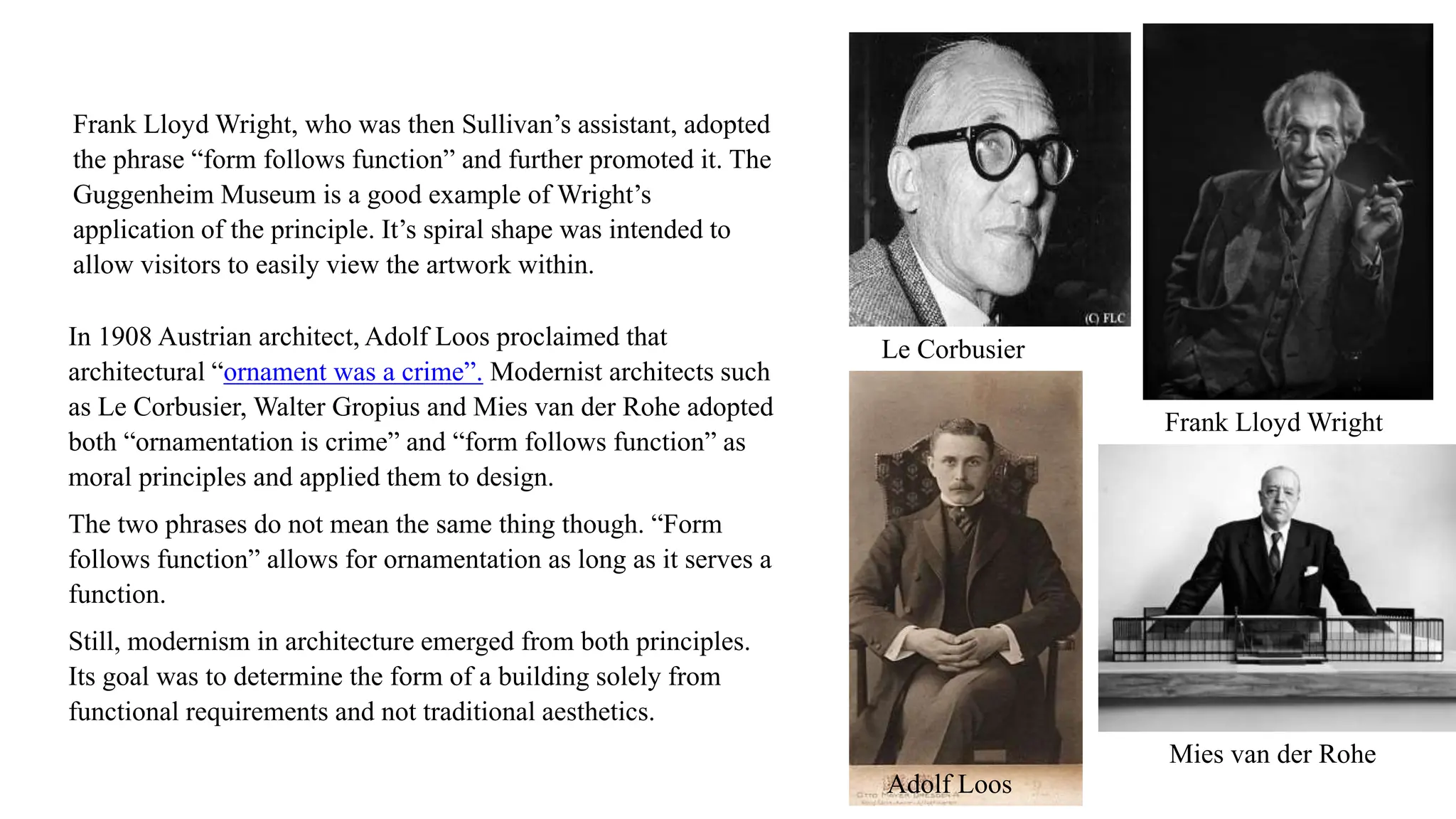
In 1908 Austrian architect, Adolf Loos proclaimed that
architectural “ornament was a crime”. Modernist architects such
as Le Corbusier, Walter Gropius and Mies van der Rohe adopted
both “ornamentation is crime” and “form follows function” as
moral principles and applied them to design.
The two phrases do not mean the same thing though. “Form
follows function” allows for ornamentation as long as it serves a
function.
Still, modernism in architecture emerged from both principles.
Its goal was to determine the form of a building solely from
functional requirements and not traditional aesthetics.
Mies van der Rohe
Adolf Loos
Le Corbusier
Frank Lloyd Wright
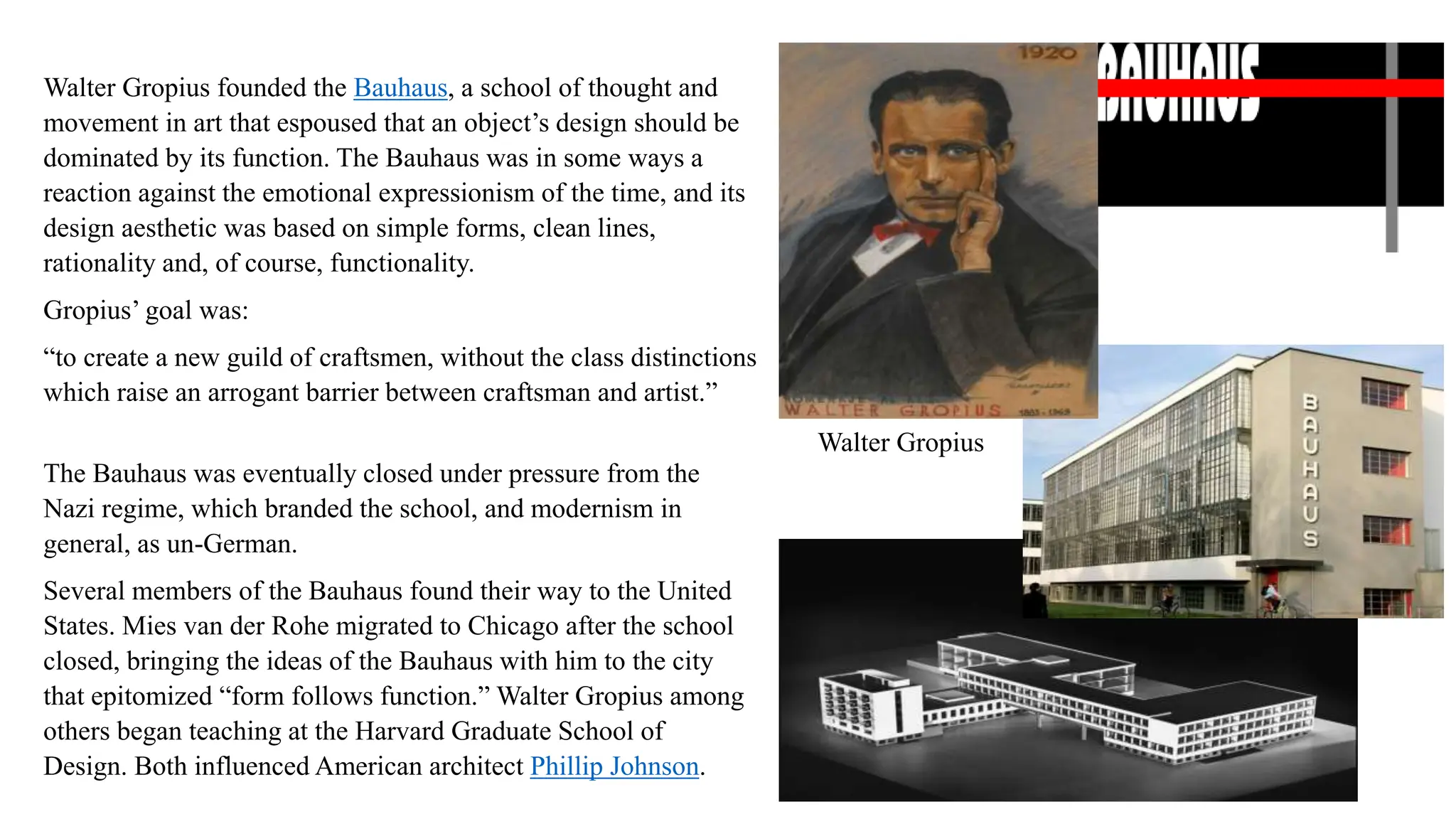
Walter Gropius founded the Bauhaus, a school of thought and
movement in art that espoused that an object’s design should be
dominated by its function. The Bauhaus was in some ways a
reaction against the emotional expressionism of the time, and its
design aesthetic was based on simple forms, clean lines,
rationality and, of course, functionality.
Gropius’ goal was:
“to create a new guild of craftsmen, without the class distinctions
which raise an arrogant barrier between craftsman and artist.”
The Bauhaus was eventually closed under pressure from the
Nazi regime, which branded the school, and modernism in
general, as un-German.
Several members of the Bauhaus found their way to the United
States. Mies van der Rohe migrated to Chicago after the school
closed, bringing the ideas of the Bauhaus with him to the city
that epitomized “form follows function.” Walter Gropius among
others began teaching at the Harvard Graduate School of
Design. Both influenced American architect Phillip Johnson.
Walter Gropius
Johnson was a strong proponent of modern architecture and
helped assemble the show “The International Style:
Architecture Since 1922” at the Museum of Modern Art. The
design principles identified by the International Style were:
1. Expression of volume rather than mass,
2. Balance rather than preconceived symmetry,
3. Expulsion of applied ornament.
Johnson’s work was often a balancing act between
minimalism and pop art. He later introduced the work of
both Mark Rothko and Andy Warhol to the Museum of
Modern Art. Johnson belonged to the post-modernist
movement in architecture, which was a reaction to
Modernism and Functionalism.
CASE STUDY
From its very beginnings the Solomon R. Guggenheim Museum
has been a hub for new art and new ideas. The museum was
designed by renowned architect Frank Lloyd Wright to house an
innovative collection of works in a unique environment. Today,
the museum continues to be a landmark destination that attracts
visitors from around the world.
The Guggenheim Museum from the Outside
The Guggenheim Museum
on the Inside
The Guggenheim Museum
from the Outside
This principle is thoroughly visible in the plan for the Guggenheim
Museum. According to Wright’s design, visitors would enter the
building, take an elevator to the top and enjoy a continuous art-
viewing experience while descending along the spiral ramp.From
this principle (function ) he create a form.
Solomon R. Guggenheim Museum floor plan
The Seagram Building is a skyscraper, located at 375 Park
Avenue, between 52nd Street and 53rd Street in Midtown
Manhattan, New York City. The structure was designed by
German architect Ludwig Mies van der Rohe while the lobby
and other internal aspects were designed by Philip Johnson,
including The Four Seasons and Brasserie restaurants .Severud
Associates were the structural engineering consultants.
The building stands 515 feet (157 m) tall with 38 stories, and
was completed in 1958. It stands as one of the finest examples
of the functionalist aesthetic and a masterpiece of corporate
modernism. It was designed as the headquarters for the
Canadian distillers Joseph E. Seagram's & Sons with the active
interest of Phyllis Lambert, the daughter of Samuel Bronfman,
Seagram's CEO. It has the worst Energy Star rating of any
building in New York, at 3 out of 100.
Wainwright Building
Wainwright Building, spring 1986
Location St. Louis, Missouri
Built 1891
Architect Adler & Sullivan
Architectural style Chicago school
Governing body State
Significant dates
Added to NRHP May 23, 1968
Designated NHL May 23, 1968[2]
The Wainwright building was commissioned by Ellis Wainwright, a St.
Louis brewer. Wainwright needed office space to manage the St
Louis Brewers Association. It was the second major commission for a
tall building won by the Adler & Sullivan firm, which had grown to
international prominence after the creation of the ten-story
Auditorium Building in Chicago (designed in 1886 and completed in
1889). As designed, the first floor of the Wainwright Building was
intended for street-accessible shops, with the second floor filled with
easily accessible public offices. The higher floors were for
"honeycomb" offices, while the top floor was for water tanks and
building machinery.
In May 2013 it was listed by a PBS program as one of "10 Buildings
That Changed America" because it was "the first skyscraper that truly
looked the part" with Sullivan being dubbed the "Father of
Skyscrapers."
analysis
In my understanding form follows function means the function
or purpose should be a primary consideration in design ,or in
other word aesthetic considerations in design should be
secondary to functional considerations.
These are the elements of functional design, the process
of responding to the needs or desires of the people.
Functional design is necessarily a relationship between users
with problems to solve and designers with solutions to offer.
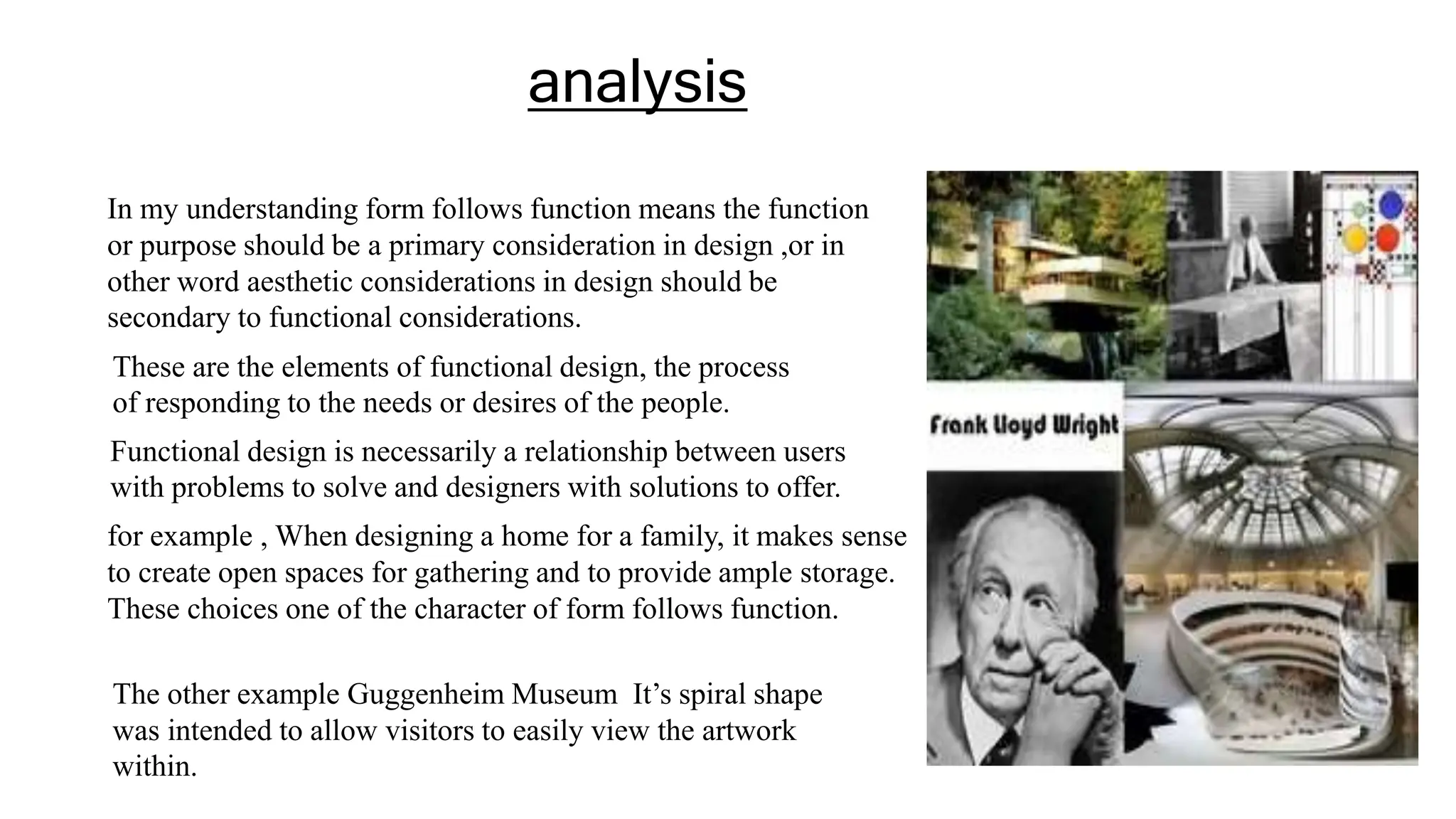
The other example Guggenheim Museum It’s spiral shape
was intended to allow visitors to easily view the artwork
within.
for example , When designing a home for a family, it makes sense
to create open spaces for gathering and to provide ample storage.
These choices one of the character of form follows function.
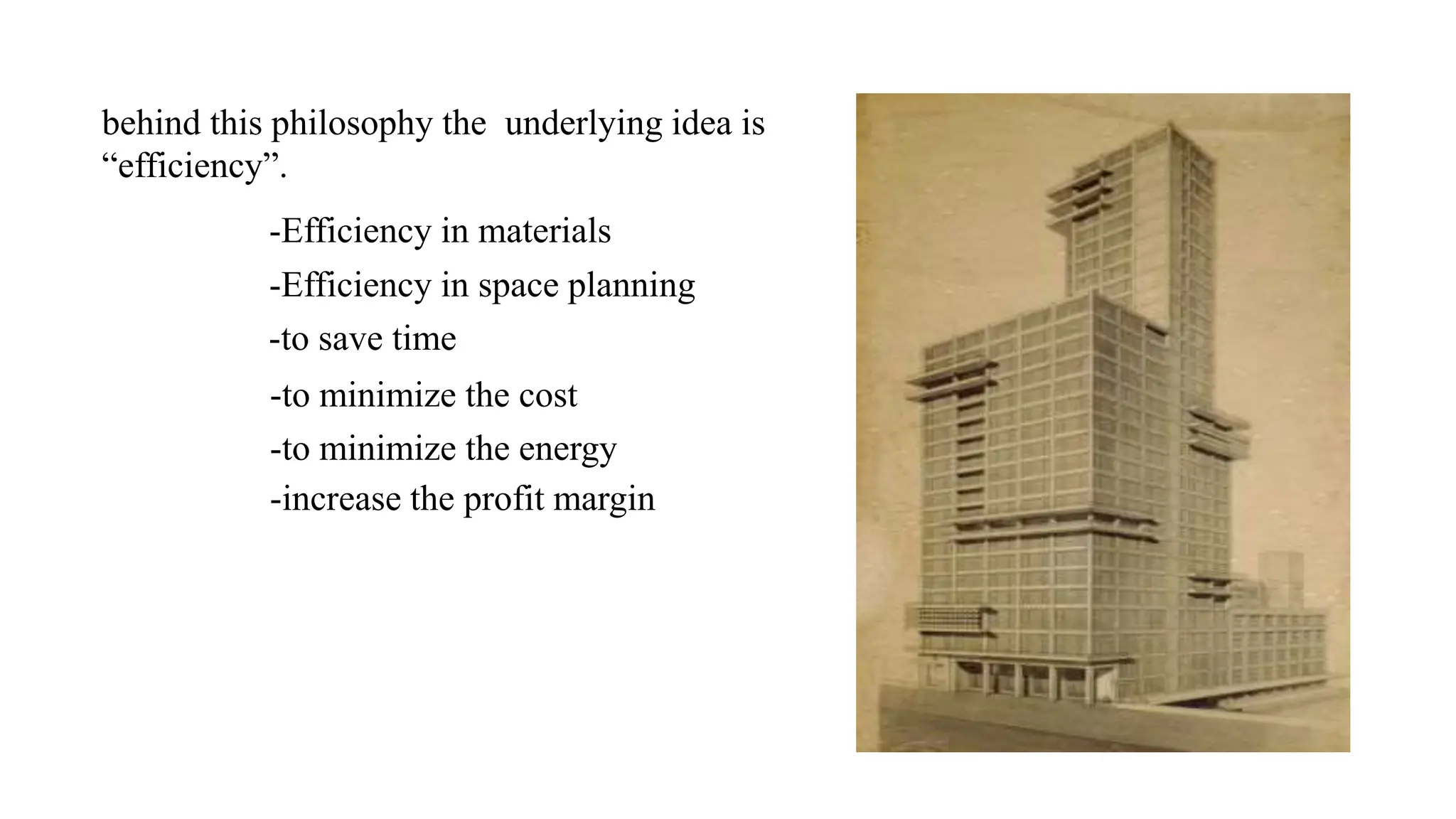
behind this philosophy the underlying idea is
“efficiency”.
-Efficiency in materials
-Efficiency in space planning
-to minimize the cost
-increase the profit margin
-to minimize the energy
-to save time
bibliography
• www. Archdaily.com
• www. Wikipedia.com
• http://architecture.about.com Online.
• http://www.greatbuildings.com/types/styles.html

FORM FOLLOW FUNCTION.pptx

  • 1.
    “Form follows function” DIREDAWA UNIVERSITY INSTITUTE OF TECHNOLOGY DEPARTMENT OF ARCHITECTURE THEORY OF ARCHITECTURE II ( ARCH 4101 ) CASE STUDY 1 BY :ZEREYACOB AMBACHEW
  • 2.
    1-INTRODUCTION 2-Historical Background 3-WHAT ISthe theory FORM FOLLOWS FUNCTION ? 4-WHY FORM FOLLOW FUNCTION ? (THE IDEA BEHIND THE PHILOSOPHY ) 5-LITERATURE REVIEW 6-CASE STUDY 7-ANALYSIS 8-RECOMMENDATION 9-BIBLOOGRAPHY
  • 3.
    You’ve likely heardthe phrase “form follows function,” but have you really thought about what it means or where it came from? The phrase “form follows function” was coined by American architect Louis Sullivan. Louis Henry Sullivan was an American architect circa 1870- 1920′s who has been called the father of modernism and the father of skyscrapers. Born September 3, 1856 Boston, Massachusetts, U.S. Died April 14, 1924 (aged 67) Chicago, Illinois, U.S. Occupation Architect After graduating from high school, Sullivan studied architecture briefly at the Massachusetts Institute of Technology. He is considered by many as the creator of the modern skyscraper, was an influential architect and critic of the Chicago School.
  • 4.
    Sullivan first presentedhis arguments that form follows function in his 1896 essay The Tall Office Building Artistically Considered.3 Sullivan’s objective in the essay was to answer the question: How do you give form to something that has never existed before? He did not mean give form to a specific building or an individual design project but to a functional building type – the modern high-rise office building (i.e., the skyscraper). Sullivan thought that social conditions had granted architecture a historic privilege, a task worthy of the architects who first built the Greek temples or Gothic cathedrals, and equal only to architecture as a living art.4 What factors had come to bear in Sullivan’s time upon the form of an office building? Sullivan’s answer to this modern problem relied on what he believed to be a universal principle – form follows function. Sullivan argued that form follows function is a matter of nature. Forms imbue each thing in nature with a part of its identity. We distinguish one thing from another through their forms – a human is distinguished from a tree, a tree from a bird, and so on.5 But forms don’t just help us to distinguish one living being from another, they also tell us something of how they live their lives. Sullivan explains, »Speaking generally, outward appearances resemble inner purposes.«6 A bird flies, a fish swims, and a plant rises from and is rooted to the ground. As such, so is each of their forms. Likewise, Sullivan believed that buildings should naturally follow suit in that their forms follow their functions, regardless that buildings are not in themselves organic things. They do not grow as an animal or a plant does. They do not reproduce. Instead, they are made. No matter, Sullivan insisted Historical Background The Wainwright building in St. Louis
  • 5.
    »It is theprevailing law of all things organic, and inorganic, of all things physical and metaphysical, of all things human and all things superhuman, of all true manifestations of the head, of the heart, of the soul, that the life is recognizable in its expression, that form ever follows function. This is the law.« Thus, the declaration that form ever follows function asserts that all manner of expressions, all manner of beings, and all forms are predicated upon their function, their purpose, and their way of being. As Sullivan lays it out, for example, a tall office building’s way of being is characterized in part by its spatial organization, which has been a model for many skyscrapers since his time – a prominent ground floor, multiple floors of offices, and a special-purpose top floor or floors (in Sullivan’s scheme, a space for mechanical services).But its organization is only a natural consequence of the building’s practical concerns. Sullivan’s notion of architecture as a living art and as form follows function insisted upon more. It insisted that those practical concerns were only a part of a functional-essential whole, »or a unit without a single dissenting line.«The full essence of a tall office building was characterized by its spatial organization and its height. The grid of offices in a tall office building easily spoke to its spatial organization. Its soaring height, if properly expressed, enlivened it. Its natural form emerged from both. Unity Temple
  • 6.
    Wright accepted Sullivan’srationale with the certainty of scientific fact. He acknowledges, »Already it has been said – lieber meister declared it – and biology knows and shows us that form follows function.«Wright also felt, however, that the idea was detrimental if it was applied unthinkingly; such an approach reduces form follows function to cant terms learned by rote and mere dogma.The solution to this dilemma lay in Wright’s belief that Sullivan’s ideas had merit but they also required further examination and development. Thinking back on his experiences in Sullivan’s office, Wright thought that an individual could only influence architecture to a limited degree during a lifetime. An architect takes on what others have left subsequent generations In a similar way, Sullivan’s principle that form follows function continued to evolve in Wright’s mind and in his work. Over time, Wright rephrased the statement itself into a new definition that demanded reconsideration: Form and function are one. Wright explained, »Not until we raise the dictum, now a dogma, to the realm of thought, and say: Form and function are one, have we stated the case for architecture. That abstract saying Form and function are one is the center line of architecture, organic. It places us in line with nature and enables us sensibly to go to work.« With these words, Wright acknowledged form follows function as a wider perspective on nature and a starting point for his own architectural theories. As such, the statement is a crucial bridge between Sullivan and Wright. Form follows function courses through Wright’s organic architecture as form and function are one. As such, we must delve further upon Wright’s ideas. Unity Temple interior.
  • 7.
    WHAT IS thetheory Form follows function ? Form follows function is a principle associated with modernist architecture and industrial design in the 20th century. The principle is that the shape of a building or object should be primarily based upon its intended function or purpose. Interpreting “Form Follows Function” There are two ways to interpret the phrase “form follows function”:  Descriptive: beauty results from purity of function;  Prescriptive: aesthetic considerations in design should be secondary to functional considerations. Louis Sullivan, mentor to Frank Lloyd Wright, once noted that, in architecture, form should follow function; a building should be designed to suit its purpose. When designing a home for a family, for example, it makes sense to create open spaces for gathering and to provide ample storage. These choices encourage family interaction and maintain some semblance of order in the midst and bustle of life. “Move the chair closer to the piano or the piano closer to the chair?”
  • 8.
    Why form followsfunction ? (THE IDEA BEHIND THIS PHILOSOPHY) The ever so famous quote used by all modernist architects “form follows function” actually comes from Sullivan’s original quote “form ever follows function”. The underlying idea behind this philosophy is “efficiency”. Efficiency in materials, space planning and ornamentation provides a way to minimize the cost of construction and increase the profit margin. The idea of efficiency suddenly became central to the high rise architecture because of modular construction that greatly supports repetition. All of the new ideas in efficiency were shown in Sullivan’s first masterpiece- The Wainwright building in St. Louis. Johnson, AT&T Building (now the Sony Building),1984, NYC Lake share drive apartment 1948, Chicago Wainwright Building
  • 9.
    While sometimes attributedto sculptor Horatio Greenough, the phrase “form follows function” was coined by American architect Louis Sullivan. In his 1896 article, “The Tall Office Building Artistically Considered,” Sullivan wrote: “It is the pervading law of all things organic and inorganic, of all things physical and metaphysical, of all things human and all things superhuman, of all true manifestations of the head, of the heart, of the soul, that the life is recognizable in its expression, that form ever follows function. This is the law.” At the time, technology, tastes and economics were rapidly changing. The forms of late-19th century buildings were still being worked out, based on innovation going all the way back to ancient Greek and Roman architecture. It was clear to Sullivan that a new form for buildings was needed, and he thought that form ought to come from the function of a building, not historical precedent. This new form became the modern structural steel skyscraper. Wainwright Building by Louis Sullivan Literature Review
  • 10.
    Frank Lloyd Wright,who was then Sullivan’s assistant, adopted the phrase “form follows function” and further promoted it. The Guggenheim Museum is a good example of Wright’s application of the principle. It’s spiral shape was intended to allow visitors to easily view the artwork within. In 1908 Austrian architect, Adolf Loos proclaimed that architectural “ornament was a crime”. Modernist architects such as Le Corbusier, Walter Gropius and Mies van der Rohe adopted both “ornamentation is crime” and “form follows function” as moral principles and applied them to design. The two phrases do not mean the same thing though. “Form follows function” allows for ornamentation as long as it serves a function. Still, modernism in architecture emerged from both principles. Its goal was to determine the form of a building solely from functional requirements and not traditional aesthetics. Mies van der Rohe Adolf Loos Le Corbusier Frank Lloyd Wright
  • 11.
    Walter Gropius foundedthe Bauhaus, a school of thought and movement in art that espoused that an object’s design should be dominated by its function. The Bauhaus was in some ways a reaction against the emotional expressionism of the time, and its design aesthetic was based on simple forms, clean lines, rationality and, of course, functionality. Gropius’ goal was: “to create a new guild of craftsmen, without the class distinctions which raise an arrogant barrier between craftsman and artist.” The Bauhaus was eventually closed under pressure from the Nazi regime, which branded the school, and modernism in general, as un-German. Several members of the Bauhaus found their way to the United States. Mies van der Rohe migrated to Chicago after the school closed, bringing the ideas of the Bauhaus with him to the city that epitomized “form follows function.” Walter Gropius among others began teaching at the Harvard Graduate School of Design. Both influenced American architect Phillip Johnson. Walter Gropius
  • 12.
    Johnson was astrong proponent of modern architecture and helped assemble the show “The International Style: Architecture Since 1922” at the Museum of Modern Art. The design principles identified by the International Style were: 1. Expression of volume rather than mass, 2. Balance rather than preconceived symmetry, 3. Expulsion of applied ornament. Johnson’s work was often a balancing act between minimalism and pop art. He later introduced the work of both Mark Rothko and Andy Warhol to the Museum of Modern Art. Johnson belonged to the post-modernist movement in architecture, which was a reaction to Modernism and Functionalism.
  • 13.
    CASE STUDY From itsvery beginnings the Solomon R. Guggenheim Museum has been a hub for new art and new ideas. The museum was designed by renowned architect Frank Lloyd Wright to house an innovative collection of works in a unique environment. Today, the museum continues to be a landmark destination that attracts visitors from around the world. The Guggenheim Museum from the Outside The Guggenheim Museum on the Inside The Guggenheim Museum from the Outside This principle is thoroughly visible in the plan for the Guggenheim Museum. According to Wright’s design, visitors would enter the building, take an elevator to the top and enjoy a continuous art- viewing experience while descending along the spiral ramp.From this principle (function ) he create a form. Solomon R. Guggenheim Museum floor plan
  • 14.
    The Seagram Buildingis a skyscraper, located at 375 Park Avenue, between 52nd Street and 53rd Street in Midtown Manhattan, New York City. The structure was designed by German architect Ludwig Mies van der Rohe while the lobby and other internal aspects were designed by Philip Johnson, including The Four Seasons and Brasserie restaurants .Severud Associates were the structural engineering consultants. The building stands 515 feet (157 m) tall with 38 stories, and was completed in 1958. It stands as one of the finest examples of the functionalist aesthetic and a masterpiece of corporate modernism. It was designed as the headquarters for the Canadian distillers Joseph E. Seagram's & Sons with the active interest of Phyllis Lambert, the daughter of Samuel Bronfman, Seagram's CEO. It has the worst Energy Star rating of any building in New York, at 3 out of 100.
  • 15.
    Wainwright Building Wainwright Building,spring 1986 Location St. Louis, Missouri Built 1891 Architect Adler & Sullivan Architectural style Chicago school Governing body State Significant dates Added to NRHP May 23, 1968 Designated NHL May 23, 1968[2] The Wainwright building was commissioned by Ellis Wainwright, a St. Louis brewer. Wainwright needed office space to manage the St Louis Brewers Association. It was the second major commission for a tall building won by the Adler & Sullivan firm, which had grown to international prominence after the creation of the ten-story Auditorium Building in Chicago (designed in 1886 and completed in 1889). As designed, the first floor of the Wainwright Building was intended for street-accessible shops, with the second floor filled with easily accessible public offices. The higher floors were for "honeycomb" offices, while the top floor was for water tanks and building machinery. In May 2013 it was listed by a PBS program as one of "10 Buildings That Changed America" because it was "the first skyscraper that truly looked the part" with Sullivan being dubbed the "Father of Skyscrapers."
  • 16.
    analysis In my understandingform follows function means the function or purpose should be a primary consideration in design ,or in other word aesthetic considerations in design should be secondary to functional considerations. These are the elements of functional design, the process of responding to the needs or desires of the people. Functional design is necessarily a relationship between users with problems to solve and designers with solutions to offer. The other example Guggenheim Museum It’s spiral shape was intended to allow visitors to easily view the artwork within. for example , When designing a home for a family, it makes sense to create open spaces for gathering and to provide ample storage. These choices one of the character of form follows function.
  • 17.
    behind this philosophythe underlying idea is “efficiency”. -Efficiency in materials -Efficiency in space planning -to minimize the cost -increase the profit margin -to minimize the energy -to save time
  • 18.
    bibliography • www. Archdaily.com •www. Wikipedia.com • http://architecture.about.com Online. • http://www.greatbuildings.com/types/styles.html