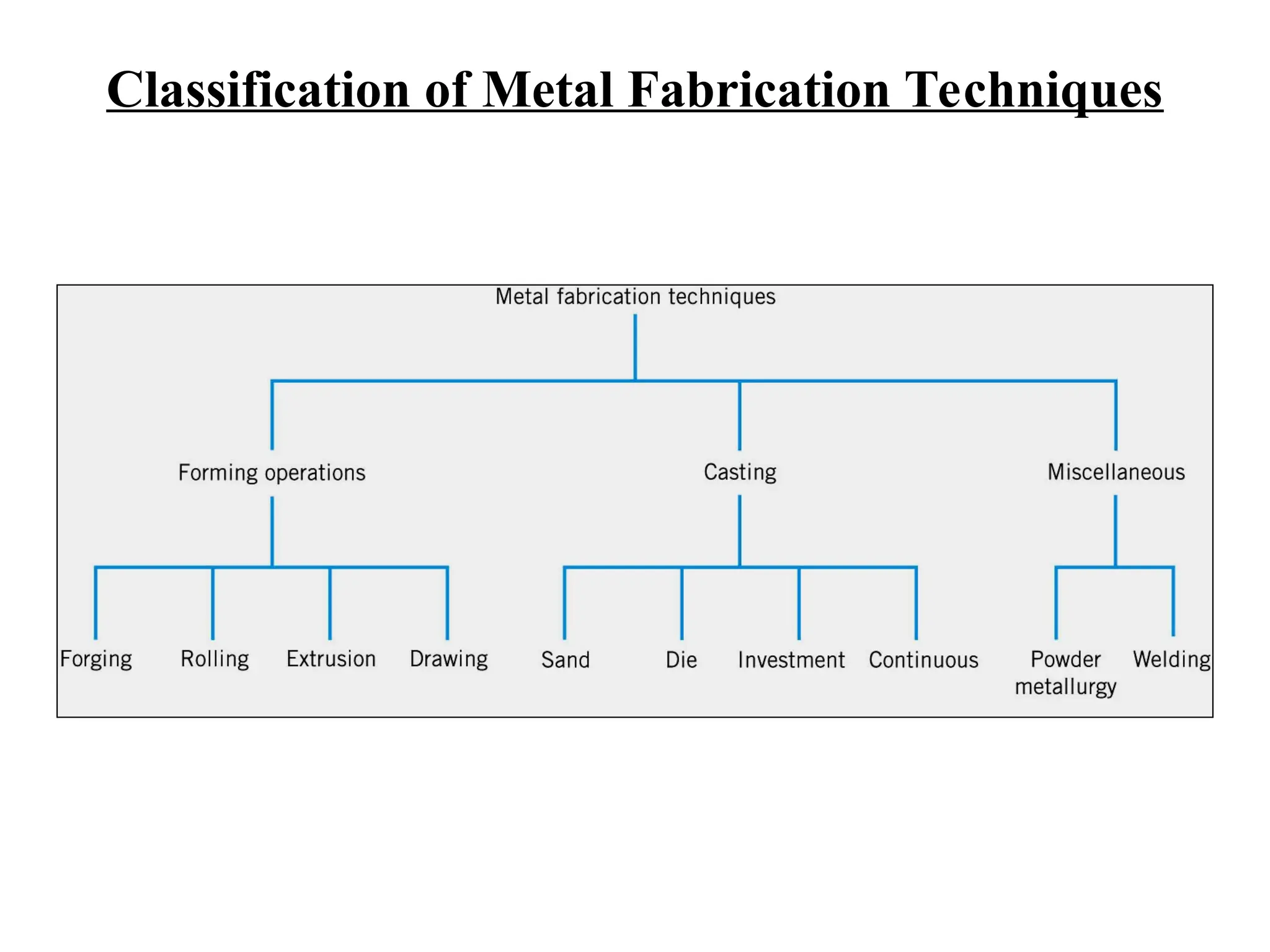
Classification of Metal Fabrication Techniques
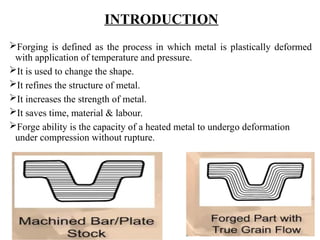
Forging is defined as the process in which metal is plastically deformed
with application of temperature and pressure.
It is used to change the shape.
It refines the structure of metal.
It increases the strength of metal.
It saves time, material & labour.
Forge ability is the capacity of a heated metal to undergo deformation
under compression without rupture.
INTRODUCTION
Hot Forging and Cold Forging
What Is Cold Forging?
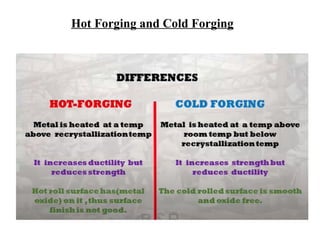
Generally cold forging is the deformation process performed at
room temperature or below recrystallization temp., the metal or alloy
is compressed with two dies until it retains the desired share.
Advantages :
Very little or no finishing work required
Cost effective.
High precision rate.
Economical and High production rates
Long die life
Disadvantages:
Only simple shape in high volumes can be shaped
Not suitable for customized components
Low ductility
Residual stress occurs.
Hot Forging and Cold Forging
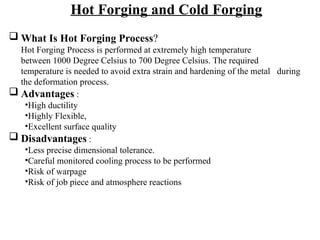
 What Is Hot Forging Process?
Hot Forging Process is performed at extremely high temperature
between 1000 Degree Celsius to 700 Degree Celsius. The required
temperature is needed to avoid extra strain and hardening of the metal during
the deformation process.
 Advantages :
•High ductility
•Highly Flexible,
•Excellent surface quality
 Disadvantages :
•Less precise dimensional tolerance.
•Careful monitored cooling process to be performed
•Risk of warpage
•Risk of job piece and atmosphere reactions
Hot Forging and Cold Forging
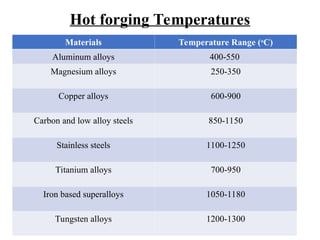
Hot forging Temperatures
Materials Temperature Range (o
C)
Aluminum alloys 400-550
Magnesium alloys 250-350
Copper alloys 600-900
Carbon and low alloy steels 850-1150
Stainless steels 1100-1250
Titanium alloys 700-950
Iron based superalloys 1050-1180
Tungsten alloys 1200-1300
Forging Tools and Equipments
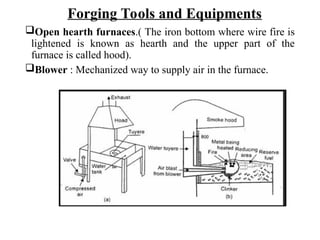
Open hearth furnaces.( The iron bottom where wire fire is
lightened is known as hearth and the upper part of the
furnace is called hood).
Blower : Mechanized way to supply air in the furnace.
Supported tools:
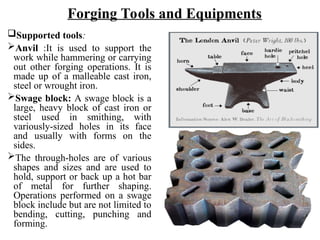
Anvil :It is used to support the
work while hammering or carrying
out other forging operations. It is
made up of a malleable cast iron,
steel or wrought iron.
Swage block: A swage block is a
large, heavy block of cast iron or
steel used in smithing, with
variously-sized holes in its face
and usually with forms on the
sides.
The through-holes are of various
shapes and sizes and are used to
hold, support or back up a hot bar
of metal for further shaping.
Operations performed on a swage
block include but are not limited to
bending, cutting, punching and
forming.
Forging Tools and Equipments
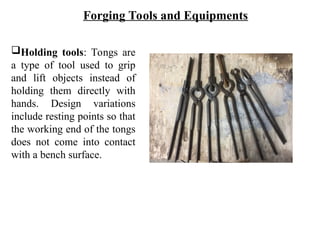
Holding tools: Tongs are
a type of tool used to grip
and lift objects instead of
holding them directly with
hands. Design variations
include resting points so that
the working end of the tongs
does not come into contact
with a bench surface.
Forging Tools and Equipments
Forming & finishing tool:
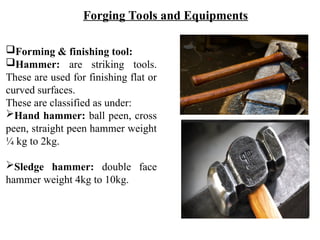
Hammer: are striking tools.
These are used for finishing flat or
curved surfaces.
These are classified as under:
Hand hammer: ball peen, cross
peen, straight peen hammer weight
¼ kg to 2kg.
Sledge hammer: double face
hammer weight 4kg to 10kg.
Forging Tools and Equipments
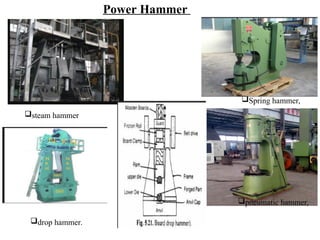
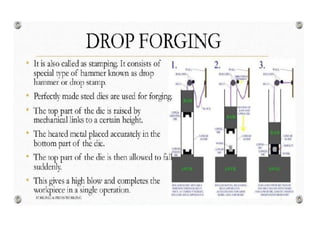
drop hammer.
Power Hammer
Spring hammer,
pneumatic hammer,
steam hammer
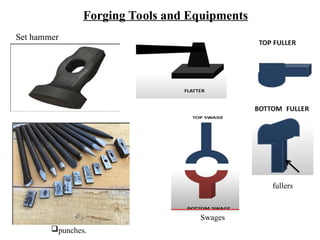
Set hammer
Forging Tools and Equipments
fullers
Swages
punches.
FORGING OPERATIONS
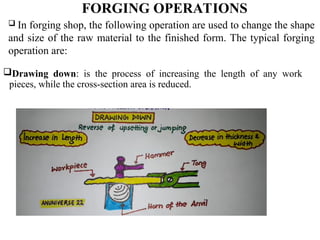
Drawing down: is the process of increasing the length of any work
pieces, while the cross-section area is reduced.
 In forging shop, the following operation are used to change the shape
and size of the raw material to the finished form. The typical forging
operation are:
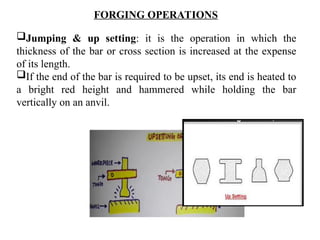
Jumping & up setting: it is the operation in which the
thickness of the bar or cross section is increased at the expense
of its length.
If the end of the bar is required to be upset, its end is heated to
a bright red height and hammered while holding the bar
vertically on an anvil.
FORGING OPERATIONS
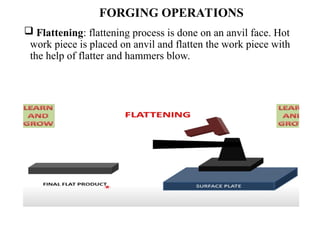
 Flattening: flattening process is done on an anvil face. Hot
work piece is placed on anvil and flatten the work piece with
the help of flatter and hammers blow.
FORGING OPERATIONS
FORGING OPERATIONS
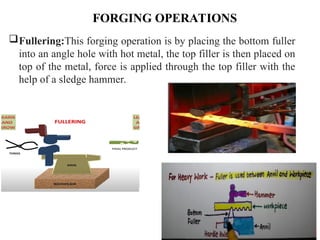
Fullering:This forging operation is by placing the bottom fuller
into an angle hole with hot metal, the top filler is then placed on
top of the metal, force is applied through the top filler with the
help of a sledge hammer.
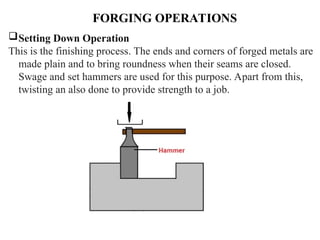
Setting Down Operation
This is the finishing process. The ends and corners of forged metals are
made plain and to bring roundness when their seams are closed.
Swage and set hammers are used for this purpose. Apart from this,
twisting an also done to provide strength to a job.
FORGING OPERATIONS
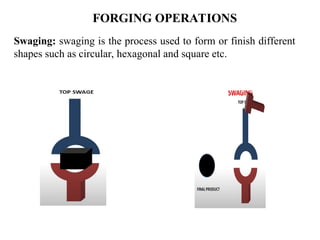
Swaging: swaging is the process used to form or finish different
shapes such as circular, hexagonal and square etc.
FORGING OPERATIONS
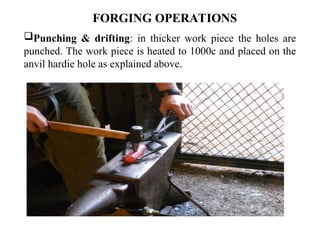
Punching & drifting: in thicker work piece the holes are
punched. The work piece is heated to 1000c and placed on the
anvil hardie hole as explained above.
FORGING OPERATIONS
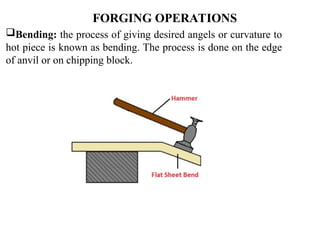
Bending: the process of giving desired angels or curvature to
hot piece is known as bending. The process is done on the edge
of anvil or on chipping block.
FORGING OPERATIONS
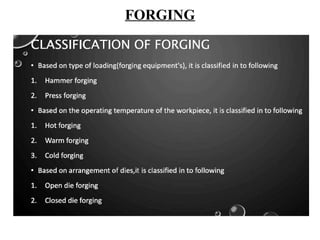
FORGING
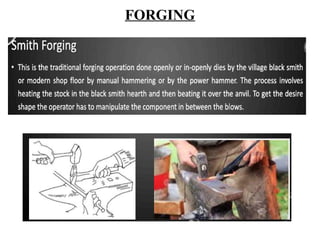
FORGING
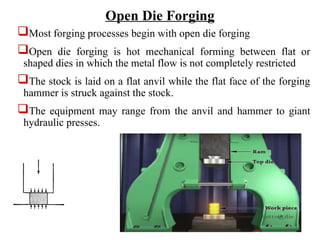
Most forging processes begin with open die forging
Open die forging is hot mechanical forming between flat or
shaped dies in which the metal flow is not completely restricted
The stock is laid on a flat anvil while the flat face of the forging
hammer is struck against the stock.
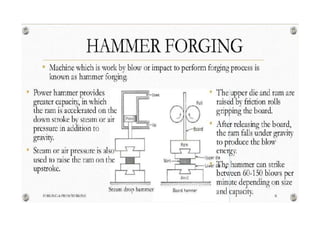
The equipment may range from the anvil and hammer to giant
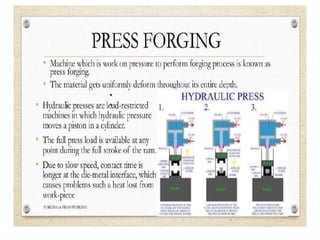
hydraulic presses.
Open Die Forging
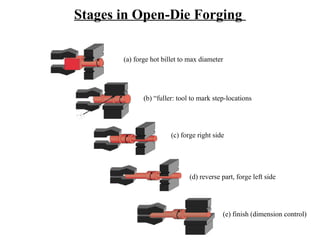
Stages in Open-Die Forging
(a) forge hot billet to max diameter
(b) “fuller: tool to mark step-locations
(c) forge right side
(d) reverse part, forge left side
(e) finish (dimension control)
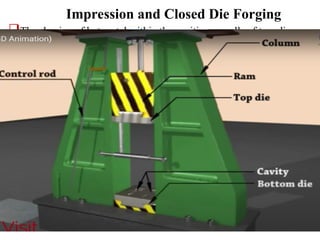
The shaping of hot metal within the cavities or walls of two dies
that come together to completely enclose the workpiece.
Use dies with the approximate end shape.
Usually requires more than one die to complete process
Often used to ensure good die filling.
Impression and Closed Die Forging
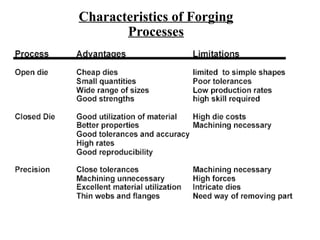
Characteristics of Forging
Processes
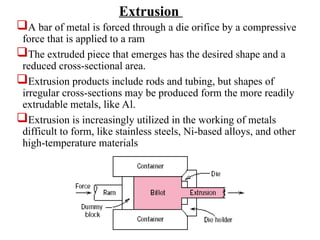
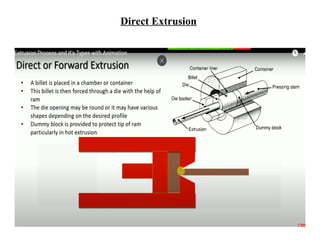
A bar of metal is forced through a die orifice by a compressive
force that is applied to a ram
The extruded piece that emerges has the desired shape and a
reduced cross-sectional area.
Extrusion products include rods and tubing, but shapes of
irregular cross-sections may be produced form the more readily
extrudable metals, like Al.
Extrusion is increasingly utilized in the working of metals
difficult to form, like stainless steels, Ni-based alloys, and other
high-temperature materials
Extrusion
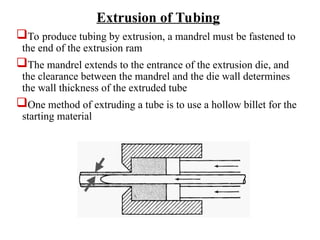
To produce tubing by extrusion, a mandrel must be fastened to
the end of the extrusion ram
The mandrel extends to the entrance of the extrusion die, and
the clearance between the mandrel and the die wall determines
the wall thickness of the extruded tube
One method of extruding a tube is to use a hollow billet for the
starting material
Extrusion of Tubing
Direct Extrusion
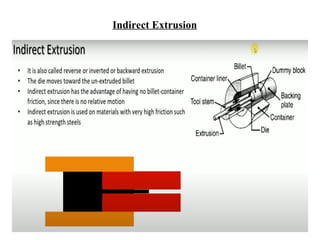
Indirect Extrusion
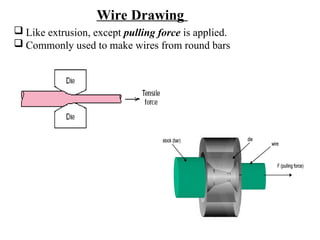
Drawing is the pulling of a metal piece through a die
having a tapered bore by means of a tensile force that is
applied on the exit side
Rod, wire and tubing products are commonly
fabricated in this way
Wiredrawing usually starts with a coil of hot-rolled rod
Draw speeds vary from about 30 to 300 ft/min
In general, the term wire refers to small diameter
products under 5 mm which may be drawn rapidly on
multiple-die machines
Wire Drawing
Wire Drawing
stock (bar)
F (pulling force)
wire
die
stock (bar)
F (pulling force)
wire
die
 Like extrusion, except pulling force is applied.
 Commonly used to make wires from round bars
forging Forging is info for mechanical engineering2.ppt

forging Forging is info for mechanical engineering2.ppt

  • 1.
    Classification of MetalFabrication Techniques
  • 3.
    Forging is definedas the process in which metal is plastically deformed with application of temperature and pressure. It is used to change the shape. It refines the structure of metal. It increases the strength of metal. It saves time, material & labour. Forge ability is the capacity of a heated metal to undergo deformation under compression without rupture. INTRODUCTION
  • 4.
    Hot Forging andCold Forging What Is Cold Forging? Generally cold forging is the deformation process performed at room temperature or below recrystallization temp., the metal or alloy is compressed with two dies until it retains the desired share. Advantages : Very little or no finishing work required Cost effective. High precision rate. Economical and High production rates Long die life Disadvantages: Only simple shape in high volumes can be shaped Not suitable for customized components Low ductility Residual stress occurs.
  • 5.
    Hot Forging andCold Forging  What Is Hot Forging Process? Hot Forging Process is performed at extremely high temperature between 1000 Degree Celsius to 700 Degree Celsius. The required temperature is needed to avoid extra strain and hardening of the metal during the deformation process.  Advantages : •High ductility •Highly Flexible, •Excellent surface quality  Disadvantages : •Less precise dimensional tolerance. •Careful monitored cooling process to be performed •Risk of warpage •Risk of job piece and atmosphere reactions
  • 6.
    Hot Forging andCold Forging
  • 7.
    Hot forging Temperatures MaterialsTemperature Range (o C) Aluminum alloys 400-550 Magnesium alloys 250-350 Copper alloys 600-900 Carbon and low alloy steels 850-1150 Stainless steels 1100-1250 Titanium alloys 700-950 Iron based superalloys 1050-1180 Tungsten alloys 1200-1300
  • 8.
    Forging Tools andEquipments Open hearth furnaces.( The iron bottom where wire fire is lightened is known as hearth and the upper part of the furnace is called hood). Blower : Mechanized way to supply air in the furnace.
  • 9.
    Supported tools: Anvil :Itis used to support the work while hammering or carrying out other forging operations. It is made up of a malleable cast iron, steel or wrought iron. Swage block: A swage block is a large, heavy block of cast iron or steel used in smithing, with variously-sized holes in its face and usually with forms on the sides. The through-holes are of various shapes and sizes and are used to hold, support or back up a hot bar of metal for further shaping. Operations performed on a swage block include but are not limited to bending, cutting, punching and forming. Forging Tools and Equipments
  • 10.
    Holding tools: Tongsare a type of tool used to grip and lift objects instead of holding them directly with hands. Design variations include resting points so that the working end of the tongs does not come into contact with a bench surface. Forging Tools and Equipments
  • 11.
    Forming & finishingtool: Hammer: are striking tools. These are used for finishing flat or curved surfaces. These are classified as under: Hand hammer: ball peen, cross peen, straight peen hammer weight ¼ kg to 2kg. Sledge hammer: double face hammer weight 4kg to 10kg. Forging Tools and Equipments
  • 12.
    drop hammer. Power Hammer Springhammer, pneumatic hammer, steam hammer
  • 13.
    Set hammer Forging Toolsand Equipments fullers Swages punches.
  • 14.
    FORGING OPERATIONS Drawing down:is the process of increasing the length of any work pieces, while the cross-section area is reduced.  In forging shop, the following operation are used to change the shape and size of the raw material to the finished form. The typical forging operation are:
  • 15.
    Jumping & upsetting: it is the operation in which the thickness of the bar or cross section is increased at the expense of its length. If the end of the bar is required to be upset, its end is heated to a bright red height and hammered while holding the bar vertically on an anvil. FORGING OPERATIONS
  • 16.
     Flattening: flatteningprocess is done on an anvil face. Hot work piece is placed on anvil and flatten the work piece with the help of flatter and hammers blow. FORGING OPERATIONS
  • 17.
    FORGING OPERATIONS Fullering:This forgingoperation is by placing the bottom fuller into an angle hole with hot metal, the top filler is then placed on top of the metal, force is applied through the top filler with the help of a sledge hammer.
  • 18.
    Setting Down Operation Thisis the finishing process. The ends and corners of forged metals are made plain and to bring roundness when their seams are closed. Swage and set hammers are used for this purpose. Apart from this, twisting an also done to provide strength to a job. FORGING OPERATIONS
  • 19.
    Swaging: swaging isthe process used to form or finish different shapes such as circular, hexagonal and square etc. FORGING OPERATIONS
  • 20.
    Punching & drifting:in thicker work piece the holes are punched. The work piece is heated to 1000c and placed on the anvil hardie hole as explained above. FORGING OPERATIONS
  • 21.
    Bending: the processof giving desired angels or curvature to hot piece is known as bending. The process is done on the edge of anvil or on chipping block. FORGING OPERATIONS
  • 22.
  • 23.
  • 24.
    Most forging processesbegin with open die forging Open die forging is hot mechanical forming between flat or shaped dies in which the metal flow is not completely restricted The stock is laid on a flat anvil while the flat face of the forging hammer is struck against the stock. The equipment may range from the anvil and hammer to giant hydraulic presses. Open Die Forging
  • 25.
    Stages in Open-DieForging (a) forge hot billet to max diameter (b) “fuller: tool to mark step-locations (c) forge right side (d) reverse part, forge left side (e) finish (dimension control)
  • 26.
    The shaping ofhot metal within the cavities or walls of two dies that come together to completely enclose the workpiece. Use dies with the approximate end shape. Usually requires more than one die to complete process Often used to ensure good die filling. Impression and Closed Die Forging
  • 27.
  • 32.
    A bar ofmetal is forced through a die orifice by a compressive force that is applied to a ram The extruded piece that emerges has the desired shape and a reduced cross-sectional area. Extrusion products include rods and tubing, but shapes of irregular cross-sections may be produced form the more readily extrudable metals, like Al. Extrusion is increasingly utilized in the working of metals difficult to form, like stainless steels, Ni-based alloys, and other high-temperature materials Extrusion
  • 33.
    To produce tubingby extrusion, a mandrel must be fastened to the end of the extrusion ram The mandrel extends to the entrance of the extrusion die, and the clearance between the mandrel and the die wall determines the wall thickness of the extruded tube One method of extruding a tube is to use a hollow billet for the starting material Extrusion of Tubing
  • 34.
  • 35.
  • 36.
    Drawing is thepulling of a metal piece through a die having a tapered bore by means of a tensile force that is applied on the exit side Rod, wire and tubing products are commonly fabricated in this way Wiredrawing usually starts with a coil of hot-rolled rod Draw speeds vary from about 30 to 300 ft/min In general, the term wire refers to small diameter products under 5 mm which may be drawn rapidly on multiple-die machines Wire Drawing
  • 37.
    Wire Drawing stock (bar) F(pulling force) wire die stock (bar) F (pulling force) wire die  Like extrusion, except pulling force is applied.  Commonly used to make wires from round bars