FlutterVsReactNative
Do you have an app idea and want to bring it to life? If cross-platform application
attracts you, you’ll love this Presentation.
Today, we are talking about two popular open-source frameworks of our time that
is winning over the developer’s community, Flutter and React Native. Reactive
performances, code usability on different platforms, reusable blocks of User
Interface are some of the reasons to pick one of these frameworks.
Introduction
FLUTTER PLATFORM
What is Flutter?
Flutter is also an open source Software Development Kit developed by Google for
designing premium native interfaces on IOS & Android. It uses Google’s
language Dart. Similar to JavaScript, it has an optional built-in type of safety
support. It works with existing code which has been created by participants and
organizations around the world.
1. Release date
Google started Flutter in 2017 and slowly started seeing the colossal
adaptation.
2. Stateful hot reloading
Hot reloading is something in which developers write codes, save the code, and hit
reload on a mobile app (react mobile app) and reload like a webpage. Flutter
Includes hot reloading as compare to native app
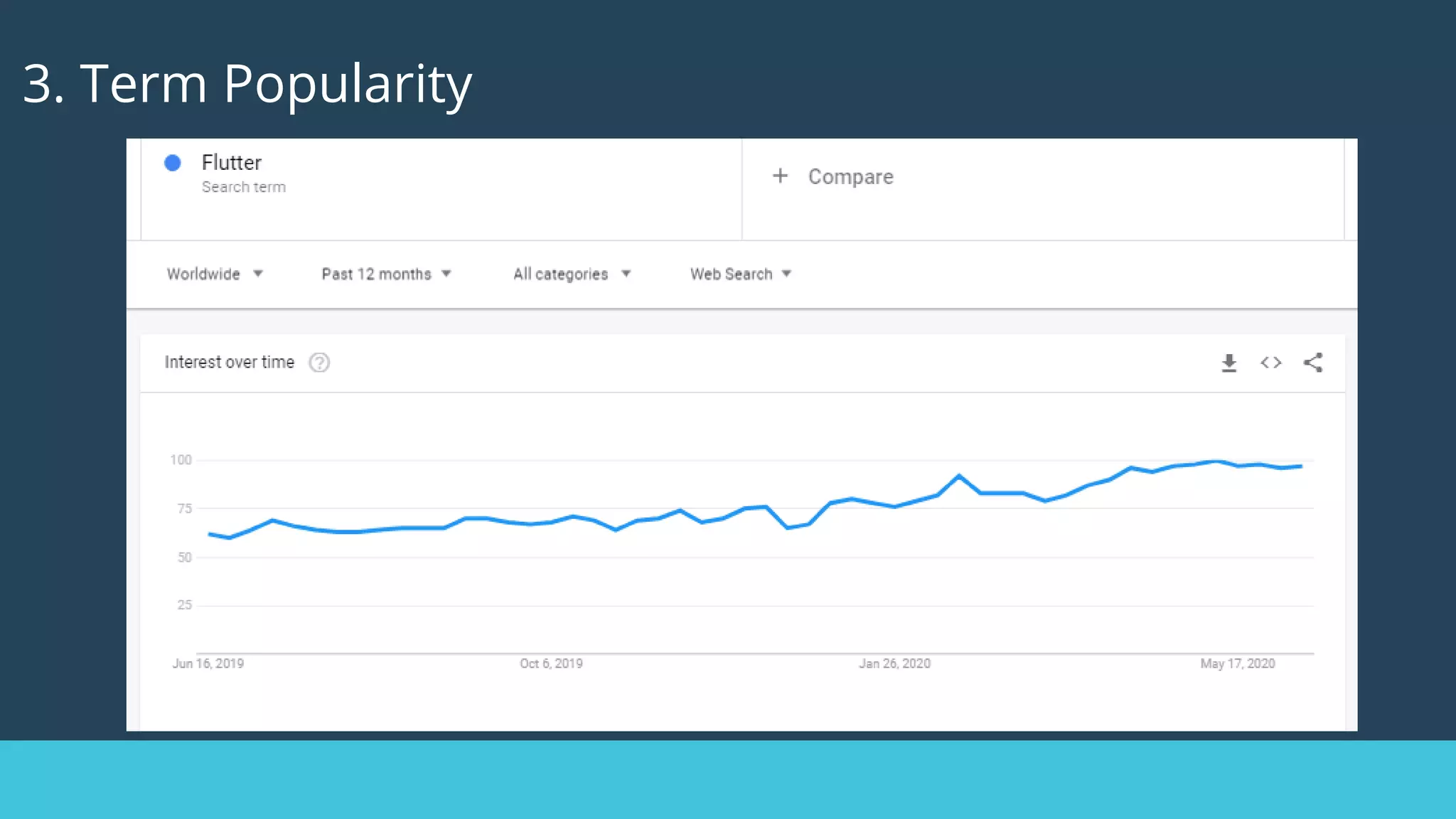
3. Term Popularity
4. Language
Flutter uses Dart as a programming language which is easy to understand for Java
developers as it supports most of the object oriented concept.
5. Components
Flutter, developers get tons of open source components designed by Google team.
It comes with everything needed to quickly render the UI, including widgets for
material design and Cupertino.
REACT NATIVE PLATFORM
What is React Native?
Facebook created React Native as an open source framework for cross-platform
mobile applications. It was launched to create a real and native rendering mobile
app. As a mixture of JavaScript and XML-esque markup language, it comes with
the potential to manage both iOS and Android app with a single code base.
1. Release date
Facebook released React Native in 2015, so, by now, it is already a mature tool and
has a huge community.
2. Stateful hot reloading
React Native includes hot reloading, which is super fast compared to how other
native apps recompile in XCode and Android Studio. If there is any error, developers
can experiment and fix bugs in no time.
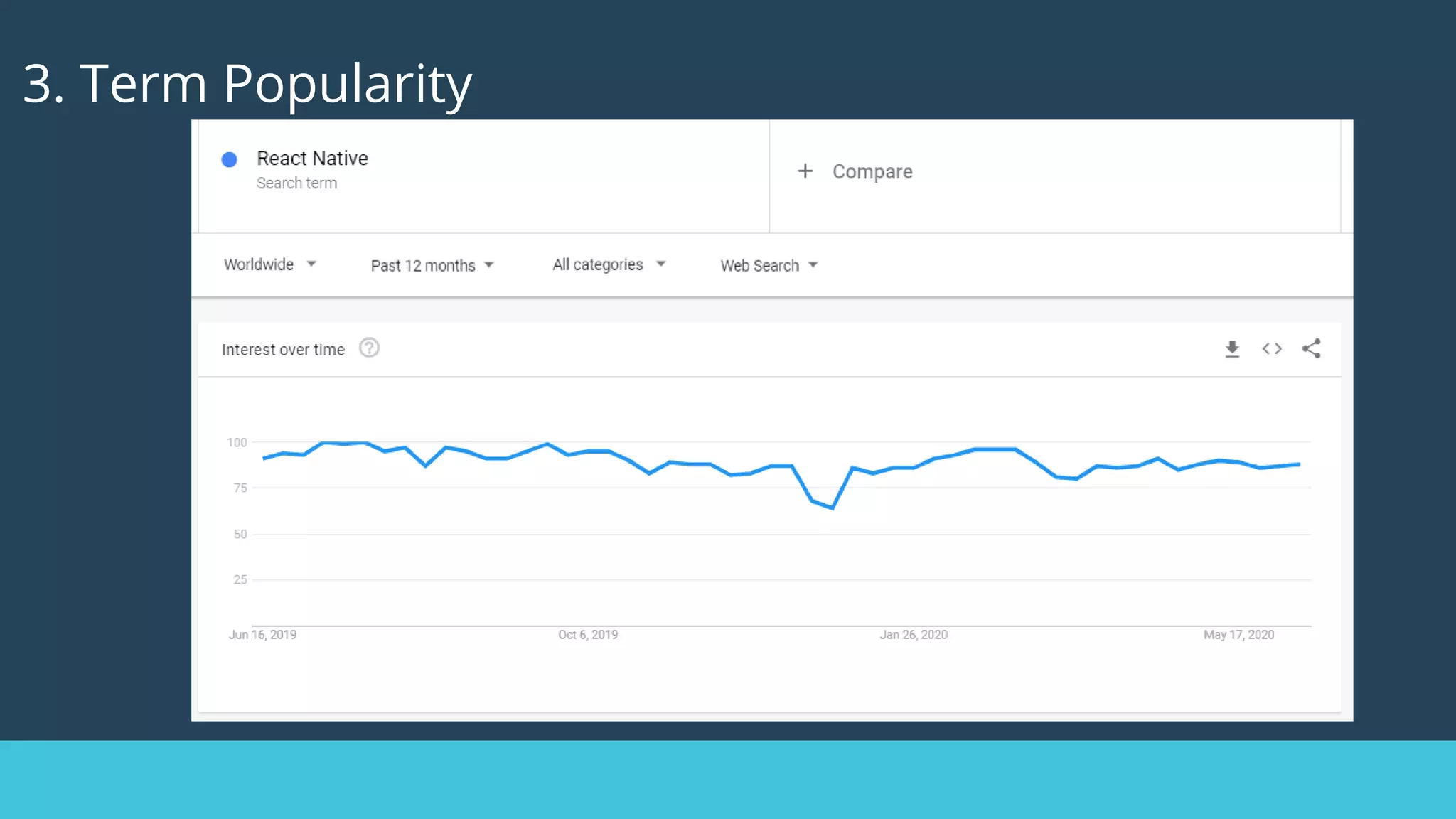
3. Term Popularity
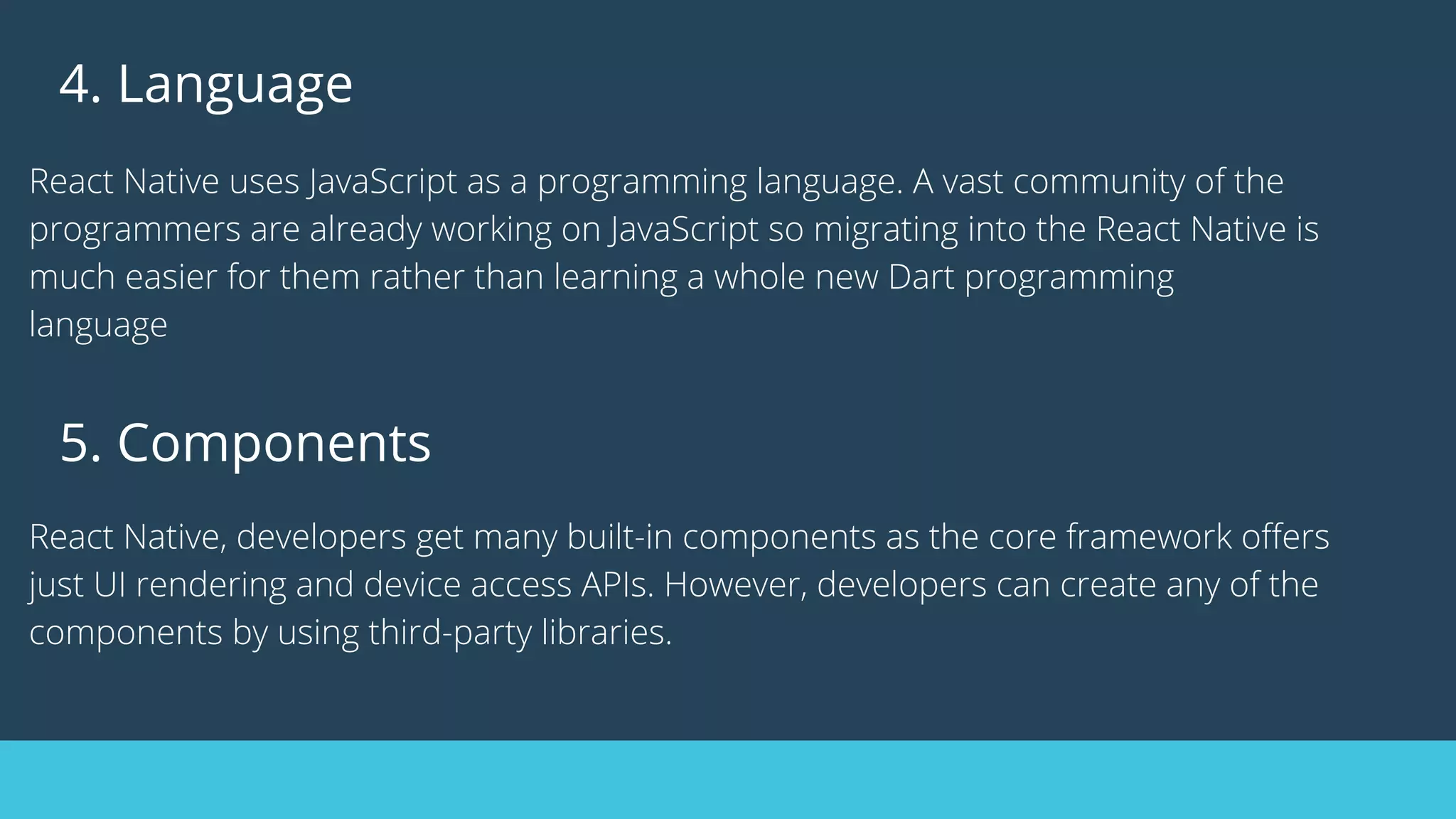
4. Language
React Native uses JavaScript as a programming language. A vast community of the
programmers are already working on JavaScript so migrating into the React Native is
much easier for them rather than learning a whole new Dart programming
language
5. Components
React Native, developers get many built-in components as the core framework offers
just UI rendering and device access APIs. However, developers can create any of the
components by using third-party libraries.
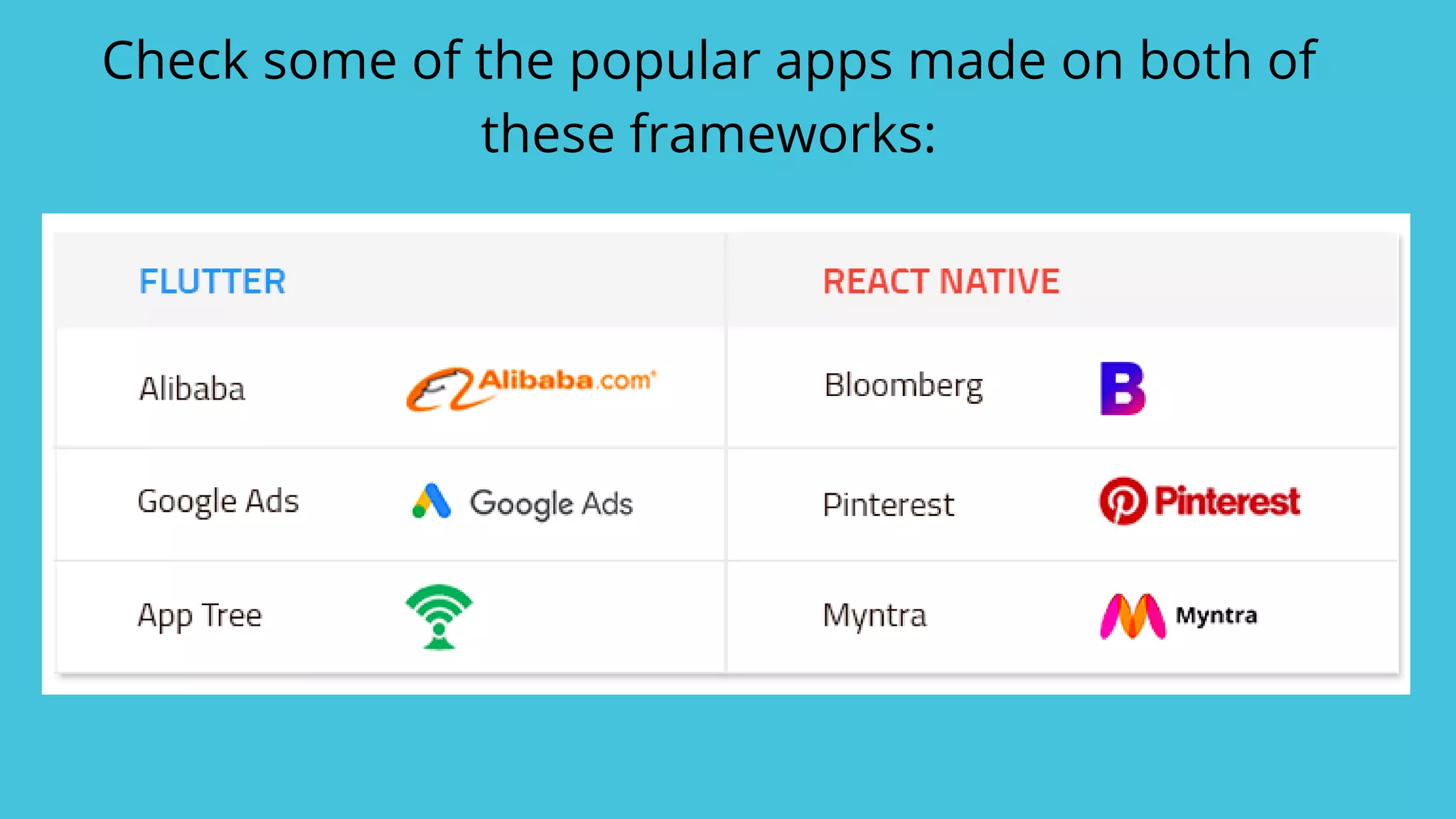
Check some of the popular apps made on both of
these frameworks:
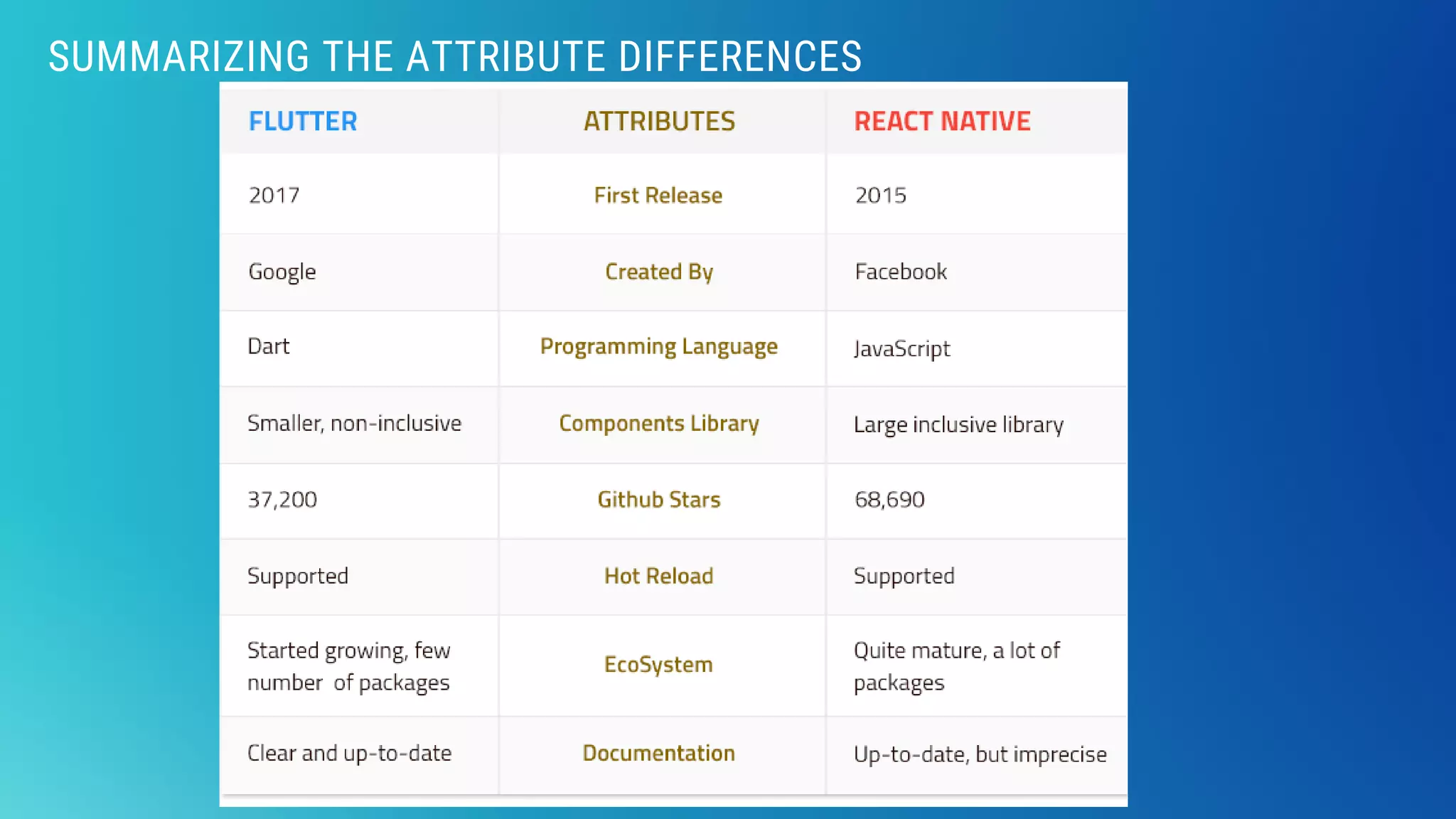
SUMMARIZING THE ATTRIBUTE DIFFERENCES
Conclusion
The choice of frameworks is generally made depending upon the
project type, its requirement, owner’s budget, deadline, and
many more factors. You must leverage the support of your
mobile app development team to find the best solution for your
app idea.

Flutter vs React Native

  • 1.
  • 2.
    Do you havean app idea and want to bring it to life? If cross-platform application attracts you, you’ll love this Presentation. Today, we are talking about two popular open-source frameworks of our time that is winning over the developer’s community, Flutter and React Native. Reactive performances, code usability on different platforms, reusable blocks of User Interface are some of the reasons to pick one of these frameworks. Introduction
  • 3.
  • 4.
    What is Flutter? Flutteris also an open source Software Development Kit developed by Google for designing premium native interfaces on IOS & Android. It uses Google’s language Dart. Similar to JavaScript, it has an optional built-in type of safety support. It works with existing code which has been created by participants and organizations around the world.
  • 5.
    1. Release date Googlestarted Flutter in 2017 and slowly started seeing the colossal adaptation. 2. Stateful hot reloading Hot reloading is something in which developers write codes, save the code, and hit reload on a mobile app (react mobile app) and reload like a webpage. Flutter Includes hot reloading as compare to native app
  • 6.
  • 7.
    4. Language Flutter usesDart as a programming language which is easy to understand for Java developers as it supports most of the object oriented concept. 5. Components Flutter, developers get tons of open source components designed by Google team. It comes with everything needed to quickly render the UI, including widgets for material design and Cupertino.
  • 8.
  • 9.
    What is ReactNative? Facebook created React Native as an open source framework for cross-platform mobile applications. It was launched to create a real and native rendering mobile app. As a mixture of JavaScript and XML-esque markup language, it comes with the potential to manage both iOS and Android app with a single code base.
  • 10.
    1. Release date Facebookreleased React Native in 2015, so, by now, it is already a mature tool and has a huge community. 2. Stateful hot reloading React Native includes hot reloading, which is super fast compared to how other native apps recompile in XCode and Android Studio. If there is any error, developers can experiment and fix bugs in no time.
  • 11.
  • 12.
    4. Language React Nativeuses JavaScript as a programming language. A vast community of the programmers are already working on JavaScript so migrating into the React Native is much easier for them rather than learning a whole new Dart programming language 5. Components React Native, developers get many built-in components as the core framework offers just UI rendering and device access APIs. However, developers can create any of the components by using third-party libraries.
  • 13.
    Check some ofthe popular apps made on both of these frameworks:
  • 14.
  • 15.
    Conclusion The choice offrameworks is generally made depending upon the project type, its requirement, owner’s budget, deadline, and many more factors. You must leverage the support of your mobile app development team to find the best solution for your app idea.