Flute in Formation: preparing for marching band
Stepping into the world of marching band as a flute player can be an exhilarating
yet challenging experience. From learning new techniques to mastering complex
choreography, your journey in the marching band will be filled with growth and
excitement. The Flute World staff has all been there at some point, so we are
compiling some tips and insights to help make the most of this musical
adventure!
1. Embrace the Team Spirit
Marching band is all about teamwork and unity. Embrace the camaraderie
among your fellow band members. Collaborate, support and encourage one
another, and cultivate a positive environment. Mistakes will happen; learn and
grow from them, and help others learn and grow – remember if one person
struggles, everyone struggles. Your bandmates will become a family, offering
you guidance and friendship through the year (and years to follow). Your section
leaders are there to help you and ensure you have a good time. Don’t be afraid
to talk to them or ask for help!
Heading to college? There’s a place for you there, too! Dr. Amy Knopps, director
of the Mizzou Athletic Bands says, “Please know there is always a place for you
to continue making music at the collegiate level in a marching band – either on
flute or piccolo depending on what the program utilizes. I invite you to audition to
become a member of the larger collegiate band family so you have the
opportunity to experience the pageantry of the collegiate game day atmosphere
as well as the range of other ventures, both domestic and abroad, that collegiate
ensembles perform.”
2. Have the Tools You Need
There are many tools that marching flute (and piccolo) players use. The first is
an instrument appropriate for marching! Whenever possible, avoid taking your
indoor/concert flute on the marching field – there are many opportunities for the
flute to be damaged from weather to bumping. Consider taking a student flute
instead. An investment in a back-up instrument might save the cost of repairing
a primary instrument. Also note that some schools march piccolo, and many
colleges ONLY march piccolo. Accessories are also quite useful and sometimes
necessary; check with your director or section leader for specifics of what your
band program recommends.
3. Master Your Instrument
While playing the flute in a concert setting may be second nature to you,
marching band adds a new layer of complexity. Rhythm will likely be your
primary focus, so be sure to practice your parts before rehearsals begin with a
metronome.
Also, spend your warm-ups with added attention to projection and volume to help
your section be heard. The temperature, humidity, and wind will all affect your
sound – be prepared by practicing in multiple conditions. Even an exercise as
seemingly simple as long tones (with a tuner and drone, played at forte and
mezzo piano) will be useful. Be ready to adjust pitch (both by headjoint
placement and embouchure flexibility) to accommodate the flute’s temperament
and tendencies. Work on maintaining a consistent tone quality while adjusting to
outdoor environments.
4. Learn the Basics of Movement
As a flute player, you’ll need to learn how to play while moving. This will require
coordination and concentration. But with practice, you’ll become comfortable
with the multitasking involved in marching band performances.
Start by playing long tones while walking and marching. When you have
achieved a consistent airstream, start practicing scales and eventually parts of
the show music in the same way. Practice in small chunks at first with basic
movements, and work your way to longer, more complex combinations.
5. Understand Marching Techniques
Familiarize yourself with marching techniques like forward marching, backward
marching, and turning. There are a few different styles of marching, so listen to
your director or section leader for specifics. Pay attention to details such as step
size, posture, and arm placement, as these elements contribute to the band’s
overall visual appeal.
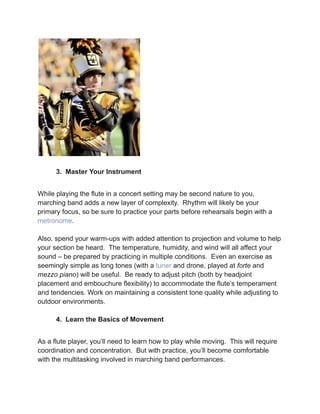
Note that many of the physical techniques you will apply in marching band do
NOT carry back into concert settings. Arm placement, for example, is very
different. In most marching bands, the right arm is pulled back to have the flute
appear in-line with the shoulders. However, this is not an ideal posture for
regular flute performance, and the flute should open forward, with the right elbow
lifted and inline with the ribs (creating a pie-shape). Practice for the
performance, but keep the two postures completely separate for a lifetime of
healthier playing.
The UCLA Bruin Marching Band Flute Section suggests: “Focus on getting the
visuals down first, even if it means you need to add the music in later. A random
person in the crowd won’t be able to tell if you stop playing for a few measures,
but they will be able to see if you’re out of the form on the field.”
6. Stay Open to Choreography
Marching band performances often include choreography and formations that
enhance the visual aspect of the show. Embrace these movements and trust in
the creative process. Your role as a flute player in these formations contributes
to the overall visual narrative of the performance.
7. Practice, Practice, Practice
Rehearsals are the heart of marching band, but practice starts at home. Learn
your parts as best as you can before rehearsals, and practice between. Plan to
attend every rehearsal and give your best effort. Consistency sharpens your own
skills on flute and as a marcher, and also demonstrates your commitment to the
band and its success!
The UCLA Bruin Marching Band Flute Section suggests, Practice tuning with a
drone, rather than a visual tuner. This is good to do all the time, but is especially
important in marching band because you’ll be outside and pitch will fluctuate a
lot. It’s important to be able to use your ears to blend to the people around you,
rather than relying on a visual cue to help you tune (especially important for
piccs!).
8. Time Management
Balancing academics, extracurricular activities, flute practice, and band
rehearsals can be challenging. Develop strong time management skills to
ensure you can excel both in the classroom and on the field. Use tools like
planners or apps to stay organized and prioritize your commitments.
9. Seek Guidance
Don’t hesitate to ask questions or seek help when needed. Your band director,
section leader, flute teacher, and fellow band members are there to support you.
If you encounter difficulties with a particular passage, seek guidance. Some of
that guidance might come from other flute resources, like the concepts of
practicing in “chunks” to learn small bits of music more thoroughly. If high notes
are an issue, you might seek guidance specifically on that! The reason so many
resources exist is that many flute players come across challenges – seek
guidance to overcome them.
10. Embrace Growth and Fun
Throughout your first year in marching band – or as your band program grows –
remember that growth comes with challenges. Celebrate your accomplishments,
both big and small! There will be setbacks; learn from them. Most importantly,
have fun! The experience of performing together and creating moving art as a
team is incredibly rewarding.
11.Reflect and Set Goals
As your first year concludes, take some time to reflect on your experiences.
Consider your achievements, areas for improvement, and how you’ve grown as a
musician and performer. Use these insights to set goals for the next year, aiming
to continue your growth and contribute even more to the band’s success.
Continue this practice of setting goals with your indoor band and solo practice as
well!
Conclusion
Your first year as a flute player in a marching band will be transformative and
memorable. Embrace the challenges, the friendships, and the joy of performing
as part of a dynamic ensemble. With dedication, practice, and a positive attitude,
you will excel in your role and contribute to the magic that is marching band– a
great experience for you, your bandmates, and the audience.

Flute in Formation: preparing for marching band

  • 1.
    Flute in Formation:preparing for marching band Flute in Formation: preparing for marching band Stepping into the world of marching band as a flute player can be an exhilarating yet challenging experience. From learning new techniques to mastering complex choreography, your journey in the marching band will be filled with growth and excitement. The Flute World staff has all been there at some point, so we are compiling some tips and insights to help make the most of this musical adventure! 1. Embrace the Team Spirit Marching band is all about teamwork and unity. Embrace the camaraderie among your fellow band members. Collaborate, support and encourage one another, and cultivate a positive environment. Mistakes will happen; learn and grow from them, and help others learn and grow – remember if one person struggles, everyone struggles. Your bandmates will become a family, offering you guidance and friendship through the year (and years to follow). Your section
  • 2.
    leaders are thereto help you and ensure you have a good time. Don’t be afraid to talk to them or ask for help! Heading to college? There’s a place for you there, too! Dr. Amy Knopps, director of the Mizzou Athletic Bands says, “Please know there is always a place for you to continue making music at the collegiate level in a marching band – either on flute or piccolo depending on what the program utilizes. I invite you to audition to become a member of the larger collegiate band family so you have the opportunity to experience the pageantry of the collegiate game day atmosphere as well as the range of other ventures, both domestic and abroad, that collegiate ensembles perform.” 2. Have the Tools You Need There are many tools that marching flute (and piccolo) players use. The first is an instrument appropriate for marching! Whenever possible, avoid taking your indoor/concert flute on the marching field – there are many opportunities for the flute to be damaged from weather to bumping. Consider taking a student flute instead. An investment in a back-up instrument might save the cost of repairing a primary instrument. Also note that some schools march piccolo, and many colleges ONLY march piccolo. Accessories are also quite useful and sometimes necessary; check with your director or section leader for specifics of what your band program recommends.
  • 3.
    3. Master YourInstrument While playing the flute in a concert setting may be second nature to you, marching band adds a new layer of complexity. Rhythm will likely be your primary focus, so be sure to practice your parts before rehearsals begin with a metronome. Also, spend your warm-ups with added attention to projection and volume to help your section be heard. The temperature, humidity, and wind will all affect your sound – be prepared by practicing in multiple conditions. Even an exercise as seemingly simple as long tones (with a tuner and drone, played at forte and mezzo piano) will be useful. Be ready to adjust pitch (both by headjoint placement and embouchure flexibility) to accommodate the flute’s temperament and tendencies. Work on maintaining a consistent tone quality while adjusting to outdoor environments. 4. Learn the Basics of Movement As a flute player, you’ll need to learn how to play while moving. This will require coordination and concentration. But with practice, you’ll become comfortable with the multitasking involved in marching band performances.
  • 4.
    Start by playinglong tones while walking and marching. When you have achieved a consistent airstream, start practicing scales and eventually parts of the show music in the same way. Practice in small chunks at first with basic movements, and work your way to longer, more complex combinations. 5. Understand Marching Techniques Familiarize yourself with marching techniques like forward marching, backward marching, and turning. There are a few different styles of marching, so listen to your director or section leader for specifics. Pay attention to details such as step size, posture, and arm placement, as these elements contribute to the band’s overall visual appeal. Note that many of the physical techniques you will apply in marching band do NOT carry back into concert settings. Arm placement, for example, is very different. In most marching bands, the right arm is pulled back to have the flute appear in-line with the shoulders. However, this is not an ideal posture for regular flute performance, and the flute should open forward, with the right elbow lifted and inline with the ribs (creating a pie-shape). Practice for the performance, but keep the two postures completely separate for a lifetime of healthier playing. The UCLA Bruin Marching Band Flute Section suggests: “Focus on getting the visuals down first, even if it means you need to add the music in later. A random person in the crowd won’t be able to tell if you stop playing for a few measures, but they will be able to see if you’re out of the form on the field.” 6. Stay Open to Choreography Marching band performances often include choreography and formations that enhance the visual aspect of the show. Embrace these movements and trust in the creative process. Your role as a flute player in these formations contributes to the overall visual narrative of the performance. 7. Practice, Practice, Practice
  • 5.
    Rehearsals are theheart of marching band, but practice starts at home. Learn your parts as best as you can before rehearsals, and practice between. Plan to attend every rehearsal and give your best effort. Consistency sharpens your own skills on flute and as a marcher, and also demonstrates your commitment to the band and its success! The UCLA Bruin Marching Band Flute Section suggests, Practice tuning with a drone, rather than a visual tuner. This is good to do all the time, but is especially important in marching band because you’ll be outside and pitch will fluctuate a lot. It’s important to be able to use your ears to blend to the people around you, rather than relying on a visual cue to help you tune (especially important for piccs!). 8. Time Management Balancing academics, extracurricular activities, flute practice, and band rehearsals can be challenging. Develop strong time management skills to ensure you can excel both in the classroom and on the field. Use tools like planners or apps to stay organized and prioritize your commitments. 9. Seek Guidance Don’t hesitate to ask questions or seek help when needed. Your band director, section leader, flute teacher, and fellow band members are there to support you. If you encounter difficulties with a particular passage, seek guidance. Some of that guidance might come from other flute resources, like the concepts of practicing in “chunks” to learn small bits of music more thoroughly. If high notes are an issue, you might seek guidance specifically on that! The reason so many resources exist is that many flute players come across challenges – seek guidance to overcome them. 10. Embrace Growth and Fun Throughout your first year in marching band – or as your band program grows – remember that growth comes with challenges. Celebrate your accomplishments, both big and small! There will be setbacks; learn from them. Most importantly,
  • 6.
    have fun! Theexperience of performing together and creating moving art as a team is incredibly rewarding. 11.Reflect and Set Goals As your first year concludes, take some time to reflect on your experiences. Consider your achievements, areas for improvement, and how you’ve grown as a musician and performer. Use these insights to set goals for the next year, aiming to continue your growth and contribute even more to the band’s success. Continue this practice of setting goals with your indoor band and solo practice as well! Conclusion Your first year as a flute player in a marching band will be transformative and memorable. Embrace the challenges, the friendships, and the joy of performing as part of a dynamic ensemble. With dedication, practice, and a positive attitude, you will excel in your role and contribute to the magic that is marching band– a great experience for you, your bandmates, and the audience.