Presented by:
Dr. Mohd Anuar Bin Awang
Dr. Ainin Tasneem Bt Abdul Rafa
Supervised by:
Dr. Norhafiza Bt Ab Rahman
1st
July 2014
CONTENT
• Introduction
• Fluid compartments & distribution
• Principle of fluid therapy
• Common electrolytes imbalance, causes &
management
• Take home messages
• References
INTRODUCTION
• Water & electrolyte balance is crucial for body
hemostasis & is one of the most protected
physiological mechanism in body
• A critical role of kidney is to maintain circulating
volume, plasma osmolality & electrolyte hemostasis
within relatively narrow limit
• Changes in both fluid volume & electrolyte
composition occur preoperatively, intraoperatively
& postoperatively, as well response to trauma or
sepsis
MOHD ANUAR
FLUID
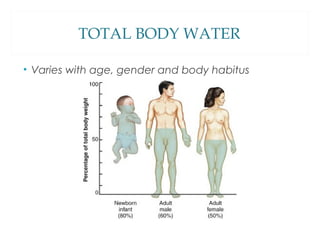
TOTAL BODY WATER
• Varies with age, gender and body habitus
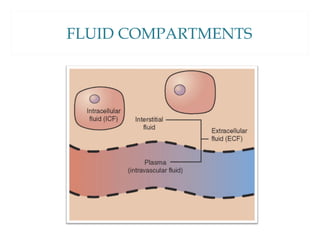
FLUID COMPARTMENTS
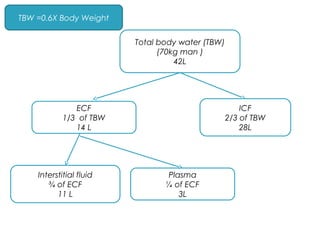
Total body water (TBW)
(70kg man )
42L
ECF
1/3 of TBW
14 L
ICF
2/3 of TBW
28L
Interstitial fluid
¾ of ECF
11 L
Plasma
¼ of ECF
3L
TBW =0.6X Body Weight
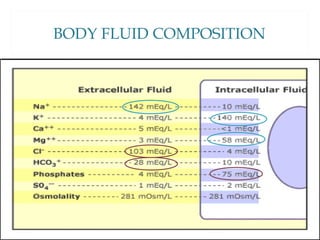
BODY FLUID COMPOSITION
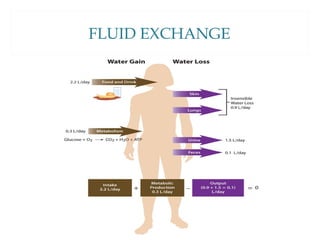
FLUID EXCHANGE
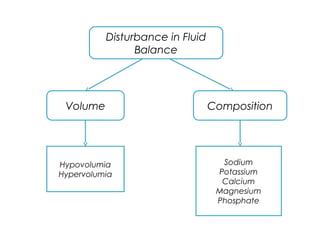
Volume Composition
Disturbance in Fluid
Balance
Hypovolumia
Hypervolumia
Sodium
Potassium
Calcium
Magnesium
Phosphate
FLUID THERAPY
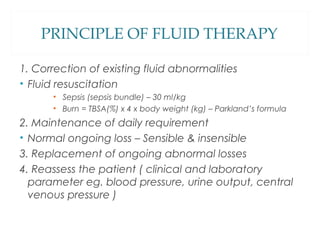
PRINCIPLE OF FLUID THERAPY
1. Correction of existing fluid abnormalities
• Fluid resuscitation
• Sepsis (sepsis bundle) – 30 ml/kg
• Burn = TBSA(%) x 4 x body weight (kg) – Parkland’s formula
2. Maintenance of daily requirement
• Normal ongoing loss – Sensible & insensible
3. Replacement of ongoing abnormal losses
4. Reassess the patient ( clinical and laboratory
parameter eg. blood pressure, urine output, central
venous pressure )
FLUID MAINTENANCE
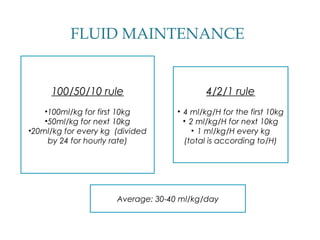
100/50/10 rule
•100ml/kg for first 10kg
•50ml/kg for next 10kg
•20ml/kg for every kg (divided
by 24 for hourly rate)
4/2/1 rule
• 4 ml/kg/H for the first 10kg
• 2 ml/kg/H for next 10kg
• 1 ml/kg/H every kg
(total is according to/H)
Average: 30-40 ml/kg/day
CASE ILLUSTRATION
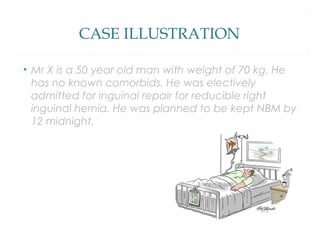
• Mr X is a 50 year old man with weight of 70 kg. He
has no known comorbids. He was electively
admitted for inguinal repair for reducible right
inguinal hernia. He was planned to be kept NBM by
12 midnight.
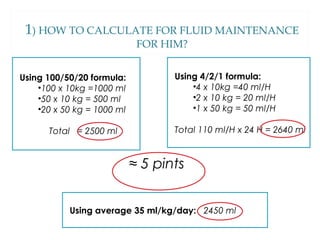
1) HOW TO CALCULATE FOR FLUID MAINTENANCE
FOR HIM?
Using 100/50/20 formula:
•100 x 10kg =1000 ml
•50 x 10 kg = 500 ml
•20 x 50 kg = 1000 ml
Total = 2500 ml
Using 4/2/1 formula:
•4 x 10kg =40 ml/H
•2 x 10 kg = 20 ml/H
•1 x 50 kg = 50 ml/H
Total 110 ml/H x 24 H = 2640 ml
Using average 35 ml/kg/day: 2450 ml
≈ 5 pints
What type of fluid to give?
To be continued……………….
ROUTE OF ADMINISTRATION
• Enteral
• Parenteral
• Crystalloids
• Colloids
• Blood products
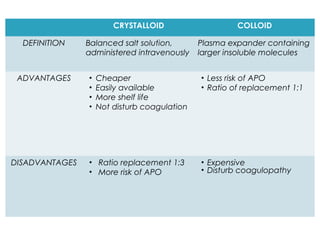
CRYSTALLOID COLLOID
DEFINITION Balanced salt solution,
administered intravenously
Plasma expander containing
larger insoluble molecules
ADVANTAGES • Cheaper
• Easily available
• More shelf life
• Not disturb coagulation
• Less risk of APO
• Ratio of replacement 1:1
DISADVANTAGES • Ratio replacement 1:3
• More risk of APO
• Expensive
• Disturb coagulopathy
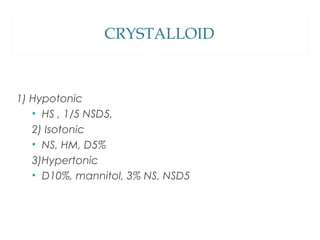
CRYSTALLOID
1) Hypotonic
• HS , 1/5 NSD5,
2) Isotonic
• NS, HM, D5%
3)Hypertonic
• D10%, mannitol, 3% NS, NSD5
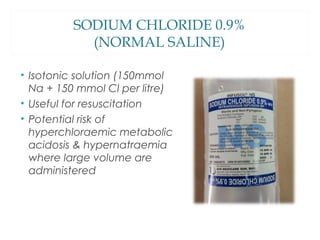
SODIUM CHLORIDE 0.9%
(NORMAL SALINE)
• Isotonic solution (150mmol
Na + 150 mmol Cl per litre)
• Useful for resuscitation
• Potential risk of
hyperchloraemic metabolic
acidosis & hypernatraemia
where large volume are
administered
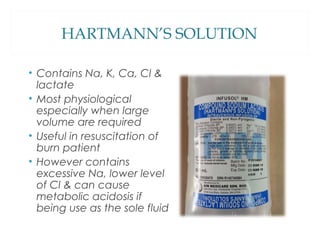
HARTMANN’S SOLUTION
• Contains Na, K, Ca, Cl &
lactate
• Most physiological
especially when large
volume are required
• Useful in resuscitation of
burn patient
• However contains
excessive Na, lower level
of Cl & can cause
metabolic acidosis if
being use as the sole fluid
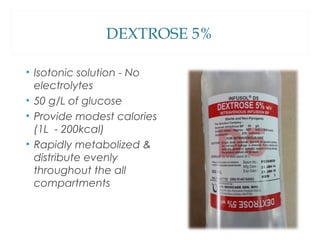
DEXTROSE 5%
• Isotonic solution - No
electrolytes
• 50 g/L of glucose
• Provide modest calories
(1L - 200kcal)
• Rapidly metabolized &
distribute evenly
throughout the all
compartments
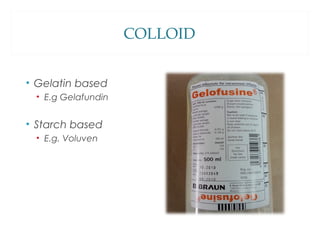
COLLOID
• Gelatin based
• E.g Gelafundin
• Starch based
• E.g. Voluven
AININ TASNEEM
ELECTROLYTES
SODIUM
SODIUM
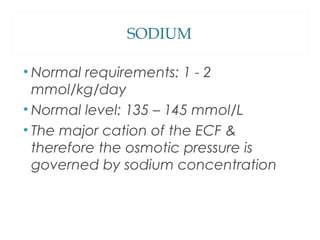
• Normal requirements: 1 - 2
mmol/kg/day
• Normal level: 135 – 145 mmol/L
• The major cation of the ECF &
therefore the osmotic pressure is
governed by sodium concentration
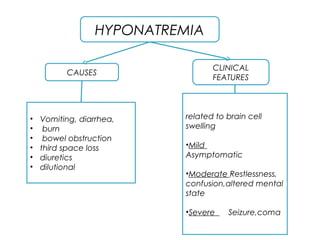
HYPONATREMIA
• Vomiting, diarrhea,
• burn
• bowel obstruction
• third space loss
• diuretics
• dilutional
related to brain cell
swelling
•Mild
Asymptomatic
•Moderate Restlessness,
confusion,altered mental
state
•Severe Seizure,coma
CAUSES
CLINICAL
FEATURES
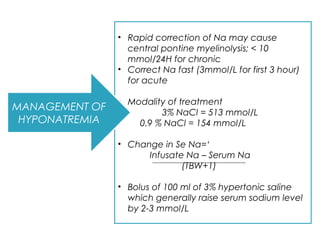
• Rapid correction of Na may cause
central pontine myelinolysis; < 10
mmol/24H for chronic
• Correct Na fast (3mmol/L for first 3 hour)
for acute
• Modality of treatment
3% NaCl = 513 mmol/L
0.9 % NaCl = 154 mmol/L
• Change in Se Na=‘
Infusate Na – Serum Na
(TBW+1)
• Bolus of 100 ml of 3% hypertonic saline
which generally raise serum sodium level
by 2-3 mmol/L
MANAGEMENT OF
HYPONATREMIA
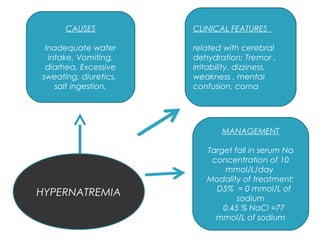
HYPERNATREMIA
CAUSES
Inadequate water
intake, Vomiting,
diarhea, Excessive
sweating, diuretics,
salt ingestion,
CLINICAL FEATURES
related with cerebral
dehydration; Tremor ,
irritability, dizziness,
weakness , mental
confusion, coma
MANAGEMENT
Target fall in serum Na
concentration of 10
mmol/L/day
Modality of treatment:
D5% = 0 mmol/L of
sodium
0.45 % NaCl =77
mmol/L of sodium
POTASSIUM
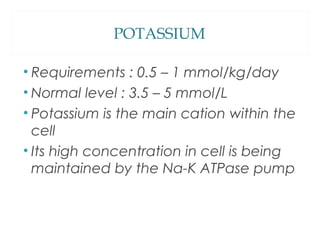
POTASSIUM
• Requirements : 0.5 – 1 mmol/kg/day
• Normal level : 3.5 – 5 mmol/L
• Potassium is the main cation within the
cell
• Its high concentration in cell is being
maintained by the Na-K ATPase pump
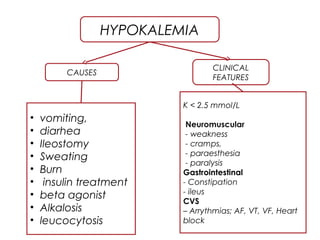
HYPOKALEMIA
• vomiting,
• diarhea
• Ileostomy
• Sweating
• Burn
• insulin treatment
• beta agonist
• Alkalosis
• leucocytosis
K < 2.5 mmol/L
Neuromuscular
- weakness
- cramps,
- paraesthesia
- paralysis
Gastrointestinal
- Constipation
- ileus
CVS
– Arrythmias; AF, VT, VF, Heart
block
CAUSES
CLINICAL
FEATURES
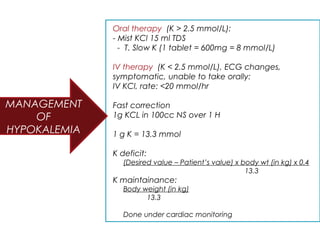
Oral therapy (K > 2.5 mmol/L):
- Mist KCl 15 ml TDS
- T. Slow K (1 tablet = 600mg = 8 mmol/L)
IV therapy (K < 2.5 mmol/L), ECG changes,
symptomatic, unable to take orally:
IV KCl, rate: <20 mmol/hr
Fast correction
1g KCL in 100cc NS over 1 H
1 g K = 13.3 mmol
K deficit:
(Desired value – Patient’s value) x body wt (in kg) x 0.4
13.3
K maintainance:
Body weight (in kg)
13.3
Done under cardiac monitoring
MANAGEMENT
OF
HYPOKALEMIA
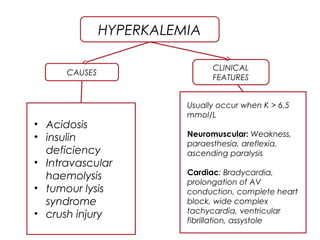
HYPERKALEMIA
• Acidosis
• insulin
deficiency
• Intravascular
haemolysis
• tumour lysis
syndrome
• crush injury
Usually occur when K > 6.5
mmol/L
Neuromuscular: Weakness,
paraesthesia, areflexia,
ascending paralysis
Cardiac: Bradycardia,
prolongation of AV
conduction, complete heart
block, wide complex
tachycardia, ventricular
fibrillation, assystole
CAUSES
CLINICAL
FEATURES
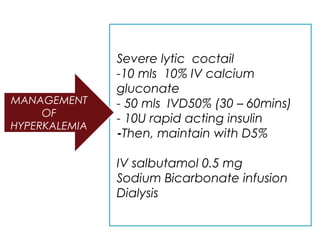
Severe lytic coctail
-10 mls 10% IV calcium
gluconate
- 50 mls IVD50% (30 – 60mins)
- 10U rapid acting insulin
-Then, maintain with D5%
IV salbutamol 0.5 mg
Sodium Bicarbonate infusion
Dialysis
MANAGEMENT
OF
HYPERKALEMIA
CASE ILLUSTRATION
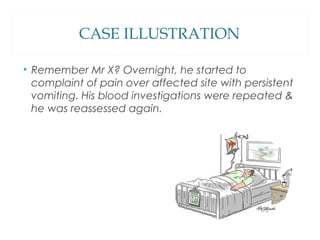
• Remember Mr X? Overnight, he started to
complaint of pain over affected site with persistent
vomiting. His blood investigations were repeated &
he was reassessed again.
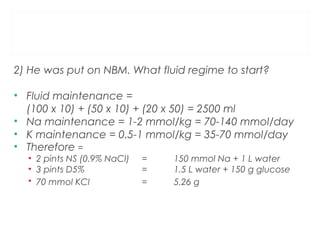
2) He was put on NBM. What fluid regime to start?
• Fluid maintenance =
(100 x 10) + (50 x 10) + (20 x 50) = 2500 ml
• Na maintenance = 1-2 mmol/kg = 70-140 mmol/day
• K maintenance = 0.5-1 mmol/kg = 35-70 mmol/day
• Therefore =
• 2 pints NS (0.9% NaCl) = 150 mmol Na + 1 L water
• 3 pints D5% = 1.5 L water + 150 g glucose
• 70 mmol KCl = 5.26 g
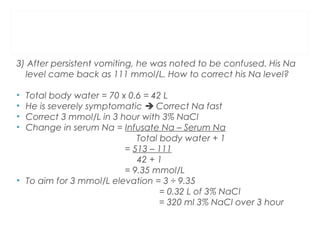
3) After persistent vomiting, he was noted to be confused. His Na
level came back as 111 mmol/L. How to correct his Na level?
• Total body water = 70 x 0.6 = 42 L
• He is severely symptomatic  Correct Na fast
• Correct 3 mmol/L in 3 hour with 3% NaCl
• Change in serum Na = Infusate Na – Serum Na
Total body water + 1
= 513 – 111
42 + 1
= 9.35 mmol/L
• To aim for 3 mmol/L elevation = 3 ÷ 9.35
= 0.32 L of 3% NaCl
= 320 ml 3% NaCl over 3 hour
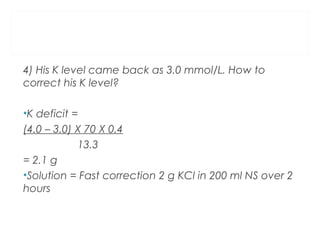
4) His K level came back as 3.0 mmol/L. How to
correct his K level?
•K deficit =
(4.0 – 3.0) X 70 X 0.4
13.3
= 2.1 g
•Solution = Fast correction 2 g KCl in 200 ml NS over 2
hours
CALCIUM
CALCIUM
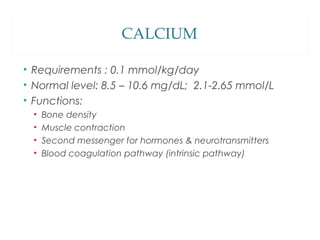
• Requirements : 0.1 mmol/kg/day
• Normal level: 8.5 – 10.6 mg/dL; 2.1-2.65 mmol/L
• Functions:
• Bone density
• Muscle contraction
• Second messenger for hormones & neurotransmitters
• Blood coagulation pathway (intrinsic pathway)
HYPOCALCEMIA
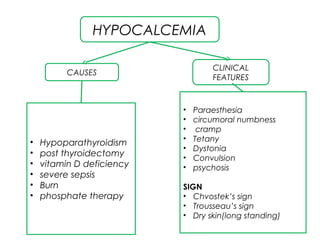
• Hypoparathyroidism
• post thyroidectomy
• vitamin D deficiency
• severe sepsis
• Burn
• phosphate therapy
• Paraesthesia
• circumoral numbness
• cramp
• Tetany
• Dystonia
• Convulsion
• psychosis
SIGN
• Chvostek’s sign
• Trousseau’s sign
• Dry skin(long standing)
CAUSES
CLINICAL
FEATURES
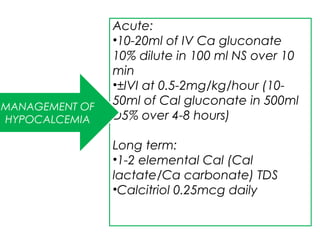
Acute:
•10-20ml of IV Ca gluconate
10% dilute in 100 ml NS over 10
min
•±IVI at 0.5-2mg/kg/hour (10-
50ml of Cal gluconate in 500ml
D5% over 4-8 hours)
Long term:
•1-2 elemental Cal (Cal
lactate/Ca carbonate) TDS
•Calcitriol 0.25mcg daily
MANAGEMENT OF
HYPOCALCEMIA
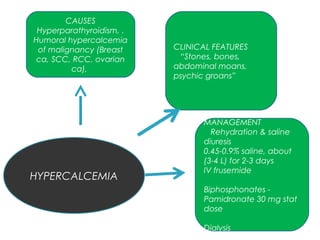
HYPERCALCEMIA
CAUSES
Hyperparathyroidism, .
Humoral hypercalcemia
of malignancy (Breast
ca, SCC, RCC, ovarian
ca),
CLINICAL FEATURES
“Stones, bones,
abdominal moans,
psychic groans”
MANAGEMENT
Rehydration & saline
diuresis
0.45-0.9% saline, about
(3-4 L) for 2-3 days
IV frusemide
Biphosphonates -
Pamidronate 30 mg stat
dose
Dialysis
• Water constitute 50-60% of body weight
• The principal extracellular cation is Na and principal
anion are Cl and HCO3.
• In contrast principal intracellular cation is K and Mg
and principal anion is PO4
• In normal individual, fluid balance is achieved
through water intake and loss.
• Water loss can be divided to insensible and sensible
loss
• Extracellular volume deficit is most common fluid
disorder in surgical patient
TAKE HOME MESSAGES
• Most acute surgical illness are accompanied by
some degree volume loss or redistribution, thus
isotonic fluid administration is most common initial IV
fluid given.
• The most important type of hyponatraemia in
surgical patients is due to hypovolumia thus
management is directed towards replacement of
water volume & Na level.
• Symptoms of hypernatraemia are related to
hyperosmolarity effect of Na which results in cellular
dehydration
• Hypokalaemia is one of the important cause of ileus
REFERENCES
• Schwartz’s Principle of Surgery (9th
edition), G. Tom
Shires 111, 2010
• The Washington Manual of Surgery (6th
edition),
Klingensmith et al, 2012
• Maintainance and replacement fluid therapy in
adult, H Stern, Uptodate.com, 2014
• Sarawak Handbook of Medical Emergencies, 3rd
edition, Soo et al, 2011
• Surgicall Recall, 6th
edition, Blackbourne, 2012

Fluid and electrolyte 29 jun

  • 1.
    Presented by: Dr. MohdAnuar Bin Awang Dr. Ainin Tasneem Bt Abdul Rafa Supervised by: Dr. Norhafiza Bt Ab Rahman 1st July 2014
  • 2.
    CONTENT • Introduction • Fluidcompartments & distribution • Principle of fluid therapy • Common electrolytes imbalance, causes & management • Take home messages • References
  • 3.
    INTRODUCTION • Water &electrolyte balance is crucial for body hemostasis & is one of the most protected physiological mechanism in body • A critical role of kidney is to maintain circulating volume, plasma osmolality & electrolyte hemostasis within relatively narrow limit • Changes in both fluid volume & electrolyte composition occur preoperatively, intraoperatively & postoperatively, as well response to trauma or sepsis
  • 4.
  • 5.
    TOTAL BODY WATER •Varies with age, gender and body habitus
  • 6.
  • 7.
    Total body water(TBW) (70kg man ) 42L ECF 1/3 of TBW 14 L ICF 2/3 of TBW 28L Interstitial fluid ¾ of ECF 11 L Plasma ¼ of ECF 3L TBW =0.6X Body Weight
  • 8.
  • 9.
  • 10.
    Volume Composition Disturbance inFluid Balance Hypovolumia Hypervolumia Sodium Potassium Calcium Magnesium Phosphate
  • 11.
  • 12.
    PRINCIPLE OF FLUIDTHERAPY 1. Correction of existing fluid abnormalities • Fluid resuscitation • Sepsis (sepsis bundle) – 30 ml/kg • Burn = TBSA(%) x 4 x body weight (kg) – Parkland’s formula 2. Maintenance of daily requirement • Normal ongoing loss – Sensible & insensible 3. Replacement of ongoing abnormal losses 4. Reassess the patient ( clinical and laboratory parameter eg. blood pressure, urine output, central venous pressure )
  • 13.
    FLUID MAINTENANCE 100/50/10 rule •100ml/kgfor first 10kg •50ml/kg for next 10kg •20ml/kg for every kg (divided by 24 for hourly rate) 4/2/1 rule • 4 ml/kg/H for the first 10kg • 2 ml/kg/H for next 10kg • 1 ml/kg/H every kg (total is according to/H) Average: 30-40 ml/kg/day
  • 14.
    CASE ILLUSTRATION • MrX is a 50 year old man with weight of 70 kg. He has no known comorbids. He was electively admitted for inguinal repair for reducible right inguinal hernia. He was planned to be kept NBM by 12 midnight.
  • 15.
    1) HOW TOCALCULATE FOR FLUID MAINTENANCE FOR HIM? Using 100/50/20 formula: •100 x 10kg =1000 ml •50 x 10 kg = 500 ml •20 x 50 kg = 1000 ml Total = 2500 ml Using 4/2/1 formula: •4 x 10kg =40 ml/H •2 x 10 kg = 20 ml/H •1 x 50 kg = 50 ml/H Total 110 ml/H x 24 H = 2640 ml Using average 35 ml/kg/day: 2450 ml ≈ 5 pints
  • 16.
    What type offluid to give? To be continued……………….
  • 17.
    ROUTE OF ADMINISTRATION •Enteral • Parenteral • Crystalloids • Colloids • Blood products
  • 18.
    CRYSTALLOID COLLOID DEFINITION Balancedsalt solution, administered intravenously Plasma expander containing larger insoluble molecules ADVANTAGES • Cheaper • Easily available • More shelf life • Not disturb coagulation • Less risk of APO • Ratio of replacement 1:1 DISADVANTAGES • Ratio replacement 1:3 • More risk of APO • Expensive • Disturb coagulopathy
  • 19.
    CRYSTALLOID 1) Hypotonic • HS, 1/5 NSD5, 2) Isotonic • NS, HM, D5% 3)Hypertonic • D10%, mannitol, 3% NS, NSD5
  • 20.
    SODIUM CHLORIDE 0.9% (NORMALSALINE) • Isotonic solution (150mmol Na + 150 mmol Cl per litre) • Useful for resuscitation • Potential risk of hyperchloraemic metabolic acidosis & hypernatraemia where large volume are administered
  • 21.
    HARTMANN’S SOLUTION • ContainsNa, K, Ca, Cl & lactate • Most physiological especially when large volume are required • Useful in resuscitation of burn patient • However contains excessive Na, lower level of Cl & can cause metabolic acidosis if being use as the sole fluid
  • 22.
    DEXTROSE 5% • Isotonicsolution - No electrolytes • 50 g/L of glucose • Provide modest calories (1L - 200kcal) • Rapidly metabolized & distribute evenly throughout the all compartments
  • 23.
    COLLOID • Gelatin based •E.g Gelafundin • Starch based • E.g. Voluven
  • 24.
  • 25.
  • 26.
    SODIUM • Normal requirements:1 - 2 mmol/kg/day • Normal level: 135 – 145 mmol/L • The major cation of the ECF & therefore the osmotic pressure is governed by sodium concentration
  • 27.
    HYPONATREMIA • Vomiting, diarrhea, •burn • bowel obstruction • third space loss • diuretics • dilutional related to brain cell swelling •Mild Asymptomatic •Moderate Restlessness, confusion,altered mental state •Severe Seizure,coma CAUSES CLINICAL FEATURES
  • 28.
    • Rapid correctionof Na may cause central pontine myelinolysis; < 10 mmol/24H for chronic • Correct Na fast (3mmol/L for first 3 hour) for acute • Modality of treatment 3% NaCl = 513 mmol/L 0.9 % NaCl = 154 mmol/L • Change in Se Na=‘ Infusate Na – Serum Na (TBW+1) • Bolus of 100 ml of 3% hypertonic saline which generally raise serum sodium level by 2-3 mmol/L MANAGEMENT OF HYPONATREMIA
  • 29.
    HYPERNATREMIA CAUSES Inadequate water intake, Vomiting, diarhea,Excessive sweating, diuretics, salt ingestion, CLINICAL FEATURES related with cerebral dehydration; Tremor , irritability, dizziness, weakness , mental confusion, coma MANAGEMENT Target fall in serum Na concentration of 10 mmol/L/day Modality of treatment: D5% = 0 mmol/L of sodium 0.45 % NaCl =77 mmol/L of sodium
  • 30.
  • 31.
    POTASSIUM • Requirements :0.5 – 1 mmol/kg/day • Normal level : 3.5 – 5 mmol/L • Potassium is the main cation within the cell • Its high concentration in cell is being maintained by the Na-K ATPase pump
  • 32.
    HYPOKALEMIA • vomiting, • diarhea •Ileostomy • Sweating • Burn • insulin treatment • beta agonist • Alkalosis • leucocytosis K < 2.5 mmol/L Neuromuscular - weakness - cramps, - paraesthesia - paralysis Gastrointestinal - Constipation - ileus CVS – Arrythmias; AF, VT, VF, Heart block CAUSES CLINICAL FEATURES
  • 33.
    Oral therapy (K> 2.5 mmol/L): - Mist KCl 15 ml TDS - T. Slow K (1 tablet = 600mg = 8 mmol/L) IV therapy (K < 2.5 mmol/L), ECG changes, symptomatic, unable to take orally: IV KCl, rate: <20 mmol/hr Fast correction 1g KCL in 100cc NS over 1 H 1 g K = 13.3 mmol K deficit: (Desired value – Patient’s value) x body wt (in kg) x 0.4 13.3 K maintainance: Body weight (in kg) 13.3 Done under cardiac monitoring MANAGEMENT OF HYPOKALEMIA
  • 34.
    HYPERKALEMIA • Acidosis • insulin deficiency •Intravascular haemolysis • tumour lysis syndrome • crush injury Usually occur when K > 6.5 mmol/L Neuromuscular: Weakness, paraesthesia, areflexia, ascending paralysis Cardiac: Bradycardia, prolongation of AV conduction, complete heart block, wide complex tachycardia, ventricular fibrillation, assystole CAUSES CLINICAL FEATURES
  • 35.
    Severe lytic coctail -10mls 10% IV calcium gluconate - 50 mls IVD50% (30 – 60mins) - 10U rapid acting insulin -Then, maintain with D5% IV salbutamol 0.5 mg Sodium Bicarbonate infusion Dialysis MANAGEMENT OF HYPERKALEMIA
  • 36.
    CASE ILLUSTRATION • RememberMr X? Overnight, he started to complaint of pain over affected site with persistent vomiting. His blood investigations were repeated & he was reassessed again.
  • 37.
    2) He wasput on NBM. What fluid regime to start? • Fluid maintenance = (100 x 10) + (50 x 10) + (20 x 50) = 2500 ml • Na maintenance = 1-2 mmol/kg = 70-140 mmol/day • K maintenance = 0.5-1 mmol/kg = 35-70 mmol/day • Therefore = • 2 pints NS (0.9% NaCl) = 150 mmol Na + 1 L water • 3 pints D5% = 1.5 L water + 150 g glucose • 70 mmol KCl = 5.26 g
  • 38.
    3) After persistentvomiting, he was noted to be confused. His Na level came back as 111 mmol/L. How to correct his Na level? • Total body water = 70 x 0.6 = 42 L • He is severely symptomatic  Correct Na fast • Correct 3 mmol/L in 3 hour with 3% NaCl • Change in serum Na = Infusate Na – Serum Na Total body water + 1 = 513 – 111 42 + 1 = 9.35 mmol/L • To aim for 3 mmol/L elevation = 3 ÷ 9.35 = 0.32 L of 3% NaCl = 320 ml 3% NaCl over 3 hour
  • 39.
    4) His Klevel came back as 3.0 mmol/L. How to correct his K level? •K deficit = (4.0 – 3.0) X 70 X 0.4 13.3 = 2.1 g •Solution = Fast correction 2 g KCl in 200 ml NS over 2 hours
  • 40.
  • 41.
    CALCIUM • Requirements :0.1 mmol/kg/day • Normal level: 8.5 – 10.6 mg/dL; 2.1-2.65 mmol/L • Functions: • Bone density • Muscle contraction • Second messenger for hormones & neurotransmitters • Blood coagulation pathway (intrinsic pathway)
  • 42.
    HYPOCALCEMIA • Hypoparathyroidism • postthyroidectomy • vitamin D deficiency • severe sepsis • Burn • phosphate therapy • Paraesthesia • circumoral numbness • cramp • Tetany • Dystonia • Convulsion • psychosis SIGN • Chvostek’s sign • Trousseau’s sign • Dry skin(long standing) CAUSES CLINICAL FEATURES
  • 43.
    Acute: •10-20ml of IVCa gluconate 10% dilute in 100 ml NS over 10 min •±IVI at 0.5-2mg/kg/hour (10- 50ml of Cal gluconate in 500ml D5% over 4-8 hours) Long term: •1-2 elemental Cal (Cal lactate/Ca carbonate) TDS •Calcitriol 0.25mcg daily MANAGEMENT OF HYPOCALCEMIA
  • 44.
    HYPERCALCEMIA CAUSES Hyperparathyroidism, . Humoral hypercalcemia ofmalignancy (Breast ca, SCC, RCC, ovarian ca), CLINICAL FEATURES “Stones, bones, abdominal moans, psychic groans” MANAGEMENT Rehydration & saline diuresis 0.45-0.9% saline, about (3-4 L) for 2-3 days IV frusemide Biphosphonates - Pamidronate 30 mg stat dose Dialysis
  • 45.
    • Water constitute50-60% of body weight • The principal extracellular cation is Na and principal anion are Cl and HCO3. • In contrast principal intracellular cation is K and Mg and principal anion is PO4 • In normal individual, fluid balance is achieved through water intake and loss. • Water loss can be divided to insensible and sensible loss • Extracellular volume deficit is most common fluid disorder in surgical patient TAKE HOME MESSAGES
  • 46.
    • Most acutesurgical illness are accompanied by some degree volume loss or redistribution, thus isotonic fluid administration is most common initial IV fluid given. • The most important type of hyponatraemia in surgical patients is due to hypovolumia thus management is directed towards replacement of water volume & Na level. • Symptoms of hypernatraemia are related to hyperosmolarity effect of Na which results in cellular dehydration • Hypokalaemia is one of the important cause of ileus
  • 47.
    REFERENCES • Schwartz’s Principleof Surgery (9th edition), G. Tom Shires 111, 2010 • The Washington Manual of Surgery (6th edition), Klingensmith et al, 2012 • Maintainance and replacement fluid therapy in adult, H Stern, Uptodate.com, 2014 • Sarawak Handbook of Medical Emergencies, 3rd edition, Soo et al, 2011 • Surgicall Recall, 6th edition, Blackbourne, 2012

Editor's Notes

  • #2 Introduction Examples Take home messages References
  • #38 Why not KCl in D5%?