practice-based CPD for growth
Chrissi Nerantzi
Academic Developer
Manchester
Metropolitan
University
@chrissinerantzi
Formal CPD?
• Conception that only formal CPD is proper CPD?
(mentioned in: King, 2004; Crawford, 2009)
• non-formal, practice-based activities also CPD >
the “invisible curriculum” (Blackmore & Castley,
2006)
• after PgCert no engagement in CPD (TESEP, 2007)
> no formal engagement perhaps?
CPD when?
• reactive (Roscoe, 2002)
• self-driven (King, 2004)
• pro-active (Crawford, 2009)
• the need for ongoing (King, 2004; Mainka,
2007; Browne Report (2010); UK Quality Code,
2012)
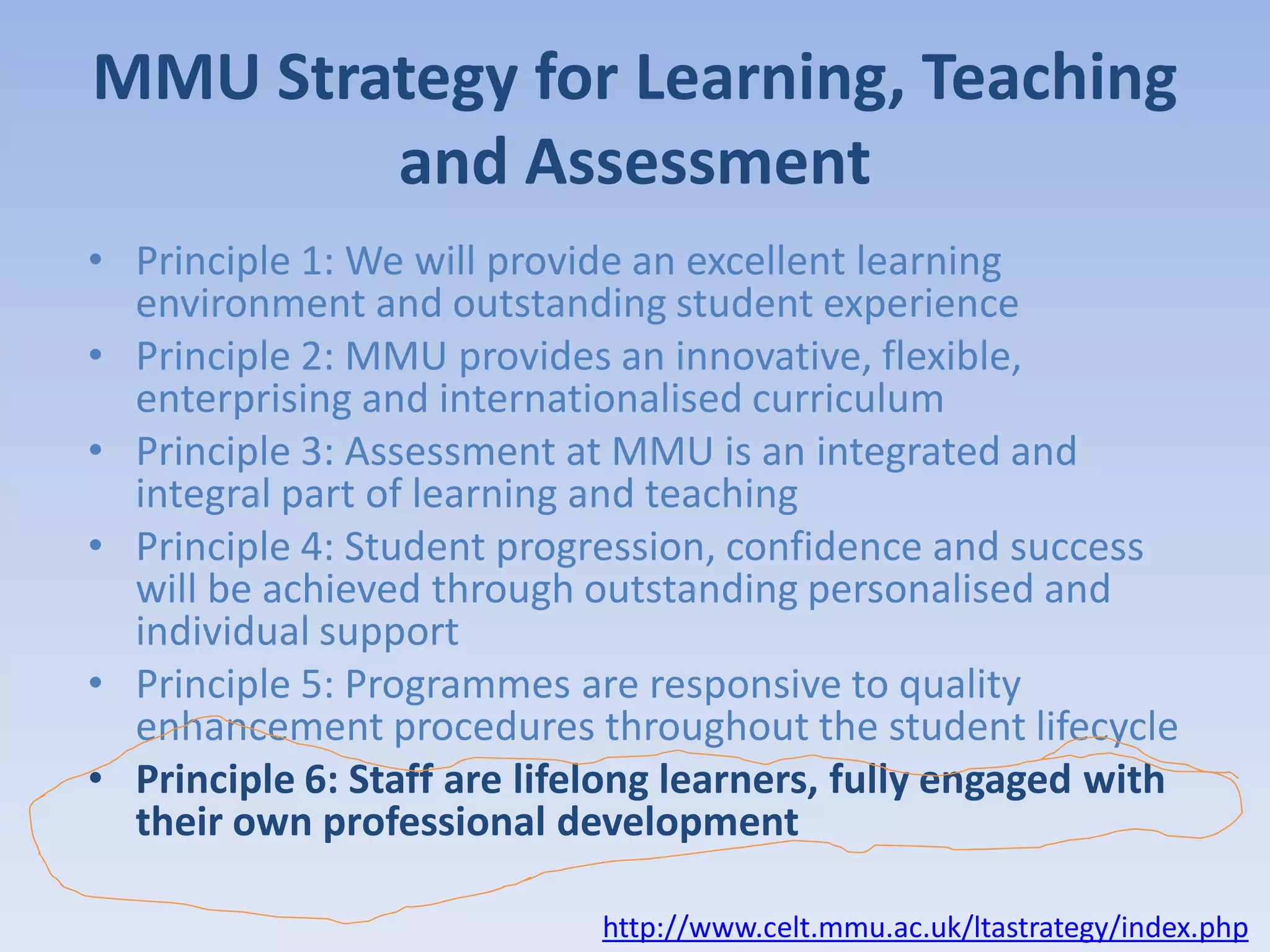
MMU Strategy for Learning, Teaching
and Assessment
• Principle 1: We will provide an excellent learning
environment and outstanding student experience
• Principle 2: MMU provides an innovative, flexible,
enterprising and internationalised curriculum
• Principle 3: Assessment at MMU is an integrated and
integral part of learning and teaching
• Principle 4: Student progression, confidence and success
will be achieved through outstanding personalised and
individual support
• Principle 5: Programmes are responsive to quality
enhancement procedures throughout the student lifecycle
• Principle 6: Staff are lifelong learners, fully engaged with
their own professional development
http://www.celt.mmu.ac.uk/ltastrategy/index.php
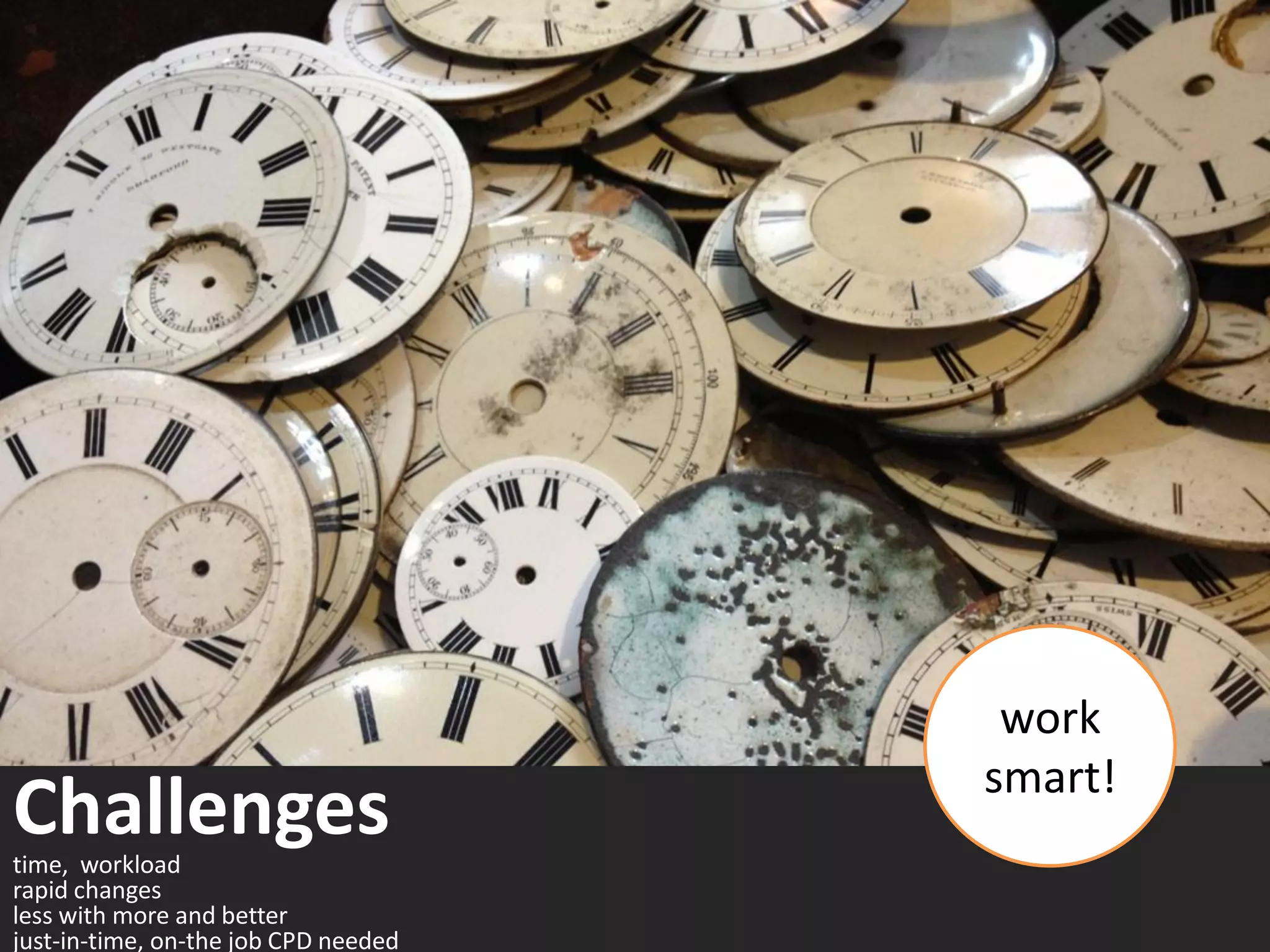
Challengestime, workload
rapid changes
less with more and better
just-in-time, on-the job CPD needed
Work
smart!
•What is it?
•Why is it good for me?
•How do I engage?
•What do I get for it?
Overview
FLEX options 15/30 credits
FLEX [PSF:
AFHEA, FHEA]
FLEX [PSF:
AFHEA, FHEA]
FLEX [THEME]FLEX [THEME]
FLEX
[Creativity,
FOS, named
themes]
FLEX
[Creativity,
FOS, named
themes]
FLEXFLEX
Learning outcomes
On successful completion of this unit, students will be able to:
• Critically reflect on their engagement with CPD (focuses on
the nature of the learning environment and culture within
their specific discipline)
• Produce a critical narrative, which demonstrates the impact
of their engagement with FLEX [brackets] on their practice
and the student experience
EXAMPLE
Note: FLEX [brackets]: This iteration of FLEX has a focus on
Creativity for Learning. This will be displayed on the transcript
within the brackets > FLEX [Creativity for Learning]
indicative open pool of CPD opportunities
linked to learning & teaching
planning a session flexible learning formative
assessment
supporting
students in the
classroom
supporting
students outside
the classroom
using stories
large group
teaching
collaborative
learning
summative
assessment
tutorials developing digital
literacies
using LEGO(R)
Serious(R) Play
small group
teaching
creating learning
communities
assessment as
learning
dialogic feedback inclusive learning
and teaching
using audio to
develop reflection
flipped classroom social media for
learning
portfolios for
learning
using the Socratic
dialogue
game-based
learning
using video in the
classroom
supporting
students
using the VLE
creatively
inclusive
assessment
group assessment problem-based
learning
work-based
learning
blended learning using smart
devices for
learning and
teaching
peer assessment self-assessment project-based
learning
learning through
making
indicative types of FLEX activities
observation of
teaching/
microteach session
presenting at a L& T
conference/event
participating in a
webinar
participating in an
open course
carry out evaluation
of teaching activity
participating in an
internal workshop
attending a
conference/event
leading a webinar leading an open
course
co-facilitating an open
course
co-facilitating
workshop
pedagogical research participating in an
external workshop
using self-study
resources
networking
mentoring coaching creating resources for
students
professional
discussion with
colleagues
(funded) project
participating in a
project
leading a pedagogical
project
participating in a
short course
leading a short course creating resources for
staff development
curriculum
development activity
curriculum
enhancement activity
reflection on practice team-teaching evaluating a student
survey
discipline specific
pedagogic activity
generic pedagogic
research
peer review listening event creating/adapting
open educational
resources
reading a L&T article,
paper/book
discussion with a
colleague around L&T
external examining validation panel visit, trip, exhibition
Participate/Lead a workshop at a conference
Participate/Lead a webinar
Participate in a workshop, informal course
Join a community
Participate in a tweetchat, lead one or join the organising team
Participate informally in another module
FLEX 15 FLEX 30
FLEX 1 FLEX 1
FLEX 2 FLEX 2
FLEX 3 FLEX 3
FLEX 4
FLEX 5
3 x 850
words or
equivalent
5 x 1000 words
or equivalent
FLEX 1
Trigger
Link to own practice
Analysis of the
situation
underpinned by
relevant literature
Action plan
Specific, based on an
informed rationale
and anticipate
outcomes for
students
Assessment Task (100% - Full and final element of Assessment – 2500/5000 words or
equivalent)
Students are required to demonstrate the learning from 3/5 FLEX CPD activities linked to
their teaching practice/supporting students and the impact this learning has had on their
practice and the student experience.
• practice-based academic CPD for teaching tailored to
priorities and aspirations
• activities linked to current/past CPD, subject-specific or
more generic
• pick ‘n’ mix academic CPD activities per academic year
• capture CPD in academic portfolio
What is it?
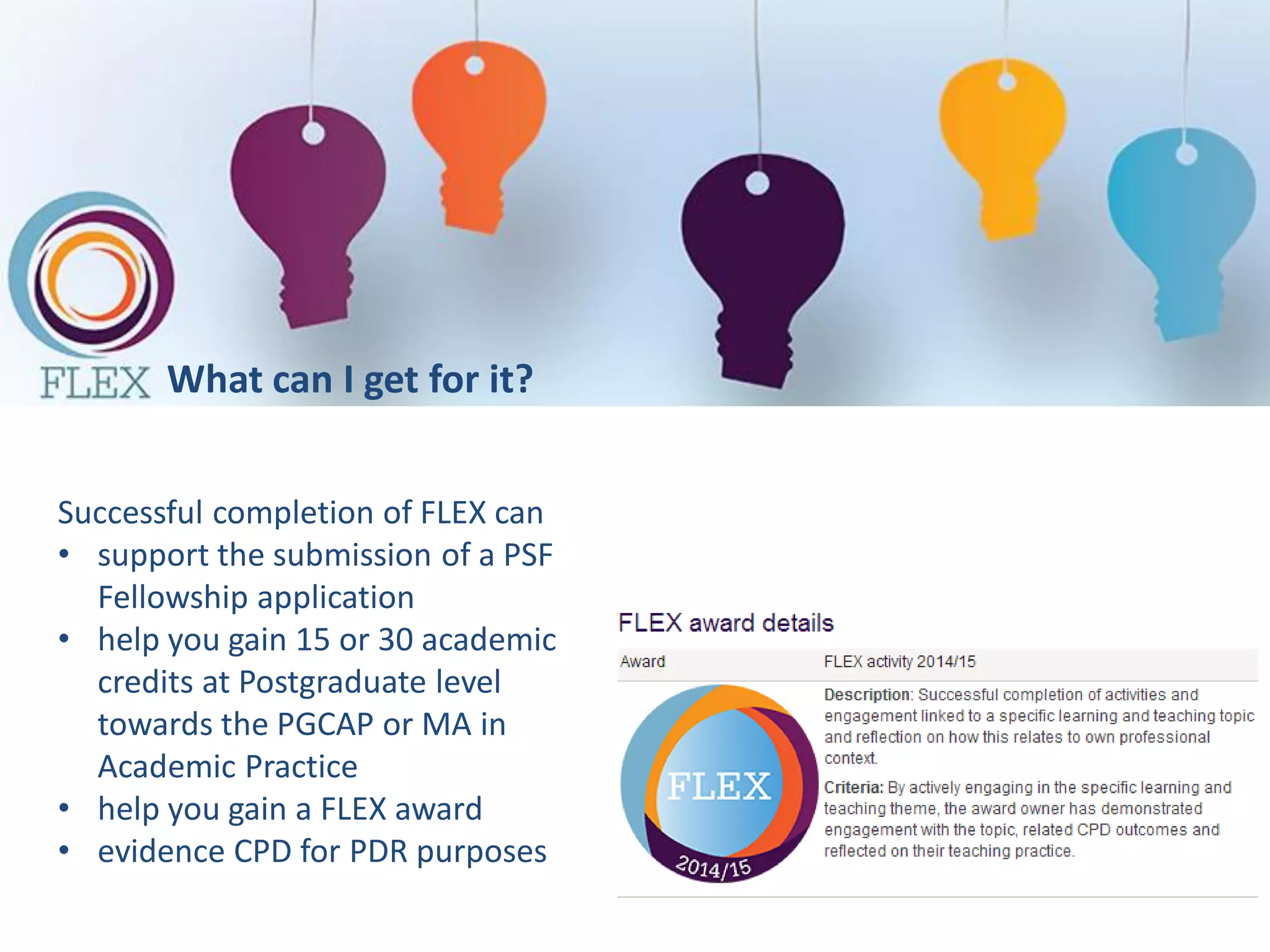
What can I get for it?
Successful engagement in FLEX can
• help you gain 15 or 30 academic credits at Postgraduate level towards the
PgCert in LTHE/HE or the MA in HE
• Work towards an HEA professional recognition (AFHEA or FHEA) and gain 15 or
30 credits of the above mentioned programmes
• evidence CPD for PDR purposes
FLEX 15/30[PSF] (see FLEX [PSF]
Handbook)
Co-accredited by the HEA to also award HEA
Fellowships:
• FLEX15 [PSF] – Associate Fellow of the HEA
• FLEX30 [PSF] – Fellow of the HEA
Activities used as sections of the portfolio are
chosen to align with the UKPSF (2011) :
Descriptors for D1 & D2 and dimensions of
practice
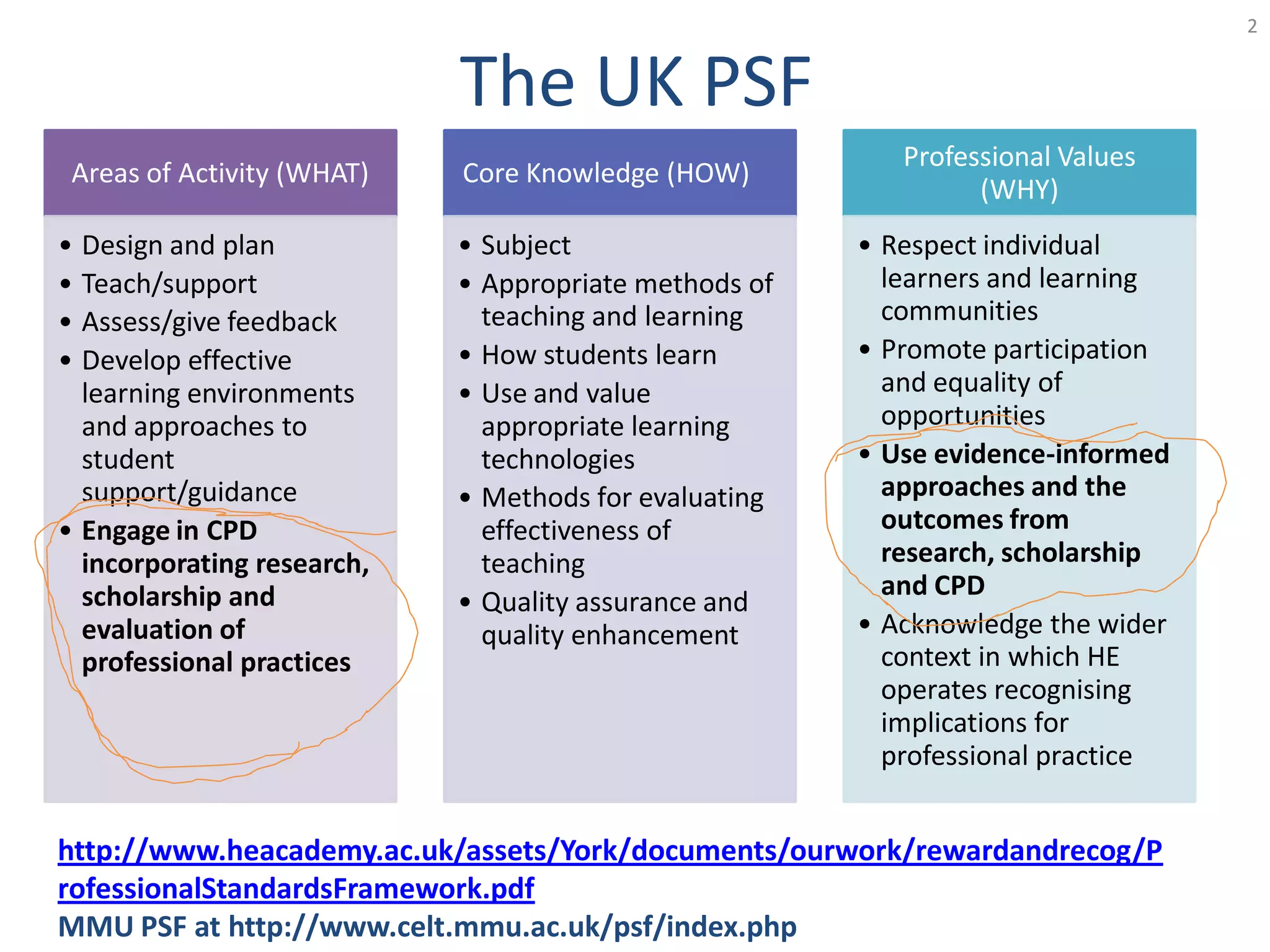
The UK PSF
21
Areas of Activity (WHAT)
• Design and plan
• Teach/support
• Assess/give feedback
• Develop effective
learning environments
and approaches to
student
support/guidance
• Engage in CPD
incorporating research,
scholarship and
evaluation of
professional practices
Core Knowledge (HOW)
• Subject
• Appropriate methods of
teaching and learning
• How students learn
• Use and value
appropriate learning
technologies
• Methods for evaluating
effectiveness of
teaching
• Quality assurance and
quality enhancement
Professional Values
(WHY)
• Respect individual
learners and learning
communities
• Promote participation
and equality of
opportunities
• Use evidence-informed
approaches and the
outcomes from
research, scholarship
and CPD
• Acknowledge the wider
context in which HE
operates recognising
implications for
professional practice
https://www.heacademy.ac.uk/ukpsf MMU PSF at
http://www.celt.mmu.ac.uk/psf/index.php
Requirements of FLEX [PSF]
FLEX15
• 3 Sections aligned with 3 Areas of Activity
– Must incorporate AA5:CPD –this section must include reference to
engagement with peer observation and dialogue with your FLEX mentor
– Must clearly reference CK1 (Subject knowledge) & 2 (Subject specific teaching
and learning theory)
– Incorporate a mapping tool to demonstrate engagement with appropriate
dimensions
FLEX30
• 5 Sections aligned with 5 Areas of Activity
– Within AA5:CPD –this section must include reference to engagement with
peer observation and dialogue with your FLEX mentor
– Must integrate engagement with all dimensions of practice
– Incorporate a mapping tool to demonstrate engagement with all dimensions
Academic portfolio
• develop reflective skills and habits
• a personal and collaborative development space for teaching and research activities
• evidence academic CPD that is recognised as such
image by Nate Steiner, source https://www.flickr.com/photos/nate/412783683/sizes/z/
Go
digital!
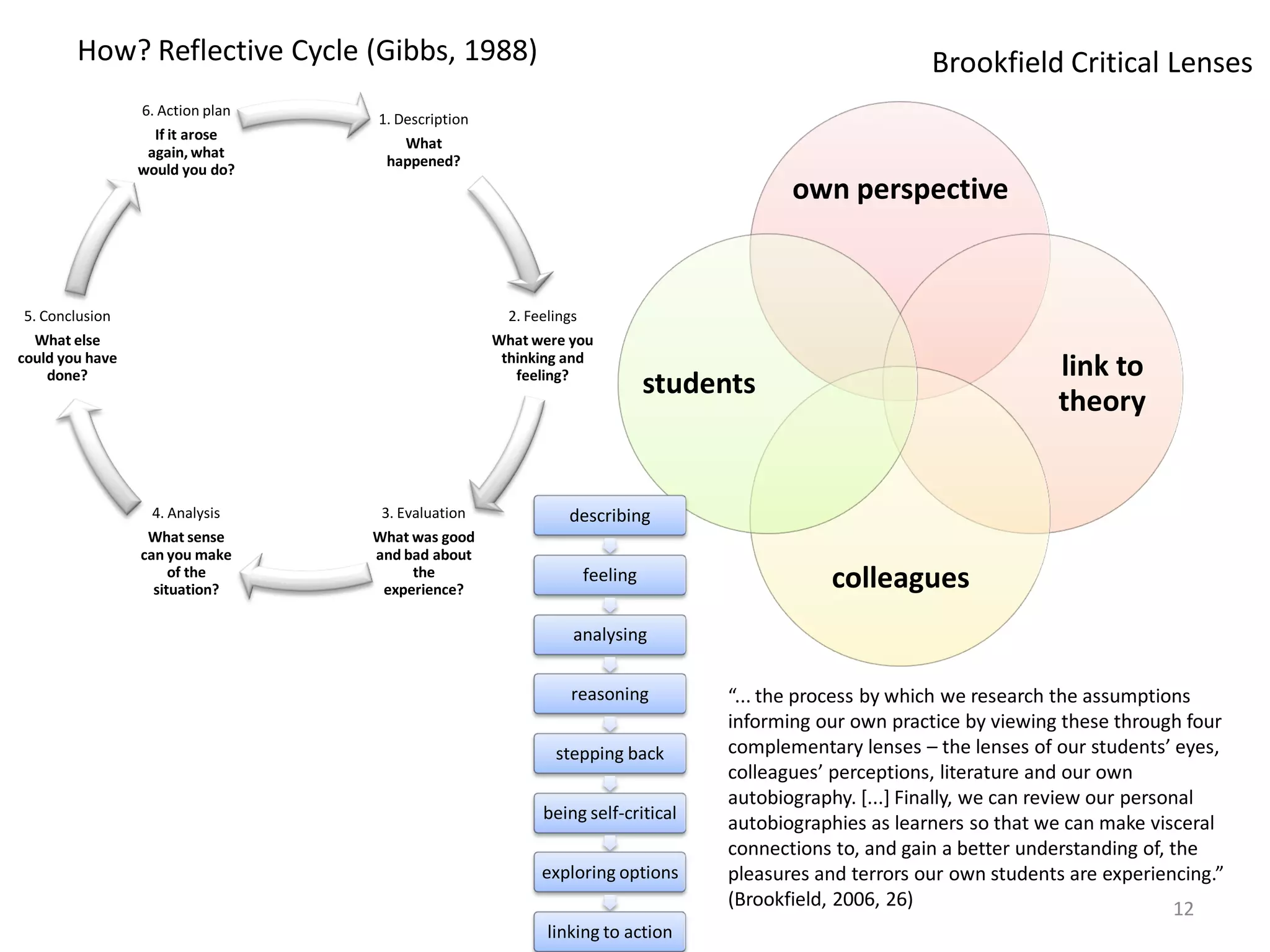
How? Reflective Cycle (Gibbs, 1988)
24
1. Description
What
happened?
2. Feelings
What were you
thinking and
feeling?
3. Evaluation
What was good
and bad about
the
experience?
4. Analysis
What sense
can you make
of the
situation?
5. Conclusion
What else
could you have
done?
6. Action plan
If it arose
again, what
would you do?
own perspective
link to
theory
colleagues
students
Brookfield Critical Lenses
describing
feeling
analysing
reasoning
stepping back
being self-critical
exploring options
linking to action
“... the process by which we research the assumptions
informing our own practice by viewing these through four
complementary lenses – the lenses of our students’ eyes,
colleagues’ perceptions, literature and our own
autobiography. [...] Finally, we can review our personal
autobiographies as learners so that we can make visceral
connections to, and gain a better understanding of, the
pleasures and terrors our own students are experiencing.”
(Brookfield, 2006, 26)
A reflective model might be useful!
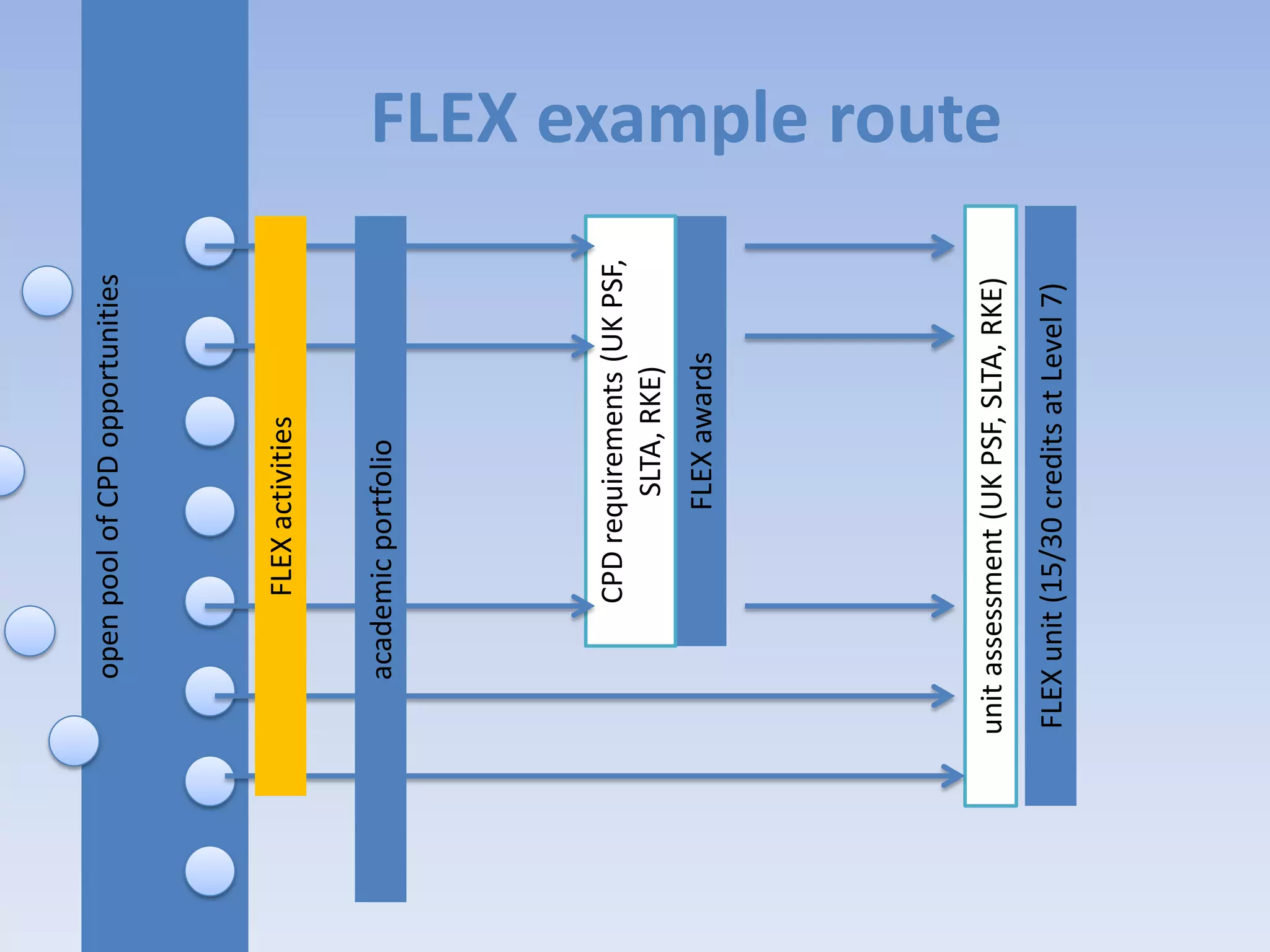
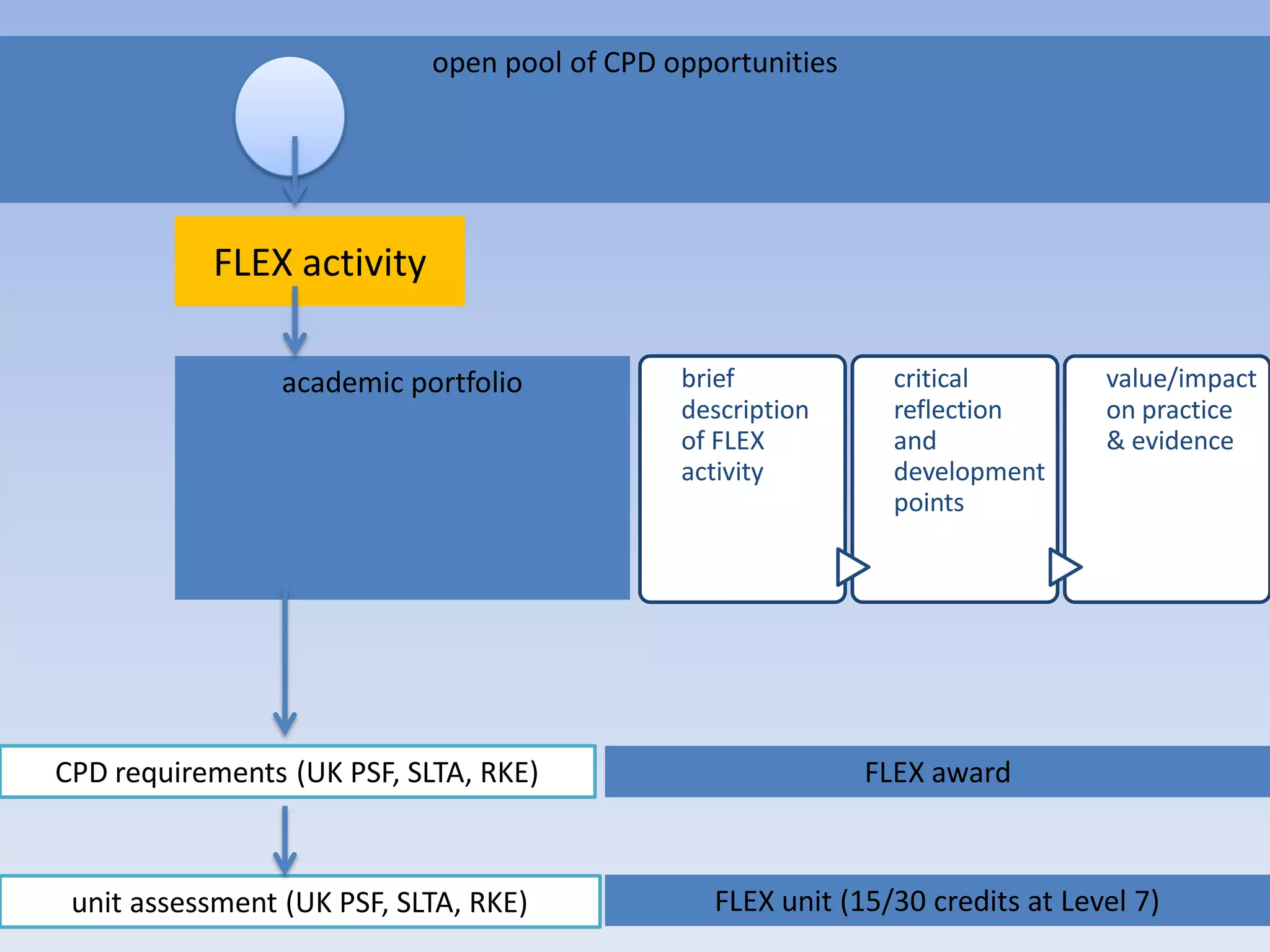
FLEX activity
open pool of CPD opportunities
academic portfolio brief
description
of FLEX
activity
critical
reflection
and
development
points
value/impact
on practice
& evidence
FLEX unit (15/30 credits at Level 7)unit assessment (UK PSF, SLTA)
CPD requirements (UK PSF, SLTA)
Example portfolios…
Colleagues Units completed
Dr Marilena Antoniadou Generic FLEX
http://marilenaantoniadou.blogspot.co.uk/
Olivia Glasser Generic FLEX and Creativity unit
https://cpdoliviaglasser.wordpress.com/
Marcin Wozniak Generic FLEX and Creativity unit
https://cpdmarcinwozniak.wordpress.com/
Matthew Crossley FLEX 15 [Creativity for Learning]
https://cpdmatthewcrossley.wordpress.com/
Daniel Orwin FLEX 30 [Creativity for Learning]
https://danielorwin.wordpress.com/
Learning outcomes
On successful completion of this unit, students will be able to:
• Critically reflect on their engagement with CPD (focuses on
the nature of the learning environment and culture within
their specific discipline)
• Produce a critical narrative, which demonstrates the impact
of their engagement with FLEX [brackets] on their practice
and the student experience
Note: FLEX [brackets]: This iteration of FLEX has a focus on
Creativity for Learning. This will be displayed on the transcript
within the brackets > FLEX [Creativity for Learning]
FLEX 15 FLEX 30
FLEX 1 FLEX 1
FLEX 2 FLEX 2
FLEX 3 FLEX 3
FLEX 4
FLEX 5
3 x 850
words or
equivalent
5 x 1000 words
or equivalent
FLEX 1
Trigger
Link to own practice
Analysis of the
situation
underpinned by
relevant literature
Action plan
Specific, based on an
informed rationale
and anticipate
outcomes for
students
Assessment Task (100% - Full and final element of Assessment – 2500/5000
words or equivalent)
Students are required to demonstrate the learning from 3/5 FLEX CPD
activities linked to Creativity for Learning and the impact this learning has
had on their practice and the student experience.
Academic CPD
Professional Recognition HEA
(AFHEA, FHEA), Good Standing
FLEX developmental CPD programme
Academic qualifications
(PgCert, MA in HE)
Informal CPD
FLEX 15 (D1) FLEX 30 (D2) Formal route
Informal route
FLEXFLEX
Academic
Portfolio
(Teaching &
Research)
Academic
Portfolio
(Teaching &
Research)
DevelopmentDevelopment
CPD
Requirements
CPD
Requirements
QualificationsQualificationsBadgesBadges
PromotionPromotion
Professional
Recognition
Professional
Recognition
Teaching &
Learning
Conversations,
monthly webinars
Learning and
Teaching in
Higher
Education,
weekly
tweetchats,
every
Wednesday
8-9pm
Creativity for Learning in HE,
MMU unit and open course,
ongoing engagement
Bring your own device for learning, 5-day open
learning event
Also
available:
• open
Assessment
course
• Open
Programme
Leadership
course
http://www.celt.mmu.ac.uk/flex
Workshop
series
Flexible, Open and Social
Learning, open course
OER with creative teaching
ideas, use and contribute
32
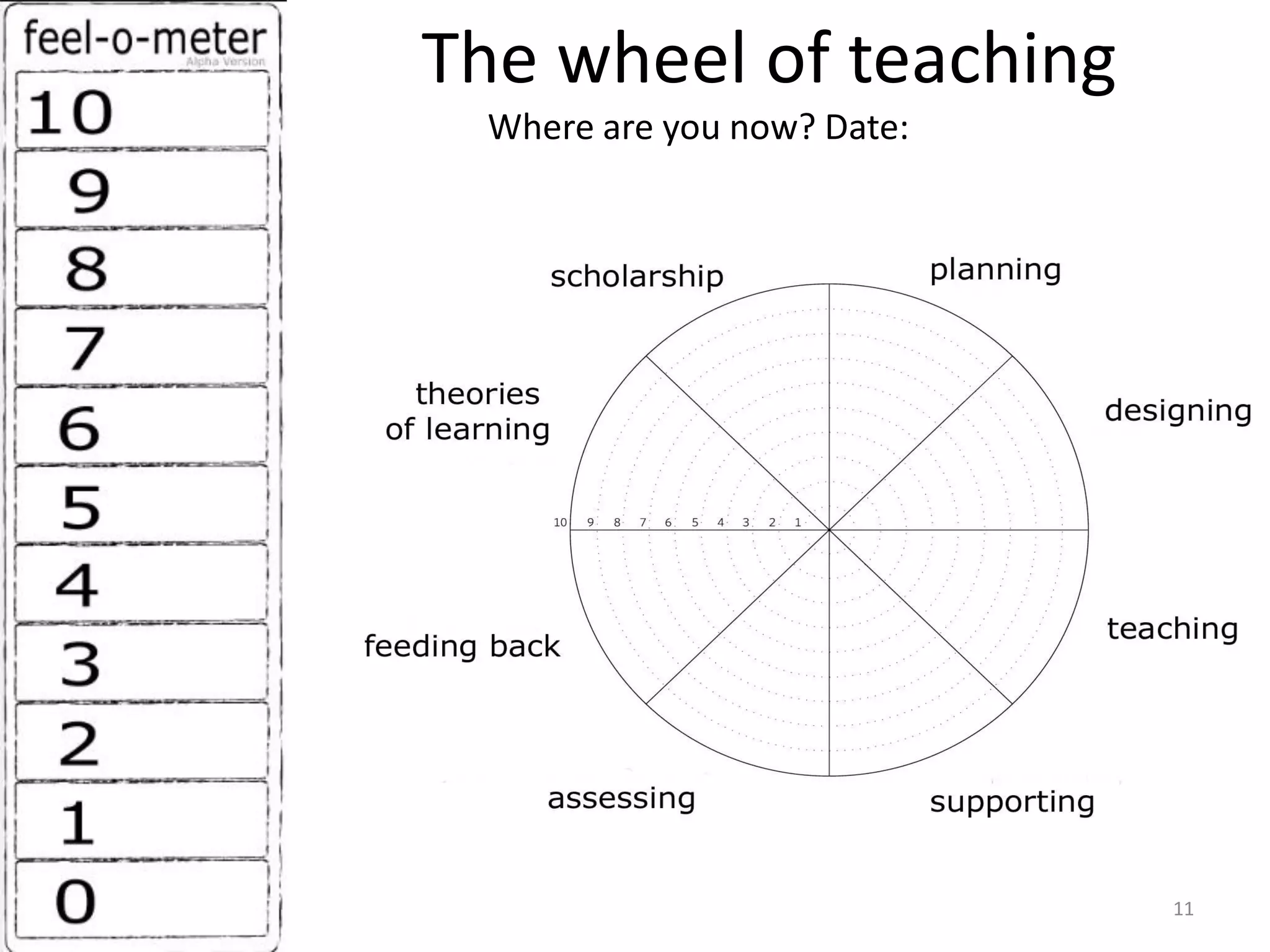
The wheel of teaching
Where are you now? Date:
33
References
Browne Report (2010) Securing a sustainable future for higher education, Department for Employment
and Learning, available at http://www.delni.gov.uk/index/publications/pubs-higher-education/browne-
report-student-fees.htm
Crawford, K. (2009) Continuing Professional Development in Higher Education: Voices from Below, EdD
thesis, University of Lincoln, available at http://eprints.lincoln.ac.uk/2146/1/Crawford-
Ed%28D%29Thesis-CPDinHE-FINAL%28Sept09%29.pdf
King, H. (2004) Continuing Professional Development in Higher Education: what do academics do?, in:
Educational Developments, Issue 5.4, Dec. 2004, pp. 1-5, available at
http://www.seda.ac.uk/resources/files/publications_25_Educational%20Dev%205.4.pdf
Mainka, C. (2007) Putting Staff first in Staff Development for Effective Use of Technology in Teaching, in:
British Journal of Educational Technology, Vol. 38, No. 1, pp. 158-160.
Roscoe, J. (2002) ‘Continuing Professional Development in Higher Education’ Human Resource
Development International 5(1), pp. 3-9.
The UK Quality Code for Higher Eduction (2012) Glouchester: Quality Assurance Agency, available at
http://www.qaa.ac.uk/Publications/InformationAndGuidance/Pages/quality-code-brief-guide.aspx
All FLEX resources, access to and participation in open courses are free to
all colleagues working at collaborative partner institutions.
If your institution is interested in gaining academic credits for FLEX, as
part of the PgCert or the MA in Higher Education or as a stand-alone CPD
unit, please get in touch with CELT to discuss your specific needs. MMU
and your institution would have to come to a separate agreement
regarding this.
Please contact Chrissi Nerantzi at c.nerantzi@mmu.ac.uk
For Collaborative Partners
This workshop/course counts towards FLEX, which is a personalised and practice-based CPD
programme with formal and informal pathways and enables you to get recognition via the FLEX award
for your CPD activities, work towards up to 30 credits of the PgCert/MA in Higher Education and help
in preparation for an application for professional recognition with the HEA.
FLEX activities need to have a focus on learning and teaching. To find out more about FLEX and how
to submit your claim, please visit FLEX at http://www.celt.mmu.ac.uk/flex/ or on Twitter using the
hashtag #flexcpd
FLEX co-ordinators: Chrissi Nerantzi at c.nerantzi@mmu.ac.uk & Mike Lowe at m.lowe@mmu.ac.uk
FLEX, practice-based CPD

FLEX: practice-based CPD for growth

  • 1.
    practice-based CPD forgrowth Chrissi Nerantzi Academic Developer Manchester Metropolitan University @chrissinerantzi
  • 2.
    Formal CPD? • Conceptionthat only formal CPD is proper CPD? (mentioned in: King, 2004; Crawford, 2009) • non-formal, practice-based activities also CPD > the “invisible curriculum” (Blackmore & Castley, 2006) • after PgCert no engagement in CPD (TESEP, 2007) > no formal engagement perhaps?
  • 3.
    CPD when? • reactive(Roscoe, 2002) • self-driven (King, 2004) • pro-active (Crawford, 2009) • the need for ongoing (King, 2004; Mainka, 2007; Browne Report (2010); UK Quality Code, 2012)
  • 4.
    MMU Strategy forLearning, Teaching and Assessment • Principle 1: We will provide an excellent learning environment and outstanding student experience • Principle 2: MMU provides an innovative, flexible, enterprising and internationalised curriculum • Principle 3: Assessment at MMU is an integrated and integral part of learning and teaching • Principle 4: Student progression, confidence and success will be achieved through outstanding personalised and individual support • Principle 5: Programmes are responsive to quality enhancement procedures throughout the student lifecycle • Principle 6: Staff are lifelong learners, fully engaged with their own professional development http://www.celt.mmu.ac.uk/ltastrategy/index.php
  • 5.
    Challengestime, workload rapid changes lesswith more and better just-in-time, on-the job CPD needed Work smart!
  • 6.
    •What is it? •Whyis it good for me? •How do I engage? •What do I get for it? Overview
  • 7.
    FLEX options 15/30credits FLEX [PSF: AFHEA, FHEA] FLEX [PSF: AFHEA, FHEA] FLEX [THEME]FLEX [THEME] FLEX [Creativity, FOS, named themes] FLEX [Creativity, FOS, named themes] FLEXFLEX
  • 8.
    Learning outcomes On successfulcompletion of this unit, students will be able to: • Critically reflect on their engagement with CPD (focuses on the nature of the learning environment and culture within their specific discipline) • Produce a critical narrative, which demonstrates the impact of their engagement with FLEX [brackets] on their practice and the student experience EXAMPLE Note: FLEX [brackets]: This iteration of FLEX has a focus on Creativity for Learning. This will be displayed on the transcript within the brackets > FLEX [Creativity for Learning]
  • 9.
    indicative open poolof CPD opportunities linked to learning & teaching planning a session flexible learning formative assessment supporting students in the classroom supporting students outside the classroom using stories large group teaching collaborative learning summative assessment tutorials developing digital literacies using LEGO(R) Serious(R) Play small group teaching creating learning communities assessment as learning dialogic feedback inclusive learning and teaching using audio to develop reflection flipped classroom social media for learning portfolios for learning using the Socratic dialogue game-based learning using video in the classroom supporting students using the VLE creatively inclusive assessment group assessment problem-based learning work-based learning blended learning using smart devices for learning and teaching peer assessment self-assessment project-based learning learning through making
  • 10.
    indicative types ofFLEX activities observation of teaching/ microteach session presenting at a L& T conference/event participating in a webinar participating in an open course carry out evaluation of teaching activity participating in an internal workshop attending a conference/event leading a webinar leading an open course co-facilitating an open course co-facilitating workshop pedagogical research participating in an external workshop using self-study resources networking mentoring coaching creating resources for students professional discussion with colleagues (funded) project participating in a project leading a pedagogical project participating in a short course leading a short course creating resources for staff development curriculum development activity curriculum enhancement activity reflection on practice team-teaching evaluating a student survey discipline specific pedagogic activity generic pedagogic research peer review listening event creating/adapting open educational resources reading a L&T article, paper/book discussion with a colleague around L&T external examining validation panel visit, trip, exhibition
  • 11.
  • 12.
  • 13.
    Participate in aworkshop, informal course
  • 14.
  • 15.
    Participate in atweetchat, lead one or join the organising team
  • 16.
  • 17.
    FLEX 15 FLEX30 FLEX 1 FLEX 1 FLEX 2 FLEX 2 FLEX 3 FLEX 3 FLEX 4 FLEX 5 3 x 850 words or equivalent 5 x 1000 words or equivalent FLEX 1 Trigger Link to own practice Analysis of the situation underpinned by relevant literature Action plan Specific, based on an informed rationale and anticipate outcomes for students Assessment Task (100% - Full and final element of Assessment – 2500/5000 words or equivalent) Students are required to demonstrate the learning from 3/5 FLEX CPD activities linked to their teaching practice/supporting students and the impact this learning has had on their practice and the student experience.
  • 18.
    • practice-based academicCPD for teaching tailored to priorities and aspirations • activities linked to current/past CPD, subject-specific or more generic • pick ‘n’ mix academic CPD activities per academic year • capture CPD in academic portfolio What is it?
  • 19.
    What can Iget for it? Successful engagement in FLEX can • help you gain 15 or 30 academic credits at Postgraduate level towards the PgCert in LTHE/HE or the MA in HE • Work towards an HEA professional recognition (AFHEA or FHEA) and gain 15 or 30 credits of the above mentioned programmes • evidence CPD for PDR purposes
  • 20.
    FLEX 15/30[PSF] (seeFLEX [PSF] Handbook) Co-accredited by the HEA to also award HEA Fellowships: • FLEX15 [PSF] – Associate Fellow of the HEA • FLEX30 [PSF] – Fellow of the HEA Activities used as sections of the portfolio are chosen to align with the UKPSF (2011) : Descriptors for D1 & D2 and dimensions of practice
  • 21.
    The UK PSF 21 Areasof Activity (WHAT) • Design and plan • Teach/support • Assess/give feedback • Develop effective learning environments and approaches to student support/guidance • Engage in CPD incorporating research, scholarship and evaluation of professional practices Core Knowledge (HOW) • Subject • Appropriate methods of teaching and learning • How students learn • Use and value appropriate learning technologies • Methods for evaluating effectiveness of teaching • Quality assurance and quality enhancement Professional Values (WHY) • Respect individual learners and learning communities • Promote participation and equality of opportunities • Use evidence-informed approaches and the outcomes from research, scholarship and CPD • Acknowledge the wider context in which HE operates recognising implications for professional practice https://www.heacademy.ac.uk/ukpsf MMU PSF at http://www.celt.mmu.ac.uk/psf/index.php
  • 22.
    Requirements of FLEX[PSF] FLEX15 • 3 Sections aligned with 3 Areas of Activity – Must incorporate AA5:CPD –this section must include reference to engagement with peer observation and dialogue with your FLEX mentor – Must clearly reference CK1 (Subject knowledge) & 2 (Subject specific teaching and learning theory) – Incorporate a mapping tool to demonstrate engagement with appropriate dimensions FLEX30 • 5 Sections aligned with 5 Areas of Activity – Within AA5:CPD –this section must include reference to engagement with peer observation and dialogue with your FLEX mentor – Must integrate engagement with all dimensions of practice – Incorporate a mapping tool to demonstrate engagement with all dimensions
  • 23.
    Academic portfolio • developreflective skills and habits • a personal and collaborative development space for teaching and research activities • evidence academic CPD that is recognised as such image by Nate Steiner, source https://www.flickr.com/photos/nate/412783683/sizes/z/ Go digital!
  • 24.
    How? Reflective Cycle(Gibbs, 1988) 24 1. Description What happened? 2. Feelings What were you thinking and feeling? 3. Evaluation What was good and bad about the experience? 4. Analysis What sense can you make of the situation? 5. Conclusion What else could you have done? 6. Action plan If it arose again, what would you do? own perspective link to theory colleagues students Brookfield Critical Lenses describing feeling analysing reasoning stepping back being self-critical exploring options linking to action “... the process by which we research the assumptions informing our own practice by viewing these through four complementary lenses – the lenses of our students’ eyes, colleagues’ perceptions, literature and our own autobiography. [...] Finally, we can review our personal autobiographies as learners so that we can make visceral connections to, and gain a better understanding of, the pleasures and terrors our own students are experiencing.” (Brookfield, 2006, 26) A reflective model might be useful!
  • 25.
    FLEX activity open poolof CPD opportunities academic portfolio brief description of FLEX activity critical reflection and development points value/impact on practice & evidence FLEX unit (15/30 credits at Level 7)unit assessment (UK PSF, SLTA) CPD requirements (UK PSF, SLTA)
  • 26.
    Example portfolios… Colleagues Unitscompleted Dr Marilena Antoniadou Generic FLEX http://marilenaantoniadou.blogspot.co.uk/ Olivia Glasser Generic FLEX and Creativity unit https://cpdoliviaglasser.wordpress.com/ Marcin Wozniak Generic FLEX and Creativity unit https://cpdmarcinwozniak.wordpress.com/ Matthew Crossley FLEX 15 [Creativity for Learning] https://cpdmatthewcrossley.wordpress.com/ Daniel Orwin FLEX 30 [Creativity for Learning] https://danielorwin.wordpress.com/
  • 27.
    Learning outcomes On successfulcompletion of this unit, students will be able to: • Critically reflect on their engagement with CPD (focuses on the nature of the learning environment and culture within their specific discipline) • Produce a critical narrative, which demonstrates the impact of their engagement with FLEX [brackets] on their practice and the student experience Note: FLEX [brackets]: This iteration of FLEX has a focus on Creativity for Learning. This will be displayed on the transcript within the brackets > FLEX [Creativity for Learning]
  • 28.
    FLEX 15 FLEX30 FLEX 1 FLEX 1 FLEX 2 FLEX 2 FLEX 3 FLEX 3 FLEX 4 FLEX 5 3 x 850 words or equivalent 5 x 1000 words or equivalent FLEX 1 Trigger Link to own practice Analysis of the situation underpinned by relevant literature Action plan Specific, based on an informed rationale and anticipate outcomes for students Assessment Task (100% - Full and final element of Assessment – 2500/5000 words or equivalent) Students are required to demonstrate the learning from 3/5 FLEX CPD activities linked to Creativity for Learning and the impact this learning has had on their practice and the student experience.
  • 29.
    Academic CPD Professional RecognitionHEA (AFHEA, FHEA), Good Standing FLEX developmental CPD programme Academic qualifications (PgCert, MA in HE) Informal CPD FLEX 15 (D1) FLEX 30 (D2) Formal route Informal route
  • 30.
  • 31.
    Teaching & Learning Conversations, monthly webinars Learningand Teaching in Higher Education, weekly tweetchats, every Wednesday 8-9pm Creativity for Learning in HE, MMU unit and open course, ongoing engagement Bring your own device for learning, 5-day open learning event Also available: • open Assessment course • Open Programme Leadership course http://www.celt.mmu.ac.uk/flex Workshop series Flexible, Open and Social Learning, open course OER with creative teaching ideas, use and contribute
  • 32.
  • 33.
    The wheel ofteaching Where are you now? Date: 33
  • 34.
    References Browne Report (2010)Securing a sustainable future for higher education, Department for Employment and Learning, available at http://www.delni.gov.uk/index/publications/pubs-higher-education/browne- report-student-fees.htm Crawford, K. (2009) Continuing Professional Development in Higher Education: Voices from Below, EdD thesis, University of Lincoln, available at http://eprints.lincoln.ac.uk/2146/1/Crawford- Ed%28D%29Thesis-CPDinHE-FINAL%28Sept09%29.pdf King, H. (2004) Continuing Professional Development in Higher Education: what do academics do?, in: Educational Developments, Issue 5.4, Dec. 2004, pp. 1-5, available at http://www.seda.ac.uk/resources/files/publications_25_Educational%20Dev%205.4.pdf Mainka, C. (2007) Putting Staff first in Staff Development for Effective Use of Technology in Teaching, in: British Journal of Educational Technology, Vol. 38, No. 1, pp. 158-160. Roscoe, J. (2002) ‘Continuing Professional Development in Higher Education’ Human Resource Development International 5(1), pp. 3-9. The UK Quality Code for Higher Eduction (2012) Glouchester: Quality Assurance Agency, available at http://www.qaa.ac.uk/Publications/InformationAndGuidance/Pages/quality-code-brief-guide.aspx
  • 35.
    All FLEX resources,access to and participation in open courses are free to all colleagues working at collaborative partner institutions. If your institution is interested in gaining academic credits for FLEX, as part of the PgCert or the MA in Higher Education or as a stand-alone CPD unit, please get in touch with CELT to discuss your specific needs. MMU and your institution would have to come to a separate agreement regarding this. Please contact Chrissi Nerantzi at c.nerantzi@mmu.ac.uk For Collaborative Partners
  • 36.
    This workshop/course countstowards FLEX, which is a personalised and practice-based CPD programme with formal and informal pathways and enables you to get recognition via the FLEX award for your CPD activities, work towards up to 30 credits of the PgCert/MA in Higher Education and help in preparation for an application for professional recognition with the HEA. FLEX activities need to have a focus on learning and teaching. To find out more about FLEX and how to submit your claim, please visit FLEX at http://www.celt.mmu.ac.uk/flex/ or on Twitter using the hashtag #flexcpd FLEX co-ordinators: Chrissi Nerantzi at c.nerantzi@mmu.ac.uk & Mike Lowe at m.lowe@mmu.ac.uk FLEX, practice-based CPD