FISH OR
POISSON
Aquatic vertebrates with fins (for
swimming) and gills (for breathing), which
represent an important source of food. At
present, more than 30000 species are known
(as many as all other vertebrates put
together). Most fish live in the seas and
oceans, at varying depths. Freshwater fish
are much less numerous. Some fish, such as
EELS and SALMON, are migratory,
spending part of their life in the sea and part
in fresh water.
Introduction
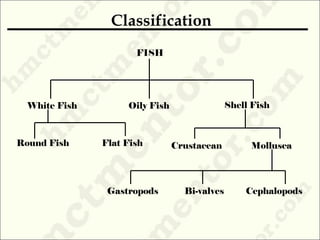
Broadly speaking, however they may be divided into
two distinct groups – those that live in the sea and
those that live in freshwater rivers and lakes.
In general term for recognition they are divided into
the following categories:
By Habitat – Salt Water and Fresh Water
By Physical Shape – Round Fish and Flat Fish
By Flesh Type – Oily Fish and White Fish
FISH
Shell FishOily FishWhite Fish
Round Fish Flat Fish Crustacean Mollusca
Gastropods Bi-valves Cephalopods
Classification
•Fish are an excellent source of protein and are low in
saturated fats and carbohydrates. Most of the fat they
do contain is polyunsaturated (unlike the animal fat
which is saturated).
•White fish have a more delicate flavour than oily fish.
They have less than 2% fat and contain approximately
80calories/100gms. Vitamin A & D are only present in
the liver.
•Oily fish, generally have darker, richer flesh. They have
8 – 20% fat and contain approximately
160calories/100gms. It contain fat soluble vitamins and
Omega3 fatty acids. These are unsaturated fatty acids
that are essential for health.
NUTRITIONAL IMPORTANCE
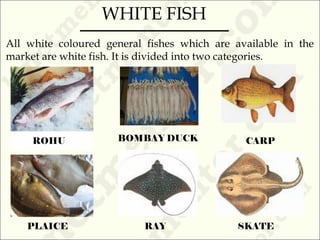
All white coloured general fishes which are available in the
market are white fish. It is divided into two categories.
ROHU CARPBOMBAY DUCK
PLAICE RAY SKATE
WHITE FISH
White Fish
Round Fish Flat Fish
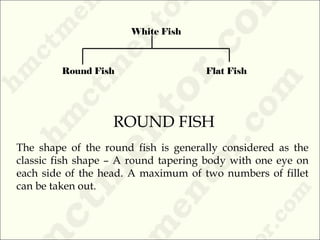
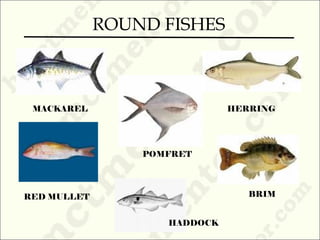
The shape of the round fish is generally considered as the
classic fish shape – A round tapering body with one eye on
each side of the head. A maximum of two numbers of fillet
can be taken out.
ROUND FISH
MACKAREL HERRING
RED MULLET
POMFRET
BRIM
HADDOCK
ROUND FISHES
FLAT FISH
It can be defined in two ways:-
1. Compressed vertically, with the eyes on the darker dorsal
(upper) surface (viz – Skates & Rays) – the ventral (lower)
surface is white, four fillet can be obtained from the fish & it
swims like a wave.
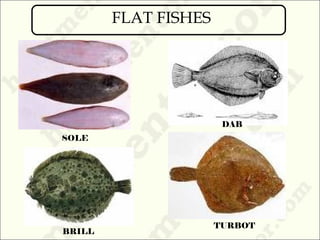
2. Compressed laterally, with both eyes either on the right side
of the head (viz – Plaice, Flounder, Dab, Sole) or on the left
(viz – Turbot, Brill), the blind side usually being without
pigment, four fillet can be obtained from the fish & it swims
like a wave.
SOLE
BRILL
TURBOT
DAB
FLAT FISHES
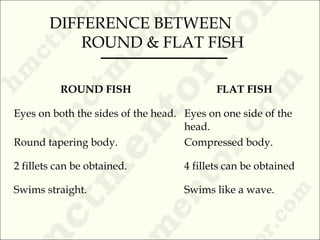
ROUND FISH FLAT FISH
Eyes on both the sides of the head. Eyes on one side of the
head.
Round tapering body. Compressed body.
2 fillets can be obtained. 4 fillets can be obtained
Swims straight. Swims like a wave.
DIFFERENCE BETWEEN
ROUND & FLAT FISH
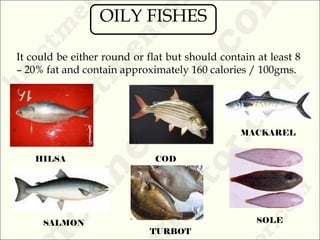
It could be either round or flat but should contain at least 8
– 20% fat and contain approximately 160 calories / 100gms.
HILSA COD
MACKAREL
SOLE
TURBOT
SALMON
OILY FISHES
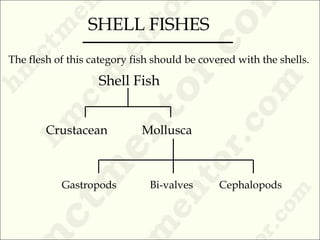
The flesh of this category fish should be covered with the shells.
Shell Fish
Crustacean Mollusca
Gastropods Bi-valves Cephalopods
SHELL FISHES
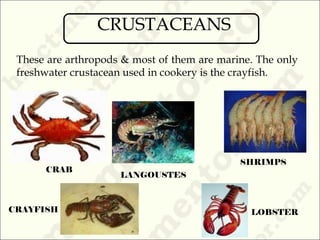
These are arthropods & most of them are marine. The only
freshwater crustacean used in cookery is the crayfish.
CRAB
SHRIMPS
LANGOUSTES
LOBSTERCRAYFISH
CRUSTACEANS
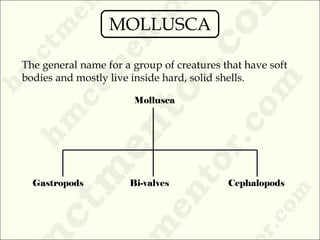
The general name for a group of creatures that have soft
bodies and mostly live inside hard, solid shells.
Mollusca
Gastropods Bi-valves Cephalopods
MOLLUSCA
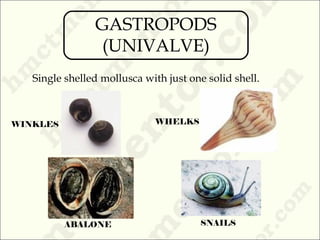
Single shelled mollusca with just one solid shell.
WINKLES WHELKS
ABALONE SNAILS
GASTROPODS
(UNIVALVE)
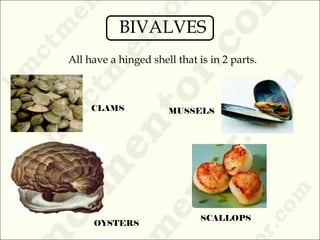
All have a hinged shell that is in 2 parts.
SCALLOPS
MUSSELSCLAMS
OYSTERS
BIVALVES
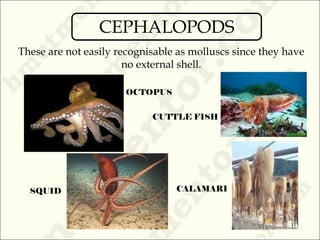
CEPHALOPODS
These are not easily recognisable as molluscs since they have
no external shell.
OCTOPUS
SQUID
CUTTLE FISH
CALAMARI
We can classify fish into two categories:
1. General Fish 2. Shell Fish
GENERAL FISH -
1. Skin – Should be shiny and of good colour.
2. Colour – For white fish, the colour should be white, not faintly yellow.
3. Weight – The body weight should be proportionate in comparison with the
length of the fish and should be springy.
4. Eyes – It should be absolutely fresh and bright not shrunken.
5. Gills – It should be bright red in colour.
6. Finger Marks – If the finger marks remain after it has been pressed, then it is
not fresh.
7. Flesh – Raw flesh should not come out from the bone.
8. Scales – Should not come out very easily.
9. Tails – The tail should be stiff in nature.
SELECTION OF FISH
SHELL FISH-
1. Freshness – Can be recognised by the brightness of the eyes and
stiffness of flesh and tail.
2. Claws – When pulled, should spring back and both the claws are
attached.
3. Smell – There should not be any bad smell.
4. Weight – The weight should be proportionate with the body.
STORAGE
Freshness in the fish is of utmost important the period of storage should be
reduced to minimum and if at all it has to be stored, fish must be clean,
washed and dried with a fresh dry cloth. Placed on a clean tray and store
under a suitable refrigeration with the temperature limit 35°F (1.5°C) – 45°F
(7.2°C).
In case of shellfish if possible they should be purchased alive so as to ensure
absolute freshness and stored in a cool room and cooked as fast as possible.
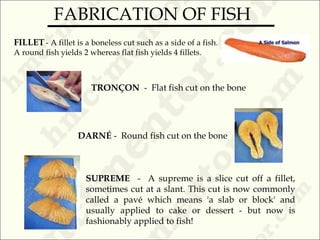
FILLET - A fillet is a boneless cut such as a side of a fish.
A round fish yields 2 whereas flat fish yields 4 fillets.
TRONÇON - Flat fish cut on the bone
DARNÉ - Round fish cut on the bone
SUPREME - A supreme is a slice cut off a fillet,
sometimes cut at a slant. This cut is now commonly
called a pavé which means 'a slab or block' and
usually applied to cake or dessert - but now is
fashionably applied to fish!
FABRICATION OF FISH
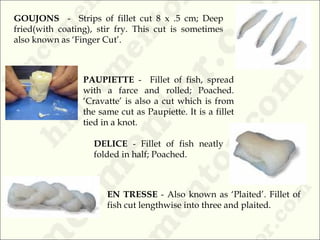
GOUJONS - Strips of fillet cut 8 x .5 cm; Deep
fried(with coating), stir fry. This cut is sometimes
also known as ‘Finger Cut’.
PAUPIETTE - Fillet of fish, spread
with a farce and rolled; Poached.
‘Cravatte’ is also a cut which is from
the same cut as Paupiette. It is a fillet
tied in a knot.
DELICE - Fillet of fish neatly
folded in half; Poached.
EN TRESSE - Also known as ‘Plaited’. Fillet of
fish cut lengthwise into three and plaited.
Thank you
… an
anish banerjee
initiative

Fish

  • 1.
  • 2.
    Aquatic vertebrates withfins (for swimming) and gills (for breathing), which represent an important source of food. At present, more than 30000 species are known (as many as all other vertebrates put together). Most fish live in the seas and oceans, at varying depths. Freshwater fish are much less numerous. Some fish, such as EELS and SALMON, are migratory, spending part of their life in the sea and part in fresh water. Introduction
  • 3.
    Broadly speaking, howeverthey may be divided into two distinct groups – those that live in the sea and those that live in freshwater rivers and lakes. In general term for recognition they are divided into the following categories: By Habitat – Salt Water and Fresh Water By Physical Shape – Round Fish and Flat Fish By Flesh Type – Oily Fish and White Fish
  • 4.
    FISH Shell FishOily FishWhiteFish Round Fish Flat Fish Crustacean Mollusca Gastropods Bi-valves Cephalopods Classification
  • 5.
    •Fish are anexcellent source of protein and are low in saturated fats and carbohydrates. Most of the fat they do contain is polyunsaturated (unlike the animal fat which is saturated). •White fish have a more delicate flavour than oily fish. They have less than 2% fat and contain approximately 80calories/100gms. Vitamin A & D are only present in the liver. •Oily fish, generally have darker, richer flesh. They have 8 – 20% fat and contain approximately 160calories/100gms. It contain fat soluble vitamins and Omega3 fatty acids. These are unsaturated fatty acids that are essential for health. NUTRITIONAL IMPORTANCE
  • 6.
    All white colouredgeneral fishes which are available in the market are white fish. It is divided into two categories. ROHU CARPBOMBAY DUCK PLAICE RAY SKATE WHITE FISH
  • 7.
    White Fish Round FishFlat Fish The shape of the round fish is generally considered as the classic fish shape – A round tapering body with one eye on each side of the head. A maximum of two numbers of fillet can be taken out. ROUND FISH
  • 8.
  • 9.
    FLAT FISH It canbe defined in two ways:- 1. Compressed vertically, with the eyes on the darker dorsal (upper) surface (viz – Skates & Rays) – the ventral (lower) surface is white, four fillet can be obtained from the fish & it swims like a wave. 2. Compressed laterally, with both eyes either on the right side of the head (viz – Plaice, Flounder, Dab, Sole) or on the left (viz – Turbot, Brill), the blind side usually being without pigment, four fillet can be obtained from the fish & it swims like a wave.
  • 10.
  • 11.
    ROUND FISH FLATFISH Eyes on both the sides of the head. Eyes on one side of the head. Round tapering body. Compressed body. 2 fillets can be obtained. 4 fillets can be obtained Swims straight. Swims like a wave. DIFFERENCE BETWEEN ROUND & FLAT FISH
  • 12.
    It could beeither round or flat but should contain at least 8 – 20% fat and contain approximately 160 calories / 100gms. HILSA COD MACKAREL SOLE TURBOT SALMON OILY FISHES
  • 13.
    The flesh ofthis category fish should be covered with the shells. Shell Fish Crustacean Mollusca Gastropods Bi-valves Cephalopods SHELL FISHES
  • 14.
    These are arthropods& most of them are marine. The only freshwater crustacean used in cookery is the crayfish. CRAB SHRIMPS LANGOUSTES LOBSTERCRAYFISH CRUSTACEANS
  • 15.
    The general namefor a group of creatures that have soft bodies and mostly live inside hard, solid shells. Mollusca Gastropods Bi-valves Cephalopods MOLLUSCA
  • 16.
    Single shelled molluscawith just one solid shell. WINKLES WHELKS ABALONE SNAILS GASTROPODS (UNIVALVE)
  • 17.
    All have ahinged shell that is in 2 parts. SCALLOPS MUSSELSCLAMS OYSTERS BIVALVES
  • 18.
    CEPHALOPODS These are noteasily recognisable as molluscs since they have no external shell. OCTOPUS SQUID CUTTLE FISH CALAMARI
  • 19.
    We can classifyfish into two categories: 1. General Fish 2. Shell Fish GENERAL FISH - 1. Skin – Should be shiny and of good colour. 2. Colour – For white fish, the colour should be white, not faintly yellow. 3. Weight – The body weight should be proportionate in comparison with the length of the fish and should be springy. 4. Eyes – It should be absolutely fresh and bright not shrunken. 5. Gills – It should be bright red in colour. 6. Finger Marks – If the finger marks remain after it has been pressed, then it is not fresh. 7. Flesh – Raw flesh should not come out from the bone. 8. Scales – Should not come out very easily. 9. Tails – The tail should be stiff in nature. SELECTION OF FISH
  • 20.
    SHELL FISH- 1. Freshness– Can be recognised by the brightness of the eyes and stiffness of flesh and tail. 2. Claws – When pulled, should spring back and both the claws are attached. 3. Smell – There should not be any bad smell. 4. Weight – The weight should be proportionate with the body. STORAGE Freshness in the fish is of utmost important the period of storage should be reduced to minimum and if at all it has to be stored, fish must be clean, washed and dried with a fresh dry cloth. Placed on a clean tray and store under a suitable refrigeration with the temperature limit 35°F (1.5°C) – 45°F (7.2°C). In case of shellfish if possible they should be purchased alive so as to ensure absolute freshness and stored in a cool room and cooked as fast as possible.
  • 21.
    FILLET - Afillet is a boneless cut such as a side of a fish. A round fish yields 2 whereas flat fish yields 4 fillets. TRONÇON - Flat fish cut on the bone DARNÉ - Round fish cut on the bone SUPREME - A supreme is a slice cut off a fillet, sometimes cut at a slant. This cut is now commonly called a pavé which means 'a slab or block' and usually applied to cake or dessert - but now is fashionably applied to fish! FABRICATION OF FISH
  • 22.
    GOUJONS - Stripsof fillet cut 8 x .5 cm; Deep fried(with coating), stir fry. This cut is sometimes also known as ‘Finger Cut’. PAUPIETTE - Fillet of fish, spread with a farce and rolled; Poached. ‘Cravatte’ is also a cut which is from the same cut as Paupiette. It is a fillet tied in a knot. DELICE - Fillet of fish neatly folded in half; Poached. EN TRESSE - Also known as ‘Plaited’. Fillet of fish cut lengthwise into three and plaited.
  • 23.
    Thank you … an anishbanerjee initiative