Lars Schmidt-Thieme, Information Systems and Machine Learning Lab (ISMLL), University of Hildesheim, Germany,
Course on Artificial Intelligence, winter term 2012/2013 0/20
Artificial Intelligence
6. First Order Logic Inference
Lars Schmidt-Thieme
Information Systems and Machine Learning Lab (ISMLL)
Institute of Economics and Information Systems
& Institute of Computer Science
University of Hildesheim
http://www.ismll.uni-hildesheim.de
Lars Schmidt-Thieme, Information Systems and Machine Learning Lab (ISMLL), University of Hildesheim, Germany,
Course on Artificial Intelligence, winter term 2012/2013 1/20
Artificial Intelligence
1. Unification
2. Forward Chaining
3. Backward Chaining
4. Resolution
Lars Schmidt-Thieme, Information Systems and Machine Learning Lab (ISMLL), University of Hildesheim, Germany,
Course on Artificial Intelligence, winter term 2012/2013 1/20
Artificial Intelligence / 1. Unification
“Compound Expressions”
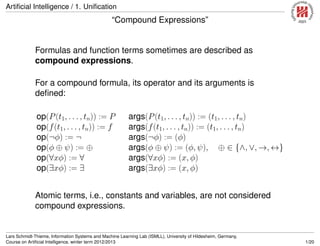
Formulas and function terms sometimes are described as
compound expressions.
For a compound formula, its operator and its arguments is
defined:
op(P(t1, . . . , tn)) := P args(P(t1, . . . , tn)) := (t1, . . . , tn)
op(f(t1, . . . , tn)) := f args(f(t1, . . . , tn)) := (t1, . . . , tn)
op(¬φ) := ¬ args(¬φ) := (φ)
op(φ ⊕ ψ) := ⊕ args(φ ⊕ ψ) := (φ, ψ), ⊕ ∈ {∧, ∨, →, ↔}
op(∀xφ) := ∀ args(∀xφ) := (x, φ)
op(∃xφ) := ∃ args(∃xφ) := (x, φ)
Atomic terms, i.e., constants and variables, are not considered
compound expressions.
Lars Schmidt-Thieme, Information Systems and Machine Learning Lab (ISMLL), University of Hildesheim, Germany,
Course on Artificial Intelligence, winter term 2012/2013 1/20
Artificial Intelligence / 1. Unification
Unification / Algorithm
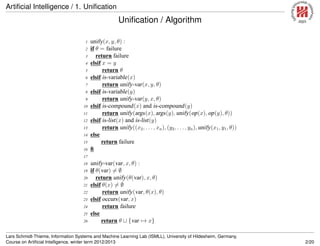
1 unify(x, y, θ) :
2 if θ = failure
3 return failure
4 elsif x = y
5 return θ
6 elsif is-variable(x)
7 return unify-var(x, y, θ)
8 elsif is-variable(y)
9 return unify-var(y, x, θ)
10 elsif is-compound(x) and is-compound(y)
11 return unify(args(x), args(y), unify(op(x), op(y), θ))
12 elsif is-list(x) and is-list(y)
13 return unify((x2, . . . , xn), (y2, . . ., yn), unify(x1, y1, θ))
14 else
15 return failure
16 fi
17
18 unify-var(var, x, θ) :
19 if θ(var) = ∅
20 return unify(θ(var), x, θ)
21 elsif θ(x) = ∅
22 return unify(var, θ(x), θ)
23 elsif occurs(var, x)
24 return failure
25 else
26 return θ ∪ {var → x}
Lars Schmidt-Thieme, Information Systems and Machine Learning Lab (ISMLL), University of Hildesheim, Germany,
Course on Artificial Intelligence, winter term 2012/2013 2/20
Artificial Intelligence / 1. Unification
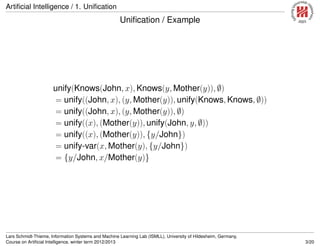
Unification / Example
unify(Knows(John, x), Knows(y, Mother(y)), ∅)
= unify((John, x), (y, Mother(y)), unify(Knows, Knows, ∅))
= unify((John, x), (y, Mother(y)), ∅)
= unify((x), (Mother(y)), unify(John, y, ∅))
= unify((x), (Mother(y)), {y/John})
= unify-var(x, Mother(y), {y/John})
= {y/John, x/Mother(y)}
Lars Schmidt-Thieme, Information Systems and Machine Learning Lab (ISMLL), University of Hildesheim, Germany,
Course on Artificial Intelligence, winter term 2012/2013 3/20
Artificial Intelligence
1. Unification
2. Forward Chaining
3. Backward Chaining
4. Resolution
Lars Schmidt-Thieme, Information Systems and Machine Learning Lab (ISMLL), University of Hildesheim, Germany,
Course on Artificial Intelligence, winter term 2012/2013 4/20
Artificial Intelligence / 2. Forward Chaining
Generalized Modus Ponens
premise conclusion name
F F, F F → G F G → -elimination / modus ponens
F F F Fθ universial instantiation
F F, F F → G, Fθ = F θ F Gθ generalized modus ponens
Lemma 1. Generalized modus ponens is sound.
Proof.
1. F F [assumption]
2. F Fθ [universal instantiation applied to 1]
3. F F → G [assumption]
4. F F θ → Gθ [universal instantiation applied to 3]
5. F Gθ [ → -elemination applied to 2,4]
Lars Schmidt-Thieme, Information Systems and Machine Learning Lab (ISMLL), University of Hildesheim, Germany,
Course on Artificial Intelligence, winter term 2012/2013 4/20
Artificial Intelligence / 2. Forward Chaining
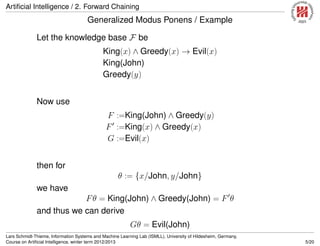
Generalized Modus Ponens / Example
Let the knowledge base F be
King(x) ∧ Greedy(x) → Evil(x)
King(John)
Greedy(y)
Now use
F :=King(John) ∧ Greedy(y)
F :=King(x) ∧ Greedy(x)
G :=Evil(x)
then for
θ := {x/John, y/John}
we have
Fθ = King(John) ∧ Greedy(John) = F θ
and thus we can derive
Gθ = Evil(John)
Lars Schmidt-Thieme, Information Systems and Machine Learning Lab (ISMLL), University of Hildesheim, Germany,
Course on Artificial Intelligence, winter term 2012/2013 5/20
Artificial Intelligence / 2. Forward Chaining
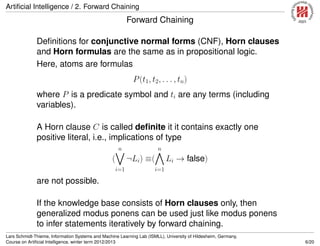
Forward Chaining
Definitions for conjunctive normal forms (CNF), Horn clauses
and Horn formulas are the same as in propositional logic.
Here, atoms are formulas
P(t1, t2, . . . , tn)
where P is a predicate symbol and ti are any terms (including
variables).
A Horn clause C is called definite it it contains exactly one
positive literal, i.e., implications of type
(
n
i=1
¬Li) ≡(
n
i=1
Li → false)
are not possible.
If the knowledge base consists of Horn clauses only, then
generalized modus ponens can be used just like modus ponens
to infer statements iteratively by forward chaining.
Lars Schmidt-Thieme, Information Systems and Machine Learning Lab (ISMLL), University of Hildesheim, Germany,
Course on Artificial Intelligence, winter term 2012/2013 6/20
Artificial Intelligence / 2. Forward Chaining
Example
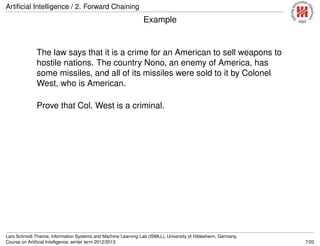
The law says that it is a crime for an American to sell weapons to
hostile nations. The country Nono, an enemy of America, has
some missiles, and all of its missiles were sold to it by Colonel
West, who is American.
Prove that Col. West is a criminal.
Lars Schmidt-Thieme, Information Systems and Machine Learning Lab (ISMLL), University of Hildesheim, Germany,
Course on Artificial Intelligence, winter term 2012/2013 7/20
Artificial Intelligence / 2. Forward Chaining
Example (2/4)
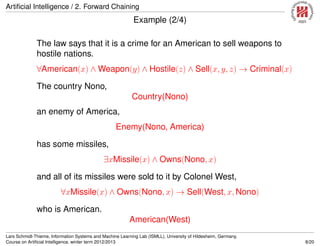
The law says that it is a crime for an American to sell weapons to
hostile nations.
∀American(x) ∧ Weapon(y) ∧ Hostile(z) ∧ Sell(x, y, z) → Criminal(x)
The country Nono,
Country(Nono)
an enemy of America,
Enemy(Nono, America)
has some missiles,
∃xMissile(x) ∧ Owns(Nono, x)
and all of its missiles were sold to it by Colonel West,
∀xMissile(x) ∧ Owns(Nono, x) → Sell(West, x, Nono)
who is American.
American(West)
Lars Schmidt-Thieme, Information Systems and Machine Learning Lab (ISMLL), University of Hildesheim, Germany,
Course on Artificial Intelligence, winter term 2012/2013 8/20
Artificial Intelligence / 2. Forward Chaining
Example (3/4)
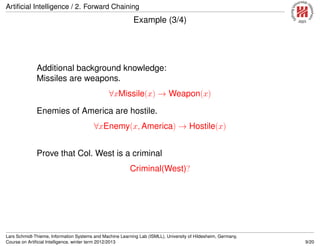
Additional background knowledge:
Missiles are weapons.
∀xMissile(x) → Weapon(x)
Enemies of America are hostile.
∀xEnemy(x, America) → Hostile(x)
Prove that Col. West is a criminal
Criminal(West)?
Lars Schmidt-Thieme, Information Systems and Machine Learning Lab (ISMLL), University of Hildesheim, Germany,
Course on Artificial Intelligence, winter term 2012/2013 9/20
Artificial Intelligence / 2. Forward Chaining
Example (4/4)
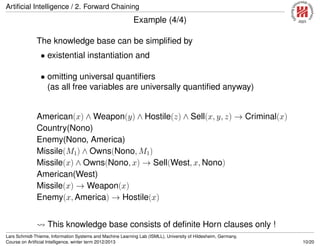
The knowledge base can be simplified by
• existential instantiation and
• omitting universal quantifiers
(as all free variables are universally quantified anyway)
American(x) ∧ Weapon(y) ∧ Hostile(z) ∧ Sell(x, y, z) → Criminal(x)
Country(Nono)
Enemy(Nono, America)
Missile(M1) ∧ Owns(Nono, M1)
Missile(x) ∧ Owns(Nono, x) → Sell(West, x, Nono)
American(West)
Missile(x) → Weapon(x)
Enemy(x, America) → Hostile(x)
This knowledge base consists of definite Horn clauses only !
Lars Schmidt-Thieme, Information Systems and Machine Learning Lab (ISMLL), University of Hildesheim, Germany,
Course on Artificial Intelligence, winter term 2012/2013 10/20
Artificial Intelligence / 2. Forward Chaining
Forward Chaining
1 entails-fc(FOL definite horn formula F, query atom Q) :
2 C := ∅
3 C′
:= clauses(F)
4 while C′
= ∅ do
5 C := C ∪ C′
6 C′
:= ∅
7 for C ∈ C do
8 C′
:= standardize-apart(C)
9 for atoms A1, A2, . . . , An ∈ C and θ with body(C′
)θ = (A1 ∧ A2 ∧ . . . ∧ An)θ do
10 H := head(C′
)θ
11 if H ∈ C and H ∈ C′
12 C′
:= C′
∪ {H}
13 if unify(H, Q) return true fi
14 fi
15 od
16 od
17 od
18 return false
Lars Schmidt-Thieme, Information Systems and Machine Learning Lab (ISMLL), University of Hildesheim, Germany,
Course on Artificial Intelligence, winter term 2012/2013 11/20
Artificial Intelligence / 2. Forward Chaining
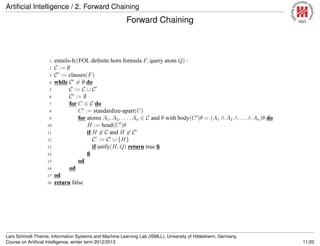
Forward Chaining / Example
Forward chaining proof
Enemy(Nono,America)Owns(Nono,M1)Missile(M1)American(West)
Lars Schmidt-Thieme, Information Systems and Machine Learning Lab (ISMLL), University of Hildesheim, Germany,
Course on Artificial Intelligence, winter term 2012/2013 11/20
Artificial Intelligence / 2. Forward Chaining
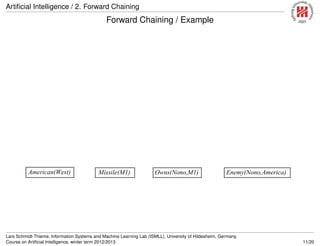
Forward Chaining / Example
Forward chaining proof
Hostile(Nono)
Enemy(Nono,America)Owns(Nono,M1)Missile(M1)American(West)
Weapon(M1) Sells(West,M1,Nono)
Lars Schmidt-Thieme, Information Systems and Machine Learning Lab (ISMLL), University of Hildesheim, Germany,
Course on Artificial Intelligence, winter term 2012/2013 11/20
Artificial Intelligence / 2. Forward Chaining
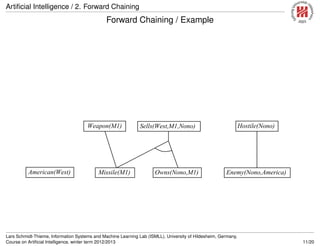
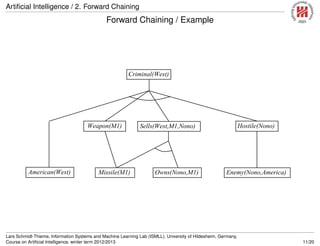
Forward Chaining / Example
Forward chaining proof
Hostile(Nono)
Enemy(Nono,America)Owns(Nono,M1)Missile(M1)American(West)
Weapon(M1)
Criminal(West)
Sells(West,M1,Nono)
Lars Schmidt-Thieme, Information Systems and Machine Learning Lab (ISMLL), University of Hildesheim, Germany,
Course on Artificial Intelligence, winter term 2012/2013 11/20
Artificial Intelligence
1. Unification
2. Forward Chaining
3. Backward Chaining
4. Resolution
Lars Schmidt-Thieme, Information Systems and Machine Learning Lab (ISMLL), University of Hildesheim, Germany,
Course on Artificial Intelligence, winter term 2012/2013 12/20
Artificial Intelligence / 3. Backward Chaining
Backward Chaining
Backward chaining works the other way around:
• keep a list of yet unsatisfied atoms Q
– starting with the query atom.
• try to find rules whichs head match atoms in Q (after
unification) and
replace the atom from Q by the atoms of the body of the
matching rule.
• proceed recursively until no more atoms have to be satisfied.
Backward chaining keeps track of the substitution needed during
the proof.
Lars Schmidt-Thieme, Information Systems and Machine Learning Lab (ISMLL), University of Hildesheim, Germany,
Course on Artificial Intelligence, winter term 2012/2013 12/20
Artificial Intelligence / 3. Backward Chaining
Backward Chaining / Algorithm
1 entails-bc(FOL definite horn formula F, query atom Q) :
2 return entails-bc-goals(clauses(F), {Q}, ∅) = ∅
3
4 entails-bc-goals(set of FOL definite Horn clauses C, set of FOL atoms Q, θ) :
5 if Q = ∅ return {θ} fi
6 Θ := ∅
7 for C ∈ C do
8 C′
:= standardize-apart(C)
9 θ′
:= unify(head(C′
), Q[1]θ)
10 if θ′
= failure
11 Θ := Θ ∪ entails-bc-goals(C, atoms(body(C′
)) ∪ (Q  {C}), θ ∪ θ′
)
12 fi
13 od
14 return Θ
Lars Schmidt-Thieme, Information Systems and Machine Learning Lab (ISMLL), University of Hildesheim, Germany,
Course on Artificial Intelligence, winter term 2012/2013 13/20
Artificial Intelligence / 3. Backward Chaining
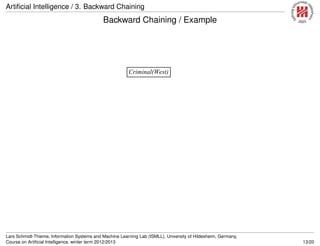
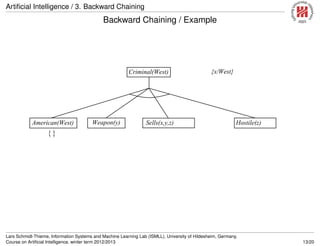
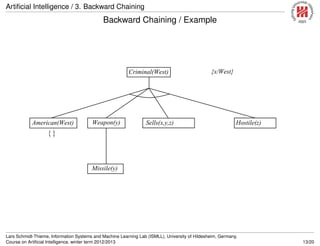
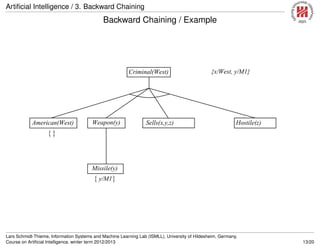
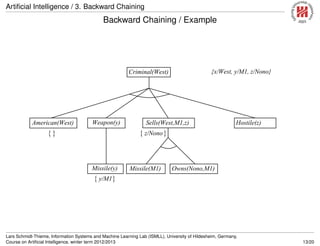
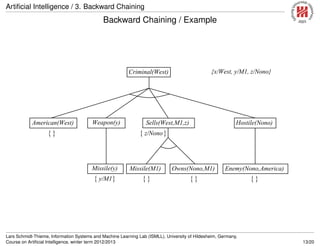
Backward Chaining / Example
Backward chaining example
Criminal(West)
Lars Schmidt-Thieme, Information Systems and Machine Learning Lab (ISMLL), University of Hildesheim, Germany,
Course on Artificial Intelligence, winter term 2012/2013 13/20
Artificial Intelligence / 3. Backward Chaining
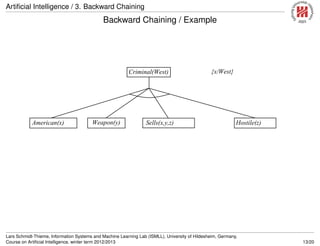
Backward Chaining / Example
Backward chaining example
Criminal(West)
Weapon(y)American(x) Sells(x,y,z) Hostile(z)
{x/West}
Lars Schmidt-Thieme, Information Systems and Machine Learning Lab (ISMLL), University of Hildesheim, Germany,
Course on Artificial Intelligence, winter term 2012/2013 13/20
Artificial Intelligence / 3. Backward Chaining
Backward Chaining / Example
Backward chaining example
Criminal(West)
Weapon(y) Sells(x,y,z) Hostile(z)
{x/West}
{ }
American(West)
Lars Schmidt-Thieme, Information Systems and Machine Learning Lab (ISMLL), University of Hildesheim, Germany,
Course on Artificial Intelligence, winter term 2012/2013 13/20
Artificial Intelligence / 3. Backward Chaining
Backward Chaining / Example
Backward chaining example
Hostile(Nono)
Criminal(West)
Missile(y)
Weapon(y) Sells(West,M1,z)American(West)
{ }
Sells(x,y,z) Hostile(z)
{x/West}
Lars Schmidt-Thieme, Information Systems and Machine Learning Lab (ISMLL), University of Hildesheim, Germany,
Course on Artificial Intelligence, winter term 2012/2013 13/20
Artificial Intelligence / 3. Backward Chaining
Backward Chaining / Example
Backward chaining example
Hostile(Nono)
Criminal(West)
Missile(y)
Weapon(y) Sells(West,M1,z)American(West)
{ }
Sells(x,y,z) Hostile(z)
y/M1{ }
{x/West, y/M1}
Lars Schmidt-Thieme, Information Systems and Machine Learning Lab (ISMLL), University of Hildesheim, Germany,
Course on Artificial Intelligence, winter term 2012/2013 13/20
Artificial Intelligence / 3. Backward Chaining
Backward Chaining / Example
Backward chaining example
Owns(Nono,M1)Missile(M1)
Criminal(West)
Missile(y)
Weapon(y) Sells(West,M1,z)American(West)
y/M1{ }
{ }z/Nono{ }
Hostile(z)
{x/West, y/M1, z/Nono}
Lars Schmidt-Thieme, Information Systems and Machine Learning Lab (ISMLL), University of Hildesheim, Germany,
Course on Artificial Intelligence, winter term 2012/2013 13/20
Artificial Intelligence / 3. Backward Chaining
Backward Chaining / Example
Backward chaining example
Hostile(Nono)
Enemy(Nono,America)Owns(Nono,M1)Missile(M1)
Criminal(West)
Missile(y)
Weapon(y) Sells(West,M1,z)American(West)
y/M1{ } { }{ }{ }
{ }z/Nono{ }
{x/West, y/M1, z/Nono}
Lars Schmidt-Thieme, Information Systems and Machine Learning Lab (ISMLL), University of Hildesheim, Germany,
Course on Artificial Intelligence, winter term 2012/2013 13/20
Artificial Intelligence / 3. Backward Chaining
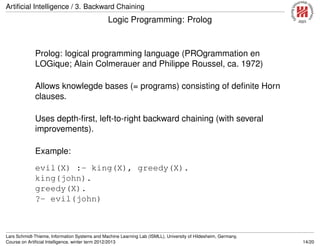
Logic Programming: Prolog
Prolog: logical programming language (PROgrammation en
LOGique; Alain Colmerauer and Philippe Roussel, ca. 1972)
Allows knowlegde bases (= programs) consisting of definite Horn
clauses.
Uses depth-first, left-to-right backward chaining (with several
improvements).
Example:
evil(X) :- king(X), greedy(X).
king(john).
greedy(X).
?- evil(john)
Lars Schmidt-Thieme, Information Systems and Machine Learning Lab (ISMLL), University of Hildesheim, Germany,
Course on Artificial Intelligence, winter term 2012/2013 14/20
Artificial Intelligence / 3. Backward Chaining
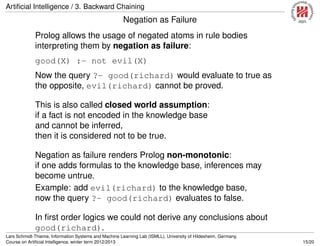
Negation as Failure
Prolog allows the usage of negated atoms in rule bodies
interpreting them by negation as failure:
good(X) :- not evil(X)
Now the query ?- good(richard) would evaluate to true as
the opposite, evil(richard) cannot be proved.
This is also called closed world assumption:
if a fact is not encoded in the knowledge base
and cannot be inferred,
then it is considered not to be true.
Negation as failure renders Prolog non-monotonic:
if one adds formulas to the knowledge base, inferences may
become untrue.
Example: add evil(richard) to the knowledge base,
now the query ?- good(richard) evaluates to false.
In first order logics we could not derive any conclusions about
good(richard).
Lars Schmidt-Thieme, Information Systems and Machine Learning Lab (ISMLL), University of Hildesheim, Germany,
Course on Artificial Intelligence, winter term 2012/2013 15/20
Artificial Intelligence / 3. Backward Chaining
Prolog / Examples
Appending two lists to produce a third:
append(X,Y,Z) encodes that X appended to Y results in Z.
append([], Y, Y).
append([X|L], Y, [X|Z]) :- append(L, Y, Z).
query: append([1,2], [3,4], C) ?
answers: C=[1,2,3,4]
query: append(A, B, [1,2]) ?
answers: A=[] B=[1,2]
A=[1] B=[2]
A=[1,2] B=[]
Lars Schmidt-Thieme, Information Systems and Machine Learning Lab (ISMLL), University of Hildesheim, Germany,
Course on Artificial Intelligence, winter term 2012/2013 16/20
Artificial Intelligence
1. Unification
2. Forward Chaining
3. Backward Chaining
4. Resolution
Lars Schmidt-Thieme, Information Systems and Machine Learning Lab (ISMLL), University of Hildesheim, Germany,
Course on Artificial Intelligence, winter term 2012/2013 17/20
Artificial Intelligence / 4. Resolution
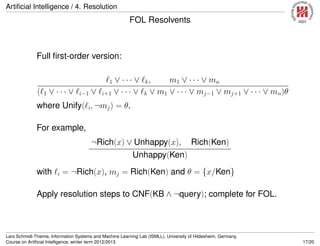
FOL Resolvents
Full first-order version:
1 ∨ · · · ∨ k, m1 ∨ · · · ∨ mn
( 1 ∨ · · · ∨ i−1 ∨ i+1 ∨ · · · ∨ k ∨ m1 ∨ · · · ∨ mj−1 ∨ mj+1 ∨ · · · ∨ mn)θ
where Unify( i, ¬mj) = θ.
For example,
¬Rich(x) ∨ Unhappy(x), Rich(Ken)
Unhappy(Ken)
with i = ¬Rich(x), mj = Rich(Ken) and θ = {x/Ken}
Apply resolution steps to CNF(KB ∧ ¬query); complete for FOL.
Lars Schmidt-Thieme, Information Systems and Machine Learning Lab (ISMLL), University of Hildesheim, Germany,
Course on Artificial Intelligence, winter term 2012/2013 17/20
Artificial Intelligence / 4. Resolution
Conversion to CNF
Everyone who loves all animals is loved by
someone:∀x[∀yAnimal(y) =⇒ Loves(x, y)] =⇒ [∃yLoves(y, x)]
1. Eliminate biconditionals and implications
∀x[¬∀y¬Animal(y) ∨ Loves(x, y)] ∨ [∃yLoves(y, x)]
2. Move ¬ inwards: ¬∀x, p ≡ ∃x¬p, ¬∃x, p ≡ ∀x¬p:
∀x[∃y¬(¬Animal(y) ∨ Loves(x, y))] ∨ [∃yLoves(y, x)]
∀x[∃y¬¬Animal(y) ∧ ¬Loves(x, y)] ∨ [∃yLoves(y, x)]
∀x[∃yAnimal(y) ∧ ¬Loves(x, y)] ∨ [∃yLoves(y, x)]
Lars Schmidt-Thieme, Information Systems and Machine Learning Lab (ISMLL), University of Hildesheim, Germany,
Course on Artificial Intelligence, winter term 2012/2013 18/20
Artificial Intelligence / 4. Resolution
Conversion to CNF
3. Standardize variables: each quantifier should use a different
one
∀x[∃yAnimal(y) ∧ ¬Loves(x, y)] ∨ [∃zLoves(z, x)]
4. Skolemize: a more general form of existential instantiation.
Each existential variable is replaced by a Skolem function
of the enclosing universally quantified variables:
∀x[Animal(F(x)) ∧ ¬Loves(x, F(x))] ∨ Loves(G(x), x)
5. Drop universal quantifiers:
[Animal(F(x)) ∧ ¬Loves(x, F(x))] ∨ Loves(G(x), x)
6. Distribute ∧ over ∨:
[Animal(F(x))∨Loves(G(x), x)]∧[¬Loves(x, F(x))∨Loves(G(x), x)]
Lars Schmidt-Thieme, Information Systems and Machine Learning Lab (ISMLL), University of Hildesheim, Germany,
Course on Artificial Intelligence, winter term 2012/2013 19/20
Artificial Intelligence / 4. Resolution
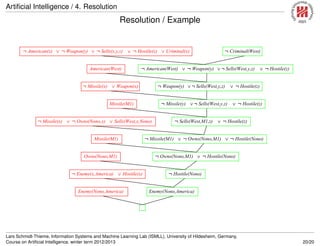
Resolution / Example
Resolution proof: definite clauses
American(West)
Missile(M1)
Missile(M1)
Owns(Nono,M1)
Enemy(Nono,America) Enemy(Nono,America)
Criminal(x)Hostile(z)
L
Sells(x,y,z)
L
Weapon(y)
L
American(x)
L
>
>
>
>
Weapon(x)Missile(x)L
>
Sells(West,x,Nono)Missile(x)
L
Owns(Nono,x)
L
>
>
Hostile(x)Enemy(x,America)
L
>
Sells(West,y,z)
L
Weapon(y)
L
American(West)
L
>
>
Hostile(z)
L
>
Sells(West,y,z)
L
Weapon(y)
L
>
Hostile(z)
L
>
Sells(West,y,z)
L
>
Hostile(z)
L
>
L
Missile(y)
Hostile(z)
L
>
L
Sells(West,M1,z)
>
>
L
Hostile(Nono)
L
Owns(Nono,M1)
L
Missile(M1)
>
L
Hostile(Nono)L Owns(Nono,M1)
L
Hostile(Nono)
Criminal(West)
L Chapter 9 46
Lars Schmidt-Thieme, Information Systems and Machine Learning Lab (ISMLL), University of Hildesheim, Germany,
Course on Artificial Intelligence, winter term 2012/2013 20/20

First Order Logic

  • 1.
    Lars Schmidt-Thieme, InformationSystems and Machine Learning Lab (ISMLL), University of Hildesheim, Germany, Course on Artificial Intelligence, winter term 2012/2013 0/20
  • 2.
    Artificial Intelligence Artificial Intelligence 6.First Order Logic Inference Lars Schmidt-Thieme Information Systems and Machine Learning Lab (ISMLL) Institute of Economics and Information Systems & Institute of Computer Science University of Hildesheim http://www.ismll.uni-hildesheim.de Lars Schmidt-Thieme, Information Systems and Machine Learning Lab (ISMLL), University of Hildesheim, Germany, Course on Artificial Intelligence, winter term 2012/2013 1/20
  • 3.
    Artificial Intelligence 1. Unification 2.Forward Chaining 3. Backward Chaining 4. Resolution Lars Schmidt-Thieme, Information Systems and Machine Learning Lab (ISMLL), University of Hildesheim, Germany, Course on Artificial Intelligence, winter term 2012/2013 1/20
  • 4.
    Artificial Intelligence /1. Unification “Compound Expressions” Formulas and function terms sometimes are described as compound expressions. For a compound formula, its operator and its arguments is defined: op(P(t1, . . . , tn)) := P args(P(t1, . . . , tn)) := (t1, . . . , tn) op(f(t1, . . . , tn)) := f args(f(t1, . . . , tn)) := (t1, . . . , tn) op(¬φ) := ¬ args(¬φ) := (φ) op(φ ⊕ ψ) := ⊕ args(φ ⊕ ψ) := (φ, ψ), ⊕ ∈ {∧, ∨, →, ↔} op(∀xφ) := ∀ args(∀xφ) := (x, φ) op(∃xφ) := ∃ args(∃xφ) := (x, φ) Atomic terms, i.e., constants and variables, are not considered compound expressions. Lars Schmidt-Thieme, Information Systems and Machine Learning Lab (ISMLL), University of Hildesheim, Germany, Course on Artificial Intelligence, winter term 2012/2013 1/20
  • 5.
    Artificial Intelligence /1. Unification Unification / Algorithm 1 unify(x, y, θ) : 2 if θ = failure 3 return failure 4 elsif x = y 5 return θ 6 elsif is-variable(x) 7 return unify-var(x, y, θ) 8 elsif is-variable(y) 9 return unify-var(y, x, θ) 10 elsif is-compound(x) and is-compound(y) 11 return unify(args(x), args(y), unify(op(x), op(y), θ)) 12 elsif is-list(x) and is-list(y) 13 return unify((x2, . . . , xn), (y2, . . ., yn), unify(x1, y1, θ)) 14 else 15 return failure 16 fi 17 18 unify-var(var, x, θ) : 19 if θ(var) = ∅ 20 return unify(θ(var), x, θ) 21 elsif θ(x) = ∅ 22 return unify(var, θ(x), θ) 23 elsif occurs(var, x) 24 return failure 25 else 26 return θ ∪ {var → x} Lars Schmidt-Thieme, Information Systems and Machine Learning Lab (ISMLL), University of Hildesheim, Germany, Course on Artificial Intelligence, winter term 2012/2013 2/20
  • 6.
    Artificial Intelligence /1. Unification Unification / Example unify(Knows(John, x), Knows(y, Mother(y)), ∅) = unify((John, x), (y, Mother(y)), unify(Knows, Knows, ∅)) = unify((John, x), (y, Mother(y)), ∅) = unify((x), (Mother(y)), unify(John, y, ∅)) = unify((x), (Mother(y)), {y/John}) = unify-var(x, Mother(y), {y/John}) = {y/John, x/Mother(y)} Lars Schmidt-Thieme, Information Systems and Machine Learning Lab (ISMLL), University of Hildesheim, Germany, Course on Artificial Intelligence, winter term 2012/2013 3/20
  • 7.
    Artificial Intelligence 1. Unification 2.Forward Chaining 3. Backward Chaining 4. Resolution Lars Schmidt-Thieme, Information Systems and Machine Learning Lab (ISMLL), University of Hildesheim, Germany, Course on Artificial Intelligence, winter term 2012/2013 4/20
  • 8.
    Artificial Intelligence /2. Forward Chaining Generalized Modus Ponens premise conclusion name F F, F F → G F G → -elimination / modus ponens F F F Fθ universial instantiation F F, F F → G, Fθ = F θ F Gθ generalized modus ponens Lemma 1. Generalized modus ponens is sound. Proof. 1. F F [assumption] 2. F Fθ [universal instantiation applied to 1] 3. F F → G [assumption] 4. F F θ → Gθ [universal instantiation applied to 3] 5. F Gθ [ → -elemination applied to 2,4] Lars Schmidt-Thieme, Information Systems and Machine Learning Lab (ISMLL), University of Hildesheim, Germany, Course on Artificial Intelligence, winter term 2012/2013 4/20
  • 9.
    Artificial Intelligence /2. Forward Chaining Generalized Modus Ponens / Example Let the knowledge base F be King(x) ∧ Greedy(x) → Evil(x) King(John) Greedy(y) Now use F :=King(John) ∧ Greedy(y) F :=King(x) ∧ Greedy(x) G :=Evil(x) then for θ := {x/John, y/John} we have Fθ = King(John) ∧ Greedy(John) = F θ and thus we can derive Gθ = Evil(John) Lars Schmidt-Thieme, Information Systems and Machine Learning Lab (ISMLL), University of Hildesheim, Germany, Course on Artificial Intelligence, winter term 2012/2013 5/20
  • 10.
    Artificial Intelligence /2. Forward Chaining Forward Chaining Definitions for conjunctive normal forms (CNF), Horn clauses and Horn formulas are the same as in propositional logic. Here, atoms are formulas P(t1, t2, . . . , tn) where P is a predicate symbol and ti are any terms (including variables). A Horn clause C is called definite it it contains exactly one positive literal, i.e., implications of type ( n i=1 ¬Li) ≡( n i=1 Li → false) are not possible. If the knowledge base consists of Horn clauses only, then generalized modus ponens can be used just like modus ponens to infer statements iteratively by forward chaining. Lars Schmidt-Thieme, Information Systems and Machine Learning Lab (ISMLL), University of Hildesheim, Germany, Course on Artificial Intelligence, winter term 2012/2013 6/20
  • 11.
    Artificial Intelligence /2. Forward Chaining Example The law says that it is a crime for an American to sell weapons to hostile nations. The country Nono, an enemy of America, has some missiles, and all of its missiles were sold to it by Colonel West, who is American. Prove that Col. West is a criminal. Lars Schmidt-Thieme, Information Systems and Machine Learning Lab (ISMLL), University of Hildesheim, Germany, Course on Artificial Intelligence, winter term 2012/2013 7/20
  • 12.
    Artificial Intelligence /2. Forward Chaining Example (2/4) The law says that it is a crime for an American to sell weapons to hostile nations. ∀American(x) ∧ Weapon(y) ∧ Hostile(z) ∧ Sell(x, y, z) → Criminal(x) The country Nono, Country(Nono) an enemy of America, Enemy(Nono, America) has some missiles, ∃xMissile(x) ∧ Owns(Nono, x) and all of its missiles were sold to it by Colonel West, ∀xMissile(x) ∧ Owns(Nono, x) → Sell(West, x, Nono) who is American. American(West) Lars Schmidt-Thieme, Information Systems and Machine Learning Lab (ISMLL), University of Hildesheim, Germany, Course on Artificial Intelligence, winter term 2012/2013 8/20
  • 13.
    Artificial Intelligence /2. Forward Chaining Example (3/4) Additional background knowledge: Missiles are weapons. ∀xMissile(x) → Weapon(x) Enemies of America are hostile. ∀xEnemy(x, America) → Hostile(x) Prove that Col. West is a criminal Criminal(West)? Lars Schmidt-Thieme, Information Systems and Machine Learning Lab (ISMLL), University of Hildesheim, Germany, Course on Artificial Intelligence, winter term 2012/2013 9/20
  • 14.
    Artificial Intelligence /2. Forward Chaining Example (4/4) The knowledge base can be simplified by • existential instantiation and • omitting universal quantifiers (as all free variables are universally quantified anyway) American(x) ∧ Weapon(y) ∧ Hostile(z) ∧ Sell(x, y, z) → Criminal(x) Country(Nono) Enemy(Nono, America) Missile(M1) ∧ Owns(Nono, M1) Missile(x) ∧ Owns(Nono, x) → Sell(West, x, Nono) American(West) Missile(x) → Weapon(x) Enemy(x, America) → Hostile(x) This knowledge base consists of definite Horn clauses only ! Lars Schmidt-Thieme, Information Systems and Machine Learning Lab (ISMLL), University of Hildesheim, Germany, Course on Artificial Intelligence, winter term 2012/2013 10/20
  • 15.
    Artificial Intelligence /2. Forward Chaining Forward Chaining 1 entails-fc(FOL definite horn formula F, query atom Q) : 2 C := ∅ 3 C′ := clauses(F) 4 while C′ = ∅ do 5 C := C ∪ C′ 6 C′ := ∅ 7 for C ∈ C do 8 C′ := standardize-apart(C) 9 for atoms A1, A2, . . . , An ∈ C and θ with body(C′ )θ = (A1 ∧ A2 ∧ . . . ∧ An)θ do 10 H := head(C′ )θ 11 if H ∈ C and H ∈ C′ 12 C′ := C′ ∪ {H} 13 if unify(H, Q) return true fi 14 fi 15 od 16 od 17 od 18 return false Lars Schmidt-Thieme, Information Systems and Machine Learning Lab (ISMLL), University of Hildesheim, Germany, Course on Artificial Intelligence, winter term 2012/2013 11/20
  • 16.
    Artificial Intelligence /2. Forward Chaining Forward Chaining / Example Forward chaining proof Enemy(Nono,America)Owns(Nono,M1)Missile(M1)American(West) Lars Schmidt-Thieme, Information Systems and Machine Learning Lab (ISMLL), University of Hildesheim, Germany, Course on Artificial Intelligence, winter term 2012/2013 11/20
  • 17.
    Artificial Intelligence /2. Forward Chaining Forward Chaining / Example Forward chaining proof Hostile(Nono) Enemy(Nono,America)Owns(Nono,M1)Missile(M1)American(West) Weapon(M1) Sells(West,M1,Nono) Lars Schmidt-Thieme, Information Systems and Machine Learning Lab (ISMLL), University of Hildesheim, Germany, Course on Artificial Intelligence, winter term 2012/2013 11/20
  • 18.
    Artificial Intelligence /2. Forward Chaining Forward Chaining / Example Forward chaining proof Hostile(Nono) Enemy(Nono,America)Owns(Nono,M1)Missile(M1)American(West) Weapon(M1) Criminal(West) Sells(West,M1,Nono) Lars Schmidt-Thieme, Information Systems and Machine Learning Lab (ISMLL), University of Hildesheim, Germany, Course on Artificial Intelligence, winter term 2012/2013 11/20
  • 19.
    Artificial Intelligence 1. Unification 2.Forward Chaining 3. Backward Chaining 4. Resolution Lars Schmidt-Thieme, Information Systems and Machine Learning Lab (ISMLL), University of Hildesheim, Germany, Course on Artificial Intelligence, winter term 2012/2013 12/20
  • 20.
    Artificial Intelligence /3. Backward Chaining Backward Chaining Backward chaining works the other way around: • keep a list of yet unsatisfied atoms Q – starting with the query atom. • try to find rules whichs head match atoms in Q (after unification) and replace the atom from Q by the atoms of the body of the matching rule. • proceed recursively until no more atoms have to be satisfied. Backward chaining keeps track of the substitution needed during the proof. Lars Schmidt-Thieme, Information Systems and Machine Learning Lab (ISMLL), University of Hildesheim, Germany, Course on Artificial Intelligence, winter term 2012/2013 12/20
  • 21.
    Artificial Intelligence /3. Backward Chaining Backward Chaining / Algorithm 1 entails-bc(FOL definite horn formula F, query atom Q) : 2 return entails-bc-goals(clauses(F), {Q}, ∅) = ∅ 3 4 entails-bc-goals(set of FOL definite Horn clauses C, set of FOL atoms Q, θ) : 5 if Q = ∅ return {θ} fi 6 Θ := ∅ 7 for C ∈ C do 8 C′ := standardize-apart(C) 9 θ′ := unify(head(C′ ), Q[1]θ) 10 if θ′ = failure 11 Θ := Θ ∪ entails-bc-goals(C, atoms(body(C′ )) ∪ (Q {C}), θ ∪ θ′ ) 12 fi 13 od 14 return Θ Lars Schmidt-Thieme, Information Systems and Machine Learning Lab (ISMLL), University of Hildesheim, Germany, Course on Artificial Intelligence, winter term 2012/2013 13/20
  • 22.
    Artificial Intelligence /3. Backward Chaining Backward Chaining / Example Backward chaining example Criminal(West) Lars Schmidt-Thieme, Information Systems and Machine Learning Lab (ISMLL), University of Hildesheim, Germany, Course on Artificial Intelligence, winter term 2012/2013 13/20
  • 23.
    Artificial Intelligence /3. Backward Chaining Backward Chaining / Example Backward chaining example Criminal(West) Weapon(y)American(x) Sells(x,y,z) Hostile(z) {x/West} Lars Schmidt-Thieme, Information Systems and Machine Learning Lab (ISMLL), University of Hildesheim, Germany, Course on Artificial Intelligence, winter term 2012/2013 13/20
  • 24.
    Artificial Intelligence /3. Backward Chaining Backward Chaining / Example Backward chaining example Criminal(West) Weapon(y) Sells(x,y,z) Hostile(z) {x/West} { } American(West) Lars Schmidt-Thieme, Information Systems and Machine Learning Lab (ISMLL), University of Hildesheim, Germany, Course on Artificial Intelligence, winter term 2012/2013 13/20
  • 25.
    Artificial Intelligence /3. Backward Chaining Backward Chaining / Example Backward chaining example Hostile(Nono) Criminal(West) Missile(y) Weapon(y) Sells(West,M1,z)American(West) { } Sells(x,y,z) Hostile(z) {x/West} Lars Schmidt-Thieme, Information Systems and Machine Learning Lab (ISMLL), University of Hildesheim, Germany, Course on Artificial Intelligence, winter term 2012/2013 13/20
  • 26.
    Artificial Intelligence /3. Backward Chaining Backward Chaining / Example Backward chaining example Hostile(Nono) Criminal(West) Missile(y) Weapon(y) Sells(West,M1,z)American(West) { } Sells(x,y,z) Hostile(z) y/M1{ } {x/West, y/M1} Lars Schmidt-Thieme, Information Systems and Machine Learning Lab (ISMLL), University of Hildesheim, Germany, Course on Artificial Intelligence, winter term 2012/2013 13/20
  • 27.
    Artificial Intelligence /3. Backward Chaining Backward Chaining / Example Backward chaining example Owns(Nono,M1)Missile(M1) Criminal(West) Missile(y) Weapon(y) Sells(West,M1,z)American(West) y/M1{ } { }z/Nono{ } Hostile(z) {x/West, y/M1, z/Nono} Lars Schmidt-Thieme, Information Systems and Machine Learning Lab (ISMLL), University of Hildesheim, Germany, Course on Artificial Intelligence, winter term 2012/2013 13/20
  • 28.
    Artificial Intelligence /3. Backward Chaining Backward Chaining / Example Backward chaining example Hostile(Nono) Enemy(Nono,America)Owns(Nono,M1)Missile(M1) Criminal(West) Missile(y) Weapon(y) Sells(West,M1,z)American(West) y/M1{ } { }{ }{ } { }z/Nono{ } {x/West, y/M1, z/Nono} Lars Schmidt-Thieme, Information Systems and Machine Learning Lab (ISMLL), University of Hildesheim, Germany, Course on Artificial Intelligence, winter term 2012/2013 13/20
  • 29.
    Artificial Intelligence /3. Backward Chaining Logic Programming: Prolog Prolog: logical programming language (PROgrammation en LOGique; Alain Colmerauer and Philippe Roussel, ca. 1972) Allows knowlegde bases (= programs) consisting of definite Horn clauses. Uses depth-first, left-to-right backward chaining (with several improvements). Example: evil(X) :- king(X), greedy(X). king(john). greedy(X). ?- evil(john) Lars Schmidt-Thieme, Information Systems and Machine Learning Lab (ISMLL), University of Hildesheim, Germany, Course on Artificial Intelligence, winter term 2012/2013 14/20
  • 30.
    Artificial Intelligence /3. Backward Chaining Negation as Failure Prolog allows the usage of negated atoms in rule bodies interpreting them by negation as failure: good(X) :- not evil(X) Now the query ?- good(richard) would evaluate to true as the opposite, evil(richard) cannot be proved. This is also called closed world assumption: if a fact is not encoded in the knowledge base and cannot be inferred, then it is considered not to be true. Negation as failure renders Prolog non-monotonic: if one adds formulas to the knowledge base, inferences may become untrue. Example: add evil(richard) to the knowledge base, now the query ?- good(richard) evaluates to false. In first order logics we could not derive any conclusions about good(richard). Lars Schmidt-Thieme, Information Systems and Machine Learning Lab (ISMLL), University of Hildesheim, Germany, Course on Artificial Intelligence, winter term 2012/2013 15/20
  • 31.
    Artificial Intelligence /3. Backward Chaining Prolog / Examples Appending two lists to produce a third: append(X,Y,Z) encodes that X appended to Y results in Z. append([], Y, Y). append([X|L], Y, [X|Z]) :- append(L, Y, Z). query: append([1,2], [3,4], C) ? answers: C=[1,2,3,4] query: append(A, B, [1,2]) ? answers: A=[] B=[1,2] A=[1] B=[2] A=[1,2] B=[] Lars Schmidt-Thieme, Information Systems and Machine Learning Lab (ISMLL), University of Hildesheim, Germany, Course on Artificial Intelligence, winter term 2012/2013 16/20
  • 32.
    Artificial Intelligence 1. Unification 2.Forward Chaining 3. Backward Chaining 4. Resolution Lars Schmidt-Thieme, Information Systems and Machine Learning Lab (ISMLL), University of Hildesheim, Germany, Course on Artificial Intelligence, winter term 2012/2013 17/20
  • 33.
    Artificial Intelligence /4. Resolution FOL Resolvents Full first-order version: 1 ∨ · · · ∨ k, m1 ∨ · · · ∨ mn ( 1 ∨ · · · ∨ i−1 ∨ i+1 ∨ · · · ∨ k ∨ m1 ∨ · · · ∨ mj−1 ∨ mj+1 ∨ · · · ∨ mn)θ where Unify( i, ¬mj) = θ. For example, ¬Rich(x) ∨ Unhappy(x), Rich(Ken) Unhappy(Ken) with i = ¬Rich(x), mj = Rich(Ken) and θ = {x/Ken} Apply resolution steps to CNF(KB ∧ ¬query); complete for FOL. Lars Schmidt-Thieme, Information Systems and Machine Learning Lab (ISMLL), University of Hildesheim, Germany, Course on Artificial Intelligence, winter term 2012/2013 17/20
  • 34.
    Artificial Intelligence /4. Resolution Conversion to CNF Everyone who loves all animals is loved by someone:∀x[∀yAnimal(y) =⇒ Loves(x, y)] =⇒ [∃yLoves(y, x)] 1. Eliminate biconditionals and implications ∀x[¬∀y¬Animal(y) ∨ Loves(x, y)] ∨ [∃yLoves(y, x)] 2. Move ¬ inwards: ¬∀x, p ≡ ∃x¬p, ¬∃x, p ≡ ∀x¬p: ∀x[∃y¬(¬Animal(y) ∨ Loves(x, y))] ∨ [∃yLoves(y, x)] ∀x[∃y¬¬Animal(y) ∧ ¬Loves(x, y)] ∨ [∃yLoves(y, x)] ∀x[∃yAnimal(y) ∧ ¬Loves(x, y)] ∨ [∃yLoves(y, x)] Lars Schmidt-Thieme, Information Systems and Machine Learning Lab (ISMLL), University of Hildesheim, Germany, Course on Artificial Intelligence, winter term 2012/2013 18/20
  • 35.
    Artificial Intelligence /4. Resolution Conversion to CNF 3. Standardize variables: each quantifier should use a different one ∀x[∃yAnimal(y) ∧ ¬Loves(x, y)] ∨ [∃zLoves(z, x)] 4. Skolemize: a more general form of existential instantiation. Each existential variable is replaced by a Skolem function of the enclosing universally quantified variables: ∀x[Animal(F(x)) ∧ ¬Loves(x, F(x))] ∨ Loves(G(x), x) 5. Drop universal quantifiers: [Animal(F(x)) ∧ ¬Loves(x, F(x))] ∨ Loves(G(x), x) 6. Distribute ∧ over ∨: [Animal(F(x))∨Loves(G(x), x)]∧[¬Loves(x, F(x))∨Loves(G(x), x)] Lars Schmidt-Thieme, Information Systems and Machine Learning Lab (ISMLL), University of Hildesheim, Germany, Course on Artificial Intelligence, winter term 2012/2013 19/20
  • 36.
    Artificial Intelligence /4. Resolution Resolution / Example Resolution proof: definite clauses American(West) Missile(M1) Missile(M1) Owns(Nono,M1) Enemy(Nono,America) Enemy(Nono,America) Criminal(x)Hostile(z) L Sells(x,y,z) L Weapon(y) L American(x) L > > > > Weapon(x)Missile(x)L > Sells(West,x,Nono)Missile(x) L Owns(Nono,x) L > > Hostile(x)Enemy(x,America) L > Sells(West,y,z) L Weapon(y) L American(West) L > > Hostile(z) L > Sells(West,y,z) L Weapon(y) L > Hostile(z) L > Sells(West,y,z) L > Hostile(z) L > L Missile(y) Hostile(z) L > L Sells(West,M1,z) > > L Hostile(Nono) L Owns(Nono,M1) L Missile(M1) > L Hostile(Nono)L Owns(Nono,M1) L Hostile(Nono) Criminal(West) L Chapter 9 46 Lars Schmidt-Thieme, Information Systems and Machine Learning Lab (ISMLL), University of Hildesheim, Germany, Course on Artificial Intelligence, winter term 2012/2013 20/20