FIRM RESOURCES AND SUSTAINED COMPETITIVE ADVANTAGE,
BARNEY,JAY B, JOURNAL OF MANAGEMENT, 1991
DATE: 10/27/2015 ID: 20155636 NAME: RIRI KUSUMARANI
ITM 501 - INNOVATION MANAGEMENT (2014)
ONE SENTENCE SUMMARY
10/27/2015ITM 501 - INNOVATION MANAGEMENT 2
The proposed framework can be used to analyze resources potential
as source for sustained competitive advantage of a firm when firm
resources are heterogeneous and immobile
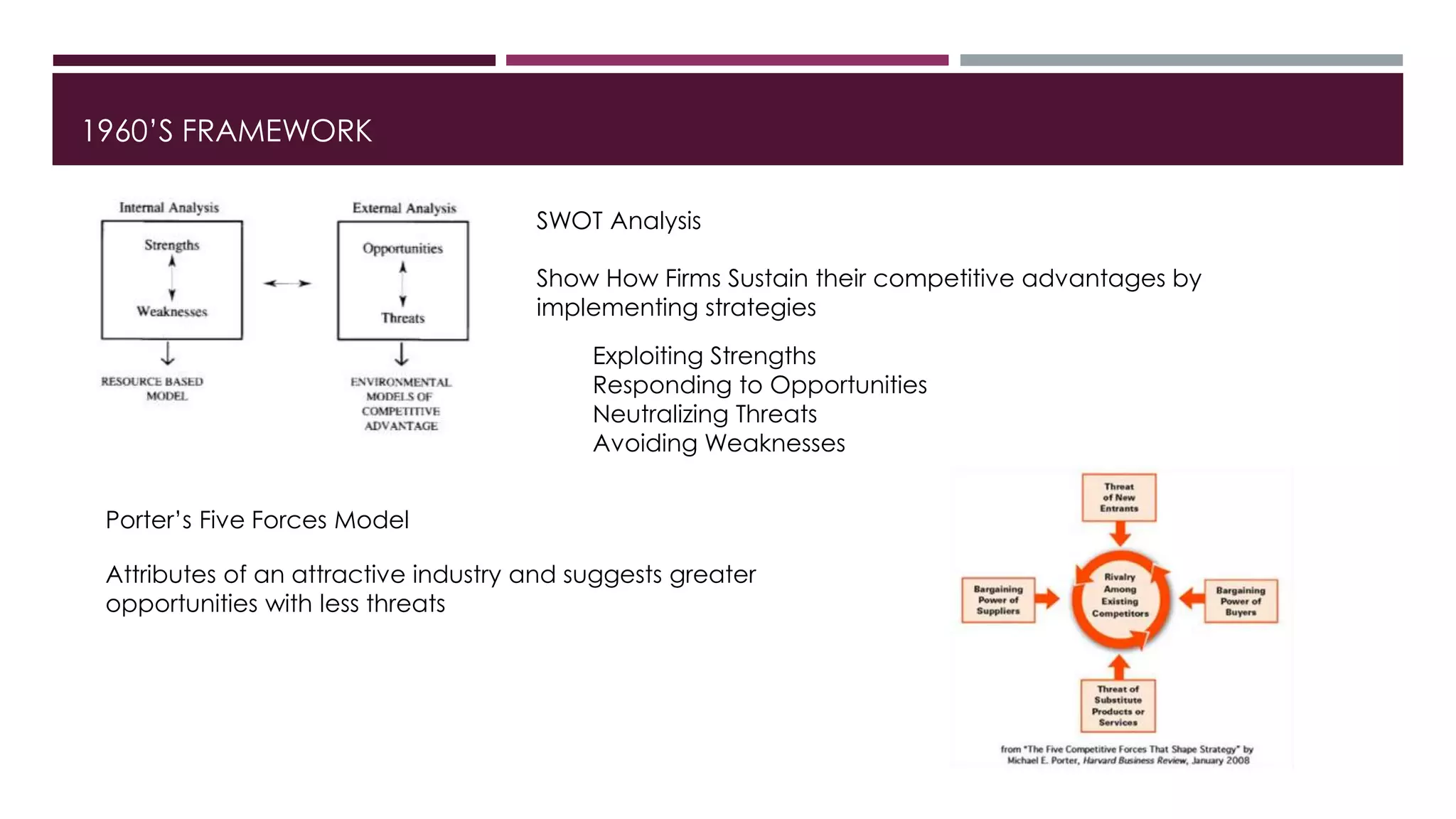
1960’S FRAMEWORK
SWOT Analysis
Show How Firms Sustain their competitive advantages by
implementing strategies
Exploiting Strengths
Responding to Opportunities
Neutralizing Threats
Avoiding Weaknesses
Porter’s Five Forces Model
Attributes of an attractive industry and suggests greater
opportunities with less threats
ASSUMPTION IN PROPOSED FRAMEWORK
 Firms in an industry may be heterogeneous with respect to the strategic resources they control
 Resources may not be perfectly mobile, therefore Heterogeneity can be long-lasting
CONCEPT IN THIS PAPER : FIRM RESOURCES
All assets, capabilities, organizational processes, firm attributes, information, knowledge etc.
that are controlled by firms to be used as strength for improving efficiency and effectiveness
(Daft,1983)
Three Categories in this paper:
 Physical capital. Ex: technologies, infrastructures, location, access to materials etc
 Human capital. Ex: training, experience,relationship,worker & manager skills
 Organizational capital . Ex:reporting structure, planning, controlling, informal
relations among group
These resources can act as barriers or enabler of a firms ability to implement valuable
strategies for sustaining competitive advantage.
Even so, this paper focus only on the function as enabler of firms sustainable competitive
advantage
CONCEPT IN THIS PAPER : COMPETITIVE ADVANTAGE & SUSTAINED COMPETITIVE ADV.
Competitive Advantage
Firm is implementing a value creating strategy not simultaneously being implemented by
other firms
Sustained Competitive Advantage
Firm is implementing a value creating strategy not simultaneously being implemented by
other firms and
when other firms are unable to duplicate the benefits of the strategy
 Does not mean it will last forever. But will not be competed away through the
duplication efforts.
 The inability of existing and potential firms to duplicate strategy
Schumpeterian Shocks : A firm enjoying a sustained competitive adv. may experience
major shifts in the structure of competition.
RESOURCE HETEROGENEITY AND IMMOBILITY
 The search for sources of sustained competitive advantage must focus on firms’ resource heterogeneity
and immobility
Homegeneity & Mobility
 If an industry is populated with identical firms that have access to similar resources, it is impossible for these
firms to enjoy sustained competitive advantage.
 In order to be a first-mover advantage, firms in an industry must be heterogeneous in terms of the resources
they control
 Entry barriers and mobility barriers can be source of sustained competitive advantage when resources are
heterogeneous and immobile.
ATTRIBUTES OF RESOURCES AS SOURCE FOR SUSTAINED COMPETITIVE ADVANTAGE
Valuable
 Enable firms to implement strategies for
increasing effectiveness and efficiency
 Exploit opportunities , Neutralizing threats
Rareness
 If a resources is valuable but easy to obtain,
it can not be used as source of competitive
advantage
 However, valuable and common resources
can also be used to ensure firms’ survival.
 If number of firms possess a valuable of
resources is less than the number of firms
needed to generate perfect competition
industry : It’s a source!
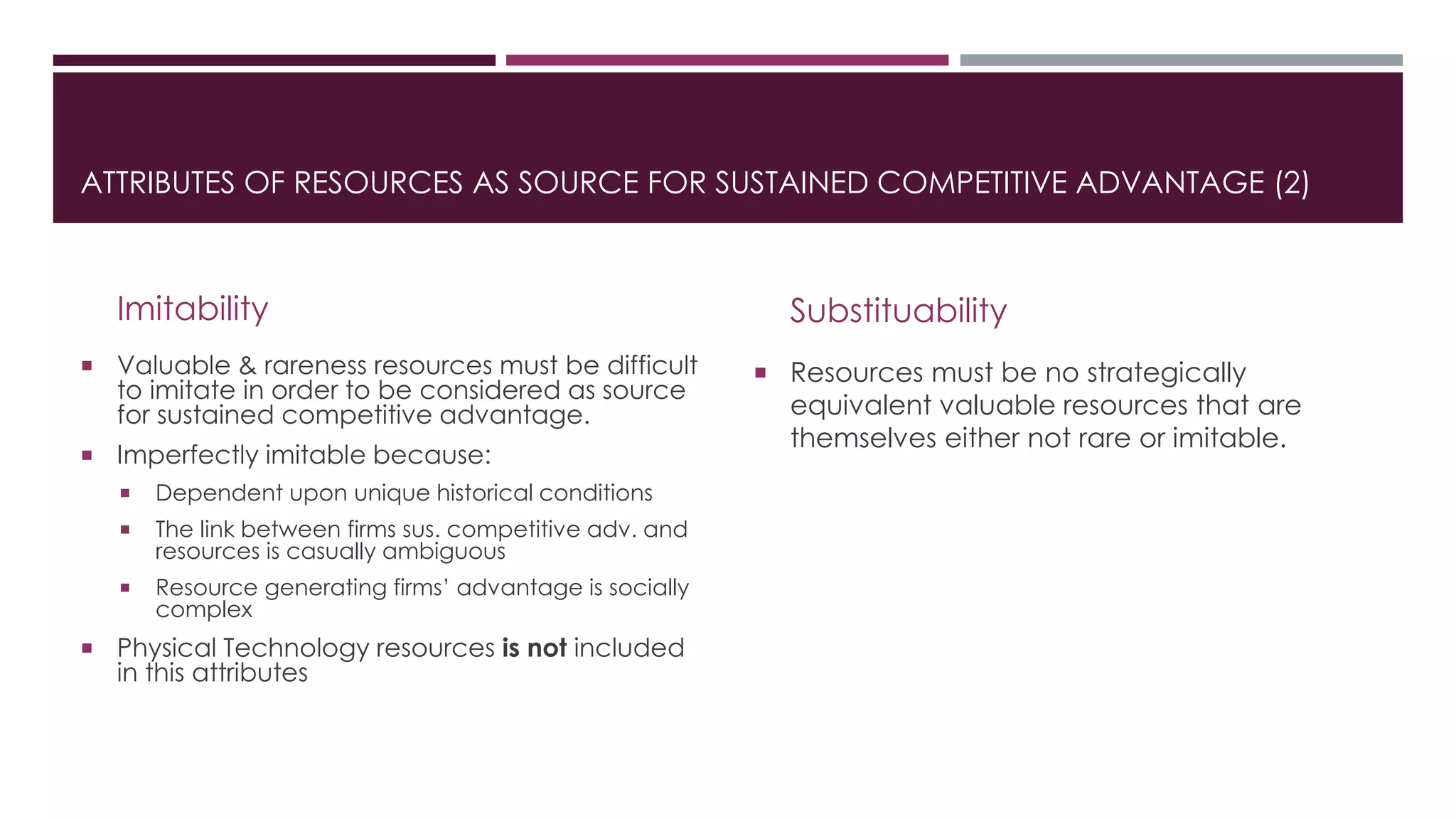
Imitability
 Valuable & rareness resources must be difficult
to imitate in order to be considered as source
for sustained competitive advantage.
 Imperfectly imitable because:
 Dependent upon unique historical conditions
 The link between firms sus. competitive adv. and
resources is casually ambiguous
 Resource generating firms’ advantage is socially
complex
 Physical Technology resources is not included
in this attributes
Substituability
 Resources must be no strategically
equivalent valuable resources that are
themselves either not rare or imitable.
ATTRIBUTES OF RESOURCES AS SOURCE FOR SUSTAINED COMPETITIVE ADVANTAGE (2)
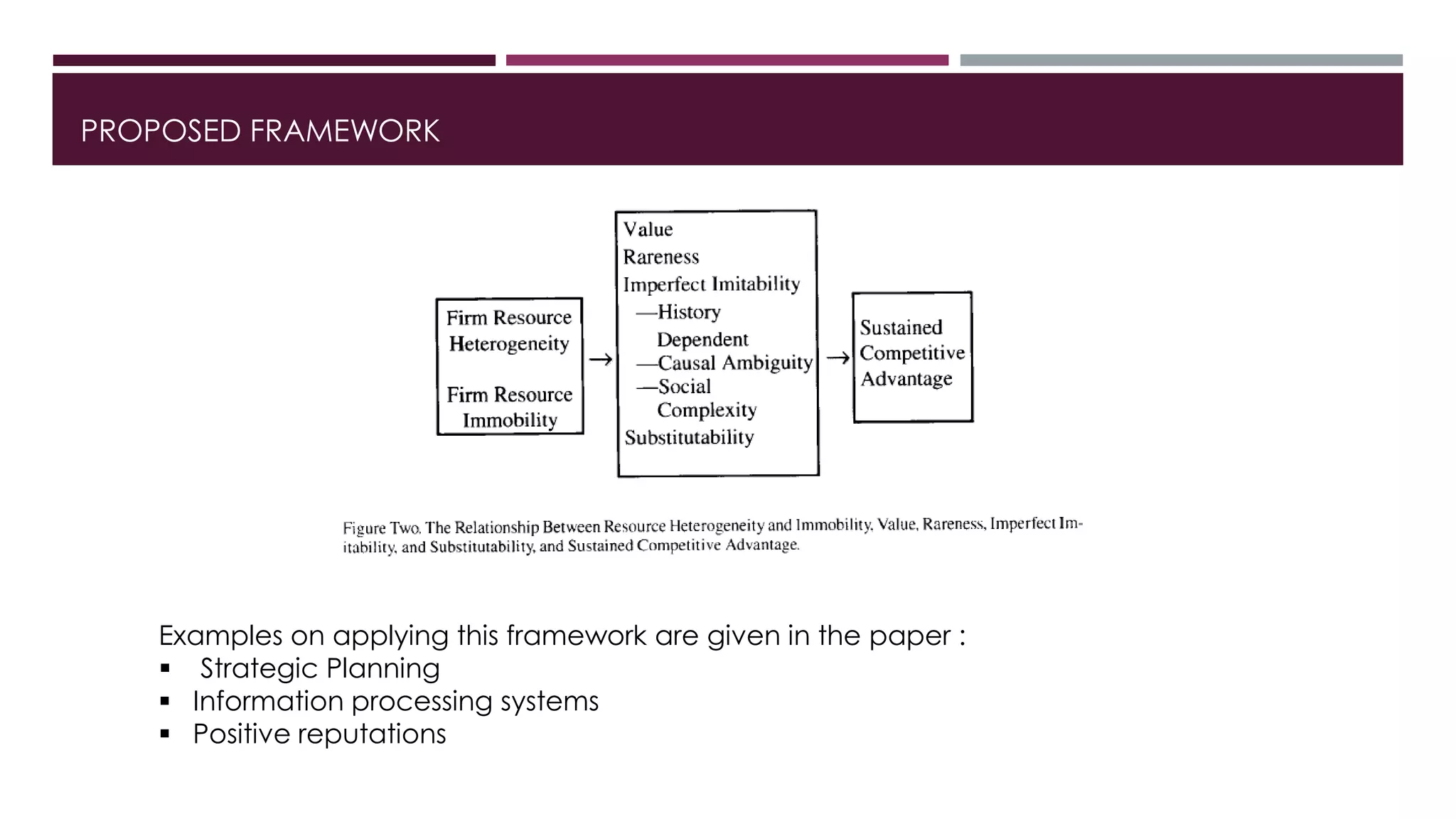
PROPOSED FRAMEWORK
Examples on applying this framework are given in the paper :
 Strategic Planning
 Information processing systems
 Positive reputations
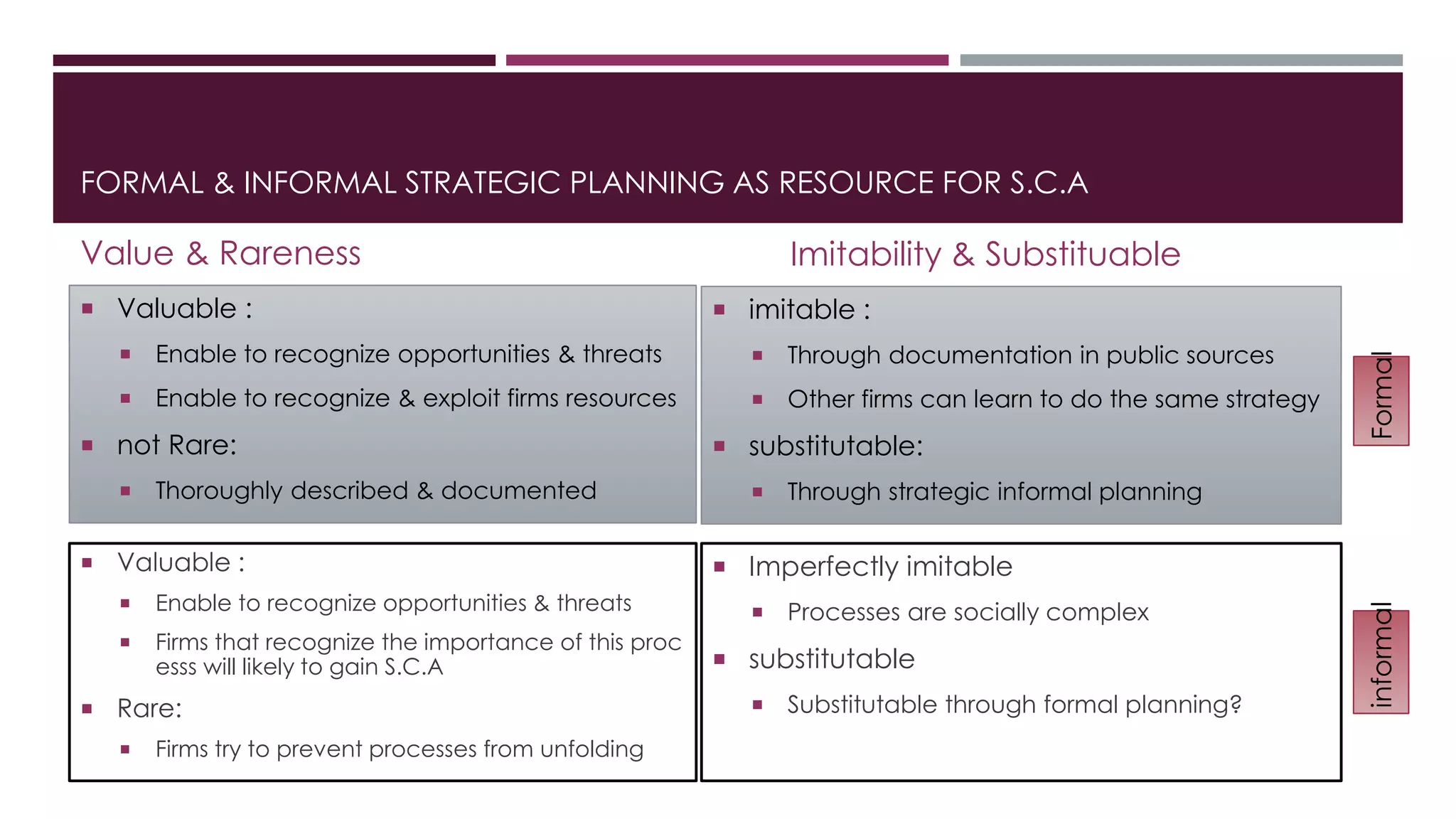
FORMAL & INFORMAL STRATEGIC PLANNING AS RESOURCE FOR S.C.A
Value & Rareness
 Valuable :
 Enable to recognize opportunities & threats
 Enable to recognize & exploit firms resources
 not Rare:
 Thoroughly described & documented
Imitability & Substituable
 imitable :
 Through documentation in public sources
 Other firms can learn to do the same strategy
 substitutable:
 Through strategic informal planning
 Valuable :
 Enable to recognize opportunities & threats
 Firms that recognize the importance of this proc
esss will likely to gain S.C.A
 Rare:
 Firms try to prevent processes from unfolding
 Imperfectly imitable
 Processes are socially complex
 substitutable
 Substitutable through formal planning?
Formalinformal
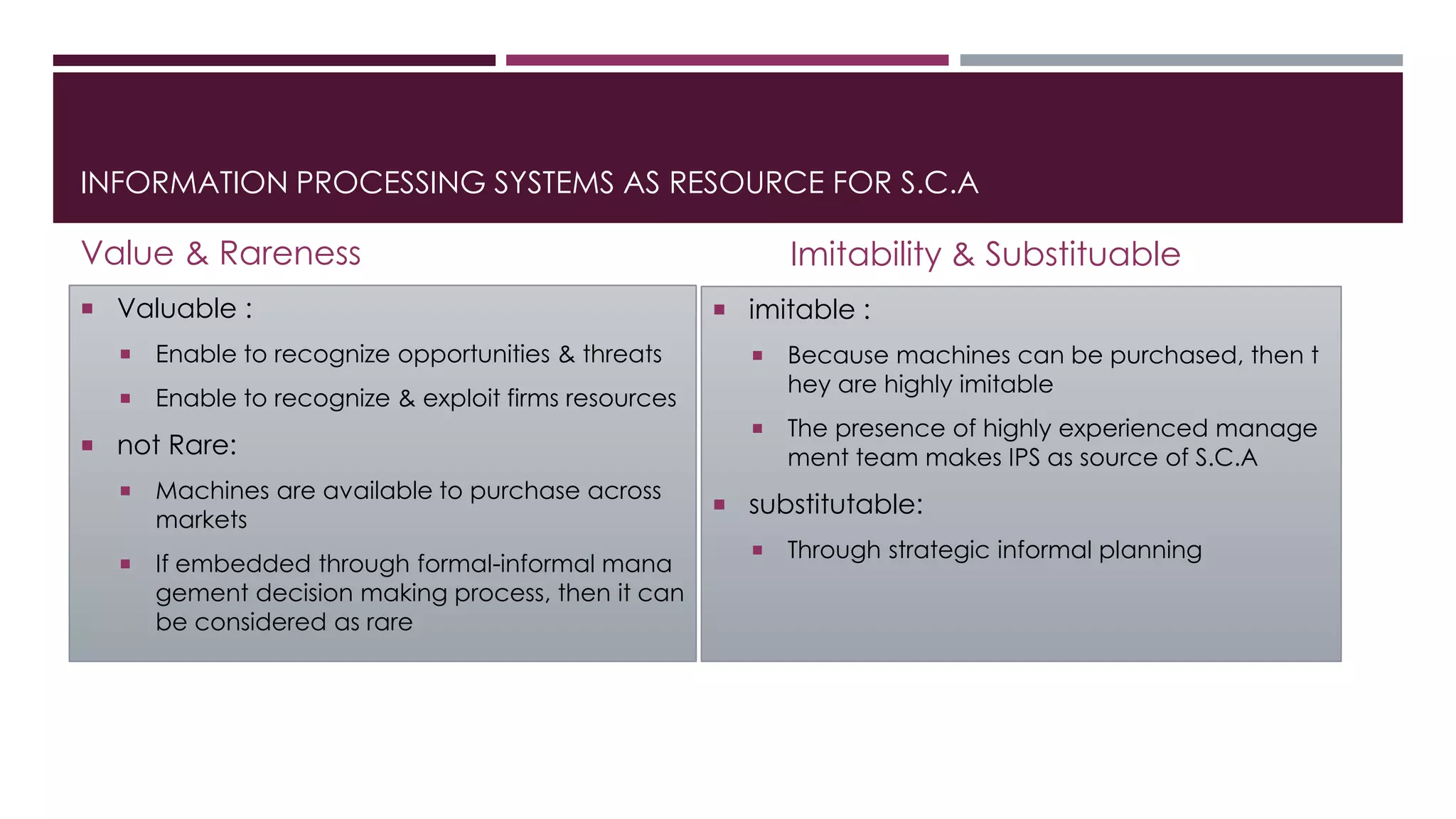
INFORMATION PROCESSING SYSTEMS AS RESOURCE FOR S.C.A
Value & Rareness
 Valuable :
 Enable to recognize opportunities & threats
 Enable to recognize & exploit firms resources
 not Rare:
 Machines are available to purchase across
markets
 If embedded through formal-informal mana
gement decision making process, then it can
be considered as rare
Imitability & Substituable
 imitable :
 Because machines can be purchased, then t
hey are highly imitable
 The presence of highly experienced manage
ment team makes IPS as source of S.C.A
 substitutable:
 Through strategic informal planning
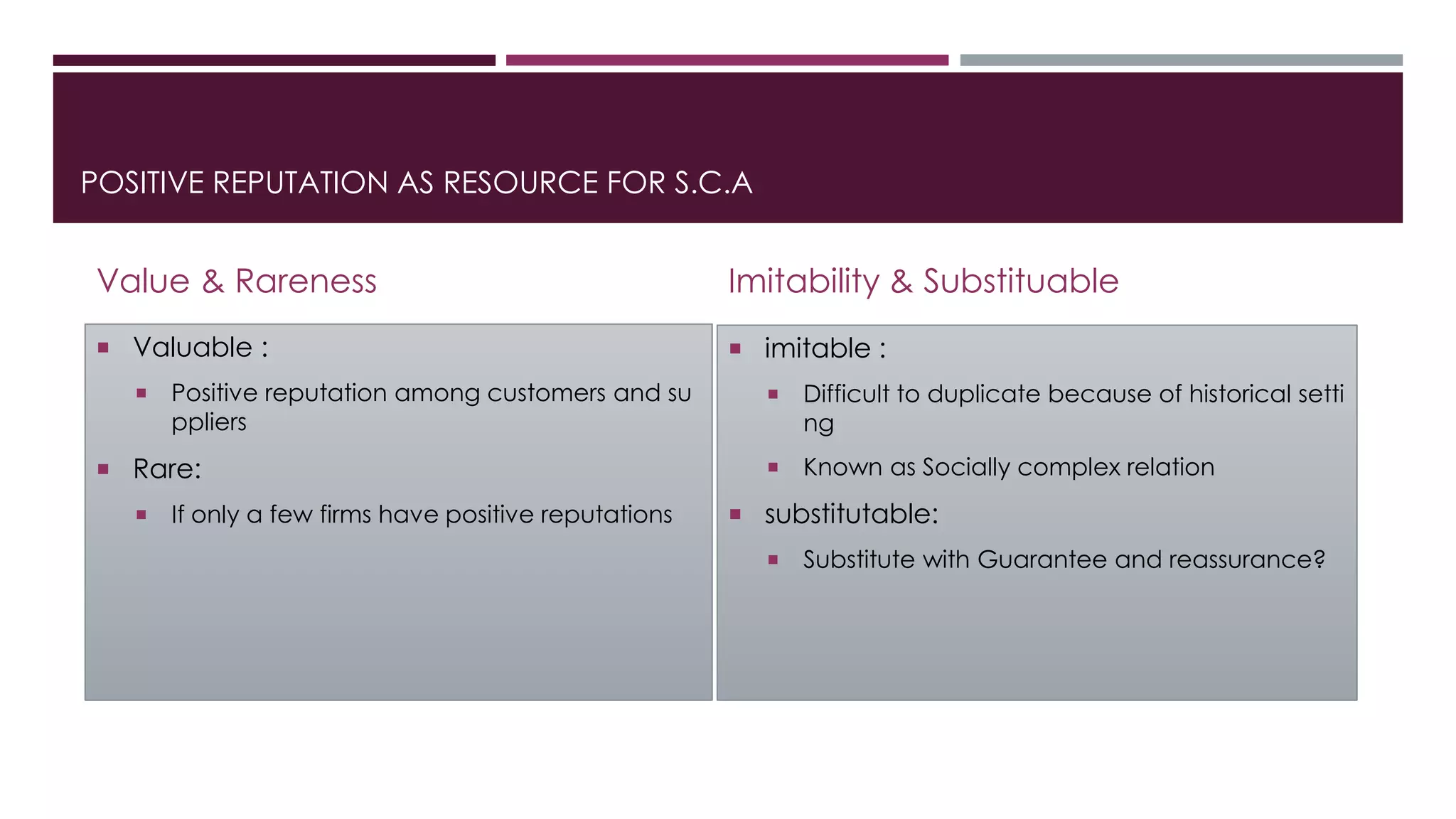
POSITIVE REPUTATION AS RESOURCE FOR S.C.A
Value & Rareness
 Valuable :
 Positive reputation among customers and su
ppliers
 Rare:
 If only a few firms have positive reputations
Imitability & Substituable
 imitable :
 Difficult to duplicate because of historical setti
ng
 Known as Socially complex relation
 substitutable:
 Substitute with Guarantee and reassurance?
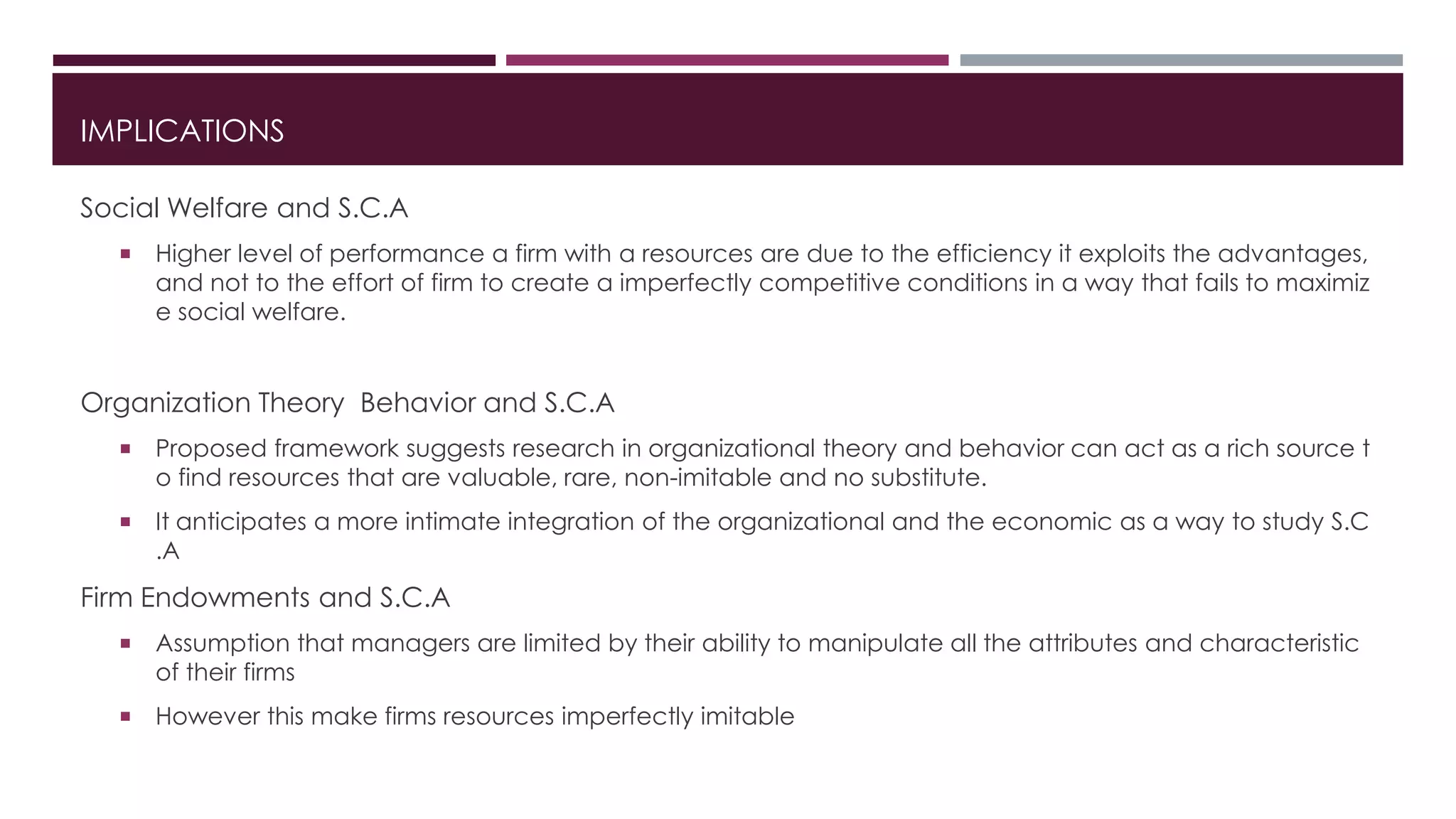
IMPLICATIONS
Social Welfare and S.C.A
 Higher level of performance a firm with a resources are due to the efficiency it exploits the advantages,
and not to the effort of firm to create a imperfectly competitive conditions in a way that fails to maximiz
e social welfare.
Organization Theory Behavior and S.C.A
 Proposed framework suggests research in organizational theory and behavior can act as a rich source t
o find resources that are valuable, rare, non-imitable and no substitute.
 It anticipates a more intimate integration of the organizational and the economic as a way to study S.C
.A
Firm Endowments and S.C.A
 Assumption that managers are limited by their ability to manipulate all the attributes and characteristic
of their firms
 However this make firms resources imperfectly imitable
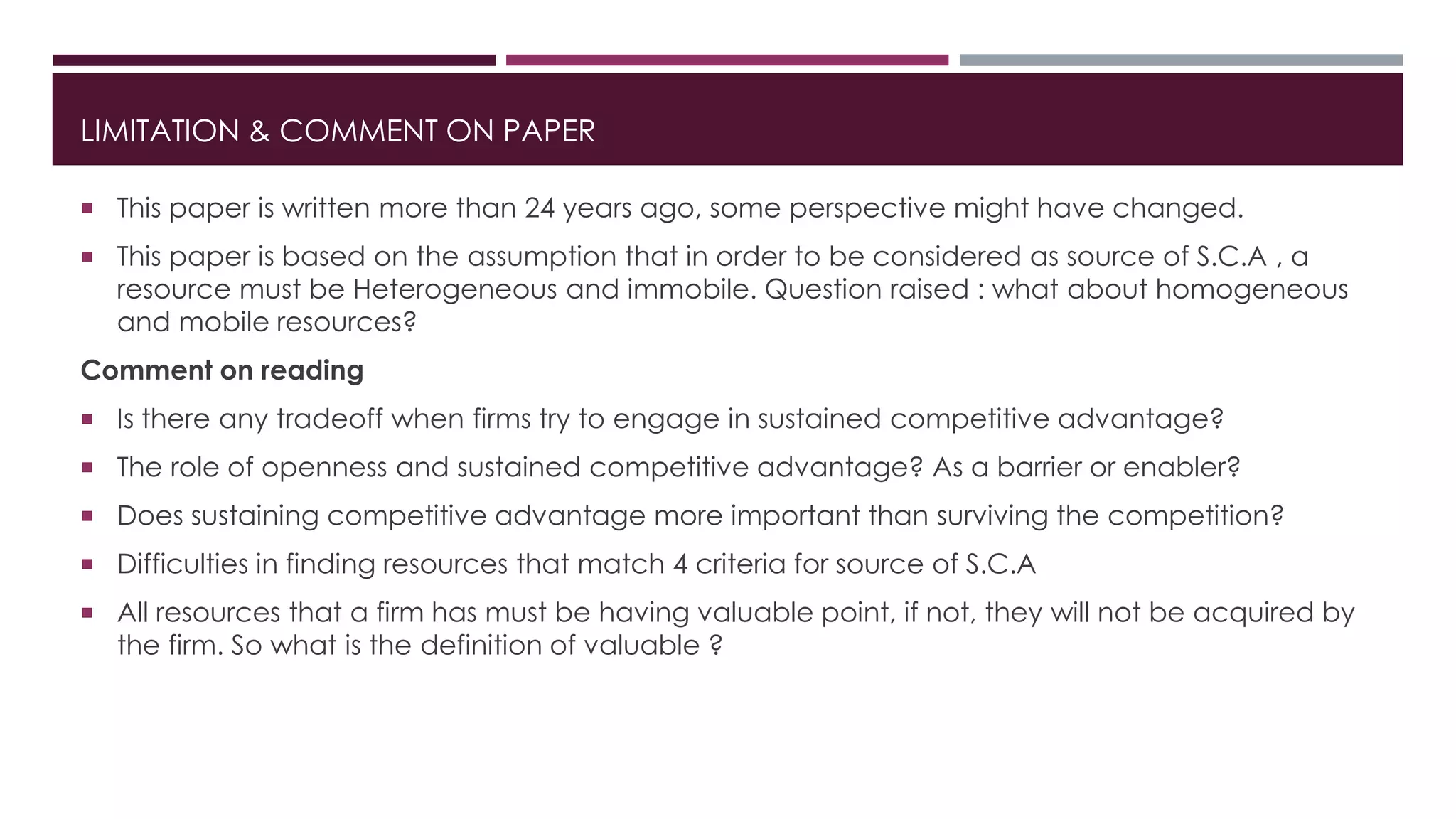
LIMITATION & COMMENT ON PAPER
 This paper is written more than 24 years ago, some perspective might have changed.
 This paper is based on the assumption that in order to be considered as source of S.C.A , a
resource must be Heterogeneous and immobile. Question raised : what about homogeneous
and mobile resources?
Comment on reading
 Is there any tradeoff when firms try to engage in sustained competitive advantage?
 The role of openness and sustained competitive advantage? As a barrier or enabler?
 Does sustaining competitive advantage more important than surviving the competition?
 Difficulties in finding resources that match 4 criteria for source of S.C.A
 All resources that a firm has must be having valuable point, if not, they will not be acquired by
the firm. So what is the definition of valuable ?

Firm Resources and Sustained Competitive Advantage

  • 1.
    FIRM RESOURCES ANDSUSTAINED COMPETITIVE ADVANTAGE, BARNEY,JAY B, JOURNAL OF MANAGEMENT, 1991 DATE: 10/27/2015 ID: 20155636 NAME: RIRI KUSUMARANI ITM 501 - INNOVATION MANAGEMENT (2014)
  • 2.
    ONE SENTENCE SUMMARY 10/27/2015ITM501 - INNOVATION MANAGEMENT 2 The proposed framework can be used to analyze resources potential as source for sustained competitive advantage of a firm when firm resources are heterogeneous and immobile
  • 3.
    1960’S FRAMEWORK SWOT Analysis ShowHow Firms Sustain their competitive advantages by implementing strategies Exploiting Strengths Responding to Opportunities Neutralizing Threats Avoiding Weaknesses Porter’s Five Forces Model Attributes of an attractive industry and suggests greater opportunities with less threats
  • 4.
    ASSUMPTION IN PROPOSEDFRAMEWORK  Firms in an industry may be heterogeneous with respect to the strategic resources they control  Resources may not be perfectly mobile, therefore Heterogeneity can be long-lasting
  • 5.
    CONCEPT IN THISPAPER : FIRM RESOURCES All assets, capabilities, organizational processes, firm attributes, information, knowledge etc. that are controlled by firms to be used as strength for improving efficiency and effectiveness (Daft,1983) Three Categories in this paper:  Physical capital. Ex: technologies, infrastructures, location, access to materials etc  Human capital. Ex: training, experience,relationship,worker & manager skills  Organizational capital . Ex:reporting structure, planning, controlling, informal relations among group These resources can act as barriers or enabler of a firms ability to implement valuable strategies for sustaining competitive advantage. Even so, this paper focus only on the function as enabler of firms sustainable competitive advantage
  • 6.
    CONCEPT IN THISPAPER : COMPETITIVE ADVANTAGE & SUSTAINED COMPETITIVE ADV. Competitive Advantage Firm is implementing a value creating strategy not simultaneously being implemented by other firms Sustained Competitive Advantage Firm is implementing a value creating strategy not simultaneously being implemented by other firms and when other firms are unable to duplicate the benefits of the strategy  Does not mean it will last forever. But will not be competed away through the duplication efforts.  The inability of existing and potential firms to duplicate strategy Schumpeterian Shocks : A firm enjoying a sustained competitive adv. may experience major shifts in the structure of competition.
  • 7.
    RESOURCE HETEROGENEITY ANDIMMOBILITY  The search for sources of sustained competitive advantage must focus on firms’ resource heterogeneity and immobility Homegeneity & Mobility  If an industry is populated with identical firms that have access to similar resources, it is impossible for these firms to enjoy sustained competitive advantage.  In order to be a first-mover advantage, firms in an industry must be heterogeneous in terms of the resources they control  Entry barriers and mobility barriers can be source of sustained competitive advantage when resources are heterogeneous and immobile.
  • 8.
    ATTRIBUTES OF RESOURCESAS SOURCE FOR SUSTAINED COMPETITIVE ADVANTAGE Valuable  Enable firms to implement strategies for increasing effectiveness and efficiency  Exploit opportunities , Neutralizing threats Rareness  If a resources is valuable but easy to obtain, it can not be used as source of competitive advantage  However, valuable and common resources can also be used to ensure firms’ survival.  If number of firms possess a valuable of resources is less than the number of firms needed to generate perfect competition industry : It’s a source!
  • 9.
    Imitability  Valuable &rareness resources must be difficult to imitate in order to be considered as source for sustained competitive advantage.  Imperfectly imitable because:  Dependent upon unique historical conditions  The link between firms sus. competitive adv. and resources is casually ambiguous  Resource generating firms’ advantage is socially complex  Physical Technology resources is not included in this attributes Substituability  Resources must be no strategically equivalent valuable resources that are themselves either not rare or imitable. ATTRIBUTES OF RESOURCES AS SOURCE FOR SUSTAINED COMPETITIVE ADVANTAGE (2)
  • 10.
    PROPOSED FRAMEWORK Examples onapplying this framework are given in the paper :  Strategic Planning  Information processing systems  Positive reputations
  • 11.
    FORMAL & INFORMALSTRATEGIC PLANNING AS RESOURCE FOR S.C.A Value & Rareness  Valuable :  Enable to recognize opportunities & threats  Enable to recognize & exploit firms resources  not Rare:  Thoroughly described & documented Imitability & Substituable  imitable :  Through documentation in public sources  Other firms can learn to do the same strategy  substitutable:  Through strategic informal planning  Valuable :  Enable to recognize opportunities & threats  Firms that recognize the importance of this proc esss will likely to gain S.C.A  Rare:  Firms try to prevent processes from unfolding  Imperfectly imitable  Processes are socially complex  substitutable  Substitutable through formal planning? Formalinformal
  • 12.
    INFORMATION PROCESSING SYSTEMSAS RESOURCE FOR S.C.A Value & Rareness  Valuable :  Enable to recognize opportunities & threats  Enable to recognize & exploit firms resources  not Rare:  Machines are available to purchase across markets  If embedded through formal-informal mana gement decision making process, then it can be considered as rare Imitability & Substituable  imitable :  Because machines can be purchased, then t hey are highly imitable  The presence of highly experienced manage ment team makes IPS as source of S.C.A  substitutable:  Through strategic informal planning
  • 13.
    POSITIVE REPUTATION ASRESOURCE FOR S.C.A Value & Rareness  Valuable :  Positive reputation among customers and su ppliers  Rare:  If only a few firms have positive reputations Imitability & Substituable  imitable :  Difficult to duplicate because of historical setti ng  Known as Socially complex relation  substitutable:  Substitute with Guarantee and reassurance?
  • 14.
    IMPLICATIONS Social Welfare andS.C.A  Higher level of performance a firm with a resources are due to the efficiency it exploits the advantages, and not to the effort of firm to create a imperfectly competitive conditions in a way that fails to maximiz e social welfare. Organization Theory Behavior and S.C.A  Proposed framework suggests research in organizational theory and behavior can act as a rich source t o find resources that are valuable, rare, non-imitable and no substitute.  It anticipates a more intimate integration of the organizational and the economic as a way to study S.C .A Firm Endowments and S.C.A  Assumption that managers are limited by their ability to manipulate all the attributes and characteristic of their firms  However this make firms resources imperfectly imitable
  • 15.
    LIMITATION & COMMENTON PAPER  This paper is written more than 24 years ago, some perspective might have changed.  This paper is based on the assumption that in order to be considered as source of S.C.A , a resource must be Heterogeneous and immobile. Question raised : what about homogeneous and mobile resources? Comment on reading  Is there any tradeoff when firms try to engage in sustained competitive advantage?  The role of openness and sustained competitive advantage? As a barrier or enabler?  Does sustaining competitive advantage more important than surviving the competition?  Difficulties in finding resources that match 4 criteria for source of S.C.A  All resources that a firm has must be having valuable point, if not, they will not be acquired by the firm. So what is the definition of valuable ?

Editor's Notes

  • #3 In one sentence, this paper is proposing a framework also known as resource-based view framework that can be used to analyze resources that are potential for firms to sustain their competitive advantage.
  • #4 Well known frameworks to understand source of S.C.A focus on firm and environment perspective. These two frameworks : SWOT analysis and porter’s five forces model put firms’ competitive position as less important.