FINTECH GUIDE FOR
BEGINNER'S
101blockchains.com
Fintech is the use of various technologies to enable different
financial services and manage consumers in an efficient
manner.
Technologies used in Fintech mainly uses various software and
algorithm to automate the process of various services for the
end user.
Fintech is here to make your banking or financial services more
modernized with online trading, digital transactions, cyber
security, digital currencies, etc.
What is Fintech?
Working of
Financial
Technology
Smart Chips and Biometric Sensors
Omnichannel and Digital Banking
Chatbots
Artificial Intelligence
DeFi, Cryptocurrencies, and Wallets
Smart Chips
and Biometric
Sensors
Biometric sensors are used in Fintech to access
the financial services. These may include, ATM
integration on mobile apps, fingerprint
recognition, palm recognition, retina scan and
so on.
ATM cards now have smart chip that allows
users to reduce any financial loss due to
unforsaken circumstances. It also, enables
users to use one time pin or passcode for
making transactions online.
Omnichannel
and Digital
Banking
Digital banking or omnichannel banking has
reshaped the world of finance. And as
Fintech utilizes these it’s the sole reason for
this massive transformation within the
banking system.
This allows people to access basic financial
services without needing to go to the
physical branch. It also helps to reduce the
number of branches for banks and cut down
the operational cost.
Chatbots Chatbots are another big part of the Fintech
working process. These are software-based
bots for assisting communications with
customers. Chatbots also offer other types
of services such as giving relative
information or telling a specific procedure
of something.
Typically, chatbots can help out with
customers that are facing any simplistic
type of issues or just wants to know about a
specific service.
Artificial
Intelligence
Artificial intelligence is enabling fintech sectors
to develop even further. With the help of
machine learning and AI, now finance providers
can detect fraud without any issues.
It can also help out in generating alerts as when
it discovers any fraudulent transactions
happening in real time. On the other hand,
machine learning can to create automated
processes, create new financial models and so
forth.
DeFi, Cryptocurrencies,
and Wallets
Fintech industry also differs from typical financial
companies in terms of customer services. Not only it offers
a better and more efficient customer service but it also
wants to empower the customers as much as possible.
As now it uses blockchain technology and other secure
platforms to handle the transactions, a new decentralized
finance technology or DeFi has emerged. DeFi allows
users to utilize cryptocurrencies and offer them
blockchain based wallet systems.
Types of Fintech
Robot-based Advice and Stock
Trading
Crowdfunding
Personal Finance Management
Peer-to-Peer Lending and
Borrowing
Blockchain and Cryptocurrencies
Regulatory Technology
Insurance Technology
Mobile Payments
Due to the popularity of cryptocurrencies, blockchain is now used
by many financial companies creating a massive niche within
Fintech industry.
Blockchain offers a peer-to-peer decentralized and distributed
transaction system that can help to process transactions in a
secure way.
On the other hand, cryptocurrencies offer an alternative to typical
fiat-based currencies with additional transparency and privacy.
Blockchain and Cryptocurrencies
Another type of Fintech would be the services that focuses on
regulatory technology.
In fact, regulatory technology is a subclass of the fintech that helps
to provide a more efficient delivery of the regulatory terms.
RegTech actually uses technology to facilitate compliance across
financial companies.
Our financial status is always changing therefore, we will need
new regulatory frameworks to reshape the financial landscape.
Regulatory Technology
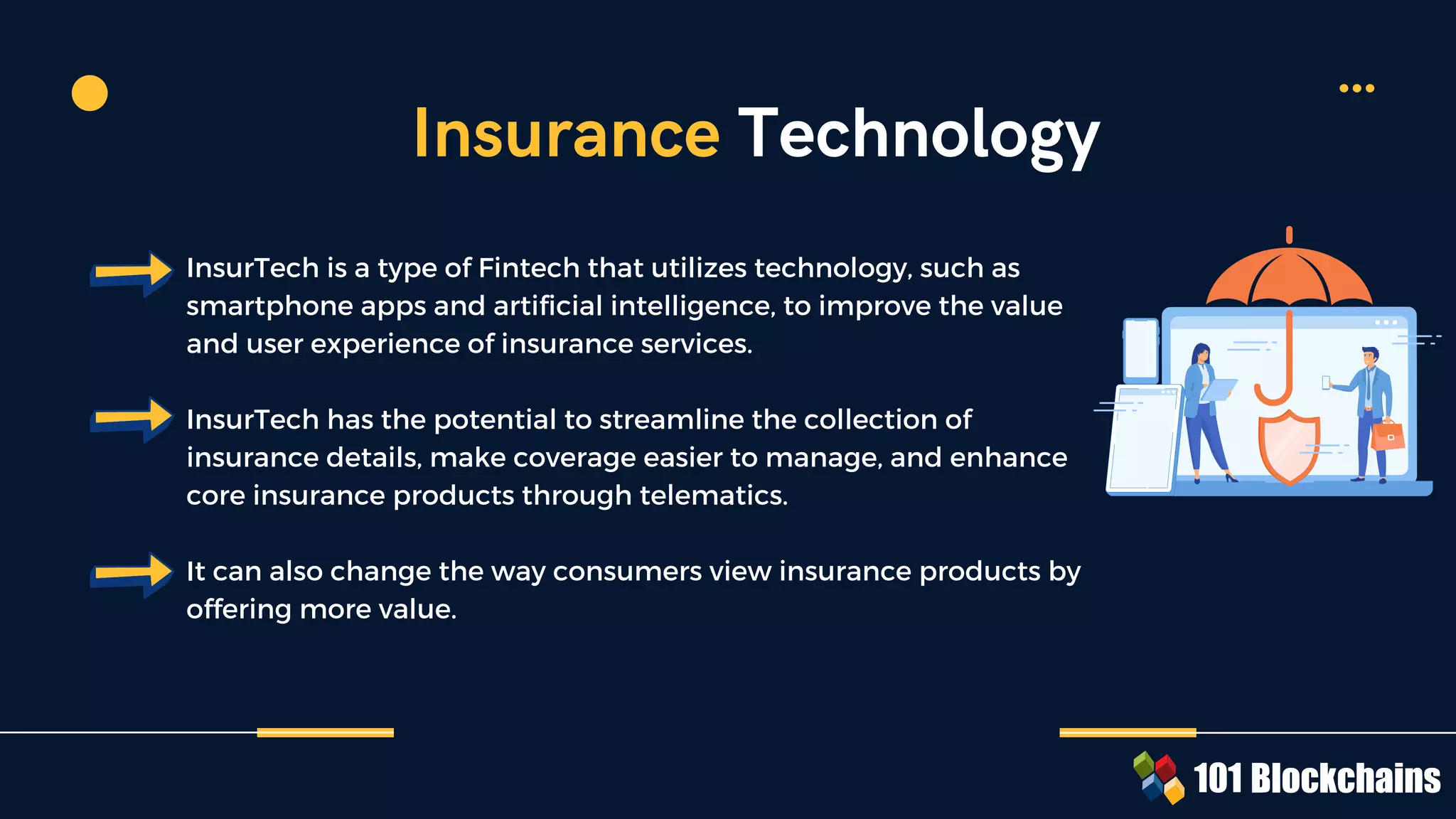
InsurTech is a type of Fintech that utilizes technology, such as
smartphone apps and artificial intelligence, to improve the value
and user experience of insurance services.
InsurTech has the potential to streamline the collection of
insurance details, make coverage easier to manage, and enhance
core insurance products through telematics.
It can also change the way consumers view insurance products by
offering more value.
Insurance Technology
Mobile payment systems, like PayPal, Apple Pay, and Google Pay,
are a type of Fintech that allow users to send and receive
payments through mobile apps.
These apps have gained widespread popularity, with some, like
Venmo, boasting over 65 million daily users.
The pandemic has brought attention to the potential for cashless
transactions and has prompted organizations to consider their
payment options. Mobile payment apps differ in their
functionalities, but their popularity suggests that they are
trustworthy.
Mobile Payments
Fintech has transformed the lending and borrowing process
through the use of peer-to-peer (P2P) lending protocols, which
allow individuals to access loans anytime and from anywhere.
These protocols, like Compound and Aave, use decentralized
finance (DeFi) to enhance the user experience and streamline
access to financial services.
Credit Karma is another popular lending application in the fintech
industry, with over 110 million users in the US. It provides free and
reliable credit score reports and tools for identity and credit
monitoring, loan shopping, and credit card recommendations.
Peer-to-Peer Lending and Borrowing
Personal finance management, also known as WealthTech, is a
type of Fintech that aims to improve wealth management and
retail investment practices through personalization and
automation.
WealthTech streamlines the investment process and can help
investors manage their portfolios more easily. Monie is a popular
example of a personal finance management solution in the
Egyptian market.
Personal Finance Management
The crowdfunding market is expected to experience significant
growth, with a compound annual growth rate of over 16%,
between 2021 and 2026.
Crowdfunding platforms have made it easier for individuals and
small businesses to secure funding for projects by eliminating the
need to pitch to venture capitalists or visit a bank.
Fintech crowdfunding services provide an opportunity for micro
and small enterprises to find investors.
Crowdfunding
Robot-based advisors, powered by artificial intelligence and
machine learning, are a type of Fintech that provide
recommendations for financial decisions.
These advisors can offer a convenient alternative to hiring a
human expert and are available to provide data analysis around
the clock. Stock trading apps, another type of Fintech, allow
investors to conduct transactions from their smartphones using AI
and ML to glean insights from large amounts of data.
Blockchain technology can also enhance the security of investors'
personal and financial information.
Robot-based Advice and Stock Trading
Fintech Uses and Examples
Seamless Mobile Transactions
Alternative Consumer
Banking solutions
Better security with Blockchain
Support for Cryptocurrency
Various Online Payment
Gateways
Automated Insurance Processes
Certification Programs
Certified Enterprise Blockchain
Professional (CEBP)™
Certified Enterprise Blockchain
Architect (CEBA)™
Certified Blockchain Security
Expert (CBSE)™
https://101blockchains.com/certification
/certified-enterprise-blockchain-
architect/
https://101blockchains.com
/certification/certified-blockchain-
security-expert/
https://101blockchains.com
/certification/blockchain-expert-
certification/
Certification Programs
Certified NFT
Professional (CNFTP)™
Certified Metaverse
Professional (CMP)™
Certified Web 3.0
Professional (CW3P)™
https://101blockchains.com/certification
/certified-metaverse-professional/
https://101blockchains.com/certification
/certified-web3-professional/
https://101blockchains.com/certification
/certified-nft-professional/
Why You Must Go With 101 Blockchains
Certification Programs?
101 Blockchains accredited certification programs are the only
industry-recognized and accredited credentials focused specifically
on Blockchain and Web3 technologies.
Better Standards Reduced Risks Marketable Appeal
101 Blockchains Courses and
Masterclasses
Courses Masterclasses
https://101blockchains.com/courses/ https://101blockchains.com/masterclasses/
Skill Path and Career Path
Skill Learning Paths Career Learning Paths
https://101blockchains.com/skill/ https://101blockchains.com/career/
Free Resources
Blockchains Fundamentals - Free Course
Webinars
Conferences
Access Free Resources Now!
Glossary
Flash Cards
Presentations
Infographics
Trusted By 60,000+ Professionals!
Read real stories on Trustpilot and G2Crowd.
800+ reviews
The presentation is not intended to provide any investment advice and should not be
taken as such. Claims made in this webinar do not constitute investment advice and
should not be taken as such. Do your own research!
While the information contained in this document and presentation has been
obtained from sources believed to be reliable, 101 Blockchains disclaims all
warranties as to the completeness or accuracy.
Although 101 Blockchains research and training may address business, financial,
investment and legal issues, 101 Blockchains does not provide any business, financial,
legal or investment advice and this training should not be construed or used as such.
101 Blockchains shall not be responsible for any loss sustained by any person who
relies on this presentation.
Disclaimer
Thank You
© 2023 101 Blockchains. All rights reserved. This document may not be distributed, transmitted or reproduced in any form or by any means without
101 Blockchains’ prior written permission. While the information contained in this document has been obtained from sources believed to be reliable,
101 Blockchains disclaims all warranties as to the completeness or accuracy. Although 101 Blockchains research may address business, financial,
investment and legal issues, 101 Blockchains does not provide any business, financial, legal or investment advice and this document should not be
construed or used as such. 101 Blockchains shall not be responsible for any loss sustained by any person who relies on this publication.

FinTech Guide for Beginner's

  • 1.
  • 2.
    Fintech is theuse of various technologies to enable different financial services and manage consumers in an efficient manner. Technologies used in Fintech mainly uses various software and algorithm to automate the process of various services for the end user. Fintech is here to make your banking or financial services more modernized with online trading, digital transactions, cyber security, digital currencies, etc. What is Fintech?
  • 3.
    Working of Financial Technology Smart Chipsand Biometric Sensors Omnichannel and Digital Banking Chatbots Artificial Intelligence DeFi, Cryptocurrencies, and Wallets
  • 4.
    Smart Chips and Biometric Sensors Biometricsensors are used in Fintech to access the financial services. These may include, ATM integration on mobile apps, fingerprint recognition, palm recognition, retina scan and so on. ATM cards now have smart chip that allows users to reduce any financial loss due to unforsaken circumstances. It also, enables users to use one time pin or passcode for making transactions online.
  • 5.
    Omnichannel and Digital Banking Digital bankingor omnichannel banking has reshaped the world of finance. And as Fintech utilizes these it’s the sole reason for this massive transformation within the banking system. This allows people to access basic financial services without needing to go to the physical branch. It also helps to reduce the number of branches for banks and cut down the operational cost.
  • 6.
    Chatbots Chatbots areanother big part of the Fintech working process. These are software-based bots for assisting communications with customers. Chatbots also offer other types of services such as giving relative information or telling a specific procedure of something. Typically, chatbots can help out with customers that are facing any simplistic type of issues or just wants to know about a specific service.
  • 7.
    Artificial Intelligence Artificial intelligence isenabling fintech sectors to develop even further. With the help of machine learning and AI, now finance providers can detect fraud without any issues. It can also help out in generating alerts as when it discovers any fraudulent transactions happening in real time. On the other hand, machine learning can to create automated processes, create new financial models and so forth.
  • 8.
    DeFi, Cryptocurrencies, and Wallets Fintechindustry also differs from typical financial companies in terms of customer services. Not only it offers a better and more efficient customer service but it also wants to empower the customers as much as possible. As now it uses blockchain technology and other secure platforms to handle the transactions, a new decentralized finance technology or DeFi has emerged. DeFi allows users to utilize cryptocurrencies and offer them blockchain based wallet systems.
  • 9.
    Types of Fintech Robot-basedAdvice and Stock Trading Crowdfunding Personal Finance Management Peer-to-Peer Lending and Borrowing Blockchain and Cryptocurrencies Regulatory Technology Insurance Technology Mobile Payments
  • 10.
    Due to thepopularity of cryptocurrencies, blockchain is now used by many financial companies creating a massive niche within Fintech industry. Blockchain offers a peer-to-peer decentralized and distributed transaction system that can help to process transactions in a secure way. On the other hand, cryptocurrencies offer an alternative to typical fiat-based currencies with additional transparency and privacy. Blockchain and Cryptocurrencies
  • 11.
    Another type ofFintech would be the services that focuses on regulatory technology. In fact, regulatory technology is a subclass of the fintech that helps to provide a more efficient delivery of the regulatory terms. RegTech actually uses technology to facilitate compliance across financial companies. Our financial status is always changing therefore, we will need new regulatory frameworks to reshape the financial landscape. Regulatory Technology
  • 12.
    InsurTech is atype of Fintech that utilizes technology, such as smartphone apps and artificial intelligence, to improve the value and user experience of insurance services. InsurTech has the potential to streamline the collection of insurance details, make coverage easier to manage, and enhance core insurance products through telematics. It can also change the way consumers view insurance products by offering more value. Insurance Technology
  • 13.
    Mobile payment systems,like PayPal, Apple Pay, and Google Pay, are a type of Fintech that allow users to send and receive payments through mobile apps. These apps have gained widespread popularity, with some, like Venmo, boasting over 65 million daily users. The pandemic has brought attention to the potential for cashless transactions and has prompted organizations to consider their payment options. Mobile payment apps differ in their functionalities, but their popularity suggests that they are trustworthy. Mobile Payments
  • 14.
    Fintech has transformedthe lending and borrowing process through the use of peer-to-peer (P2P) lending protocols, which allow individuals to access loans anytime and from anywhere. These protocols, like Compound and Aave, use decentralized finance (DeFi) to enhance the user experience and streamline access to financial services. Credit Karma is another popular lending application in the fintech industry, with over 110 million users in the US. It provides free and reliable credit score reports and tools for identity and credit monitoring, loan shopping, and credit card recommendations. Peer-to-Peer Lending and Borrowing
  • 15.
    Personal finance management,also known as WealthTech, is a type of Fintech that aims to improve wealth management and retail investment practices through personalization and automation. WealthTech streamlines the investment process and can help investors manage their portfolios more easily. Monie is a popular example of a personal finance management solution in the Egyptian market. Personal Finance Management
  • 16.
    The crowdfunding marketis expected to experience significant growth, with a compound annual growth rate of over 16%, between 2021 and 2026. Crowdfunding platforms have made it easier for individuals and small businesses to secure funding for projects by eliminating the need to pitch to venture capitalists or visit a bank. Fintech crowdfunding services provide an opportunity for micro and small enterprises to find investors. Crowdfunding
  • 17.
    Robot-based advisors, poweredby artificial intelligence and machine learning, are a type of Fintech that provide recommendations for financial decisions. These advisors can offer a convenient alternative to hiring a human expert and are available to provide data analysis around the clock. Stock trading apps, another type of Fintech, allow investors to conduct transactions from their smartphones using AI and ML to glean insights from large amounts of data. Blockchain technology can also enhance the security of investors' personal and financial information. Robot-based Advice and Stock Trading
  • 18.
    Fintech Uses andExamples Seamless Mobile Transactions Alternative Consumer Banking solutions Better security with Blockchain Support for Cryptocurrency Various Online Payment Gateways Automated Insurance Processes
  • 19.
    Certification Programs Certified EnterpriseBlockchain Professional (CEBP)™ Certified Enterprise Blockchain Architect (CEBA)™ Certified Blockchain Security Expert (CBSE)™ https://101blockchains.com/certification /certified-enterprise-blockchain- architect/ https://101blockchains.com /certification/certified-blockchain- security-expert/ https://101blockchains.com /certification/blockchain-expert- certification/
  • 20.
    Certification Programs Certified NFT Professional(CNFTP)™ Certified Metaverse Professional (CMP)™ Certified Web 3.0 Professional (CW3P)™ https://101blockchains.com/certification /certified-metaverse-professional/ https://101blockchains.com/certification /certified-web3-professional/ https://101blockchains.com/certification /certified-nft-professional/
  • 21.
    Why You MustGo With 101 Blockchains Certification Programs? 101 Blockchains accredited certification programs are the only industry-recognized and accredited credentials focused specifically on Blockchain and Web3 technologies. Better Standards Reduced Risks Marketable Appeal
  • 22.
    101 Blockchains Coursesand Masterclasses Courses Masterclasses https://101blockchains.com/courses/ https://101blockchains.com/masterclasses/
  • 23.
    Skill Path andCareer Path Skill Learning Paths Career Learning Paths https://101blockchains.com/skill/ https://101blockchains.com/career/
  • 24.
    Free Resources Blockchains Fundamentals- Free Course Webinars Conferences Access Free Resources Now! Glossary Flash Cards Presentations Infographics
  • 25.
    Trusted By 60,000+Professionals! Read real stories on Trustpilot and G2Crowd. 800+ reviews
  • 26.
    The presentation isnot intended to provide any investment advice and should not be taken as such. Claims made in this webinar do not constitute investment advice and should not be taken as such. Do your own research! While the information contained in this document and presentation has been obtained from sources believed to be reliable, 101 Blockchains disclaims all warranties as to the completeness or accuracy. Although 101 Blockchains research and training may address business, financial, investment and legal issues, 101 Blockchains does not provide any business, financial, legal or investment advice and this training should not be construed or used as such. 101 Blockchains shall not be responsible for any loss sustained by any person who relies on this presentation. Disclaimer
  • 27.
    Thank You © 2023101 Blockchains. All rights reserved. This document may not be distributed, transmitted or reproduced in any form or by any means without 101 Blockchains’ prior written permission. While the information contained in this document has been obtained from sources believed to be reliable, 101 Blockchains disclaims all warranties as to the completeness or accuracy. Although 101 Blockchains research may address business, financial, investment and legal issues, 101 Blockchains does not provide any business, financial, legal or investment advice and this document should not be construed or used as such. 101 Blockchains shall not be responsible for any loss sustained by any person who relies on this publication.