Dr. James M. Martin-Hayden
Associate Professor
Analytical and Numerical
Ground Water Flow Modeling
An Introduction
(419) 530-2634
Jhayden@Geology.UToledo.edu
The Ground Water Flow Equation
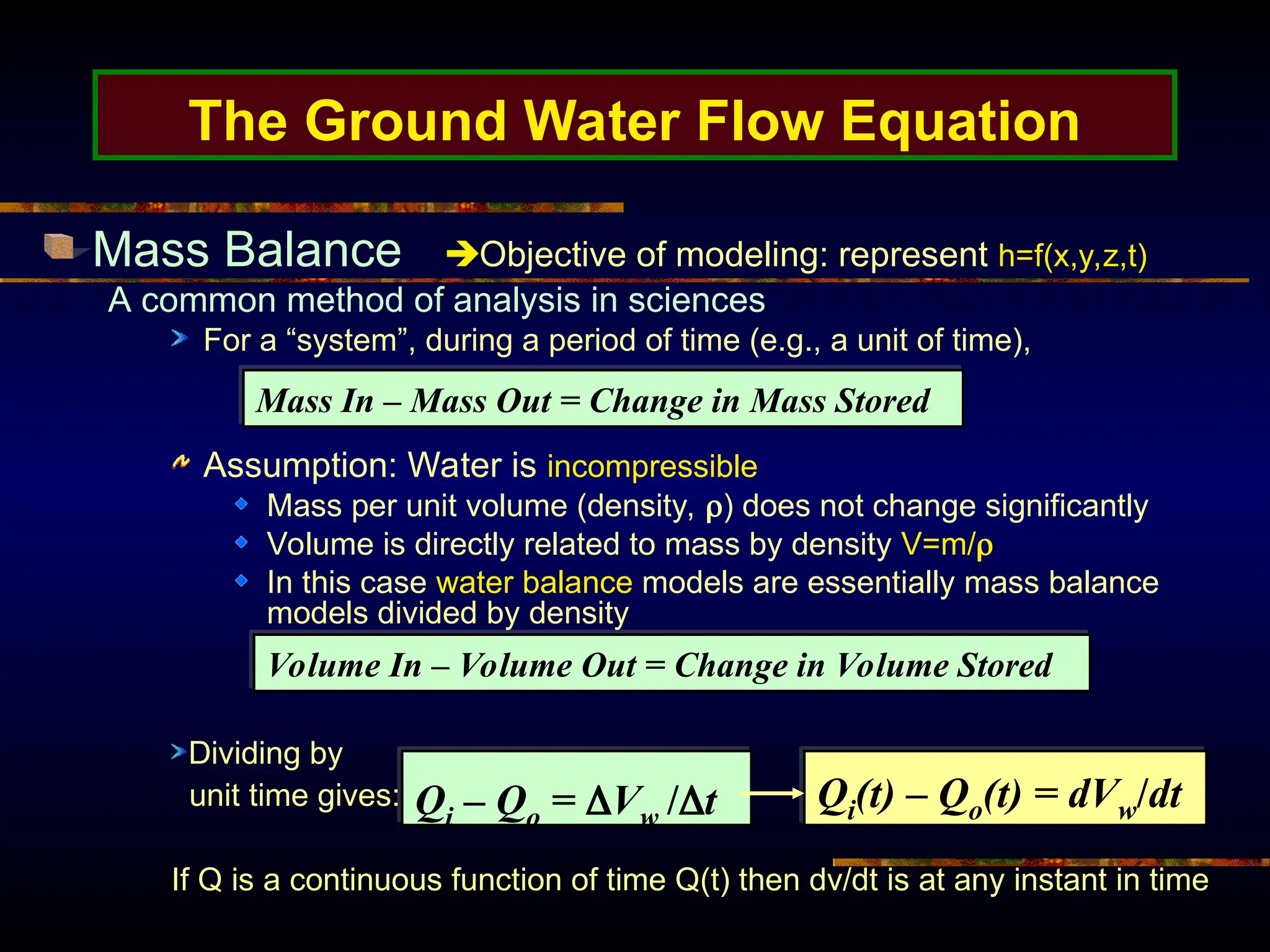
Mass Balance Objective of modeling: represent h=f(x,y,z,t)
A common method of analysis in sciences
For a “system”, during a period of time (e.g., a unit of time),
Assumption: Water is incompressible
Mass per unit volume (density, ) does not change significantly
Volume is directly related to mass by density V=m/
In this case water balance models are essentially mass balance
models divided by density
Mass In – Mass Out = Change in Mass Stored
Volume In – Volume Out = Change in Volume Stored
Qi – Qo = Vw /t
Dividing by
unit time gives:
If Q is a continuous function of time Q(t) then dv/dt is at any instant in time
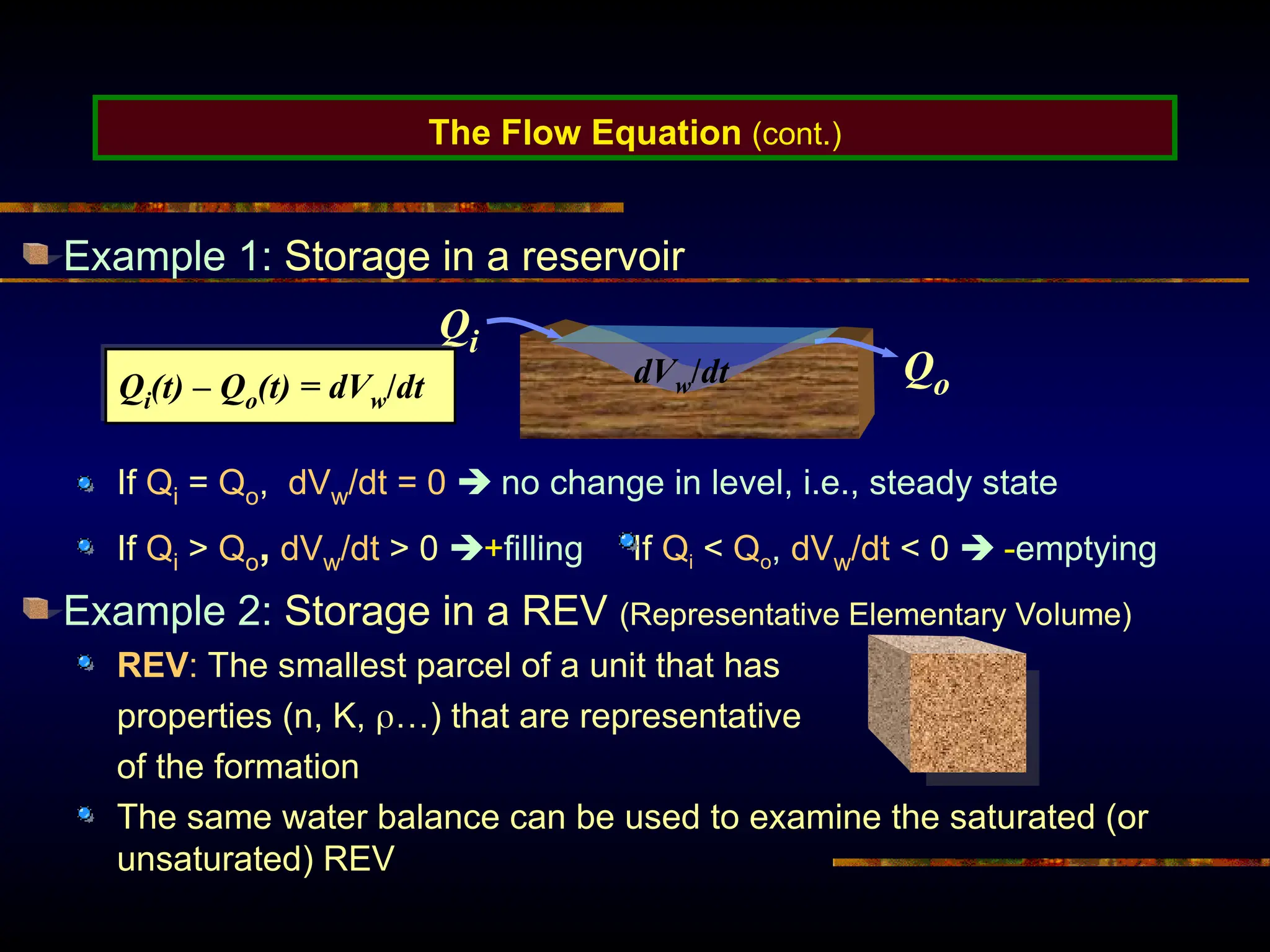
Qi(t) – Qo(t) = dVw/dt
The Flow Equation (cont.)
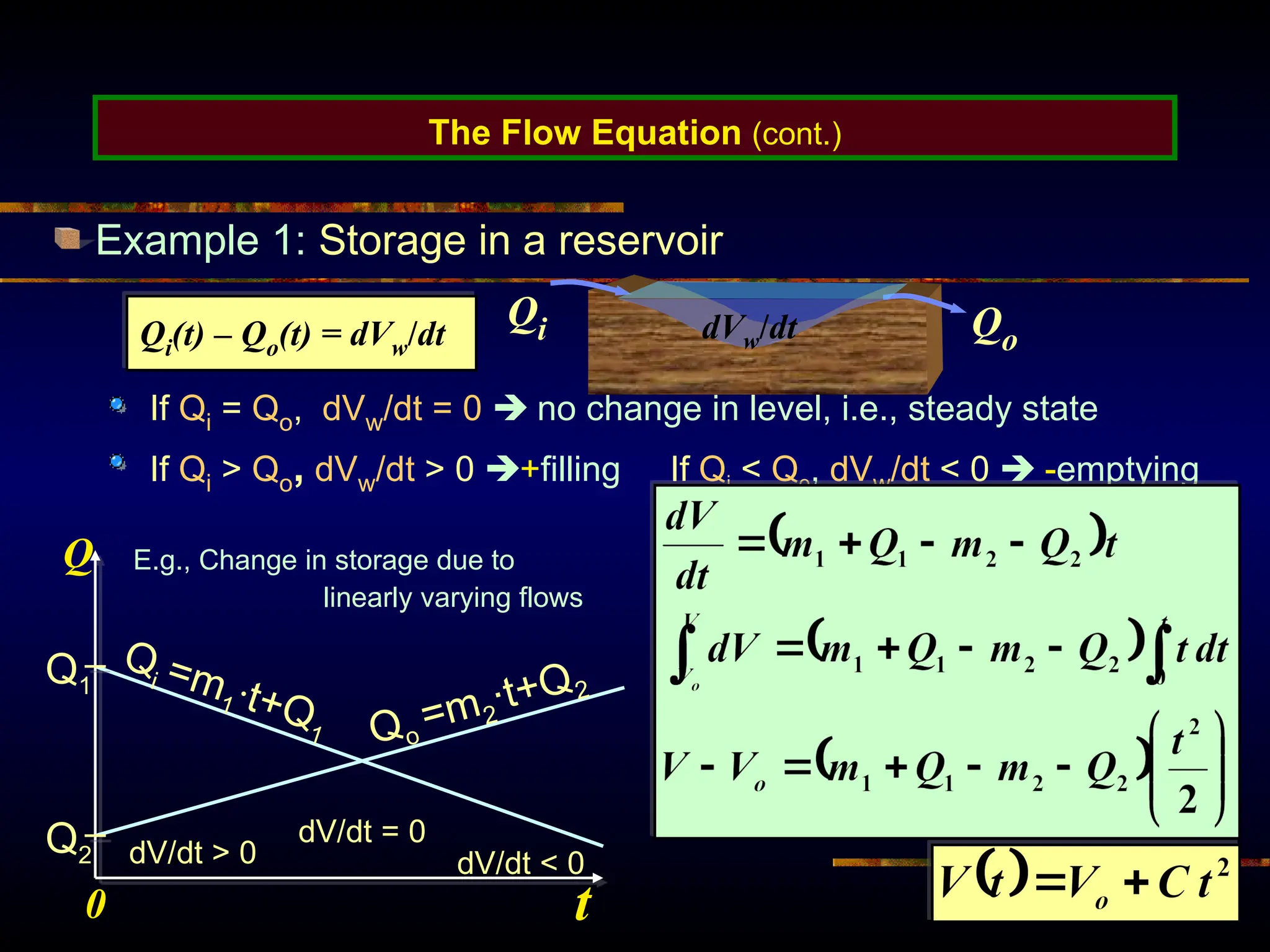
Example 1: Storage in a reservoir
If Qi = Qo, dVw/dt = 0  no change in level, i.e., steady state
If Qi > Qo, dVw/dt > 0 +filling If Qi < Qo, dVw/dt < 0  -emptying
E.g., Change in storage due to
linearly varying flows
Qi Qo
dVw/dt
Qi(t) – Qo(t) = dVw/dt
Q1
Q2
Qi =m
1·t+Q1 Qo
=m2
·t+Q2
t
Q
0
dV/dt = 0
dV/dt < 0
dV/dt > 0
The Flow Equation (cont.)
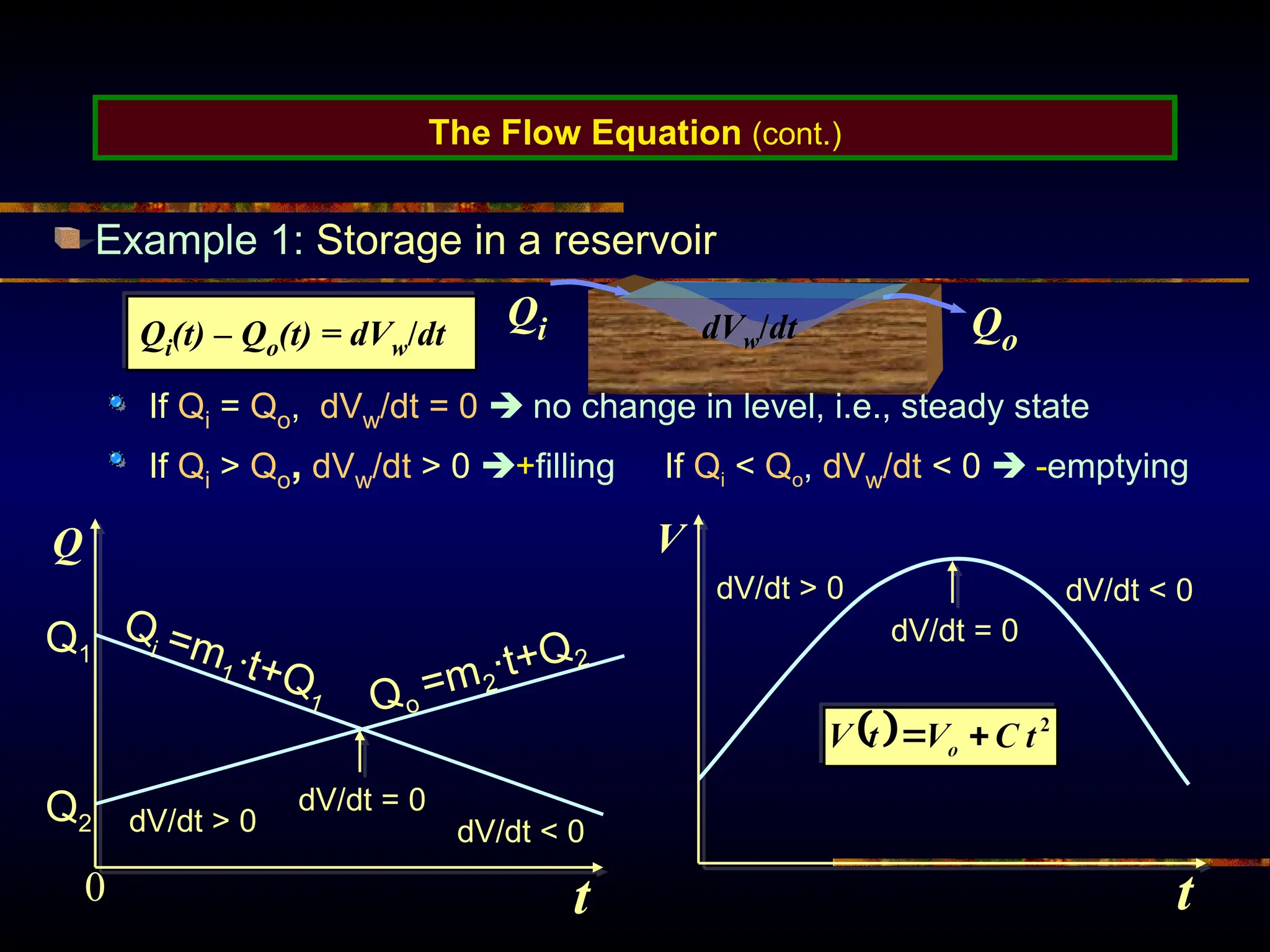
Example 1: Storage in a reservoir
If Qi = Qo, dVw/dt = 0  no change in level, i.e., steady state
If Qi > Qo, dVw/dt > 0 +filling If Qi < Qo, dVw/dt < 0  -emptying
Qi Qo
dVw/dt
Qi(t) – Qo(t) = dVw/dt
Q1
Q2
Qi =m
1·t+Q1 Qo
=m2
·t+Q2
t
Q
0
dV/dt = 0
dV/dt < 0
dV/dt > 0
t
V
dV/dt = 0
dV/dt < 0
dV/dt > 0
The Flow Equation (cont.)
Example 1: Storage in a reservoir
If Qi = Qo, dVw/dt = 0  no change in level, i.e., steady state
If Qi > Qo, dVw/dt > 0 +filling If Qi < Qo, dVw/dt < 0  -emptying
Example 2: Storage in a REV (Representative Elementary Volume)
REV: The smallest parcel of a unit that has
properties (n, K, …) that are representative
of the formation
The same water balance can be used to examine the saturated (or
unsaturated) REV
Qi
Qo
dVw/dt
Qi(t) – Qo(t) = dVw/dt
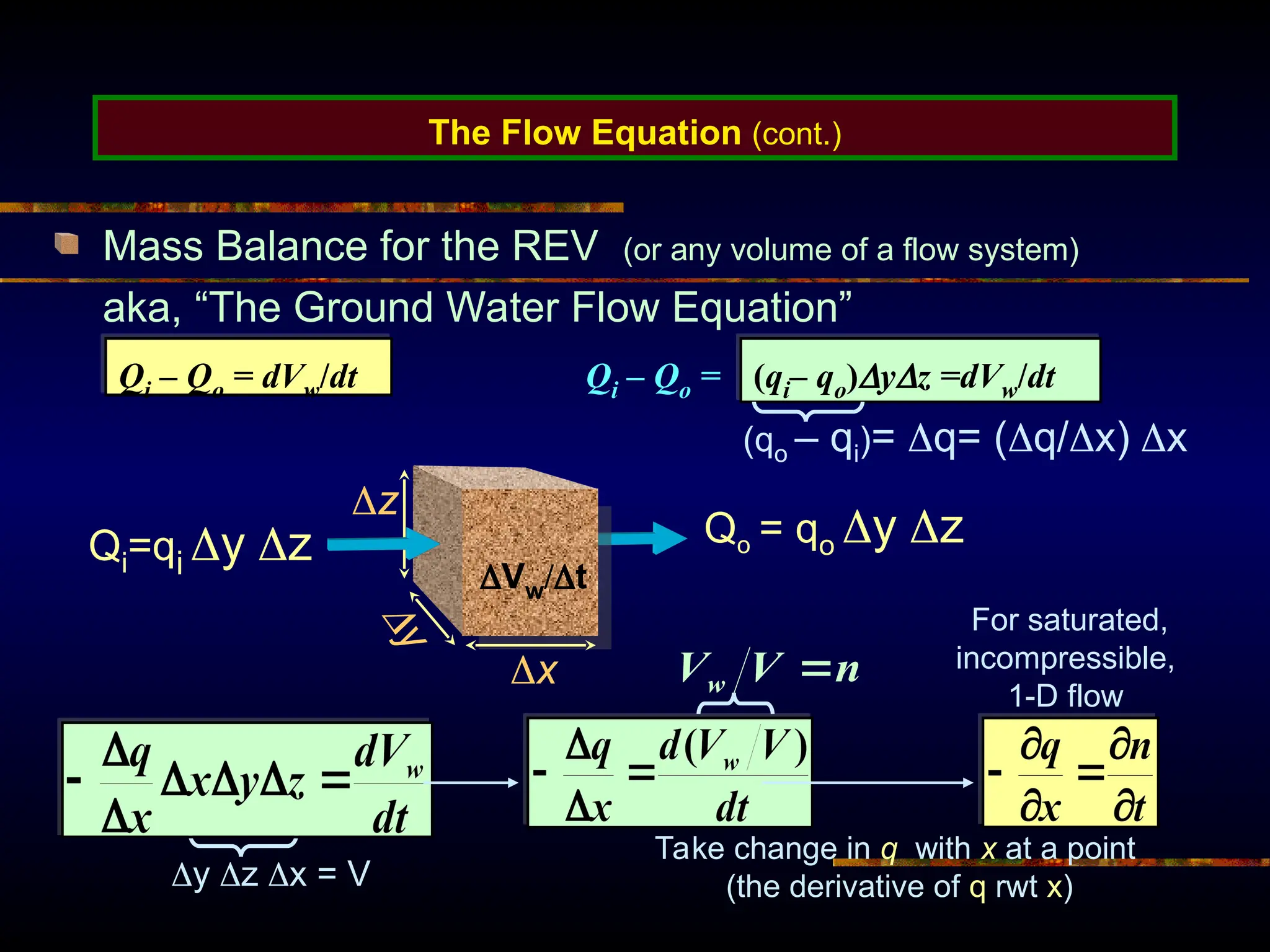
Qo = qo y z
The Flow Equation (cont.)
Mass Balance for the REV (or any volume of a flow system)
aka, “The Ground Water Flow Equation”
x

y
z
Vw/t
Qi – Qo = dVw/dt
y z x = V
(qi– qo)yz =dVw/dt
Qi – Qo =
(qo – qi)= q= (q/x) x
Take change in q with x at a point
(the derivative of q rwt x)
For saturated,
incompressible,
1-D flow
n
V
Vw 
Qi=qi y z
The Flow Equation (cont.)
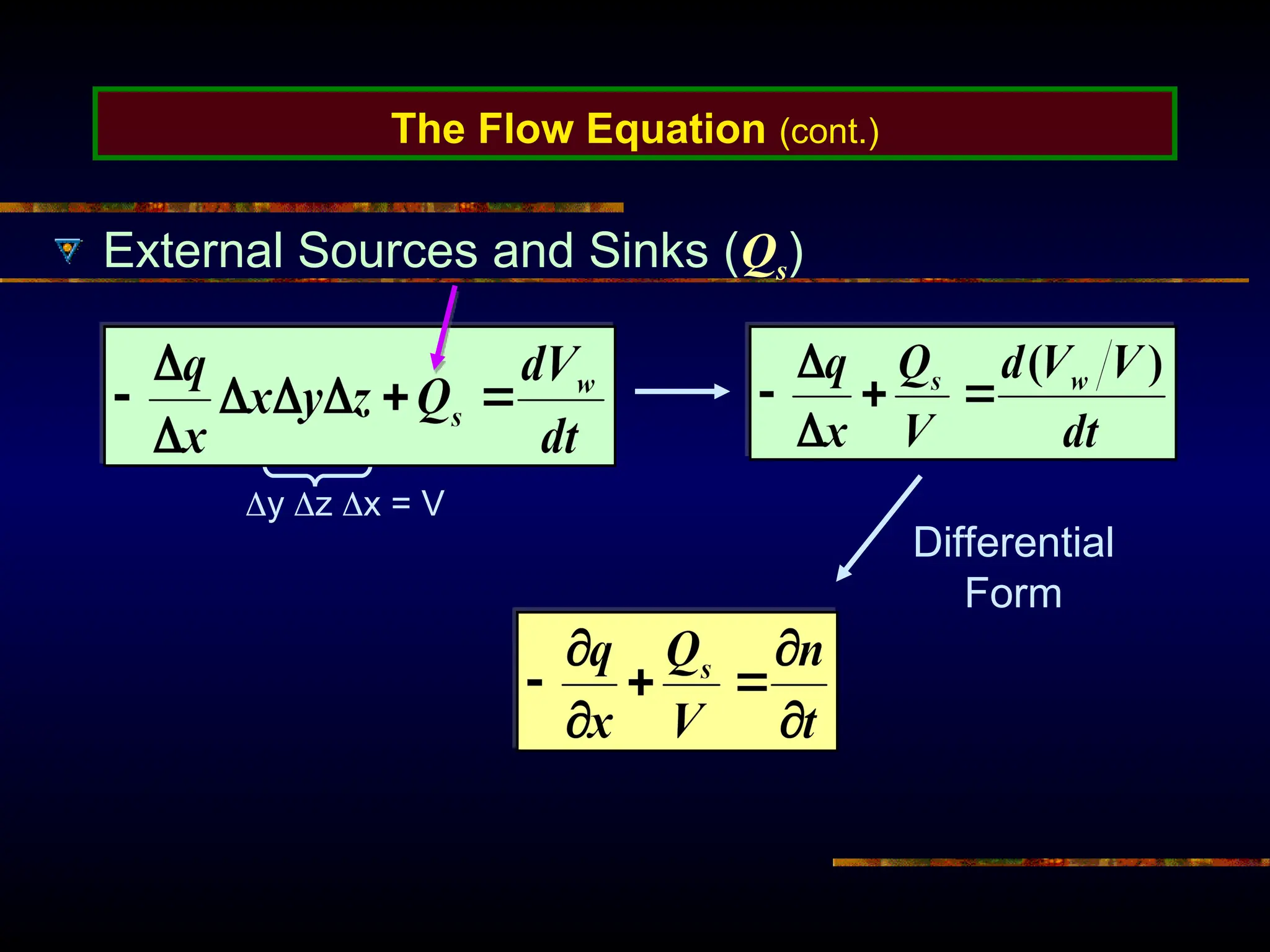
External Sources and Sinks (Qs)
y z x = V
Differential
Form
The Flow Equation (cont.)
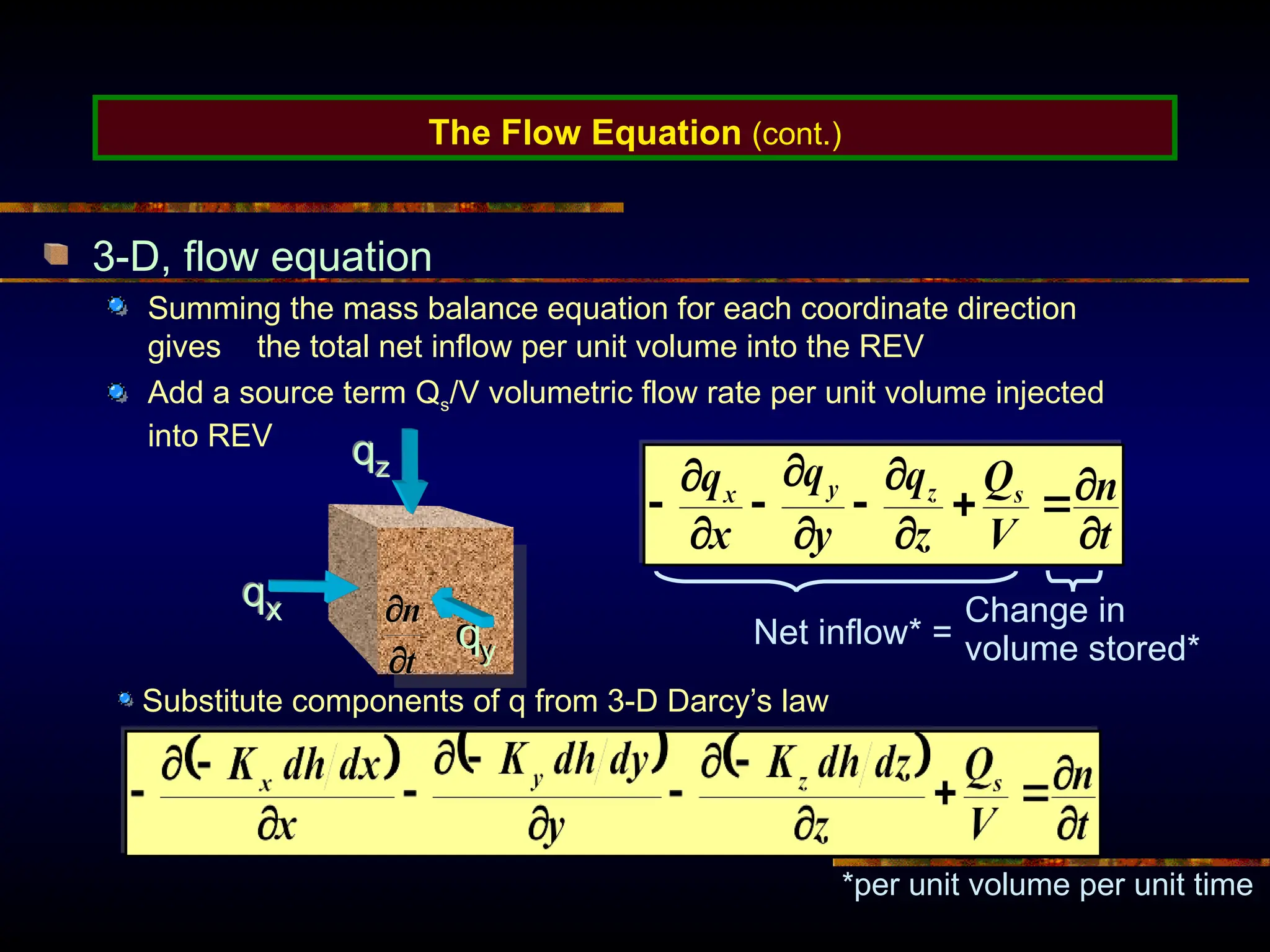
3-D, flow equation
Summing the mass balance equation for each coordinate direction
gives the total net inflow per unit volume into the REV
Add a source term Qs/V volumetric flow rate per unit volume injected
into REV
Net inflow* =
Change in
volume stored*
*per unit volume per unit time
qx
qz
qy
Substitute components of q from 3-D Darcy’s law
The Flow Equation (cont.)
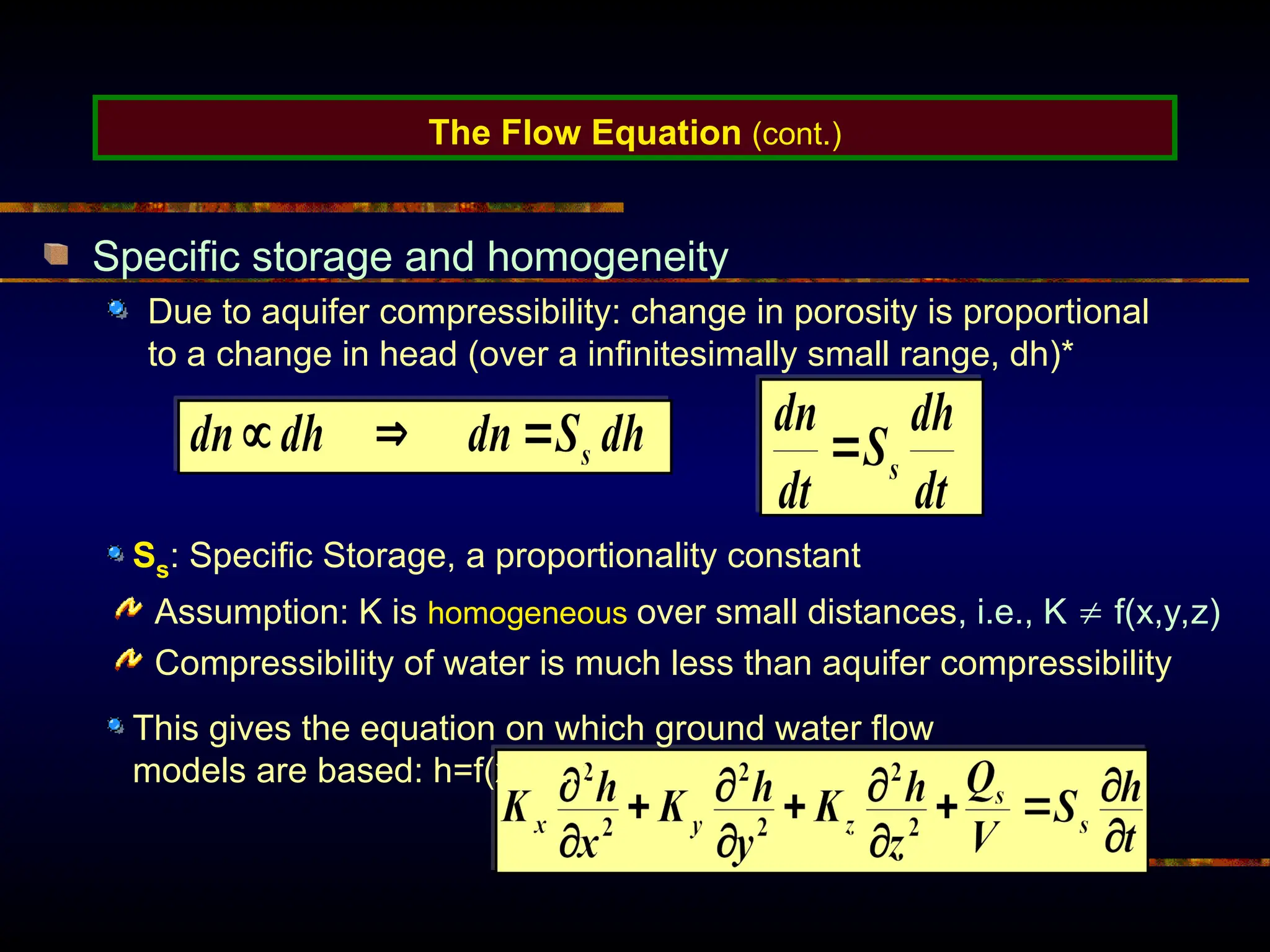
Specific storage and homogeneity
Due to aquifer compressibility: change in porosity is proportional
to a change in head (over a infinitesimally small range, dh)*
Assumption: K is homogeneous over small distances, i.e., K  f(x,y,z)
Compressibility of water is much less than aquifer compressibility
This gives the equation on which ground water flow
models are based: h=f(x,y,z,t)
Ss: Specific Storage, a proportionality constant
The Flow Equation (cont.)
Flow Equation Simplifications
0
Our job is not yet finished, h=f(x,y,z,t)?
Isotropic, 2-D, steady state flow equation
(without source term), a.k.a.: The Laplace Equation
2-D, horizontally isotropic flow equation
Kx=Ky=Kh
T=Kh b units: [L2
/T], S=Ss b
Ah: horizontal area of recharge
Ss/Kh=S/T  hydraulic diffusivity
Two dimensional flow equation
Horizontal flow (Dupuit assumption)
Thus: dh/dz = 0
Steady State Flow Equation
If inflow = out flow, Net inflow = 0
Change in storage = 0
0
0 0
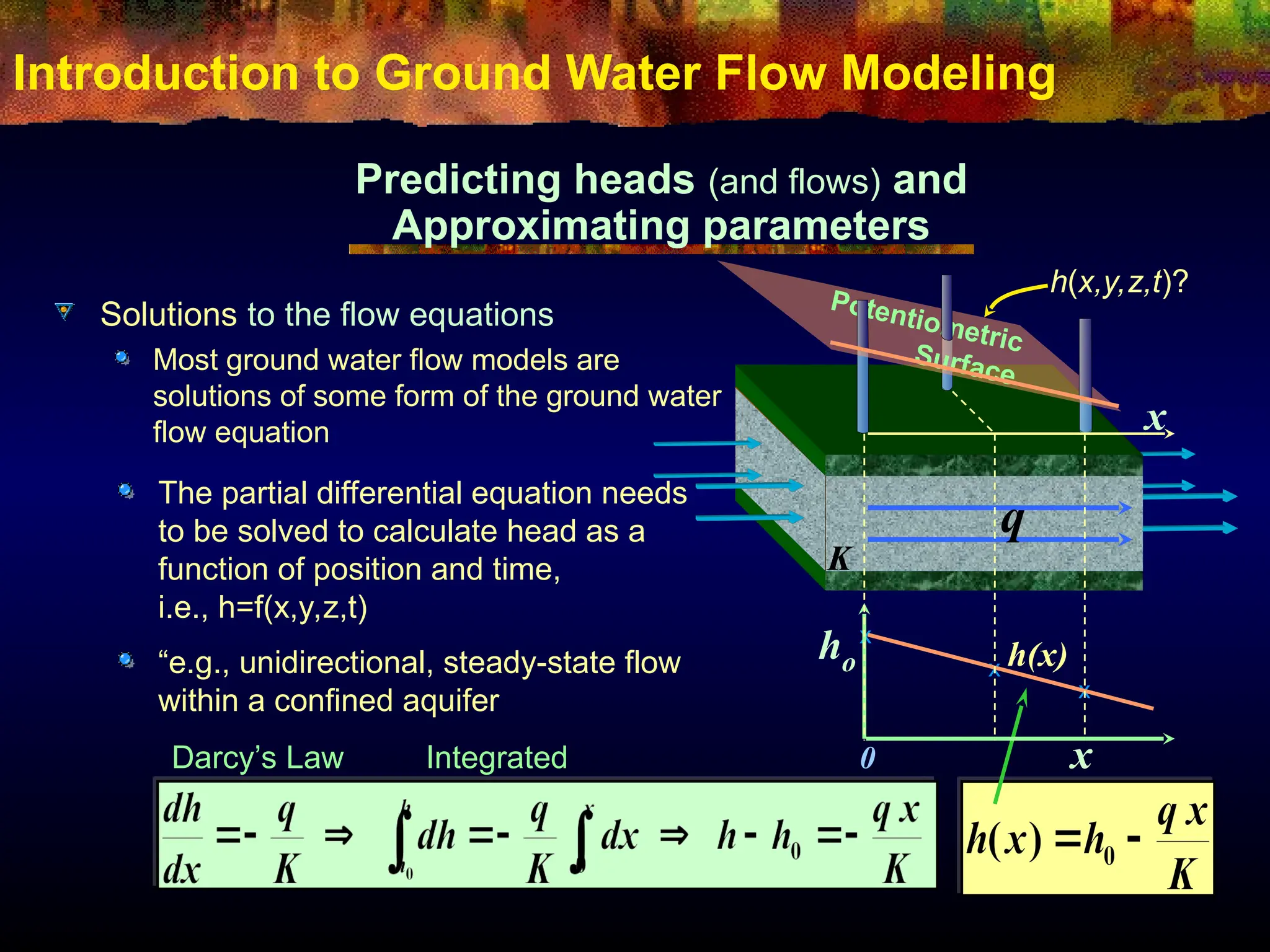
Introduction to Ground Water Flow Modeling
Predicting heads (and flows) and
Approximating parameters
Solutions to the flow equations
Most ground water flow models are
solutions of some form of the ground water
flow equation
Potentiometric
Surface
x
x
x
ho
x
0
h(x)
x
K
q
“e.g., unidirectional, steady-state flow
within a confined aquifer
The partial differential equation needs
to be solved to calculate head as a
function of position and time,
i.e., h=f(x,y,z,t)
h(x,y,z,t)?
Darcy’s Law Integrated
Flow Modeling (cont.)
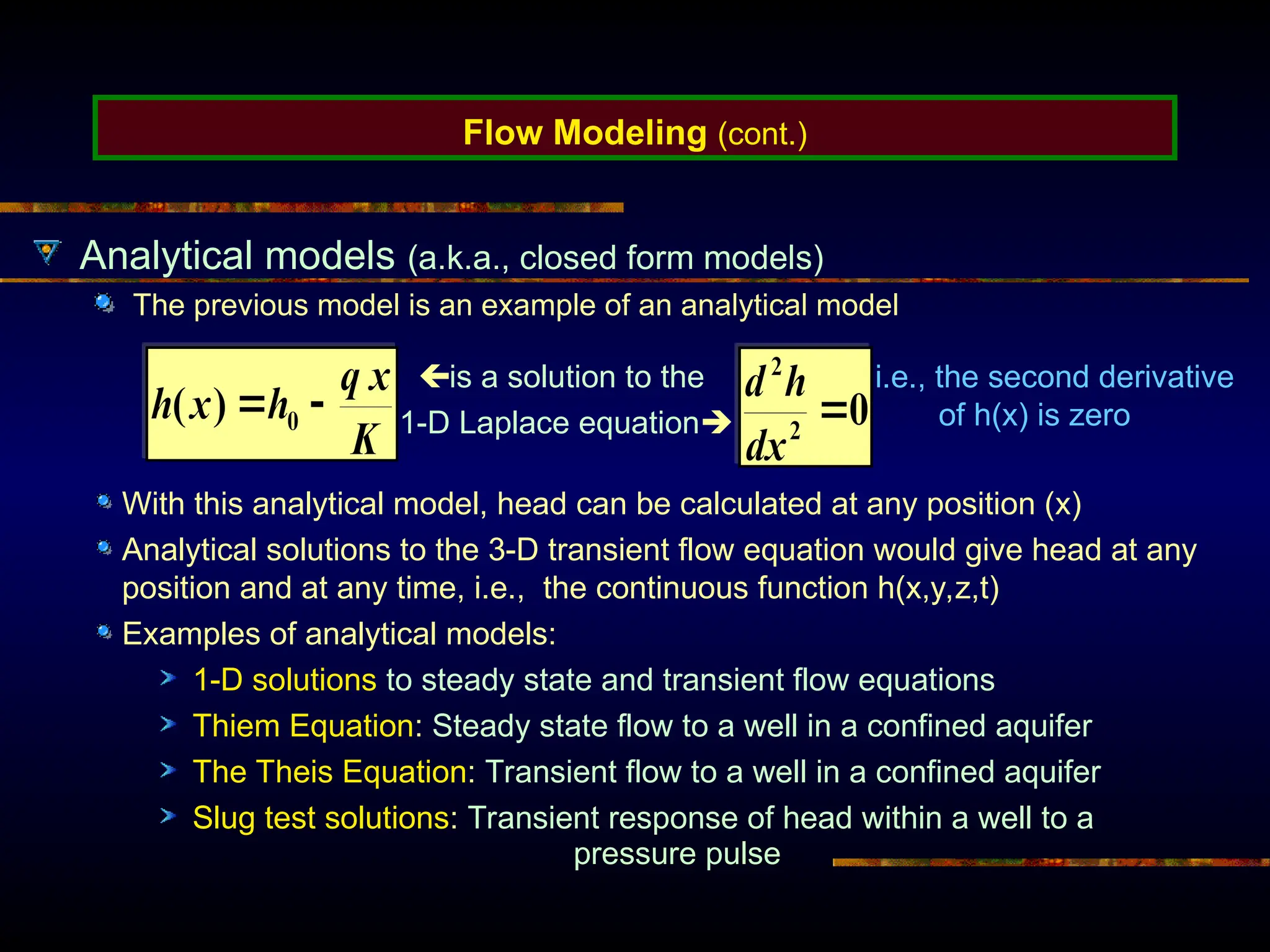
Analytical models (a.k.a., closed form models)
The previous model is an example of an analytical model
is a solution to the
1-D Laplace equation
i.e., the second derivative
of h(x) is zero
With this analytical model, head can be calculated at any position (x)
Analytical solutions to the 3-D transient flow equation would give head at any
position and at any time, i.e., the continuous function h(x,y,z,t)
Examples of analytical models:
1-D solutions to steady state and transient flow equations
Thiem Equation: Steady state flow to a well in a confined aquifer
The Theis Equation: Transient flow to a well in a confined aquifer
Slug test solutions: Transient response of head within a well to a
pressure pulse
Flow Modeling (cont.)
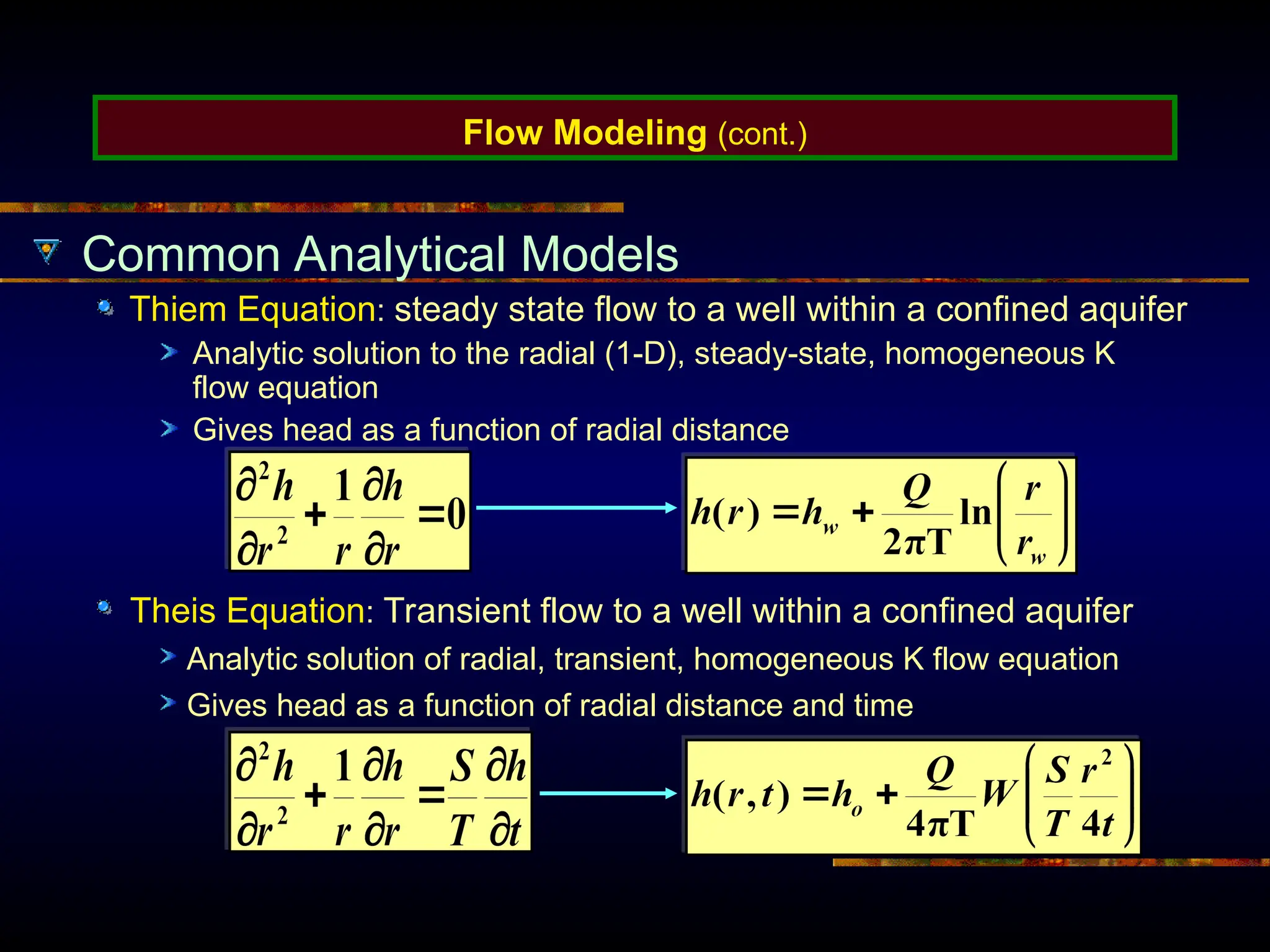
Common Analytical Models
Thiem Equation: steady state flow to a well within a confined aquifer
Analytic solution to the radial (1-D), steady-state, homogeneous K
flow equation
Gives head as a function of radial distance
Theis Equation: Transient flow to a well within a confined aquifer
Analytic solution of radial, transient, homogeneous K flow equation
Gives head as a function of radial distance and time
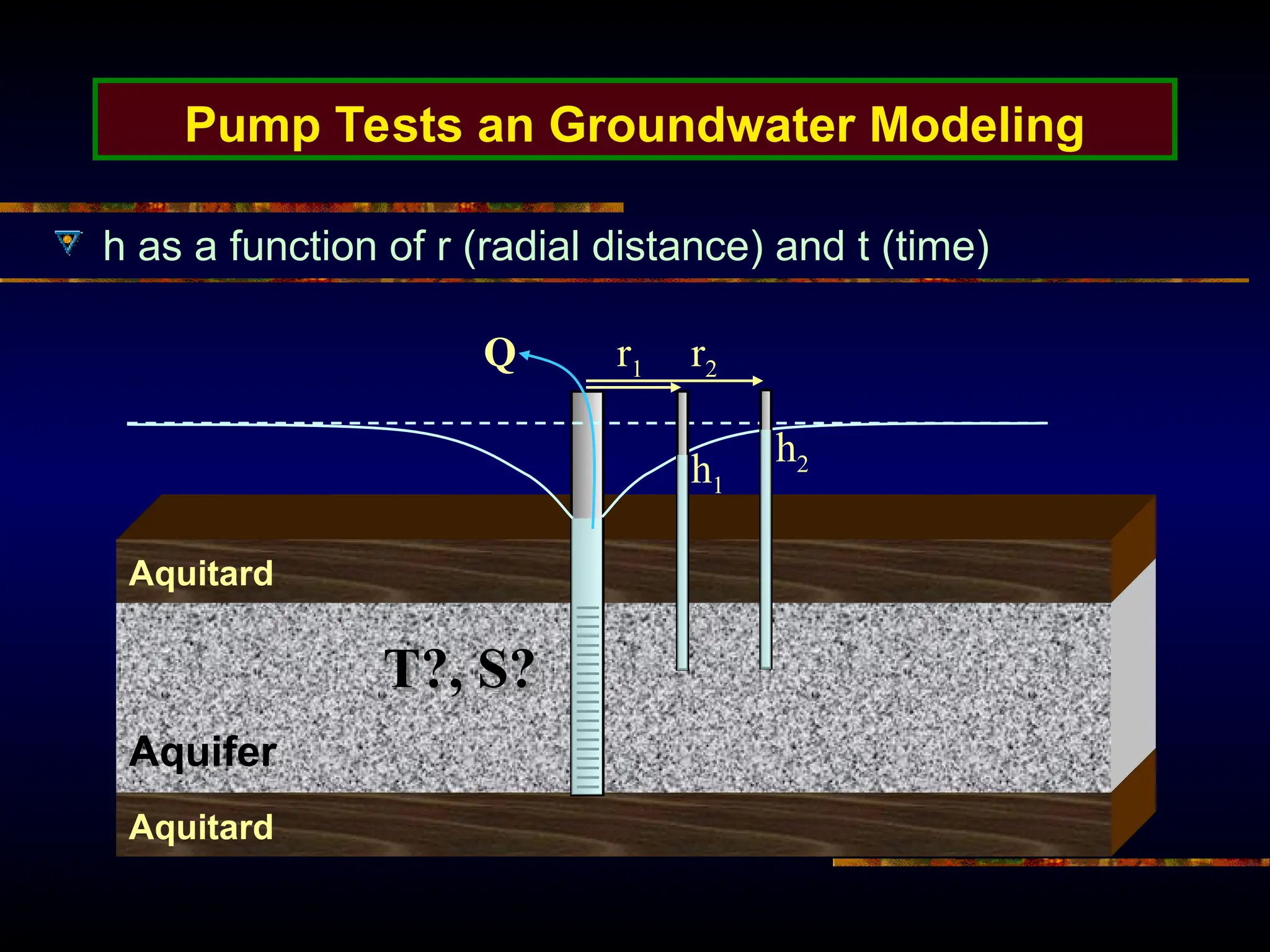
Pump Tests an Groundwater Modeling
h as a function of r (radial distance) and t (time)
Aquitard
Aquifer
Aquitard
r1 r2
h1
h2
Q
T?, S?
Flow Modeling (cont.)
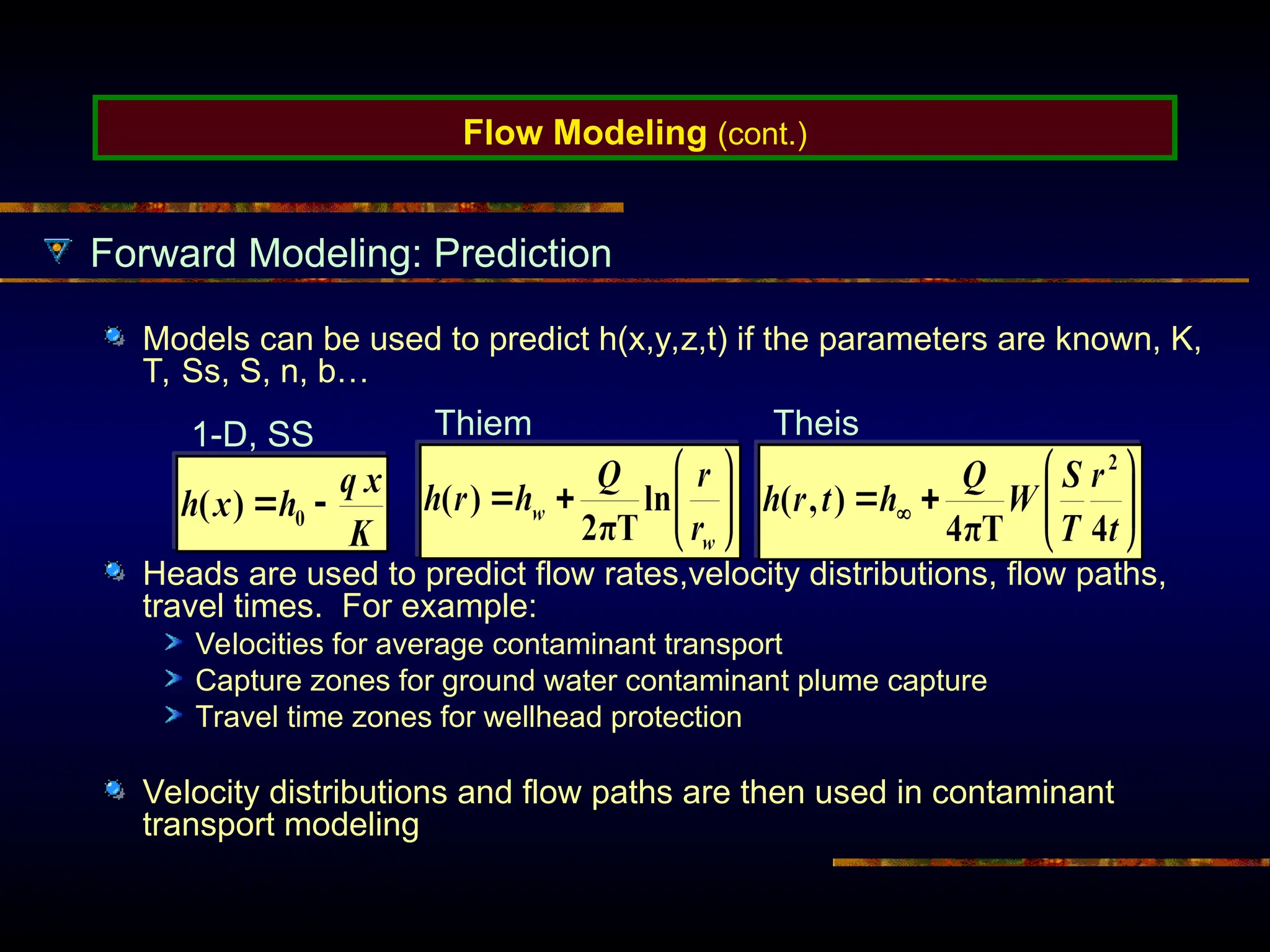
Forward Modeling: Prediction
Models can be used to predict h(x,y,z,t) if the parameters are known, K,
T, Ss, S, n, b…
Heads are used to predict flow rates,velocity distributions, flow paths,
travel times. For example:
Velocities for average contaminant transport
Capture zones for ground water contaminant plume capture
Travel time zones for wellhead protection
Velocity distributions and flow paths are then used in contaminant
transport modeling
1-D, SS Thiem Theis
Flow Modeling (cont.)
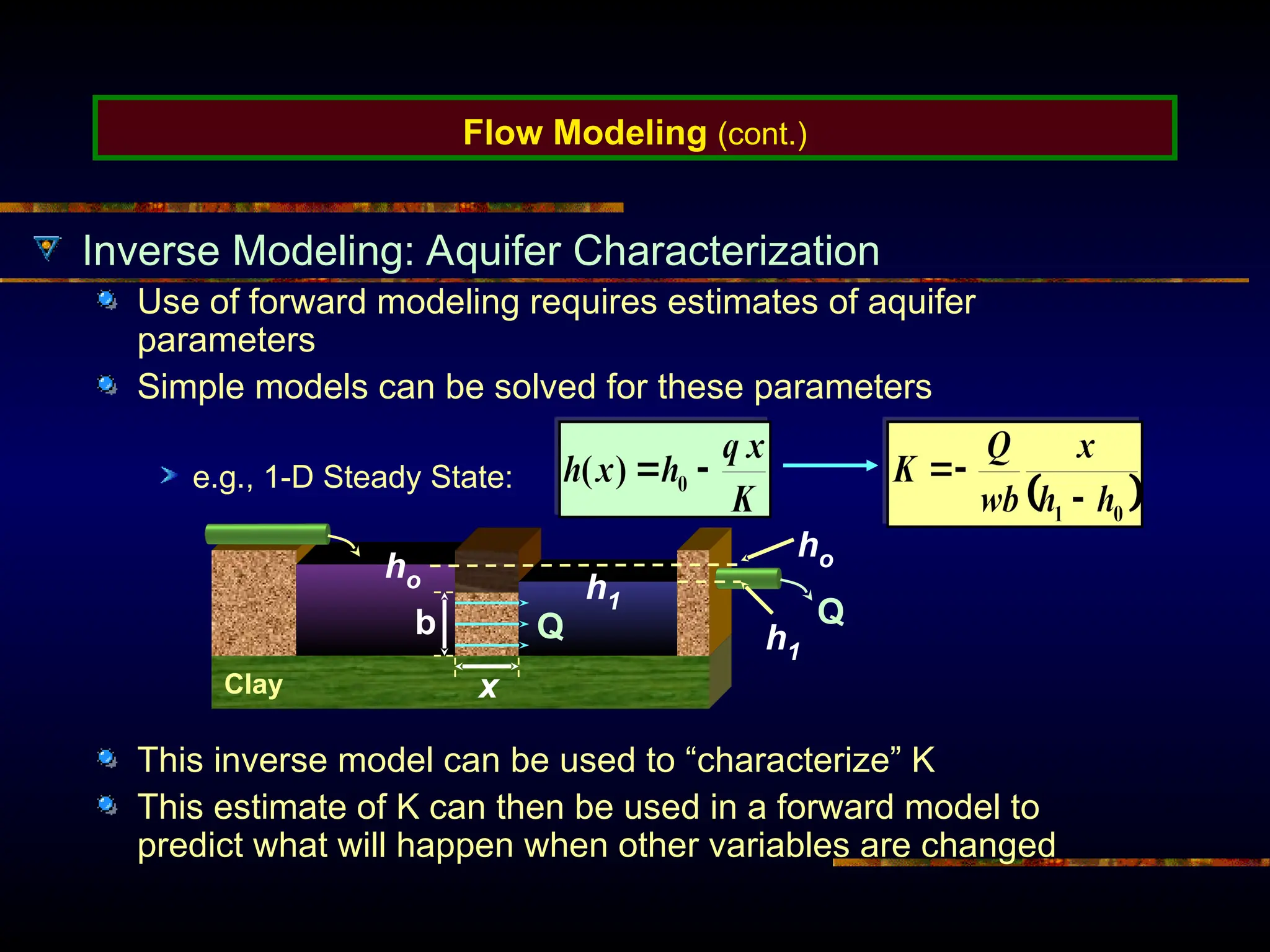
Inverse Modeling: Aquifer Characterization
Use of forward modeling requires estimates of aquifer
parameters
Simple models can be solved for these parameters
e.g., 1-D Steady State:
This inverse model can be used to “characterize” K
This estimate of K can then be used in a forward model to
predict what will happen when other variables are changed
ho
h1
Clay
b
x
ho h1
Q Q
Flow Modeling (cont.)
Inverse Modeling: Aquifer Characterization
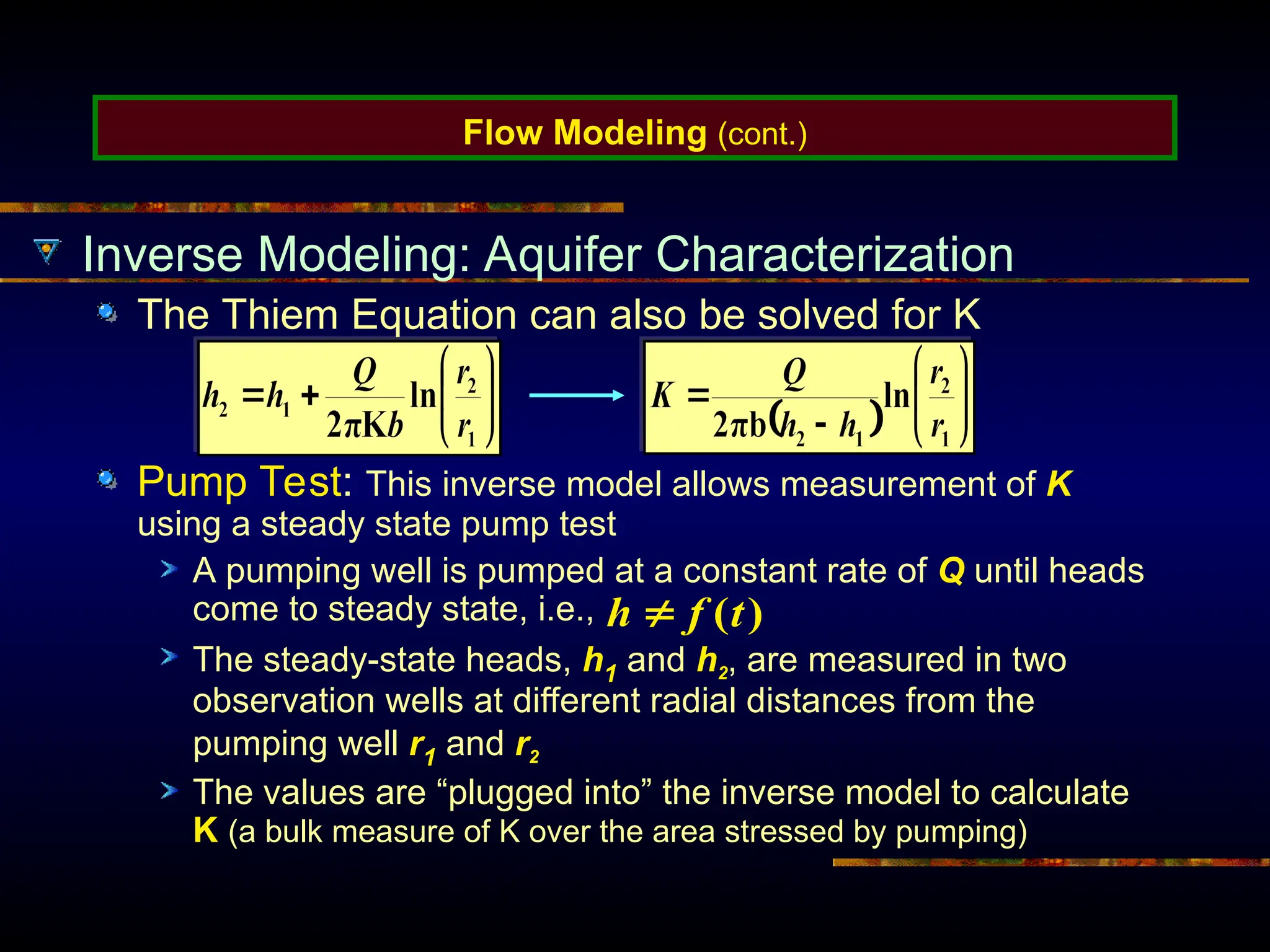
The Thiem Equation can also be solved for K
Pump Test: This inverse model allows measurement of K
using a steady state pump test
A pumping well is pumped at a constant rate of Q until heads
come to steady state, i.e.,
The steady-state heads, h1 and h2, are measured in two
observation wells at different radial distances from the
pumping well r1 and r2
The values are “plugged into” the inverse model to calculate
K (a bulk measure of K over the area stressed by pumping)
)
(t
f
h 
Flow Modeling (cont.)
Inverse Modeling: Aquifer Characterization
Indirect solution of flow models
More complex analytical flow models cannot be solved for the
parameters
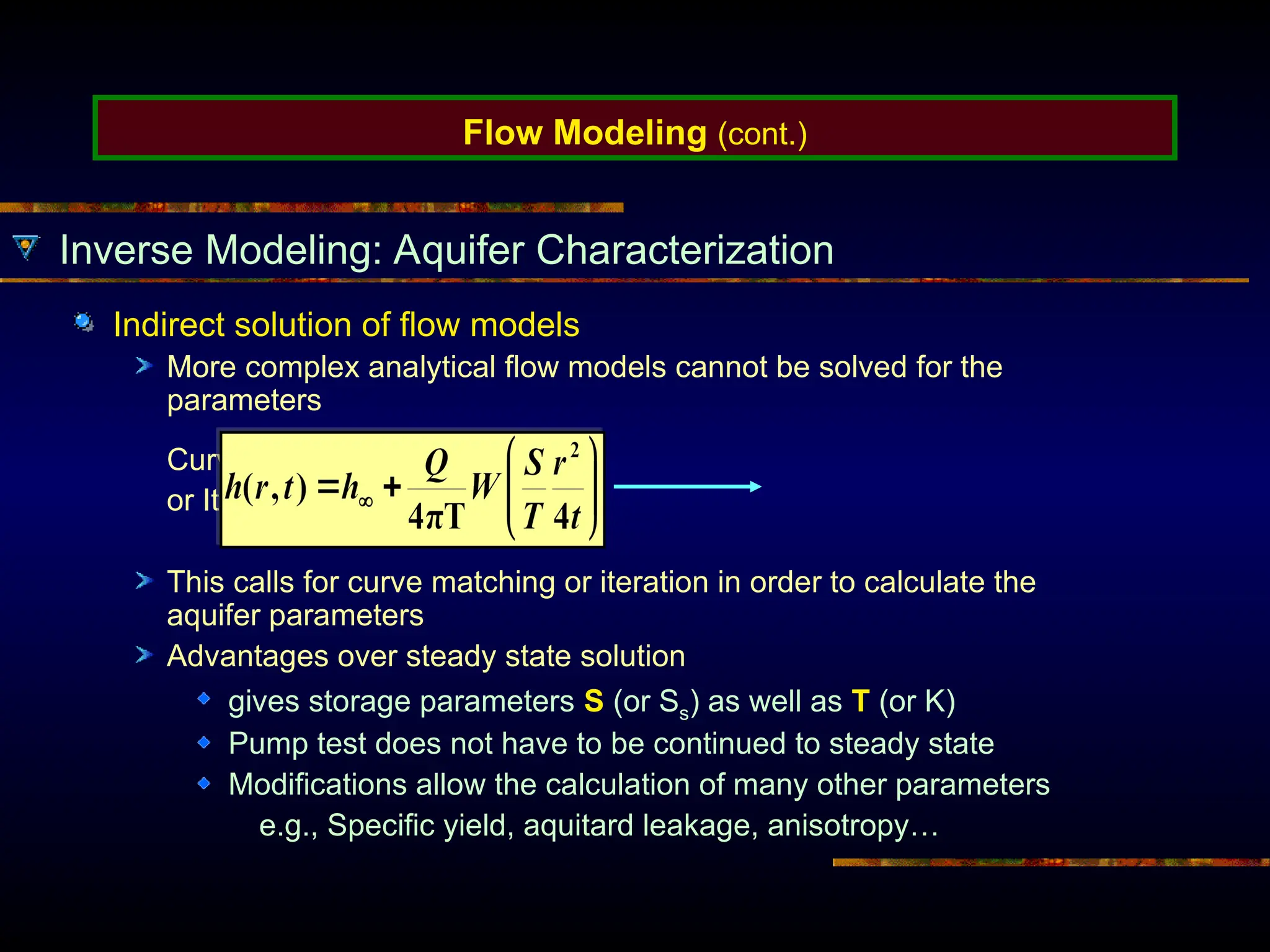
Curve Matching
or Iteration
This calls for curve matching or iteration in order to calculate the
aquifer parameters
Advantages over steady state solution
gives storage parameters S (or Ss) as well as T (or K)
Pump test does not have to be continued to steady state
Modifications allow the calculation of many other parameters
e.g., Specific yield, aquitard leakage, anisotropy…
Flow Modeling (cont.)
Limitations of Analytical Models
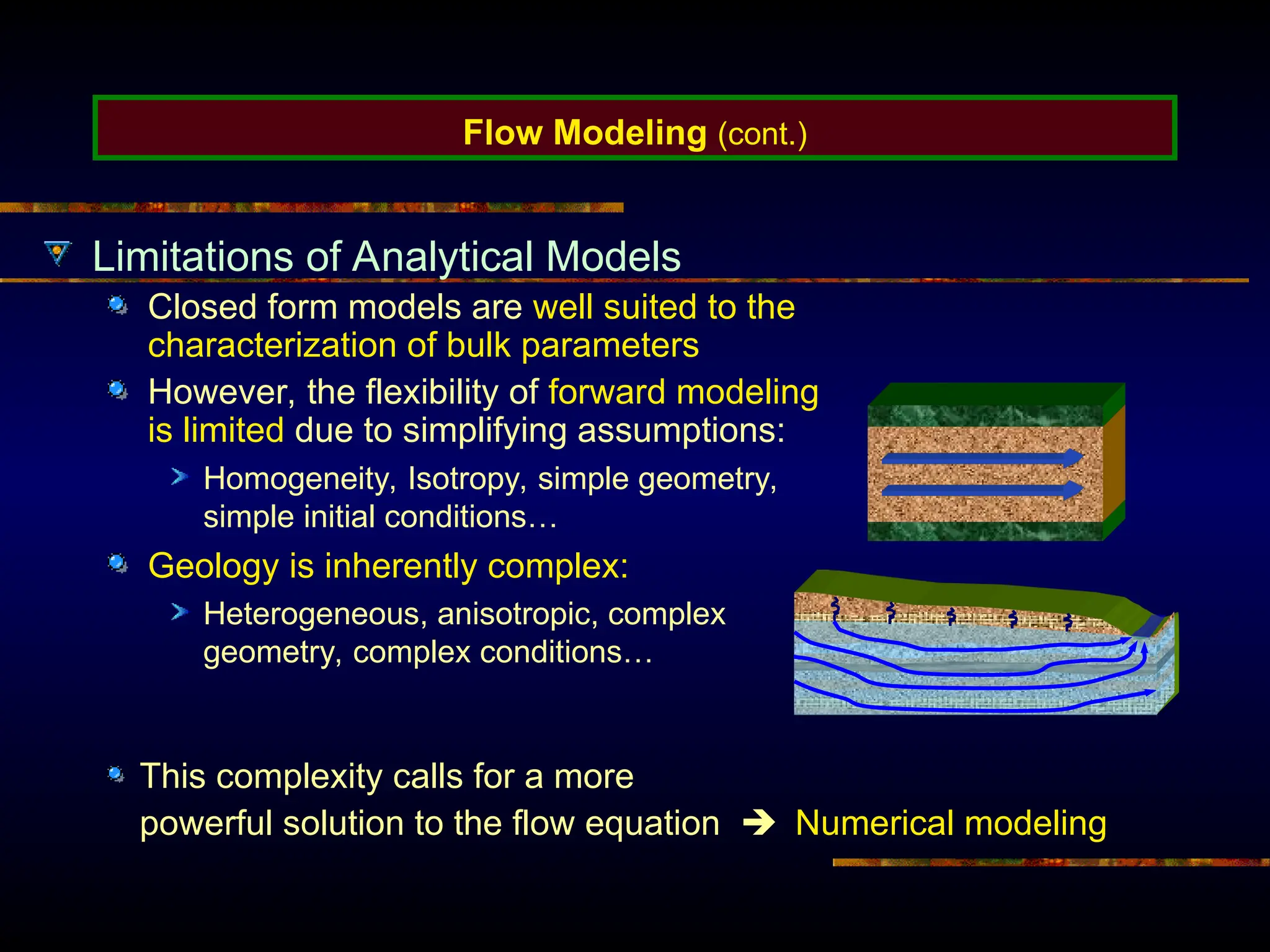
Closed form models are well suited to the
characterization of bulk parameters
However, the flexibility of forward modeling
is limited due to simplifying assumptions:
Homogeneity, Isotropy, simple geometry,
simple initial conditions…
Geology is inherently complex:
Heterogeneous, anisotropic, complex
geometry, complex conditions…
This complexity calls for a more
powerful solution to the flow equation  Numerical modeling
Numerical Modeling in a Nutshell
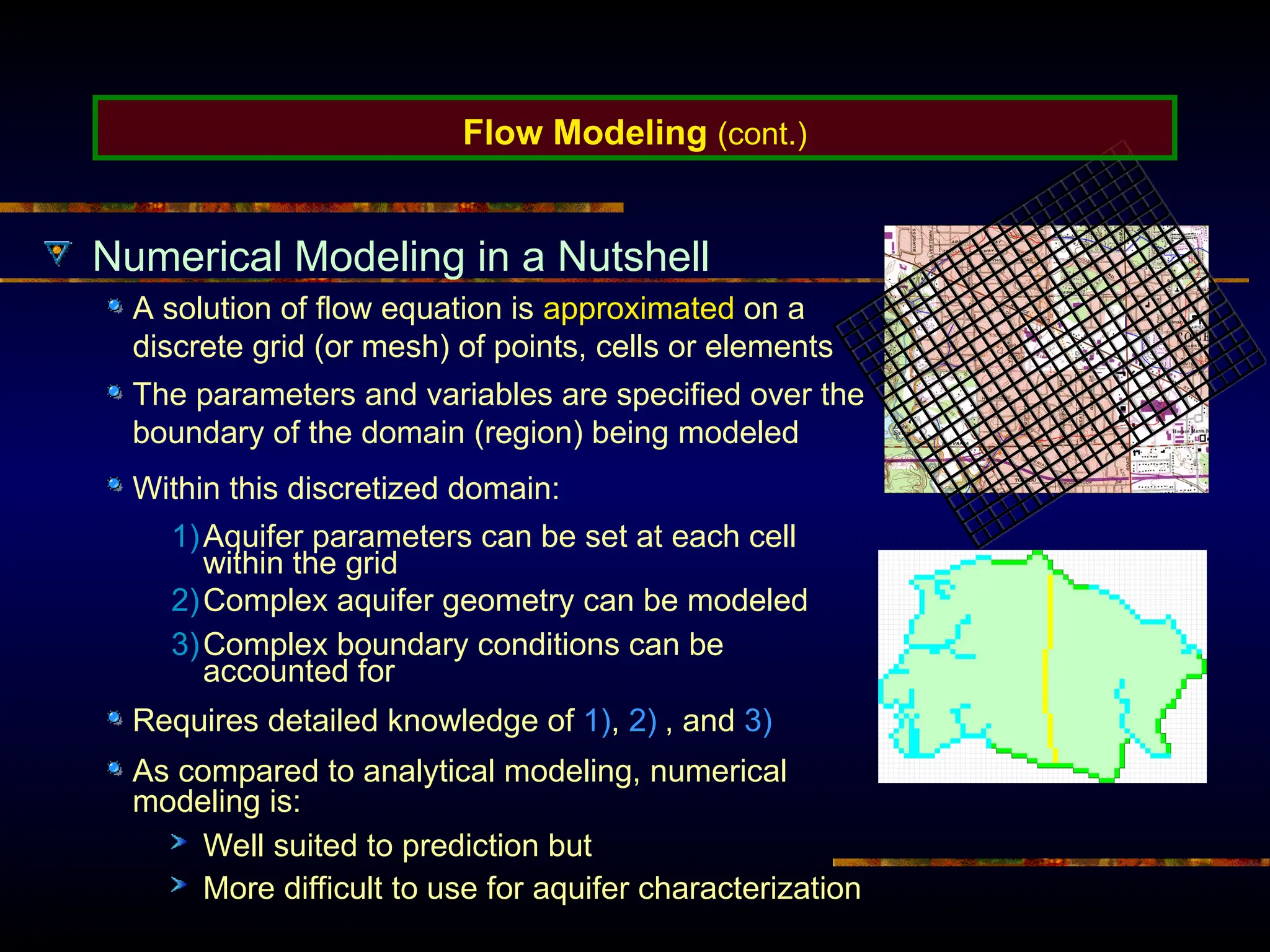
A solution of flow equation is approximated on a
discrete grid (or mesh) of points, cells or elements
Within this discretized domain:
1)Aquifer parameters can be set at each cell
within the grid
2)Complex aquifer geometry can be modeled
3)Complex boundary conditions can be
accounted for
Requires detailed knowledge of 1), 2) , and 3)
As compared to analytical modeling, numerical
modeling is:
Well suited to prediction but
More difficult to use for aquifer characterization
Flow Modeling (cont.)
The parameters and variables are specified over the
boundary of the domain (region) being modeled
An Introduction to Finite Difference Modeling
Approximate Solutions to the
Flow Equation
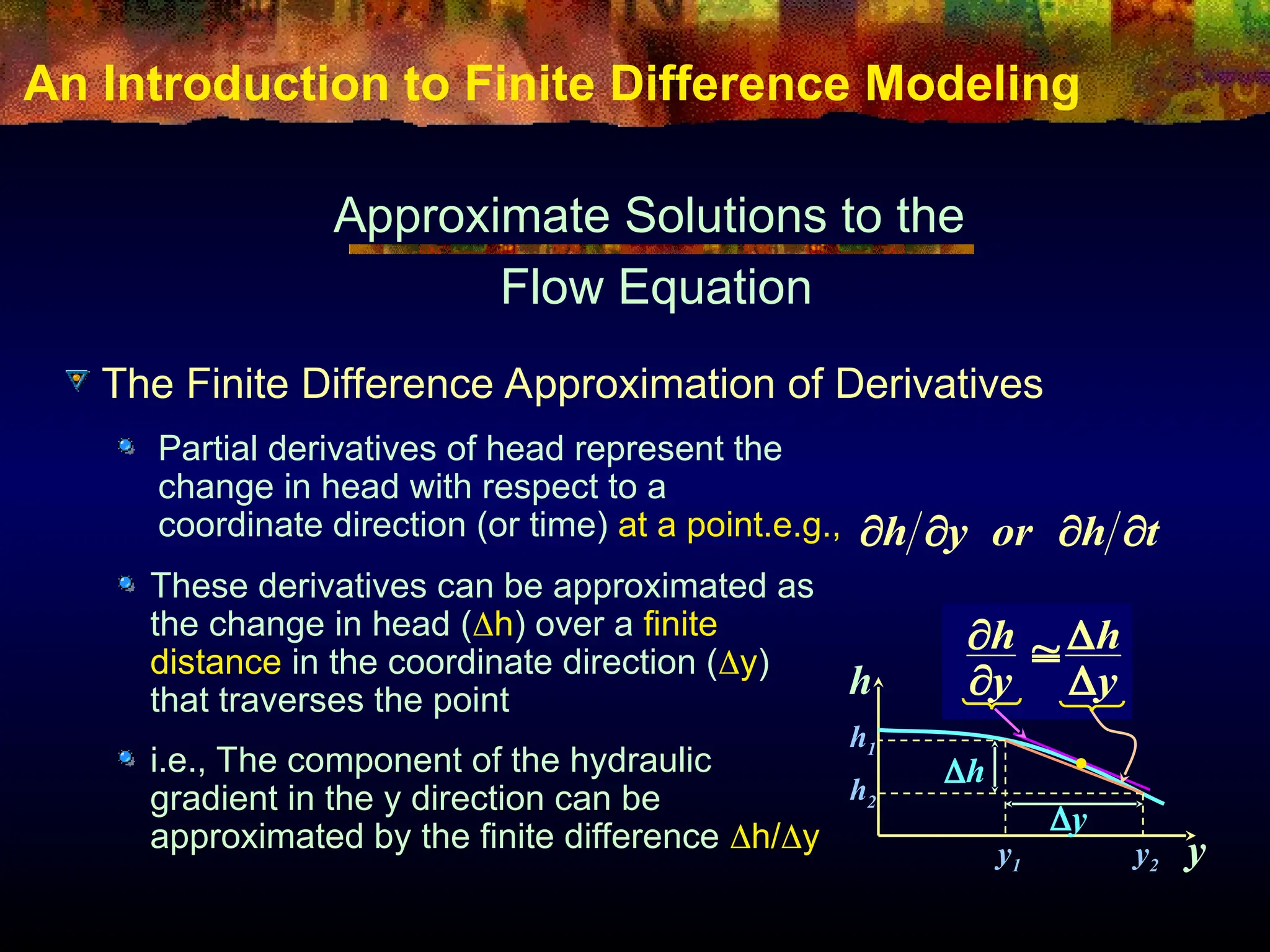
Partial derivatives of head represent the
change in head with respect to a
coordinate direction (or time) at a point.e.g., t
h
or
y
h 



h
y
h
y
h1
h2
y1 y2
y
h
y
h





These derivatives can be approximated as
the change in head (h) over a finite
distance in the coordinate direction (y)
that traverses the point
i.e., The component of the hydraulic
gradient in the y direction can be
approximated by the finite difference h/y
The Finite Difference Approximation of Derivatives
Finite Difference Modeling (cont.)
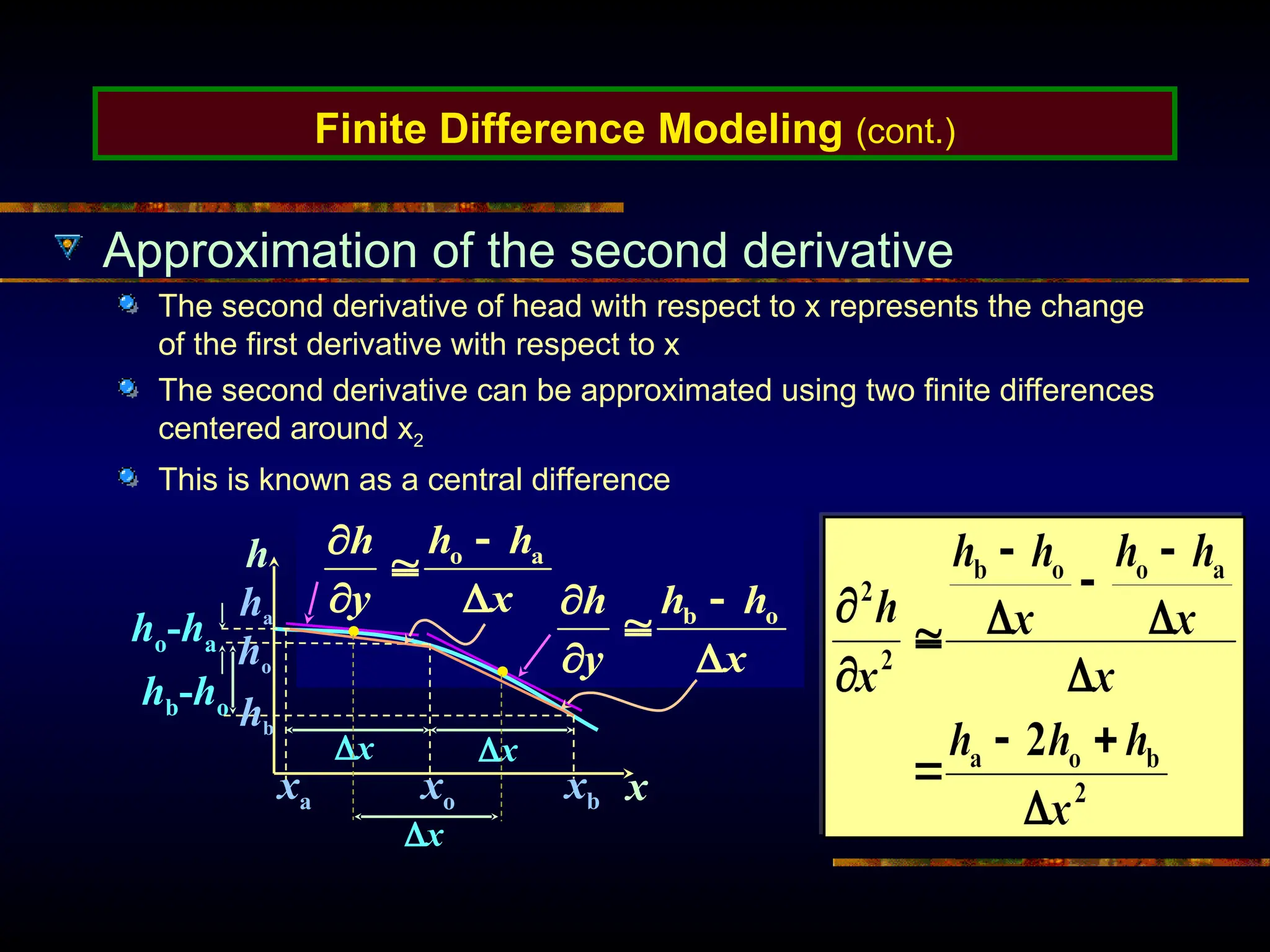
Approximation of the second derivative
The second derivative of head with respect to x represents the change
of the first derivative with respect to x
The second derivative can be approximated using two finite differences
centered around x2
This is known as a central difference
h
x
x
ha
ho
xo xb
xa
x
hb
ho-ha
hb-ho
x
x
h
h
y
h




 a
o
x
h
h
y
h




 o
b
Finite Difference Modeling (cont.)
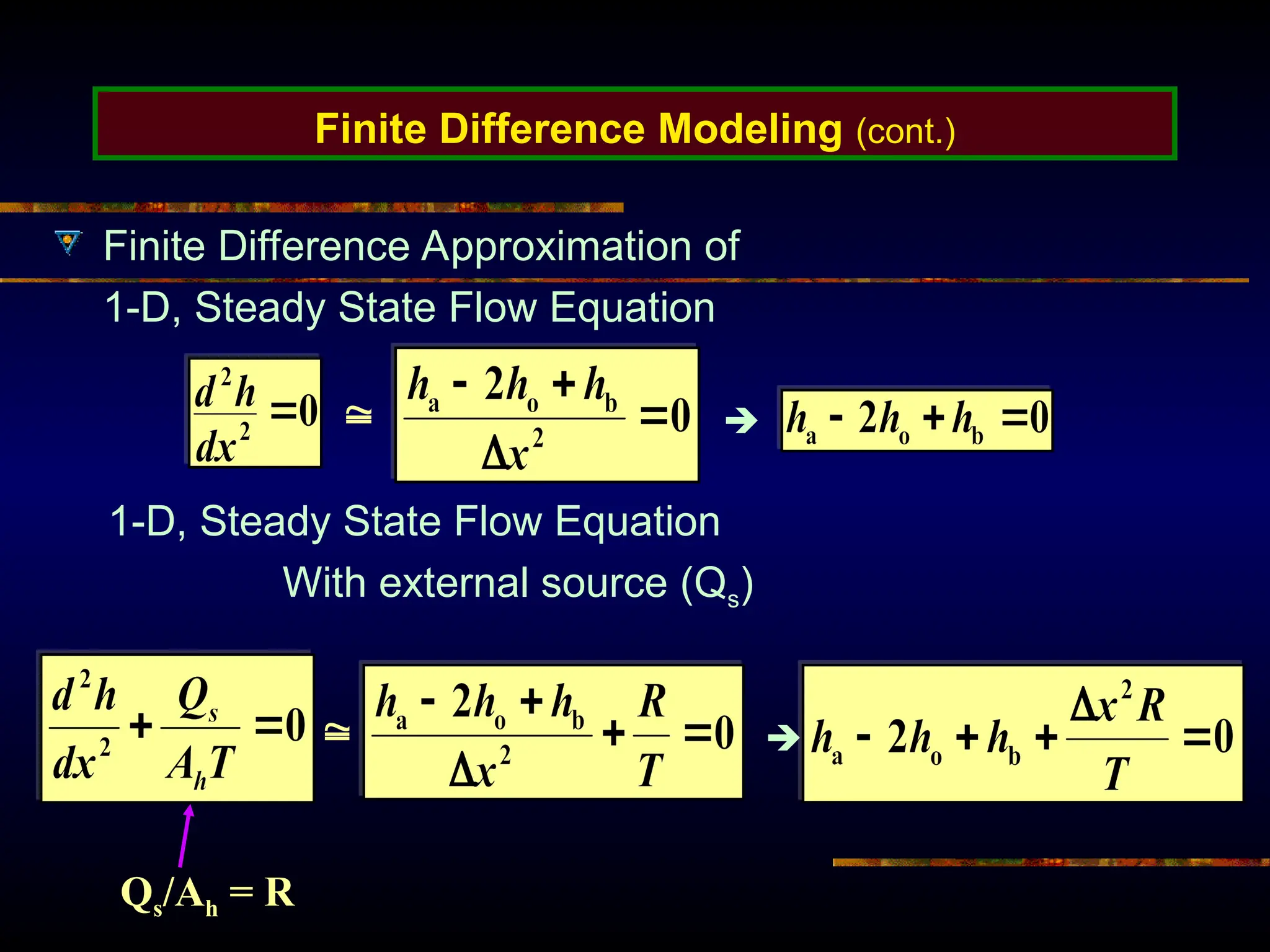
Finite Difference Approximation of
1-D, Steady State Flow Equation
 
1-D, Steady State Flow Equation
With external source (Qs)
 
Qs/Ah = R
Finite Difference Modeling (cont.)
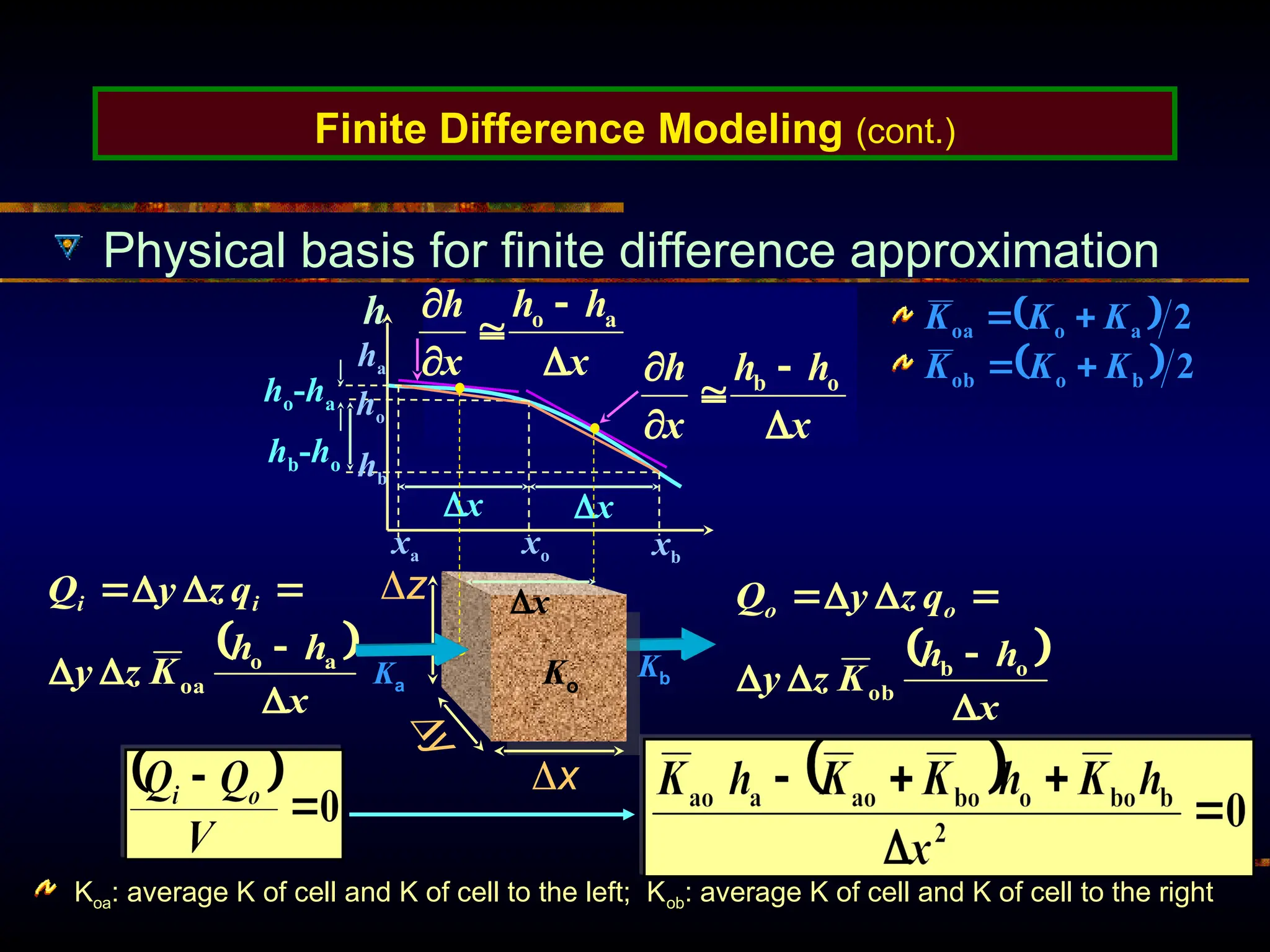
Physical basis for finite difference approximation
h
x
ha
ho
xo xb
xa
x
hb
ho-ha
hb-ho
x
x
h
h
x
h




 a
o
x
h
h
x
h




 o
b
 
x
h
h
K
z
y
q
z
y
Q i
i








a
o
oa
 
x
h
h
K
z
y
q
z
y
Q o
o








o
b
ob
Koa: average K of cell and K of cell to the left; Kob: average K of cell and K of cell to the right
 
  2
2
b
o
ob
a
o
oa
K
K
K
K
K
K





y
z
x
Ka
Kb
Ko
Finite Difference Modeling (cont.)
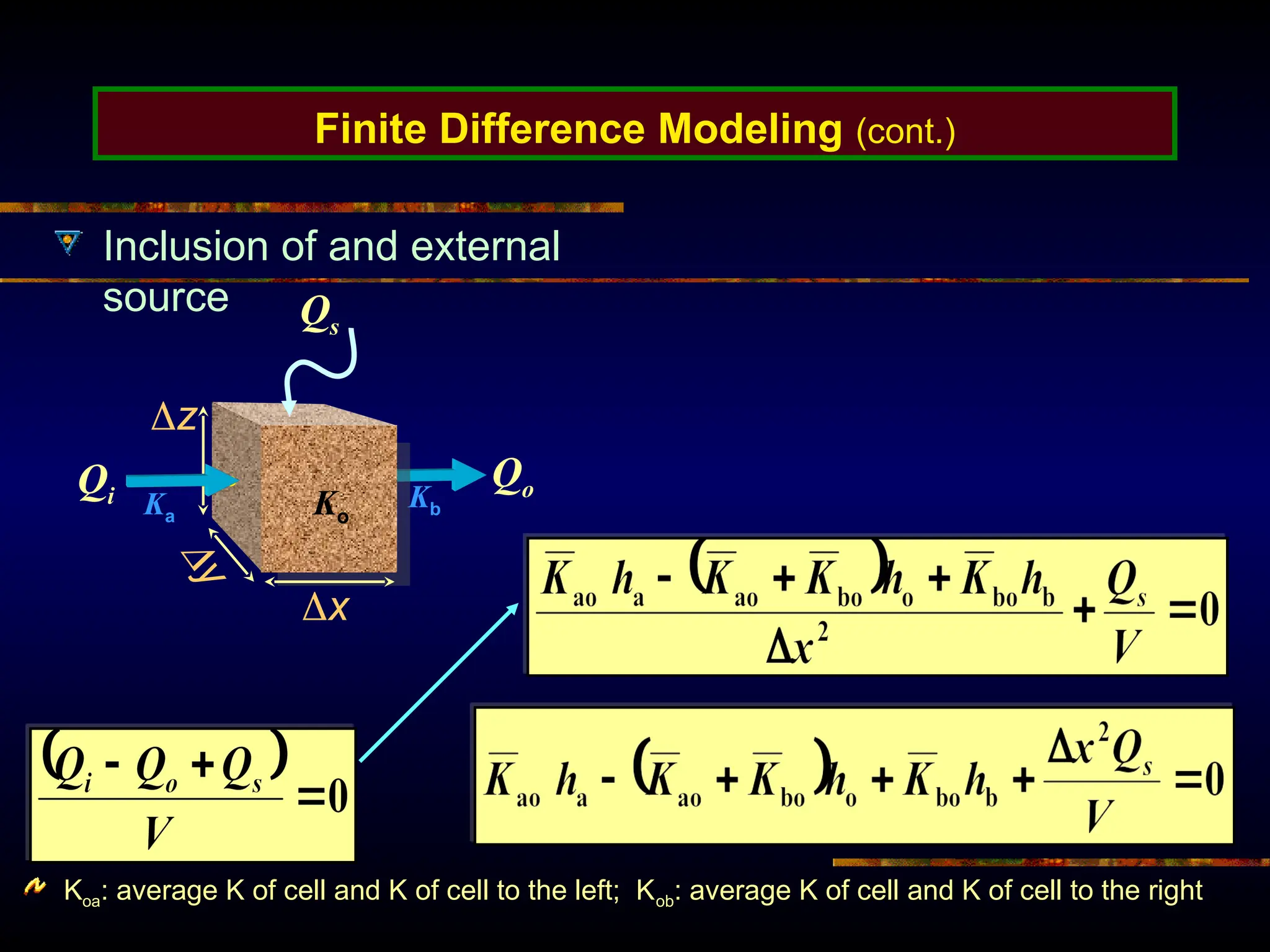
Inclusion of and external
source
Koa: average K of cell and K of cell to the left; Kob: average K of cell and K of cell to the right

y
z
x
Ka
Kb
Ko
Qs
Qi
Qo
Finite Difference Modeling (cont.)
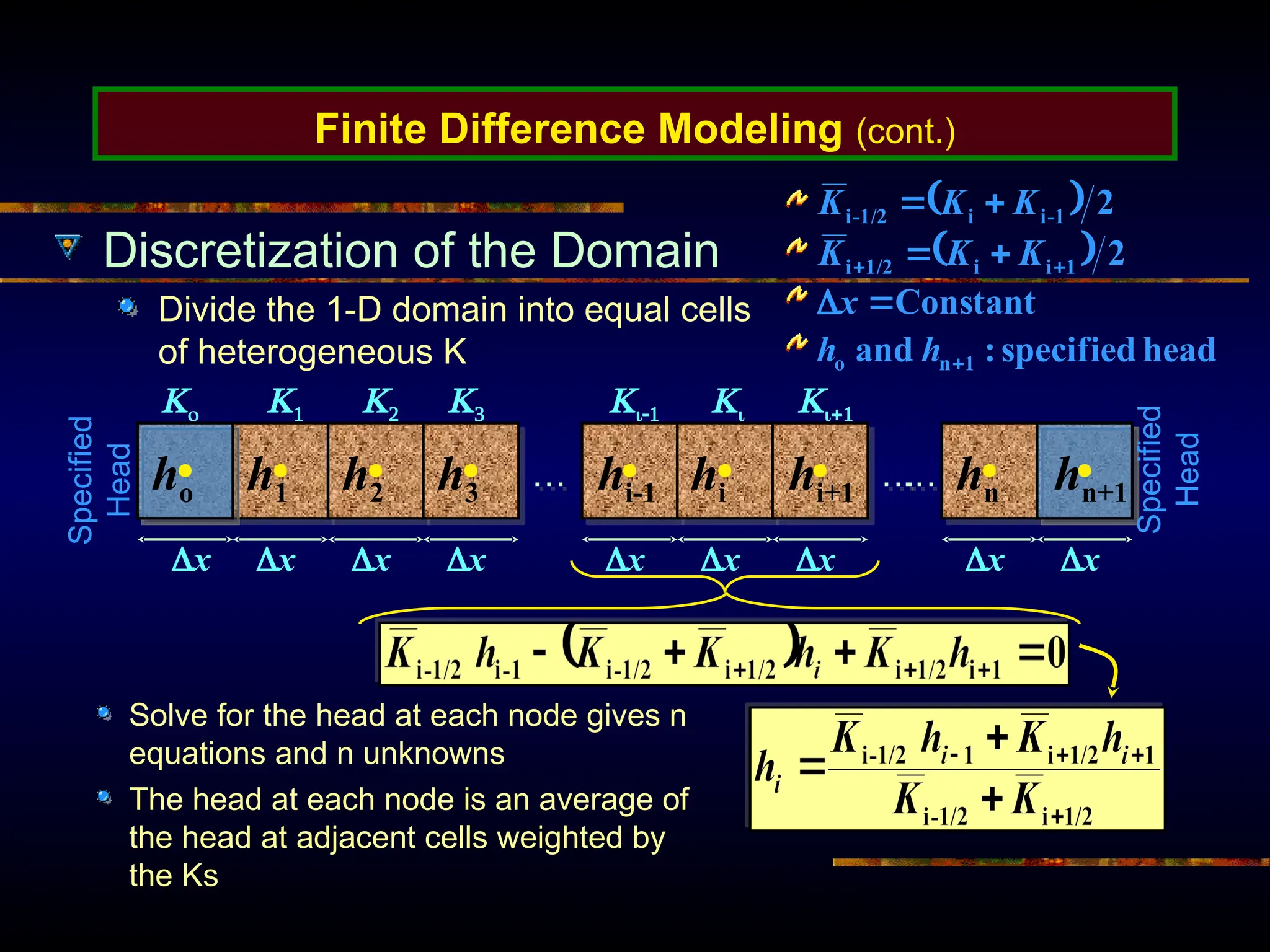
Discretization of the Domain
Divide the 1-D domain into equal cells
of heterogeneous K
… …
h1 h2 h3 hi-1 hn
x x x x x x x
 
 
head
specified
:
and
Constant
2
2
1
n
o
1
i
i
1/2
i
1
-
i
i
1/2
-
i









h
h
x
K
K
K
K
K
K
    
…
hi hi+1
x x
 
Solve for the head at each node gives n
equations and n unknowns
The head at each node is an average of
the head at adjacent cells weighted by
the Ks
ho hn+1
Specified
Head
Specified
Head
Finite Difference Modeling (cont.)
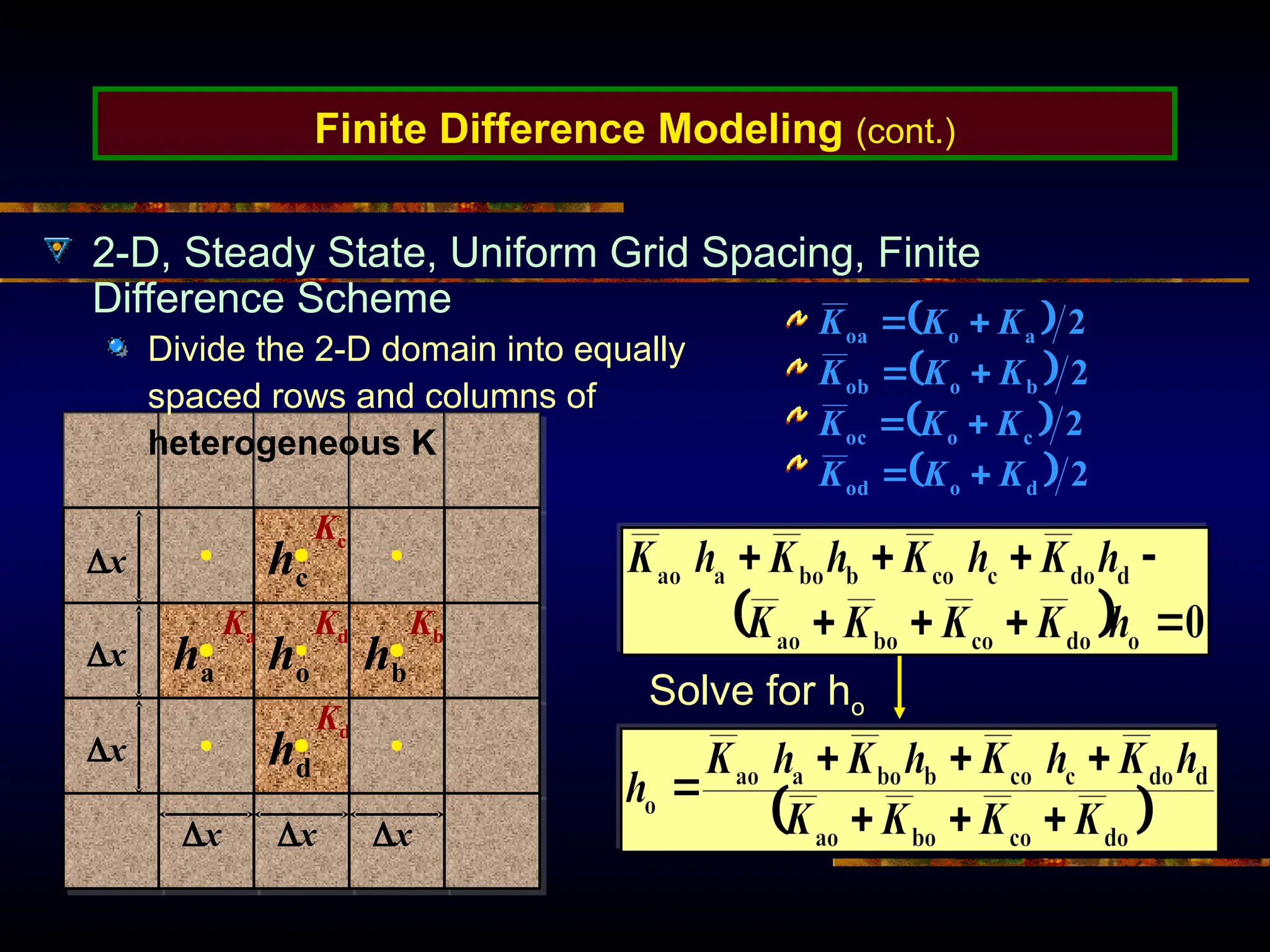
2-D, Steady State, Uniform Grid Spacing, Finite
Difference Scheme
Divide the 2-D domain into equally
spaced rows and columns of
heterogeneous K
ha ho hb
hd
hc
x
x
x
 
 
 
  2
2
2
2
d
o
od
c
o
oc
b
o
ob
a
o
oa
K
K
K
K
K
K
K
K
K
K
K
K








Ka
Kc
Kb
Kd
Kd
x x x
Solve for ho
Finite Difference Modeling (cont.)
2-D, Steady State, Uniform Grid Spacing, Finite
Difference Scheme
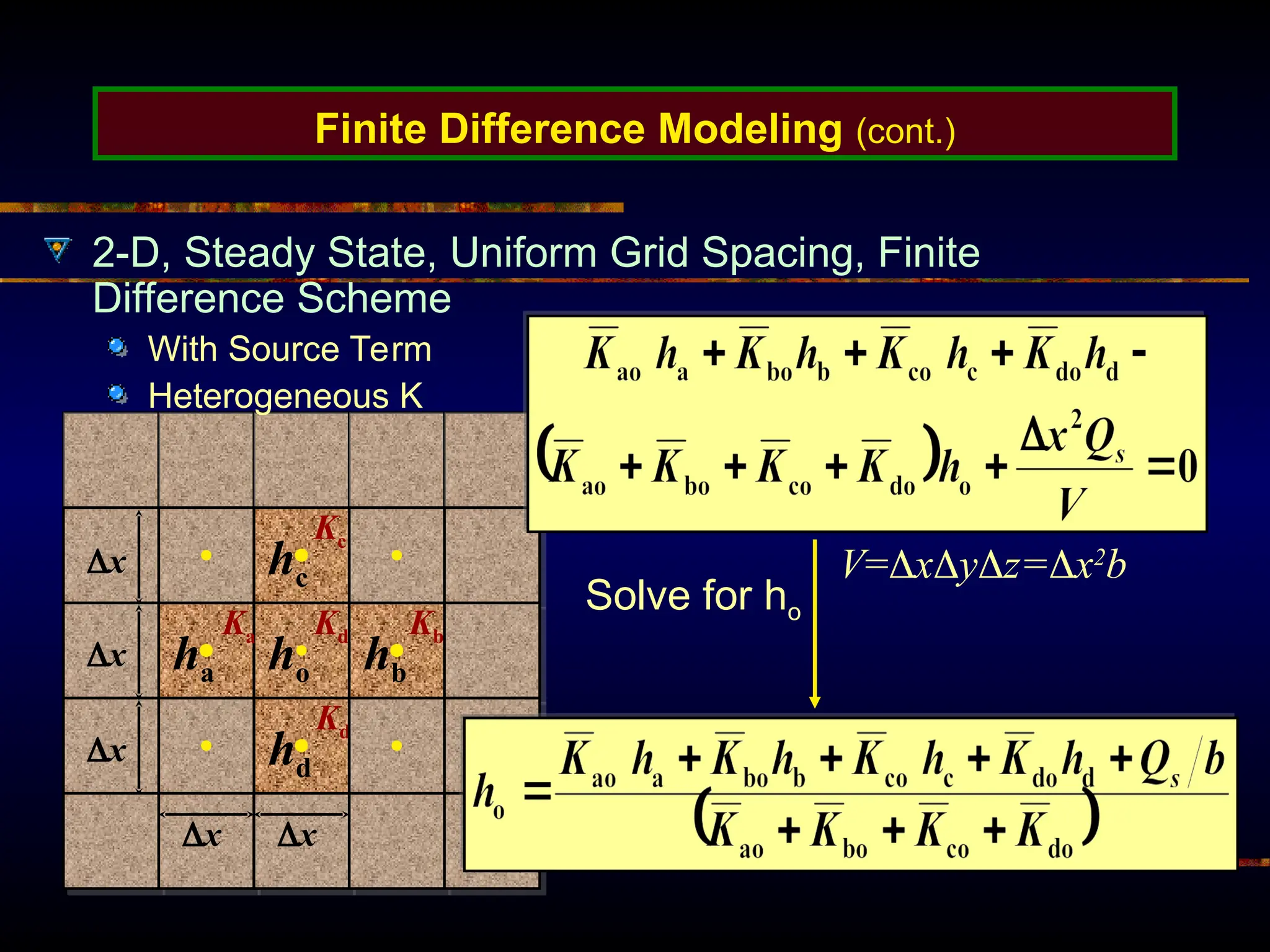
With Source Term
Heterogeneous K
ha ho hb
hd
hc
x
x
x
Ka
Kc
Kb
Kd
Kd
x x
Solve for ho
V=xyz=x2
b
ha ho hb
hc
Ka
Kc
Kb
Kd
Finite Difference Modeling (cont.)
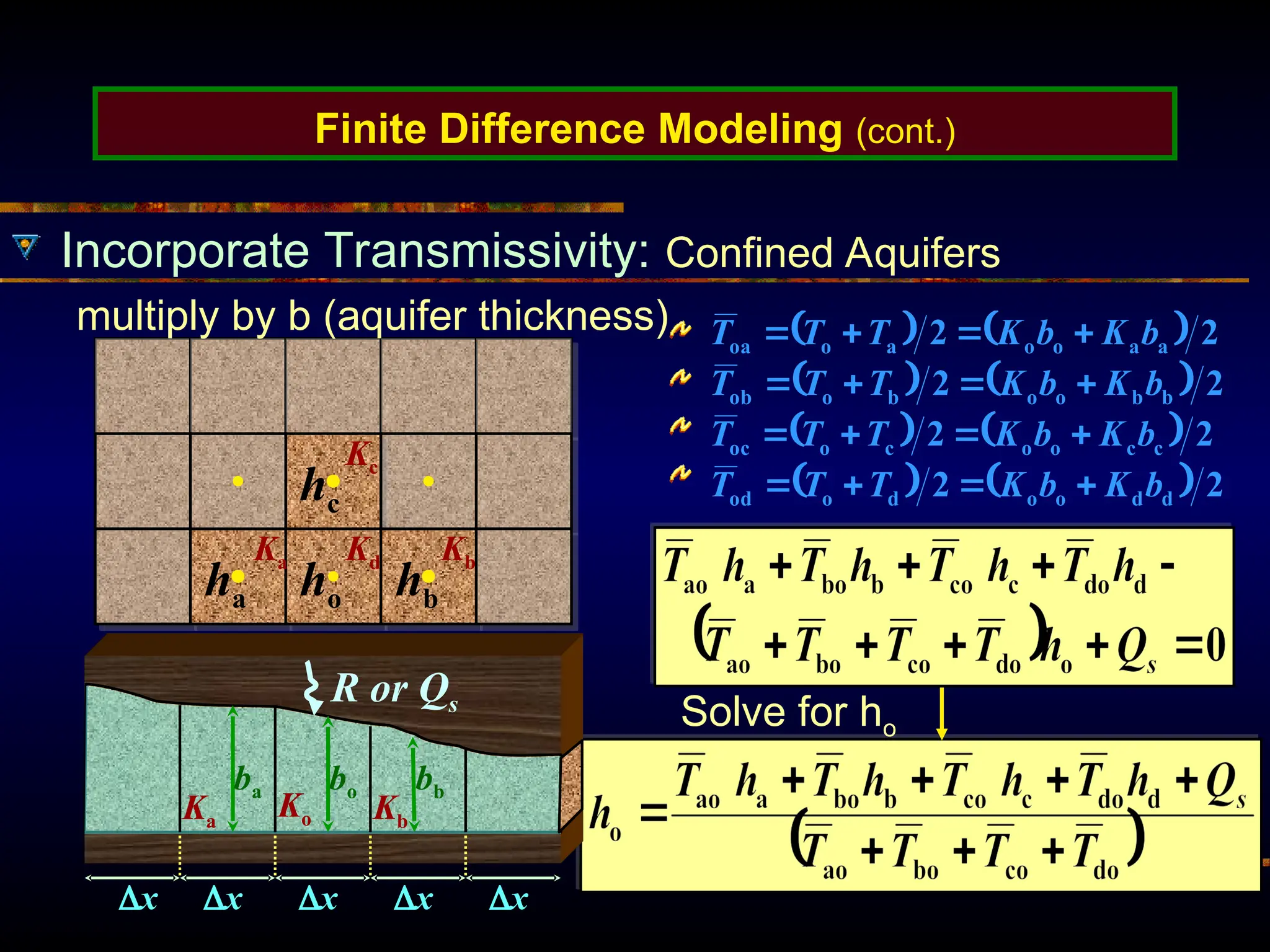
Incorporate Transmissivity: Confined Aquifers
multiply by b (aquifer thickness)    
   
   
    2
2
2
2
2
2
2
2
d
d
o
o
d
o
od
c
c
o
o
c
o
oc
b
b
o
o
b
o
ob
a
a
o
o
a
o
oa
b
K
b
K
T
T
T
b
K
b
K
T
T
T
b
K
b
K
T
T
T
b
K
b
K
T
T
T
















x x x x x
Ko Kb
Ka
ba bo bb
Solve for ho
R or Qs
ha ho hb
hc
Ka
Kc
Kb
Kd
x x x x x
Ko Kb
Ka
ha ho hb
Finite Difference Modeling (cont.)
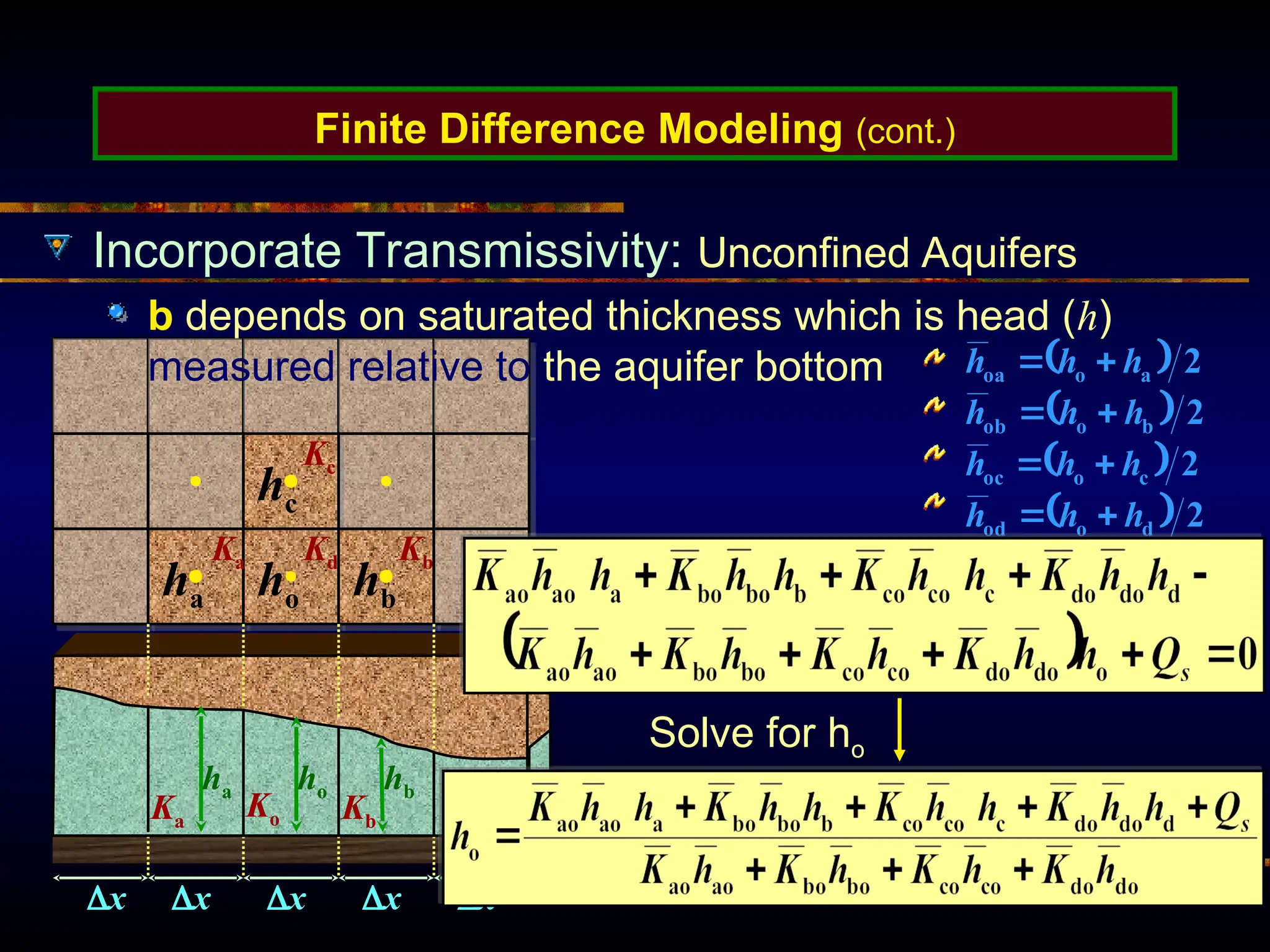
Incorporate Transmissivity: Unconfined Aquifers
b depends on saturated thickness which is head (h)
measured relative to the aquifer bottom  
 
 
  2
2
2
2
d
o
od
c
o
oc
b
o
ob
a
o
oa
h
h
h
h
h
h
h
h
h
h
h
h








Solve for ho
ha ho hb
hc
Ka
Kc
Kb
Kd
x x x x x
Ko Kb
Ka
ha ho hb
Finite Difference Modeling (cont.)
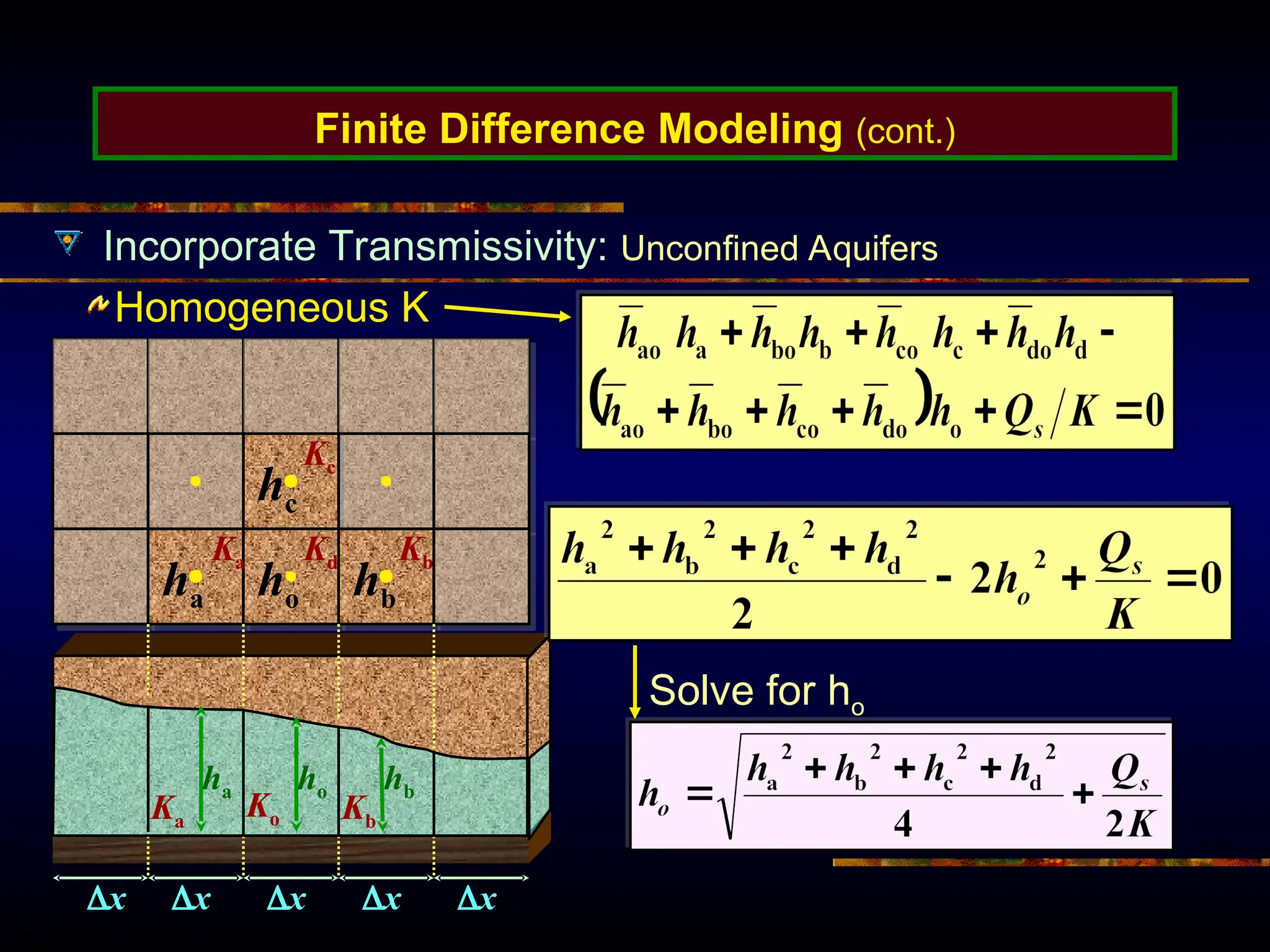
Incorporate Transmissivity: Unconfined Aquifers
Homogeneous K
Solve for ho
Finite Difference Modeling (cont.)
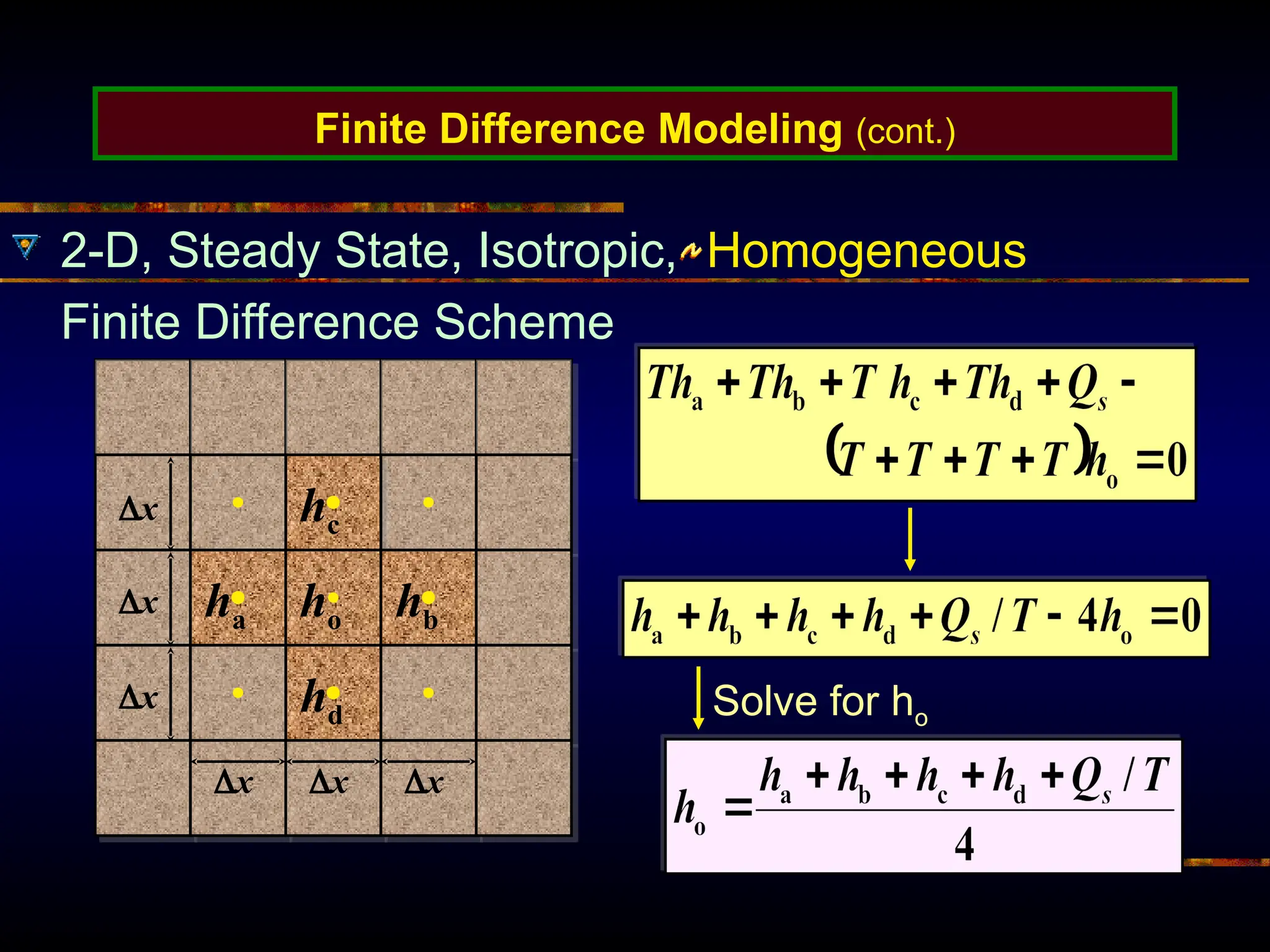
2-D, Steady State, Isotropic, Homogeneous
Finite Difference Scheme
ha ho hb
hd
hc
x
x
x
x x x
Solve for ho
Finite Difference Modeling (cont.)
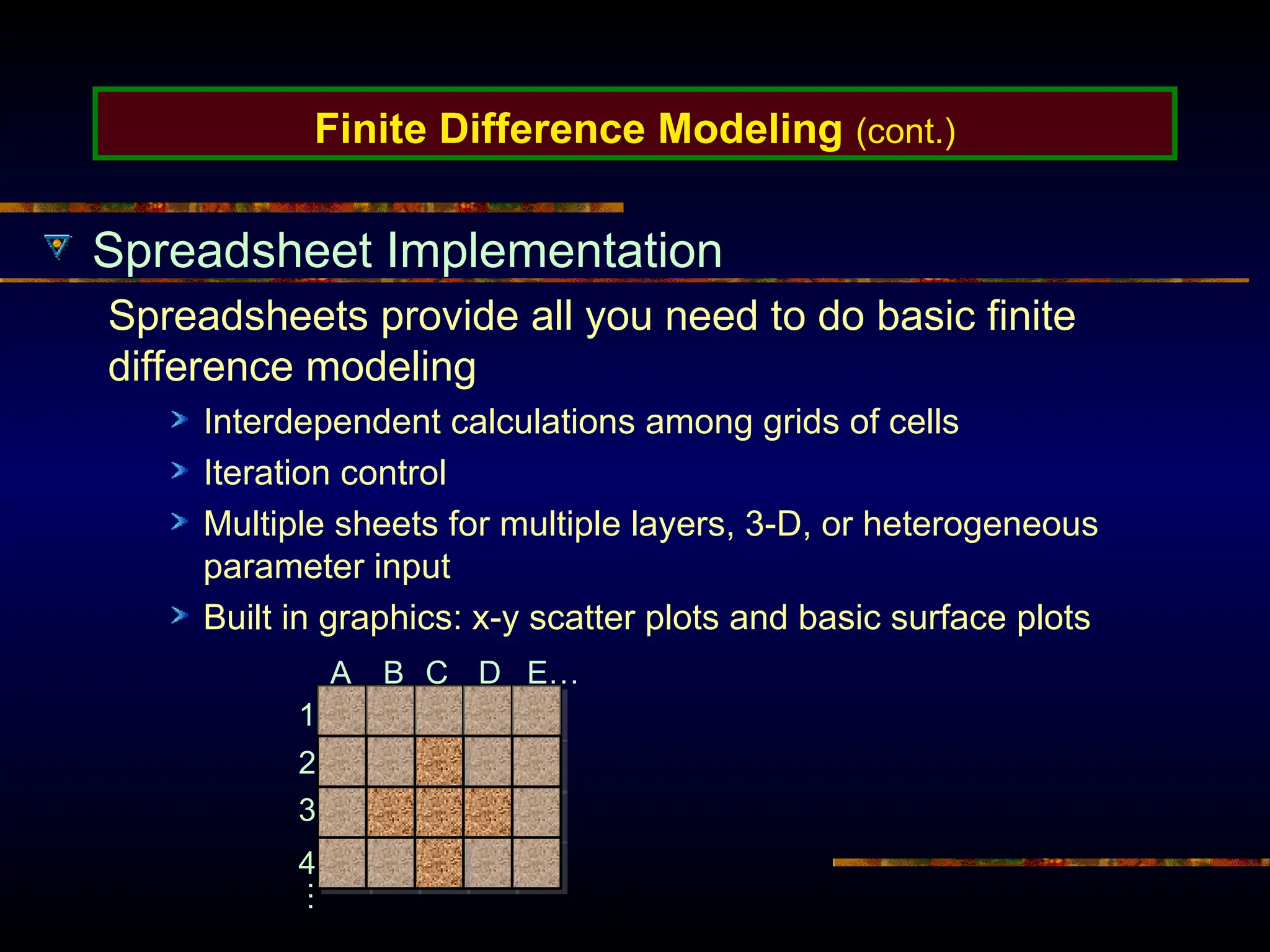
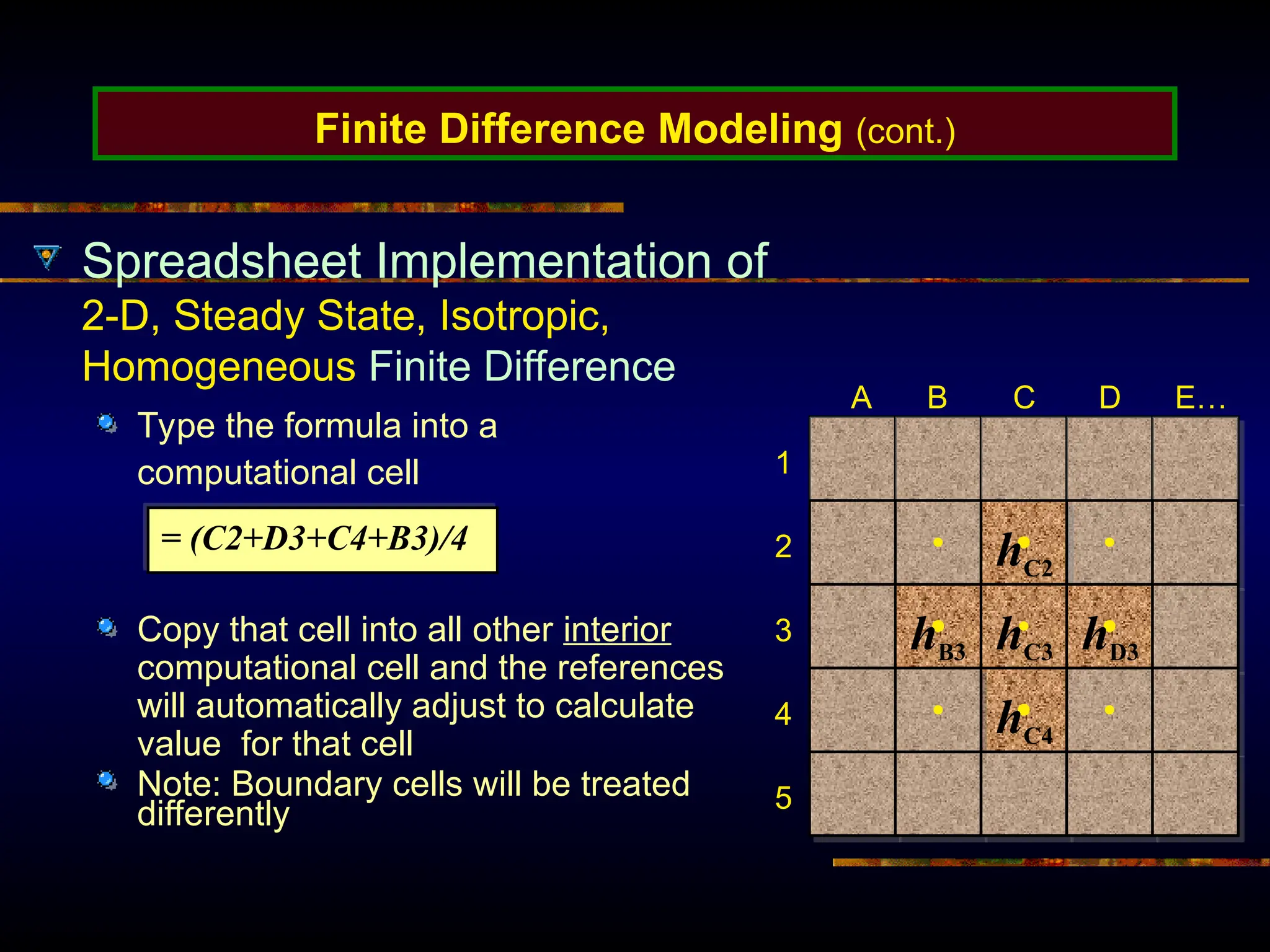
Spreadsheet Implementation
Spreadsheets provide all you need to do basic finite
difference modeling
Interdependent calculations among grids of cells
Iteration control
Multiple sheets for multiple layers, 3-D, or heterogeneous
parameter input
Built in graphics: x-y scatter plots and basic surface plots
A B C D E…
1
2
3
4
…
Finite Difference Modeling (cont.)
Spreadsheet Implementation of
2-D, Steady State, Isotropic,
Homogeneous Finite Difference
Type the formula into a
computational cell
Copy that cell into all other interior
computational cell and the references
will automatically adjust to calculate
value for that cell
Note: Boundary cells will be treated
differently
hB3 hC3 hD3
hC4
hC2
A B C D E…
1
2
3
4
5
= (C2+D3+C4+B3)/4
Finite Difference Modeling (cont.)
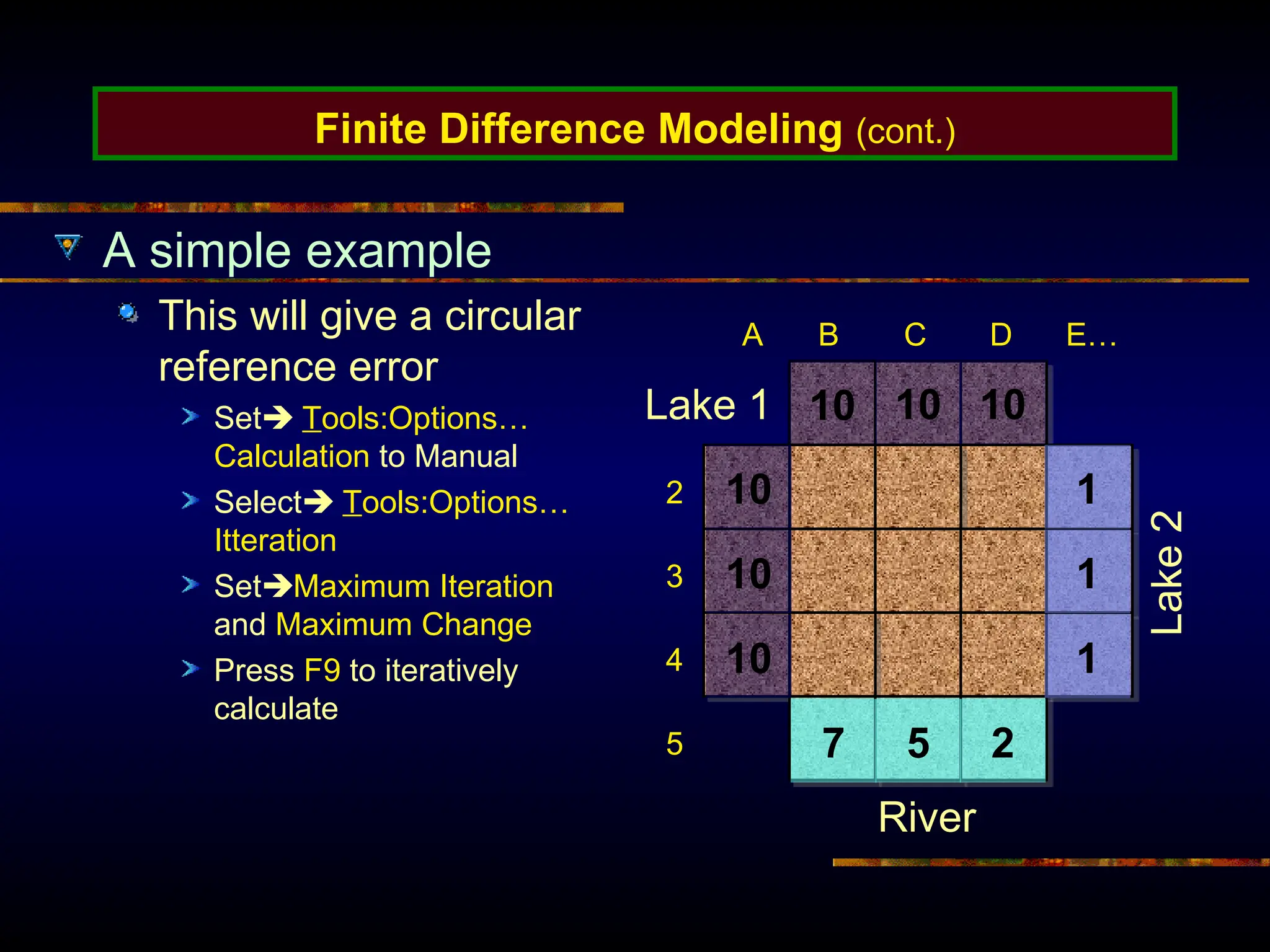
A simple example
This will give a circular
reference error
Set Tools:Options…
Calculation to Manual
Select Tools:Options…
Itteration
SetMaximum Iteration
and Maximum Change
Press F9 to iteratively
calculate
10
A B C D E…
2
3
4
5
10 10
10
10
10
7 5 2
1
1
1
Lake 1
Lake
2
River
Basic Finite Difference Design
Discretization and
Boundary Conditions
Grids should be oriented and spaced to
maximize the efficiency of the model
Boundary conditions should represent
reality as closely as possible
Basic Finite Difference Design (cont.)
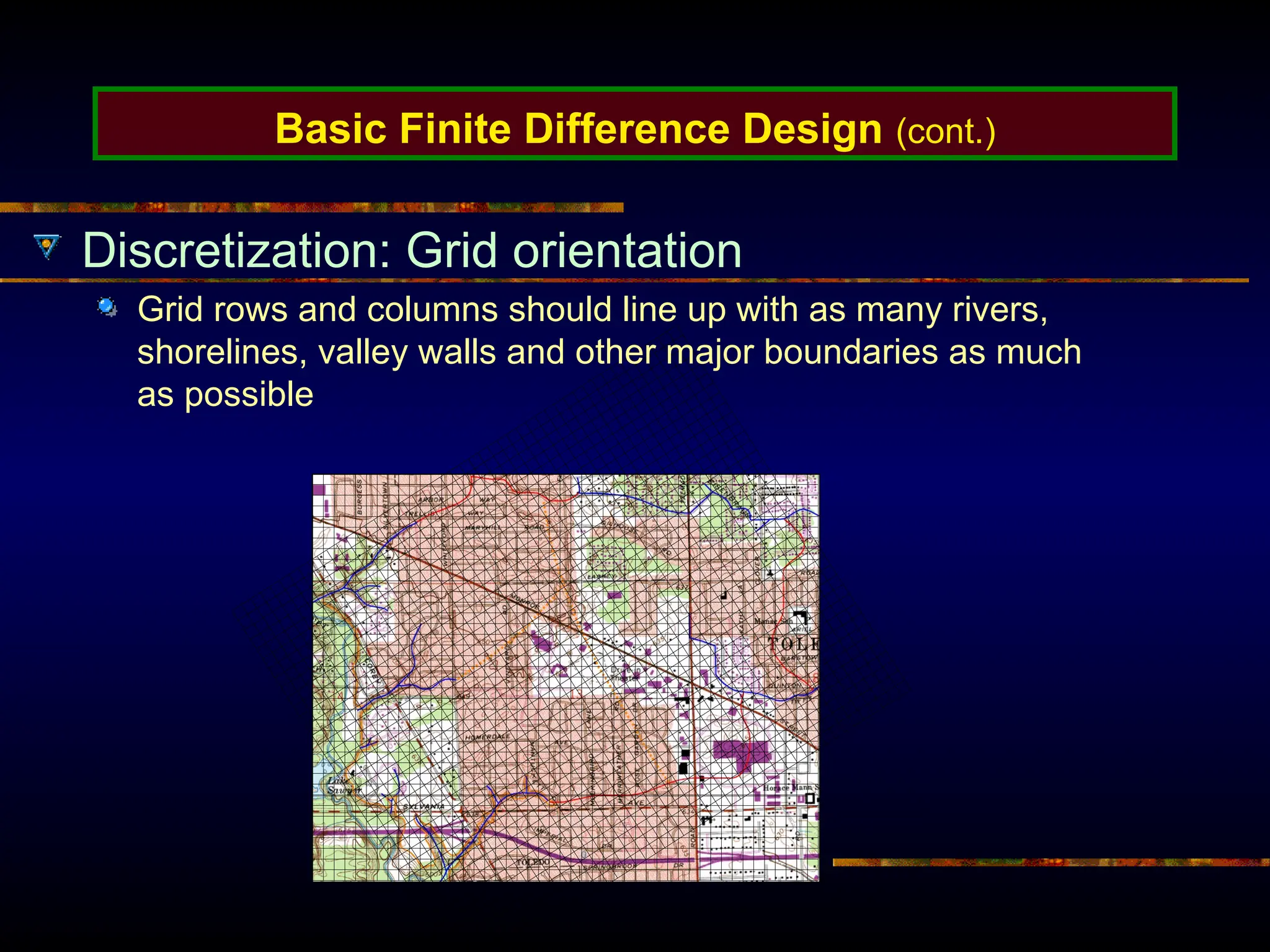
Discretization: Grid orientation
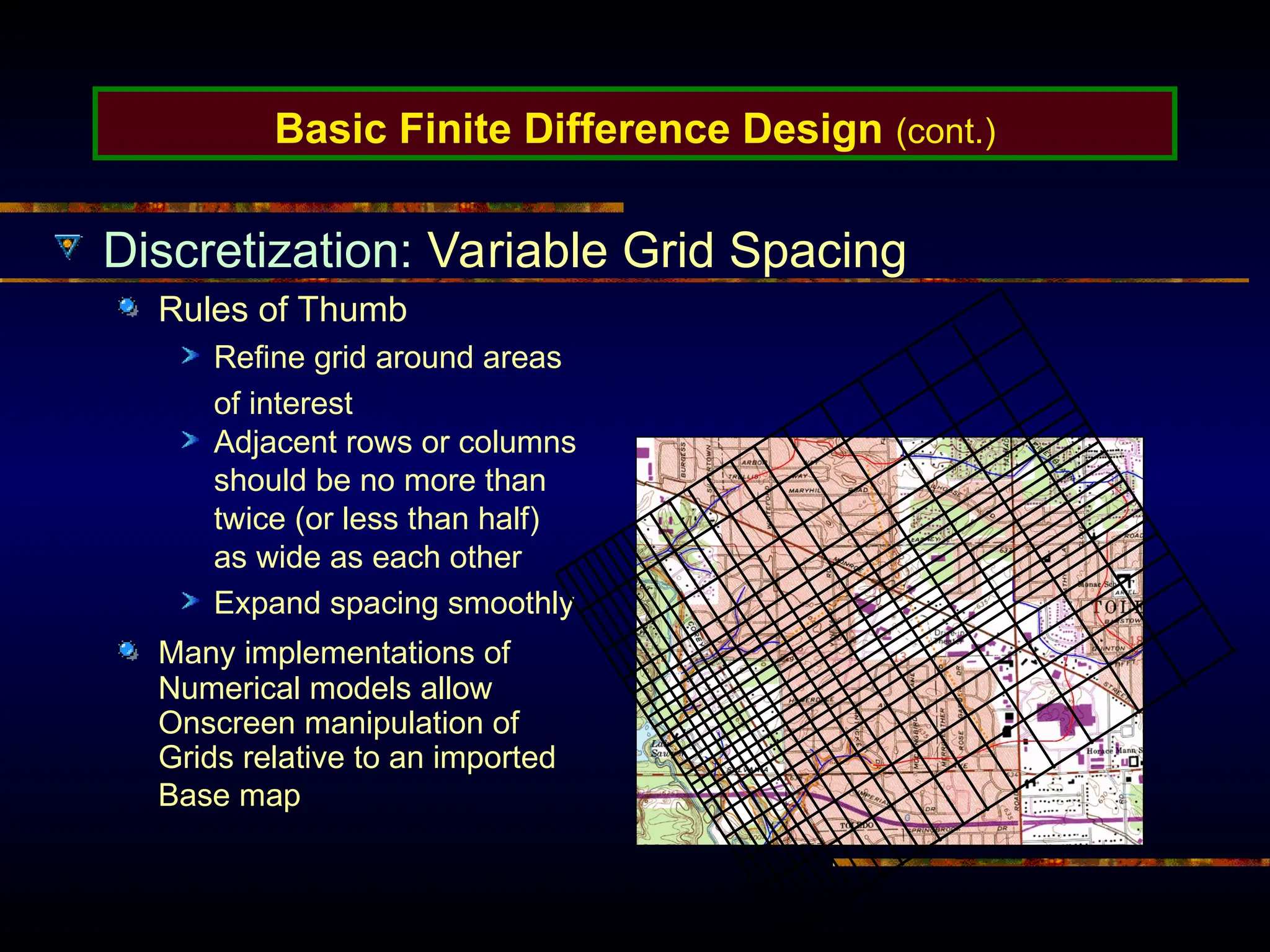
Grid rows and columns should line up with as many rivers,
shorelines, valley walls and other major boundaries as much
as possible
Basic Finite Difference Design (cont.)
Discretization: Variable Grid Spacing
Rules of Thumb
Refine grid around areas
of interest
Adjacent rows or columns
should be no more than
twice (or less than half)
as wide as each other
Expand spacing smoothly
Many implementations of
Numerical models allow
Onscreen manipulation of
Grids relative to an imported
Base map
Basic Finite Difference Design (cont.)
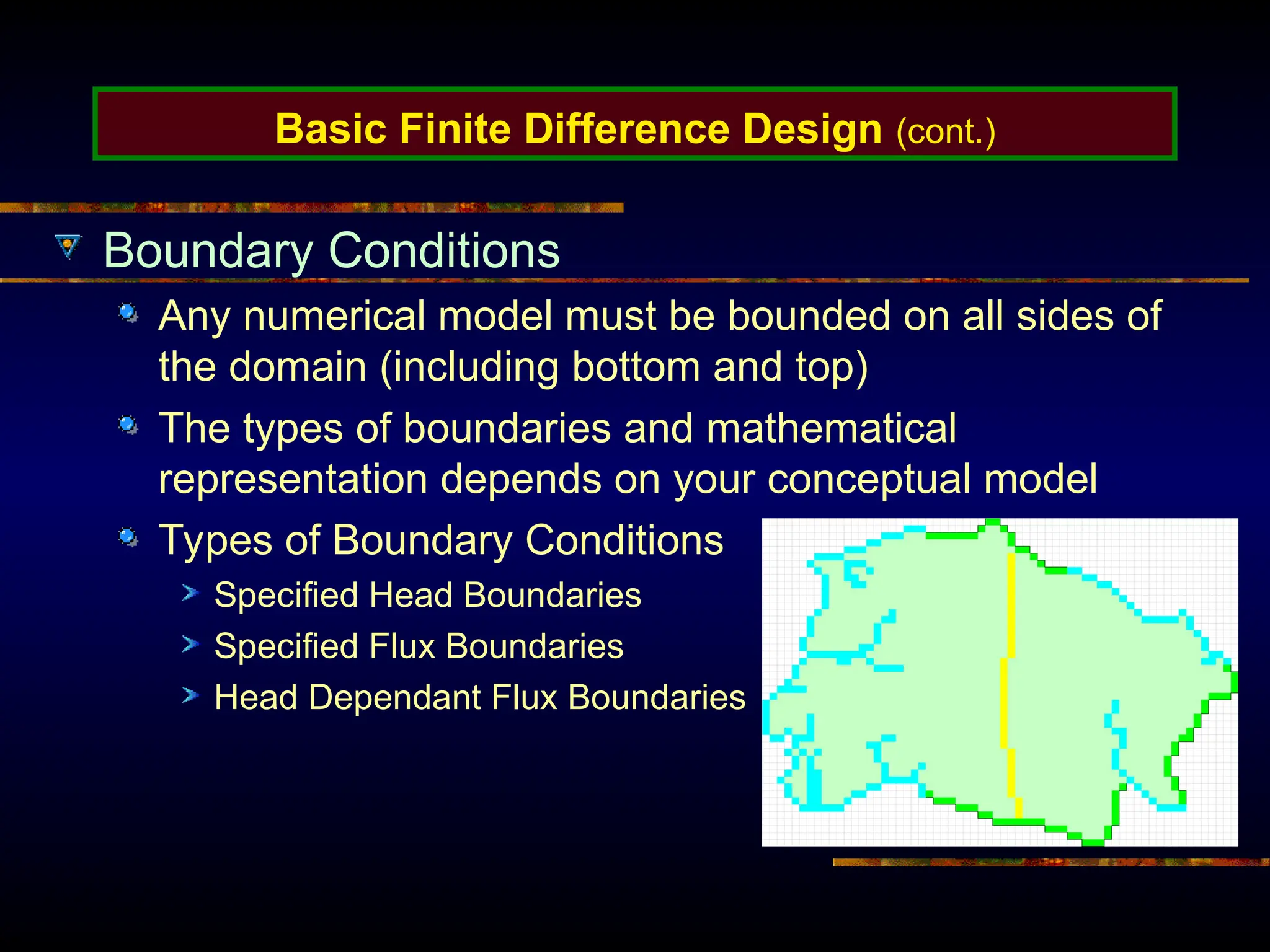
Boundary Conditions
Any numerical model must be bounded on all sides of
the domain (including bottom and top)
The types of boundaries and mathematical
representation depends on your conceptual model
Types of Boundary Conditions
Specified Head Boundaries
Specified Flux Boundaries
Head Dependant Flux Boundaries
Basic Finite Difference Design (cont.)
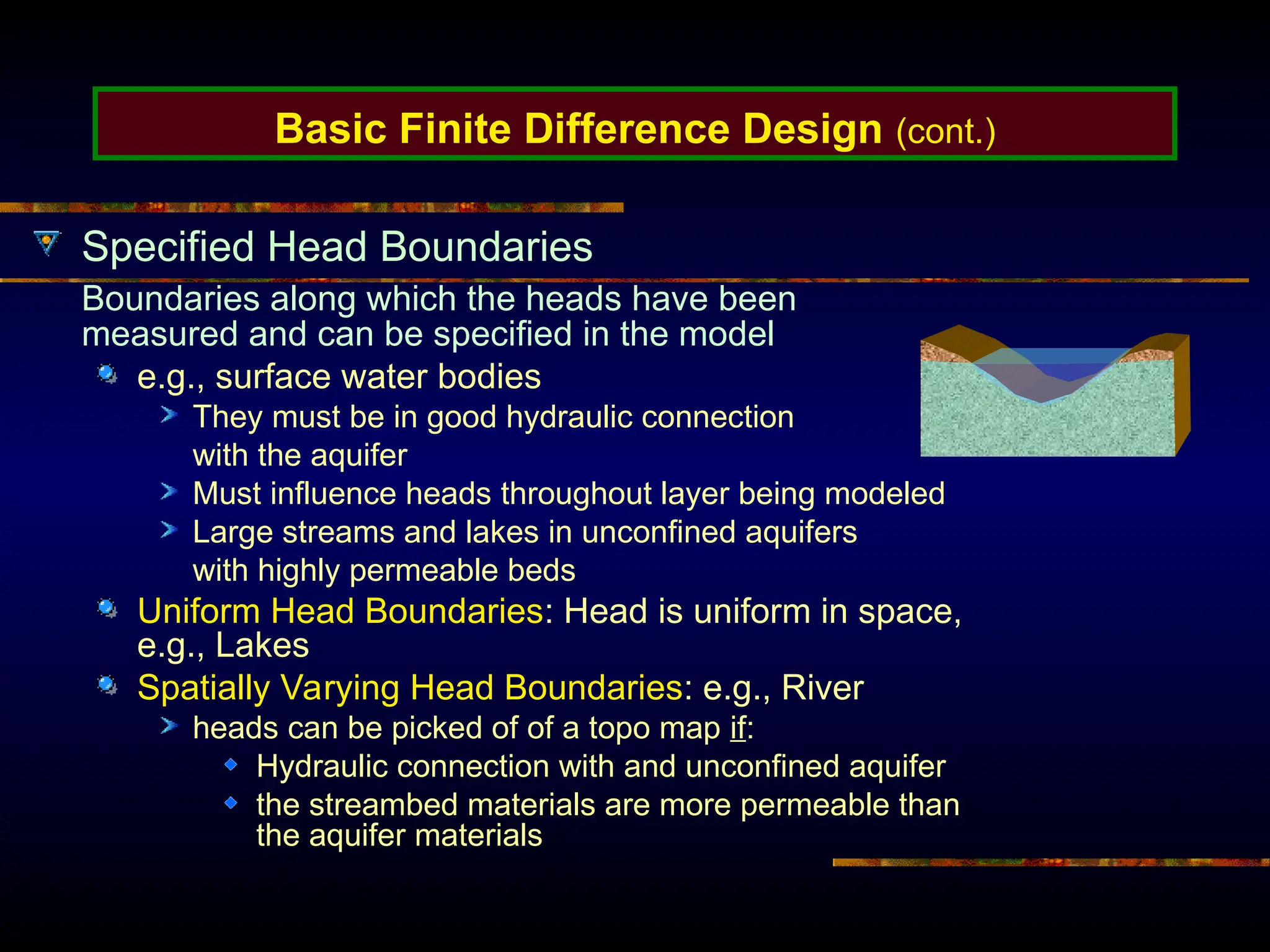
Specified Head Boundaries
Boundaries along which the heads have been
measured and can be specified in the model
e.g., surface water bodies
They must be in good hydraulic connection
with the aquifer
Must influence heads throughout layer being modeled
Large streams and lakes in unconfined aquifers
with highly permeable beds
Uniform Head Boundaries: Head is uniform in space,
e.g., Lakes
Spatially Varying Head Boundaries: e.g., River
heads can be picked of of a topo map if:
Hydraulic connection with and unconfined aquifer
the streambed materials are more permeable than
the aquifer materials
Basic Finite Difference Design (cont.)
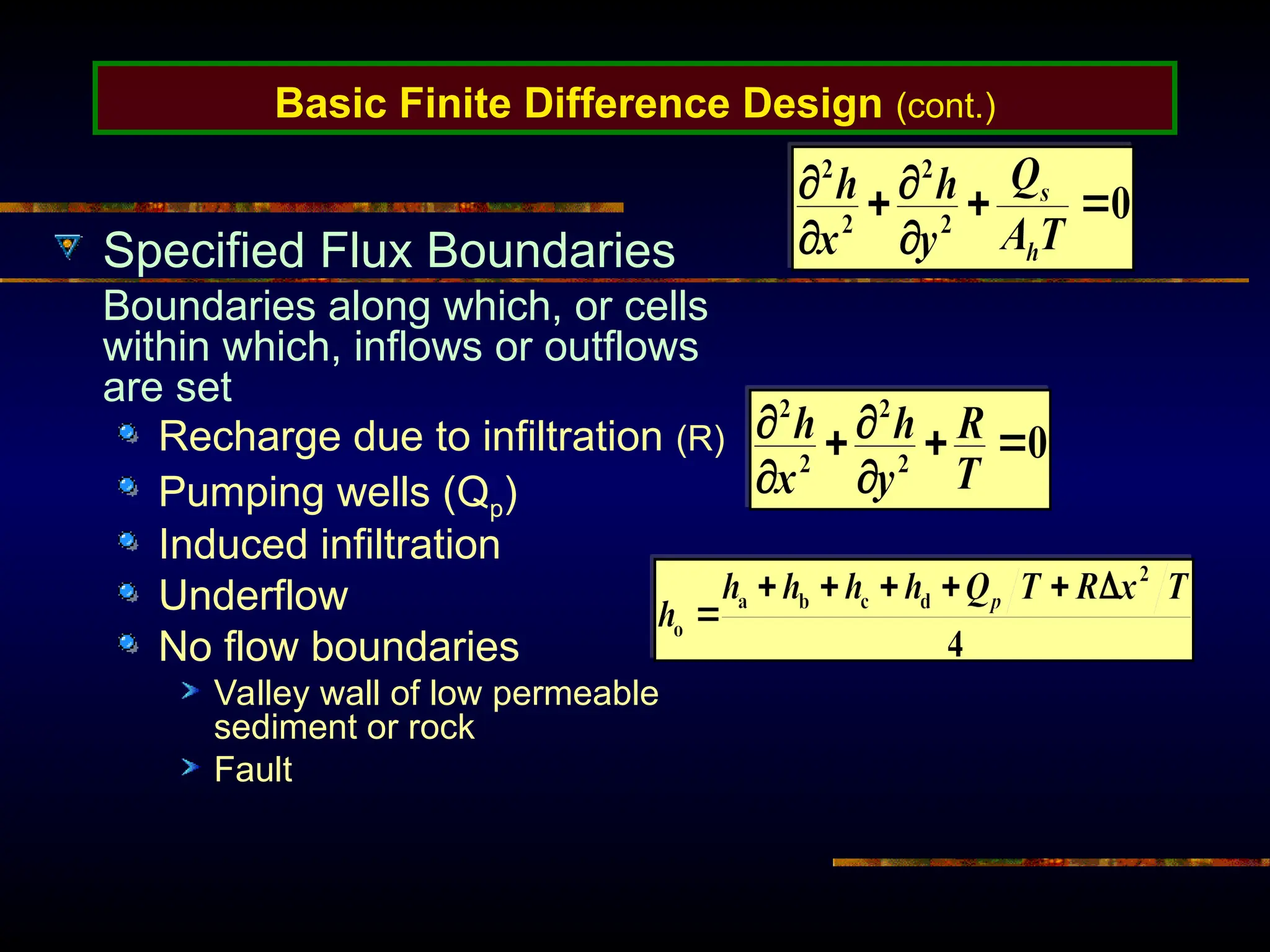
Specified Flux Boundaries
Boundaries along which, or cells
within which, inflows or outflows
are set
Recharge due to infiltration (R)
Pumping wells (Qp)
Induced infiltration
Underflow
No flow boundaries
Valley wall of low permeable
sediment or rock
Fault
Finite Difference Modeling (cont.)
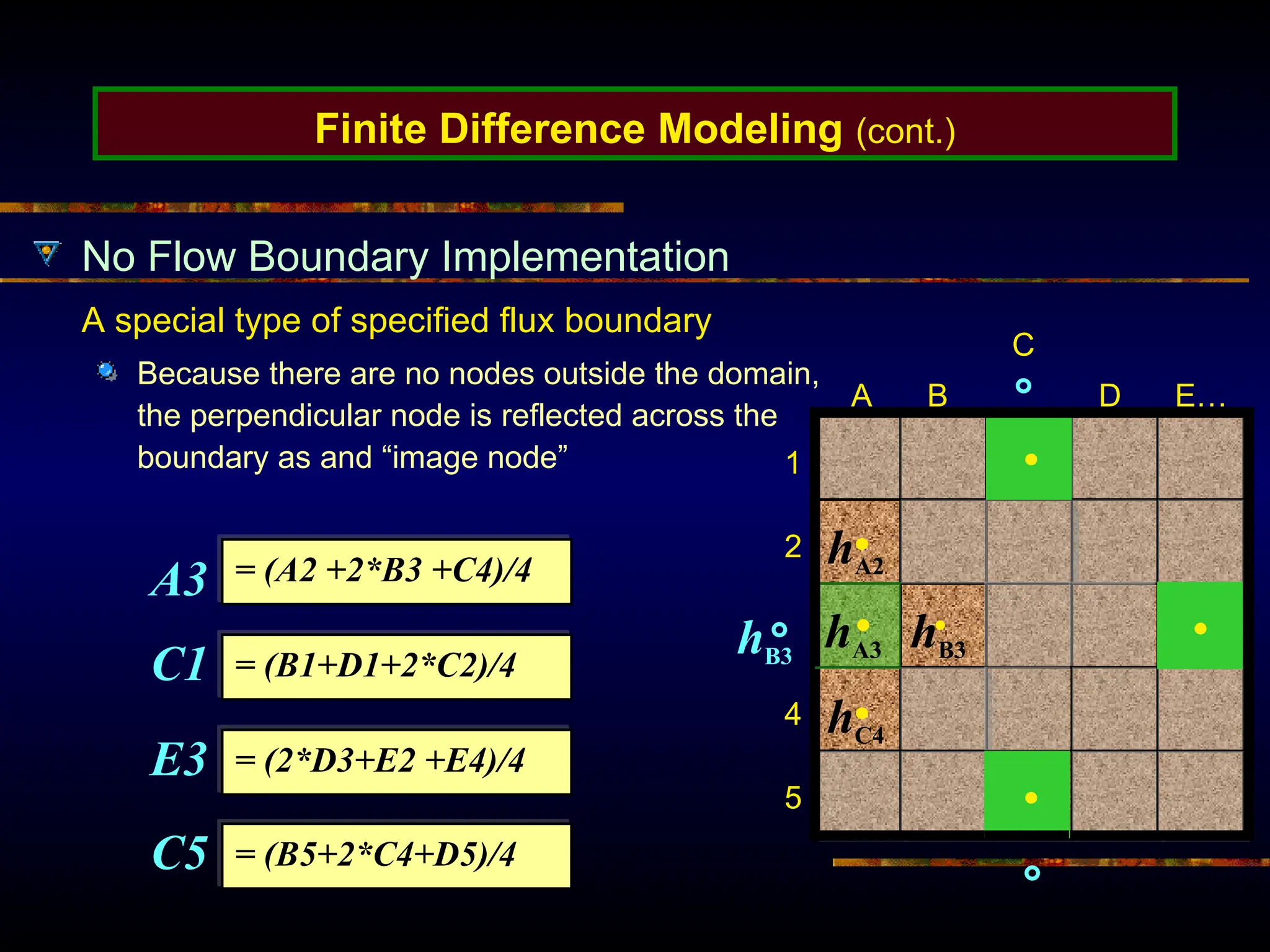
No Flow Boundary Implementation
A special type of specified flux boundary
Because there are no nodes outside the domain,
the perpendicular node is reflected across the
boundary as and “image node”
hB3
hC4
hA2
A B
C
D E…
1
2
4
5
= (A2 +2*B3 +C4)/4
= (B1+D1+2*C2)/4
A3
C1
E3 = (2*D3+E2 +E4)/4
= (B5+2*C4+D5)/4
C5
hA3
hB3
Finite Difference Modeling (cont.)
No Flow Boundary Implementation
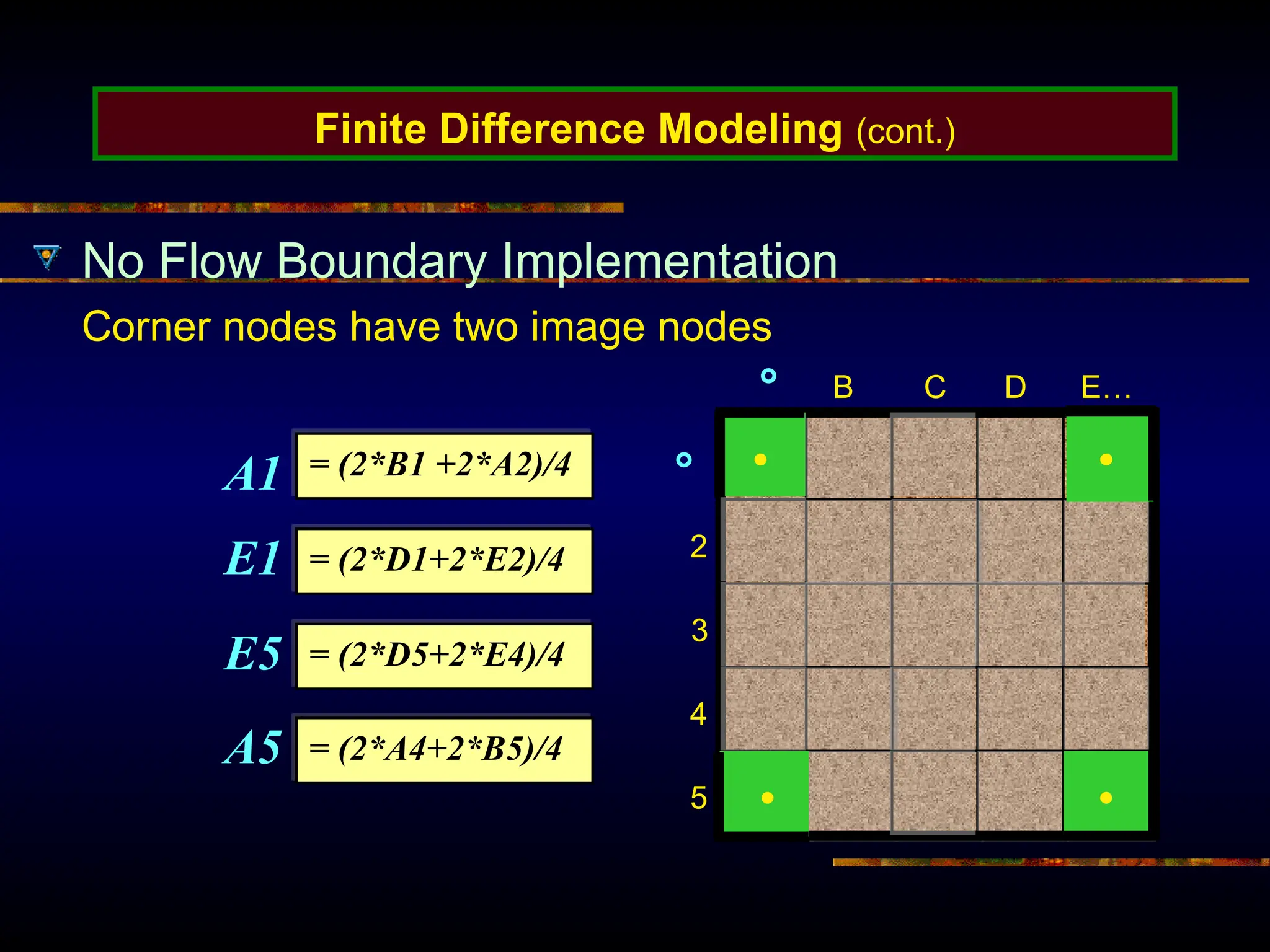
Corner nodes have two image nodes
B C D E…
2
4
5
= (2*B1 +2*A2)/4
= (2*D1+2*E2)/4
A1
E1
E5 = (2*D5+2*E4)/4
= (2*A4+2*B5)/4
A5
3
Finite Difference Modeling (cont.)
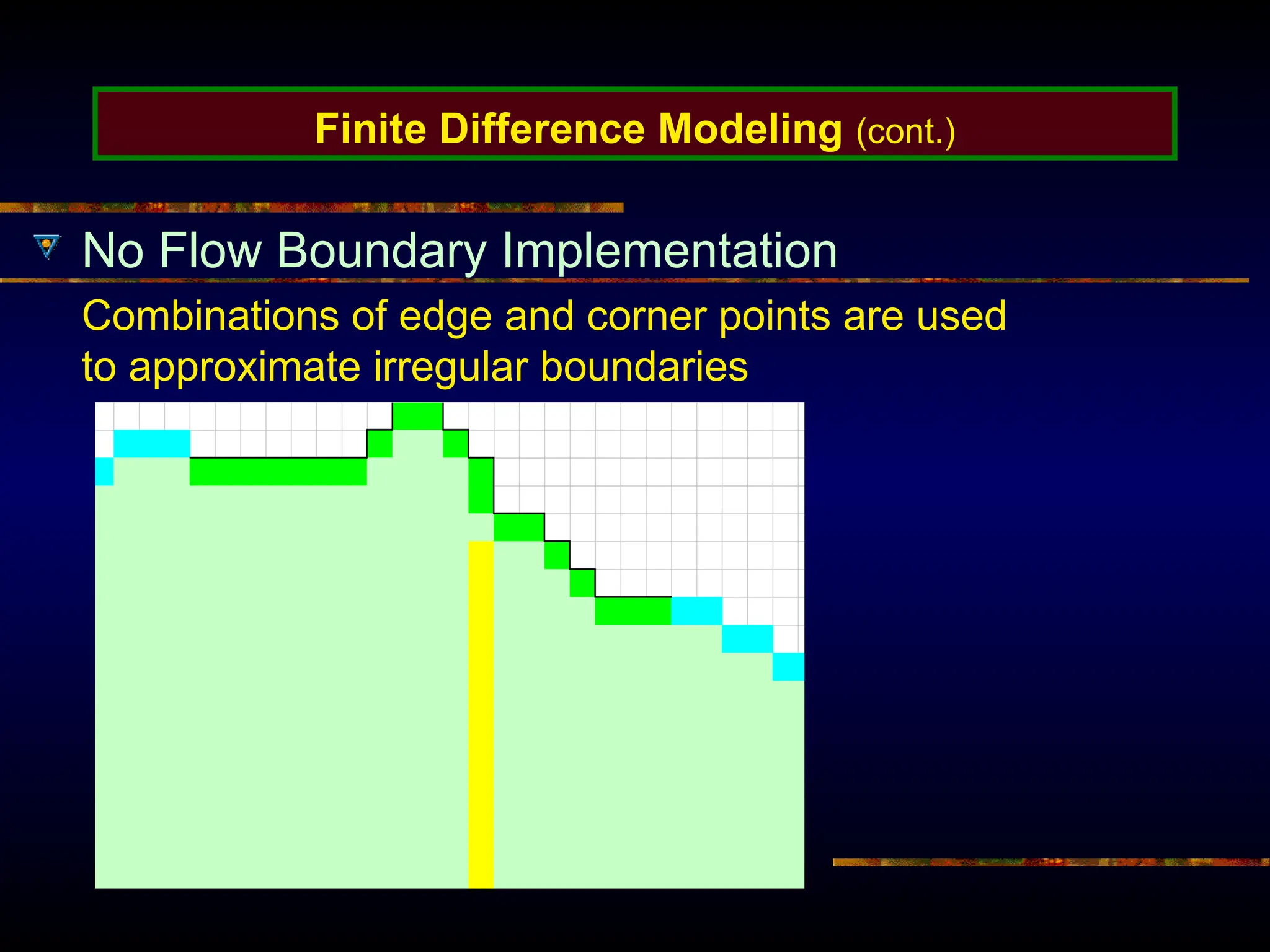
No Flow Boundary Implementation
Combinations of edge and corner points are used
to approximate irregular boundaries
Finite Difference Modeling (cont.)
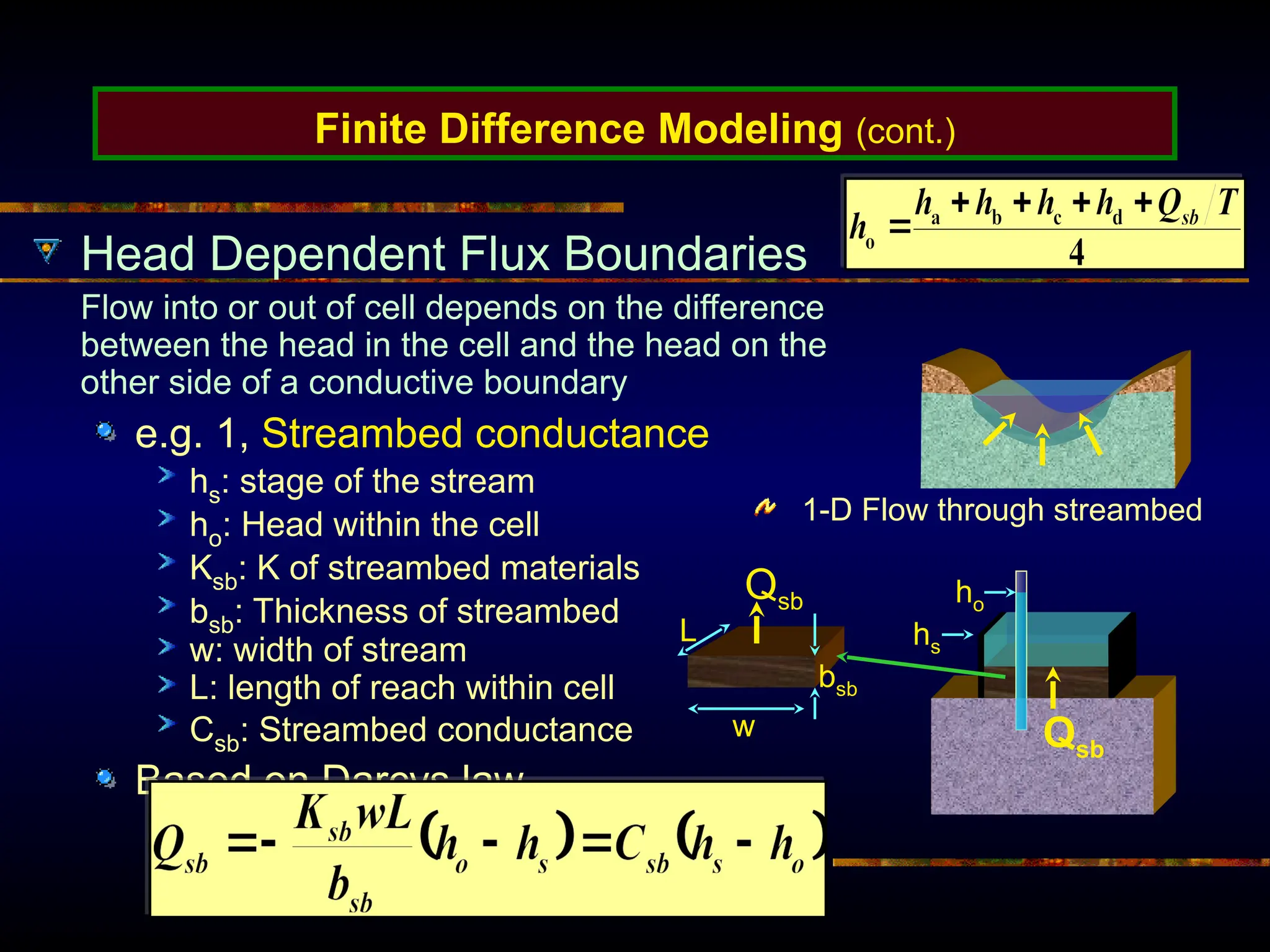
Head Dependent Flux Boundaries
Flow into or out of cell depends on the difference
between the head in the cell and the head on the
other side of a conductive boundary
e.g. 1, Streambed conductance
hs: stage of the stream
ho: Head within the cell
Ksb: K of streambed materials
bsb: Thickness of streambed
w: width of stream
L: length of reach within cell
Csb: Streambed conductance
Based on Darcys law
1-D Flow through streambed
hs
ho
w
L
bsb
Qsb
Qsb
Finite Difference Modeling (cont.)
Head Dependent Flux Boundaries
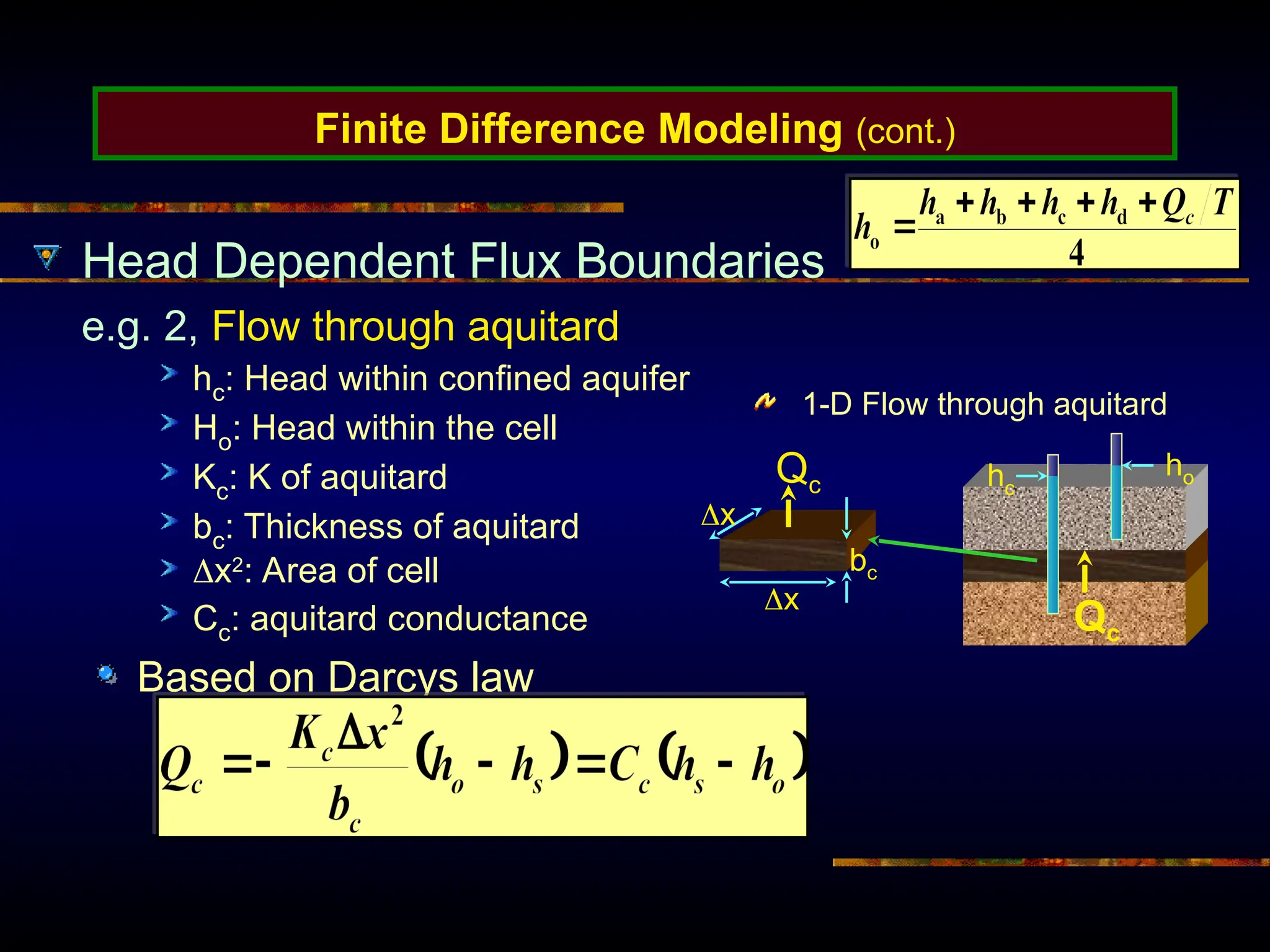
e.g. 2, Flow through aquitard
hc: Head within confined aquifer
Ho: Head within the cell
Kc: K of aquitard
bc: Thickness of aquitard
x2
: Area of cell
Cc: aquitard conductance
Based on Darcys law
1-D Flow through aquitard
ho
hc
x
bc
Qc
Qc
x
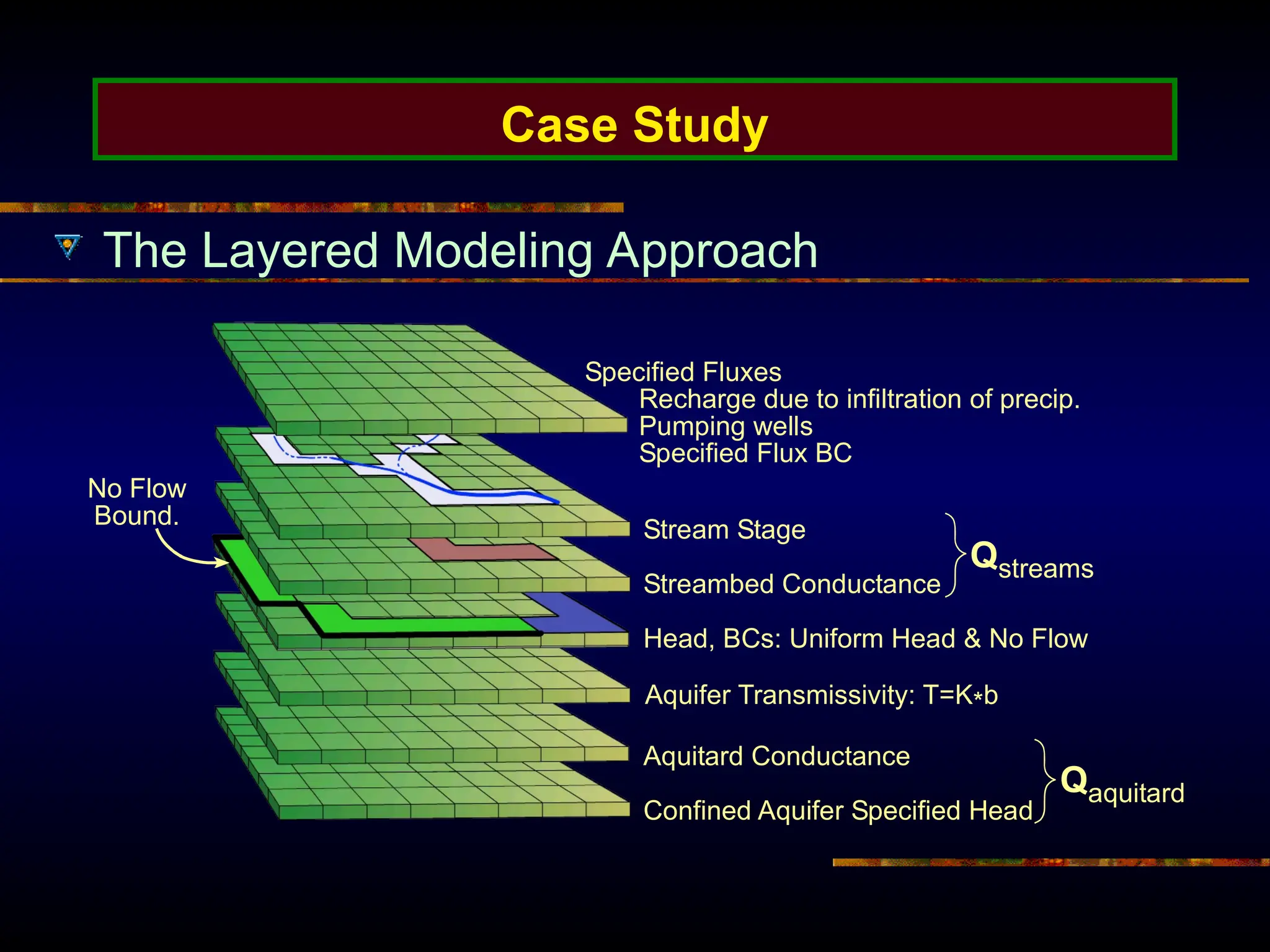
Case Study
The Layered Modeling Approach
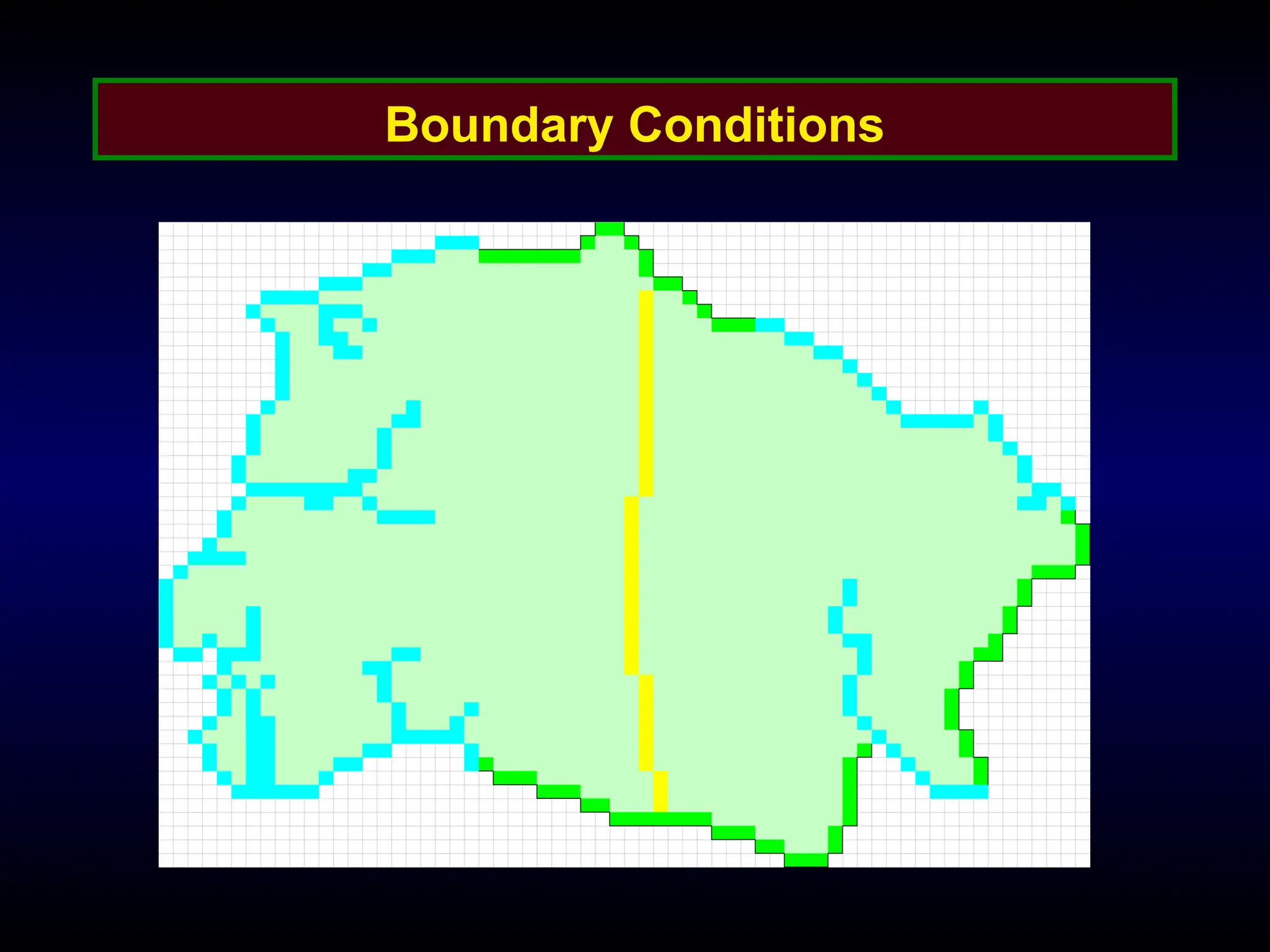
Head, BCs: Uniform Head & No Flow
Streambed Conductance
Stream Stage
Aquitard Conductance
Confined Aquifer Specified Head
Qstreams
Qaquitard
Aquifer Transmissivity: T=K*b
Specified Fluxes
Recharge due to infiltration of precip.
Pumping wells
Specified Flux BC
No Flow
Bound.
Finite Difference Modeling (cont.)
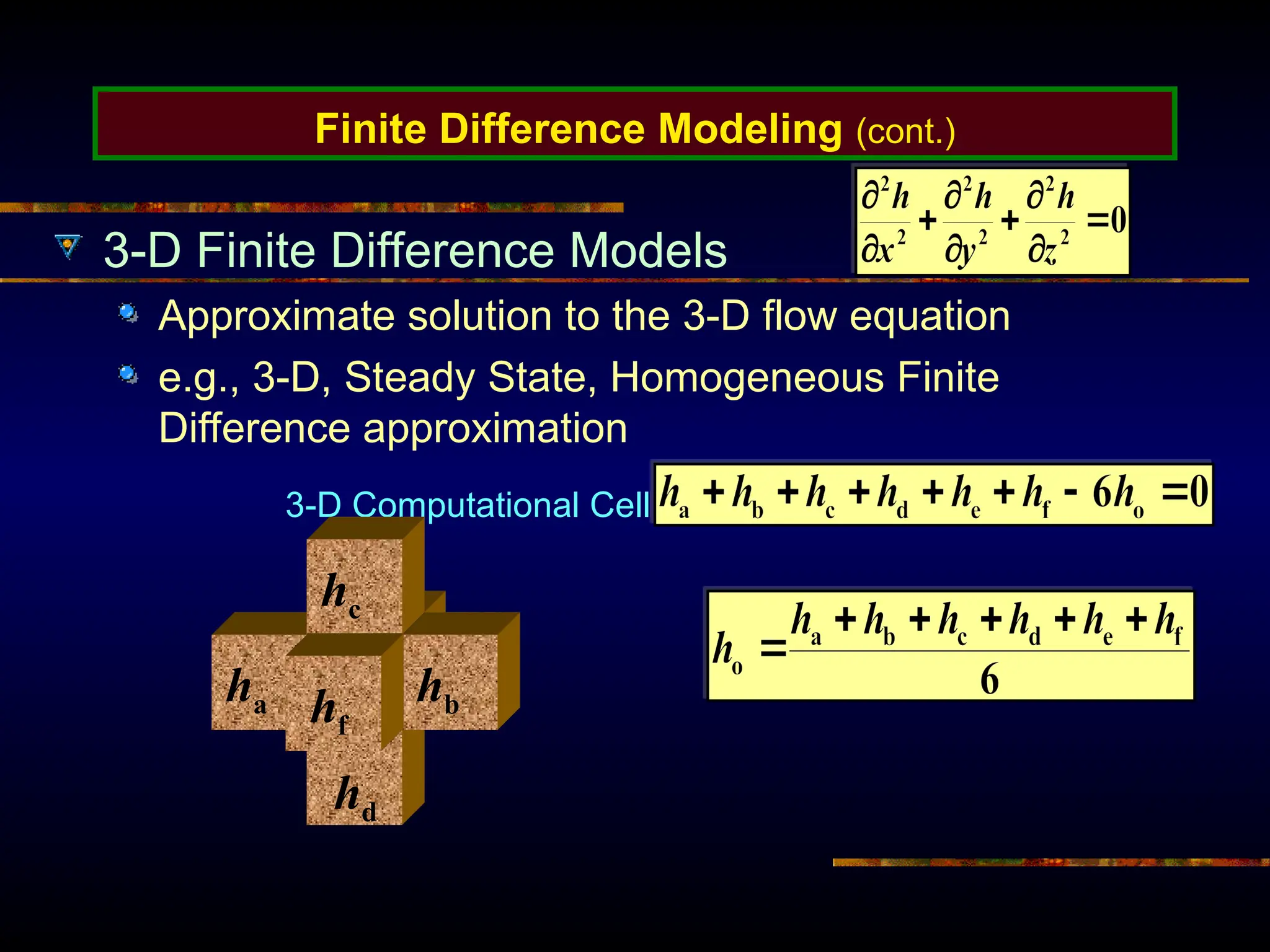
3-D Finite Difference Models
Approximate solution to the 3-D flow equation
e.g., 3-D, Steady State, Homogeneous Finite
Difference approximation
3-D Computational Cell
ha ho hb
hd
hc
hf
Finite Difference Modeling (cont.)
3-D Finite Difference Models
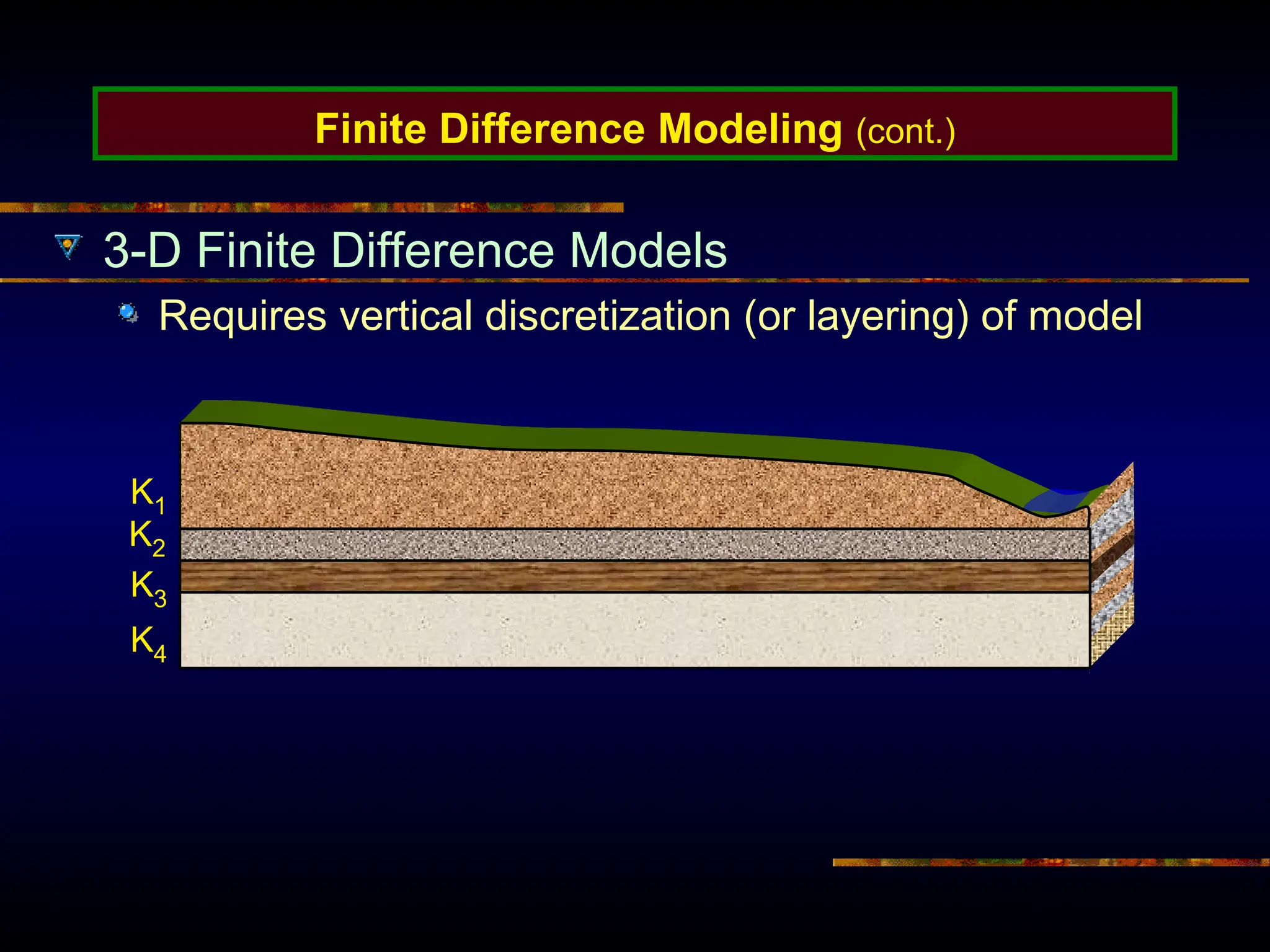
Requires vertical discretization (or layering) of model
K1
K2
K3
K4
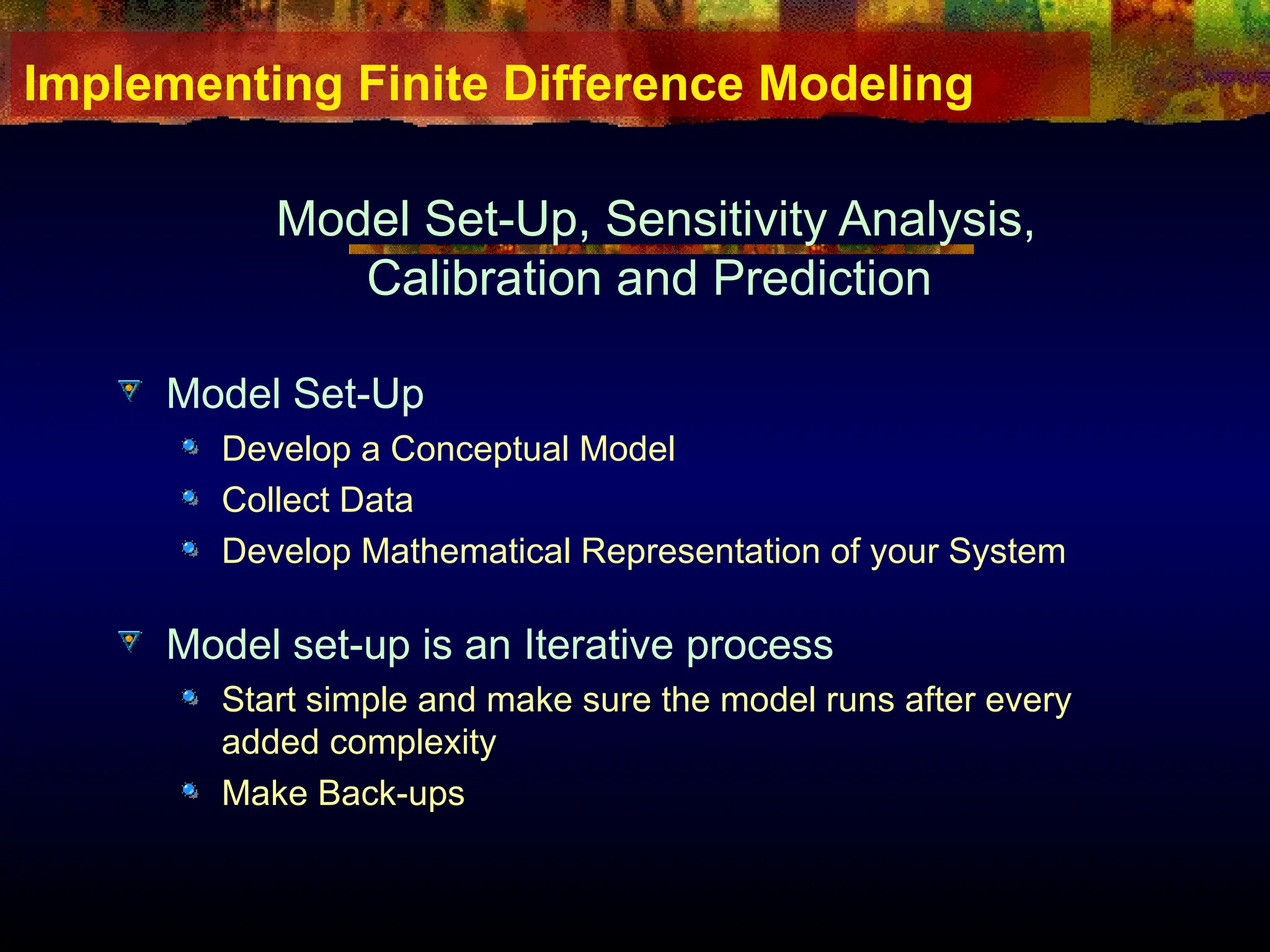
Implementing Finite Difference Modeling
Model Set-Up, Sensitivity Analysis,
Calibration and Prediction
Model Set-Up
Develop a Conceptual Model
Collect Data
Develop Mathematical Representation of your System
Model set-up is an Iterative process
Start simple and make sure the model runs after every
added complexity
Make Back-ups
Implementation
Anatomy of a Hydrogeological Investigation
and accompanying report
Significance
Define the problem in lay-terms
Highlight the importance of the problem being addressed
Objectives
Define the specific objectives in technical terms
Description of site and general hydrogeology
This is a presentation of your conceptual model
Implementation
Anatomy of a Hydrogeological Investigation (cont.)
Methodology
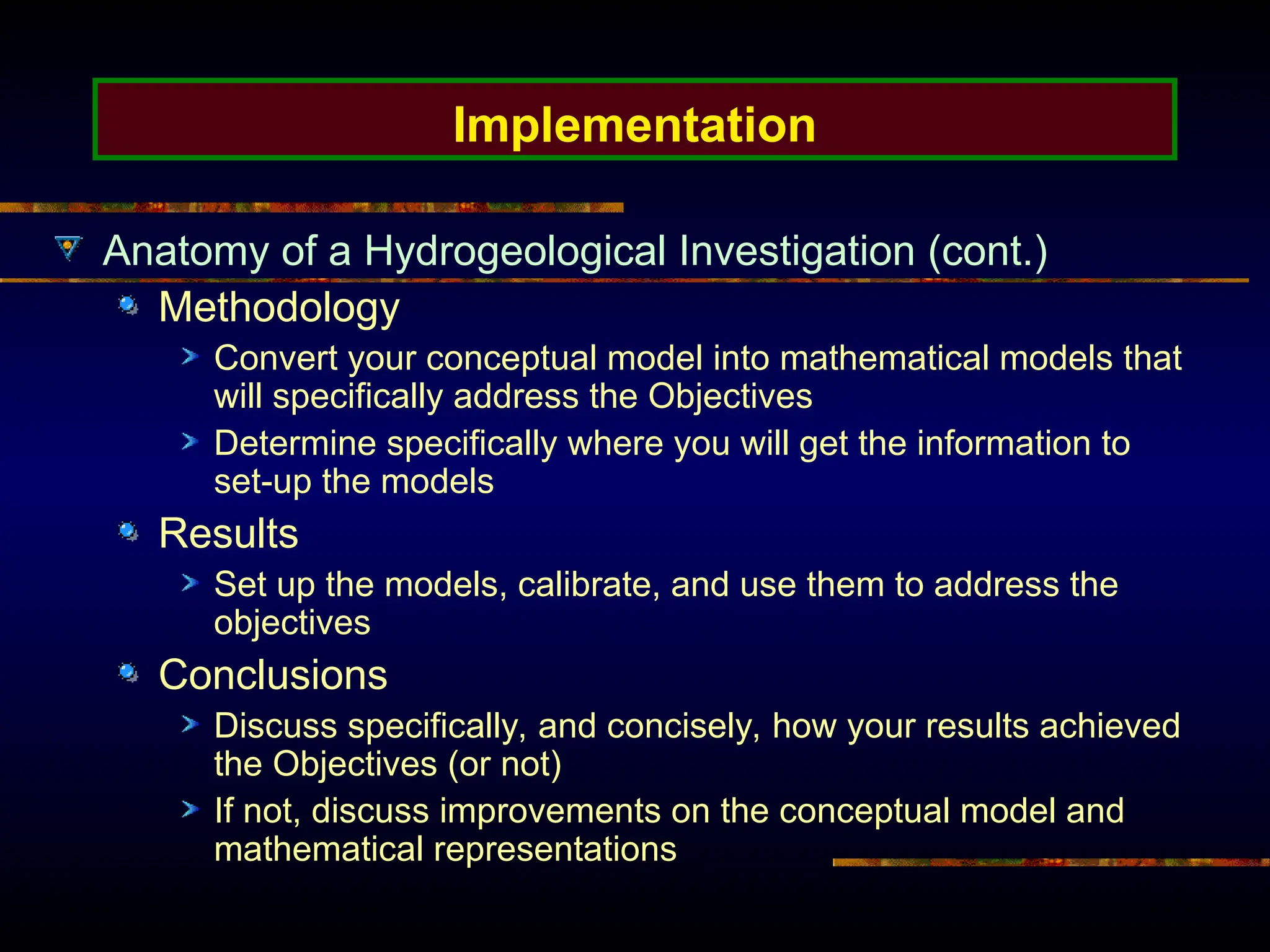
Convert your conceptual model into mathematical models that
will specifically address the Objectives
Determine specifically where you will get the information to
set-up the models
Results
Set up the models, calibrate, and use them to address the
objectives
Conclusions
Discuss specifically, and concisely, how your results achieved
the Objectives (or not)
If not, discuss improvements on the conceptual model and
mathematical representations
Developing a Conceptual Model
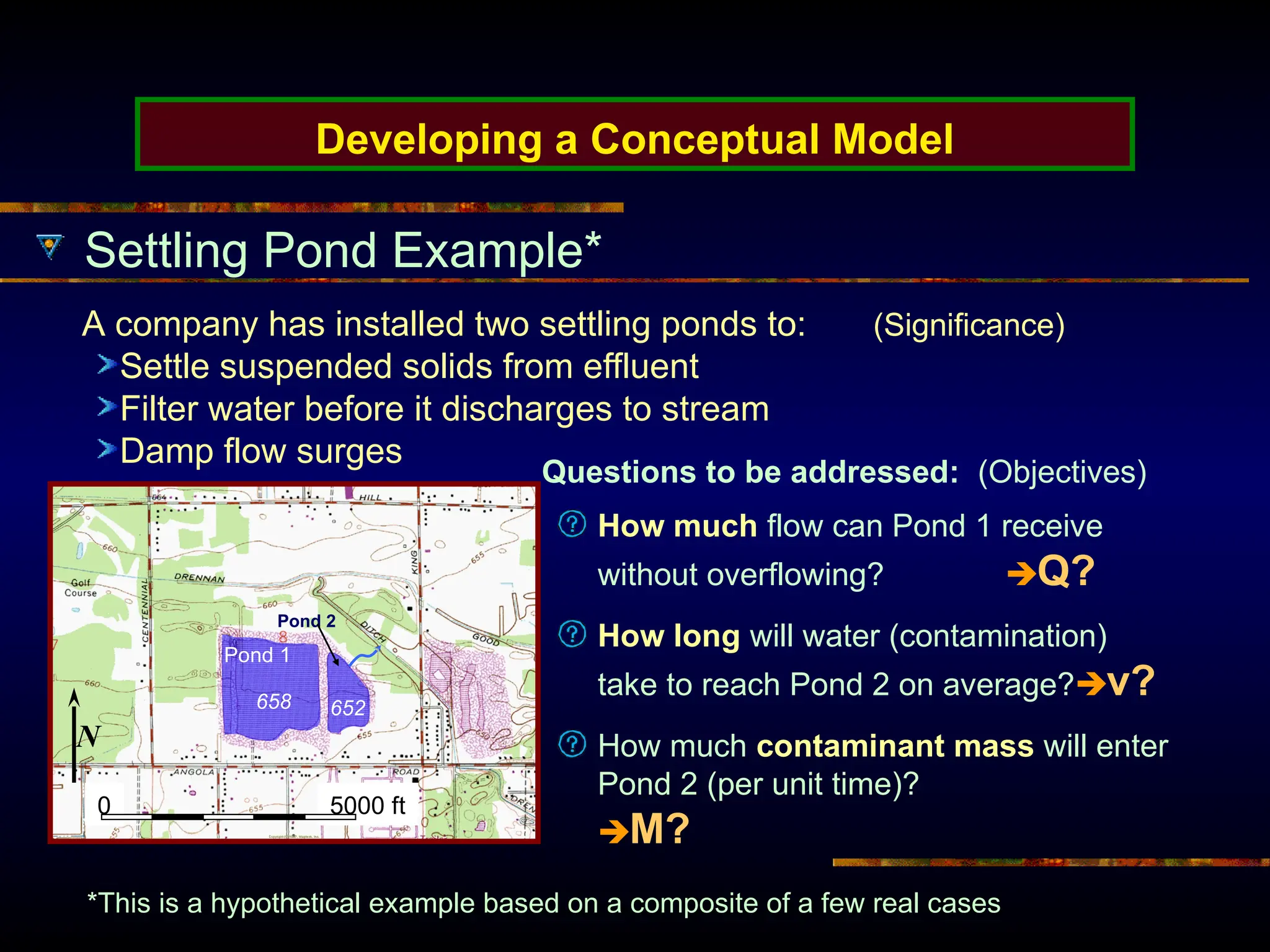
Settling Pond Example*
Questions to be addressed: (Objectives)
How much flow can Pond 1 receive
without overflowing? Q?
How long will water (contamination)
take to reach Pond 2 on average?v?
How much contaminant mass will enter
Pond 2 (per unit time)?
M?
A company has installed two settling ponds to: (Significance)
Settle suspended solids from effluent
Filter water before it discharges to stream
Damp flow surges
*This is a hypothetical example based on a composite of a few real cases
5000 ft
652
658
0
N
Pond 1
Pond 2
Conceptual Model (cont.)
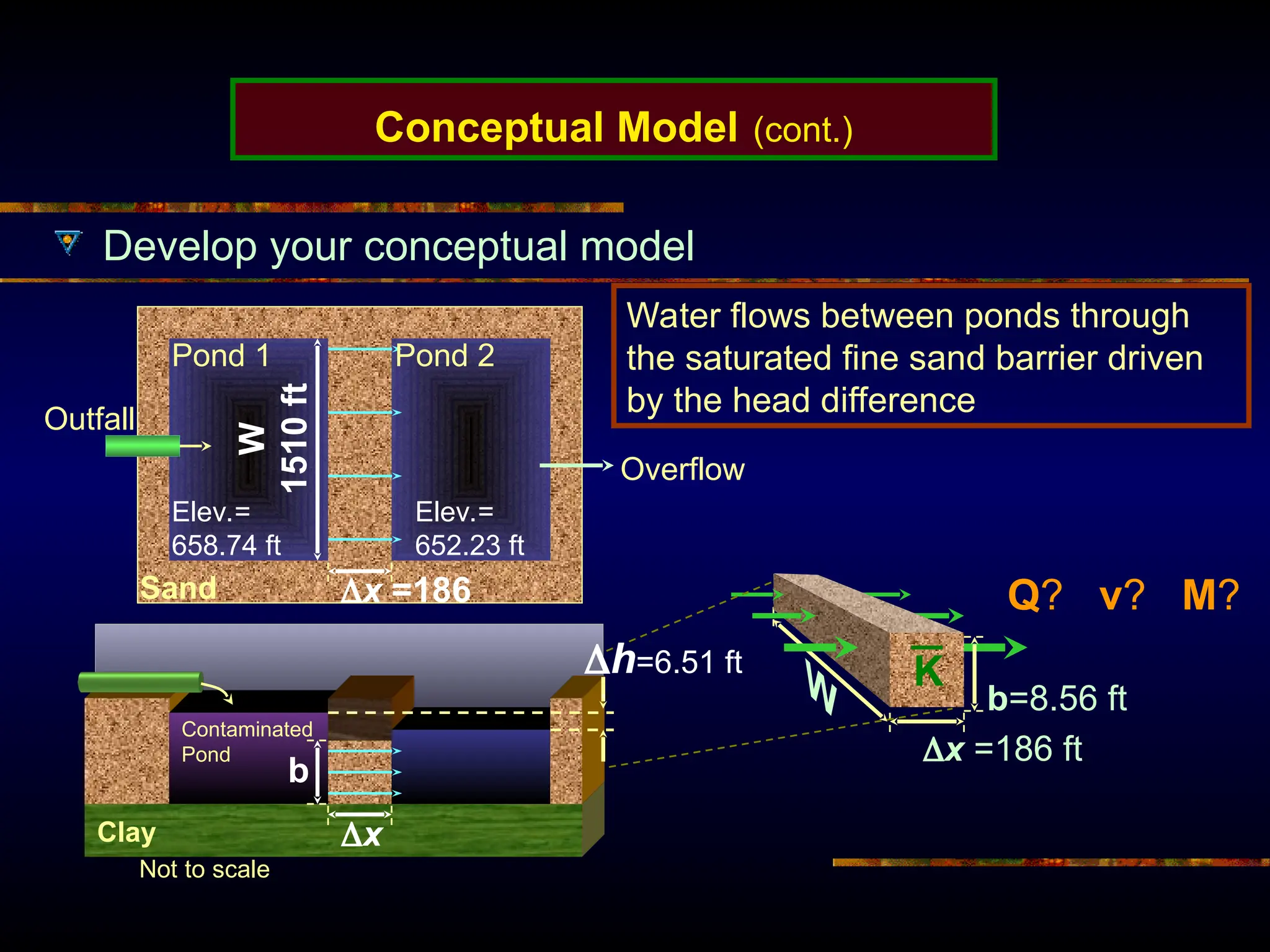
Develop your conceptual model
W
1510
ft
x =186
Pond 1 Pond 2
Outfall
Elev.=
658.74 ft
Elev.=
652.23 ft
Q? v? M?
K
x =186 ft
b=8.56 ft
Water flows between ponds through
the saturated fine sand barrier driven
by the head difference
Sand
Clay
h=6.51 ft
Contaminated
Pond
b
x
Not to scale
Overflow
Conceptual Model (cont.)
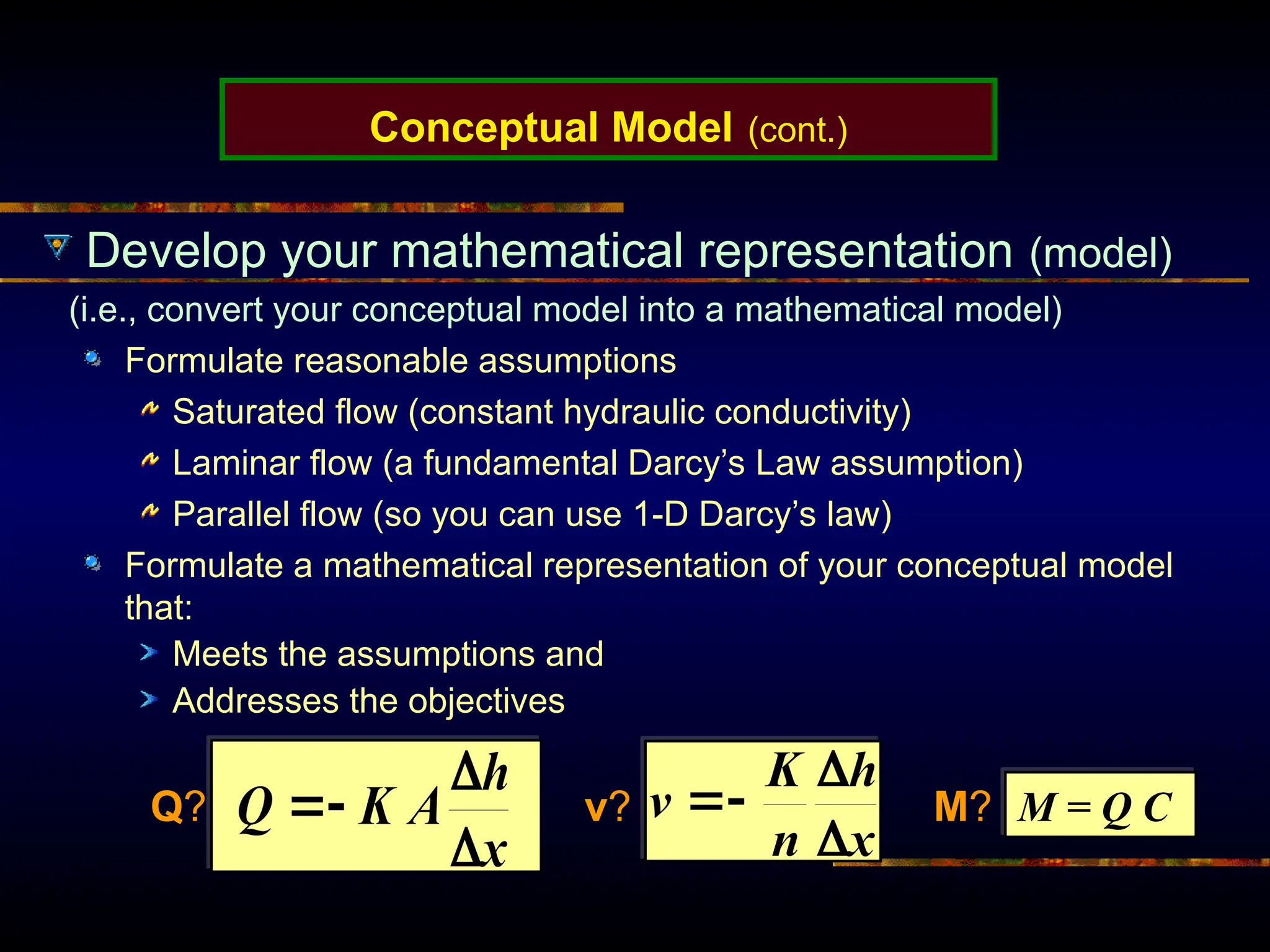
Develop your mathematical representation (model)
(i.e., convert your conceptual model into a mathematical model)
Formulate reasonable assumptions
Saturated flow (constant hydraulic conductivity)
Laminar flow (a fundamental Darcy’s Law assumption)
Parallel flow (so you can use 1-D Darcy’s law)
Formulate a mathematical representation of your conceptual model
that:
Meets the assumptions and
Addresses the objectives
M = Q C
Q? v? M?
Conceptual Model (cont.)
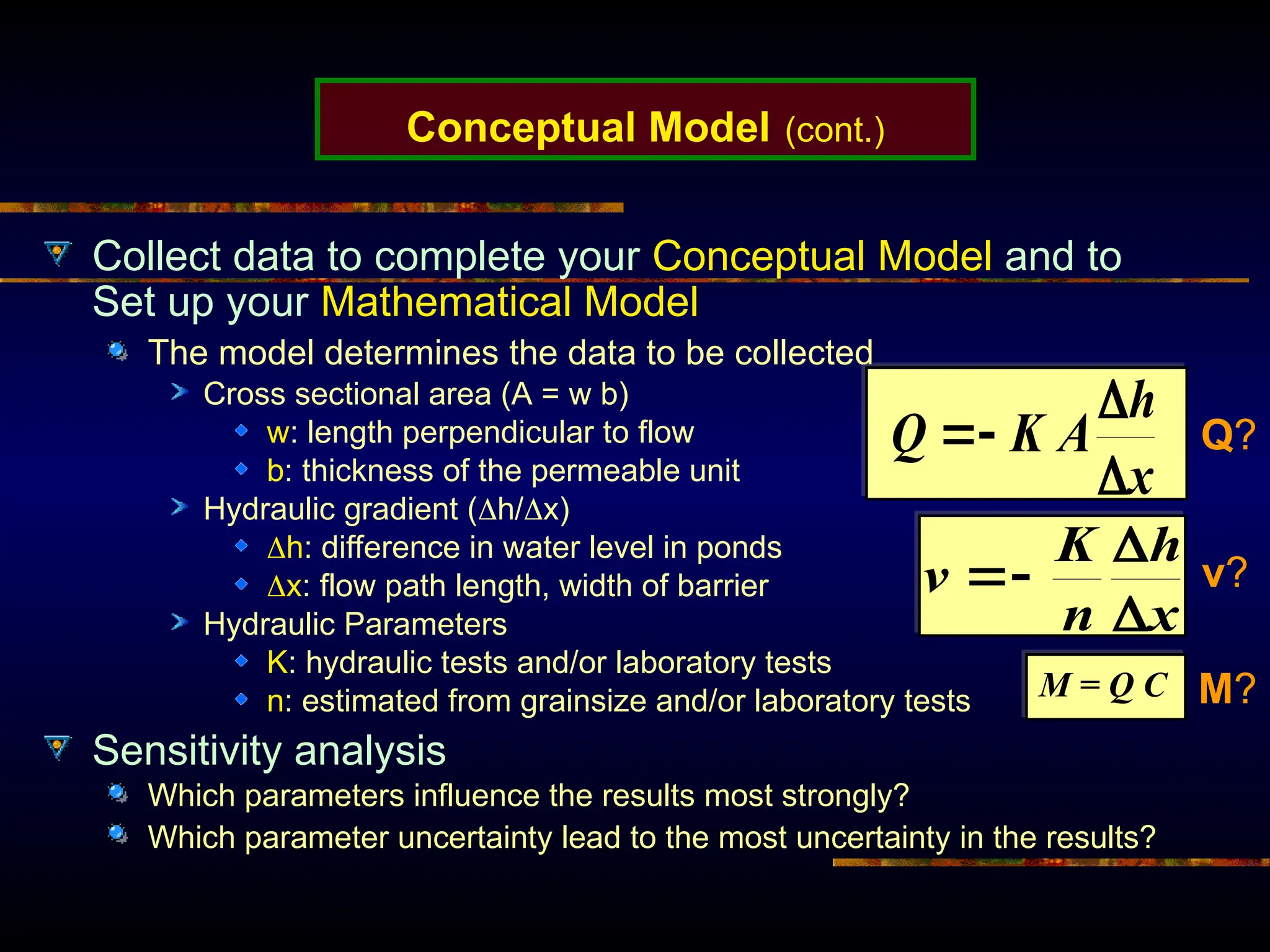
Collect data to complete your Conceptual Model and to
Set up your Mathematical Model
The model determines the data to be collected
Cross sectional area (A = w b)
w: length perpendicular to flow
b: thickness of the permeable unit
Hydraulic gradient (h/x)
h: difference in water level in ponds
x: flow path length, width of barrier
Hydraulic Parameters
K: hydraulic tests and/or laboratory tests
n: estimated from grainsize and/or laboratory tests
Sensitivity analysis
Which parameters influence the results most strongly?
Which parameter uncertainty lead to the most uncertainty in the results?
x
h
A
K
Q




x
h
n
K
v




M = Q C
Q?
v?
M?
Implementing Finite Difference Modeling
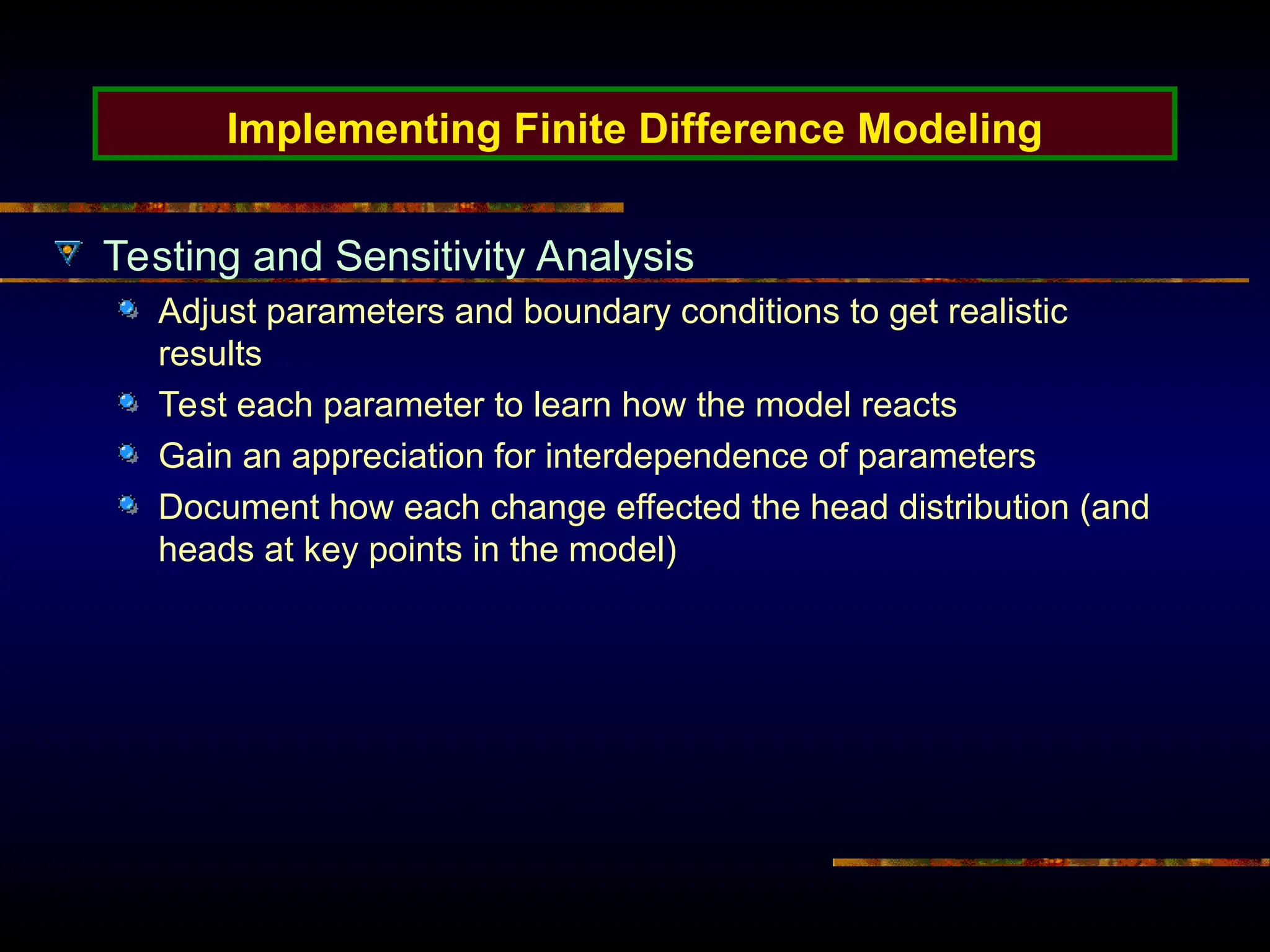
Testing and Sensitivity Analysis
Adjust parameters and boundary conditions to get realistic
results
Test each parameter to learn how the model reacts
Gain an appreciation for interdependence of parameters
Document how each change effected the head distribution (and
heads at key points in the model)
Implementation (cont.)
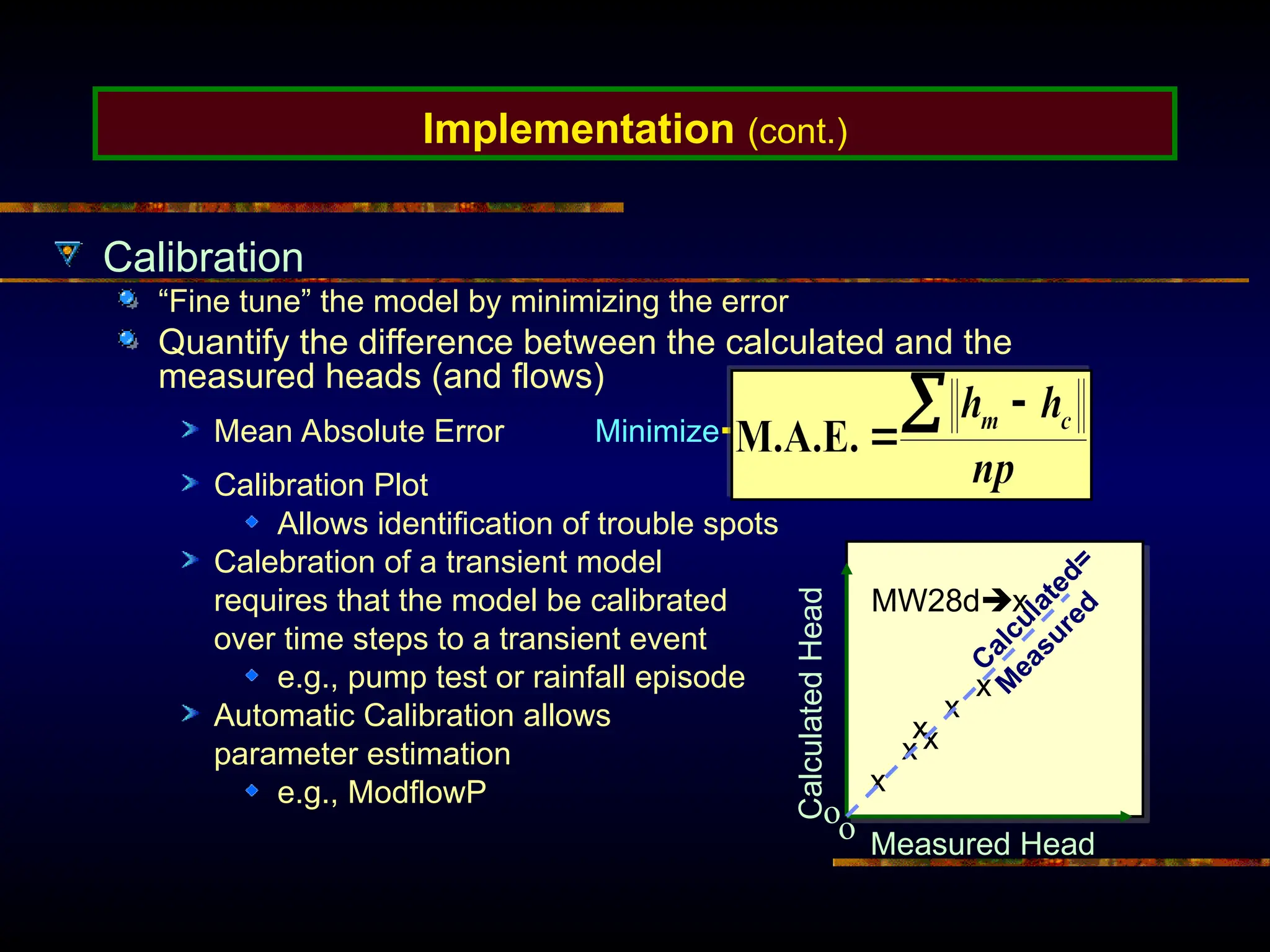
Calibration
“Fine tune” the model by minimizing the error
Quantify the difference between the calculated and the
measured heads (and flows)
Mean Absolute Error Minimize
Calibration Plot
Allows identification of trouble spots
Calebration of a transient model
requires that the model be calibrated
over time steps to a transient event
e.g., pump test or rainfall episode
Automatic Calibration allows
parameter estimation
e.g., ModflowP
Measured Head
Calculated
Head
x
x
o
o
x
x
x
x
MW28dx
C
a
l
c
u
l
a
t
e
d
=
M
e
a
s
u
r
e
d
Implementation (cont.)
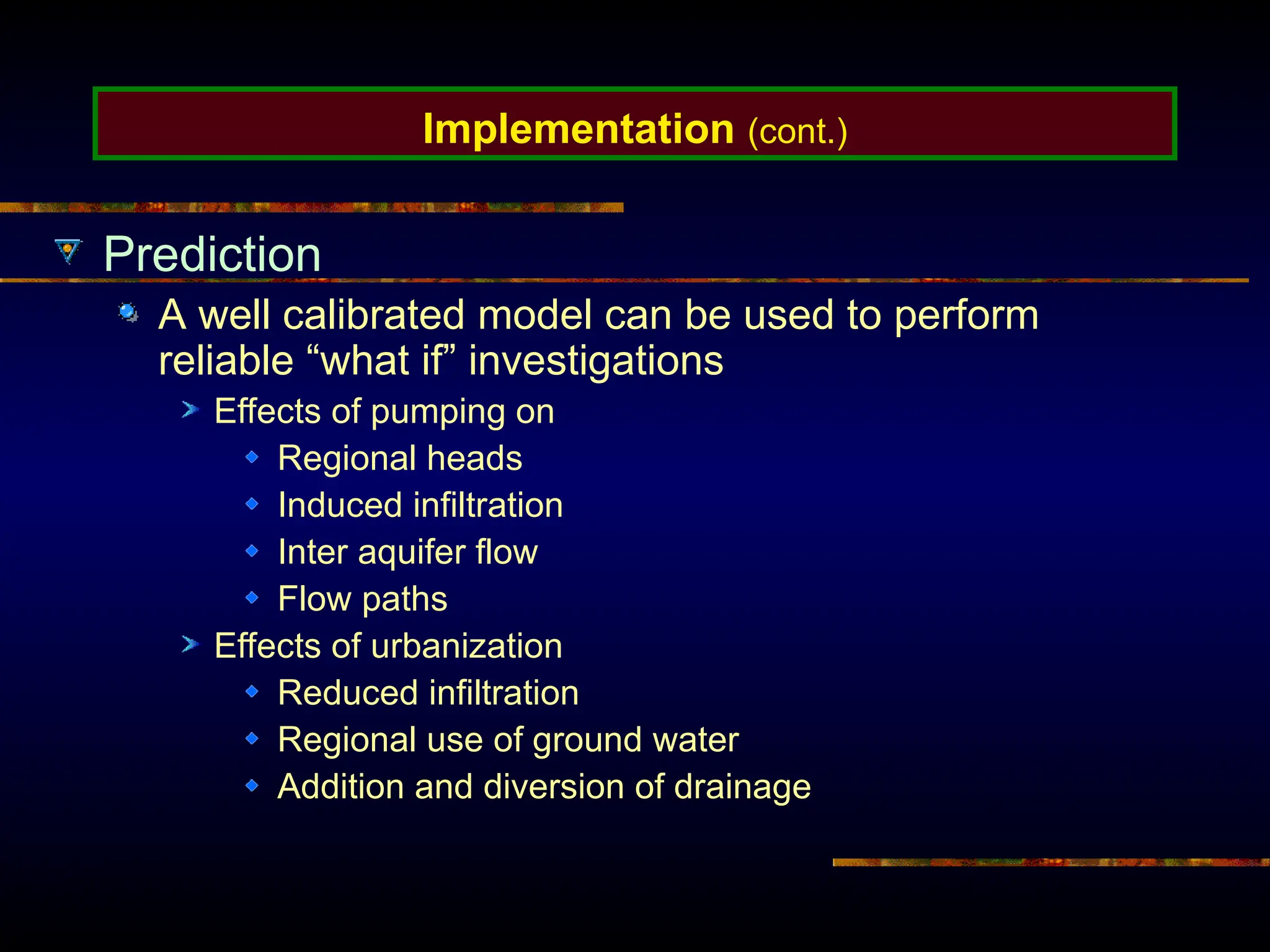
Prediction
A well calibrated model can be used to perform
reliable “what if” investigations
Effects of pumping on
Regional heads
Induced infiltration
Inter aquifer flow
Flow paths
Effects of urbanization
Reduced infiltration
Regional use of ground water
Addition and diversion of drainage
Case Study
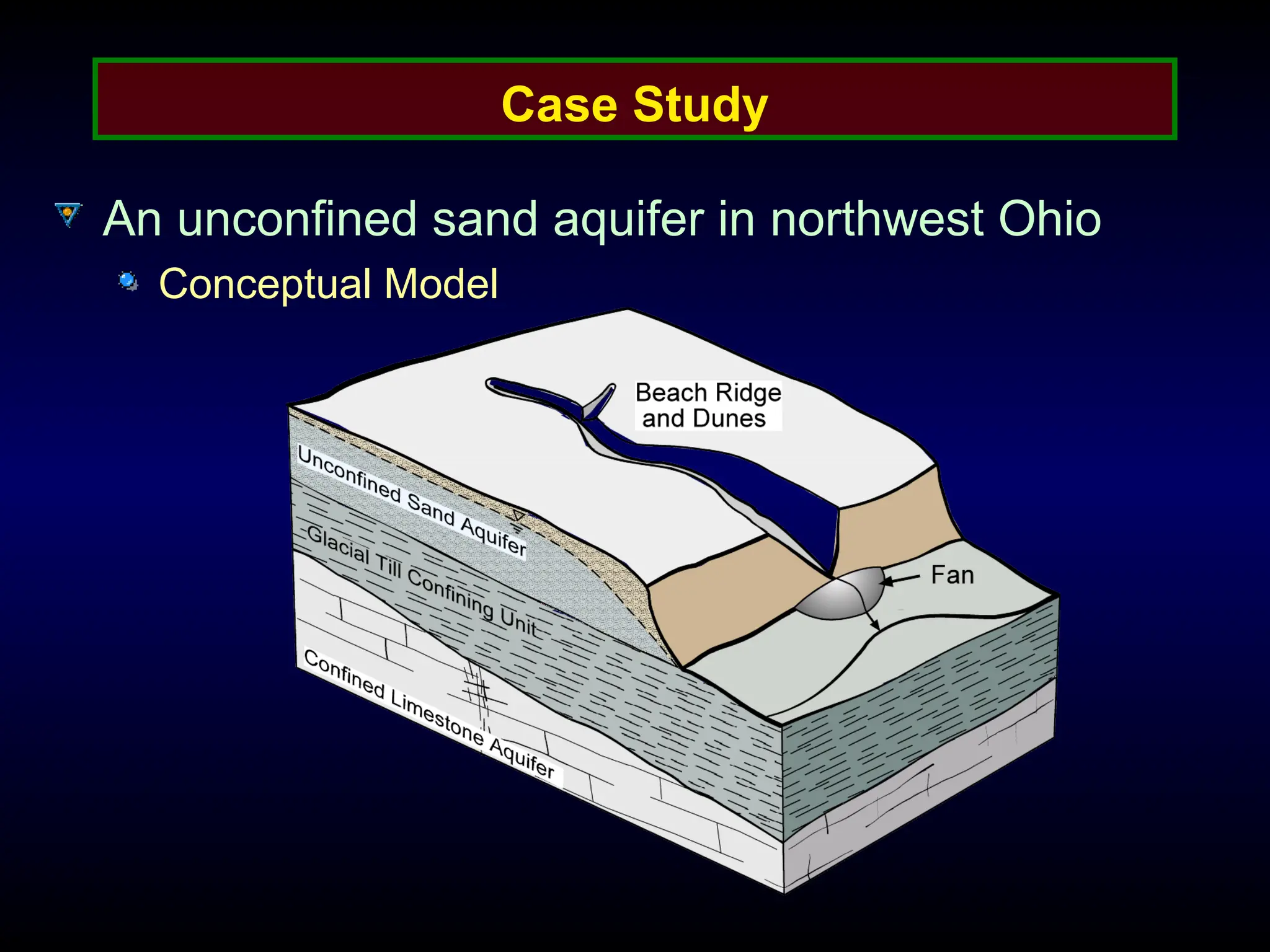
An unconfined sand aquifer in northwest Ohio
Conceptual Model
Case Study
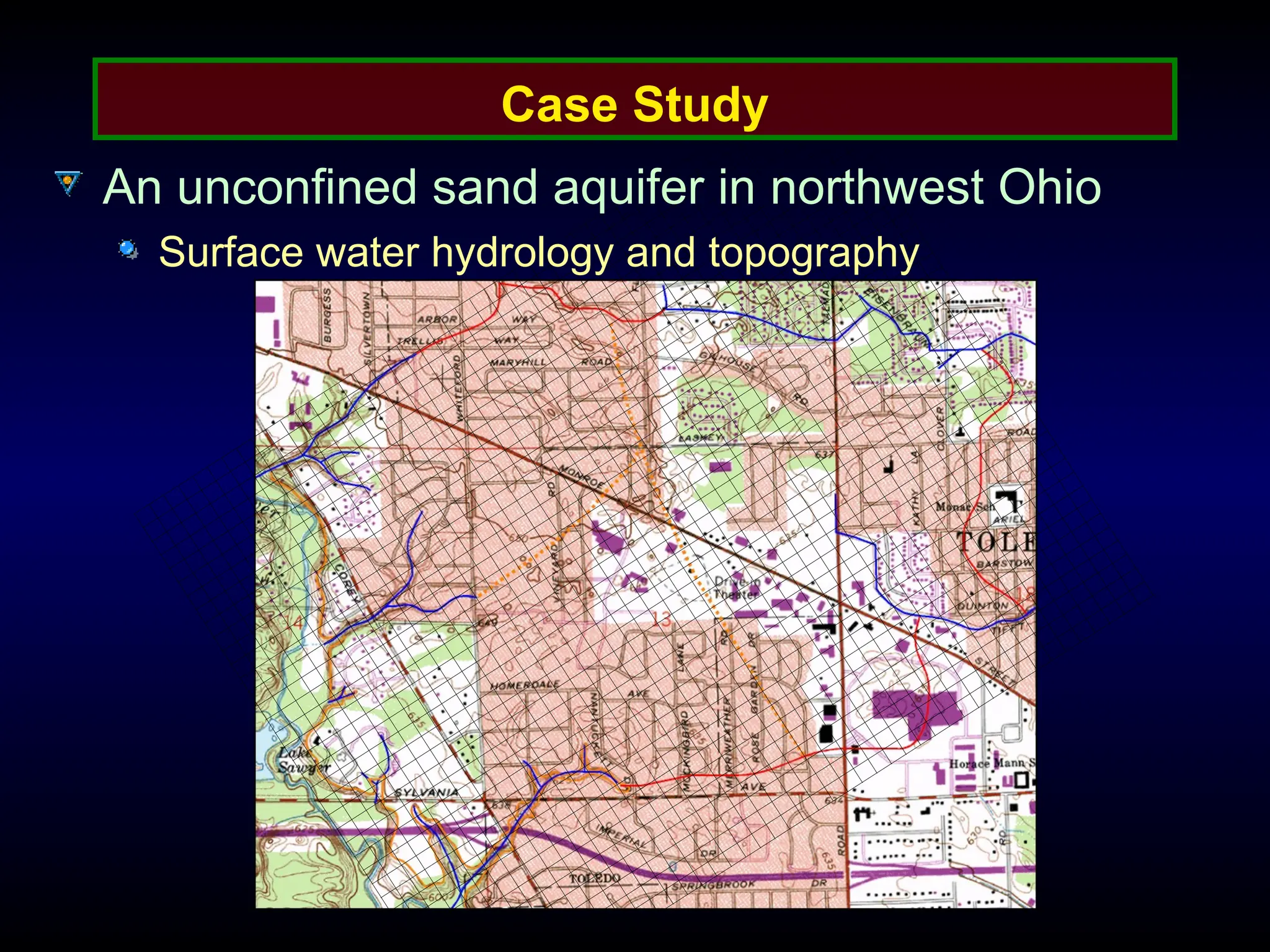
An unconfined sand aquifer in northwest Ohio
Surface water hydrology and topography
Boundary Conditions
FiniteDifference GW modeling  -  Compatibility Mode  -  Repaired.ppt

FiniteDifference GW modeling - Compatibility Mode - Repaired.ppt

  • 1.
    Dr. James M.Martin-Hayden Associate Professor Analytical and Numerical Ground Water Flow Modeling An Introduction (419) 530-2634 Jhayden@Geology.UToledo.edu
  • 2.
    The Ground WaterFlow Equation Mass Balance Objective of modeling: represent h=f(x,y,z,t) A common method of analysis in sciences For a “system”, during a period of time (e.g., a unit of time), Assumption: Water is incompressible Mass per unit volume (density, ) does not change significantly Volume is directly related to mass by density V=m/ In this case water balance models are essentially mass balance models divided by density Mass In – Mass Out = Change in Mass Stored Volume In – Volume Out = Change in Volume Stored Qi – Qo = Vw /t Dividing by unit time gives: If Q is a continuous function of time Q(t) then dv/dt is at any instant in time Qi(t) – Qo(t) = dVw/dt
  • 3.
    The Flow Equation(cont.) Example 1: Storage in a reservoir If Qi = Qo, dVw/dt = 0  no change in level, i.e., steady state If Qi > Qo, dVw/dt > 0 +filling If Qi < Qo, dVw/dt < 0  -emptying E.g., Change in storage due to linearly varying flows Qi Qo dVw/dt Qi(t) – Qo(t) = dVw/dt Q1 Q2 Qi =m 1·t+Q1 Qo =m2 ·t+Q2 t Q 0 dV/dt = 0 dV/dt < 0 dV/dt > 0
  • 4.
    The Flow Equation(cont.) Example 1: Storage in a reservoir If Qi = Qo, dVw/dt = 0  no change in level, i.e., steady state If Qi > Qo, dVw/dt > 0 +filling If Qi < Qo, dVw/dt < 0  -emptying Qi Qo dVw/dt Qi(t) – Qo(t) = dVw/dt Q1 Q2 Qi =m 1·t+Q1 Qo =m2 ·t+Q2 t Q 0 dV/dt = 0 dV/dt < 0 dV/dt > 0 t V dV/dt = 0 dV/dt < 0 dV/dt > 0
  • 5.
    The Flow Equation(cont.) Example 1: Storage in a reservoir If Qi = Qo, dVw/dt = 0  no change in level, i.e., steady state If Qi > Qo, dVw/dt > 0 +filling If Qi < Qo, dVw/dt < 0  -emptying Example 2: Storage in a REV (Representative Elementary Volume) REV: The smallest parcel of a unit that has properties (n, K, …) that are representative of the formation The same water balance can be used to examine the saturated (or unsaturated) REV Qi Qo dVw/dt Qi(t) – Qo(t) = dVw/dt
  • 6.
    Qo = qoy z The Flow Equation (cont.) Mass Balance for the REV (or any volume of a flow system) aka, “The Ground Water Flow Equation” x  y z Vw/t Qi – Qo = dVw/dt y z x = V (qi– qo)yz =dVw/dt Qi – Qo = (qo – qi)= q= (q/x) x Take change in q with x at a point (the derivative of q rwt x) For saturated, incompressible, 1-D flow n V Vw  Qi=qi y z
  • 7.
    The Flow Equation(cont.) External Sources and Sinks (Qs) y z x = V Differential Form
  • 8.
    The Flow Equation(cont.) 3-D, flow equation Summing the mass balance equation for each coordinate direction gives the total net inflow per unit volume into the REV Add a source term Qs/V volumetric flow rate per unit volume injected into REV Net inflow* = Change in volume stored* *per unit volume per unit time qx qz qy Substitute components of q from 3-D Darcy’s law
  • 9.
    The Flow Equation(cont.) Specific storage and homogeneity Due to aquifer compressibility: change in porosity is proportional to a change in head (over a infinitesimally small range, dh)* Assumption: K is homogeneous over small distances, i.e., K  f(x,y,z) Compressibility of water is much less than aquifer compressibility This gives the equation on which ground water flow models are based: h=f(x,y,z,t) Ss: Specific Storage, a proportionality constant
  • 10.
    The Flow Equation(cont.) Flow Equation Simplifications 0 Our job is not yet finished, h=f(x,y,z,t)? Isotropic, 2-D, steady state flow equation (without source term), a.k.a.: The Laplace Equation 2-D, horizontally isotropic flow equation Kx=Ky=Kh T=Kh b units: [L2 /T], S=Ss b Ah: horizontal area of recharge Ss/Kh=S/T  hydraulic diffusivity Two dimensional flow equation Horizontal flow (Dupuit assumption) Thus: dh/dz = 0 Steady State Flow Equation If inflow = out flow, Net inflow = 0 Change in storage = 0 0 0 0
  • 11.
    Introduction to GroundWater Flow Modeling Predicting heads (and flows) and Approximating parameters Solutions to the flow equations Most ground water flow models are solutions of some form of the ground water flow equation Potentiometric Surface x x x ho x 0 h(x) x K q “e.g., unidirectional, steady-state flow within a confined aquifer The partial differential equation needs to be solved to calculate head as a function of position and time, i.e., h=f(x,y,z,t) h(x,y,z,t)? Darcy’s Law Integrated
  • 12.
    Flow Modeling (cont.) Analyticalmodels (a.k.a., closed form models) The previous model is an example of an analytical model is a solution to the 1-D Laplace equation i.e., the second derivative of h(x) is zero With this analytical model, head can be calculated at any position (x) Analytical solutions to the 3-D transient flow equation would give head at any position and at any time, i.e., the continuous function h(x,y,z,t) Examples of analytical models: 1-D solutions to steady state and transient flow equations Thiem Equation: Steady state flow to a well in a confined aquifer The Theis Equation: Transient flow to a well in a confined aquifer Slug test solutions: Transient response of head within a well to a pressure pulse
  • 13.
    Flow Modeling (cont.) CommonAnalytical Models Thiem Equation: steady state flow to a well within a confined aquifer Analytic solution to the radial (1-D), steady-state, homogeneous K flow equation Gives head as a function of radial distance Theis Equation: Transient flow to a well within a confined aquifer Analytic solution of radial, transient, homogeneous K flow equation Gives head as a function of radial distance and time
  • 14.
    Pump Tests anGroundwater Modeling h as a function of r (radial distance) and t (time) Aquitard Aquifer Aquitard r1 r2 h1 h2 Q T?, S?
  • 15.
    Flow Modeling (cont.) ForwardModeling: Prediction Models can be used to predict h(x,y,z,t) if the parameters are known, K, T, Ss, S, n, b… Heads are used to predict flow rates,velocity distributions, flow paths, travel times. For example: Velocities for average contaminant transport Capture zones for ground water contaminant plume capture Travel time zones for wellhead protection Velocity distributions and flow paths are then used in contaminant transport modeling 1-D, SS Thiem Theis
  • 16.
    Flow Modeling (cont.) InverseModeling: Aquifer Characterization Use of forward modeling requires estimates of aquifer parameters Simple models can be solved for these parameters e.g., 1-D Steady State: This inverse model can be used to “characterize” K This estimate of K can then be used in a forward model to predict what will happen when other variables are changed ho h1 Clay b x ho h1 Q Q
  • 17.
    Flow Modeling (cont.) InverseModeling: Aquifer Characterization The Thiem Equation can also be solved for K Pump Test: This inverse model allows measurement of K using a steady state pump test A pumping well is pumped at a constant rate of Q until heads come to steady state, i.e., The steady-state heads, h1 and h2, are measured in two observation wells at different radial distances from the pumping well r1 and r2 The values are “plugged into” the inverse model to calculate K (a bulk measure of K over the area stressed by pumping) ) (t f h 
  • 18.
    Flow Modeling (cont.) InverseModeling: Aquifer Characterization Indirect solution of flow models More complex analytical flow models cannot be solved for the parameters Curve Matching or Iteration This calls for curve matching or iteration in order to calculate the aquifer parameters Advantages over steady state solution gives storage parameters S (or Ss) as well as T (or K) Pump test does not have to be continued to steady state Modifications allow the calculation of many other parameters e.g., Specific yield, aquitard leakage, anisotropy…
  • 19.
    Flow Modeling (cont.) Limitationsof Analytical Models Closed form models are well suited to the characterization of bulk parameters However, the flexibility of forward modeling is limited due to simplifying assumptions: Homogeneity, Isotropy, simple geometry, simple initial conditions… Geology is inherently complex: Heterogeneous, anisotropic, complex geometry, complex conditions… This complexity calls for a more powerful solution to the flow equation  Numerical modeling
  • 20.
    Numerical Modeling ina Nutshell A solution of flow equation is approximated on a discrete grid (or mesh) of points, cells or elements Within this discretized domain: 1)Aquifer parameters can be set at each cell within the grid 2)Complex aquifer geometry can be modeled 3)Complex boundary conditions can be accounted for Requires detailed knowledge of 1), 2) , and 3) As compared to analytical modeling, numerical modeling is: Well suited to prediction but More difficult to use for aquifer characterization Flow Modeling (cont.) The parameters and variables are specified over the boundary of the domain (region) being modeled
  • 21.
    An Introduction toFinite Difference Modeling Approximate Solutions to the Flow Equation Partial derivatives of head represent the change in head with respect to a coordinate direction (or time) at a point.e.g., t h or y h     h y h y h1 h2 y1 y2 y h y h      These derivatives can be approximated as the change in head (h) over a finite distance in the coordinate direction (y) that traverses the point i.e., The component of the hydraulic gradient in the y direction can be approximated by the finite difference h/y The Finite Difference Approximation of Derivatives
  • 22.
    Finite Difference Modeling(cont.) Approximation of the second derivative The second derivative of head with respect to x represents the change of the first derivative with respect to x The second derivative can be approximated using two finite differences centered around x2 This is known as a central difference h x x ha ho xo xb xa x hb ho-ha hb-ho x x h h y h      a o x h h y h      o b
  • 23.
    Finite Difference Modeling(cont.) Finite Difference Approximation of 1-D, Steady State Flow Equation   1-D, Steady State Flow Equation With external source (Qs)   Qs/Ah = R
  • 24.
    Finite Difference Modeling(cont.) Physical basis for finite difference approximation h x ha ho xo xb xa x hb ho-ha hb-ho x x h h x h      a o x h h x h      o b   x h h K z y q z y Q i i         a o oa   x h h K z y q z y Q o o         o b ob Koa: average K of cell and K of cell to the left; Kob: average K of cell and K of cell to the right     2 2 b o ob a o oa K K K K K K      y z x Ka Kb Ko
  • 25.
    Finite Difference Modeling(cont.) Inclusion of and external source Koa: average K of cell and K of cell to the left; Kob: average K of cell and K of cell to the right  y z x Ka Kb Ko Qs Qi Qo
  • 26.
    Finite Difference Modeling(cont.) Discretization of the Domain Divide the 1-D domain into equal cells of heterogeneous K … … h1 h2 h3 hi-1 hn x x x x x x x     head specified : and Constant 2 2 1 n o 1 i i 1/2 i 1 - i i 1/2 - i          h h x K K K K K K      … hi hi+1 x x   Solve for the head at each node gives n equations and n unknowns The head at each node is an average of the head at adjacent cells weighted by the Ks ho hn+1 Specified Head Specified Head
  • 27.
    Finite Difference Modeling(cont.) 2-D, Steady State, Uniform Grid Spacing, Finite Difference Scheme Divide the 2-D domain into equally spaced rows and columns of heterogeneous K ha ho hb hd hc x x x         2 2 2 2 d o od c o oc b o ob a o oa K K K K K K K K K K K K         Ka Kc Kb Kd Kd x x x Solve for ho
  • 28.
    Finite Difference Modeling(cont.) 2-D, Steady State, Uniform Grid Spacing, Finite Difference Scheme With Source Term Heterogeneous K ha ho hb hd hc x x x Ka Kc Kb Kd Kd x x Solve for ho V=xyz=x2 b
  • 29.
    ha ho hb hc Ka Kc Kb Kd FiniteDifference Modeling (cont.) Incorporate Transmissivity: Confined Aquifers multiply by b (aquifer thickness)                 2 2 2 2 2 2 2 2 d d o o d o od c c o o c o oc b b o o b o ob a a o o a o oa b K b K T T T b K b K T T T b K b K T T T b K b K T T T                 x x x x x Ko Kb Ka ba bo bb Solve for ho R or Qs
  • 30.
    ha ho hb hc Ka Kc Kb Kd xx x x x Ko Kb Ka ha ho hb Finite Difference Modeling (cont.) Incorporate Transmissivity: Unconfined Aquifers b depends on saturated thickness which is head (h) measured relative to the aquifer bottom         2 2 2 2 d o od c o oc b o ob a o oa h h h h h h h h h h h h         Solve for ho
  • 31.
    ha ho hb hc Ka Kc Kb Kd xx x x x Ko Kb Ka ha ho hb Finite Difference Modeling (cont.) Incorporate Transmissivity: Unconfined Aquifers Homogeneous K Solve for ho
  • 32.
    Finite Difference Modeling(cont.) 2-D, Steady State, Isotropic, Homogeneous Finite Difference Scheme ha ho hb hd hc x x x x x x Solve for ho
  • 33.
    Finite Difference Modeling(cont.) Spreadsheet Implementation Spreadsheets provide all you need to do basic finite difference modeling Interdependent calculations among grids of cells Iteration control Multiple sheets for multiple layers, 3-D, or heterogeneous parameter input Built in graphics: x-y scatter plots and basic surface plots A B C D E… 1 2 3 4 …
  • 34.
    Finite Difference Modeling(cont.) Spreadsheet Implementation of 2-D, Steady State, Isotropic, Homogeneous Finite Difference Type the formula into a computational cell Copy that cell into all other interior computational cell and the references will automatically adjust to calculate value for that cell Note: Boundary cells will be treated differently hB3 hC3 hD3 hC4 hC2 A B C D E… 1 2 3 4 5 = (C2+D3+C4+B3)/4
  • 35.
    Finite Difference Modeling(cont.) A simple example This will give a circular reference error Set Tools:Options… Calculation to Manual Select Tools:Options… Itteration SetMaximum Iteration and Maximum Change Press F9 to iteratively calculate 10 A B C D E… 2 3 4 5 10 10 10 10 10 7 5 2 1 1 1 Lake 1 Lake 2 River
  • 36.
    Basic Finite DifferenceDesign Discretization and Boundary Conditions Grids should be oriented and spaced to maximize the efficiency of the model Boundary conditions should represent reality as closely as possible
  • 37.
    Basic Finite DifferenceDesign (cont.) Discretization: Grid orientation Grid rows and columns should line up with as many rivers, shorelines, valley walls and other major boundaries as much as possible
  • 38.
    Basic Finite DifferenceDesign (cont.) Discretization: Variable Grid Spacing Rules of Thumb Refine grid around areas of interest Adjacent rows or columns should be no more than twice (or less than half) as wide as each other Expand spacing smoothly Many implementations of Numerical models allow Onscreen manipulation of Grids relative to an imported Base map
  • 39.
    Basic Finite DifferenceDesign (cont.) Boundary Conditions Any numerical model must be bounded on all sides of the domain (including bottom and top) The types of boundaries and mathematical representation depends on your conceptual model Types of Boundary Conditions Specified Head Boundaries Specified Flux Boundaries Head Dependant Flux Boundaries
  • 40.
    Basic Finite DifferenceDesign (cont.) Specified Head Boundaries Boundaries along which the heads have been measured and can be specified in the model e.g., surface water bodies They must be in good hydraulic connection with the aquifer Must influence heads throughout layer being modeled Large streams and lakes in unconfined aquifers with highly permeable beds Uniform Head Boundaries: Head is uniform in space, e.g., Lakes Spatially Varying Head Boundaries: e.g., River heads can be picked of of a topo map if: Hydraulic connection with and unconfined aquifer the streambed materials are more permeable than the aquifer materials
  • 41.
    Basic Finite DifferenceDesign (cont.) Specified Flux Boundaries Boundaries along which, or cells within which, inflows or outflows are set Recharge due to infiltration (R) Pumping wells (Qp) Induced infiltration Underflow No flow boundaries Valley wall of low permeable sediment or rock Fault
  • 42.
    Finite Difference Modeling(cont.) No Flow Boundary Implementation A special type of specified flux boundary Because there are no nodes outside the domain, the perpendicular node is reflected across the boundary as and “image node” hB3 hC4 hA2 A B C D E… 1 2 4 5 = (A2 +2*B3 +C4)/4 = (B1+D1+2*C2)/4 A3 C1 E3 = (2*D3+E2 +E4)/4 = (B5+2*C4+D5)/4 C5 hA3 hB3
  • 43.
    Finite Difference Modeling(cont.) No Flow Boundary Implementation Corner nodes have two image nodes B C D E… 2 4 5 = (2*B1 +2*A2)/4 = (2*D1+2*E2)/4 A1 E1 E5 = (2*D5+2*E4)/4 = (2*A4+2*B5)/4 A5 3
  • 44.
    Finite Difference Modeling(cont.) No Flow Boundary Implementation Combinations of edge and corner points are used to approximate irregular boundaries
  • 45.
    Finite Difference Modeling(cont.) Head Dependent Flux Boundaries Flow into or out of cell depends on the difference between the head in the cell and the head on the other side of a conductive boundary e.g. 1, Streambed conductance hs: stage of the stream ho: Head within the cell Ksb: K of streambed materials bsb: Thickness of streambed w: width of stream L: length of reach within cell Csb: Streambed conductance Based on Darcys law 1-D Flow through streambed hs ho w L bsb Qsb Qsb
  • 46.
    Finite Difference Modeling(cont.) Head Dependent Flux Boundaries e.g. 2, Flow through aquitard hc: Head within confined aquifer Ho: Head within the cell Kc: K of aquitard bc: Thickness of aquitard x2 : Area of cell Cc: aquitard conductance Based on Darcys law 1-D Flow through aquitard ho hc x bc Qc Qc x
  • 47.
    Case Study The LayeredModeling Approach Head, BCs: Uniform Head & No Flow Streambed Conductance Stream Stage Aquitard Conductance Confined Aquifer Specified Head Qstreams Qaquitard Aquifer Transmissivity: T=K*b Specified Fluxes Recharge due to infiltration of precip. Pumping wells Specified Flux BC No Flow Bound.
  • 48.
    Finite Difference Modeling(cont.) 3-D Finite Difference Models Approximate solution to the 3-D flow equation e.g., 3-D, Steady State, Homogeneous Finite Difference approximation 3-D Computational Cell ha ho hb hd hc hf
  • 49.
    Finite Difference Modeling(cont.) 3-D Finite Difference Models Requires vertical discretization (or layering) of model K1 K2 K3 K4
  • 50.
    Implementing Finite DifferenceModeling Model Set-Up, Sensitivity Analysis, Calibration and Prediction Model Set-Up Develop a Conceptual Model Collect Data Develop Mathematical Representation of your System Model set-up is an Iterative process Start simple and make sure the model runs after every added complexity Make Back-ups
  • 51.
    Implementation Anatomy of aHydrogeological Investigation and accompanying report Significance Define the problem in lay-terms Highlight the importance of the problem being addressed Objectives Define the specific objectives in technical terms Description of site and general hydrogeology This is a presentation of your conceptual model
  • 52.
    Implementation Anatomy of aHydrogeological Investigation (cont.) Methodology Convert your conceptual model into mathematical models that will specifically address the Objectives Determine specifically where you will get the information to set-up the models Results Set up the models, calibrate, and use them to address the objectives Conclusions Discuss specifically, and concisely, how your results achieved the Objectives (or not) If not, discuss improvements on the conceptual model and mathematical representations
  • 53.
    Developing a ConceptualModel Settling Pond Example* Questions to be addressed: (Objectives) How much flow can Pond 1 receive without overflowing? Q? How long will water (contamination) take to reach Pond 2 on average?v? How much contaminant mass will enter Pond 2 (per unit time)? M? A company has installed two settling ponds to: (Significance) Settle suspended solids from effluent Filter water before it discharges to stream Damp flow surges *This is a hypothetical example based on a composite of a few real cases 5000 ft 652 658 0 N Pond 1 Pond 2
  • 54.
    Conceptual Model (cont.) Developyour conceptual model W 1510 ft x =186 Pond 1 Pond 2 Outfall Elev.= 658.74 ft Elev.= 652.23 ft Q? v? M? K x =186 ft b=8.56 ft Water flows between ponds through the saturated fine sand barrier driven by the head difference Sand Clay h=6.51 ft Contaminated Pond b x Not to scale Overflow
  • 55.
    Conceptual Model (cont.) Developyour mathematical representation (model) (i.e., convert your conceptual model into a mathematical model) Formulate reasonable assumptions Saturated flow (constant hydraulic conductivity) Laminar flow (a fundamental Darcy’s Law assumption) Parallel flow (so you can use 1-D Darcy’s law) Formulate a mathematical representation of your conceptual model that: Meets the assumptions and Addresses the objectives M = Q C Q? v? M?
  • 56.
    Conceptual Model (cont.) Collectdata to complete your Conceptual Model and to Set up your Mathematical Model The model determines the data to be collected Cross sectional area (A = w b) w: length perpendicular to flow b: thickness of the permeable unit Hydraulic gradient (h/x) h: difference in water level in ponds x: flow path length, width of barrier Hydraulic Parameters K: hydraulic tests and/or laboratory tests n: estimated from grainsize and/or laboratory tests Sensitivity analysis Which parameters influence the results most strongly? Which parameter uncertainty lead to the most uncertainty in the results? x h A K Q     x h n K v     M = Q C Q? v? M?
  • 57.
    Implementing Finite DifferenceModeling Testing and Sensitivity Analysis Adjust parameters and boundary conditions to get realistic results Test each parameter to learn how the model reacts Gain an appreciation for interdependence of parameters Document how each change effected the head distribution (and heads at key points in the model)
  • 58.
    Implementation (cont.) Calibration “Fine tune”the model by minimizing the error Quantify the difference between the calculated and the measured heads (and flows) Mean Absolute Error Minimize Calibration Plot Allows identification of trouble spots Calebration of a transient model requires that the model be calibrated over time steps to a transient event e.g., pump test or rainfall episode Automatic Calibration allows parameter estimation e.g., ModflowP Measured Head Calculated Head x x o o x x x x MW28dx C a l c u l a t e d = M e a s u r e d
  • 59.
    Implementation (cont.) Prediction A wellcalibrated model can be used to perform reliable “what if” investigations Effects of pumping on Regional heads Induced infiltration Inter aquifer flow Flow paths Effects of urbanization Reduced infiltration Regional use of ground water Addition and diversion of drainage
  • 60.
    Case Study An unconfinedsand aquifer in northwest Ohio Conceptual Model
  • 61.
    Case Study An unconfinedsand aquifer in northwest Ohio Surface water hydrology and topography
  • 62.

Editor's Notes

  • #51 Understanding of the hydrogeological system will hinge on the development of a sound conceptual model, a concept in your mind of how the plumbing works and how it relates to the problem to be addressed We will use mathematical models (analytical and numerical) as tools to address these problems The next step is to learn how to convert your conceptual model into a mathematical model. This could be as simple as applying 1-D Darcy’s Law and as complex as setting up and calibrating a 3-D, transient numerical model. In any case the procedure is the same: 1) Define the problem in lay-terms (demonstrate the significance to your audience), 2) define the specific objectives in technical (hydrogeological) terms, 3) Develop a conceptual model [site description and general hydrogeology], 4) convert the conceptual model into mathematical models that will address the objectives [methodology] 5) determine specifically where you will get the information from to set up your model [more methodology], 6) set up your model, calibrate and use it to address the objective [results] This will also help write the documentation which you should be writing all along
  • #52 4) convert the conceptual model into mathematical models that will address the objectives [methodology] 5) determine specifically where you will get the information from to set up your model [more methodology], 6) set up your model, calibrate and use it to address the objective [results] This will also help write the documentation which you should be writing all along
  • #53 The company wanted to discharge sediment laden water into Pond 1 and have the water filter through a sand dike before it discharges into the stream This brings up the first question: How much water could they discharge without overflowing Pond 2? The upper settling pond is separated from the lower pond by 186 ft of sand The maximum elevation of Pond 1 is 658 ft and the outlet of Pond 2 is at an elevation of 652 If Pond 1 becomes contaminated with a dissolved contaminant it will flow towards Pond 2 at a rate roughly equivalent to the average groundwater velocity Once we figure out this velocity (given the distance of travel) it can be used to get a worst case calculation of the time of arrival of the advective front Once the contamination reaches Pond 2 the volumetric flow rate of the groundwater
  • #54 Two settling ponds were dug in 10 ft of sand, bottomed on low permeability clay. Two settling ponds, different levels, separated by an earthen barrier Start with conceptual model
  • #55 Any mathimatical model requires assumptions in order to represent an infinitely complex natural system with a set of mathematical equations This is a bit of an art because technically you need to develop a more complex model and demonstrate that the simplifications do not significantly effect the results If you understand the limits of the model you can make more appropriate assumptions
  • #56 The mathematical model is helpful in that it will dictate what information you need to collect Cross sectional area (perpendicular to flow): A=b*w Hydraulic gradient: Dh: head difference between ponds, Dx flow pathlength Discuss sensitivity analysis The accuracy of the model results depends on 1) how well your assumptions represent reality and 2) how accurately you have determined the parameters of the model.