Finite Automata for Lexical Analysis
Automatic lexical analyzer generation
• How do Lex and similar tools do their job?
– Lex translates regular expressions into transition
diagrams.
– Then it translates the transition diagrams into C
code to recognize tokens in the input stream.
• There are many possible algorithms.
• The simplest algorithm is RE -> NFA -> DFA -> C code.
Finite automata (FAs) and regular
languages
• A RECOGNIZER takes language L and string x as
input, and responds YES if x∈L, or NO otherwise.
• The finite automaton (FA) is one class of recognizer.
• A FA is DETERMINISTIC if there is only one possible
transition for each <state,input> pair.
• A FA is NONDETERMINISTIC if there is more than one
possible transition some <state,input> pair.
• BUT both DFAs and NFAs recognize the same class of
languages: REGULAR languages, or the class of
languages that can be written as regular expressions.
NFAs
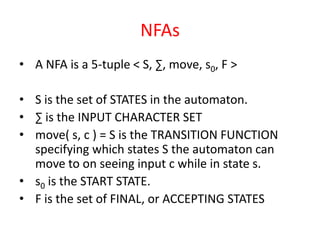
• A NFA is a 5-tuple < S, ∑, move, s0, F >
• S is the set of STATES in the automaton.
• ∑ is the INPUT CHARACTER SET
• move( s, c ) = S is the TRANSITION FUNCTION
specifying which states S the automaton can
move to on seeing input c while in state s.
• s0 is the START STATE.
• F is the set of FINAL, or ACCEPTING STATES
NFA example
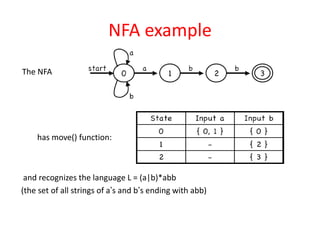
The NFA
has move() function:
and recognizes the language L = (a|b)*abb
(the set of all strings of a’s and b’s ending with abb)
The language defined by a NFA
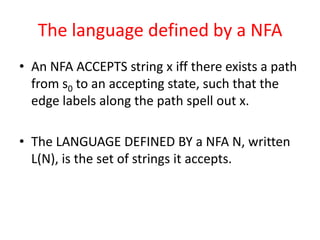
• An NFA ACCEPTS string x iff there exists a path
from s0 to an accepting state, such that the
edge labels along the path spell out x.
• The LANGUAGE DEFINED BY a NFA N, written
L(N), is the set of strings it accepts.
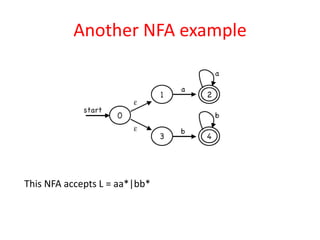
Another NFA example
This NFA accepts L = aa*|bb*
Deterministic FAs (DFAs)
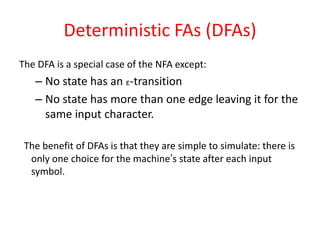
The DFA is a special case of the NFA except:
– No state has an ε-transition
– No state has more than one edge leaving it for the
same input character.
The benefit of DFAs is that they are simple to simulate: there is
only one choice for the machine’s state after each input
symbol.
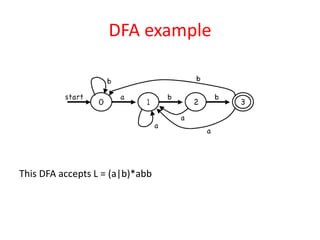
DFA example
This DFA accepts L = (a|b)*abb
RE -> DFA
• Now we know how to simulate DFAs.
• If we can convert our REs into a DFA, we can
automatically generate lexical analyzers.
• BUT it is not easy to convert REs directly into a
DFA.
• Instead, we will convert our REs to a NFA then
convert the NFA to a DFA.
Converting a NFA to a DFA
NFA -> DFA
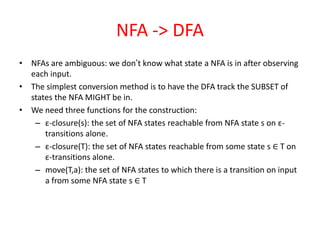
• NFAs are ambiguous: we don’t know what state a NFA is in after observing
each input.
• The simplest conversion method is to have the DFA track the SUBSET of
states the NFA MIGHT be in.
• We need three functions for the construction:
– ε-closure(s): the set of NFA states reachable from NFA state s on ε-
transitions alone.
– ε-closure(T): the set of NFA states reachable from some state s ∈ T on
ε-transitions alone.
– move(T,a): the set of NFA states to which there is a transition on input
a from some NFA state s ∈ T
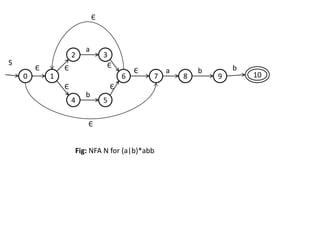
0 1
2 3
4 5
6 7 8 9 10
S
Є Є
Є
a
Є
Є
Є
b
Є
Є a b b
Fig: NFA N for (a|b)*abb
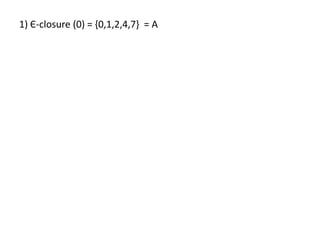
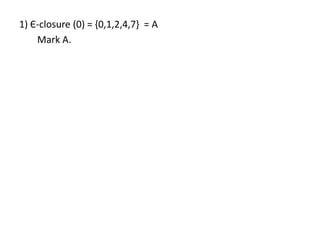
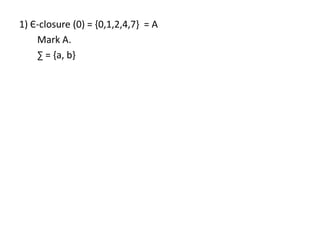
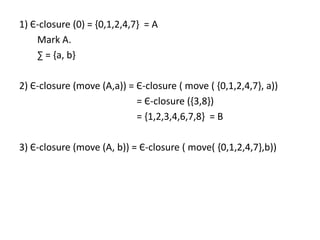
1) Є-closure (0) = {0,1,2,4,7} = A
Mark A.
1) Є-closure (0) = {0,1,2,4,7} = A
Mark A.
∑ = {a, b}
1) Є-closure (0) = {0,1,2,4,7} = A
Mark A.
∑ = {a, b}
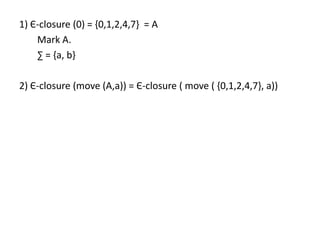
2) Є-closure (move (A,a)) = Є-closure ( move ( {0,1,2,4,7}, a))
1) Є-closure (0) = {0,1,2,4,7} = A
Mark A.
∑ = {a, b}
2) Є-closure (move (A,a)) = Є-closure ( move ( {0,1,2,4,7}, a))
= Є-closure ({3,8})
1) Є-closure (0) = {0,1,2,4,7} = A
Mark A.
∑ = {a, b}
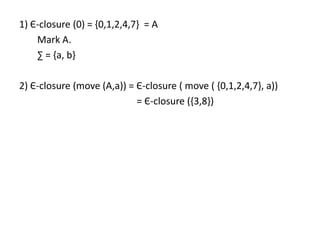
2) Є-closure (move (A,a)) = Є-closure ( move ( {0,1,2,4,7}, a))
= Є-closure ({3,8})
= {1,2,3,4,6,7,8} = B
1) Є-closure (0) = {0,1,2,4,7} = A
Mark A.
∑ = {a, b}
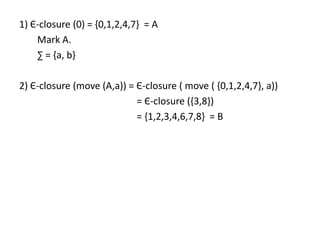
2) Є-closure (move (A,a)) = Є-closure ( move ( {0,1,2,4,7}, a))
= Є-closure ({3,8})
= {1,2,3,4,6,7,8} = B
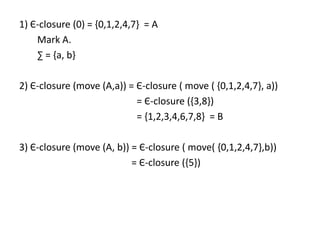
3) Є-closure (move (A, b)) = Є-closure ( move( {0,1,2,4,7},b))
1) Є-closure (0) = {0,1,2,4,7} = A
Mark A.
∑ = {a, b}
2) Є-closure (move (A,a)) = Є-closure ( move ( {0,1,2,4,7}, a))
= Є-closure ({3,8})
= {1,2,3,4,6,7,8} = B
3) Є-closure (move (A, b)) = Є-closure ( move( {0,1,2,4,7},b))
= Є-closure ({5})
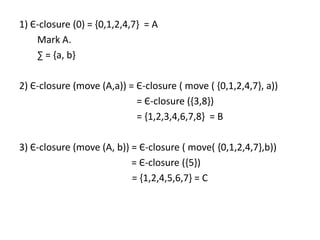
1) Є-closure (0) = {0,1,2,4,7} = A
Mark A.
∑ = {a, b}
2) Є-closure (move (A,a)) = Є-closure ( move ( {0,1,2,4,7}, a))
= Є-closure ({3,8})
= {1,2,3,4,6,7,8} = B
3) Є-closure (move (A, b)) = Є-closure ( move( {0,1,2,4,7},b))
= Є-closure ({5})
= {1,2,4,5,6,7} = C
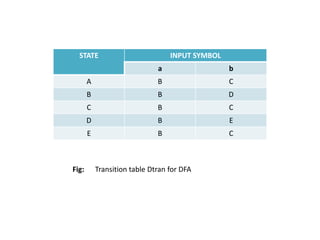
STATE INPUT SYMBOL
a b
A B C
B B D
C B C
D B E
E B C
Fig: Transition table Dtran for DFA
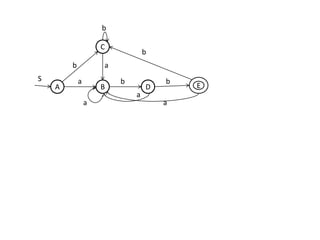
A
C
DB E
S
b
a
a
b
b
b b
a
a
a
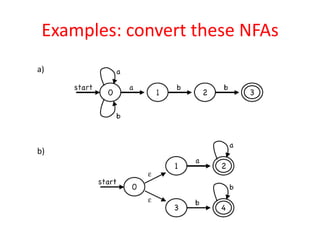
Examples: convert these NFAs
a)
b)
Converting a RE to a NFA
RE -> NFA
• The construction is bottom up.
• Construct NFAs to recognize ε and each element
a ∈ ∑.
• Recursively expand those NFAs for
alternation, concatenation, and Kleene closure.
• Every step introduces at most two additional
NFA states.
• Therefore the NFA is at most twice as large as
the regular expression.
RE -> NFA algorithm (Thompson’s
Construction)
Inputs: A RE r over alphabet ∑
Outputs: A NFA N accepting L(r)
Method: Parse r.
RE -> NFA algorithm (Thompson’s
Construction)
Inputs: A RE r over alphabet ∑
Outputs: A NFA N accepting L(r)
Method: Parse r.
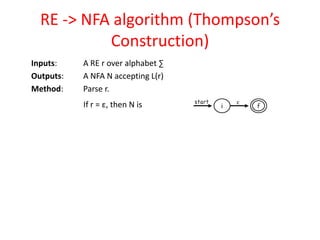
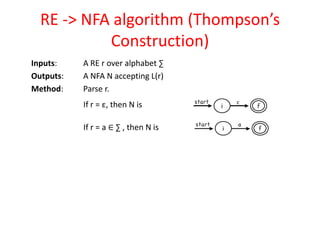
If r = ε, then N is
RE -> NFA algorithm (Thompson’s
Construction)
Inputs: A RE r over alphabet ∑
Outputs: A NFA N accepting L(r)
Method: Parse r.
If r = ε, then N is
RE -> NFA algorithm (Thompson’s
Construction)
Inputs: A RE r over alphabet ∑
Outputs: A NFA N accepting L(r)
Method: Parse r.
If r = ε, then N is
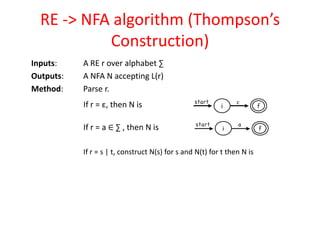
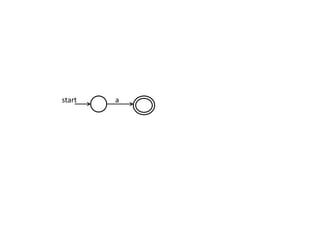
If r = a ∈ ∑ , then N is
RE -> NFA algorithm (Thompson’s
Construction)
Inputs: A RE r over alphabet ∑
Outputs: A NFA N accepting L(r)
Method: Parse r.
If r = ε, then N is
If r = a ∈ ∑ , then N is
RE -> NFA algorithm (Thompson’s
Construction)
Inputs: A RE r over alphabet ∑
Outputs: A NFA N accepting L(r)
Method: Parse r.
If r = ε, then N is
If r = a ∈ ∑ , then N is
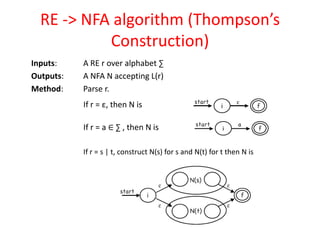
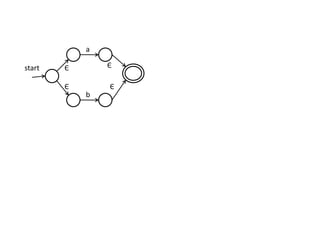
If r = s | t, construct N(s) for s and N(t) for t then N is
RE -> NFA algorithm (Thompson’s
Construction)
Inputs: A RE r over alphabet ∑
Outputs: A NFA N accepting L(r)
Method: Parse r.
If r = ε, then N is
If r = a ∈ ∑ , then N is
If r = s | t, construct N(s) for s and N(t) for t then N is
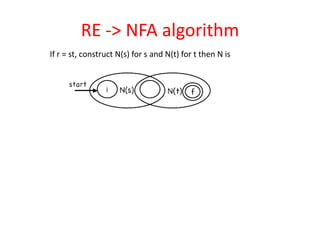
RE -> NFA algorithm
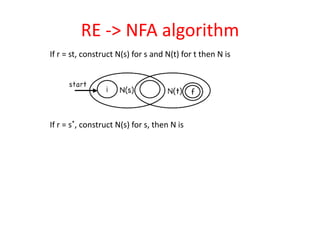
If r = st, construct N(s) for s and N(t) for t then N is
RE -> NFA algorithm
If r = st, construct N(s) for s and N(t) for t then N is
RE -> NFA algorithm
If r = st, construct N(s) for s and N(t) for t then N is
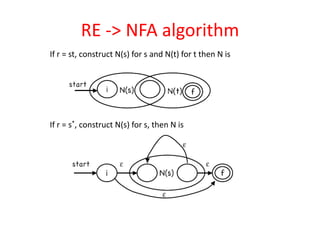
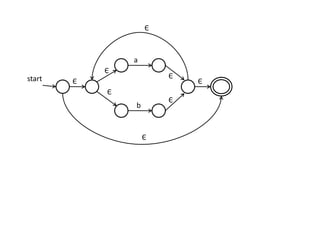
If r = s*, construct N(s) for s, then N is
RE -> NFA algorithm
If r = st, construct N(s) for s and N(t) for t then N is
If r = s*, construct N(s) for s, then N is
Example
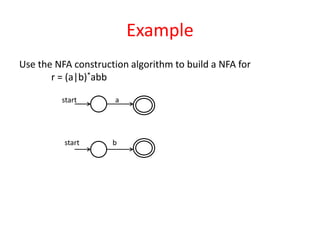
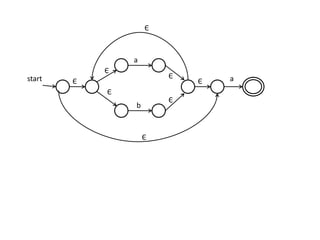
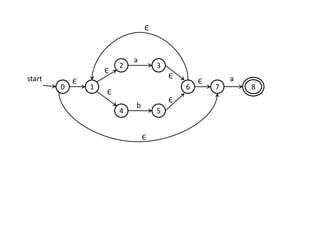
Use the NFA construction algorithm to build a NFA for
r = (a|b)*abb
start a
start b
Є
Є
a
Є
Є
b
start
Є
Є
a
Є
Є
b
Єstart
Є
Є
Є
start a
Є
Є
a
Є
Є
b
Єstart
Є
Є
Є
a
1
2 3
4 5
Є
Є
a
Є
Є
b
6
Є
0
start
Є
Є
Є
7 8
a
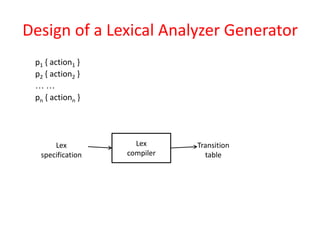
Design of a Lexical Analyzer Generator
p1 { action1 }
p2 { action2 }
… …
pn { actionn }
Lex
compiler
Lex
specification
Transition
table
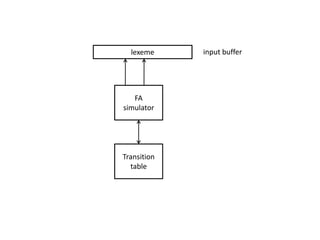
lexeme
FA
simulator
Transition
table
input buffer
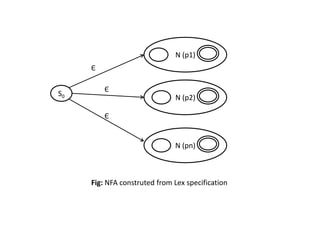
S0
N (p1)
N (p2)
N (pn)
Є
Є
Є
Fig: NFA construted from Lex specification
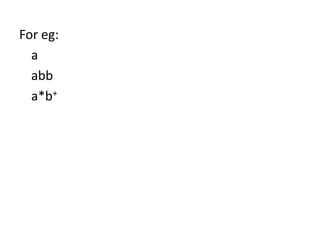
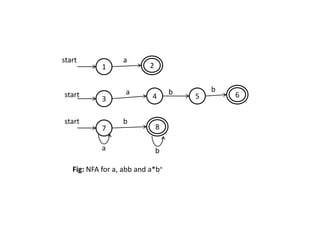
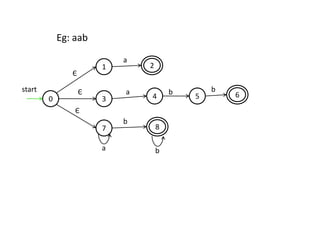
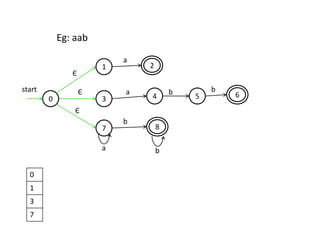
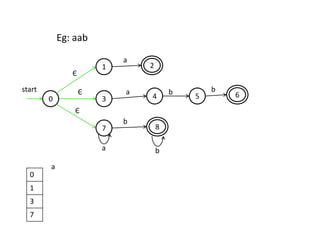
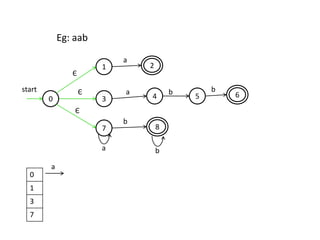
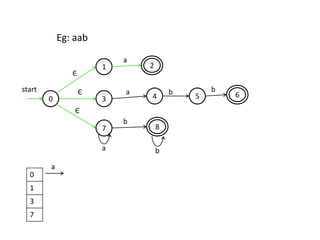
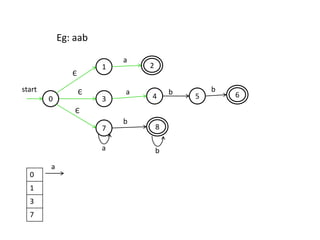
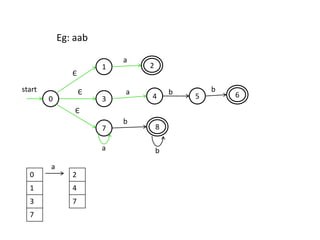
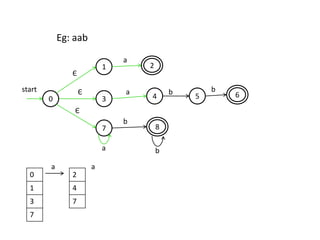
For eg:
a
abb
a*b+
1
3
7
2
54 6
8
start
start
start
a
a
a
b
b
b b
Fig: NFA for a, abb and a*b+
1
3
7
2
54 6
8
start
a
a
a
b
b
b b
1
Є
Є
Є
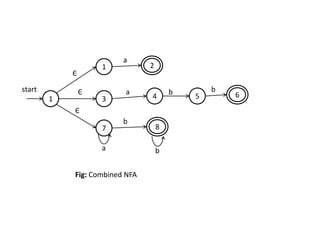
Fig: Combined NFA
1
3
7
2
54 6
8
start
a
a
a
b
b
b b
0
Є
Є
Є
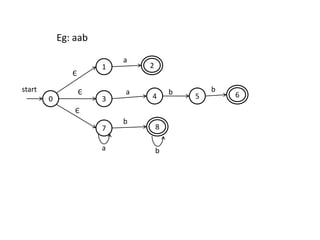
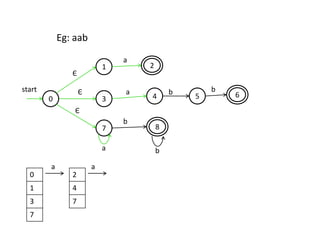
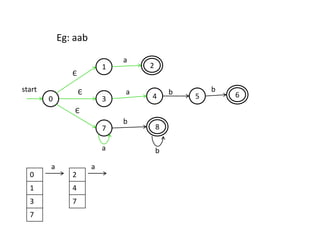
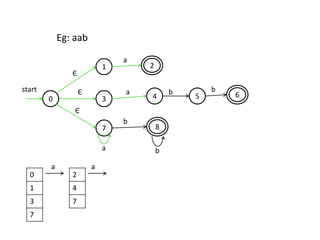
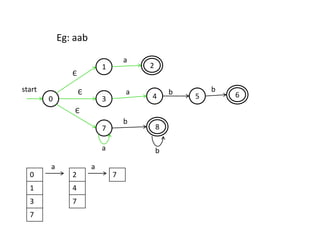
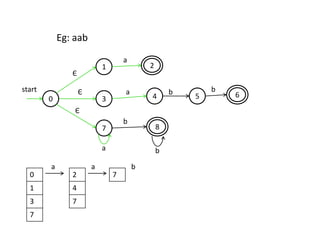
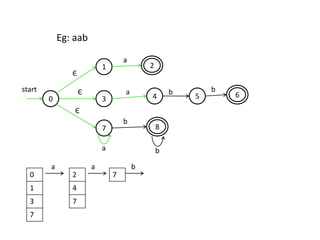
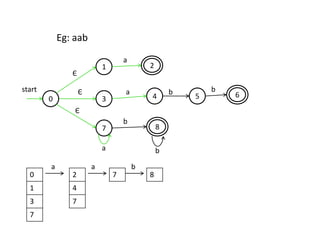
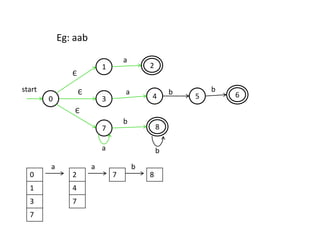
Eg: aab
1
3
7
2
54 6
8
start
a
a
a
b
b
b b
0
Є
Є
Є
Eg: aab
1
3
7
2
54 6
8
start
a
a
a
b
b
b b
0
Є
Є
Є
Eg: aab
0
1
3
7
1
3
7
2
54 6
8
start
a
a
a
b
b
b b
0
Є
Є
Є
Eg: aab
0
1
3
7
a
1
3
7
2
54 6
8
start
a
a
a
b
b
b b
0
Є
Є
Є
Eg: aab
0
1
3
7
a
1
3
7
2
54 6
8
start
a
a
a
b
b
b b
0
Є
Є
Є
Eg: aab
0
1
3
7
a
1
3
7
2
54 6
8
start
a
a
a
b
b
b b
0
Є
Є
Є
Eg: aab
0
1
3
7
a
1
3
7
2
54 6
8
start
a
a
a
b
b
b b
0
Є
Є
Є
Eg: aab
0
1
3
7
2
4
7
a
1
3
7
2
54 6
8
start
a
a
a
b
b
b b
0
Є
Є
Є
Eg: aab
0
1
3
7
2
4
7
a a
1
3
7
2
54 6
8
start
a
a
a
b
b
b b
0
Є
Є
Є
Eg: aab
0
1
3
7
2
4
7
a a
1
3
7
2
54 6
8
start
a
a
a
b
b
b b
0
Є
Є
Є
Eg: aab
0
1
3
7
2
4
7
a a
1
3
7
2
54 6
8
start
a
a
a
b
b
b b
0
Є
Є
Є
Eg: aab
0
1
3
7
2
4
7
a a
1
3
7
2
54 6
8
start
a
a
a
b
b
b b
0
Є
Є
Є
Eg: aab
0
1
3
7
2
4
7
7
a a
1
3
7
2
54 6
8
start
a
a
a
b
b
b b
0
Є
Є
Є
Eg: aab
0
1
3
7
2
4
7
7
a a b
1
3
7
2
54 6
8
start
a
a
a
b
b
b b
0
Є
Є
Є
Eg: aab
0
1
3
7
2
4
7
7
a a b
1
3
7
2
54 6
8
start
a
a
a
b
b
b b
0
Є
Є
Є
Eg: aab
0
1
3
7
2
4
7
7 8
a a b
1
3
7
2
54 6
8
start
a
a
a
b
b
b b
0
Є
Є
Є
Eg: aab
0
1
3
7
2
4
7
7 8
a a b
0 21
6
3
45
7
8
start
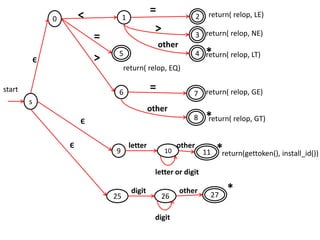
< =
>
other
return( relop, LE)
return( relop, NE)
return( relop, LT)
return( relop, EQ)
return( relop, GE)
return( relop, GT)
other
=
*
*
=
>
9 10 11
Є
letter
letter or digit
other
*return(gettoken(), install_id())
25 26 27
digit
digit
other *
Є
s
Є

Finite automata-for-lexical-analysis