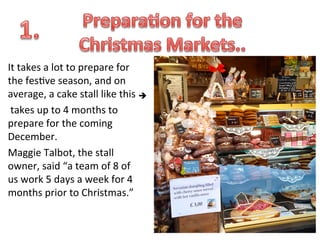
It	
  takes	
  a	
  lot	
  to	
  prepare	
  for	
  
the	
  fes.ve	
  season,	
  and	
  on	
  
average,	
  a	
  cake	
  stall	
  like	
  this	
  è	


  takes	
  up	
  to	
  4	
  months	
  to	
  
prepare	
  for	
  the	
  coming	
  
December.	
  	
  
Maggie	
  Talbot,	
  the	
  stall	
  
owner,	
  said	
  “a	
  team	
  of	
  8	
  of	
  
us	
  work	
  5	
  days	
  a	
  week	
  for	
  4	
  
months	
  prior	
  to	
  Christmas.”	
  
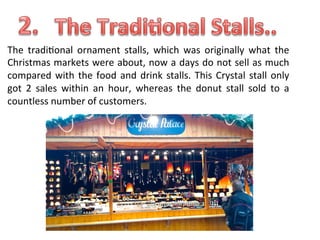
The	
   tradi.onal	
   ornament	
   stalls,	
   which	
   was	
   originally	
   what	
   the	
  
Christmas	
  markets	
  were	
  about,	
  now	
  a	
  days	
  do	
  not	
  sell	
  as	
  much	
  
compared	
   with	
   the	
   food	
   and	
   drink	
   stalls.	
   This	
   Crystal	
   stall	
   only	
  
got	
   2	
   sales	
   within	
   an	
   hour,	
   whereas	
   the	
   donut	
   stall	
   sold	
   to	
   a	
  
countless	
  number	
  of	
  customers.	
  
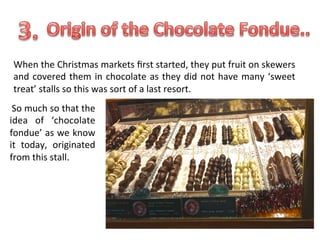
When	
  the	
  Christmas	
  markets	
  first	
  started,	
  they	
  put	
  fruit	
  on	
  skewers	
  
and	
   covered	
   them	
   in	
   chocolate	
   as	
   they	
   did	
   not	
   have	
   many	
   ‘sweet	
  
treat’	
  stalls	
  so	
  this	
  was	
  sort	
  of	
  a	
  last	
  resort.	
  
	
  So	
  much	
  so	
  that	
  the	
  

idea	
   of	
   ‘chocolate	
  
fondue’	
  as	
  we	
  know	
  
it	
   today,	
   originated	
  
from	
  this	
  stall.	


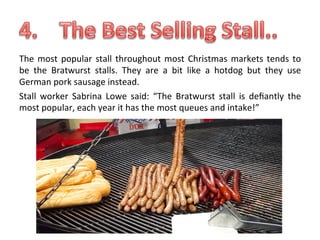
The	
   most	
   popular	
   stall	
   throughout	
   most	
   Christmas	
   markets	
   tends	
   to	
  
be	
   the	
   Bratwurst	
   stalls.	
   They	
   are	
   a	
   bit	
   like	
   a	
   hotdog	
   but	
   they	
   use	
  
German	
  pork	
  sausage	
  instead.	
  
Stall	
   worker	
   Sabrina	
   Lowe	
   said:	
   “The	
   Bratwurst	
   stall	
   is	
   defiantly	
   the	
  
most	
  popular,	
  each	
  year	
  it	
  has	
  the	
  most	
  queues	
  and	
  intake!”	


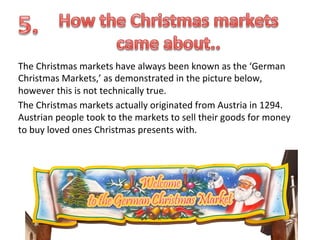
The	
  Christmas	
  markets	
  have	
  always	
  been	
  known	
  as	
  the	
  ‘German	
  
Christmas	
  Markets,’	
  as	
  demonstrated	
  in	
  the	
  picture	
  below,	
  
however	
  this	
  is	
  not	
  technically	
  true.	
  
The	
  Christmas	
  markets	
  actually	
  originated	
  from	
  Austria	
  in	
  1294.	
  
Austrian	
  people	
  took	
  to	
  the	
  markets	
  to	
  sell	
  their	
  goods	
  for	
  money	
  
to	
  buy	
  loved	
  ones	
  Christmas	
  presents	
  with.	
  
There	
   are	
   the	
   more	
   general	
  
stalls	
   that	
   appear	
   at	
   all	
  
Christmas	
   markets	
   but	
   every	
  
town	
   that	
   hosts	
   the	
   markets	
  
will	
   have	
   a	
   local	
   varia.on	
   of	
  
stalls,	
   for	
   example	
   the	
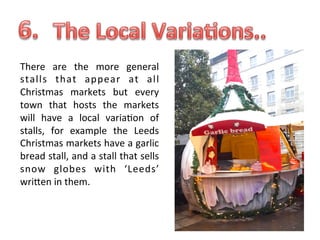
   Leeds	
  
Christmas	
   markets	
   have	
   a	
   garlic	
  
bread	
  stall,	
  and	
  a	
  stall	
  that	
  sells	
  
snow	
   globes	
   with	
   ‘Leeds’	
  
wriUen	
  in	
  them.	
  
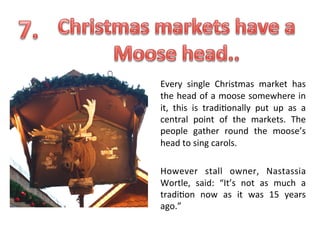
Every	
   single	
   Christmas	
   market	
   has	
  
the	
  head	
  of	
  a	
  moose	
  somewhere	
  in	
  
it,	
   this	
   is	
   tradi.onally	
   put	
   up	
   as	
   a	
  
central	
   point	
   of	
   the	
   markets.	
   The	
  
people	
   gather	
   round	
   the	
   moose’s	
  
head	
  to	
  sing	
  carols.	


However	
   stall	
   owner,	
   Nastassia	
  
Wortle,	
   said:	
   “It’s	
   not	
   as	
   much	
   a	
  
tradi.on	
   now	
   as	
   it	
   was	
   15	
   years	
  
ago.”	


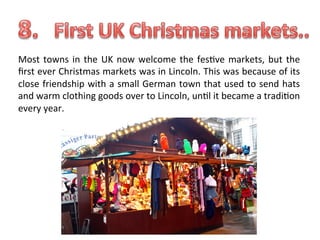
Most	
   towns	
   in	
   the	
   UK	
   now	
   welcome	
   the	
   fes.ve	
   markets,	
   but	
   the	
  
first	
  ever	
  Christmas	
  markets	
  was	
  in	
  Lincoln.	
  This	
  was	
  because	
  of	
  its	
  
close	
  friendship	
  with	
  a	
  small	
  German	
  town	
  that	
  used	
  to	
  send	
  hats	
  
and	
  warm	
  clothing	
  goods	
  over	
  to	
  Lincoln,	
  un.l	
  it	
  became	
  a	
  tradi.on	
  
every	
  year.	
  
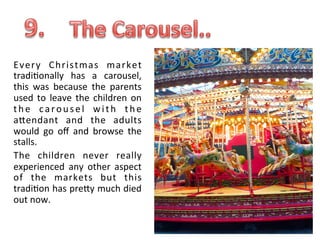
Every	
   Chri stmas	
   market	
  
tradi.onally	
   has	
   a	
   carousel,	
  
this	
   was	
   because	
   the	
   parents	
  
used	
   to	
   leave	
   the	
   children	
   on	
  
t h e	
   c a r o u s e l	
   w i t h	
   t h e	
  
aUendant	
   and	
   the	
   adults	
  
would	
   go	
   off	
   and	
   browse	
   the	
  
stalls.	
  	
  
The	
   children	
   never	
   really	
  
experienced	
   any	
   other	
   aspect	
  
of	
   the	
   markets	
   but	
   this	
  
tradi.on	
  has	
  preUy	
  much	
  died	
  
out	
  now.	
  
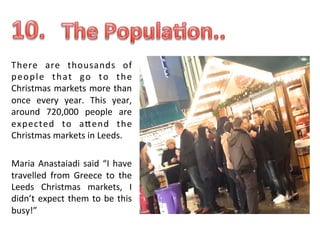
There	
   are	
   thousands	
   of	
  
p e o p l e	
   t h a t	
   g o	
   t o	
   t h e	
  
Christmas	
  markets	
  more	
  than	
  
once	
   every	
   year.	
   This	
   year,	
  
around	
   720,000	
   people	
   are	
  
expected	
   to	
   aUend	
   the	
  
Christmas	
  markets	
  in	
  Leeds.	


Maria	
   Anastaiadi	
   said	
   “I	
   have	
  
travelled	
   from	
   Greece	
   to	
   the	
  
Leeds	
   Christmas	
   markets,	
   I	
  
didn’t	
   expect	
   them	
   to	
   be	
   this	
  
busy!”	
  

Finished christmas markets dp assignment

  • 2.
    It  takes  a  lot  to  prepare  for   the  fes.ve  season,  and  on   average,  a  cake  stall  like  this  è      takes  up  to  4  months  to   prepare  for  the  coming   December.     Maggie  Talbot,  the  stall   owner,  said  “a  team  of  8  of   us  work  5  days  a  week  for  4   months  prior  to  Christmas.”  
  • 3.
    The   tradi.onal   ornament   stalls,   which   was   originally   what   the   Christmas  markets  were  about,  now  a  days  do  not  sell  as  much   compared   with   the   food   and   drink   stalls.   This   Crystal   stall   only   got   2   sales   within   an   hour,   whereas   the   donut   stall   sold   to   a   countless  number  of  customers.  
  • 4.
    When  the  Christmas  markets  first  started,  they  put  fruit  on  skewers   and   covered   them   in   chocolate   as   they   did   not   have   many   ‘sweet   treat’  stalls  so  this  was  sort  of  a  last  resort.    So  much  so  that  the   idea   of   ‘chocolate   fondue’  as  we  know   it   today,   originated   from  this  stall.      
  • 5.
    The   most   popular   stall   throughout   most   Christmas   markets   tends   to   be   the   Bratwurst   stalls.   They   are   a   bit   like   a   hotdog   but   they   use   German  pork  sausage  instead.   Stall   worker   Sabrina   Lowe   said:   “The   Bratwurst   stall   is   defiantly   the   most  popular,  each  year  it  has  the  most  queues  and  intake!”    
  • 6.
    The  Christmas  markets  have  always  been  known  as  the  ‘German   Christmas  Markets,’  as  demonstrated  in  the  picture  below,   however  this  is  not  technically  true.   The  Christmas  markets  actually  originated  from  Austria  in  1294.   Austrian  people  took  to  the  markets  to  sell  their  goods  for  money   to  buy  loved  ones  Christmas  presents  with.  
  • 7.
    There   are   the   more   general   stalls   that   appear   at   all   Christmas   markets   but   every   town   that   hosts   the   markets   will   have   a   local   varia.on   of   stalls,   for   example   the   Leeds   Christmas   markets   have   a   garlic   bread  stall,  and  a  stall  that  sells   snow   globes   with   ‘Leeds’   wriUen  in  them.  
  • 8.
    Every   single   Christmas   market   has   the  head  of  a  moose  somewhere  in   it,   this   is   tradi.onally   put   up   as   a   central   point   of   the   markets.   The   people   gather   round   the   moose’s   head  to  sing  carols.     However   stall   owner,   Nastassia   Wortle,   said:   “It’s   not   as   much   a   tradi.on   now   as   it   was   15   years   ago.”    
  • 9.
    Most   towns   in   the   UK   now   welcome   the   fes.ve   markets,   but   the   first  ever  Christmas  markets  was  in  Lincoln.  This  was  because  of  its   close  friendship  with  a  small  German  town  that  used  to  send  hats   and  warm  clothing  goods  over  to  Lincoln,  un.l  it  became  a  tradi.on   every  year.  
  • 10.
    Every   Christmas   market   tradi.onally   has   a   carousel,   this   was   because   the   parents   used   to   leave   the   children   on   t h e   c a r o u s e l   w i t h   t h e   aUendant   and   the   adults   would   go   off   and   browse   the   stalls.     The   children   never   really   experienced   any   other   aspect   of   the   markets   but   this   tradi.on  has  preUy  much  died   out  now.  
  • 11.
    There   are   thousands   of   p e o p l e   t h a t   g o   t o   t h e   Christmas  markets  more  than   once   every   year.   This   year,   around   720,000   people   are   expected   to   aUend   the   Christmas  markets  in  Leeds.     Maria   Anastaiadi   said   “I   have   travelled   from   Greece   to   the   Leeds   Christmas   markets,   I   didn’t   expect   them   to   be   this   busy!”