Finding the Agile Sweet Spot
Agile Leadership Series
Charles Husemann
Agile Enablement Lead / Agile Coach
My Context
25 years of the software development
experience – Dev, BA, PM, SM, Coach
12+ years of agile development -mostly
Scrum and Kanban with a dash of XP for
flavor
Things I frequently say
- “Metrics are my jam”
- “That seems sub-optimal”
- “This is why we can’t have nice things”
“The future of
agility is
decreasing the
time it takes to
get something
into production”
We want agile outcomes
• Ability to innovate
• Quickly respond to market changes
• Leverage change for a competitive advantage
• Ability to deliver small units of value quickly
• Turn business on a dime (budget of a sprint/timebox)
• Ensure we are building the right thing for our
customers through fast feedback loops
Why are agile
outcomes
important?
IT SAVES MONEY REDUCES RISK
INCREASES CUSTOMER
LOYALTY AND RETENTION
HAPPIER EMPLOYEES
Agile
Something is missing from some transformations
What is the agile
mindset?
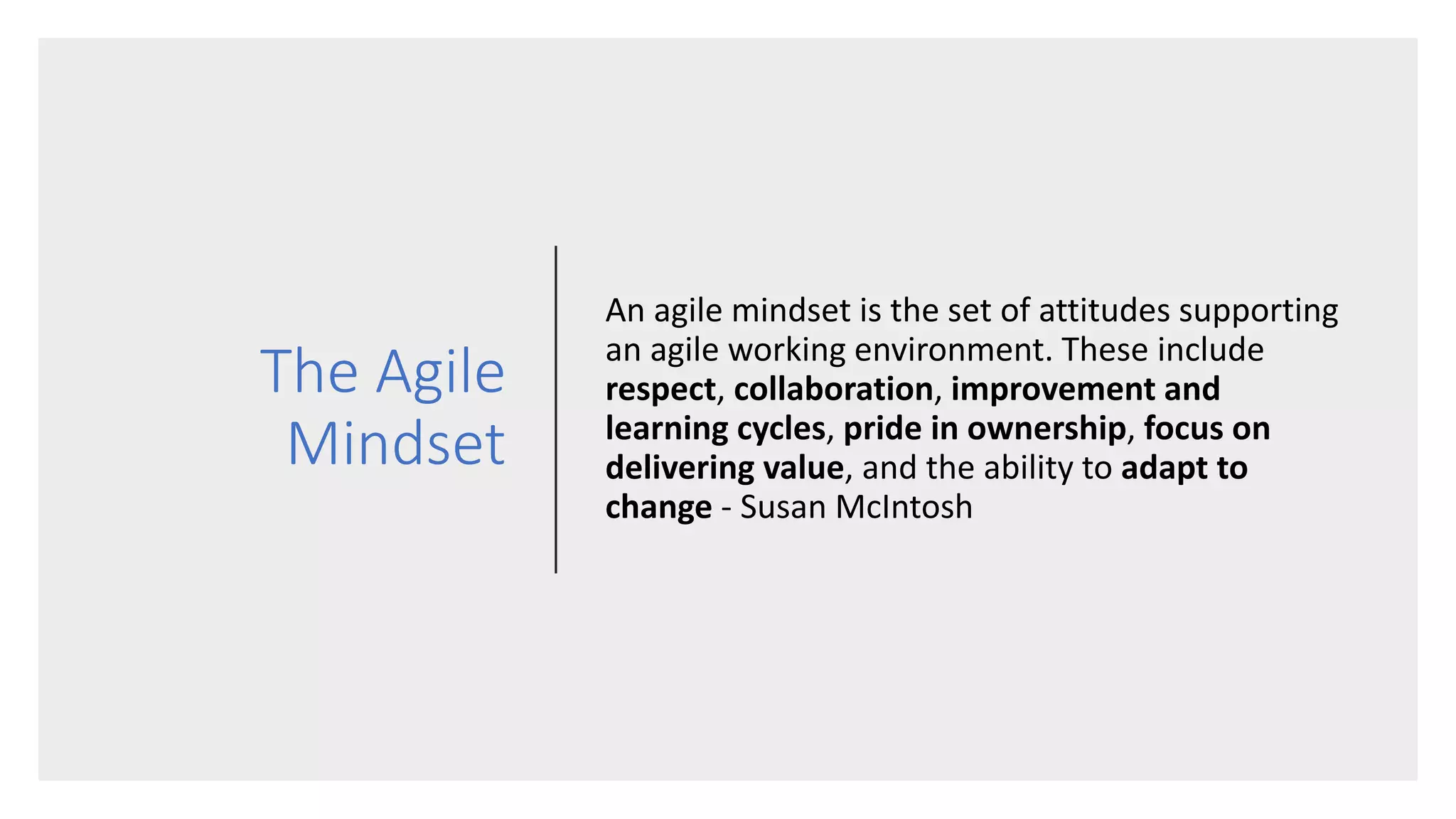
The Agile
Mindset
An agile mindset is the set of attitudes supporting
an agile working environment. These include

respect, collaboration, improvement and
learning cycles, pride in ownership, focus on
delivering value, and the ability to adapt to
change - Susan McIntosh
Why is the agile
mindset critical?
• Creates the culture necessary for
teams to thrive and grow
• Create psychological safety within your
organization – failure is acceptable and
expected
• Leverage data from past experiences
(empiricism) to adapt and improve
• Teams take ownership and pride in
their work
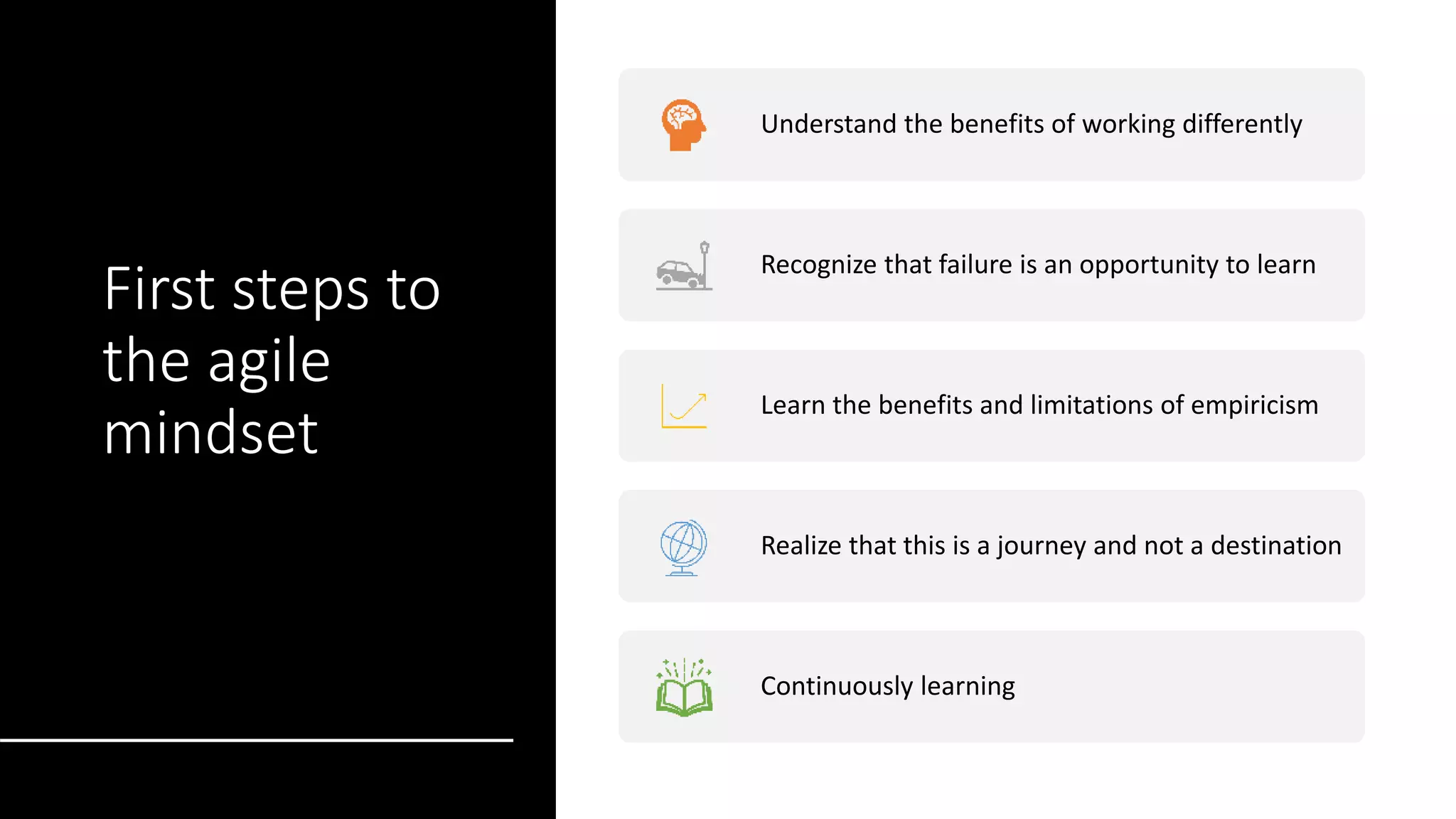
First steps to
the agile
mindset
Understand the benefits of working differently
Recognize that failure is an opportunity to learn
Learn the benefits and limitations of empiricism
Realize that this is a journey and not a destination
Continuously learning
Technical Agility
What does
Technical
Agility
provide?
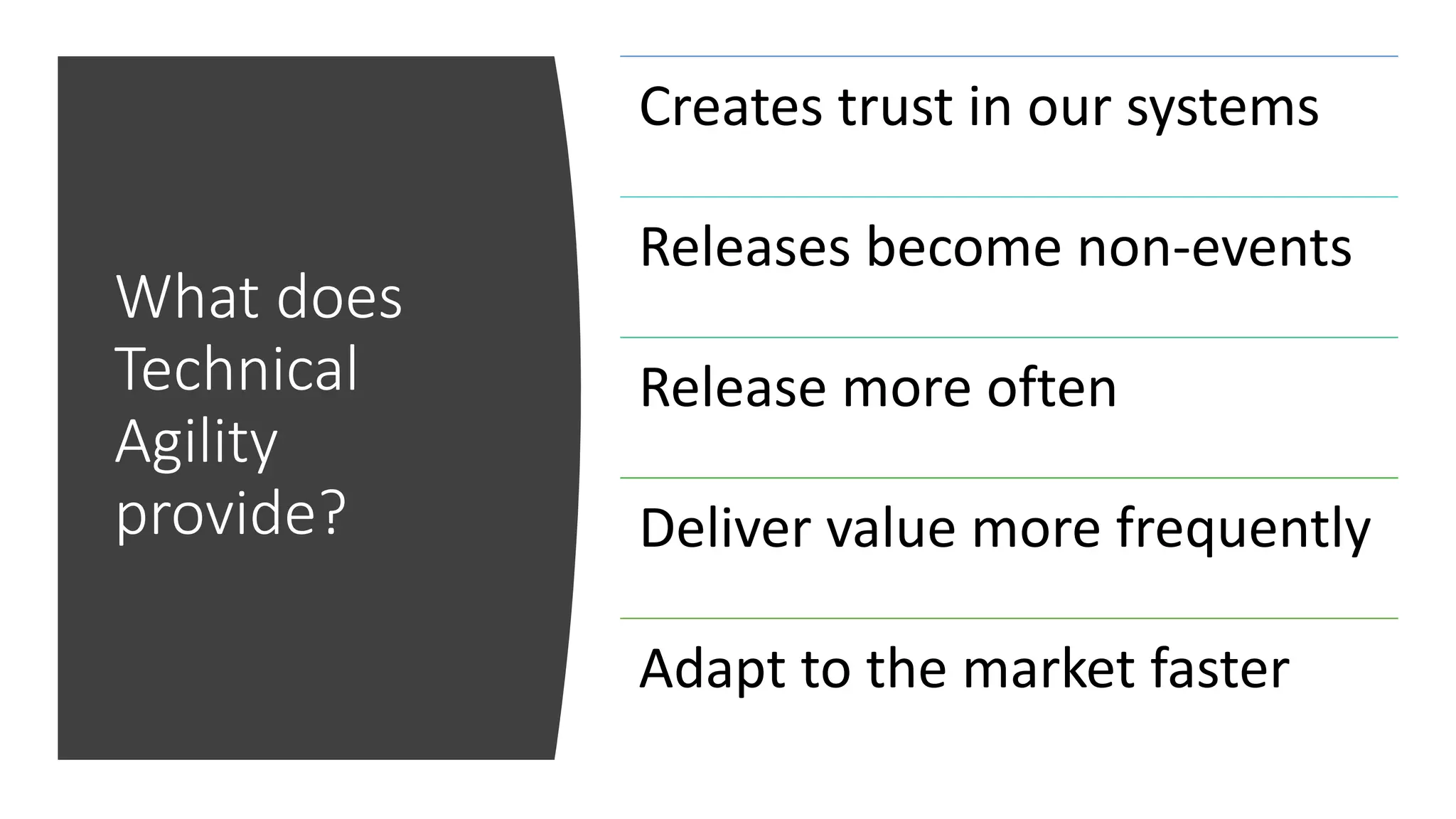
Creates trust in our systems
Releases become non-events
Release more often
Deliver value more frequently
Adapt to the market faster
What’s the most
expensive and time
consuming activity we
do to verify new code?
How does
Technical
Agility do
this?
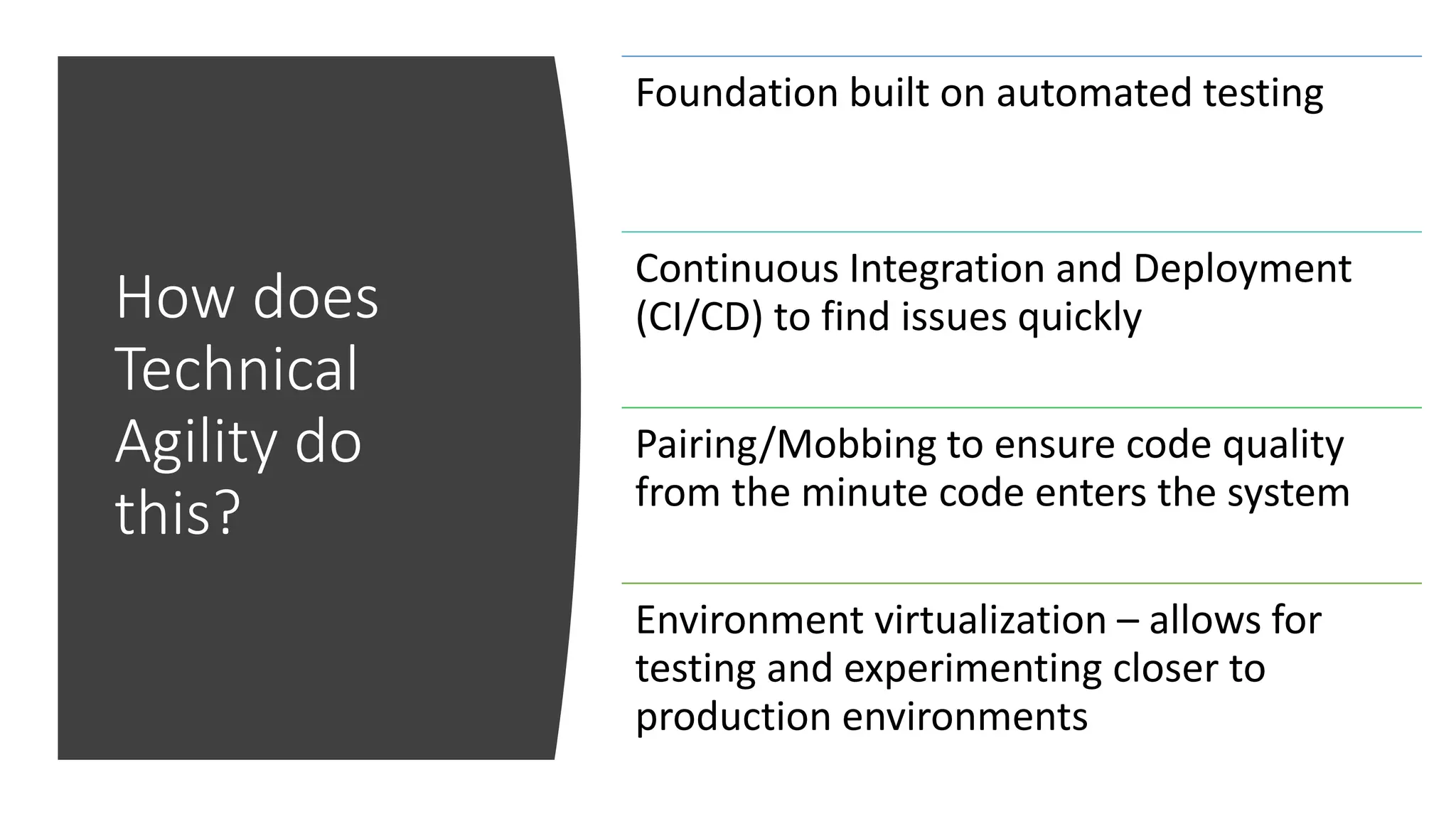
Foundation built on automated testing
Continuous Integration and Deployment
(CI/CD) to find issues quickly
Pairing/Mobbing to ensure code quality
from the minute code enters the system
Environment virtualization – allows for
testing and experimenting closer to
production environments
Costs of
technical agility
Code takes longer to write
Tests need to be maintained
Difficult to add to legacy applications
Culture and mindset change
First steps to
technical
agility
Start writing automated tests for new code
Build a CI/CD pipeline
Retrofit old code with automated tests as you
modify or work near it
Adopt a test first mentality
Experiment with pairing and mobbing
Fast and frequent releases –
that’s perfect right?
(Kind of but not really)
Have we created feature
factories?
What's a
feature
factory?
Features go into production without any regard to if
users will get value out of them
Focus on outputs (number of features in
production/velocity) vs outcomes (actual stuff that
users need/want)
Technical Agility exacerbates the feature factory
problem
Feature factories lead to feature debt
…more than 50% of all software
developed is not used or doesn’t
meet its business intent
Gary Gruver/Tommy Mouser
“Leading the Transformation”
Feature debt
Technical debt’s more attractive cousin
Calculating
feature debt
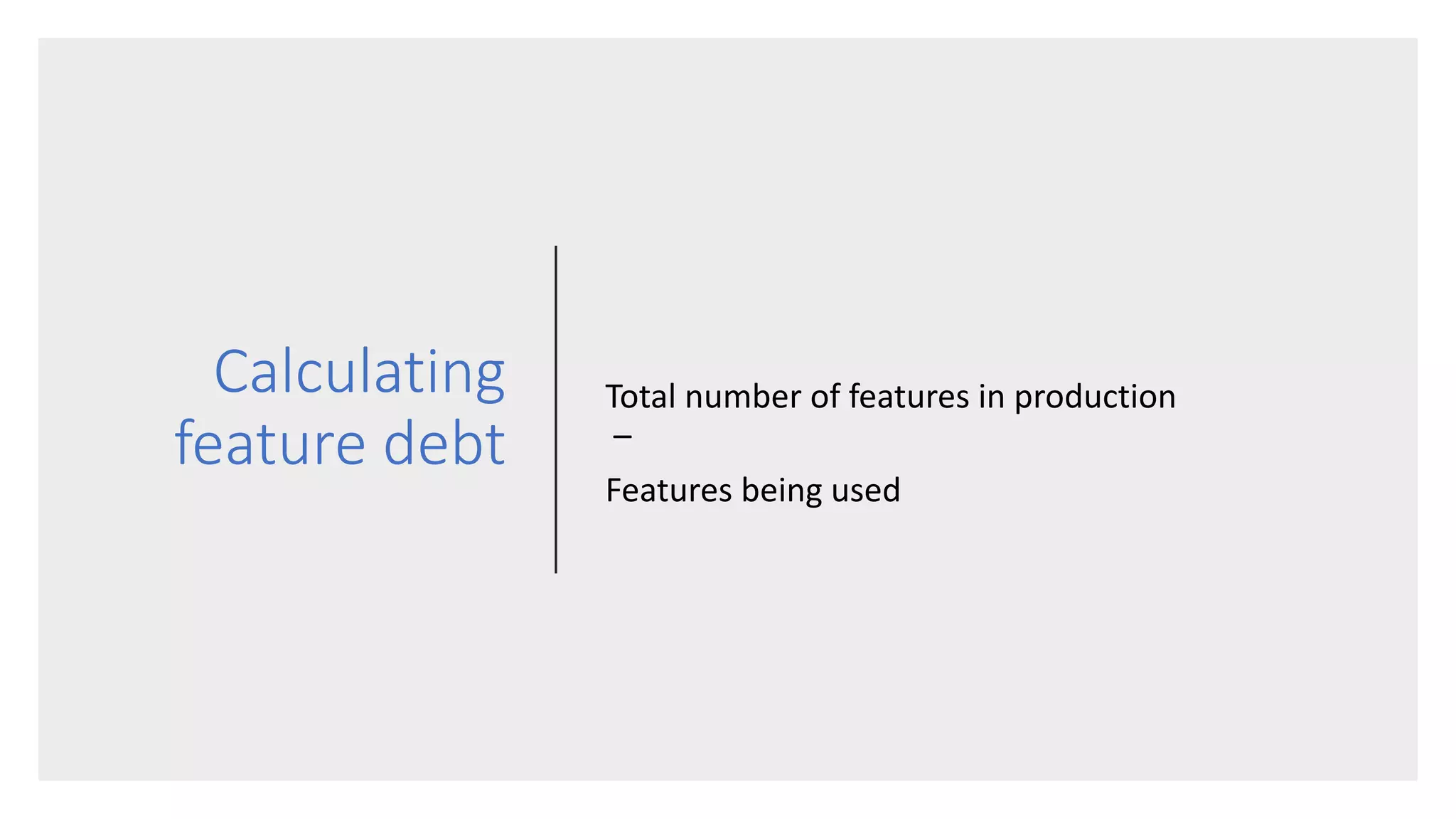
Total number of features in production
–
Features being used
Calculating
feature debt
Actual feature usage / target feature usage
Code in production costs
money
What can we do about
this?
Underperforming
features should be
targets for improvement
or elimination
Product Management
Why product
management?
Track how customers are using your product
Identify the features your customers use and don’t use
Ensure you are building the right thing for your
customers
Quickly adapt to the needs of your customer
Avoid wasting time and money developing/supporting
features customers don’t want or need
Hypothesis-Driven Product
Management- It’s no longer good
enough for to say, “I think users want
this feature.”
Instead, you need to ask, “What
outcome do you predict this feature will
have?”
Image from Flurry
Product Ops
“Product ops builds a foundation for excellence
by reinforcing product strategy with metrics,
infrastructure, business processes, best practices,
budgeting, and reporting.”
Not just for
external facing
applications
Casino operator Caesars
Entertainment now has
about 260 internal software
applications, down from
more than 800 about 18
months ago
- WSJ – “CIOs Crack Open
the ‘Black Box’ of Tech
Productivity”
Image from Atlassian
Image from Optimizely
First steps to
product
management
New features should start with objectives and key
results (OKR)
Talk to your customers and watch customers them
use your application
Add telemetry into your application
Use the telemetry to see how customers are using
the application
Talk to your customers some more
What if I only want to do
some of these things?
Wrapping up
“The future of
agility is
decreasing the
time it takes to
get something
into production”
“The future of
agility is
decreasing the
time it takes to
get something
valuable into
production”
Takeaways
Technical Agility and Product
Management are
complementary practices –
not competing ones
The agile mindset is a
starting point, but we need
to have the ability to
experiment and learn quickly
Technical Agility is necessary
to build trust in your systems
and respond quickly to your
customers
Product Management
ensures that you are
delivering the right thing to
your customers
Everything you release
should have expectations
that you validate once it’s in
production
These things are great
individually but combining
practices is required for true
transformation
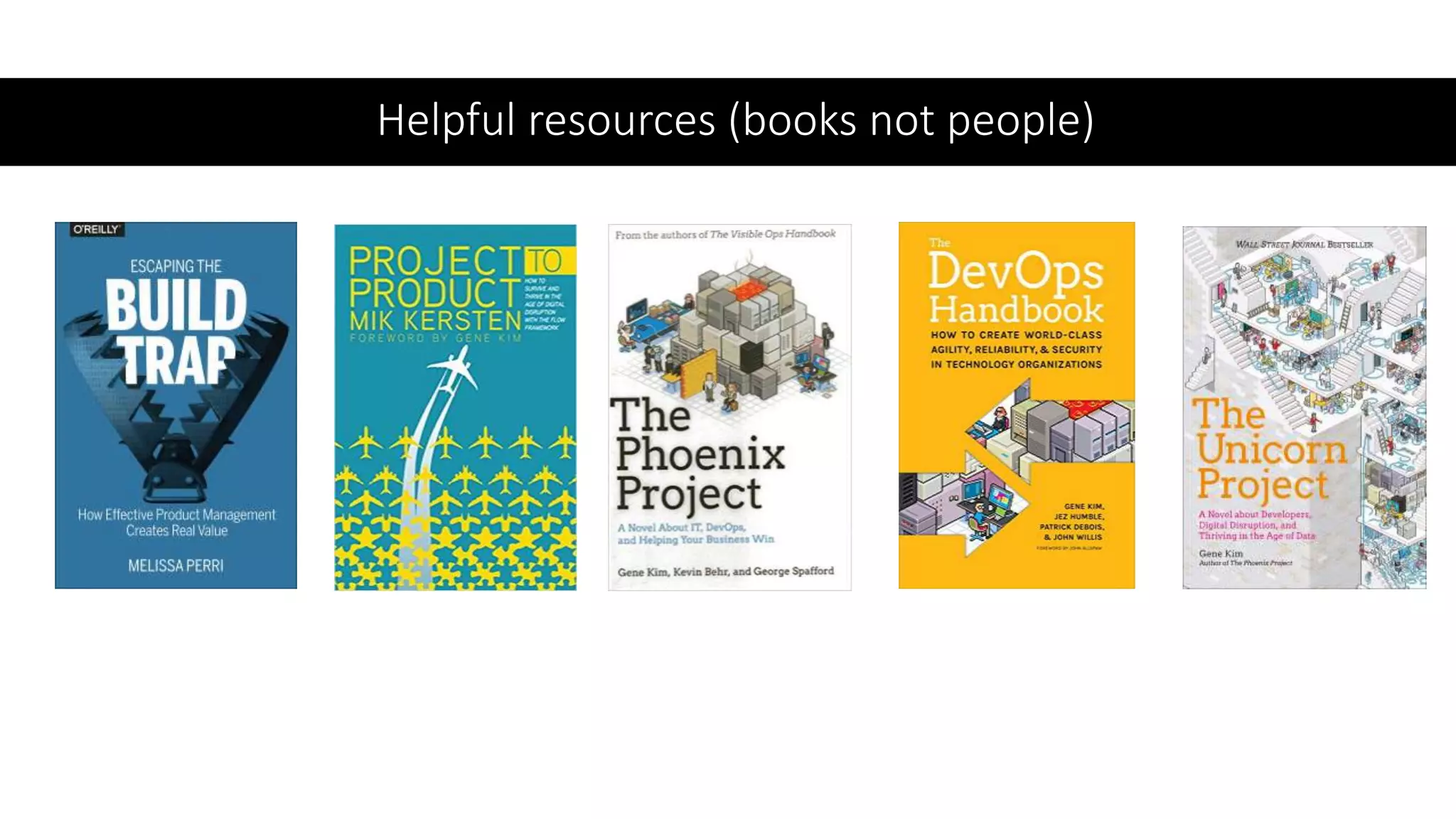
Helpful resources (books not people)
Contact Info
Charles.Husemann@insight.com / chusemann@gmail.com
@chusemann
https://www.linkedin.com/in/chusemann/

Finding The Agile Sweet Spot

  • 1.
    Finding the AgileSweet Spot Agile Leadership Series Charles Husemann Agile Enablement Lead / Agile Coach
  • 2.
    My Context 25 yearsof the software development experience – Dev, BA, PM, SM, Coach 12+ years of agile development -mostly Scrum and Kanban with a dash of XP for flavor Things I frequently say - “Metrics are my jam” - “That seems sub-optimal” - “This is why we can’t have nice things”
  • 4.
    “The future of agilityis decreasing the time it takes to get something into production”
  • 6.
    We want agileoutcomes • Ability to innovate • Quickly respond to market changes • Leverage change for a competitive advantage • Ability to deliver small units of value quickly • Turn business on a dime (budget of a sprint/timebox) • Ensure we are building the right thing for our customers through fast feedback loops
  • 7.
    Why are agile outcomes important? ITSAVES MONEY REDUCES RISK INCREASES CUSTOMER LOYALTY AND RETENTION HAPPIER EMPLOYEES
  • 8.
  • 9.
    Something is missingfrom some transformations
  • 10.
    What is theagile mindset?
  • 11.
    The Agile Mindset An agilemindset is the set of attitudes supporting an agile working environment. These include respect, collaboration, improvement and learning cycles, pride in ownership, focus on delivering value, and the ability to adapt to change - Susan McIntosh

  • 12.
    Why is theagile mindset critical? • Creates the culture necessary for teams to thrive and grow • Create psychological safety within your organization – failure is acceptable and expected • Leverage data from past experiences (empiricism) to adapt and improve • Teams take ownership and pride in their work
  • 13.
    First steps to theagile mindset Understand the benefits of working differently Recognize that failure is an opportunity to learn Learn the benefits and limitations of empiricism Realize that this is a journey and not a destination Continuously learning
  • 18.
  • 19.
    What does Technical Agility provide? Creates trustin our systems Releases become non-events Release more often Deliver value more frequently Adapt to the market faster
  • 20.
    What’s the most expensiveand time consuming activity we do to verify new code?
  • 21.
    How does Technical Agility do this? Foundationbuilt on automated testing Continuous Integration and Deployment (CI/CD) to find issues quickly Pairing/Mobbing to ensure code quality from the minute code enters the system Environment virtualization – allows for testing and experimenting closer to production environments
  • 23.
    Costs of technical agility Codetakes longer to write Tests need to be maintained Difficult to add to legacy applications Culture and mindset change
  • 24.
    First steps to technical agility Startwriting automated tests for new code Build a CI/CD pipeline Retrofit old code with automated tests as you modify or work near it Adopt a test first mentality Experiment with pairing and mobbing
  • 25.
    Fast and frequentreleases – that’s perfect right?
  • 26.
    (Kind of butnot really)
  • 28.
    Have we createdfeature factories?
  • 29.
    What's a feature factory? Features gointo production without any regard to if users will get value out of them Focus on outputs (number of features in production/velocity) vs outcomes (actual stuff that users need/want) Technical Agility exacerbates the feature factory problem Feature factories lead to feature debt
  • 30.
    …more than 50%of all software developed is not used or doesn’t meet its business intent Gary Gruver/Tommy Mouser “Leading the Transformation”
  • 31.
    Feature debt Technical debt’smore attractive cousin
  • 32.
    Calculating feature debt Total numberof features in production – Features being used
  • 33.
    Calculating feature debt Actual featureusage / target feature usage
  • 34.
    Code in productioncosts money
  • 38.
    What can wedo about this?
  • 39.
    Underperforming features should be targetsfor improvement or elimination
  • 40.
  • 42.
    Why product management? Track howcustomers are using your product Identify the features your customers use and don’t use Ensure you are building the right thing for your customers Quickly adapt to the needs of your customer Avoid wasting time and money developing/supporting features customers don’t want or need
  • 43.
    Hypothesis-Driven Product Management- It’sno longer good enough for to say, “I think users want this feature.” Instead, you need to ask, “What outcome do you predict this feature will have?”
  • 47.
  • 48.
    Product Ops “Product opsbuilds a foundation for excellence by reinforcing product strategy with metrics, infrastructure, business processes, best practices, budgeting, and reporting.”
  • 49.
    Not just for externalfacing applications Casino operator Caesars Entertainment now has about 260 internal software applications, down from more than 800 about 18 months ago - WSJ – “CIOs Crack Open the ‘Black Box’ of Tech Productivity”
  • 50.
  • 51.
  • 53.
    First steps to product management Newfeatures should start with objectives and key results (OKR) Talk to your customers and watch customers them use your application Add telemetry into your application Use the telemetry to see how customers are using the application Talk to your customers some more
  • 54.
    What if Ionly want to do some of these things?
  • 56.
  • 57.
    “The future of agilityis decreasing the time it takes to get something into production”
  • 58.
    “The future of agilityis decreasing the time it takes to get something valuable into production”
  • 59.
    Takeaways Technical Agility andProduct Management are complementary practices – not competing ones The agile mindset is a starting point, but we need to have the ability to experiment and learn quickly Technical Agility is necessary to build trust in your systems and respond quickly to your customers Product Management ensures that you are delivering the right thing to your customers Everything you release should have expectations that you validate once it’s in production These things are great individually but combining practices is required for true transformation
  • 60.
  • 62.
    Contact Info Charles.Husemann@insight.com /chusemann@gmail.com @chusemann https://www.linkedin.com/in/chusemann/

Editor's Notes

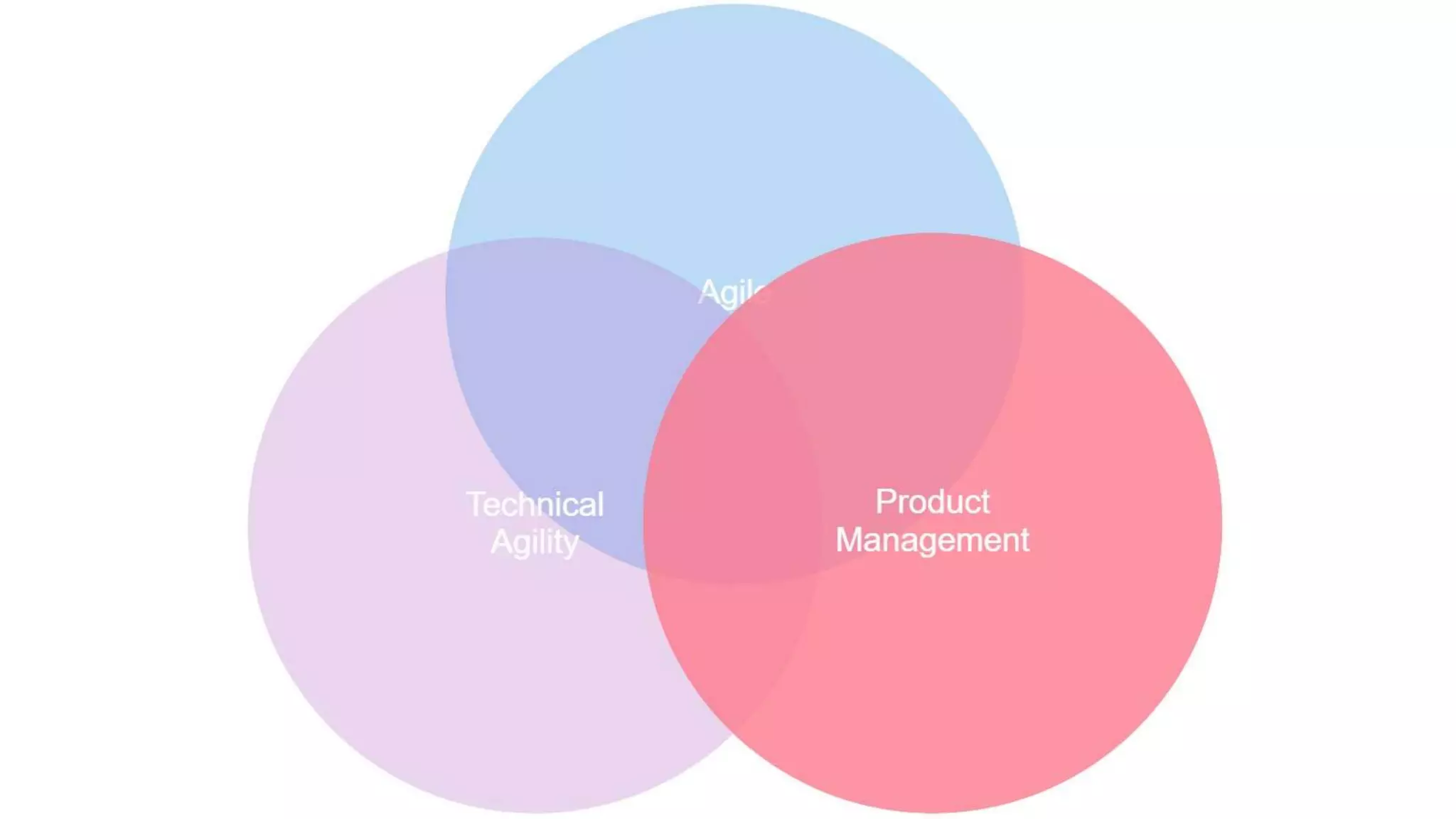
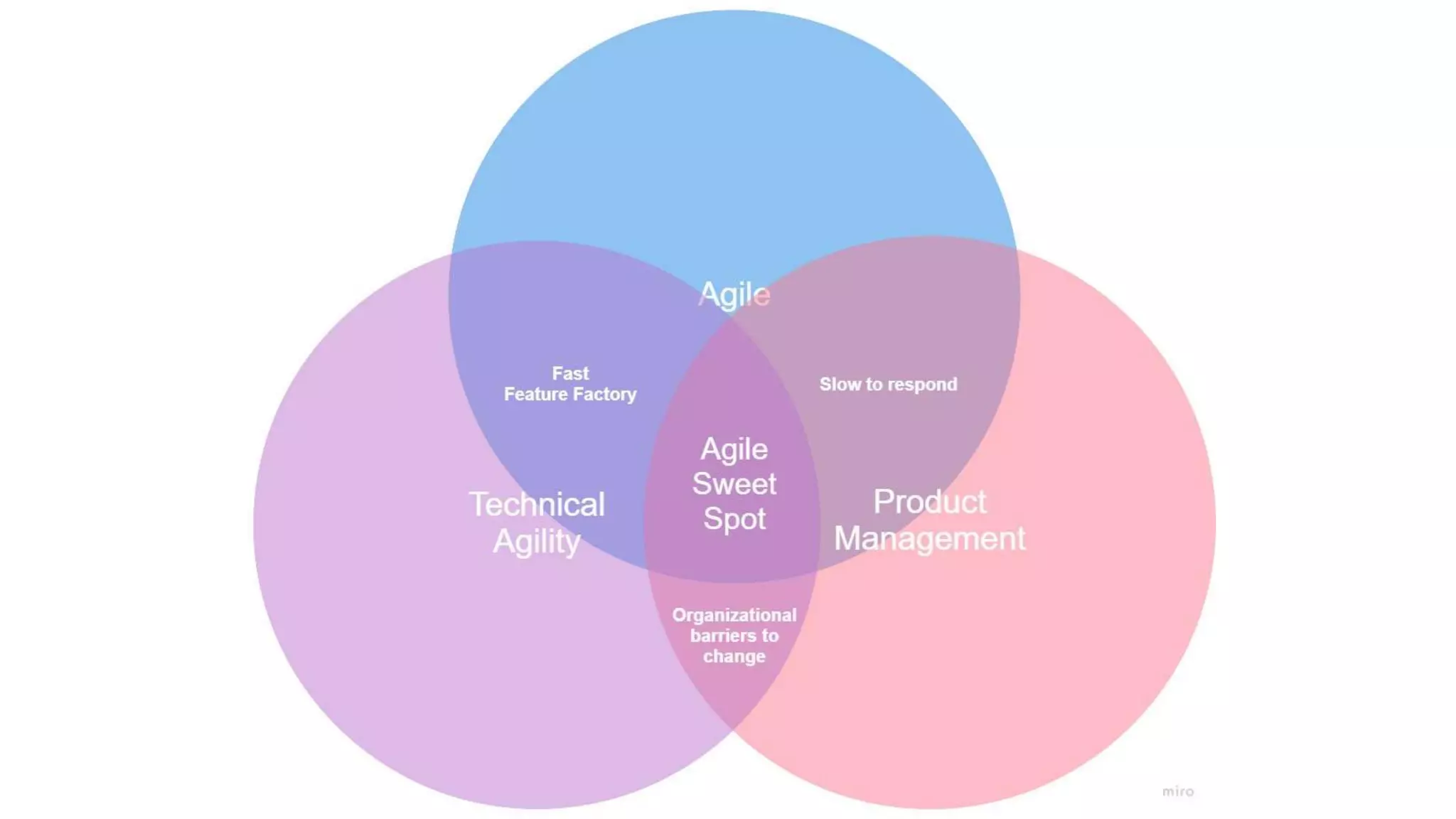
  • #2 Good morning – welcome to the Insight Agile Leadership Series Thank you for coming out this morning to learn a little bit about finding how to find the agile sweet spot– today we are going to talk about the intersection of the agile mindset, technical agility, and product management and why you need all three of these things in your agile transformation
  • #4 Before we start I kind of want to give you the idea of where this presentation came from
  • #5 Presentation somewhat inspired by Bob Galen at Path to Agility 2018 where he talked about how agility is becoming more and more about decreasing the time it takes to get something to production So that got me thinking about all of the things we do from an agile transformation. Along the way I started reading more and more about DevOps (technical practices) and Product management and that’s where this presentation comes from. The more I looked into it the more I realized that these three things are complementary and will lead us to the next level of agile
  • #6 Why are we adopting agile? The want to better meet the needs of the market Need to be able to respond to change faster Better relationships with stakeholders who are now part of the process Quality They want to deliver value faster and more often
  • #7 https://scrumorg-website-prod.s3.amazonaws.com/drupal/2019-05/EBM_Guide%20January_2019.pdf Have empiricism at the front Re-label Agile sweet spot - agile outcomes
  • #8 We had a team that released new features into production and within 10 minutes they were able to get feedback on it and within an hour they were starting to generate revenue Within a day they were able to tweak some features to make it more usable for the customer based on interactions It saves money Eliminates operating expenses by reducing defects Increases the effectiveness of capital spending Reduces risk Financial Technical Move up to why we are doing agile
  • #9 When I talk about agile – let’s not talk about a particular framework – let’s talk in generalities a bit
  • #10  Agile is more than just adopting a framework and its rituals and ceremonies It’s more than story points and sprints It’s not that hard to get from Zero to zombie agile in a few months – the real value is the adoption of the agile mindset and the culture that comes with it
  • #11 An agile mindset is the set of attitudes supporting an agile working environment. These include respect, collaboration, improvement and learning cycles, pride in ownership, focus on delivering value, and the ability to adapt to change - Susan McIntosh
  • #13 Agile mindset helps you develop some critical organizational super powers - Good showed this during project Aristotle
  • #15 The agile mindset is foundational to an organizations agile journey but it’s just the first step
  • #16 We need to have the ability to have experiment quickly in market so we can learn things as soon as possible
  • #17 Let’s go back to Bob’s central idea - How often do you release to production? Yearly Quarterly Monthly Weekly Daily Hourly We just released 10 features in the time it took to read this
  • #18 Why don’t we release more often? Lots of reasons - Some legal regulatory issues - Regression testing - Lots of teams migrating to production - Don’t want to break something in production? - Don’t want to impact users Customers can’t take frequent releases
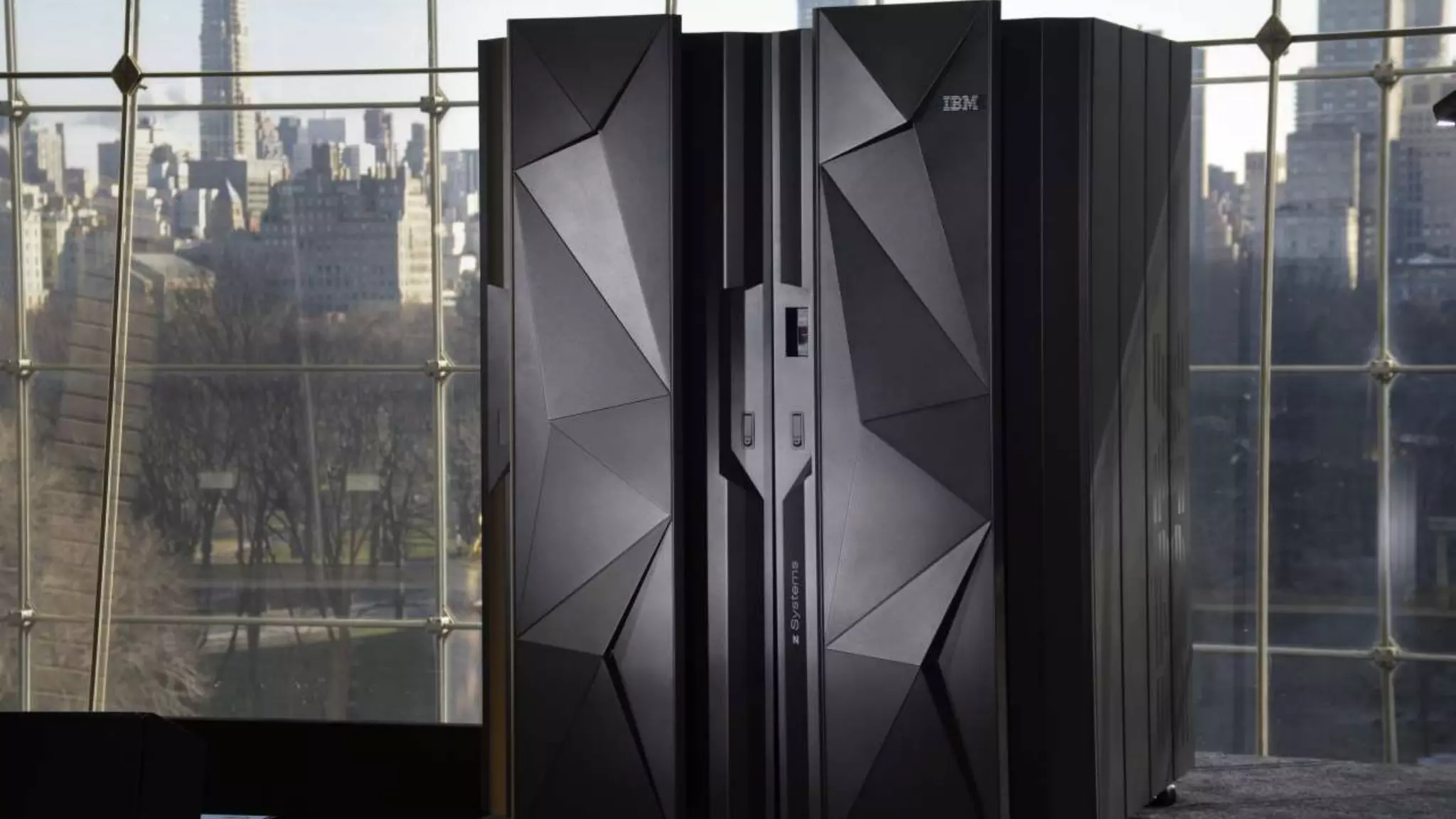
  • #23 But what about your mainframe? Well IBM has tools to do all of this on mainframes- you can develop automated tests – build pipelines, and have CI/CD Automated tests from the mainframe could even be re-used if you ever want to replatform
  • #24 Writing tests takes a bit more time but the additional time it takes to write tests is more than saved in operating costs – 60-90% As your codebase evolves – your tests do as well There are mitigation strategies for legacy apps but that’s a separate presentation – there are ways to do it but it is difficult to
  • #26 So we’ve figured out how to deliver stuff quickly – fulfilling the answer from Galen but then something hit me – are we sure we are actually delivering value?
  • #28 So you shipped a few features Are your users/customers using it? Are they using it as much as you thought they would? Is it delivering the expected value to your customers? Are they using it like you thought they would?
  • #32 Rough count of the number of apps on your phone that you haven’t used?
  • #33 65% of features are never used
  • #36 Feature debt - code Automated tests that must be run/maintained Impacts development of new features Cost to support the code Performance impact
  • #37 Feature Debt - UX Consumes critical screen/menu real estate Interface clutter – makes valuable features hard to find
  • #38 Reasons for underuse Was the feature marketed correctly? Is the feature discoverable? Is the feature usable? Do users need training on the feature? Did customers want/need it?
  • #40 IT’s very hard to kill features – sometimes you have to kill your babies?
  • #42 Agile talks about delivering value to the business but are we sure that we are delivering value?
  • #43 Need to deliver smaller and smaller features and ensure that they are performing as expected Not design thinking https://econsultancy.com/how-top-performing-digital-companies-use-product-thinking-to-succeed-stats/
  • #46 How do we get there?
  • #47 Talk to your customers It’s relatively cheap! They know that they want* They know what they don’t want
  • #48 Telemetry Add metrics/analytics to every part of your application Track how users are moving through your application Product owners/managers should be armed with data about how their application is being used What are your most popular/least used features If you can’t build telemetry into your application look for alternatives – database stats/server logs/ anything that provides information on how your users are using your applicaiton
  • #49 Yes this is really a thing and I’m sorry for foisting this on your if you haven’t heard the term before But this is a science and as we roll applications out to more people
  • #50 Remember code in production costs you money
  • #51 Intersection of PT and Technical Agility Push a feature into production that only certain users can see Test in production against production data
  • #52 Can do A/B testing to see if the feature is worth it
  • #53 DevTestOps Code coverage isn’t the best metric Continuous testing Product Coverage over code coverage Testing what gives value, based on customer usage
  • #58 Going back to the idea that inspired this I think Bob hit the nail on the head but I think we need to make one minor tweak to that phrase.
  • #59 If we add the word “valuable” to this I think this gives us exactly what we need for a direction of agility
  • #62 Thank you so much for coming out to hear me talk, If you have any questions about my presentation let’s talk about them now