1
Finding, Exploring, and Refining Trading
Strategies: A Case Study
QuantCon, New York, 3.14.15
Presented by Matthew Granade and Yoshiki Obayashi
2	

FROM IDEA TO EXECUTION
QUANTCON, NEWYORK, 3.14.15	

  What makes a good idea? (And where do good ideas come from?)
  How to decide if an idea is worth researching?
  How to move from idea to a trading strategy
  How to move from a trading strategy into execution
As a researcher, your most valuable asset is your time.
Invest it like you invest your money: thoughtfully and carefully.
3	

GOOD IDEAS
QUANTCON, NEWYORK, 3.14.15	

  Usually some nub, often non-linear
  An ounce or two of evidence that it might actually work
  Plus some logic / some believable story for why it working would make sense
Here’s the story of Eido as a trading strategy …
4	

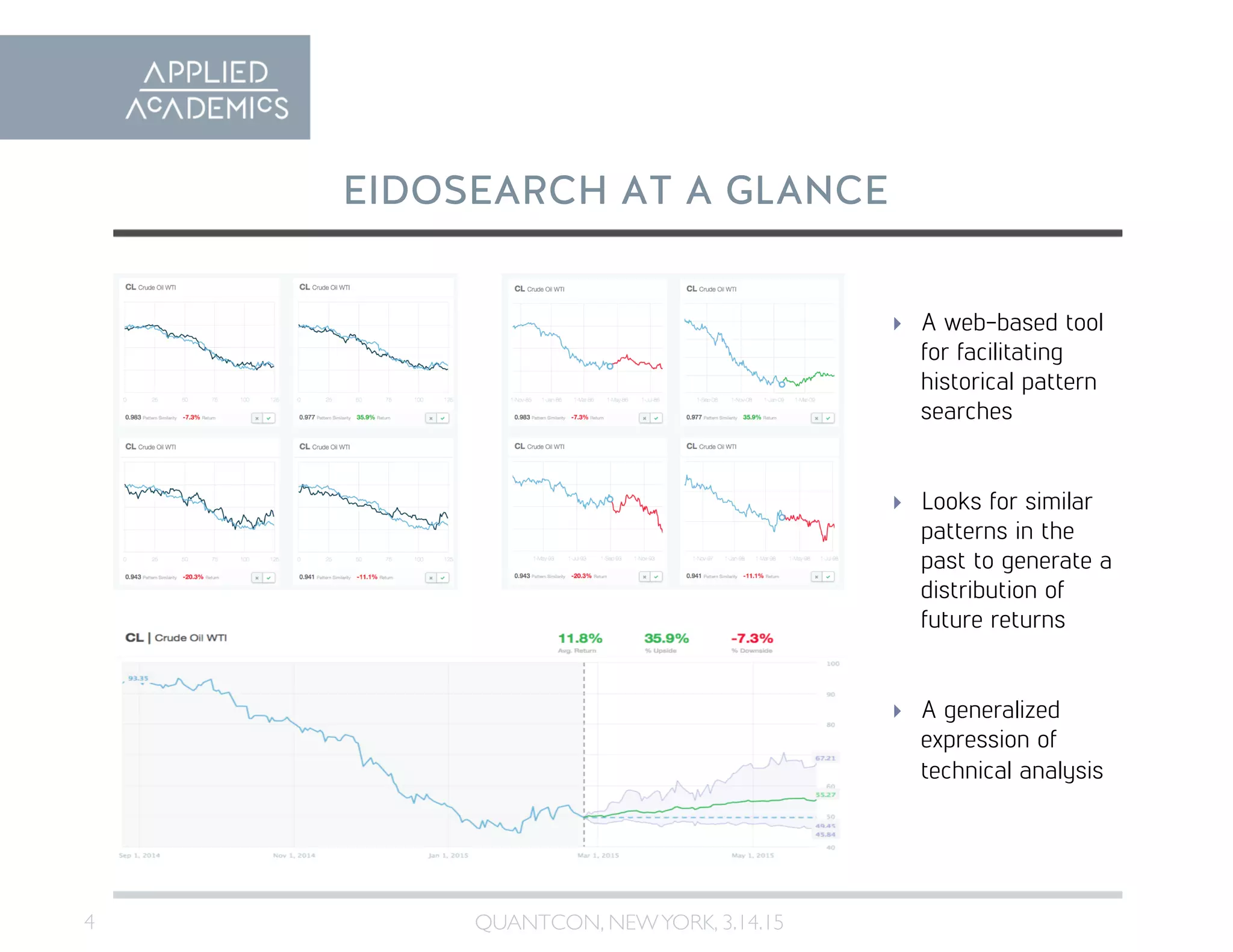
EIDOSEARCH AT A GLANCE
  A web-based tool
for facilitating
historical pattern
searches
  Looks for similar
patterns in the
past to generate a
distribution of
future returns
  A generalized
expression of
technical analysis
QUANTCON, NEWYORK, 3.14.15
5	

HOW DO WE KNOW IF THE CONCEPT WORKS?
QUANTCON, NEWYORK, 3.14.15	

  Jump right into back-testing trading rules incorporating the signals?
•  A common but mostly suboptimal practice
  Establish a precise mathematical definition of the “concept”
•  What are the parameters and inputs (what’s the difference?)
•  What are the outputs?
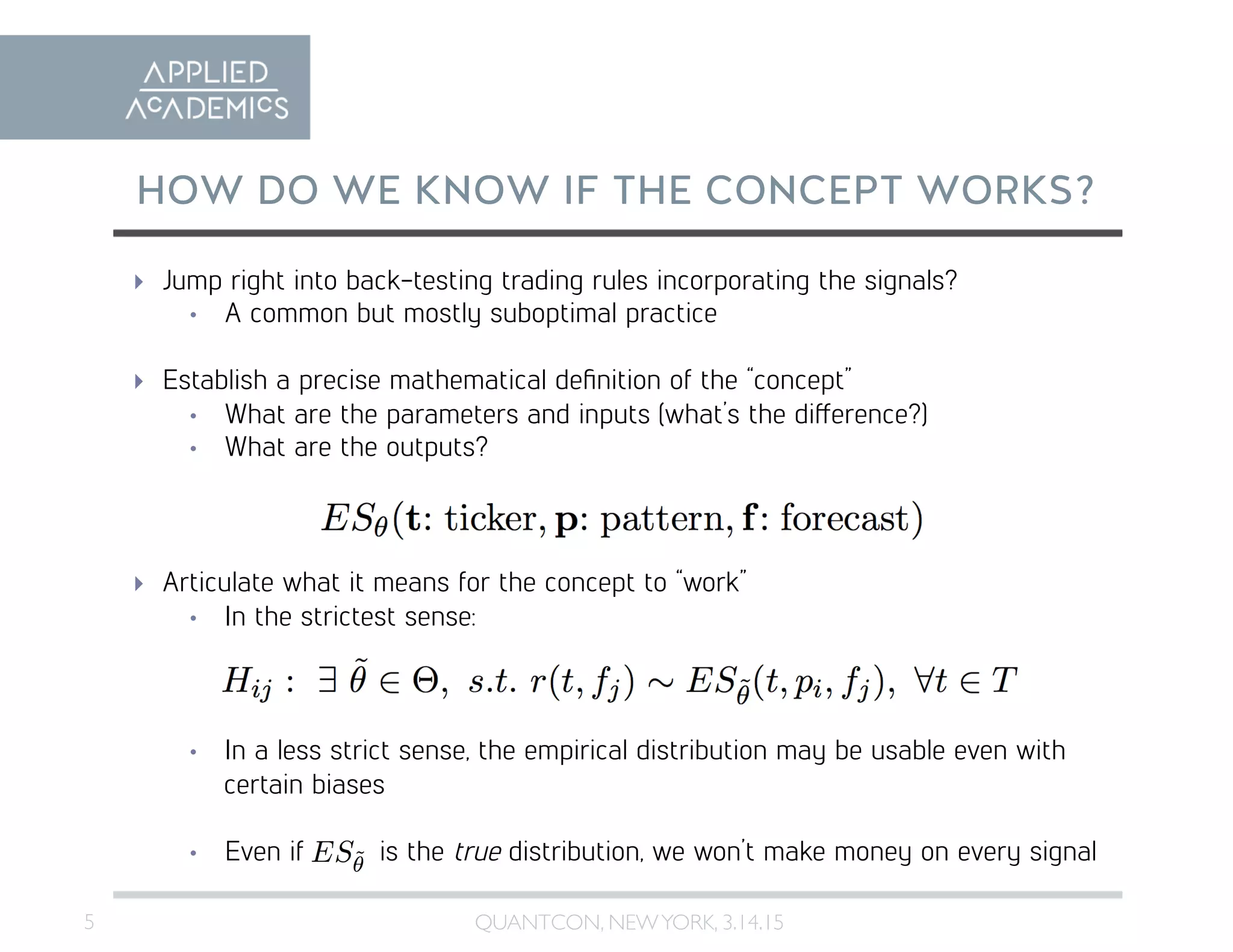
  Articulate what it means for the concept to “work”
•  In the strictest sense:
•  In a less strict sense, the empirical distribution may be usable even with
certain biases
•  Even if is the true distribution, we won’t make money on every signal
6	

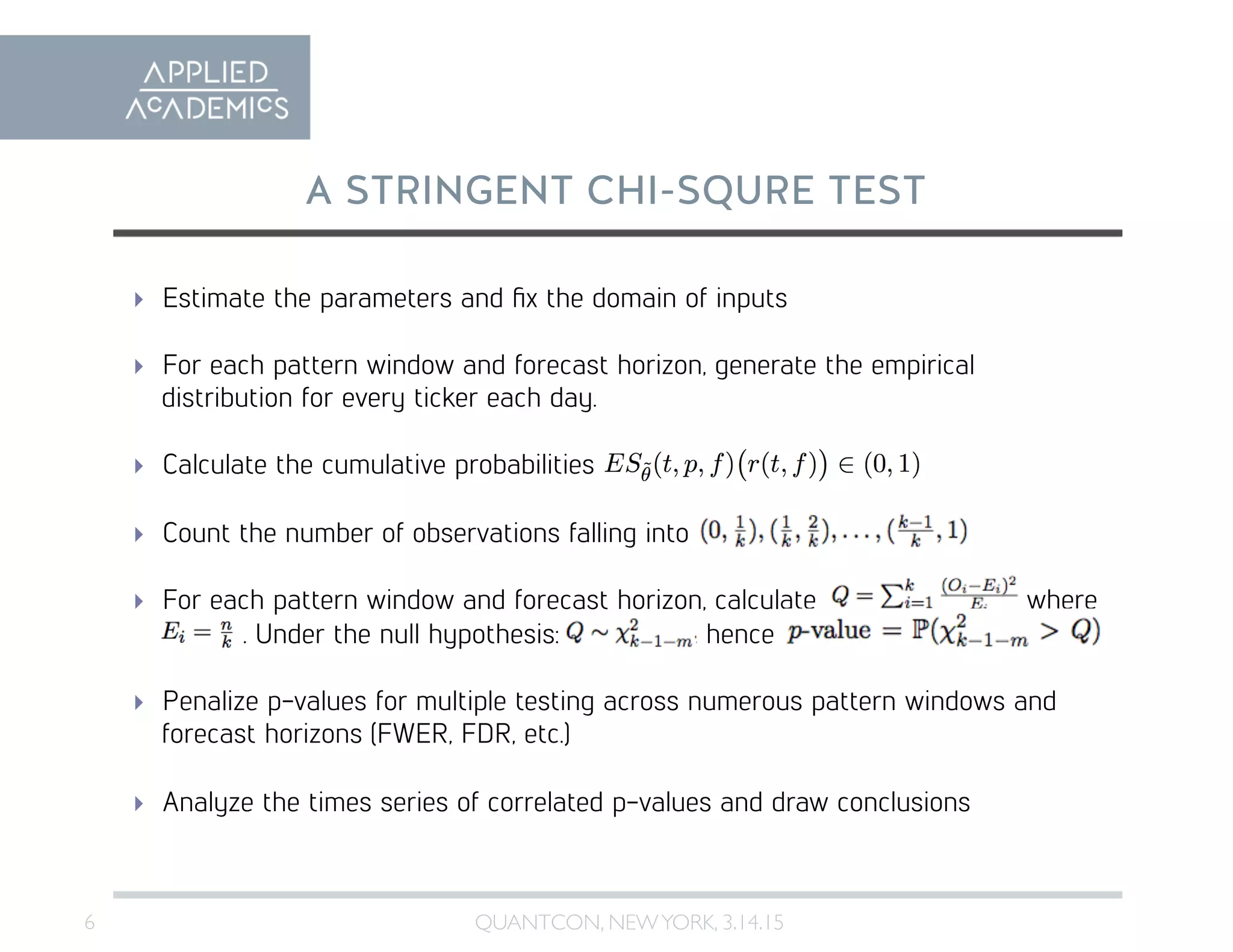
A STRINGENT CHI-SQURE TEST
QUANTCON, NEWYORK, 3.14.15	

  Estimate the parameters and fix the domain of inputs
  For each pattern window and forecast horizon, generate the empirical
distribution for every ticker each day.
  Calculate the cumulative probabilities
  Count the number of observations falling into
  For each pattern window and forecast horizon, calculate where
. Under the null hypothesis: , hence
  Penalize p-values for multiple testing across numerous pattern windows and
forecast horizons (FWER, FDR, etc.)
  Analyze the times series of correlated p-values and draw conclusions
7	

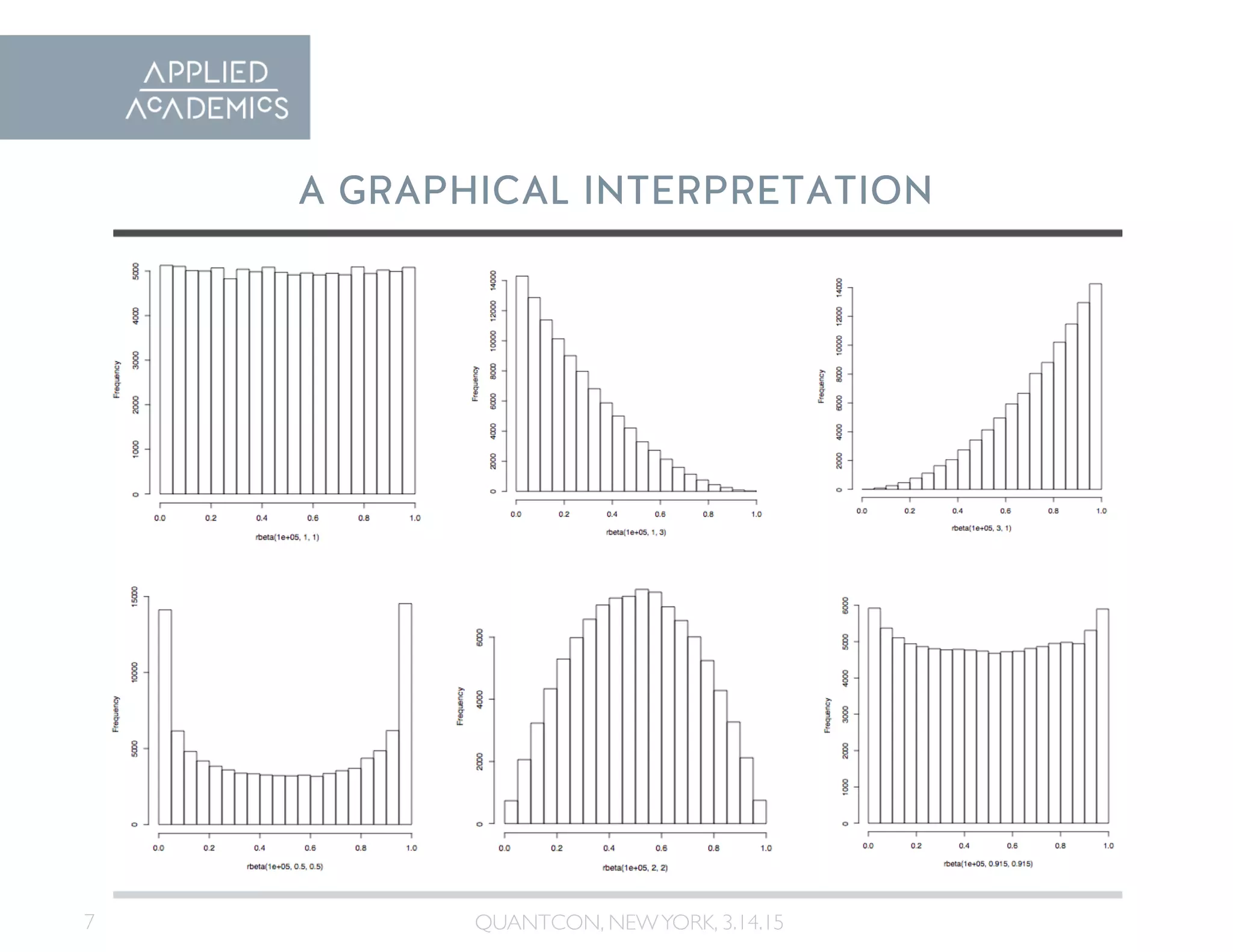
A GRAPHICAL INTERPRETATION
QUANTCON, NEWYORK, 3.14.15
8	

ANYTHING-BUT-U-SHAPE! TEST DESIGN
QUANTCON, NEWYORK, 3.14.15	

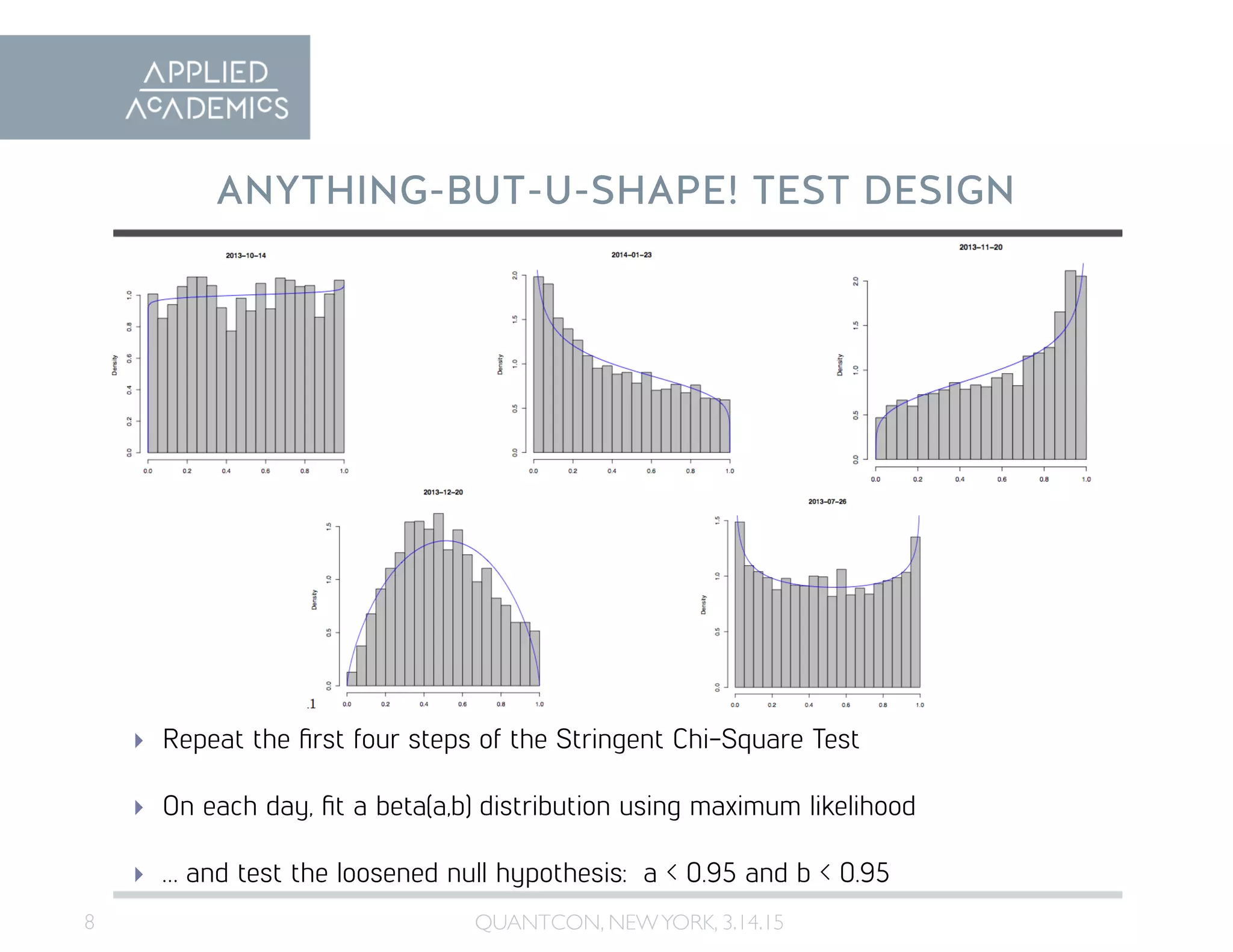
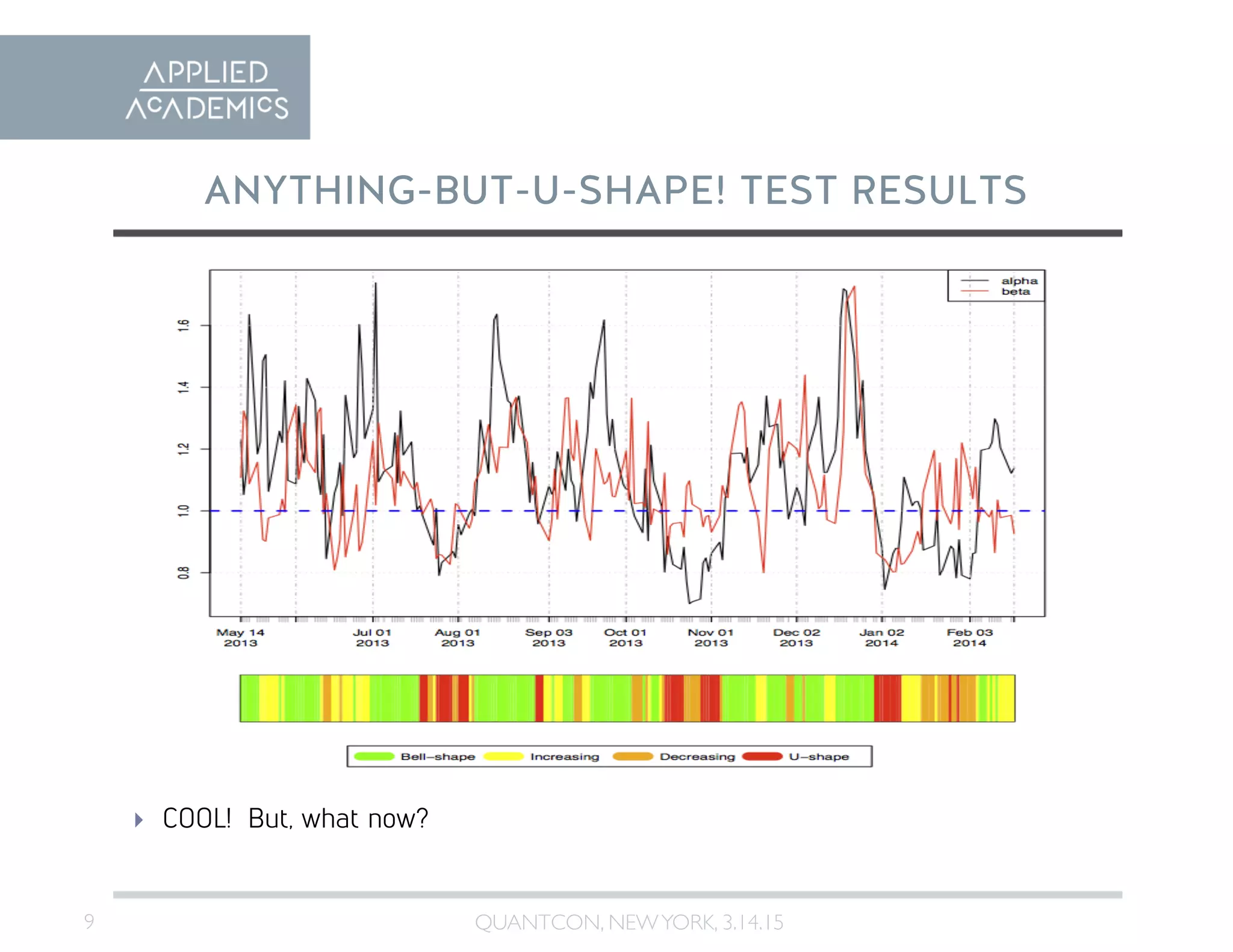
  Repeat the first four steps of the Stringent Chi-Square Test
  On each day, fit a beta(a,b) distribution using maximum likelihood
  … and test the loosened null hypothesis: a < 0.95 and b < 0.95
9	

ANYTHING-BUT-U-SHAPE! TEST RESULTS
QUANTCON, NEWYORK, 3.14.15	

  COOL! But, what now?
10	

FROM SIGNAL TO STRATEGY
QUANTCON, NEWYORK, 3.14.15	

  You’ve decided to invest further in an idea; next step is to find a sensible trading
strategy
  Dimensions to think about:
  Whether to go long, short, or both
  What basket of assets to trade
  How strong a signal to require
  How many trades to make
  What time horizon to hold over
  What performance criteria to prioritize
  Almost always wrong to test everything; possible strategies should be driven by
a deep understanding of why you think the strategy works
11	

FIRST LET’S JUST GO WILD!
QUANTCON, NEWYORK, 3.14.15	

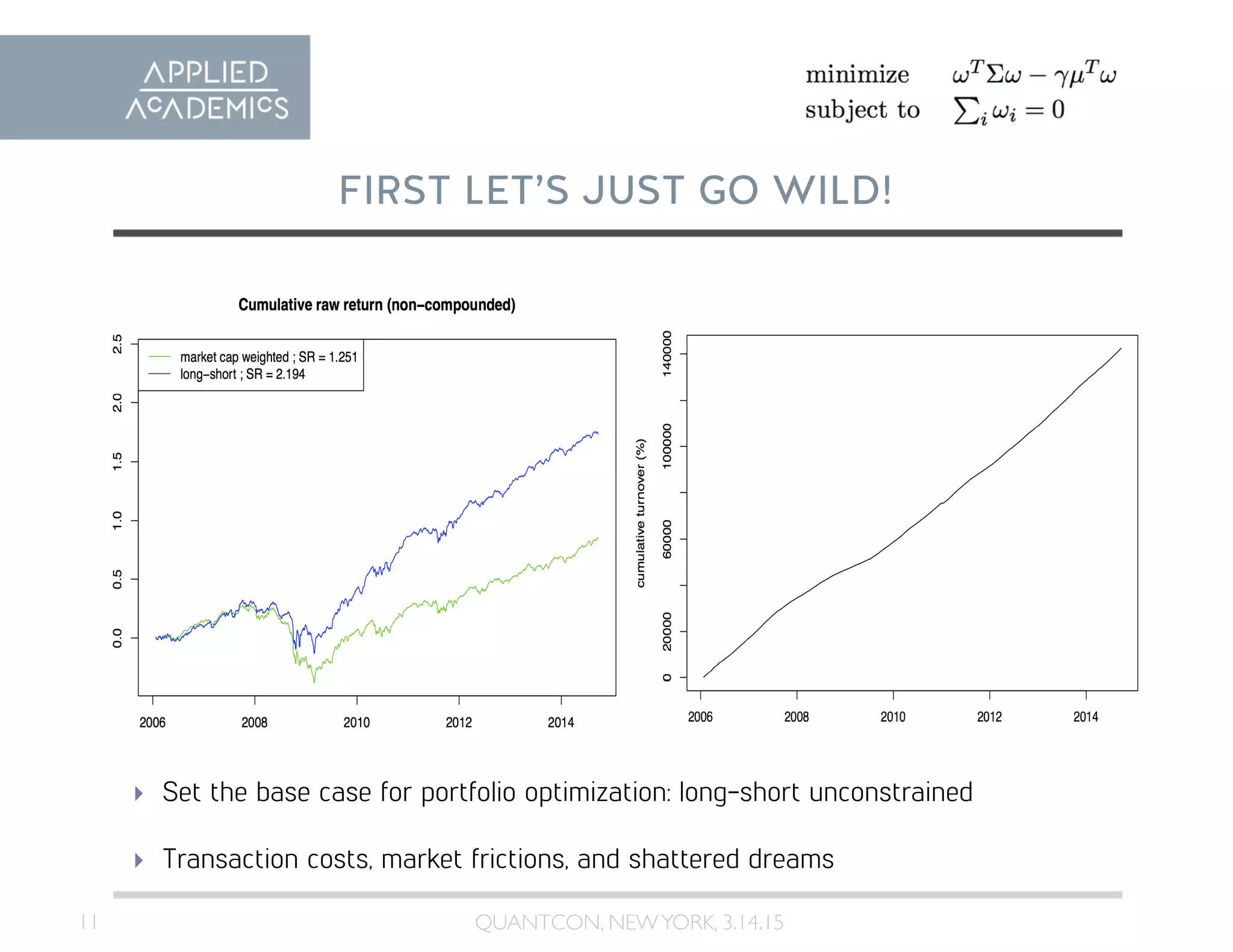
  Set the base case for portfolio optimization: long-short unconstrained
  Transaction costs, market frictions, and shattered dreams
12	

BACK-TESTING SHORT SELLING IS DICEY…
QUANTCON, NEWYORK, 3.14.15	

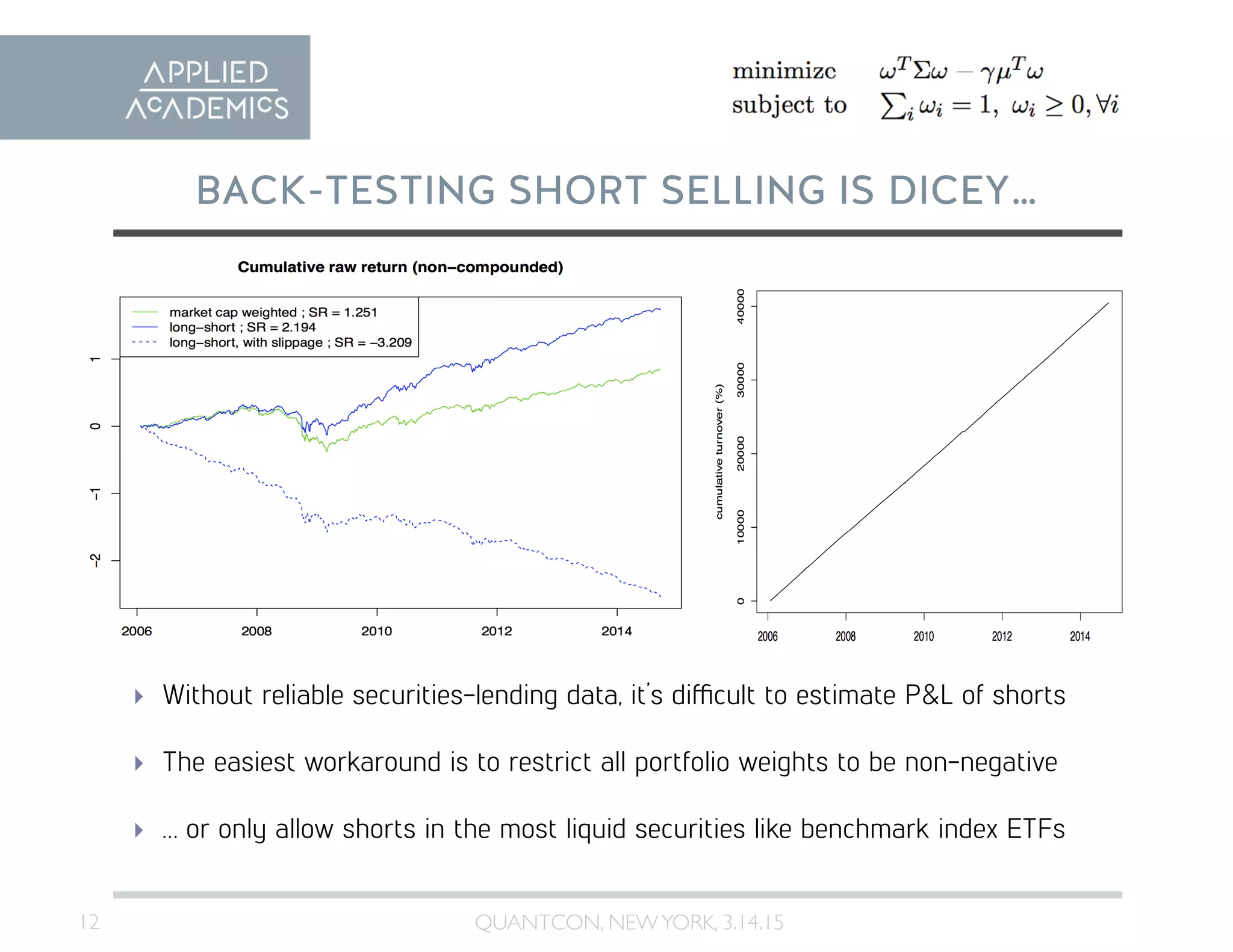
  Without reliable securities-lending data, it’s difficult to estimate P&L of shorts
  The easiest workaround is to restrict all portfolio weights to be non-negative
  … or only allow shorts in the most liquid securities like benchmark index ETFs
13	

BACK TO REALITY: CONTROL TURNOVER
QUANTCON, NEWYORK, 3.14.15	

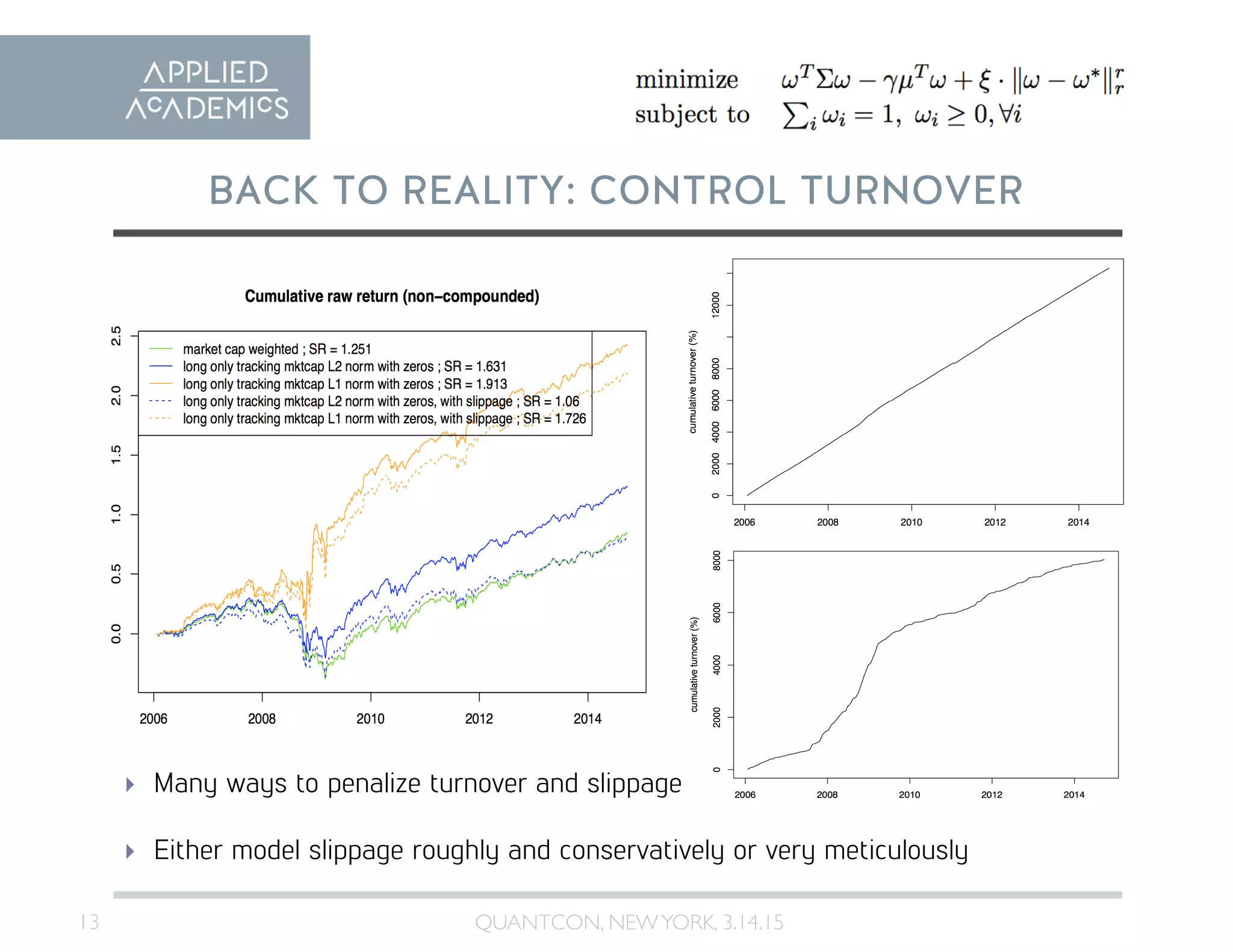
  Many ways to penalize turnover and slippage
  Either model slippage roughly and conservatively or very meticulously
14	

IMPORTANCE OF INTUITION
QUANTCON, NEWYORK, 3.14.15	

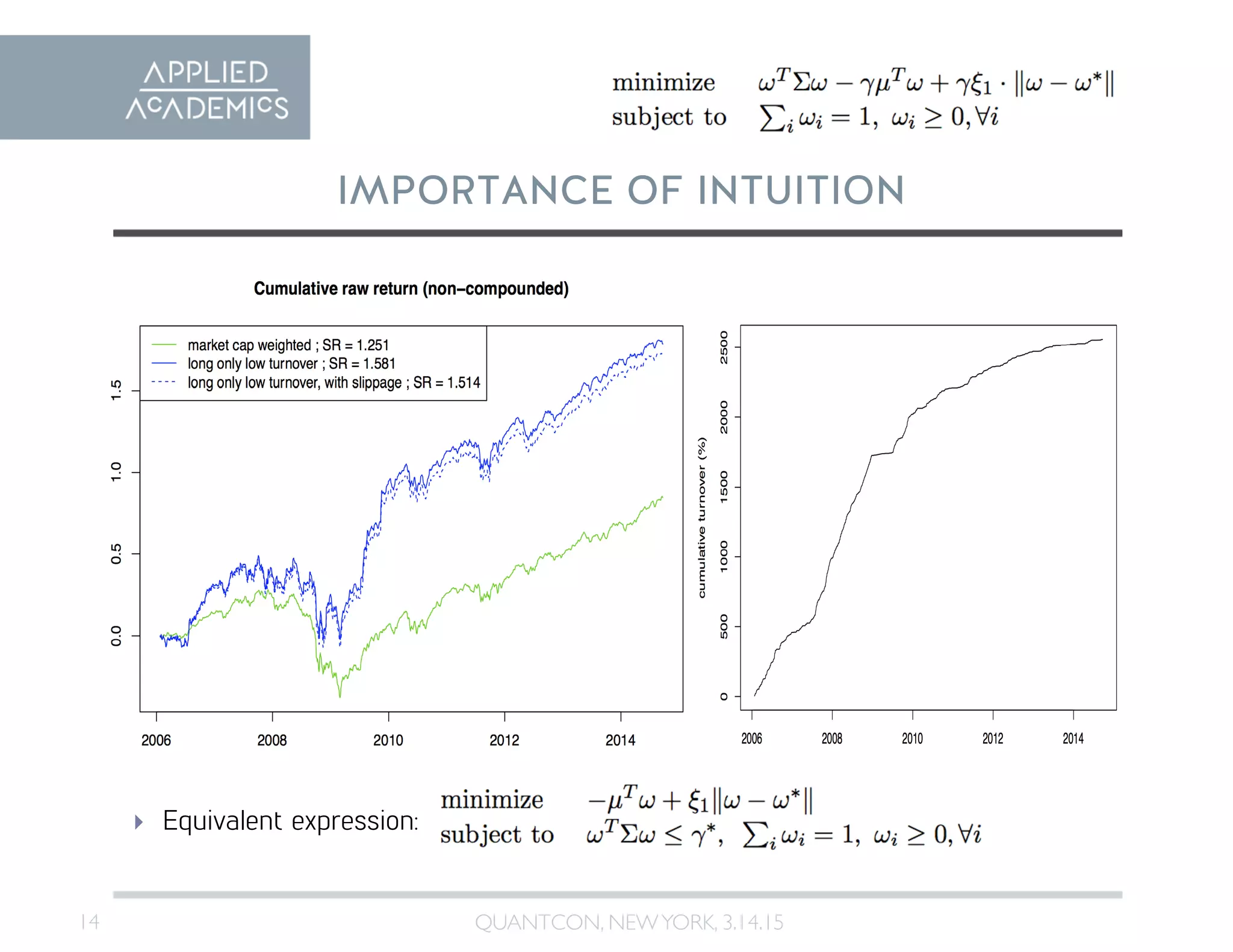
  Equivalent expression:
15	

MOMENT OF TRUTH: TOP 500 MARKET CAP ONLY!
QUANTCON, NEWYORK, 3.14.15	

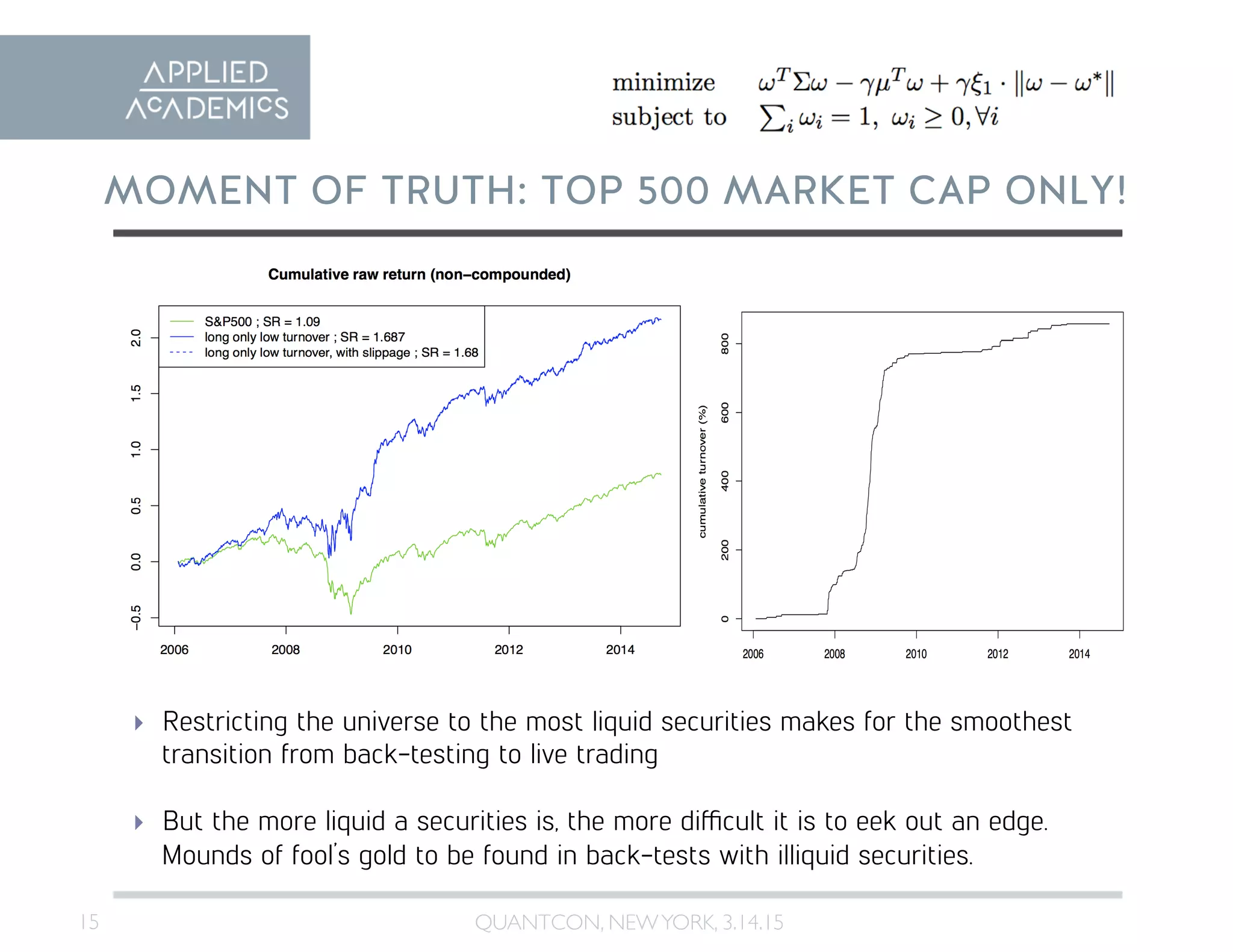
  Restricting the universe to the most liquid securities makes for the smoothest
transition from back-testing to live trading
  But the more liquid a securities is, the more difficult it is to eek out an edge.
Mounds of fool’s gold to be found in back-tests with illiquid securities.
16	

IMPLEMENTING THE STRATEGY
QUANTCON, NEWYORK, 3.14.15	

  This is where we are now …
  In honor of our host, I will tell you that we are using Fetcher to pull our signals
into Quantopian and then execute in IB.
  As a principle it’s always good to get to this stage as quickly as possible …
nothing matters until you’re touching the money

Finding, Exploring, and Refining Trading Strategies: A Case Study by Matthew Granade and Yoshiki Obayashi

  • 1.
    1 Finding, Exploring, andRefining Trading Strategies: A Case Study QuantCon, New York, 3.14.15 Presented by Matthew Granade and Yoshiki Obayashi
  • 2.
    2 FROM IDEA TOEXECUTION QUANTCON, NEWYORK, 3.14.15   What makes a good idea? (And where do good ideas come from?)   How to decide if an idea is worth researching?   How to move from idea to a trading strategy   How to move from a trading strategy into execution As a researcher, your most valuable asset is your time. Invest it like you invest your money: thoughtfully and carefully.
  • 3.
    3 GOOD IDEAS QUANTCON, NEWYORK,3.14.15   Usually some nub, often non-linear   An ounce or two of evidence that it might actually work   Plus some logic / some believable story for why it working would make sense Here’s the story of Eido as a trading strategy …
  • 4.
    4 EIDOSEARCH AT AGLANCE   A web-based tool for facilitating historical pattern searches   Looks for similar patterns in the past to generate a distribution of future returns   A generalized expression of technical analysis QUANTCON, NEWYORK, 3.14.15
  • 5.
    5 HOW DO WEKNOW IF THE CONCEPT WORKS? QUANTCON, NEWYORK, 3.14.15   Jump right into back-testing trading rules incorporating the signals? •  A common but mostly suboptimal practice   Establish a precise mathematical definition of the “concept” •  What are the parameters and inputs (what’s the difference?) •  What are the outputs?   Articulate what it means for the concept to “work” •  In the strictest sense: •  In a less strict sense, the empirical distribution may be usable even with certain biases •  Even if is the true distribution, we won’t make money on every signal
  • 6.
    6 A STRINGENT CHI-SQURETEST QUANTCON, NEWYORK, 3.14.15   Estimate the parameters and fix the domain of inputs   For each pattern window and forecast horizon, generate the empirical distribution for every ticker each day.   Calculate the cumulative probabilities   Count the number of observations falling into   For each pattern window and forecast horizon, calculate where . Under the null hypothesis: , hence   Penalize p-values for multiple testing across numerous pattern windows and forecast horizons (FWER, FDR, etc.)   Analyze the times series of correlated p-values and draw conclusions
  • 7.
  • 8.
    8 ANYTHING-BUT-U-SHAPE! TEST DESIGN QUANTCON,NEWYORK, 3.14.15   Repeat the first four steps of the Stringent Chi-Square Test   On each day, fit a beta(a,b) distribution using maximum likelihood   … and test the loosened null hypothesis: a < 0.95 and b < 0.95
  • 9.
    9 ANYTHING-BUT-U-SHAPE! TEST RESULTS QUANTCON,NEWYORK, 3.14.15   COOL! But, what now?
  • 10.
    10 FROM SIGNAL TOSTRATEGY QUANTCON, NEWYORK, 3.14.15   You’ve decided to invest further in an idea; next step is to find a sensible trading strategy   Dimensions to think about:   Whether to go long, short, or both   What basket of assets to trade   How strong a signal to require   How many trades to make   What time horizon to hold over   What performance criteria to prioritize   Almost always wrong to test everything; possible strategies should be driven by a deep understanding of why you think the strategy works
  • 11.
    11 FIRST LET’S JUSTGO WILD! QUANTCON, NEWYORK, 3.14.15   Set the base case for portfolio optimization: long-short unconstrained   Transaction costs, market frictions, and shattered dreams
  • 12.
    12 BACK-TESTING SHORT SELLINGIS DICEY… QUANTCON, NEWYORK, 3.14.15   Without reliable securities-lending data, it’s difficult to estimate P&L of shorts   The easiest workaround is to restrict all portfolio weights to be non-negative   … or only allow shorts in the most liquid securities like benchmark index ETFs
  • 13.
    13 BACK TO REALITY:CONTROL TURNOVER QUANTCON, NEWYORK, 3.14.15   Many ways to penalize turnover and slippage   Either model slippage roughly and conservatively or very meticulously
  • 14.
    14 IMPORTANCE OF INTUITION QUANTCON,NEWYORK, 3.14.15   Equivalent expression:
  • 15.
    15 MOMENT OF TRUTH:TOP 500 MARKET CAP ONLY! QUANTCON, NEWYORK, 3.14.15   Restricting the universe to the most liquid securities makes for the smoothest transition from back-testing to live trading   But the more liquid a securities is, the more difficult it is to eek out an edge. Mounds of fool’s gold to be found in back-tests with illiquid securities.
  • 16.
    16 IMPLEMENTING THE STRATEGY QUANTCON,NEWYORK, 3.14.15   This is where we are now …   In honor of our host, I will tell you that we are using Fetcher to pull our signals into Quantopian and then execute in IB.   As a principle it’s always good to get to this stage as quickly as possible … nothing matters until you’re touching the money