CAREER POINT
UNIVERSITY
ACCOUNTANCY
I would like to express my special thanks of gratitude
to my teacher (Pragya Bhargav Ma’am (my mentor);
assistant professor) who gave me the golden
opportunity to do this wonderful project on the
topic (Financial Statement),which also helped me in
doing a lot of Research and I came to know about so
many new things I am really thankful to them.
Secondly I would also like to thank my parents who
helped me a lot in finalizing this project within the
limited time frame.
o Meaning of financial statement
o Objectives of financial statement
o Characteristics of financial statement
o Nature of financial statement
o Balance sheet
o Format of balance sheet
o Illustrations
o Exercises
o Statement of profit & loss
o Format of statement of profit & loss
o Notes of statement of profit &loss
o Illustrations
o Exercises
• To present a true and fair view of the
financial performance (i.e. profit & loss) of
the business.
• To present a true and fair view of the
financial position (i.e. assets/equity &
liabilities) of the business.
• They are related to past period.
• They are expressed in terms of money.
• They show profitability through statement
of profit & loss and financial position
through balance sheet.
Recorded facts : the term ‘recorded facts’ means that the data
used for preparing financial statements are drawn from
accounting records. It do not include such facts which are not
recorded in the books of accounts.
Accounting conventions : it is based on accounting
conventions. This means that the actual financial position of
the business may be much better than disclosed by financial
statements.
Personal judgement : even through certain accounting
convention are followed while preparing the financial
statements, still personal judgment of the accountant plays a
decisive role in accounting. For e.g. :- the accountant has to
decide whether the asset is to be depreciated on straight line
method, written down value method or some other method.
o It is part of financial statement.
o It consists of assets & equity and liabilities.
o The balance sheet is in vertical form.
o The format given in Schedule III of
companies act,2013.
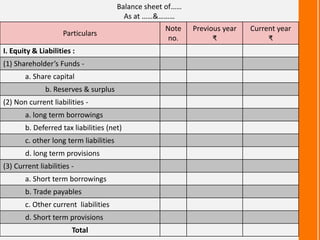
Particulars
Note
no.
Previous year
₹
Current year
₹
I. Equity & Liabilities :
(1) Shareholder’s Funds -
a. Share capital
b. Reserves & surplus
(2) Non current liabilities -
a. long term borrowings
b. Deferred tax liabilities (net)
c. other long term liabilities
d. long term provisions
(3) Current liabilities -
a. Short term borrowings
b. Trade payables
c. Other current liabilities
d. Short term provisions
Total
Balance sheet of……
As at ……&………
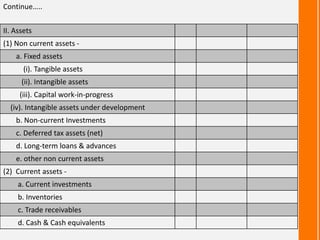
II. Assets
(1) Non current assets -
a. Fixed assets
(i). Tangible assets
(ii). Intangible assets
(iii). Capital work-in-progress
(iv). Intangible assets under development
b. Non-current Investments
c. Deferred tax assets (net)
d. Long-term loans & advances
e. other non current assets
(2) Current assets -
a. Current investments
b. Inventories
c. Trade receivables
d. Cash & Cash equivalents
Continue…..
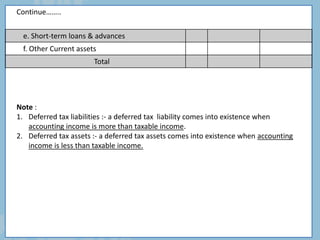
e. Short-term loans & advances
f. Other Current assets
Total
Continue……..
Note :
1. Deferred tax liabilities :- a deferred tax liability comes into existence when
accounting income is more than taxable income.
2. Deferred tax assets :- a deferred tax assets comes into existence when accounting
income is less than taxable income.
Illustration
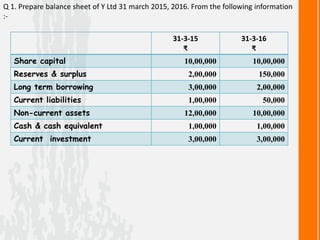
Q 1. Prepare balance sheet of Y Ltd 31 march 2015, 2016. From the following information
:-
31-3-15
₹
31-3-16
₹
Share capital 10,00,000 10,00,000
Reserves & surplus 2,00,000 150,000
Long term borrowing 3,00,000 2,00,000
Current liabilities 1,00,000 50,000
Non-current assets 12,00,000 10,00,000
Cash & cash equivalent 1,00,000 1,00,000
Current investment 3,00,000 3,00,000
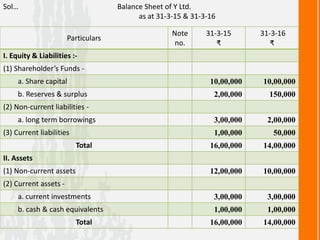
Sol… Balance Sheet of Y Ltd.
as at 31-3-15 & 31-3-16
Particulars
Note
no.
31-3-15
₹
31-3-16
₹
I. Equity & Liabilities :-
(1) Shareholder’s Funds -
a. Share capital 10,00,000 10,00,000
b. Reserves & surplus 2,00,000 150,000
(2) Non-current liabilities -
a. long term borrowings 3,00,000 2,00,000
(3) Current liabilities 1,00,000 50,000
Total 16,00,000 14,00,000
II. Assets
(1) Non-current assets 12,00,000 10,00,000
(2) Current assets -
a. current investments 3,00,000 3,00,000
b. cash & cash equivalents 1,00,000 1,00,000
Total 16,00,000 14,00,000
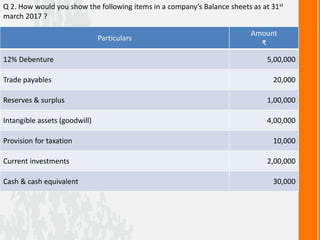
Q 2. How would you show the following items in a company’s Balance sheets as at 31st
march 2017 ?
Particulars
Amount
₹
12% Debenture 5,00,000
Trade payables 20,000
Reserves & surplus 1,00,000
Intangible assets (goodwill) 4,00,000
Provision for taxation 10,000
Current investments 2,00,000
Cash & cash equivalent 30,000
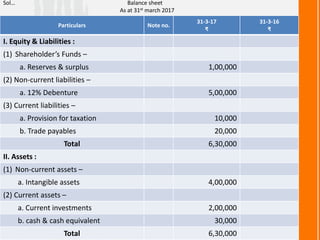
Sol… Balance sheet
As at 31st march 2017
Particulars Note no.
31-3-17
₹
31-3-16
₹
I. Equity & Liabilities :
(1) Shareholder’s Funds –
a. Reserves & surplus 1,00,000
(2) Non-current liabilities –
a. 12% Debenture 5,00,000
(3) Current liabilities –
a. Provision for taxation 10,000
b. Trade payables 20,000
Total 6,30,000
II. Assets :
(1) Non-current assets –
a. Intangible assets 4,00,000
(2) Current assets –
a. Current investments 2,00,000
b. cash & cash equivalent 30,000
Total 6,30,000
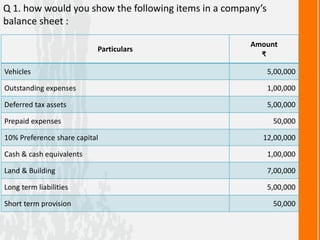
Q 1. how would you show the following items in a company’s
balance sheet :
Particulars
Amount
₹
Vehicles 5,00,000
Outstanding expenses 1,00,000
Deferred tax assets 5,00,000
Prepaid expenses 50,000
10% Preference share capital 12,00,000
Cash & cash equivalents 1,00,000
Land & Building 7,00,000
Long term liabilities 5,00,000
Short term provision 50,000
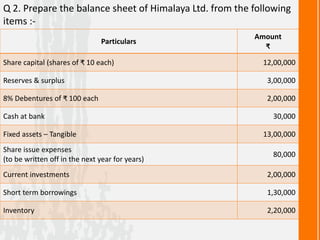
Q 2. Prepare the balance sheet of Himalaya Ltd. from the following
items :-
Particulars
Amount
₹
Share capital (shares of ₹ 10 each) 12,00,000
Reserves & surplus 3,00,000
8% Debentures of ₹ 100 each 2,00,000
Cash at bank 30,000
Fixed assets – Tangible 13,00,000
Share issue expenses
(to be written off in the next year for years)
80,000
Current investments 2,00,000
Short term borrowings 1,30,000
Inventory 2,20,000
It is a part of financial
statement .
It shows the profit & loss of the
company.
The format of statement of
profit & loss is specified in Part
II Schedule-III of the
companies act, 2013.
It consists of four column.
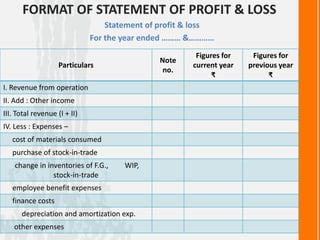
FORMAT OF STATEMENT OF PROFIT & LOSS
Statement of profit & loss
For the year ended ……… &…………
Particulars
Note
no.
Figures for
current year
₹
Figures for
previous year
₹
I. Revenue from operation
II. Add : Other income
III. Total revenue (I + II)
IV. Less : Expenses –
cost of materials consumed
purchase of stock-in-trade
change in inventories of F.G., WIP,
stock-in-trade
employee benefit expenses
finance costs
depreciation and amortization exp.
other expenses
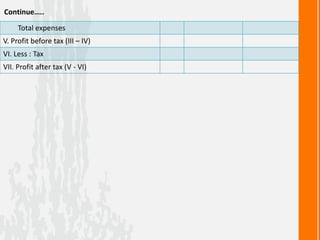
Total expenses
V. Profit before tax (III – IV)
VI. Less : Tax
VII. Profit after tax (V - VI)
Continue…..
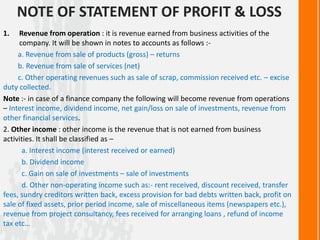
NOTE OF STATEMENT OF PROFIT & LOSS
1. Revenue from operation : it is revenue earned from business activities of the
company. It will be shown in notes to accounts as follows :-
a. Revenue from sale of products (gross) – returns
b. Revenue from sale of services (net)
c. Other operating revenues such as sale of scrap, commission received etc. – excise
duty collected.
Note :- in case of a finance company the following will become revenue from operations
– Interest income, dividend income, net gain/loss on sale of investments, revenue from
other financial services.
2. Other income : other income is the revenue that is not earned from business
activities. It shall be classified as –
a. Interest income (interest received or earned)
b. Dividend income
c. Gain on sale of investments – sale of investments
d. Other non-operating income such as:- rent received, discount received, transfer
fees, sundry creditors written back, excess provision for bad debts written back, profit on
sale of fixed assets, prior period income, sale of miscellaneous items (newspapers etc.),
revenue from project consultancy, fees received for arranging loans , refund of income
tax etc…
CONTINUE…….
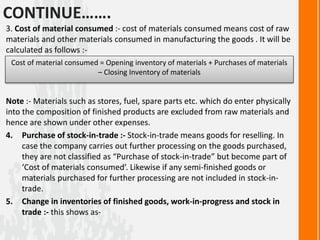
3. Cost of material consumed :- cost of materials consumed means cost of raw
materials and other materials consumed in manufacturing the goods . It will be
calculated as follows :-
Note :- Materials such as stores, fuel, spare parts etc. which do enter physically
into the composition of finished products are excluded from raw materials and
hence are shown under other expenses.
4. Purchase of stock-in-trade :- Stock-in-trade means goods for reselling. In
case the company carries out further processing on the goods purchased,
they are not classified as “Purchase of stock-in-trade” but become part of
‘Cost of materials consumed’. Likewise if any semi-finished goods or
materials purchased for further processing are not included in stock-in-
trade.
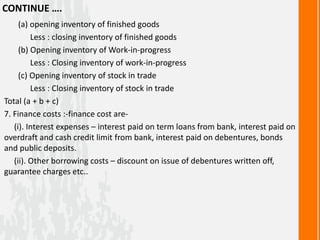
5. Change in inventories of finished goods, work-in-progress and stock in
trade :- this shows as-
Cost of material consumed = Opening inventory of materials + Purchases of materials
– Closing Inventory of materials
CONTINUE ….
(a) opening inventory of finished goods
Less : closing inventory of finished goods
(b) Opening inventory of Work-in-progress
Less : Closing inventory of work-in-progress
(c) Opening inventory of stock in trade
Less : Closing inventory of stock in trade
Total (a + b + c)
7. Finance costs :-finance cost are-
(i). Interest expenses – interest paid on term loans from bank, interest paid on
overdraft and cash credit limit from bank, interest paid on debentures, bonds
and public deposits.
(ii). Other borrowing costs – discount on issue of debentures written off,
guarantee charges etc..
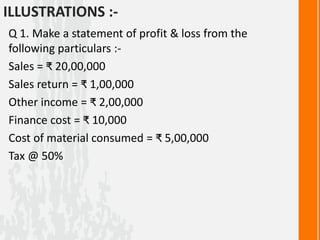
ILLUSTRATIONS :-
Q 1. Make a statement of profit & loss from the
following particulars :-
Sales = ₹ 20,00,000
Sales return = ₹ 1,00,000
Other income = ₹ 2,00,000
Finance cost = ₹ 10,000
Cost of material consumed = ₹ 5,00,000
Tax @ 50%
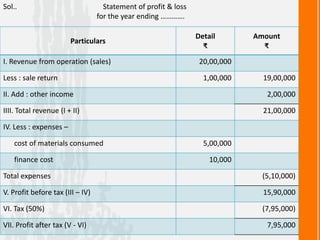
Sol.. Statement of profit & loss
for the year ending ………….
Particulars
Detail
₹
Amount
₹
I. Revenue from operation (sales) 20,00,000
Less : sale return 1,00,000 19,00,000
II. Add : other income 2,00,000
IIII. Total revenue (I + II) 21,00,000
IV. Less : expenses –
cost of materials consumed 5,00,000
finance cost 10,000
Total expenses (5,10,000)
V. Profit before tax (III – IV) 15,90,000
VI. Tax (50%) (7,95,000)
VII. Profit after tax (V - VI) 7,95,000
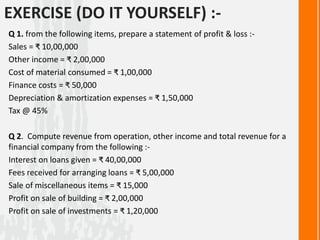
EXERCISE (DO IT YOURSELF) :-
Q 1. from the following items, prepare a statement of profit & loss :-
Sales = ₹ 10,00,000
Other income = ₹ 2,00,000
Cost of material consumed = ₹ 1,00,000
Finance costs = ₹ 50,000
Depreciation & amortization expenses = ₹ 1,50,000
Tax @ 45%
Q 2. Compute revenue from operation, other income and total revenue for a
financial company from the following :-
Interest on loans given = ₹ 40,00,000
Fees received for arranging loans = ₹ 5,00,000
Sale of miscellaneous items = ₹ 15,000
Profit on sale of building = ₹ 2,00,000
Profit on sale of investments = ₹ 1,20,000
Thank
you
Presented by :
Yamini Kahaliya
BBA (Honors’)

Financial statement

  • 1.
  • 2.
  • 3.
    I would liketo express my special thanks of gratitude to my teacher (Pragya Bhargav Ma’am (my mentor); assistant professor) who gave me the golden opportunity to do this wonderful project on the topic (Financial Statement),which also helped me in doing a lot of Research and I came to know about so many new things I am really thankful to them. Secondly I would also like to thank my parents who helped me a lot in finalizing this project within the limited time frame.
  • 4.
    o Meaning offinancial statement o Objectives of financial statement o Characteristics of financial statement o Nature of financial statement o Balance sheet o Format of balance sheet o Illustrations o Exercises o Statement of profit & loss o Format of statement of profit & loss o Notes of statement of profit &loss o Illustrations o Exercises
  • 6.
    • To presenta true and fair view of the financial performance (i.e. profit & loss) of the business. • To present a true and fair view of the financial position (i.e. assets/equity & liabilities) of the business.
  • 7.
    • They arerelated to past period. • They are expressed in terms of money. • They show profitability through statement of profit & loss and financial position through balance sheet.
  • 8.
    Recorded facts :the term ‘recorded facts’ means that the data used for preparing financial statements are drawn from accounting records. It do not include such facts which are not recorded in the books of accounts. Accounting conventions : it is based on accounting conventions. This means that the actual financial position of the business may be much better than disclosed by financial statements. Personal judgement : even through certain accounting convention are followed while preparing the financial statements, still personal judgment of the accountant plays a decisive role in accounting. For e.g. :- the accountant has to decide whether the asset is to be depreciated on straight line method, written down value method or some other method.

  • 9.
    o It ispart of financial statement. o It consists of assets & equity and liabilities. o The balance sheet is in vertical form. o The format given in Schedule III of companies act,2013.
  • 10.
    Particulars Note no. Previous year ₹ Current year ₹ I.Equity & Liabilities : (1) Shareholder’s Funds - a. Share capital b. Reserves & surplus (2) Non current liabilities - a. long term borrowings b. Deferred tax liabilities (net) c. other long term liabilities d. long term provisions (3) Current liabilities - a. Short term borrowings b. Trade payables c. Other current liabilities d. Short term provisions Total Balance sheet of…… As at ……&………
  • 11.
    II. Assets (1) Noncurrent assets - a. Fixed assets (i). Tangible assets (ii). Intangible assets (iii). Capital work-in-progress (iv). Intangible assets under development b. Non-current Investments c. Deferred tax assets (net) d. Long-term loans & advances e. other non current assets (2) Current assets - a. Current investments b. Inventories c. Trade receivables d. Cash & Cash equivalents Continue…..
  • 12.
    e. Short-term loans& advances f. Other Current assets Total Continue…….. Note : 1. Deferred tax liabilities :- a deferred tax liability comes into existence when accounting income is more than taxable income. 2. Deferred tax assets :- a deferred tax assets comes into existence when accounting income is less than taxable income.
  • 13.
  • 14.
    Q 1. Preparebalance sheet of Y Ltd 31 march 2015, 2016. From the following information :- 31-3-15 ₹ 31-3-16 ₹ Share capital 10,00,000 10,00,000 Reserves & surplus 2,00,000 150,000 Long term borrowing 3,00,000 2,00,000 Current liabilities 1,00,000 50,000 Non-current assets 12,00,000 10,00,000 Cash & cash equivalent 1,00,000 1,00,000 Current investment 3,00,000 3,00,000
  • 15.
    Sol… Balance Sheetof Y Ltd. as at 31-3-15 & 31-3-16 Particulars Note no. 31-3-15 ₹ 31-3-16 ₹ I. Equity & Liabilities :- (1) Shareholder’s Funds - a. Share capital 10,00,000 10,00,000 b. Reserves & surplus 2,00,000 150,000 (2) Non-current liabilities - a. long term borrowings 3,00,000 2,00,000 (3) Current liabilities 1,00,000 50,000 Total 16,00,000 14,00,000 II. Assets (1) Non-current assets 12,00,000 10,00,000 (2) Current assets - a. current investments 3,00,000 3,00,000 b. cash & cash equivalents 1,00,000 1,00,000 Total 16,00,000 14,00,000
  • 16.
    Q 2. Howwould you show the following items in a company’s Balance sheets as at 31st march 2017 ? Particulars Amount ₹ 12% Debenture 5,00,000 Trade payables 20,000 Reserves & surplus 1,00,000 Intangible assets (goodwill) 4,00,000 Provision for taxation 10,000 Current investments 2,00,000 Cash & cash equivalent 30,000
  • 17.
    Sol… Balance sheet Asat 31st march 2017 Particulars Note no. 31-3-17 ₹ 31-3-16 ₹ I. Equity & Liabilities : (1) Shareholder’s Funds – a. Reserves & surplus 1,00,000 (2) Non-current liabilities – a. 12% Debenture 5,00,000 (3) Current liabilities – a. Provision for taxation 10,000 b. Trade payables 20,000 Total 6,30,000 II. Assets : (1) Non-current assets – a. Intangible assets 4,00,000 (2) Current assets – a. Current investments 2,00,000 b. cash & cash equivalent 30,000 Total 6,30,000
  • 19.
    Q 1. howwould you show the following items in a company’s balance sheet : Particulars Amount ₹ Vehicles 5,00,000 Outstanding expenses 1,00,000 Deferred tax assets 5,00,000 Prepaid expenses 50,000 10% Preference share capital 12,00,000 Cash & cash equivalents 1,00,000 Land & Building 7,00,000 Long term liabilities 5,00,000 Short term provision 50,000
  • 20.
    Q 2. Preparethe balance sheet of Himalaya Ltd. from the following items :- Particulars Amount ₹ Share capital (shares of ₹ 10 each) 12,00,000 Reserves & surplus 3,00,000 8% Debentures of ₹ 100 each 2,00,000 Cash at bank 30,000 Fixed assets – Tangible 13,00,000 Share issue expenses (to be written off in the next year for years) 80,000 Current investments 2,00,000 Short term borrowings 1,30,000 Inventory 2,20,000
  • 21.
    It is apart of financial statement . It shows the profit & loss of the company. The format of statement of profit & loss is specified in Part II Schedule-III of the companies act, 2013. It consists of four column.
  • 22.
    FORMAT OF STATEMENTOF PROFIT & LOSS Statement of profit & loss For the year ended ……… &………… Particulars Note no. Figures for current year ₹ Figures for previous year ₹ I. Revenue from operation II. Add : Other income III. Total revenue (I + II) IV. Less : Expenses – cost of materials consumed purchase of stock-in-trade change in inventories of F.G., WIP, stock-in-trade employee benefit expenses finance costs depreciation and amortization exp. other expenses
  • 23.
    Total expenses V. Profitbefore tax (III – IV) VI. Less : Tax VII. Profit after tax (V - VI) Continue…..
  • 24.
    NOTE OF STATEMENTOF PROFIT & LOSS 1. Revenue from operation : it is revenue earned from business activities of the company. It will be shown in notes to accounts as follows :- a. Revenue from sale of products (gross) – returns b. Revenue from sale of services (net) c. Other operating revenues such as sale of scrap, commission received etc. – excise duty collected. Note :- in case of a finance company the following will become revenue from operations – Interest income, dividend income, net gain/loss on sale of investments, revenue from other financial services. 2. Other income : other income is the revenue that is not earned from business activities. It shall be classified as – a. Interest income (interest received or earned) b. Dividend income c. Gain on sale of investments – sale of investments d. Other non-operating income such as:- rent received, discount received, transfer fees, sundry creditors written back, excess provision for bad debts written back, profit on sale of fixed assets, prior period income, sale of miscellaneous items (newspapers etc.), revenue from project consultancy, fees received for arranging loans , refund of income tax etc…
  • 25.
    CONTINUE……. 3. Cost ofmaterial consumed :- cost of materials consumed means cost of raw materials and other materials consumed in manufacturing the goods . It will be calculated as follows :- Note :- Materials such as stores, fuel, spare parts etc. which do enter physically into the composition of finished products are excluded from raw materials and hence are shown under other expenses. 4. Purchase of stock-in-trade :- Stock-in-trade means goods for reselling. In case the company carries out further processing on the goods purchased, they are not classified as “Purchase of stock-in-trade” but become part of ‘Cost of materials consumed’. Likewise if any semi-finished goods or materials purchased for further processing are not included in stock-in- trade. 5. Change in inventories of finished goods, work-in-progress and stock in trade :- this shows as- Cost of material consumed = Opening inventory of materials + Purchases of materials – Closing Inventory of materials
  • 26.
    CONTINUE …. (a) openinginventory of finished goods Less : closing inventory of finished goods (b) Opening inventory of Work-in-progress Less : Closing inventory of work-in-progress (c) Opening inventory of stock in trade Less : Closing inventory of stock in trade Total (a + b + c) 7. Finance costs :-finance cost are- (i). Interest expenses – interest paid on term loans from bank, interest paid on overdraft and cash credit limit from bank, interest paid on debentures, bonds and public deposits. (ii). Other borrowing costs – discount on issue of debentures written off, guarantee charges etc..
  • 27.
    ILLUSTRATIONS :- Q 1.Make a statement of profit & loss from the following particulars :- Sales = ₹ 20,00,000 Sales return = ₹ 1,00,000 Other income = ₹ 2,00,000 Finance cost = ₹ 10,000 Cost of material consumed = ₹ 5,00,000 Tax @ 50%
  • 28.
    Sol.. Statement ofprofit & loss for the year ending …………. Particulars Detail ₹ Amount ₹ I. Revenue from operation (sales) 20,00,000 Less : sale return 1,00,000 19,00,000 II. Add : other income 2,00,000 IIII. Total revenue (I + II) 21,00,000 IV. Less : expenses – cost of materials consumed 5,00,000 finance cost 10,000 Total expenses (5,10,000) V. Profit before tax (III – IV) 15,90,000 VI. Tax (50%) (7,95,000) VII. Profit after tax (V - VI) 7,95,000
  • 29.
    EXERCISE (DO ITYOURSELF) :- Q 1. from the following items, prepare a statement of profit & loss :- Sales = ₹ 10,00,000 Other income = ₹ 2,00,000 Cost of material consumed = ₹ 1,00,000 Finance costs = ₹ 50,000 Depreciation & amortization expenses = ₹ 1,50,000 Tax @ 45% Q 2. Compute revenue from operation, other income and total revenue for a financial company from the following :- Interest on loans given = ₹ 40,00,000 Fees received for arranging loans = ₹ 5,00,000 Sale of miscellaneous items = ₹ 15,000 Profit on sale of building = ₹ 2,00,000 Profit on sale of investments = ₹ 1,20,000
  • 30.
  • 31.
    Presented by : YaminiKahaliya BBA (Honors’)