Financial
Reporting
for Financial
Institutions
Presented by : Bhoomika
Financial
Reportin
g
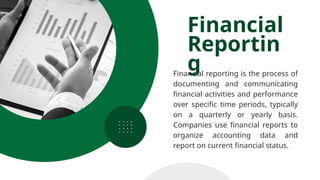
Financial reporting is the process of
documenting and communicating
financial activities and performance
over specific time periods, typically
on a quarterly or yearly basis.
Companies use financial reports to
organize accounting data and
report on current financial status.
• International Accounting Standards Board (IASB)
• Basel Committee on Banking Supervision (BCBS)
• Generally Accepted Accounting Principles (GAAP)
• The National Financial Reporting Authority (NFRA)
• Reserve Bank of India (RBI)
• Securities and Exchange Board of India (SEBI)
Regulatory Body
Objectives of
Financial
Reporting
• Transparency in Financial
Position
1
• Monitor & Evaluate
Performance
4
• Risk
Management
3
• Support Stakeholder Decision-
Making
2
• Transparency and
Accountability:
Financial reporting ensures that the
institution’s financial position and
performance are accurately disclosed
to stakeholders, including investors,
regulators, and customers.
It fosters trust and confidence by
providing a clear picture of financial
health.
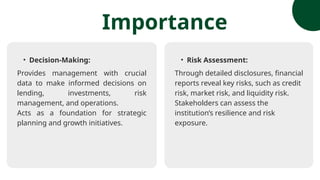
Importance
• Regulatory Compliance:
Financial institutions operate in a
highly regulated environment.
Compliance with standards like IFRS,
Basel norms, and local laws is critical.
Accurate reporting helps meet
statutory obligations and avoid
penalties or sanctions.
• Decision-Making:
Provides management with crucial
data to make informed decisions on
lending, investments, risk
management, and operations.
Acts as a foundation for strategic
planning and growth initiatives.
Importance
• Risk Assessment:
Through detailed disclosures, financial
reports reveal key risks, such as credit
risk, market risk, and liquidity risk.
Stakeholders can assess the
institution’s resilience and risk
exposure.
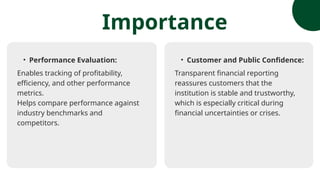
• Performance Evaluation:
Enables tracking of profitability,
efficiency, and other performance
metrics.
Helps compare performance against
industry benchmarks and
competitors.
Importance
• Customer and Public Confidence:
Transparent financial reporting
reassures customers that the
institution is stable and trustworthy,
which is especially critical during
financial uncertainties or crises.
1 Income Statement
2 Balance Sheet
3 Cash Flow Statement
4 Statement of Changes in Equity
Types of Financial
Reports
Users of Financial Reports
• Regulatory Authorities
• Investors and Shareholders
• Lenders and Creditors
• Employees
• Depositors
• Credit Rating Agencies
• Auditors
• Competitors
• Tax Authorities
Thank You

FINANCIAL REPORTING FOR FINANCIAL INSTITUTIONS

  • 1.
  • 2.
    Financial Reportin g Financial reporting isthe process of documenting and communicating financial activities and performance over specific time periods, typically on a quarterly or yearly basis. Companies use financial reports to organize accounting data and report on current financial status.
  • 3.
    • International AccountingStandards Board (IASB) • Basel Committee on Banking Supervision (BCBS) • Generally Accepted Accounting Principles (GAAP) • The National Financial Reporting Authority (NFRA) • Reserve Bank of India (RBI) • Securities and Exchange Board of India (SEBI) Regulatory Body
  • 4.
    Objectives of Financial Reporting • Transparencyin Financial Position 1 • Monitor & Evaluate Performance 4 • Risk Management 3 • Support Stakeholder Decision- Making 2
  • 5.
    • Transparency and Accountability: Financialreporting ensures that the institution’s financial position and performance are accurately disclosed to stakeholders, including investors, regulators, and customers. It fosters trust and confidence by providing a clear picture of financial health. Importance • Regulatory Compliance: Financial institutions operate in a highly regulated environment. Compliance with standards like IFRS, Basel norms, and local laws is critical. Accurate reporting helps meet statutory obligations and avoid penalties or sanctions.
  • 6.
    • Decision-Making: Provides managementwith crucial data to make informed decisions on lending, investments, risk management, and operations. Acts as a foundation for strategic planning and growth initiatives. Importance • Risk Assessment: Through detailed disclosures, financial reports reveal key risks, such as credit risk, market risk, and liquidity risk. Stakeholders can assess the institution’s resilience and risk exposure.
  • 7.
    • Performance Evaluation: Enablestracking of profitability, efficiency, and other performance metrics. Helps compare performance against industry benchmarks and competitors. Importance • Customer and Public Confidence: Transparent financial reporting reassures customers that the institution is stable and trustworthy, which is especially critical during financial uncertainties or crises.
  • 8.
    1 Income Statement 2Balance Sheet 3 Cash Flow Statement 4 Statement of Changes in Equity Types of Financial Reports
  • 9.
    Users of FinancialReports • Regulatory Authorities • Investors and Shareholders • Lenders and Creditors • Employees • Depositors • Credit Rating Agencies • Auditors • Competitors • Tax Authorities
  • 10.