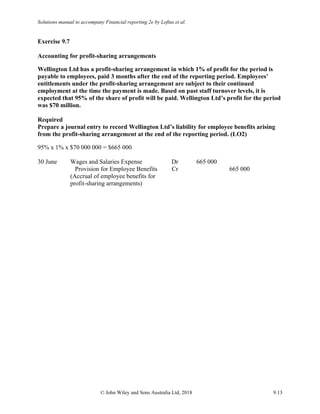
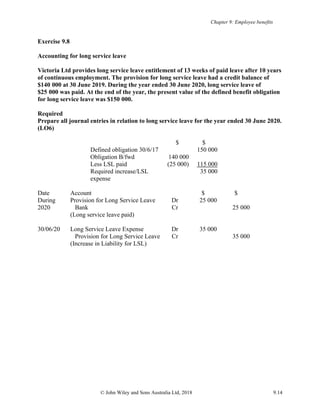
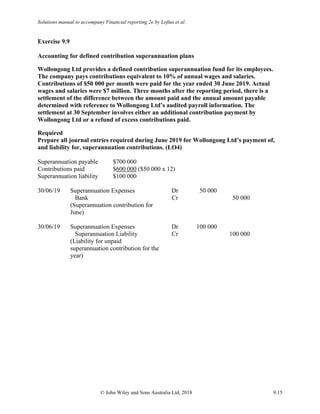
Financial Reporting 2ndEdition Loftus Solutions
Manual download
https://testbankfan.com/product/financial-reporting-2nd-edition-
loftus-solutions-manual/
Explore and download more test bank or solution manual
at testbankfan.com
2.
Here are somerecommended products for you. Click the link to
download, or explore more at testbankfan.com
Financial Reporting 2nd Edition Loftus Test Bank
https://testbankfan.com/product/financial-reporting-2nd-edition-
loftus-test-bank/
Financial Reporting 1st Edition Loftus Solutions Manual
https://testbankfan.com/product/financial-reporting-1st-edition-
loftus-solutions-manual/
Financial Reporting 1st Edition Loftus Test Bank
https://testbankfan.com/product/financial-reporting-1st-edition-
loftus-test-bank/
Solid Waste Engineering A Global Perspective 3rd Edition
Worrell Solutions Manual
https://testbankfan.com/product/solid-waste-engineering-a-global-
perspective-3rd-edition-worrell-solutions-manual/
3.
Canadian Entrepreneurship AndSmall Business Management
Canadian 9th Edition Balderson Test Bank
https://testbankfan.com/product/canadian-entrepreneurship-and-small-
business-management-canadian-9th-edition-balderson-test-bank/
Managing the Law The Legal Aspects of Doing Business 4th
Edition McInnes Test Bank
https://testbankfan.com/product/managing-the-law-the-legal-aspects-of-
doing-business-4th-edition-mcinnes-test-bank/
Intermediate Algebra Everyday Explorations 5th Edition
Kaseberg Test Bank
https://testbankfan.com/product/intermediate-algebra-everyday-
explorations-5th-edition-kaseberg-test-bank/
Introduction to Human Services 8th Edition Woodside Test
Bank
https://testbankfan.com/product/introduction-to-human-services-8th-
edition-woodside-test-bank/
Corporate Finance 9th Edition Ross Test Bank
https://testbankfan.com/product/corporate-finance-9th-edition-ross-
test-bank/
4.
Understanding Financial Statements11th Edition Fraser
Test Bank
https://testbankfan.com/product/understanding-financial-
statements-11th-edition-fraser-test-bank/
But Arrelsford, intenselyalive to what was going on, interposed.
“He’s at it again, sir!”
“Halt, there!” said General Randolph. “I ordered you to wait.”
The despatch was almost completed. Thorne ground his teeth with
rage in his impatience. He had tried audacity before, he would try it
again.
“I was sent here to attend to the business of this office and that
business is going out,” he said resolutely.
“No,” said General Randolph with equal firmness, “it is not going out
until I am ready for it.”
“My orders come from the War Department, not from you, sir. This
despatch came in half an hour ago,” answered Thorne angrily, his
voice rising, “they are calling for it at the other end of the line. It’s
my business to send it out and I am going to do it.”
“Stop!” said General Randolph, as Thorne began to send the
message again. “Sergeant, seize that man and keep him from that
machine.”
Well, the last hope was gone. As the Sergeant stepped forward to
execute his orders, Thorne, desperately determined to the last,
clicked out a letter, but he was cut short in the middle of a word.
The Sergeant and two men dragged him away, chair and all, from
the table, and two others posted themselves in front of the key.
“I will have you court-martialled for this, sir,” said General Randolph
angrily.
“You will have to answer yourself,” cried Thorne, playing the game to
the last, “for the delay of a despatch of vital importance, sent by the
Secretary of War.”
“Do you mean that?” cried Randolph.
“I mean just that,” answered Thorne, “and I demand that you let me
proceed with the business of this office. Before these officers and
men I repeat that demand.”
23.
“By what authoritydo you send that despatch?”
“I refer you to the Department, sir.”
“Show me your orders for taking charge of this office.”
“I refer you to the Department, sir,” answered Thorne stubbornly.
“By God, sir!” continued General Randolph hotly. “I will refer to the
Department. Leave your men on guard there, Sergeant. Go over to
the War Office. My compliments to the Secretary of War, and ask
him if he will be so good as to——”
But Arrelsford’s evil genius prompted him to interpose again. When
affairs were going to his liking he should have let them alone, but
fate seemed to be playing into his hand, and he determined to make
the most of it and the chance.
“Another witness! Miss Varney,” he cried triumphantly, as he bowed
toward the window in which Edith had at that moment appeared.
“She was here with me, she saw it all. Ask her.”
General Randolph turned toward the window and in his turn bowed
to the girl.
“Miss Varney,” he asked courteously, “do you know anything about
this?”
“About what, sir?” answered Edith in a low voice.
“Mr. Arrelsford claims that Captain Thorne is acting without authority
in this office and that you can testify to that effect,” was the
General’s answer.
24.
CHAPTER XV
LOVE ANDDUTY AT THE TOUCH
Thorne’s case was now absolutely hopeless. By the testimony of two
witnesses a thing is established. All that Arrelsford had seen Edith
had seen. All that he knew, she knew. She had only to speak and
the plan had failed; the cleverly constructed scheme would fall to
pieces. His brother’s life would have been wasted, nay more, his own
life also; for well did he realise that the bold way he had played the
game would the more certainly hasten his immediate execution. A
spy in the Confederate capital!
He could reproach himself with nothing. He had done his very best.
An ordinary man would have failed a dozen times in the struggle.
Courage, adroitness, resourcefulness, and good fortune had carried
him so far, but the odds were now heavily against him and nothing
that he could do would avail him anything. The game was played
and he had lost; Arrelsford had triumphed.
Thorne, in the one word that Edith Varney was to speak, would lose
life, honour, and that for which he had risked both. And he would
lose more than that. He would lose the love of the woman who had
never seemed so beautiful to him as she stood there, pale-faced,
erect, the very incarnation of self-sacrifice, as were all the women of
the Confederacy. And he would lose more than her love. He would
lose her respect. His humiliation would be her humiliation. Never so
long as she lived could her mind dwell on him with tenderness. The
sound of his name would be a hissing and a reproach in her ear, his
reputation a by-word and a shame. Her connection with him and
that he had loved her would humiliate her only less than the fact
that she had loved him.
25.
His condition wasindeed pitiable; yet, to do him justice, his thoughts
were not so much for himself as they were for two other things. First
and foremost bulked largest before him the plan for which he had
made all this sacrifice, which had promised to end the weary months
of siege which Richmond and Petersburg had sustained. His brother
had lost his life, he more than suspected, in the endeavour to carry
it out, and now he had failed. That was a natural humiliation and
reproach to his pride, although as his mind went back over the
scene he could detect no false move on his part. Of course his
allowing his love for Edith Varney to get the mastery of him had
been wrong under the circumstances, but that had not affected the
failure or success of his endeavours.
And his thoughts also were for the woman. He knew that she loved
him, she had admitted it, but once his eyes had been opened, he
could have told it without any admission at all. All that he had
suffered, she had suffered, and more. If she would be compelled to
apologise for him, she would also be compelled to assume the
defensive for him. She loved him and she was placed in the fearful
position of having to deal the blow. The words which would
presently fall from her lips would complete his undoing. They would
blast his reputation forever and send him to his death. He knew they
would not be easy words for her to speak. He knew that whatever
his merit or demerit, she would never forget that it was she who had
completed his ruin; the fact that she would also ruin the plan against
her country would not weigh very heavily in her breaking heart
against that present personal consideration—after a while maybe but
not at first. And therefore he pitied her.
He drew himself erect to meet his fate like a man, and waited. The
wait was a long one. Edith Varney was having her own troubles. She
knew as well as any one the importance of her testimony. She had
come from the Commissary General’s vacant office and had been
back at the window long enough to have heard the conversation
between General Randolph and the two men. She was an unusually
keen-witted girl and she realised the situation to the full.
26.
Her confidence inher lover had been shaken, undermined, restored,
and shaken again, until her mind was in a perfect whirl. She did not
know, she could not tell whether he was what he seemed to be or
not. It seemed like treachery to him, this uncertainty. It would be a
simple matter to corroborate Mr. Arrelsford at once, and it occurred
to her that she had no option. But coincident with the question
flashed into her mind something she had forgotten which made it
possible for her to answer in another way. Thus, she understood that
the life of her lover hung upon her decision.
What answer should she make? What course should she take? She
realised, too, that it was quite possible if she saved his life, it might
result in the carrying out of the plan about which there had been so
much discussion and which threatened so much against her country.
If he were false and she saved him he would certainly take
advantage of the respite. If he were true and she saved him no
harm could come to her country. She was intensely patriotic. And
that phase of the problem worried her greatly.
Her eyes flashed quickly from the vindictive yet triumphant fact of
Arrelsford, whom she loathed, to the pale, composed, set face of
Thorne, whom she loved, and her glance fell upon his wounded left
wrist, tied up, the blood oozing through the handkerchief. A wave of
sympathy and tenderness filled her breast. He was hurt, suffering—
that decided her.
With one brief, voiceless prayer to God for guidance, she turned to
General Randolph, and it was well that she spoke when she did, for
the pause had become insupportable to Thorne at least. He had
made up his mind to relieve the dilemma and confess his guilt so
that the girl would not have to reproach herself with a betrayal of
her lover or her cause, that she might not feel that she had been
found wanting at the crucial moment. Indeed, Thorne would have
done this before but his duty as a soldier enjoined upon him the
propriety, the imperative necessity, of playing the game to the very
end. The battle was not yet over. It would never be over until he
faced the firing party.
27.
And then Edith’svoice broke the silence that had become so tense
with emotion.
“Mr. Arrelsford is mistaken, General Randolph,” she said quietly,
“Captain Thorne has the highest authority in this office.”
Arrelsford started violently and opened his mouth to speak, but
General Randolph silenced him with a look. The blood of the old
general was up, and it had become impossible for any one to
presume in the least degree. Thorne started, too. The blood rushed
to his heart. He thought he would choke to death. What did the girl
mean?
“The highest authority, sir,” continued Edith Varney, slowly drawing
out the commission, which every one but she had forgotten in the
excitement, “the authority of the President of the Confederate States
of America.”
Well, she had done it for weal or for woe. She had made her
decision. Had it been a wise decision? Had she acted for the best?
What interest had governed her, love for Thorne, love for her
country, or love for her own peace of mind? It was in the hands of
General Randolph now. The girl turned slowly away, unable to
sustain the burning glances of her lover and the vindictive stare of
Arrelsford.
“What’s this?” said General Randolph. “Umph! A Major’s Commission.
In command of the Telegraph Department. Major Thorne, I
congratulate you.”
“That commission, General Randolph!” exclaimed Arrelsford, his
voice rising, “let me explain how she——”
“That will do from you, sir,” said the General, “you have made
enough trouble as it is. I suppose you claim that this is a forgery, too
——”
“Let me tell you, sir,” persisted the Secret Service Agent.
“You have told me enough as it is. Sergeant, take him over to
headquarters.”
28.
“Fall in there!”cried the Sergeant of the Guard. “Two of you take the
prisoner. Forward, march!”
Two men seized Arrelsford, and the rest of them closed about him.
To do the man justice, he made a violent struggle and was only
marched out at the point of the bayonet, protesting and crying:
“For God’s sake, he’s in the Yankee Secret Service! He’ll send that
despatch out. His brother brought in the signal to-night!”
All the way down the corridor he could be heard yelling and
struggling. General Randolph paid not the slightest attention to him.
He stepped over to the telegraph table beside which Thorne stood—
and with all the force of which he was capable the young man could
hardly control the trembling of his knees.
“Major Thorne,” he said reprovingly as Thorne saluted him, “all this
delay has been your own fault. If you had only had sense enough to
mention this before we would have been saved a damned lot of
trouble. There’s your commission, sir.” He handed it to Thorne, who
saluted him again as one in a dream. “Come, gentlemen,” he said to
his officers, “I can’t understand why they have to be so cursed shy
about their Secret Service orders! Lieutenant Foray?”
“Yes, sir.”
“Take your orders from Major Thorne.”
“Yes, sir,” returned Foray.
“Good-night,” said the General, forgetful of the fact apparently that
Edith Varney was still standing by the window.
“Good-night, sir,” answered Thorne.
Foray moved over to the table at the right, while Thorne leaped to
his former position, and his hand sought the key. At last he could
send his message, there was nothing to prevent him or interrupt him
now, he was in command. Could he get it through? For a moment he
forgot everything but that, as he clicked out the call again, but he
29.
had scarcely pressedthe button when Edith Varney stepped to his
side.
“Captain Thorne,” she said in a low voice, giving him the old title.
He looked up at her, stopping a moment.
“What I have done gives you time to escape from Richmond,” she
continued.
“Escape!” whispered Thorne, clicking the key again. “Impossible!”
“Oh,” said the girl, laying her hand on his arm, “you wouldn’t do it—
now!”
And again the man’s fingers remained poised over the key as he
stared at her.
“I gave it to you to—to save your life. I didn’t think you’d use it for
anything else. Oh! You wouldn’t!”
Her voice in its low whisper was agonising. If her face had been
white before, what could be said of it now? In a flash Thorne saw
all. She had been confident of his guilt, and she had sought to save
his life because she loved him, and now because she loved her
country she sought to save that too.
The call sounded from the table. Thorne turned to it, bent over it,
and listened. It was the call for the message. Then he turned to the
woman. She looked at him; just one look. The kind of a look that
Christ might have turned upon Peter after those denials when He
saw him in the courtyard early on that bitter morning of betrayal. “I
saved you,” the girl’s look seemed to say, “I redeemed you and now
you betray me!” She spoke no words, words were useless between
them. Everything had been said, everything had been done. She
could only go. Never woman looked at man nor man looked at
woman as these two at each other.
The woman turned, she could trust herself no further. She went
blindly toward the door. The man followed her slowly, crushing the
commission in his hand, and ever as he went he heard the sound of
30.
the call behindhim. He stopped halfway between the door and the
table and watched her go, and then he turned.
Lieutenant Foray understanding nothing of what had transpired, but
hearing the call, had taken Thorne’s place before the table. He had
the despatch about which there had been so much trouble, and
upon which the whole plan turned, in his hand before him.
“They are calling for that despatch, sir,” he said as Thorne stared at
him in agony. “What shall I do with it?”
“Send it,” said the other hoarsely.
“Very good, sir,” answered Foray, seating himself and taking hold of
the key, but the first click of the sounder awakened Thorne to
action.
“No, no!” he cried. “Stop!” He rushed forward and seized the
despatch. “I won’t do it!” he thundered. With his wounded hand and
his well one he tore the despatch into fragments. “Revoke the order.
Tell them it was a mistake instantly. I refuse to act under this
commission!”
CHAPTER XVI
THE TUMULTIN HUMAN HEARTS
Of the many frightful nights in Richmond during the siege, that night
was one of the worst. The comparative calmness of the earlier hours
of repose of the quiet April evening gave way to pandemonium. The
works at Petersburg, desperately held by the Confederates, were
miles away from the city to the southward, but such was the
tremendous nature of the cannonading that the shocking sounds
seemed to be close at hand. Children cowered, women shuddered,
and old men prayed as they thought of the furious onslaughts in the
battle raging.
The Richmond streets were filled with people, mostly invalids, non-
combatants, women, and children. A tremendous attack was being
launched by the besiegers somewhere, it was evident. Urgent
messengers from General Lee called every reserve out of the
garrison at Richmond, and the quiet streets and country highways
awoke instantly to life. Such troops as could be spared moved to the
front at the double-quick. Every car of the dilapidated railroad was
pressed into service. Those who could not be transported by train
went on horseback or afoot. The youngest boy and the oldest man
alike shouldered their muskets, and with motley clothes, but with
hearts aflame, marched to the sound of the cannon. The women,
the sick, the wounded and invalid men and the children waited.
Morning would tell the tale. Into the city from which they marched,
men and boys would come back; an army nearly as great as had
gone forth, but an army halting, maimed, helpless, wounded,
suffering, shot to pieces. They had seen it too often not to be able
to forecast the scene absolutely. They knew with what heroic
determination their veterans, under the great Lee, were fighting
33.
back the terrificattacks of their brothers in blue, under the grimly
determined Grant. They could hear his great war-hammer ringing on
their anvil; a hammer of men, an anvil of men. Plan or no plan,
success or no success of some Secret Service operations, some vital
point was being wrestled for in a death-grapple between two armies;
and all the offensive capacities of the one and all the defensive
resources of the other were meeting, as they had been meeting
during the long years.
In a time like that, of public peril and public need, private and
personal affairs ought to be forgotten, but it was not so. Love and
hate, confidence and jealousy, faithfulness and disloyalty, self-
sacrifice and revenge, were still in human hearts. And these feelings
would put to shame even the passions engendered in the bloody
battles of the fearful warfare.
Edith Varney, for instance, had gone out of the telegraph office
assured that the sacrifice she had made for her lover had resulted in
the betrayal of her country; that Thorne had had not even the
common gratitude to accede to her request, although she had saved
his life, and, for the time being, his honour. Every cannon-shot,
every crashing volley of musketry that came faintly or loudly across
the hills seemed pointed straight at her heart. For all she knew, the
despatch had been sent, the cunningly devised scheme had been
carried out, and into some undefended gap in the lines the Federal
troops were pouring. The defence would crumble and the Army
would be cut in two; the city of Richmond would be taken, and the
Confederacy would be lost.
And she had done it! Would she have done it if she had known? She
had certainly expected to establish such a claim upon Thorne by her
interposition that he could not disregard it. But if she had known
positively that he would have done what she thought he did, would
she have sent him to his death? She put the question to herself in
agony. And she realised with flushes of shame and waves of
contrition that she would not, could not have done this thing. She
must have acted as she had, whatever was to come of it. Whatever
34.
he was, whateverhe did, she loved that man. She need not tell him,
she need tell no one, there could be no fruition to that love. She
must hide it, bury it in her bosom if she could, but for weal or woe
she loved him above everything else, and for all eternity.
Where was he now? Her interposition had been but for a few
moments. The truth was certain to be discovered. There would be
no ultimate escape possible for him. She heard shots on occasion
nearer than Petersburg, in the city streets. What could they mean?
Short, short would be his shrift if they caught him. Had they caught
him? Certainly they must, if they had not. She realised with a thrill
that she had given him an opportunity to escape and that he had
refused it. The sending of that despatch had been more to him than
life. Traitor, spy, Secret Service Agent—was there anything that could
be said for him? At least he was faithful to his own idea of duty.
She had met Caroline Mitford waiting in the lower hall of the
telegraph office, and the two, convoyed by old Martha, had come
home together. Many curious glances had been thrown at them, but
in these great movements that were toward, no one molested them.
The younger girl had seen the agony in her friend’s face. She had
timidly sought to question her, but she had received no answer or no
satisfaction to her queries. Refusing Caroline’s proffered services
when she reached home, Edith had gone straight to her own room
and locked the door.
The affair had been irritating beyond expression to Mr. Arrelsford. It
had taken him some time to establish his innocence and to get his
release from General Randolph’s custody. Meanwhile, everything that
he had hoped to prevent had happened. To do him justice, he really
loved Edith Varney, and the thought that her actions and her words
had caused his own undoing and the failure of his carefully laid
plans, filled him with bitterness, which he vented in increased
animosity toward Thorne.
These were bitter moments to Mrs. Varney. She had become
somewhat used to her husband being in the thick of things, but it
was her boy now that was in the ranks. The noise of the cannon and
35.
the passing troopsthrew Howard into a fever of anxiety which was
very bad for him.
And those were dreadful moments to Thorne. What had he done?
He had risked everything, was ready to pay everything, would,
indeed, be forced to do so in the end, and yet he had not done that
which he had intended. Had he been false to his duty and to his
country when he refused to send that telegram, being given the
opportunity? He could not tell. The ethics of the question were
beyond his present solution. The opportunity had come to him
through a piece of sublime self-sacrifice on the part of the woman,
who, knowing him thoroughly and understanding his plan and
purpose, had yet perjured herself to save his life.
That life was hers, was it not? He had become her prisoner as much
as if she had placed him under lock and key and held him without
the possibility of communication with any one. Her honour was
involved. No, under the circumstances, he could not send the
despatch. The Confederates would certainly kill him if they caught
him, and if they did not, and by any providential chance he escaped,
his honour would compel him to report the circumstances, the cause
of his failure, to his own superiors. Would they court-martial him for
not sending the despatch? Would they enter into his feelings, would
they understand? Would the woman and her actions be considered
by them as determining factors? Would his course be looked upon as
justifiable? He could not flatter himself that any one of these things
would be so considered by any military court. There would be only
two things which would influence his superiors in their judgment of
him. Did he get a chance, and having it, did he use it?
The popular idea of a Secret Service Agent, a spy, was that he would
stick at nothing. As such men were outside the pale of military
brotherhood, so were they supposed to have a code of their own.
Well, his code did not permit him to send the despatch when his
power to send it had been procured in such a way. It was not so
much love for the woman as it was honour—her honour, suddenly
put into his keeping—that turned him from the key. When both
36.
honour and lovewere thrown into the scale, there was no possibility
of any other action. He could not see any call of duty paramount to
them.
He stood looking at Foray for a while, and then, without a further
command to that intensely surprised young man, or even a word of
explanation, he seized his hat and coat and left the room. Foray was
a keen-witted officer, he reviewed the situation briefly, and presently
a great light dawned upon him. A certain admiration for Thorne
developed in his breast, and as Allison opportunely came back at this
juncture, he turned over the telegraph office to his subordinate, and
in his turn went out on what he believed to be an exceedingly
important errand.
Thorne found the streets full of people. He had not marked the
beginning of the cannonading in the tumult of the office, but the
lights, the bells pealing alarms from every church-steeple, the
trampling of horses and men, and the roll of the gun-carriages
apprised him of what was toward. Trusting that Thorne had been
able to carry out his part, Grant was attacking the place indicated by
“Plan 3” in heavy force.
What was Thorne to do? Obviously attempt to escape from
Richmond, although it would be a matter of extreme difficulty on
account of the alarm which now aroused every section. He could not
go, either, until he had seen his brother. He surmised that he was
dead, but he could not know that; and he determined not to attempt
to leave without making assurance double sure. It was a duty he
owed to his brother, to his father in the Union Army, and to his
superiors in the Federal Secret Service. If that brother were alive, he
must be at the Varney house. He fancied that he would run as little
chance of being observed in the excitement going in that direction
as in any other, and he started to make his way there.
The fact that Edith was there influenced him also. Was the call of
love and the living as great, or greater than the call of duty and the
dying or the dead? Who shall say?
37.
And the remotechance that he might be observed on the way was
taken by his ever-vigilant enemy; for Arrelsford, upon obtaining his
freedom, had sent the troops at the disposal of the Secret Service to
hunt him down, and one of them caught sight of him. The shout of
the observer apprised him of his discovery. He threw one glance
behind him and then ran for his life. He had no especial hope of
escaping, but he might get to the Varney house ahead of the
soldiers, and he might see his brother, and he might see the woman
he loved for a moment before he was taken and killed.
If it had not been for the two he would have stopped and given
himself up. Somehow he did not care for life. His life was forfeit to
the Federals and the Confederates alike. When she thought to save
it, Edith Varney had doomed him. Also he felt that she had damned
him. But he ran on and on, doubling and turning on his tracks;
white-faced, desperate, his breath coming fainter, his heart beating
faster, as he ran.
38.
CHAPTER XVII
WILFRED PLAYSTHE MAN
A sharp contrast to the noise outside was presented by the quiet of
the Varney house inside. The sewing women, in view of the attack
and the movements of the boys and the old men, had separated
sooner than they had intended and had gone their several ways. Old
Jonas, frightened to death, remained locked up in the closet where
he had been left by Arrelsford’s men. Martha was upstairs in
Howard’s room, making ready to watch over him during the night.
Caroline Mitford had not gone home. She had sent word that she
intended to pass the night at the Varney house. Somehow she
thought they seemed to need her. She was standing by one of the
long front windows in the drawing-room, now a scene of much
disorder because of the recent struggle. Tables were thrust aside out
of their places, chairs were turned over, and there was a big dark
spot on the carpet where Henry Dumont had poured out his life-
blood unavailingly.
Caroline stared out of the window at the flashes of light. She
listened, with heaving breast and throbbing heart, to the roar of the
cannon and the rattle of musketry. She had heard both many times
lately, but now it was different, for Wilfred was there. Mrs. Varney
came upon her with her hand pressed against her breast, her face
white and staring, tears brimming her eyes, but, as usual, Mrs.
Varney was so engrossed with her own tremendous troubles that
she had little thought for the girl.
“Caroline,” she began anxiously, “tell me what happened. Edith won’t
speak to me. She has locked herself up in her room. What was it?
Where has she been? What——”
“She was at the telegraph office,” answered Caroline in a low voice.
39.
“What did shedo there? What happened there?”
“I am not sure.”
“But try to tell me, dear.”
“I would if I could, Mrs. Varney, but I was afraid and ran out and
waited for her in the hall. The rest of them——” The girl broke off as
the deep tones of the city bells clanged sharply above the diapason
of artillery.
“It’s the alarm bell,” said Mrs. Varney.
“Yes,” said Caroline, “they are calling out the last reserves.”
“Yes; hark to the cannonading. Isn’t it awful?” returned Mrs. Varney.
“They must be making a terrible attack to-night. Lieutenant Maxwell
was right; that quiet spell was a signal.”
“There goes another battery of artillery,” said Caroline, staring
through the window. “A man told us that they were sending them all
over to Cemetery Hill. That’s where the fighting is, Cemetery Hill.”
“General Varney’s Division is to the right of that position, or was the
last time I heard from him,” said Mrs. Varney anxiously.
The two women looked at each other for a moment, both of them
thinking the same thought, to which neither dared give utterance.
The object of their thought was the boy, and the continuous flashes
of light on the horizon seemed to make the situation more horrible.
“I am afraid they are going to have a bad time of it to-night,” said
Caroline, drawing the curtains and turning away from the window.
“I’m afraid so,” was the rejoinder. “Now, try to think, dear, who was
at the telegraph office? Can’t you tell me something that occurred
that will explain Edith’s silence? She looks like death, and——”
“I can’t tell you anything except that they arrested Mr. Arrelsford.”
“Mr. Arrelsford! You don’t mean that?”
“Yes, I do,” answered Caroline. “General Randolph,—I went and
brought him there, because they wouldn’t send my telegram,—he
40.
was in afearful temper——”
“But Edith? Can’t you tell me what she did?”
“I can’t, Mrs. Varney, for I don’t know. I waited for her in the hall,
and when she came out she couldn’t speak. Then we hurried home.
I tried to get her to tell me, but she wouldn’t say a word except that
her heart was broken, and that’s all I know, Mrs. Varney, truly, truly.”
“I believe you, my dear. I know you would tell me if you could.”
“I certainly would, for I love——”
There was a loud ring at the front door. It was evidently unlocked,
for, without waiting for an answer, it was thrown open, roughly, and
through the hall and into the drawing-room stalked Mr. Arrelsford.
He was wildly excited, evidently in a tremendous hurry, and utterly
oblivious to manners or anything else. He had been checked and
thwarted so many times that he was in a bad temper for anything.
“Is your daughter in the house?” he began roughly, without any
further preliminaries or salutation, without even removing his hat.
Mrs. Varney drew herself up and looked at him. But he paid no
attention to her at all.
“Answer,” he said harshly.
She bowed her head in the affirmative, scarcely able to speak in her
indignation at his manner and bearing.
“I wish to see her.”
“I don’t believe she will care to receive you at present,” returned her
mother quietly.
“What she cares to do at present is of small consequence. I must
see her at once. Shall I go up to her room with these men, or will
you have her down here?”
The room had filled with soldiers as the two spoke together.
“Neither the one nor the other, sir,” said Mrs. Varney, who was not in
the least afraid of Mr. Arrelsford or his soldiers, “until I know your
41.
business with her.”
“Mybusiness,—a few questions,—I’ve got a few questions to ask
her. Listen to that noise out yonder? Do you hear those guns and the
troops passing by? Now, you know what ‘Attack to-night, Plan 3,’
means.”
“Is that the attack!” asked Mrs. Varney.
“That’s the attack. They are breaking through our lines at Cemetery
Hill. That was the place indicated by ‘Plan 3.’ We are rushing to the
front all the reserves we have, to the last man and boy, but they
may not get there in time.”
“What, may I ask, has my daughter to do with it?”
“Do with it? She did it!” asserted Arrelsford bitterly.
“What!” exclaimed Mrs. Varney, in a great outburst of indignation.
“How dare you!”
“We had him in a trap, under arrest, the telegraph under guard,
when she brought in that commission. We would have shot him in a
moment, but they took me prisoner and let him go.”
“Impossible!” whispered Mrs. Varney. “You don’t mean——”
“Yes, she did. She put the game in his hands. He got control of the
wires and the despatch went through. As soon as I could get to
headquarters I explained, and they saw the trick. They rushed the
guard back, but the scoundrel had got away. Foray was gone, too,
and Allison knew nothing about it, but we’re after him, and if she
knows where he is,” he turned as if to leave the room and ascend
the stairs, “I will get it out of her.”
“You don’t suppose that my daughter would——” began Mrs. Varney.
“I suppose everything.”
“I will not believe it,” persisted the mother.
“We can’t wait for what you believe,” said Arrelsford roughly, this
time taking a step toward the door.
42.
Mrs. Varney caughthim by the arm.
“Let me speak to her,” she pleaded.
“No, I will see her myself.”
But Miss Mitford, who had been the indirect cause of so much
trouble, once more interposed. She had listened to him with scarcely
less surprise than that developing in Mrs. Varney’s breast. She took a
malicious joy in thwarting the Secret Service Agent. She barred the
way, her slight figure in the door, with arms extended.
“Where is your order for this?” she asked.
Arrelsford stared at her in surprise.
“Get out of my way,” he said curtly; “I have a word or two to say to
you after I have been upstairs.”
“Show me your order,” persisted the girl, who made not the slightest
attempt to give way.
“It’s Department business and I don’t require an order.”
“You are mistaken about that,” said Caroline with astonishing
resourcefulness. “This is a private house, it isn’t the telegraph office
or the Secret Service Department. If you want to go upstairs or see
anybody against their will, you will have to bring an order. I don’t
know much, but I know enough for that.”
Arrelsford turned to Mrs. Varney.
“Am I to understand, madam,” he began, “that you refuse——”
But before Mrs. Varney could answer, the soldiers Arrelsford had
brought with him gave way before the advent of a sergeant and
another party of men. The Sergeant advanced directly to Mrs.
Varney, touched his cap to her, and began:
“Are you the lady that lives here, ma’am?”
“Yes, I am Mrs. Varney.”
43.
Welcome to ourwebsite – the perfect destination for book lovers and
knowledge seekers. We believe that every book holds a new world,
offering opportunities for learning, discovery, and personal growth.
That’s why we are dedicated to bringing you a diverse collection of
books, ranging from classic literature and specialized publications to
self-development guides and children's books.
More than just a book-buying platform, we strive to be a bridge
connecting you with timeless cultural and intellectual values. With an
elegant, user-friendly interface and a smart search system, you can
quickly find the books that best suit your interests. Additionally,
our special promotions and home delivery services help you save time
and fully enjoy the joy of reading.
Join us on a journey of knowledge exploration, passion nurturing, and
personal growth every day!
testbankfan.com