Mr.Sameh Aljabli
 Subject Name: Financial Modeling
 Pre-requisites: Introduction to Accounting
 Assessment and scoring details:
◦ Attendace 10%
◦ Quizes 10%
◦ Assignments 30%
◦ Midterm (Throy, Lab) 20%
◦ Project 30%
 Key Reference Sources:
Books:
◦ Financial Modeling Using Excel and VBA, CHANDAN
SENGUPTA
◦ Simon Benninga, (2014). Financial Modeling, 4rd Edition
◦ Lectures
 Financial Modeling is a valuation tool which
teaches you to work with historical
information of companies and analyze the
company performance on relevant financial
parameters. This analysis is then used to give
you an estimate of the valuation of
companies/projects.
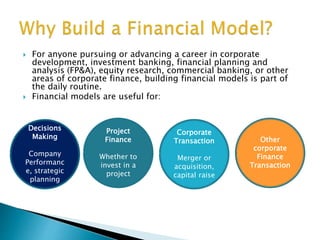
 For anyone pursuing or advancing a career in corporate
development, investment banking, financial planning and
analysis (FP&A), equity research, commercial banking, or other
areas of corporate finance, building financial models is part of
the daily routine.
 Financial models are useful for:
Decisions
Making
Company
Performanc
e, strategic
planning
Project
Finance
Whether to
invest in a
project
Corporate
Transaction
Merger or
acquisition,
capital raise
Other
corporate
Finance
Transaction
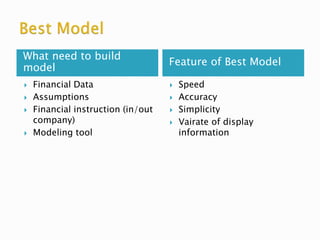
What need to build
model
Feature of Best Model
 Financial Data
 Assumptions
 Financial instruction (in/out
company)
 Modeling tool
 Speed
 Accuracy
 Simplicity
 Vairate of display
information
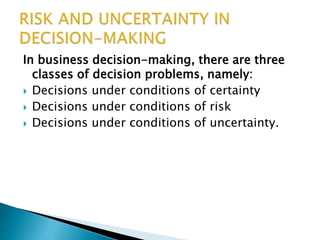
In business decision-making, there are three
classes of decision problems, namely:
 Decisions under conditions of certainty
 Decisions under conditions of risk
 Decisions under conditions of uncertainty.
Models involve a large number of assumptions
Uncontrollable variables because they are
outside the decision-maker’s control, e.g.,
interest rates, consumer trends, currency
fluctuations, etc.
Controllable variables are those inputs that
influence a model’s outcome and are within
the decision-maker’s control. E.g. , product
price, the level of output, or acceptable profit
levels.
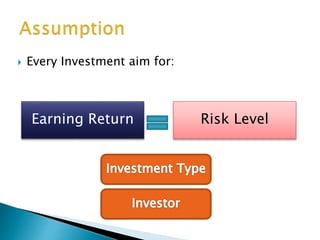
 Every Investment aim for:
Earning Return Risk Level
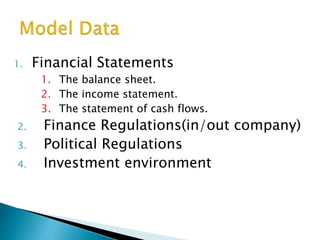
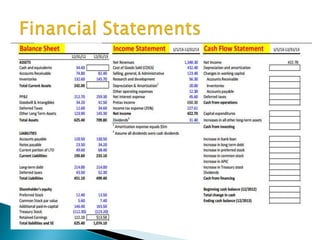
1. Financial Statements
1. The balance sheet.
2. The income statement.
3. The statement of cash flows.
2. Finance Regulations(in/out company)
3. Political Regulations
4. Investment environment
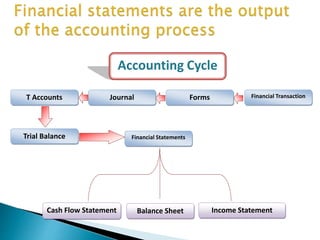
Financial TransactionFormsJournalT Accounts
Trial Balance Financial Statements
Balance Sheet Income StatementCash Flow Statement
Accounting Cycle
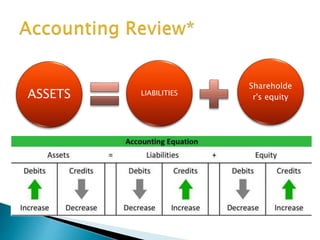
Shareholde
r's equity
LIABILITIESASSETS
The best tool for financial modeling is spread
sheet MS EXCEL.
The advantages of a model:
 it is easy for the decision-maker to
understand
 it can be modified quickly and cheaply
 there is less risk when experimenting with a
model than with the real system
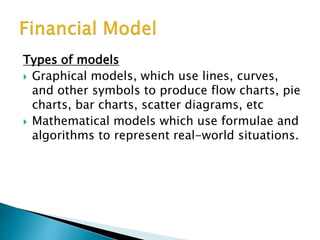
Types of models
 Graphical models, which use lines, curves,
and other symbols to produce flow charts, pie
charts, bar charts, scatter diagrams, etc
 Mathematical models which use formulae and
algorithms to represent real-world situations.
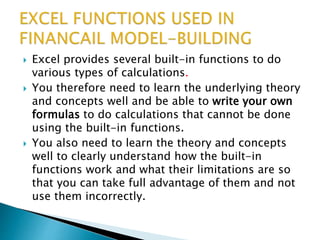
 Excel provides several built-in functions to do
various types of calculations.
 You therefore need to learn the underlying theory
and concepts well and be able to write your own
formulas to do calculations that cannot be done
using the built-in functions.
 You also need to learn the theory and concepts
well to clearly understand how the built-in
functions work and what their limitations are so
that you can take full advantage of them and not
use them incorrectly.
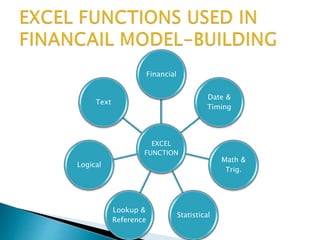
EXCEL
FUNCTION
Financial
Date &
Timing
Math &
Trig.
Statistical
Lookup &
Reference
Logical
Text
 Data Table
 Pivot Table
 Charts
 Validation
 VBA

Financial modeling sameh aljabli - lecture 1

  • 1.
  • 2.
     Subject Name:Financial Modeling  Pre-requisites: Introduction to Accounting  Assessment and scoring details: ◦ Attendace 10% ◦ Quizes 10% ◦ Assignments 30% ◦ Midterm (Throy, Lab) 20% ◦ Project 30%  Key Reference Sources: Books: ◦ Financial Modeling Using Excel and VBA, CHANDAN SENGUPTA ◦ Simon Benninga, (2014). Financial Modeling, 4rd Edition ◦ Lectures
  • 3.
     Financial Modelingis a valuation tool which teaches you to work with historical information of companies and analyze the company performance on relevant financial parameters. This analysis is then used to give you an estimate of the valuation of companies/projects.
  • 4.
     For anyonepursuing or advancing a career in corporate development, investment banking, financial planning and analysis (FP&A), equity research, commercial banking, or other areas of corporate finance, building financial models is part of the daily routine.  Financial models are useful for: Decisions Making Company Performanc e, strategic planning Project Finance Whether to invest in a project Corporate Transaction Merger or acquisition, capital raise Other corporate Finance Transaction
  • 5.
    What need tobuild model Feature of Best Model  Financial Data  Assumptions  Financial instruction (in/out company)  Modeling tool  Speed  Accuracy  Simplicity  Vairate of display information
  • 7.
    In business decision-making,there are three classes of decision problems, namely:  Decisions under conditions of certainty  Decisions under conditions of risk  Decisions under conditions of uncertainty.
  • 8.
    Models involve alarge number of assumptions Uncontrollable variables because they are outside the decision-maker’s control, e.g., interest rates, consumer trends, currency fluctuations, etc. Controllable variables are those inputs that influence a model’s outcome and are within the decision-maker’s control. E.g. , product price, the level of output, or acceptable profit levels.
  • 9.
     Every Investmentaim for: Earning Return Risk Level
  • 10.
    1. Financial Statements 1.The balance sheet. 2. The income statement. 3. The statement of cash flows. 2. Finance Regulations(in/out company) 3. Political Regulations 4. Investment environment
  • 12.
    Financial TransactionFormsJournalT Accounts TrialBalance Financial Statements Balance Sheet Income StatementCash Flow Statement Accounting Cycle
  • 13.
  • 15.
    The best toolfor financial modeling is spread sheet MS EXCEL. The advantages of a model:  it is easy for the decision-maker to understand  it can be modified quickly and cheaply  there is less risk when experimenting with a model than with the real system
  • 16.
    Types of models Graphical models, which use lines, curves, and other symbols to produce flow charts, pie charts, bar charts, scatter diagrams, etc  Mathematical models which use formulae and algorithms to represent real-world situations.
  • 18.
     Excel providesseveral built-in functions to do various types of calculations.  You therefore need to learn the underlying theory and concepts well and be able to write your own formulas to do calculations that cannot be done using the built-in functions.  You also need to learn the theory and concepts well to clearly understand how the built-in functions work and what their limitations are so that you can take full advantage of them and not use them incorrectly.
  • 19.
  • 20.
     Data Table Pivot Table  Charts  Validation  VBA