Dr S SHEIK FAREETH
MBA., M.Phil., SET., NET., Ph.D
Assistant Professor
Deaprtment of Business Administration
Arul Anandar Coll;ege (Autonomous)
Karumathur- Madurai.
Email: sheikfareeth@aactni.edu.in
 Any kind of business activity depends on the finance. Hence, it is
called as lifeblood of business organization.
 Whether the business concerns are big or small, they need finance to
fulfil their business activities.
 The entire business activities are directly related with making profit.
 According to Khan and Jain, “Finance is the art and
science of managing money”.
 According to Oxford dictionary, the word ‘finance’
connotes ‘management of money’.
 Webster’s Ninth New Collegiate Dictionary defines
finance as “the Science on study of the management of
funds’ and the management of fund as the system that
includes the circulation of money, the granting of credit,
the making of investments, and the provision of banking
facilities.
 According to the Wheeler, “Business finance is that business activity
which concerns with the acquisition and conversation of capital funds in
meeting financial needs and overall objectives of a business enterprise”.
 According to the Guthumann and Dougall “Business finance can
broadly be defined as the activity concerned with planning, raising,
controlling, administering of the funds used in the business”.
 Finance is one of the important and integral part of business concerns,
hence, it plays a major role in every part of the business activities. It is
used in all the area of the activities under the different names.
 Finance can be classified into two major parts:
 Private Finance, which includes the Individual, Firms, Business or
Corporate Financial activities to meet the requirements.
 Public Finance which concerns with revenue and disbursement of
Government such as Central Government, State Government and Semi-
Government Financial matters.
 The term financial management has been defined by
Solomon, “It is concerned with the efficient use of an
important economic resource namely, capital funds”.
 The most popular and acceptable definition of financial
management as given by S.C.Kuchal is that “Financial
Management deals with procurement of funds and their
effective utilization in the business”.
Chapter – II
Scope
Objectives of Financial management
 Introduction – Life blood of Business
 Definition of Finance – khan –Jain, oxford Dictionary, Webster's
Dictionary
 Definition of Business Finance – Wheeler, Dougall
 Types of finance – Private Finance and Public Fiance
 Financial management – Definition – Solomon, Kuchall
 Financial Management & Economics
Economic concepts like micro and macroeconomics are directly applied with the financial
management approaches. Investment decisions, micro and macro environmental factors
are closely associated with the functions of financial manager. Financial management
also uses the economic equations like money value discount factor, economic order
quantity etc. Financial economics is one of the emerging area, which provides immense
opportunities to finance, and economical areas.
 Financial Management and Accounting
In the olden periods, both financial management and accounting are treated as a
same discipline and then it has been merged as Management Accounting because
this part is very much helpful to finance manager to take decisions. But nowaday’s
financial management and accounting discipline are separate and interrelated.
 Financial Management or Mathematics
Modern approaches of the financial management applied large number of
mathematical and statistical tools and techniques. They are also called as
econometrics. Economic order quantity, discount factor, time value of money, present
value of money, cost of capital, capital structure theories, dividend theories, ratio
analysis and working capital analysis are used as mathematical and statistical tools
and techniques in the field of financial management.
 Financial Management and Production Management
Production management is the operational part of the business concern, which helps to
multiple the money into profit. Production performance needs finance, because
production department requires raw material, machinery, wages, operating expenses
etc. These expenditures are decided and estimated by the financial department and the
finance manager allocates the appropriate finance to production department.
 Objectives of Financial Management may be broadly divided
into two parts such as:
1. Profit maximization
2. Wealth maximization.
 Profit Maximization
Main aim of any kind of economic activity is earning profit. A business concern is also
functioning mainly for the purpose of earning profit. Profit is the measuring
techniques to understand the business efficiency of the concern. Profit maximization
is also the traditional and narrow approach, which aims at, maximizes the profit of the
concern. Profit maximization consists of the following important features.
 Profit maximization is also called as cashing per share maximization. It leads to
maximize the business operation for profit maximization.
 Ultimate aim of the business concern is earning profit, hence, it considers all the
possible ways to increase the profitability of the concern.
 Profit is the parameter of measuring the efficiency of the business concern. So it
shows the entire position of the business concern.
 Profit maximization objectives help to reduce the risk of the business.
 Wealth Maximization
 Wealth maximization is one of the modern approaches, which
involves latest innovations and improvements in the field of the
business concern. The term wealth means shareholder wealth or
the wealth of the persons those who are involved in the business
concern.
 Wealth maximization is also known as value maximization or net
present worth maximization. This objective is an universally
accepted concept in the field of business.
Chapter – I
Functions of finance
Investment Decisions
 Finance function is one of the major parts of business organization, which
involves the permanent, and continuous process of the business concern.
 A person who deals finance related activities may be called finance manager.
 Finance manager performs the following major functions:
 Forecasting Financial Requirements
 It is the primary function of the Finance Manager.
 He is responsible to estimate the financial requirement of the business concern.
 He should estimate, how much finances required to acquire fixed assets and
forecast the amount needed to meet the working capital requirements in future.
 Acquiring Necessary Capital
 After deciding the financial requirement, the finance manager should
concentrate how the finance is mobilized and where it will be available. It
is also highly critical in nature.
 Investment Decision
 The finance manager must carefully select best investment alternatives
and consider the reasonable and stable return from the investment. He
must be well versed in the field of capital budgeting techniques to
determine the effective utilization of investment. The finance manager
must concentrate to principles of safety, liquidity and profitability while
investing capital.
 Cash Management
 Present days cash management plays a major role in the area of finance
because proper cash management is not only essential for effective
utilization of cash but it also helps to meet the short-term liquidity
position of the concern.
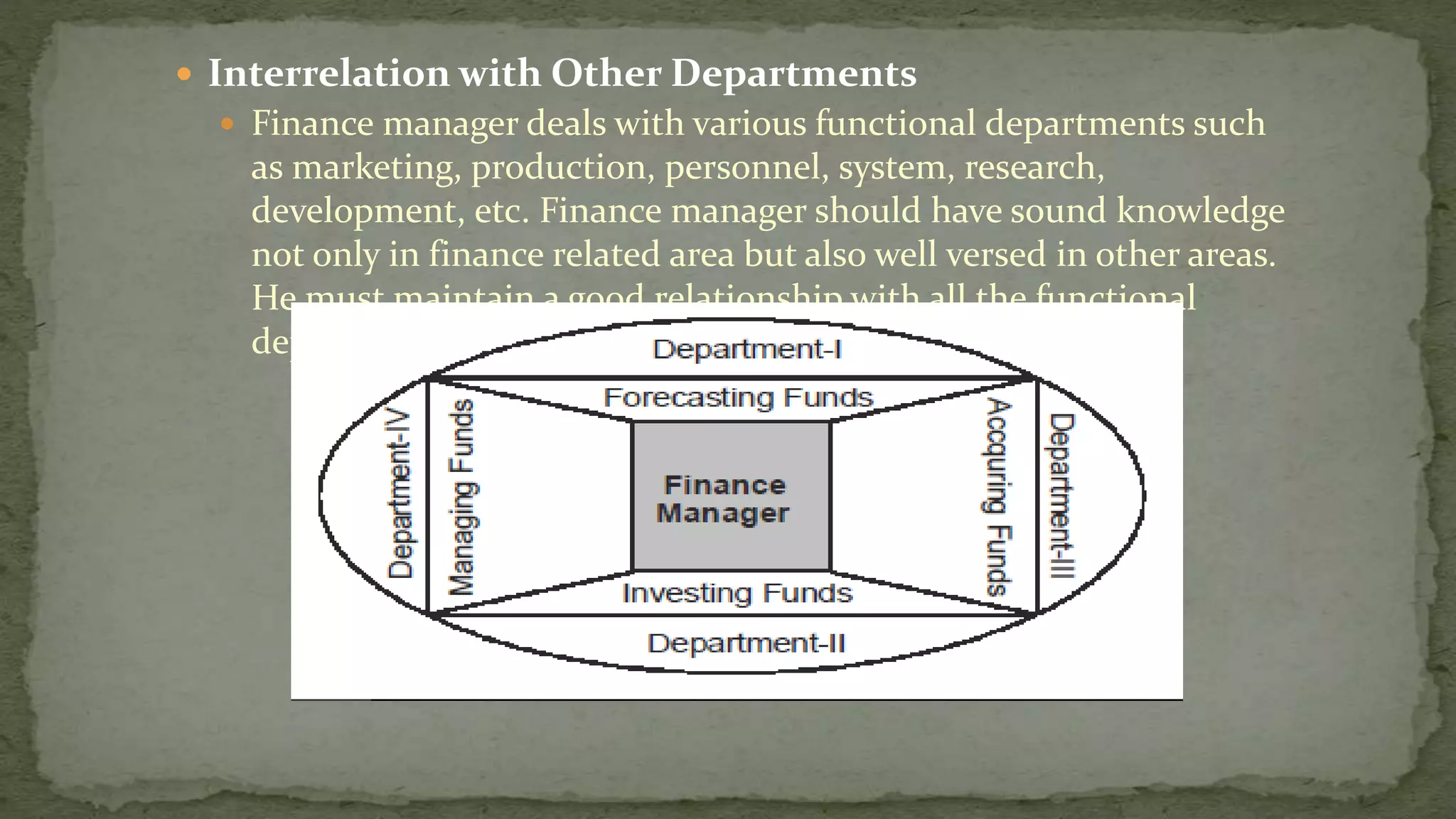
 Interrelation with Other Departments
 Finance manager deals with various functional departments such
as marketing, production, personnel, system, research,
development, etc. Finance manager should have sound knowledge
not only in finance related area but also well versed in other areas.
He must maintain a good relationship with all the functional
departments of the business organization.
 (2) Financing decisions:
 These are Concerned with when, where from and how to acquire funds to
meet a firm’s investment needs. It involves determining the proper asset
mix for a business.
 All business activities require funds that are procured from various
sources like Shareholders, Banks, Financial Institutions etc. The capital
Structure of a firm is a mix of debt and equity capital. A finance manager
must select such sources of finance that will make an optimal capital
structure (mix of debt and equity) and where the cost of capital is
minimal.
 Dividend decision:
 It is concerned with disbursement of profits back to the shareholders and
investors of the business. Dividend refers to that portion of profits which
is distributed by the company to its shareholders. A business must decide
whether to distribute all profits or retain them, or distribute a portion
and retain the balance.
 Dividend Decisions taken by a financial manager –
 Dividend payout ratio- Profits distributed as dividends.
 Retention ratio- Portion of profits retained.
 Debt and dividend policies
Chapter – 1
Organization of the Finance Functions
 Today, finance function has obtained the status of a science and an art. As
finance function has far reaching significance in overall management
process, structural organization for further function becomes an outcome
of an important organization problem
 The ultimate responsibility of carrying out the finance function lies with
the top management. However, organization of finance function differs
from company to company depending on their respective requirements.
 In many organizations one can note different layers among the finance executives such
as Assistant Manager (Finance), Deputy Manager (Finance) and General Manager
(Finance). The designations given to the executives are different.
 It is evident from the above that Board of Directors is the supreme body under whose
supervision and control Managing Director, Production Director, Personnel Director,
Financial Director, Marketing Director perform their respective duties and functions.
 . Further while auditing credit management, retirement benefits and cost control
banking, insurance, investment function under treasurer, planning and budgeting,
inventory management, tax administration, performance evaluation and accounting
functions are under the supervision of controller.
 The treasurer is generally concerned with the organization’s financial matters such as
raising and management of cash. On the other hand, the Controller looks after
operating matters with a view to assist management in decision making.
 The Controller provides managers with specialised services such as advice and help in
budgeting, analysing variances, pricing decisions, special decisions. The Controller is
considered an organization’s top accounting officer. Sometimes, the Controller
prepares the annual accounts and financial statements for external users.
Chapter - 1
Controller vs. Treasurer
 Treasurers and controllers are both financial managers, but they have
different roles. Controllers usually concentrate on what has already
happened inside a company. They prepare financial statements and
other reports based on past activity. Treasurers focus outward and
interact with the bankers, shareholders and potential investors who
provide capital. In some small businesses, the owner, a controller and
an outside accountant might share the financial duties.
 Qualifications
 Treasurers and controllers should be college graduates -- with
several years of experience working in accounting or finance
positions -- who have completed courses in accounting, finance or
economics. Both positions call for candidates who pay attention to
detail, are analytically minded and possess organizational skills.
They should be comfortable working with Microsoft Excel and
financial analysis software. Master's degrees are preferred,
especially by large corporations. Employers often require that
controllers be certified public accountants
 Qualifications
 Treasurers and controllers should be college graduates -- with several years of
experience working in accounting or finance positions -- who have completed
courses in accounting, finance or economics. Both positions call for
candidates who pay attention to detail, are analytically minded and possess
organizational skills. They should be comfortable working with Microsoft
Excel and financial analysis software. Master's degrees are preferred,
especially by large corporations. Employers often require that controllers be
certified public accountants
Financial management unit1 full

Financial management unit1 full

  • 1.
    Dr S SHEIKFAREETH MBA., M.Phil., SET., NET., Ph.D Assistant Professor Deaprtment of Business Administration Arul Anandar Coll;ege (Autonomous) Karumathur- Madurai. Email: sheikfareeth@aactni.edu.in
  • 2.
     Any kindof business activity depends on the finance. Hence, it is called as lifeblood of business organization.  Whether the business concerns are big or small, they need finance to fulfil their business activities.  The entire business activities are directly related with making profit.  The entire business activities are directly related with making profit.
  • 3.
     According toKhan and Jain, “Finance is the art and science of managing money”.  According to Oxford dictionary, the word ‘finance’ connotes ‘management of money’.  Webster’s Ninth New Collegiate Dictionary defines finance as “the Science on study of the management of funds’ and the management of fund as the system that includes the circulation of money, the granting of credit, the making of investments, and the provision of banking facilities.
  • 4.
     According tothe Wheeler, “Business finance is that business activity which concerns with the acquisition and conversation of capital funds in meeting financial needs and overall objectives of a business enterprise”.  According to the Guthumann and Dougall “Business finance can broadly be defined as the activity concerned with planning, raising, controlling, administering of the funds used in the business”.
  • 5.
     Finance isone of the important and integral part of business concerns, hence, it plays a major role in every part of the business activities. It is used in all the area of the activities under the different names.  Finance can be classified into two major parts:  Private Finance, which includes the Individual, Firms, Business or Corporate Financial activities to meet the requirements.  Public Finance which concerns with revenue and disbursement of Government such as Central Government, State Government and Semi- Government Financial matters.
  • 6.
     The termfinancial management has been defined by Solomon, “It is concerned with the efficient use of an important economic resource namely, capital funds”.  The most popular and acceptable definition of financial management as given by S.C.Kuchal is that “Financial Management deals with procurement of funds and their effective utilization in the business”.
  • 7.
    Chapter – II Scope Objectivesof Financial management
  • 8.
     Introduction –Life blood of Business  Definition of Finance – khan –Jain, oxford Dictionary, Webster's Dictionary  Definition of Business Finance – Wheeler, Dougall  Types of finance – Private Finance and Public Fiance  Financial management – Definition – Solomon, Kuchall
  • 9.
     Financial Management& Economics Economic concepts like micro and macroeconomics are directly applied with the financial management approaches. Investment decisions, micro and macro environmental factors are closely associated with the functions of financial manager. Financial management also uses the economic equations like money value discount factor, economic order quantity etc. Financial economics is one of the emerging area, which provides immense opportunities to finance, and economical areas.  Financial Management and Accounting In the olden periods, both financial management and accounting are treated as a same discipline and then it has been merged as Management Accounting because this part is very much helpful to finance manager to take decisions. But nowaday’s financial management and accounting discipline are separate and interrelated.
  • 10.
     Financial Managementor Mathematics Modern approaches of the financial management applied large number of mathematical and statistical tools and techniques. They are also called as econometrics. Economic order quantity, discount factor, time value of money, present value of money, cost of capital, capital structure theories, dividend theories, ratio analysis and working capital analysis are used as mathematical and statistical tools and techniques in the field of financial management.  Financial Management and Production Management Production management is the operational part of the business concern, which helps to multiple the money into profit. Production performance needs finance, because production department requires raw material, machinery, wages, operating expenses etc. These expenditures are decided and estimated by the financial department and the finance manager allocates the appropriate finance to production department.
  • 11.
     Objectives ofFinancial Management may be broadly divided into two parts such as: 1. Profit maximization 2. Wealth maximization.
  • 12.
     Profit Maximization Mainaim of any kind of economic activity is earning profit. A business concern is also functioning mainly for the purpose of earning profit. Profit is the measuring techniques to understand the business efficiency of the concern. Profit maximization is also the traditional and narrow approach, which aims at, maximizes the profit of the concern. Profit maximization consists of the following important features.  Profit maximization is also called as cashing per share maximization. It leads to maximize the business operation for profit maximization.  Ultimate aim of the business concern is earning profit, hence, it considers all the possible ways to increase the profitability of the concern.  Profit is the parameter of measuring the efficiency of the business concern. So it shows the entire position of the business concern.  Profit maximization objectives help to reduce the risk of the business.
  • 13.
     Wealth Maximization Wealth maximization is one of the modern approaches, which involves latest innovations and improvements in the field of the business concern. The term wealth means shareholder wealth or the wealth of the persons those who are involved in the business concern.  Wealth maximization is also known as value maximization or net present worth maximization. This objective is an universally accepted concept in the field of business.
  • 14.
    Chapter – I Functionsof finance Investment Decisions
  • 15.
     Finance functionis one of the major parts of business organization, which involves the permanent, and continuous process of the business concern.  A person who deals finance related activities may be called finance manager.  Finance manager performs the following major functions:  Forecasting Financial Requirements  It is the primary function of the Finance Manager.  He is responsible to estimate the financial requirement of the business concern.  He should estimate, how much finances required to acquire fixed assets and forecast the amount needed to meet the working capital requirements in future.
  • 16.
     Acquiring NecessaryCapital  After deciding the financial requirement, the finance manager should concentrate how the finance is mobilized and where it will be available. It is also highly critical in nature.  Investment Decision  The finance manager must carefully select best investment alternatives and consider the reasonable and stable return from the investment. He must be well versed in the field of capital budgeting techniques to determine the effective utilization of investment. The finance manager must concentrate to principles of safety, liquidity and profitability while investing capital.  Cash Management  Present days cash management plays a major role in the area of finance because proper cash management is not only essential for effective utilization of cash but it also helps to meet the short-term liquidity position of the concern.
  • 17.
     Interrelation withOther Departments  Finance manager deals with various functional departments such as marketing, production, personnel, system, research, development, etc. Finance manager should have sound knowledge not only in finance related area but also well versed in other areas. He must maintain a good relationship with all the functional departments of the business organization.
  • 19.
     (2) Financingdecisions:  These are Concerned with when, where from and how to acquire funds to meet a firm’s investment needs. It involves determining the proper asset mix for a business.  All business activities require funds that are procured from various sources like Shareholders, Banks, Financial Institutions etc. The capital Structure of a firm is a mix of debt and equity capital. A finance manager must select such sources of finance that will make an optimal capital structure (mix of debt and equity) and where the cost of capital is minimal.  Dividend decision:  It is concerned with disbursement of profits back to the shareholders and investors of the business. Dividend refers to that portion of profits which is distributed by the company to its shareholders. A business must decide whether to distribute all profits or retain them, or distribute a portion and retain the balance.  Dividend Decisions taken by a financial manager –  Dividend payout ratio- Profits distributed as dividends.  Retention ratio- Portion of profits retained.  Debt and dividend policies
  • 20.
    Chapter – 1 Organizationof the Finance Functions
  • 21.
     Today, financefunction has obtained the status of a science and an art. As finance function has far reaching significance in overall management process, structural organization for further function becomes an outcome of an important organization problem  The ultimate responsibility of carrying out the finance function lies with the top management. However, organization of finance function differs from company to company depending on their respective requirements.
  • 23.
     In manyorganizations one can note different layers among the finance executives such as Assistant Manager (Finance), Deputy Manager (Finance) and General Manager (Finance). The designations given to the executives are different.  It is evident from the above that Board of Directors is the supreme body under whose supervision and control Managing Director, Production Director, Personnel Director, Financial Director, Marketing Director perform their respective duties and functions.  . Further while auditing credit management, retirement benefits and cost control banking, insurance, investment function under treasurer, planning and budgeting, inventory management, tax administration, performance evaluation and accounting functions are under the supervision of controller.
  • 24.
     The treasureris generally concerned with the organization’s financial matters such as raising and management of cash. On the other hand, the Controller looks after operating matters with a view to assist management in decision making.  The Controller provides managers with specialised services such as advice and help in budgeting, analysing variances, pricing decisions, special decisions. The Controller is considered an organization’s top accounting officer. Sometimes, the Controller prepares the annual accounts and financial statements for external users.
  • 25.
  • 28.
     Treasurers andcontrollers are both financial managers, but they have different roles. Controllers usually concentrate on what has already happened inside a company. They prepare financial statements and other reports based on past activity. Treasurers focus outward and interact with the bankers, shareholders and potential investors who provide capital. In some small businesses, the owner, a controller and an outside accountant might share the financial duties.  Qualifications  Treasurers and controllers should be college graduates -- with several years of experience working in accounting or finance positions -- who have completed courses in accounting, finance or economics. Both positions call for candidates who pay attention to detail, are analytically minded and possess organizational skills. They should be comfortable working with Microsoft Excel and financial analysis software. Master's degrees are preferred, especially by large corporations. Employers often require that controllers be certified public accountants
  • 29.
     Qualifications  Treasurersand controllers should be college graduates -- with several years of experience working in accounting or finance positions -- who have completed courses in accounting, finance or economics. Both positions call for candidates who pay attention to detail, are analytically minded and possess organizational skills. They should be comfortable working with Microsoft Excel and financial analysis software. Master's degrees are preferred, especially by large corporations. Employers often require that controllers be certified public accountants