Case Law: Woodley V Metropolitan
District Railway Co (1877) 2 Ex D 384
1
01-177191-027
VOLENTI NON FIT INJURIA
• The maxim ‘Volenti non fit injuria’ is a defence that can be
used by the defendant when the plaintiff voluntarily agrees to
suffer loss or harm
• Latin for "to a willing person, no injury is done
• Volenti is sometimes described as the plaintiff "consenting to
run a risk“
• The most important part of this doctrine is that the plaintiff
must voluntarily agree to suffer the harm and the defendant
won’t be liable for it
• Volenti is also known as a "voluntary assumption of risk" (In
US law).
2
01-177191-029
EXAMPLE
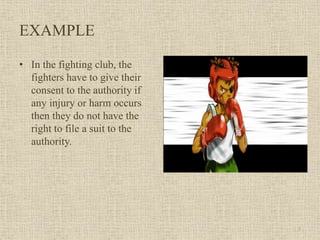
• In the fighting club, the
fighters have to give their
consent to the authority if
any injury or harm occurs
then they do not have the
right to file a suit to the
authority.
3
ESSENTIALS OF THE DOCTRINE
1. Consent must be free.
2. Consent should not be obtained by fraud.
3. Mere knowledge does not imply assent.
4. Negligence of the defendant.
4
01-177191-026
Basic History and Development of the
Legal Maxim
• Nulla iniuria est, quæ in volentem fiat
Volenti non fit injuria is an often-quoted form of the legal maxim
formulated by the Roman jurist Ulpian which means:
‘No injury is committed against one who consents or when a person
consents to the infliction of some harm upon himself , he has no
remedy for that in torts.’
(Corpus Iuris Civilis Digests bk, 47, ch 10, sec. 1, subsec, 5)
5
01-177191-028
Jurist Opinion on Maxim
According to Lord Herschel
(Lord High Chancellor of Great Britain in 1886)
"The maxim is founded on good sense and justice. One who has
invited or assented to an act being done towards him, cannot,
when he suffers from it, complain of it as a wrong.”
• The defence, although well recognized in general terms
through- out actions for negligence, has been expressly applied
by name in very few cases until in recent years.
6
Case laws Showing Evolution of Maxim
lott v. Wilkes (1820)
The famous spring-gun case (Negligence)
Skipp v. Eastern Counties Ry. Co.4 (I853)
Plaintiff's duty to attach the carriages
Senior v. Ward (I859)
The negligence of the plaintiff deprived him of any remedy.
Woodley v. Met. Dist. Ry. Co.3 (I877)
The defendant was not at fault and owed no duty to the plaintiff.
Thomas v. Quartermain (I887)
Employers' Liability Act in England 1880
Smith v. Baker (1891)
Risk was one of fact and not one of law
7
LIMITATION OF THE MAXIM
1. Consent must be voluntary and free
2. Consent must not generally be to illegal acts [case
law: Lane v Holloway]
3. Application of the maxim in cases of negligence [case
law: Dann v. Hamilton]
4. The maxim does not apply to rescue cases [case law:
Haynes v. Harwood]
5. Knowledge does not necessarily imply assent or
consent [case law:
Indian Industrials v. Alamelu Amma]
8
01-177191-030
THANK YOU
9

FINAL-TORT-PPT-GROUP--1--29052020-102733pm.pptx

  • 1.
    Case Law: WoodleyV Metropolitan District Railway Co (1877) 2 Ex D 384 1 01-177191-027
  • 2.
    VOLENTI NON FITINJURIA • The maxim ‘Volenti non fit injuria’ is a defence that can be used by the defendant when the plaintiff voluntarily agrees to suffer loss or harm • Latin for "to a willing person, no injury is done • Volenti is sometimes described as the plaintiff "consenting to run a risk“ • The most important part of this doctrine is that the plaintiff must voluntarily agree to suffer the harm and the defendant won’t be liable for it • Volenti is also known as a "voluntary assumption of risk" (In US law). 2 01-177191-029
  • 3.
    EXAMPLE • In thefighting club, the fighters have to give their consent to the authority if any injury or harm occurs then they do not have the right to file a suit to the authority. 3
  • 4.
    ESSENTIALS OF THEDOCTRINE 1. Consent must be free. 2. Consent should not be obtained by fraud. 3. Mere knowledge does not imply assent. 4. Negligence of the defendant. 4 01-177191-026
  • 5.
    Basic History andDevelopment of the Legal Maxim • Nulla iniuria est, quæ in volentem fiat Volenti non fit injuria is an often-quoted form of the legal maxim formulated by the Roman jurist Ulpian which means: ‘No injury is committed against one who consents or when a person consents to the infliction of some harm upon himself , he has no remedy for that in torts.’ (Corpus Iuris Civilis Digests bk, 47, ch 10, sec. 1, subsec, 5) 5 01-177191-028
  • 6.
    Jurist Opinion onMaxim According to Lord Herschel (Lord High Chancellor of Great Britain in 1886) "The maxim is founded on good sense and justice. One who has invited or assented to an act being done towards him, cannot, when he suffers from it, complain of it as a wrong.” • The defence, although well recognized in general terms through- out actions for negligence, has been expressly applied by name in very few cases until in recent years. 6
  • 7.
    Case laws ShowingEvolution of Maxim lott v. Wilkes (1820) The famous spring-gun case (Negligence) Skipp v. Eastern Counties Ry. Co.4 (I853) Plaintiff's duty to attach the carriages Senior v. Ward (I859) The negligence of the plaintiff deprived him of any remedy. Woodley v. Met. Dist. Ry. Co.3 (I877) The defendant was not at fault and owed no duty to the plaintiff. Thomas v. Quartermain (I887) Employers' Liability Act in England 1880 Smith v. Baker (1891) Risk was one of fact and not one of law 7
  • 8.
    LIMITATION OF THEMAXIM 1. Consent must be voluntary and free 2. Consent must not generally be to illegal acts [case law: Lane v Holloway] 3. Application of the maxim in cases of negligence [case law: Dann v. Hamilton] 4. The maxim does not apply to rescue cases [case law: Haynes v. Harwood] 5. Knowledge does not necessarily imply assent or consent [case law: Indian Industrials v. Alamelu Amma] 8 01-177191-030
  • 9.