Chapter 6
Tree (18M)
Visit for more Learning Resources
Data structure
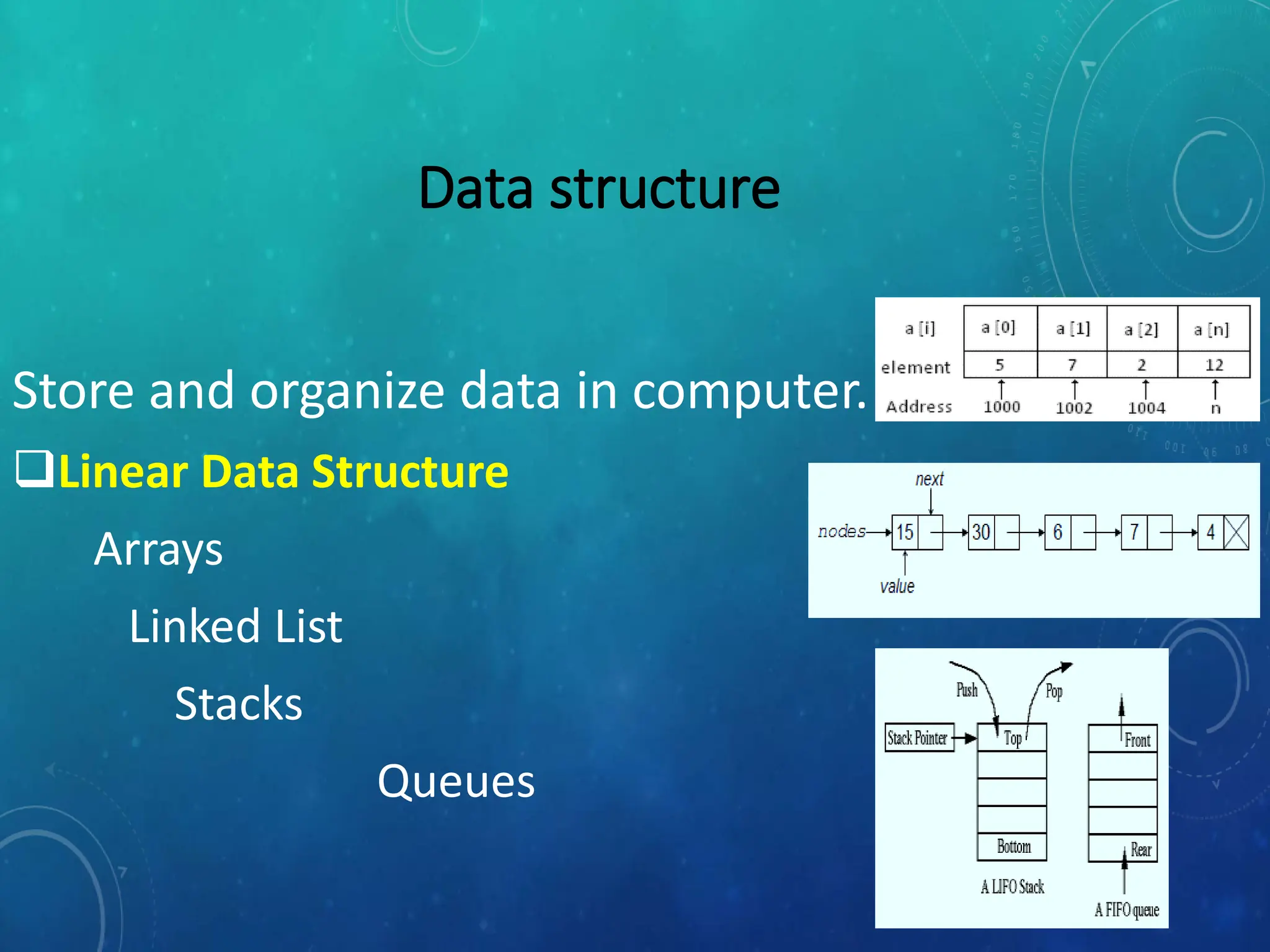
Store and organize data in computer.
Linear Data Structure
Arrays
Linked List
Stacks
Queues
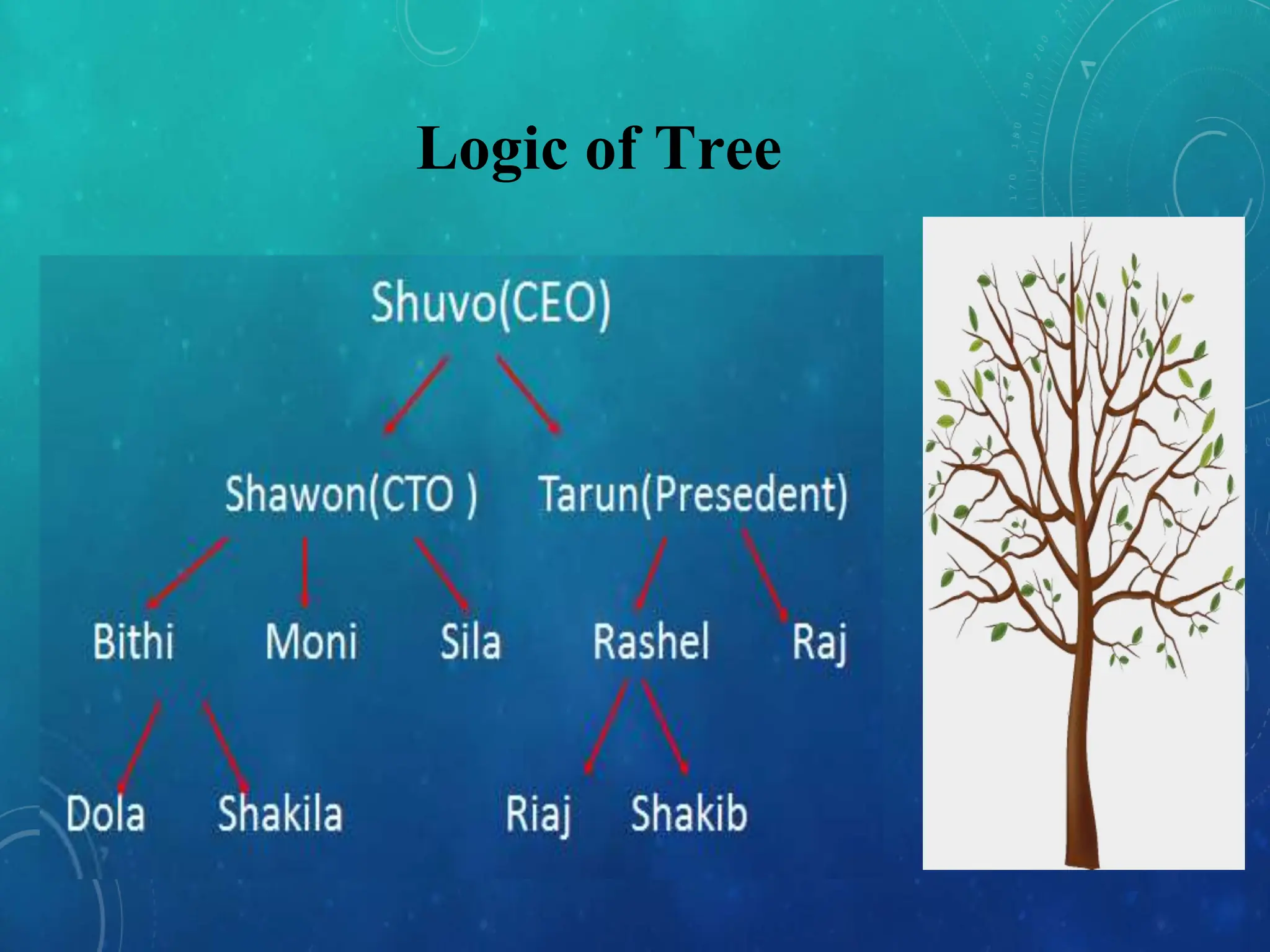
Logic of Tree
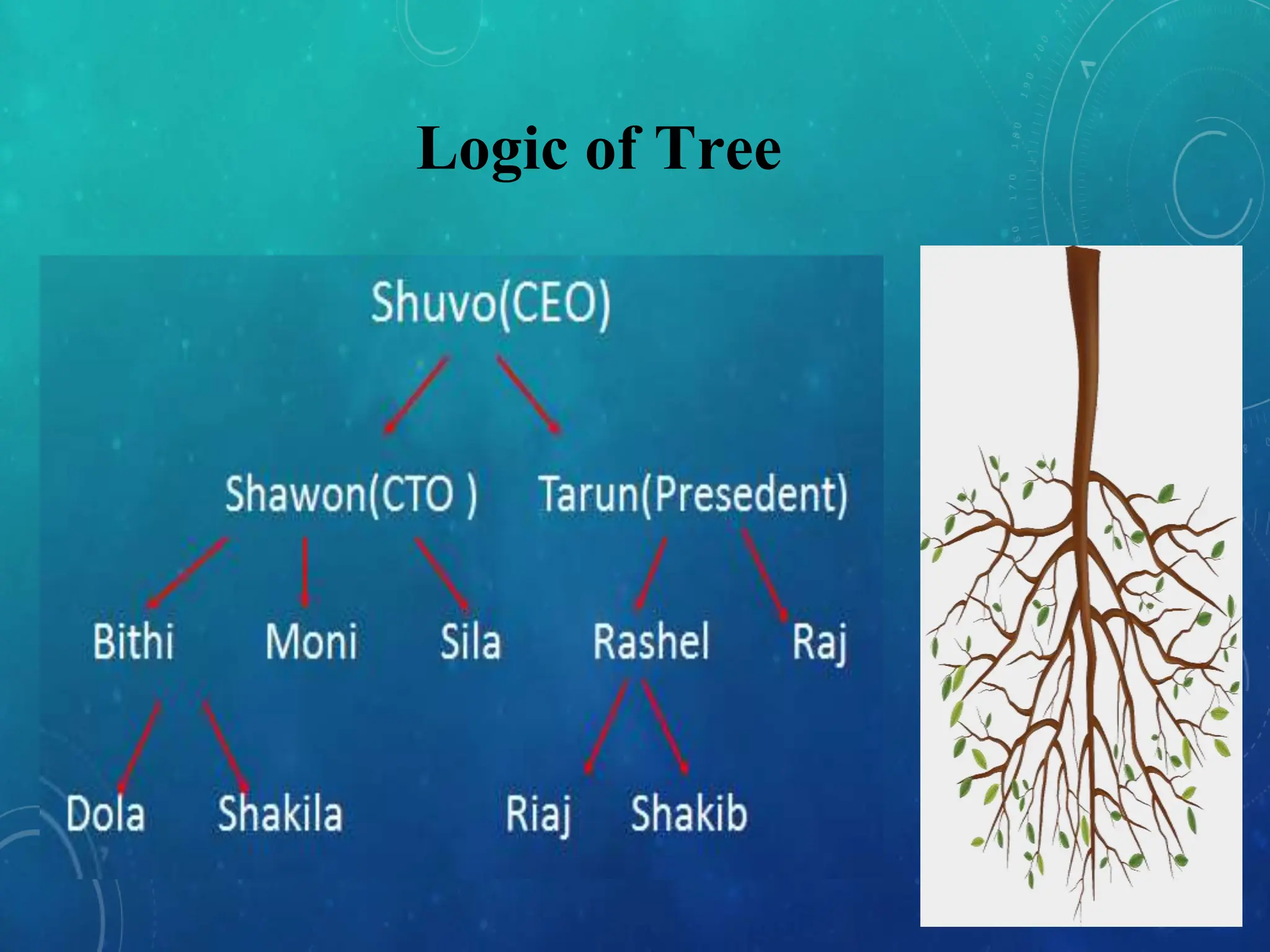
Logic of Tree
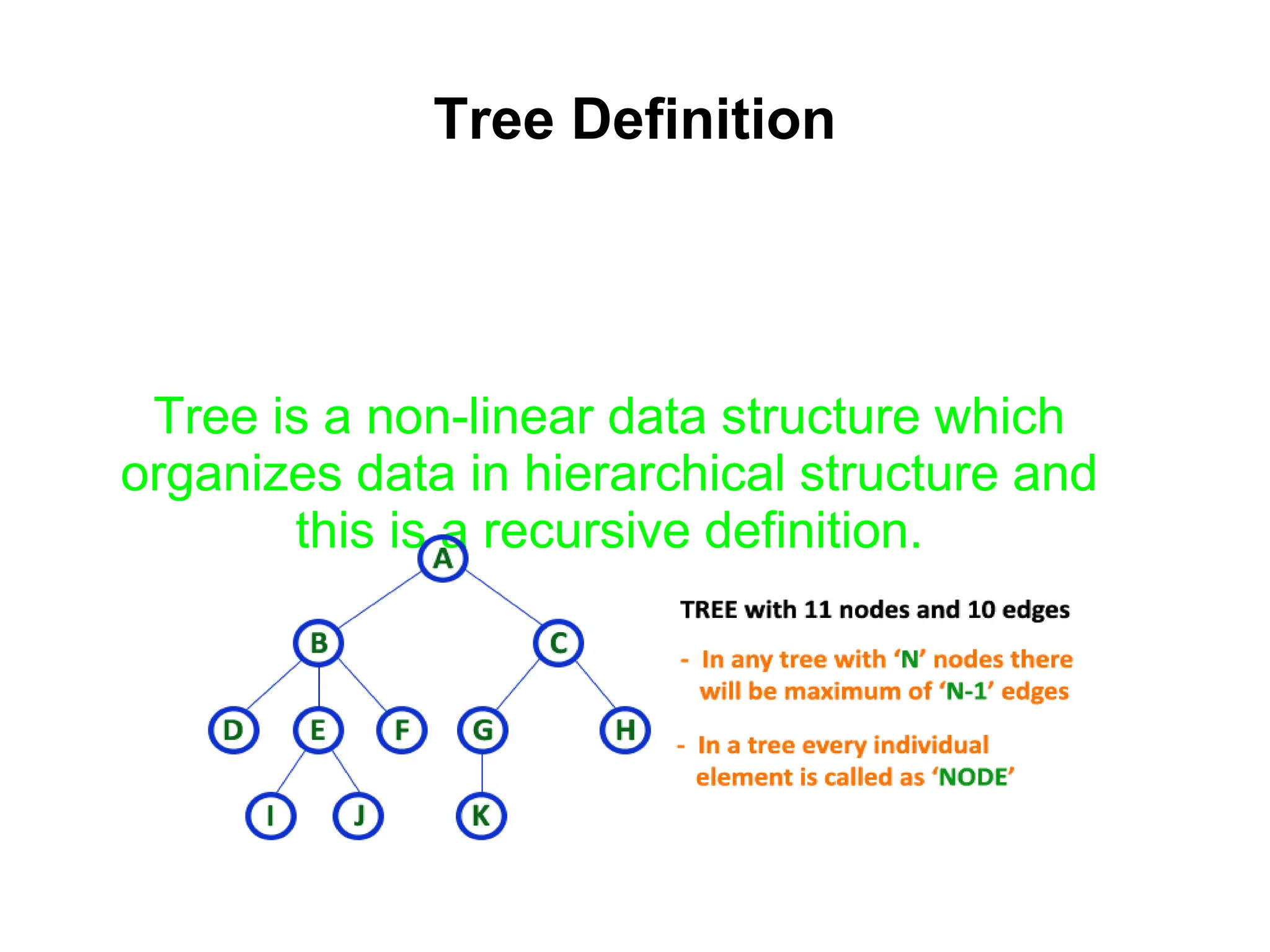
Tree Definition
Tree is a non-linear data structure which
organizes data in hierarchical structure and
this is a recursive definition.
Tree terminology...
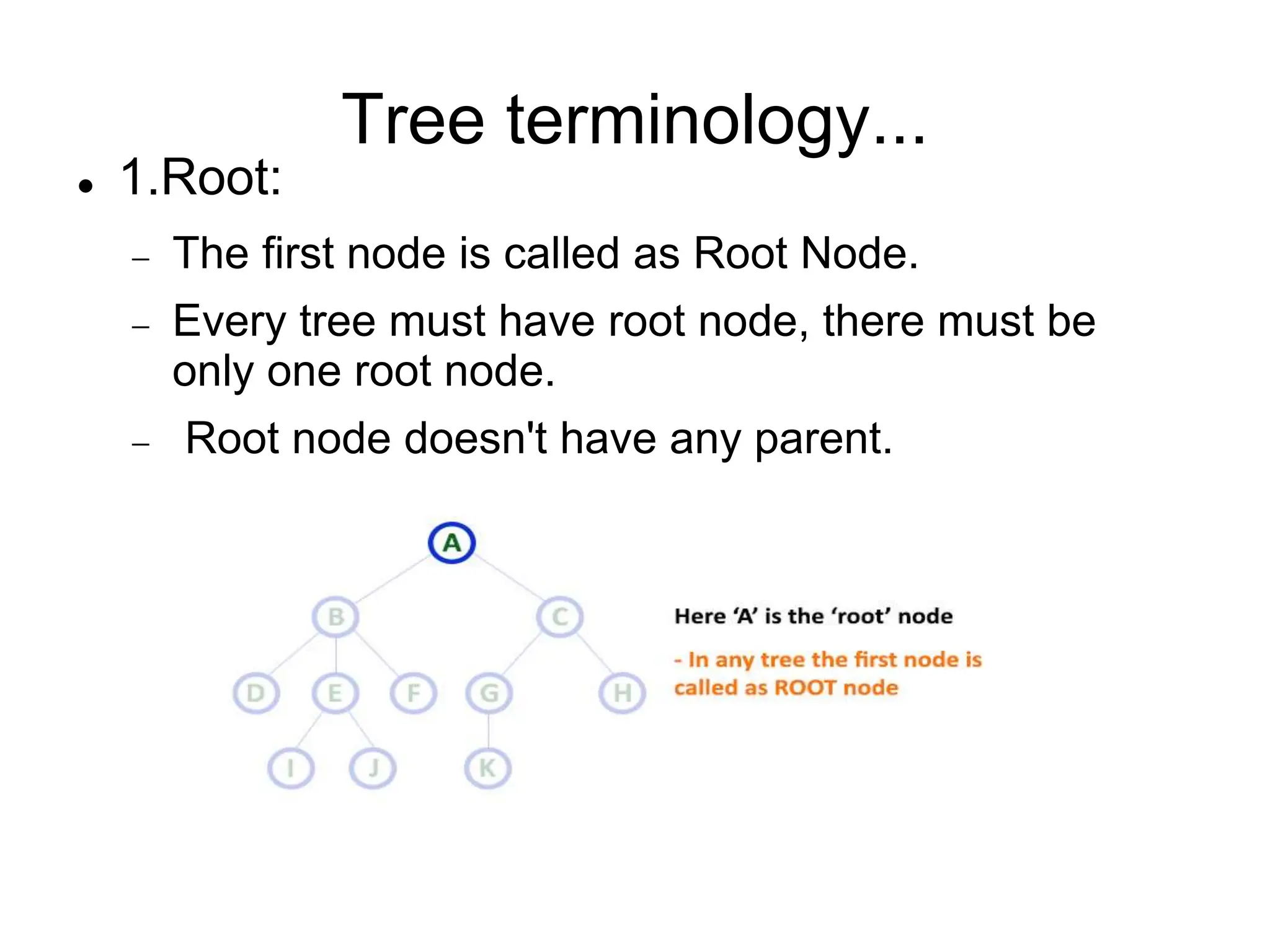
 1.Root:
 The first node is called as Root Node.
 Every tree must have root node, there must be
only one root node.
 Root node doesn't have any parent.
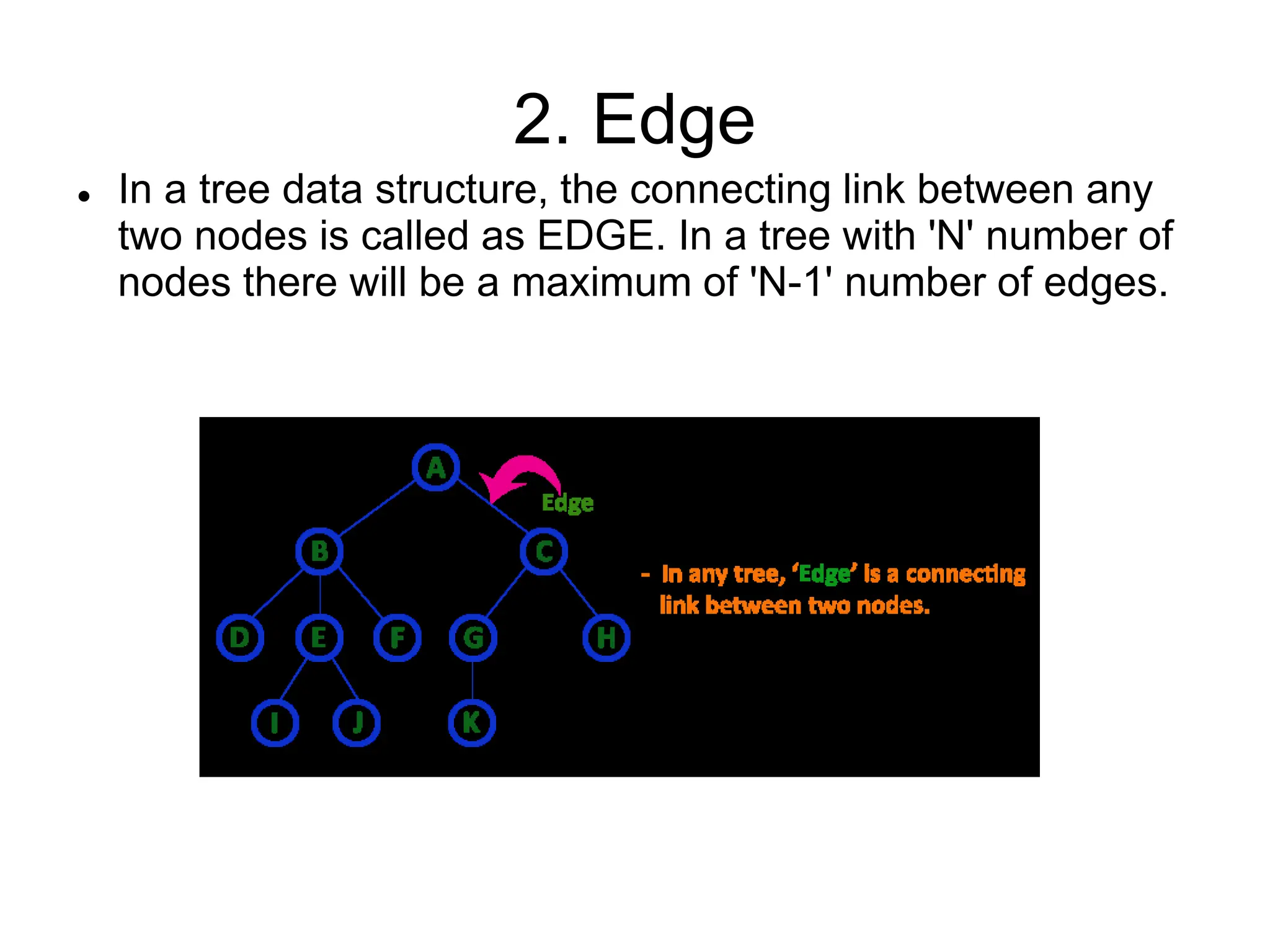
2. Edge
 In a tree data structure, the connecting link between any
two nodes is called as EDGE. In a tree with 'N' number of
nodes there will be a maximum of 'N-1' number of edges.
3. Parent
 In a tree data structure, the node which is predecessor of any
node is called as PARENT NODE. In simple words, the node
which has branch from it to any other node is called as parent
node. Parent node can also be defined as "The node which
has child / children".
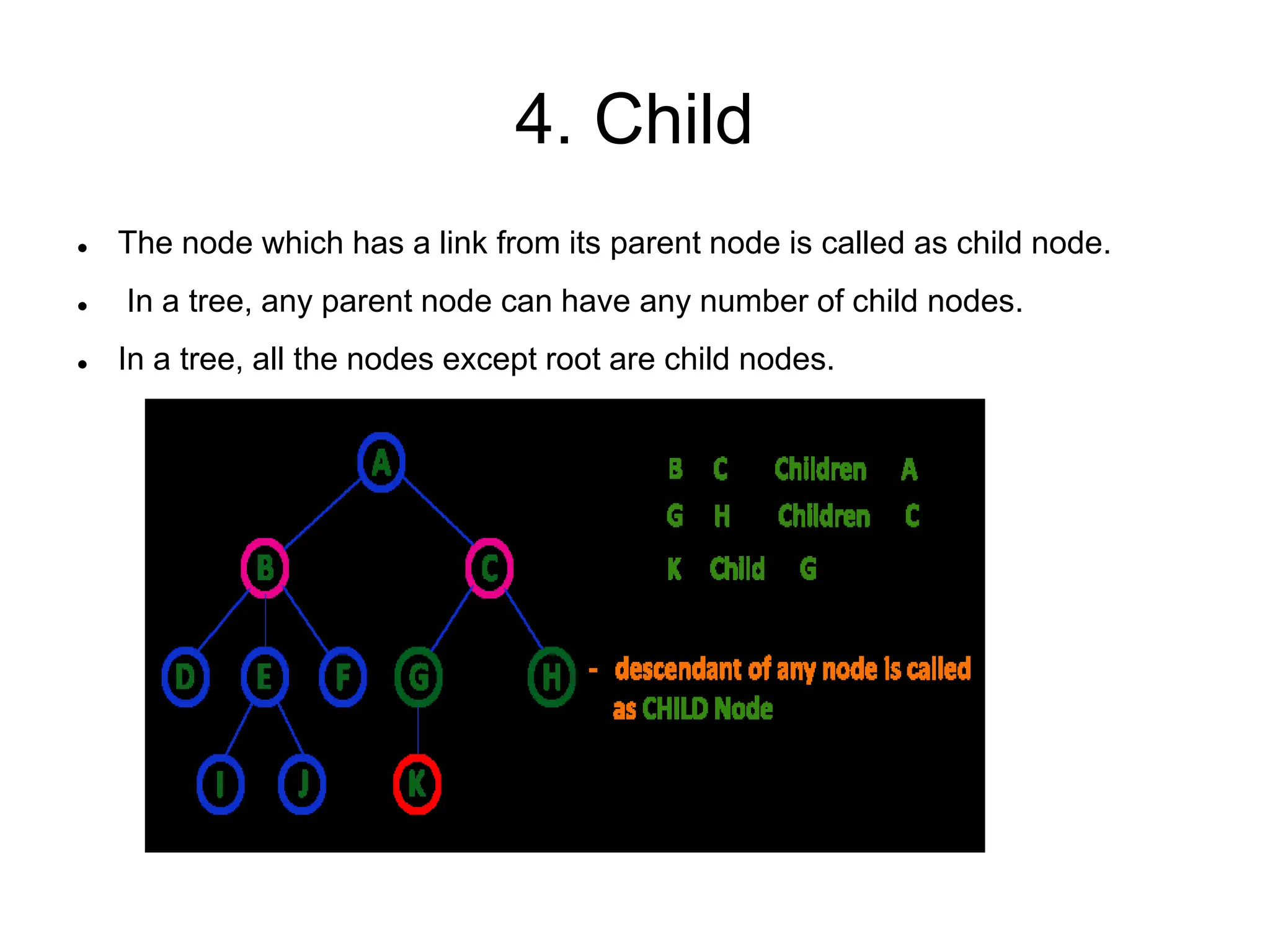
4. Child
 The node which has a link from its parent node is called as child node.
 In a tree, any parent node can have any number of child nodes.
 In a tree, all the nodes except root are child nodes.
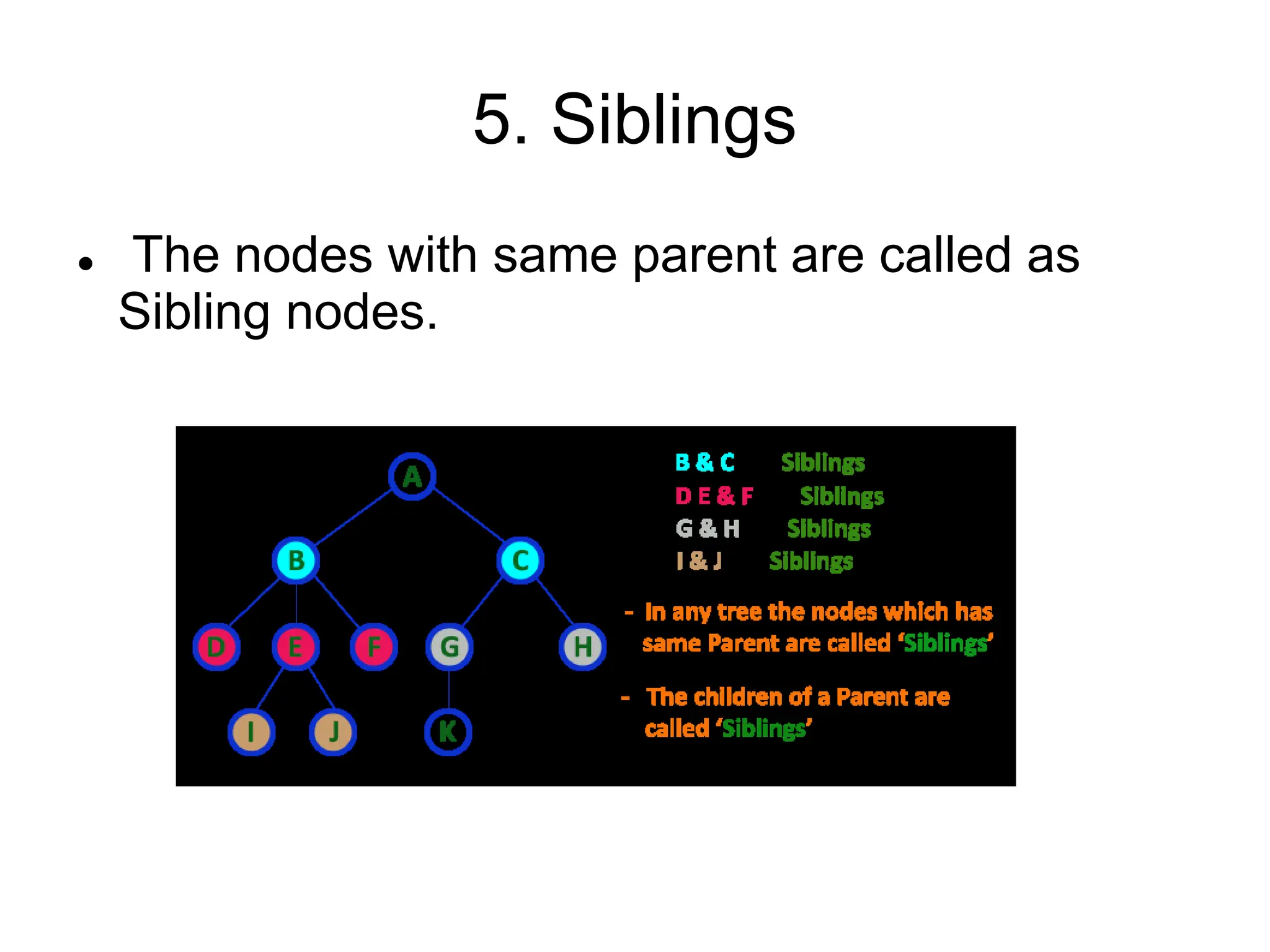
5. Siblings
 The nodes with same parent are called as
Sibling nodes.
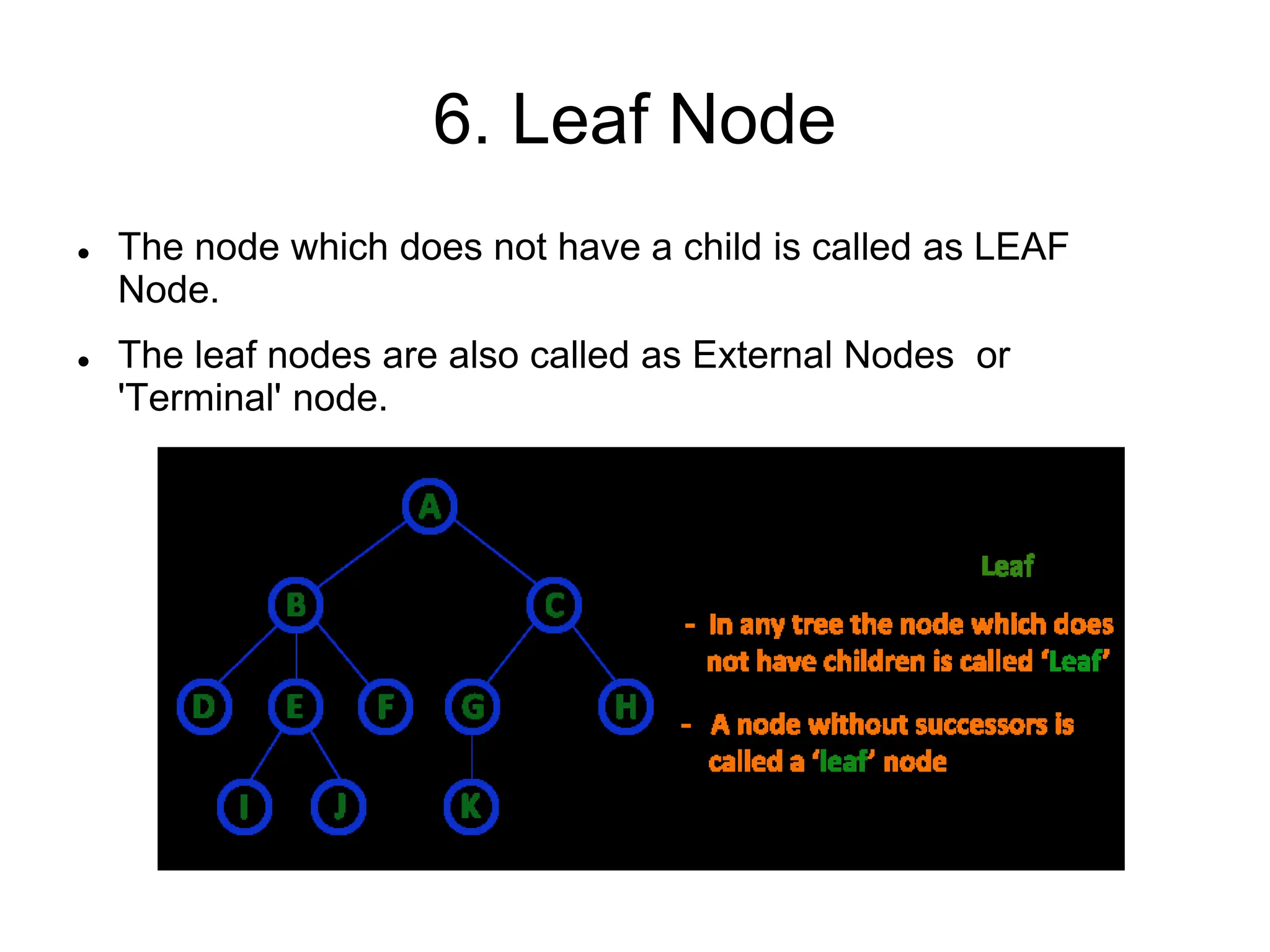
6. Leaf Node
 The node which does not have a child is called as LEAF
Node.
 The leaf nodes are also called as External Nodes or
'Terminal' node.
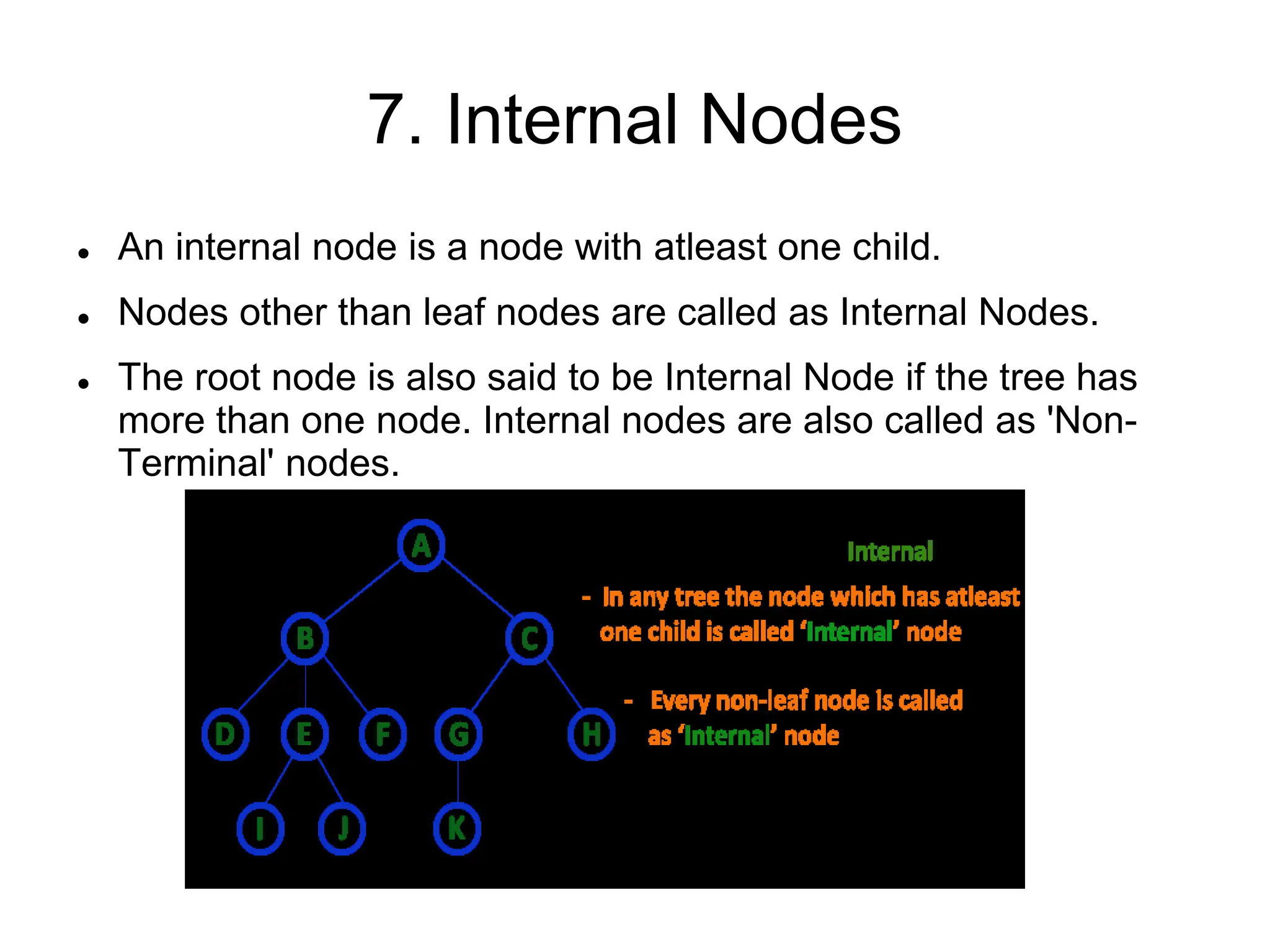
7. Internal Nodes
 An internal node is a node with atleast one child.
 Nodes other than leaf nodes are called as Internal Nodes.
 The root node is also said to be Internal Node if the tree has
more than one node. Internal nodes are also called as 'Non-
Terminal' nodes.
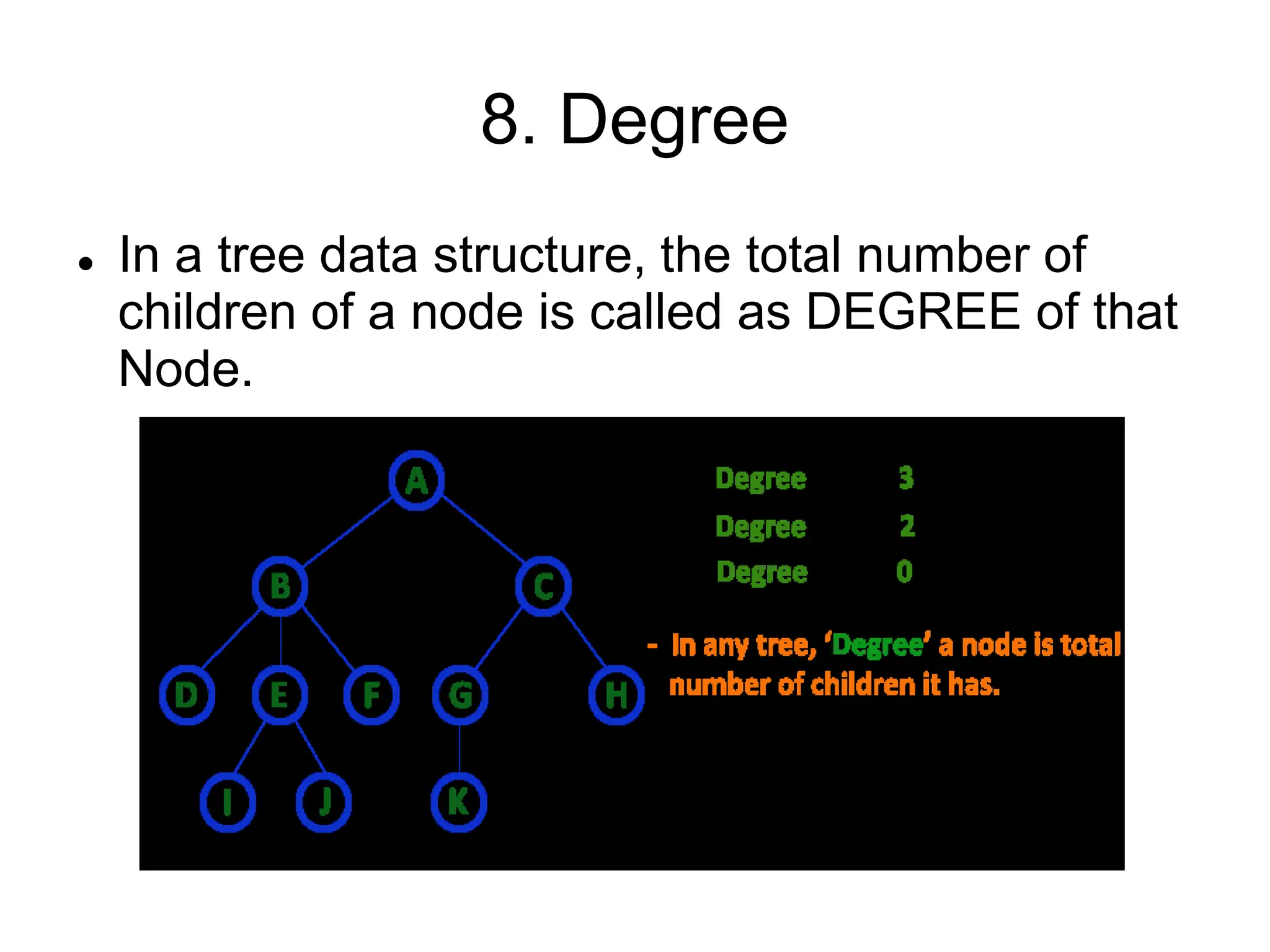
8. Degree
 In a tree data structure, the total number of
children of a node is called as DEGREE of that
Node.
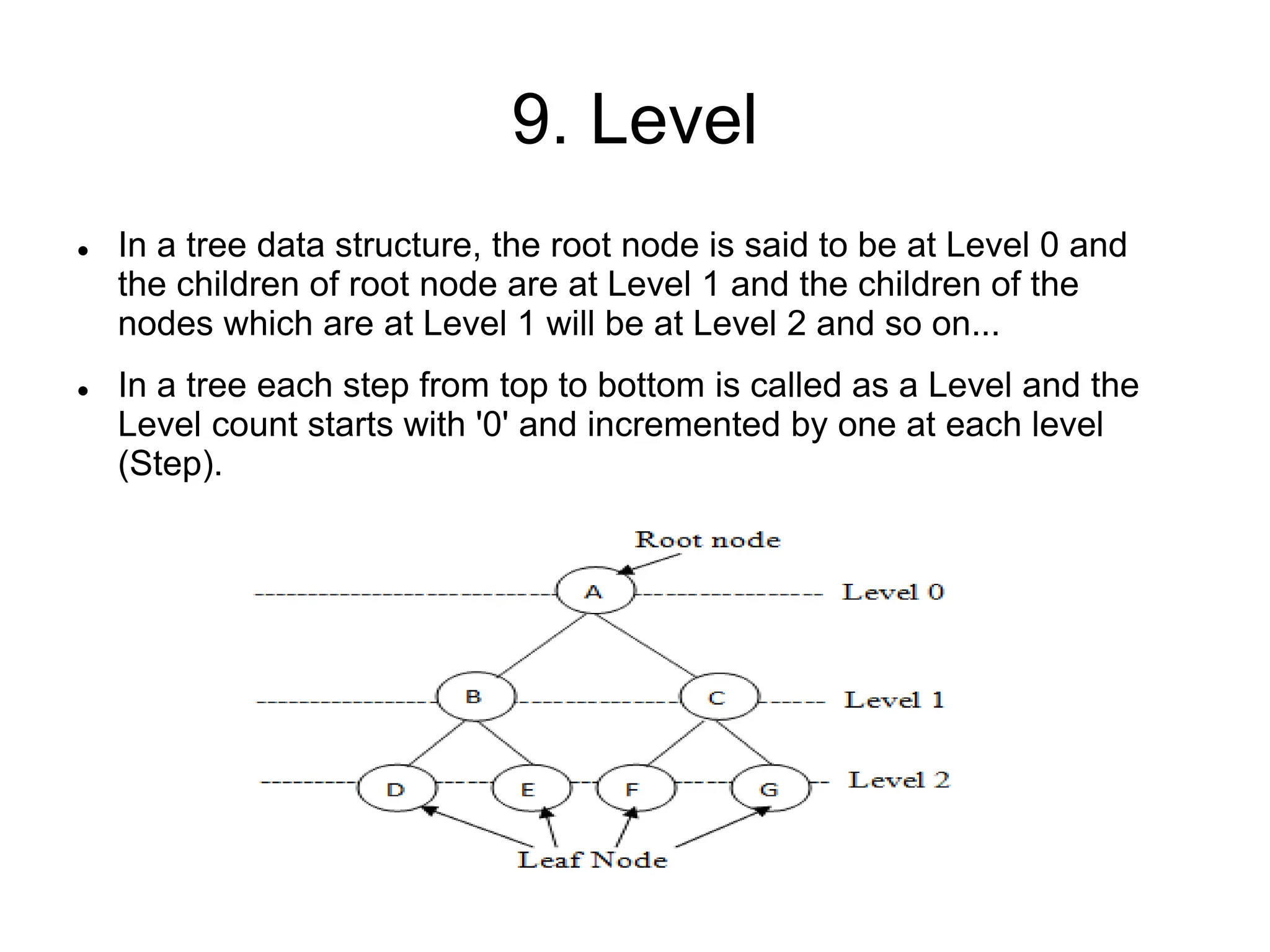
9. Level
 In a tree data structure, the root node is said to be at Level 0 and
the children of root node are at Level 1 and the children of the
nodes which are at Level 1 will be at Level 2 and so on...
 In a tree each step from top to bottom is called as a Level and the
Level count starts with '0' and incremented by one at each level
(Step).
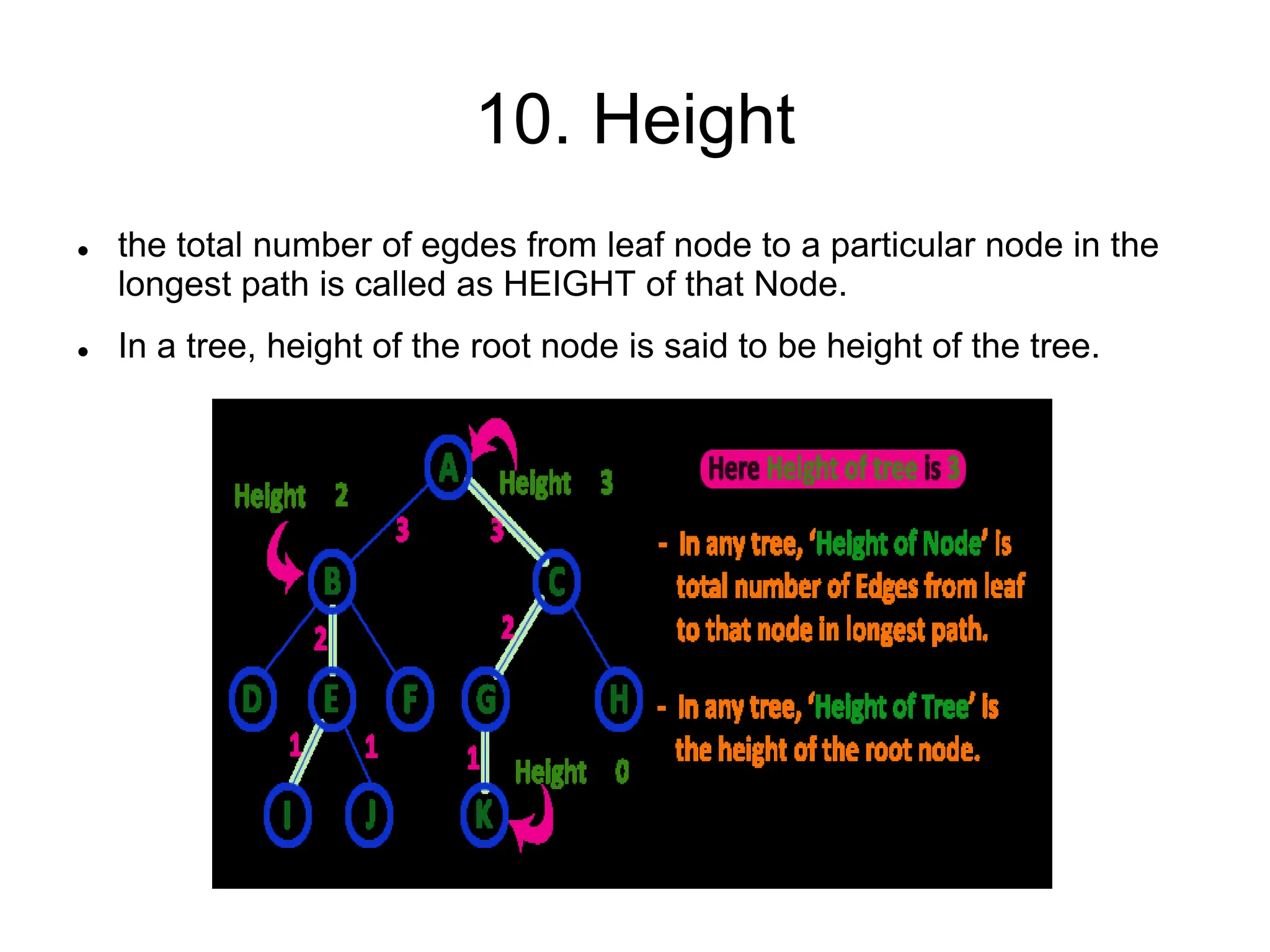
10. Height
 the total number of egdes from leaf node to a particular node in the
longest path is called as HEIGHT of that Node.
 In a tree, height of the root node is said to be height of the tree.
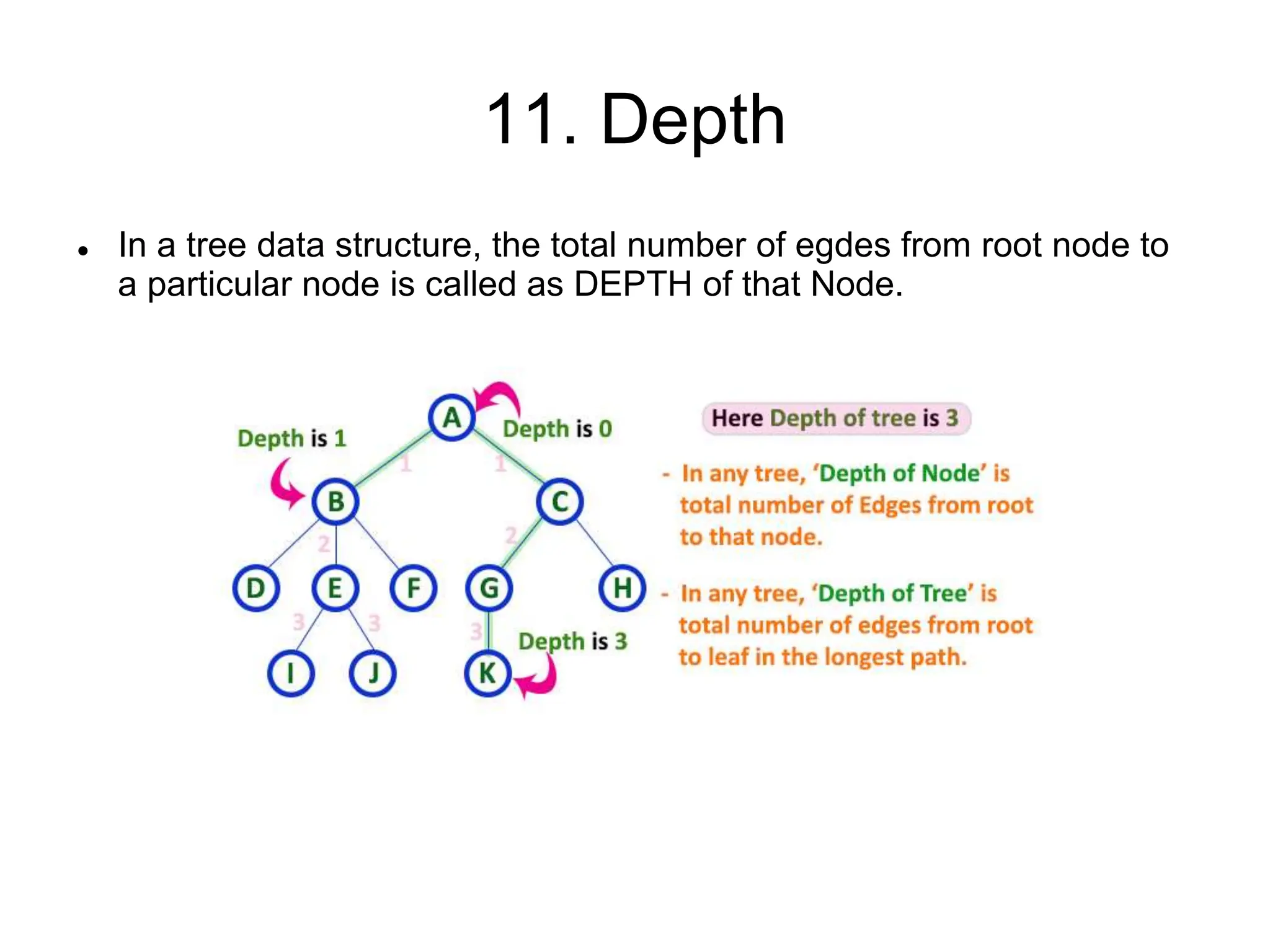
11. Depth
 In a tree data structure, the total number of egdes from root node to
a particular node is called as DEPTH of that Node.
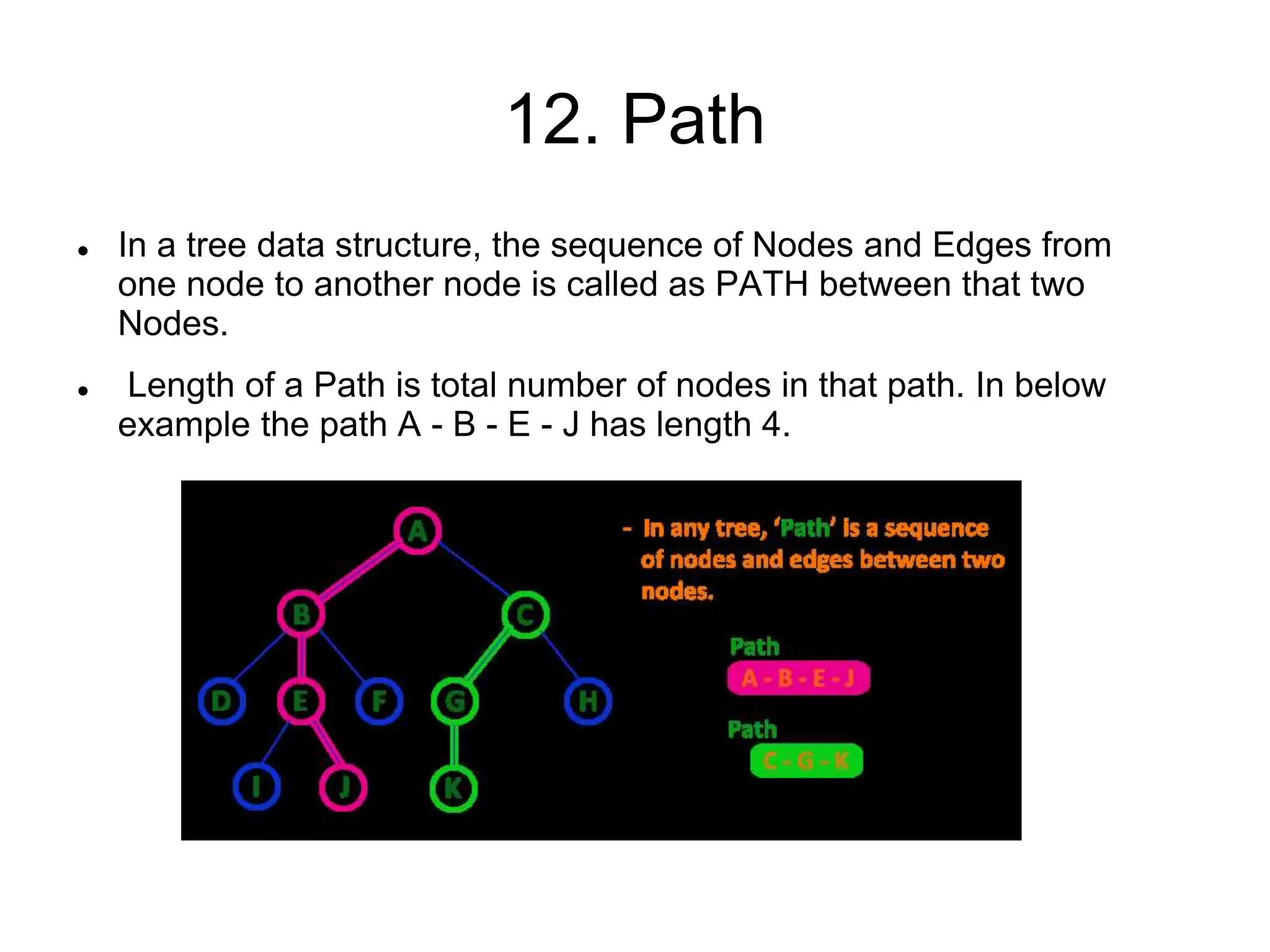
12. Path
 In a tree data structure, the sequence of Nodes and Edges from
one node to another node is called as PATH between that two
Nodes.
 Length of a Path is total number of nodes in that path. In below
example the path A - B - E - J has length 4.
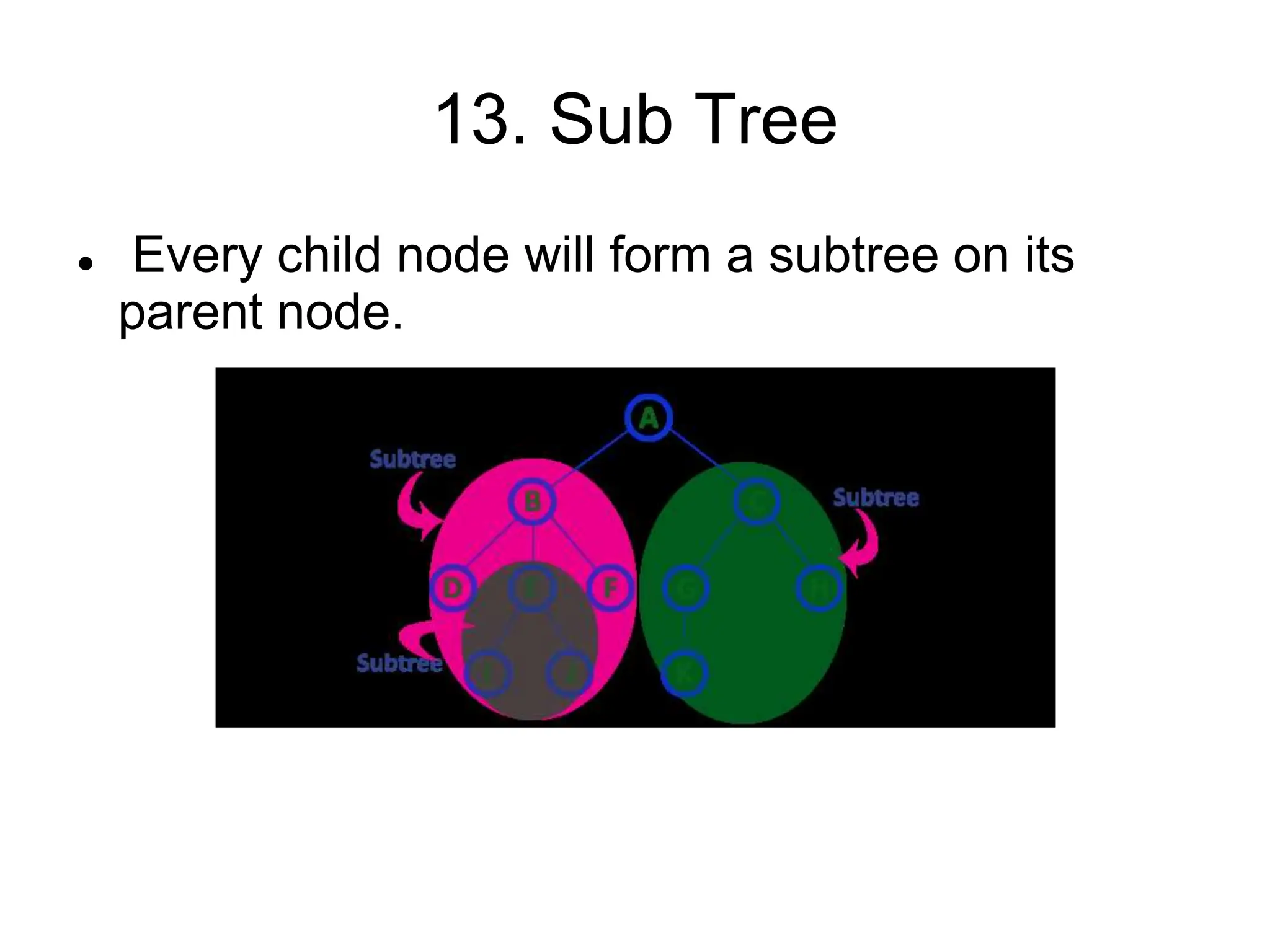
13. Sub Tree
 Every child node will form a subtree on its
parent node.
Type of Trees
• General tree
• Binary tree
• Binary Search Tree
General Tree
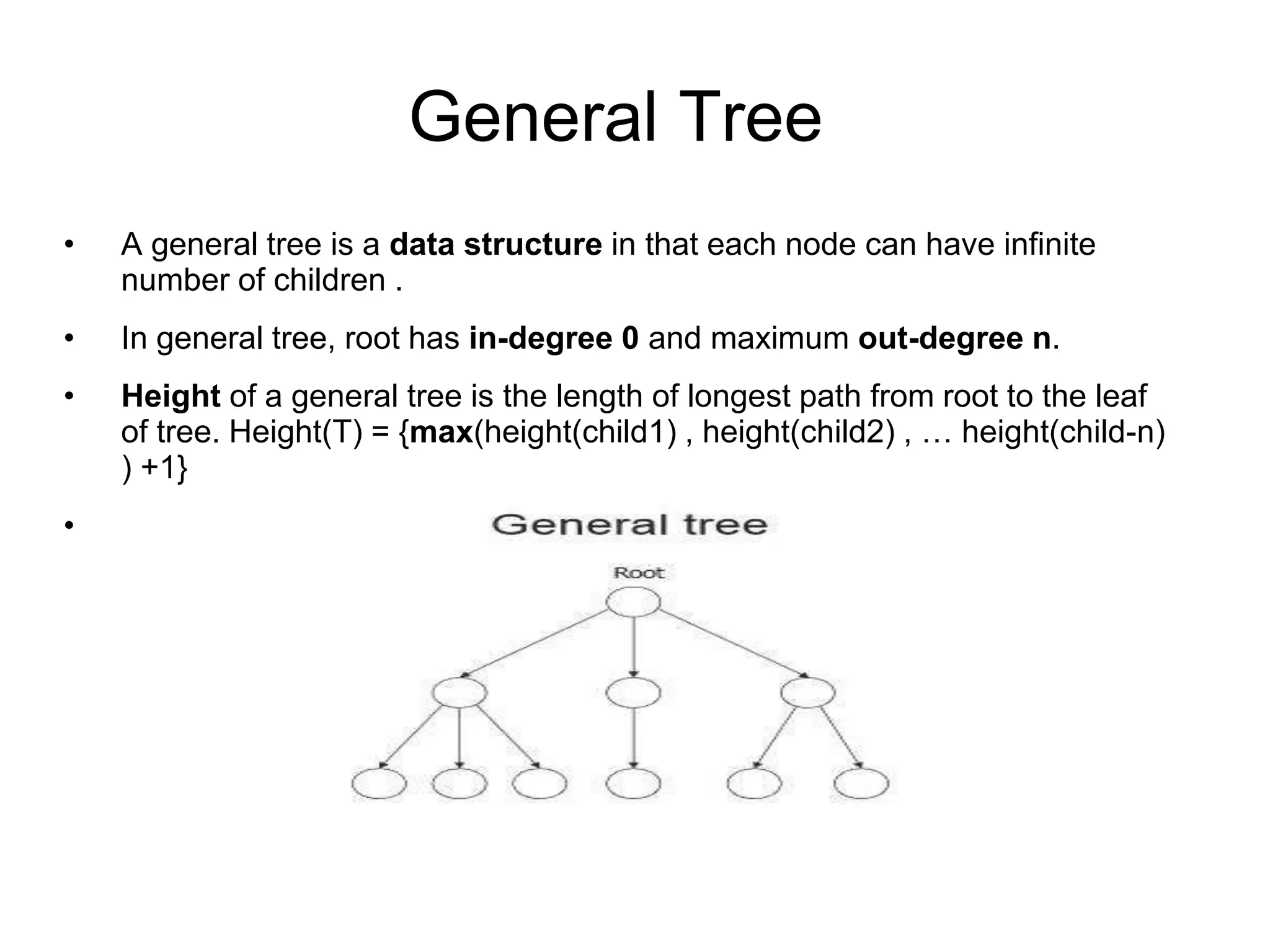
• A general tree is a data structure in that each node can have infinite
number of children .
• In general tree, root has in-degree 0 and maximum out-degree n.
• Height of a general tree is the length of longest path from root to the leaf
of tree. Height(T) = {max(height(child1) , height(child2) , … height(child-n)
) +1}
•
Binary tree
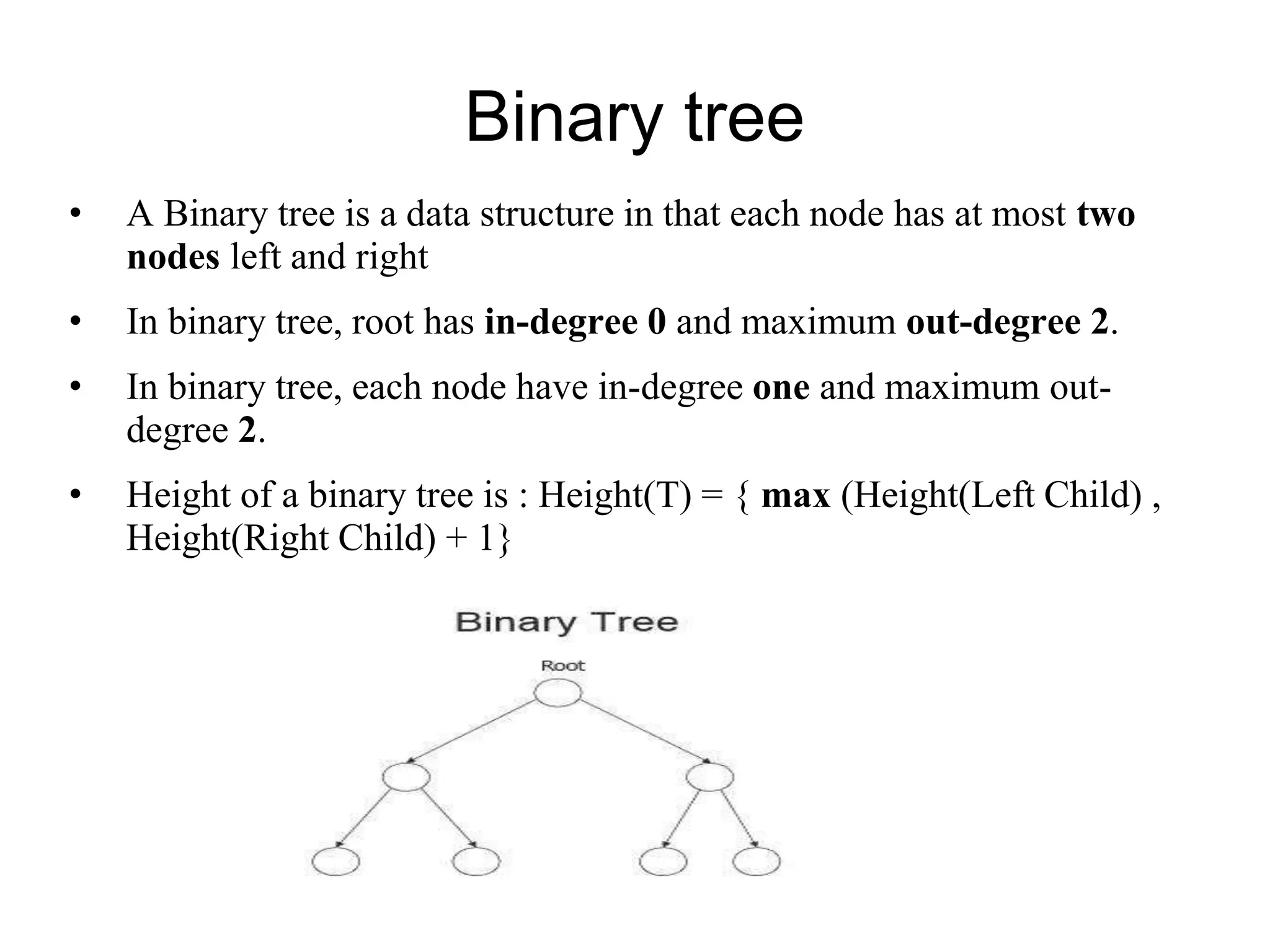
• A Binary tree is a data structure in that each node has at most two
nodes left and right
• In binary tree, root has in-degree 0 and maximum out-degree 2.
• In binary tree, each node have in-degree one and maximum out-
degree 2.
• Height of a binary tree is : Height(T) = { max (Height(Left Child) ,
Height(Right Child) + 1}
Representation of Binary Tree
1. Array Representation
2. Linked List Representation.
Representation of Binary Tree
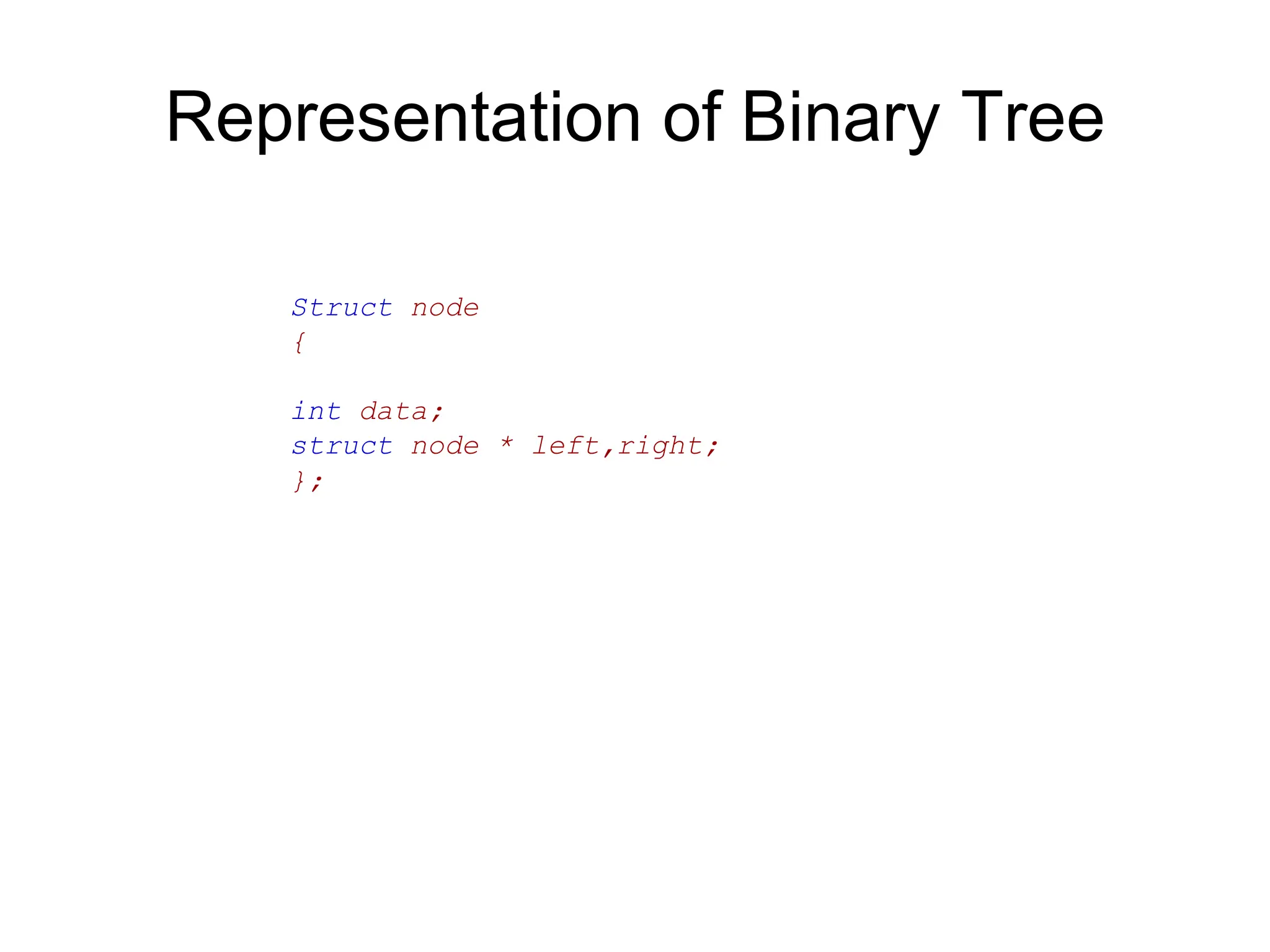
Struct node
{
int data;
struct node * left,right;
};
Array Representation
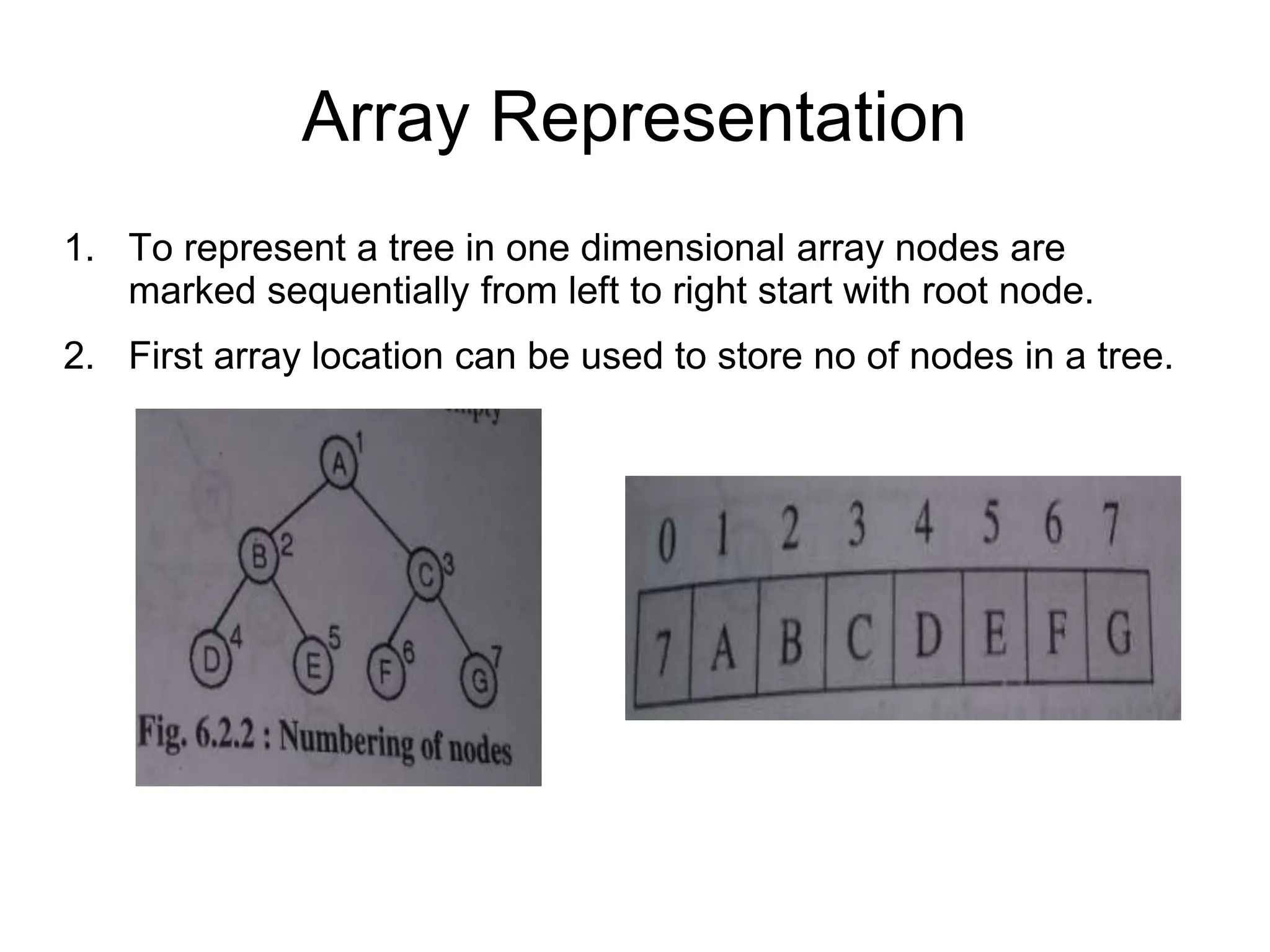
1. To represent a tree in one dimensional array nodes are
marked sequentially from left to right start with root node.
2. First array location can be used to store no of nodes in a tree.
Linked Representation
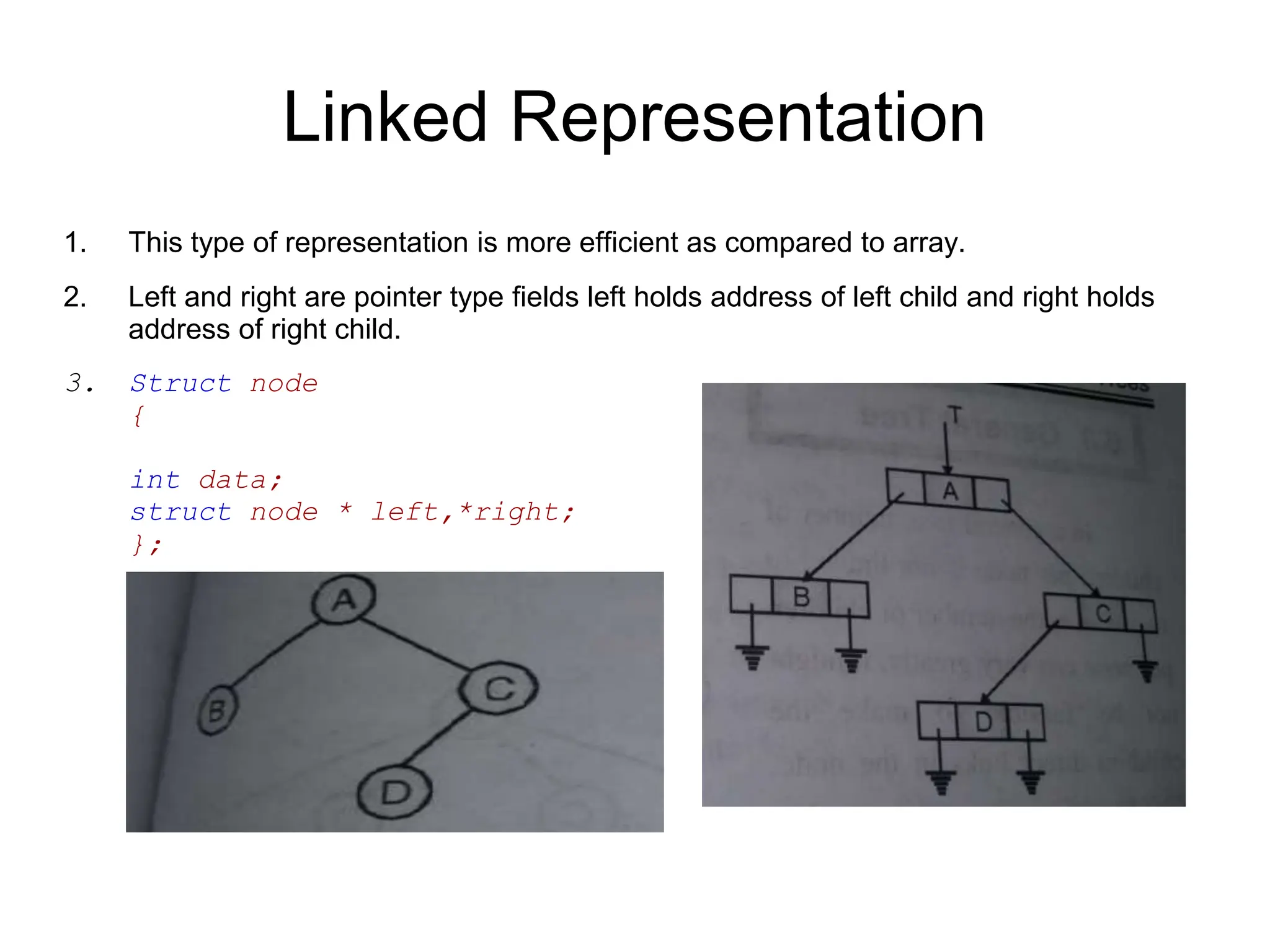
1. This type of representation is more efficient as compared to array.
2. Left and right are pointer type fields left holds address of left child and right holds
address of right child.
3. Struct node
{
int data;
struct node * left,*right;
};
Binary Tree Types
1. Extended Binary Tree
2. Complete Binary Tree
3. Full Binary Tree
4. Skewed Binary Tree
5. Strictly Binary Tree
6. Expression Binary tree
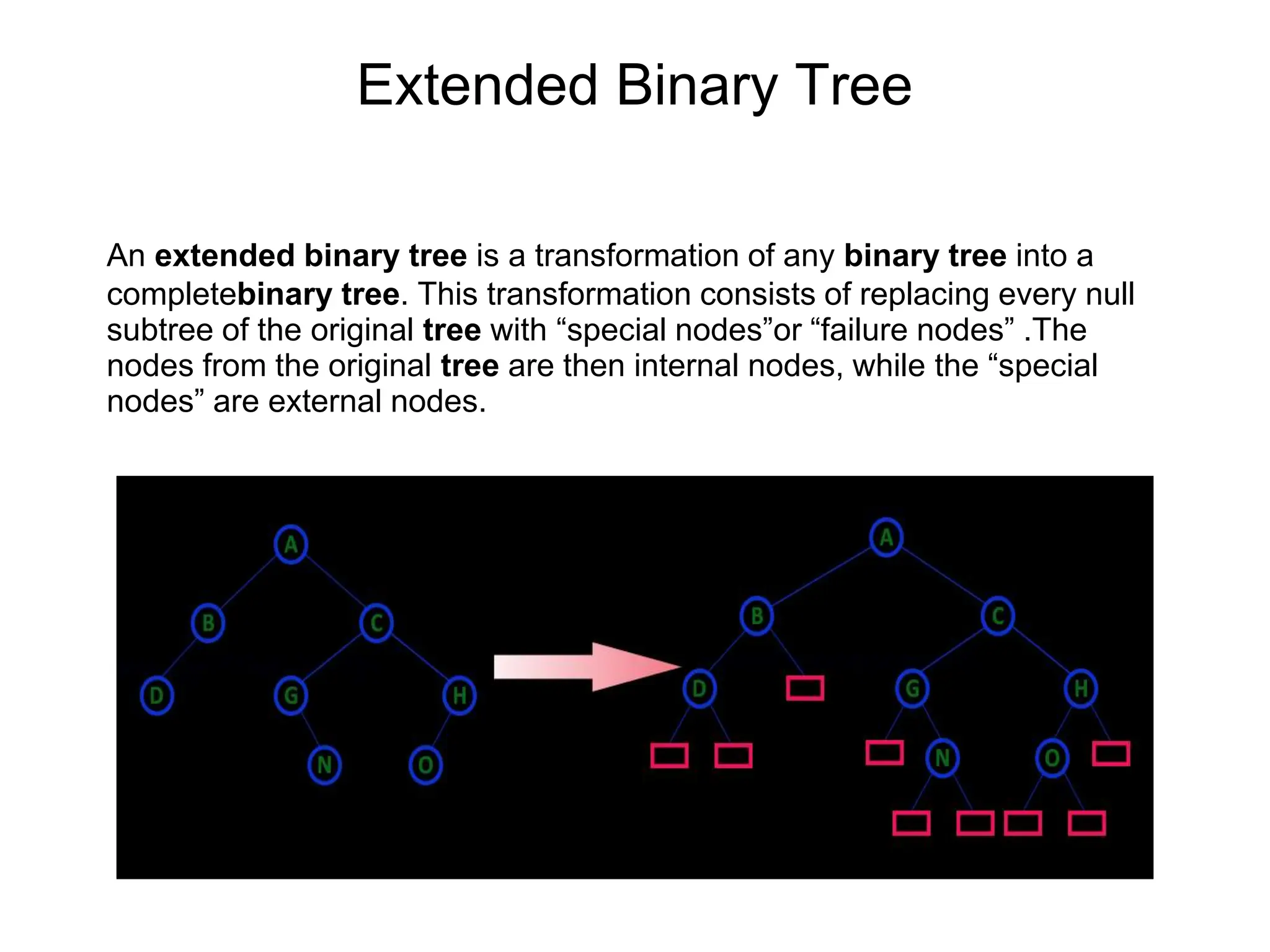
Extended Binary Tree
An extended binary tree is a transformation of any binary tree into a
completebinary tree. This transformation consists of replacing every null
subtree of the original tree with “special nodes”or “failure nodes” .The
nodes from the original tree are then internal nodes, while the “special
nodes” are external nodes.
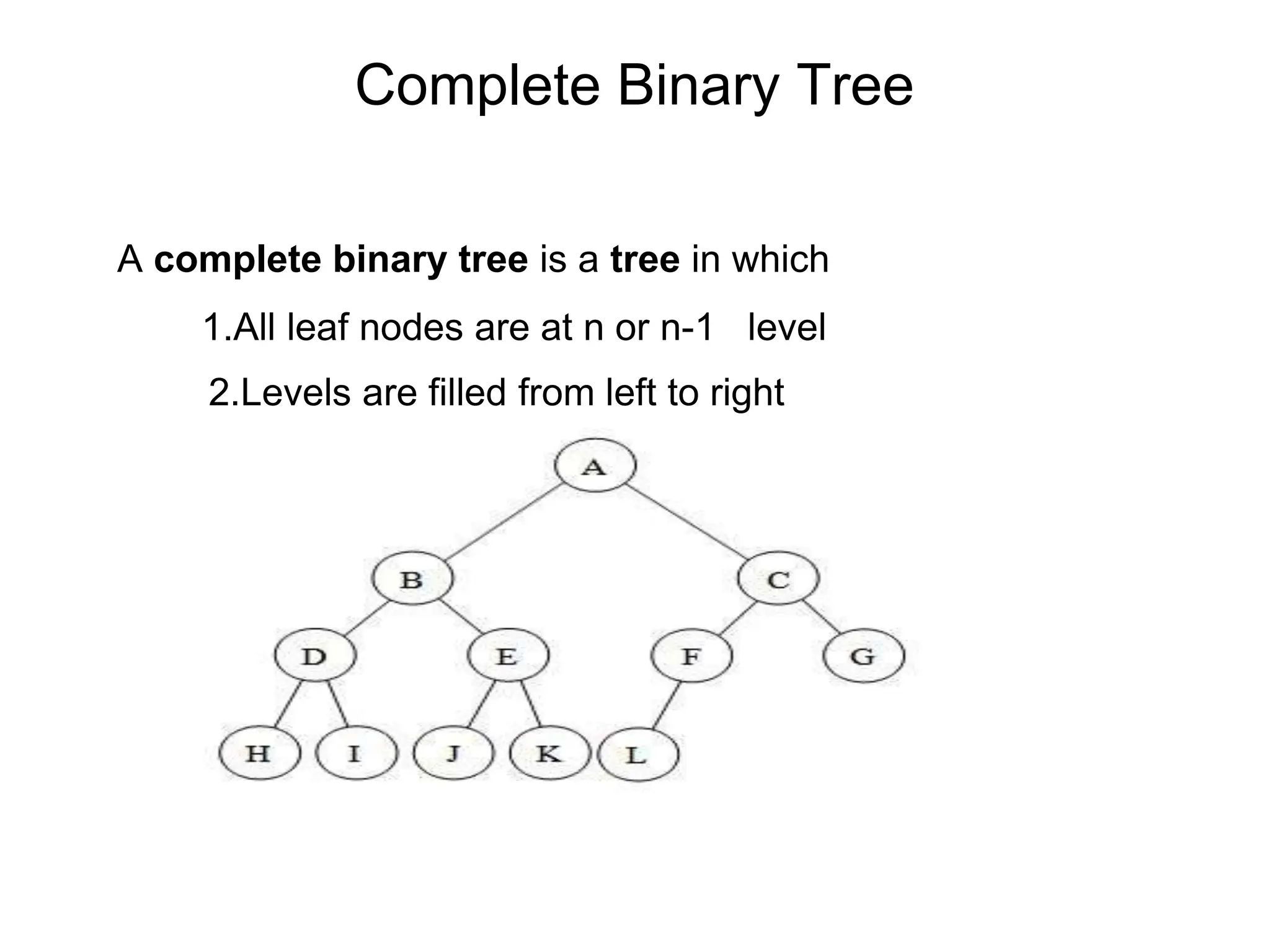
Complete Binary Tree
A complete binary tree is a tree in which
1.All leaf nodes are at n or n-1 level
2.Levels are filled from left to right
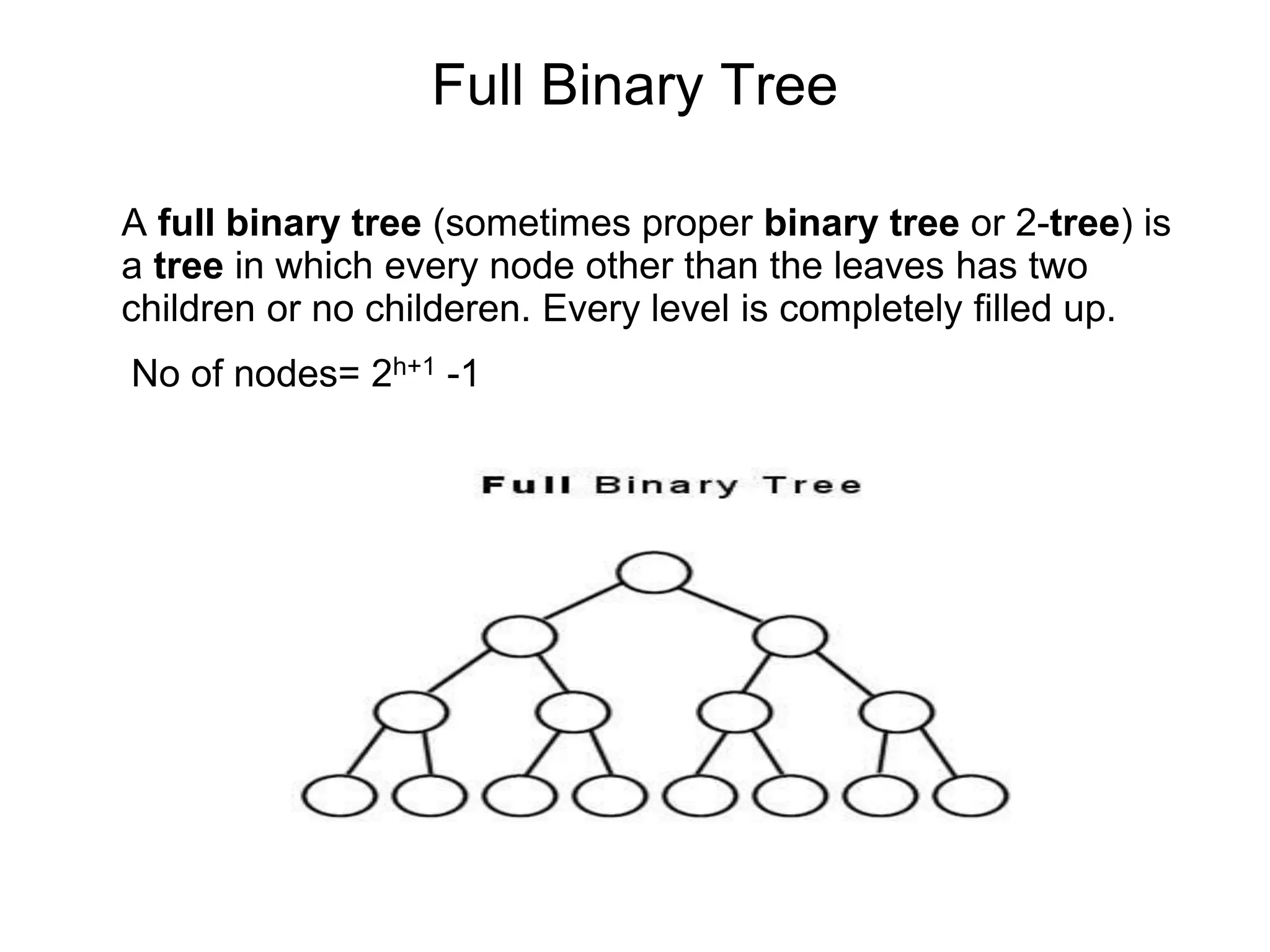
Full Binary Tree
A full binary tree (sometimes proper binary tree or 2-tree) is
a tree in which every node other than the leaves has two
children or no childeren. Every level is completely filled up.
No of nodes= 2h+1 -1
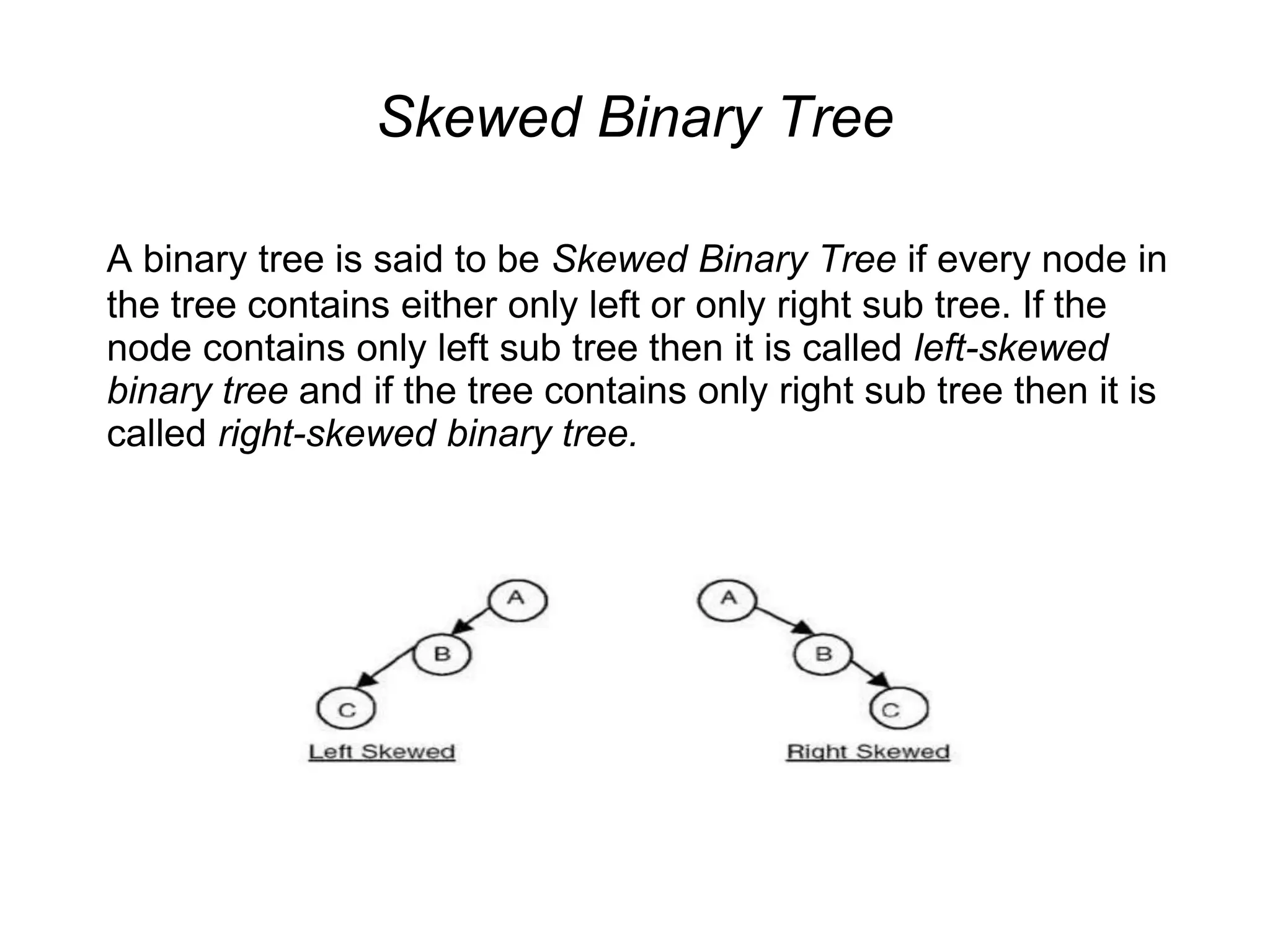
Skewed Binary Tree
A binary tree is said to be Skewed Binary Tree if every node in
the tree contains either only left or only right sub tree. If the
node contains only left sub tree then it is called left-skewed
binary tree and if the tree contains only right sub tree then it is
called right-skewed binary tree.
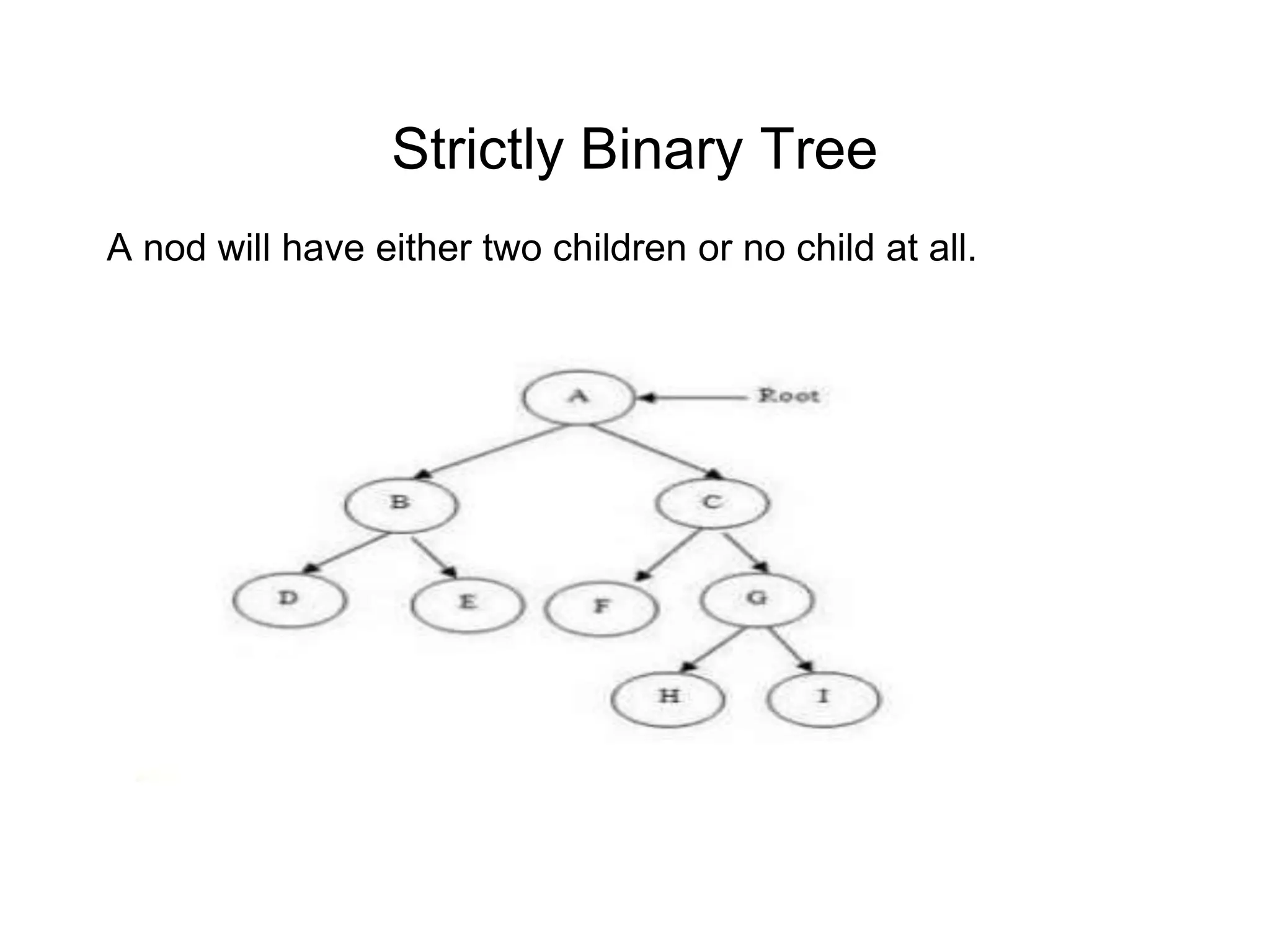
Strictly Binary Tree
A nod will have either two children or no child at all.
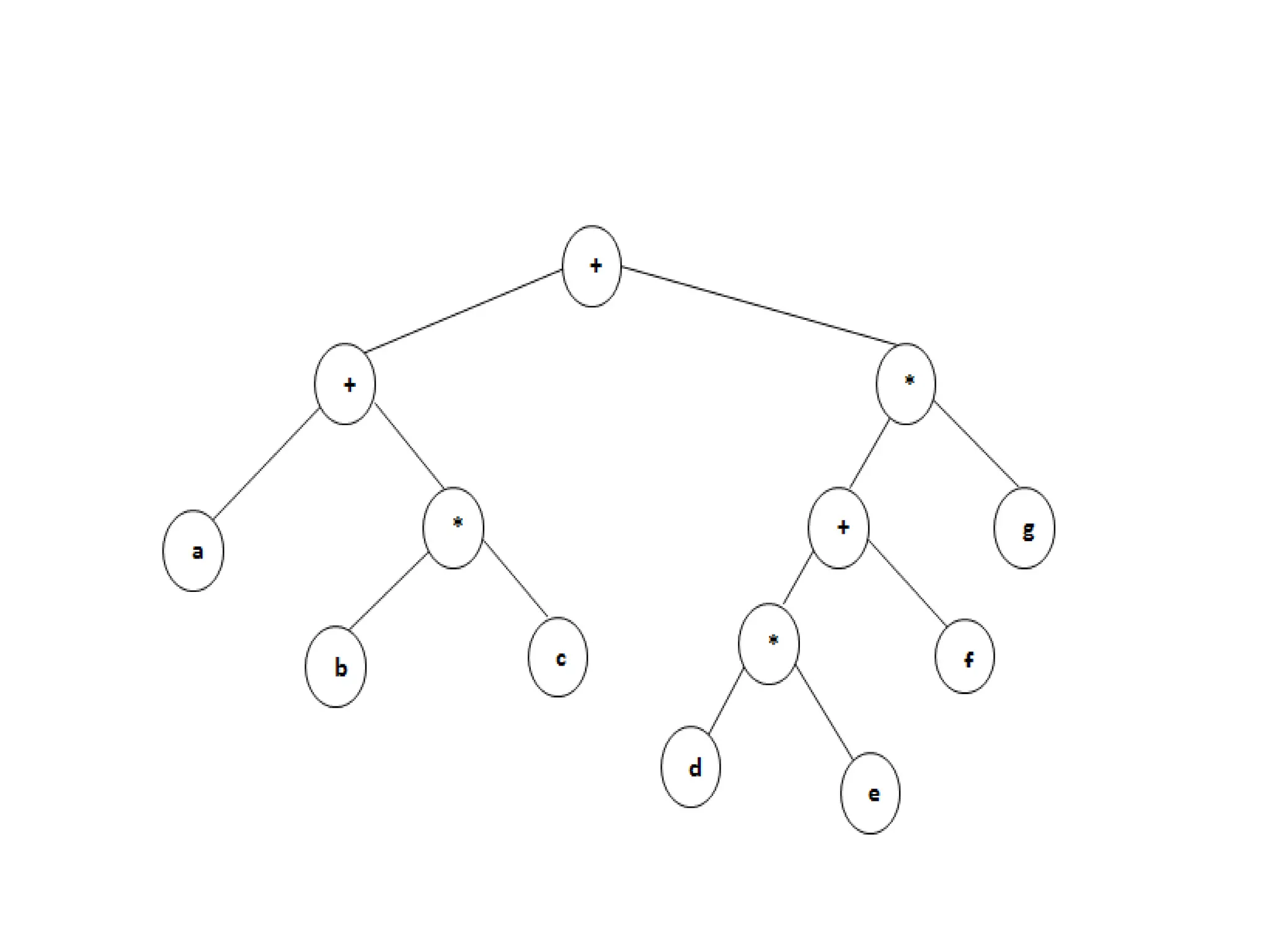
Expression Binary tree
• Expression trees are a special kind of binary tree used to
evaluate certain expressions.
• Two common types of expressions that a binary expression
tree can represent are algebraic and boolean.
• These trees can represent expressions that contain both unary
and binary operators.
• The leaves of a binary expression tree are operands, such as
constants or variable names, and the other nodes contain
operators.
• Expression tree are used in most compilers.
Binary Tree Traversal
1. Preorder traversal:-In this traversal method
first process root element, then left sub tree
and then right sub tree.
Procedure:-
Step 1: Visit root node
Step 2: Visit left sub tree in preorder
Step 3: Visit right sub tree in preorder
2. Inorder traversal:-
In this traversal method first process left element,
then root element and then the right element.
Procedure:-
Step 1: Visit left sub tree in inorder
Step 2: Visit root node
Step 3: Visit right sub tree in inorder
3. Postorder traversal:-
In this traversal first visit / process left sub tree,
then right sub tree and then the root element.
Procedure:-
Step 1: Visit left sub tree in postorder
Step 2: Visit right sub tree in postorder
Step 3: Visit root node
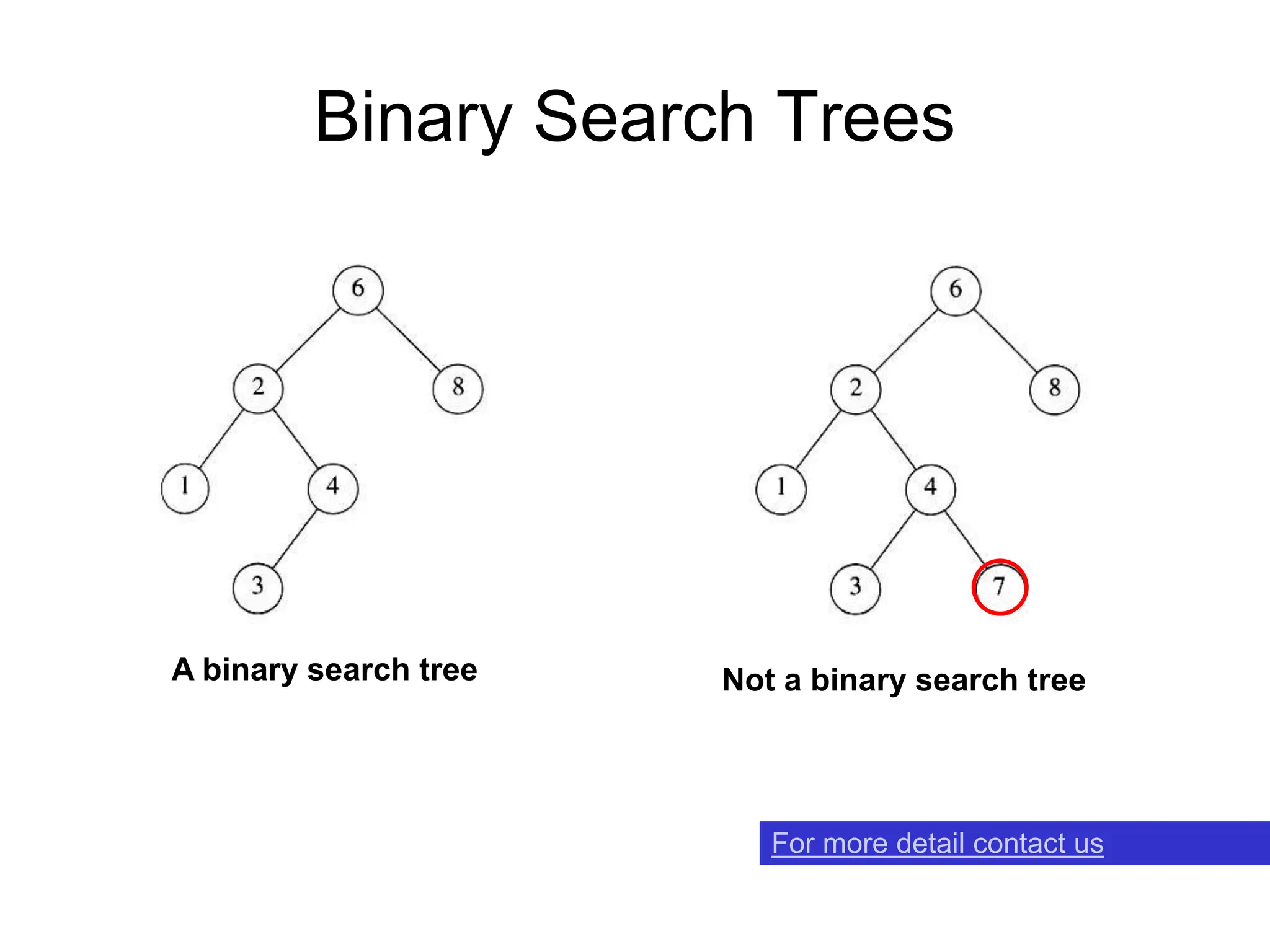
Binary Search Tree
A binary search tree (BST) or
"ordered binary tree" is a empty or in which
each node contains a key that satisfies
following conditions:
1. All keys are distinct.’
2. , all elements in its left subtree are less to the node
(<), and all the elements in its right subtree are greater
than the node (>).
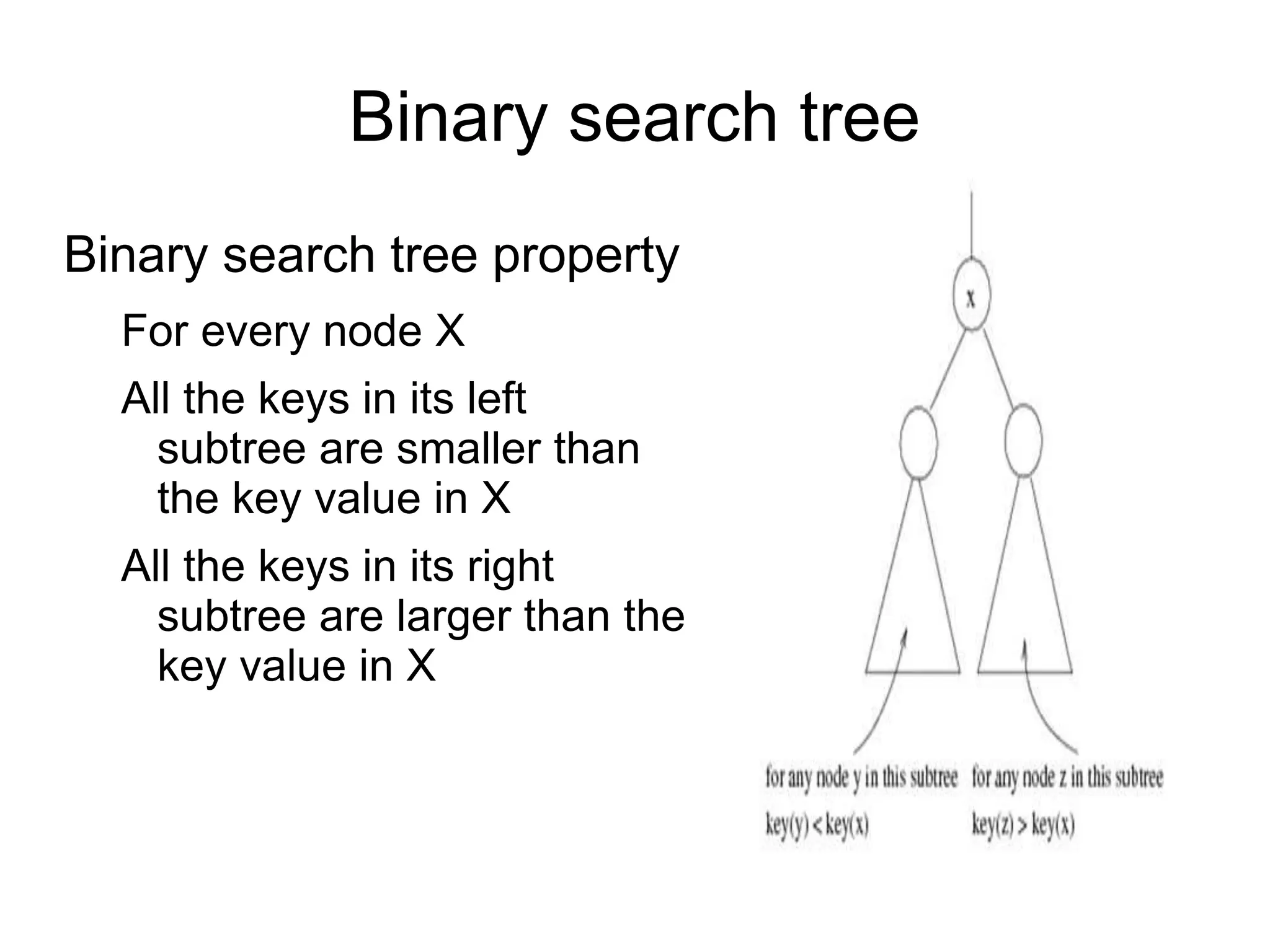
Binary search tree
Binary search tree property
For every node X
All the keys in its left
subtree are smaller than
the key value in X
All the keys in its right
subtree are larger than the
key value in X
Binary Search Trees
A binary search tree Not a binary search tree
For more detail contact us

Final tree.ppt tells about tree presentation

  • 1.
    Chapter 6 Tree (18M) Visitfor more Learning Resources
  • 2.
    Data structure Store andorganize data in computer. Linear Data Structure Arrays Linked List Stacks Queues
  • 3.
  • 4.
  • 5.
    Tree Definition Tree isa non-linear data structure which organizes data in hierarchical structure and this is a recursive definition.
  • 6.
    Tree terminology...  1.Root: The first node is called as Root Node.  Every tree must have root node, there must be only one root node.  Root node doesn't have any parent.
  • 7.
    2. Edge  Ina tree data structure, the connecting link between any two nodes is called as EDGE. In a tree with 'N' number of nodes there will be a maximum of 'N-1' number of edges.
  • 8.
    3. Parent  Ina tree data structure, the node which is predecessor of any node is called as PARENT NODE. In simple words, the node which has branch from it to any other node is called as parent node. Parent node can also be defined as "The node which has child / children".
  • 9.
    4. Child  Thenode which has a link from its parent node is called as child node.  In a tree, any parent node can have any number of child nodes.  In a tree, all the nodes except root are child nodes.
  • 10.
    5. Siblings  Thenodes with same parent are called as Sibling nodes.
  • 11.
    6. Leaf Node The node which does not have a child is called as LEAF Node.  The leaf nodes are also called as External Nodes or 'Terminal' node.
  • 12.
    7. Internal Nodes An internal node is a node with atleast one child.  Nodes other than leaf nodes are called as Internal Nodes.  The root node is also said to be Internal Node if the tree has more than one node. Internal nodes are also called as 'Non- Terminal' nodes.
  • 13.
    8. Degree  Ina tree data structure, the total number of children of a node is called as DEGREE of that Node.
  • 14.
    9. Level  Ina tree data structure, the root node is said to be at Level 0 and the children of root node are at Level 1 and the children of the nodes which are at Level 1 will be at Level 2 and so on...  In a tree each step from top to bottom is called as a Level and the Level count starts with '0' and incremented by one at each level (Step).
  • 15.
    10. Height  thetotal number of egdes from leaf node to a particular node in the longest path is called as HEIGHT of that Node.  In a tree, height of the root node is said to be height of the tree.
  • 16.
    11. Depth  Ina tree data structure, the total number of egdes from root node to a particular node is called as DEPTH of that Node.
  • 17.
    12. Path  Ina tree data structure, the sequence of Nodes and Edges from one node to another node is called as PATH between that two Nodes.  Length of a Path is total number of nodes in that path. In below example the path A - B - E - J has length 4.
  • 18.
    13. Sub Tree Every child node will form a subtree on its parent node.
  • 19.
    Type of Trees •General tree • Binary tree • Binary Search Tree
  • 20.
    General Tree • Ageneral tree is a data structure in that each node can have infinite number of children . • In general tree, root has in-degree 0 and maximum out-degree n. • Height of a general tree is the length of longest path from root to the leaf of tree. Height(T) = {max(height(child1) , height(child2) , … height(child-n) ) +1} •
  • 21.
    Binary tree • ABinary tree is a data structure in that each node has at most two nodes left and right • In binary tree, root has in-degree 0 and maximum out-degree 2. • In binary tree, each node have in-degree one and maximum out- degree 2. • Height of a binary tree is : Height(T) = { max (Height(Left Child) , Height(Right Child) + 1}
  • 22.
    Representation of BinaryTree 1. Array Representation 2. Linked List Representation.
  • 23.
    Representation of BinaryTree Struct node { int data; struct node * left,right; };
  • 24.
    Array Representation 1. Torepresent a tree in one dimensional array nodes are marked sequentially from left to right start with root node. 2. First array location can be used to store no of nodes in a tree.
  • 25.
    Linked Representation 1. Thistype of representation is more efficient as compared to array. 2. Left and right are pointer type fields left holds address of left child and right holds address of right child. 3. Struct node { int data; struct node * left,*right; };
  • 26.
    Binary Tree Types 1.Extended Binary Tree 2. Complete Binary Tree 3. Full Binary Tree 4. Skewed Binary Tree 5. Strictly Binary Tree 6. Expression Binary tree
  • 27.
    Extended Binary Tree Anextended binary tree is a transformation of any binary tree into a completebinary tree. This transformation consists of replacing every null subtree of the original tree with “special nodes”or “failure nodes” .The nodes from the original tree are then internal nodes, while the “special nodes” are external nodes.
  • 28.
    Complete Binary Tree Acomplete binary tree is a tree in which 1.All leaf nodes are at n or n-1 level 2.Levels are filled from left to right
  • 29.
    Full Binary Tree Afull binary tree (sometimes proper binary tree or 2-tree) is a tree in which every node other than the leaves has two children or no childeren. Every level is completely filled up. No of nodes= 2h+1 -1
  • 30.
    Skewed Binary Tree Abinary tree is said to be Skewed Binary Tree if every node in the tree contains either only left or only right sub tree. If the node contains only left sub tree then it is called left-skewed binary tree and if the tree contains only right sub tree then it is called right-skewed binary tree.
  • 31.
    Strictly Binary Tree Anod will have either two children or no child at all.
  • 32.
    Expression Binary tree •Expression trees are a special kind of binary tree used to evaluate certain expressions. • Two common types of expressions that a binary expression tree can represent are algebraic and boolean. • These trees can represent expressions that contain both unary and binary operators. • The leaves of a binary expression tree are operands, such as constants or variable names, and the other nodes contain operators. • Expression tree are used in most compilers.
  • 34.
    Binary Tree Traversal 1.Preorder traversal:-In this traversal method first process root element, then left sub tree and then right sub tree. Procedure:- Step 1: Visit root node Step 2: Visit left sub tree in preorder Step 3: Visit right sub tree in preorder
  • 35.
    2. Inorder traversal:- Inthis traversal method first process left element, then root element and then the right element. Procedure:- Step 1: Visit left sub tree in inorder Step 2: Visit root node Step 3: Visit right sub tree in inorder
  • 36.
    3. Postorder traversal:- Inthis traversal first visit / process left sub tree, then right sub tree and then the root element. Procedure:- Step 1: Visit left sub tree in postorder Step 2: Visit right sub tree in postorder Step 3: Visit root node
  • 37.
    Binary Search Tree Abinary search tree (BST) or "ordered binary tree" is a empty or in which each node contains a key that satisfies following conditions: 1. All keys are distinct.’ 2. , all elements in its left subtree are less to the node (<), and all the elements in its right subtree are greater than the node (>).
  • 38.
    Binary search tree Binarysearch tree property For every node X All the keys in its left subtree are smaller than the key value in X All the keys in its right subtree are larger than the key value in X
  • 39.
    Binary Search Trees Abinary search tree Not a binary search tree For more detail contact us