Poster No.
EPB-018
Swarna Priya Basker*, Yuga Priya M, Ranjeeth Kumar K, Madhumitha V, Subalakshmi S, Thamizh Selvan S
ABSTRACT:The present study is designed to explore
the qualification of the pharmacist behind every sale
and dispensing of the drugs aimed at providing the
better patient counseling for the proper use of drugs,
through a prospective cross sectional survey.
INTRODUCTION: Pharmacists had relatively better
knowledge on storage temperature, prescription
terminologies and status of medicines along with
understanding monographs. Unfortunately, despite
India excelling in all other industries, the health care
industry has been very slow on the uptake of
pharmacist as an integral tool in improving health
services, which includes dispensing medicines with
appropriate advice and professional counseling.
METHODOLOGY: The study includes the data
collection from cities of Chennai with a self designed
questionnaire and the study was conducted on
monsoon season, in a sample size of 131. Data
analysis was done using descriptive statistics.
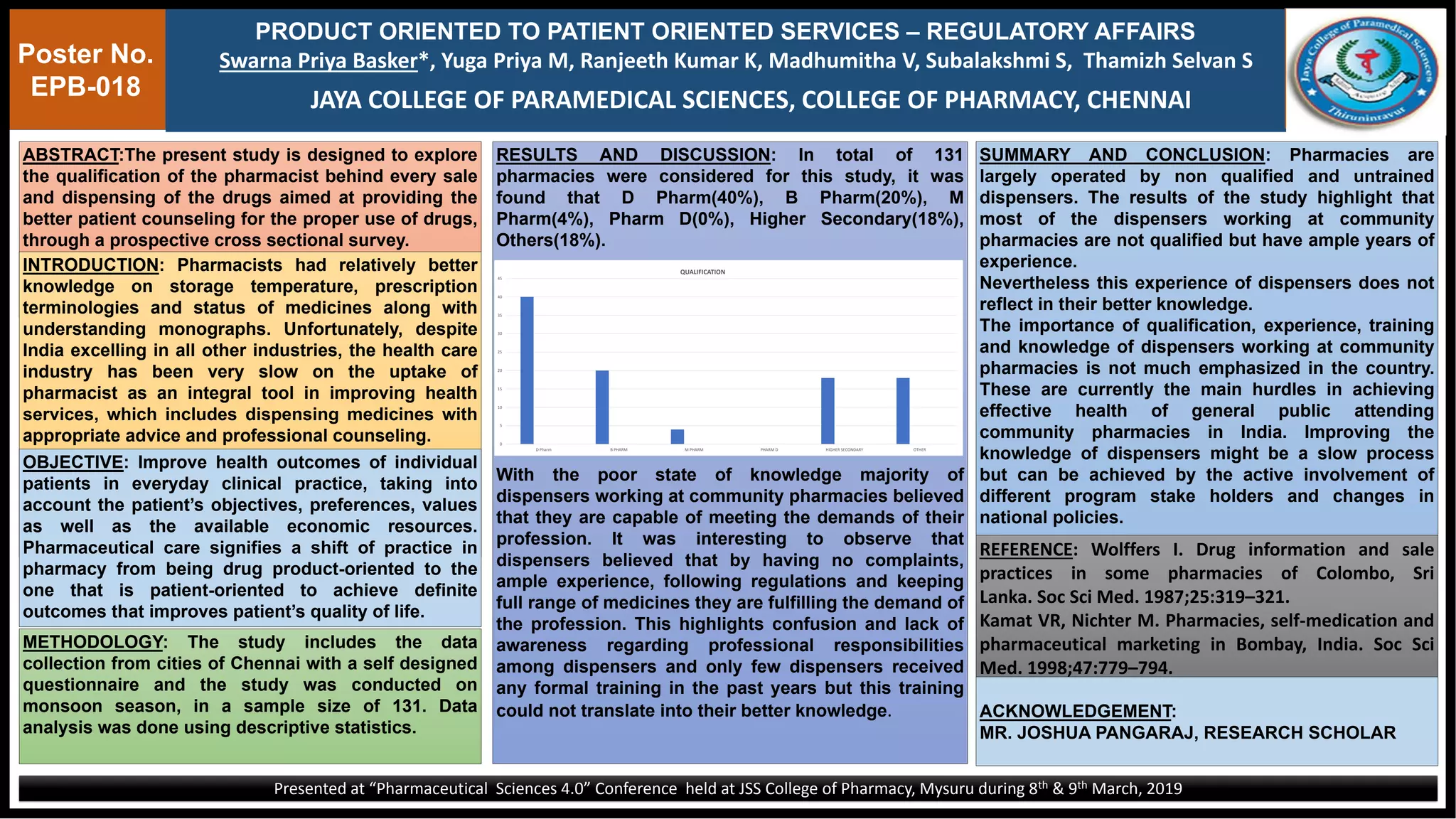
RESULTS AND DISCUSSION: In total of 131
pharmacies were considered for this study, it was
found that D Pharm(40%), B Pharm(20%), M
Pharm(4%), Pharm D(0%), Higher Secondary(18%),
Others(18%).
With the poor state of knowledge majority of
dispensers working at community pharmacies believed
that they are capable of meeting the demands of their
profession. It was interesting to observe that
dispensers believed that by having no complaints,
ample experience, following regulations and keeping
full range of medicines they are fulfilling the demand of
the profession. This highlights confusion and lack of
awareness regarding professional responsibilities
among dispensers and only few dispensers received
any formal training in the past years but this training
could not translate into their better knowledge.
SUMMARY AND CONCLUSION: Pharmacies are
largely operated by non qualified and untrained
dispensers. The results of the study highlight that
most of the dispensers working at community
pharmacies are not qualified but have ample years of
experience.
Nevertheless this experience of dispensers does not
reflect in their better knowledge.
The importance of qualification, experience, training
and knowledge of dispensers working at community
pharmacies is not much emphasized in the country.
These are currently the main hurdles in achieving
effective health of general public attending
community pharmacies in India. Improving the
knowledge of dispensers might be a slow process
but can be achieved by the active involvement of
different program stake holders and changes in
national policies.
REFERENCE: Wolffers I. Drug information and sale
practices in some pharmacies of Colombo, Sri
Lanka. Soc Sci Med. 1987;25:319–321.
Kamat VR, Nichter M. Pharmacies, self-medication and
pharmaceutical marketing in Bombay, India. Soc Sci
Med. 1998;47:779–794.
Presented at “Pharmaceutical Sciences 4.0” Conference held at JSS College of Pharmacy, Mysuru during 8th & 9th March, 2019
OBJECTIVE: Improve health outcomes of individual
patients in everyday clinical practice, taking into
account the patient’s objectives, preferences, values
as well as the available economic resources.
Pharmaceutical care signifies a shift of practice in
pharmacy from being drug product-oriented to the
one that is patient-oriented to achieve definite
outcomes that improves patient’s quality of life.
ACKNOWLEDGEMENT:
MR. JOSHUA PANGARAJ, RESEARCH SCHOLAR
PRODUCT ORIENTED TO PATIENT ORIENTED SERVICES – REGULATORY AFFAIRS
JAYA COLLEGE OF PARAMEDICAL SCIENCES, COLLEGE OF PHARMACY, CHENNAI
0
5
10
15
20
25
30
35
40
45
D Pharm B PHARM M PHARM PHARM D HIGHER SECONDARY OTHER
QUALIFICATION

Final template

  • 1.
    Poster No. EPB-018 Swarna PriyaBasker*, Yuga Priya M, Ranjeeth Kumar K, Madhumitha V, Subalakshmi S, Thamizh Selvan S ABSTRACT:The present study is designed to explore the qualification of the pharmacist behind every sale and dispensing of the drugs aimed at providing the better patient counseling for the proper use of drugs, through a prospective cross sectional survey. INTRODUCTION: Pharmacists had relatively better knowledge on storage temperature, prescription terminologies and status of medicines along with understanding monographs. Unfortunately, despite India excelling in all other industries, the health care industry has been very slow on the uptake of pharmacist as an integral tool in improving health services, which includes dispensing medicines with appropriate advice and professional counseling. METHODOLOGY: The study includes the data collection from cities of Chennai with a self designed questionnaire and the study was conducted on monsoon season, in a sample size of 131. Data analysis was done using descriptive statistics. RESULTS AND DISCUSSION: In total of 131 pharmacies were considered for this study, it was found that D Pharm(40%), B Pharm(20%), M Pharm(4%), Pharm D(0%), Higher Secondary(18%), Others(18%). With the poor state of knowledge majority of dispensers working at community pharmacies believed that they are capable of meeting the demands of their profession. It was interesting to observe that dispensers believed that by having no complaints, ample experience, following regulations and keeping full range of medicines they are fulfilling the demand of the profession. This highlights confusion and lack of awareness regarding professional responsibilities among dispensers and only few dispensers received any formal training in the past years but this training could not translate into their better knowledge. SUMMARY AND CONCLUSION: Pharmacies are largely operated by non qualified and untrained dispensers. The results of the study highlight that most of the dispensers working at community pharmacies are not qualified but have ample years of experience. Nevertheless this experience of dispensers does not reflect in their better knowledge. The importance of qualification, experience, training and knowledge of dispensers working at community pharmacies is not much emphasized in the country. These are currently the main hurdles in achieving effective health of general public attending community pharmacies in India. Improving the knowledge of dispensers might be a slow process but can be achieved by the active involvement of different program stake holders and changes in national policies. REFERENCE: Wolffers I. Drug information and sale practices in some pharmacies of Colombo, Sri Lanka. Soc Sci Med. 1987;25:319–321. Kamat VR, Nichter M. Pharmacies, self-medication and pharmaceutical marketing in Bombay, India. Soc Sci Med. 1998;47:779–794. Presented at “Pharmaceutical Sciences 4.0” Conference held at JSS College of Pharmacy, Mysuru during 8th & 9th March, 2019 OBJECTIVE: Improve health outcomes of individual patients in everyday clinical practice, taking into account the patient’s objectives, preferences, values as well as the available economic resources. Pharmaceutical care signifies a shift of practice in pharmacy from being drug product-oriented to the one that is patient-oriented to achieve definite outcomes that improves patient’s quality of life. ACKNOWLEDGEMENT: MR. JOSHUA PANGARAJ, RESEARCH SCHOLAR PRODUCT ORIENTED TO PATIENT ORIENTED SERVICES – REGULATORY AFFAIRS JAYA COLLEGE OF PARAMEDICAL SCIENCES, COLLEGE OF PHARMACY, CHENNAI 0 5 10 15 20 25 30 35 40 45 D Pharm B PHARM M PHARM PHARM D HIGHER SECONDARY OTHER QUALIFICATION