School report 
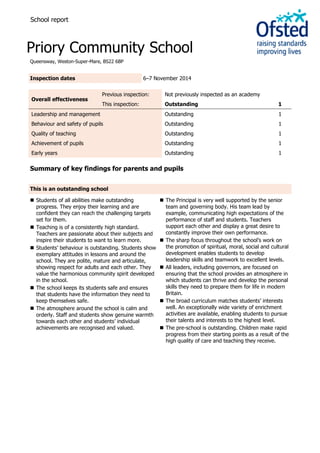
Priory Community School 
Queensway, Weston-Super-Mare, BS22 6BP 
Inspection dates 
6–7 November 2014 
Overall effectiveness Previous inspection: Not previously inspected as an academy This inspection: Outstanding 1 Leadership and management 
Outstanding 
1 Behaviour and safety of pupils 
Outstanding 
1 Quality of teaching 
Outstanding 
1 Achievement of pupils 
Outstanding 
1 Early years 
Outstanding 
1 
Summary of key findings for parents and pupils 
This is an outstanding school 
 Students of all abilities make outstanding progress. They enjoy their learning and are confident they can reach the challenging targets set for them. 
 Teaching is of a consistently high standard. Teachers are passionate about their subjects and inspire their students to want to learn more. 
 Students’ behaviour is outstanding. Students show exemplary attitudes in lessons and around the school. They are polite, mature and articulate, showing respect for adults and each other. They value the harmonious community spirit developed in the school. 
 The school keeps its students safe and ensures that students have the information they need to keep themselves safe. 
 The atmosphere around the school is calm and orderly. Staff and students show genuine warmth towards each other and students’ individual achievements are recognised and valued. 
 The Principal is very well supported by the senior team and governing body. His team lead by example, communicating high expectations of the performance of staff and students. Teachers support each other and display a great desire to constantly improve their own performance. 
 The sharp focus throughout the school’s work on the promotion of spiritual, moral, social and cultural development enables students to develop leadership skills and teamwork to excellent levels. 
 All leaders, including governors, are focused on ensuring that the school provides an atmosphere in which students can thrive and develop the personal skills they need to prepare them for life in modern Britain. 
 The broad curriculum matches students’ interests well. An exceptionally wide variety of enrichment activities are available, enabling students to pursue their talents and interests to the highest level. 
 The pre-school is outstanding. Children make rapid progress from their starting points as a result of the high quality of care and teaching they receive.
Inspection report: Priory Community School, 6–7 November 2014 2 of 10 
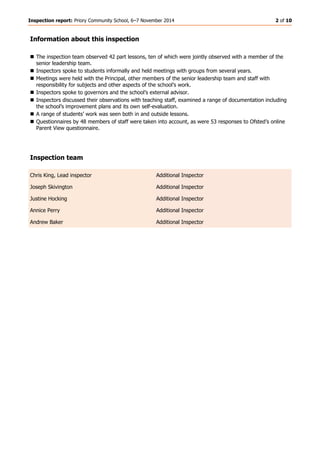
Information about this inspection 
 The inspection team observed 42 part lessons, ten of which were jointly observed with a member of the senior leadership team. 
 Inspectors spoke to students informally and held meetings with groups from several years. 
 Meetings were held with the Principal, other members of the senior leadership team and staff with responsibility for subjects and other aspects of the school’s work. 
 Inspectors spoke to governors and the school’s external advisor. 
 Inspectors discussed their observations with teaching staff, examined a range of documentation including the school’s improvement plans and its own self-evaluation. 
 A range of students’ work was seen both in and outside lessons. 
 Questionnaires by 48 members of staff were taken into account, as were 53 responses to Ofsted’s online Parent View questionnaire. 
Inspection team Chris King, Lead inspector Additional Inspector Joseph Skivington Additional Inspector Justine Hocking Additional Inspector Annice Perry Additional Inspector Andrew Baker Additional Inspector
Inspection report: Priory Community School, 6–7 November 2014 3 of 10 
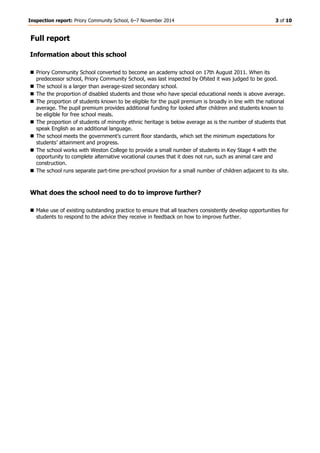
Full report 
Information about this school 
 Priory Community School converted to become an academy school on 17th August 2011. When its predecessor school, Priory Community School, was last inspected by Ofsted it was judged to be good. 
 The school is a larger than average-sized secondary school. 
 The the proportion of disabled students and those who have special educational needs is above average. 
 The proportion of students known to be eligible for the pupil premium is broadly in line with the national average. The pupil premium provides additional funding for looked after children and students known to be eligible for free school meals. 
 The proportion of students of minority ethnic heritage is below average as is the number of students that speak English as an additional language. 
 The school meets the government’s current floor standards, which set the minimum expectations for students’ attainment and progress. 
 The school works with Weston College to provide a small number of students in Key Stage 4 with the opportunity to complete alternative vocational courses that it does not run, such as animal care and construction. 
 The school runs separate part-time pre-school provision for a small number of children adjacent to its site. 
What does the school need to do to improve further? 
 Make use of existing outstanding practice to ensure that all teachers consistently develop opportunities for students to respond to the advice they receive in feedback on how to improve further.
Inspection report: Priory Community School, 6–7 November 2014 4 of 10 
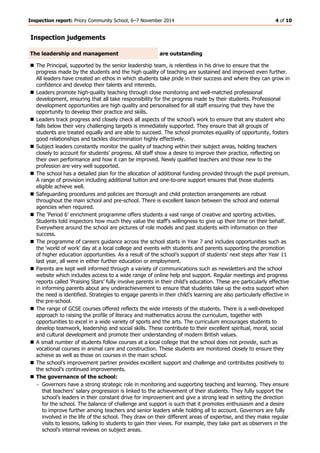
Inspection judgements The leadership and management 
are outstanding 
 The Principal, supported by the senior leadership team, is relentless in his drive to ensure that the progress made by the students and the high quality of teaching are sustained and improved even further. All leaders have created an ethos in which students take pride in their success and where they can grow in confidence and develop their talents and interests. 
 Leaders promote high-quality teaching through close monitoring and well-matched professional development, ensuring that all take responsibility for the progress made by their students. Professional development opportunities are high quality and personalised for all staff ensuring that they have the opportunity to develop their practice and skills. 
 Leaders track progress and closely check all aspects of the school’s work to ensure that any student who falls below their very challenging targets is immediately supported. They ensure that all groups of students are treated equally and are able to succeed. The school promotes equality of opportunity, fosters good relationships and tackles discrimination highly effectively. 
 Subject leaders constantly monitor the quality of teaching within their subject areas, holding teachers closely to account for students’ progress. All staff show a desire to improve their practice, reflecting on their own performance and how it can be improved. Newly qualified teachers and those new to the profession are very well supported. 
 The school has a detailed plan for the allocation of additional funding provided through the pupil premium. A range of provision including additional tuition and one-to-one support ensures that those students eligible achieve well. 
 Safeguarding procedures and policies are thorough and child protection arrangements are robust throughout the main school and pre-school. There is excellent liaison between the school and external agencies when required. 
 The ‘Period 6’ enrichment programme offers students a vast range of creative and sporting activities. Students told inspectors how much they value the staff’s willingness to give up their time on their behalf. Everywhere around the school are pictures of role models and past students with information on their success. 
 The programme of careers guidance across the school starts in Year 7 and includes opportunities such as the ‘world of work’ day at a local college and events with students and parents supporting the promotion of higher education opportunities. As a result of the school’s support of students’ next steps after Year 11 last year, all were in either further education or employment. 
 Parents are kept well informed through a variety of communications such as newsletters and the school website which includes access to a wide range of online help and support. Regular meetings and progress reports called ‘Praising Stars’ fully involve parents in their child’s education. These are particularly effective in informing parents about any underachievement to ensure that students take up the extra support when the need is identified. Strategies to engage parents in their child’s learning are also particularly effective in the pre-school. 
 The range of GCSE courses offered reflects the wide interests of the students. There is a well-developed approach to raising the profile of literacy and mathematics across the curriculum, together with opportunities to excel in a wide variety of sports and the arts. The curriculum encourages students to develop teamwork, leadership and social skills. These contribute to their excellent spiritual, moral, social and cultural development and promote their understanding of modern British values. 
 A small number of students follow courses at a local college that the school does not provide, such as vocational courses in animal care and construction. These students are monitored closely to ensure they achieve as well as those on courses in the main school. 
 The school’s improvement partner provides excellent support and challenge and contributes positively to the school’s continued improvements. 
 The governance of the school: 
 Governors have a strong strategic role in monitoring and supporting teaching and learning. They ensure that teachers’ salary progression is linked to the achievement of their students. They fully support the school’s leaders in their constant drive for improvement and give a strong lead in setting the direction for the school. The balance of challenge and support is such that it promotes enthusiasm and a desire to improve further among teachers and senior leaders while holding all to account. Governors are fully involved in the life of the school. They draw on their different areas of expertise, and they make regular visits to lessons, talking to students to gain their views. For example, they take part as observers in the school’s internal reviews on subject areas.
Inspection report: Priory Community School, 6–7 November 2014 5 of 10 
 Governors have a thorough understanding of performance data and how the school compares to others nationally. They ensure that they access training and that new governors are appropriately supported to enable them to carry out their role effectively. They ensure that both students and staff are kept safe and that safeguarding procedures are robust. They are ambitious and want the very best opportunities for all students. 
The behaviour and safety of pupils 
are outstanding 
Behaviour 
 The behaviour of students is outstanding. Attitudes to learning and the behaviour of students are exemplary. They respond extremely well to their teachers and take a full part in their learning. 
 Students are very positive about behaviour and can explain how effectively the staff create good attitudes. They respond quickly to instructions and contribute very positively. They show much enthusiasm in their learning. 
 Students are extremely courteous and well mannered. They show great respect for each other and for the adults in the school. Exclusions from school are very low. 
 Behaviour around the school is calm and orderly. Students wear their uniform smartly and little litter can be seen. Artwork and displays around the building are valued and not touched or damaged. 
 Attendance overall is high for all groups of students. Students move around the school with purpose and are punctual so that lessons start quickly and efficiently. They enjoy school and want to do well. 
 The school works very hard to support each individual student. This improves the behaviour and attitudes of the very small number of students who need such support. 
 Students are highly appreciative of the wide range of activities the school provides. Many take part enthusiastically in the wide range of sporting, music, artistic, drama and other events such as raising large sums of money for good causes, or taking part in the ‘drop in’ music sessions at lunchtime that allow all students to play and enjoy their music. This makes a significant contribution to the inclusive atmosphere in the school. All of these activities and opportunities make a strong contribution to the spiritual, moral, social and cultural development of students. 
 The development of children’s understanding of how to work and share effectively with each other is developed well in the pre-school. 
 The school tracks carefully the behaviour and safety of those students that attend alternative provision. Their attendance, behaviour and safety are in line with their peers who spend all their time on the main school site. 
 Students willingly contribute to the leadership and direction of the school through the student leadership opportunities given in roles such as being prefects, literacy leaders or ‘Digi-leaders’. They make a very strong contribution to the culture of the school. 
Safety 
 The school’s work to keep students safe and secure is outstanding. 
 Students feel safe, are considerate and contribute well to the very positive ethos of the school; they are proud to be part of the school. Students have an excellent understanding of the various forms of bullying and e-safety. Bullying is rare and students are confident that any incidents are dealt with swiftly and effectively. 
 The positive views of the students about their safety and behaviour are supported by those of their parents and by staff. 
 There is a well-planned programme, through the personal, social and health education curriculum, to support students in their understanding of and in managing risks to young people. 
The quality of teaching 
is outstanding 
 The rapid progress made by students of all abilities and in all year groups indicates that the quality of teaching is outstanding. During the inspection a high degree of consistent practice was observed and a large proportion of outstanding teaching. 
 Teachers know their students very well and have very high expectations of what each student can
Inspection report: Priory Community School, 6–7 November 2014 6 of 10 
achieve. They are aware of disadvantaged students within their classes and target them to ensure that they achieve as well as other students. They also ensure that the disabled students and those who have special educational needs are well supported. All staff are trained in how best to support these students according to their individual learning needs. 
 Students expressed how much they value the support and dedication of their teachers and their willingness to spend time providing extra help to ensure that students achieve their potential, particularly during extra support sessions given before and after school. 
 Students are required to think carefully and are challenged to justify their responses by skilful questioning. There is a high level of student engagement with all able to make a contribution because plenty of opportunity is provided for students to discuss their learning with others. This was particularly effective in the pre-school where children were questioned in a way that encouraged them to talk with each other and with adults so that their language skills developed well. 
 Assessment during lessons, and through marking, is of high quality so that students have a clear understanding of how to develop their learning further. They frequently use assessment criteria to evaluate their own or each other’s work, further reinforcing how to attain the highest grades. Marking is effective in many areas of the school, particularly in English, where students have the opportunity to redraft passages of their work or make corrections before their work is marked again. This leads to rapid progress. There is, however, some inconsistency in a small number of lessons and not all teachers check that students have responded well enough to the advice they have been given on the next steps they need to take to move their learning on. 
 Whole-school initiatives to develop literacy and mathematics across the curriculum have been successful. For example, in one science lesson observed in which students were preparing an examination question on ‘decay’, opportunities to reinforce principles around the use of numbers and sentence construction were highly effective. 
The achievement of pupils 
is outstanding 
 Students start the school with skills in reading, writing, communication and mathematics that are broadly average. By the end of Year 11, the proportion of students gaining five A* to C GCSE passes including English and mathematics is consistently high over time. In 2014, 72% gained this measure, which is well above the national average. 
 The proportion of students that make expected progress in both English and mathematics is well above the national average and a high proportion make more than expected progress. 
 Where students take examinations early they are not disadvantaged and achieve well. 
 The most able students now achieve their challenging targets and are supported effectively by aspiration programmes to ensure that they take advantage of their talents and choose routes that allow them entry to higher education. 
 Students express confidence that the school will help them to reach their challenging targets. They were keen to tell inspectors how much they are encouraged and supported by teachers communicating the belief that they will do well. Students know their targets and are constantly encouraged to strive for the highest grade. 
 Disabled students and those who have special educational needs make exceptional progress as a result of the outstanding teaching and support that they receive. The school provides areas where students who need extra help with their learning or face challenging circumstances can receive the individual support they need. 
 There is a strong emphasis on the promotion of literacy skills across all subjects, where students are frequently encouraged to read out loud or to write descriptions of practical activities. 
 Students for whom the pupil premium provides additional funding achieve in line with all students nationally in both English and mathematics. Although in 2014 they were just over half a grade behind their peers in English and almost a grade behind in mathematics, the school’s current assessments show that this gap is closing rapidly, as is the rate of expected progress for this group in English and mathematics across all year groups. 
 The progress of students following alternative off-site courses is frequently checked and the school ensures that these students also achieve well. The proportion of students who leave the school not in education, employment or training was zero in 2014. 
 Children in the pre-school make rapid progress in their development of skills and knowledge. As a result they are ready to start Year R.
Inspection report: Priory Community School, 6–7 November 2014 7 of 10 
The early years provision 
is outstanding 
 Children are highly motivated and engage eagerly in learning. Adults are highly skilled in maximising every opportunity for learning and as a result children make rapid progress in their development. 
 Leaders have an excellent understanding of how to engage children in playing, exploring and learning. This supports children to be highly motivated in making the progress they do from their different starting points. 
 Children demonstrate high levels of security and self-esteem when they are at pre-school. Adults know children extremely well and this ensures their individual needs are met to a very high standard. There are very secure attachments between the adults and children and this fosters children's emotional security. 
 Children’s learning and development are closely monitored through assessment and includes all those involved in their learning. Consequently, planning is sharply focused and leads to the children making rapid progress. 
 The pre-school uses highly successful strategies to engage parents in their children's learning, such as engaging displays that celebrate and recognise the learning children do at home and bring to share at pre- school. 
 Robust systems for reflecting on practice, involving managers, teachers, assistants and parents help the team to identify priorities for continued improvement. These improvements link closely to the professional development targets and training priorities for staff. 
 The transition from pre-school to school is managed very well. Effective strategies are in place to ensure that even the most vulnerable children are ready to start Year R.
Inspection report: Priory Community School, 6–7 November 2014 8 of 10 
What inspection judgements mean School Grade Judgement Description 
Grade 1 
Outstanding 
An outstanding school is highly effective in delivering outcomes that provide exceptionally well for all its pupils’ needs. This ensures that pupils are very well equipped for the next stage of their education, training or employment. 
Grade 2 
Good 
A good school is effective in delivering outcomes that provide well for all its pupils’ needs. Pupils are well prepared for the next stage of their education, training or employment. 
Grade 3 
Requires improvement 
A school that requires improvement is not yet a good school, but it is not inadequate. This school will receive a full inspection within 24 months from the date of this inspection. 
Grade 4 
Inadequate 
A school that has serious weaknesses is inadequate overall and requires significant improvement but leadership and management are judged to be Grade 3 or better. This school will receive regular monitoring by Ofsted inspectors. 
A school that requires special measures is one where the school is failing to give its pupils an acceptable standard of education and the school’s leaders, managers or governors have not demonstrated that they have the capacity to secure the necessary improvement in the school. This school will receive regular monitoring by Ofsted inspectors.
Inspection report: Priory Community School, 6–7 November 2014 9 of 10 
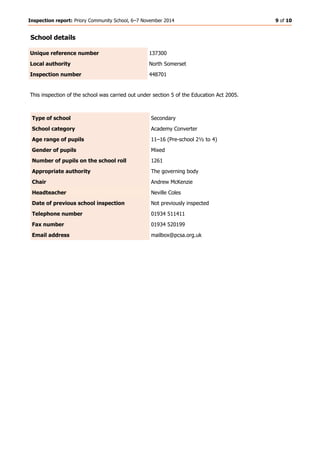
School details Unique reference number 
137300 Local authority 
North Somerset Inspection number 
448701 
This inspection of the school was carried out under section 5 of the Education Act 2005. 
Type of school 
Secondary School category 
Academy Converter Age range of pupils 
11–16 (Pre-school 2½ to 4) Gender of pupils 
Mixed Number of pupils on the school roll 
1261 Appropriate authority 
The governing body Chair 
Andrew McKenzie Headteacher 
Neville Coles Date of previous school inspection 
Not previously inspected Telephone number 
01934 511411 Fax number 
01934 520199 Email address 
mailbox@pcsa.org.uk
Any complaints about the inspection or the report should be made following the procedures set out in the guidance ‘raising concerns and making complaints about Ofsted', which is available from Ofsted’s website: www.ofsted.gov.uk. If you would like Ofsted to send you a copy of the guidance, please telephone 0300 123 4234, or email enquiries@ofsted.gov.uk. 
You can use Parent View to give Ofsted your opinion on your child’s school. Ofsted will use the information parents and carers provide when deciding which schools to inspect and when and as part of the inspection. 
You can also use Parent View to find out what other parents and carers think about schools in England. You can visit www.parentview.ofsted.gov.uk, or look for the link on the main Ofsted website: www.ofsted.gov.uk 
The Office for Standards in Education, Children's Services and Skills (Ofsted) regulates and inspects to achieve excellence in the care of children and young people, and in education and skills for learners of all ages. It regulates and inspects childcare and children's social care, and inspects the Children and Family Court Advisory and Support Service (Cafcass), schools, colleges, initial teacher training, work-based learning and skills training, adult and community learning, and education and training in prisons and other secure establishments. It assesses council children’s services, and inspects services for looked after children, safeguarding and child protection. 
Further copies of this report are obtainable from the school. Under the Education Act 2005, the school must provide a copy of this report free of charge to certain categories of people. A charge not exceeding the full cost of reproduction may be made for any other copies supplied. 
If you would like a copy of this document in a different format, such as large print or Braille, please telephone 0300 123 4234, or email enquiries@ofsted.gov.uk. 
You may copy all or parts of this document for non-commercial educational purposes, as long as you give details of the source and date of publication and do not alter the information in any way. 
To receive regular email alerts about new publications, including survey reports and school inspection reports, please visit our website and go to ‘Subscribe’. 
Piccadilly Gate 
Store St 
Manchester 
M1 2WD 
T: 0300 123 4234 
Textphone: 0161 618 8524 
E: enquiries@ofsted.gov.uk 
W: www.ofsted.gov.uk 
© Crown copyright 2014

FINAL OFSTED 2014

  • 1.
    School report PrioryCommunity School Queensway, Weston-Super-Mare, BS22 6BP Inspection dates 6–7 November 2014 Overall effectiveness Previous inspection: Not previously inspected as an academy This inspection: Outstanding 1 Leadership and management Outstanding 1 Behaviour and safety of pupils Outstanding 1 Quality of teaching Outstanding 1 Achievement of pupils Outstanding 1 Early years Outstanding 1 Summary of key findings for parents and pupils This is an outstanding school  Students of all abilities make outstanding progress. They enjoy their learning and are confident they can reach the challenging targets set for them.  Teaching is of a consistently high standard. Teachers are passionate about their subjects and inspire their students to want to learn more.  Students’ behaviour is outstanding. Students show exemplary attitudes in lessons and around the school. They are polite, mature and articulate, showing respect for adults and each other. They value the harmonious community spirit developed in the school.  The school keeps its students safe and ensures that students have the information they need to keep themselves safe.  The atmosphere around the school is calm and orderly. Staff and students show genuine warmth towards each other and students’ individual achievements are recognised and valued.  The Principal is very well supported by the senior team and governing body. His team lead by example, communicating high expectations of the performance of staff and students. Teachers support each other and display a great desire to constantly improve their own performance.  The sharp focus throughout the school’s work on the promotion of spiritual, moral, social and cultural development enables students to develop leadership skills and teamwork to excellent levels.  All leaders, including governors, are focused on ensuring that the school provides an atmosphere in which students can thrive and develop the personal skills they need to prepare them for life in modern Britain.  The broad curriculum matches students’ interests well. An exceptionally wide variety of enrichment activities are available, enabling students to pursue their talents and interests to the highest level.  The pre-school is outstanding. Children make rapid progress from their starting points as a result of the high quality of care and teaching they receive.
  • 2.
    Inspection report: PrioryCommunity School, 6–7 November 2014 2 of 10 Information about this inspection  The inspection team observed 42 part lessons, ten of which were jointly observed with a member of the senior leadership team.  Inspectors spoke to students informally and held meetings with groups from several years.  Meetings were held with the Principal, other members of the senior leadership team and staff with responsibility for subjects and other aspects of the school’s work.  Inspectors spoke to governors and the school’s external advisor.  Inspectors discussed their observations with teaching staff, examined a range of documentation including the school’s improvement plans and its own self-evaluation.  A range of students’ work was seen both in and outside lessons.  Questionnaires by 48 members of staff were taken into account, as were 53 responses to Ofsted’s online Parent View questionnaire. Inspection team Chris King, Lead inspector Additional Inspector Joseph Skivington Additional Inspector Justine Hocking Additional Inspector Annice Perry Additional Inspector Andrew Baker Additional Inspector
  • 3.
    Inspection report: PrioryCommunity School, 6–7 November 2014 3 of 10 Full report Information about this school  Priory Community School converted to become an academy school on 17th August 2011. When its predecessor school, Priory Community School, was last inspected by Ofsted it was judged to be good.  The school is a larger than average-sized secondary school.  The the proportion of disabled students and those who have special educational needs is above average.  The proportion of students known to be eligible for the pupil premium is broadly in line with the national average. The pupil premium provides additional funding for looked after children and students known to be eligible for free school meals.  The proportion of students of minority ethnic heritage is below average as is the number of students that speak English as an additional language.  The school meets the government’s current floor standards, which set the minimum expectations for students’ attainment and progress.  The school works with Weston College to provide a small number of students in Key Stage 4 with the opportunity to complete alternative vocational courses that it does not run, such as animal care and construction.  The school runs separate part-time pre-school provision for a small number of children adjacent to its site. What does the school need to do to improve further?  Make use of existing outstanding practice to ensure that all teachers consistently develop opportunities for students to respond to the advice they receive in feedback on how to improve further.
  • 4.
    Inspection report: PrioryCommunity School, 6–7 November 2014 4 of 10 Inspection judgements The leadership and management are outstanding  The Principal, supported by the senior leadership team, is relentless in his drive to ensure that the progress made by the students and the high quality of teaching are sustained and improved even further. All leaders have created an ethos in which students take pride in their success and where they can grow in confidence and develop their talents and interests.  Leaders promote high-quality teaching through close monitoring and well-matched professional development, ensuring that all take responsibility for the progress made by their students. Professional development opportunities are high quality and personalised for all staff ensuring that they have the opportunity to develop their practice and skills.  Leaders track progress and closely check all aspects of the school’s work to ensure that any student who falls below their very challenging targets is immediately supported. They ensure that all groups of students are treated equally and are able to succeed. The school promotes equality of opportunity, fosters good relationships and tackles discrimination highly effectively.  Subject leaders constantly monitor the quality of teaching within their subject areas, holding teachers closely to account for students’ progress. All staff show a desire to improve their practice, reflecting on their own performance and how it can be improved. Newly qualified teachers and those new to the profession are very well supported.  The school has a detailed plan for the allocation of additional funding provided through the pupil premium. A range of provision including additional tuition and one-to-one support ensures that those students eligible achieve well.  Safeguarding procedures and policies are thorough and child protection arrangements are robust throughout the main school and pre-school. There is excellent liaison between the school and external agencies when required.  The ‘Period 6’ enrichment programme offers students a vast range of creative and sporting activities. Students told inspectors how much they value the staff’s willingness to give up their time on their behalf. Everywhere around the school are pictures of role models and past students with information on their success.  The programme of careers guidance across the school starts in Year 7 and includes opportunities such as the ‘world of work’ day at a local college and events with students and parents supporting the promotion of higher education opportunities. As a result of the school’s support of students’ next steps after Year 11 last year, all were in either further education or employment.  Parents are kept well informed through a variety of communications such as newsletters and the school website which includes access to a wide range of online help and support. Regular meetings and progress reports called ‘Praising Stars’ fully involve parents in their child’s education. These are particularly effective in informing parents about any underachievement to ensure that students take up the extra support when the need is identified. Strategies to engage parents in their child’s learning are also particularly effective in the pre-school.  The range of GCSE courses offered reflects the wide interests of the students. There is a well-developed approach to raising the profile of literacy and mathematics across the curriculum, together with opportunities to excel in a wide variety of sports and the arts. The curriculum encourages students to develop teamwork, leadership and social skills. These contribute to their excellent spiritual, moral, social and cultural development and promote their understanding of modern British values.  A small number of students follow courses at a local college that the school does not provide, such as vocational courses in animal care and construction. These students are monitored closely to ensure they achieve as well as those on courses in the main school.  The school’s improvement partner provides excellent support and challenge and contributes positively to the school’s continued improvements.  The governance of the school:  Governors have a strong strategic role in monitoring and supporting teaching and learning. They ensure that teachers’ salary progression is linked to the achievement of their students. They fully support the school’s leaders in their constant drive for improvement and give a strong lead in setting the direction for the school. The balance of challenge and support is such that it promotes enthusiasm and a desire to improve further among teachers and senior leaders while holding all to account. Governors are fully involved in the life of the school. They draw on their different areas of expertise, and they make regular visits to lessons, talking to students to gain their views. For example, they take part as observers in the school’s internal reviews on subject areas.
  • 5.
    Inspection report: PrioryCommunity School, 6–7 November 2014 5 of 10  Governors have a thorough understanding of performance data and how the school compares to others nationally. They ensure that they access training and that new governors are appropriately supported to enable them to carry out their role effectively. They ensure that both students and staff are kept safe and that safeguarding procedures are robust. They are ambitious and want the very best opportunities for all students. The behaviour and safety of pupils are outstanding Behaviour  The behaviour of students is outstanding. Attitudes to learning and the behaviour of students are exemplary. They respond extremely well to their teachers and take a full part in their learning.  Students are very positive about behaviour and can explain how effectively the staff create good attitudes. They respond quickly to instructions and contribute very positively. They show much enthusiasm in their learning.  Students are extremely courteous and well mannered. They show great respect for each other and for the adults in the school. Exclusions from school are very low.  Behaviour around the school is calm and orderly. Students wear their uniform smartly and little litter can be seen. Artwork and displays around the building are valued and not touched or damaged.  Attendance overall is high for all groups of students. Students move around the school with purpose and are punctual so that lessons start quickly and efficiently. They enjoy school and want to do well.  The school works very hard to support each individual student. This improves the behaviour and attitudes of the very small number of students who need such support.  Students are highly appreciative of the wide range of activities the school provides. Many take part enthusiastically in the wide range of sporting, music, artistic, drama and other events such as raising large sums of money for good causes, or taking part in the ‘drop in’ music sessions at lunchtime that allow all students to play and enjoy their music. This makes a significant contribution to the inclusive atmosphere in the school. All of these activities and opportunities make a strong contribution to the spiritual, moral, social and cultural development of students.  The development of children’s understanding of how to work and share effectively with each other is developed well in the pre-school.  The school tracks carefully the behaviour and safety of those students that attend alternative provision. Their attendance, behaviour and safety are in line with their peers who spend all their time on the main school site.  Students willingly contribute to the leadership and direction of the school through the student leadership opportunities given in roles such as being prefects, literacy leaders or ‘Digi-leaders’. They make a very strong contribution to the culture of the school. Safety  The school’s work to keep students safe and secure is outstanding.  Students feel safe, are considerate and contribute well to the very positive ethos of the school; they are proud to be part of the school. Students have an excellent understanding of the various forms of bullying and e-safety. Bullying is rare and students are confident that any incidents are dealt with swiftly and effectively.  The positive views of the students about their safety and behaviour are supported by those of their parents and by staff.  There is a well-planned programme, through the personal, social and health education curriculum, to support students in their understanding of and in managing risks to young people. The quality of teaching is outstanding  The rapid progress made by students of all abilities and in all year groups indicates that the quality of teaching is outstanding. During the inspection a high degree of consistent practice was observed and a large proportion of outstanding teaching.  Teachers know their students very well and have very high expectations of what each student can
  • 6.
    Inspection report: PrioryCommunity School, 6–7 November 2014 6 of 10 achieve. They are aware of disadvantaged students within their classes and target them to ensure that they achieve as well as other students. They also ensure that the disabled students and those who have special educational needs are well supported. All staff are trained in how best to support these students according to their individual learning needs.  Students expressed how much they value the support and dedication of their teachers and their willingness to spend time providing extra help to ensure that students achieve their potential, particularly during extra support sessions given before and after school.  Students are required to think carefully and are challenged to justify their responses by skilful questioning. There is a high level of student engagement with all able to make a contribution because plenty of opportunity is provided for students to discuss their learning with others. This was particularly effective in the pre-school where children were questioned in a way that encouraged them to talk with each other and with adults so that their language skills developed well.  Assessment during lessons, and through marking, is of high quality so that students have a clear understanding of how to develop their learning further. They frequently use assessment criteria to evaluate their own or each other’s work, further reinforcing how to attain the highest grades. Marking is effective in many areas of the school, particularly in English, where students have the opportunity to redraft passages of their work or make corrections before their work is marked again. This leads to rapid progress. There is, however, some inconsistency in a small number of lessons and not all teachers check that students have responded well enough to the advice they have been given on the next steps they need to take to move their learning on.  Whole-school initiatives to develop literacy and mathematics across the curriculum have been successful. For example, in one science lesson observed in which students were preparing an examination question on ‘decay’, opportunities to reinforce principles around the use of numbers and sentence construction were highly effective. The achievement of pupils is outstanding  Students start the school with skills in reading, writing, communication and mathematics that are broadly average. By the end of Year 11, the proportion of students gaining five A* to C GCSE passes including English and mathematics is consistently high over time. In 2014, 72% gained this measure, which is well above the national average.  The proportion of students that make expected progress in both English and mathematics is well above the national average and a high proportion make more than expected progress.  Where students take examinations early they are not disadvantaged and achieve well.  The most able students now achieve their challenging targets and are supported effectively by aspiration programmes to ensure that they take advantage of their talents and choose routes that allow them entry to higher education.  Students express confidence that the school will help them to reach their challenging targets. They were keen to tell inspectors how much they are encouraged and supported by teachers communicating the belief that they will do well. Students know their targets and are constantly encouraged to strive for the highest grade.  Disabled students and those who have special educational needs make exceptional progress as a result of the outstanding teaching and support that they receive. The school provides areas where students who need extra help with their learning or face challenging circumstances can receive the individual support they need.  There is a strong emphasis on the promotion of literacy skills across all subjects, where students are frequently encouraged to read out loud or to write descriptions of practical activities.  Students for whom the pupil premium provides additional funding achieve in line with all students nationally in both English and mathematics. Although in 2014 they were just over half a grade behind their peers in English and almost a grade behind in mathematics, the school’s current assessments show that this gap is closing rapidly, as is the rate of expected progress for this group in English and mathematics across all year groups.  The progress of students following alternative off-site courses is frequently checked and the school ensures that these students also achieve well. The proportion of students who leave the school not in education, employment or training was zero in 2014.  Children in the pre-school make rapid progress in their development of skills and knowledge. As a result they are ready to start Year R.
  • 7.
    Inspection report: PrioryCommunity School, 6–7 November 2014 7 of 10 The early years provision is outstanding  Children are highly motivated and engage eagerly in learning. Adults are highly skilled in maximising every opportunity for learning and as a result children make rapid progress in their development.  Leaders have an excellent understanding of how to engage children in playing, exploring and learning. This supports children to be highly motivated in making the progress they do from their different starting points.  Children demonstrate high levels of security and self-esteem when they are at pre-school. Adults know children extremely well and this ensures their individual needs are met to a very high standard. There are very secure attachments between the adults and children and this fosters children's emotional security.  Children’s learning and development are closely monitored through assessment and includes all those involved in their learning. Consequently, planning is sharply focused and leads to the children making rapid progress.  The pre-school uses highly successful strategies to engage parents in their children's learning, such as engaging displays that celebrate and recognise the learning children do at home and bring to share at pre- school.  Robust systems for reflecting on practice, involving managers, teachers, assistants and parents help the team to identify priorities for continued improvement. These improvements link closely to the professional development targets and training priorities for staff.  The transition from pre-school to school is managed very well. Effective strategies are in place to ensure that even the most vulnerable children are ready to start Year R.
  • 8.
    Inspection report: PrioryCommunity School, 6–7 November 2014 8 of 10 What inspection judgements mean School Grade Judgement Description Grade 1 Outstanding An outstanding school is highly effective in delivering outcomes that provide exceptionally well for all its pupils’ needs. This ensures that pupils are very well equipped for the next stage of their education, training or employment. Grade 2 Good A good school is effective in delivering outcomes that provide well for all its pupils’ needs. Pupils are well prepared for the next stage of their education, training or employment. Grade 3 Requires improvement A school that requires improvement is not yet a good school, but it is not inadequate. This school will receive a full inspection within 24 months from the date of this inspection. Grade 4 Inadequate A school that has serious weaknesses is inadequate overall and requires significant improvement but leadership and management are judged to be Grade 3 or better. This school will receive regular monitoring by Ofsted inspectors. A school that requires special measures is one where the school is failing to give its pupils an acceptable standard of education and the school’s leaders, managers or governors have not demonstrated that they have the capacity to secure the necessary improvement in the school. This school will receive regular monitoring by Ofsted inspectors.
  • 9.
    Inspection report: PrioryCommunity School, 6–7 November 2014 9 of 10 School details Unique reference number 137300 Local authority North Somerset Inspection number 448701 This inspection of the school was carried out under section 5 of the Education Act 2005. Type of school Secondary School category Academy Converter Age range of pupils 11–16 (Pre-school 2½ to 4) Gender of pupils Mixed Number of pupils on the school roll 1261 Appropriate authority The governing body Chair Andrew McKenzie Headteacher Neville Coles Date of previous school inspection Not previously inspected Telephone number 01934 511411 Fax number 01934 520199 Email address mailbox@pcsa.org.uk
  • 10.
    Any complaints aboutthe inspection or the report should be made following the procedures set out in the guidance ‘raising concerns and making complaints about Ofsted', which is available from Ofsted’s website: www.ofsted.gov.uk. If you would like Ofsted to send you a copy of the guidance, please telephone 0300 123 4234, or email enquiries@ofsted.gov.uk. You can use Parent View to give Ofsted your opinion on your child’s school. Ofsted will use the information parents and carers provide when deciding which schools to inspect and when and as part of the inspection. You can also use Parent View to find out what other parents and carers think about schools in England. You can visit www.parentview.ofsted.gov.uk, or look for the link on the main Ofsted website: www.ofsted.gov.uk The Office for Standards in Education, Children's Services and Skills (Ofsted) regulates and inspects to achieve excellence in the care of children and young people, and in education and skills for learners of all ages. It regulates and inspects childcare and children's social care, and inspects the Children and Family Court Advisory and Support Service (Cafcass), schools, colleges, initial teacher training, work-based learning and skills training, adult and community learning, and education and training in prisons and other secure establishments. It assesses council children’s services, and inspects services for looked after children, safeguarding and child protection. Further copies of this report are obtainable from the school. Under the Education Act 2005, the school must provide a copy of this report free of charge to certain categories of people. A charge not exceeding the full cost of reproduction may be made for any other copies supplied. If you would like a copy of this document in a different format, such as large print or Braille, please telephone 0300 123 4234, or email enquiries@ofsted.gov.uk. You may copy all or parts of this document for non-commercial educational purposes, as long as you give details of the source and date of publication and do not alter the information in any way. To receive regular email alerts about new publications, including survey reports and school inspection reports, please visit our website and go to ‘Subscribe’. Piccadilly Gate Store St Manchester M1 2WD T: 0300 123 4234 Textphone: 0161 618 8524 E: enquiries@ofsted.gov.uk W: www.ofsted.gov.uk © Crown copyright 2014