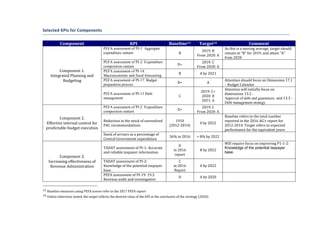
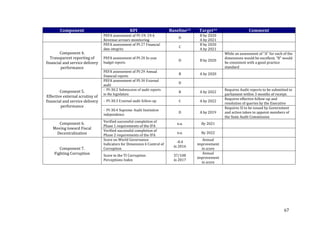
1
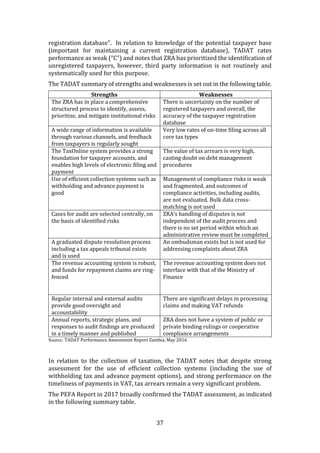
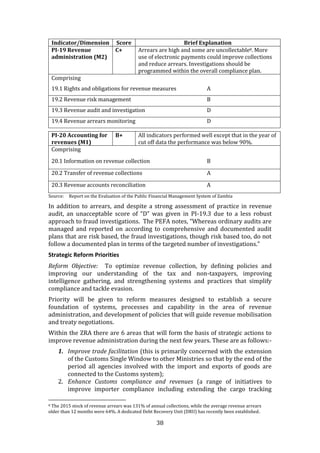
Republic of Zambia
Public Finance
Management Reform
Strategy
2019 to 2022
November 2018
2
Introduction.......................................................................................................................................5
1. Integrated Planning and Budgeting .....................................................................................8
In an ideal world ….....................................................................................................................8
Current situation...................................................................................................................... 11
Strategic Reform Priorities................................................................................................... 16
2. Effective internal control for predictable budget execution ................................... 19
In an idea world ….. ................................................................................................................. 19
Current Situation...................................................................................................................... 21
Strategic Reform Priorities................................................................................................... 26
3. Increasing effectiveness of Revenue Mobilisation ...................................................... 34
In an ideal world ….................................................................................................................. 34
Current Situation...................................................................................................................... 35
Strategic Reform Priorities................................................................................................... 38
4. Transparent reporting of financial and service delivery performance............... 40
In an ideal World …. ................................................................................................................ 40
Current Situation...................................................................................................................... 41
Strategic Reform Priorities................................................................................................... 43
5. Effective external scrutiny of financial and service delivery performance....... 46
In an ideal world ….................................................................................................................. 46
Current Situation...................................................................................................................... 46
Strategic Reform Priorities................................................................................................... 49
6. Moving toward Fiscal Decentralization........................................................................... 52
In an ideal world ….................................................................................................................. 52
Current position ....................................................................................................................... 52
Strategic Reform Priorities................................................................................................... 55
7. Fighting Corruption................................................................................................................. 57
In an ideal world ….................................................................................................................. 57
Current situation...................................................................................................................... 57
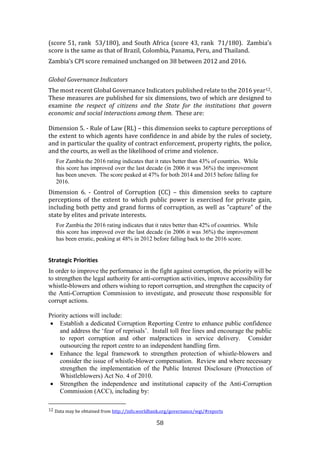
Strategic Priorities................................................................................................................... 58
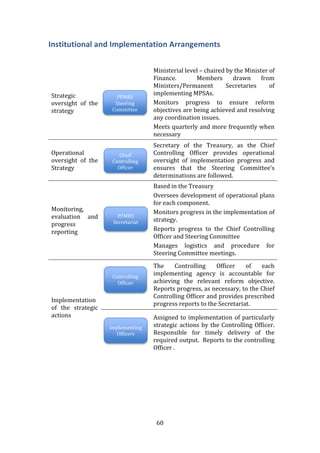
Institutional and Implementation Arrangements............................................................ 60
Change Management Framework........................................................................................... 61
Strategic Risks and Risk Management.................................................................................. 63
Monitoring and Evaluation ....................................................................................................... 65
Attachment 1 - List of documents reviewed in drafting the PFMRS.................... 68
3
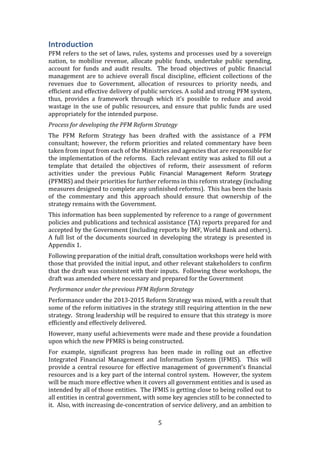
Acronyms
ACL Audit Command Language
AFS Annual Financial Statements
BCC Budget Call Circular
BOZ Bank of Zambia
CO Controlling Officer
e-GP Electronic Government Procurement
FAD Fiscal Affairs Division (of the IMF)
FD Fiscal Decentralization
FIC Financial Intelligence Centre
GAAP Generally Accepted Accounting Practices
GAI Grant Aided Organisation
GDP Gross Domestic Product
GRZ Government of the Republic of Zambia
IC Internal Control
IDC Industrial Development Corporation
IFA Intergovernmental Fiscal Architecture
IFMIS Integrated Financial Management System
IMF International Monetary Fund
IPSAS International Public Sector Accounting Standards
IT Information Technology
LG Local Government
LGA Local Government Authority
LGEF Local Government Equalisation Fund
MLGH Ministry of Local Government and Housing
MNDP Ministry of National Development Planning
MOF Ministry of Finance
MOLNR Ministry of Lands and Natural Resources
MPSA Ministry, Province, Spending Authority
NAPSA National Pension Scheme Authority
NDP National Development Plan
NGO Non-Government Organisation
OAG Office of the Auditor General
OBB Output Based Budgeting
OSR Own Source Revenue
OSSIS One Stop Shop Integration System
PAC Public Accounts Committee (of the National Assembly)
PACRA Payments and Companies Registrations Agency
PEFA Public Expenditure and Financial Accountability
PFM Public Financial Management
PFMRP Public Finance Management Reform Program (of the WB)
PFMRS Public Financial Management Reform Strategy
PI Performance Indicator
4
Acronyms
PMEC Payroll Management and Establishment Control
PMRC Policy Management and Research Centre
RTSA Road Transport and Safety Agency
SAC State Audit Commission
SI Statutory Instrument
SO Strategic Objective
SOE State Owned Enterprise
TA Technical Assistance
TADAT Tax Administration Diagnostic Assessment Tool
TSA Treasury Single Account
VAT Value Added Tax
WB World bank
ZPPA Zambian Public Procurement Authority
ZRA Zambia Revenue Authority
5
Introduction
PFM refers to the set of laws, rules, systems and processes used by a sovereign
nation, to mobilise revenue, allocate public funds, undertake public spending,
account for funds and audit results. The broad objectives of public financial
management are to achieve overall fiscal discipline, efficient collections of the
revenues due to Government, allocation of resources to priority needs, and
efficient and effective delivery of public services. A solid and strong PFM system,
thus, provides a framework through which it’s possible to reduce and avoid
wastage in the use of public resources, and ensure that public funds are used
appropriately for the intended purpose.
Process for developing the PFM Reform Strategy
The PFM Reform Strategy has been drafted with the assistance of a PFM
consultant; however, the reform priorities and related commentary have been
taken from input from each of the Ministries and agencies that are responsible for
the implementation of the reforms. Each relevant entity was asked to fill out a
template that detailed the objectives of reform, their assessment of reform
activities under the previous Public Financial Management Reform Strategy
(PFMRS) and their priorities for further reforms in this reform strategy (including
measures designed to complete any unfinished reforms). This has been the basis
of the commentary and this approach should ensure that ownership of the
strategy remains with the Government.
This information has been supplemented by reference to a range of government
policies and publications and technical assistance (TA) reports prepared for and
accepted by the Government (including reports by IMF, World Bank and others).
A full list of the documents sourced in developing the strategy is presented in
Appendix 1.
Following preparation of the initial draft, consultation workshops were held with
those that provided the initial input, and other relevant stakeholders to confirm
that the draft was consistent with their inputs. Following these workshops, the
draft was amended where necessary and prepared for the Government
Performance under the previous PFM Reform Strategy
Performance under the 2013-2015 Reform Strategy was mixed, with a result that
some of the reform initiatives in the strategy still requiring attention in the new
strategy. Strong leadership will be required to ensure that this strategy is more
efficiently and effectively delivered.
However, many useful achievements were made and these provide a foundation
upon which the new PFMRS is being constructed.
For example, significant progress has been made in rolling out an effective
Integrated Financial Management and Information System (IFMIS). This will
provide a central resource for effective management of government’s financial
resources and is a key part of the internal control system. However, the system
will be much more effective when it covers all government entities and is used as
intended by all of those entities. The IFMIS is getting close to being rolled out to
all entities in central government, with some key agencies still to be connected to
it. Also, with increasing de-concentration of service delivery, and an ambition to
6
move to fiscal decentralisation, there is a need to ensure connectivity in provinces
and districts in order to capture all government transactions at source.
There is also a critical need to ensure that the system is used as intended as a
central plank of the government’s internal control system. The system must be
used for the creation of purchase orders, and to record commitments of funds
before payments are due in order to avoid payments arrears.
Approach to drafting the new PFM Reform Strategy
The new PFMRS will cover the period from 2019 to 2022, a four-year period. It
adopts an approach that prioritises the creation or reinforcement of foundations,
before moving on to more sophisticated reform measures.
An example of this is in the Planning and Budgeting processes. The Government
has commenced piloting a new and more sophisticated approach to the annual
budget – Output Based Budgeting – and has announced that it would like to roll-
out the approach out to all MPSAs in the next budget. While this performance-
based approach is a very useful reform, a pre-requisite for successful
implementation is a solid track record of budget reliability.
Demonstrably, the required level of budget reliability has not yet been attained,
and the low scores achieved on the 2017 Public Expenditure and Financial
Accountability (PEFA) assessment provide evidence of this. As a result, the PFMRS
prioritises those measures that are designed to improve budget reliability and
integrity, alongside of measures to implement Output based Budgeting.
The reform strategy is built around a number of themes. These broadly follow the
standard PFM cycle (see illustration on the next page).
The thematic areas are:
1. Integrated Planning and Budgeting (encompassing Planning and policy and
budget elements of the PFM cycle)
2. Effective internal control for predictable budget execution (encompassing
the expenditure elements of budget execution)
3. Increased effectiveness of Revenue Mobilisation (encompassing the
revenue elements of budget execution)
4. Transparent reporting of financial and service delivery performance
(encompassing the accounting and reporting element)
5. Effective external scrutiny of financial and service delivery performance
(encompassing the external review element)
6. Moving toward Fiscal Decentralization (while not aligned with any
particular element of the PFM cycle, FD is highlighted in a separate
thematic area because it is government policy and a very substantial
reform in its own right).
7
For each thematic area, the Reform Strategy document is written in three parts:
 A description of what might be considered best practice in the thematic
area, under the heading “In an ideal world …”;
 This is contrasted with an assessment of current practice, based on data
from the PEFA and other diagnostic tools, TA reports, etc., under the
heading “Current situation”; and finally
 An outline of priority strategic reforms that will assist to bring practice
more closely into line with best practices – “Strategic reform priorities”.
It is important to note that the PFM Reform Strategy is not a comprehensive
record of the reforms necessary to achieve international best practice. It does
seek however, to indicate those reforms that are considered absolutely necessary
to build a foundation for best practice.
8
1. Integrated Planning and Budgeting
In an ideal world ….
Planning
The National Development Plan (NDP) establishes the strategic priorities of
Government in the medium term. It addresses:
 the strategic priorities in relation to service delivery in all sectors;
 revenue mobilisation and other medium-term financing strategies; and
 medium term institutional reform priorities in Government.
The NDP provides the rationale for each strategic priority, based on evidence
based research, and this is influential in developing a common ownership of the
priorities, both within the government (from the executive to agency staff) and
the broader community.
Each sector’s strategic plan reflects the National Development Plan strategic
priorities for which the sector has responsibility. The sector plans reflect each
sector’s medium-term service delivery priorities, and identifies gaps in the
Sector’s capacity to deliver the identified priorities in terms of: its staff and staff
capabilities; its budget and other sources of funds available for service delivery;
and physical resources (buildings, equipment, etc.). The sector strategy
provides evidence-based rationale for the selected priorities, and is influential in
building common ownership of the priorities within the sector and amongst its
stakeholders. The sector has well defined processes established and resourced,
to monitor performance against its strategic priorities. The senior executive
(sector Minister and senior Public servants) meets regularly to effectively
manage the achievement of all priorities.
Public investments projects are consistent with the sector strategy, and are
subjected to feasibility study, design and costing, and an economic appraisal, well
in advance of the commencement of the annual budget process. The project
undergoes design, costing and appraisal, only after the feasibility study has been
completed and the Ministry of National Development Planning (MNDP) agrees
with this assessment. If the economic appraisal is positive (i.e. the project is
assessed as having a positive net value) the MNDP will approve the project for
submission in the next annual budgeting process. No project is ever submitted
for consideration in the budget process until it has been appraised. The project
will only receive budget approval if it successfully competes with other priorities
for available budget funding.
The Ministry of Finance prepares medium-term macro fiscal forecasts of
revenues and expenditures. These provide an accurate estimate of: what levels
of revenue will be collected over the next 3-5 years under the current tax and
non-tax revenue policy settings; what levels of expenditure can be expected over
the next 3-5 years under the current expenditure policies, including all forward
commitments for approved capital projects. By subtracting expenditure from
revenue estimates, the Government examines the outlook for the primary deficit
over the 3-5 year period. Based on this, a review is undertaken of both revenue
and expenditure policies. That is:
9
 Where a primary deficit has been forecast for any of the forward years,
the analysis will examine three possible policy responses: changing revenue
policy to increase overall revenues; changing expenditure policy to reduce
expenditures; and/or examining the potential to finance part of the forecast
deficit with debt or grant receipts. In all cases, these options will be
constrained by fiscal rules that have been adopted by the Parliament and the
Government to ensure sustainable economic growth, including a debt
sustainability targets.
 Where a primary surplus has been forecast for any of the forward years,
the analysis will examine three possible policy responses: changing revenue
policy to provide relief to taxpayers; changing expenditure policy to expand
or enhance the delivery of services to the public; and/or paying off some of
the accumulated debt to strengthen the government’s balance sheet.
Policy options are developed by the MOF from the results of this analysis in
consultation with sector ministries, and these are provided, with
recommendations, for the Cabinet to decide the policy settings to be pursued in
the Budget. Once decided, the macro fiscal forecasts are updated for the specific
choices taken by the Cabinet.
Budget Envelopes are then developed for Each Ministry taking into account:
 the available ‘fiscal space’ (i.e. macro fiscal forecast of the primary deficit or
surplus);
 each ministry’s forward estimate of expenditure (based on a ‘no change’
policy);
 the capacity for debt financing of investment projects; and
 adjustments to account for any policy options approved by the Cabinet.
Budgeting
These budget envelopes, or planning ceilings, are then formulated and
distributed to each Ministry in the Budget Call Circular (BCC). The BCC also
contains the templates necessary for submitting the MPSA’s Budget to MOF in a
standardised form, and instructions for completing the templates.
Prior to the receipt of the BCC, each MPSA will have formed a Budget Committee
(usually headed by a senior executive) to oversee the conduct of an internal
budget process, designed to ensure that all internal and external stakeholders
are adequately consulted in the preparation of the budget.
The process begins by identifying and forecasting the cost of the on-going
services provided by the Ministry, and all current capital investment projects,
for the next three years. Stakeholders are then asked to identify any desired
changes to current services delivered (including increasing and/or enhancing
existing services; decreasing existing service levels, changing the services
delivery approach in any particular area), and these changes are costed and
prioritised.
Once budget templates and ceilings are received, a first draft of the MPSA budget
is prepared ensuring that budget ceilings are complied with. Where there are
urgent priorities that cannot be fitted within the ceiling, or that cannot be
accommodated by making savings elsewhere in the MPSA’s budget, a separate
10
request may be made for additional funding for this purpose. Government will
consider this request, along with similar requests from other MPSAs, when
framing the final budget.
Capital investment projects included in the budget draft will include all projects
that have been funded in previous Budgets and which have commenced but not
yet been completed. Any new projects to be included must have previously been
subjected to feasibility assessment, design and an economic appraisal under the
supervision of the MNDP.
The MPSA budget will be workshopped with all MPSA stakeholders prior to
being finalised and submitted to the Ministry of Finance.
The Ministry of Finance reviews the MPSA submissions with particular
attention to the following:
 Are the service delivery plans detailed, and funded, in the submission
consistent with the NDP and Sector strategic plans?
 Do the estimates submitted comply with the budget ceilings?
 Are the costs of service delivery consistent with good practice (i.e. efficient
and effective) delivery of the required Government outcomes?
 Are there different and better ways of delivering the government outcomes
addressed in each submission (e.g. based on international best practice)?
 Have all on-going capital investment projects been included?
 Have any new investment projects included in the budget submission been
subjected to feasibility, design, and economic appraisal and signed off on by
the MNDP.
Based on the answers to these questions, further discussions may be held with
each MPSA to further refine the submission (at the MPSA’s discretion) and/or to
better inform MoF advice to Government on the submission. Policy hearings
may be conducted to facilitate these discussions. The submission, and
MNDP/MoF briefing and advice to government are then provided to the Cabinet
for final budget decisions.
The final budget will:
 Provide for all recurrent costs of Government to be within the limits of
aggregate revenue estimates for the budget year and each of the outer-years;
 Allow capital investment projects to be funded by borrowings only where
the project has been appraised as having an overall economic value over
their life.
The Budget documents are written in a manner, which will properly inform
stakeholders (including parliament, the users of all government services, and the
implementing budget agencies) in relation to:
 the cost of Government policies over the medium term; how services will be
financed over the medium term and what are the overall implications for the
sustainability of debt; and
 what government services will be delivered, to what minimum standard, and
how service delivery performance will be measured and reported.
The budget is tabled in the Parliament for approval at least two months before the
11
commencement of the year to which the Budget relates. The Parliament has a
well-developed and disciplined process for reviewing the details of the budget and
ensuring its passage before the commencement of the Budget year. The
legislature’s review covers fiscal policies, medium term fiscal framework and
medium-term priorities, as well as details of expenditure and revenue. The
legislature’s procedures for budget review are firmly established and respected.
They include internal organizational arrangements, such as specialized review
committees, and negotiation procedures.
Current situation
National Development Planning: is currently undertaken comprehensively. A
new Planning and Budgeting Bill sets out the legal and policy framework for
planning, including the long-term development plan, a national development plan
and requirements for the creation of ‘clusters’ which will aim to ensure that all
sub-national planning is consistent with the NDP. The completion of the 7th NDP
was achieved in mid-2017. This sets out development policies, priorities and
strategies for the period 2017–2021, and provides guidance regarding the
governance framework (including the establishment, role and responsibilities of
Cluster Advisory Groups).
For the Government’s part, the NDP is delivered through the mechanism of the
annual budget. The Budget planning process commences with the development
of macro-economic and fiscal forecasts to inform budget decision-making by
Government. The PEFA assessment completed in 2017 (refer PI-14), rates
performance over the period 2013-2016 as being “fair”, and notes that
transparency and confidence in the forecasts could be enhanced: through an
independent review of the forecasts; by providing explanations of variations that
have been made from previous forecasts; and by making the macro-fiscal
sensitivity analysis, currently undertaken by Ministry of Finance, available to
stakeholders.
The PEFA provides a favorable (“A”) assessment of performance in relation to the
effective use of fiscal strategy in budget formulation (refer PI-15). The medium
term fiscal strategy is developed early in the process (once the macro-economic
forecasts have been prepared) and communicated to the Cabinet and key
stakeholders through ‘Green Paper’. This sets the tone for the budget and guides
the formulation of Budget planning ceilings. The strategy, including explicit and
time-based targets, is also included in the budget speech, which provides an
assessment of past performance as well as future targets.
While budget documentation contains estimates of medium term expenditures,
there is little evidence that this information has a significant influence on the
determination of annual budget estimates. The PEFA (PI-16) noted that medium
term planning ceilings and budget estimates are both satisfactorily presented in
budget documents, indicators of the successful alignment of the budget with
strategic plans, and the consistency of medium term budget estimates over time,
are both less than satisfactory, indicating a gap that needs to be addressed in the
reform strategy.
Budget Calendar: The Budget preparation process is based on a Budget calendar
that is published only in summary form. The process is required to lead-up to the
tabling of Budget Estimates in the legislature at least 90 days prior to the end of
12
the budget year. The process begins with processes to develop macro-fiscal
forecasts and determine fiscal strategy. Once these are completed, a Budget Call
Circular is released to MPSAs providing detailed instruction for the completion of
Budget submissions. The PEFA notes (in PI-17) that the BCC is often released
quite late in the process and, because the targeted date for submission to
Legislature cannot be moved, this can result in inadequate time being allowed to
MPSAs for the formulation of their budget submissions. On average, only 2-3
weeks have been allowed for this task over the last 4 years, compared with periods
in excess of 6 weeks in good practice jurisdictions. The IMF has raised the same
issue frequently in its TA reports.
The PEFA (in PI-18) found that Legislative scrutiny of Budgets is strong, and the
Annual Budget has regularly been passed before the end of December. While
medium term budget estimates are provided in the Green paper and Budget
Speech, most focus is on the annual budget estimates. More attention should be
given to medium-term issues and in-year control of budget variations.
Budget Credibility: The most important indicator of the quality of the planning
and budgeting processes is the extent to which the government budget is able to
be implemented “as passed” by the National Assembly. This is measured in the
PEFA methodology by comparing actual revenue and expenditure with the
original budget. The 2017 PEFA makes the following observations:
 The aggregate revenue estimates were within 5 percent of the actual outturn,
but revenue composition variances were high for each year, with VAT receipts
consistently underestimated by more than 20 percent.
 The expenditure outturn, at the aggregate level, was just within 15 percent of
the budget for 2015 and within 10 percent for 2013 and 2014. However,
when analyzed at the economic head level, variances of more than 20 percent
are evident for each of the 3 years. Most expenditure Heads also had
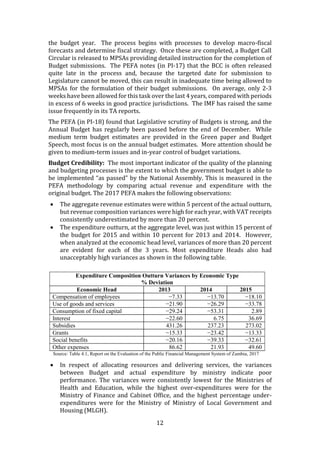
unacceptably high variances as shown in the following table.
Expenditure Composition Outturn Variances by Economic Type
% Deviation
Economic Head 2013 2014 2015
Compensation of employees −7.33 −13.70 −18.10
Use of goods and services −21.90 −26.29 −33.78
Consumption of fixed capital −29.24 −53.31 2.89
Interest −22.60 6.75 36.69
Subsidies 431.26 237.23 273.02
Grants −15.33 −23.42 −13.33
Social benefits −20.16 −39.33 −32.61
Other expenses 86.62 21.93 49.60
Source: Table 4.1, Report on the Evaluation of the Public Financial Management System of Zambia, 2017
 In respect of allocating resources and delivering services, the variances
between Budget and actual expenditure by ministry indicate poor
performance. The variances were consistently lowest for the Ministries of
Health and Education, while the highest over-expenditures were for the
Ministry of Finance and Cabinet Office, and the highest percentage under-
expenditures were for the Ministry of Ministry of Local Government and
Housing (MLGH).
13
This unevenness directly, and substantially, alters the approved resource
allocation and has significant effects on the achievement of service delivery
objectives.
The reasons for this are not clear from the PEFA report, except for a note that
there are “some consequential fiscal discipline issues regarding expenditure
control as MPSAs override commitment and cash controls and incur excess
expenditures through supplier credit to carry out their functions. This has
resulted in expenditure arrears that are proving difficult to eradicate”.
International experience suggests a number of possible reasons for excessive
variations in budget at the compositional level. These include:
 The failure to comprehensively budget for all expenditures implied by
expenditure policy, and/or inaccurate costing of all implied expenditures.
This leads to frequent requirements for budgeted amounts to be increased in-
year with a consequent requirement for other expenditure lines to be
decreased in order to preserve fiscal balance.
 In-year commitments to additional expenditure proposals (often large
infrastructure programs which were not included in the budget), which
require budget supplementation. This often requires compensating savings
to be made from within other budget lines and causes disruption to planned
expenditures.
 Inaccurate revenue forecasting resulting in lower than budgeted revenue
receipts and requiring expenditure savings to be implemented in-year.
A failure to comprehensively budget and accurately cost activities at the MPSA
level has been noted and needs to be addressed through: extending the period of
time allowed for MPSAs to prepare their Budget submissions (to at least 6 weeks);
and continuing to build competence in the Financial Management areas of both
MPSAs and central agencies.
Proposed reforms to evaluate and undertake more detailed costing of new capital
development projects will also assist. The 2017 reinforcement of procedures,
requiring the presentation to the National Assembly of a Supplementary Budget
before any unplanned expenditure is undertaken, has increased transparency
where this occurs and should encourage decision makers to plan more carefully
and ensure the budget is more comprehensive.
Realignment of budgeting and cash management responsibilities: A key role
of the Ministry of Finance is the management of a system for the preparation of
the annual and medium-term budgets. In addition to establishing the system, and
coordinating all budget stakeholder inputs, the Budget Department should
provide a budget challenge role, which enforces discipline in the estimates
process. Budget department must challenge all budget-funded activities in
relation to:
 the alignment of activities to national and sectoral planning objectives;
 whether the particular activities for which funding is sought are the most
effective way to achieve the defined objective and represent reasonable
standards of efficiency;
 the accuracy and reasonableness of the costing of the activity.
14
To succeed in this, Budget Department staff must clearly understand the national
and sectoral objectives and the business model of the MPSA spending entities,
research and maintain current knowledge of international best practice in the
activities addressed by the MPSAs, and have a detailed knowledge of the cost base
of each of the spending entities within the MPSA. This is a substantial requirement
that demands the full-time attention of expert budget officers.
As noted by an AFRITAC South (IMF) technical assistance mission1 in 2016,
budget officers were heavily involved with implementing the cash rationing
system to the exclusion of activities that would contribute to the credibility of
resource allocation and the budget. However, in 2017 a new structure was
approved for Budget Office that included the creation of a relatively large, 19-
person, unit dedicated to the Budget formulation and monitoring process. In spite
of this a smaller unit for budget execution was maintained.
This highlights another issue, that is, there appears to be a misalignment of roles
as between the Budget Department and the office of the Accountant General. Good
practice jurisdictions assign budget formulation to a Budget Department and
budget execution (including cash management) to the Accountant General’s office.
The AFRITAC South report has recommended that all current Budget Department
responsibilities for cash rationing be passed to the Treasury Services and Cash
Management Department in the Office of the Accountant General, and the Budget
department refocuss its effort on the budget formulation and challenge roles
alone. Reform processes to increase the capacity of the Budget Department to
successfully fulfil its “Budget Challenge” role and function should accompany this.
Work is already underway to build this capacity.
Capital Investment planning: Reforms are planned to the way in which capital
investment projects are brought to the budget process. Previously, capital
investment projects have been approved to implement without sufficient
preparation. Many projects have been given the go-ahead to proceed outside of
the budget process, leading to the cashflow and service delivery disruptions
indicated above. Even where the projects have been approved within the context
of the formal budget process, the projects have not been fully evaluated (to ensure
a positive economic return on the investment) or fully designed and costed.
This has resulted in many projects that have cost many times more than originally
estimated and which may not fulfil their intended purpose as well as expected.
These factors result in poor value for money being achieved. It is proposed to
develop an improved process for development of the capital investment program.
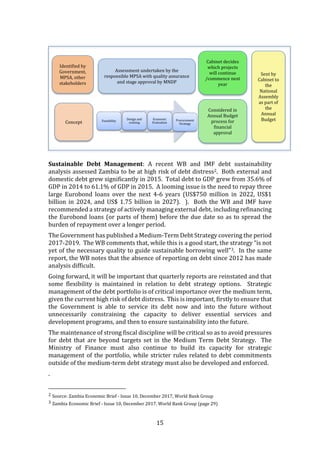
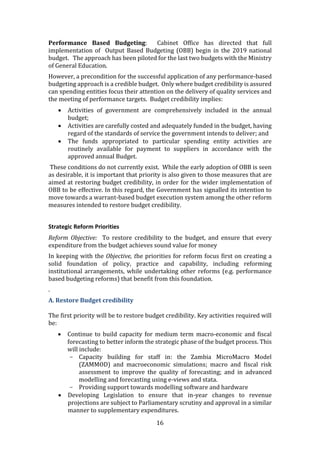
This is to be built around the following conceptual model.
1 Mission report titled “Zambia - Macro-fiscal Management and Budget Formulation, February 2016”
15
Sustainable Debt Management: A recent WB and IMF debt sustainability
analysis assessed Zambia to be at high risk of debt distress2. Both external and
domestic debt grew significantly in 2015. Total debt to GDP grew from 35.6% of
GDP in 2014 to 61.1% of GDP in 2015. A looming issue is the need to repay three
large Eurobond loans over the next 4-6 years (US$750 million in 2022, US$1
billion in 2024, and US$ 1.75 billion in 2027). ). Both the WB and IMF have
recommended a strategy of actively managing external debt, including refinancing
the Eurobond loans (or parts of them) before the due date so as to spread the
burden of repayment over a longer period.
The Government has published a Medium-Term Debt Strategy covering the period
2017-2019. The WB comments that, while this is a good start, the strategy “is not
yet of the necessary quality to guide sustainable borrowing well”3. In the same
report, the WB notes that the absence of reporting on debt since 2012 has made
analysis difficult.
Going forward, it will be important that quarterly reports are reinstated and that
some flexibility is maintained in relation to debt strategy options. Strategic
management of the debt portfolio is of critical importance over the medium term,
given the current high risk of debt distress. This is important, firstly to ensure that
the Government is able to service its debt now and into the future without
unnecessarily constraining the capacity to deliver essential services and
development programs, and then to ensure sustainability into the future.
The maintenance of strong fiscal discipline will be critical so as to avoid pressures
for debt that are beyond targets set in the Medium Term Debt Strategy. The
Ministry of Finance must also continue to build its capacity for strategic
management of the portfolio, while stricter rules related to debt commitments
outside of the medium-term debt strategy must also be developed and enforced.
.
2 Source: Zambia Economic Brief - Issue 10, December 2017, World Bank Group
3 Zambia Economic Brief - Issue 10, December 2017, World Bank Group (page 29)
Feasibility
Design and
costiing
Economic
Evaluation
Procurement
Strategy
Concept
Identified by
Government,
MPSA, other
stakeholders
Assessment undertaken by the
responsible MPSA with quality assurance
and stage approval by MNDP
Considered in
Annual Budget
process for
financial
approval
Sent by
Cabinet to
the
National
Assembly
as part of
the
Annual
Budget
Cabinet decides
which projects
will continue
/commence next
year
16
Performance Based Budgeting: Cabinet Office has directed that full
implementation of Output Based Budgeting (OBB) begin in the 2019 national
budget. The approach has been piloted for the last two budgets with the Ministry
of General Education.
However, a precondition for the successful application of any performance-based
budgeting approach is a credible budget. Only where budget credibility is assured
can spending entities focus their attention on the delivery of quality services and
the meeting of performance targets. Budget credibility implies:
 Activities of government are comprehensively included in the annual
budget;
 Activities are carefully costed and adequately funded in the budget, having
regard of the standards of service the government intends to deliver; and
 The funds appropriated to particular spending entity activities are
routinely available for payment to suppliers in accordance with the
approved annual Budget.
These conditions do not currently exist. While the early adoption of OBB is seen
as desirable, it is important that priority is also given to those measures that are
aimed at restoring budget credibility, in order for the wider implementation of
OBB to be effective. In this regard, the Government has signalled its intention to
move towards a warrant-based budget execution system among the other reform
measures intended to restore budget credibility.
Strategic Reform Priorities
Reform Objective: To restore credibility to the budget, and ensure that every
expenditure from the budget achieves sound value for money
In keeping with the Objective, the priorities for reform focus first on creating a
solid foundation of policy, practice and capability, including reforming
institutional arrangements, while undertaking other reforms (e.g. performance
based budgeting reforms) that benefit from this foundation.
.
A. Restore Budget credibility
The first priority will be to restore budget credibility. Key activities required will
be:
 Continue to build capacity for medium term macro-economic and fiscal
forecasting to better inform the strategic phase of the budget process. This
will include:
- Capacity building for staff in: the Zambia MicroMacro Model
(ZAMMOD) and macroeconomic simulations; macro and fiscal risk
assessment to improve the quality of forecasting; and in advanced
modelling and forecasting using e-views and stata.
- Providing support towards modelling software and hardware
 Developing Legislation to ensure that in-year changes to revenue
projections are subject to Parliamentary scrutiny and approval in a similar
manner to supplementary expenditures.
17
 Linking of the ZRA data capture systems with the Ministry of Finance for
better oversight and more responsive policy formulation
 strengthening the cash planning and release processes and aligning these
with reporting and accounting for expenditure. This will entail:
- Merging the responsibility for budget cash releases, forecasting and
planning currently in the Budget Department with the Treasury and
Cash Management Department under a Treasury Management
Department.
- Training staff in the Budget Department to develop expertise in
strategic budgeting and the Budget Challenge Function.
- Reviewing and revising the Budget Calendar to retain the two phased
budgeting process and to ensure that MPSA’s are given at least 6 weeks
to prepare their detailed budget submissions after the budget ceilings
are advised.
- Training MPSA management and budgeting staff in the accurate
costing of budgeted activities.
 Revise the process for development and approval of capital investment
projects to ensure that a project is submitted for financial approval in the
annual budget, only after it has been tested for its feasibility, designed and
costed, and its economic benefit evaluated. This will require:
- Capacity strengthening in the MNDP so that it is capable of providing
the leadership necessary for the new arrangements to be conducted
across Government, and to ensure that the required technical skills are
in place to guide and quality assure the processes of feasibility testing
and economic evaluation.
- The development in MNDP of a database and workflow system that
ensures that all projects in development and all projects in
implementation are tracked and monitored centrally for the purpose
of feeding these when appropriate into the annual budget process. The
database should be interfaced with the Budget development systems
to enhance information sharing for budget planning and forecasting.
- Ongoing capacity building for MPSA staff who are developing projects
and managing capital investment projects.
 Strengthen the Government’s capacity for sustainable debt management, so
as to reduce extent of the drain on fiscal resources represented by debt
service costs and to effectively manage the maturity of the Eurobond loans.
This should include:
- Ongoing training and capacity building for the staff of the Debt
Management Unit;
- Review and revision of Medium Term Debt Management Strategy to
strengthen areas of current weakness. The strategy should be
approved by government and publicly available and updated annually
with any changes in strategy well explained.
- Active management of the debt portfolio to mitigate the stress
potentially associated with the maturity of current Eurobond issues (in
2022, 2024 and 2027).
- Ensure all debt is comprehensively recorded and reported on a
quarterly basis, so stakeholders can monitor progress with the
MTDMS.
18
- Maintenance of a prudent approach to the fiscal deficit to ensure that
pressure to increase debt, other than for economically viable
investment projects, is eliminated.
B. Introduce Performance based budgeting to drive improved provision of
public services.
Some MPSAs have been piloting Output Based Budgeting, and the pilots have been
evaluated as successful enough to proceed to roll the technique out to other
MPSAs. However, it is recognised that attempting broad implementation of any
performance-based budgeting approach in an environment characterised by low
levels of budget integrity, will probably guarantee a failed implementation effort.
This is why implementation of the Output Based Budgeting System, in line with
Governments Directives, must be accompanied by all the measures (stated above) that
are intended to ensure budget credibility as well as the following activities:
- Consistent monitoring and evaluation of progress and challenges made by
MPSAs recently introduced to the system; and
- Development of a system, such as quarterly warrant system, that can provide
MPSA Managers with greater control of financial inputs governing their
outputs.
19
2. Effective internal control for predictable budget execution
In an idea world …..
In-year budget changes
Expenditures are undertaken strictly in accordance with Budget.
Where an expenditure need arises during the year, which was not foreseen in the
budget, the Ministry of Finance firstly asks, “is the expenditure unavoidable?”
If the answer to this is, “No”, the request is denied and may be reconsidered in the
budget process for the next year.
If the answer is, “Yes”, the Ministry will ask, “is the expenditure urgent … must it
therefore be undertaken this year?”. If the answer is, “No”, the request is denied
and may be reconsidered in the budget process for the next year.
If the request is considered both unavoidable and urgent, then the Ministry of
Finance will consider ways to finance the expenditure by: raising additional
revenue; reducing expenditure from funding approved in the budget for some
other purpose; by raising a loan to fund the expenditure; or identify some other
source of funding (e.g. grant). Once options have been identified, these are
carefully documented in a paper to Cabinet, along with MOF recommendations,
for decision as to how to proceed.
The Government will then prepare a supplementary Budget for submission to the
Parliament. The supporting documentation to this will explain: why the
expenditure is considered to have been unforeseen at the time of the Budget, as
well as unavoidable and urgent; what revenue increase, expenditure reduction,
and/or other financing vehicle will be implemented to fund the expenditure; and
what risks this may impose for the integrity of the budget, or the delivery of
services to citizens.
Once the Parliament is convinced that the expenditure is essential and consequent
risks are being adequately managed, they will authorise the supplementary
budget and the government will commence execution of the expenditure and
actions required to fund the expenditure.
Budget execution
The Treasury prepares a cash flow forecast for the fiscal year. This takes into
account estimated cash receipts from taxes, non-tax revenues, grants and loan
financing. It also takes into account the cash flow projections of Spending Entities.
This cash flow forecast is updated monthly on the basis of actual cash inflows and
outflows.
The budget is executed by Spending Entities, in accordance with the authority
given through the Budget. Significant in-year adjustments to budget allocations
take place only once or twice in a year, and are done in a transparent and
predictable way.
Spending agencies are able to plan and commit expenditure for at least six month
in advance in accordance with the budgeted appropriations. Spending agencies
will plan the execution of their budget to ensure that authorised expenditure is
spread throughout the year in accordance with a work plan and a cash plan, and
ensure that the authorised expenditure amounts are not exceeded.
20
Where, due to unforeseen changes in demand for services, it is determined that
the budget amounts for a particular purpose will not be sufficient, the spending
agency will attempt to identify savings in other expenditure items sufficient to
fund the unforeseen expenditures. The agency will then seek approval to transfer
these amounts from one purpose to another (virement).
Internal Control Environment
A strong control environment is developed and maintained in order to provide
confidence to the Controlling Officer, and external audit authority, that all
expenditures are made for authorised purposes, within budget limits, and
efficiently spent. This includes:
 Comprehensive expenditure commitment controls are in place to effectively
limit commitments to no more than the approved budget allocations, and to
actual cash availability. All purchase requests and purchase orders are
processed through the IFMIS system, which automatically checks expenditure
authority for the purpose and cash availability. No commitments can be
entered into without a purchase order.
 A well-functioning procurement system is in place and routinely used to
ensure that money is used effectively and efficiently. The procurement system
maximises open competition in the purchase of goods and services and is
highly transparent. Only where significant justification exists (with regard to
value for money, or other national interests) is limited or sole-sourcing used
in the procurement process.
 Strict procedures are in place and enforced, to limit the incidence of mistake
or fraud when processing payments. Payments are made against invoices that
are verified against the purchase order and the goods/service
delivery/receipt documentation, and payment is separately authorised on the
basis of this verification.
 The Government’s personnel database and payroll systems are directly linked
to ensure data consistency and enable monthly reconciliation. Changes to the
personnel records and payroll (to reflect recruitment and retirement, and
changes in salary or conditions of service) are routinely entered monthly, in
time for the following month’s payments. Retroactive adjustments are rare.
Authority to change records and payroll is restricted and results in an audit
trail. A strong system of annual payroll audits exists to identify control
weaknesses and/or ghost workers
Internal Audit
The Controlling Officer (CO) of each spending entity accepts responsibility and
accountability for ensuring that all expenditure is undertaken in accordance with
the authorized budget, in an orderly and planned manner, and that internal
control systems are in place to prevent fraud, error and waste in spending.
A prerequisite for fulfilling this responsibility is the creation, maintenance and,
monitoring of the system of internal controls. Each CO relies on a professional
internal audit unit to provide assurance to him/her that the controls are
appropriate and in place, and are effective (that is, all transactions undertaken by
the entity pass through these controls and the controls cannot be avoided).
The Internal Audit Unit is structured to ensure its professional independence and
21
reports directly to the CO. It has a broad mandate, has guaranteed access to
information, and uses professional audit methods, including risk assessment
techniques. The Unit reports to the CO on significant systemic issues in relation to:
reliability and integrity of financial and operational information; effectiveness and
efficiency of operations; safeguarding of assets; and compliance with laws,
regulations, and contracts.
The external auditor (OAG) uses the internal audit reports as part of its audit
planning process, and the CO ensures that action is taken promptly to address all
internal audit findings.
Current Situation
In-year budget changes/ Budget execution
As outlined in the previous chapter, budget reliability (that is, the closeness of
actual expenditures to the approved budget) is very poor, when considered at a
component level. PEFA PI-1 deals with the aggregate level, and a rating of “B” was
assessed as overall budget expenditure was within +/-10% for two of the three
years assessed. While this is acceptable, significant improvement is required to
reach a good practice rating of “A”, which would require a variation of +/-5% in
two of the last three years.
However, PI-2 assesses performance at a compositional level and was assessed at
an unacceptable “D+”. Three dimensions make up this rating, as follows:
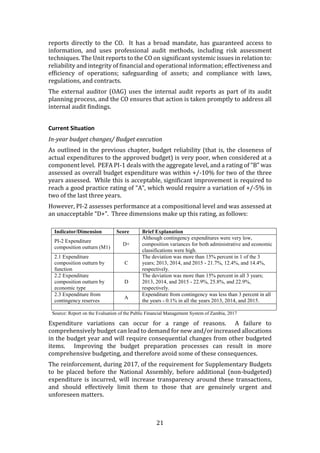
Indicator/Dimension Score Brief Explanation
PI-2 Expenditure
composition outturn (M1)
D+
Although contingency expenditures were very low,
composition variances for both administrative and economic
classifications were high.
2.1 Expenditure
composition outturn by
function
C
The deviation was more than 15% percent in 1 of the 3
years; 2013, 2014, and 2015 - 21.7%, 12.4%, and 14.4%,
respectively.
2.2 Expenditure
composition outturn by
economic type
D
The deviation was more than 15% percent in all 3 years;
2013, 2014, and 2015 - 22.9%, 25.8%, and 22.9%,
respectively.
2.3 Expenditure from
contingency reserves
A
Expenditure from contingency was less than 3 percent in all
the years - 0.1% in all the years 2013, 2014, and 2015.
Source: Report on the Evaluation of the Public Financial Management System of Zambia, 2017
Expenditure variations can occur for a range of reasons. A failure to
comprehensively budget can lead to demand for new and/or increased allocations
in the budget year and will require consequential changes from other budgeted
items. Improving the budget preparation processes can result in more
comprehensive budgeting, and therefore avoid some of these consequences.
The reinforcement, during 2017, of the requirement for Supplementary Budgets
to be placed before the National Assembly, before additional (non-budgeted)
expenditure is incurred, will increase transparency around these transactions,
and should effectively limit them to those that are genuinely urgent and
unforeseen matters.
22
Internal Control Environment
It is critically important to ensure the strongest possible internal control
environment is in place, to reduce the incidence of loss due to error and/or fraud,
and to ensure compliance with the law – including the approved budget law.
However, a wide range of internal control breaches and issues exist, as is
highlighted by the following list from the Auditor General’s Report for 2016:
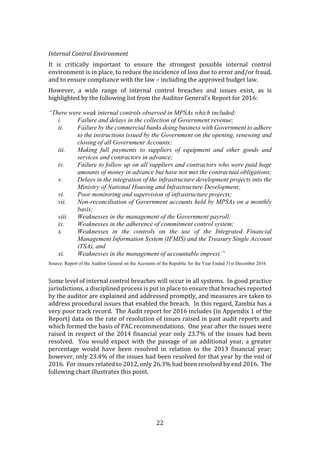
“There were weak internal controls observed in MPSAs which included:
i. Failure and delays in the collection of Government revenue;
ii. Failure by the commercial banks doing business with Government to adhere
to the instructions issued by the Government on the opening, renewing and
closing of all Government Accounts;
iii. Making full payments to suppliers of equipment and other goods and
services and contractors in advance;
iv. Failure to follow up on all suppliers and contractors who were paid huge
amounts of money in advance but have not met the contractual obligations;
v. Delays in the integration of the infrastructure development projects into the
Ministry of National Housing and Infrastructure Development;
vi. Poor monitoring and supervision of infrastructure projects;
vii. Non-reconciliation of Government accounts held by MPSAs on a monthly
basis;
viii. Weaknesses in the management of the Government payroll;
ix. Weaknesses in the adherence of commitment control system;
x. Weaknesses in the controls on the use of the Integrated Financial
Management Information System (IFMIS) and the Treasury Single Account
(TSA), and
xi. Weaknesses in the management of accountable imprest.”
Source: Report of the Auditor General on the Accounts of the Republic for the Year Ended 31st December 2016
Some level of internal control breaches will occur in all systems. In good practice
jurisdictions, a disciplined process is put in place to ensure that breaches reported
by the auditor are explained and addressed promptly, and measures are taken to
address procedural issues that enabled the breach. In this regard, Zambia has a
very poor track record. The Audit report for 2016 includes (in Appendix 1 of the
Report) data on the rate of resolution of issues raised in past audit reports and
which formed the basis of PAC recommendations. One year after the issues were
raised in respect of the 2014 financial year only 23.7% of the issues had been
resolved. You would expect with the passage of an additional year, a greater
percentage would have been resolved in relation to the 2013 financial year;
however, only 23.4% of the issues had been resolved for that year by the end of
2016. For issues related to 2012, only 26.3% had been resolved by end 2016. The
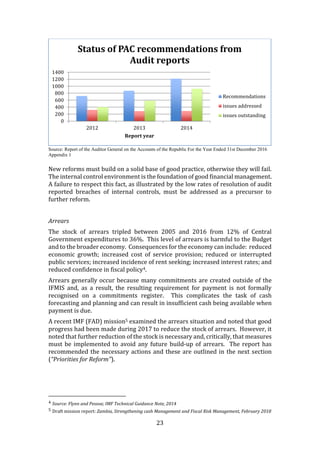
following chart illustrates this point.
23
Source: Report of the Auditor General on the Accounts of the Republic For the Year Ended 31st December 2016
Appendix 1
New reforms must build on a solid base of good practice, otherwise they will fail.
The internal control environment is the foundation of good financial management.
A failure to respect this fact, as illustrated by the low rates of resolution of audit
reported breaches of internal controls, must be addressed as a precursor to
further reform.
Arrears
The stock of arrears tripled between 2005 and 2016 from 12% of Central
Government expenditures to 36%. This level of arrears is harmful to the Budget
and to the broader economy. Consequences for the economy can include: reduced
economic growth; increased cost of service provision; reduced or interrupted
public services; increased incidence of rent seeking; increased interest rates; and
reduced confidence in fiscal policy4.
Arrears generally occur because many commitments are created outside of the
IFMIS and, as a result, the resulting requirement for payment is not formally
recognised on a commitments register. This complicates the task of cash
forecasting and planning and can result in insufficient cash being available when
payment is due.
A recent IMF (FAD) mission5 examined the arrears situation and noted that good
progress had been made during 2017 to reduce the stock of arrears. However, it
noted that further reduction of the stock is necessary and, critically, that measures
must be implemented to avoid any future build-up of arrears. The report has
recommended the necessary actions and these are outlined in the next section
(“Priorities for Reform”).
4 Source: Flynn and Pessoa; IMF Technical Guidance Note, 2014
5 Draft mission report: Zambia, Strengthening cash Management and Fiscal Risk Management, February 2018
0
200
400
600
800
1000
1200
1400
2012 2013 2014
Report year
Status of PAC recommendations from
Audit reports
Recommendations
issues addressed
issues outstanding
24
Continue to strengthen procurement policy and practice
The Zambia Public Procurement Authority (ZPPA) performs an oversight and
regulatory role in public procurement. It has been working hard to develop and
implement the legal and regulatory environment for procurement and to
implement modern and efficient systems and practices. Under the previous
PFMRS, significant reforms were undertaken including:
Capacity Building
 MPSAs - MPSA staff were trained to act as Procurement Focal Point Persons
in their respective line ministries for mentoring and coaching their
procurement staff. There has been notable improvement in the capacity of
the trained staff in MPSAs in terms of interpretation and implementation of
the public procurement law and regulations while undertaking procurements
with unlimited thresholds.
 Other government training including:
- Legal officers from the office of the Attorney General, were trained in the
parts of the Standard Solicitation Document;
- 18 government institutions were trained in public procurement
procedures,
- 25 professionals were trained in Contract Administration and
Management; and
- 58 internal auditors (under the PFMRP).
 Bidders - 450 bidders were trained on how to submit competitive bids and
there has been a remarkable improvement in compliance among bidders to
the procurement procedures and this has lessened the number of “non –
responsive” bids.
 E-Procurement - training of end users in e-GP system included 3,262
suppliers, 35 members of management teams from the pilot institutions, and
35 procurement practitioners.
Systems and procedures
 A system of comparable reference prices for commonly used items in the
public sector has been piloted.
 Review of the Public Procurement Act – This Act has been reviewed and the
bill is awaiting approval by the National Assembly. In anticipation, work has
commenced on the development of Procurement Manuals and Guidelines and
a review of Standard Solicitation documents. 30 Procurement and Supplies
Unit staff will be trained in the use of the guidelines and manuals once they
have been drafted.
 The e-GP system was developed and piloted. This will replace the manual
procurement system and is anticipated to enhance efficiency in the
procurement process, reduce costs of doing business and reduce corruption
among others.
25
The rollout of the IFMIS
A significant enabler of strong internal accounting controls is the full usage of the
IFMIS system, including its commitment management capabilities, as well as its
payment and accounting modules. Significant progress has been made in 2016
and 2017 in rolling out access to the IFMIS to nearly all Government Spending
Entities.
The IFMIS provides an automated control environment, which should reinforce
best practices in internal control. The rollout of the IFMIS is nearly complete (51
out of 56 key Central Government spending entities). It will be important to
complete this rollout as a first priority. It will also be necessary to carefully
monitor the use of the system, to ensure that it is being used in an appropriate
manner and that key work processes, such as use of the commitments module, are
not being bypassed.
Completion of the rollout the Treasury Single Account:
This is required in order to incorporate all Government bank accounts and
provide improved flexibility to Government in its cash management and active
debt management as well as certainty to the operators of the accounts. The recent
IMF FAD Technical Assistance mission6 made a number of recommendations in
relation to the completion of the rollout of the TSA. These are outlined in the next
section (“Priorities for Reform”).
Internal Audit
Current status and achievements under the last PFMRS:
The Internal Audit sector is organised centrally under the leadership of the
Controller of Internal Audit, and comprises some 270 staff. Internal Auditors are
embedded within the MPSAs and spending entities. During the last PFMRS reform
strategy, significant achievements have been made in terms of building capacity
and effective internal audit service. Achievements have included:
 Development and introduction of internal audit quality assurance systems.
 Introduced a risk management framework in the public sector.
 Adoption of international auditing standards and establishing arrangements
for training public sector internal auditors in local training institutions.
 Standardised internal audit work including the development of internal audit
manuals such as:-
- Procedural Internal Audit Manual
- Performance Audit Manual
- IT Manual
- Risk Based Audit Manual
 Trained internal auditors in specialised audits such as:
- Audit command language (ACL)
- IT/IFMIS/TSA
- Internal Audit Quality Assurance – 25
- Training in performance Audit
- Conducted internal audit quality assessment reviews.
6 Draft mission report: Zambia, Strengthening Cash Management and Fiscal Risk Management, February
2018
26
- Conducted a hands-on performance audit training with the office of the
Auditor General.
 Aligned audit committee procedures to international standards and
strengthening their activities through the development and publication of a
revised audit committee handbook.
Strategic Reform Priorities
Reform Objective: To build and strengthen the system of internal controls and
professional discipline to ensure that the annual budget can be executed as it was
intended, and to avoid waste, error, theft and fraud in this process.
The above objective will be achieved in an environment where systems are robust
and universally respected. The priorities outlined below therefore focus on
activities to:
 Ensure that sanctions are established and applied where behaviours and
practices undermine this objective;
 Knowledge and understanding of the purpose and importance of the internal
control environment by all executives and finance/accounting staff, is
enhanced; and
 The continued development and strengthening of capacity, systems and
processes related to key elements of the internal control environment (e.g. the
IFMIS, Internal Audit and Procurement).
Strengthening internal controls
There are many reasons why IC breaches may occur. Some of these are highlighted
in the following table along with some of the responses that may be useful to
prevent ongoing breaches. The cause of the current weakness may be due to any
of these and is probably due to many (if not all) of them.
Potential reasons for failure to
comply with Internal Controls
Measures to strengthen compliance with internal
controls
Insufficient sanctions that can be
employed against those who fail to
comply with internal control
Development of a sanctions regime that requires the
application of penalties against government officers
deemed to be accountable for breaches of controls.
Penalties should match the severity of the breach and
range from administrative sanctions to criminal penalties
for the most serious breaches.
Insufficient knowledge of the purpose
and importance of compliance with
internal controls?
Ongoing training and capacity building designed to
ensure all office holders clearly understand
their responsibilities for upholding and operating within
internal controls; and the sanctions/ penalties that they
will be subjected to if they fail to comply. Training must
be tailored for different groups (e.g. parliamentarians,
ministers, heads of MPSAs and other spending entities,
heads of department, division, etc., finance professionals)
to directly address the groups’ responsibilities and
obligations for upholding internal controls.
27
Potential reasons for failure to
comply with Internal Controls
Measures to strengthen compliance with internal
controls
A lack of strong leadership:
 that stresses the requirement for
compliance and speedy resolution
where compliance has failed at the
levels of department, sending entity,
MPSA, Province, and SOE; and
 that demands compliance at the
ministerial, parliamentary, executive
government level?
Additional training and capacity building focusing on:
 Effective leadership practice;
 The responsibilities of leaders for establishing a
culture that demands respect, honesty, openness and
public service.
Leaders must accept responsibility for compliance within
their organisation, and hold themselves accountable for
assuring firstly that the number of issues raised in the
Audit report are reduced to close to nil, and secondly,
that where issues are raised, that these are addressed to
PAC’s satisfaction quickly.
Frustration with other government
systems and processes (for example,
cash rationing) that frustrate spending
entities attempts to deliver services in
accordance with their approved
budgets?
Address the issues that cause systems and processes to
become so frustrating that they encourage officers to
break the law by avoiding internal controls.
A small cadre of corrupt officers who
avoid controls in order to achieve
personal financial gain?
Proactive policing of corruption aimed at early detection
of corrupt acts, followed by strong and timely
enforcement of sanctions against all such acts.
Priority actions to strengthen the internal control framework will therefore be to:
- Consider what sanctions should be applied to discourage avoidance of the
controls. Implement these by inclusion of the sanctions in regulations and
adoption of appropriate enforcement strategies.
- Prepare and implement a change management strategy, following the
guidelines outlined in the table above. The strategy will aim to change
behaviours and will program repetitive activities until new behaviours are
embedded.
- Reform any existing systems or processes that may be frustrating users
into avoiding internal controls.
In addition to the measures outlined above, the Audit Report for 2016 includes a
number of specific recommendations for change that should be implemented as a
matter of urgency (see page 359 of the Audit Report).
Reducing the Stock of Arrears
The Government will continue the current successful process for reducing the
stock of arrears.
In addition, measures, which are designed to avoid future increases in the stock of
arrears, must be taken. This will include:
 Expand the coverage of the quarterly payment arrears monitoring reports to
include the entire General Government sector.
28
 Consider IFMIS functionality to (i) separate the purposes and frequencies of
budget releases from cash releases; and (ii) include multi-annual registration
and maintenance of contracted milestones, payments and contract variations.
 Publish reports on the stock of payment arrears and a strategy and plan for
liquidating them and preventing the future accumulation of arrears.
Continue to strengthen Internal Audit
Building on the current strengths of internal audit by:
 Aligning Internal Audit work to Ministry of Finance Strategic plan and
National strategies.
 Continue to build capacity of the internal audit function through an on-
going program of training and capacity building and by purchasing
essential furniture and equipment.
 Enhance effectiveness of the service by training internal auditors in the use
of analytical audit tools such as Audit Command Language (ACL) and
upgrade the ACL software, scripting and licenses.
 Enhance the quality and standard of the Internal Audit work, including by:
- Conducting internal quality assessment and peer-to-peer reviews; and
- Conducting in-house training on the Risk Audit Manual with a view to
streamline the formulation of annual internal audit work plans.
 Enhancement of Audit Committees in the MPSAs by sensitising committees
to the new Audit Committee Handbook, and monitoring their performance.
 Build the capacity of internal auditors in 117 local authorities and sensitise
managers in local authorities to the benefits of a strong internal audit
presence.
 Maintenance of the Audit Services Database and document management
system including: assistance with system maintenance costs and upgrade
features; training of users on the data management system; and
sensitisation of Internal Auditors from various MPSA’s on the use of Audit
Services Database and document management.
Further develop the growth and quality of Internal Audit in Zambia by:
 Development and implementation of the curriculum for Internal Auditors,
and by building the capacity of local training institutions to deliver the
curriculum into the future.
 Develop and seek enactment of the Institute of Internal Auditors Bill.
Continue to strengthen procurement policy and practice
1) Introducing Information Technology in Public Procurement –e-GP system
- Procurement of field equipment for continuous training of users in the use
of the electronic government procurement system
- e-GP system post implementation audits
- e-GP system Usage and Rollout support activities to PEs (Assessment of
PEs readiness to be on e-GP, User training etc)
29
2) Implementation of enhancements to the electronic procurement system:
- Procurement of field equipment for continuous training of users in the use
of the electronic government procurement system
- Implementation of geo-tagging on the e-GP platform
- Implementation of SMS facility for information and alerts on public
procurement activities including the e-GP
- Setup of training lab for e-GP training and capacity building
- Benchmarking activities
- Provisions for Change Requests
- Disaster Recovery for the e-GP System
- Replacement of major equipment for the e-GPS
- Provision of ICT Hardware for PEs for e-GPS implementation
- Procurement of Motor Vehicles for e-GPS implementation
3) Strengthening Procurement management in specific Sectors and ZPPA through
on-going training and capacity building.
- Undertaking capacity building for ZPPA staff and staff from the Procuring
entities in various procurement areas,
- Undertaking capacity building for ZPPA staff in Value for Money
Assessment techniques, Engineering, Procurement and Construction
projects and Change Management
- Review the prevailing rates in the construction industry
- Establish an e-learning platform in public procurement
4) Introducing Social Accountability in procurement monitoring, communication
and behavioural change by:
- Develop and implement a Change Management Plan and Advocacy
Campaign.
- Identify and train influential civil society groups, NGOs and media
professionals.
- Establishing Public-Private Stakeholders Forum
- Training moderators for the Public – Private Stakeholders Forum
5) Strengthening of ZPPA and promoting policy reforms by:
- Reviewing the Public Procurement Regulations;
- Reviewing the Standard Solicitation Documents;
- Reviewing the procurement Guidelines and Manuals; and
- Undertaking capacity building in procurement procedures aimed at
reducing Audit queries
6) Implementation of collaborative working partnerships with other
procurement authorities and procuring entities
- Host national, regional and continental summits in Public procurement
- conduct workshop for parliamentarians
Continue the development and implementation of the IFMIS system
30
An IFMIS Strategy and Roadmap was prepared for GRZ in December 2016. This
document looks at all aspects of the development of the IFMIS system to ensure
that it’s value is optimised. The key findings and recommendations of the Strategy
and Roadmap will be put into action under this PFM Reform Strategy. These
findings in summary are:
1) Physical coverage of the IFMIS
• Develop and Implement a comprehensive Change Management Strategy
• Roll out IFMIS to outstanding MPSAs
- Engage security establishments (military, Statehouse, Office of the
President) with case studies from other countries where IFMIS has been
successfully implemented to ease their scepticism and encourage their
embrace of IFMIS. Train their own personnel to undertake system
configuration if there is a fear of breach of security protocol.
- In the case of the Electoral Commission, which has already made a
decision to have an independent instance of SAP, engage with the
Commission and design a mutually beneficial interface prior to their
completing their implementation.
• Roll out IFMIS to Provinces
To reduce the reporting time and ensure data is captured at source, it is
important for the IFMIS to be rolled out to the provincial levels of the MSAs.
• Roll out IFMIS to Districts
Rolling out IFMIS to this level will enhance transparency and accountability.
The districts with low transaction volumes should be serviced from local
Transaction Hubs where this is more efficient.
• Assess whether or not to roll out IFMIS to Local Government Structures
Only once the central government is connected to IFMIS should a decision be
made regarding connecting of Local Government structures like the City
Councils, Municipalities, Town Councils, Rural Councils and District Councils
to the IFMIS. It will be important to consider the independence of this level
of government when making this decision.
2) Fund Coverage
Significant funds that are not currently recorded through the IFMIS are:
• Internally Generated Funds in MPSAs; and
• Development Partner funds.
It is also important that the IFMIS be configured to actively support the
implementation of the Treasury Single Account.
In order to bring these onto IFMIS (to the extent possible) it will be necessary to:
• Develop and Implement a comprehensive Change Management Strategy
• Realignment of the accounting manual to the system processes
3. System Functionality
• Enhance system utilisation of existing functionality through aggressive change
management initiatives.
This is a key initiative and should focus on the following functional areas:
- Purchasing and Commitment Accounting;
31
- Inventory and Stock Control (through Materials Management);
- Receipting and Accounts Receivable;
- Project Accounting;
- Fleet Management;
• Implement enhancements/ functionality that will increase the IFMIS value
The following additional functionality will enhance the IFMIS implementation
in GRZ;
- Business Planning and Consolidation also referred to as Budgeting and
Release of Funds for budgeting and financial reporting
- Solution Manager for the management of the IFMIS environment
- SAP Governance Risk and Compliance for the management of licences and
risks identified in the Auditor General’s report.
- Self Service
• Integrate the Payroll Management and Establishment Control system (PMEC)
and IFMIS onto one instance
To realise the value of an integrated system, there is urgent need to integrate
these two environments into one. Capitalising on the migration of the systems
from the current hardware onto new hardware (see also note re hardware
migration below), the two can be integrated into one instance of SAP.
• Design and build interfaces with all related non-SAP systems
Some of the interfaces that need to be designed and built include:
- ZRA - SAP;
- DMFAS
- E-procurement
- Lands Management System.
- ZIMS
4. Technology
• Implement Solution Manager
Solution Manager should be the first system to be installed on the new
hardware. All the other installations will be undertaken through Solution
Manager as per the prescription of the system manufacturer. This Solution
Manager can be used to manage both the current IFMIS and PMEC.
• Reinstall IFMIS on the new hardware and integrate with PMEC
Carry out a new implementation integrating IFMIS and PMEC on one platform
on the new hardware while the PMEC and IFMIS continue on the same
platform. Once the new implementation is complete, data is migrated to the
new platform.
• Implement thin client technology
This client technology will enable end-users to access IFMIS via the web, in
addition to the point to point which is currently the case. All the new rollouts
32
of IFMIS to Provinces and districts should be on thin client and, in time, the
technology can be expanded to sites where IFMIS is already implemented.
5. Organisation and Governance
• Develop and Adopt a broader governance framework
The IFMIS has now reached the stage where it needs to broaden its
governance framework to ensure user stakeholders are fundamentally
engaged. Definition of a new governance structure will help the different
stakeholders to appreciate their role. The framework will also outline the
communication and reporting protocols to be employed by the different
stakeholders.
• Reconstitute the Steering Committee
The perspective and the authority of the committee should enable the IFMIS
to be effective across MPSAs. Thus the political and operational support from
the Committee is critical in getting the IFMIS to move forward with the right
momentum. Raising the Steering Committee to the level of Secretary to the
Treasury will give the system the political clout it requires to influence its
adoption across MPSAs. The steering committee can then be made up of the
Permanent Secretaries from selected Ministries with others attending by
invitation. Representatives of the cooperating partners can also be invited to
attend Steering Committee meetings.
6. Security
• IFMIS Security Audit
It is of paramount importance that the security risk within IFMIS is
established and corrective measures instituted. The audit may be able to
confirm or allay fears of stakeholders but most importantly it will provide a
good starting point in building confidence of all stakeholders in the IFMIS.
• Adoption of a Security Standard
Identification and subsequent adoption of a security standard will help GRZ
manage its security environment better. Adherence to a defined and accepted
standard gives stakeholders the comfort that the information and assets of
GRZ are well taken care of.
Continue the implementation of TSA
 The Office of the Accountant General (OAG) will establish priorities and
timetable for the extension of the coverage of the TSA, in consultation with the
IFMIS team. This will include:
- Incorporation of all ministry-level bodies and larger de-concentrated
bodies and agencies as a first priority;
- Larger Grant Aided Institutions (GAIs) as the next priority;
33
- All other central government bodies (except the very smallest), and other
large GAIs as the next priority; and
- Donor accounts and selected SOEs (where they are arms of government
and substantially financed from the budget).
 The Office of the Accountant General should consult with the BoZ with a view
to both (i) bringing the proceeds and revenue control accounts within the TSA;
and (ii) integrating the accounts with the TSA as soon as is practicable.
34
3. Increasing effectiveness of Revenue Mobilisation
In an ideal world ….
The legislation for all major taxes is comprehensive and clear, and related
procedures for administering the taxes are clear and effectively communicated.
Taxpayers have easy access to comprehensive, user friendly and up-to-date
information on tax liabilities and administrative procedures, and the Revenue
Authority conducts ongoing and active taxpayer education campaigns.
There is an effective separation between Government agents who are authorised
to exercise discretionary powers in relation to taxation and other revenues, and
those that actually collect the revenue. Taxation policy and the granting of
exemptions are vested with the Minister of Finance (acting in accordance with
advice from the Ministry of Finance), while tax-revenue collection and
administration is the exclusive responsibility of the Zambian Revenue Authority
(ZRA).
Taxpayers have easy access to a tax appeals system, which is transparent,
administrative convenient and accessible and which has appropriate checks and
balances, and which is implemented through an independent institutional
structure. It enjoys the respect of all parties such that it is perceived as fair and its
decisions are promptly acted upon.
All taxpayers are registered in a complete database to ensure that all tax liabilities
are recognised and discharged. The ZRA undertakes constant efforts to increase
the comprehensiveness of the database, and comprehensive, direct linkages to
relevant government registration and regulatory systems facilitate this. The
taxation system is a self-assessment system requiring all taxpayers to identify,
assess and pay the taxation for which they are responsible. Tax audits and fraud
investigations are managed and reported on according to a comprehensive and
documented audit plan, with clear risk assessment criteria for all major taxes that
apply self-assessment.
Penalties for all areas of non-compliance are set sufficiently high so as to act as a
deterrent, and are consistently administered.
All tax revenue is paid directly into accounts controlled by the Treasury, or else
transfers to the Treasury are made daily. A complete reconciliation of tax
assessments, collections, arrears and transfers to Treasury, takes place every
month and is completed within one month of end of month.
The Revenue Authority effectively manages arrears in tax liabilities to ensure that
they remain at a low level.
35
Current Situation
The legislation for all major taxes is comprehensive and clear, and related
procedures for administering the taxes are published in the Government gazette.
All can be purchased from the Government Printing Department, while some can
be found on the Ministry of Finance data portal and the National Assembly
website.
There is an effective separation between Government agents who are authorised
to exercise discretionary powers in relation to taxation and those that actually
collect the revenue. Taxation policy and the granting of exemptions are vested
with the Minister of Finance (acting in accordance with advice from the Ministry
of Finance), while tax-revenue collection and administration is the exclusive
responsibility of the Zambian Revenue Authority (ZRA). For non-tax collecting
agencies the legislation is controlled by the Minister of each respective Ministry.
Government is endeavouring to enhance revenue collected from non-tax sources,
as this revenue category has been constant over the years in spite of growth of the
economy.
The tax system appears to be comparable to other tax systems on the continent.
The reduction in budget support and financing, as well as the full effects of
regional trade liberalisation have refocused attention on the need to enhance
domestic revenue mobilisation. This has led to a number of tax policy
pronouncements, which have met with mixed reviews from stakeholders.
The need for a thorough consultative review of the tax system has arisen in order
to enhance ownership of the system and compliance and ultimately promote
stable and consistent policy.
Further, emerging areas in international taxation such as the OECD Base Erosion and
profit shifting recommendations are starting to be incorporated into domestic
legislation with the most notable development being the release of updated Transfer
Pricing Regulations and the introduction of Documentation Rules. The PFMRP
program has been assisting the Ministry of Finance to enhance staff capacity and keep
up-to-date with the fast paced international tax environment.
Tax Administration
The ZRA strategic plan adopts a balanced scorecard based around 4 perspectives
and identifying an objective for each. These are:
Perspective Objective
Financial Results SO1 To optimise revenue collection.
Business Processes SO2 To improve operational efficiency and develop
infrastructure.
Employee Satisfaction SO3 To enhance the professionalism and productivity
of the Human Capital.
Customer Satisfaction SO4 To provide accurate, courteous, timely and
professional services to internal and external
customers
36
Much has been achieved in the development of the ZRA and its capabilities over
the last 3-5 years. Systems and processes have been put in place to transform the
ZRA into a modern revenue authority. Necessarily, a lot of effort and resources
have been targeted at acquiring the technology necessary for modern operation,
as well as on raising the capacity of the organisation’s human resources. Reform
activities and achievements under the previous PFMRS included:
Measures implemented
Related
SO
Enhancing electronic applications and tax administration
System for monitoring Balance of Payments (e-BOP) SO1
Surveillance tools and equipment to support taxation investigations SO1
Communication tools – particularly to enhance operations in the districts and to aid
investigation operations.
SO2
Mineral value chain monitoring project – to enhance reporting and monitoring of
mineral activities through a Mineral Output Statistical Evaluation System
(MOSES).
SO1
Case Management SO1
Electronic Records Management System SO2
Measures to improve compliance
Transit tracking and suspense regime SO1
Exploring the use of Electronic Fiscal Devices SO1
Strengthen taxation related capacity
Development of Audit Sector Notes to enhance the curriculum for training tax
inspectors;
SO3
Improved management of tax debts, including by introducing a garnishee system SO1
Upgrading the Forensic Laboratory and its equipment and building the capacity for
forensic analysis.
SO3
Upgrading existing office infrastructure SO3
The most recent Tax Administration Diagnostic Assessment Tool (TADAT) 7
assessment in May 2016, pointed to a number of strengths and weakness of the
current Taxation administration system. These paint a picture of an organization
that is developing, but has some way to go before it is fully effective.
The most basic capabilities of a revenue authority are principally: to be able to
identify all entities and people that are required by law to pay tax or non-tax
revenues to Government; and to effectively collect the revenues due. These are
both demonstrated by the TADAT to be areas of weakness.
In relation to the current taxpayer registration database the TADAT assigns an
inadequate rating of “D” and notes that, while the database is “fully computerized,
centralized and the design meets international good practice standards, however,
there is uncertainty on the number of registered taxpayers and the accuracy of the
7 TADAT Performance Assessment Report Zambia, May 2016
37
registration database”. In relation to knowledge of the potential taxpayer base
(important for maintaining a current registration database), TADAT rates
performance as weak (“C”) and notes that ZRA has prioritized the identification of
unregistered taxpayers, however, third party information is not routinely and
systematically used for this purpose.
The TADAT summary of strengths and weaknesses is set out in the following table.
Strengths Weaknesses
The ZRA has in place a comprehensive
structured process to identify, assess,
prioritize, and mitigate institutional risks
There is uncertainty on the number of
registered taxpayers and overall, the
accuracy of the taxpayer registration
database
A wide range of information is available
through various channels, and feedback
from taxpayers is regularly sought
Very low rates of on-time filing across all
core tax types
The TaxOnline system provides a strong
foundation for taxpayer accounts, and
enables high levels of electronic filing and
payment
The value of tax arrears is very high,
casting doubt on debt management
procedures
Use of efficient collection systems such as
withholding and advance payment is
good
Management of compliance risks is weak
and fragmented, and outcomes of
compliance activities, including audits,
are not evaluated. Bulk data cross-
matching is not used
Cases for audit are selected centrally, on
the basis of identified risks
ZRA’s handling of disputes is not
independent of the audit process and
there is no set period within which an
administrative review must be completed
A graduated dispute resolution process
including a tax appeals tribunal exists
and is used
An ombudsman exists but is not used for
addressing complaints about ZRA
The revenue accounting system is robust,
and funds for repayment claims are ring-
fenced
The revenue accounting system does not
interface with that of the Ministry of
Finance
Regular internal and external audits
provide good oversight and
accountability
There are significant delays in processing
claims and making VAT refunds
Annual reports, strategic plans, and
responses to audit findings are produced
in a timely manner and published
ZRA does not have a system of public or
private binding rulings or cooperative
compliance arrangements
Source: TADAT Performance Assessment Report Zambia, May 2016
In relation to the collection of taxation, the TADAT notes that despite strong
assessment for the use of efficient collection systems (including the use of
withholding tax and advance payment options), and strong performance on the
timeliness of payments in VAT, tax arrears remain a very significant problem.
The PEFA Report in 2017 broadly confirmed the TADAT assessment, as indicated
in the following summary table.
38
Indicator/Dimension Score Brief Explanation
PI-19 Revenue
administration (M2)
C+ Arrears are high and some are uncollectable8. More
use of electronic payments could improve collections
and reduce arrears. Investigations should be
programmed within the overall compliance plan.
Comprising
19.1 Rights and obligations for revenue measures A
19.2 Revenue risk management B
19.3 Revenue audit and investigation D
19.4 Revenue arrears monitoring D
PI-20 Accounting for
revenues (M1)
B+ All indicators performed well except that in the year of
cut off data the performance was below 90%.
Comprising
20.1 Information on revenue collection B
20.2 Transfer of revenue collections A
20.3 Revenue accounts reconciliation A
Source: Report on the Evaluation of the Public Financial Management System of Zambia
In addition to arrears, and despite a strong assessment of practice in revenue
audit, an unacceptable score of “D” was given in PI-19.3 due to a less robust
approach to fraud investigations. The PEFA notes, “Whereas ordinary audits are
managed and reported on according to comprehensive and documented audit
plans that are risk based, the fraud investigations, though risk based too, do not
follow a documented plan in terms of the targeted number of investigations.”
Strategic Reform Priorities
Reform Objective: To optimize revenue collection, by defining policies and
improving our understanding of the tax and non-taxpayers, improving
intelligence gathering, and strengthening systems and practices that simplify
compliance and tackle evasion.
Priority will be given to reform measures designed to establish a secure
foundation of systems, processes and capability in the area of revenue
administration, and development of policies that will guide revenue mobilisation
and treaty negotiations.
Within the ZRA there are 6 areas that will form the basis of strategic actions to
improve revenue administration during the next few years. These are as follows:-
1. Improve trade facilitation (this is primarily concerned with the extension
of the Customs Single Window to other Ministries so that by the end of the
period all agencies involved with the import and exports of goods are
connected to the Customs system);
2. Enhance Customs compliance and revenues (a range of initiatives to
improve importer compliance including extending the cargo tracking
8 The 2015 stock of revenue arrears was 131% of annual collections, while the average revenue arrears
older than 12 months were 64%. A dedicated Debt Recovery Unit (DRU) has recently been established.
39
system, increasing use customs reference values, and making increased use
of technology at the borders to make smuggling more difficult);
3. Enhancing tax compliance (a range of initiatives to raise compliance
including the development and implementation of a One Stop Shop
Integration System (OSSIS) to establish interfaces between the databases
of ZRA and key Government agencies; addressing the current stock of tax
arrears by taking concerted action to eliminate the arrears, and build the
capacity for Bulk Intelligence Data Analysis using data warehousing
technology; extend the number of audit sector notes; implementing a
system for Digital Tax stamping of excise products).
4. Improving Investigation and compliance work (a range of initiatives to
extend the radio communications network; to introduce an investigation
case management system; and to enhance the skills of investigation staff
including the certification of forensic laboratory staff (and further
development of the laboratory itself).
5. Extending the Mineral Value Chain Project (including extending the system
to smaller base metal mines (1300) and gradually extending the system into
new areas including gemstones).
6. Enhancing the ZRA IT infrastructure (replacement of aged servers; and
improving business continuity arrangements; upgrading the data centre;
developing call centre systems; and improving cyber security).
A tax policy component to the strategy will include:
 Joining up and establishing the information feeds to enable effective tax
policy formulations;
 Implementation of the remaining parts of the OECD BEPS initiatives
(including developing the capability to exchange information with other
jurisdictions);
 Completion of Marginal Effective Tax Rate Studies and the tax gap study
and undertaking further tax studies as required;
 Continued capacity building in tax policy staff in areas such as financial
modelling and policy impact assessment to lay the foundation for
comprehensive tax policy review and reform;
 Development of non-tax and tax treaty policy to ensure consistent and
predictable policy formulation even as Government strives to enhance
revenue mobilisation;
 Examination of the effectiveness of the collection of property taxes and of
the ways that non-tax revenues are collected (and the use of new methods
of payment to enhance collections).
40
4. Transparent reporting of financial and service delivery
performance
In an ideal World ….
All Spending Entities transact their daily accounting through the central
accounting (IFMIS) system, ensuring that real-time data is available for all central
accounts. Where this is not possible for all spending entities, reconciled
accounting data from all other entities is regularly submitted to the Accountant
General’s Department for the purpose of consolidation.
IPSAS standards are applied for all statements, and accounts are prepared on an
accrual basis so as to report not just the cash flows of Government but recognise
the economic timing and substance of events through the profit and loss statement
and balance sheet.
The classification of accounting data is consistent with the classification used for
preparing the budget (that is: the Chart of accounts and Budget Classifications are
entirely consistent), so that direct comparison can be made between the original
budget and actual expenditures. Information maintained on the system and in all
accounting reports includes all items of budget estimates. Expenditure is covered
at both commitment and payment stages
Bank reconciliation for all central government bank accounts take place at least
monthly at both aggregate and detailed levels, and is completed within 4 weeks of
end of period.
Reconciliation and clearance of suspense accounts and advances takes place at
least quarterly, and completed within a month from end of period. Only minimal
balances are brought forward.
Financial reports for central government are prepared quarterly or more
frequently, and issued within 4 weeks of end of period. These are made easily
accessible to all government stakeholders, through the Ministry of Finance
website. Government stakeholders are confident that the data reported is
accurate, and that it fairly represents the Government’s financial position.
Autonomous government entities comply with international accounting
standards and prepare: monthly financial statements/reports in a timely manner,
which are submitted to central government, quarterly reports for Government
and other stakeholders, and audited annual reports.
A consolidated government financial statement is prepared annually and includes
full information on revenue, expenditure and financial assets/liabilities. The
statement is submitted for external audit within 3 months of the end of the fiscal
year.
41
Current Situation
Most central Government Spending Entities record and account for their financial
transactions through the IFMIS. The remaining entities will be included on IFMIS
(or where unavoidable, integrated or interfaced with IFMIS). Thematic area 2
outlines the strategy to roll IFMIS out to all of central Government and then to
include provinces and districts.
Accounts are prepared on a cash basis and are compliant with IPSAS Cash
standards. Cash based accounts do not provide meaningful information about the
Governments overall position, or the sustainability of that position.
The classification of accounting data is broadly consistent with that of Budget data.
Where this is not the case, a consultancy has commenced to harmonise these two
classifications and this will be undertaken in the immediate future.
Bank reconciliations are not undertaken regularly or frequently enough currently.
This is highlighted by the PEFA assessment for PI-27 Financial data integrity. This
indicator assesses the extent to which treasury bank accounts, suspense accounts,
and advance accounts are regularly reconciled and how the processes in place
support the integrity of financial data. Overall, the assessment is an unsatisfactory
“C” which is derived from the assessment of four dimensions as outlined in the
following table from the PEFA report.
Indicator/Dimension (M2) Score Brief Explanation
PI-27 Financial data integrity
(M2)
C Reconciliations are not timely.
27.1 Bank account reconciliation D
Most Central Government bank accounts (holding
accounts and others bank accounts) are usually not
reconciled monthly by MPSAs. Reconciliations
occur quarterly and at year-end. Most MPSAs are
between, 3 to 6 months behind when submitting
bank reconciliation statements to the Treasury.
27.2 Suspense accounts C
Majority of suspense accounts were not reconciled
monthly but left up to quarter and close of the year
reconciliations when annual financial statements
are being prepared.
27.3 Advance accounts C
Majority of clearing accounts are not reconciled
monthly as required by accounting standards. The
majority of MPSAs leave these un-reconciled until
2 to 4 months after end of the financial year.
27.4 Financial data integrity
processes
B
All users of the system are restricted to their area of
authorization and there is an audit trail. However,
there is no specific unit that routinely verifies
financial data integrity.
Source: Report on the Evaluation of the Public Financial Management System of Zambia, 2017
Timely reconciliations are an important check that the accounting records are
accurate. There can be no assurance of accurate reporting unless they are carried
out regularly and in a timely manner.
42
In-year reporting is mainly designed to report on progress in the execution of the
annual budget. PI-28 In-year budget reports of the PEFA assessment examines the
comprehensiveness, accuracy, and timeliness of information on budget execution.
In-year budget reports must be consistent with budget coverage and
classifications to allow monitoring of budget performance and, if necessary, timely
use of corrective measures. The summary assessment of PI-28 is detailed in the
following table.
Indicator/Dimension Score Brief Explanation
PI-28 In-year budget reports D+
28.1 Coverage and
comparability of reports
C These cover budget, supplementary releases, and
reported expenditure, expressed as a percentage of
funding quarterly.
28.2 Timing of in-year budget
reports
D Budget execution reports are prepared quarterly but on
average they are issued between 2–4 months after the
end of the quarter. The main reason for delays in
producing these reports is the use of residual manual
processes by some MPSAs.
28.3 Accuracy of in-year
budget reports
C Due to failure to reconcile accounts on a timely basis,
accuracy of reports cannot be assumed.
Source: Report on the Evaluation of the Public Financial Management System of Zambia, 2017
A failure of all spending entities to use the IFMIS for accounting and reporting
contributes to issues with the lack of timeliness as reports must be compiled from
other (sometimes manual) systems and sent to MoF for inclusion in the
consolidated report. This takes a lot more time.
Annual Financial Statements are prepared and audited and submitted to the
National Assembly for review. PEFA indicator PI-29 assesses the extent to which
annual financial statements are complete, timely, and consistent with generally
accepted accounting principles and standards. This is crucial for accountability
and transparency in the PFM system. A summary assessment is set out in the
following table.
Indicator/Dimension Score Brief Explanation
PI-29 Annual financial reports
(M1)
B+ While performance has been strong on average for all
the dimensions under this indicator, reliability of
reports cannot be assumed as in each of the 3 years
around 50 percent of the reports received audit
qualifications from the Auditor-General.
29.1 Completeness of annual
financial reports
A The reports are prepared annually and take the format
of the budget outturn, comparing expenditure against
original budget indicating budget variances.
Financial Reports for Budgetary Central Government
are comparable with the Approved Budget. Ministry
of Finance website has reports by Accountant
General’s office that includes required financial
details.
29.2 Submission of reports for
external audit
B The submission of statements to the Auditor-General
for audit in the review period was made within 6
months after the end of the fiscal year. This is against
the constitution provision of a March 31 deadline.
29.3 Accounting standards B The reports are prepared in accordance with Generally
Accepted Accounting Practices (GAAP).
Source: Report on the Evaluation of the Public Financial Management System of Zambia, 2017
43
While the above assessment is generally positive, the observation that 50% of
MPSA reports receive audit qualification is concerning. More concerning is that
for more than 25% of MPSAs qualifications were evident for all three years
reviewed by the PEFA assessment.
Strategic Reform Priorities
Reform objective: To strengthen compliance with systems and practices which are
the foundation of reliable, useful and timely reporting of Government’s financial
activities and performance.
Timely completion of reconciliations for Bank, suspense and advance accounts
A first priority is to reform behaviour across Government to ensure that the
responsibility to routinely reconcile all accounts is recognised, accepted and
always acted upon. Unless and until this is the case, there will be no basis for the
users of government financial reports to assume that reports are accurate. Very
clearly, there is currently no acceptance of the need for routine and timely
reconciliations.
The Treasury will develop a change management plan designed to achieve the
necessary behavioural change. This will consider and document a strategy to:
 Ensure that every Controlling Officer understands that he/she is
responsible for ensuring that routine reconciliations are undertaken, on a
timely basis and unreconciled accounts must be promptly addressed, as
part of a strong system of internal controls for which they are accountable.
The Secretary to the Treasury has the overall responsibility for ensuring
that each Controlling Officer understands his/her responsibility.
 Review all instructions (through legislation, regulations, and sub-
regulatory instruments) to ensure that these provide clear instruction to
Controlling Officers and their nominees in regard to the timing and
methods by which reconciliations must take place. These should include
some feedback mechanism so that the Secretary to the Treasury can
monitor compliance by each Controlling Officer.
 Ensure adequate training is provided to each Controlling Officer and to
each of his/her nominees to ensure they are fully competent to discharge
this responsibility in a regular and timely fashion.
The change management plan will be actioned and all required actions
undertaken as a matter of urgent priority and will include repeated actions
(sensitisation events and training sessions) for the next three years to ensure that
the practice becomes embedded.
In-year Reporting
Priority will also be given to reforming the process of producing the budget
execution reports, to ensure that they are routinely produced on a quarterly basis
and within 4 weeks of the end of each quarter. To achieve this, it will be critical
to:
44
 Roll out IFMIS to as many spending entities as is possible, and ensure that
each spending entity is using the system’s commitment controls (action for
this is detailed as part of the Strategic reform priorities for 2. Effective
internal control for effective budget execution).
 For those spending entities that are not using IFMIS (or for which the
rollout cannot be accelerated), the Secretary to the Treasury will require
the Controlling Officer to undertake a review of the entity’s accounting
system to identify the impediments to timely reporting and solutions to
these impediments that will allow the entity to report to Treasury on a
timely basis.
 The Office of the Accountant General will provide training to finance and
accounting staff in all spending entities to ensure they have the
competence to prepare accurate and timely quarterly reports.
 The Secretary to the Treasury will monitor the quality and timeliness of
reports and hold the Controlling Officers accountable for these.
Annual Reporting
Priority will be given to reforms aimed at reducing the incidence of audit
qualifications to annual financial statements by MPSAs. Critical to this is to
strengthen the discipline with which all key players approach the resolution of
issues that have given rise to a qualification. This applies to qualifications that
result from the absence of, or a weakness in, internal controls, and from errors,
fraud and theft.
The strategic reform priorities for 2. Effective internal control for effective budget
execution, include a priority to address internal control breaches qualified by the
audit. The Secretary to the Treasury will put in place systems to monitor
responses to PAC recommendations in relation to audit findings and ensure that
each Controlling Officer appropriately discharges their statuary obligations to
resolve the issue and demonstrate that this is so within a reasonable timeline.
Migration to IPSAS Accrual Accounting and Reporting Standard
A medium term strategy and work plan will be developed to guide a process to move
the basis of government accounting from cash to accrual. This will ensure that
accounting reports provide a more complete presentation of the Government’s financial
performance and the sustainability of its financial position in the medium term. The
strategy and work plan will identify and set out a timeframe for the sets that are
necessary in this process, identify the technical advice that will be necessary to help the
Government on this journey, and develop a targeted approach to change management
in this process so that all stakeholders will recognise the benefits of this reform, all
financial management staff will understand how their role will change, and all financial
report users will be able to interpret the new financial reporting framework and use the
information to better manage the government. Key reform activities will include:
 Reviewing and augmenting accounting policies and guidelines to reflect
accrual concepts. This will include addressing issues of valuation of various
classes of asset and liability to ensure they reflect local conditions and
practices.
45
 Capacity building staff (in MoF and line MPSAs) in the valuation of both
financial and non-financial assets and liabilities, and the timing and matching
concepts behind the notions of revenue and expense.
 Undertaking a carefully planned process of valuing all assets (including land
and buildings, equipment, inventories, etc.), and liabilities.
 Reviewing the chart of accounts to recognise assets, liabilities, revenues and
expenses, and configuring accounting systems (including IFMIS).
 Liaise with Auditor General’s, internal Audit, and Public Accounts Committee
to ensure they understand and support the changes. Where necessary, facilitate
training and capacity building with these stakeholders.
46
5. Effective external scrutiny of financial and service delivery
performance
In an ideal world ….
All central government entities are audited annually covering revenue, expenditure and
assets/liabilities. A full range of financial audits and some aspects of performance audit
are performed and these generally adhere to auditing standards, and focusing on
significant and systemic issues. Audit reports are submitted to the legislature within 4
months of the end of the period covered and in the case of financial statements from
their receipt by the audit office.
Other government owned entities prepare annual financial statements, and cause to be
audited (under the direct supervision of the Auditor General). These Audited Financial
Statements will be tabled by the responsibly Minister for scrutiny by the legislature.
Scrutiny of the audited reports is usually completed by the legislature within 3 months
from receipt of the reports. In-depth hearings on key findings take place consistently
with responsible officers from all audited entities, with particular attention being given
to reports containing a qualified or adverse audit opinion. Based on these hearings, the
Parliament will log the actions that it considers require follow-up and correction, and
will assign accountability for these actions to the Executive. The Executive regularly
reports to Parliament on the action taken to address recommendations, until the
Parliament decides that the issue has been adequately addressed. There is clear
evidence of effective and timely follow up.
Current Situation
External Audit - The PEFA (indicator PI-30) assesses the effectiveness of external
audit against 4 dimensions, as follows.
Dimension Rating Reason
1) Audit coverage A Assessments for both of these were favourable
reflecting the OAG’s strong performance in audit
planning and execution. Audits are undertaken in line
with the ISSAIs, and Audit reports are submitted within 6
months of receipt of financial statements from MoF.
2)
Timely submission of
audit reports to the
Legislature
B
3)
External audit follow
up
C
While formal processes exist for follow-up of audit
findings, the reality is that performance across
government in satisfactorily resolving reported audit
issues (as reflected in recommendations made by the
PAC) is very poor.
4)
The independence of
the OAG
D
Since the retirement of the previous AG in December
2015, the deputy has been acting in the position. A
constitutional amendment in 2016 creates a State Audit
Commission to oversee the operation of the OAG and to
recommend appointment of a new AG. The SAC has not
yet been formally constituted. PEFA notes that
Constitutional arrangements, and the provisions of the
Pubic Audit Act (2016) appear appropriate but because
they have not been implemented, the OAG’s
independence cannot be confirmed.
Source: Report on the Evaluation of the Public Financial Management System of Zambia, 2017
47
The audit process is favourably assessed on the process related dimensions of
completeness/coverage and timeliness. The assessments for the remaining
dimensions (i.e. External audit follow up; Independence of the OAG) are less
satisfactory. These dimensions are outside of the direct control of the OAG and
need to be addressed by Government.
External audit follow-up: The report of the Auditor General is reviewed by the
Public Accounts Committee of the National Assembly by way of a series of public
hearings. The PAC makes recommendations in relation to audit findings and these
are included in the PAC’s report. It is the responsibility of the Secretary to the
Treasury (in the role of Chief Controlling Officer) to oversee a process of formal
response to these recommendations. The Secretary to the Treasury compels
controlling Officers in spending entities to respond to the recommendations and
a formal response is compiled and submitted to the PAC. However, the Auditor
General’s report highlights that while the responses are prepared, the rate at
which issues raised are actually addressed is very poor (see the graph below).
This situation must be addressed as a priority. There will be many reasons for this
lack of responsiveness including perhaps: a lack of strong leadership which
compels Controlling Officers to address issues; a lack of sanctions for non-action;
weak capacity or a lack of understanding of the importance of addressing these
issues; and the long delay between the end of the financial year and the issue of
the PAC report (18 months). These, and other reasons will be explored to identify
priority actions that will redress this weakness.
Autonomy of the Office of the Auditor General: The Amended Constitution (2016)
enshrines autonomy of the appointment process for the Auditor-General. Article
234 requires that the State Audit Commission makes recommendations to the
President on the appointment of the Auditor-General. Article 249 requires
appointment of the Auditor-General by the President to be ratified by the National
Assembly. The tenure of the Auditor-General is secured through the constitution
to the age of sixty. Removal of the Auditor-General before this age requires
recommendation of a tribunal that should have investigated the alleged
misconduct or incompetence.
0
500
1000
1500
2012 2013 2014
Report year
Status of PAC recommendations
from Audit reports
Recommendations
issues addressed
issues outstanding
48
However, to date the Government has yet to issue the Statutory Instruments (SIs)
required to operationalize the State Audit Commission (SAC) and Public Audit
Acts, as these are key factors for the independence of the OAG.
National Assembly
PEFA indicator PI-31 Legislative scrutiny of audit reports focuses on legislative
scrutiny of the audited financial reports of the national government. A summary
of the assessment is set out in the following table.
Indicator/Dimension Score Brief Explanation
Overall assessment B+ Timeliness and difficulties in ensuring corrective action can
be issues.
31.1 Timing of audit report
scrutiny
C Scrutiny of audit reports on annual financial reports has been
completed by the legislature within 8 months from receipt of
the reports.
31.2 Hearings on audit
findings
A PAC holds in-depth hearings on key findings of audit reports
regularly with responsible officers from all audited entities
that received a qualified or adverse audit opinion. Every year
the PAC together with OAG and the MoF meet to come up
with a program to consider all reports issued by the OAG.
31.3 Recommendations on
audit by the legislature
B The legislature issues recommendations on actions to be
implemented by the executive and follows up on their
implementation. Although there are mechanisms for
following the action being undertaken, the legislature relies
on the Treasury to report progress being made. The executive
reports progress made although in some cases no action is
undertaken.
31.4 Transparency of
legislative scrutiny of audit
reports
A All hearings are conducted in public except for strictly limited
circumstances such as discussions related to national security
or sensitive discussions. Committee reports are debated in the
full chamber of the legislature and published on an official
website or by any other means easily accessible to the public.
PAC hearings are also broadcast on Parliament radio and
national and private TV and through stories carried in the
print media.
The assessment is generally positive, and highlights two areas that might be
addressed to improve the overall effectiveness of legislative scrutiny. These are:
the timeliness of the process; and the poor track record of Controlling Officers in
addressing PAC recommendations.
Systemic weakness in the Governance of parastatals/SOEs
Parastatals/SOEs form an important part of the economy in terms of the provision
of regulatory services, commercial/development activities, the provision of
essential utility services etc. They are managed by a Board of Directors, which is
responsible for good governance of the entity and for achieving its strategic
objectives.
Parastatals/SOEs are significant players in the economy. They consume
significant amounts of capital and current resources, and often deliver services
which are essential to support the living standards and development of the nation.
49
It’s critical therefore that their Governance is well managed. Unfortunately, the
experience in many developing countries is that the Directors appointed to Boards
often do not have the skills or experience or authority to maintain appropriate
governance standards.
The PAC’s review of report of the Auditor General on the accounts of parastatal bodies
and other statutory institutions for the financial year ended 31st
December 2014 bears
witness to the lack of standards that currently exist. These include:
 At the most basic level, 25 entities failed to produce audited accounts for the year
(an increase from 20 entities failing to report in the previous year)
 A general weakness in corporate governance was noted by the PAC, with a
response from the Treasury that boards would be put in place where there is
currently no effective or functional board. This response fails to recognize,
however, the standards required to ensure a board is effective and functional;
 The PAC noted poor Financial and Operational Performance by many entities. The
Treasury response was to include performance measures for management teams to
overcome this. However, the response fails to recognize that performance indicators alone
will not solve this problem. The Boards need to carefully monitor the indicators and
respond appropriately to what the indicators indicate – this requires Directors to be skilled
and experienced executives, with the authority to apply sanctions where necessary, to
change corporate strategy where necessary, to reward positive performance where
necessary.
 A range of other issues and problems were noted by the PAC as being generally applicable,
including: lack of deeds for properties owned by parastatals; weaknesses in contract
management; failure to remit statutory contributions; and irregular payments.
Responsibility for the oversight of parastatals is through the industrial
Development Corporation (IDC), or through the Controlling Officer of the relevant
sector. There is therefore, no definitive source of guidance on governance
standards for parastatals.
Strategic Reform Priorities
Reform Objective: To build on the good work of the Auditor-General and the Public
Accounts Committee by building the knowledge and understanding of all
controlling officers of their responsibilities and accountabilities and
implementing and enforcing sanctions for not responding appropriately to PAC
recommendations.
Priority will be given to reforms designed to improve:
 The discipline with which Controlling Officers in all spending entities address
the recommendations of the Public Accounts Committee; and
 The timeliness of financial reporting to the National Assembly; audit of
reports; and review of the reports by the Assembly;
In addition to the above reform measures, there is an urgent need to reinforce the
independence of the Auditor General’s Office by creating the State Audit
Commission and appointing a substantive Auditor General.
50
Addressing PAC recommendations
Accountability for effectively addressing PAC recommendations falls firstly on the
Secretary to the Treasury, as this position fills the role of Chief Controlling Officer.
This position is accountable directly to Executive Government for the integrity of
financial management systems and practices in government entities. The
Secretary to Treasury discharges this responsibility through the Controlling
Officers of each spending entity, each of whom are responsible and accountable to
their Ministers and the Chief Controlling Officer for the integrity of financial
management systems and practices in their own entity.
The Secretary to the Treasury will, as a matter of priority, work with all
Controlling Officers to identify the reasons why they are so tardy in addressing
PAC recommendations, and to the extent necessary, implement reform measures
to overcome these. This may include:
 review of sanctions on Controlling Officers for non-discharge of their
responsibility;
 more direct and forceful application of sanctions for non-discharge of
responsibility;
 training and capacity building for Controlling Officers and their nominated
officers, to improve their capacity to effectively discharge their
responsibilities;
Timeliness of Annual Financial Statements
The Secretary to the Treasury will seek ways to address PAC recommendations in
a more time and relevant manner by:
 Working with the Accountant General to improve the timeliness of the
Annual Financial Statements (AFS) to meet the requirement in clause 211
of the Constitution Amendment Act which requires the AFS to be submitted
to the Auditor General within 3 months of the end of the financial year.
 Supporting the Auditor General to meet the requirement of Clause 211 that
the Audit of the accounts is completed and an opinion within two months
of the receipt of the accounts; and
 Ensuring that the Audited AFS are presented to the National Assembly
within one month of receipt of the audit opinion – thus ensuring that the
statements are available for PAC scrutiny from end June each year (rather
than August/September)
 Working with he Chairman of the PAC to improve the timeliness of the
review of those statements so that the recommendations are more time
relevant. If the statements are available in June, the aim will be to complete
the PAC hearings and produce a report before the end of the calendar year.
Strengthening the Governance of Parastatals/SOEs
The Ministry of Finance will undertake a review of corporate Governance in
parastatals/SOEs to identify weaknesses and solutions. It will oversee the
development of corporate Governance standards that provide definitive guidance
in relation to the following:
51
 The process for appointment of boards of Directors.
 What minimum standards of education, skill and experience must be
observed when appointing board members. What arrangements will be
made to ensure that these standards are enforced in practice.
 What are the responsibilities, obligations and accountabilities that
individual board members must accept, and what additional
responsibilities, obligations and accountabilities the Board must accept
corporately. To whom is the Board accountable, and what structures,
processes and systems are necessary to ensure they are effectively held to
account.
 What key positions must be evident in the executive cadre of all parastatals
(e.g. CEO, Internal Audit manager, Chief Finance Manager, etc.)
52
6. Moving toward Fiscal Decentralization
In an ideal world …..
Central Government and local Government authorities have a very clear
understanding about which public services each will provide, so there is no
duplication. The services delivered at the local level are those that have most
impact on daily life (e.g. local roads and transport, health delivery, water and
sanitation).
Each Local Government Authority (LGA) funds its own local services. The LGA
raises taxes and regulatory fees from local residents and businesses in a fair and
equitable manner. These are augmented by equitable distributions of a portion of
overall federal taxes from the central government.
Central Government sets the policy framework for ensuring effective local
government operations, and the policy framework for nationally important
sectors (e.g. education, health, agriculture, etc.) will be set and monitored by
central Government.
The LGA’s are semi-autonomous of central government, and control the resources
(human, financial and physical) necessary to deliver services. They are
accountable to central Government for compliance with applicable national laws
and policies, but are principally accountable to their community for all other
matters.
Each LGA is elected by the local community and is accountable to its community
for: the effective and efficient use of the funds entrusted to it; and for the quality
of services provided to residents. It discharges this accountability by:
 Ensuring that the community is consulted prior to all major financial and
service delivery decisions taken by the LGA;
 Producing quarterly unaudited financial reports which are made accessible to
the community (within 30 days of the end of the quarter);
 Producing audited Annual Financial Statements within 90 days of the end of
the financial year;
 Producing regular service delivery performance reports to inform the
community of service delivery performance and measures to address
unsatisfactory performance.
Current position
The Government has been signalling its intention to implement decentralisation,
in some form, since independence. There have been several policies prepared
over this time, however, to date there has been very low rates of implementation.
The intended benefits of decentralisation are to give communities a greater
influence in relation to the government provided services it receives, and to
strengthen the accountability between the providing government and the citizens
through increased local proximity.
In 2002, a major policy for decentralisation was announced, and this was revised
and updated in 2013. In 2014, Circular No. 10 was released, signalling the
53
Government’s intent to commence implementing the policy through a process of
devolution.
In 2017, an Intergovernmental Fiscal Architecture (IFA) was developed and
published by Government. The IFA is designed to provide a framework for fiscal
decentralization as outlined in the 2013 National Decentralization Policy and
focuses on the four pillars of fiscal decentralization as the key building blocks:
 the identification of the local level expenditure responsibilities;
 the assignment of local own source revenues;
 the operationalization of the central-local intergovernmental transfer
system; and
 the framework to guide local government borrowing and debt
management.
The IFA provides an assessment of the current state of play in its Situational
Analysis (Chapter 1). Some of the observations made include the following
points:
 Zambia has had a high rate of fiscal centralisation with regard to public
expenditure arrangements and Expenditure Assignments have in the past
largely been ‘permissive’ under the Local Government Act (CAP 281). While
this provided flexibility to Local Governments (LGs), this ‘permissive’ nature
tended to weaken Local Government accountability for delivering local
public services. As LGs have had virtually no mandatory service delivery
requirements, they could not be held accountable when those important
local services were not delivered.
 Local government Own Source Revenues (OSR) have in the past been low,
and have systematically deteriorated over time as the Central Government
has often intervened on levies, exemptions and rate levels. In most cases,
property valuation rolls have been out-of-date, incomplete, cumbersome
and expensive - reducing the LG ability to mobilize property rates. At the
same time, LG administrations have been relaxed, often without the needed
capacity nor backed by adequate local political will to improve the equity,
efficiency and revenue collection from the available local revenue
instruments.
 Intergovernmental Transfers have lacked a clear framework leading to an
unpredictable, inconsistent and inadequate transfer system, thereby
creating an atmosphere of instability and unpredictability. Zambia has
always determined the vertical share of resources on a year-to-year, ad hoc
manner. The horizontal allocation has also largely been determined on an
annual ad hoc manner, with the exception of the recurrent grant allocation
from 2009-2012. Although well intentioned, this formula-based approach
collapsed towards the end of 2012 at which time the recurrent grants were
largely allocated to pay LG salaries affecting the pay harmonization reform
process.
 Local level long-term borrowing is virtually non-existent. Zambia, however,
does have a major debt problem largely surrounding personnel related
payments linked to unpaid salaries and statutory obligations. The re-
creation of this long term lending environment is one of the objectives of the
IFA.
54
 The IFA framework, is anchored around the establishment of the Local
Government Equalization Fund (LGEF), which provides the much needed
stability, predictability and transparency to support the further
implementation of the National Decentralization Policy (NDP). Building on
this LGEF cornerstone, the IFA framework will be strengthened.
The Policy Management and Research Centre (PMRC) recently made a
presentation to the Parliamentary Committee on Local Governance, Local
Housing and Chief’s Affairs (January 2018), on the state of implementation of
Fiscal Decentralisation 9 . This amplified the issues raised in the IFA. The
presentation concludes that
 The regulatory and legal framework governing the implementation of the
decentralisation policy is visible and adequate to some extent. The main
challenge is adequate action on implementation.
 The number of districts in Zambia increased from 72 in 2012 to 115 in
2018. However, this is not a guarantee to successful decentralization for
increased community participation and improved service delivery. In most
cases, the districts have been created but not given the necessary power or
authority for decision-making and resource mobilization.
The PMRC conducted a “mini-survey” of seven randomly selected local
governments. The key findings of this were:
 While most councils have seen, and claim to understand the
decentralisation policy, few of the staff of the councils have more than a
superficial knowledge of the policy. There has been no deliberate move to
sensitize these staff.
 Most councils surveyed (about 75%) have had some functions devolved to
them. They perform administrative and reporting roles in relation to these
services. Most councils indicate that inadequate levels of funding and
capacity building accompanied the devolved services.
 Councils report challenges with devolved functions including resistance, a
strain on council finances, and difficulties with the dual reporting system
(it is difficult for the councils to completely carry out their roles because
the devolved departments report to both the councils and the provincial
heads).
 Councils feel that there is no clear roadmap for implementation, and that
they are inadequately supported by the Decentralization Secretariat. The
dual reporting arrangements for devolved functions means they have
administrative responsibility but do not have control of the finance or the
staff related to services.
9 Implementation of the National Decentralisation Policy In Zambia, PMRC Lusaka, January 2018
55
Strategic Reform Priorities
Reform Objective: To establish a solid foundation upon which fiscal
decentralisation can be built in a manner that is sustainable and produces tangible
benefits for citizens who are the recipients of government services.
It is clear that any meaningful progress on decentralisation will require greater
implementation effort than was given to all the failed attempts of the past. The
IFA deals comprehensively with the fiscal side of the implementation task and
therefore provides a sound guide for this PFM Reform Strategy.
Chapter six of the IFA sets out a 2-phased implementation strategy, and has been
reproduced below. The IFA warns that implementation must be undertaken, “ever
mindful of the political, administrative and fiscal opportunities and constraints”
that will be encountered.
Phase 1 (2018 – 2020)
i. Establish the Local Government Equalisation Fund (LGEF) as a stable
cornerstone for IFA - The LGEF will be established at a minimum 5% of the
national income tax, allocating funds directly to LGs on a formula basis.
During Phase 1, other intergovernmental transfers (e.g., Contributions in
Lieu of Rates, Restructuring Grant, CDF and others) will remain functioning
as is, with their reforms/ restructuring being phased in under Phase 2
ii. Stop the further accumulation of LG debt - Central Government will
undertake to develop and adopt a debt policy and amend the LGA Act (CAP
281) to guide debt contraction and management. LGs will be required to
undertake a debt inventory, adopt and implement debt liquidation plans.
Careful monitoring and strict enforcement of the debt liquidation process
will be important, and should be carefully linked to performance
conditions through the LGEF to ensure results.
iii. Improve local own revenue mobilization: LGs, while receiving supplemental
funding from LGEF, should be expected to take proactive steps to improve
local OSR through improving taxpayer service and taking proactive steps
to improve collection efficiency and enforcement against delinquent
accounts. These efforts would be applied to both property rates and other
non-property rate local OSR such as fees, charges and levies. LGs will be
given incentives to mobilize local OSR through LGEF performance
incentives.
iv. Improve existing Local Government Services - Government is committed to
devolve additional expenditure functions to LGs. However, LGs are
expected to improve the delivery of existing services as provided under the
LG Act (CAP 281).
Phase 2 (beyond 2020)
i. First priority will be to continue LGEF operationalization - Depending on the
level of expenditure devolution, consideration will be made to increase the
percentage of income tax annually going to the LGEF from 5%. The
horizontal allocation formula may also require reviewing.
ii. Restructuring of Head 20 and Commencement of Direct Transfers - To begin
restructuring Budget Head 20 funding, which is currently being spent by
the MLGH on behalf of LGs, to begin flowing through the intergovernmental
56
transfer system directly to Local Authorities (increasing their autonomy).
The separate capital development grant components for water and roads
will be channeled to Local Authorities through the separate sector grants,
while a substantial amount of the remaining Head 20 will be channeled as
transfers to Local Authorities as appropriate.
iii. Rationalize the other intergovernmental transfer channels - Consideration
will be made to rationalise other intergovernmental transfer channels such
as mineral royalty sharing, the restructuring grant, and CDF, as
appropriate. For example, the restructuring grant will need to be calibrated
to the LG debt liquidation plan experience with the intention that the debt
repayment will not be solely paid through the restructuring grant but also
through additional OSR. The debt repayment experience will also need to
be reviewed, with adjustments made as appropriate. The mineral royalty
sharing will be formalized at a fixed percentage of nationally-collected
royalties, shared by formula among LGs. The vertical and horizontal
sharing formula will be finalized and adjusted, depending on the LGEF
experience.
iv. Grants in Lieu of Rates – Grants in lieu of rates will continue to be paid to
provide an opportunity for government, as a user of local services, to
contribute funding directly to LGs for those services. It will be particularly
important for central Government to ensure these do not fall into arrears.
v. Enhancing local OSR - Enhancing local OSR will continue under Phase 2 and
priority will continue to be placed on improving taxpayer service,
enhancing collection and applying enforcement measures. In addition, the
Government will begin applying the revised Rating Act provisions, with
regards to fiscal cadaster maintenance and property valuation, to begin
updating valuation rolls ready for implementation. It is expected that these
improved, more cost effective, valuation rolls will lay the foundation for a
broader, up to date and equitable revenue base.
vi. Improve taxpayer service, revenue base coverage, collections and
enforcement of other fees, charges and levies - based on a continuing
monitoring and review of implementation experience. Policy adjustments,
along with improvements in administration, will be introduced as
appropriate.
vii. Monitor and adjust the debt policy and debt repayments plans - The
accumulated debt problem did not appear overnight and will not be solved
overnight, but through systematic fiscal discipline with oversight and
action.
Phase 2 will also be a period of considering further devolution of additional
expenditure responsibilities - As outlined in the proposed IFA, those specific
transfers should include both recurrent and capital components, allocated by
a well-designed formula to ensure equity, efficiency and accountability. This
further devolution process should be evaluated in light of the Phase 1 IFA
implementation, with the resulting next steps taking into account progress to
date, administrative, operational and fiscal capacity, among others.
57
7. Fighting Corruption
In an ideal world …
Systems and processes of government will be fair and transparent and conducted
in strict application of the law and associated regulations. Internal controls are
built into all systems and processes to ensure that individuals cannot defraud the
system or individual citizens, and the Government will actively inform citizens of
these controls and encourage them to report breaches.
Knowing that even the strongest controls can be compromised by corruption, the
Government will welcome such reports and, where they are genuine, adequate
protection will be given to the reporter (sometimes referred to as a whistle-
blower). Every reported breach will be properly investigated and, if proven the
person or people responsible will be appropriately punished according to the law.
Anyone suffering loss as a result of corrupt activities will be adequately and
appropriately compensated fro their loss.
Current situation
Overall assessment
U4, a web based Anti Corruption Resource Centre compiled a report entitled
“Zambia: Overview of Corruption and Anti Corruption”10 in 2014. This report
notes that:
 “Zambia has made considerable progress in the fight against corruption in the last
decade (2004-2014), as reflected by major improvements recorded in main
governance indicators. The legal and institutional frameworks against corruption
have been strengthened, and efforts have been made to reduce red tape and
streamline bureaucratic procedures, as well as to investigate and prosecute
corruption cases, including those involving high-ranking officials.”
 “In spite of progress made, corruption remains a serious issue in Zambia, affecting
the lives of ordinary citizens and their access to public services. Corruption in the
police emerges as an area of particular concern (with frequency of bribery well
above that found in any other sector), followed by corruption in the education and
health services.”
Corruption Perceptions Index - Transparency International
Zambia was rated at 37/100 in the 2017 ratings of the Corruption Perceptions
Index11 compiled by Transparency International. This scale accommodates scores
from 0 to 100 with 0 indicating that the country is highly corrupt and 100
indicating that the country is very clean. A score of 37 places Zambia at 96th out of
180 countries. Zambia compares favourably to Zimbabwe (score 22, rank
157/180), Angola (score 19, rank 167/180), DRC (Score 21, rank 161/180),
Tanzania (score 36, rank 103/180), Mozambique (score 25, rank 153/180). It
compares less favourably against Botswana (score 61, rank 34/180), Namibia
10 This report can be accessed from www.u4.no
11 Data is available from www.transparency.org/news/feature/corruption_perceptions_index_2017
58
(score 51, rank 53/180), and South Africa (score 43, rank 71/180). Zambia’s
score is the same as that of Brazil, Colombia, Panama, Peru, and Thailand.
Zambia’s CPI score remained unchanged on 38 between 2012 and 2016.
Global Governance Indicators
The most recent Global Governance Indicators published relate to the 2016 year12.
These measures are published for six dimensions, two of which are designed to
examine the respect of citizens and the State for the institutions that govern
economic and social interactions among them. These are:
Dimension 5. - Rule of Law (RL) – this dimension seeks to capture perceptions of
the extent to which agents have confidence in and abide by the rules of society,
and in particular the quality of contract enforcement, property rights, the police,
and the courts, as well as the likelihood of crime and violence.
For Zambia the 2016 rating indicates that it rates better than 43% of countries. While
this score has improved over the last decade (in 2006 it was 36%) the improvement
has been uneven. The score peaked at 47% for both 2014 and 2015 before falling for
2016.
Dimension 6. - Control of Corruption (CC) – this dimension seeks to capture
perceptions of the extent to which public power is exercised for private gain,
including both petty and grand forms of corruption, as well as "capture" of the
state by elites and private interests.
For Zambia the 2016 rating indicates that it rates better than 42% of countries. While
this score has improved over the last decade (in 2006 it was 36%) the improvement
has been erratic, peaking at 48% in 2012 before falling back to the 2016 score.
Strategic Priorities
In order to improve the performance in the fight against corruption, the priority will be
to strengthen the legal authority for anti-corruption activities, improve accessibility for
whistle-blowers and others wishing to report corruption, and strengthen the capacity of
the Anti-Corruption Commission to investigate, and prosecute those responsible for
corrupt actions.
Priority actions will include:
 Establish a dedicated Corruption Reporting Centre to enhance public confidence
and address the ‘fear of reprisals’. Install toll free lines and encourage the public
to report corruption and other malpractices in service delivery. Consider
outsourcing the report centre to an independent handling firm.
 Enhance the legal framework to strengthen protection of whistle-blowers and
consider the issue of whistle-blower compensation. Review and where necessary
strengthen the implementation of the Public Interest Disclosure (Protection of
Whistleblowers) Act No. 4 of 2010.
 Strengthen the independence and institutional capacity of the Anti-Corruption
Commission (ACC), including by:
12 Data may be obtained from http://info.worldbank.org/governance/wgi/#reports
59
- allowing the ACC to prosecute cases of alleged corruption without seeking the
consent of the DPP;
- Implement a sustainable funding model for ACC operations that is
independent of executive Government
- Reforming the remuneration and conditions of service of ACC officers to be
consistent with the independent role of the Commission
- Strengthen the authority of the ACC to access databases of public institutions.
- Requiring the ACC to undertake annual Corruption Vulnerability Assessments
(CVAs) for public institutions (recommendations of CVAs should be included
in the Performance Management and Development Contracts (PMDC) for the
Controlling Officer of the institution)
 Enhance public awareness of anti-corruption institutions, policies and practices
through a sustained awareness strategy.
60
Institutional and Implementation Arrangements
Strategic
oversight of the
strategy
Ministerial level – chaired by the Minister of
Finance. Members drawn from
Ministers/Permanent Secretaries of
implementing MPSAs.
Monitors progress to ensure reform
objectives are being achieved and resolving
any coordination issues.
Meets quarterly and more frequently when
necessary
Operational
oversight of the
Strategy
Secretary of the Treasury, as the Chief
Controlling Officer provides operational
oversight of implementation progress and
ensures that the Steering Committee’s
determinations are followed.
Monitoring,
evaluation and
progress
reporting
Based in the Treasury
Oversees development of operational plans
for each component.
Monitors progress in the implementation of
strategy.
Reports progress to the Chief Controlling
Officer and Steering Committee
Manages logistics and procedure for
Steering Committee meetings.
Implementation
of the strategic
actions
The Controlling Officer of each
implementing agency is accountable for
achieving the relevant reform objective.
Reports progress, as necessary, to the Chief
Controlling Officer and provides prescribed
progress reports to the Secretariat.
Assigned to implementation of particularly
strategic actions by the Controlling Officer.
Responsible for timely delivery of the
required output. Reports to the controlling
Officer .
Chief
Controlling
Officer
PFMRS
Secretariat
PFMRS
Steering
Committee
Controlling
Officer
Implementing
Officers
61
Change Management Framework
In order for the PFM Reform Program Phase II to realize its intended benefits
and deliver sustainable improvements to fiscal transparency, accountability
and effective use of public resources, a structured change management
approach will be necessary.
The Government of Zambia, through Ministry of Finance, will put in place a
framework for delivering organizational change management and training in
support of reforms. This framework will aim at ensuring that not only are the
technical solutions implemented but that they are well understood by
stakeholders and those that must interact with the reforms understand the
benefits and have the skills necessary to achieve the benefits. They are
prepared and capable of changing their workplace behaviour to fit the
reformed systems, processes and practices.
In a low capacity environment, an effective change management framework will
involve a multi-faceted approach. That is, a carefully managed mix of formal
training, on-the-job training, coaching and mentoring. Formal training employs
adult learning techniques to enhance learning, and training is both repeated
regularly and reinforced by on-the-job training, specialist coaching and
mentoring.
The change management framework will be developed following a capacity
assessment and will be organized around categories of stakeholders. For example,
these categories could include, members of Executive Government (i.e. Ministers),
Members of the Parliament, MPSA Budget Management Committee Members,
finance and planning officers, MPSA service delivery managers and staff,
Government suppliers, training institutions, and the citizens who benefit from
government service delivery. Each group will have different information and
training needs that will be best fulfilled using different modalities.
Each of the components and (and in some cases, sub-components) will identify
change management issues specific to their reform priorities and will identify
approaches to each issue specific to the categories of stakeholder, including
training and capacity development approaches. The PFM Reform Coordinator’s
Office will engage an expert Training and Capacity Building Adviser to work with
each of the Components and sub-Components to assess existing capacity, develop
a capacity development strategy, and to advise, assist and oversee the
implementation of each of these strategies. The adviser will be based in the PFM
Reform Coordinator’s Office.
As part of the Change Management Strategy, key leaders will take on a
sponsorship role – to make peers aware of the benefits of reform, and to
encourage them to act as sponsors for the reform within their organisation. Key
positions in this regard are set out in the following table.
62
Sponsor Focus of sponsorship Peer group
Minister of
Finance
• Ensure Members of the Legislature are aware of the
strategic priorities and persuaded of the importance of
the priorities.
• Update Legislature on progress with the reform
program and seek their support for new Acts,
regulations and other actions undertaken as part of the
strategy
Members of
Legislature
• Develop and maintain Cabinet support for the reform
program through dialogue and advocacy.
Cabinet
• Encourage individual Ministers to support and
advocate for the reforms within their MPSA and to
intervene when their MPSA’s participation in the
reforms is not sufficient.
Individual
Ministers
• Be the public face of the Reform program and sell the
benefits of reform to the broader community
The General
Public
Secretary to
the
Treasury
• Ensure Controlling Officers are aware of the strategic
reform priorities and are fully aware of the benefits of
the reforms to their MPSAs, to the Government more
broadly, and to the General Public.
• Update Controlling Officers on progress with the
reform program and seek their support for removing
any ‘roadblocks’ to reform implementation where they
arise.
Controlling
Officers
• Actively advocate the benefits of reform to senior
managers and encourage their active participation in
the reform process.
• Where ‘roadblocks’ to reform emerge within The
Ministry, work with senior staff to remove/resolve
them.
Senior staff
in the
Ministry of
Finance
PFM
Reform
Coordinator
• Ensure that each member understands their
responsibilities as members of the SC and that they
fulfill their obligations to the reform program
• Ensure that members have regular updates of progress
of all Components, key achievements, and emerging
issues and problems.
Steering
Committee
members
• Ensure that each component lead understands their
function and responsibility for leading their
component, including implementation of priority
reforms, design and implementation of change
management strategy for each reform activity, and
regular reporting of progress.
• Encourage each component lead to make use of
expertise in the Coordinators office to assist them in
their role (including the TCBA)
Component
Leads
63
Strategic Risks and Risk Management
Through stakeholder consultation and based on experience when implementing
the PFMRS 2011-2016, four key strategic risks have been identified. These are:
• Failure of leadership (political and bureaucratic) to actively support the
reform program;
• Failure to secure the funding necessary to implement the strategy;
• Resistance to reform by those required to implement the reforms and
those who must engage with reformed systems and processes;
• Capacity constraints.
Each of these could have potentially serious impact on the success or otherwise of
the PFM Reform Strategy. Each of these is described briefly below and a mitigation
strategy is outlined.
These are not the only risks that could impact on the success of the strategy. There
are many operational risks that need to be considered by each component and
sub-component lead and mitigation strategies developed to guide the
implementation process.
Risk: Leadership fails to adequately support reform implementation
resulting in less than optimal implementation action and quality, and
a failure to assign key staff expertise to reform implementation.
Likelihood - Medium
Impact - Very high
Mitigation Strategy: Engaging and equipping key leadership figures must be a strong priority
for change management within the program.
The Secretary to the Treasury has a pivotal role as adviser to the Minister of Finance and Cabinet,
and Chief Controlling Officer of the Government. He must be very well briefed weekly and a
program Communications Strategy should program regular public statements, media briefings
and stakeholder meetings designed to maintain a high profile both within the Government and
with the General Public.
The Minister of Finance, Secretary of The Treasury, and the PFM Reforms Coordinator, are all
allocated specific leadership roles under the Change Management component of the strategy.
They each have a natural constituency of peers for amongst whom they will encourage support
for the reform program by: educating them on the benefits of the reform; keeping them updated
on implementation progress (including emerging problems and roadblocks that need to be
addressed); and inviting them to celebrate milestone achievements throughout the program.
A strong Governance structure that seeks to engage all key stakeholders in the reform process
will contribute to strong leadership.
Risk: Resourcing – a failure of the DPs to come ‘to the party’ to fund
a significant part of the PFM reform strategy
Likelihood - High
Impact - Very high
64
Mitigation Strategy: This risk will probably be impacted most significantly by the DP’s
assessment of the GRZ’s performance in relation to the IMF program. Management of this risk
therefore lies outside of the program itself, but is dependent on the actions of many of the
program’s key stakeholders.
For the reform program’s part, it can make it easier for the DP’s to engage with the reforms by
ensuring that the key priorities remain clear, and by engaging the DP’s, along with other
stakeholders, in the process of setting priorities. Each reform initiative should be clearly
described, including in terms of its intended benefits for citizens and the strength of overall PFM.
It must be clearly linked to a strategic priority described in the PFM Reform Strategy. The costing
of each initiative must be reasonable, verifiable and transparent, and work plans must set out
step by step the processes of implementation and the human, physical and financial resources
required for each.
The Program must demonstrate a proactive approach to implementation and be able to
demonstrate that implementation target are being met more often than not, and where they are
not met, a justification must be offered.
Risk: Resistance to reform implementation
Likelihood - High
Impact - Medium
Mitigation Strategy: Resistance is often met in reform processes where the benefits of reform
are not well understood and/or not shared. Resistance can be passive or active, and most usually
results in reformed systems and practices not being used/followed in a manner that will produce
the intended benefits.
Effective leadership and change management approaches can help to avoid or mitigate
resistance by stakeholders. The PFM Reform Strategy identifies a Governance structure for the
Program that engages most of the key stakeholders. It also Includes a change management
strategy that assigns key leaders the role of encouraging and facilitating active support for the
strategy from amongst their peers.
Many of the reformed systems and processes will be subject to the provisions of the new PFM
Act. It will be important that the sanctions for non-performance, which are contained in the Act,
are applied where Government mandated systems and practices are not being followed. This
will send a clear message to those that may otherwise resist new systems and processes that
such behavior will not be tolerated.
Risk: Capacity constraints prevent reform objectives from being fully
achieved.
Likelihood - High
Impact - High
Mitigation Strategy: The capacity constraint will vary from workplace to workplace and from
function to function. Where essential capacity is not in place to ensure that reform objectives
will be achieved, the program has a responsibility to build the necessary capacity.
The Strategy includes a provision to engage a specialist training and capacity building adviser,
for the duration of the strategy, who will work with all component and sub-component leads to
ensure that appropriate training and capacity building accompanies each reform initiative. The
adviser will encourage the use of appropriately tailored approaches (from formal classroom
training to on-the-job training, coaching and mentoring). Where necessary the adviser will train
the trainers in workplace training and adult training methods to ensure that the training is
effective. The Adviser will also review all training plans to ensure appropriate training is
scheduled in each component and sub-component.
Where specialist, off-site training is deemed to be appropriate, the program will facilitate this.
65
Monitoring and Evaluation
The Framework is designed to ensure that both progress and impact of the overall
strategy are routinely monitored, and to ensure that key stakeholder groups are
well informed as to the conclusions reached. The Strategy is structured into 7
Components. Monitoring, evaluation and reporting of progress and impact will be
built around these. The Governance Framework for the strategy recognizes and
seeks to meet the needs of the governance committee structures outlined above.
Monitoring, evaluating and reporting needs to be undertaken at levels that meet
the needs of each of these groups. The Monitoring and Evaluation team will
prepare reports as follows:
For annual reporting and for the quarterly meeting of the PFM Steering
Committee, a report that focuses on Key Performance Indicators (KPIs) for each
Component should be routinely prepared. Suggested KPIs for each Component
are detailed in Table x (below). While most, but not all, KPIs will be outcome
related, and therefore may not be measurable in the short term, the monitoring
report should evaluate progress towards achieving the outcome. For this purpose,
reporting against selected targets in the Action Plan will enhance the usefulness
of the report.
For operational management purposes, to assist Component Leads and to inform
the work of the PFM Technical Committee, monthly updates should be prepared
detailing the achievements against the Action Plan. This report should highlight
exceptions – eg. Where targets have been achieved ahead of time, or where targets
have not been achieved, and analysis of the reasons for exceptions and
recommendations for actions to capitalize on early achievements or rectify issues
causing the failure to achieve a target on time. This report should also provide
analysis of issues relating to coordination of efforts between stakeholder groups
and/or between thematic areas and recommendations to improve coordination
where necessary.
Selected KPIs for Components
Component KPI Baseline13 Target14 Comment
Component 1.
Integrated Planning and
Budgeting
PEFA assessment of PI-1: Aggregate
expenditure outturn B
2019: B
From 2020: A
As this is a moving average, target should
remain at “B” for 2019, and attain “A”
from 2020
PEFA assessment of PI-2: Expenditure
composition outturn
D+
2019: C
From 2020: A
PEFA assessment of PI-14:
Macroeconomic and fiscal forecasting
B A by 2021
PEFA assessment of PI-17: Budget
preparation process
B+ A
Attention should focus on Dimension 17.1
– Budget Calendar
PEFA assessment of PI-13 Debt
management
C
2019: C+
2020: B
2021: A
Attention will initially focus on
dimensions 13.2 -
Approval of debt and guarantees; and 13.3 -
Debt management strategy
Component 2.
Effective internal control for
predictable budget execution
PEFA assessment of PI-2: Expenditure
composition outturn
D+
2019: C
From 2020: A
Reduction in the stock of unresolved
PAC recommendations
1910
(2012-2014)
0 by 2022
Baseline refers to the total number
reported in the 2016 AG’s report for
2012-2014. Target refers to expected
performance for the equivalent years
Stock of arrears as a percentage of
Central Government expenditure
36% in 2016 < 8% by 2022
Component 3.
Increasing effectiveness of
Revenue Administration
TADAT assessment of PI-1: Accurate
and reliable taxpayer information.
D
in 2016
report
B by 2022
Will require focus on improving P1-1-2:
Knowledge of the potential taxpayer
base.
TADAT assessment of PI-2:
Knowledge of the potential taxpayer
base .
C
in 2016
Report
A by 2022
PEFA assessment of PI-19: 19.3.
Revenue audit and investigation
D A by 2020
13 Baseline measures using PEFA scores refer to the 2017 PEFA report
14 Unless otherwise stated, the target reflects the desired value of the KPI at the conclusion of the strategy (2020)
67
Component KPI Baseline13 Target14 Comment
PEFA assessment of PI-19: 19.4.
Revenue arrears monitoring
D
B by 2020
A by 2021
Component 4.
Transparent reporting of
financial and service delivery
performance
PEFA assessment of PI-27 Financial
data integrity
C
B by 2020
A by 2021
PEFA assessment of PI-28 In-year
budget reports
D B by 2020
While an assessment of “A” for each of the
dimensions would be excellent, “B” would
be consistent with a good practice
standard
PEFA assessment of PI-29 Annual
financial reports
B A by 2020
Component 5.
Effective external scrutiny of
financial and service delivery
performance
PEFA assessment of PI-30 External
audit
D
- PI-30.2 Submission of audit reports
to the legislature
B A by 2022
Requires Audit reports to be submitted to
parliament within 3 months of receipt.
- PI-30.3 External audit follow-up C A by 2022
Requires effective follow-up and
resolution of queries by the Executive
- PI-30.4 Supreme Audit Institution
independence
D A by 2019
Requires SI to be issued by Government
and action taken to appoint members of
the State Audit Commission
Component 6.
Moving toward Fiscal
Decentralization
Verified successful completion of
Phase 1 requirements of the IFA
n.a. By 2021
Verified successful completion of
Phase 2 requirements of the IFA
n.a. By 2022
Component 7.
Fighting Corruption
Score on World Governance
Indicators for Dimension 6 Control of
Corruption
-0.4
in 2016
Annual
improvement
in score
Score in the TI Corruption
Perceptions Index
37/100
in 2017
Annual
improvement
in score
68
Attachment 1 - List of documents reviewed in drafting the PFMRS
1 Zambia Economic Brief – How can Zambia Borrow without Sorrow (WB,
Dec 2017)
2 National Financial Inclusion Strategy 2017-2022 (Republic of Zambia)
3 PEFA Report 2017 (Republic of Zambia)
4 Economic Stabilisation and Growth Program – Zambia Plus (Republic of
Zambia)
5 National Financial Sector Development Policy 2017 (Republic of Zambia).
6 Cash Management – Moving away from cash rationing -comparison Sth
Africa and Zambia (Meeting note GIZ)
7 IFMIS Strategy and Roadmap (Ministry of Finance – GRZ , December
2016)
8 Fiscal Optimisation Plan (Zambia Central Statistics Office, October 2017)
9 Proposed Modernisation Projects to Enhance Domestic Revenue
Mobilisation – ZRA submission to PFRMP phase 2
10 Auditor General Report on the Accounts of the Republic for the year to 31
December 2016
11 Medium Term Debt Strategy (2017-2019) (MOF)
12 Financial Intelligence Center – Financing Proposal (Sept 2016)
13 Zambia-Macro fiscal management and budget formulation - Final report-
IMF AFRITAC South - Feb 2016
14 Report on the Review of the PFM Regulatory Framework for Zambia -
FAD IMF TA (Aug 2015)
15 Seventh National Development Plan (2017-2021)
16 Republic of Zambia Vision 2030
17 PFM Strategy 2013-16
18 PFMRP Phase I PAD (Approved version April 30, 2014)
19 PFMRP progress reports
20 National Budget and Planning Policy (MOF 2014)
21 Zambia: State Owned Enterprise Policy (MoF)
22 National Planning and Budgeting Bill (2017)

Final draft PFMR Strategy Zambia 2019 -2022.pdf

  • 1.
    1 Republic of Zambia PublicFinance Management Reform Strategy 2019 to 2022 November 2018
  • 2.
    2 Introduction.......................................................................................................................................5 1. Integrated Planningand Budgeting .....................................................................................8 In an ideal world ….....................................................................................................................8 Current situation...................................................................................................................... 11 Strategic Reform Priorities................................................................................................... 16 2. Effective internal control for predictable budget execution ................................... 19 In an idea world ….. ................................................................................................................. 19 Current Situation...................................................................................................................... 21 Strategic Reform Priorities................................................................................................... 26 3. Increasing effectiveness of Revenue Mobilisation ...................................................... 34 In an ideal world ….................................................................................................................. 34 Current Situation...................................................................................................................... 35 Strategic Reform Priorities................................................................................................... 38 4. Transparent reporting of financial and service delivery performance............... 40 In an ideal World …. ................................................................................................................ 40 Current Situation...................................................................................................................... 41 Strategic Reform Priorities................................................................................................... 43 5. Effective external scrutiny of financial and service delivery performance....... 46 In an ideal world ….................................................................................................................. 46 Current Situation...................................................................................................................... 46 Strategic Reform Priorities................................................................................................... 49 6. Moving toward Fiscal Decentralization........................................................................... 52 In an ideal world ….................................................................................................................. 52 Current position ....................................................................................................................... 52 Strategic Reform Priorities................................................................................................... 55 7. Fighting Corruption................................................................................................................. 57 In an ideal world ….................................................................................................................. 57 Current situation...................................................................................................................... 57 Strategic Priorities................................................................................................................... 58 Institutional and Implementation Arrangements............................................................ 60 Change Management Framework........................................................................................... 61 Strategic Risks and Risk Management.................................................................................. 63 Monitoring and Evaluation ....................................................................................................... 65 Attachment 1 - List of documents reviewed in drafting the PFMRS.................... 68
  • 3.
    3 Acronyms ACL Audit CommandLanguage AFS Annual Financial Statements BCC Budget Call Circular BOZ Bank of Zambia CO Controlling Officer e-GP Electronic Government Procurement FAD Fiscal Affairs Division (of the IMF) FD Fiscal Decentralization FIC Financial Intelligence Centre GAAP Generally Accepted Accounting Practices GAI Grant Aided Organisation GDP Gross Domestic Product GRZ Government of the Republic of Zambia IC Internal Control IDC Industrial Development Corporation IFA Intergovernmental Fiscal Architecture IFMIS Integrated Financial Management System IMF International Monetary Fund IPSAS International Public Sector Accounting Standards IT Information Technology LG Local Government LGA Local Government Authority LGEF Local Government Equalisation Fund MLGH Ministry of Local Government and Housing MNDP Ministry of National Development Planning MOF Ministry of Finance MOLNR Ministry of Lands and Natural Resources MPSA Ministry, Province, Spending Authority NAPSA National Pension Scheme Authority NDP National Development Plan NGO Non-Government Organisation OAG Office of the Auditor General OBB Output Based Budgeting OSR Own Source Revenue OSSIS One Stop Shop Integration System PAC Public Accounts Committee (of the National Assembly) PACRA Payments and Companies Registrations Agency PEFA Public Expenditure and Financial Accountability PFM Public Financial Management PFMRP Public Finance Management Reform Program (of the WB) PFMRS Public Financial Management Reform Strategy PI Performance Indicator
  • 4.
    4 Acronyms PMEC Payroll Managementand Establishment Control PMRC Policy Management and Research Centre RTSA Road Transport and Safety Agency SAC State Audit Commission SI Statutory Instrument SO Strategic Objective SOE State Owned Enterprise TA Technical Assistance TADAT Tax Administration Diagnostic Assessment Tool TSA Treasury Single Account VAT Value Added Tax WB World bank ZPPA Zambian Public Procurement Authority ZRA Zambia Revenue Authority
  • 5.
    5 Introduction PFM refers tothe set of laws, rules, systems and processes used by a sovereign nation, to mobilise revenue, allocate public funds, undertake public spending, account for funds and audit results. The broad objectives of public financial management are to achieve overall fiscal discipline, efficient collections of the revenues due to Government, allocation of resources to priority needs, and efficient and effective delivery of public services. A solid and strong PFM system, thus, provides a framework through which it’s possible to reduce and avoid wastage in the use of public resources, and ensure that public funds are used appropriately for the intended purpose. Process for developing the PFM Reform Strategy The PFM Reform Strategy has been drafted with the assistance of a PFM consultant; however, the reform priorities and related commentary have been taken from input from each of the Ministries and agencies that are responsible for the implementation of the reforms. Each relevant entity was asked to fill out a template that detailed the objectives of reform, their assessment of reform activities under the previous Public Financial Management Reform Strategy (PFMRS) and their priorities for further reforms in this reform strategy (including measures designed to complete any unfinished reforms). This has been the basis of the commentary and this approach should ensure that ownership of the strategy remains with the Government. This information has been supplemented by reference to a range of government policies and publications and technical assistance (TA) reports prepared for and accepted by the Government (including reports by IMF, World Bank and others). A full list of the documents sourced in developing the strategy is presented in Appendix 1. Following preparation of the initial draft, consultation workshops were held with those that provided the initial input, and other relevant stakeholders to confirm that the draft was consistent with their inputs. Following these workshops, the draft was amended where necessary and prepared for the Government Performance under the previous PFM Reform Strategy Performance under the 2013-2015 Reform Strategy was mixed, with a result that some of the reform initiatives in the strategy still requiring attention in the new strategy. Strong leadership will be required to ensure that this strategy is more efficiently and effectively delivered. However, many useful achievements were made and these provide a foundation upon which the new PFMRS is being constructed. For example, significant progress has been made in rolling out an effective Integrated Financial Management and Information System (IFMIS). This will provide a central resource for effective management of government’s financial resources and is a key part of the internal control system. However, the system will be much more effective when it covers all government entities and is used as intended by all of those entities. The IFMIS is getting close to being rolled out to all entities in central government, with some key agencies still to be connected to it. Also, with increasing de-concentration of service delivery, and an ambition to
  • 6.
    6 move to fiscaldecentralisation, there is a need to ensure connectivity in provinces and districts in order to capture all government transactions at source. There is also a critical need to ensure that the system is used as intended as a central plank of the government’s internal control system. The system must be used for the creation of purchase orders, and to record commitments of funds before payments are due in order to avoid payments arrears. Approach to drafting the new PFM Reform Strategy The new PFMRS will cover the period from 2019 to 2022, a four-year period. It adopts an approach that prioritises the creation or reinforcement of foundations, before moving on to more sophisticated reform measures. An example of this is in the Planning and Budgeting processes. The Government has commenced piloting a new and more sophisticated approach to the annual budget – Output Based Budgeting – and has announced that it would like to roll- out the approach out to all MPSAs in the next budget. While this performance- based approach is a very useful reform, a pre-requisite for successful implementation is a solid track record of budget reliability. Demonstrably, the required level of budget reliability has not yet been attained, and the low scores achieved on the 2017 Public Expenditure and Financial Accountability (PEFA) assessment provide evidence of this. As a result, the PFMRS prioritises those measures that are designed to improve budget reliability and integrity, alongside of measures to implement Output based Budgeting. The reform strategy is built around a number of themes. These broadly follow the standard PFM cycle (see illustration on the next page). The thematic areas are: 1. Integrated Planning and Budgeting (encompassing Planning and policy and budget elements of the PFM cycle) 2. Effective internal control for predictable budget execution (encompassing the expenditure elements of budget execution) 3. Increased effectiveness of Revenue Mobilisation (encompassing the revenue elements of budget execution) 4. Transparent reporting of financial and service delivery performance (encompassing the accounting and reporting element) 5. Effective external scrutiny of financial and service delivery performance (encompassing the external review element) 6. Moving toward Fiscal Decentralization (while not aligned with any particular element of the PFM cycle, FD is highlighted in a separate thematic area because it is government policy and a very substantial reform in its own right).
  • 7.
    7 For each thematicarea, the Reform Strategy document is written in three parts:  A description of what might be considered best practice in the thematic area, under the heading “In an ideal world …”;  This is contrasted with an assessment of current practice, based on data from the PEFA and other diagnostic tools, TA reports, etc., under the heading “Current situation”; and finally  An outline of priority strategic reforms that will assist to bring practice more closely into line with best practices – “Strategic reform priorities”. It is important to note that the PFM Reform Strategy is not a comprehensive record of the reforms necessary to achieve international best practice. It does seek however, to indicate those reforms that are considered absolutely necessary to build a foundation for best practice.
  • 8.
    8 1. Integrated Planningand Budgeting In an ideal world …. Planning The National Development Plan (NDP) establishes the strategic priorities of Government in the medium term. It addresses:  the strategic priorities in relation to service delivery in all sectors;  revenue mobilisation and other medium-term financing strategies; and  medium term institutional reform priorities in Government. The NDP provides the rationale for each strategic priority, based on evidence based research, and this is influential in developing a common ownership of the priorities, both within the government (from the executive to agency staff) and the broader community. Each sector’s strategic plan reflects the National Development Plan strategic priorities for which the sector has responsibility. The sector plans reflect each sector’s medium-term service delivery priorities, and identifies gaps in the Sector’s capacity to deliver the identified priorities in terms of: its staff and staff capabilities; its budget and other sources of funds available for service delivery; and physical resources (buildings, equipment, etc.). The sector strategy provides evidence-based rationale for the selected priorities, and is influential in building common ownership of the priorities within the sector and amongst its stakeholders. The sector has well defined processes established and resourced, to monitor performance against its strategic priorities. The senior executive (sector Minister and senior Public servants) meets regularly to effectively manage the achievement of all priorities. Public investments projects are consistent with the sector strategy, and are subjected to feasibility study, design and costing, and an economic appraisal, well in advance of the commencement of the annual budget process. The project undergoes design, costing and appraisal, only after the feasibility study has been completed and the Ministry of National Development Planning (MNDP) agrees with this assessment. If the economic appraisal is positive (i.e. the project is assessed as having a positive net value) the MNDP will approve the project for submission in the next annual budgeting process. No project is ever submitted for consideration in the budget process until it has been appraised. The project will only receive budget approval if it successfully competes with other priorities for available budget funding. The Ministry of Finance prepares medium-term macro fiscal forecasts of revenues and expenditures. These provide an accurate estimate of: what levels of revenue will be collected over the next 3-5 years under the current tax and non-tax revenue policy settings; what levels of expenditure can be expected over the next 3-5 years under the current expenditure policies, including all forward commitments for approved capital projects. By subtracting expenditure from revenue estimates, the Government examines the outlook for the primary deficit over the 3-5 year period. Based on this, a review is undertaken of both revenue and expenditure policies. That is:
  • 9.
    9  Where aprimary deficit has been forecast for any of the forward years, the analysis will examine three possible policy responses: changing revenue policy to increase overall revenues; changing expenditure policy to reduce expenditures; and/or examining the potential to finance part of the forecast deficit with debt or grant receipts. In all cases, these options will be constrained by fiscal rules that have been adopted by the Parliament and the Government to ensure sustainable economic growth, including a debt sustainability targets.  Where a primary surplus has been forecast for any of the forward years, the analysis will examine three possible policy responses: changing revenue policy to provide relief to taxpayers; changing expenditure policy to expand or enhance the delivery of services to the public; and/or paying off some of the accumulated debt to strengthen the government’s balance sheet. Policy options are developed by the MOF from the results of this analysis in consultation with sector ministries, and these are provided, with recommendations, for the Cabinet to decide the policy settings to be pursued in the Budget. Once decided, the macro fiscal forecasts are updated for the specific choices taken by the Cabinet. Budget Envelopes are then developed for Each Ministry taking into account:  the available ‘fiscal space’ (i.e. macro fiscal forecast of the primary deficit or surplus);  each ministry’s forward estimate of expenditure (based on a ‘no change’ policy);  the capacity for debt financing of investment projects; and  adjustments to account for any policy options approved by the Cabinet. Budgeting These budget envelopes, or planning ceilings, are then formulated and distributed to each Ministry in the Budget Call Circular (BCC). The BCC also contains the templates necessary for submitting the MPSA’s Budget to MOF in a standardised form, and instructions for completing the templates. Prior to the receipt of the BCC, each MPSA will have formed a Budget Committee (usually headed by a senior executive) to oversee the conduct of an internal budget process, designed to ensure that all internal and external stakeholders are adequately consulted in the preparation of the budget. The process begins by identifying and forecasting the cost of the on-going services provided by the Ministry, and all current capital investment projects, for the next three years. Stakeholders are then asked to identify any desired changes to current services delivered (including increasing and/or enhancing existing services; decreasing existing service levels, changing the services delivery approach in any particular area), and these changes are costed and prioritised. Once budget templates and ceilings are received, a first draft of the MPSA budget is prepared ensuring that budget ceilings are complied with. Where there are urgent priorities that cannot be fitted within the ceiling, or that cannot be accommodated by making savings elsewhere in the MPSA’s budget, a separate
  • 10.
    10 request may bemade for additional funding for this purpose. Government will consider this request, along with similar requests from other MPSAs, when framing the final budget. Capital investment projects included in the budget draft will include all projects that have been funded in previous Budgets and which have commenced but not yet been completed. Any new projects to be included must have previously been subjected to feasibility assessment, design and an economic appraisal under the supervision of the MNDP. The MPSA budget will be workshopped with all MPSA stakeholders prior to being finalised and submitted to the Ministry of Finance. The Ministry of Finance reviews the MPSA submissions with particular attention to the following:  Are the service delivery plans detailed, and funded, in the submission consistent with the NDP and Sector strategic plans?  Do the estimates submitted comply with the budget ceilings?  Are the costs of service delivery consistent with good practice (i.e. efficient and effective) delivery of the required Government outcomes?  Are there different and better ways of delivering the government outcomes addressed in each submission (e.g. based on international best practice)?  Have all on-going capital investment projects been included?  Have any new investment projects included in the budget submission been subjected to feasibility, design, and economic appraisal and signed off on by the MNDP. Based on the answers to these questions, further discussions may be held with each MPSA to further refine the submission (at the MPSA’s discretion) and/or to better inform MoF advice to Government on the submission. Policy hearings may be conducted to facilitate these discussions. The submission, and MNDP/MoF briefing and advice to government are then provided to the Cabinet for final budget decisions. The final budget will:  Provide for all recurrent costs of Government to be within the limits of aggregate revenue estimates for the budget year and each of the outer-years;  Allow capital investment projects to be funded by borrowings only where the project has been appraised as having an overall economic value over their life. The Budget documents are written in a manner, which will properly inform stakeholders (including parliament, the users of all government services, and the implementing budget agencies) in relation to:  the cost of Government policies over the medium term; how services will be financed over the medium term and what are the overall implications for the sustainability of debt; and  what government services will be delivered, to what minimum standard, and how service delivery performance will be measured and reported. The budget is tabled in the Parliament for approval at least two months before the
  • 11.
    11 commencement of theyear to which the Budget relates. The Parliament has a well-developed and disciplined process for reviewing the details of the budget and ensuring its passage before the commencement of the Budget year. The legislature’s review covers fiscal policies, medium term fiscal framework and medium-term priorities, as well as details of expenditure and revenue. The legislature’s procedures for budget review are firmly established and respected. They include internal organizational arrangements, such as specialized review committees, and negotiation procedures. Current situation National Development Planning: is currently undertaken comprehensively. A new Planning and Budgeting Bill sets out the legal and policy framework for planning, including the long-term development plan, a national development plan and requirements for the creation of ‘clusters’ which will aim to ensure that all sub-national planning is consistent with the NDP. The completion of the 7th NDP was achieved in mid-2017. This sets out development policies, priorities and strategies for the period 2017–2021, and provides guidance regarding the governance framework (including the establishment, role and responsibilities of Cluster Advisory Groups). For the Government’s part, the NDP is delivered through the mechanism of the annual budget. The Budget planning process commences with the development of macro-economic and fiscal forecasts to inform budget decision-making by Government. The PEFA assessment completed in 2017 (refer PI-14), rates performance over the period 2013-2016 as being “fair”, and notes that transparency and confidence in the forecasts could be enhanced: through an independent review of the forecasts; by providing explanations of variations that have been made from previous forecasts; and by making the macro-fiscal sensitivity analysis, currently undertaken by Ministry of Finance, available to stakeholders. The PEFA provides a favorable (“A”) assessment of performance in relation to the effective use of fiscal strategy in budget formulation (refer PI-15). The medium term fiscal strategy is developed early in the process (once the macro-economic forecasts have been prepared) and communicated to the Cabinet and key stakeholders through ‘Green Paper’. This sets the tone for the budget and guides the formulation of Budget planning ceilings. The strategy, including explicit and time-based targets, is also included in the budget speech, which provides an assessment of past performance as well as future targets. While budget documentation contains estimates of medium term expenditures, there is little evidence that this information has a significant influence on the determination of annual budget estimates. The PEFA (PI-16) noted that medium term planning ceilings and budget estimates are both satisfactorily presented in budget documents, indicators of the successful alignment of the budget with strategic plans, and the consistency of medium term budget estimates over time, are both less than satisfactory, indicating a gap that needs to be addressed in the reform strategy. Budget Calendar: The Budget preparation process is based on a Budget calendar that is published only in summary form. The process is required to lead-up to the tabling of Budget Estimates in the legislature at least 90 days prior to the end of
  • 12.
    12 the budget year.The process begins with processes to develop macro-fiscal forecasts and determine fiscal strategy. Once these are completed, a Budget Call Circular is released to MPSAs providing detailed instruction for the completion of Budget submissions. The PEFA notes (in PI-17) that the BCC is often released quite late in the process and, because the targeted date for submission to Legislature cannot be moved, this can result in inadequate time being allowed to MPSAs for the formulation of their budget submissions. On average, only 2-3 weeks have been allowed for this task over the last 4 years, compared with periods in excess of 6 weeks in good practice jurisdictions. The IMF has raised the same issue frequently in its TA reports. The PEFA (in PI-18) found that Legislative scrutiny of Budgets is strong, and the Annual Budget has regularly been passed before the end of December. While medium term budget estimates are provided in the Green paper and Budget Speech, most focus is on the annual budget estimates. More attention should be given to medium-term issues and in-year control of budget variations. Budget Credibility: The most important indicator of the quality of the planning and budgeting processes is the extent to which the government budget is able to be implemented “as passed” by the National Assembly. This is measured in the PEFA methodology by comparing actual revenue and expenditure with the original budget. The 2017 PEFA makes the following observations:  The aggregate revenue estimates were within 5 percent of the actual outturn, but revenue composition variances were high for each year, with VAT receipts consistently underestimated by more than 20 percent.  The expenditure outturn, at the aggregate level, was just within 15 percent of the budget for 2015 and within 10 percent for 2013 and 2014. However, when analyzed at the economic head level, variances of more than 20 percent are evident for each of the 3 years. Most expenditure Heads also had unacceptably high variances as shown in the following table. Expenditure Composition Outturn Variances by Economic Type % Deviation Economic Head 2013 2014 2015 Compensation of employees −7.33 −13.70 −18.10 Use of goods and services −21.90 −26.29 −33.78 Consumption of fixed capital −29.24 −53.31 2.89 Interest −22.60 6.75 36.69 Subsidies 431.26 237.23 273.02 Grants −15.33 −23.42 −13.33 Social benefits −20.16 −39.33 −32.61 Other expenses 86.62 21.93 49.60 Source: Table 4.1, Report on the Evaluation of the Public Financial Management System of Zambia, 2017  In respect of allocating resources and delivering services, the variances between Budget and actual expenditure by ministry indicate poor performance. The variances were consistently lowest for the Ministries of Health and Education, while the highest over-expenditures were for the Ministry of Finance and Cabinet Office, and the highest percentage under- expenditures were for the Ministry of Ministry of Local Government and Housing (MLGH).
  • 13.
    13 This unevenness directly,and substantially, alters the approved resource allocation and has significant effects on the achievement of service delivery objectives. The reasons for this are not clear from the PEFA report, except for a note that there are “some consequential fiscal discipline issues regarding expenditure control as MPSAs override commitment and cash controls and incur excess expenditures through supplier credit to carry out their functions. This has resulted in expenditure arrears that are proving difficult to eradicate”. International experience suggests a number of possible reasons for excessive variations in budget at the compositional level. These include:  The failure to comprehensively budget for all expenditures implied by expenditure policy, and/or inaccurate costing of all implied expenditures. This leads to frequent requirements for budgeted amounts to be increased in- year with a consequent requirement for other expenditure lines to be decreased in order to preserve fiscal balance.  In-year commitments to additional expenditure proposals (often large infrastructure programs which were not included in the budget), which require budget supplementation. This often requires compensating savings to be made from within other budget lines and causes disruption to planned expenditures.  Inaccurate revenue forecasting resulting in lower than budgeted revenue receipts and requiring expenditure savings to be implemented in-year. A failure to comprehensively budget and accurately cost activities at the MPSA level has been noted and needs to be addressed through: extending the period of time allowed for MPSAs to prepare their Budget submissions (to at least 6 weeks); and continuing to build competence in the Financial Management areas of both MPSAs and central agencies. Proposed reforms to evaluate and undertake more detailed costing of new capital development projects will also assist. The 2017 reinforcement of procedures, requiring the presentation to the National Assembly of a Supplementary Budget before any unplanned expenditure is undertaken, has increased transparency where this occurs and should encourage decision makers to plan more carefully and ensure the budget is more comprehensive. Realignment of budgeting and cash management responsibilities: A key role of the Ministry of Finance is the management of a system for the preparation of the annual and medium-term budgets. In addition to establishing the system, and coordinating all budget stakeholder inputs, the Budget Department should provide a budget challenge role, which enforces discipline in the estimates process. Budget department must challenge all budget-funded activities in relation to:  the alignment of activities to national and sectoral planning objectives;  whether the particular activities for which funding is sought are the most effective way to achieve the defined objective and represent reasonable standards of efficiency;  the accuracy and reasonableness of the costing of the activity.
  • 14.
    14 To succeed inthis, Budget Department staff must clearly understand the national and sectoral objectives and the business model of the MPSA spending entities, research and maintain current knowledge of international best practice in the activities addressed by the MPSAs, and have a detailed knowledge of the cost base of each of the spending entities within the MPSA. This is a substantial requirement that demands the full-time attention of expert budget officers. As noted by an AFRITAC South (IMF) technical assistance mission1 in 2016, budget officers were heavily involved with implementing the cash rationing system to the exclusion of activities that would contribute to the credibility of resource allocation and the budget. However, in 2017 a new structure was approved for Budget Office that included the creation of a relatively large, 19- person, unit dedicated to the Budget formulation and monitoring process. In spite of this a smaller unit for budget execution was maintained. This highlights another issue, that is, there appears to be a misalignment of roles as between the Budget Department and the office of the Accountant General. Good practice jurisdictions assign budget formulation to a Budget Department and budget execution (including cash management) to the Accountant General’s office. The AFRITAC South report has recommended that all current Budget Department responsibilities for cash rationing be passed to the Treasury Services and Cash Management Department in the Office of the Accountant General, and the Budget department refocuss its effort on the budget formulation and challenge roles alone. Reform processes to increase the capacity of the Budget Department to successfully fulfil its “Budget Challenge” role and function should accompany this. Work is already underway to build this capacity. Capital Investment planning: Reforms are planned to the way in which capital investment projects are brought to the budget process. Previously, capital investment projects have been approved to implement without sufficient preparation. Many projects have been given the go-ahead to proceed outside of the budget process, leading to the cashflow and service delivery disruptions indicated above. Even where the projects have been approved within the context of the formal budget process, the projects have not been fully evaluated (to ensure a positive economic return on the investment) or fully designed and costed. This has resulted in many projects that have cost many times more than originally estimated and which may not fulfil their intended purpose as well as expected. These factors result in poor value for money being achieved. It is proposed to develop an improved process for development of the capital investment program. This is to be built around the following conceptual model. 1 Mission report titled “Zambia - Macro-fiscal Management and Budget Formulation, February 2016”
  • 15.
    15 Sustainable Debt Management:A recent WB and IMF debt sustainability analysis assessed Zambia to be at high risk of debt distress2. Both external and domestic debt grew significantly in 2015. Total debt to GDP grew from 35.6% of GDP in 2014 to 61.1% of GDP in 2015. A looming issue is the need to repay three large Eurobond loans over the next 4-6 years (US$750 million in 2022, US$1 billion in 2024, and US$ 1.75 billion in 2027). ). Both the WB and IMF have recommended a strategy of actively managing external debt, including refinancing the Eurobond loans (or parts of them) before the due date so as to spread the burden of repayment over a longer period. The Government has published a Medium-Term Debt Strategy covering the period 2017-2019. The WB comments that, while this is a good start, the strategy “is not yet of the necessary quality to guide sustainable borrowing well”3. In the same report, the WB notes that the absence of reporting on debt since 2012 has made analysis difficult. Going forward, it will be important that quarterly reports are reinstated and that some flexibility is maintained in relation to debt strategy options. Strategic management of the debt portfolio is of critical importance over the medium term, given the current high risk of debt distress. This is important, firstly to ensure that the Government is able to service its debt now and into the future without unnecessarily constraining the capacity to deliver essential services and development programs, and then to ensure sustainability into the future. The maintenance of strong fiscal discipline will be critical so as to avoid pressures for debt that are beyond targets set in the Medium Term Debt Strategy. The Ministry of Finance must also continue to build its capacity for strategic management of the portfolio, while stricter rules related to debt commitments outside of the medium-term debt strategy must also be developed and enforced. . 2 Source: Zambia Economic Brief - Issue 10, December 2017, World Bank Group 3 Zambia Economic Brief - Issue 10, December 2017, World Bank Group (page 29) Feasibility Design and costiing Economic Evaluation Procurement Strategy Concept Identified by Government, MPSA, other stakeholders Assessment undertaken by the responsible MPSA with quality assurance and stage approval by MNDP Considered in Annual Budget process for financial approval Sent by Cabinet to the National Assembly as part of the Annual Budget Cabinet decides which projects will continue /commence next year
  • 16.
    16 Performance Based Budgeting:Cabinet Office has directed that full implementation of Output Based Budgeting (OBB) begin in the 2019 national budget. The approach has been piloted for the last two budgets with the Ministry of General Education. However, a precondition for the successful application of any performance-based budgeting approach is a credible budget. Only where budget credibility is assured can spending entities focus their attention on the delivery of quality services and the meeting of performance targets. Budget credibility implies:  Activities of government are comprehensively included in the annual budget;  Activities are carefully costed and adequately funded in the budget, having regard of the standards of service the government intends to deliver; and  The funds appropriated to particular spending entity activities are routinely available for payment to suppliers in accordance with the approved annual Budget. These conditions do not currently exist. While the early adoption of OBB is seen as desirable, it is important that priority is also given to those measures that are aimed at restoring budget credibility, in order for the wider implementation of OBB to be effective. In this regard, the Government has signalled its intention to move towards a warrant-based budget execution system among the other reform measures intended to restore budget credibility. Strategic Reform Priorities Reform Objective: To restore credibility to the budget, and ensure that every expenditure from the budget achieves sound value for money In keeping with the Objective, the priorities for reform focus first on creating a solid foundation of policy, practice and capability, including reforming institutional arrangements, while undertaking other reforms (e.g. performance based budgeting reforms) that benefit from this foundation. . A. Restore Budget credibility The first priority will be to restore budget credibility. Key activities required will be:  Continue to build capacity for medium term macro-economic and fiscal forecasting to better inform the strategic phase of the budget process. This will include: - Capacity building for staff in: the Zambia MicroMacro Model (ZAMMOD) and macroeconomic simulations; macro and fiscal risk assessment to improve the quality of forecasting; and in advanced modelling and forecasting using e-views and stata. - Providing support towards modelling software and hardware  Developing Legislation to ensure that in-year changes to revenue projections are subject to Parliamentary scrutiny and approval in a similar manner to supplementary expenditures.
  • 17.
    17  Linking ofthe ZRA data capture systems with the Ministry of Finance for better oversight and more responsive policy formulation  strengthening the cash planning and release processes and aligning these with reporting and accounting for expenditure. This will entail: - Merging the responsibility for budget cash releases, forecasting and planning currently in the Budget Department with the Treasury and Cash Management Department under a Treasury Management Department. - Training staff in the Budget Department to develop expertise in strategic budgeting and the Budget Challenge Function. - Reviewing and revising the Budget Calendar to retain the two phased budgeting process and to ensure that MPSA’s are given at least 6 weeks to prepare their detailed budget submissions after the budget ceilings are advised. - Training MPSA management and budgeting staff in the accurate costing of budgeted activities.  Revise the process for development and approval of capital investment projects to ensure that a project is submitted for financial approval in the annual budget, only after it has been tested for its feasibility, designed and costed, and its economic benefit evaluated. This will require: - Capacity strengthening in the MNDP so that it is capable of providing the leadership necessary for the new arrangements to be conducted across Government, and to ensure that the required technical skills are in place to guide and quality assure the processes of feasibility testing and economic evaluation. - The development in MNDP of a database and workflow system that ensures that all projects in development and all projects in implementation are tracked and monitored centrally for the purpose of feeding these when appropriate into the annual budget process. The database should be interfaced with the Budget development systems to enhance information sharing for budget planning and forecasting. - Ongoing capacity building for MPSA staff who are developing projects and managing capital investment projects.  Strengthen the Government’s capacity for sustainable debt management, so as to reduce extent of the drain on fiscal resources represented by debt service costs and to effectively manage the maturity of the Eurobond loans. This should include: - Ongoing training and capacity building for the staff of the Debt Management Unit; - Review and revision of Medium Term Debt Management Strategy to strengthen areas of current weakness. The strategy should be approved by government and publicly available and updated annually with any changes in strategy well explained. - Active management of the debt portfolio to mitigate the stress potentially associated with the maturity of current Eurobond issues (in 2022, 2024 and 2027). - Ensure all debt is comprehensively recorded and reported on a quarterly basis, so stakeholders can monitor progress with the MTDMS.
  • 18.
    18 - Maintenance ofa prudent approach to the fiscal deficit to ensure that pressure to increase debt, other than for economically viable investment projects, is eliminated. B. Introduce Performance based budgeting to drive improved provision of public services. Some MPSAs have been piloting Output Based Budgeting, and the pilots have been evaluated as successful enough to proceed to roll the technique out to other MPSAs. However, it is recognised that attempting broad implementation of any performance-based budgeting approach in an environment characterised by low levels of budget integrity, will probably guarantee a failed implementation effort. This is why implementation of the Output Based Budgeting System, in line with Governments Directives, must be accompanied by all the measures (stated above) that are intended to ensure budget credibility as well as the following activities: - Consistent monitoring and evaluation of progress and challenges made by MPSAs recently introduced to the system; and - Development of a system, such as quarterly warrant system, that can provide MPSA Managers with greater control of financial inputs governing their outputs.
  • 19.
    19 2. Effective internalcontrol for predictable budget execution In an idea world ….. In-year budget changes Expenditures are undertaken strictly in accordance with Budget. Where an expenditure need arises during the year, which was not foreseen in the budget, the Ministry of Finance firstly asks, “is the expenditure unavoidable?” If the answer to this is, “No”, the request is denied and may be reconsidered in the budget process for the next year. If the answer is, “Yes”, the Ministry will ask, “is the expenditure urgent … must it therefore be undertaken this year?”. If the answer is, “No”, the request is denied and may be reconsidered in the budget process for the next year. If the request is considered both unavoidable and urgent, then the Ministry of Finance will consider ways to finance the expenditure by: raising additional revenue; reducing expenditure from funding approved in the budget for some other purpose; by raising a loan to fund the expenditure; or identify some other source of funding (e.g. grant). Once options have been identified, these are carefully documented in a paper to Cabinet, along with MOF recommendations, for decision as to how to proceed. The Government will then prepare a supplementary Budget for submission to the Parliament. The supporting documentation to this will explain: why the expenditure is considered to have been unforeseen at the time of the Budget, as well as unavoidable and urgent; what revenue increase, expenditure reduction, and/or other financing vehicle will be implemented to fund the expenditure; and what risks this may impose for the integrity of the budget, or the delivery of services to citizens. Once the Parliament is convinced that the expenditure is essential and consequent risks are being adequately managed, they will authorise the supplementary budget and the government will commence execution of the expenditure and actions required to fund the expenditure. Budget execution The Treasury prepares a cash flow forecast for the fiscal year. This takes into account estimated cash receipts from taxes, non-tax revenues, grants and loan financing. It also takes into account the cash flow projections of Spending Entities. This cash flow forecast is updated monthly on the basis of actual cash inflows and outflows. The budget is executed by Spending Entities, in accordance with the authority given through the Budget. Significant in-year adjustments to budget allocations take place only once or twice in a year, and are done in a transparent and predictable way. Spending agencies are able to plan and commit expenditure for at least six month in advance in accordance with the budgeted appropriations. Spending agencies will plan the execution of their budget to ensure that authorised expenditure is spread throughout the year in accordance with a work plan and a cash plan, and ensure that the authorised expenditure amounts are not exceeded.
  • 20.
    20 Where, due tounforeseen changes in demand for services, it is determined that the budget amounts for a particular purpose will not be sufficient, the spending agency will attempt to identify savings in other expenditure items sufficient to fund the unforeseen expenditures. The agency will then seek approval to transfer these amounts from one purpose to another (virement). Internal Control Environment A strong control environment is developed and maintained in order to provide confidence to the Controlling Officer, and external audit authority, that all expenditures are made for authorised purposes, within budget limits, and efficiently spent. This includes:  Comprehensive expenditure commitment controls are in place to effectively limit commitments to no more than the approved budget allocations, and to actual cash availability. All purchase requests and purchase orders are processed through the IFMIS system, which automatically checks expenditure authority for the purpose and cash availability. No commitments can be entered into without a purchase order.  A well-functioning procurement system is in place and routinely used to ensure that money is used effectively and efficiently. The procurement system maximises open competition in the purchase of goods and services and is highly transparent. Only where significant justification exists (with regard to value for money, or other national interests) is limited or sole-sourcing used in the procurement process.  Strict procedures are in place and enforced, to limit the incidence of mistake or fraud when processing payments. Payments are made against invoices that are verified against the purchase order and the goods/service delivery/receipt documentation, and payment is separately authorised on the basis of this verification.  The Government’s personnel database and payroll systems are directly linked to ensure data consistency and enable monthly reconciliation. Changes to the personnel records and payroll (to reflect recruitment and retirement, and changes in salary or conditions of service) are routinely entered monthly, in time for the following month’s payments. Retroactive adjustments are rare. Authority to change records and payroll is restricted and results in an audit trail. A strong system of annual payroll audits exists to identify control weaknesses and/or ghost workers Internal Audit The Controlling Officer (CO) of each spending entity accepts responsibility and accountability for ensuring that all expenditure is undertaken in accordance with the authorized budget, in an orderly and planned manner, and that internal control systems are in place to prevent fraud, error and waste in spending. A prerequisite for fulfilling this responsibility is the creation, maintenance and, monitoring of the system of internal controls. Each CO relies on a professional internal audit unit to provide assurance to him/her that the controls are appropriate and in place, and are effective (that is, all transactions undertaken by the entity pass through these controls and the controls cannot be avoided). The Internal Audit Unit is structured to ensure its professional independence and
  • 21.
    21 reports directly tothe CO. It has a broad mandate, has guaranteed access to information, and uses professional audit methods, including risk assessment techniques. The Unit reports to the CO on significant systemic issues in relation to: reliability and integrity of financial and operational information; effectiveness and efficiency of operations; safeguarding of assets; and compliance with laws, regulations, and contracts. The external auditor (OAG) uses the internal audit reports as part of its audit planning process, and the CO ensures that action is taken promptly to address all internal audit findings. Current Situation In-year budget changes/ Budget execution As outlined in the previous chapter, budget reliability (that is, the closeness of actual expenditures to the approved budget) is very poor, when considered at a component level. PEFA PI-1 deals with the aggregate level, and a rating of “B” was assessed as overall budget expenditure was within +/-10% for two of the three years assessed. While this is acceptable, significant improvement is required to reach a good practice rating of “A”, which would require a variation of +/-5% in two of the last three years. However, PI-2 assesses performance at a compositional level and was assessed at an unacceptable “D+”. Three dimensions make up this rating, as follows: Indicator/Dimension Score Brief Explanation PI-2 Expenditure composition outturn (M1) D+ Although contingency expenditures were very low, composition variances for both administrative and economic classifications were high. 2.1 Expenditure composition outturn by function C The deviation was more than 15% percent in 1 of the 3 years; 2013, 2014, and 2015 - 21.7%, 12.4%, and 14.4%, respectively. 2.2 Expenditure composition outturn by economic type D The deviation was more than 15% percent in all 3 years; 2013, 2014, and 2015 - 22.9%, 25.8%, and 22.9%, respectively. 2.3 Expenditure from contingency reserves A Expenditure from contingency was less than 3 percent in all the years - 0.1% in all the years 2013, 2014, and 2015. Source: Report on the Evaluation of the Public Financial Management System of Zambia, 2017 Expenditure variations can occur for a range of reasons. A failure to comprehensively budget can lead to demand for new and/or increased allocations in the budget year and will require consequential changes from other budgeted items. Improving the budget preparation processes can result in more comprehensive budgeting, and therefore avoid some of these consequences. The reinforcement, during 2017, of the requirement for Supplementary Budgets to be placed before the National Assembly, before additional (non-budgeted) expenditure is incurred, will increase transparency around these transactions, and should effectively limit them to those that are genuinely urgent and unforeseen matters.
  • 22.
    22 Internal Control Environment Itis critically important to ensure the strongest possible internal control environment is in place, to reduce the incidence of loss due to error and/or fraud, and to ensure compliance with the law – including the approved budget law. However, a wide range of internal control breaches and issues exist, as is highlighted by the following list from the Auditor General’s Report for 2016: “There were weak internal controls observed in MPSAs which included: i. Failure and delays in the collection of Government revenue; ii. Failure by the commercial banks doing business with Government to adhere to the instructions issued by the Government on the opening, renewing and closing of all Government Accounts; iii. Making full payments to suppliers of equipment and other goods and services and contractors in advance; iv. Failure to follow up on all suppliers and contractors who were paid huge amounts of money in advance but have not met the contractual obligations; v. Delays in the integration of the infrastructure development projects into the Ministry of National Housing and Infrastructure Development; vi. Poor monitoring and supervision of infrastructure projects; vii. Non-reconciliation of Government accounts held by MPSAs on a monthly basis; viii. Weaknesses in the management of the Government payroll; ix. Weaknesses in the adherence of commitment control system; x. Weaknesses in the controls on the use of the Integrated Financial Management Information System (IFMIS) and the Treasury Single Account (TSA), and xi. Weaknesses in the management of accountable imprest.” Source: Report of the Auditor General on the Accounts of the Republic for the Year Ended 31st December 2016 Some level of internal control breaches will occur in all systems. In good practice jurisdictions, a disciplined process is put in place to ensure that breaches reported by the auditor are explained and addressed promptly, and measures are taken to address procedural issues that enabled the breach. In this regard, Zambia has a very poor track record. The Audit report for 2016 includes (in Appendix 1 of the Report) data on the rate of resolution of issues raised in past audit reports and which formed the basis of PAC recommendations. One year after the issues were raised in respect of the 2014 financial year only 23.7% of the issues had been resolved. You would expect with the passage of an additional year, a greater percentage would have been resolved in relation to the 2013 financial year; however, only 23.4% of the issues had been resolved for that year by the end of 2016. For issues related to 2012, only 26.3% had been resolved by end 2016. The following chart illustrates this point.
  • 23.
    23 Source: Report ofthe Auditor General on the Accounts of the Republic For the Year Ended 31st December 2016 Appendix 1 New reforms must build on a solid base of good practice, otherwise they will fail. The internal control environment is the foundation of good financial management. A failure to respect this fact, as illustrated by the low rates of resolution of audit reported breaches of internal controls, must be addressed as a precursor to further reform. Arrears The stock of arrears tripled between 2005 and 2016 from 12% of Central Government expenditures to 36%. This level of arrears is harmful to the Budget and to the broader economy. Consequences for the economy can include: reduced economic growth; increased cost of service provision; reduced or interrupted public services; increased incidence of rent seeking; increased interest rates; and reduced confidence in fiscal policy4. Arrears generally occur because many commitments are created outside of the IFMIS and, as a result, the resulting requirement for payment is not formally recognised on a commitments register. This complicates the task of cash forecasting and planning and can result in insufficient cash being available when payment is due. A recent IMF (FAD) mission5 examined the arrears situation and noted that good progress had been made during 2017 to reduce the stock of arrears. However, it noted that further reduction of the stock is necessary and, critically, that measures must be implemented to avoid any future build-up of arrears. The report has recommended the necessary actions and these are outlined in the next section (“Priorities for Reform”). 4 Source: Flynn and Pessoa; IMF Technical Guidance Note, 2014 5 Draft mission report: Zambia, Strengthening cash Management and Fiscal Risk Management, February 2018 0 200 400 600 800 1000 1200 1400 2012 2013 2014 Report year Status of PAC recommendations from Audit reports Recommendations issues addressed issues outstanding
  • 24.
    24 Continue to strengthenprocurement policy and practice The Zambia Public Procurement Authority (ZPPA) performs an oversight and regulatory role in public procurement. It has been working hard to develop and implement the legal and regulatory environment for procurement and to implement modern and efficient systems and practices. Under the previous PFMRS, significant reforms were undertaken including: Capacity Building  MPSAs - MPSA staff were trained to act as Procurement Focal Point Persons in their respective line ministries for mentoring and coaching their procurement staff. There has been notable improvement in the capacity of the trained staff in MPSAs in terms of interpretation and implementation of the public procurement law and regulations while undertaking procurements with unlimited thresholds.  Other government training including: - Legal officers from the office of the Attorney General, were trained in the parts of the Standard Solicitation Document; - 18 government institutions were trained in public procurement procedures, - 25 professionals were trained in Contract Administration and Management; and - 58 internal auditors (under the PFMRP).  Bidders - 450 bidders were trained on how to submit competitive bids and there has been a remarkable improvement in compliance among bidders to the procurement procedures and this has lessened the number of “non – responsive” bids.  E-Procurement - training of end users in e-GP system included 3,262 suppliers, 35 members of management teams from the pilot institutions, and 35 procurement practitioners. Systems and procedures  A system of comparable reference prices for commonly used items in the public sector has been piloted.  Review of the Public Procurement Act – This Act has been reviewed and the bill is awaiting approval by the National Assembly. In anticipation, work has commenced on the development of Procurement Manuals and Guidelines and a review of Standard Solicitation documents. 30 Procurement and Supplies Unit staff will be trained in the use of the guidelines and manuals once they have been drafted.  The e-GP system was developed and piloted. This will replace the manual procurement system and is anticipated to enhance efficiency in the procurement process, reduce costs of doing business and reduce corruption among others.
  • 25.
    25 The rollout ofthe IFMIS A significant enabler of strong internal accounting controls is the full usage of the IFMIS system, including its commitment management capabilities, as well as its payment and accounting modules. Significant progress has been made in 2016 and 2017 in rolling out access to the IFMIS to nearly all Government Spending Entities. The IFMIS provides an automated control environment, which should reinforce best practices in internal control. The rollout of the IFMIS is nearly complete (51 out of 56 key Central Government spending entities). It will be important to complete this rollout as a first priority. It will also be necessary to carefully monitor the use of the system, to ensure that it is being used in an appropriate manner and that key work processes, such as use of the commitments module, are not being bypassed. Completion of the rollout the Treasury Single Account: This is required in order to incorporate all Government bank accounts and provide improved flexibility to Government in its cash management and active debt management as well as certainty to the operators of the accounts. The recent IMF FAD Technical Assistance mission6 made a number of recommendations in relation to the completion of the rollout of the TSA. These are outlined in the next section (“Priorities for Reform”). Internal Audit Current status and achievements under the last PFMRS: The Internal Audit sector is organised centrally under the leadership of the Controller of Internal Audit, and comprises some 270 staff. Internal Auditors are embedded within the MPSAs and spending entities. During the last PFMRS reform strategy, significant achievements have been made in terms of building capacity and effective internal audit service. Achievements have included:  Development and introduction of internal audit quality assurance systems.  Introduced a risk management framework in the public sector.  Adoption of international auditing standards and establishing arrangements for training public sector internal auditors in local training institutions.  Standardised internal audit work including the development of internal audit manuals such as:- - Procedural Internal Audit Manual - Performance Audit Manual - IT Manual - Risk Based Audit Manual  Trained internal auditors in specialised audits such as: - Audit command language (ACL) - IT/IFMIS/TSA - Internal Audit Quality Assurance – 25 - Training in performance Audit - Conducted internal audit quality assessment reviews. 6 Draft mission report: Zambia, Strengthening Cash Management and Fiscal Risk Management, February 2018
  • 26.
    26 - Conducted ahands-on performance audit training with the office of the Auditor General.  Aligned audit committee procedures to international standards and strengthening their activities through the development and publication of a revised audit committee handbook. Strategic Reform Priorities Reform Objective: To build and strengthen the system of internal controls and professional discipline to ensure that the annual budget can be executed as it was intended, and to avoid waste, error, theft and fraud in this process. The above objective will be achieved in an environment where systems are robust and universally respected. The priorities outlined below therefore focus on activities to:  Ensure that sanctions are established and applied where behaviours and practices undermine this objective;  Knowledge and understanding of the purpose and importance of the internal control environment by all executives and finance/accounting staff, is enhanced; and  The continued development and strengthening of capacity, systems and processes related to key elements of the internal control environment (e.g. the IFMIS, Internal Audit and Procurement). Strengthening internal controls There are many reasons why IC breaches may occur. Some of these are highlighted in the following table along with some of the responses that may be useful to prevent ongoing breaches. The cause of the current weakness may be due to any of these and is probably due to many (if not all) of them. Potential reasons for failure to comply with Internal Controls Measures to strengthen compliance with internal controls Insufficient sanctions that can be employed against those who fail to comply with internal control Development of a sanctions regime that requires the application of penalties against government officers deemed to be accountable for breaches of controls. Penalties should match the severity of the breach and range from administrative sanctions to criminal penalties for the most serious breaches. Insufficient knowledge of the purpose and importance of compliance with internal controls? Ongoing training and capacity building designed to ensure all office holders clearly understand their responsibilities for upholding and operating within internal controls; and the sanctions/ penalties that they will be subjected to if they fail to comply. Training must be tailored for different groups (e.g. parliamentarians, ministers, heads of MPSAs and other spending entities, heads of department, division, etc., finance professionals) to directly address the groups’ responsibilities and obligations for upholding internal controls.
  • 27.
    27 Potential reasons forfailure to comply with Internal Controls Measures to strengthen compliance with internal controls A lack of strong leadership:  that stresses the requirement for compliance and speedy resolution where compliance has failed at the levels of department, sending entity, MPSA, Province, and SOE; and  that demands compliance at the ministerial, parliamentary, executive government level? Additional training and capacity building focusing on:  Effective leadership practice;  The responsibilities of leaders for establishing a culture that demands respect, honesty, openness and public service. Leaders must accept responsibility for compliance within their organisation, and hold themselves accountable for assuring firstly that the number of issues raised in the Audit report are reduced to close to nil, and secondly, that where issues are raised, that these are addressed to PAC’s satisfaction quickly. Frustration with other government systems and processes (for example, cash rationing) that frustrate spending entities attempts to deliver services in accordance with their approved budgets? Address the issues that cause systems and processes to become so frustrating that they encourage officers to break the law by avoiding internal controls. A small cadre of corrupt officers who avoid controls in order to achieve personal financial gain? Proactive policing of corruption aimed at early detection of corrupt acts, followed by strong and timely enforcement of sanctions against all such acts. Priority actions to strengthen the internal control framework will therefore be to: - Consider what sanctions should be applied to discourage avoidance of the controls. Implement these by inclusion of the sanctions in regulations and adoption of appropriate enforcement strategies. - Prepare and implement a change management strategy, following the guidelines outlined in the table above. The strategy will aim to change behaviours and will program repetitive activities until new behaviours are embedded. - Reform any existing systems or processes that may be frustrating users into avoiding internal controls. In addition to the measures outlined above, the Audit Report for 2016 includes a number of specific recommendations for change that should be implemented as a matter of urgency (see page 359 of the Audit Report). Reducing the Stock of Arrears The Government will continue the current successful process for reducing the stock of arrears. In addition, measures, which are designed to avoid future increases in the stock of arrears, must be taken. This will include:  Expand the coverage of the quarterly payment arrears monitoring reports to include the entire General Government sector.
  • 28.
    28  Consider IFMISfunctionality to (i) separate the purposes and frequencies of budget releases from cash releases; and (ii) include multi-annual registration and maintenance of contracted milestones, payments and contract variations.  Publish reports on the stock of payment arrears and a strategy and plan for liquidating them and preventing the future accumulation of arrears. Continue to strengthen Internal Audit Building on the current strengths of internal audit by:  Aligning Internal Audit work to Ministry of Finance Strategic plan and National strategies.  Continue to build capacity of the internal audit function through an on- going program of training and capacity building and by purchasing essential furniture and equipment.  Enhance effectiveness of the service by training internal auditors in the use of analytical audit tools such as Audit Command Language (ACL) and upgrade the ACL software, scripting and licenses.  Enhance the quality and standard of the Internal Audit work, including by: - Conducting internal quality assessment and peer-to-peer reviews; and - Conducting in-house training on the Risk Audit Manual with a view to streamline the formulation of annual internal audit work plans.  Enhancement of Audit Committees in the MPSAs by sensitising committees to the new Audit Committee Handbook, and monitoring their performance.  Build the capacity of internal auditors in 117 local authorities and sensitise managers in local authorities to the benefits of a strong internal audit presence.  Maintenance of the Audit Services Database and document management system including: assistance with system maintenance costs and upgrade features; training of users on the data management system; and sensitisation of Internal Auditors from various MPSA’s on the use of Audit Services Database and document management. Further develop the growth and quality of Internal Audit in Zambia by:  Development and implementation of the curriculum for Internal Auditors, and by building the capacity of local training institutions to deliver the curriculum into the future.  Develop and seek enactment of the Institute of Internal Auditors Bill. Continue to strengthen procurement policy and practice 1) Introducing Information Technology in Public Procurement –e-GP system - Procurement of field equipment for continuous training of users in the use of the electronic government procurement system - e-GP system post implementation audits - e-GP system Usage and Rollout support activities to PEs (Assessment of PEs readiness to be on e-GP, User training etc)
  • 29.
    29 2) Implementation ofenhancements to the electronic procurement system: - Procurement of field equipment for continuous training of users in the use of the electronic government procurement system - Implementation of geo-tagging on the e-GP platform - Implementation of SMS facility for information and alerts on public procurement activities including the e-GP - Setup of training lab for e-GP training and capacity building - Benchmarking activities - Provisions for Change Requests - Disaster Recovery for the e-GP System - Replacement of major equipment for the e-GPS - Provision of ICT Hardware for PEs for e-GPS implementation - Procurement of Motor Vehicles for e-GPS implementation 3) Strengthening Procurement management in specific Sectors and ZPPA through on-going training and capacity building. - Undertaking capacity building for ZPPA staff and staff from the Procuring entities in various procurement areas, - Undertaking capacity building for ZPPA staff in Value for Money Assessment techniques, Engineering, Procurement and Construction projects and Change Management - Review the prevailing rates in the construction industry - Establish an e-learning platform in public procurement 4) Introducing Social Accountability in procurement monitoring, communication and behavioural change by: - Develop and implement a Change Management Plan and Advocacy Campaign. - Identify and train influential civil society groups, NGOs and media professionals. - Establishing Public-Private Stakeholders Forum - Training moderators for the Public – Private Stakeholders Forum 5) Strengthening of ZPPA and promoting policy reforms by: - Reviewing the Public Procurement Regulations; - Reviewing the Standard Solicitation Documents; - Reviewing the procurement Guidelines and Manuals; and - Undertaking capacity building in procurement procedures aimed at reducing Audit queries 6) Implementation of collaborative working partnerships with other procurement authorities and procuring entities - Host national, regional and continental summits in Public procurement - conduct workshop for parliamentarians Continue the development and implementation of the IFMIS system
  • 30.
    30 An IFMIS Strategyand Roadmap was prepared for GRZ in December 2016. This document looks at all aspects of the development of the IFMIS system to ensure that it’s value is optimised. The key findings and recommendations of the Strategy and Roadmap will be put into action under this PFM Reform Strategy. These findings in summary are: 1) Physical coverage of the IFMIS • Develop and Implement a comprehensive Change Management Strategy • Roll out IFMIS to outstanding MPSAs - Engage security establishments (military, Statehouse, Office of the President) with case studies from other countries where IFMIS has been successfully implemented to ease their scepticism and encourage their embrace of IFMIS. Train their own personnel to undertake system configuration if there is a fear of breach of security protocol. - In the case of the Electoral Commission, which has already made a decision to have an independent instance of SAP, engage with the Commission and design a mutually beneficial interface prior to their completing their implementation. • Roll out IFMIS to Provinces To reduce the reporting time and ensure data is captured at source, it is important for the IFMIS to be rolled out to the provincial levels of the MSAs. • Roll out IFMIS to Districts Rolling out IFMIS to this level will enhance transparency and accountability. The districts with low transaction volumes should be serviced from local Transaction Hubs where this is more efficient. • Assess whether or not to roll out IFMIS to Local Government Structures Only once the central government is connected to IFMIS should a decision be made regarding connecting of Local Government structures like the City Councils, Municipalities, Town Councils, Rural Councils and District Councils to the IFMIS. It will be important to consider the independence of this level of government when making this decision. 2) Fund Coverage Significant funds that are not currently recorded through the IFMIS are: • Internally Generated Funds in MPSAs; and • Development Partner funds. It is also important that the IFMIS be configured to actively support the implementation of the Treasury Single Account. In order to bring these onto IFMIS (to the extent possible) it will be necessary to: • Develop and Implement a comprehensive Change Management Strategy • Realignment of the accounting manual to the system processes 3. System Functionality • Enhance system utilisation of existing functionality through aggressive change management initiatives. This is a key initiative and should focus on the following functional areas: - Purchasing and Commitment Accounting;
  • 31.
    31 - Inventory andStock Control (through Materials Management); - Receipting and Accounts Receivable; - Project Accounting; - Fleet Management; • Implement enhancements/ functionality that will increase the IFMIS value The following additional functionality will enhance the IFMIS implementation in GRZ; - Business Planning and Consolidation also referred to as Budgeting and Release of Funds for budgeting and financial reporting - Solution Manager for the management of the IFMIS environment - SAP Governance Risk and Compliance for the management of licences and risks identified in the Auditor General’s report. - Self Service • Integrate the Payroll Management and Establishment Control system (PMEC) and IFMIS onto one instance To realise the value of an integrated system, there is urgent need to integrate these two environments into one. Capitalising on the migration of the systems from the current hardware onto new hardware (see also note re hardware migration below), the two can be integrated into one instance of SAP. • Design and build interfaces with all related non-SAP systems Some of the interfaces that need to be designed and built include: - ZRA - SAP; - DMFAS - E-procurement - Lands Management System. - ZIMS 4. Technology • Implement Solution Manager Solution Manager should be the first system to be installed on the new hardware. All the other installations will be undertaken through Solution Manager as per the prescription of the system manufacturer. This Solution Manager can be used to manage both the current IFMIS and PMEC. • Reinstall IFMIS on the new hardware and integrate with PMEC Carry out a new implementation integrating IFMIS and PMEC on one platform on the new hardware while the PMEC and IFMIS continue on the same platform. Once the new implementation is complete, data is migrated to the new platform. • Implement thin client technology This client technology will enable end-users to access IFMIS via the web, in addition to the point to point which is currently the case. All the new rollouts
  • 32.
    32 of IFMIS toProvinces and districts should be on thin client and, in time, the technology can be expanded to sites where IFMIS is already implemented. 5. Organisation and Governance • Develop and Adopt a broader governance framework The IFMIS has now reached the stage where it needs to broaden its governance framework to ensure user stakeholders are fundamentally engaged. Definition of a new governance structure will help the different stakeholders to appreciate their role. The framework will also outline the communication and reporting protocols to be employed by the different stakeholders. • Reconstitute the Steering Committee The perspective and the authority of the committee should enable the IFMIS to be effective across MPSAs. Thus the political and operational support from the Committee is critical in getting the IFMIS to move forward with the right momentum. Raising the Steering Committee to the level of Secretary to the Treasury will give the system the political clout it requires to influence its adoption across MPSAs. The steering committee can then be made up of the Permanent Secretaries from selected Ministries with others attending by invitation. Representatives of the cooperating partners can also be invited to attend Steering Committee meetings. 6. Security • IFMIS Security Audit It is of paramount importance that the security risk within IFMIS is established and corrective measures instituted. The audit may be able to confirm or allay fears of stakeholders but most importantly it will provide a good starting point in building confidence of all stakeholders in the IFMIS. • Adoption of a Security Standard Identification and subsequent adoption of a security standard will help GRZ manage its security environment better. Adherence to a defined and accepted standard gives stakeholders the comfort that the information and assets of GRZ are well taken care of. Continue the implementation of TSA  The Office of the Accountant General (OAG) will establish priorities and timetable for the extension of the coverage of the TSA, in consultation with the IFMIS team. This will include: - Incorporation of all ministry-level bodies and larger de-concentrated bodies and agencies as a first priority; - Larger Grant Aided Institutions (GAIs) as the next priority;
  • 33.
    33 - All othercentral government bodies (except the very smallest), and other large GAIs as the next priority; and - Donor accounts and selected SOEs (where they are arms of government and substantially financed from the budget).  The Office of the Accountant General should consult with the BoZ with a view to both (i) bringing the proceeds and revenue control accounts within the TSA; and (ii) integrating the accounts with the TSA as soon as is practicable.
  • 34.
    34 3. Increasing effectivenessof Revenue Mobilisation In an ideal world …. The legislation for all major taxes is comprehensive and clear, and related procedures for administering the taxes are clear and effectively communicated. Taxpayers have easy access to comprehensive, user friendly and up-to-date information on tax liabilities and administrative procedures, and the Revenue Authority conducts ongoing and active taxpayer education campaigns. There is an effective separation between Government agents who are authorised to exercise discretionary powers in relation to taxation and other revenues, and those that actually collect the revenue. Taxation policy and the granting of exemptions are vested with the Minister of Finance (acting in accordance with advice from the Ministry of Finance), while tax-revenue collection and administration is the exclusive responsibility of the Zambian Revenue Authority (ZRA). Taxpayers have easy access to a tax appeals system, which is transparent, administrative convenient and accessible and which has appropriate checks and balances, and which is implemented through an independent institutional structure. It enjoys the respect of all parties such that it is perceived as fair and its decisions are promptly acted upon. All taxpayers are registered in a complete database to ensure that all tax liabilities are recognised and discharged. The ZRA undertakes constant efforts to increase the comprehensiveness of the database, and comprehensive, direct linkages to relevant government registration and regulatory systems facilitate this. The taxation system is a self-assessment system requiring all taxpayers to identify, assess and pay the taxation for which they are responsible. Tax audits and fraud investigations are managed and reported on according to a comprehensive and documented audit plan, with clear risk assessment criteria for all major taxes that apply self-assessment. Penalties for all areas of non-compliance are set sufficiently high so as to act as a deterrent, and are consistently administered. All tax revenue is paid directly into accounts controlled by the Treasury, or else transfers to the Treasury are made daily. A complete reconciliation of tax assessments, collections, arrears and transfers to Treasury, takes place every month and is completed within one month of end of month. The Revenue Authority effectively manages arrears in tax liabilities to ensure that they remain at a low level.
  • 35.
    35 Current Situation The legislationfor all major taxes is comprehensive and clear, and related procedures for administering the taxes are published in the Government gazette. All can be purchased from the Government Printing Department, while some can be found on the Ministry of Finance data portal and the National Assembly website. There is an effective separation between Government agents who are authorised to exercise discretionary powers in relation to taxation and those that actually collect the revenue. Taxation policy and the granting of exemptions are vested with the Minister of Finance (acting in accordance with advice from the Ministry of Finance), while tax-revenue collection and administration is the exclusive responsibility of the Zambian Revenue Authority (ZRA). For non-tax collecting agencies the legislation is controlled by the Minister of each respective Ministry. Government is endeavouring to enhance revenue collected from non-tax sources, as this revenue category has been constant over the years in spite of growth of the economy. The tax system appears to be comparable to other tax systems on the continent. The reduction in budget support and financing, as well as the full effects of regional trade liberalisation have refocused attention on the need to enhance domestic revenue mobilisation. This has led to a number of tax policy pronouncements, which have met with mixed reviews from stakeholders. The need for a thorough consultative review of the tax system has arisen in order to enhance ownership of the system and compliance and ultimately promote stable and consistent policy. Further, emerging areas in international taxation such as the OECD Base Erosion and profit shifting recommendations are starting to be incorporated into domestic legislation with the most notable development being the release of updated Transfer Pricing Regulations and the introduction of Documentation Rules. The PFMRP program has been assisting the Ministry of Finance to enhance staff capacity and keep up-to-date with the fast paced international tax environment. Tax Administration The ZRA strategic plan adopts a balanced scorecard based around 4 perspectives and identifying an objective for each. These are: Perspective Objective Financial Results SO1 To optimise revenue collection. Business Processes SO2 To improve operational efficiency and develop infrastructure. Employee Satisfaction SO3 To enhance the professionalism and productivity of the Human Capital. Customer Satisfaction SO4 To provide accurate, courteous, timely and professional services to internal and external customers
  • 36.
    36 Much has beenachieved in the development of the ZRA and its capabilities over the last 3-5 years. Systems and processes have been put in place to transform the ZRA into a modern revenue authority. Necessarily, a lot of effort and resources have been targeted at acquiring the technology necessary for modern operation, as well as on raising the capacity of the organisation’s human resources. Reform activities and achievements under the previous PFMRS included: Measures implemented Related SO Enhancing electronic applications and tax administration System for monitoring Balance of Payments (e-BOP) SO1 Surveillance tools and equipment to support taxation investigations SO1 Communication tools – particularly to enhance operations in the districts and to aid investigation operations. SO2 Mineral value chain monitoring project – to enhance reporting and monitoring of mineral activities through a Mineral Output Statistical Evaluation System (MOSES). SO1 Case Management SO1 Electronic Records Management System SO2 Measures to improve compliance Transit tracking and suspense regime SO1 Exploring the use of Electronic Fiscal Devices SO1 Strengthen taxation related capacity Development of Audit Sector Notes to enhance the curriculum for training tax inspectors; SO3 Improved management of tax debts, including by introducing a garnishee system SO1 Upgrading the Forensic Laboratory and its equipment and building the capacity for forensic analysis. SO3 Upgrading existing office infrastructure SO3 The most recent Tax Administration Diagnostic Assessment Tool (TADAT) 7 assessment in May 2016, pointed to a number of strengths and weakness of the current Taxation administration system. These paint a picture of an organization that is developing, but has some way to go before it is fully effective. The most basic capabilities of a revenue authority are principally: to be able to identify all entities and people that are required by law to pay tax or non-tax revenues to Government; and to effectively collect the revenues due. These are both demonstrated by the TADAT to be areas of weakness. In relation to the current taxpayer registration database the TADAT assigns an inadequate rating of “D” and notes that, while the database is “fully computerized, centralized and the design meets international good practice standards, however, there is uncertainty on the number of registered taxpayers and the accuracy of the 7 TADAT Performance Assessment Report Zambia, May 2016
  • 37.
    37 registration database”. Inrelation to knowledge of the potential taxpayer base (important for maintaining a current registration database), TADAT rates performance as weak (“C”) and notes that ZRA has prioritized the identification of unregistered taxpayers, however, third party information is not routinely and systematically used for this purpose. The TADAT summary of strengths and weaknesses is set out in the following table. Strengths Weaknesses The ZRA has in place a comprehensive structured process to identify, assess, prioritize, and mitigate institutional risks There is uncertainty on the number of registered taxpayers and overall, the accuracy of the taxpayer registration database A wide range of information is available through various channels, and feedback from taxpayers is regularly sought Very low rates of on-time filing across all core tax types The TaxOnline system provides a strong foundation for taxpayer accounts, and enables high levels of electronic filing and payment The value of tax arrears is very high, casting doubt on debt management procedures Use of efficient collection systems such as withholding and advance payment is good Management of compliance risks is weak and fragmented, and outcomes of compliance activities, including audits, are not evaluated. Bulk data cross- matching is not used Cases for audit are selected centrally, on the basis of identified risks ZRA’s handling of disputes is not independent of the audit process and there is no set period within which an administrative review must be completed A graduated dispute resolution process including a tax appeals tribunal exists and is used An ombudsman exists but is not used for addressing complaints about ZRA The revenue accounting system is robust, and funds for repayment claims are ring- fenced The revenue accounting system does not interface with that of the Ministry of Finance Regular internal and external audits provide good oversight and accountability There are significant delays in processing claims and making VAT refunds Annual reports, strategic plans, and responses to audit findings are produced in a timely manner and published ZRA does not have a system of public or private binding rulings or cooperative compliance arrangements Source: TADAT Performance Assessment Report Zambia, May 2016 In relation to the collection of taxation, the TADAT notes that despite strong assessment for the use of efficient collection systems (including the use of withholding tax and advance payment options), and strong performance on the timeliness of payments in VAT, tax arrears remain a very significant problem. The PEFA Report in 2017 broadly confirmed the TADAT assessment, as indicated in the following summary table.
  • 38.
    38 Indicator/Dimension Score BriefExplanation PI-19 Revenue administration (M2) C+ Arrears are high and some are uncollectable8. More use of electronic payments could improve collections and reduce arrears. Investigations should be programmed within the overall compliance plan. Comprising 19.1 Rights and obligations for revenue measures A 19.2 Revenue risk management B 19.3 Revenue audit and investigation D 19.4 Revenue arrears monitoring D PI-20 Accounting for revenues (M1) B+ All indicators performed well except that in the year of cut off data the performance was below 90%. Comprising 20.1 Information on revenue collection B 20.2 Transfer of revenue collections A 20.3 Revenue accounts reconciliation A Source: Report on the Evaluation of the Public Financial Management System of Zambia In addition to arrears, and despite a strong assessment of practice in revenue audit, an unacceptable score of “D” was given in PI-19.3 due to a less robust approach to fraud investigations. The PEFA notes, “Whereas ordinary audits are managed and reported on according to comprehensive and documented audit plans that are risk based, the fraud investigations, though risk based too, do not follow a documented plan in terms of the targeted number of investigations.” Strategic Reform Priorities Reform Objective: To optimize revenue collection, by defining policies and improving our understanding of the tax and non-taxpayers, improving intelligence gathering, and strengthening systems and practices that simplify compliance and tackle evasion. Priority will be given to reform measures designed to establish a secure foundation of systems, processes and capability in the area of revenue administration, and development of policies that will guide revenue mobilisation and treaty negotiations. Within the ZRA there are 6 areas that will form the basis of strategic actions to improve revenue administration during the next few years. These are as follows:- 1. Improve trade facilitation (this is primarily concerned with the extension of the Customs Single Window to other Ministries so that by the end of the period all agencies involved with the import and exports of goods are connected to the Customs system); 2. Enhance Customs compliance and revenues (a range of initiatives to improve importer compliance including extending the cargo tracking 8 The 2015 stock of revenue arrears was 131% of annual collections, while the average revenue arrears older than 12 months were 64%. A dedicated Debt Recovery Unit (DRU) has recently been established.
  • 39.
    39 system, increasing usecustoms reference values, and making increased use of technology at the borders to make smuggling more difficult); 3. Enhancing tax compliance (a range of initiatives to raise compliance including the development and implementation of a One Stop Shop Integration System (OSSIS) to establish interfaces between the databases of ZRA and key Government agencies; addressing the current stock of tax arrears by taking concerted action to eliminate the arrears, and build the capacity for Bulk Intelligence Data Analysis using data warehousing technology; extend the number of audit sector notes; implementing a system for Digital Tax stamping of excise products). 4. Improving Investigation and compliance work (a range of initiatives to extend the radio communications network; to introduce an investigation case management system; and to enhance the skills of investigation staff including the certification of forensic laboratory staff (and further development of the laboratory itself). 5. Extending the Mineral Value Chain Project (including extending the system to smaller base metal mines (1300) and gradually extending the system into new areas including gemstones). 6. Enhancing the ZRA IT infrastructure (replacement of aged servers; and improving business continuity arrangements; upgrading the data centre; developing call centre systems; and improving cyber security). A tax policy component to the strategy will include:  Joining up and establishing the information feeds to enable effective tax policy formulations;  Implementation of the remaining parts of the OECD BEPS initiatives (including developing the capability to exchange information with other jurisdictions);  Completion of Marginal Effective Tax Rate Studies and the tax gap study and undertaking further tax studies as required;  Continued capacity building in tax policy staff in areas such as financial modelling and policy impact assessment to lay the foundation for comprehensive tax policy review and reform;  Development of non-tax and tax treaty policy to ensure consistent and predictable policy formulation even as Government strives to enhance revenue mobilisation;  Examination of the effectiveness of the collection of property taxes and of the ways that non-tax revenues are collected (and the use of new methods of payment to enhance collections).
  • 40.
    40 4. Transparent reportingof financial and service delivery performance In an ideal World …. All Spending Entities transact their daily accounting through the central accounting (IFMIS) system, ensuring that real-time data is available for all central accounts. Where this is not possible for all spending entities, reconciled accounting data from all other entities is regularly submitted to the Accountant General’s Department for the purpose of consolidation. IPSAS standards are applied for all statements, and accounts are prepared on an accrual basis so as to report not just the cash flows of Government but recognise the economic timing and substance of events through the profit and loss statement and balance sheet. The classification of accounting data is consistent with the classification used for preparing the budget (that is: the Chart of accounts and Budget Classifications are entirely consistent), so that direct comparison can be made between the original budget and actual expenditures. Information maintained on the system and in all accounting reports includes all items of budget estimates. Expenditure is covered at both commitment and payment stages Bank reconciliation for all central government bank accounts take place at least monthly at both aggregate and detailed levels, and is completed within 4 weeks of end of period. Reconciliation and clearance of suspense accounts and advances takes place at least quarterly, and completed within a month from end of period. Only minimal balances are brought forward. Financial reports for central government are prepared quarterly or more frequently, and issued within 4 weeks of end of period. These are made easily accessible to all government stakeholders, through the Ministry of Finance website. Government stakeholders are confident that the data reported is accurate, and that it fairly represents the Government’s financial position. Autonomous government entities comply with international accounting standards and prepare: monthly financial statements/reports in a timely manner, which are submitted to central government, quarterly reports for Government and other stakeholders, and audited annual reports. A consolidated government financial statement is prepared annually and includes full information on revenue, expenditure and financial assets/liabilities. The statement is submitted for external audit within 3 months of the end of the fiscal year.
  • 41.
    41 Current Situation Most centralGovernment Spending Entities record and account for their financial transactions through the IFMIS. The remaining entities will be included on IFMIS (or where unavoidable, integrated or interfaced with IFMIS). Thematic area 2 outlines the strategy to roll IFMIS out to all of central Government and then to include provinces and districts. Accounts are prepared on a cash basis and are compliant with IPSAS Cash standards. Cash based accounts do not provide meaningful information about the Governments overall position, or the sustainability of that position. The classification of accounting data is broadly consistent with that of Budget data. Where this is not the case, a consultancy has commenced to harmonise these two classifications and this will be undertaken in the immediate future. Bank reconciliations are not undertaken regularly or frequently enough currently. This is highlighted by the PEFA assessment for PI-27 Financial data integrity. This indicator assesses the extent to which treasury bank accounts, suspense accounts, and advance accounts are regularly reconciled and how the processes in place support the integrity of financial data. Overall, the assessment is an unsatisfactory “C” which is derived from the assessment of four dimensions as outlined in the following table from the PEFA report. Indicator/Dimension (M2) Score Brief Explanation PI-27 Financial data integrity (M2) C Reconciliations are not timely. 27.1 Bank account reconciliation D Most Central Government bank accounts (holding accounts and others bank accounts) are usually not reconciled monthly by MPSAs. Reconciliations occur quarterly and at year-end. Most MPSAs are between, 3 to 6 months behind when submitting bank reconciliation statements to the Treasury. 27.2 Suspense accounts C Majority of suspense accounts were not reconciled monthly but left up to quarter and close of the year reconciliations when annual financial statements are being prepared. 27.3 Advance accounts C Majority of clearing accounts are not reconciled monthly as required by accounting standards. The majority of MPSAs leave these un-reconciled until 2 to 4 months after end of the financial year. 27.4 Financial data integrity processes B All users of the system are restricted to their area of authorization and there is an audit trail. However, there is no specific unit that routinely verifies financial data integrity. Source: Report on the Evaluation of the Public Financial Management System of Zambia, 2017 Timely reconciliations are an important check that the accounting records are accurate. There can be no assurance of accurate reporting unless they are carried out regularly and in a timely manner.
  • 42.
    42 In-year reporting ismainly designed to report on progress in the execution of the annual budget. PI-28 In-year budget reports of the PEFA assessment examines the comprehensiveness, accuracy, and timeliness of information on budget execution. In-year budget reports must be consistent with budget coverage and classifications to allow monitoring of budget performance and, if necessary, timely use of corrective measures. The summary assessment of PI-28 is detailed in the following table. Indicator/Dimension Score Brief Explanation PI-28 In-year budget reports D+ 28.1 Coverage and comparability of reports C These cover budget, supplementary releases, and reported expenditure, expressed as a percentage of funding quarterly. 28.2 Timing of in-year budget reports D Budget execution reports are prepared quarterly but on average they are issued between 2–4 months after the end of the quarter. The main reason for delays in producing these reports is the use of residual manual processes by some MPSAs. 28.3 Accuracy of in-year budget reports C Due to failure to reconcile accounts on a timely basis, accuracy of reports cannot be assumed. Source: Report on the Evaluation of the Public Financial Management System of Zambia, 2017 A failure of all spending entities to use the IFMIS for accounting and reporting contributes to issues with the lack of timeliness as reports must be compiled from other (sometimes manual) systems and sent to MoF for inclusion in the consolidated report. This takes a lot more time. Annual Financial Statements are prepared and audited and submitted to the National Assembly for review. PEFA indicator PI-29 assesses the extent to which annual financial statements are complete, timely, and consistent with generally accepted accounting principles and standards. This is crucial for accountability and transparency in the PFM system. A summary assessment is set out in the following table. Indicator/Dimension Score Brief Explanation PI-29 Annual financial reports (M1) B+ While performance has been strong on average for all the dimensions under this indicator, reliability of reports cannot be assumed as in each of the 3 years around 50 percent of the reports received audit qualifications from the Auditor-General. 29.1 Completeness of annual financial reports A The reports are prepared annually and take the format of the budget outturn, comparing expenditure against original budget indicating budget variances. Financial Reports for Budgetary Central Government are comparable with the Approved Budget. Ministry of Finance website has reports by Accountant General’s office that includes required financial details. 29.2 Submission of reports for external audit B The submission of statements to the Auditor-General for audit in the review period was made within 6 months after the end of the fiscal year. This is against the constitution provision of a March 31 deadline. 29.3 Accounting standards B The reports are prepared in accordance with Generally Accepted Accounting Practices (GAAP). Source: Report on the Evaluation of the Public Financial Management System of Zambia, 2017
  • 43.
    43 While the aboveassessment is generally positive, the observation that 50% of MPSA reports receive audit qualification is concerning. More concerning is that for more than 25% of MPSAs qualifications were evident for all three years reviewed by the PEFA assessment. Strategic Reform Priorities Reform objective: To strengthen compliance with systems and practices which are the foundation of reliable, useful and timely reporting of Government’s financial activities and performance. Timely completion of reconciliations for Bank, suspense and advance accounts A first priority is to reform behaviour across Government to ensure that the responsibility to routinely reconcile all accounts is recognised, accepted and always acted upon. Unless and until this is the case, there will be no basis for the users of government financial reports to assume that reports are accurate. Very clearly, there is currently no acceptance of the need for routine and timely reconciliations. The Treasury will develop a change management plan designed to achieve the necessary behavioural change. This will consider and document a strategy to:  Ensure that every Controlling Officer understands that he/she is responsible for ensuring that routine reconciliations are undertaken, on a timely basis and unreconciled accounts must be promptly addressed, as part of a strong system of internal controls for which they are accountable. The Secretary to the Treasury has the overall responsibility for ensuring that each Controlling Officer understands his/her responsibility.  Review all instructions (through legislation, regulations, and sub- regulatory instruments) to ensure that these provide clear instruction to Controlling Officers and their nominees in regard to the timing and methods by which reconciliations must take place. These should include some feedback mechanism so that the Secretary to the Treasury can monitor compliance by each Controlling Officer.  Ensure adequate training is provided to each Controlling Officer and to each of his/her nominees to ensure they are fully competent to discharge this responsibility in a regular and timely fashion. The change management plan will be actioned and all required actions undertaken as a matter of urgent priority and will include repeated actions (sensitisation events and training sessions) for the next three years to ensure that the practice becomes embedded. In-year Reporting Priority will also be given to reforming the process of producing the budget execution reports, to ensure that they are routinely produced on a quarterly basis and within 4 weeks of the end of each quarter. To achieve this, it will be critical to:
  • 44.
    44  Roll outIFMIS to as many spending entities as is possible, and ensure that each spending entity is using the system’s commitment controls (action for this is detailed as part of the Strategic reform priorities for 2. Effective internal control for effective budget execution).  For those spending entities that are not using IFMIS (or for which the rollout cannot be accelerated), the Secretary to the Treasury will require the Controlling Officer to undertake a review of the entity’s accounting system to identify the impediments to timely reporting and solutions to these impediments that will allow the entity to report to Treasury on a timely basis.  The Office of the Accountant General will provide training to finance and accounting staff in all spending entities to ensure they have the competence to prepare accurate and timely quarterly reports.  The Secretary to the Treasury will monitor the quality and timeliness of reports and hold the Controlling Officers accountable for these. Annual Reporting Priority will be given to reforms aimed at reducing the incidence of audit qualifications to annual financial statements by MPSAs. Critical to this is to strengthen the discipline with which all key players approach the resolution of issues that have given rise to a qualification. This applies to qualifications that result from the absence of, or a weakness in, internal controls, and from errors, fraud and theft. The strategic reform priorities for 2. Effective internal control for effective budget execution, include a priority to address internal control breaches qualified by the audit. The Secretary to the Treasury will put in place systems to monitor responses to PAC recommendations in relation to audit findings and ensure that each Controlling Officer appropriately discharges their statuary obligations to resolve the issue and demonstrate that this is so within a reasonable timeline. Migration to IPSAS Accrual Accounting and Reporting Standard A medium term strategy and work plan will be developed to guide a process to move the basis of government accounting from cash to accrual. This will ensure that accounting reports provide a more complete presentation of the Government’s financial performance and the sustainability of its financial position in the medium term. The strategy and work plan will identify and set out a timeframe for the sets that are necessary in this process, identify the technical advice that will be necessary to help the Government on this journey, and develop a targeted approach to change management in this process so that all stakeholders will recognise the benefits of this reform, all financial management staff will understand how their role will change, and all financial report users will be able to interpret the new financial reporting framework and use the information to better manage the government. Key reform activities will include:  Reviewing and augmenting accounting policies and guidelines to reflect accrual concepts. This will include addressing issues of valuation of various classes of asset and liability to ensure they reflect local conditions and practices.
  • 45.
    45  Capacity buildingstaff (in MoF and line MPSAs) in the valuation of both financial and non-financial assets and liabilities, and the timing and matching concepts behind the notions of revenue and expense.  Undertaking a carefully planned process of valuing all assets (including land and buildings, equipment, inventories, etc.), and liabilities.  Reviewing the chart of accounts to recognise assets, liabilities, revenues and expenses, and configuring accounting systems (including IFMIS).  Liaise with Auditor General’s, internal Audit, and Public Accounts Committee to ensure they understand and support the changes. Where necessary, facilitate training and capacity building with these stakeholders.
  • 46.
    46 5. Effective externalscrutiny of financial and service delivery performance In an ideal world …. All central government entities are audited annually covering revenue, expenditure and assets/liabilities. A full range of financial audits and some aspects of performance audit are performed and these generally adhere to auditing standards, and focusing on significant and systemic issues. Audit reports are submitted to the legislature within 4 months of the end of the period covered and in the case of financial statements from their receipt by the audit office. Other government owned entities prepare annual financial statements, and cause to be audited (under the direct supervision of the Auditor General). These Audited Financial Statements will be tabled by the responsibly Minister for scrutiny by the legislature. Scrutiny of the audited reports is usually completed by the legislature within 3 months from receipt of the reports. In-depth hearings on key findings take place consistently with responsible officers from all audited entities, with particular attention being given to reports containing a qualified or adverse audit opinion. Based on these hearings, the Parliament will log the actions that it considers require follow-up and correction, and will assign accountability for these actions to the Executive. The Executive regularly reports to Parliament on the action taken to address recommendations, until the Parliament decides that the issue has been adequately addressed. There is clear evidence of effective and timely follow up. Current Situation External Audit - The PEFA (indicator PI-30) assesses the effectiveness of external audit against 4 dimensions, as follows. Dimension Rating Reason 1) Audit coverage A Assessments for both of these were favourable reflecting the OAG’s strong performance in audit planning and execution. Audits are undertaken in line with the ISSAIs, and Audit reports are submitted within 6 months of receipt of financial statements from MoF. 2) Timely submission of audit reports to the Legislature B 3) External audit follow up C While formal processes exist for follow-up of audit findings, the reality is that performance across government in satisfactorily resolving reported audit issues (as reflected in recommendations made by the PAC) is very poor. 4) The independence of the OAG D Since the retirement of the previous AG in December 2015, the deputy has been acting in the position. A constitutional amendment in 2016 creates a State Audit Commission to oversee the operation of the OAG and to recommend appointment of a new AG. The SAC has not yet been formally constituted. PEFA notes that Constitutional arrangements, and the provisions of the Pubic Audit Act (2016) appear appropriate but because they have not been implemented, the OAG’s independence cannot be confirmed. Source: Report on the Evaluation of the Public Financial Management System of Zambia, 2017
  • 47.
    47 The audit processis favourably assessed on the process related dimensions of completeness/coverage and timeliness. The assessments for the remaining dimensions (i.e. External audit follow up; Independence of the OAG) are less satisfactory. These dimensions are outside of the direct control of the OAG and need to be addressed by Government. External audit follow-up: The report of the Auditor General is reviewed by the Public Accounts Committee of the National Assembly by way of a series of public hearings. The PAC makes recommendations in relation to audit findings and these are included in the PAC’s report. It is the responsibility of the Secretary to the Treasury (in the role of Chief Controlling Officer) to oversee a process of formal response to these recommendations. The Secretary to the Treasury compels controlling Officers in spending entities to respond to the recommendations and a formal response is compiled and submitted to the PAC. However, the Auditor General’s report highlights that while the responses are prepared, the rate at which issues raised are actually addressed is very poor (see the graph below). This situation must be addressed as a priority. There will be many reasons for this lack of responsiveness including perhaps: a lack of strong leadership which compels Controlling Officers to address issues; a lack of sanctions for non-action; weak capacity or a lack of understanding of the importance of addressing these issues; and the long delay between the end of the financial year and the issue of the PAC report (18 months). These, and other reasons will be explored to identify priority actions that will redress this weakness. Autonomy of the Office of the Auditor General: The Amended Constitution (2016) enshrines autonomy of the appointment process for the Auditor-General. Article 234 requires that the State Audit Commission makes recommendations to the President on the appointment of the Auditor-General. Article 249 requires appointment of the Auditor-General by the President to be ratified by the National Assembly. The tenure of the Auditor-General is secured through the constitution to the age of sixty. Removal of the Auditor-General before this age requires recommendation of a tribunal that should have investigated the alleged misconduct or incompetence. 0 500 1000 1500 2012 2013 2014 Report year Status of PAC recommendations from Audit reports Recommendations issues addressed issues outstanding
  • 48.
    48 However, to datethe Government has yet to issue the Statutory Instruments (SIs) required to operationalize the State Audit Commission (SAC) and Public Audit Acts, as these are key factors for the independence of the OAG. National Assembly PEFA indicator PI-31 Legislative scrutiny of audit reports focuses on legislative scrutiny of the audited financial reports of the national government. A summary of the assessment is set out in the following table. Indicator/Dimension Score Brief Explanation Overall assessment B+ Timeliness and difficulties in ensuring corrective action can be issues. 31.1 Timing of audit report scrutiny C Scrutiny of audit reports on annual financial reports has been completed by the legislature within 8 months from receipt of the reports. 31.2 Hearings on audit findings A PAC holds in-depth hearings on key findings of audit reports regularly with responsible officers from all audited entities that received a qualified or adverse audit opinion. Every year the PAC together with OAG and the MoF meet to come up with a program to consider all reports issued by the OAG. 31.3 Recommendations on audit by the legislature B The legislature issues recommendations on actions to be implemented by the executive and follows up on their implementation. Although there are mechanisms for following the action being undertaken, the legislature relies on the Treasury to report progress being made. The executive reports progress made although in some cases no action is undertaken. 31.4 Transparency of legislative scrutiny of audit reports A All hearings are conducted in public except for strictly limited circumstances such as discussions related to national security or sensitive discussions. Committee reports are debated in the full chamber of the legislature and published on an official website or by any other means easily accessible to the public. PAC hearings are also broadcast on Parliament radio and national and private TV and through stories carried in the print media. The assessment is generally positive, and highlights two areas that might be addressed to improve the overall effectiveness of legislative scrutiny. These are: the timeliness of the process; and the poor track record of Controlling Officers in addressing PAC recommendations. Systemic weakness in the Governance of parastatals/SOEs Parastatals/SOEs form an important part of the economy in terms of the provision of regulatory services, commercial/development activities, the provision of essential utility services etc. They are managed by a Board of Directors, which is responsible for good governance of the entity and for achieving its strategic objectives. Parastatals/SOEs are significant players in the economy. They consume significant amounts of capital and current resources, and often deliver services which are essential to support the living standards and development of the nation.
  • 49.
    49 It’s critical thereforethat their Governance is well managed. Unfortunately, the experience in many developing countries is that the Directors appointed to Boards often do not have the skills or experience or authority to maintain appropriate governance standards. The PAC’s review of report of the Auditor General on the accounts of parastatal bodies and other statutory institutions for the financial year ended 31st December 2014 bears witness to the lack of standards that currently exist. These include:  At the most basic level, 25 entities failed to produce audited accounts for the year (an increase from 20 entities failing to report in the previous year)  A general weakness in corporate governance was noted by the PAC, with a response from the Treasury that boards would be put in place where there is currently no effective or functional board. This response fails to recognize, however, the standards required to ensure a board is effective and functional;  The PAC noted poor Financial and Operational Performance by many entities. The Treasury response was to include performance measures for management teams to overcome this. However, the response fails to recognize that performance indicators alone will not solve this problem. The Boards need to carefully monitor the indicators and respond appropriately to what the indicators indicate – this requires Directors to be skilled and experienced executives, with the authority to apply sanctions where necessary, to change corporate strategy where necessary, to reward positive performance where necessary.  A range of other issues and problems were noted by the PAC as being generally applicable, including: lack of deeds for properties owned by parastatals; weaknesses in contract management; failure to remit statutory contributions; and irregular payments. Responsibility for the oversight of parastatals is through the industrial Development Corporation (IDC), or through the Controlling Officer of the relevant sector. There is therefore, no definitive source of guidance on governance standards for parastatals. Strategic Reform Priorities Reform Objective: To build on the good work of the Auditor-General and the Public Accounts Committee by building the knowledge and understanding of all controlling officers of their responsibilities and accountabilities and implementing and enforcing sanctions for not responding appropriately to PAC recommendations. Priority will be given to reforms designed to improve:  The discipline with which Controlling Officers in all spending entities address the recommendations of the Public Accounts Committee; and  The timeliness of financial reporting to the National Assembly; audit of reports; and review of the reports by the Assembly; In addition to the above reform measures, there is an urgent need to reinforce the independence of the Auditor General’s Office by creating the State Audit Commission and appointing a substantive Auditor General.
  • 50.
    50 Addressing PAC recommendations Accountabilityfor effectively addressing PAC recommendations falls firstly on the Secretary to the Treasury, as this position fills the role of Chief Controlling Officer. This position is accountable directly to Executive Government for the integrity of financial management systems and practices in government entities. The Secretary to Treasury discharges this responsibility through the Controlling Officers of each spending entity, each of whom are responsible and accountable to their Ministers and the Chief Controlling Officer for the integrity of financial management systems and practices in their own entity. The Secretary to the Treasury will, as a matter of priority, work with all Controlling Officers to identify the reasons why they are so tardy in addressing PAC recommendations, and to the extent necessary, implement reform measures to overcome these. This may include:  review of sanctions on Controlling Officers for non-discharge of their responsibility;  more direct and forceful application of sanctions for non-discharge of responsibility;  training and capacity building for Controlling Officers and their nominated officers, to improve their capacity to effectively discharge their responsibilities; Timeliness of Annual Financial Statements The Secretary to the Treasury will seek ways to address PAC recommendations in a more time and relevant manner by:  Working with the Accountant General to improve the timeliness of the Annual Financial Statements (AFS) to meet the requirement in clause 211 of the Constitution Amendment Act which requires the AFS to be submitted to the Auditor General within 3 months of the end of the financial year.  Supporting the Auditor General to meet the requirement of Clause 211 that the Audit of the accounts is completed and an opinion within two months of the receipt of the accounts; and  Ensuring that the Audited AFS are presented to the National Assembly within one month of receipt of the audit opinion – thus ensuring that the statements are available for PAC scrutiny from end June each year (rather than August/September)  Working with he Chairman of the PAC to improve the timeliness of the review of those statements so that the recommendations are more time relevant. If the statements are available in June, the aim will be to complete the PAC hearings and produce a report before the end of the calendar year. Strengthening the Governance of Parastatals/SOEs The Ministry of Finance will undertake a review of corporate Governance in parastatals/SOEs to identify weaknesses and solutions. It will oversee the development of corporate Governance standards that provide definitive guidance in relation to the following:
  • 51.
    51  The processfor appointment of boards of Directors.  What minimum standards of education, skill and experience must be observed when appointing board members. What arrangements will be made to ensure that these standards are enforced in practice.  What are the responsibilities, obligations and accountabilities that individual board members must accept, and what additional responsibilities, obligations and accountabilities the Board must accept corporately. To whom is the Board accountable, and what structures, processes and systems are necessary to ensure they are effectively held to account.  What key positions must be evident in the executive cadre of all parastatals (e.g. CEO, Internal Audit manager, Chief Finance Manager, etc.)
  • 52.
    52 6. Moving towardFiscal Decentralization In an ideal world ….. Central Government and local Government authorities have a very clear understanding about which public services each will provide, so there is no duplication. The services delivered at the local level are those that have most impact on daily life (e.g. local roads and transport, health delivery, water and sanitation). Each Local Government Authority (LGA) funds its own local services. The LGA raises taxes and regulatory fees from local residents and businesses in a fair and equitable manner. These are augmented by equitable distributions of a portion of overall federal taxes from the central government. Central Government sets the policy framework for ensuring effective local government operations, and the policy framework for nationally important sectors (e.g. education, health, agriculture, etc.) will be set and monitored by central Government. The LGA’s are semi-autonomous of central government, and control the resources (human, financial and physical) necessary to deliver services. They are accountable to central Government for compliance with applicable national laws and policies, but are principally accountable to their community for all other matters. Each LGA is elected by the local community and is accountable to its community for: the effective and efficient use of the funds entrusted to it; and for the quality of services provided to residents. It discharges this accountability by:  Ensuring that the community is consulted prior to all major financial and service delivery decisions taken by the LGA;  Producing quarterly unaudited financial reports which are made accessible to the community (within 30 days of the end of the quarter);  Producing audited Annual Financial Statements within 90 days of the end of the financial year;  Producing regular service delivery performance reports to inform the community of service delivery performance and measures to address unsatisfactory performance. Current position The Government has been signalling its intention to implement decentralisation, in some form, since independence. There have been several policies prepared over this time, however, to date there has been very low rates of implementation. The intended benefits of decentralisation are to give communities a greater influence in relation to the government provided services it receives, and to strengthen the accountability between the providing government and the citizens through increased local proximity. In 2002, a major policy for decentralisation was announced, and this was revised and updated in 2013. In 2014, Circular No. 10 was released, signalling the
  • 53.
    53 Government’s intent tocommence implementing the policy through a process of devolution. In 2017, an Intergovernmental Fiscal Architecture (IFA) was developed and published by Government. The IFA is designed to provide a framework for fiscal decentralization as outlined in the 2013 National Decentralization Policy and focuses on the four pillars of fiscal decentralization as the key building blocks:  the identification of the local level expenditure responsibilities;  the assignment of local own source revenues;  the operationalization of the central-local intergovernmental transfer system; and  the framework to guide local government borrowing and debt management. The IFA provides an assessment of the current state of play in its Situational Analysis (Chapter 1). Some of the observations made include the following points:  Zambia has had a high rate of fiscal centralisation with regard to public expenditure arrangements and Expenditure Assignments have in the past largely been ‘permissive’ under the Local Government Act (CAP 281). While this provided flexibility to Local Governments (LGs), this ‘permissive’ nature tended to weaken Local Government accountability for delivering local public services. As LGs have had virtually no mandatory service delivery requirements, they could not be held accountable when those important local services were not delivered.  Local government Own Source Revenues (OSR) have in the past been low, and have systematically deteriorated over time as the Central Government has often intervened on levies, exemptions and rate levels. In most cases, property valuation rolls have been out-of-date, incomplete, cumbersome and expensive - reducing the LG ability to mobilize property rates. At the same time, LG administrations have been relaxed, often without the needed capacity nor backed by adequate local political will to improve the equity, efficiency and revenue collection from the available local revenue instruments.  Intergovernmental Transfers have lacked a clear framework leading to an unpredictable, inconsistent and inadequate transfer system, thereby creating an atmosphere of instability and unpredictability. Zambia has always determined the vertical share of resources on a year-to-year, ad hoc manner. The horizontal allocation has also largely been determined on an annual ad hoc manner, with the exception of the recurrent grant allocation from 2009-2012. Although well intentioned, this formula-based approach collapsed towards the end of 2012 at which time the recurrent grants were largely allocated to pay LG salaries affecting the pay harmonization reform process.  Local level long-term borrowing is virtually non-existent. Zambia, however, does have a major debt problem largely surrounding personnel related payments linked to unpaid salaries and statutory obligations. The re- creation of this long term lending environment is one of the objectives of the IFA.
  • 54.
    54  The IFAframework, is anchored around the establishment of the Local Government Equalization Fund (LGEF), which provides the much needed stability, predictability and transparency to support the further implementation of the National Decentralization Policy (NDP). Building on this LGEF cornerstone, the IFA framework will be strengthened. The Policy Management and Research Centre (PMRC) recently made a presentation to the Parliamentary Committee on Local Governance, Local Housing and Chief’s Affairs (January 2018), on the state of implementation of Fiscal Decentralisation 9 . This amplified the issues raised in the IFA. The presentation concludes that  The regulatory and legal framework governing the implementation of the decentralisation policy is visible and adequate to some extent. The main challenge is adequate action on implementation.  The number of districts in Zambia increased from 72 in 2012 to 115 in 2018. However, this is not a guarantee to successful decentralization for increased community participation and improved service delivery. In most cases, the districts have been created but not given the necessary power or authority for decision-making and resource mobilization. The PMRC conducted a “mini-survey” of seven randomly selected local governments. The key findings of this were:  While most councils have seen, and claim to understand the decentralisation policy, few of the staff of the councils have more than a superficial knowledge of the policy. There has been no deliberate move to sensitize these staff.  Most councils surveyed (about 75%) have had some functions devolved to them. They perform administrative and reporting roles in relation to these services. Most councils indicate that inadequate levels of funding and capacity building accompanied the devolved services.  Councils report challenges with devolved functions including resistance, a strain on council finances, and difficulties with the dual reporting system (it is difficult for the councils to completely carry out their roles because the devolved departments report to both the councils and the provincial heads).  Councils feel that there is no clear roadmap for implementation, and that they are inadequately supported by the Decentralization Secretariat. The dual reporting arrangements for devolved functions means they have administrative responsibility but do not have control of the finance or the staff related to services. 9 Implementation of the National Decentralisation Policy In Zambia, PMRC Lusaka, January 2018
  • 55.
    55 Strategic Reform Priorities ReformObjective: To establish a solid foundation upon which fiscal decentralisation can be built in a manner that is sustainable and produces tangible benefits for citizens who are the recipients of government services. It is clear that any meaningful progress on decentralisation will require greater implementation effort than was given to all the failed attempts of the past. The IFA deals comprehensively with the fiscal side of the implementation task and therefore provides a sound guide for this PFM Reform Strategy. Chapter six of the IFA sets out a 2-phased implementation strategy, and has been reproduced below. The IFA warns that implementation must be undertaken, “ever mindful of the political, administrative and fiscal opportunities and constraints” that will be encountered. Phase 1 (2018 – 2020) i. Establish the Local Government Equalisation Fund (LGEF) as a stable cornerstone for IFA - The LGEF will be established at a minimum 5% of the national income tax, allocating funds directly to LGs on a formula basis. During Phase 1, other intergovernmental transfers (e.g., Contributions in Lieu of Rates, Restructuring Grant, CDF and others) will remain functioning as is, with their reforms/ restructuring being phased in under Phase 2 ii. Stop the further accumulation of LG debt - Central Government will undertake to develop and adopt a debt policy and amend the LGA Act (CAP 281) to guide debt contraction and management. LGs will be required to undertake a debt inventory, adopt and implement debt liquidation plans. Careful monitoring and strict enforcement of the debt liquidation process will be important, and should be carefully linked to performance conditions through the LGEF to ensure results. iii. Improve local own revenue mobilization: LGs, while receiving supplemental funding from LGEF, should be expected to take proactive steps to improve local OSR through improving taxpayer service and taking proactive steps to improve collection efficiency and enforcement against delinquent accounts. These efforts would be applied to both property rates and other non-property rate local OSR such as fees, charges and levies. LGs will be given incentives to mobilize local OSR through LGEF performance incentives. iv. Improve existing Local Government Services - Government is committed to devolve additional expenditure functions to LGs. However, LGs are expected to improve the delivery of existing services as provided under the LG Act (CAP 281). Phase 2 (beyond 2020) i. First priority will be to continue LGEF operationalization - Depending on the level of expenditure devolution, consideration will be made to increase the percentage of income tax annually going to the LGEF from 5%. The horizontal allocation formula may also require reviewing. ii. Restructuring of Head 20 and Commencement of Direct Transfers - To begin restructuring Budget Head 20 funding, which is currently being spent by the MLGH on behalf of LGs, to begin flowing through the intergovernmental
  • 56.
    56 transfer system directlyto Local Authorities (increasing their autonomy). The separate capital development grant components for water and roads will be channeled to Local Authorities through the separate sector grants, while a substantial amount of the remaining Head 20 will be channeled as transfers to Local Authorities as appropriate. iii. Rationalize the other intergovernmental transfer channels - Consideration will be made to rationalise other intergovernmental transfer channels such as mineral royalty sharing, the restructuring grant, and CDF, as appropriate. For example, the restructuring grant will need to be calibrated to the LG debt liquidation plan experience with the intention that the debt repayment will not be solely paid through the restructuring grant but also through additional OSR. The debt repayment experience will also need to be reviewed, with adjustments made as appropriate. The mineral royalty sharing will be formalized at a fixed percentage of nationally-collected royalties, shared by formula among LGs. The vertical and horizontal sharing formula will be finalized and adjusted, depending on the LGEF experience. iv. Grants in Lieu of Rates – Grants in lieu of rates will continue to be paid to provide an opportunity for government, as a user of local services, to contribute funding directly to LGs for those services. It will be particularly important for central Government to ensure these do not fall into arrears. v. Enhancing local OSR - Enhancing local OSR will continue under Phase 2 and priority will continue to be placed on improving taxpayer service, enhancing collection and applying enforcement measures. In addition, the Government will begin applying the revised Rating Act provisions, with regards to fiscal cadaster maintenance and property valuation, to begin updating valuation rolls ready for implementation. It is expected that these improved, more cost effective, valuation rolls will lay the foundation for a broader, up to date and equitable revenue base. vi. Improve taxpayer service, revenue base coverage, collections and enforcement of other fees, charges and levies - based on a continuing monitoring and review of implementation experience. Policy adjustments, along with improvements in administration, will be introduced as appropriate. vii. Monitor and adjust the debt policy and debt repayments plans - The accumulated debt problem did not appear overnight and will not be solved overnight, but through systematic fiscal discipline with oversight and action. Phase 2 will also be a period of considering further devolution of additional expenditure responsibilities - As outlined in the proposed IFA, those specific transfers should include both recurrent and capital components, allocated by a well-designed formula to ensure equity, efficiency and accountability. This further devolution process should be evaluated in light of the Phase 1 IFA implementation, with the resulting next steps taking into account progress to date, administrative, operational and fiscal capacity, among others.
  • 57.
    57 7. Fighting Corruption Inan ideal world … Systems and processes of government will be fair and transparent and conducted in strict application of the law and associated regulations. Internal controls are built into all systems and processes to ensure that individuals cannot defraud the system or individual citizens, and the Government will actively inform citizens of these controls and encourage them to report breaches. Knowing that even the strongest controls can be compromised by corruption, the Government will welcome such reports and, where they are genuine, adequate protection will be given to the reporter (sometimes referred to as a whistle- blower). Every reported breach will be properly investigated and, if proven the person or people responsible will be appropriately punished according to the law. Anyone suffering loss as a result of corrupt activities will be adequately and appropriately compensated fro their loss. Current situation Overall assessment U4, a web based Anti Corruption Resource Centre compiled a report entitled “Zambia: Overview of Corruption and Anti Corruption”10 in 2014. This report notes that:  “Zambia has made considerable progress in the fight against corruption in the last decade (2004-2014), as reflected by major improvements recorded in main governance indicators. The legal and institutional frameworks against corruption have been strengthened, and efforts have been made to reduce red tape and streamline bureaucratic procedures, as well as to investigate and prosecute corruption cases, including those involving high-ranking officials.”  “In spite of progress made, corruption remains a serious issue in Zambia, affecting the lives of ordinary citizens and their access to public services. Corruption in the police emerges as an area of particular concern (with frequency of bribery well above that found in any other sector), followed by corruption in the education and health services.” Corruption Perceptions Index - Transparency International Zambia was rated at 37/100 in the 2017 ratings of the Corruption Perceptions Index11 compiled by Transparency International. This scale accommodates scores from 0 to 100 with 0 indicating that the country is highly corrupt and 100 indicating that the country is very clean. A score of 37 places Zambia at 96th out of 180 countries. Zambia compares favourably to Zimbabwe (score 22, rank 157/180), Angola (score 19, rank 167/180), DRC (Score 21, rank 161/180), Tanzania (score 36, rank 103/180), Mozambique (score 25, rank 153/180). It compares less favourably against Botswana (score 61, rank 34/180), Namibia 10 This report can be accessed from www.u4.no 11 Data is available from www.transparency.org/news/feature/corruption_perceptions_index_2017
  • 58.
    58 (score 51, rank53/180), and South Africa (score 43, rank 71/180). Zambia’s score is the same as that of Brazil, Colombia, Panama, Peru, and Thailand. Zambia’s CPI score remained unchanged on 38 between 2012 and 2016. Global Governance Indicators The most recent Global Governance Indicators published relate to the 2016 year12. These measures are published for six dimensions, two of which are designed to examine the respect of citizens and the State for the institutions that govern economic and social interactions among them. These are: Dimension 5. - Rule of Law (RL) – this dimension seeks to capture perceptions of the extent to which agents have confidence in and abide by the rules of society, and in particular the quality of contract enforcement, property rights, the police, and the courts, as well as the likelihood of crime and violence. For Zambia the 2016 rating indicates that it rates better than 43% of countries. While this score has improved over the last decade (in 2006 it was 36%) the improvement has been uneven. The score peaked at 47% for both 2014 and 2015 before falling for 2016. Dimension 6. - Control of Corruption (CC) – this dimension seeks to capture perceptions of the extent to which public power is exercised for private gain, including both petty and grand forms of corruption, as well as "capture" of the state by elites and private interests. For Zambia the 2016 rating indicates that it rates better than 42% of countries. While this score has improved over the last decade (in 2006 it was 36%) the improvement has been erratic, peaking at 48% in 2012 before falling back to the 2016 score. Strategic Priorities In order to improve the performance in the fight against corruption, the priority will be to strengthen the legal authority for anti-corruption activities, improve accessibility for whistle-blowers and others wishing to report corruption, and strengthen the capacity of the Anti-Corruption Commission to investigate, and prosecute those responsible for corrupt actions. Priority actions will include:  Establish a dedicated Corruption Reporting Centre to enhance public confidence and address the ‘fear of reprisals’. Install toll free lines and encourage the public to report corruption and other malpractices in service delivery. Consider outsourcing the report centre to an independent handling firm.  Enhance the legal framework to strengthen protection of whistle-blowers and consider the issue of whistle-blower compensation. Review and where necessary strengthen the implementation of the Public Interest Disclosure (Protection of Whistleblowers) Act No. 4 of 2010.  Strengthen the independence and institutional capacity of the Anti-Corruption Commission (ACC), including by: 12 Data may be obtained from http://info.worldbank.org/governance/wgi/#reports
  • 59.
    59 - allowing theACC to prosecute cases of alleged corruption without seeking the consent of the DPP; - Implement a sustainable funding model for ACC operations that is independent of executive Government - Reforming the remuneration and conditions of service of ACC officers to be consistent with the independent role of the Commission - Strengthen the authority of the ACC to access databases of public institutions. - Requiring the ACC to undertake annual Corruption Vulnerability Assessments (CVAs) for public institutions (recommendations of CVAs should be included in the Performance Management and Development Contracts (PMDC) for the Controlling Officer of the institution)  Enhance public awareness of anti-corruption institutions, policies and practices through a sustained awareness strategy.
  • 60.
    60 Institutional and ImplementationArrangements Strategic oversight of the strategy Ministerial level – chaired by the Minister of Finance. Members drawn from Ministers/Permanent Secretaries of implementing MPSAs. Monitors progress to ensure reform objectives are being achieved and resolving any coordination issues. Meets quarterly and more frequently when necessary Operational oversight of the Strategy Secretary of the Treasury, as the Chief Controlling Officer provides operational oversight of implementation progress and ensures that the Steering Committee’s determinations are followed. Monitoring, evaluation and progress reporting Based in the Treasury Oversees development of operational plans for each component. Monitors progress in the implementation of strategy. Reports progress to the Chief Controlling Officer and Steering Committee Manages logistics and procedure for Steering Committee meetings. Implementation of the strategic actions The Controlling Officer of each implementing agency is accountable for achieving the relevant reform objective. Reports progress, as necessary, to the Chief Controlling Officer and provides prescribed progress reports to the Secretariat. Assigned to implementation of particularly strategic actions by the Controlling Officer. Responsible for timely delivery of the required output. Reports to the controlling Officer . Chief Controlling Officer PFMRS Secretariat PFMRS Steering Committee Controlling Officer Implementing Officers
  • 61.
    61 Change Management Framework Inorder for the PFM Reform Program Phase II to realize its intended benefits and deliver sustainable improvements to fiscal transparency, accountability and effective use of public resources, a structured change management approach will be necessary. The Government of Zambia, through Ministry of Finance, will put in place a framework for delivering organizational change management and training in support of reforms. This framework will aim at ensuring that not only are the technical solutions implemented but that they are well understood by stakeholders and those that must interact with the reforms understand the benefits and have the skills necessary to achieve the benefits. They are prepared and capable of changing their workplace behaviour to fit the reformed systems, processes and practices. In a low capacity environment, an effective change management framework will involve a multi-faceted approach. That is, a carefully managed mix of formal training, on-the-job training, coaching and mentoring. Formal training employs adult learning techniques to enhance learning, and training is both repeated regularly and reinforced by on-the-job training, specialist coaching and mentoring. The change management framework will be developed following a capacity assessment and will be organized around categories of stakeholders. For example, these categories could include, members of Executive Government (i.e. Ministers), Members of the Parliament, MPSA Budget Management Committee Members, finance and planning officers, MPSA service delivery managers and staff, Government suppliers, training institutions, and the citizens who benefit from government service delivery. Each group will have different information and training needs that will be best fulfilled using different modalities. Each of the components and (and in some cases, sub-components) will identify change management issues specific to their reform priorities and will identify approaches to each issue specific to the categories of stakeholder, including training and capacity development approaches. The PFM Reform Coordinator’s Office will engage an expert Training and Capacity Building Adviser to work with each of the Components and sub-Components to assess existing capacity, develop a capacity development strategy, and to advise, assist and oversee the implementation of each of these strategies. The adviser will be based in the PFM Reform Coordinator’s Office. As part of the Change Management Strategy, key leaders will take on a sponsorship role – to make peers aware of the benefits of reform, and to encourage them to act as sponsors for the reform within their organisation. Key positions in this regard are set out in the following table.
  • 62.
    62 Sponsor Focus ofsponsorship Peer group Minister of Finance • Ensure Members of the Legislature are aware of the strategic priorities and persuaded of the importance of the priorities. • Update Legislature on progress with the reform program and seek their support for new Acts, regulations and other actions undertaken as part of the strategy Members of Legislature • Develop and maintain Cabinet support for the reform program through dialogue and advocacy. Cabinet • Encourage individual Ministers to support and advocate for the reforms within their MPSA and to intervene when their MPSA’s participation in the reforms is not sufficient. Individual Ministers • Be the public face of the Reform program and sell the benefits of reform to the broader community The General Public Secretary to the Treasury • Ensure Controlling Officers are aware of the strategic reform priorities and are fully aware of the benefits of the reforms to their MPSAs, to the Government more broadly, and to the General Public. • Update Controlling Officers on progress with the reform program and seek their support for removing any ‘roadblocks’ to reform implementation where they arise. Controlling Officers • Actively advocate the benefits of reform to senior managers and encourage their active participation in the reform process. • Where ‘roadblocks’ to reform emerge within The Ministry, work with senior staff to remove/resolve them. Senior staff in the Ministry of Finance PFM Reform Coordinator • Ensure that each member understands their responsibilities as members of the SC and that they fulfill their obligations to the reform program • Ensure that members have regular updates of progress of all Components, key achievements, and emerging issues and problems. Steering Committee members • Ensure that each component lead understands their function and responsibility for leading their component, including implementation of priority reforms, design and implementation of change management strategy for each reform activity, and regular reporting of progress. • Encourage each component lead to make use of expertise in the Coordinators office to assist them in their role (including the TCBA) Component Leads
  • 63.
    63 Strategic Risks andRisk Management Through stakeholder consultation and based on experience when implementing the PFMRS 2011-2016, four key strategic risks have been identified. These are: • Failure of leadership (political and bureaucratic) to actively support the reform program; • Failure to secure the funding necessary to implement the strategy; • Resistance to reform by those required to implement the reforms and those who must engage with reformed systems and processes; • Capacity constraints. Each of these could have potentially serious impact on the success or otherwise of the PFM Reform Strategy. Each of these is described briefly below and a mitigation strategy is outlined. These are not the only risks that could impact on the success of the strategy. There are many operational risks that need to be considered by each component and sub-component lead and mitigation strategies developed to guide the implementation process. Risk: Leadership fails to adequately support reform implementation resulting in less than optimal implementation action and quality, and a failure to assign key staff expertise to reform implementation. Likelihood - Medium Impact - Very high Mitigation Strategy: Engaging and equipping key leadership figures must be a strong priority for change management within the program. The Secretary to the Treasury has a pivotal role as adviser to the Minister of Finance and Cabinet, and Chief Controlling Officer of the Government. He must be very well briefed weekly and a program Communications Strategy should program regular public statements, media briefings and stakeholder meetings designed to maintain a high profile both within the Government and with the General Public. The Minister of Finance, Secretary of The Treasury, and the PFM Reforms Coordinator, are all allocated specific leadership roles under the Change Management component of the strategy. They each have a natural constituency of peers for amongst whom they will encourage support for the reform program by: educating them on the benefits of the reform; keeping them updated on implementation progress (including emerging problems and roadblocks that need to be addressed); and inviting them to celebrate milestone achievements throughout the program. A strong Governance structure that seeks to engage all key stakeholders in the reform process will contribute to strong leadership. Risk: Resourcing – a failure of the DPs to come ‘to the party’ to fund a significant part of the PFM reform strategy Likelihood - High Impact - Very high
  • 64.
    64 Mitigation Strategy: Thisrisk will probably be impacted most significantly by the DP’s assessment of the GRZ’s performance in relation to the IMF program. Management of this risk therefore lies outside of the program itself, but is dependent on the actions of many of the program’s key stakeholders. For the reform program’s part, it can make it easier for the DP’s to engage with the reforms by ensuring that the key priorities remain clear, and by engaging the DP’s, along with other stakeholders, in the process of setting priorities. Each reform initiative should be clearly described, including in terms of its intended benefits for citizens and the strength of overall PFM. It must be clearly linked to a strategic priority described in the PFM Reform Strategy. The costing of each initiative must be reasonable, verifiable and transparent, and work plans must set out step by step the processes of implementation and the human, physical and financial resources required for each. The Program must demonstrate a proactive approach to implementation and be able to demonstrate that implementation target are being met more often than not, and where they are not met, a justification must be offered. Risk: Resistance to reform implementation Likelihood - High Impact - Medium Mitigation Strategy: Resistance is often met in reform processes where the benefits of reform are not well understood and/or not shared. Resistance can be passive or active, and most usually results in reformed systems and practices not being used/followed in a manner that will produce the intended benefits. Effective leadership and change management approaches can help to avoid or mitigate resistance by stakeholders. The PFM Reform Strategy identifies a Governance structure for the Program that engages most of the key stakeholders. It also Includes a change management strategy that assigns key leaders the role of encouraging and facilitating active support for the strategy from amongst their peers. Many of the reformed systems and processes will be subject to the provisions of the new PFM Act. It will be important that the sanctions for non-performance, which are contained in the Act, are applied where Government mandated systems and practices are not being followed. This will send a clear message to those that may otherwise resist new systems and processes that such behavior will not be tolerated. Risk: Capacity constraints prevent reform objectives from being fully achieved. Likelihood - High Impact - High Mitigation Strategy: The capacity constraint will vary from workplace to workplace and from function to function. Where essential capacity is not in place to ensure that reform objectives will be achieved, the program has a responsibility to build the necessary capacity. The Strategy includes a provision to engage a specialist training and capacity building adviser, for the duration of the strategy, who will work with all component and sub-component leads to ensure that appropriate training and capacity building accompanies each reform initiative. The adviser will encourage the use of appropriately tailored approaches (from formal classroom training to on-the-job training, coaching and mentoring). Where necessary the adviser will train the trainers in workplace training and adult training methods to ensure that the training is effective. The Adviser will also review all training plans to ensure appropriate training is scheduled in each component and sub-component. Where specialist, off-site training is deemed to be appropriate, the program will facilitate this.
  • 65.
    65 Monitoring and Evaluation TheFramework is designed to ensure that both progress and impact of the overall strategy are routinely monitored, and to ensure that key stakeholder groups are well informed as to the conclusions reached. The Strategy is structured into 7 Components. Monitoring, evaluation and reporting of progress and impact will be built around these. The Governance Framework for the strategy recognizes and seeks to meet the needs of the governance committee structures outlined above. Monitoring, evaluating and reporting needs to be undertaken at levels that meet the needs of each of these groups. The Monitoring and Evaluation team will prepare reports as follows: For annual reporting and for the quarterly meeting of the PFM Steering Committee, a report that focuses on Key Performance Indicators (KPIs) for each Component should be routinely prepared. Suggested KPIs for each Component are detailed in Table x (below). While most, but not all, KPIs will be outcome related, and therefore may not be measurable in the short term, the monitoring report should evaluate progress towards achieving the outcome. For this purpose, reporting against selected targets in the Action Plan will enhance the usefulness of the report. For operational management purposes, to assist Component Leads and to inform the work of the PFM Technical Committee, monthly updates should be prepared detailing the achievements against the Action Plan. This report should highlight exceptions – eg. Where targets have been achieved ahead of time, or where targets have not been achieved, and analysis of the reasons for exceptions and recommendations for actions to capitalize on early achievements or rectify issues causing the failure to achieve a target on time. This report should also provide analysis of issues relating to coordination of efforts between stakeholder groups and/or between thematic areas and recommendations to improve coordination where necessary.
  • 66.
    Selected KPIs forComponents Component KPI Baseline13 Target14 Comment Component 1. Integrated Planning and Budgeting PEFA assessment of PI-1: Aggregate expenditure outturn B 2019: B From 2020: A As this is a moving average, target should remain at “B” for 2019, and attain “A” from 2020 PEFA assessment of PI-2: Expenditure composition outturn D+ 2019: C From 2020: A PEFA assessment of PI-14: Macroeconomic and fiscal forecasting B A by 2021 PEFA assessment of PI-17: Budget preparation process B+ A Attention should focus on Dimension 17.1 – Budget Calendar PEFA assessment of PI-13 Debt management C 2019: C+ 2020: B 2021: A Attention will initially focus on dimensions 13.2 - Approval of debt and guarantees; and 13.3 - Debt management strategy Component 2. Effective internal control for predictable budget execution PEFA assessment of PI-2: Expenditure composition outturn D+ 2019: C From 2020: A Reduction in the stock of unresolved PAC recommendations 1910 (2012-2014) 0 by 2022 Baseline refers to the total number reported in the 2016 AG’s report for 2012-2014. Target refers to expected performance for the equivalent years Stock of arrears as a percentage of Central Government expenditure 36% in 2016 < 8% by 2022 Component 3. Increasing effectiveness of Revenue Administration TADAT assessment of PI-1: Accurate and reliable taxpayer information. D in 2016 report B by 2022 Will require focus on improving P1-1-2: Knowledge of the potential taxpayer base. TADAT assessment of PI-2: Knowledge of the potential taxpayer base . C in 2016 Report A by 2022 PEFA assessment of PI-19: 19.3. Revenue audit and investigation D A by 2020 13 Baseline measures using PEFA scores refer to the 2017 PEFA report 14 Unless otherwise stated, the target reflects the desired value of the KPI at the conclusion of the strategy (2020)
  • 67.
    67 Component KPI Baseline13Target14 Comment PEFA assessment of PI-19: 19.4. Revenue arrears monitoring D B by 2020 A by 2021 Component 4. Transparent reporting of financial and service delivery performance PEFA assessment of PI-27 Financial data integrity C B by 2020 A by 2021 PEFA assessment of PI-28 In-year budget reports D B by 2020 While an assessment of “A” for each of the dimensions would be excellent, “B” would be consistent with a good practice standard PEFA assessment of PI-29 Annual financial reports B A by 2020 Component 5. Effective external scrutiny of financial and service delivery performance PEFA assessment of PI-30 External audit D - PI-30.2 Submission of audit reports to the legislature B A by 2022 Requires Audit reports to be submitted to parliament within 3 months of receipt. - PI-30.3 External audit follow-up C A by 2022 Requires effective follow-up and resolution of queries by the Executive - PI-30.4 Supreme Audit Institution independence D A by 2019 Requires SI to be issued by Government and action taken to appoint members of the State Audit Commission Component 6. Moving toward Fiscal Decentralization Verified successful completion of Phase 1 requirements of the IFA n.a. By 2021 Verified successful completion of Phase 2 requirements of the IFA n.a. By 2022 Component 7. Fighting Corruption Score on World Governance Indicators for Dimension 6 Control of Corruption -0.4 in 2016 Annual improvement in score Score in the TI Corruption Perceptions Index 37/100 in 2017 Annual improvement in score
  • 68.
    68 Attachment 1 -List of documents reviewed in drafting the PFMRS 1 Zambia Economic Brief – How can Zambia Borrow without Sorrow (WB, Dec 2017) 2 National Financial Inclusion Strategy 2017-2022 (Republic of Zambia) 3 PEFA Report 2017 (Republic of Zambia) 4 Economic Stabilisation and Growth Program – Zambia Plus (Republic of Zambia) 5 National Financial Sector Development Policy 2017 (Republic of Zambia). 6 Cash Management – Moving away from cash rationing -comparison Sth Africa and Zambia (Meeting note GIZ) 7 IFMIS Strategy and Roadmap (Ministry of Finance – GRZ , December 2016) 8 Fiscal Optimisation Plan (Zambia Central Statistics Office, October 2017) 9 Proposed Modernisation Projects to Enhance Domestic Revenue Mobilisation – ZRA submission to PFRMP phase 2 10 Auditor General Report on the Accounts of the Republic for the year to 31 December 2016 11 Medium Term Debt Strategy (2017-2019) (MOF) 12 Financial Intelligence Center – Financing Proposal (Sept 2016) 13 Zambia-Macro fiscal management and budget formulation - Final report- IMF AFRITAC South - Feb 2016 14 Report on the Review of the PFM Regulatory Framework for Zambia - FAD IMF TA (Aug 2015) 15 Seventh National Development Plan (2017-2021) 16 Republic of Zambia Vision 2030 17 PFM Strategy 2013-16 18 PFMRP Phase I PAD (Approved version April 30, 2014) 19 PFMRP progress reports 20 National Budget and Planning Policy (MOF 2014) 21 Zambia: State Owned Enterprise Policy (MoF) 22 National Planning and Budgeting Bill (2017)