Project
Audit and
Closure
IRL6050-A:
PROJECT
MANAGEMENT IN
INTERNATIONAL
RELATIONS
To understand the process
of project audit
To recognize the value of
an audit to project
management
To determine when to
terminate a project
To identify various reasons
why a project is terminated
To identify checklist
Objectives
Learning
outcomes
 Evaluate if the project delivered the expected
benefits to all stakeholders.
 Was the project managed well?
 Was the customer satisfied?
 Assess what was done wrong and
what contributed to successes.
 Identify changes to improve the delivery of
future projects.
 Align project success criteria to project
objectives.
 Measure the progress of a project.
 Solicit stakeholder feedback and lessons learnt.
 Understand concept of benefits of realisation
and who takes ownership.
By the end
of this topic,
you should
be able to:
Are we doing the right thing (at
each milestone)?
Did we do the right thing (for
completed projects)?
Are we doing it right (at each
milestone)?
Did we do it right (for
completed projects)?
The lessons learned? What
adjustments are necessary?
Lessons from successes? From
failures?
 Project audit is
done during and
after projects are
complete.
 The outcome of
project audit is a
report that suggests:
Project Audit
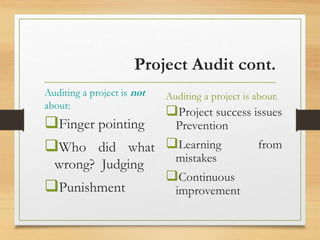
Project Audit cont.
Auditing a project is not
about:
Finger pointing
Who did what
wrong? Judging
Punishment
Auditing a project is about:
Project success issues
Prevention
Learning from
mistakes
Continuous
improvement
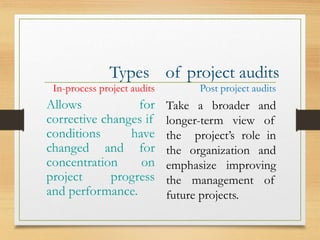
Types of project audits
In-process project audits
Allows for
corrective changes if
conditions have
changed and for
concentration on
project progress
and performance.
Post project audits
Take a broader and
longer-term view of
the project’s role in
the organization and
emphasize improving
the management of
future projects.
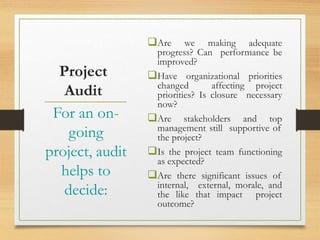
Are we making adequate
progress? Can performance be
improved?
Have organizational priorities
changed affecting project
priorities? Is closure necessary
now?
Are stakeholders and top
management still supportive of
the project?
Is the project team functioning
as expected?
Are there significant issues of
internal, external, morale, and
the like that impact project
outcome?
For an on-
going
project, audit
helps to
decide:
Project
Audit
P
rojectA
udit
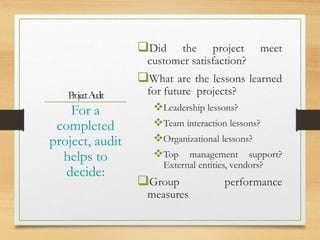
Did the project meet
customer satisfaction?
What are the lessons learned
for future projects?
Leadership lessons?
Team interaction lessons?
Organizational lessons?
Top management support?
External entities, vendors?
Group performance
measures
For a
completed
project, audit
helps to
decide:
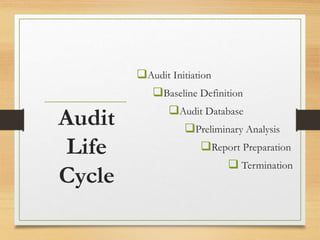
Audit Initiation
Baseline Definition
Audit Database
Preliminary Analysis
Report Preparation
 Termination
Audit
Life
Cycle
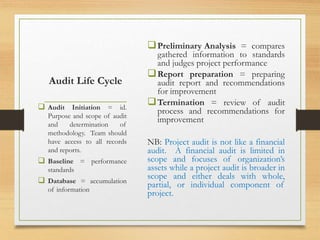
Audit Life Cycle
Preliminary Analysis = compares
gathered information to standards
and judges project performance
Report preparation = preparing
audit report and recommendations
for improvement
Termination = review of audit
process and recommendations for
improvement
NB: Project audit is not like a financial
audit. A financial audit is limited in
scope and focuses of organization’s
assets while a project audit is broader in
scope and either deals with whole,
partial, or individual component of
project.
 Audit Initiation = id.
Purpose and scope of audit
and determination of
methodology. Team should
have access to all records
and reports.
 Baseline = performance
standards
 Database = accumulation
of information
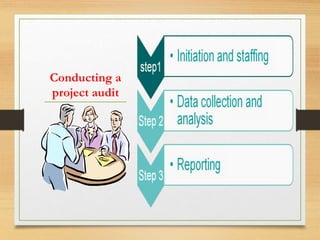
Conducting a
project audit
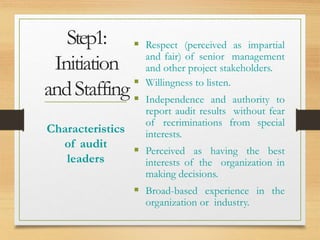
Step1:
Initiation
andStaffing
 Respect (perceived as impartial
and fair) of senior management
and other project stakeholders.
 Willingness to listen.
 Independence and authority to
report audit results without fear
of recriminations from special
interests.
 Perceived as having the best
interests of the organization in
making decisions.
 Broad-based experience in the
organization or industry.
Characteristics
of audit
leaders
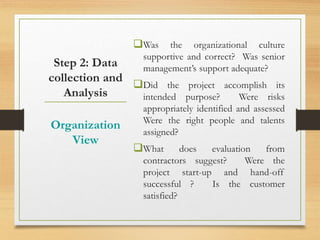
Step 2: Data
collection and
Analysis
Was the organizational culture
supportive and correct? Was senior
management’s support adequate?
Did the project accomplish its
intended purpose? Were risks
appropriately identified and assessed
Were the right people and talents
assigned?
What does evaluation from
contractors suggest? Were the
project start-up and hand-off
successful ? Is the customer
satisfied?
Organization
View
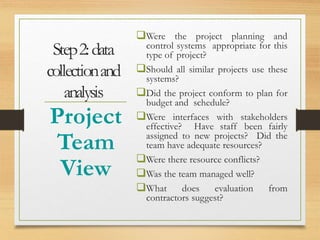
Step2:data
collectionand
analysis
Were the project planning and
control systems appropriate for this
type of project?
Should all similar projects use these
systems?
Did the project conform to plan for
budget and schedule?
Were interfaces with stakeholders
effective? Have staff been fairly
assigned to new projects? Did the
team have adequate resources?
Were there resource conflicts?
Was the team managed well?
What does evaluation from
contractors suggest?
Project
Team
View
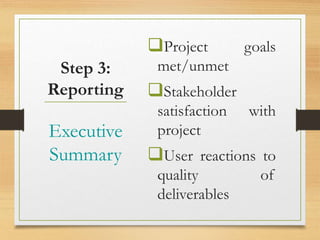
Project goals
met/unmet
Stakeholder
satisfaction with
project
User reactions to
quality of
deliverables
Executive
Summary
Step 3:
Reporting
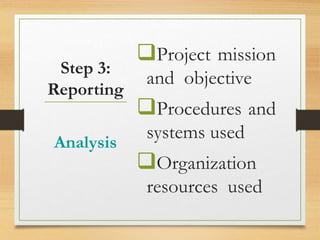
Project mission
and objective
Procedures and
systems used
Organization
resources used
Analysis
Step 3:
Reporting
Technical
improvements
Corrective
actions
Recommendations :
Step 3:
Reporting
Reminders
Retrospectives
Lessons
Learned
Step 3:
Reporting
Backup data
Critical
information
Appendix
Step 3:
Reporting
A project must be
administratively closed once
its product is successfully
delivered to the customer.
A failed project must also be
administratively closed.
A deadlocked project (drastic
change of focus, support,
personnel, executive decision,
etc.) must be administratively
closed.
Project
Closure
Reasons for
Termination
By Extinction
By Addition
By Integration
By Starvation
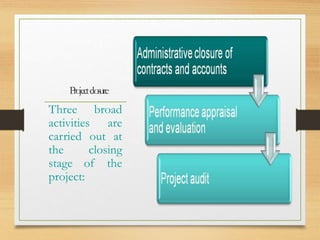
P
rojectclosure
Three broad
activities are
carried out at
the closing
stage of the
project:
Identifying tasks
necessary to close the
project
Assigning individuals to
carry out closure tasks
Monitoring
implementation
Ending closure process
The following
activities must
be addressed
in the project
closure plan:
Administrative
Closure
To evaluate
contribution that
individuals make to the
project success
To provide feedback to
the individual regarding
career development
Most organizations
have established
standards for
performance appraisal
Objectives:
Performance
Appraisal &
Evaluation
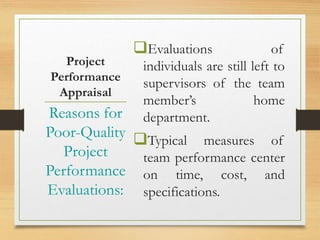
Performance
Appraisal
Innovation and creativity
Responsiveness
Team work Customer
relations
Learning and adaptability
Triple constraints (time, cost,
focus)
Value added contribution to
the project
One-on-one conference with
individual team members
In appraising
an individual
consider
Project
Performance
Appraisal
Evaluations of
individuals are still left to
supervisors of the team
member’s home
department.
Typical measures of
team performance center
on time, cost, and
specifications.
Reasons for
Poor-Quality
Project
Performance
Evaluations:
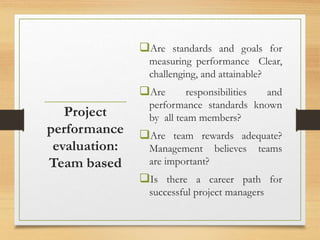
Are standards and goals for
measuring performance Clear,
challenging, and attainable?
Are responsibilities and
performance standards known
by all team members?
Are team rewards adequate?
Management believes teams
are important?
Is there a career path for
successful project managers
Project
performance
evaluation:
Team based
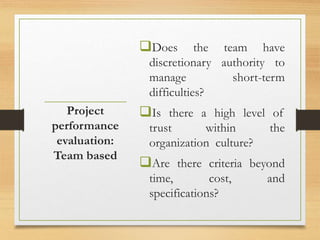
Does the team have
discretionary authority to
manage short-term
difficulties?
Is there a high level of
trust within the
organization culture?
Are there criteria beyond
time, cost, and
specifications?
Project
performance
evaluation:
Team based
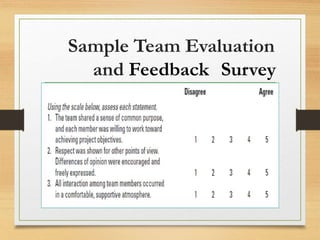
Sample Team Evaluation
and Feedback Survey
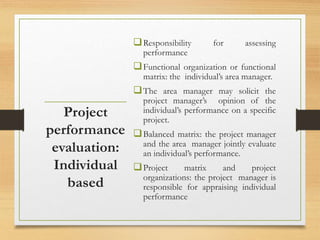
Responsibility for assessing
performance
Functional organization or functional
matrix: the individual’s area manager.
The area manager may solicit the
project manager’s opinion of the
individual’s performance on a specific
project.
Balanced matrix: the project manager
and the area manager jointly evaluate
an individual’s performance.
Project matrix and project
organizations: the project manager is
responsible for appraising individual
performance
Project
performance
evaluation:
Individual
based
Multi rater appraisal or
the “360-degree feedback
Involves soliciting
feedback concerning team
members’ performance
from all the people their
work affects.
This includes project
managers, area managers,
peers, subordinates, and
even customers.
Project
performance
evaluation:
individual
based
Project
Closure
Normal
Premature
Perpetual
Failed Project
Changed
Priority
Conditions
for
Closure
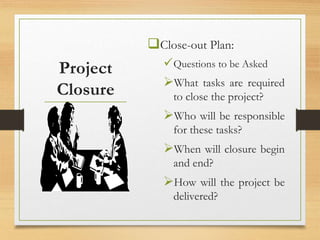
Project
Closure
Close-out Plan:
Questions to be Asked
What tasks are required
to close the project?
Who will be responsible
for these tasks?
When will closure begin
and end?
How will the project be
delivered?
1. Getting delivery acceptance
from the customer.
2. Shutting down resources and
releasing to new uses.
3. Reassigning project team
members.
4. Closing accounts and seeing all
bills are paid.
5. Evaluating the project team,
project team members, and
the project manager.
Closure
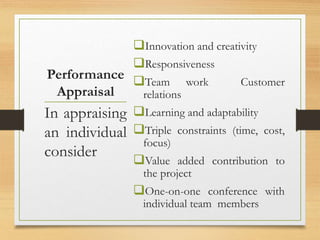
Ensure completion of work
Notify essential contacts of project
completion
Ensure documentation is complete
Clear final billings and oversee
preparation of final invoices,
paperwork, etc.
Redistribute resources
Ensure proper storage and
distribution of documents
Ascertain product support
requirements
Oversee closing of project
notebook and other books
Primary
Duties of
Project
Leader
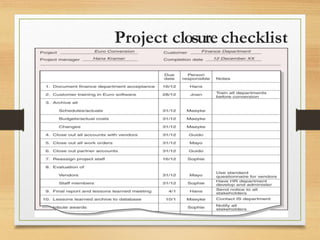
Project closure checklist

Final Class Presentation on Project Audit and Closure.ppt

  • 1.
  • 2.
    To understand theprocess of project audit To recognize the value of an audit to project management To determine when to terminate a project To identify various reasons why a project is terminated To identify checklist Objectives
  • 3.
    Learning outcomes  Evaluate ifthe project delivered the expected benefits to all stakeholders.  Was the project managed well?  Was the customer satisfied?  Assess what was done wrong and what contributed to successes.  Identify changes to improve the delivery of future projects.  Align project success criteria to project objectives.  Measure the progress of a project.  Solicit stakeholder feedback and lessons learnt.  Understand concept of benefits of realisation and who takes ownership. By the end of this topic, you should be able to:
  • 4.
    Are we doingthe right thing (at each milestone)? Did we do the right thing (for completed projects)? Are we doing it right (at each milestone)? Did we do it right (for completed projects)? The lessons learned? What adjustments are necessary? Lessons from successes? From failures?  Project audit is done during and after projects are complete.  The outcome of project audit is a report that suggests: Project Audit
  • 5.
    Project Audit cont. Auditinga project is not about: Finger pointing Who did what wrong? Judging Punishment Auditing a project is about: Project success issues Prevention Learning from mistakes Continuous improvement
  • 6.
    Types of projectaudits In-process project audits Allows for corrective changes if conditions have changed and for concentration on project progress and performance. Post project audits Take a broader and longer-term view of the project’s role in the organization and emphasize improving the management of future projects.
  • 7.
    Are we makingadequate progress? Can performance be improved? Have organizational priorities changed affecting project priorities? Is closure necessary now? Are stakeholders and top management still supportive of the project? Is the project team functioning as expected? Are there significant issues of internal, external, morale, and the like that impact project outcome? For an on- going project, audit helps to decide: Project Audit
  • 8.
    P rojectA udit Did the projectmeet customer satisfaction? What are the lessons learned for future projects? Leadership lessons? Team interaction lessons? Organizational lessons? Top management support? External entities, vendors? Group performance measures For a completed project, audit helps to decide:
  • 9.
    Audit Initiation Baseline Definition AuditDatabase Preliminary Analysis Report Preparation  Termination Audit Life Cycle
  • 10.
    Audit Life Cycle PreliminaryAnalysis = compares gathered information to standards and judges project performance Report preparation = preparing audit report and recommendations for improvement Termination = review of audit process and recommendations for improvement NB: Project audit is not like a financial audit. A financial audit is limited in scope and focuses of organization’s assets while a project audit is broader in scope and either deals with whole, partial, or individual component of project.  Audit Initiation = id. Purpose and scope of audit and determination of methodology. Team should have access to all records and reports.  Baseline = performance standards  Database = accumulation of information
  • 11.
  • 12.
    Step1: Initiation andStaffing  Respect (perceivedas impartial and fair) of senior management and other project stakeholders.  Willingness to listen.  Independence and authority to report audit results without fear of recriminations from special interests.  Perceived as having the best interests of the organization in making decisions.  Broad-based experience in the organization or industry. Characteristics of audit leaders
  • 13.
    Step 2: Data collectionand Analysis Was the organizational culture supportive and correct? Was senior management’s support adequate? Did the project accomplish its intended purpose? Were risks appropriately identified and assessed Were the right people and talents assigned? What does evaluation from contractors suggest? Were the project start-up and hand-off successful ? Is the customer satisfied? Organization View
  • 14.
    Step2:data collectionand analysis Were the projectplanning and control systems appropriate for this type of project? Should all similar projects use these systems? Did the project conform to plan for budget and schedule? Were interfaces with stakeholders effective? Have staff been fairly assigned to new projects? Did the team have adequate resources? Were there resource conflicts? Was the team managed well? What does evaluation from contractors suggest? Project Team View
  • 15.
    Project goals met/unmet Stakeholder satisfaction with project Userreactions to quality of deliverables Executive Summary Step 3: Reporting
  • 16.
    Project mission and objective Proceduresand systems used Organization resources used Analysis Step 3: Reporting
  • 17.
  • 18.
  • 19.
  • 20.
    A project mustbe administratively closed once its product is successfully delivered to the customer. A failed project must also be administratively closed. A deadlocked project (drastic change of focus, support, personnel, executive decision, etc.) must be administratively closed. Project Closure
  • 21.
    Reasons for Termination By Extinction ByAddition By Integration By Starvation
  • 22.
    P rojectclosure Three broad activities are carriedout at the closing stage of the project:
  • 23.
    Identifying tasks necessary toclose the project Assigning individuals to carry out closure tasks Monitoring implementation Ending closure process The following activities must be addressed in the project closure plan: Administrative Closure
  • 24.
    To evaluate contribution that individualsmake to the project success To provide feedback to the individual regarding career development Most organizations have established standards for performance appraisal Objectives: Performance Appraisal & Evaluation
  • 25.
    Performance Appraisal Innovation and creativity Responsiveness Teamwork Customer relations Learning and adaptability Triple constraints (time, cost, focus) Value added contribution to the project One-on-one conference with individual team members In appraising an individual consider
  • 26.
    Project Performance Appraisal Evaluations of individuals arestill left to supervisors of the team member’s home department. Typical measures of team performance center on time, cost, and specifications. Reasons for Poor-Quality Project Performance Evaluations:
  • 27.
    Are standards andgoals for measuring performance Clear, challenging, and attainable? Are responsibilities and performance standards known by all team members? Are team rewards adequate? Management believes teams are important? Is there a career path for successful project managers Project performance evaluation: Team based
  • 28.
    Does the teamhave discretionary authority to manage short-term difficulties? Is there a high level of trust within the organization culture? Are there criteria beyond time, cost, and specifications? Project performance evaluation: Team based
  • 29.
  • 30.
    Responsibility for assessing performance Functionalorganization or functional matrix: the individual’s area manager. The area manager may solicit the project manager’s opinion of the individual’s performance on a specific project. Balanced matrix: the project manager and the area manager jointly evaluate an individual’s performance. Project matrix and project organizations: the project manager is responsible for appraising individual performance Project performance evaluation: Individual based
  • 31.
    Multi rater appraisalor the “360-degree feedback Involves soliciting feedback concerning team members’ performance from all the people their work affects. This includes project managers, area managers, peers, subordinates, and even customers. Project performance evaluation: individual based
  • 32.
  • 33.
    Project Closure Close-out Plan: Questions tobe Asked What tasks are required to close the project? Who will be responsible for these tasks? When will closure begin and end? How will the project be delivered?
  • 34.
    1. Getting deliveryacceptance from the customer. 2. Shutting down resources and releasing to new uses. 3. Reassigning project team members. 4. Closing accounts and seeing all bills are paid. 5. Evaluating the project team, project team members, and the project manager. Closure
  • 35.
    Ensure completion ofwork Notify essential contacts of project completion Ensure documentation is complete Clear final billings and oversee preparation of final invoices, paperwork, etc. Redistribute resources Ensure proper storage and distribution of documents Ascertain product support requirements Oversee closing of project notebook and other books Primary Duties of Project Leader
  • 36.