Active Filters
Filters
A  filter is a system that processes a signal
 in some desired fashion.
 • A continuous-time signal or continuous signal of
     x(t) is a function of the continuous variable t. A
     continuous-time signal is often called an analog
     signal.
 •   A discrete-time signal or discrete signal x(kT) is
     defined only at discrete instances t=kT, where k
     is an integer and T is the uniform spacing or
     period between samples
Types of Filters
   There are two broad categories of filters:
    •   An analog filter processes continuous-time signals
    •   A digital filter processes discrete-time signals.
   The analog or digital filters can be subdivided
    into four categories:
    •   Lowpass Filters
    •   Highpass Filters
    •   Bandstop Filters
    •   Bandpass Filters
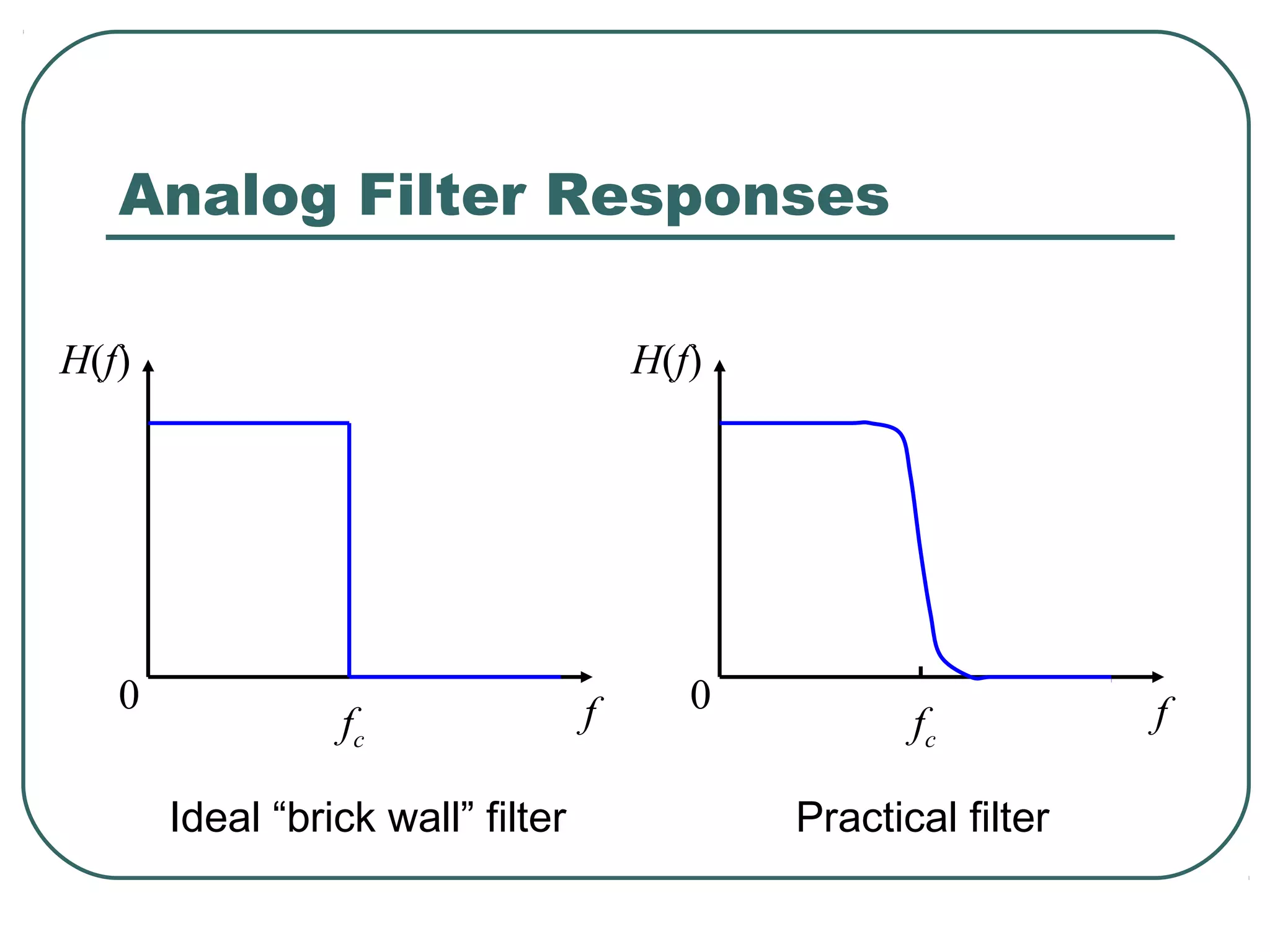
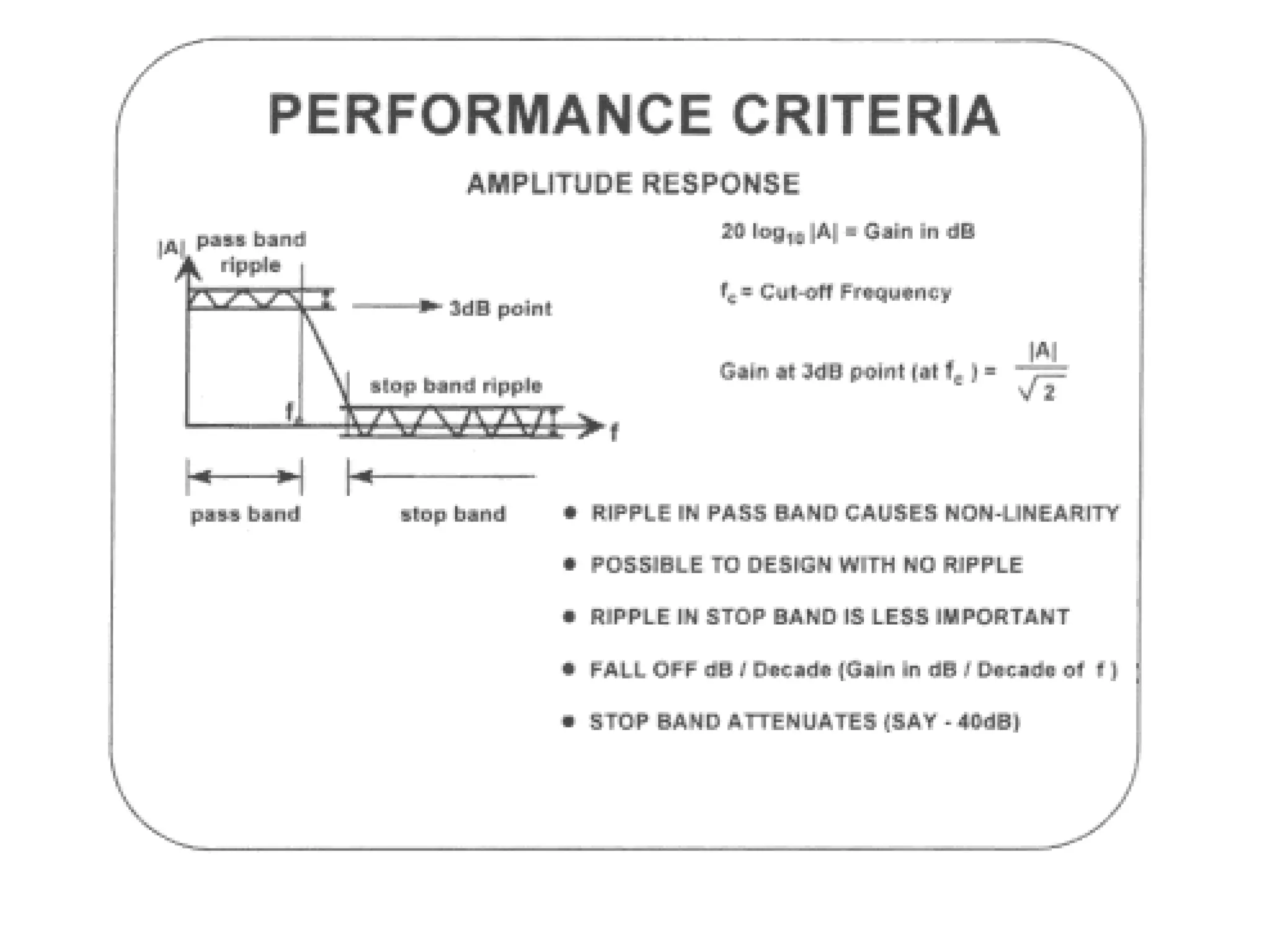
Analog Filter Responses

H(f)                                   H(f)


   0                               f      0                      f
                 fc                                  fc

       Ideal “brick wall” filter              Practical filter
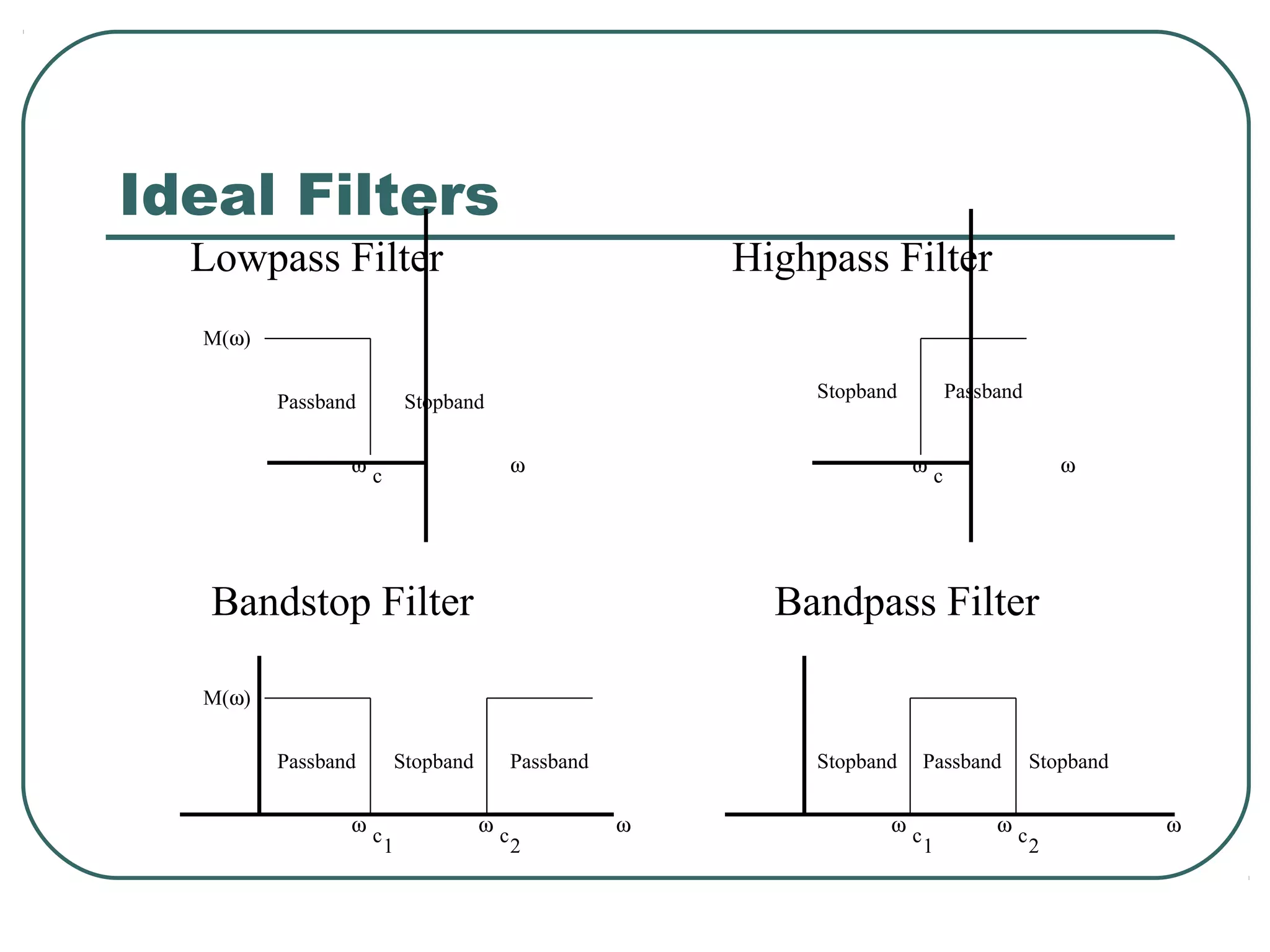
Ideal Filters
  Lowpass Filter                                  Highpass Filter
  M(ω)

                                                      Stopband        Passband
         Passband      Stopband


                ωc                 ω                             ωc                 ω


   Bandstop Filter                                  Bandpass Filter

  M(ω)


         Passband    Stopband      Passband           Stopband   Passband        Stopband


                ωc              ωc            ω              ωc            ωc               ω
                   1               2                            1             2
 There  are a number of ways to build
 filters and of these passive and active
 filters are the most commonly used in
 voice and data communications.
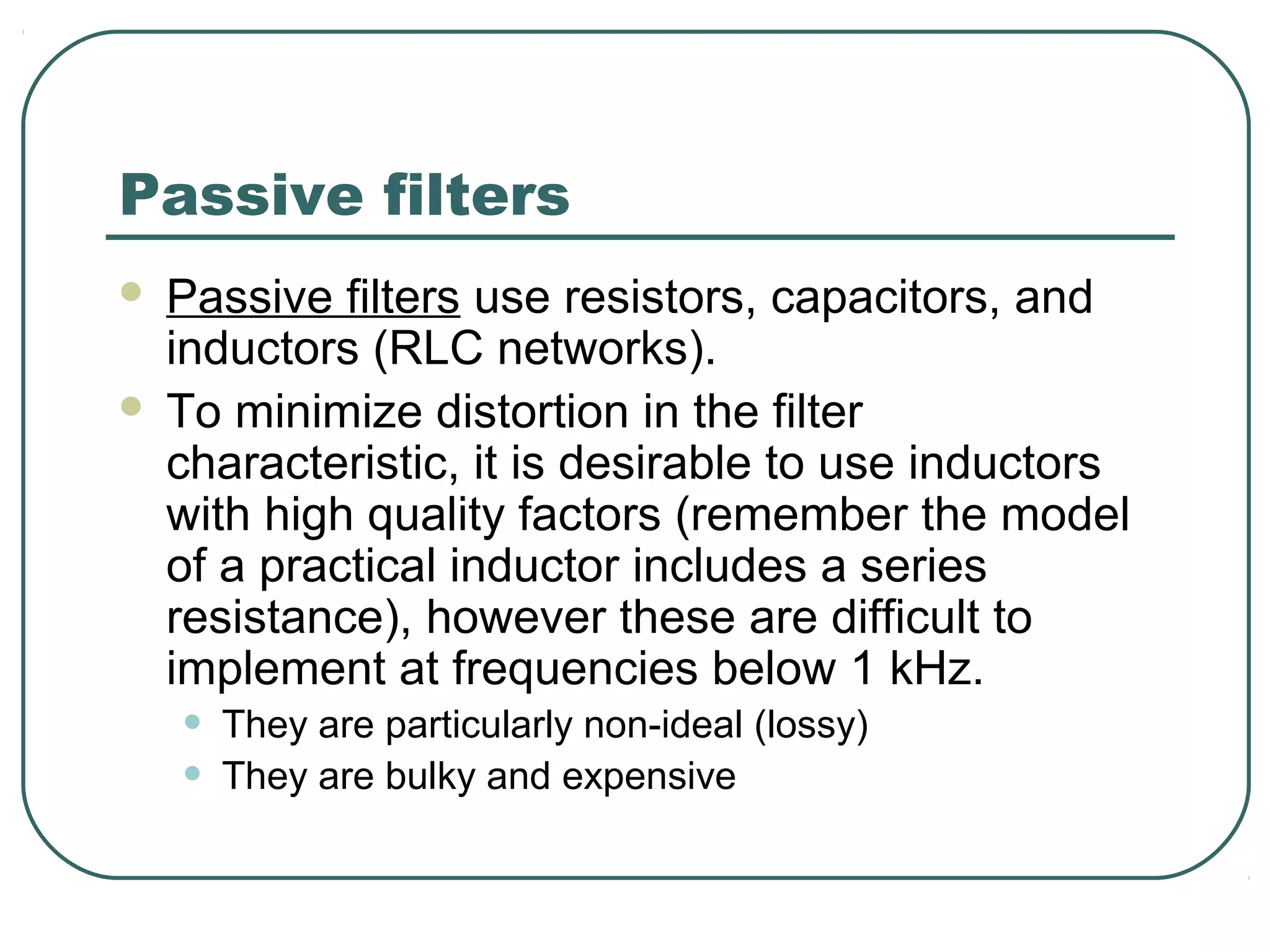
Passive filters
   Passive filters use resistors, capacitors, and
    inductors (RLC networks).
   To minimize distortion in the filter
    characteristic, it is desirable to use inductors
    with high quality factors (remember the model
    of a practical inductor includes a series
    resistance), however these are difficult to
    implement at frequencies below 1 kHz.
    •   They are particularly non-ideal (lossy)
    •   They are bulky and expensive
 Active
       filters overcome these drawbacks
 and are realized using resistors,
 capacitors, and active devices (usually
 op-amps) which can all be integrated:
  • Active filters replace inductors using op-amp
    based equivalent circuits.
Op Amp Advantages
   Advantages of active RC filters include:
    •   reduced size and weight, and therefore parasitics
    •   increased reliability and improved performance
    •   simpler design than for passive filters and can realize
        a wider range of functions as well as providing voltage
        gain
    •   in large quantities, the cost of an IC is less than its
        passive counterpart
Op Amp Disadvantages
   Active RC filters also have some disadvantages:
    •   limited bandwidth of active devices limits the highest
        attainable pole frequency and therefore applications above
        100 kHz (passive RLCfilters can be used up to 500 MHz)
    •   the achievable quality factor is also limited
    •   require power supplies (unlike passive filters)
    •   increased sensitivity to variations in circuit parameters
        caused by environmental changes compared to passive
        filters
   For many applications, particularly in voice and data
    communications, the economic and performance
    advantages of active RC filters far outweigh their
    disadvantages.
Bode Plots
 Bode plots are important when
 considering the frequency response
 characteristics of amplifiers. They plot
 the magnitude or phase of a transfer
 function in dB versus frequency.
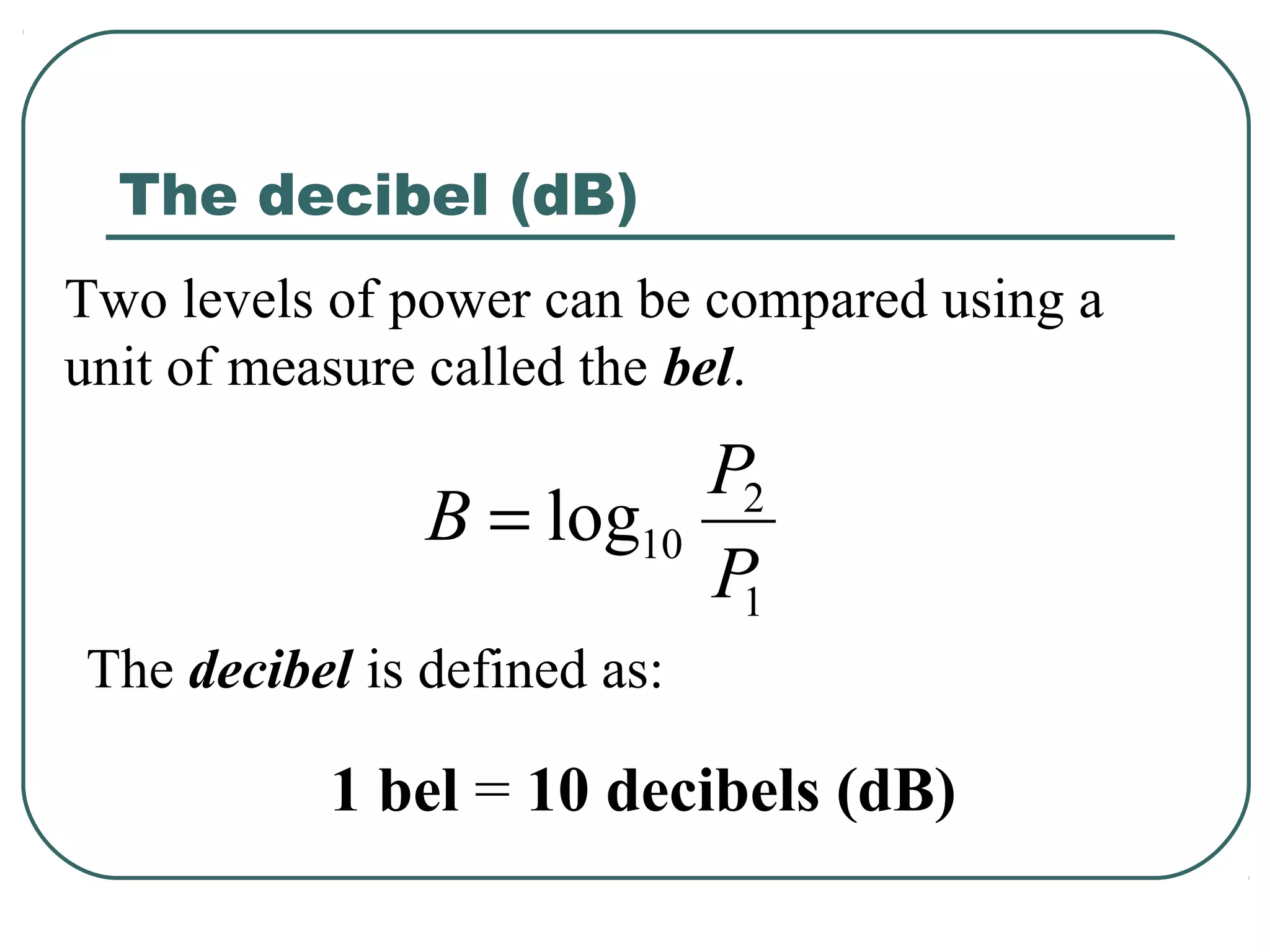
The decibel (dB)
Two levels of power can be compared using a
unit of measure called the bel.
                         P2
               B = log10
                         P1
The decibel is defined as:

          1 bel = 10 decibels (dB)
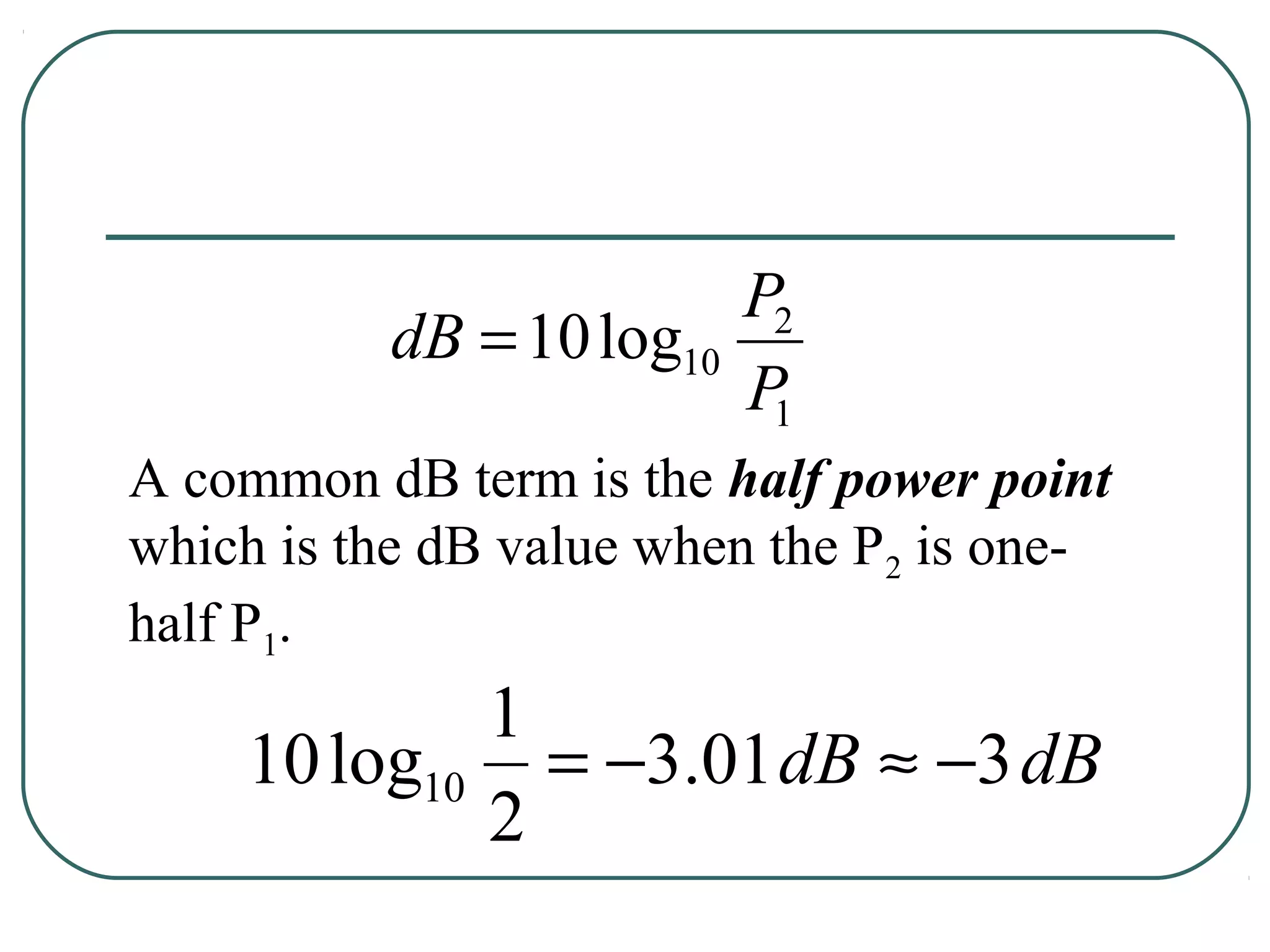
P2
          dB = 10 log10
                        P1
A common dB term is the half power point
which is the dB value when the P2 is one-
half P1.
            1
    10 log10 = −3.01 dB ≈ −3 dB
            2
Logarithms
A   logarithm is a linear transformation used
  to simplify mathematical and graphical
  operations.
 A logarithm is a one-to-one correspondence.
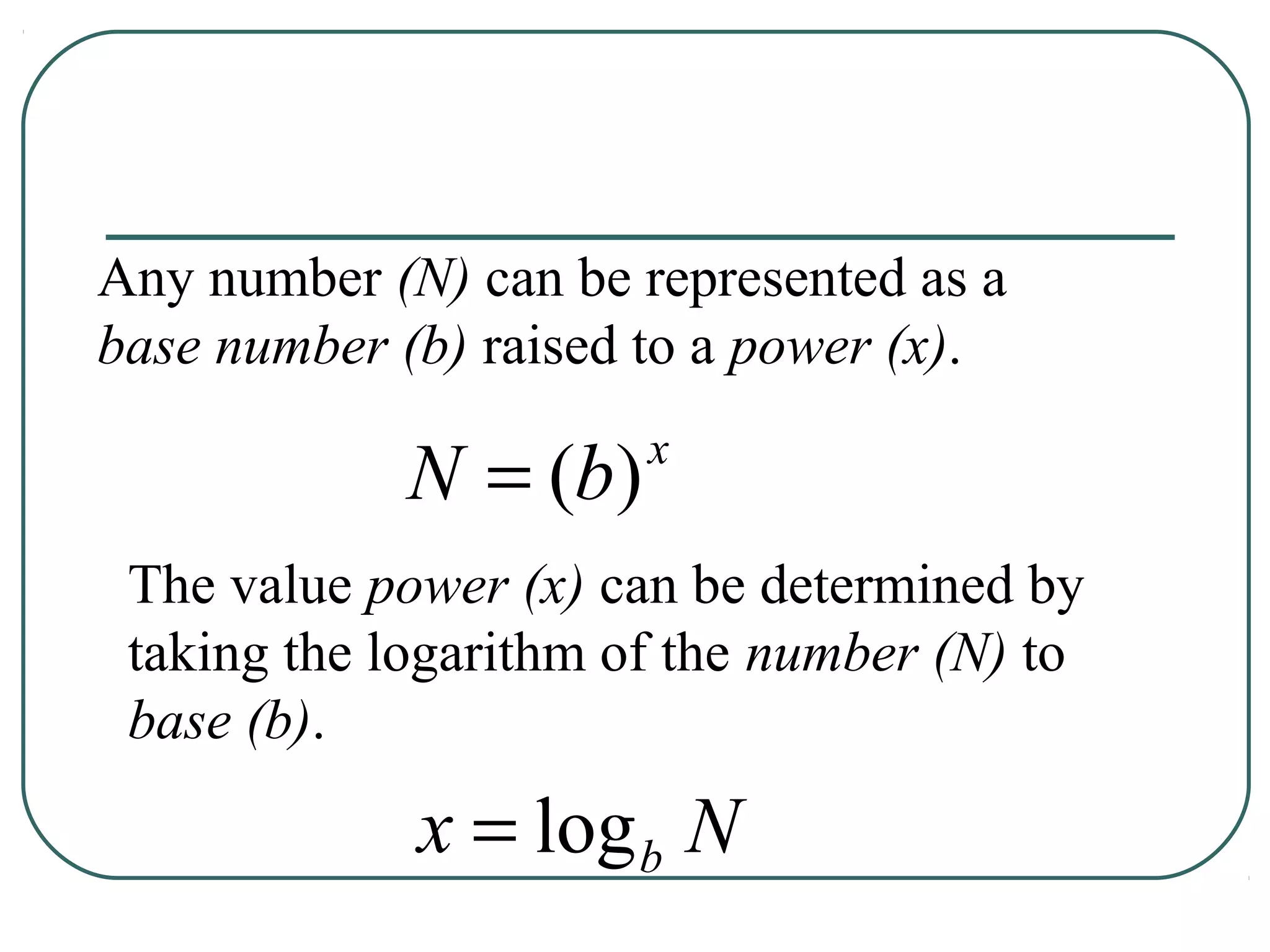
Any number (N) can be represented as a
base number (b) raised to a power (x).

            N = (b)    x

 The value power (x) can be determined by
 taking the logarithm of the number (N) to
 base (b).

             x = log b N
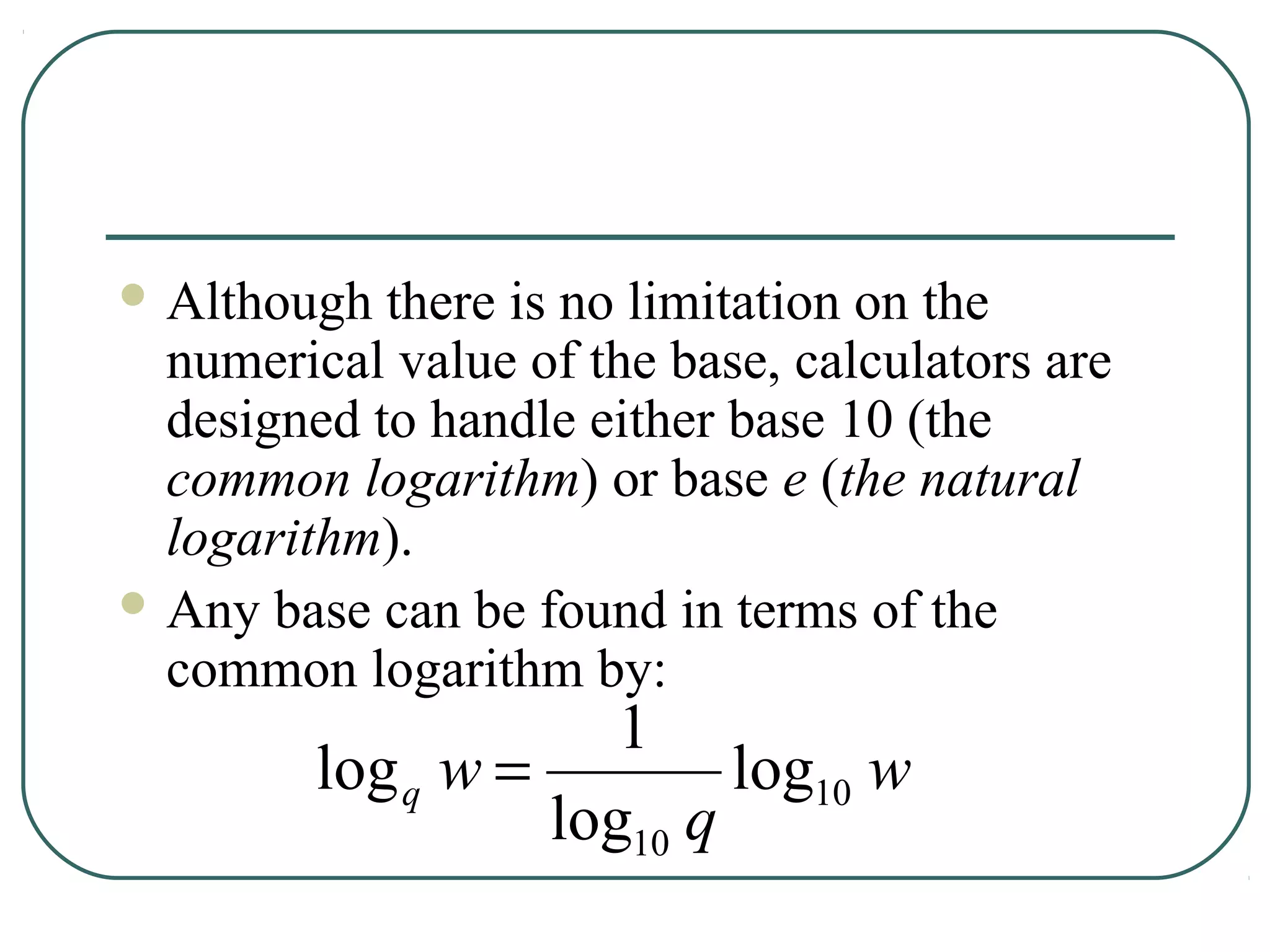
 Although  there is no limitation on the
  numerical value of the base, calculators are
  designed to handle either base 10 (the
  common logarithm) or base e (the natural
  logarithm).
 Any base can be found in terms of the
  common logarithm by:
                      1
         log q w =         log10 w
                   log10 q
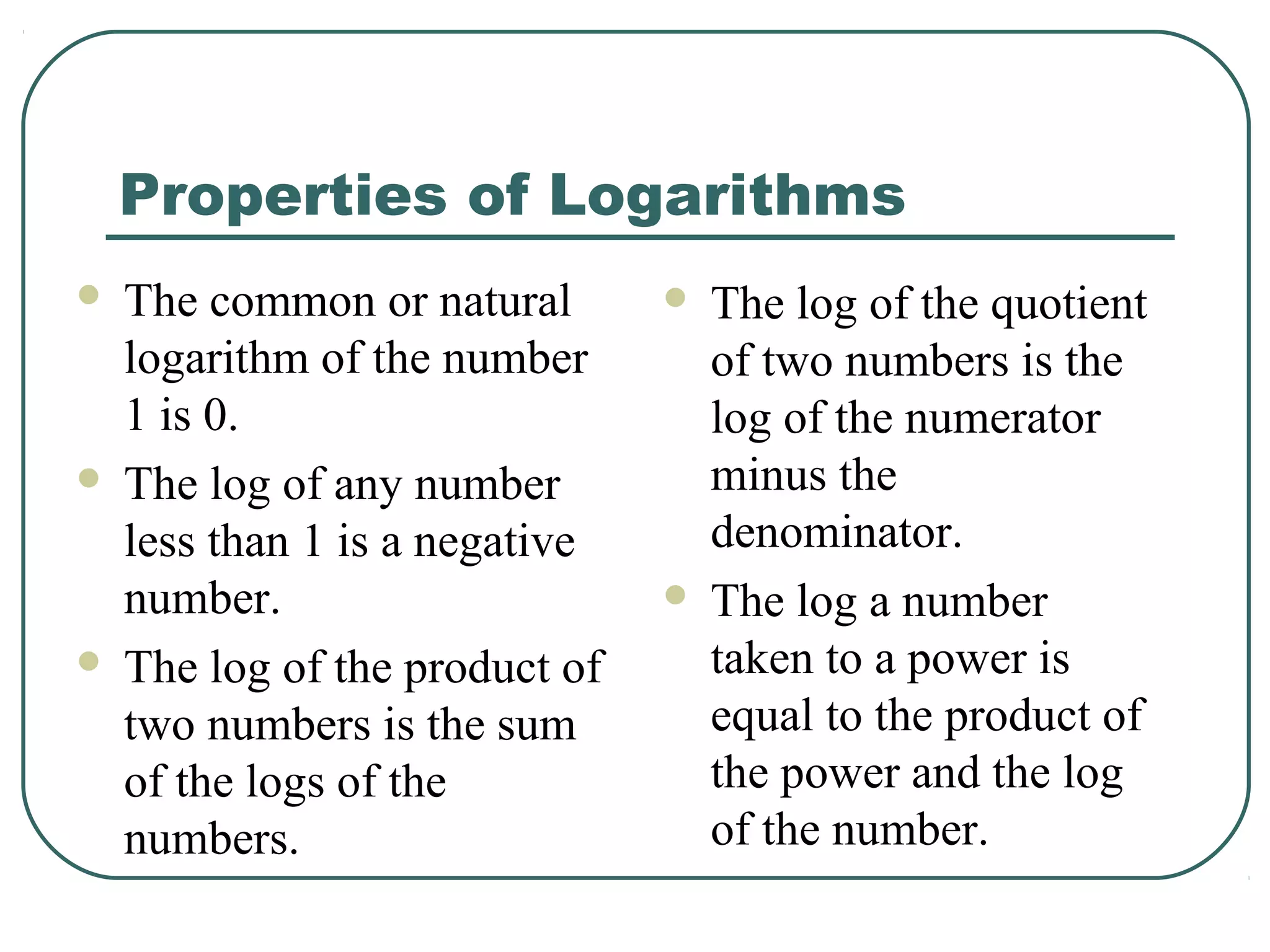
Properties of Logarithms
   The common or natural          The log of the quotient
    logarithm of the number         of two numbers is the
    1 is 0.                         log of the numerator
   The log of any number           minus the
    less than 1 is a negative       denominator.
    number.                        The log a number
   The log of the product of       taken to a power is
    two numbers is the sum          equal to the product of
    of the logs of the              the power and the log
    numbers.                        of the number.
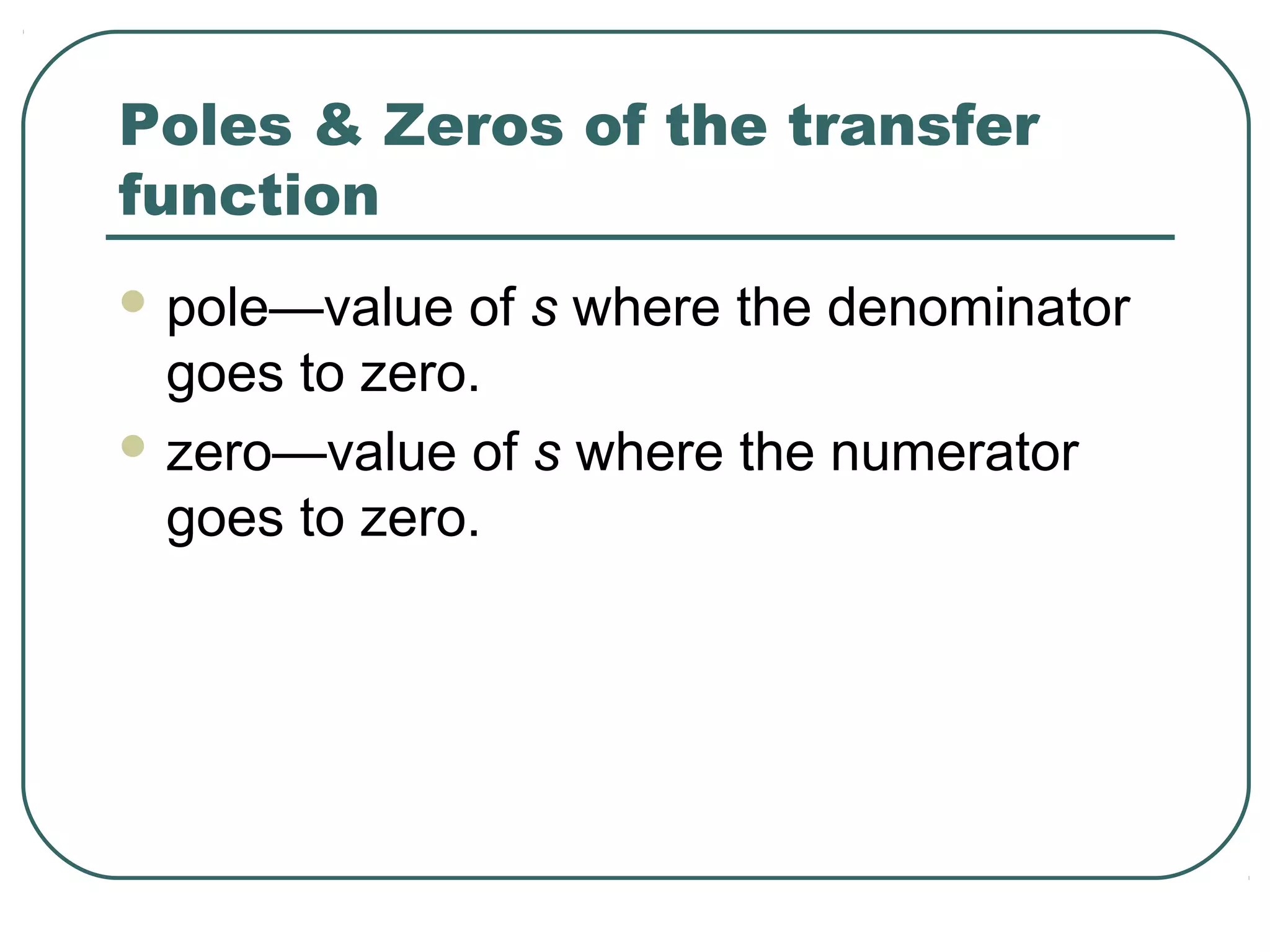
Poles & Zeros of the transfer
function
 pole—value  of s where the denominator
  goes to zero.
 zero—value of s where the numerator
  goes to zero.
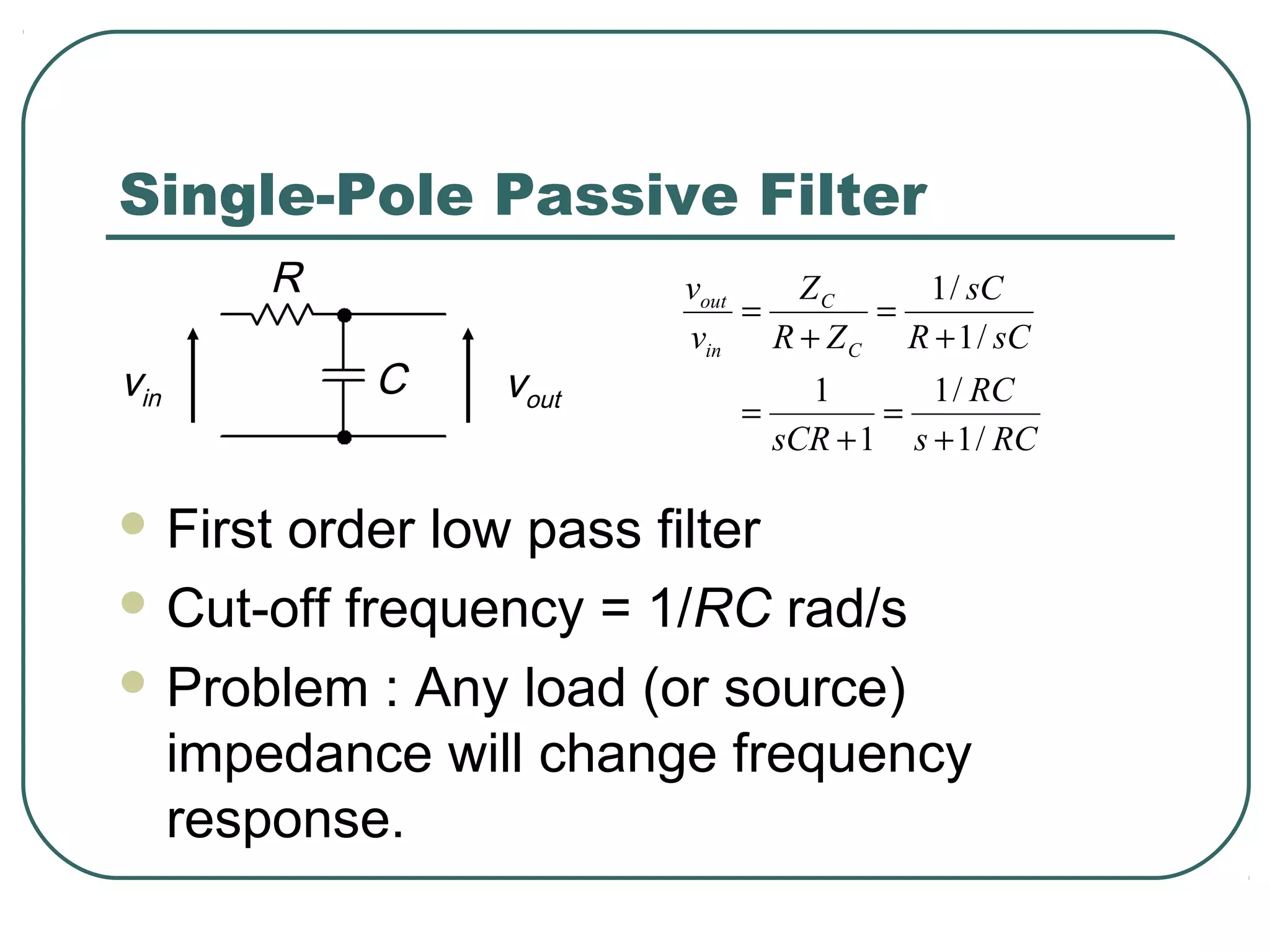
Single-Pole Passive Filter
      R              vout   ZC    1 / sC
                          =     =
                     vin R + Z C R + 1 / sC
vin       C   vout            1       1 / RC
                        =          =
                            sCR + 1 s + 1 / RC

 Firstorder low pass filter
 Cut-off frequency = 1/RC rad/s

 Problem : Any load (or source)
  impedance will change frequency
  response.
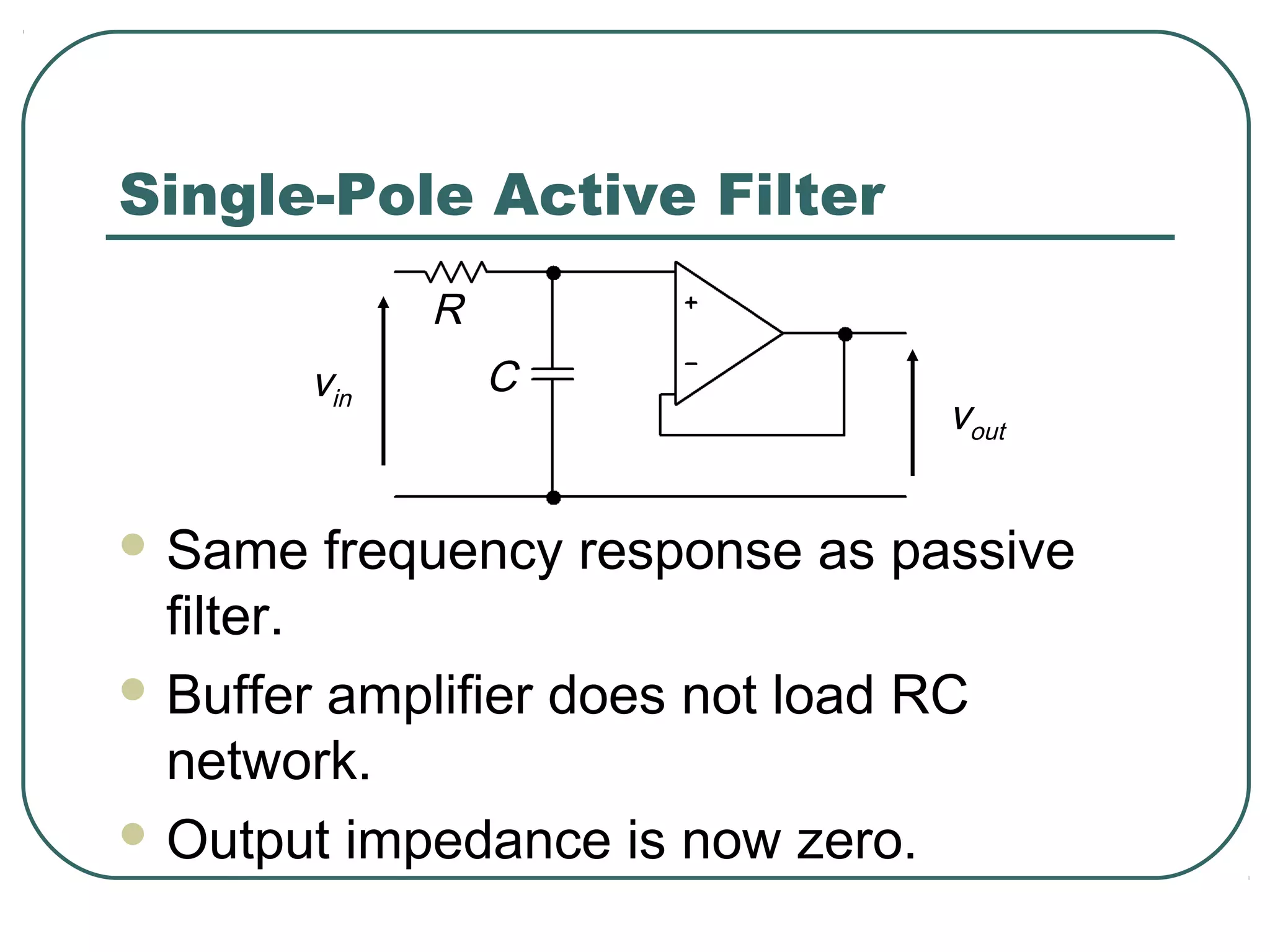
Single-Pole Active Filter
               R
         vin       C
                                  vout

 Same   frequency response as passive
  filter.
 Buffer amplifier does not load RC
  network.
 Output impedance is now zero.
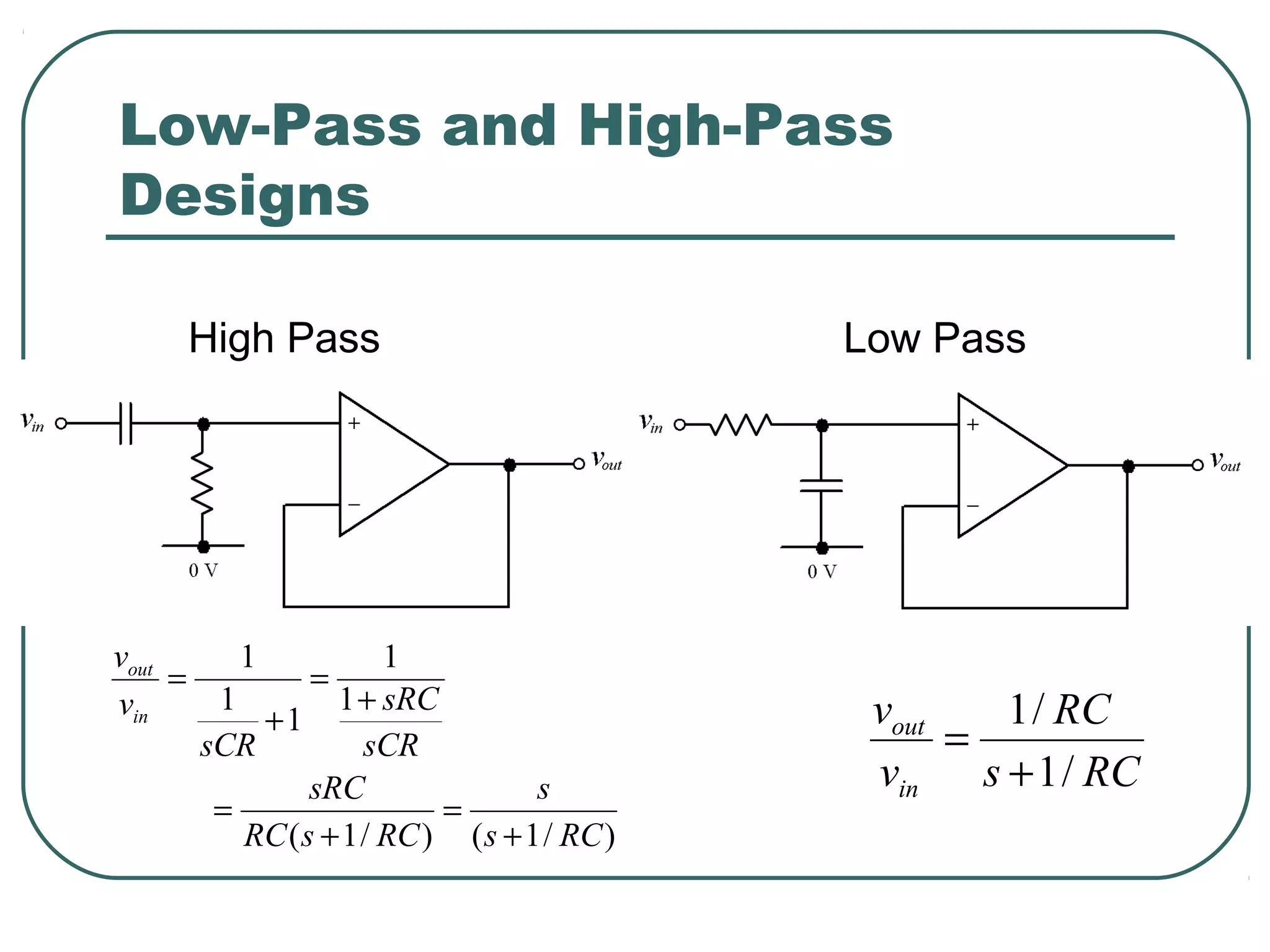
Low-Pass and High-Pass
Designs

      High Pass                              Low Pass


vout      1            1
     =          =
vin     1         1 + sRC                     vout   1 / RC
            +1
       sCR           sCR                           =
                sRC                s          vin s + 1 / RC
        =                  =
          RC ( s + 1 / RC ) ( s + 1 / RC )
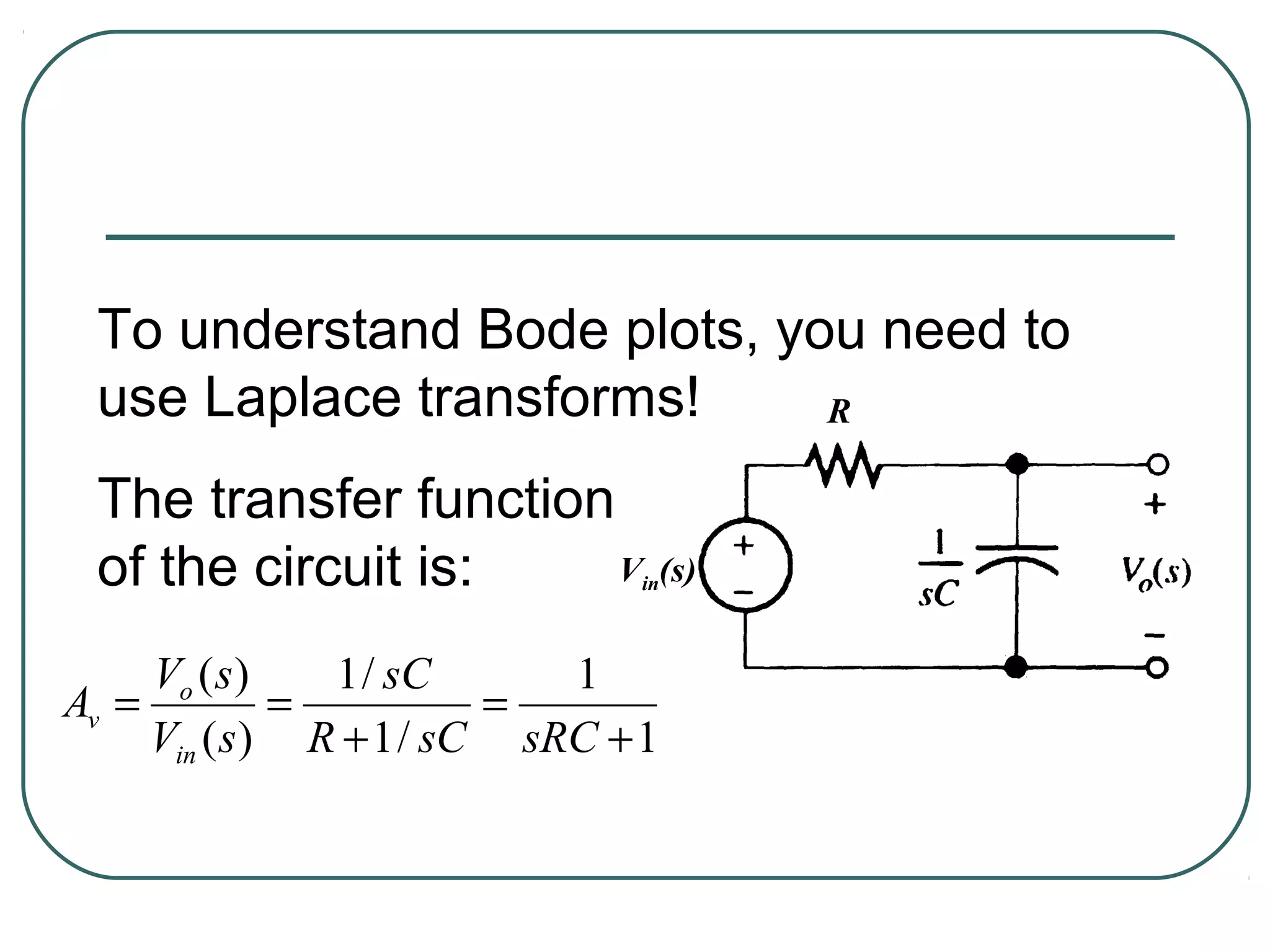
To understand Bode plots, you need to
 use Laplace transforms!     R

 The transfer function
 of the circuit is:    V        in   (s)


     Vo ( s )   1 / sC      1
Av =          =          =
     Vin ( s ) R + 1 / sC sRC + 1
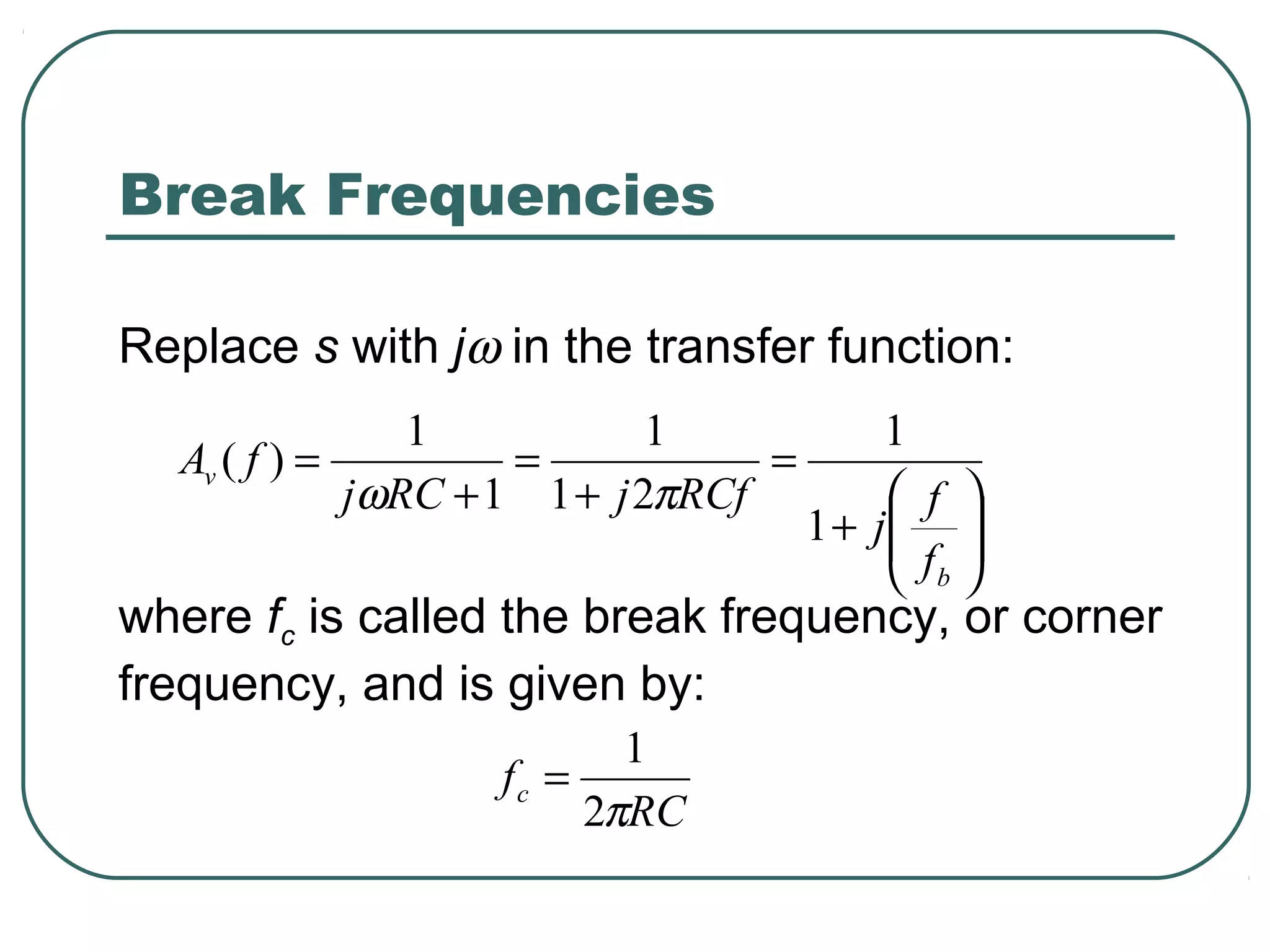
Break Frequencies

Replace s with jω in the transfer function:
                1            1             1
  Av ( f ) =         =            =
             jωRC + 1 1 + j 2πRCf           f 
                                      1 + j 
                                           f 
                                            b
where fc is called the break frequency, or corner
frequency, and is given by:
                          1
                   fc =
                        2πRC
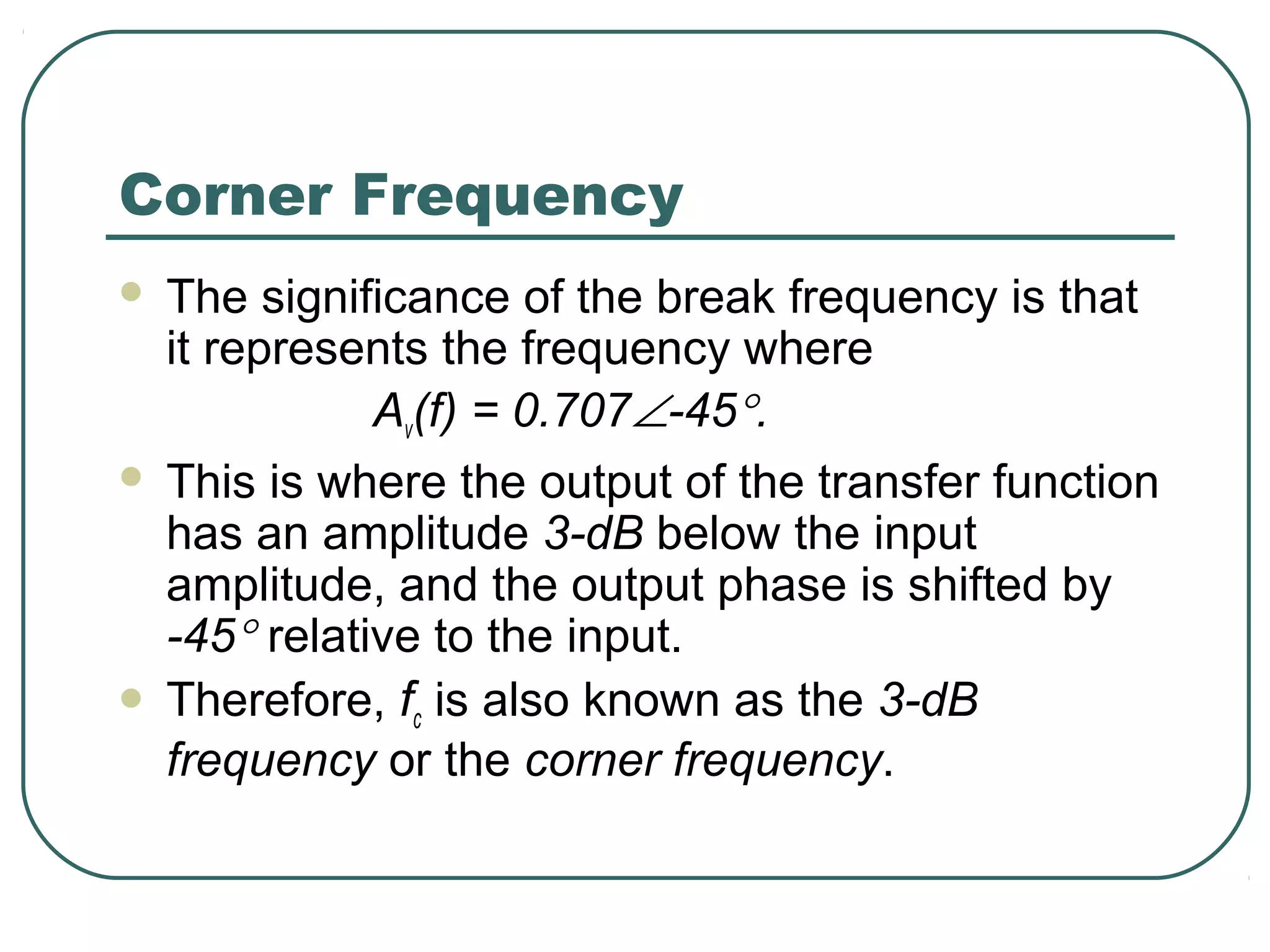
Corner Frequency
   The significance of the break frequency is that
    it represents the frequency where
               Av(f) = 0.707∠-45°.
   This is where the output of the transfer function
    has an amplitude 3-dB below the input
    amplitude, and the output phase is shifted by
    -45° relative to the input.
   Therefore, fc is also known as the 3-dB
    frequency or the corner frequency.
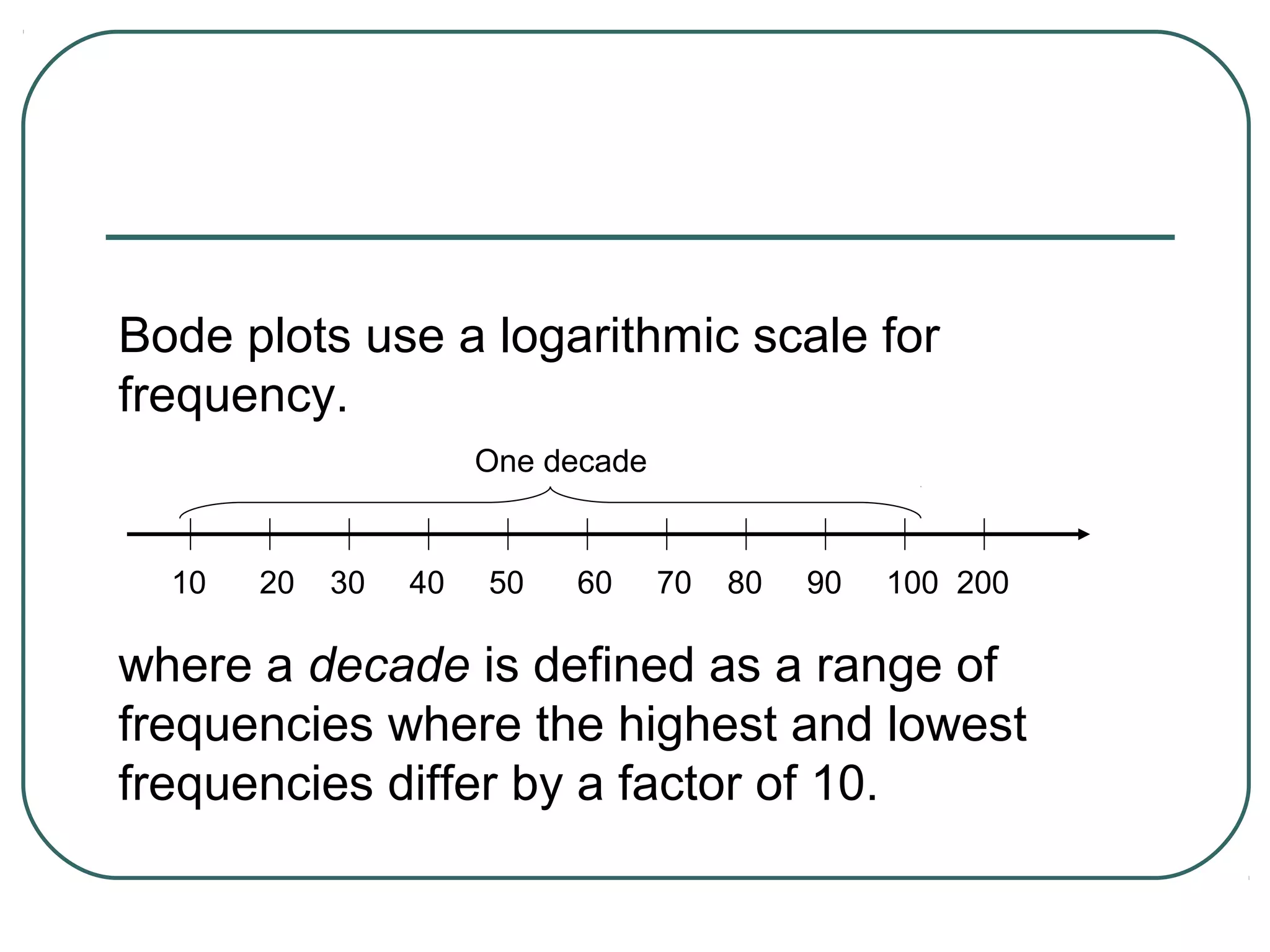
Bode plots use a logarithmic scale for
frequency.
                      One decade


  10   20   30   40   50   60      70   80   90   100 200

where a decade is defined as a range of
frequencies where the highest and lowest
frequencies differ by a factor of 10.
 Consider         the magnitude of the transfer
      function:                                1
                          Av ( f ) =
                                         1 + ( f / fb )
                                                          2


   Expressed in dB, the expression is
Av ( f ) dB = 20 log 1 − 20 log 1 + ( f / f b )
                                                   2


                                                              [
                  = −20 log 1 + ( f / f b ) = −10 log 1 + ( f / f b )
                                              2                         2
                                                                            ]
                  = −20 log( f / f b )
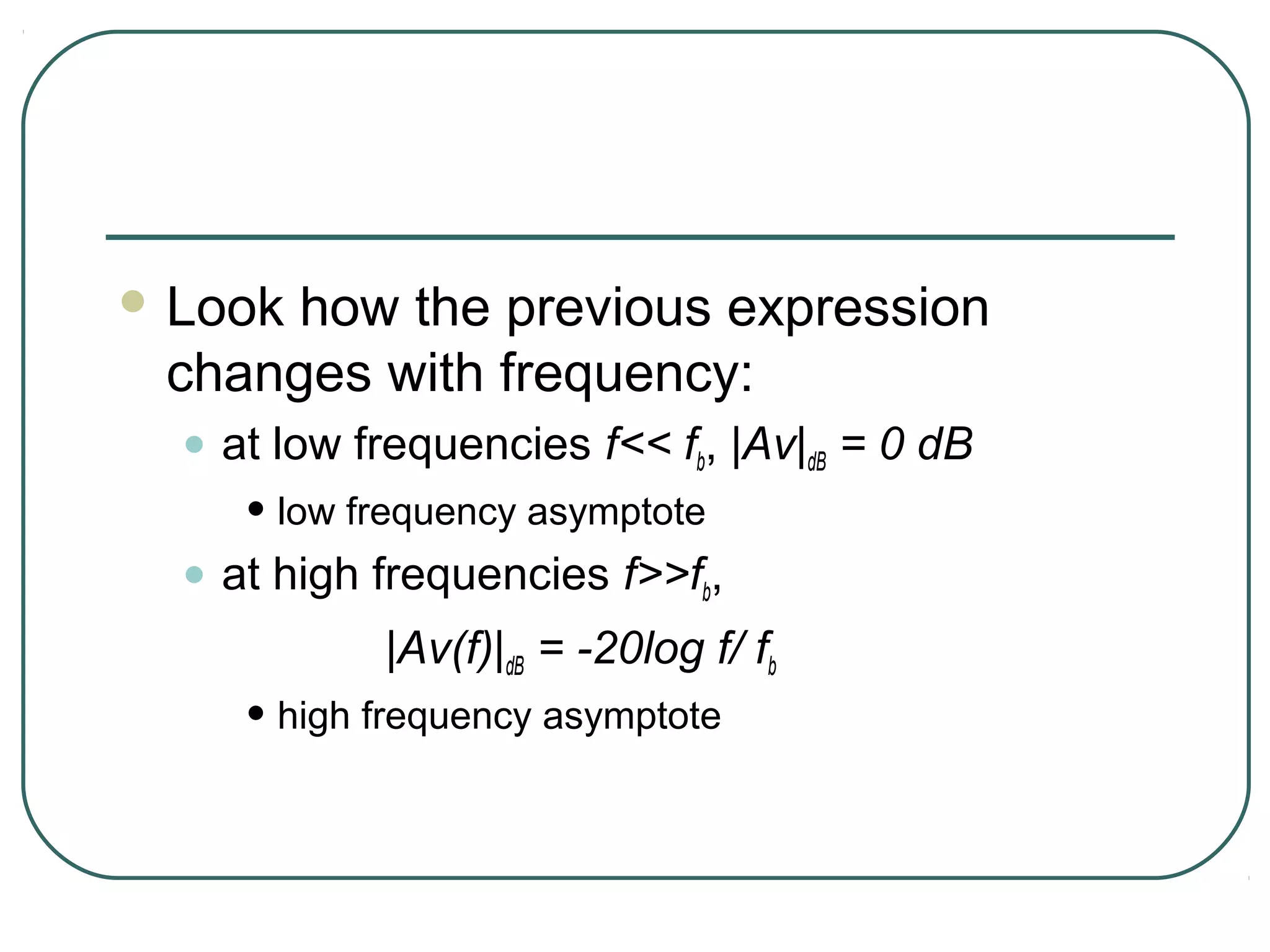
 Lookhow the previous expression
 changes with frequency:
  • at low frequencies f<< f , |Av|
                               b       dB   = 0 dB
     • low frequency asymptote
  • at high frequencies f>>f , b

            |Av(f)|dB = -20log f/ fb
     • high frequency asymptote
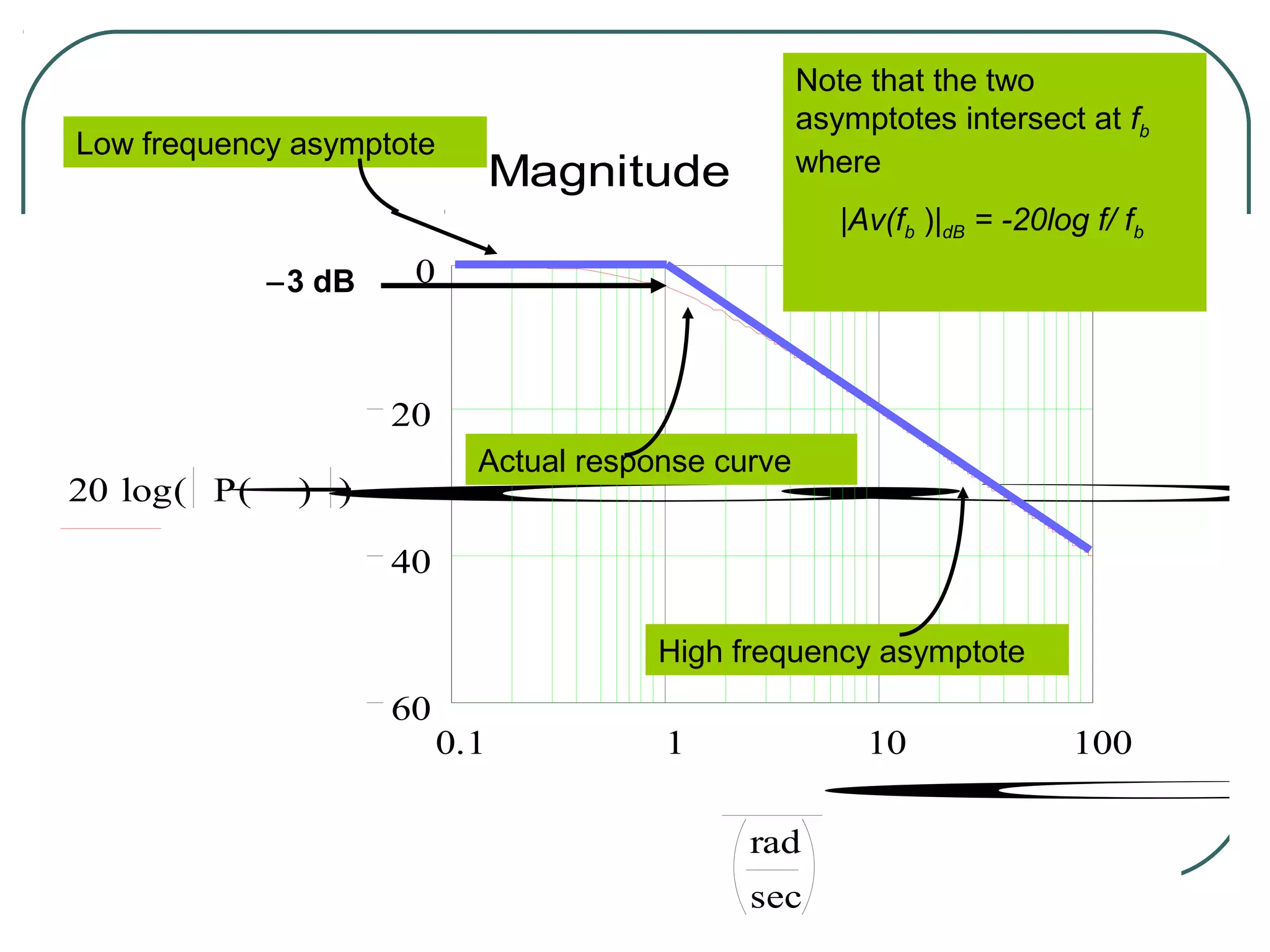
Note that the two
                                                    asymptotes intersect at fb
Low frequency asymptote
                                Magnitude           where
                                                       |Av(fb )|dB = -20log f/ fb
            −3 dB    0


                    20
                            Actual response curve
20 .
   log ( P ( ω
             ) )

                    40

                                        High frequency asymptote
                    60
                          0.1           1     10 100
                                              ω
                                              rad
                                              sec
 The   technique for approximating a filter
  function based on Bode plots is useful
  for low order, simple filter designs
 More complex filter characteristics are
  more easily approximated by using some
  well-described rational functions, the
  roots of which have already been
  tabulated and are well-known.
Real Filters
 The   approximations to the ideal filter are
 the:
  • Butterworth filter
  • Chebyshev filter
  • Cauer (Elliptic) filter
  • Bessel filter
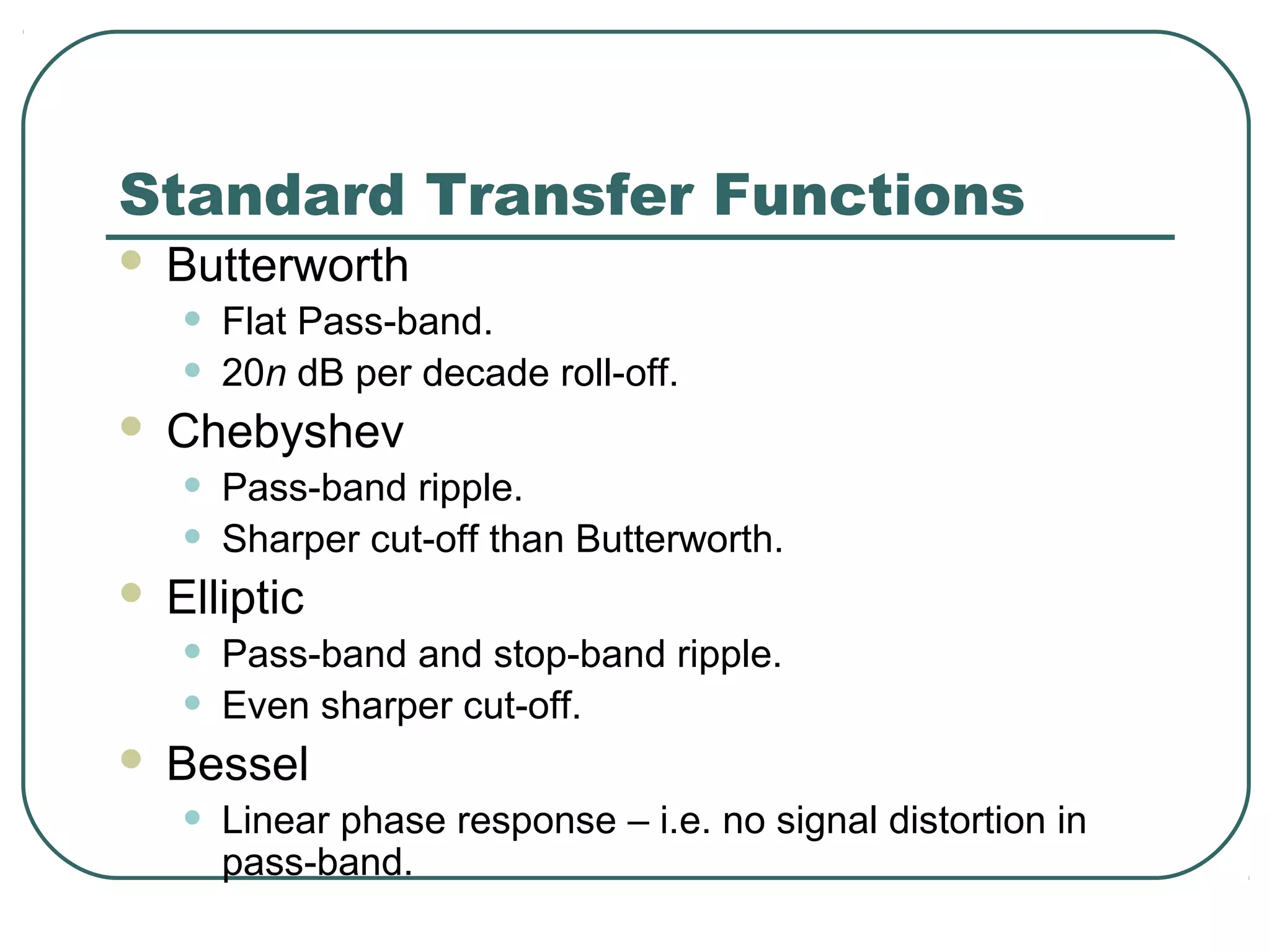
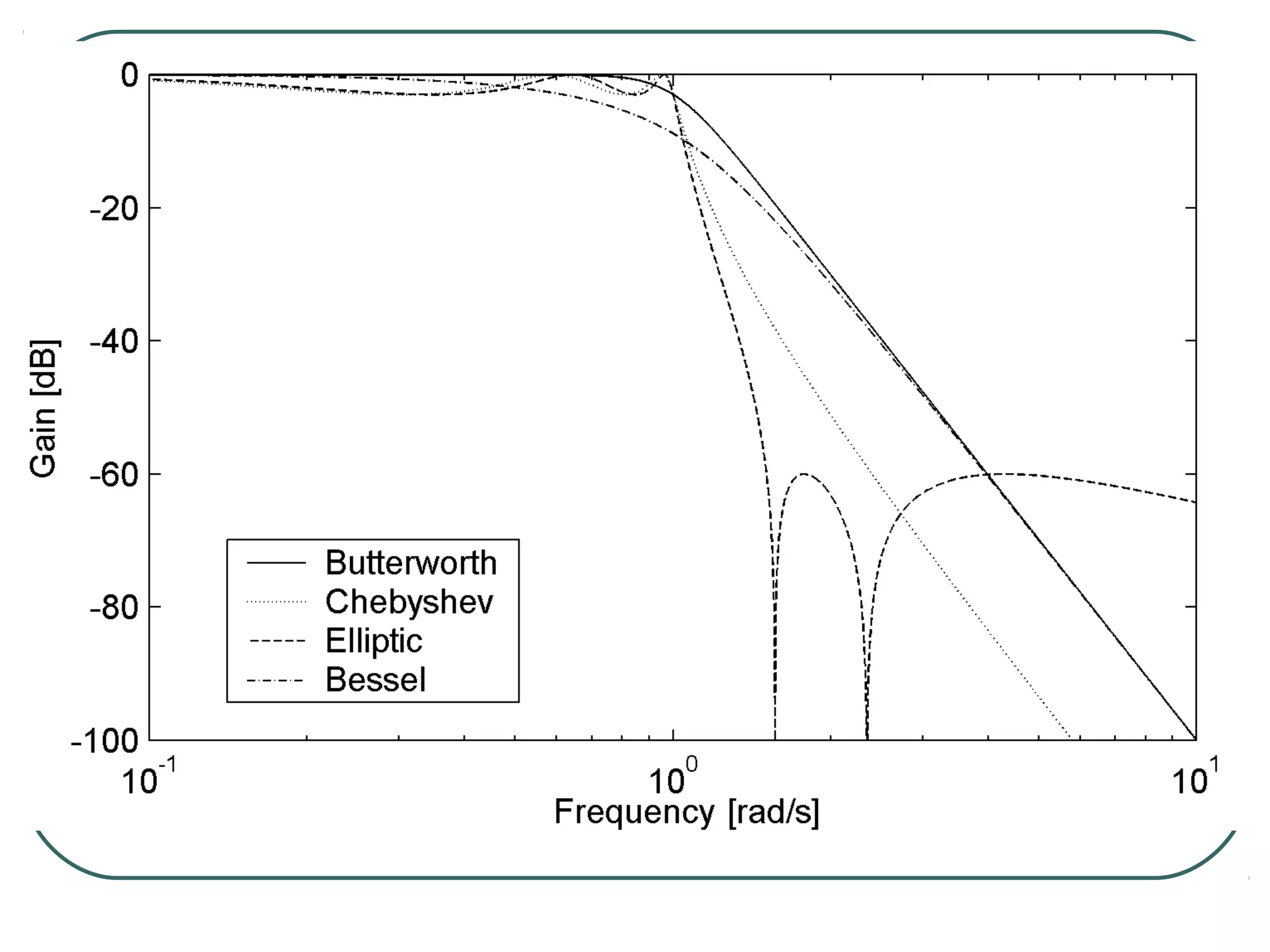
Standard Transfer Functions
   Butterworth
    •   Flat Pass-band.
    •   20n dB per decade roll-off.
   Chebyshev
    •   Pass-band ripple.
    •   Sharper cut-off than Butterworth.
   Elliptic
    •   Pass-band and stop-band ripple.
    •   Even sharper cut-off.
   Bessel
    •   Linear phase response – i.e. no signal distortion in
        pass-band.
Butterworth Filter
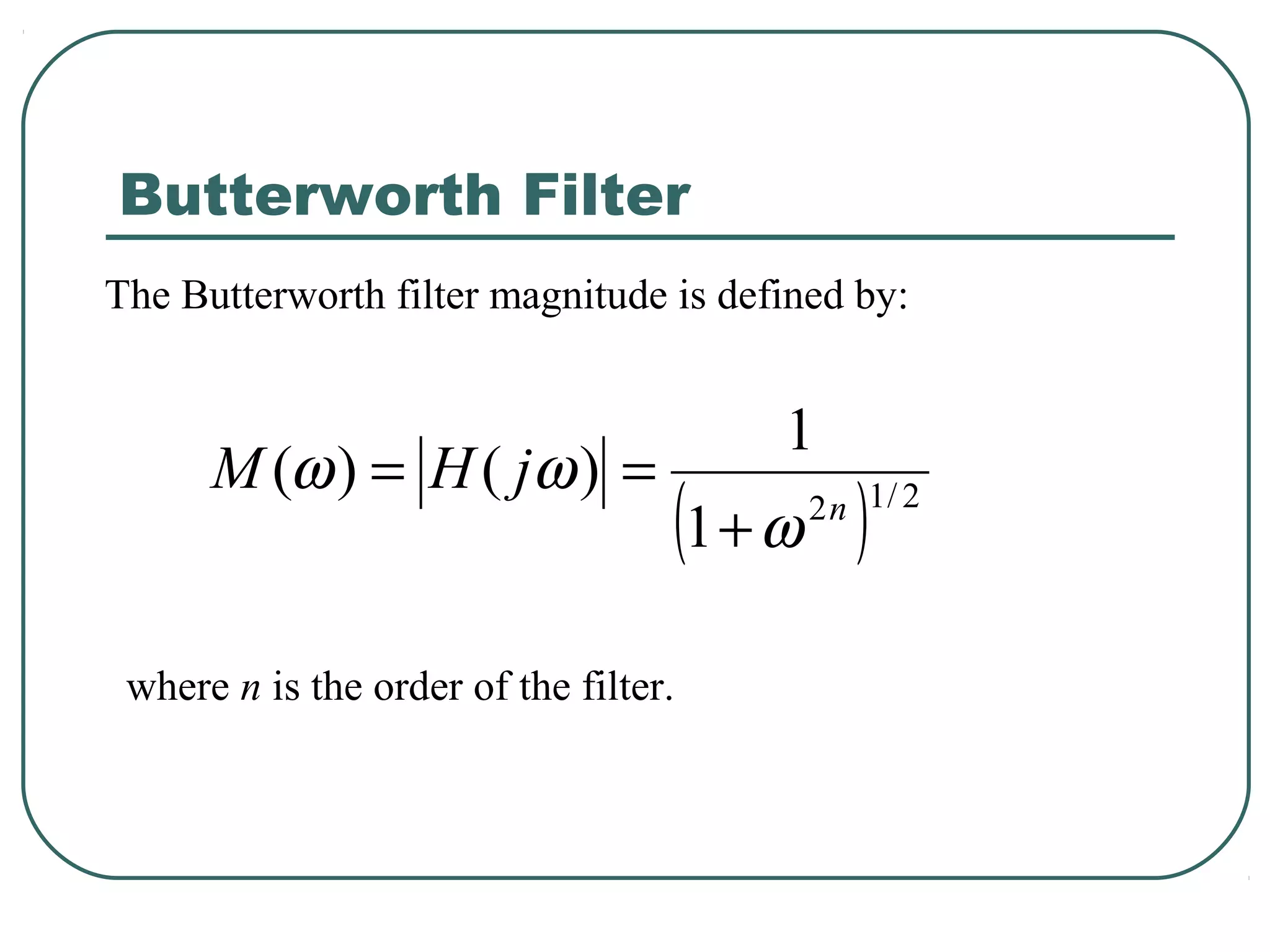
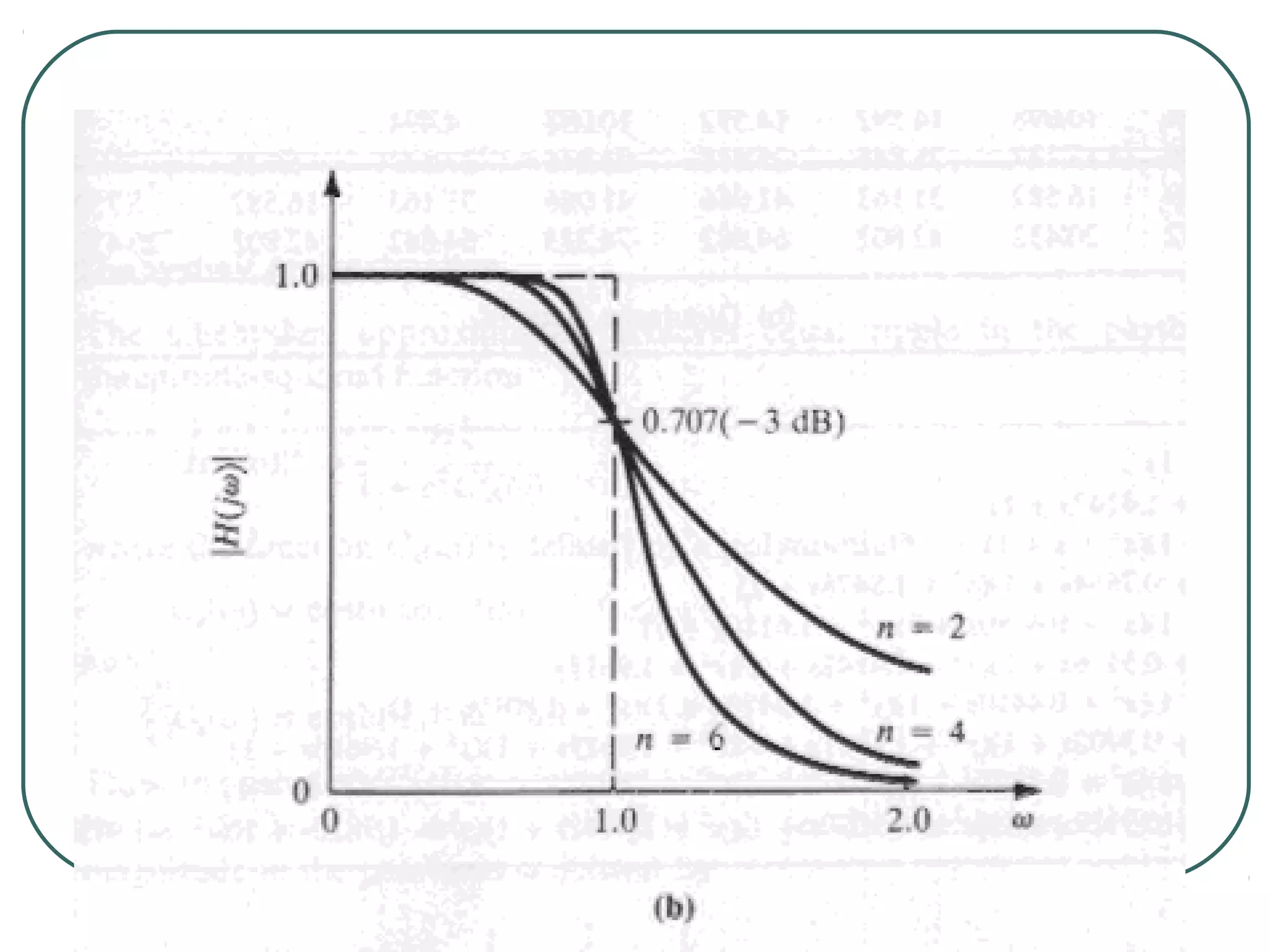
The Butterworth filter magnitude is defined by:


                                       1
      M (ω ) = H ( jω ) =
                                   (1 + ω )
                                         2 n 1/ 2


 where n is the order of the filter.
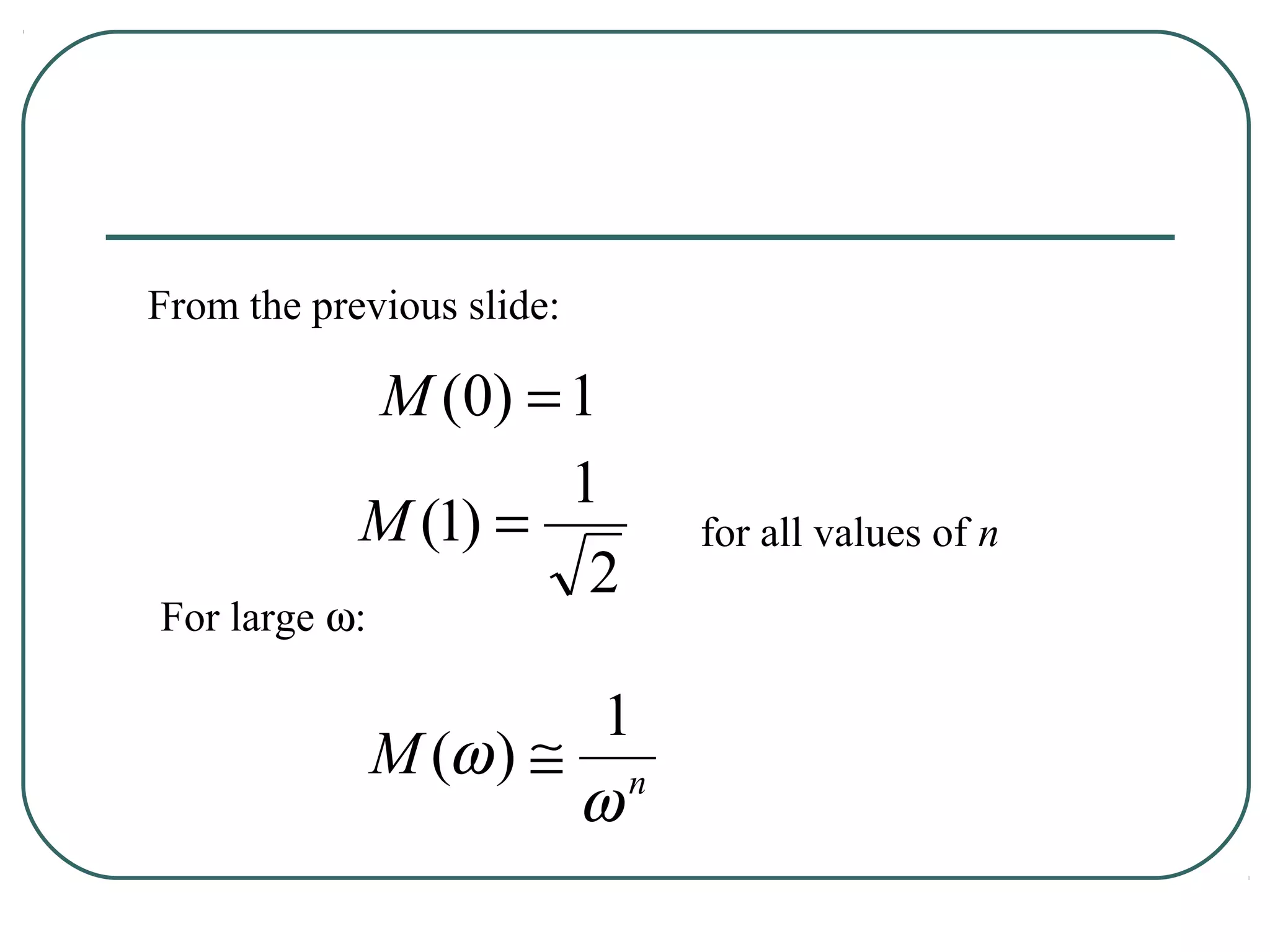
From the previous slide:

            M (0) = 1
                    1
            M (1) =         for all values of n
                     2
For large ω:

                        1
               M (ω ) ≅ n
                       ω
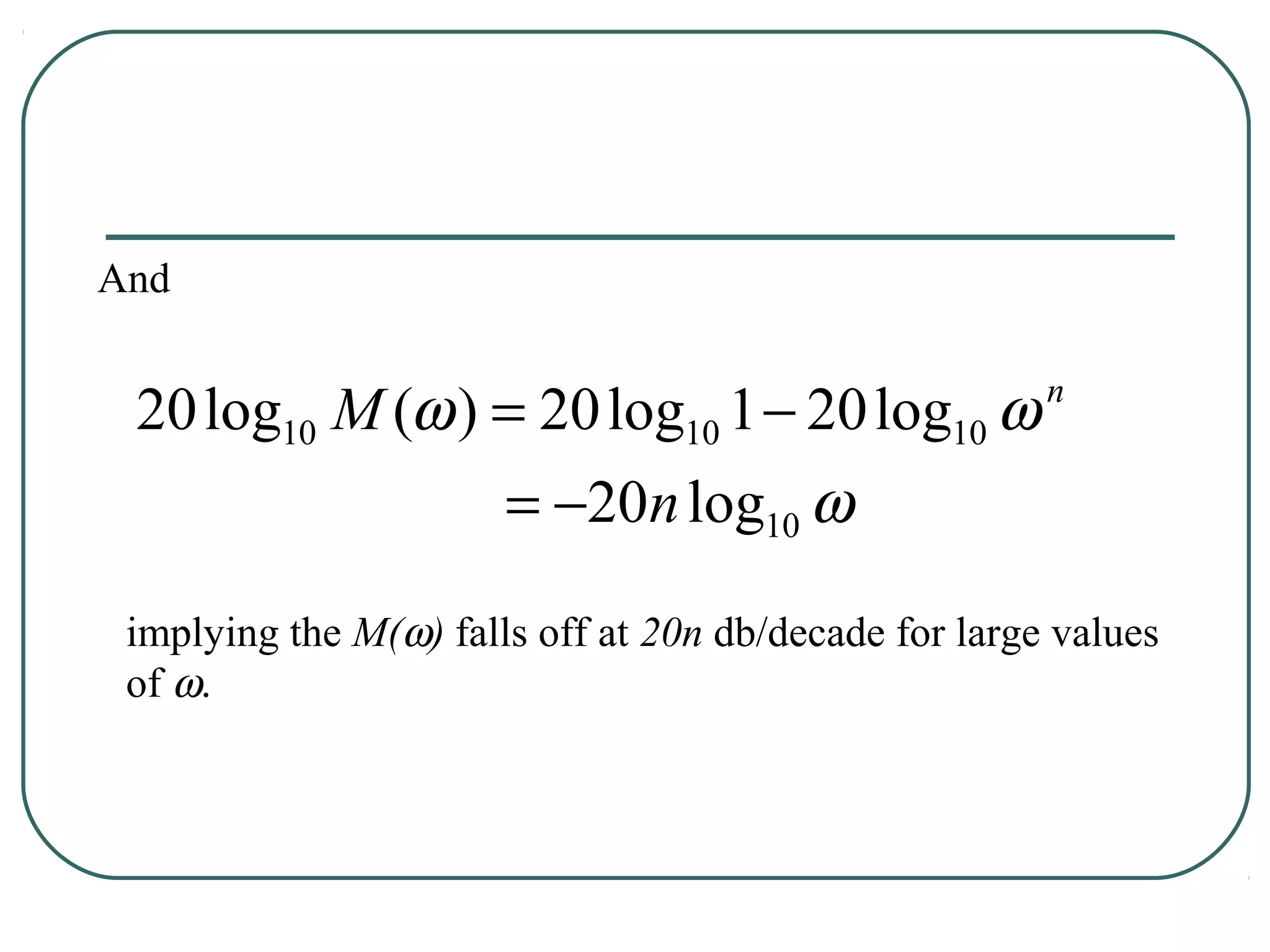
And


 20 log10 M (ω ) = 20 log10 1 − 20 log10 ω             n


                       = −20n log10 ω

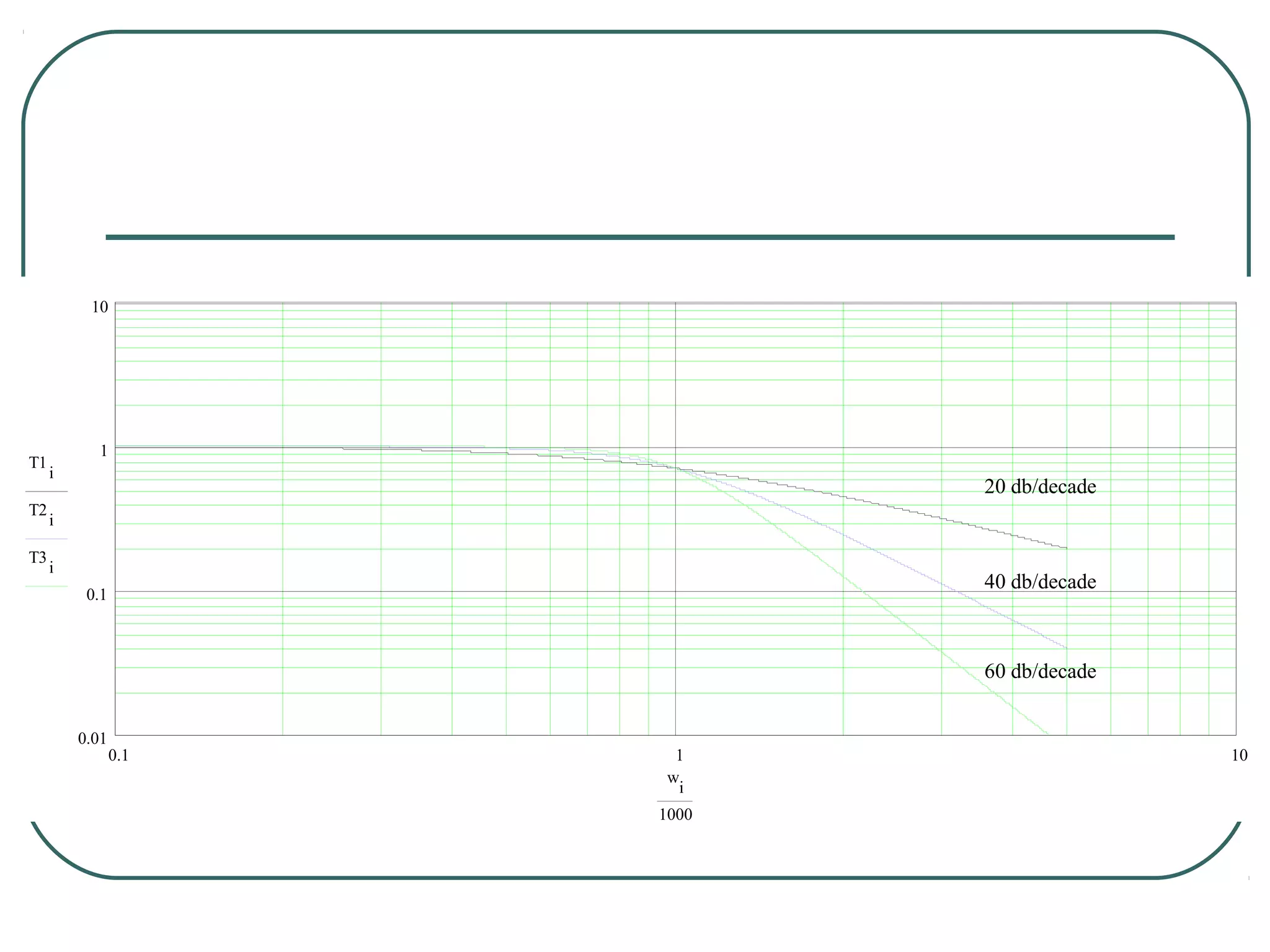
 implying the M(ω) falls off at 20n db/decade for large values
 of ω.
10


           1
T1
     i
                             20 db/decade
T2
     i

T3
     i
                             40 db/decade
          0.1


                             60 db/decade


         0.01
                0.1     1                   10
                       w
                        i
                      1000
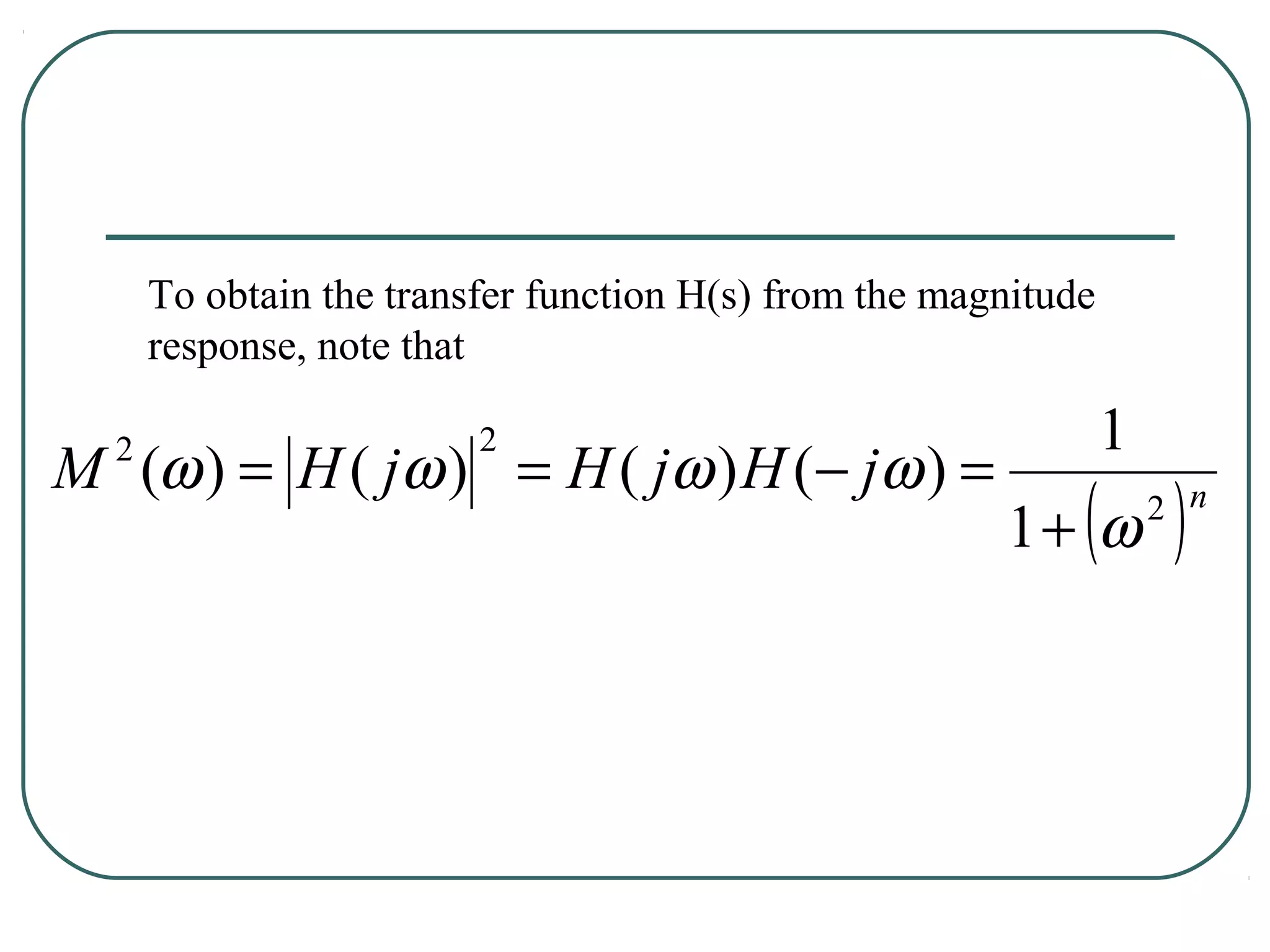
To obtain the transfer function H(s) from the magnitude
      response, note that

                         2                                      1
M (ω ) = H ( jω ) = H ( jω ) H (− jω ) =
  2

                                                       1+ ω ( )     2 n
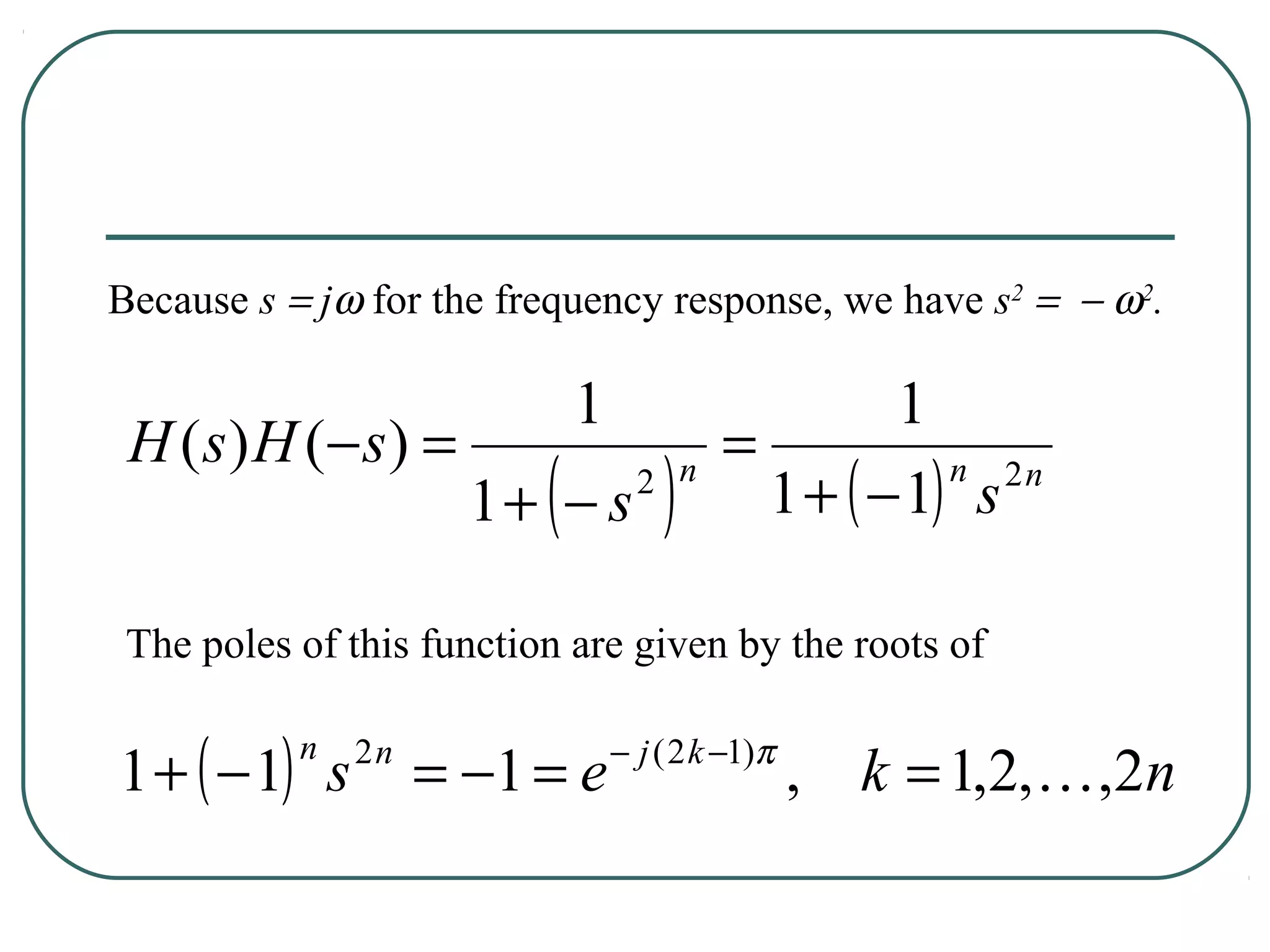
Because s = jω for the frequency response, we have s2 = − ω2.

                              1                     1
 H ( s) H (− s) =                          =
                          (
                      1+ − s          )
                                    2 n
                                             1 + ( − 1) s
                                                       n 2n


 The poles of this function are given by the roots of


1 + ( − 1) s                      − j ( 2 k −1)π
           n   2n
                    = −1 = e                       , k = 1,2,  ,2n
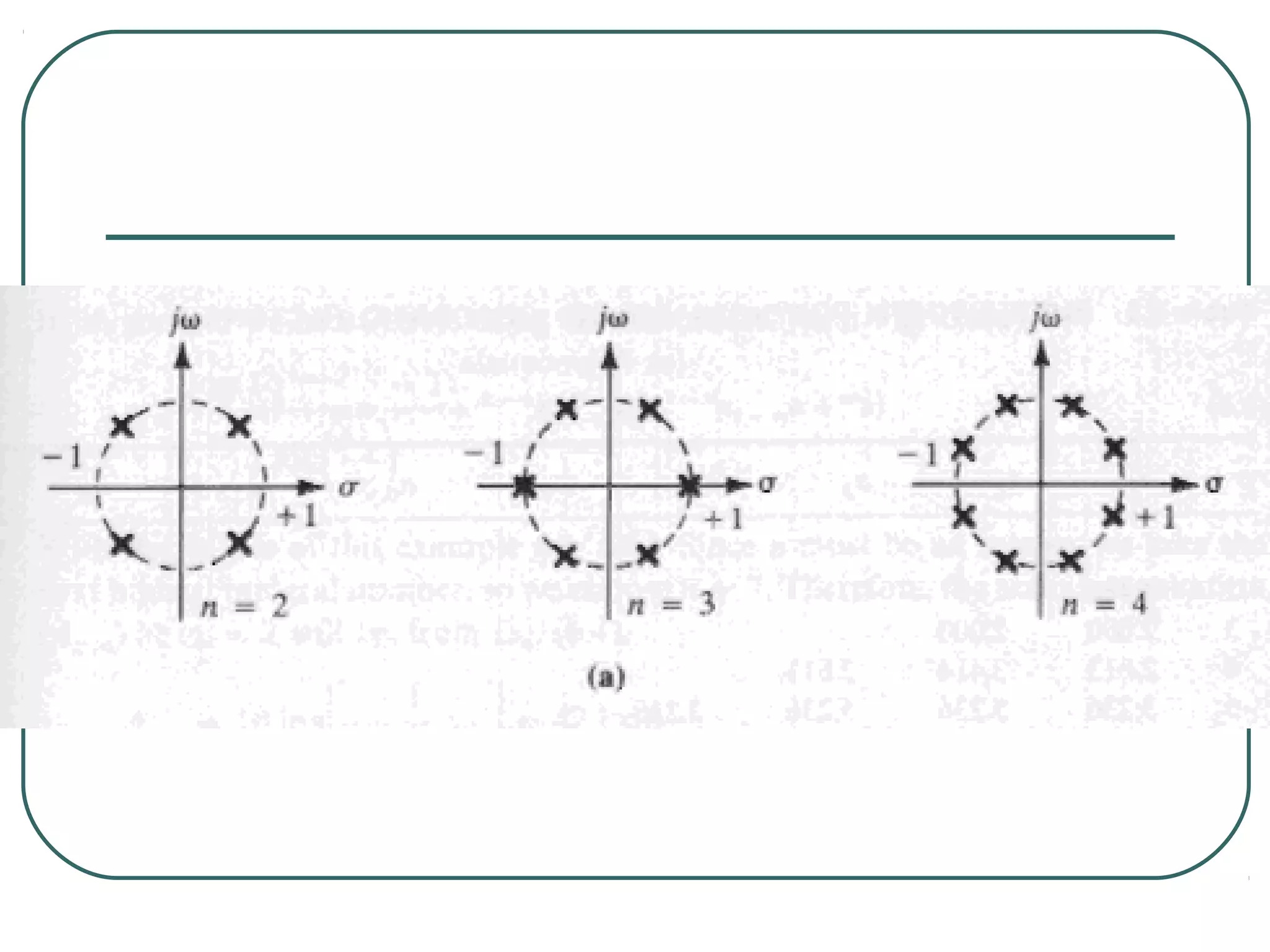
The 2n pole are:


              e j[(2k-1)/2n]π n even, k = 1,2,...,2n
       sk =
              e j(k/n)π   n odd, k = 0,1,2,...,2n-1


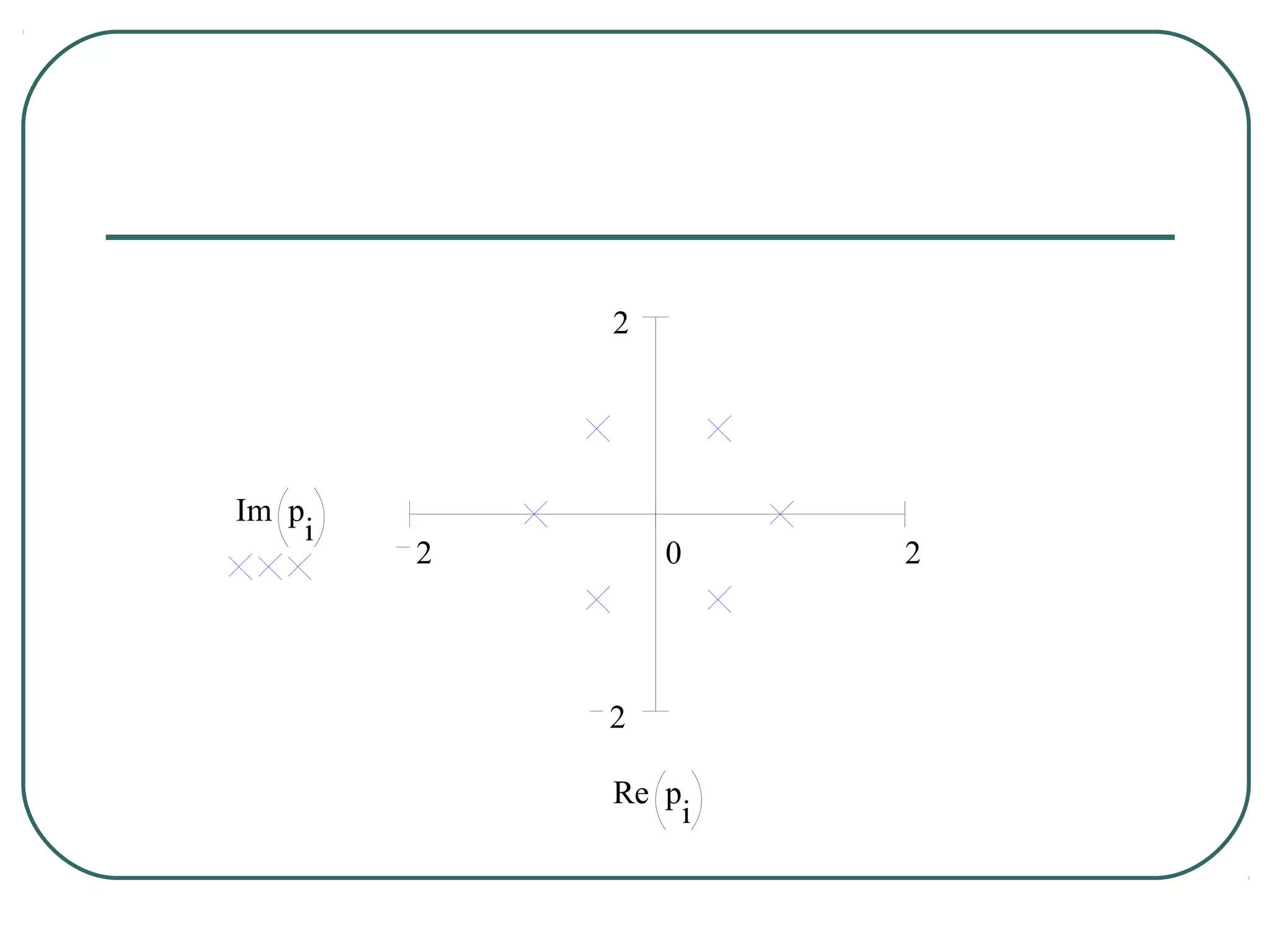
Note that for any n, the poles of the normalized Butterworth
filter lie on the unit circle in the s-plane. The left half-plane
poles are identified with H(s). The poles associated with
H(-s) are mirror images.
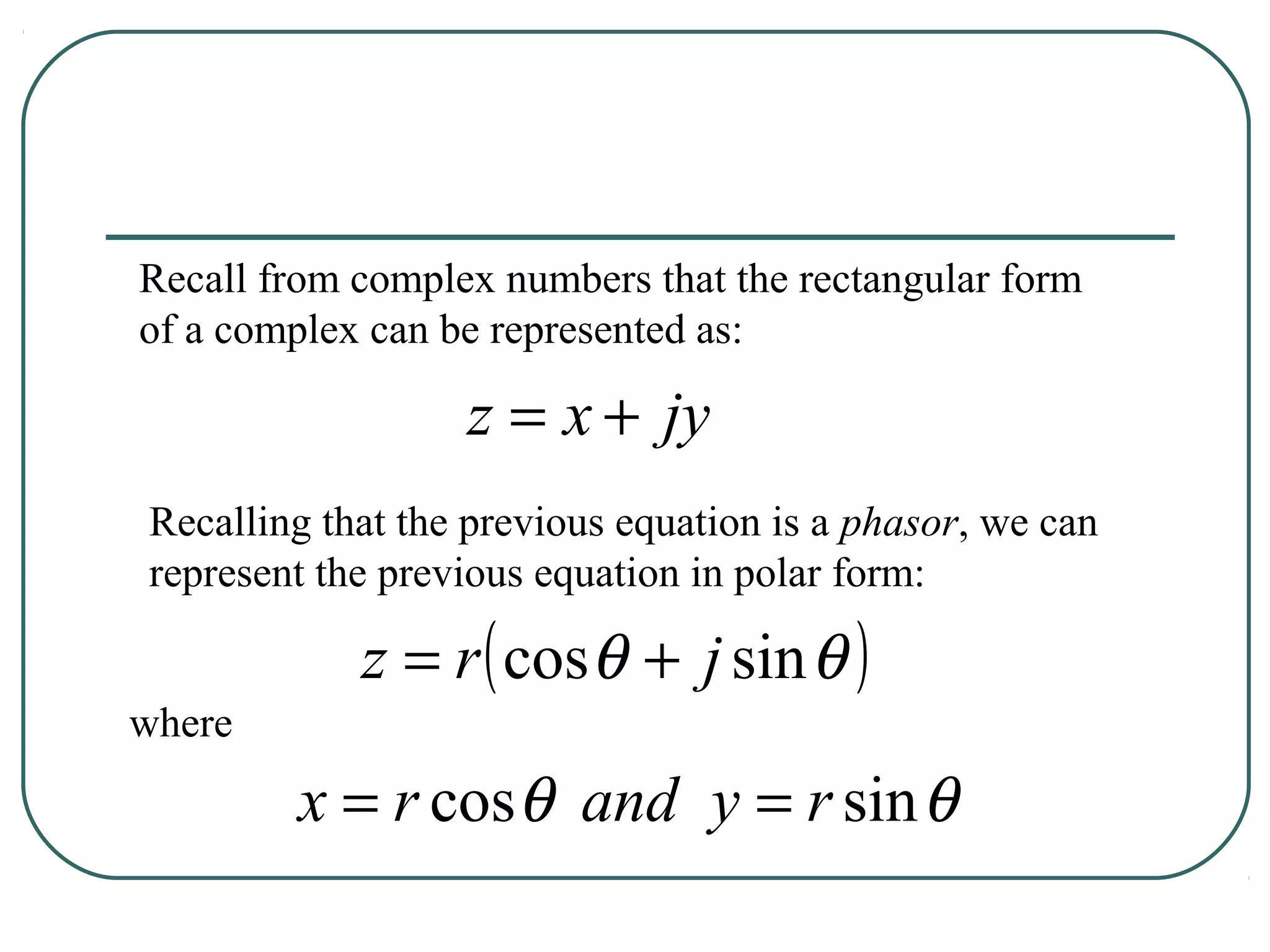
Recall from complex numbers that the rectangular form
of a complex can be represented as:

                  z = x + jy
Recalling that the previous equation is a phasor, we can
represent the previous equation in polar form:

            z = r ( cosθ + j sin θ )
where
        x = r cosθ and y = r sin θ
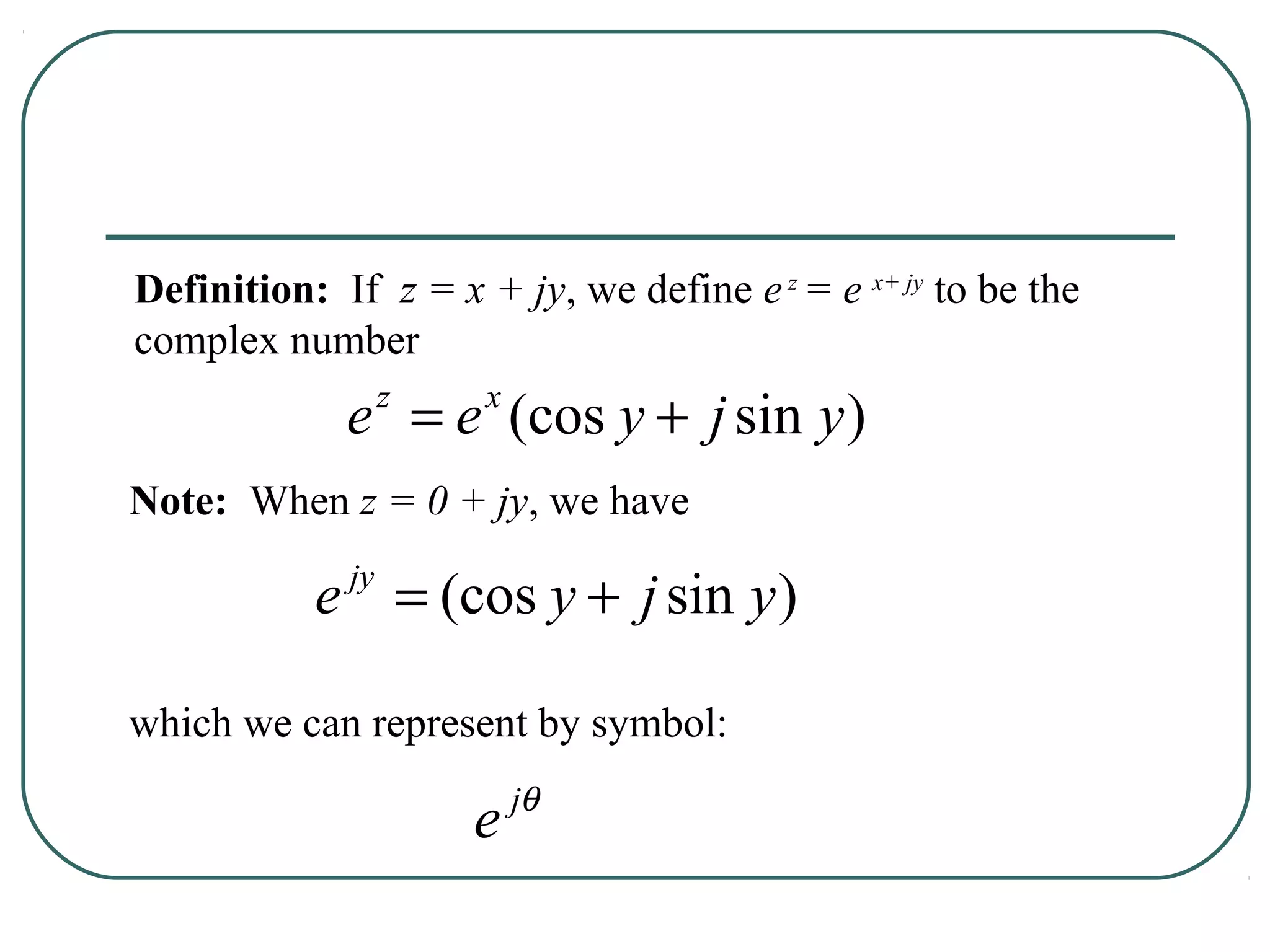
Definition: If z = x + jy, we define e z = e x+ jy to be the
complex number
             e = e (cos y + j sin y )
               z      x


Note: When z = 0 + jy, we have

           e jy = (cos y + j sin y )

which we can represent by symbol:
                          jθ
                     e
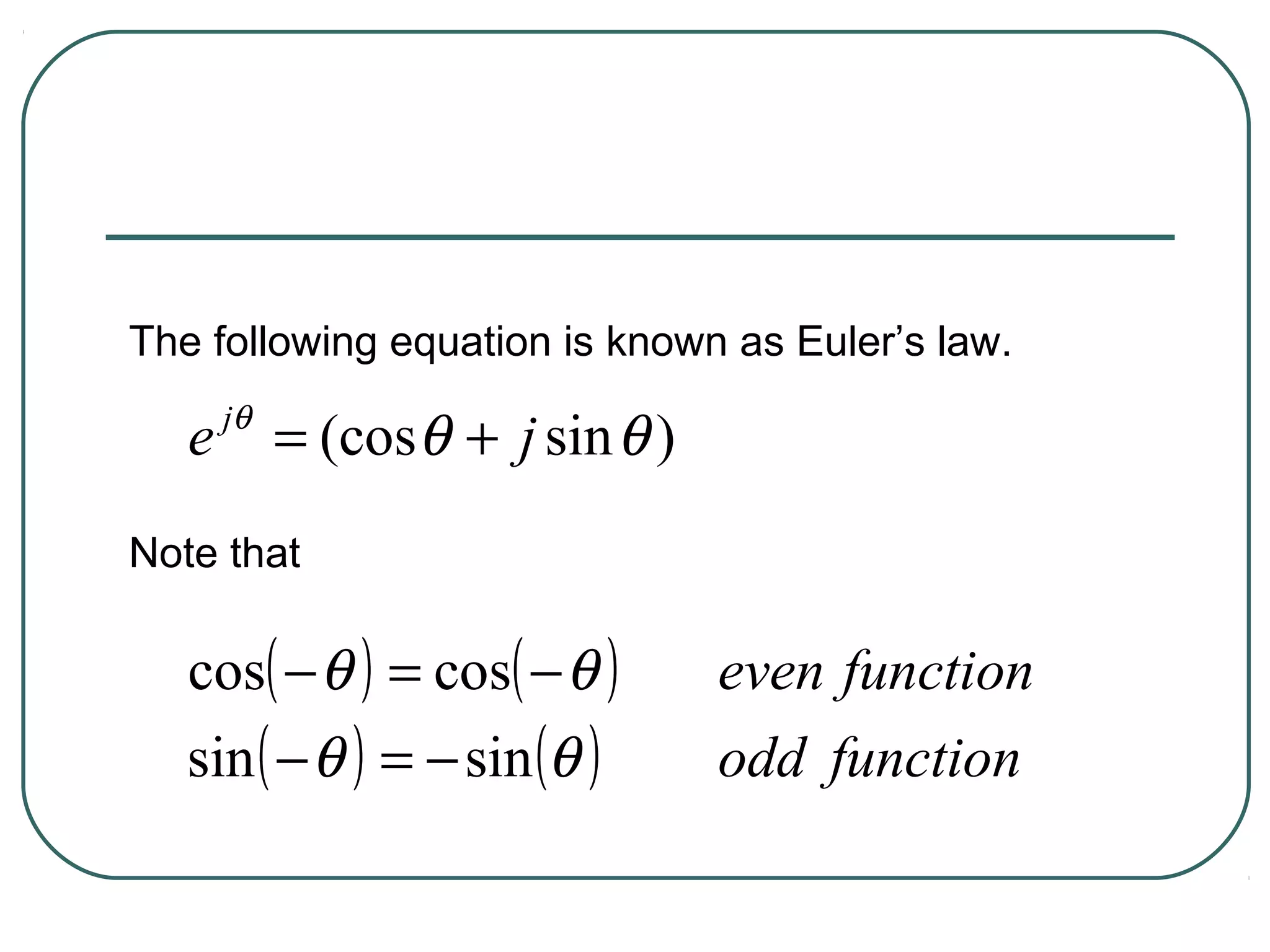
The following equation is known as Euler’s law.
       jθ
   e        = (cosθ + j sin θ )
Note that

   cos( − θ ) = cos( − θ )        even function
   sin ( − θ ) = − sin (θ )       odd function
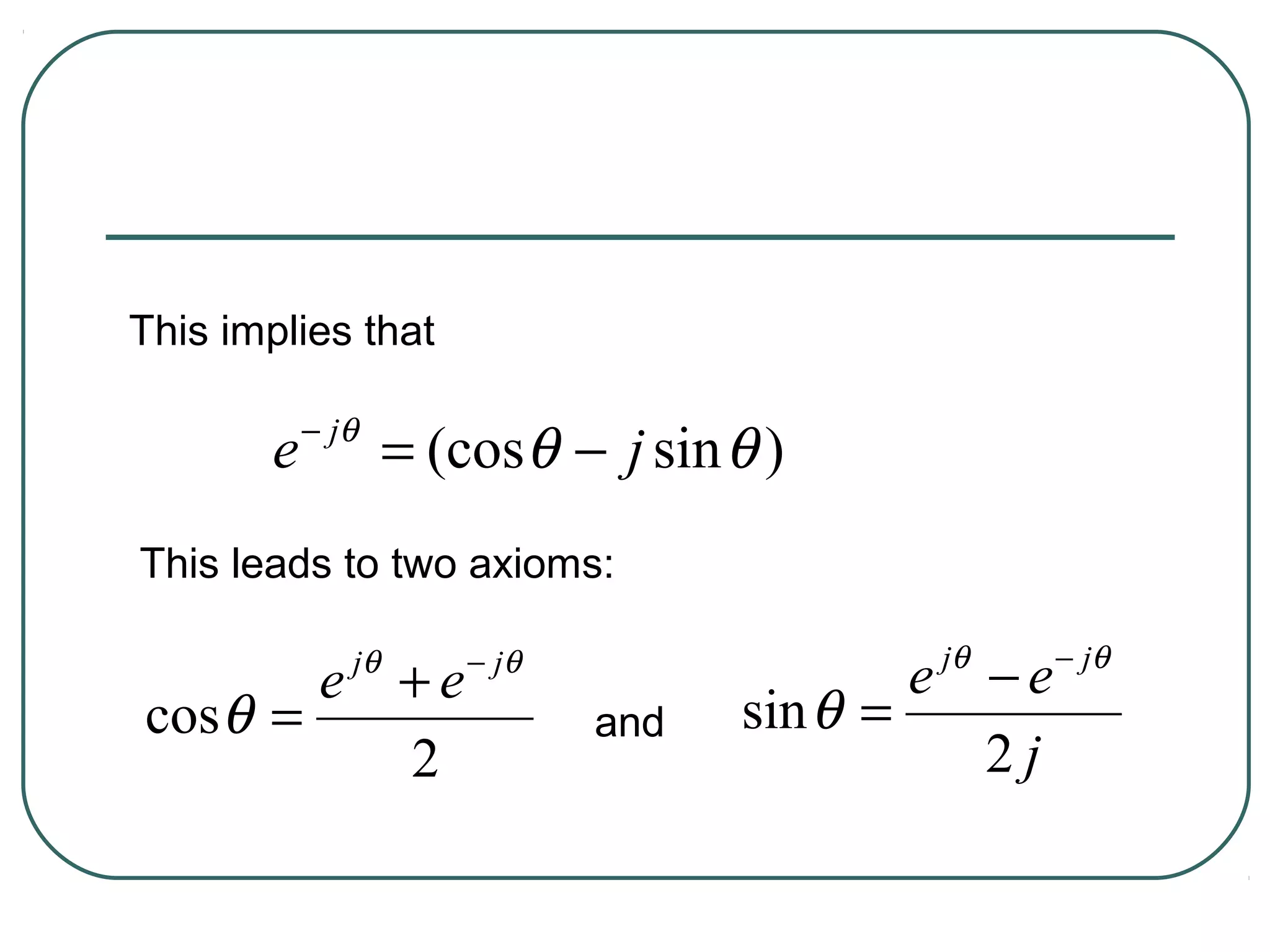
This implies that

           − jθ
       e           = (cosθ − j sin θ )
This leads to two axioms:

                                           jθ      − jθ
        e +e  jθ       − jθ
                                            e −e
cos θ =                       and   sin θ =
          2                                   2j
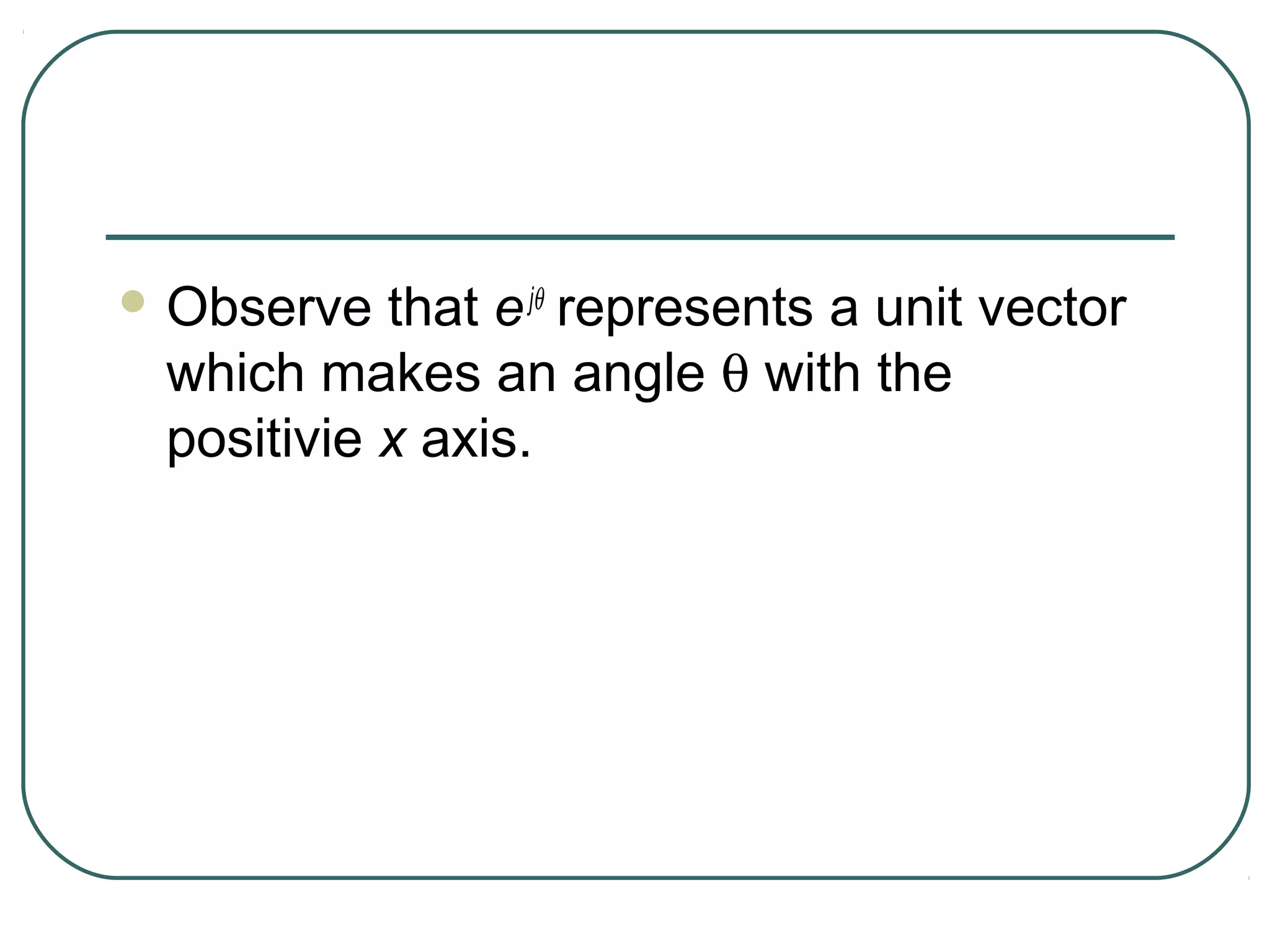
 Observe  that e jθ represents a unit vector
 which makes an angle θ with the
 positivie x axis.
Find the transfer function that corresponds to a third-order
(n = 3) Butterworth filter.

Solution:
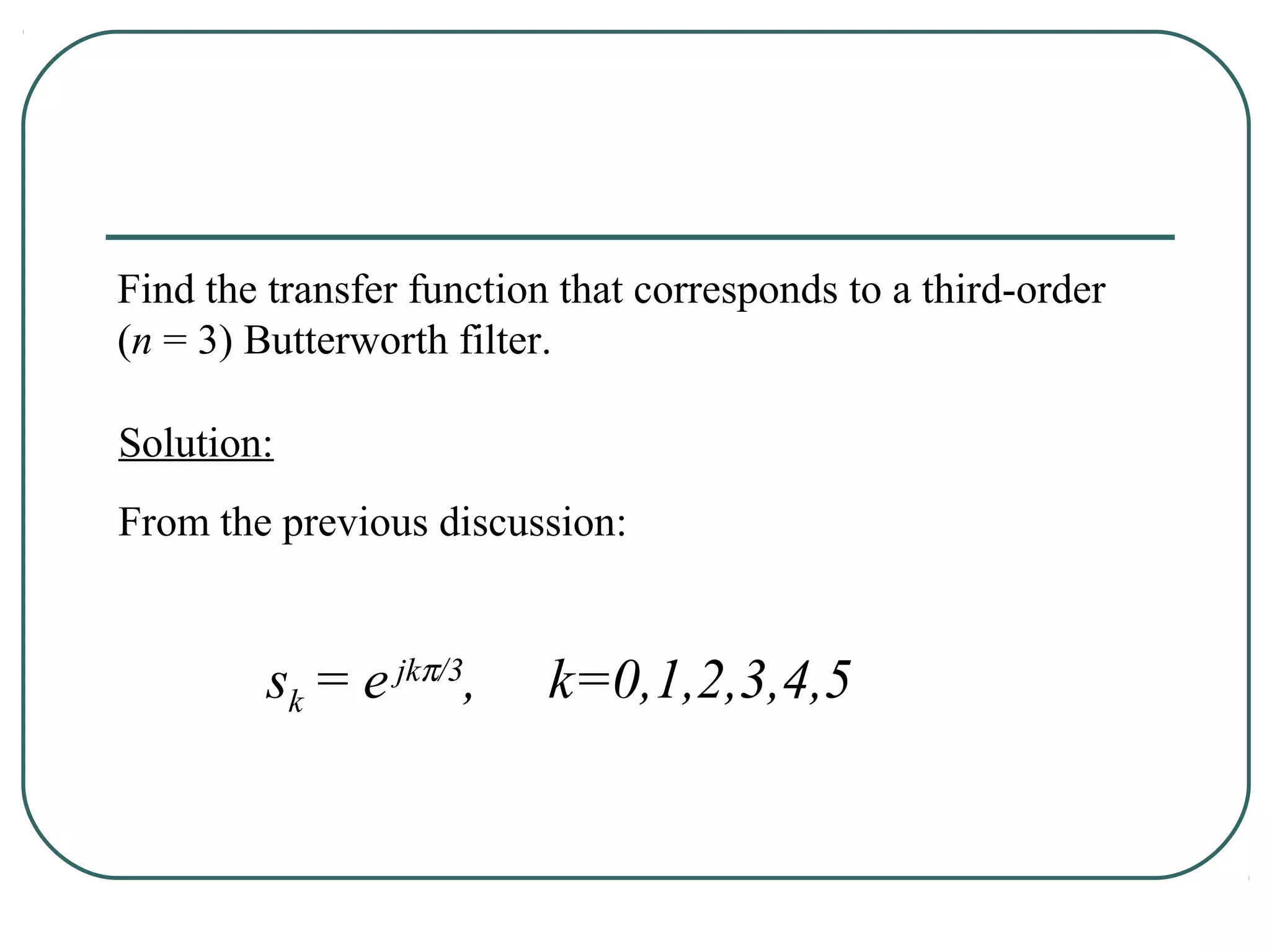
From the previous discussion:


         sk = e jkπ/3,    k=0,1,2,3,4,5
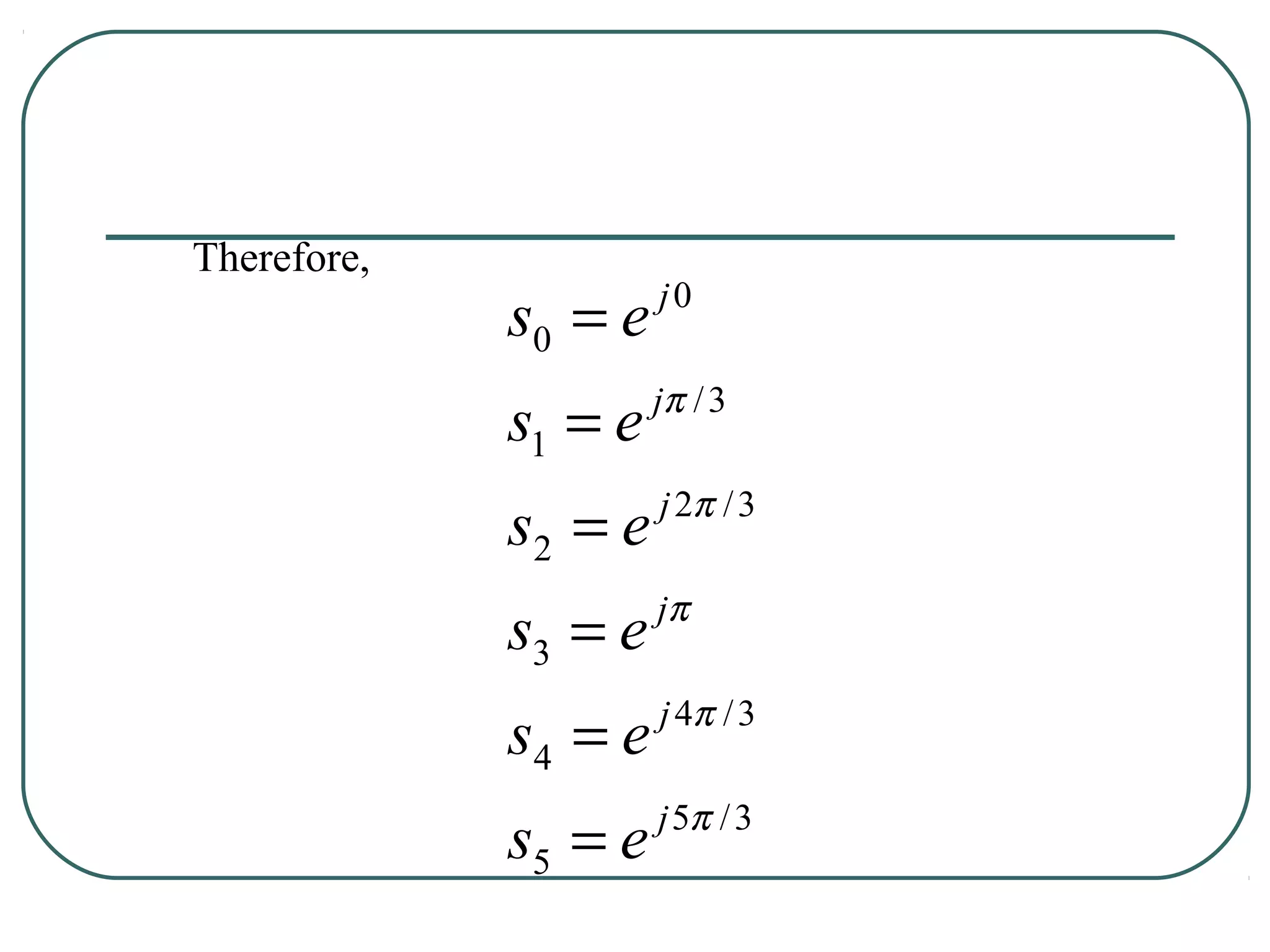
Therefore,
             s0 = e   j0

                      jπ / 3
             s1 = e
                      j 2π / 3
             s2 = e
                      jπ
             s3 = e
                      j 4π / 3
             s4 = e
                      j 5π / 3
             s5 = e
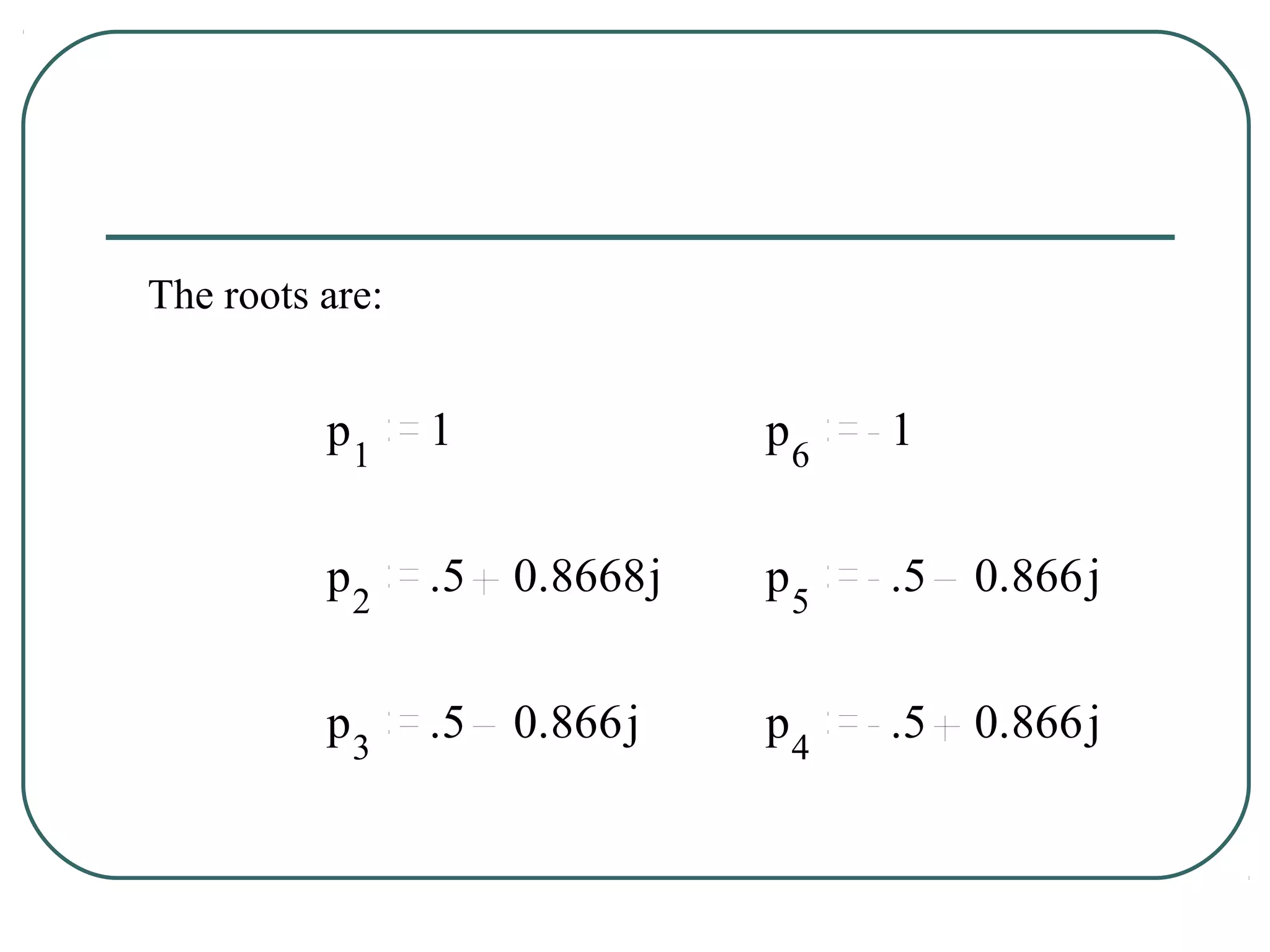
The roots are:


          p1     1         p6   1


          p2     .5         ..
                      0.8668j p5 .5 0.866 j


          p3     .5        . .
                      0.866j p4 .5 0.866 j
2


Im p
       i
           2       0       2


               2

               Re p
                       i
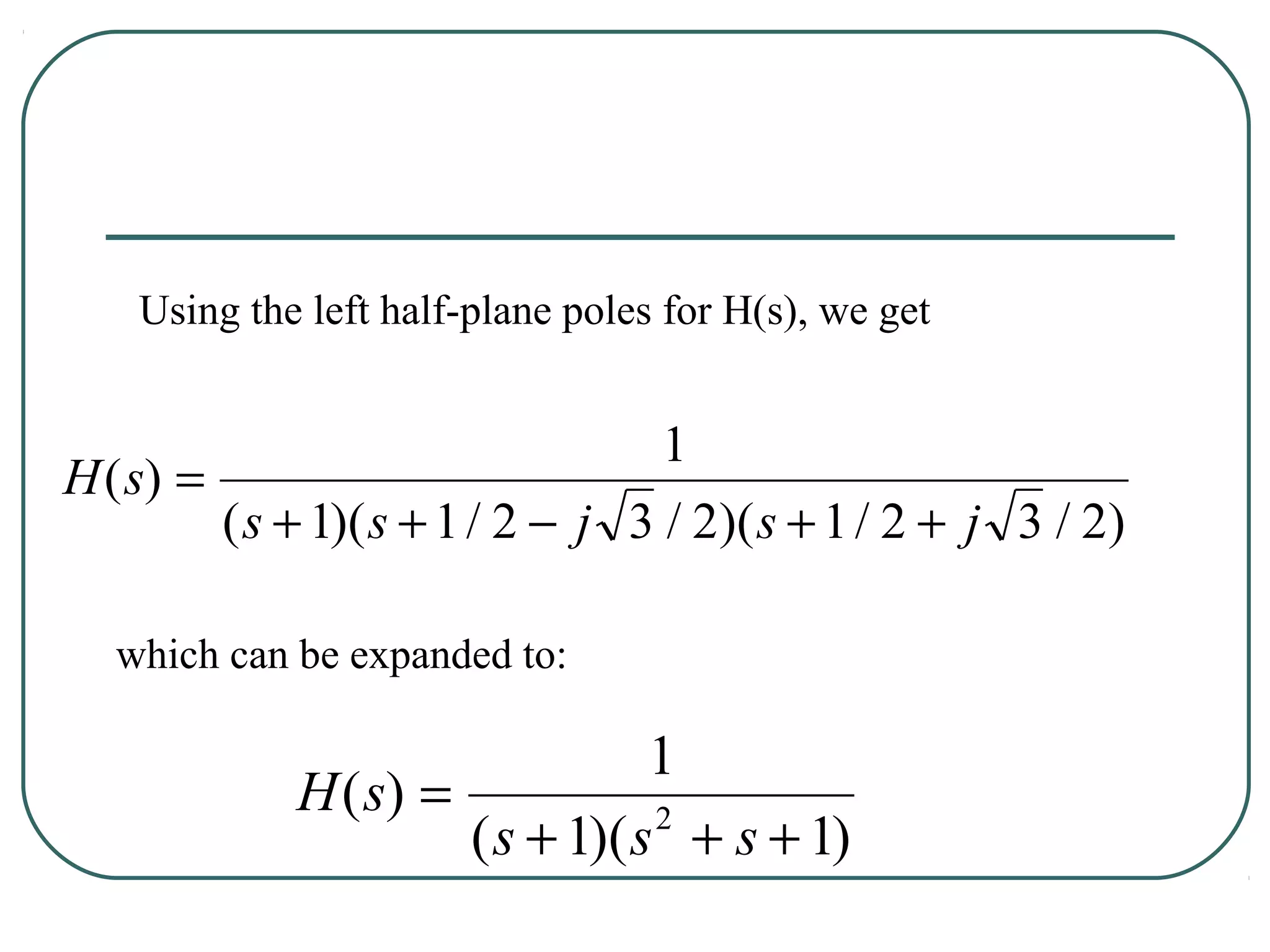
Using the left half-plane poles for H(s), we get


                                   1
H ( s) =
         ( s + 1)( s + 1 / 2 − j 3 / 2)( s + 1 / 2 + j 3 / 2)

   which can be expanded to:

                                 1
             H ( s) =
                      ( s + 1)( s + s + 1)
                                 2
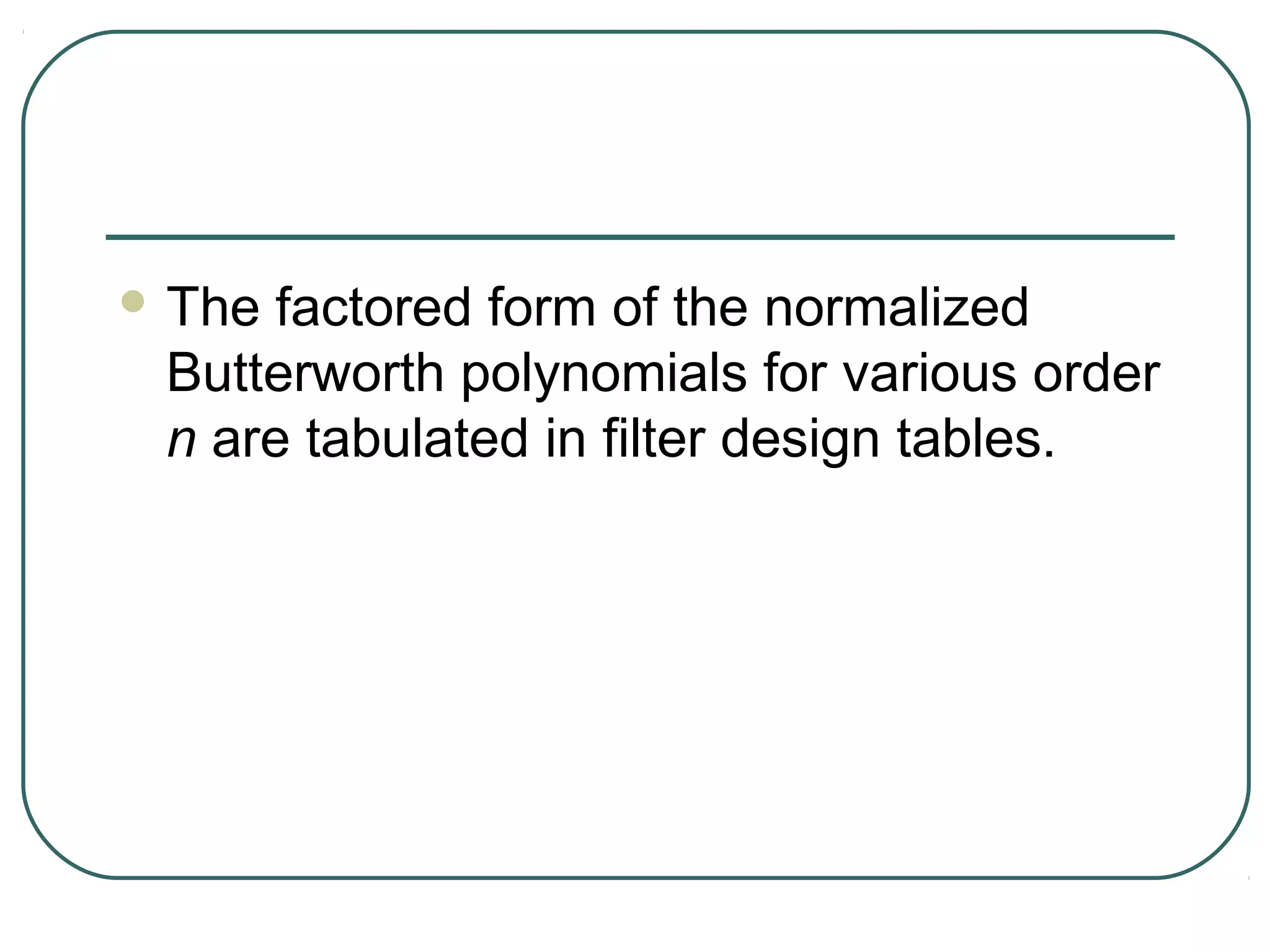
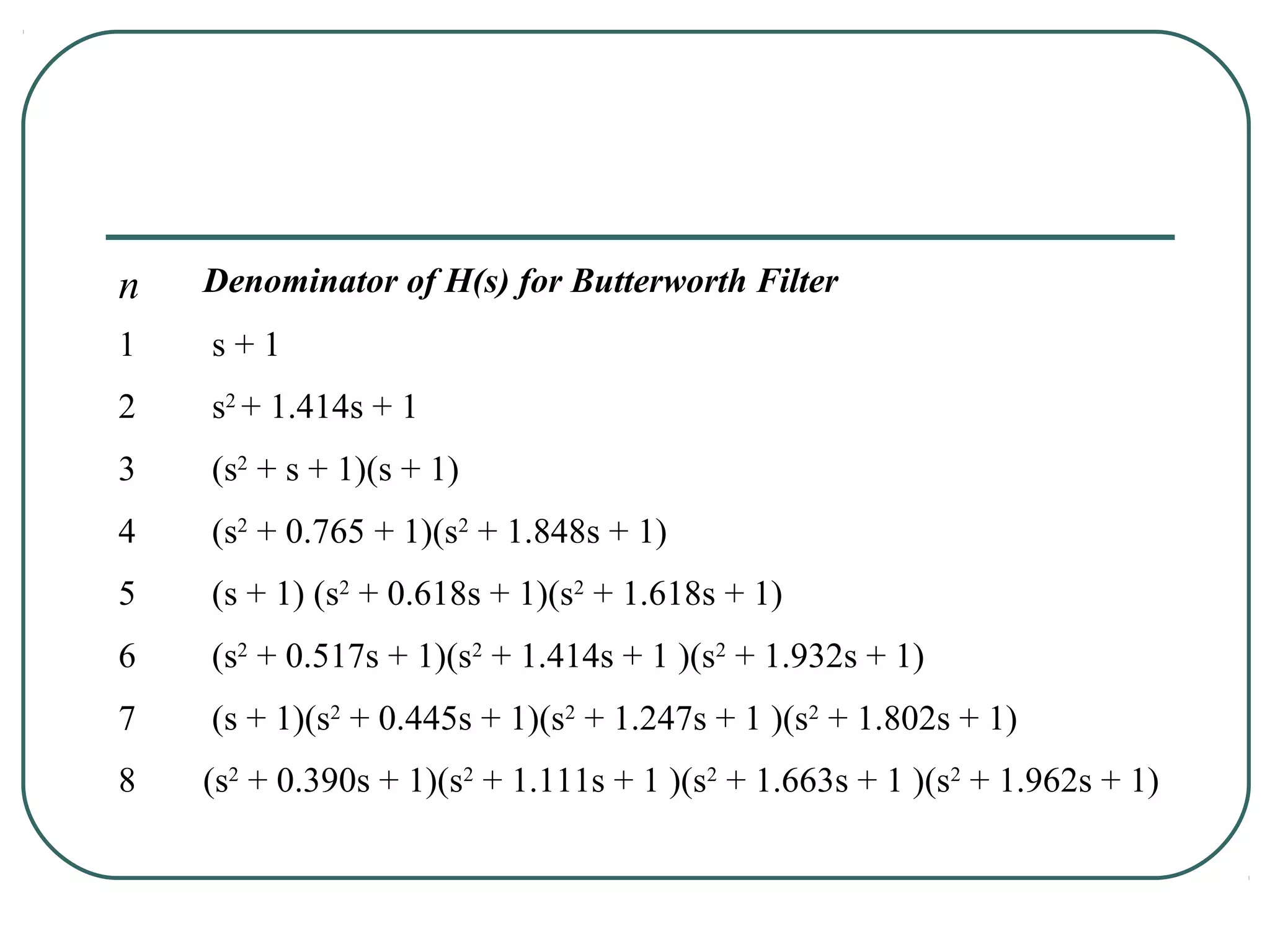
 The factored form of the normalized
 Butterworth polynomials for various order
 n are tabulated in filter design tables.
n   Denominator of H(s) for Butterworth Filter
1   s+1
2   s2 + 1.414s + 1
3   (s2 + s + 1)(s + 1)
4   (s2 + 0.765 + 1)(s2 + 1.848s + 1)
5   (s + 1) (s2 + 0.618s + 1)(s2 + 1.618s + 1)
6   (s2 + 0.517s + 1)(s2 + 1.414s + 1 )(s2 + 1.932s + 1)
7   (s + 1)(s2 + 0.445s + 1)(s2 + 1.247s + 1 )(s2 + 1.802s + 1)
8   (s2 + 0.390s + 1)(s2 + 1.111s + 1 )(s2 + 1.663s + 1 )(s2 + 1.962s + 1)
Frequency Transformations
So far we have looked at the Butterworth filter
with a normalized cutoff frequency

            ω c = 1 rad / sec

By means of a frequency transformation, we
can obtain a lowpass, bandpass, bandstop, or
highpass filter with specific cutoff frequencies.
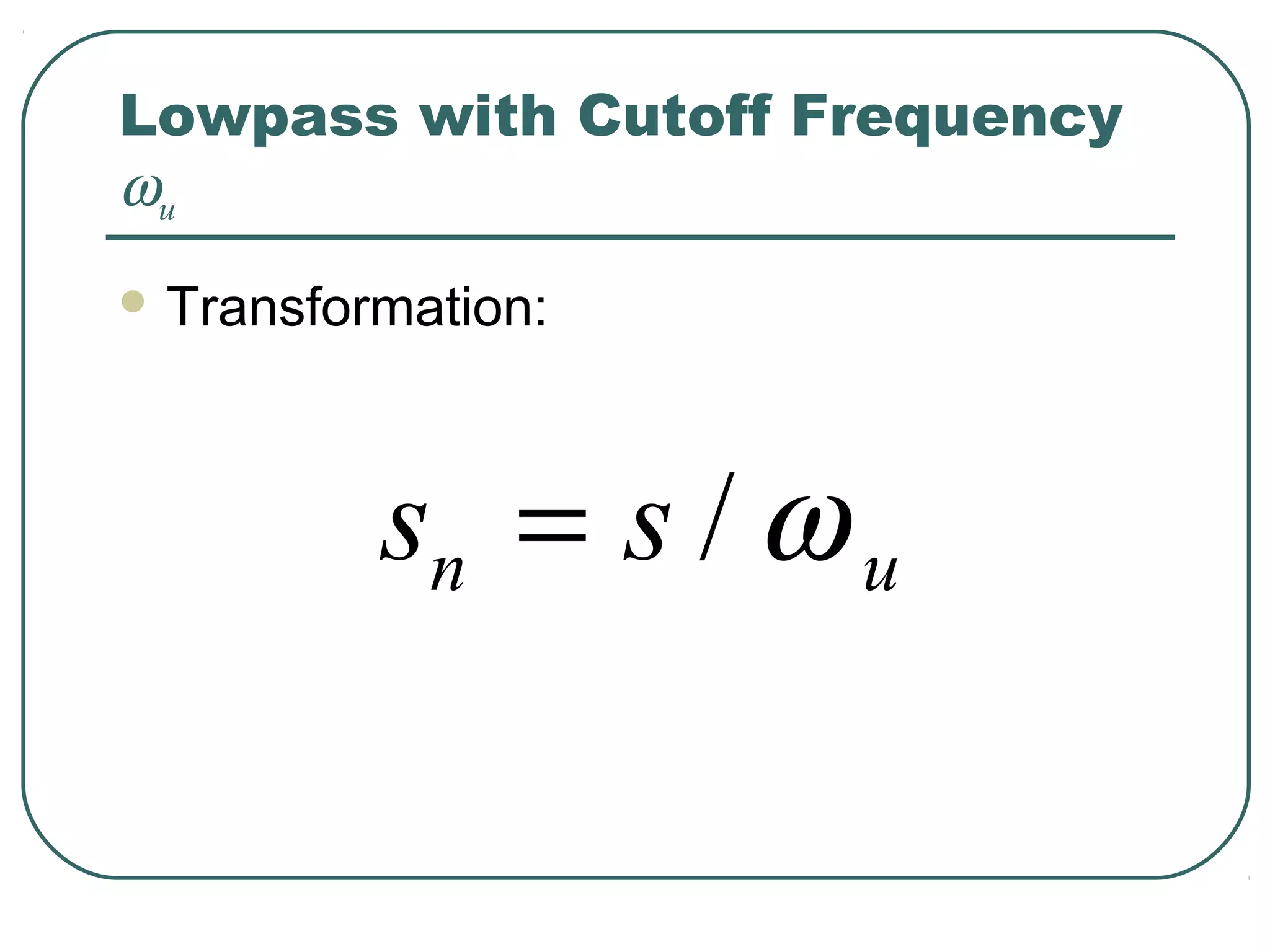
Lowpass with Cutoff Frequency
ωu
 Transformation:


          sn = s / ω u
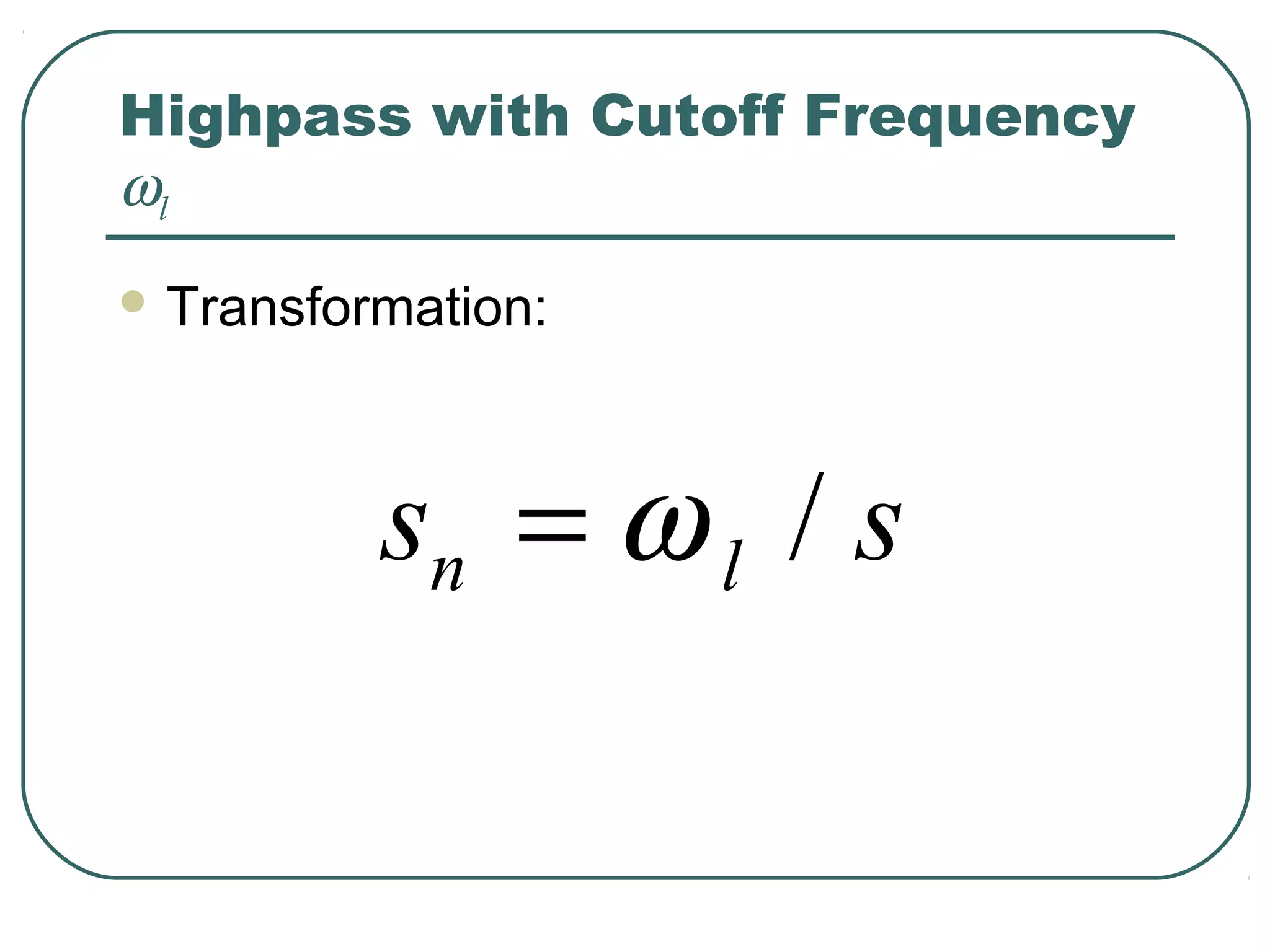
Highpass with Cutoff Frequency
ωl
 Transformation:


          sn = ω l / s
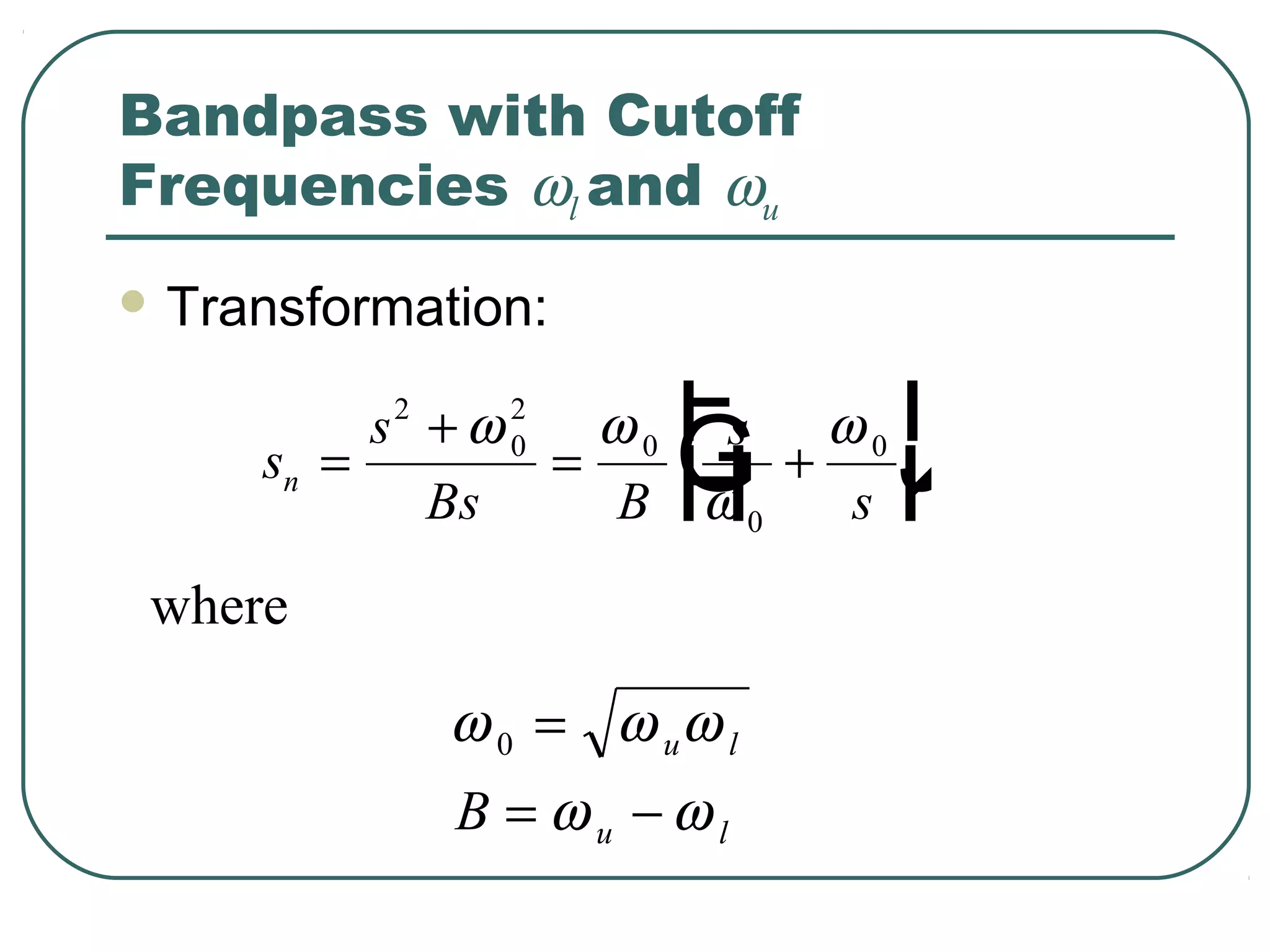
Bandpass with Cutoff
Frequencies ωl and ωu
 Transformation:


                      F
                      G
          s2 + ω 2 ω 0 s ω 0    I
                                J
     sn =          =
                      H   +
                                K
                 0

             Bs      B ω0   s
 where

             ω 0 = ω uω l
             B = ωu −ωl
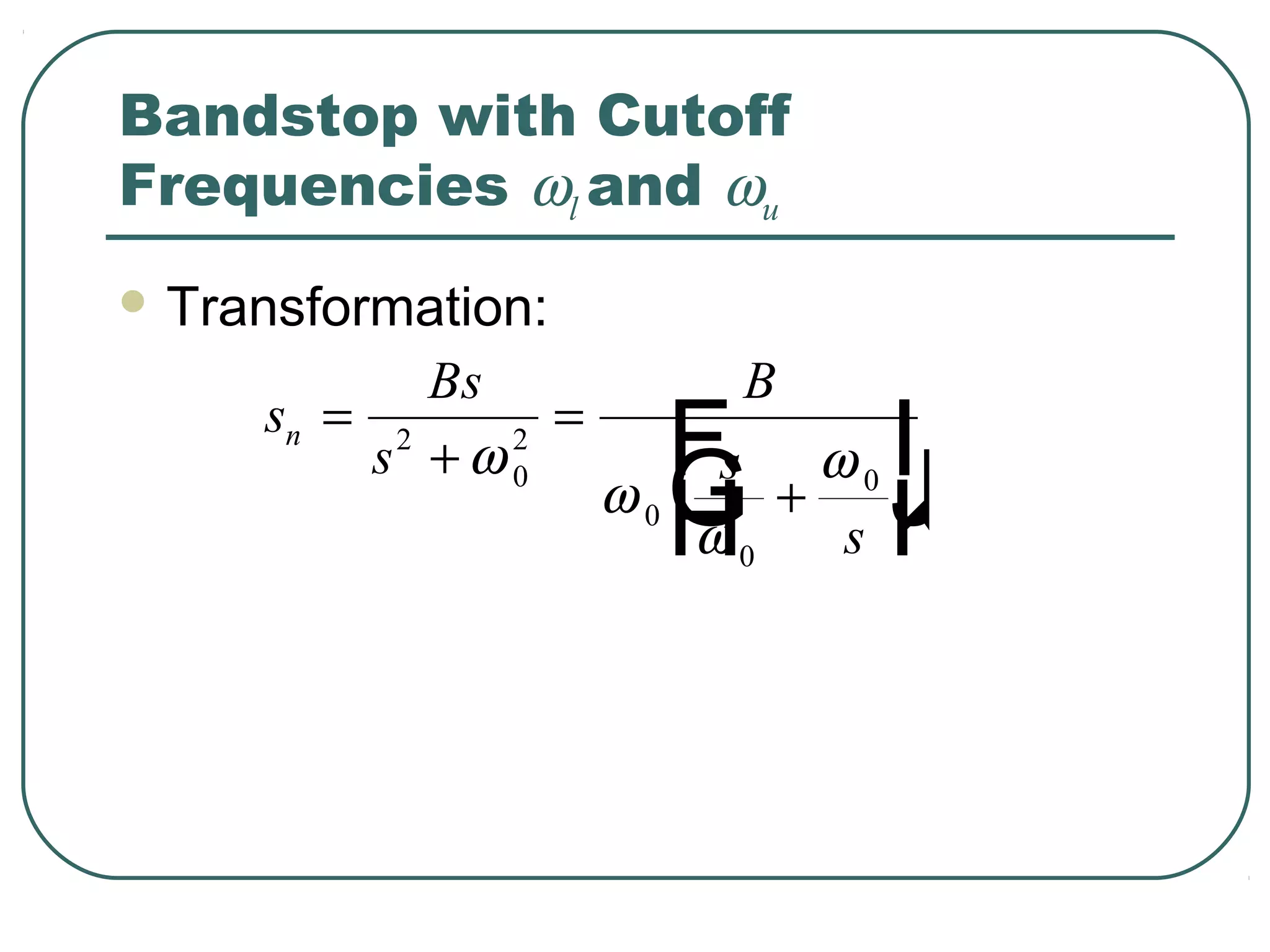
Bandstop with Cutoff
Frequencies ωl and ωu
 Transformation:

            Bs            B
     sn = 2
         s +ω0 2
                 =
                       Fs + ω I
                     ω G      J
                       H sK
                              0

                        ω
                      0
                          0
Active Filters
 To  achieve a gain > 1, we need to utilize
  an op-amp based circuit to form an
  active filter
 We can design all the common filter
  types using op-amp based active filters
 Recall for an ideal op-amp that

             V+ = V–       I+ = I – = 0

   Lect23            EEE 202            61
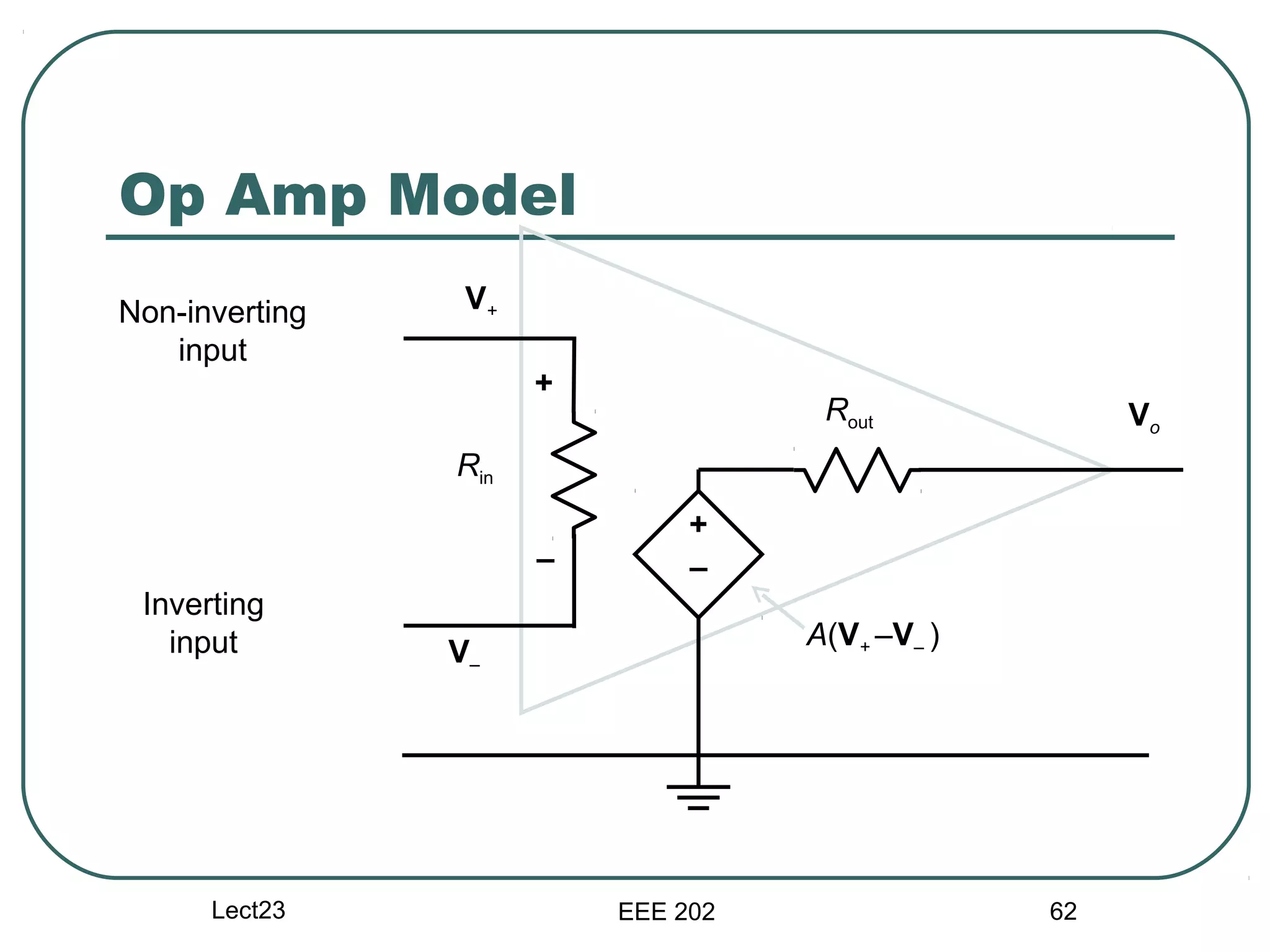
Op Amp Model
Non-inverting    V+
   input
                      +
                                     Rout             Vo
                Rin
                               +
                      –        –
 Inverting
   input                            A(V+ –V– )
                V–


      Lect23              EEE 202                62
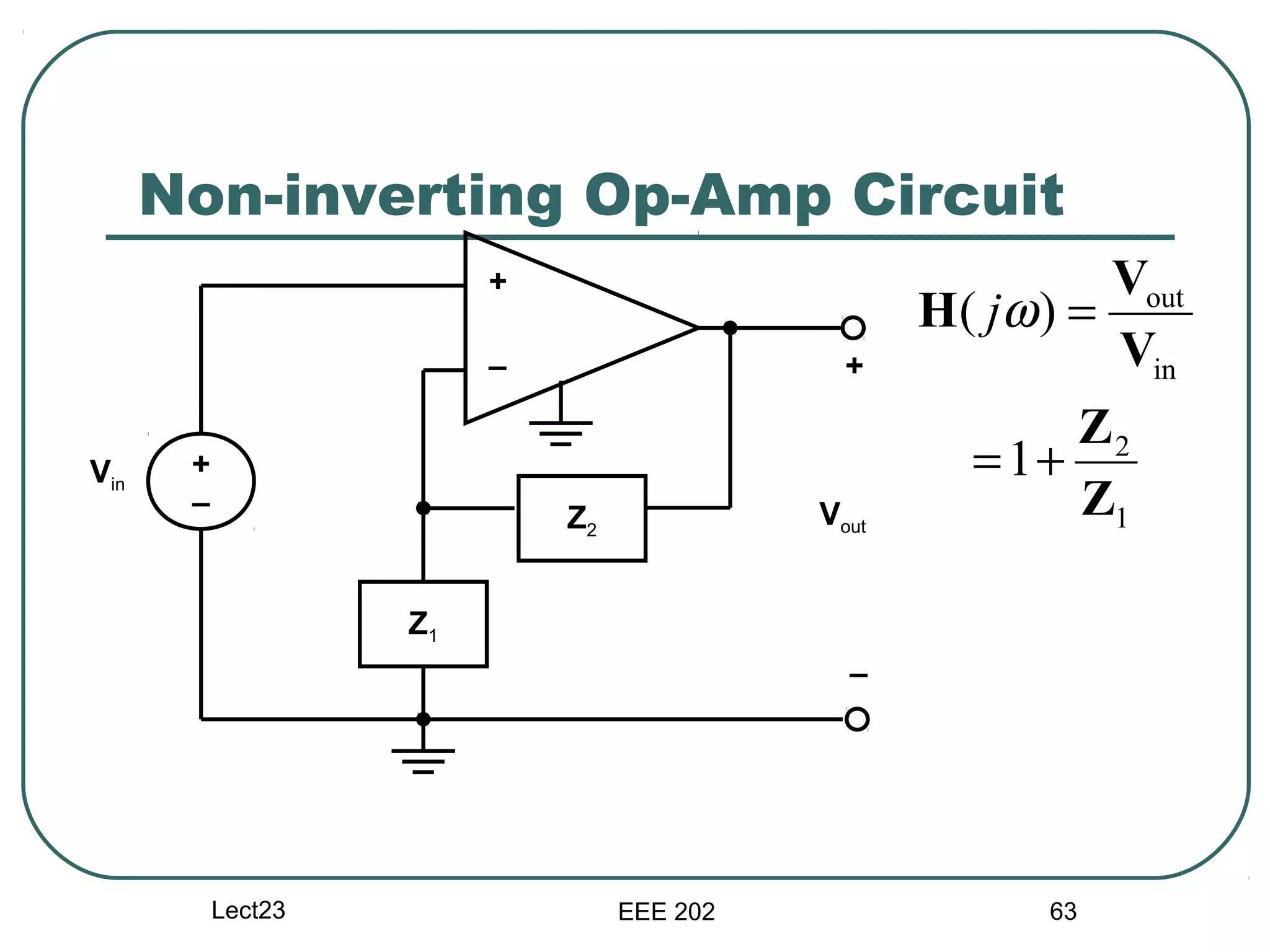
Non-inverting Op-Amp Circuit
                         +                                    Vout
                                                   H ( jω ) =
                         –                    +               Vin
                                                           Z2
Vin    +                                              = 1+
       –                     Z2             Vout           Z1

                    Z1
                                              –


           Lect23                 EEE 202                 63
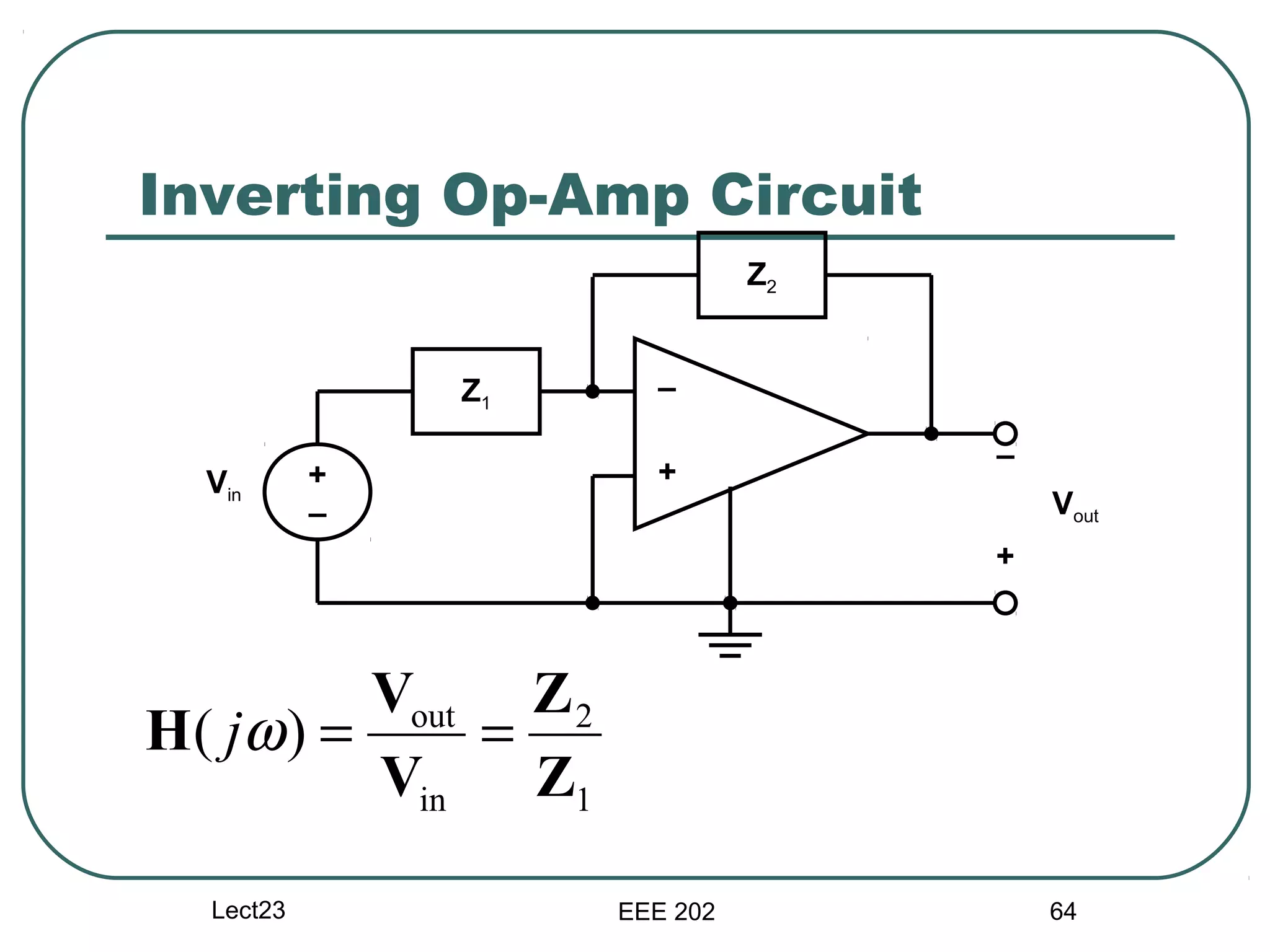
Inverting Op-Amp Circuit
                                Z2


               Z1       –

                                     –
  Vin      +            +
           –                             Vout
                                     +


           Vout Z 2
H ( jω ) =     =
           Vin   Z1

  Lect23              EEE 202            64
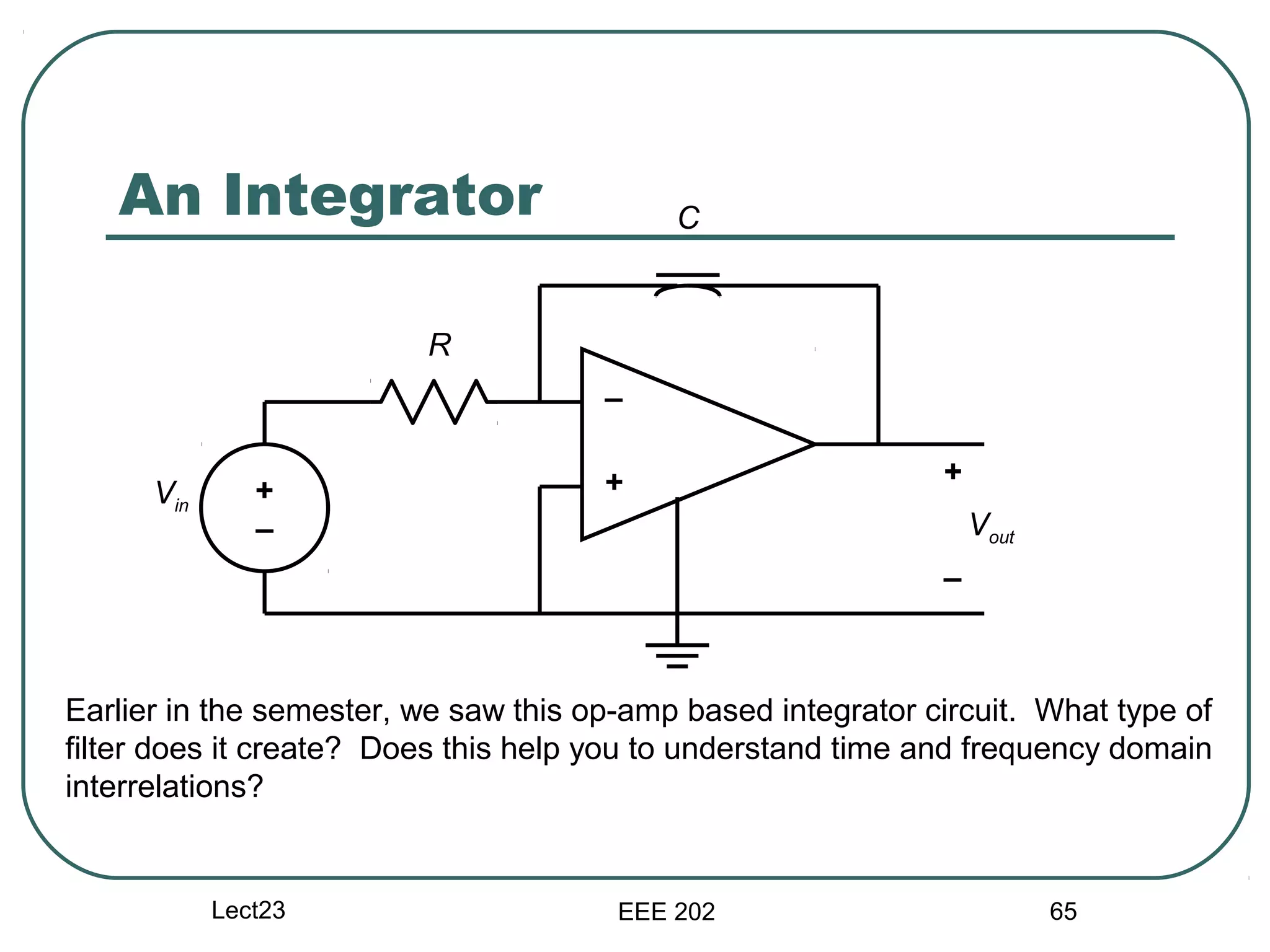
An Integrator                           C


                         R
                                      –

                                      +                       +
      Vin      +
               –                                                  Vout
                                                              –


Earlier in the semester, we saw this op-amp based integrator circuit. What type of
filter does it create? Does this help you to understand time and frequency domain
interrelations?


            Lect23                     EEE 202                           65
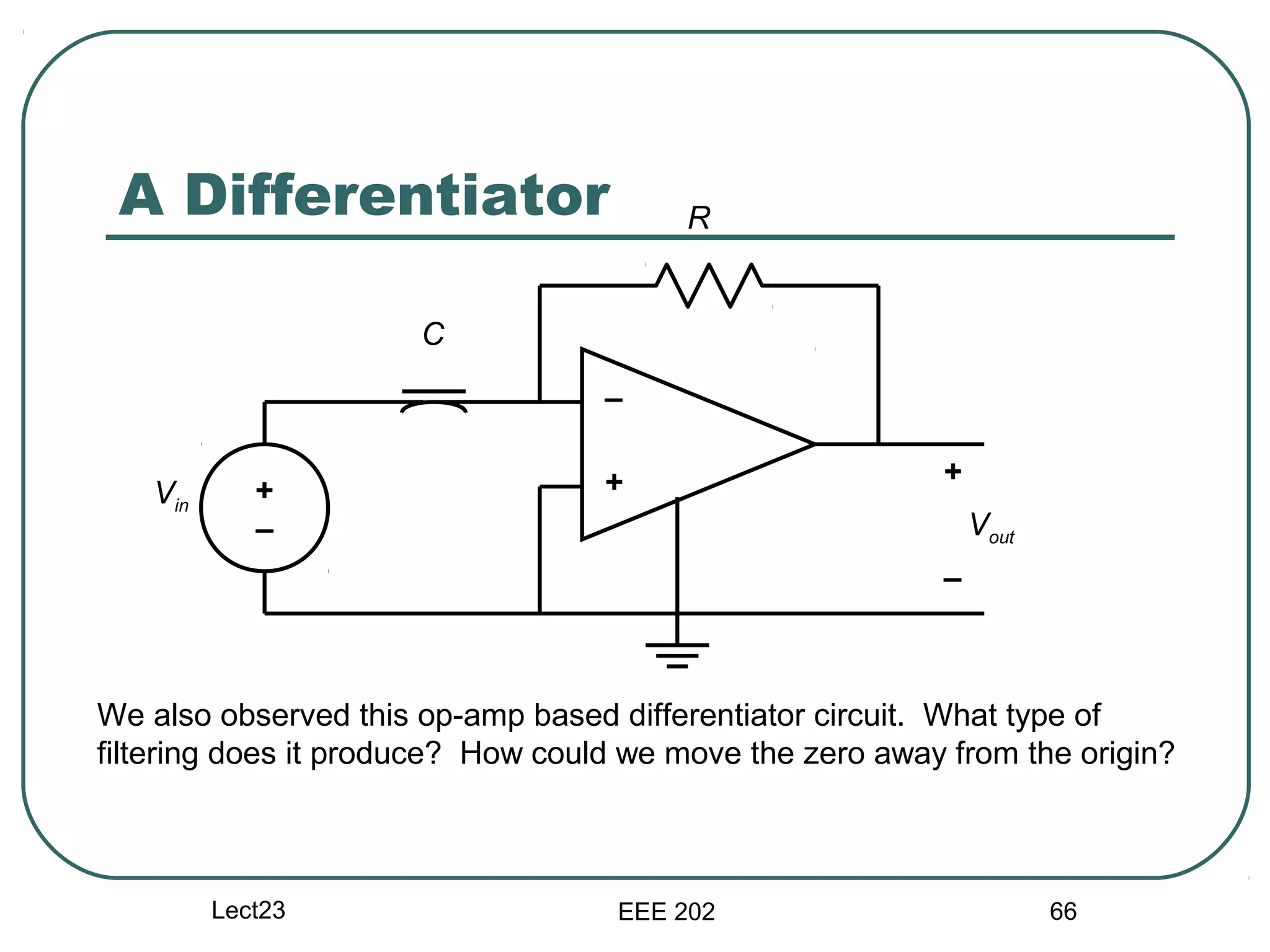
A Differentiator                        R


                      C

                                   –

                                   +                      +
   Vin      +
            –                                                 Vout
                                                          –


We also observed this op-amp based differentiator circuit. What type of
filtering does it produce? How could we move the zero away from the origin?


         Lect23                     EEE 202                          66
Practical Example
 Youare shopping for a stereo system,
 and the following specifications are
 quoted:
  • Frequency range: –6 dB at 65 Hz and 22 kHz
  • Frequency response: 75 Hz to 20 kHz ±3 dB
 What      do these specs really mean?
  • Note that the human hearing range is around
   20 Hz to 20 kHz (audible frequencies)
 Could
      you draw a rough Bode
 (magnitude) plot for the stereo system?
   Lect23               EEE 202            67
MATLAB Filter Example
 How can we filter a real measurement
  signal?
 One method involves using a numerical
  algorithm called the Fast Fourier Transform
  (FFT) which converts a time domain signal
  into the frequency domain
 Start MATLAB, then download and run the
  ‘EEE202Filter.m’ file
    • Can you observe the reduction in the high
      frequency components in both the time and
      frequency domain plots of the output signal?68
     Lect23               EEE 202
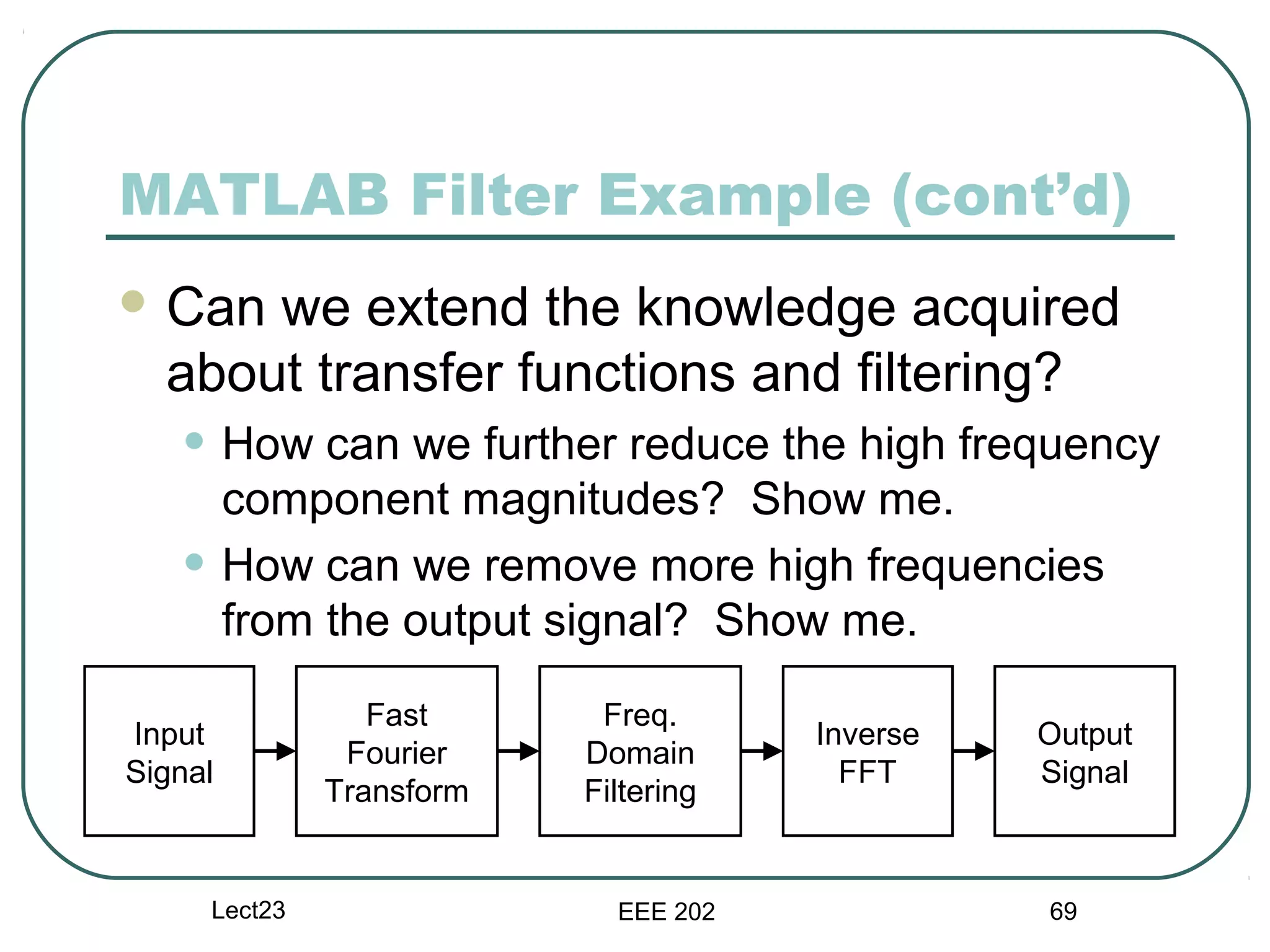
MATLAB Filter Example (cont’d)
 Can we extend the knowledge acquired
  about transfer functions and filtering?
   • How can we further reduce the high frequency
         component magnitudes? Show me.
   •     How can we remove more high frequencies
         from the output signal? Show me.
                   Fast      Freq.
Input                                   Inverse   Output
                 Fourier    Domain
Signal                                    FFT     Signal
                Transform   Filtering


       Lect23                 EEE 202             69

Filter dengan-op-amp

  • 1.
  • 2.
    Filters A filteris a system that processes a signal in some desired fashion. • A continuous-time signal or continuous signal of x(t) is a function of the continuous variable t. A continuous-time signal is often called an analog signal. • A discrete-time signal or discrete signal x(kT) is defined only at discrete instances t=kT, where k is an integer and T is the uniform spacing or period between samples
  • 3.
    Types of Filters  There are two broad categories of filters: • An analog filter processes continuous-time signals • A digital filter processes discrete-time signals.  The analog or digital filters can be subdivided into four categories: • Lowpass Filters • Highpass Filters • Bandstop Filters • Bandpass Filters
  • 4.
    Analog Filter Responses H(f) H(f) 0 f 0 f fc fc Ideal “brick wall” filter Practical filter
  • 5.
    Ideal Filters Lowpass Filter Highpass Filter M(ω) Stopband Passband Passband Stopband ωc ω ωc ω Bandstop Filter Bandpass Filter M(ω) Passband Stopband Passband Stopband Passband Stopband ωc ωc ω ωc ωc ω 1 2 1 2
  • 6.
     There are a number of ways to build filters and of these passive and active filters are the most commonly used in voice and data communications.
  • 7.
    Passive filters  Passive filters use resistors, capacitors, and inductors (RLC networks).  To minimize distortion in the filter characteristic, it is desirable to use inductors with high quality factors (remember the model of a practical inductor includes a series resistance), however these are difficult to implement at frequencies below 1 kHz. • They are particularly non-ideal (lossy) • They are bulky and expensive
  • 8.
     Active filters overcome these drawbacks and are realized using resistors, capacitors, and active devices (usually op-amps) which can all be integrated: • Active filters replace inductors using op-amp based equivalent circuits.
  • 9.
    Op Amp Advantages  Advantages of active RC filters include: • reduced size and weight, and therefore parasitics • increased reliability and improved performance • simpler design than for passive filters and can realize a wider range of functions as well as providing voltage gain • in large quantities, the cost of an IC is less than its passive counterpart
  • 10.
    Op Amp Disadvantages  Active RC filters also have some disadvantages: • limited bandwidth of active devices limits the highest attainable pole frequency and therefore applications above 100 kHz (passive RLCfilters can be used up to 500 MHz) • the achievable quality factor is also limited • require power supplies (unlike passive filters) • increased sensitivity to variations in circuit parameters caused by environmental changes compared to passive filters  For many applications, particularly in voice and data communications, the economic and performance advantages of active RC filters far outweigh their disadvantages.
  • 11.
    Bode Plots  Bodeplots are important when considering the frequency response characteristics of amplifiers. They plot the magnitude or phase of a transfer function in dB versus frequency.
  • 12.
    The decibel (dB) Twolevels of power can be compared using a unit of measure called the bel. P2 B = log10 P1 The decibel is defined as: 1 bel = 10 decibels (dB)
  • 13.
    P2 dB = 10 log10 P1 A common dB term is the half power point which is the dB value when the P2 is one- half P1. 1 10 log10 = −3.01 dB ≈ −3 dB 2
  • 14.
    Logarithms A logarithm is a linear transformation used to simplify mathematical and graphical operations.  A logarithm is a one-to-one correspondence.
  • 15.
    Any number (N)can be represented as a base number (b) raised to a power (x). N = (b) x The value power (x) can be determined by taking the logarithm of the number (N) to base (b). x = log b N
  • 16.
     Although there is no limitation on the numerical value of the base, calculators are designed to handle either base 10 (the common logarithm) or base e (the natural logarithm).  Any base can be found in terms of the common logarithm by: 1 log q w = log10 w log10 q
  • 17.
    Properties of Logarithms  The common or natural  The log of the quotient logarithm of the number of two numbers is the 1 is 0. log of the numerator  The log of any number minus the less than 1 is a negative denominator. number.  The log a number  The log of the product of taken to a power is two numbers is the sum equal to the product of of the logs of the the power and the log numbers. of the number.
  • 18.
    Poles & Zerosof the transfer function  pole—value of s where the denominator goes to zero.  zero—value of s where the numerator goes to zero.
  • 19.
    Single-Pole Passive Filter R vout ZC 1 / sC = = vin R + Z C R + 1 / sC vin C vout 1 1 / RC = = sCR + 1 s + 1 / RC  Firstorder low pass filter  Cut-off frequency = 1/RC rad/s  Problem : Any load (or source) impedance will change frequency response.
  • 20.
    Single-Pole Active Filter R vin C vout  Same frequency response as passive filter.  Buffer amplifier does not load RC network.  Output impedance is now zero.
  • 21.
    Low-Pass and High-Pass Designs High Pass Low Pass vout 1 1 = = vin 1 1 + sRC vout 1 / RC +1 sCR sCR = sRC s vin s + 1 / RC = = RC ( s + 1 / RC ) ( s + 1 / RC )
  • 22.
    To understand Bodeplots, you need to use Laplace transforms! R The transfer function of the circuit is: V in (s) Vo ( s ) 1 / sC 1 Av = = = Vin ( s ) R + 1 / sC sRC + 1
  • 23.
    Break Frequencies Replace swith jω in the transfer function: 1 1 1 Av ( f ) = = = jωRC + 1 1 + j 2πRCf  f  1 + j  f   b where fc is called the break frequency, or corner frequency, and is given by: 1 fc = 2πRC
  • 24.
    Corner Frequency  The significance of the break frequency is that it represents the frequency where Av(f) = 0.707∠-45°.  This is where the output of the transfer function has an amplitude 3-dB below the input amplitude, and the output phase is shifted by -45° relative to the input.  Therefore, fc is also known as the 3-dB frequency or the corner frequency.
  • 26.
    Bode plots usea logarithmic scale for frequency. One decade 10 20 30 40 50 60 70 80 90 100 200 where a decade is defined as a range of frequencies where the highest and lowest frequencies differ by a factor of 10.
  • 27.
     Consider the magnitude of the transfer function: 1 Av ( f ) = 1 + ( f / fb ) 2 Expressed in dB, the expression is Av ( f ) dB = 20 log 1 − 20 log 1 + ( f / f b ) 2 [ = −20 log 1 + ( f / f b ) = −10 log 1 + ( f / f b ) 2 2 ] = −20 log( f / f b )
  • 28.
     Lookhow theprevious expression changes with frequency: • at low frequencies f<< f , |Av| b dB = 0 dB • low frequency asymptote • at high frequencies f>>f , b |Av(f)|dB = -20log f/ fb • high frequency asymptote
  • 29.
    Note that thetwo asymptotes intersect at fb Low frequency asymptote Magnitude where |Av(fb )|dB = -20log f/ fb −3 dB 0 20 Actual response curve 20 . log ( P ( ω ) ) 40 High frequency asymptote 60 0.1 1 10 100 ω rad sec
  • 30.
     The technique for approximating a filter function based on Bode plots is useful for low order, simple filter designs  More complex filter characteristics are more easily approximated by using some well-described rational functions, the roots of which have already been tabulated and are well-known.
  • 31.
    Real Filters  The approximations to the ideal filter are the: • Butterworth filter • Chebyshev filter • Cauer (Elliptic) filter • Bessel filter
  • 32.
    Standard Transfer Functions  Butterworth • Flat Pass-band. • 20n dB per decade roll-off.  Chebyshev • Pass-band ripple. • Sharper cut-off than Butterworth.  Elliptic • Pass-band and stop-band ripple. • Even sharper cut-off.  Bessel • Linear phase response – i.e. no signal distortion in pass-band.
  • 34.
    Butterworth Filter The Butterworthfilter magnitude is defined by: 1 M (ω ) = H ( jω ) = (1 + ω ) 2 n 1/ 2 where n is the order of the filter.
  • 35.
    From the previousslide: M (0) = 1 1 M (1) = for all values of n 2 For large ω: 1 M (ω ) ≅ n ω
  • 36.
    And 20 log10M (ω ) = 20 log10 1 − 20 log10 ω n = −20n log10 ω implying the M(ω) falls off at 20n db/decade for large values of ω.
  • 37.
    10 1 T1 i 20 db/decade T2 i T3 i 40 db/decade 0.1 60 db/decade 0.01 0.1 1 10 w i 1000
  • 38.
    To obtain thetransfer function H(s) from the magnitude response, note that 2 1 M (ω ) = H ( jω ) = H ( jω ) H (− jω ) = 2 1+ ω ( ) 2 n
  • 39.
    Because s =jω for the frequency response, we have s2 = − ω2. 1 1 H ( s) H (− s) = = ( 1+ − s ) 2 n 1 + ( − 1) s n 2n The poles of this function are given by the roots of 1 + ( − 1) s − j ( 2 k −1)π n 2n = −1 = e , k = 1,2,  ,2n
  • 40.
    The 2n poleare: e j[(2k-1)/2n]π n even, k = 1,2,...,2n sk = e j(k/n)π n odd, k = 0,1,2,...,2n-1 Note that for any n, the poles of the normalized Butterworth filter lie on the unit circle in the s-plane. The left half-plane poles are identified with H(s). The poles associated with H(-s) are mirror images.
  • 43.
    Recall from complexnumbers that the rectangular form of a complex can be represented as: z = x + jy Recalling that the previous equation is a phasor, we can represent the previous equation in polar form: z = r ( cosθ + j sin θ ) where x = r cosθ and y = r sin θ
  • 44.
    Definition: If z= x + jy, we define e z = e x+ jy to be the complex number e = e (cos y + j sin y ) z x Note: When z = 0 + jy, we have e jy = (cos y + j sin y ) which we can represent by symbol: jθ e
  • 45.
    The following equationis known as Euler’s law. jθ e = (cosθ + j sin θ ) Note that cos( − θ ) = cos( − θ ) even function sin ( − θ ) = − sin (θ ) odd function
  • 46.
    This implies that − jθ e = (cosθ − j sin θ ) This leads to two axioms: jθ − jθ e +e jθ − jθ e −e cos θ = and sin θ = 2 2j
  • 47.
     Observe that e jθ represents a unit vector which makes an angle θ with the positivie x axis.
  • 48.
    Find the transferfunction that corresponds to a third-order (n = 3) Butterworth filter. Solution: From the previous discussion: sk = e jkπ/3, k=0,1,2,3,4,5
  • 49.
    Therefore, s0 = e j0 jπ / 3 s1 = e j 2π / 3 s2 = e jπ s3 = e j 4π / 3 s4 = e j 5π / 3 s5 = e
  • 50.
    The roots are: p1 1 p6 1 p2 .5 .. 0.8668j p5 .5 0.866 j p3 .5 . . 0.866j p4 .5 0.866 j
  • 51.
    2 Im p i 2 0 2 2 Re p i
  • 52.
    Using the lefthalf-plane poles for H(s), we get 1 H ( s) = ( s + 1)( s + 1 / 2 − j 3 / 2)( s + 1 / 2 + j 3 / 2) which can be expanded to: 1 H ( s) = ( s + 1)( s + s + 1) 2
  • 53.
     The factoredform of the normalized Butterworth polynomials for various order n are tabulated in filter design tables.
  • 54.
    n Denominator of H(s) for Butterworth Filter 1 s+1 2 s2 + 1.414s + 1 3 (s2 + s + 1)(s + 1) 4 (s2 + 0.765 + 1)(s2 + 1.848s + 1) 5 (s + 1) (s2 + 0.618s + 1)(s2 + 1.618s + 1) 6 (s2 + 0.517s + 1)(s2 + 1.414s + 1 )(s2 + 1.932s + 1) 7 (s + 1)(s2 + 0.445s + 1)(s2 + 1.247s + 1 )(s2 + 1.802s + 1) 8 (s2 + 0.390s + 1)(s2 + 1.111s + 1 )(s2 + 1.663s + 1 )(s2 + 1.962s + 1)
  • 55.
  • 56.
    So far wehave looked at the Butterworth filter with a normalized cutoff frequency ω c = 1 rad / sec By means of a frequency transformation, we can obtain a lowpass, bandpass, bandstop, or highpass filter with specific cutoff frequencies.
  • 57.
    Lowpass with CutoffFrequency ωu  Transformation: sn = s / ω u
  • 58.
    Highpass with CutoffFrequency ωl  Transformation: sn = ω l / s
  • 59.
    Bandpass with Cutoff Frequenciesωl and ωu  Transformation: F G s2 + ω 2 ω 0 s ω 0 I J sn = = H + K 0 Bs B ω0 s where ω 0 = ω uω l B = ωu −ωl
  • 60.
    Bandstop with Cutoff Frequenciesωl and ωu  Transformation: Bs B sn = 2 s +ω0 2 = Fs + ω I ω G J H sK 0 ω 0 0
  • 61.
    Active Filters  To achieve a gain > 1, we need to utilize an op-amp based circuit to form an active filter  We can design all the common filter types using op-amp based active filters  Recall for an ideal op-amp that V+ = V– I+ = I – = 0 Lect23 EEE 202 61
  • 62.
    Op Amp Model Non-inverting V+ input + Rout Vo Rin + – – Inverting input A(V+ –V– ) V– Lect23 EEE 202 62
  • 63.
    Non-inverting Op-Amp Circuit + Vout H ( jω ) = – + Vin Z2 Vin + = 1+ – Z2 Vout Z1 Z1 – Lect23 EEE 202 63
  • 64.
    Inverting Op-Amp Circuit Z2 Z1 – – Vin + + – Vout + Vout Z 2 H ( jω ) = = Vin Z1 Lect23 EEE 202 64
  • 65.
    An Integrator C R – + + Vin + – Vout – Earlier in the semester, we saw this op-amp based integrator circuit. What type of filter does it create? Does this help you to understand time and frequency domain interrelations? Lect23 EEE 202 65
  • 66.
    A Differentiator R C – + + Vin + – Vout – We also observed this op-amp based differentiator circuit. What type of filtering does it produce? How could we move the zero away from the origin? Lect23 EEE 202 66
  • 67.
    Practical Example  Youareshopping for a stereo system, and the following specifications are quoted: • Frequency range: –6 dB at 65 Hz and 22 kHz • Frequency response: 75 Hz to 20 kHz ±3 dB  What do these specs really mean? • Note that the human hearing range is around 20 Hz to 20 kHz (audible frequencies)  Could you draw a rough Bode (magnitude) plot for the stereo system? Lect23 EEE 202 67
  • 68.
    MATLAB Filter Example How can we filter a real measurement signal?  One method involves using a numerical algorithm called the Fast Fourier Transform (FFT) which converts a time domain signal into the frequency domain  Start MATLAB, then download and run the ‘EEE202Filter.m’ file • Can you observe the reduction in the high frequency components in both the time and frequency domain plots of the output signal?68 Lect23 EEE 202
  • 69.
    MATLAB Filter Example(cont’d)  Can we extend the knowledge acquired about transfer functions and filtering? • How can we further reduce the high frequency component magnitudes? Show me. • How can we remove more high frequencies from the output signal? Show me. Fast Freq. Input Inverse Output Fourier Domain Signal FFT Signal Transform Filtering Lect23 EEE 202 69

Editor's Notes

  • #66 Dr. Holbert Lecture 23 EEE 202 H(jw) = 1/(sRC)
  • #67 Dr. Holbert Lecture 23 EEE 202 H(jw) = sRC