What is the difference between…
Literal
and
Figurative
language?
Literal means…
•The actual, dictionary meaning of a word;
language that means what it appears to mean
•Avoiding exaggeration, metaphor, or
embellishment
•Conforming to the most obvious meaning of a
word, phrase, sentence, or story
In other words,…
•It means exactly what it says!
Word for word.
Example One: The U.S. is a large country.
What does it mean? Exactly what it says!
ExampleTwo: The weather is beautiful
today.
What does it mean? Exactly what it says!
Figurative means…
•Language that goes beyond the normal meaning
of the words used
•Based on or making use of figures of speech;
metaphorical
•Represented by a figure or symbol
In other words,…
•Figure it out! There’s a deeper
meaning hidden in the words.
Example: Fragrance always stays in the hand that gives
the rose. -Hada Bejar
Does it mean you have a smelly hand? NO!
What does it mean? Giving to others is gracious and the
good feeling of giving stays with you.
So…
Read between the lines
because not
everything is as it
appears.
TYPES OF
1. Simile
•A FIGURE OF SPEECH in which a
comparison is made between
unlike or dissimilar objects using
the words like or as.
For example…
•Friends are like parachutes. If they aren’t
there the first time you need them, chances
are, you won’t be needing them again.
-JamesA. Lovell Jr.
• Does this mean that I should jump out of an airplane
with my friend strapped to my back? Absolutely not!
• Friends are being compared to parachutes using the
word like. (friends = parachutes)
• Friends and parachutes are dissimilar and unlike each
other, yet we have found a way to relate and compare
them.
What is the meaning of…?
• Friends are like parachutes. If they
aren’t there the first time you need
them, chances are, you won’t be
needing them again. -
James A. Lovell Jr.
• Parachutes must be there for you the first time you
need them or you will fall to your death. If they are
not there for you the first time you need them, you will
not need them again. You’ll be dead!
• Friends are the same way. If you have a crisis and
need your friend to support you, but he doesn’t come
through, you don’t really need that friend for help
again.
2. Metaphor
•A FIGURE OF SPEECH in which
a comparison is drawn between
two dissimilar or unlike things
without the use of like or as.
For example…
•A good laugh is sunshine in a house. -
Thackeray
• Does this mean that a laugh is actually light from the
sun? Absolutely not!
• A good laugh is being compared to sunshine by saying
that it is sunshine. (laugh = sunshine)
• A good laugh and sunshine are dissimilar and unlike
things being compared to each other.
What is the meaning of…?
•A good laugh is sunshine in a house.
-Thackeray
• Sunshine brings joy and happiness to people. It brightens
up a room, a house or wherever its rays strike.
• Laughter does the same thing. It also brings joy and
happiness to people and brightens up a room, a house, or
wherever it is heard.
3. Personification
•A FIGURE OF SPEECH in which
animals, ideas, or objects are
given human characteristics or
form.
For example…
• The tree bowed and waved to
me in the wind.
• Does this mean a tree recognized I was there and
acknowledged me by taking a bow and waving to me?
Absolutely not!
• The tree is being given the human characteristics or
actions of waving and bowing. The tree is being
personified. It now has character.
• Again, unlike or dissimilar things are being compared.
(tree = person)
What is the meaning of this…?
• The tree bowed and waved to
me in the wind.
• This simply draws the picture in our minds that it
must be an extremely windy day for the trees
branches to ‘wave’ and the trunk to bend as if it
were ‘bowing.’
• The tree is being given the human characteristics or
actions of waving and bowing. The tree is being
personified. It now has character.
4. Hyperbole
•A FIGURE OF SPEECH in
which an exaggeration or
overstatement is made to illustrate
a point.
For example…
• I’m so hungry I could eat a horse!
and
• Ten thousand suns light up this
room.
• Does this mean I could actually eat an entire horse or
that this room is blindingly bright from actual suns? Of
course not!
• A ridiculous image is being painted in our minds to get
the significance and importance of the point across.
What is the meaning of this…?
• I’m so hungry I could eat a horse!
and
• Ten thousand suns light up this room.
• The first obviously means that I am extremely hungry
but in no way could I eat a 400 pound horse!
• The second clearly means that our room is extremely
bright but in no way will we be blinded by it!
What is the meaning of this…?
• I’m so hungry I could eat a
horse!
and
• Ten thousand suns light up this
room.
• These are both exaggerations to
illustrate a point.
• Here are a few humorous
hyperboles:
• “My sister uses so much makeup, she broke a
chisel trying to get it off last night!” Johnny, Baton
Rouge, LA
• “My teacher is so old, they’ve already nailed the
coffin shut.” Michelle S., Knoxville, TN
• “My dog is so ugly, you can’t tell if he’s coming or
going.” Ashley Brosseau
• “Your sister is so skinny, she has to run around in
5. Metonymy
•A FIGURE OF SPEECH in which a
part represents a whole or a
whole represents a part.
For example…
• The dagger of the United States sliced
Saddam Hussein’s army to pieces.
and
• I pledge my service to the crown.
• Did just a knife alone destroy Sadaam’s armies? Absolutely
not! The knife represents a part of the whole United States
Armed Forces. (knife = U.S. Armed Forces)
• Do I pledge my service to just a crown that sits atop the king’s head? No!
The solitary crown represents a part of the whole king and kingdom to
whom I pledge my service. (crown = king and kingdom)
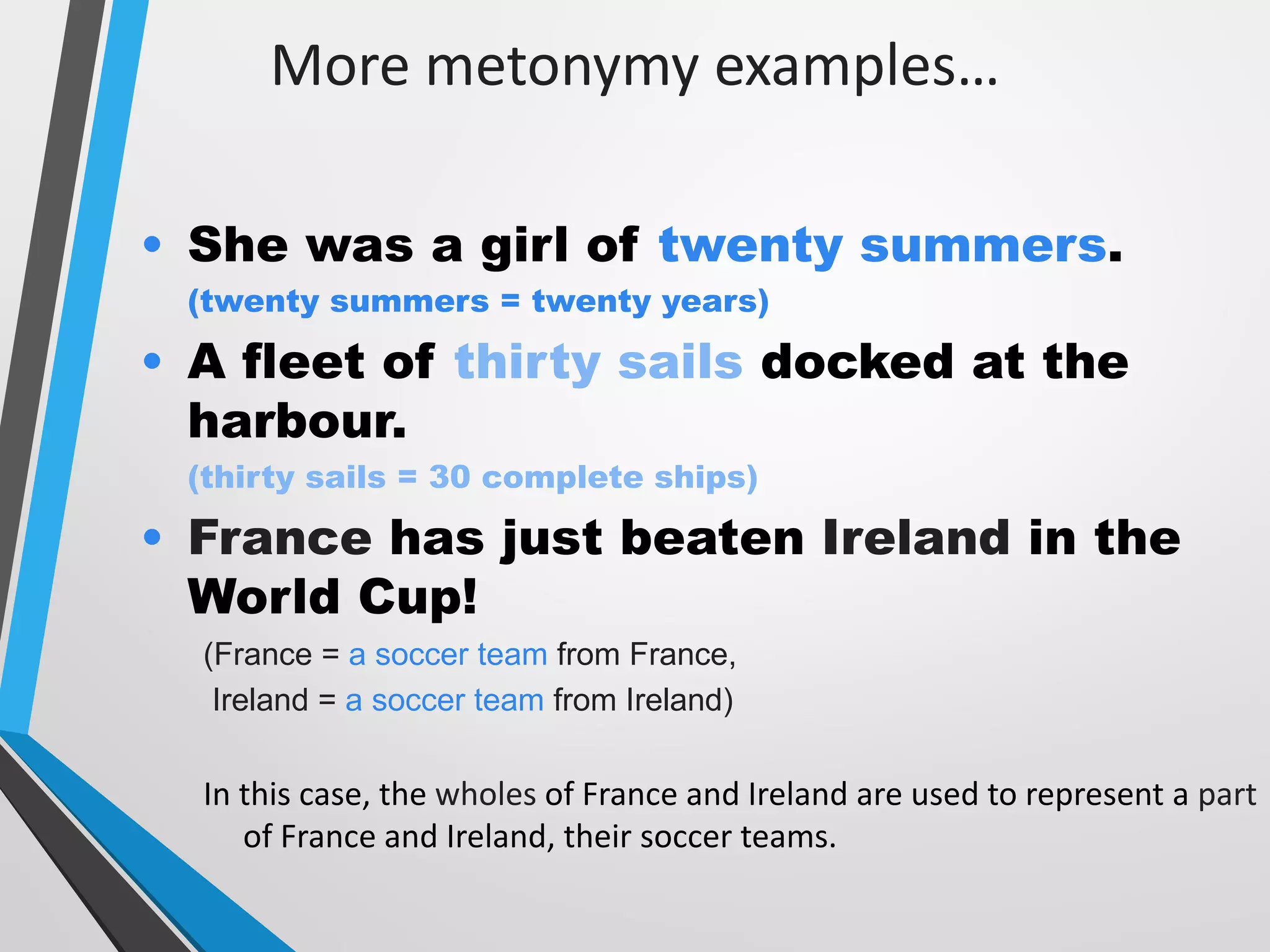
More metonymy examples…
• She was a girl of twenty summers.
(twenty summers = twenty years)
• A fleet of thirty sails docked at the
harbour.
(thirty sails = 30 complete ships)
• France has just beaten Ireland in the
World Cup!
(France = a soccer team from France,
Ireland = a soccer team from Ireland)
In this case, the wholes of France and Ireland are used to represent a part
of France and Ireland, their soccer teams.
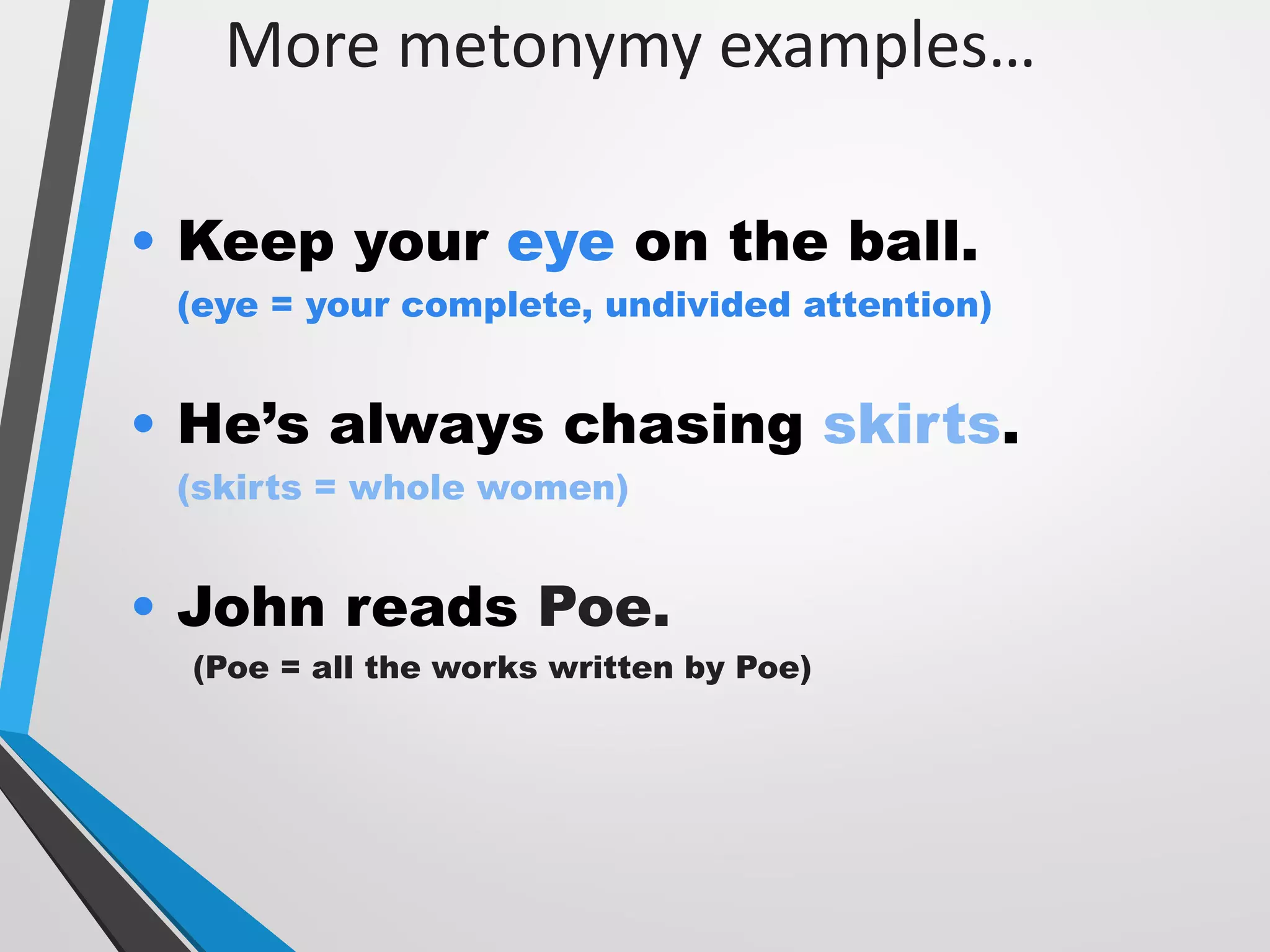
More metonymy examples…
• Keep your eye on the ball.
(eye = your complete, undivided attention)
• He’s always chasing skirts.
(skirts = whole women)
• John reads Poe.
(Poe = all the works written by Poe)
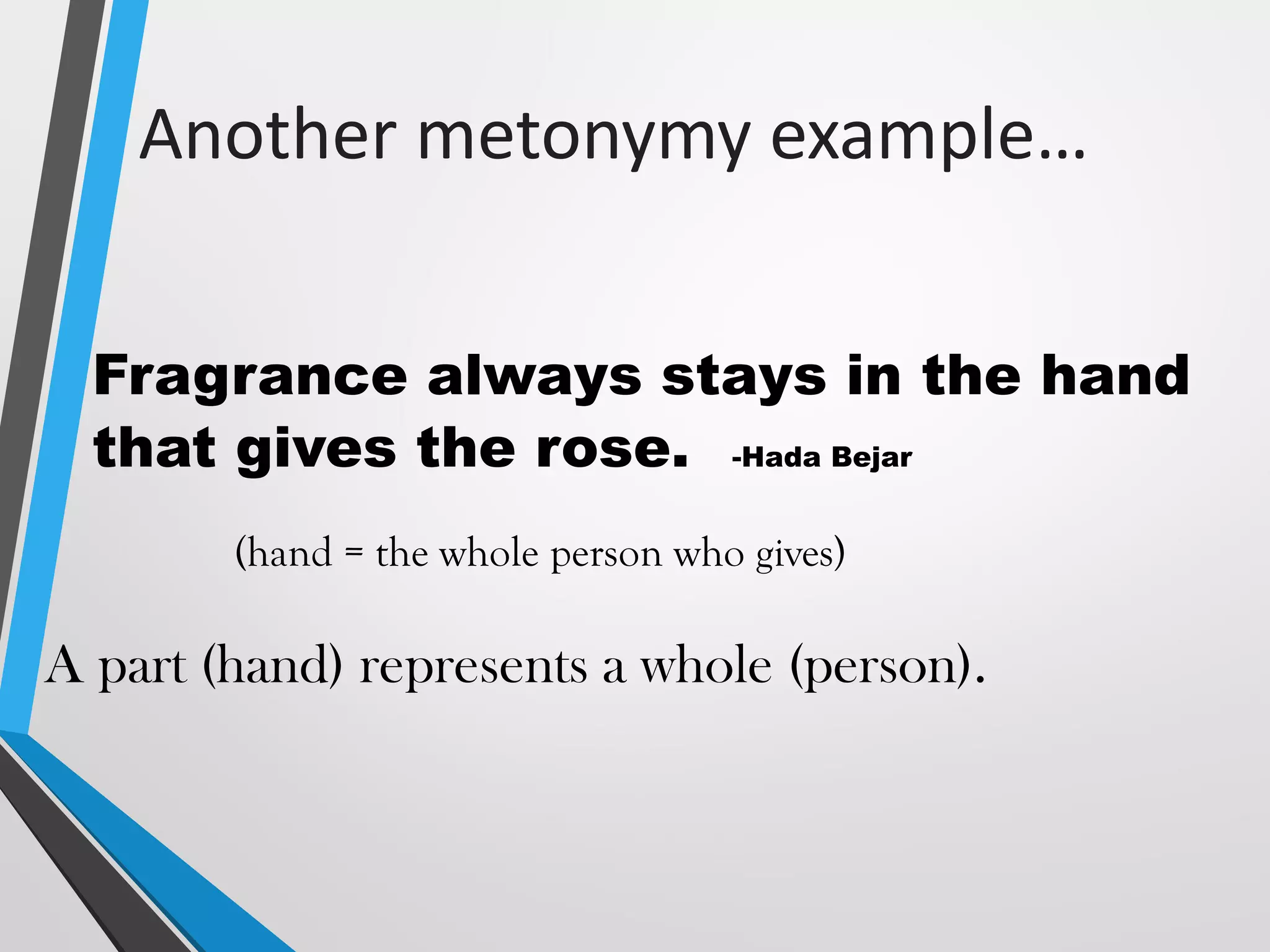
Another metonymy example…
Fragrance always stays in the hand
that gives the rose. -Hada Bejar
(hand = the whole person who gives)
A part (hand) represents a whole (person).
And now you have learned the
following figures of speech…
❑ Similes
❑ Metaphors
❑ Personification
❑ Hyperbole
❑ Metonymy
THANK YOU FOR
LISTENING
JO-ANE T. SIERAS

fIGURES OF SPEECH WEEK 1-2.pdf

  • 2.
    What is thedifference between… Literal and Figurative language?
  • 3.
    Literal means… •The actual,dictionary meaning of a word; language that means what it appears to mean •Avoiding exaggeration, metaphor, or embellishment •Conforming to the most obvious meaning of a word, phrase, sentence, or story
  • 4.
    In other words,… •Itmeans exactly what it says! Word for word. Example One: The U.S. is a large country. What does it mean? Exactly what it says! ExampleTwo: The weather is beautiful today. What does it mean? Exactly what it says!
  • 5.
    Figurative means… •Language thatgoes beyond the normal meaning of the words used •Based on or making use of figures of speech; metaphorical •Represented by a figure or symbol
  • 6.
    In other words,… •Figureit out! There’s a deeper meaning hidden in the words. Example: Fragrance always stays in the hand that gives the rose. -Hada Bejar Does it mean you have a smelly hand? NO! What does it mean? Giving to others is gracious and the good feeling of giving stays with you.
  • 7.
    So… Read between thelines because not everything is as it appears.
  • 8.
  • 9.
    1. Simile •A FIGUREOF SPEECH in which a comparison is made between unlike or dissimilar objects using the words like or as.
  • 10.
    For example… •Friends arelike parachutes. If they aren’t there the first time you need them, chances are, you won’t be needing them again. -JamesA. Lovell Jr. • Does this mean that I should jump out of an airplane with my friend strapped to my back? Absolutely not! • Friends are being compared to parachutes using the word like. (friends = parachutes) • Friends and parachutes are dissimilar and unlike each other, yet we have found a way to relate and compare them.
  • 11.
    What is themeaning of…? • Friends are like parachutes. If they aren’t there the first time you need them, chances are, you won’t be needing them again. - James A. Lovell Jr. • Parachutes must be there for you the first time you need them or you will fall to your death. If they are not there for you the first time you need them, you will not need them again. You’ll be dead! • Friends are the same way. If you have a crisis and need your friend to support you, but he doesn’t come through, you don’t really need that friend for help again.
  • 12.
    2. Metaphor •A FIGUREOF SPEECH in which a comparison is drawn between two dissimilar or unlike things without the use of like or as.
  • 13.
    For example… •A goodlaugh is sunshine in a house. - Thackeray • Does this mean that a laugh is actually light from the sun? Absolutely not! • A good laugh is being compared to sunshine by saying that it is sunshine. (laugh = sunshine) • A good laugh and sunshine are dissimilar and unlike things being compared to each other.
  • 14.
    What is themeaning of…? •A good laugh is sunshine in a house. -Thackeray • Sunshine brings joy and happiness to people. It brightens up a room, a house or wherever its rays strike. • Laughter does the same thing. It also brings joy and happiness to people and brightens up a room, a house, or wherever it is heard.
  • 15.
    3. Personification •A FIGUREOF SPEECH in which animals, ideas, or objects are given human characteristics or form.
  • 16.
    For example… • Thetree bowed and waved to me in the wind. • Does this mean a tree recognized I was there and acknowledged me by taking a bow and waving to me? Absolutely not! • The tree is being given the human characteristics or actions of waving and bowing. The tree is being personified. It now has character. • Again, unlike or dissimilar things are being compared. (tree = person)
  • 17.
    What is themeaning of this…? • The tree bowed and waved to me in the wind. • This simply draws the picture in our minds that it must be an extremely windy day for the trees branches to ‘wave’ and the trunk to bend as if it were ‘bowing.’ • The tree is being given the human characteristics or actions of waving and bowing. The tree is being personified. It now has character.
  • 18.
    4. Hyperbole •A FIGUREOF SPEECH in which an exaggeration or overstatement is made to illustrate a point.
  • 19.
    For example… • I’mso hungry I could eat a horse! and • Ten thousand suns light up this room. • Does this mean I could actually eat an entire horse or that this room is blindingly bright from actual suns? Of course not! • A ridiculous image is being painted in our minds to get the significance and importance of the point across.
  • 20.
    What is themeaning of this…? • I’m so hungry I could eat a horse! and • Ten thousand suns light up this room. • The first obviously means that I am extremely hungry but in no way could I eat a 400 pound horse! • The second clearly means that our room is extremely bright but in no way will we be blinded by it!
  • 21.
    What is themeaning of this…? • I’m so hungry I could eat a horse! and • Ten thousand suns light up this room. • These are both exaggerations to illustrate a point.
  • 22.
    • Here area few humorous hyperboles: • “My sister uses so much makeup, she broke a chisel trying to get it off last night!” Johnny, Baton Rouge, LA • “My teacher is so old, they’ve already nailed the coffin shut.” Michelle S., Knoxville, TN • “My dog is so ugly, you can’t tell if he’s coming or going.” Ashley Brosseau • “Your sister is so skinny, she has to run around in
  • 23.
    5. Metonymy •A FIGUREOF SPEECH in which a part represents a whole or a whole represents a part.
  • 24.
    For example… • Thedagger of the United States sliced Saddam Hussein’s army to pieces. and • I pledge my service to the crown. • Did just a knife alone destroy Sadaam’s armies? Absolutely not! The knife represents a part of the whole United States Armed Forces. (knife = U.S. Armed Forces) • Do I pledge my service to just a crown that sits atop the king’s head? No! The solitary crown represents a part of the whole king and kingdom to whom I pledge my service. (crown = king and kingdom)
  • 25.
    More metonymy examples… •She was a girl of twenty summers. (twenty summers = twenty years) • A fleet of thirty sails docked at the harbour. (thirty sails = 30 complete ships) • France has just beaten Ireland in the World Cup! (France = a soccer team from France, Ireland = a soccer team from Ireland) In this case, the wholes of France and Ireland are used to represent a part of France and Ireland, their soccer teams.
  • 26.
    More metonymy examples… •Keep your eye on the ball. (eye = your complete, undivided attention) • He’s always chasing skirts. (skirts = whole women) • John reads Poe. (Poe = all the works written by Poe)
  • 27.
    Another metonymy example… Fragrancealways stays in the hand that gives the rose. -Hada Bejar (hand = the whole person who gives) A part (hand) represents a whole (person).
  • 28.
    And now youhave learned the following figures of speech… ❑ Similes ❑ Metaphors ❑ Personification ❑ Hyperbole ❑ Metonymy
  • 29.