



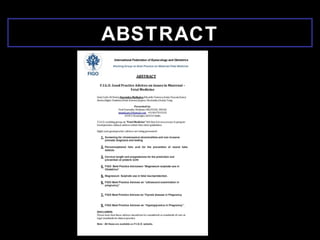






International Federation of Gynecology and Obstetrics
Working Group on Best Practice on Maternal-Fetal Medicine
Presented by
NARENDRA MALHOTRA MD,FICOG,FRCOG
Committee member
President Elect ISPAT
Past President FOGSI,India
Sec SAFOG
OUR PUBLICATION AT
FIGO
ABSTRACT
This is often not the test that is good or bad
but the way we use it
FIGO GUD PRACTICE ADVISES
PREMISES
Why good practice advises
• Too many recent developments
• Many asumptions for best managements of
pregnancy and child birth
• FIGO’s attempt to give a clearity for the
applications of new techniques and clinical
options
• These issues apply univesally
• More important in inndustrializesd and semi
industrialized countries
• Authoritative guidance is urgently needed to
establish best practice
FIGO RECOMMENDATIONS
FIGO GUIDELINES
PRESENT 8 GOOD
PRACTICE ADVISES
• 1.SCREENING FOR CHROMOSOMAL
ABNORMALITIES AND NIPD
• 2.PRECONCEPTIONAL FOLIC ACID FOR THE
PREVENTION OF NEURAL TUBE DEFECTS
• 3.CERVICAL LENGTH AND PROGESTERONE
FOR THE PREDICTION AND PREVENTION OF
PRETERM BIRTH
• 4. & 5.MAGNISIUM SULPHATE USE IN
OBSTETRICS
• 6.ULTRASOUND EXAMINATION IN PREGNANCY
• 7.THYROID DISEASE IN PREGNANCY
• 8.HYPERGLYCEMIA IN PREGNANCY
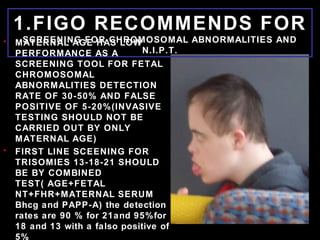
1.FIGO RECOMMENDS FOR
SCREENING FOR CHROMOSOMAL ABNORMALITIES AND
N.I.P.T.
• MATERNAL AGE HAS LOW
PERFORMANCE AS A
SCREENING TOOL FOR FETAL
CHROMOSOMAL
ABNORMALITIES DETECTION
RATE OF 30-50% AND FALSE
POSITIVE OF 5-20%(INVASIVE
TESTING SHOULD NOT BE
CARRIED OUT BY ONLY
MATERNAL AGE)
• FIRST LINE SCEENING FOR
TRISOMIES 13-18-21 SHOULD
BE BY COMBINED
TEST( AGE+FETAL
NT+FHR+MATERNAL SERUM
Bhcg and PAPP-A) the detection
rates are 90 % for 21and 95%for
18 and 13 with a falso positive of
5%
Cont….
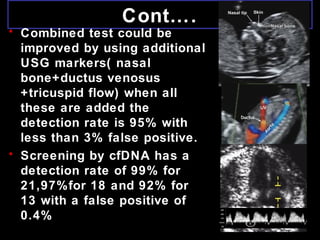
• Combined test could be
improved by using additional
USG markers( nasal
bone+ductus venosus
+tricuspid flow) when all
these are added the
detection rate is 95% with
less than 3% false positive.
• Screening by cfDNA has a
detection rate of 99% for
21,97%for 18 and 92% for
13 with a false positive of
0.4%
Cont….
• So as of now the cfDNA should be in
combination to the combined test at
11-13 weeks
FIGO recommends
the following
stratergy for prenatal
diagnosis
• The patients with combined test risk
over 1:100 can be offered cfDNA or
invasive testing
• Combined test risk of 101-2500;pts
can be offered the option of cfDNA
• Combined test risk lower than 1 in
2500:there is no need for further
testing)
2. FIGO RECOMMENDS
PRECONCEPTIONAL FOLIC ACID FOR THE
PREVENTION OF NEURAL TUBE DEFECTS
• All women who plan to become
pregnant or women of child bearing
age not on contraceptives should
utilize 400 ug(0.4 mg) of synthetic
folic acid,at least 30 days before
conception and continue throughout
first trimester
• All women coming for any medical
appointment should be advised on the
benefits of folic acid
Cont……….
• Health care providers should
inform and council women a)
benefits of folic acid in pregnancy
is not only prevention of NTD but
also for IUGR,autism,preterm and
cleft palate defect
prevention,b)folic acid 0.4 mg(400
ug) can be taken for years without
any know adverse effects and
c)effects of high doses of folic
acid are not known except
complicating diagnosis of vit B 12
deficiency,hence the dose of daily
folic acid supplimentation should
be kept below 1 mg except in
women at high risk of NTD
Cont………
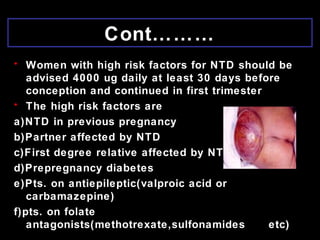
• Women with high risk factors for NTD should be
advised 4000 ug daily at least 30 days before
conception and continued in first trimester
• The high risk factors are
a)NTD in previous pregnancy
b)Partner affected by NTD
c)First degree relative affected by NTD
d)Prepregnancy diabetes
e)Pts. on antiepileptic(valproic acid or
carbamazepine)
f)pts. on folate
antagonists(methotrexate,sulfonamides etc)
3.FIGO recommends Cervical
length and progesterone for
prediction and prevention of
PRETERM birth
• Sonographic cervical length measurement should
be performed for all pregnant women at 19-23
weeks of gestation by TVS as a part of the
ANATOMICAL SURVEY scan
• Women with short cervix <25 mm diagnosed in
mid trimester should be offered daily vaginal
micronised progesterone therapy for prevention
of preterm birth and neonatal morbidity
• Vaginal micronised progesterone 200 mg soft
capsule nightly or 90 mg micronized progesterone
gel each morning
Cont………
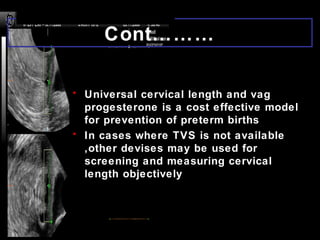
• Universal cervical length and vag
progesterone is a cost effective model
for prevention of preterm births
• In cases where TVS is not available
,other devises may be used for
screening and measuring cervical
length objectively
THESE THREE ADVISES HAVE BEEN ENDORSED BY
THE FIGO BOARD AND ALSO PUBLISHED in 2014-2015
MAY 2015 :5 NEW GOOD
PRACTICE ADVISES WERE
ENDORSED BY FIGO BOARD in
2015
• PREPARED BY FIGO
WORKING GROUP
• AND RELEASED AT
VANCOUVER FIGO
CONGRESS OCT 2015
THESE ARE
• MAGNISIUM SULPHATE USE IN OBSTETRICS(2)
• ULTRASOUND EXAMINATION IN PREGNANCY
• THYROID DISEASE IN PREGNANCY
• HYPERGLYCEMIA IN PREGNANCY
4.& 5. FIGO RECOMMENDS
MAGNISIUM SULPHATE USE IN
OBSTETRICS
• intravenous/intramuscular mag sulphate is
indiacted during labour and post partum for all
women diagnosed with severe p.i.h.
• for elective c.s. in such pts mag sulf is given
atleast 2 hrs before the operation
• the dose iv mag sulf 4-6 g diluted in 100 ml
ns/dw5 over 15-20 mins with maintainance of 1-2
g per hour……for im mag sulf 10 g can be
undiluted 50 % solution divided into each
buttocks followed by 4-5 g every 4 hrly
Cont……..
• Mandatory monitoring of respiratory rate,deep
tendon reflexes and urinary output ,particularly in
oligouric patients…..mag toxicity is treated by
10% 10 ml calcium gluconate
• In women with normal renal functions half time for
excretion of magnisium is 4 hours
• There is no association of mag sulf use with
congenital birth defects
Cont………..
• Very long term infusion may be related to
sustained hypocalcemia in fetus and may
result in congenital rickets and adverse
bone mineralisation
Neonatologists should be alerted to look
for neonatal neurologic depression,resp
depression,muscle weakness and
hyporeflexia in fetus born to women on
mag sulf infusion
5.MAGNISIUM SULPHATE USE IN
FETAL NEUROPROTECTION
• For imminent preterm birth (active labour with or
without PROM) or elective preterm birth for
maternal or fetal indication….antenatal mag sulf
should be considered for fetal neuroprotection
• Antenatal mag sulf should be considered from
viability to 31 + 6 days gestation
• Mag sulf should be discontinued if delivery in no
longer imminent or after max of 24 hours of
therapy
Cont…….
• Mag Sulf loading dose 4 g over 30 mins,ideally 4-
6 hours before delivery followed by infusion of
1g/hour until delivery occurs .however there may
be still benefit even if given less than 4 hours
• There is insufficient evidence of use of a repeat
course
• Delivery should not be delayed in order to
administer antenatal mag sulf if there is a
maternal and fetal indication for emergency
• Maternity care provider should use the standard
monitoring protocols same as in PIH/ECLAMSIA
• Neonatologist should be alerted to asses neonate
for effects of mag sulf
6. FIGO RECOMMENDS
ULTRAOUND EXAMINATION IN
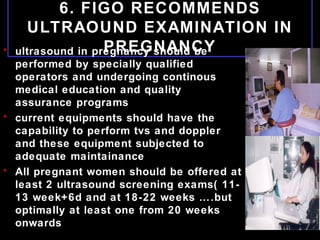
PREGNANCY• ultrasound in pregnancy should be
performed by specially qualified
operators and undergoing continous
medical education and quality
assurance programs
• current equipments should have the
capability to perform tvs and doppler
and these equipment subjected to
adequate maintainance
• All pregnant women should be offered at
least 2 ultrasound screening exams( 11-
13 week+6d and at 18-22 weeks ….but
optimally at least one from 20 weeks
onwards
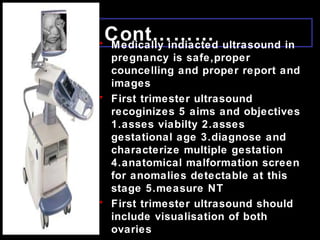
Cont………• Medically indiacted ultrasound in
pregnancy is safe,proper
councelling and proper report and
images
• First trimester ultrasound
recoginizes 5 aims and objectives
1.asses viabilty 2.asses
gestational age 3.diagnose and
characterize multiple gestation
4.anatomical malformation screen
for anomalies detectable at this
stage 5.measure NT
• First trimester ultrasound should
include visualisation of both
ovaries
Cont…….
• Mid trimester ultrasound also recognises 5 aims
and objectives 1. asses gest age if not yet been
done 2.asses fetal biometry 3.conduct anatomical
survey to screen for anomalies 4.asses placenta
and cord insertion 5.measure cervical length by
TVS as a part of risk assesment for preterm births
• Ultrasound and DOPPLER should be liberally
used in the third trimester to asses AMNIOTIC
FLUID,CERVICAL LENGTH,FETAL GROWTH and
FETAL WELLBEING
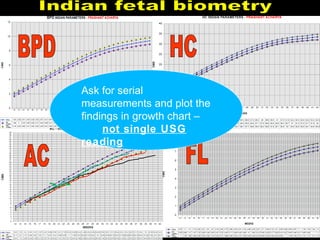
• Biometric tests (tests to measure size)
• Biometric tests are designed to
predict size and growth
AC, EFW
08/18/16 DR.PRASHANT 31
Ask for serial
measurements and plot the
findings in growth chart –
not single USG
reading
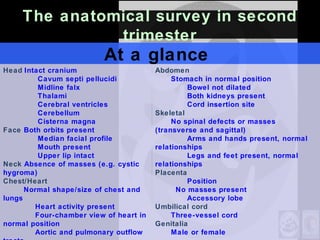
The anatomical survey in second
trimester
At a glance
Head Intact cranium
Cavum septi pellucidi
Midline falx
Thalami
Cerebral ventricles
Cerebellum
Cisterna magna
Face Both orbits present
Median facial profile
Mouth present
Upper lip intact
Neck Absence of masses (e.g. cystic
hygroma)
Chest/Heart
Normal shape/size of chest and
lungs
Heart activity present
Four-chamber view of heart in
normal position
Aortic and pulmonary outflow
Abdomen
Stomach in normal position
Bowel not dilated
Both kidneys present
Cord insertion site
Skeletal
No spinal defects or masses
(transverse and sagittal)
Arms and hands present, normal
relationships
Legs and feet present, normal
relationships
Placenta
Position
No masses present
Accessory lobe
Umbilical cord
Three-vessel cord
Genitalia
Male or female
Placenta and cervix
Guidelines for maturity and
position
+
+
+
+
+
+
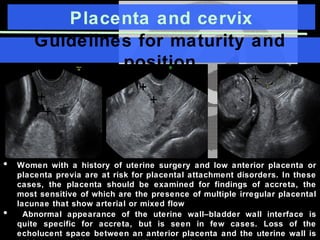
• Women with a history of uterine surgery and low anterior placenta or
placenta previa are at risk for placental attachment disorders. In these
cases, the placenta should be examined for findings of accreta, the
most sensitive of which are the presence of multiple irregular placental
lacunae that show arterial or mixed flow
• Abnormal appearance of the uterine wall–bladder wall interface is
quite specific for accreta, but is seen in few cases. Loss of the
echolucent space between an anterior placenta and the uterine wall is
Maternal anatomy
Guidelines
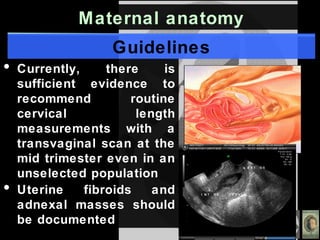
• Currently, there is
sufficient evidence to
recommend routine
cervical length
measurements with a
transvaginal scan at the
mid trimester even in an
unselected population
• Uterine fibroids and
adnexal masses should
be documented
Cont……..
• The results of a screening ultrasound in first and
second trimester can generate refferal for
specialised or focused ultrasound
• In multiple pregnancy choionicity should be
optimally determined before 15 weeks
• The use of ultrasound in labour should be
encouraged to determine fetal and placental
position as well as prior to instrumental delivery
• The use of ultrasound should be encouraged in
postpartum period to evaluate non physiologiccal
bleeding and infections
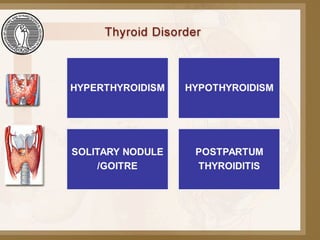
Thyroid Disorders in
Pregnancy
Thyroid disease is the second most
common cause of endocrine
dysfunction in women of child bearing
age.
Hypothyroidism is more common during
pregnancy than hyperthyroidism.
Pearls for Practice
7.FIGO recommends for
THYROID diseases in
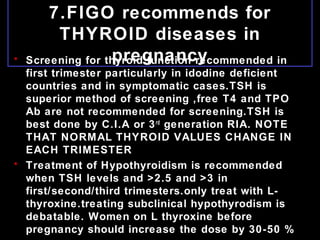
pregnancy• Screening for thyroid function recommended in
first trimester particularly in idodine deficient
countries and in symptomatic cases.TSH is
superior method of screening ,free T4 and TPO
Ab are not recommended for screening.TSH is
best done by C.I.A or 3rd
generation RIA. NOTE
THAT NORMAL THYROID VALUES CHANGE IN
EACH TRIMESTER
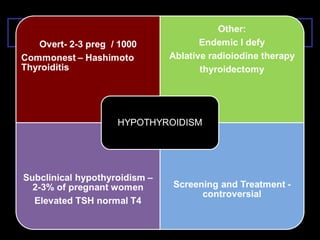
• Treatment of Hypothyroidism is recommended
when TSH levels and >2.5 and >3 in
first/second/third trimesters.only treat with L-
thyroxine.treating subclinical hypothyrodism is
debatable. Women on L thyroxine before
pregnancy should increase the dose by 30-50 %
Cont……….
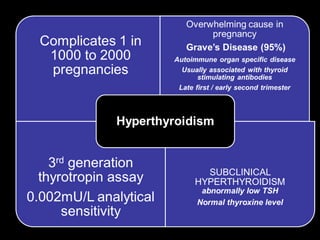
• Treatment of hyperthyroidism due to Grave’s
disease is by antithyroid drugs
(PROPYLTHIOURACIL-PTU or
CARBIMAZOLE/METHIMAZOLE.its not
recommended to change the drug during
pregnancy.sometimes symptomatic treatment with
b-blockers for short time may be needed
• Primary prevention of hypothyroidism is by a
healthy diet and iodised fortified salt
Cont……
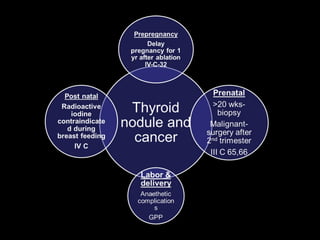
• If the patient has a thyroid nodule she should be
evaluated and treated during pregnancy.thyroid
ultrasound scan and FNA.Surgery should be
preferably deffered to post partum period
• Follow up and post partum TSH evaluation and
reduction of L-thyroxine dose to prepregnant
levels
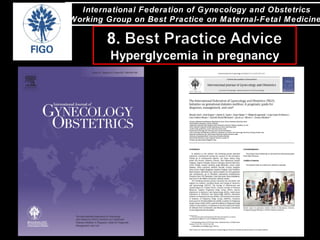
International Federation of Gynecology and Obstetrics
Working Group on Best Practice on Maternal-Fetal Medicine
International Federation of Gynecology and Obstetrics
Working Group on Best Practice on Maternal-Fetal Medicine
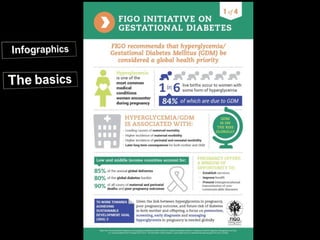
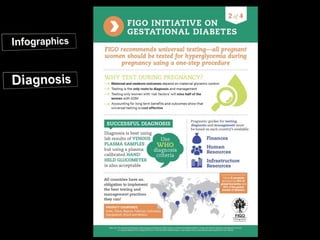
• All pregnant women should be tested for
hyperglycemia. Universal testing by all member
associations
• WHO(2013) and IADPSG(2010) criteria for
diagnosis of gestational diabetes must be used
• Diagnosis of HDP should be on properly collected
venous plasma samples. In developing countries
a plasma calibrated hand held gluocometer is
acceptable
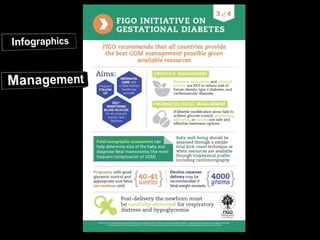
• Management of HDP should be in accordance
with available national resources and
International Federation of Gynecology and Obstetrics
Working Group on Best Practice on Maternal-Fetal Medicine
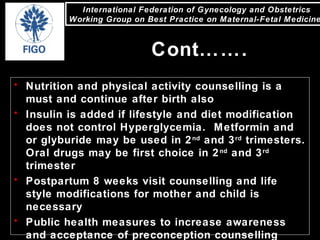
• Nutrition and physical activity counselling is a
must and continue after birth also
• Insulin is added if lifestyle and diet modification
does not control Hyperglycemia. Metformin and
or glyburide may be used in 2nd
and 3rd
trimesters.
Oral drugs may be first choice in 2nd
and 3rd
trimester
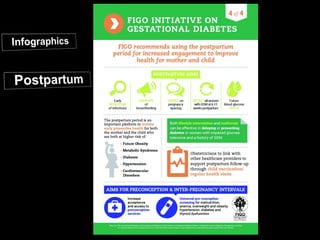
• Postpartum 8 weeks visit counselling and life
style modifications for mother and child is
necessary
• Public health measures to increase awareness
and acceptance of preconception counselling
Cont…….
THANK YOU

FIGO best practice recomendations

  • 1.
    International Federation ofGynecology and Obstetrics Working Group on Best Practice on Maternal-Fetal Medicine Presented by NARENDRA MALHOTRA MD,FICOG,FRCOG Committee member President Elect ISPAT Past President FOGSI,India Sec SAFOG
  • 2.
  • 4.
  • 5.
    This is oftennot the test that is good or bad but the way we use it FIGO GUD PRACTICE ADVISES
  • 6.
  • 7.
    Why good practiceadvises • Too many recent developments • Many asumptions for best managements of pregnancy and child birth • FIGO’s attempt to give a clearity for the applications of new techniques and clinical options • These issues apply univesally • More important in inndustrializesd and semi industrialized countries • Authoritative guidance is urgently needed to establish best practice
  • 8.
  • 9.
    FIGO GUIDELINES PRESENT 8GOOD PRACTICE ADVISES • 1.SCREENING FOR CHROMOSOMAL ABNORMALITIES AND NIPD • 2.PRECONCEPTIONAL FOLIC ACID FOR THE PREVENTION OF NEURAL TUBE DEFECTS • 3.CERVICAL LENGTH AND PROGESTERONE FOR THE PREDICTION AND PREVENTION OF PRETERM BIRTH • 4. & 5.MAGNISIUM SULPHATE USE IN OBSTETRICS • 6.ULTRASOUND EXAMINATION IN PREGNANCY • 7.THYROID DISEASE IN PREGNANCY • 8.HYPERGLYCEMIA IN PREGNANCY
  • 10.
    1.FIGO RECOMMENDS FOR SCREENINGFOR CHROMOSOMAL ABNORMALITIES AND N.I.P.T. • MATERNAL AGE HAS LOW PERFORMANCE AS A SCREENING TOOL FOR FETAL CHROMOSOMAL ABNORMALITIES DETECTION RATE OF 30-50% AND FALSE POSITIVE OF 5-20%(INVASIVE TESTING SHOULD NOT BE CARRIED OUT BY ONLY MATERNAL AGE) • FIRST LINE SCEENING FOR TRISOMIES 13-18-21 SHOULD BE BY COMBINED TEST( AGE+FETAL NT+FHR+MATERNAL SERUM Bhcg and PAPP-A) the detection rates are 90 % for 21and 95%for 18 and 13 with a falso positive of 5%
  • 11.
    Cont…. • Combined testcould be improved by using additional USG markers( nasal bone+ductus venosus +tricuspid flow) when all these are added the detection rate is 95% with less than 3% false positive. • Screening by cfDNA has a detection rate of 99% for 21,97%for 18 and 92% for 13 with a false positive of 0.4%
  • 12.
    Cont…. • So asof now the cfDNA should be in combination to the combined test at 11-13 weeks
  • 13.
    FIGO recommends the following stratergyfor prenatal diagnosis • The patients with combined test risk over 1:100 can be offered cfDNA or invasive testing • Combined test risk of 101-2500;pts can be offered the option of cfDNA • Combined test risk lower than 1 in 2500:there is no need for further testing)
  • 14.
    2. FIGO RECOMMENDS PRECONCEPTIONALFOLIC ACID FOR THE PREVENTION OF NEURAL TUBE DEFECTS • All women who plan to become pregnant or women of child bearing age not on contraceptives should utilize 400 ug(0.4 mg) of synthetic folic acid,at least 30 days before conception and continue throughout first trimester • All women coming for any medical appointment should be advised on the benefits of folic acid
  • 15.
    Cont………. • Health careproviders should inform and council women a) benefits of folic acid in pregnancy is not only prevention of NTD but also for IUGR,autism,preterm and cleft palate defect prevention,b)folic acid 0.4 mg(400 ug) can be taken for years without any know adverse effects and c)effects of high doses of folic acid are not known except complicating diagnosis of vit B 12 deficiency,hence the dose of daily folic acid supplimentation should be kept below 1 mg except in women at high risk of NTD
  • 16.
    Cont……… • Women withhigh risk factors for NTD should be advised 4000 ug daily at least 30 days before conception and continued in first trimester • The high risk factors are a)NTD in previous pregnancy b)Partner affected by NTD c)First degree relative affected by NTD d)Prepregnancy diabetes e)Pts. on antiepileptic(valproic acid or carbamazepine) f)pts. on folate antagonists(methotrexate,sulfonamides etc)
  • 17.
    3.FIGO recommends Cervical lengthand progesterone for prediction and prevention of PRETERM birth • Sonographic cervical length measurement should be performed for all pregnant women at 19-23 weeks of gestation by TVS as a part of the ANATOMICAL SURVEY scan • Women with short cervix <25 mm diagnosed in mid trimester should be offered daily vaginal micronised progesterone therapy for prevention of preterm birth and neonatal morbidity • Vaginal micronised progesterone 200 mg soft capsule nightly or 90 mg micronized progesterone gel each morning
  • 18.
    Cont……… • Universal cervicallength and vag progesterone is a cost effective model for prevention of preterm births • In cases where TVS is not available ,other devises may be used for screening and measuring cervical length objectively
  • 19.
    THESE THREE ADVISESHAVE BEEN ENDORSED BY THE FIGO BOARD AND ALSO PUBLISHED in 2014-2015
  • 20.
    MAY 2015 :5NEW GOOD PRACTICE ADVISES WERE ENDORSED BY FIGO BOARD in 2015 • PREPARED BY FIGO WORKING GROUP • AND RELEASED AT VANCOUVER FIGO CONGRESS OCT 2015
  • 21.
    THESE ARE • MAGNISIUMSULPHATE USE IN OBSTETRICS(2) • ULTRASOUND EXAMINATION IN PREGNANCY • THYROID DISEASE IN PREGNANCY • HYPERGLYCEMIA IN PREGNANCY
  • 22.
    4.& 5. FIGORECOMMENDS MAGNISIUM SULPHATE USE IN OBSTETRICS • intravenous/intramuscular mag sulphate is indiacted during labour and post partum for all women diagnosed with severe p.i.h. • for elective c.s. in such pts mag sulf is given atleast 2 hrs before the operation • the dose iv mag sulf 4-6 g diluted in 100 ml ns/dw5 over 15-20 mins with maintainance of 1-2 g per hour……for im mag sulf 10 g can be undiluted 50 % solution divided into each buttocks followed by 4-5 g every 4 hrly
  • 23.
    Cont…….. • Mandatory monitoringof respiratory rate,deep tendon reflexes and urinary output ,particularly in oligouric patients…..mag toxicity is treated by 10% 10 ml calcium gluconate • In women with normal renal functions half time for excretion of magnisium is 4 hours • There is no association of mag sulf use with congenital birth defects
  • 24.
    Cont……….. • Very longterm infusion may be related to sustained hypocalcemia in fetus and may result in congenital rickets and adverse bone mineralisation Neonatologists should be alerted to look for neonatal neurologic depression,resp depression,muscle weakness and hyporeflexia in fetus born to women on mag sulf infusion
  • 25.
    5.MAGNISIUM SULPHATE USEIN FETAL NEUROPROTECTION • For imminent preterm birth (active labour with or without PROM) or elective preterm birth for maternal or fetal indication….antenatal mag sulf should be considered for fetal neuroprotection • Antenatal mag sulf should be considered from viability to 31 + 6 days gestation • Mag sulf should be discontinued if delivery in no longer imminent or after max of 24 hours of therapy
  • 26.
    Cont……. • Mag Sulfloading dose 4 g over 30 mins,ideally 4- 6 hours before delivery followed by infusion of 1g/hour until delivery occurs .however there may be still benefit even if given less than 4 hours • There is insufficient evidence of use of a repeat course • Delivery should not be delayed in order to administer antenatal mag sulf if there is a maternal and fetal indication for emergency • Maternity care provider should use the standard monitoring protocols same as in PIH/ECLAMSIA • Neonatologist should be alerted to asses neonate for effects of mag sulf
  • 27.
    6. FIGO RECOMMENDS ULTRAOUNDEXAMINATION IN PREGNANCY• ultrasound in pregnancy should be performed by specially qualified operators and undergoing continous medical education and quality assurance programs • current equipments should have the capability to perform tvs and doppler and these equipment subjected to adequate maintainance • All pregnant women should be offered at least 2 ultrasound screening exams( 11- 13 week+6d and at 18-22 weeks ….but optimally at least one from 20 weeks onwards
  • 28.
    Cont………• Medically indiactedultrasound in pregnancy is safe,proper councelling and proper report and images • First trimester ultrasound recoginizes 5 aims and objectives 1.asses viabilty 2.asses gestational age 3.diagnose and characterize multiple gestation 4.anatomical malformation screen for anomalies detectable at this stage 5.measure NT • First trimester ultrasound should include visualisation of both ovaries
  • 29.
    Cont……. • Mid trimesterultrasound also recognises 5 aims and objectives 1. asses gest age if not yet been done 2.asses fetal biometry 3.conduct anatomical survey to screen for anomalies 4.asses placenta and cord insertion 5.measure cervical length by TVS as a part of risk assesment for preterm births • Ultrasound and DOPPLER should be liberally used in the third trimester to asses AMNIOTIC FLUID,CERVICAL LENGTH,FETAL GROWTH and FETAL WELLBEING
  • 30.
    • Biometric tests(tests to measure size) • Biometric tests are designed to predict size and growth AC, EFW
  • 31.
    08/18/16 DR.PRASHANT 31 Askfor serial measurements and plot the findings in growth chart – not single USG reading
  • 32.
    The anatomical surveyin second trimester At a glance Head Intact cranium Cavum septi pellucidi Midline falx Thalami Cerebral ventricles Cerebellum Cisterna magna Face Both orbits present Median facial profile Mouth present Upper lip intact Neck Absence of masses (e.g. cystic hygroma) Chest/Heart Normal shape/size of chest and lungs Heart activity present Four-chamber view of heart in normal position Aortic and pulmonary outflow Abdomen Stomach in normal position Bowel not dilated Both kidneys present Cord insertion site Skeletal No spinal defects or masses (transverse and sagittal) Arms and hands present, normal relationships Legs and feet present, normal relationships Placenta Position No masses present Accessory lobe Umbilical cord Three-vessel cord Genitalia Male or female
  • 33.
    Placenta and cervix Guidelinesfor maturity and position + + + + + + • Women with a history of uterine surgery and low anterior placenta or placenta previa are at risk for placental attachment disorders. In these cases, the placenta should be examined for findings of accreta, the most sensitive of which are the presence of multiple irregular placental lacunae that show arterial or mixed flow • Abnormal appearance of the uterine wall–bladder wall interface is quite specific for accreta, but is seen in few cases. Loss of the echolucent space between an anterior placenta and the uterine wall is
  • 34.
    Maternal anatomy Guidelines • Currently,there is sufficient evidence to recommend routine cervical length measurements with a transvaginal scan at the mid trimester even in an unselected population • Uterine fibroids and adnexal masses should be documented
  • 35.
    Cont…….. • The resultsof a screening ultrasound in first and second trimester can generate refferal for specialised or focused ultrasound • In multiple pregnancy choionicity should be optimally determined before 15 weeks • The use of ultrasound in labour should be encouraged to determine fetal and placental position as well as prior to instrumental delivery • The use of ultrasound should be encouraged in postpartum period to evaluate non physiologiccal bleeding and infections
  • 36.
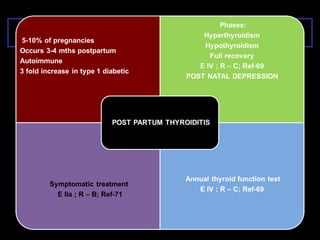
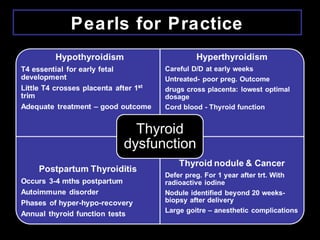
    Thyroid Disorders in Pregnancy Thyroiddisease is the second most common cause of endocrine dysfunction in women of child bearing age. Hypothyroidism is more common during pregnancy than hyperthyroidism.
  • 42.
  • 43.
    7.FIGO recommends for THYROIDdiseases in pregnancy• Screening for thyroid function recommended in first trimester particularly in idodine deficient countries and in symptomatic cases.TSH is superior method of screening ,free T4 and TPO Ab are not recommended for screening.TSH is best done by C.I.A or 3rd generation RIA. NOTE THAT NORMAL THYROID VALUES CHANGE IN EACH TRIMESTER • Treatment of Hypothyroidism is recommended when TSH levels and >2.5 and >3 in first/second/third trimesters.only treat with L- thyroxine.treating subclinical hypothyrodism is debatable. Women on L thyroxine before pregnancy should increase the dose by 30-50 %
  • 44.
    Cont………. • Treatment ofhyperthyroidism due to Grave’s disease is by antithyroid drugs (PROPYLTHIOURACIL-PTU or CARBIMAZOLE/METHIMAZOLE.its not recommended to change the drug during pregnancy.sometimes symptomatic treatment with b-blockers for short time may be needed • Primary prevention of hypothyroidism is by a healthy diet and iodised fortified salt
  • 45.
    Cont…… • If thepatient has a thyroid nodule she should be evaluated and treated during pregnancy.thyroid ultrasound scan and FNA.Surgery should be preferably deffered to post partum period • Follow up and post partum TSH evaluation and reduction of L-thyroxine dose to prepregnant levels
  • 46.
    International Federation ofGynecology and Obstetrics Working Group on Best Practice on Maternal-Fetal Medicine
  • 48.
    International Federation ofGynecology and Obstetrics Working Group on Best Practice on Maternal-Fetal Medicine • All pregnant women should be tested for hyperglycemia. Universal testing by all member associations • WHO(2013) and IADPSG(2010) criteria for diagnosis of gestational diabetes must be used • Diagnosis of HDP should be on properly collected venous plasma samples. In developing countries a plasma calibrated hand held gluocometer is acceptable • Management of HDP should be in accordance with available national resources and
  • 52.
    International Federation ofGynecology and Obstetrics Working Group on Best Practice on Maternal-Fetal Medicine • Nutrition and physical activity counselling is a must and continue after birth also • Insulin is added if lifestyle and diet modification does not control Hyperglycemia. Metformin and or glyburide may be used in 2nd and 3rd trimesters. Oral drugs may be first choice in 2nd and 3rd trimester • Postpartum 8 weeks visit counselling and life style modifications for mother and child is necessary • Public health measures to increase awareness and acceptance of preconception counselling Cont…….
  • 53.

Editor's Notes

  • #37 Diabetes being the first