




Course #2: preparing research studies
       nicolas nova | liftlab
       Head, Geneva | October, 29th 2009

Thursday, October 29, 2009
Article presentation


Thursday, October 29, 2009
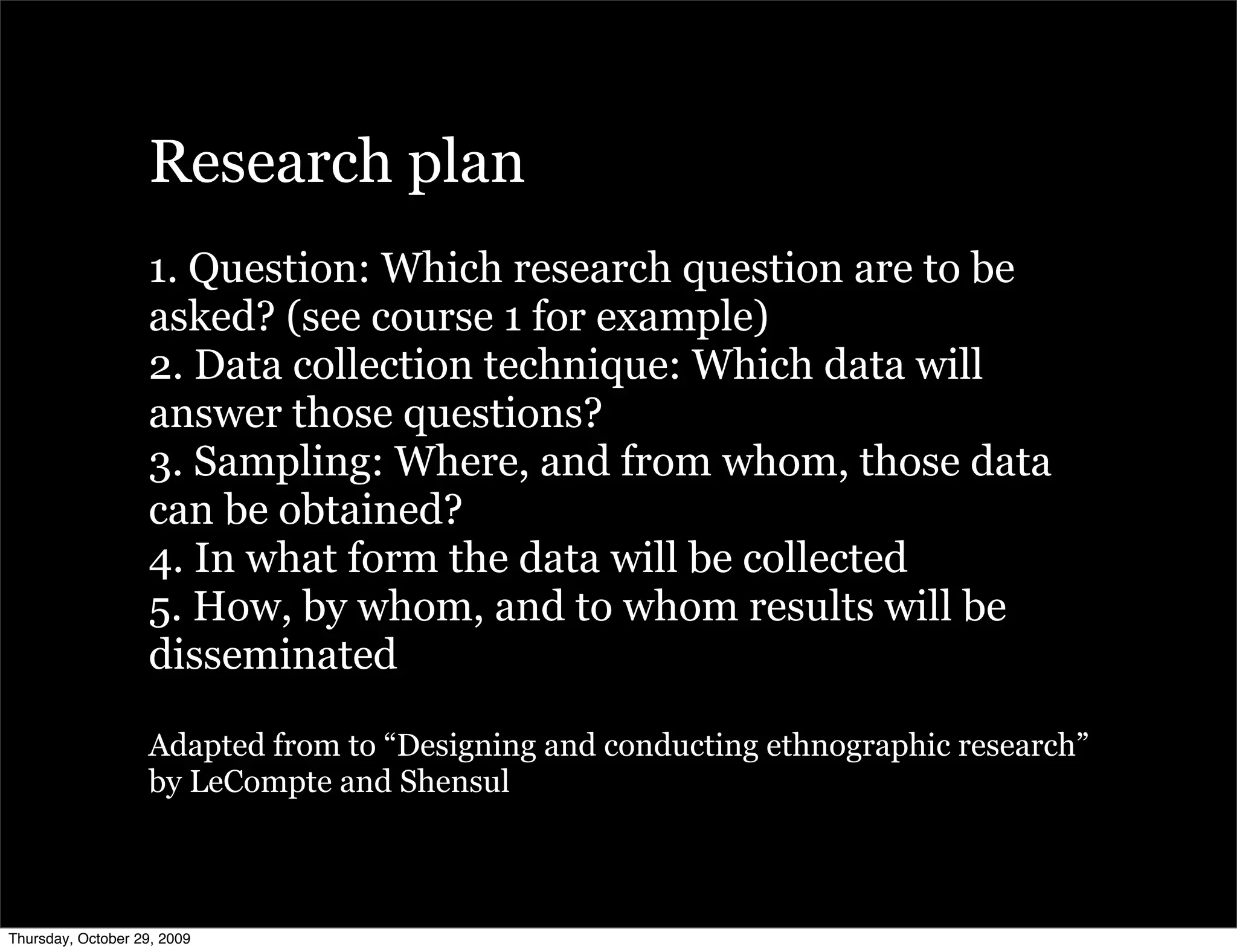
Research plan
                   1. Question: Which research question are to be
                   asked? (see course 1 for example)
                   2. Data collection technique: Which data will
                   answer those questions?
                   3. Sampling: Where, and from whom, those data
                   can be obtained?
                   4. In what form the data will be collected
                   5. How, by whom, and to whom results will be
                   disseminated

                   Adapted from to “Designing and conducting ethnographic research”
                   by LeCompte and Shensul


Thursday, October 29, 2009
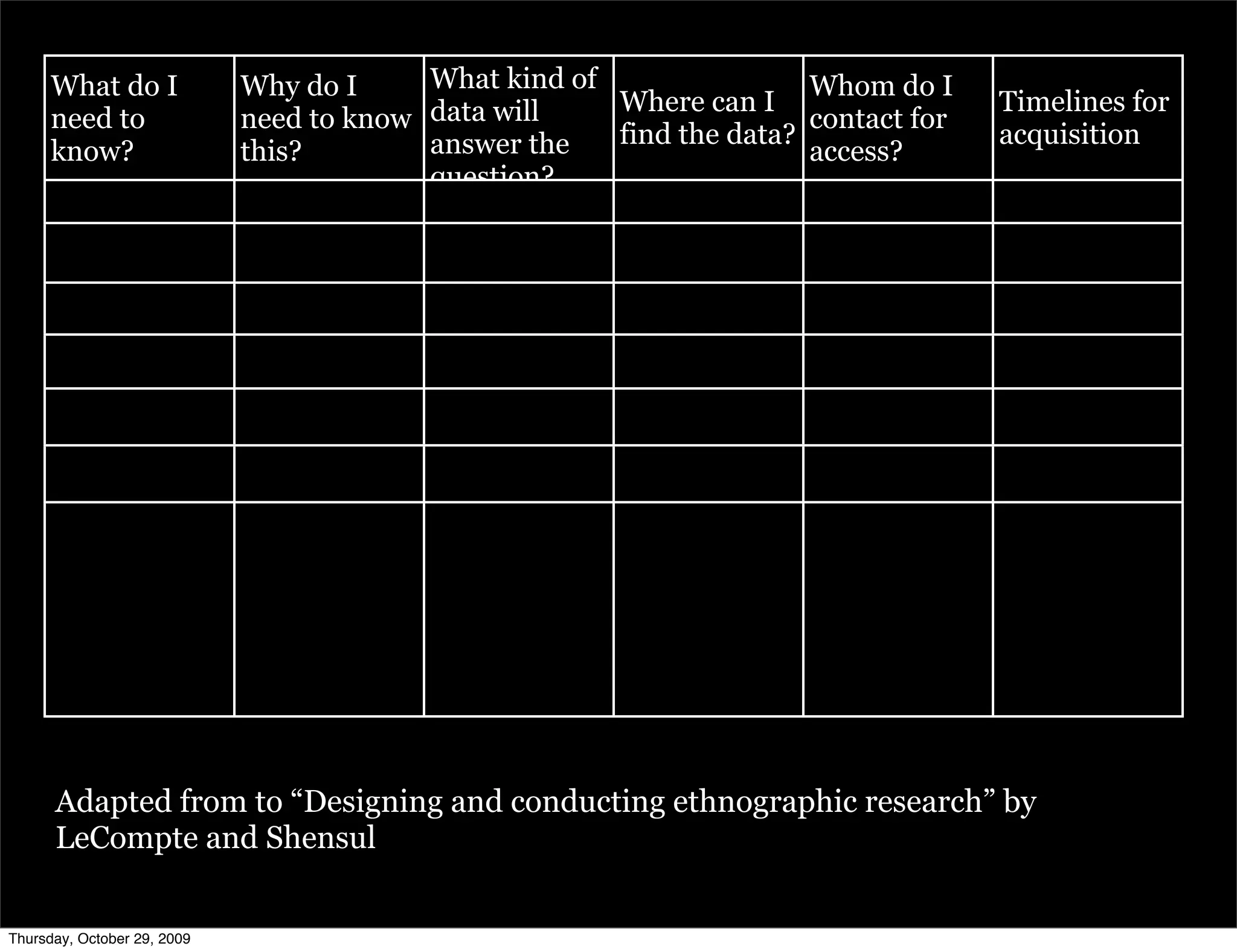
What do I              Why do I     What kind of                Whom do I
                                                       Where can I                  Timelines for
      need to                need to know data will                   contact for
                                          answer the   find the data?               acquisition
      know?                  this?                                    access?
                                          question?


      Adapted from to “Designing and conducting ethnographic research” by
      LeCompte and Shensul


Thursday, October 29, 2009
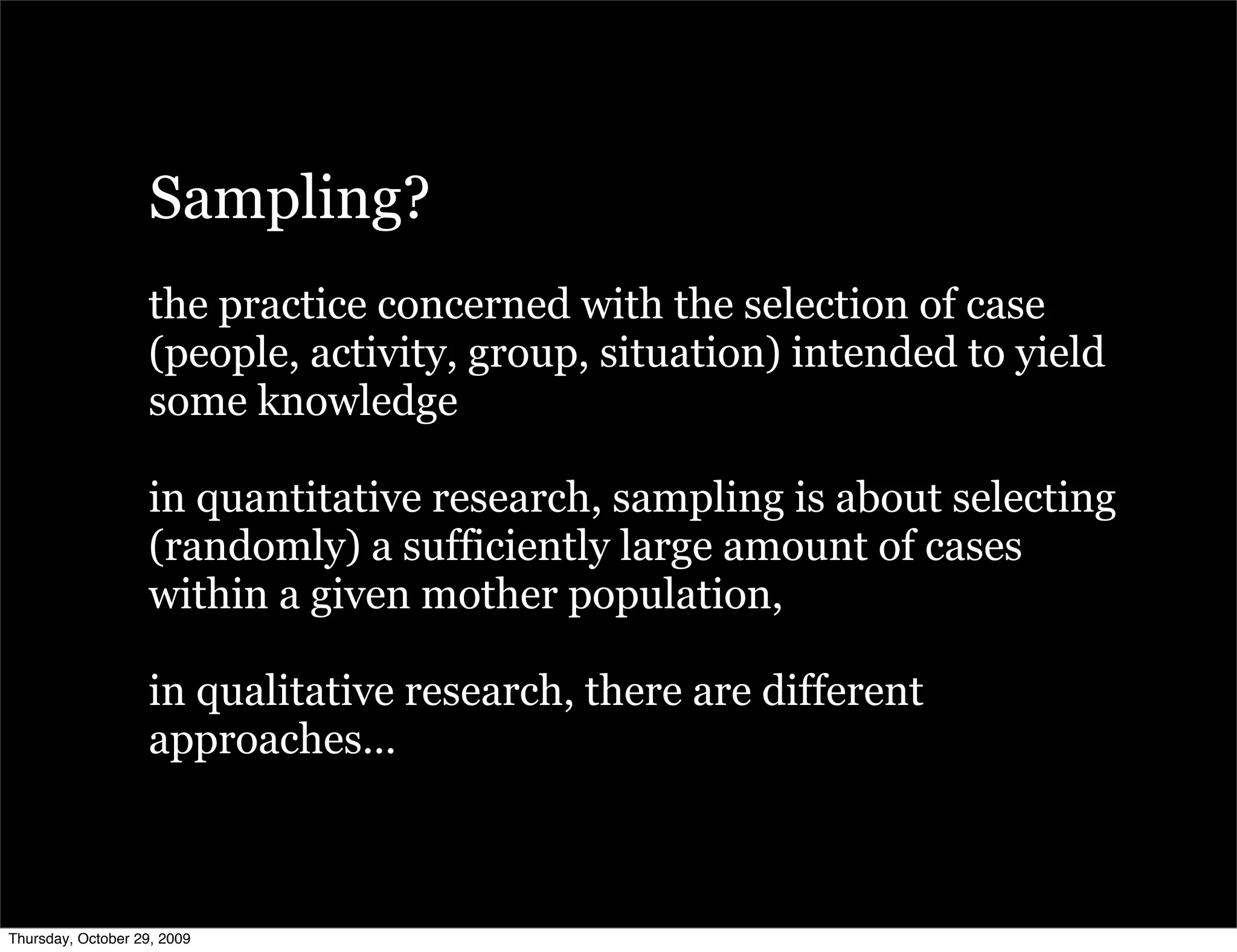
Sampling?
                   the practice concerned with the selection of case
                   (people, activity, group, situation) intended to yield
                   some knowledge

                   in quantitative research, sampling is about selecting
                   (randomly) a sufficiently large amount of cases
                   within a given mother population,

                   in qualitative research, there are different
                   approaches...


Thursday, October 29, 2009
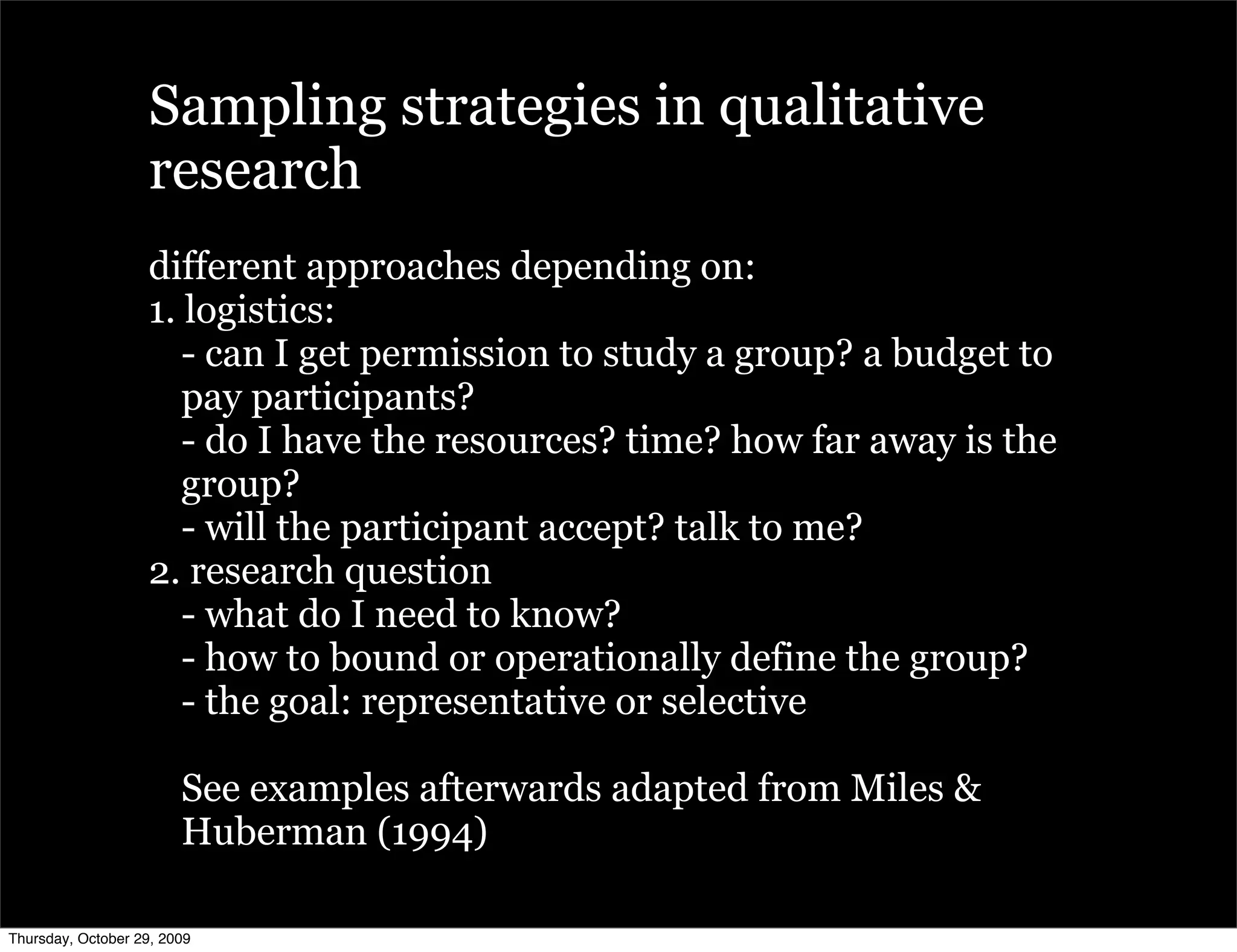
Sampling strategies in qualitative
                   research
                   different approaches depending on:
                   1. logistics:
                      - can I get permission to study a group? a budget to
                      pay participants?
                      - do I have the resources? time? how far away is the
                      group?
                      - will the participant accept? talk to me?
                   2. research question
                      - what do I need to know?
                      - how to bound or operationally define the group?
                      - the goal: representative or selective

                        See examples afterwards adapted from Miles &
                        Huberman (1994)

Thursday, October 29, 2009
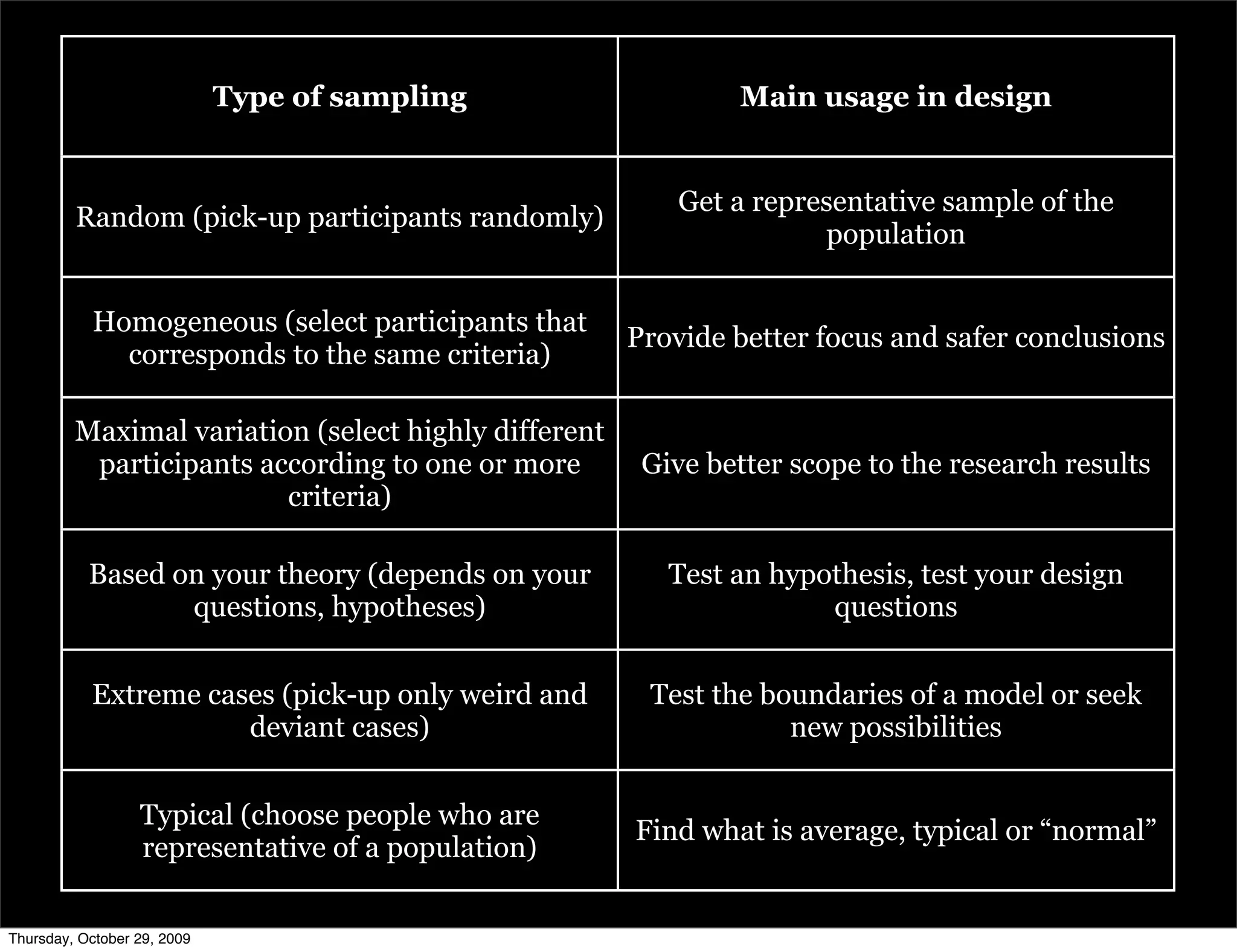
Type of sampling                 Main usage in design


                                                          Get a representative sample of the
         Random (pick-up participants randomly)
                                                                     population


           Homogeneous (select participants that
                                                      Provide better focus and safer conclusions
             corresponds to the same criteria)

         Maximal variation (select highly different
          participants according to one or more        Give better scope to the research results
                         criteria)

           Based on your theory (depends on your         Test an hypothesis, test your design
                  questions, hypotheses)                             questions


           Extreme cases (pick-up only weird and       Test the boundaries of a model or seek
                      deviant cases)                              new possibilities


                  Typical (choose people who are
                                                      Find what is average, typical or “normal”
                  representative of a population)

Thursday, October 29, 2009
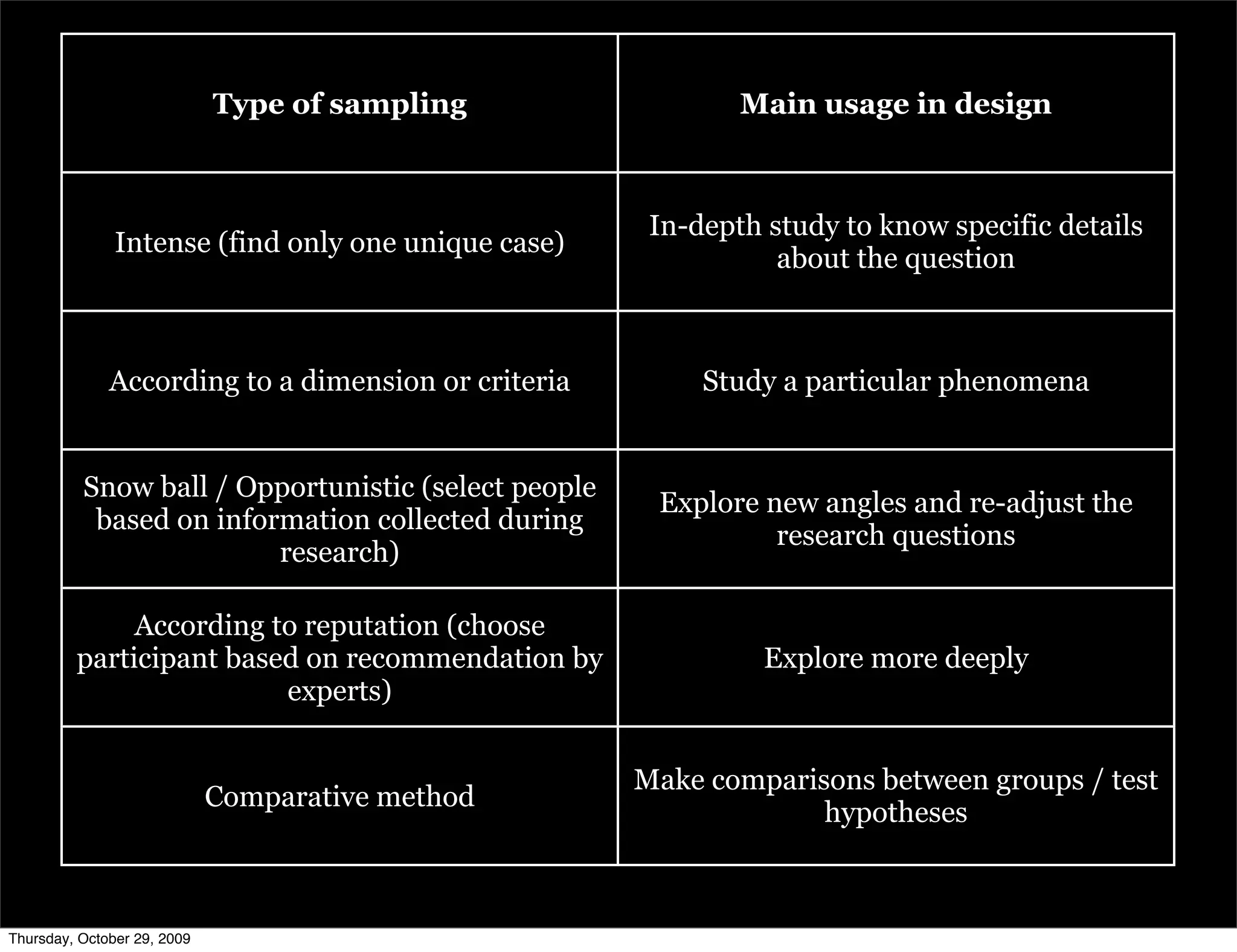
Type of sampling                Main usage in design


                                                      In-depth study to know specific details
               Intense (find only one unique case)
                                                                about the question


              According to a dimension or criteria        Study a particular phenomena


          Snow ball / Opportunistic (select people
                                                      Explore new angles and re-adjust the
           based on information collected during
                                                               research questions
                         research)

              According to reputation (choose
         participant based on recommendation by                Explore more deeply
                         experts)


                                                     Make comparisons between groups / test
                             Comparative method
                                                                  hypotheses


Thursday, October 29, 2009
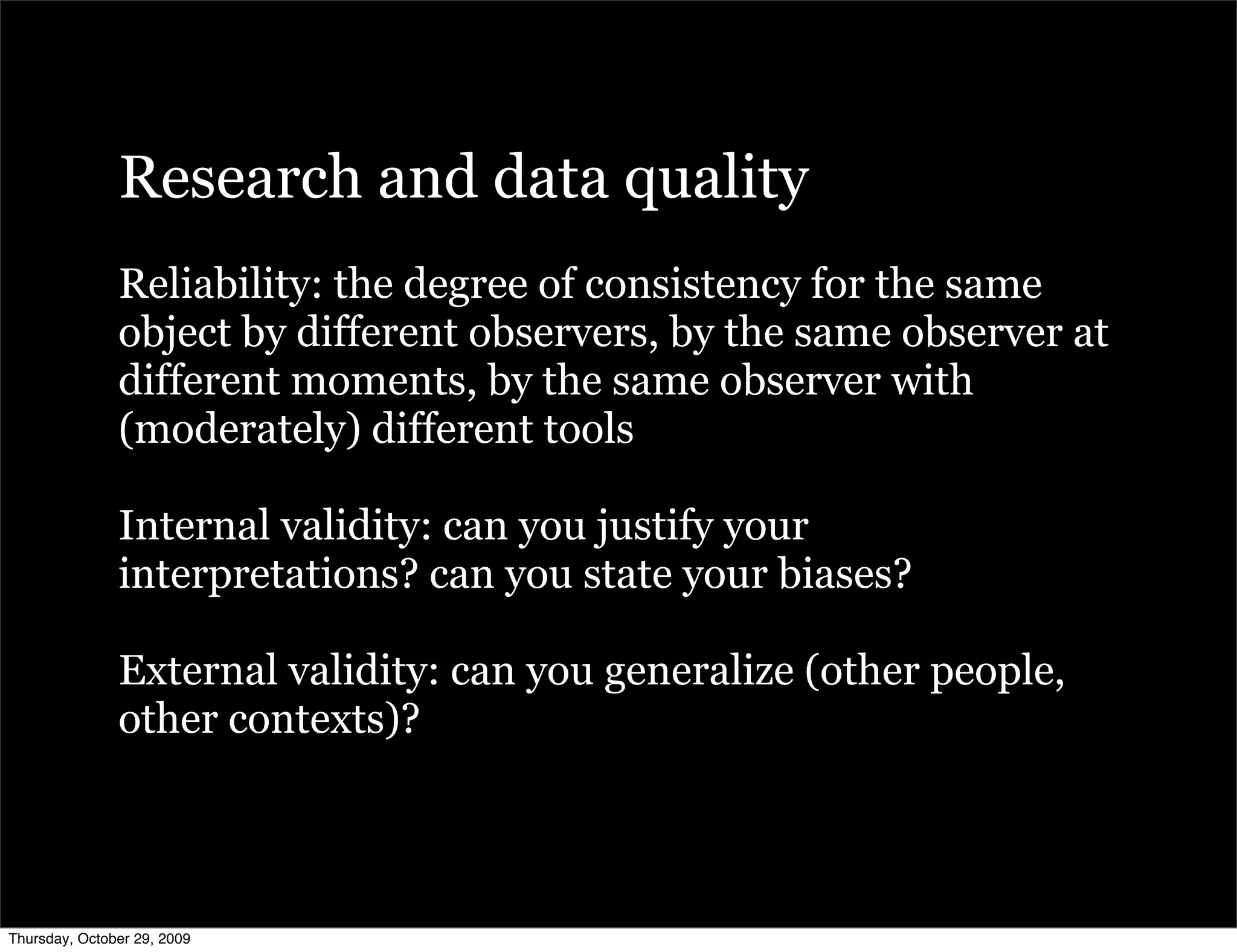
Research and data quality
               Reliability: the degree of consistency for the same
               object by different observers, by the same observer at
               different moments, by the same observer with
               (moderately) different tools

               Internal validity: can you justify your
               interpretations? can you state your biases?

               External validity: can you generalize (other people,
               other contexts)?


Thursday, October 29, 2009
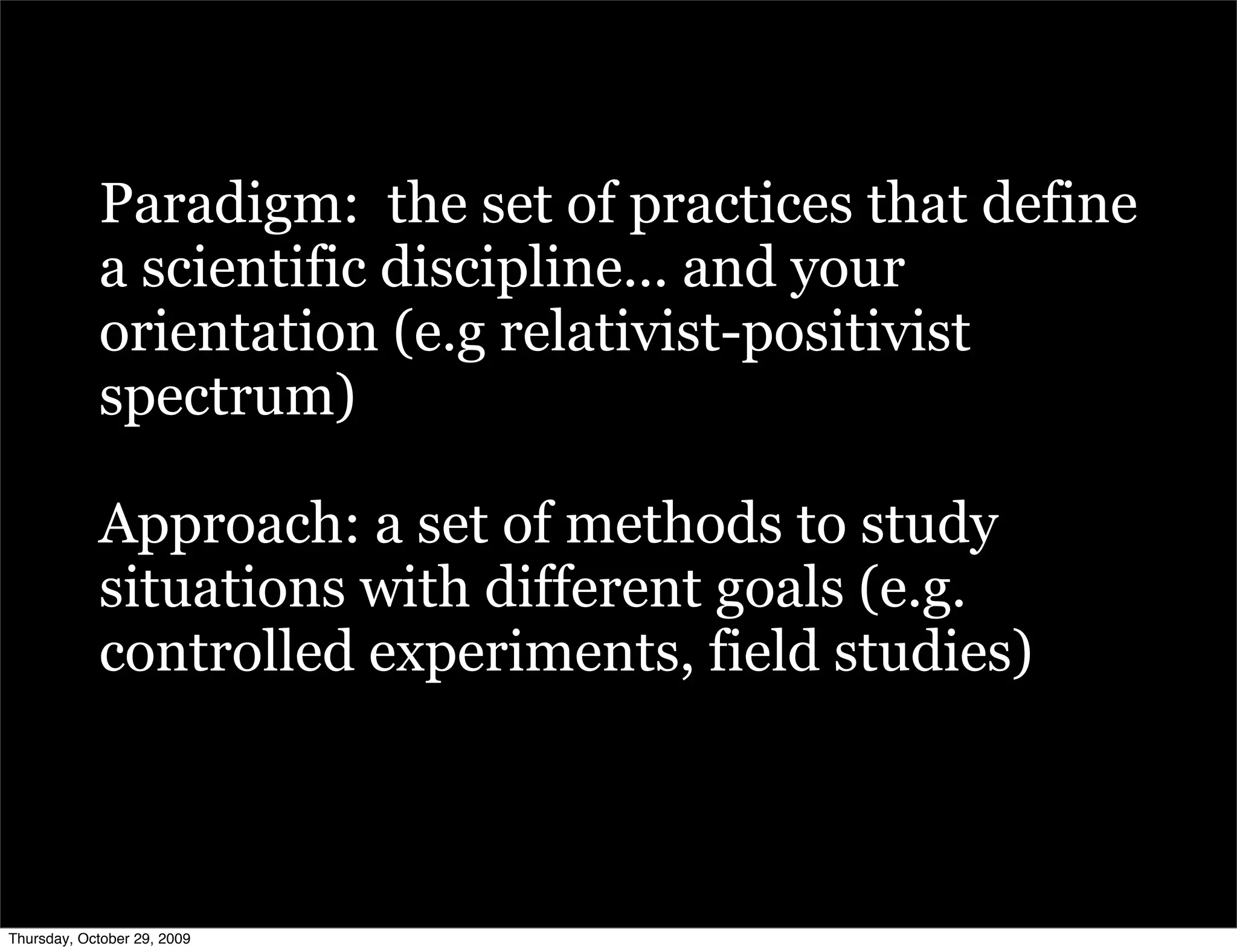
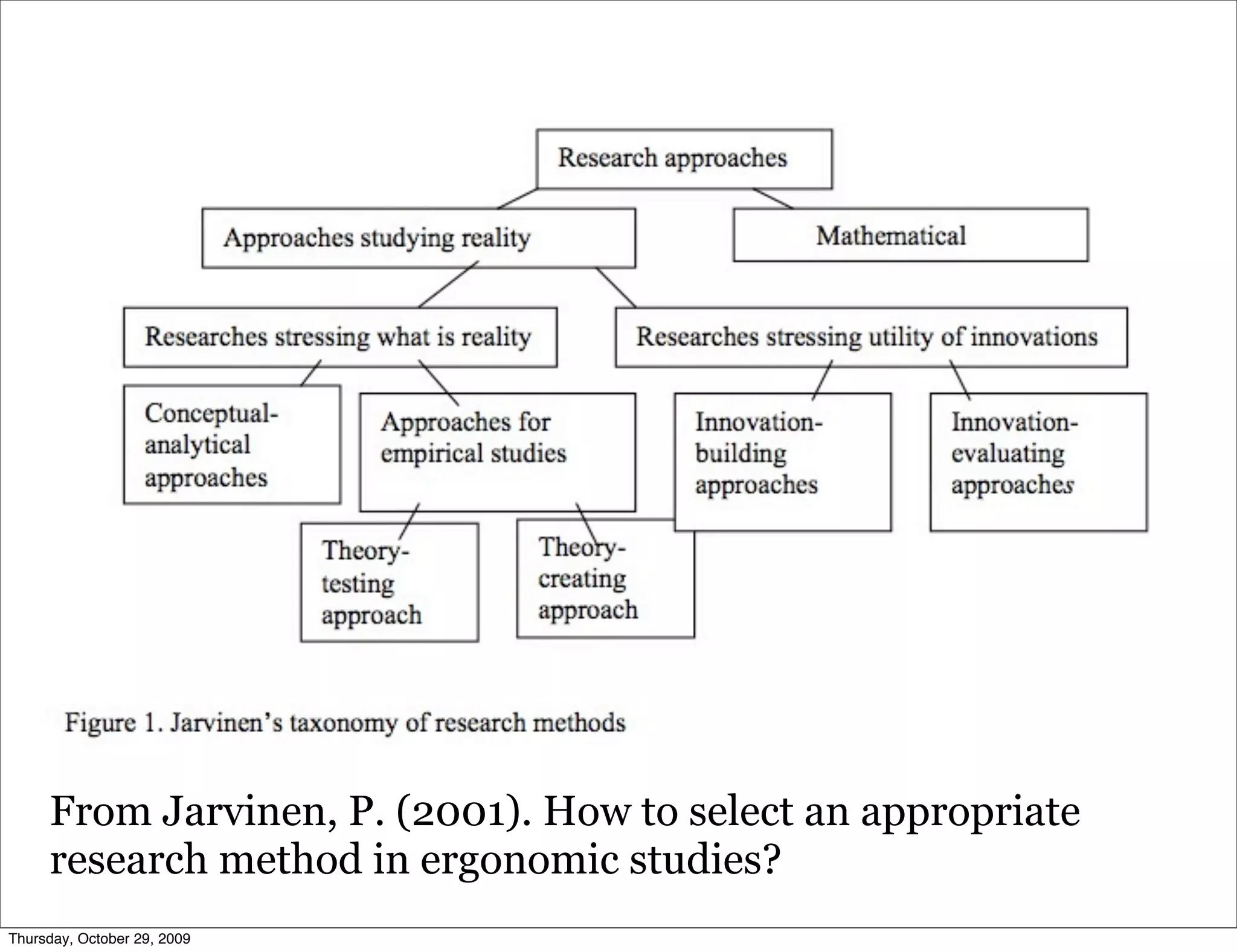
Paradigm: the set of practices that define
            a scientific discipline... and your
            orientation (e.g relativist-positivist
            spectrum)

            Approach: a set of methods to study
            situations with different goals (e.g.
            controlled experiments, field studies)


Thursday, October 29, 2009
From Jarvinen, P. (2001). How to select an appropriate
     research method in ergonomic studies?
Thursday, October 29, 2009
Conceptual/theoretical frameworks:
            provide an overview of a phenomenon,
            help to formulate questions , list
            dimensions of a situation and enable to
            structure the analysis

            in design research, frameworks are less
            employed than in other domains

            two examples though


Thursday, October 29, 2009
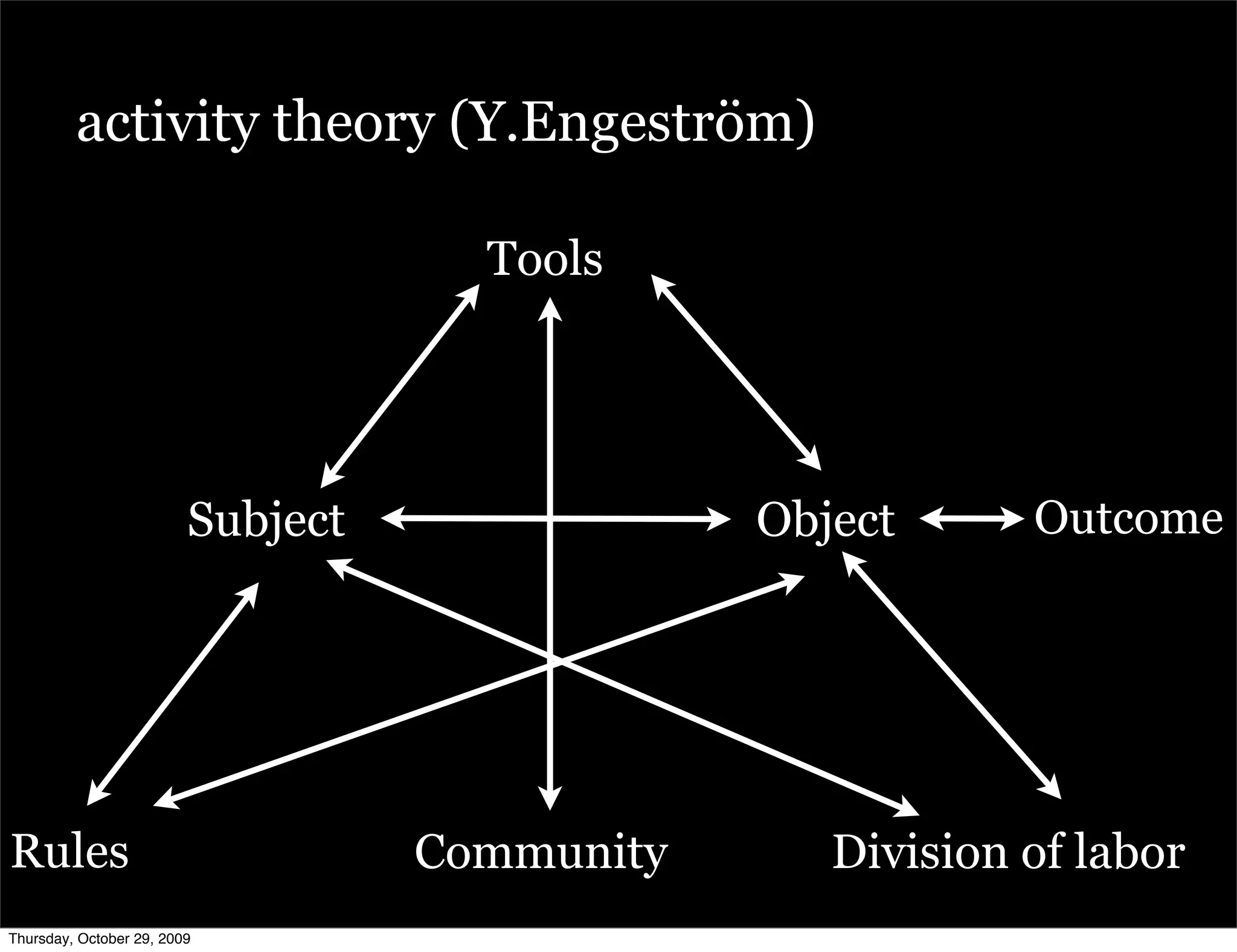
activity theory (Y.Engeström)

                                     Tools


                         Subject               Object      Outcome


Rules                              Community      Division of labor
Thursday, October 29, 2009
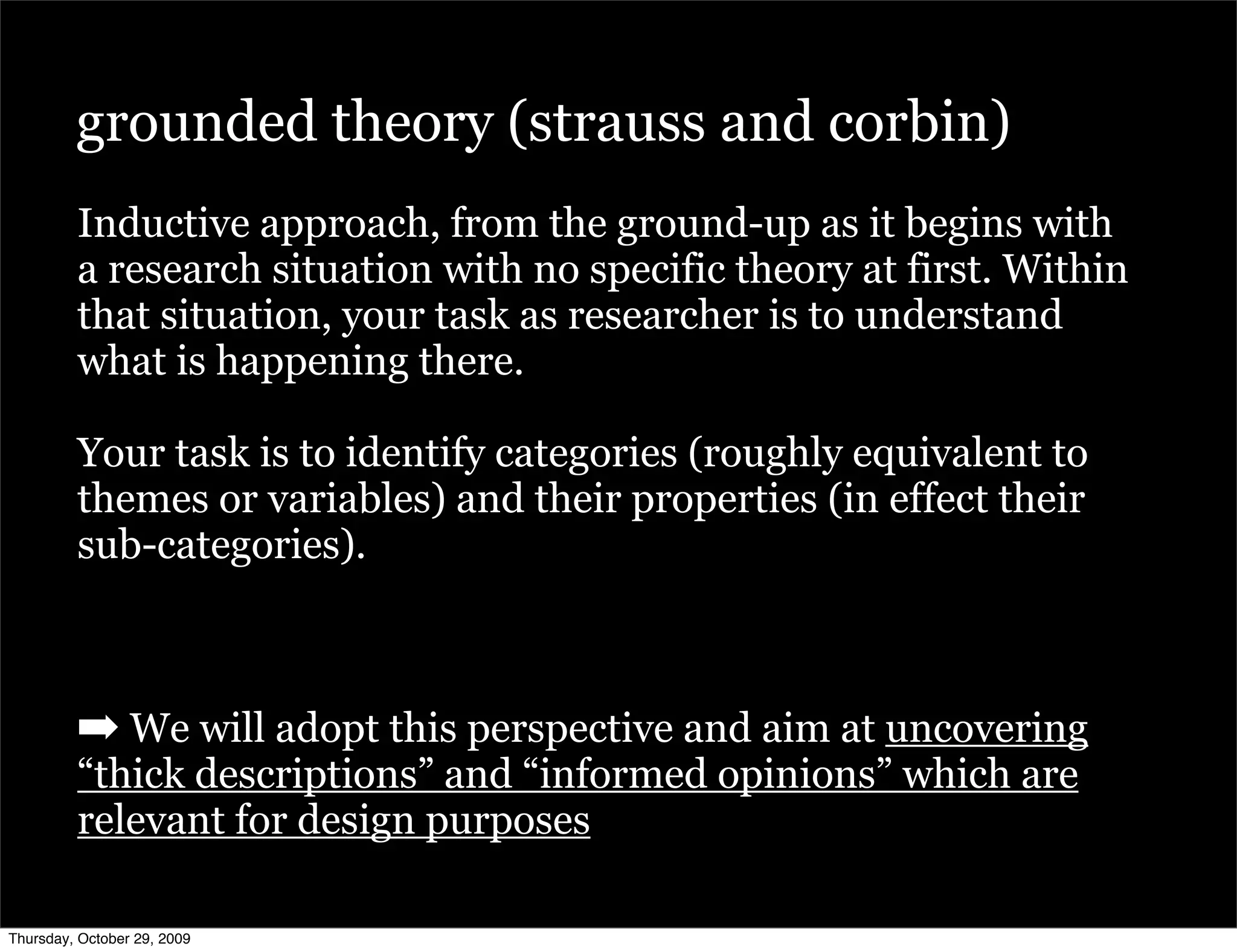
grounded theory (strauss and corbin)
         Inductive approach, from the ground-up as it begins with
         a research situation with no specific theory at first. Within
         that situation, your task as researcher is to understand
         what is happening there.

         Your task is to identify categories (roughly equivalent to
         themes or variables) and their properties (in effect their
         sub-categories).


         ➡ We will adopt this perspective and aim at uncovering
         “thick descriptions” and “informed opinions” which are
         relevant for design purposes

Thursday, October 29, 2009
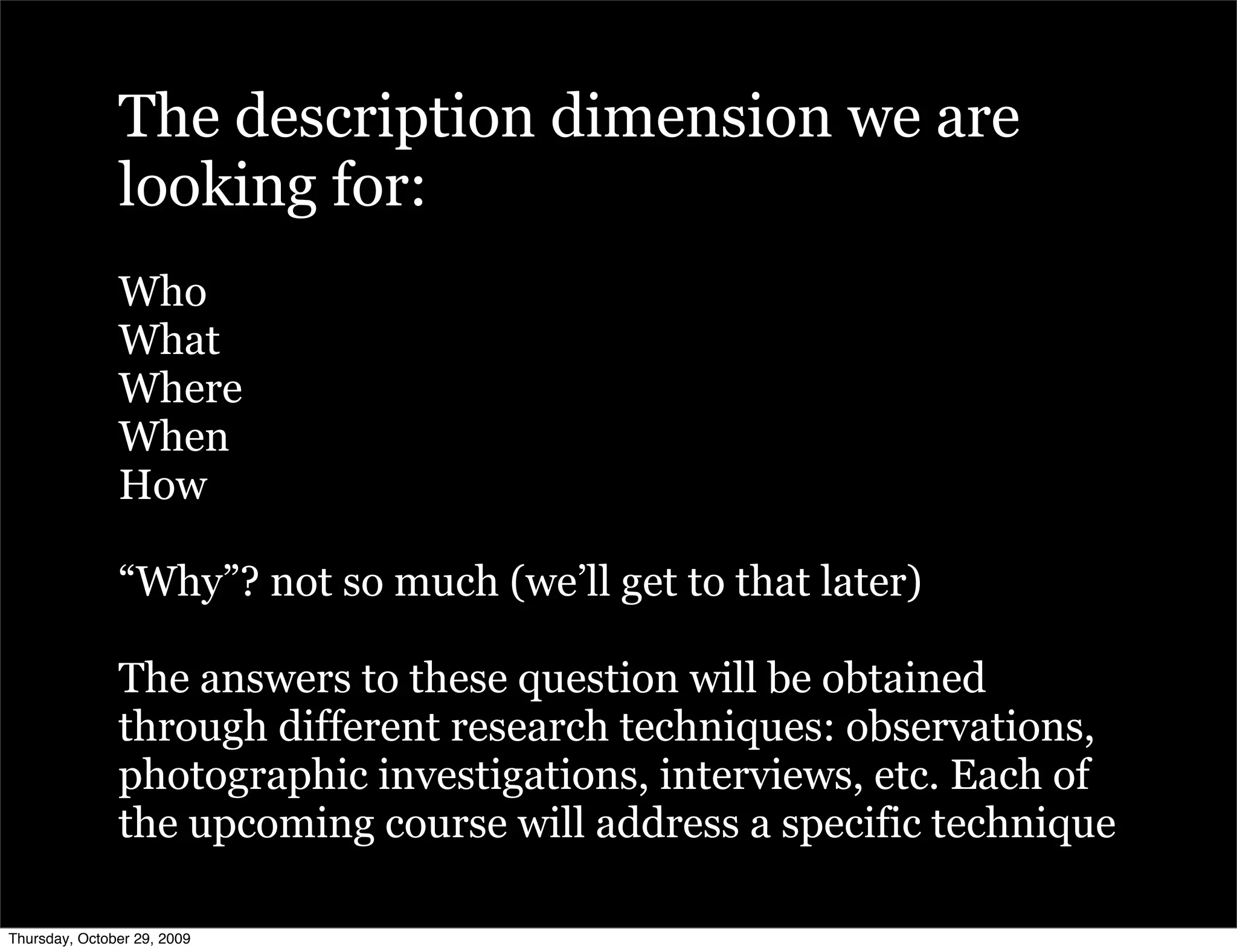
The description dimension we are
               looking for:
               Who
               What
               Where
               When
               How

               “Why”? not so much (we’ll get to that later)

               The answers to these question will be obtained
               through different research techniques: observations,
               photographic investigations, interviews, etc. Each of
               the upcoming course will address a specific technique

Thursday, October 29, 2009
Project discussion


Thursday, October 29, 2009
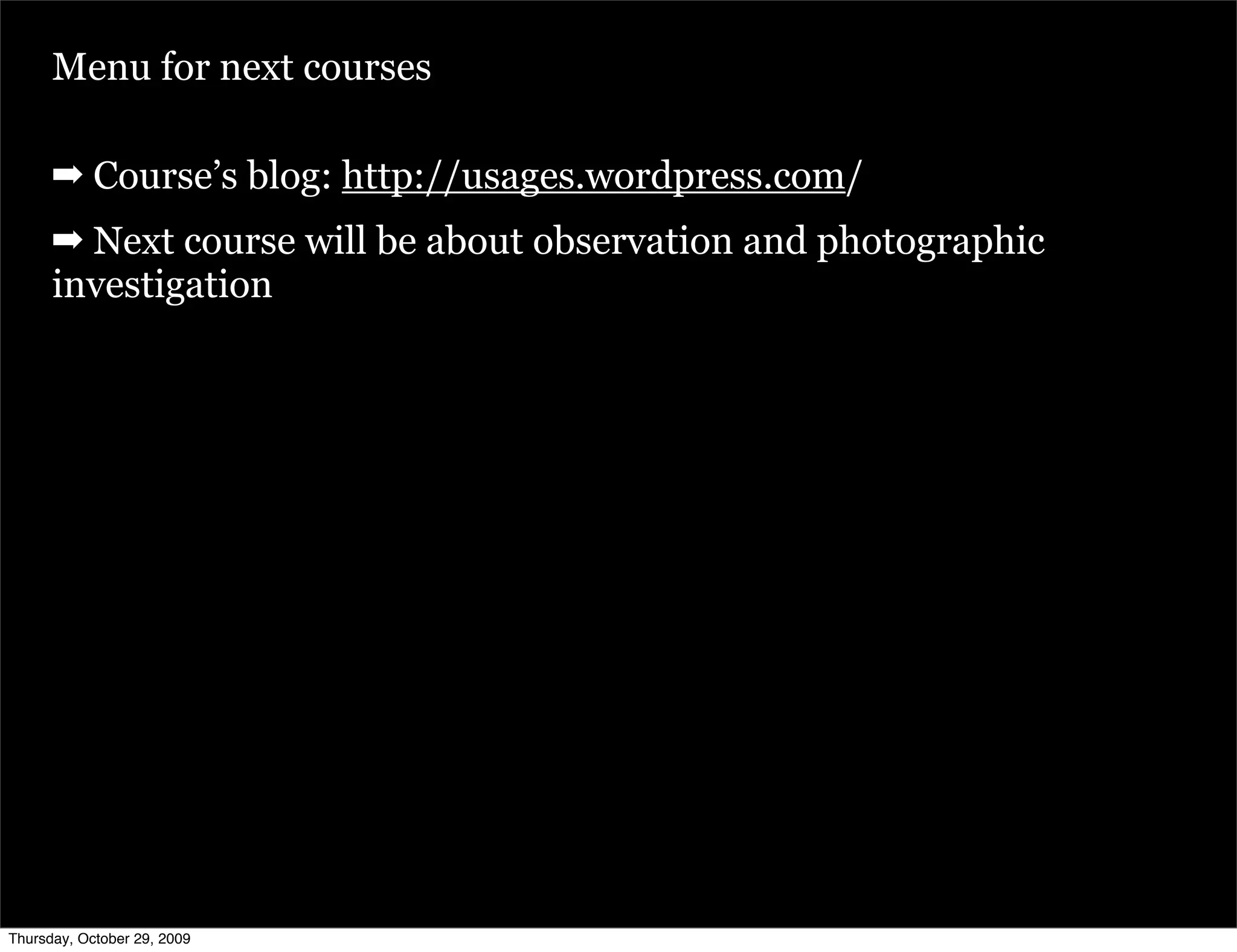
Menu for next courses

      ➡ Course’s blog: http://usages.wordpress.com/
      ➡ Next course will be about observation and photographic
      investigation


Thursday, October 29, 2009
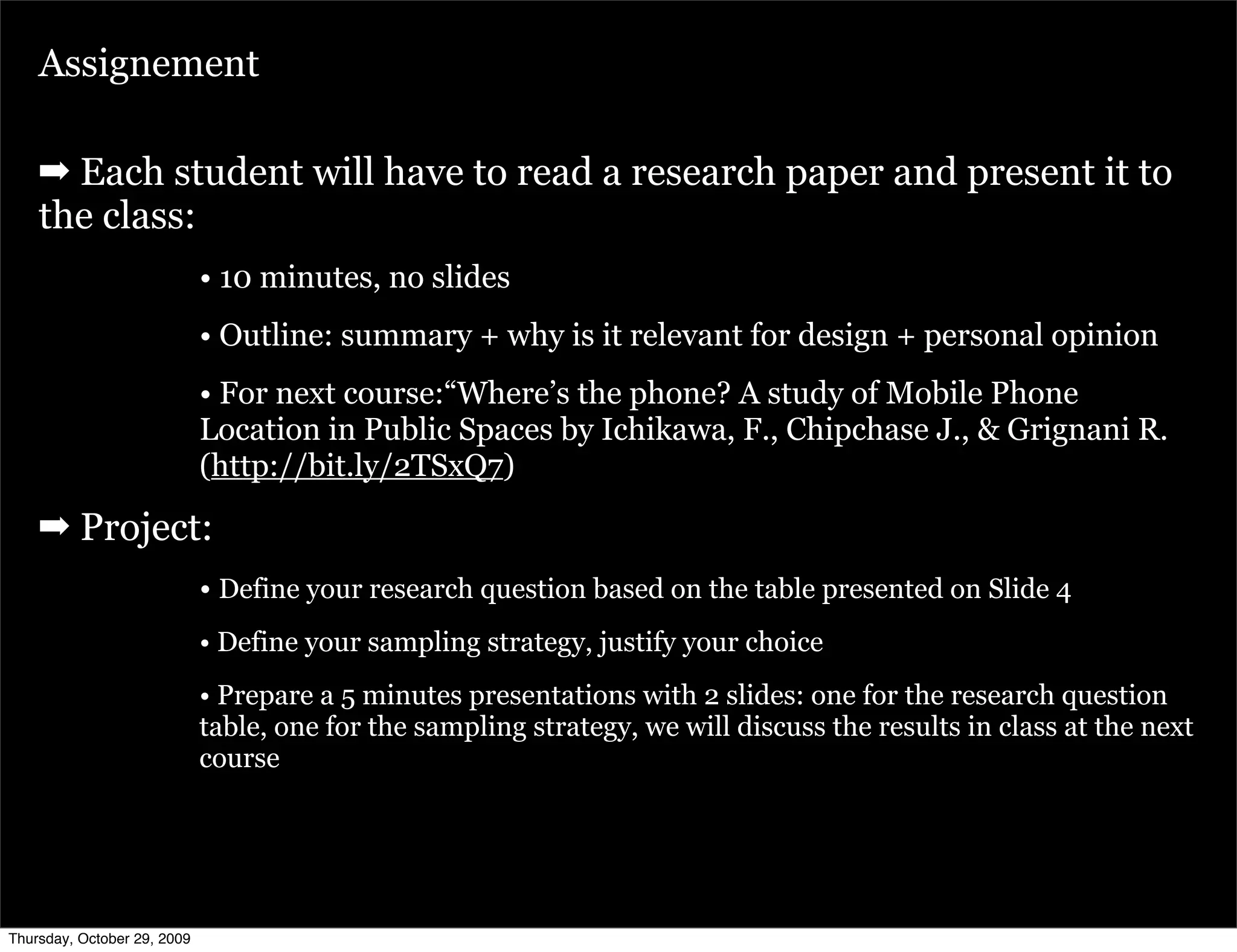
Assignement

    ➡ Each student will have to read a research paper and present it to
    the class:
                             • 10 minutes, no slides
                             • Outline: summary + why is it relevant for design + personal opinion
                             • For next course:“Where’s the phone? A study of Mobile Phone
                             Location in Public Spaces by Ichikawa, F., Chipchase J., & Grignani R.
                             (http://bit.ly/2TSxQ7)

    ➡ Project:
                             • Define your research question based on the table presented on Slide 4
                             • Define your sampling strategy, justify your choice
                             • Prepare a 5 minutes presentations with 2 slides: one for the research question
                             table, one for the sampling strategy, we will discuss the results in class at the next
                             course


Thursday, October 29, 2009
Let’s discuss your research question


Thursday, October 29, 2009
thanks
         nicolas@liftlab.com

Thursday, October 29, 2009

Field research and interaction design: course #2

  • 1.
    Course #2: preparingresearch studies nicolas nova | liftlab Head, Geneva | October, 29th 2009 Thursday, October 29, 2009
  • 2.
  • 3.
    Research plan 1. Question: Which research question are to be asked? (see course 1 for example) 2. Data collection technique: Which data will answer those questions? 3. Sampling: Where, and from whom, those data can be obtained? 4. In what form the data will be collected 5. How, by whom, and to whom results will be disseminated Adapted from to “Designing and conducting ethnographic research” by LeCompte and Shensul Thursday, October 29, 2009
  • 4.
    What do I Why do I What kind of Whom do I Where can I Timelines for need to need to know data will contact for answer the find the data? acquisition know? this? access? question? Adapted from to “Designing and conducting ethnographic research” by LeCompte and Shensul Thursday, October 29, 2009
  • 5.
    Sampling? the practice concerned with the selection of case (people, activity, group, situation) intended to yield some knowledge in quantitative research, sampling is about selecting (randomly) a sufficiently large amount of cases within a given mother population, in qualitative research, there are different approaches... Thursday, October 29, 2009
  • 6.
    Sampling strategies inqualitative research different approaches depending on: 1. logistics: - can I get permission to study a group? a budget to pay participants? - do I have the resources? time? how far away is the group? - will the participant accept? talk to me? 2. research question - what do I need to know? - how to bound or operationally define the group? - the goal: representative or selective See examples afterwards adapted from Miles & Huberman (1994) Thursday, October 29, 2009
  • 7.
    Type of sampling Main usage in design Get a representative sample of the Random (pick-up participants randomly) population Homogeneous (select participants that Provide better focus and safer conclusions corresponds to the same criteria) Maximal variation (select highly different participants according to one or more Give better scope to the research results criteria) Based on your theory (depends on your Test an hypothesis, test your design questions, hypotheses) questions Extreme cases (pick-up only weird and Test the boundaries of a model or seek deviant cases) new possibilities Typical (choose people who are Find what is average, typical or “normal” representative of a population) Thursday, October 29, 2009
  • 8.
    Type of sampling Main usage in design In-depth study to know specific details Intense (find only one unique case) about the question According to a dimension or criteria Study a particular phenomena Snow ball / Opportunistic (select people Explore new angles and re-adjust the based on information collected during research questions research) According to reputation (choose participant based on recommendation by Explore more deeply experts) Make comparisons between groups / test Comparative method hypotheses Thursday, October 29, 2009
  • 9.
    Research and dataquality Reliability: the degree of consistency for the same object by different observers, by the same observer at different moments, by the same observer with (moderately) different tools Internal validity: can you justify your interpretations? can you state your biases? External validity: can you generalize (other people, other contexts)? Thursday, October 29, 2009
  • 10.
    Paradigm: the setof practices that define a scientific discipline... and your orientation (e.g relativist-positivist spectrum) Approach: a set of methods to study situations with different goals (e.g. controlled experiments, field studies) Thursday, October 29, 2009
  • 11.
    From Jarvinen, P.(2001). How to select an appropriate research method in ergonomic studies? Thursday, October 29, 2009
  • 12.
    Conceptual/theoretical frameworks: provide an overview of a phenomenon, help to formulate questions , list dimensions of a situation and enable to structure the analysis in design research, frameworks are less employed than in other domains two examples though Thursday, October 29, 2009
  • 13.
    activity theory (Y.Engeström) Tools Subject Object Outcome Rules Community Division of labor Thursday, October 29, 2009
  • 14.
    grounded theory (straussand corbin) Inductive approach, from the ground-up as it begins with a research situation with no specific theory at first. Within that situation, your task as researcher is to understand what is happening there. Your task is to identify categories (roughly equivalent to themes or variables) and their properties (in effect their sub-categories). ➡ We will adopt this perspective and aim at uncovering “thick descriptions” and “informed opinions” which are relevant for design purposes Thursday, October 29, 2009
  • 15.
    The description dimensionwe are looking for: Who What Where When How “Why”? not so much (we’ll get to that later) The answers to these question will be obtained through different research techniques: observations, photographic investigations, interviews, etc. Each of the upcoming course will address a specific technique Thursday, October 29, 2009
  • 16.
  • 17.
    Menu for nextcourses ➡ Course’s blog: http://usages.wordpress.com/ ➡ Next course will be about observation and photographic investigation Thursday, October 29, 2009
  • 18.
    Assignement ➡ Each student will have to read a research paper and present it to the class: • 10 minutes, no slides • Outline: summary + why is it relevant for design + personal opinion • For next course:“Where’s the phone? A study of Mobile Phone Location in Public Spaces by Ichikawa, F., Chipchase J., & Grignani R. (http://bit.ly/2TSxQ7) ➡ Project: • Define your research question based on the table presented on Slide 4 • Define your sampling strategy, justify your choice • Prepare a 5 minutes presentations with 2 slides: one for the research question table, one for the sampling strategy, we will discuss the results in class at the next course Thursday, October 29, 2009
  • 19.
    Let’s discuss yourresearch question Thursday, October 29, 2009
  • 20.
    thanks nicolas@liftlab.com Thursday, October 29, 2009