FETAL DEVELOPMENT
FETAL DEVELOPMENT
A. Pre-embryonic period: First 2 weeks after
conception
B. Embryonic period: Beginning at day 15 through
approximately the eighth week after conception
C. Fetal period: Beginning at the ninth week after
conception and ending with birth
Week 1
 Blastocyst is free-floating.
Weeks 2 to 3
 Embryo is 1.5 to 2 mm in length.
 Lung buds appear
 Blood circulation begins.
 Heart is tubular and begins to beat.
 Neural plate becomes brain and spinal cord.
Week 5
 Embryo is 0.4 to 0.5 cm in length.
 Embryo is 0.4 g.
 Double heart chambers are visible.
 Heart is beating.
 Limb buds form.
Week 8
 Embryo is 3 cm in length.
 Embryo is 2 g.
 Eyelids begin to fuse.
 Circulatory system through umbilical cord is well
established.
 Every organ system is present.
Week 12
 Fetus is 6 to 9 cm in length.
 Fetus is 19 g.
 Face is well formed
 Limbs are long and slender.
 Kidneys begin to form urine.
 Spontaneous movements occur.
 Heartbeat is detected by Doppler transducer between
10
 and 12 weeks.
 Sex is visually recognizable.
Week 16
 Fetus is 11.5 to 13.5 cm in length.
 Fetus is 100 g.
 Active movements are present.
 Fetal skin is transparent.
 Lanugo hair begins to develop.
 Skeletal ossification occurs.
Week 20
 Fetus is 16 to 18.5 cm in length.
 Fetus is 300 g.
 Lanugo covers the entire body.
 Fetus has nails.
 Muscles are developed.
 Enamel and dentin are depositing.
 Heartbeat is detected by regular (nonelectronic)
fetoscope.
Week 24
 Fetus is 23 cm in length.
 Fetus is 600 g.
 Hair on head is well formed.
 Skin is reddish and wrinkled.
 Reflex hand grasp functions.
 Vernix caseosa covers entire body.
 Fetus has ability to hear.
Week 28
 Fetus is 27 cm in length.
 Fetus is 1100 g.
 Limbs are well flexed.
 Brain is developing rapidly.
 Eyelids open and close.
 Lungs are developed sufficiently to provide gas
exchange(lecithin forming).
 If born, neonate can breathe at this time.
Week 32
 Fetus is 31 cm in length.
 Fetus is 1800 to 2100 g.
 Bones are fully developed.
 Subcutaneous fat has collected.
 Lecithin-to-sphingomyelin (L/S) ratio is 1.2:1.
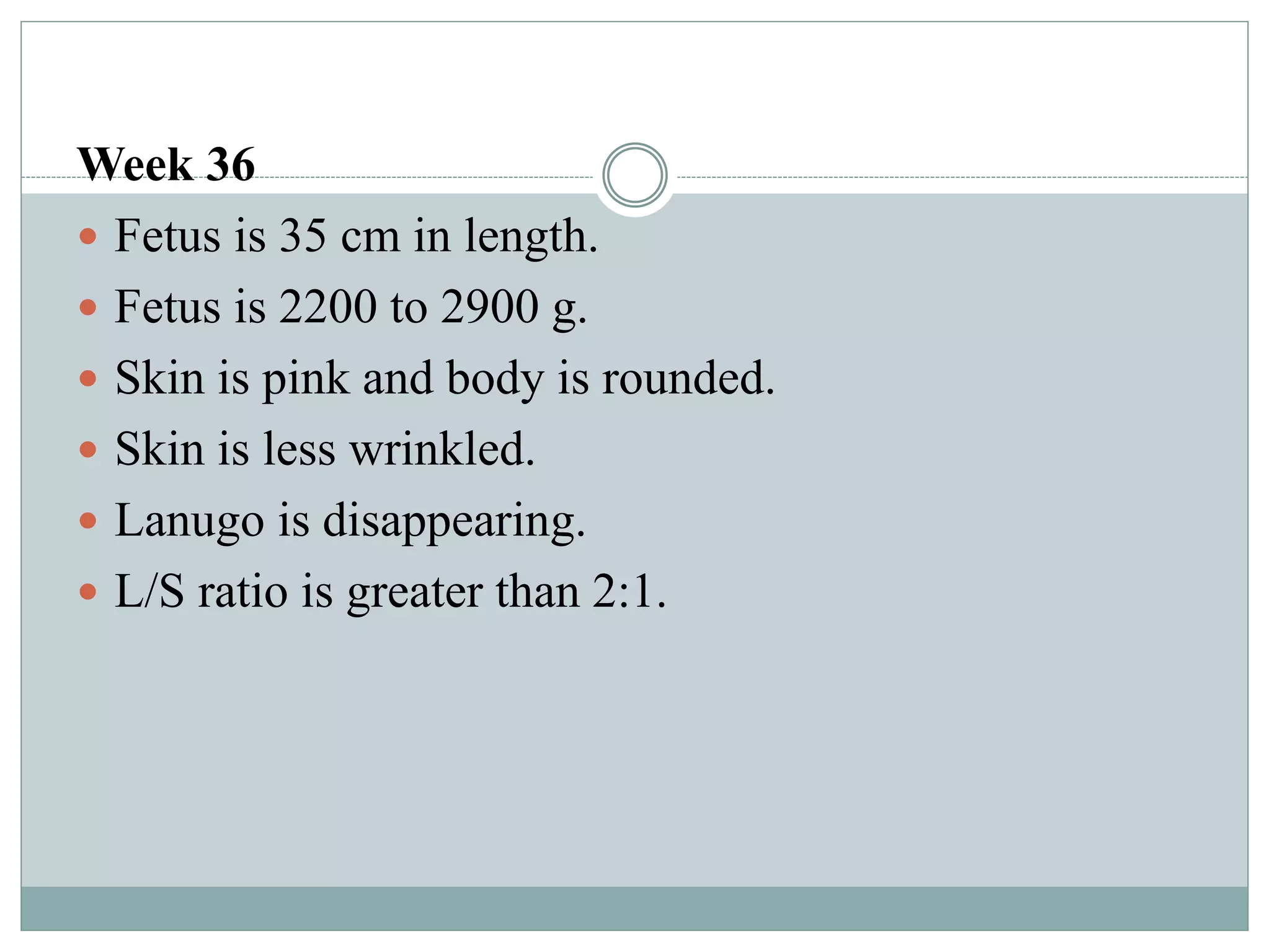
Week 36
 Fetus is 35 cm in length.
 Fetus is 2200 to 2900 g.
 Skin is pink and body is rounded.
 Skin is less wrinkled.
 Lanugo is disappearing.
 L/S ratio is greater than 2:1.
Week 40
 Fetus is 40 cm in length.
 Fetus is more than 3200 g.
 Skin is pinkish and smooth.
 Lanugo is present on upper arms and shoulders.
 Vernix caseosa decreases.
 Fingernails extend beyond fingertips.
 Sole (plantar) creases run down to the heel.
 Testes are in the scrotum.
 Labia majora are well developed.

Fetal development

  • 1.
  • 2.
    FETAL DEVELOPMENT A. Pre-embryonicperiod: First 2 weeks after conception B. Embryonic period: Beginning at day 15 through approximately the eighth week after conception C. Fetal period: Beginning at the ninth week after conception and ending with birth
  • 3.
    Week 1  Blastocystis free-floating. Weeks 2 to 3  Embryo is 1.5 to 2 mm in length.  Lung buds appear  Blood circulation begins.  Heart is tubular and begins to beat.  Neural plate becomes brain and spinal cord.
  • 4.
    Week 5  Embryois 0.4 to 0.5 cm in length.  Embryo is 0.4 g.  Double heart chambers are visible.  Heart is beating.  Limb buds form.
  • 5.
    Week 8  Embryois 3 cm in length.  Embryo is 2 g.  Eyelids begin to fuse.  Circulatory system through umbilical cord is well established.  Every organ system is present.
  • 6.
    Week 12  Fetusis 6 to 9 cm in length.  Fetus is 19 g.  Face is well formed  Limbs are long and slender.  Kidneys begin to form urine.  Spontaneous movements occur.  Heartbeat is detected by Doppler transducer between 10  and 12 weeks.  Sex is visually recognizable.
  • 7.
    Week 16  Fetusis 11.5 to 13.5 cm in length.  Fetus is 100 g.  Active movements are present.  Fetal skin is transparent.  Lanugo hair begins to develop.  Skeletal ossification occurs.
  • 8.
    Week 20  Fetusis 16 to 18.5 cm in length.  Fetus is 300 g.  Lanugo covers the entire body.  Fetus has nails.  Muscles are developed.  Enamel and dentin are depositing.  Heartbeat is detected by regular (nonelectronic) fetoscope.
  • 9.
    Week 24  Fetusis 23 cm in length.  Fetus is 600 g.  Hair on head is well formed.  Skin is reddish and wrinkled.  Reflex hand grasp functions.  Vernix caseosa covers entire body.  Fetus has ability to hear.
  • 10.
    Week 28  Fetusis 27 cm in length.  Fetus is 1100 g.  Limbs are well flexed.  Brain is developing rapidly.  Eyelids open and close.  Lungs are developed sufficiently to provide gas exchange(lecithin forming).  If born, neonate can breathe at this time.
  • 11.
    Week 32  Fetusis 31 cm in length.  Fetus is 1800 to 2100 g.  Bones are fully developed.  Subcutaneous fat has collected.  Lecithin-to-sphingomyelin (L/S) ratio is 1.2:1.
  • 12.
    Week 36  Fetusis 35 cm in length.  Fetus is 2200 to 2900 g.  Skin is pink and body is rounded.  Skin is less wrinkled.  Lanugo is disappearing.  L/S ratio is greater than 2:1.
  • 13.
    Week 40  Fetusis 40 cm in length.  Fetus is more than 3200 g.  Skin is pinkish and smooth.  Lanugo is present on upper arms and shoulders.  Vernix caseosa decreases.  Fingernails extend beyond fingertips.  Sole (plantar) creases run down to the heel.  Testes are in the scrotum.  Labia majora are well developed.