Electro-hydraulics

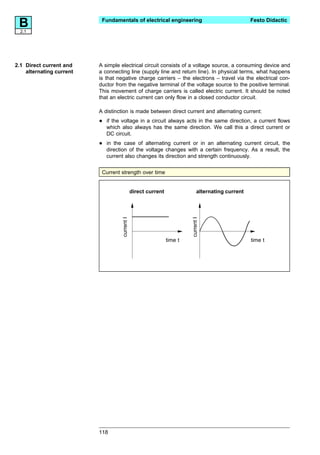
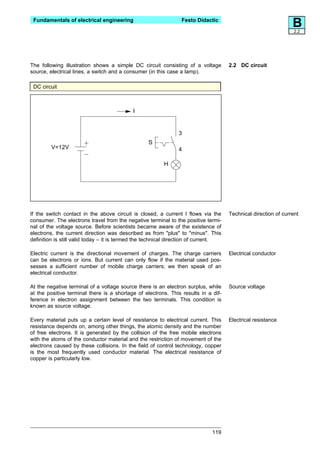
Basic level


D. Merkle   • K. Rupp • D. Scholz
Order no.:      093611
Description:    E.-HYDR.LEHRB.
Designation:    D.LB-TP601-GB
Edition:        4/92
Graphics:       A. Reulecke
Layout:         16.6.93, C. Paproth, M. Schwarz
Editor:         A. Zimmermann
Authors:        D. Merkle, K. Rupp, D. Scholz
Translator:     T. Tranter

© Copyright by Festo Didactic KG, D-73734 Esslingen, 1994

All rights reserved, including translation rights. No part of this publication may
be reproduced or transmitted in any form or by any means, electronic, mechan-
ical, photocopying, or otherwise, without the prior written permission of Festo
Didactic KG.

ISBN 3-8127-3611-X
Table of contents                                                                         Festo Didactic


Conception of the book . . . . . . . . . . . . . . . . . . . . . . . . . . . . . . . . . . . . . . . . . . . . 6 Table of contents


Part A: Course
1.      Introduction 9
1.1     Advantages of electro-hydraulics . . . . . . . . . . . . . . . . . . . . . . . . . . . . . . 10
1.2     Fields of application of electro-hydraulics . . . . . . . . . . . . . . . . . . . . . . . 10
1.3     Design of an electro-hydraulic system . . . . . . . . . . . . . . . . . . . . . . . . . . 11

2.      Circuit and graphic symbols . . . . . . . . . . . . . . . . . . . . . . . . . . . . . . . . . . 13
2.1     Pumps and motors . . . . . . . . . . . . . . . . . . . . . . . . . . . . . . . . . . . . . . . . . 14
2.2     Directional control valves . . . . . . . . . . . . . . . . . . . . . . . . . . . . . . . . . . . . 15
2.3     Pressure valves . . . . . . . . . . . . . . . . . . . . . . . . . . . . . . . . . . . . . . . . . . . 16
2.4     Flow valves . . . . . . . . . . . . . . . . . . . . . . . . . . . . . . . . . . . . . . . . . . . . . . 18
2.5     Non-return valves . . . . . . . . . . . . . . . . . . . . . . . . . . . . . . . . . . . . . . . . . . 19
2.6     Cylinders . . . . . . . . . . . . . . . . . . . . . . . . . . . . . . . . . . . . . . . . . . . . . . . . 20
2.7     Energy transfer and preparation . . . . . . . . . . . . . . . . . . . . . . . . . . . . . . 22
2.8     Measuring instruments . . . . . . . . . . . . . . . . . . . . . . . . . . . . . . . . . . . . . . 23
2.9     Equipment combinations . . . . . . . . . . . . . . . . . . . . . . . . . . . . . . . . . . . . 23
2.10    Electrical circuit symbols . . . . . . . . . . . . . . . . . . . . . . . . . . . . . . . . . . . . 24

3.      Electro-hydraulic control . . . . . . . . . . . . . . . . . . . . . . . . . . . . . . . . . . . . . 27
3.1     Hydraulic circuit diagram . . . . . . . . . . . . . . . . . . . . . . . . . . . . . . . . . . . . 28
3.2     Electrical circuit diagram . . . . . . . . . . . . . . . . . . . . . . . . . . . . . . . . . . . . 32
3.3     Function diagram . . . . . . . . . . . . . . . . . . . . . . . . . . . . . . . . . . . . . . . . . . 35
3.4     Procedure for the construction
        of an electro-hydraulic system . . . . . . . . . . . . . . . . . . . . . . . . . . . . . . . . 39

4.      Actuation of a single-acting cylinder . . . . . . . . . . . . . . . . . . . . . . . . . . . 43
4.1     Exercise 1: Direct solenoid valve actuation
                     (example: pressure roller) . . . . . . . . . . . . . . . . . . . . . . . . . 45
4.2     Exercise 2: Indirect solenoid valve actuation
                     (example: pressure roller) . . . . . . . . . . . . . . . . . . . . . . . . . 50
4.3     Exercise 3: Boolean basic logic functions
                     (example: tank forming press) . . . . . . . . . . . . . . . . . . . . . . 54

5.      Actuation of a double-acting cylinder . . . . . . . . . . . . . . . . . . . . . . . . . . . 63
5.1     Exercise 4: Signal reversal
                     (example: tank forming press) . . . . . . . . . . . . . . . . . . . . . . 64

6       Logic operations . . . . . . . . . . . . . . . . . . . . . . . . . . . . . . . . . . . . . . . . . . . 71
6.1     Exercise 5: Conjunction (AND function) and negation (NOT function)
                     (example: plastic injection moulding machine) . . . . . . . . . 72
6.2     Exercise 6: Disjunction (OR function)
                     (example: boiler door) . . . . . . . . . . . . . . . . . . . . . . . . . . . . 77
6.3     Exercise 7: Exclusive OR (EXOR function)
                     (example: assembly line) . . . . . . . . . . . . . . . . . . . . . . . . . . 81


                                                                                                                  3
Table of contents                                                                        Festo Didactic


7.    Signal storage . . . . . . . . . . . . . . . . . . . . . . . . . . . . . . . . . . . . . . . . . . . . . 85
7.1   Exercise 8: Signal storage in the hydraulic section
                   (example: clamping device with double solenoid valve) . . 86
7.2   Exercise 9: Signal storage in the electrical section
                   (example: clamping device with latching) . . . . . . . . . . . . . 90
7.3   Speed control
      Exercise 10: Flow control
                   (example: reaming machine) . . . . . . . . . . . . . . . . . . . . . . . 95

8.    Sequence control system . . . . . . . . . . . . . . . . . . . . . . . . . . . . . . . . . . . 101
8.1   Exercise 11: Pressure- and path-dependent sequence control
                   (example: pressing device) . . . . . . . . . . . . . . . . . . . . . . . 102
8.2   Exercise 12: Sequence control with automatic operation
                   (example: milling machine) . . . . . . . . . . . . . . . . . . . . . . . 107


Part B: Fundamentals
1.    Electro-hydraulic system . . . . . . . . . . . . . . . . . . . . . . . . . . . . . . . . . . . . 113
1.1   Power section . . . . . . . . . . . . . . . . . . . . . . . . . . . . . . . . . . . . . . . . . . . . 114
1.2   Signal control section . . . . . . . . . . . . . . . . . . . . . . . . . . . . . . . . . . . . . . 115
1.3   Interface . . . . . . . . . . . . . . . . . . . . . . . . . . . . . . . . . . . . . . . . . . . . . . . . 115

2.    Fundamentals of electrical engineering . . . . . . . . . . . . . . . . . . . . . . . . 117
2.1   Direct current and alternating current . . . . . . . . . . . . . . . . . . . . . . . . . . 118
2.2   DC circuit . . . . . . . . . . . . . . . . . . . . . . . . . . . . . . . . . . . . . . . . . . . . . . . 119
2.3   Electromagnetism . . . . . . . . . . . . . . . . . . . . . . . . . . . . . . . . . . . . . . . . . 122
2.4   Capacitance . . . . . . . . . . . . . . . . . . . . . . . . . . . . . . . . . . . . . . . . . . . . . 123
2.5   Measurements in a circuit . . . . . . . . . . . . . . . . . . . . . . . . . . . . . . . . . . . 124

3.    Electrical components . . . . . . . . . . . . . . . . . . . . . . . . . . . . . . . . . . . . . . 127
3.1   Power supply unit . . . . . . . . . . . . . . . . . . . . . . . . . . . . . . . . . . . . . . . . . 128
3.2   Electrical input elements . . . . . . . . . . . . . . . . . . . . . . . . . . . . . . . . . . . . 129
3.3   Sensors . . . . . . . . . . . . . . . . . . . . . . . . . . . . . . . . . . . . . . . . . . . . . . . . . 131
3.4   Relay and contactor . . . . . . . . . . . . . . . . . . . . . . . . . . . . . . . . . . . . . . . 137
3.5   Solenoids . . . . . . . . . . . . . . . . . . . . . . . . . . . . . . . . . . . . . . . . . . . . . . . 140
3.6   Control cabinet . . . . . . . . . . . . . . . . . . . . . . . . . . . . . . . . . . . . . . . . . . . 145
3.7   Voltage supply of an electro-hydraulic system . . . . . . . . . . . . . . . . . . . 148

4.    Safety recommendations . . . . . . . . . . . . . . . . . . . . . . . . . . . . . . . . . . . . 149
4.1   General safety recommendations . . . . . . . . . . . . . . . . . . . . . . . . . . . . . 150
4.2   Safety recommendations for electro-hydraulic systems . . . . . . . . . . . . 150
4.3   Safety recommendations for electrical systems . . . . . . . . . . . . . . . . . . 152


4
Table of contents                                                                               Festo Didactic


Part C: Solutions
Exercise       1   . . . . . . . . . . . . . . . . . . . . . . . . . . . . . . . . . . . . . . . . . . . . . . . . . . . 158
Exercise       2   . . . . . . . . . . . . . . . . . . . . . . . . . . . . . . . . . . . . . . . . . . . . . . . . . . . 160
Exercise       3   . . . . . . . . . . . . . . . . . . . . . . . . . . . . . . . . . . . . . . . . . . . . . . . . . . . 162
Exercise       4   . . . . . . . . . . . . . . . . . . . . . . . . . . . . . . . . . . . . . . . . . . . . . . . . . . . 166
Exercise       5   . . . . . . . . . . . . . . . . . . . . . . . . . . . . . . . . . . . . . . . . . . . . . . . . . . . 170
Exercise       6   . . . . . . . . . . . . . . . . . . . . . . . . . . . . . . . . . . . . . . . . . . . . . . . . . . . 172
Exercise       7   . . . . . . . . . . . . . . . . . . . . . . . . . . . . . . . . . . . . . . . . . . . . . . . . . . . 174
Exercise       8   . . . . . . . . . . . . . . . . . . . . . . . . . . . . . . . . . . . . . . . . . . . . . . . . . . . 176
Exercise       9   . . . . . . . . . . . . . . . . . . . . . . . . . . . . . . . . . . . . . . . . . . . . . . . . . . . 178
Exercise      10   . . . . . . . . . . . . . . . . . . . . . . . . . . . . . . . . . . . . . . . . . . . . . . . . . . . 180
Exercise      11   . . . . . . . . . . . . . . . . . . . . . . . . . . . . . . . . . . . . . . . . . . . . . . . . . . . 182
Exercise      12   . . . . . . . . . . . . . . . . . . . . . . . . . . . . . . . . . . . . . . . . . . . . . . . . . . . 186


Appendix
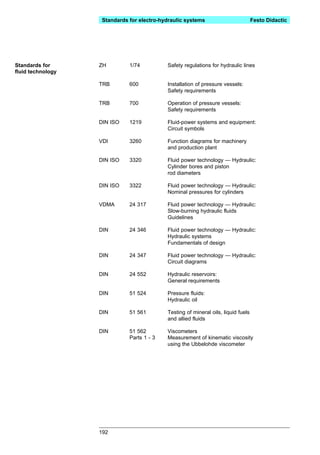
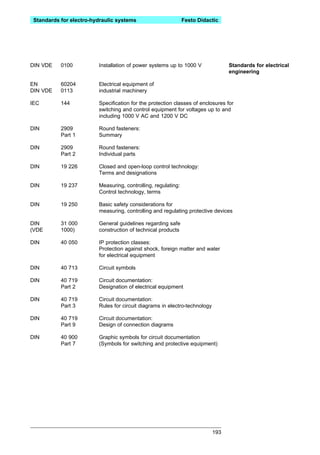
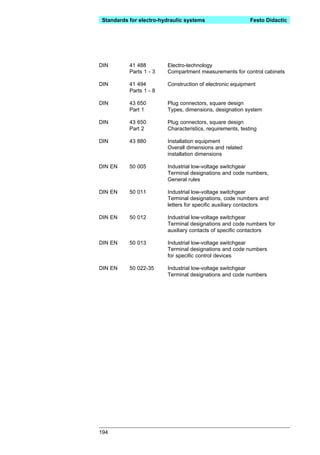
Standards for electro-hydraulic systems . . . . . . . . . . . . . . . . . . . . . . . . . . . . 191
Index . . . . . . . . . . . . . . . . . . . . . . . . . . . . . . . . . . . . . . . . . . . . . . . . . . . . . . . . 195


                                                                                                                          5
Conception of the book                                        Festo Didactic


Conception of the book

This textbook forms part of the Training System for Automation and Communi-
cations from Festo Didactic KG. It is designed for seminar teaching as well as
for independent study.

The book is divided into:
• Course, Part A,
• Fundamentals, Part B,
• and Solutions, Part C.

Part A: Course
The reader gains subject knowledge through examples and exercises. The
subject topics are coordinated in terms of content and supplement one another.
References draw the reader‘s attention to more detailed information on specific
topics in the Fundamentals section.

Part B: Fundamentals
This section contains basic theoretical information on the subject. Subject
topics are arranged in logical order. In this textbook, the emphasis is on the
field of electrical components. The Fundamentals section can be studied chap-
ter by chapter or used as a reference source.

Part C: Solutions
This section contains the solutions to the problems set in the Course section.

A list of the most important standards and a detailed index can be found in the
appendix.

When using the textbook, readers will benefit from previous knowledge gained
on hydraulic fundamentals, equipment and accessories at the level attained in
the "Hydraulics" textbook (LB501) from Festo Didactic.

The textbook can be incorporated in existing training schedules.


6
Festo Didactic
                          A


Part A

Course


                      7
A       Festo Didactic


    8
Introduction   Festo Didactic
                                    A
                                    1


Chapter 1

Introduction


                                9
A
1.1/1.2
                             Introduction                                                     Festo Didactic


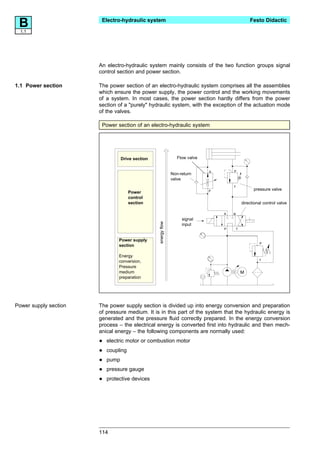
                            Hydraulic systems are used wherever high power concentration, good heat
                            dissipation or extremely high forces are required.

                            Electro-hydraulic systems are made up of hydraulic and electrical components:

                            •    The movements and forces are generated by hydraulic means (e.g. by
                                 cylinders).

                            •    Signal input and signal processing, on the other hand, are effected by elec-
                                 trical and electronic components (e.g. electromechanical switching elements
                                 or stored-program controls).

1.1 Advantages of           The use of electrical and electronic components in the control of hydraulic
    electro-hydraulics      systems is advantageous for the following reasons:

                            •    Electrical signals can be transmitted via cables quickly and easily and over
                                 great distances. Mechanical signal transmission (linkages, cable-pulls) or
                                 hydraulic signal transmission (tubes, pipes) are far more complex. This is
                                 the reason why electro-hydraulic systems are being used increasingly fre-
                                 quently in aeroplanes, for example.

                            •    In the field of automation, signal processing is generally effected by electri-
                                 cal means. This enhances the options for the use of electro-hydraulic sys-
                                 tems in automatic production operations (e.g. in a fully automatic pressing
                                 line for the manufacture of car wings).

                            •    Many machines require complex control procedures (e.g. plastics process-
                                 ing). In such cases, an electrical control is often less complex and more
                                 economical than a mechanical or hydraulic control system.

1.2 Fields of application   Over the last 25 years, there has been rapid progress in the field of electrical
    of electro-hydraulics   control technology. The use of electrical controls has opened up many new
                            fields of application for hydraulics.

                            Electro-hydraulics are used in a wide range of sectors, such as:

                            •    the machine construction sector (feed systems for machine tools, force gen-
                                 erators for presses and in the field of plastics processing),

                            •    automobile construction (drive systems for production machines),

                            •    aeroplane construction (landing flap operation, rudder operation),

                            •    in shipbuilding (rudder operation).


                            10
Introduction                                                    Festo Didactic
                                                                                                                   A1.3


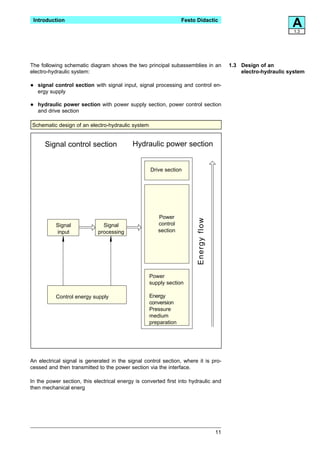
The following schematic diagram shows the two principal subassemblies in an                 1.3 Design of an
electro-hydraulic system:                                                                       electro-hydraulic system

•   signal control section with signal input, signal processing and control en-
    ergy supply

•   hydraulic power section with power supply section, power control section
    and drive section

Schematic design of an electro-hydraulic system


      Signal control section               Hydraulic power section


                                                   Drive section


                                                      Power
                                                                       E nergy fl ow

           Signal              Signal                 control
           input             processing               section


                                                   Power
                                                   supply section

           Control energy supply                   Energy
                                                   conversion
                                                   Pressure
                                                   medium
                                                   preparation


An electrical signal is generated in the signal control section, where it is pro-
cessed and then transmitted to the power section via the interface.

In the power section, this electrical energy is converted first into hydraulic and
then mechanical energ


                                                                                       11
A
1
    Introduction   Festo Didactic


    12
Circuit and graphic symbols   Festo Didactic
                                               A
                                               2


Chapter 2

Circuit and graphic symbols


                                          13
A
 2.1
                        Circuit and graphic symbols                                    Festo Didactic


                       To simplify the presentation of electro-hydraulic systems in circuit diagrams, we
                       use simple symbols (also called graphic and circuit symbols) for the various
                       components. A symbol is used to identify a component and its function, but
                       tells us nothing about the design of the component. DIN ISO 1219 contains
                       regulations on circuit symbols, while DIN 40900 (Part 7) lists the graphic sym-
                       bols for circuit documentation, and DIN 40719 governs the letter symbols used
                       for identification of the type of operating equipment. The most important
                       graphic symbols are explained below. The functions of the components are
                       described in the chapters in section B of this book.

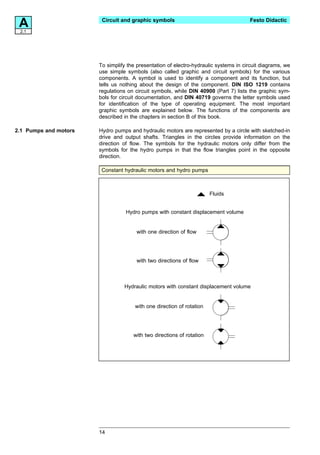
2.1 Pumps and motors   Hydro pumps and hydraulic motors are represented by a circle with sketched-in
                       drive and output shafts. Triangles in the circles provide information on the
                       direction of flow. The symbols for the hydraulic motors only differ from the
                       symbols for the hydro pumps in that the flow triangles point in the opposite
                       direction.

                        Constant hydraulic motors and hydro pumps


                                                                       Fluids


                                  Hydro pumps with constant displacement volume


                                      with one direction of flow


                                      with two directions of flow


                                 Hydraulic motors with constant displacement volume


                                      with one direction of rotation


                                     with two directions of rotation


                       14
Circuit and graphic symbols                                          Festo Didactic
                                                                                                                A
                                                                                                                2.2


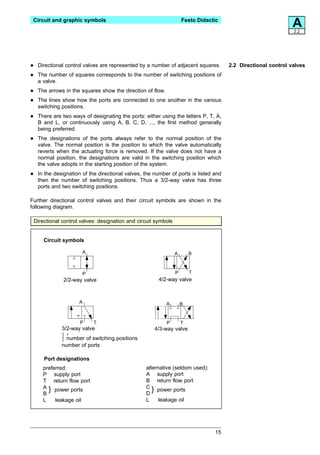
•    Directional control valves are represented by a number of adjacent squares.       2.2 Directional control valves

•    The number of squares corresponds to the number of switching positions of
     a valve.

•    The arrows in the squares show the direction of flow.

•    The lines show how the ports are connected to one another in the various
     switching positions.

•    There are two ways of designating the ports: either using the letters P, T, A,
     B and L, or continuously using A, B, C, D, ..., the first method generally
     being preferred.

•    The designations of the ports always refer to the normal position of the
     valve. The normal position is the position to which the valve automatically
     reverts when the actuating force is removed. If the valve does not have a
     normal position, the designations are valid in the switching position which
     the valve adopts in the starting position of the system.

•    In the designation of the directional valves, the number of ports is listed and
     then the number of switching positions. Thus a 3/2-way valve has three
     ports and two switching positions.

Further directional control valves and their circuit symbols are shown in the
following diagram.

    Directional control valves: designation and circuit symbols


        Circuit symbols

                        A                                         A       B


                        P                                         P       T
                2/2-way valve                            4/2-way valve


                       A                                     A        B


                       P     T                               P        T
               3/2-way valve                           4/3-way valve
                 number of switching positions
               number of ports

        Port designations
        preferred:                                 alternative (seldom used):
        P supply port                              A supply port
        T return flow port                         B return flow port
        A power ports                              C
        B
          }                                        D
                                                      } power ports
        L    leakage oil                           L     leakage oil


                                                                                  15
A
 2.3
                       Circuit and graphic symbols                                     Festo Didactic


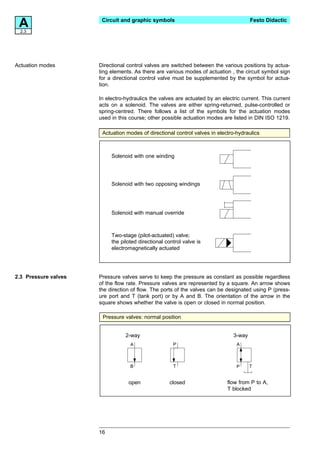
Actuation modes       Directional control valves are switched between the various positions by actua-
                      ting elements. As there are various modes of actuation , the circuit symbol sign
                      for a directional control valve must be supplemented by the symbol for actua-
                      tion.

                      In electro-hydraulics the valves are actuated by an electric current. This current
                      acts on a solenoid. The valves are either spring-returned, pulse-controlled or
                      spring-centred. There follows a list of the symbols for the actuation modes
                      used in this course; other possible actuation modes are listed in DIN ISO 1219.

                       Actuation modes of directional control valves in electro-hydraulics


                           Solenoid with one winding


                           Solenoid with two opposing windings


                           Solenoid with manual override


                           Two-stage (pilot-actuated) valve;
                           the piloted directional control valve is
                           electromagnetically actuated


2.3 Pressure valves   Pressure valves serve to keep the pressure as constant as possible regardless
                      of the flow rate. Pressure valves are represented by a square. An arrow shows
                      the direction of flow. The ports of the valves can be designated using P (press-
                      ure port and T (tank port) or by A and B. The orientation of the arrow in the
                      square shows whether the valve is open or closed in normal position.

                       Pressure valves: normal position


                                 2-way                                         3-way
                                   A                  P                          A


                                   B                  T                          P     T


                                  open               closed                  flow from P to A,
                                                                             T blocked


                      16
Circuit and graphic symbols                                    Festo Didactic
                                                                                                           A
                                                                                                           2.3


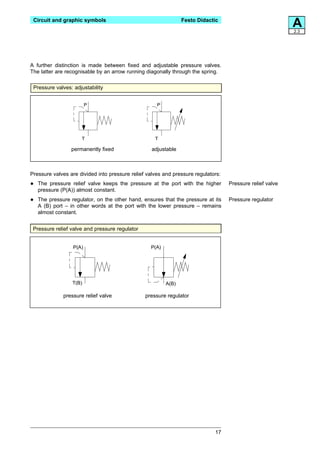
A further distinction is made between fixed and adjustable pressure valves.
The latter are recognisable by an arrow running diagonally through the spring.

 Pressure valves: adjustability


                         P                           P


                     T                              T

                 permanently fixed                 adjustable


Pressure valves are divided into pressure relief valves and pressure regulators:

•   The pressure relief valve keeps the pressure at the port with the higher
    pressure (P(A)) almost constant.
                                                                                   Pressure relief valve


•   The pressure regulator, on the other hand, ensures that the pressure at its
    A (B) port – in other words at the port with the lower pressure – remains
                                                                                   Pressure regulator

    almost constant.


 Pressure relief valve and pressure regulator


                  P(A)                            P(A)


                  T(B)                                   A(B)

              pressure relief valve             pressure regulator


                                                                             17
A2.4
                          Circuit and graphic symbols                                      Festo Didactic


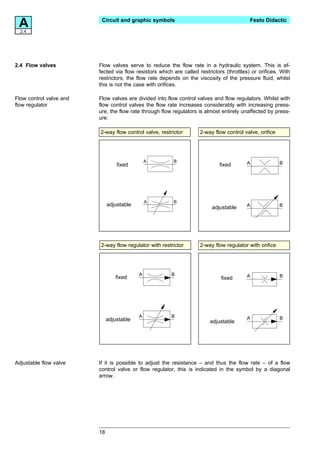
2.4 Flow valves          Flow valves serve to reduce the flow rate in a hydraulic system. This is ef-
                         fected via flow resistors which are called restrictors (throttles) or orifices. With
                         restrictors, the flow rate depends on the viscosity of the pressure fluid, whilst
                         this is not the case with orifices.

Flow control valve and   Flow valves are divided into flow control valves and flow regulators. Whilst with
flow regulator           flow control valves the flow rate increases considerably with increasing press-
                         ure, the flow rate through flow regulators is almost entirely unaffected by press-
                         ure.

                         2-way flow control valve, restrictor        2-way flow control valve, orifice


                                               A         B                                A              B
                                  fixed                                       fixed


                                               A         B
                              adjustable                                                  A              B
                                                                          adjustable


                         2-way flow regulator with restrictor        2-way flow regulator with orifice


                                           A            B                                 A              B
                                 fixed                                        fixed


                                           A            B                                 A              B
                              adjustable                                 adjustable


Adjustable flow valve    If it is possible to adjust the resistance – and thus the flow rate – of a flow
                         control valve or flow regulator, this is indicated in the symbol by a diagonal
                         arrow.


                         18
Circuit and graphic symbols                                     Festo Didactic
                                                                                                              A
                                                                                                              2.5


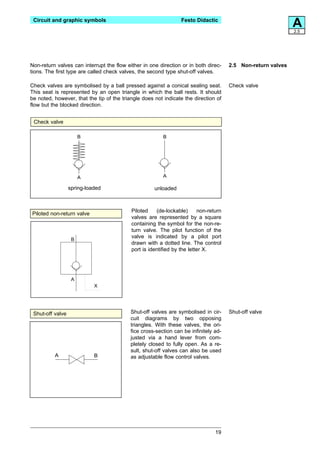
Non-return valves can interrupt the flow either in one direction or in both direc-    2.5 Non-return valves
tions. The first type are called check valves, the second type shut-off valves.

Check valves are symbolised by a ball pressed against a conical sealing seat.         Check valve
This seat is represented by an open triangle in which the ball rests. It should
be noted, however, that the tip of the triangle does not indicate the direction of
flow but the blocked direction.


 Check valve

                       B                                 B


                       A                                 A

                  spring-loaded                      unloaded


                                           Piloted    (de-lockable)      non-return
Piloted non-return valve
                                           valves are represented by a square
                                           containing the symbol for the non-re-
                                           turn valve. The pilot function of the
                                           valve is indicated by a pilot port
                   B
                                           drawn with a dotted line. The control
                                           port is identified by the letter X.


                   A
                            X


 Shut-off valve                            Shut-off valves are symbolised in cir-     Shut-off valve
                                           cuit diagrams by two opposing
                                           triangles. With these valves, the ori-
                                           fice cross-section can be infinitely ad-
                                           justed via a hand lever from com-
                                           pletely closed to fully open. As a re-
                                           sult, shut-off valves can also be used
          A                 B              as adjustable flow control valves.


                                                                                19
A2.6
                          Circuit and graphic symbols                                         Festo Didactic


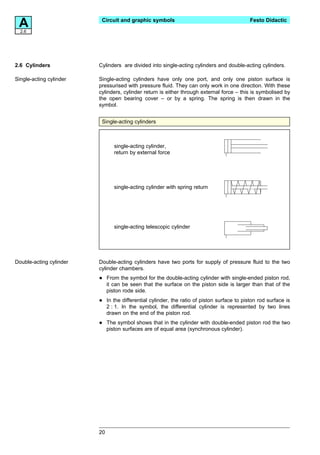
2.6 Cylinders            Cylinders are divided into single-acting cylinders and double-acting cylinders.

Single-acting cylinder   Single-acting cylinders have only one port, and only one piston surface is
                         pressurised with pressure fluid. They can only work in one direction. With these
                         cylinders, cylinder return is either through external force – this is symbolised by
                         the open bearing cover – or by a spring. The spring is then drawn in the
                         symbol.


                          Single-acting cylinders


                                 single-acting cylinder,
                                 return by external force


                                 single-acting cylinder with spring return


                                 single-acting telescopic cylinder


Double-acting cylinder   Double-acting cylinders have two ports for supply of pressure fluid to the two
                         cylinder chambers.

                         •    From the symbol for the double-acting cylinder with single-ended piston rod,
                              it can be seen that the surface on the piston side is larger than that of the
                              piston rode side.

                         •    In the differential cylinder, the ratio of piston surface to piston rod surface is
                              2 : 1. In the symbol, the differential cylinder is represented by two lines
                              drawn on the end of the piston rod.

                         •    The symbol shows that in the cylinder with double-ended piston rod the two
                              piston surfaces are of equal area (synchronous cylinder).


                         20
Circuit and graphic symbols                                      Festo Didactic
                                                                                      A
                                                                                      2.6


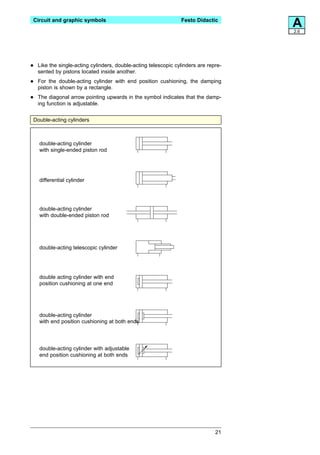
•   Like the single-acting cylinders, double-acting telescopic cylinders are repre-
    sented by pistons located inside another.

•   For the double-acting cylinder with end position cushioning, the damping
    piston is shown by a rectangle.

•   The diagonal arrow pointing upwards in the symbol indicates that the damp-
    ing function is adjustable.


Double-acting cylinders


    double-acting cylinder
    with single-ended piston rod


    differential cylinder


    double-acting cylinder
    with double-ended piston rod


    double-acting telescopic cylinder


    double acting cylinder with end
    position cushioning at one end


    double-acting cylinder
    with end position cushioning at both ends


    double-acting cylinder with adjustable
    end position cushioning at both ends


                                                                                21
A
 2.7
                           Circuit and graphic symbols                                   Festo Didactic


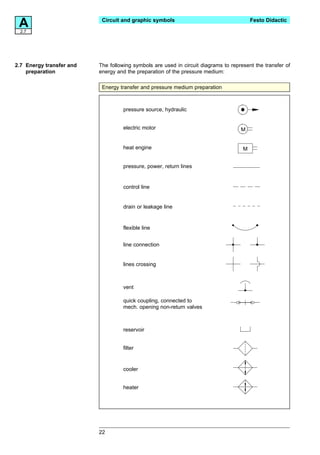
2.7 Energy transfer and   The following symbols are used in circuit diagrams to represent the transfer of
    preparation           energy and the preparation of the pressure medium:

                           Energy transfer and pressure medium preparation


                                    pressure source, hydraulic


                                    electric motor                                  M


                                    heat engine                                      M


                                    pressure, power, return lines


                                    control line


                                    drain or leakage line


                                    flexible line


                                    line connection


                                    lines crossing


                                    vent

                                    quick coupling, connected to
                                    mech. opening non-return valves


                                    reservoir


                                    filter


                                    cooler


                                    heater


                          22
Circuit and graphic symbols                                 Festo Didactic
                                                                                                       A
                                                                                                      2.8/2.9


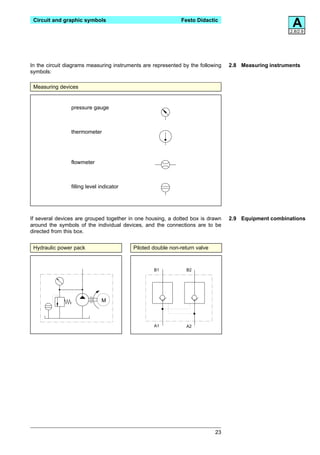
In the circuit diagrams measuring instruments are represented by the following   2.8 Measuring instruments
symbols:

 Measuring devices


                pressure gauge


                thermometer


                flowmeter


                filling level indicator


If several devices are grouped together in one housing, a dotted box is drawn    2.9 Equipment combinations
around the symbols of the individual devices, and the connections are to be
directed from this box.


 Hydraulic power pack                     Piloted double non-return valve


                                                  B1           B2


                              M


                                                  A1           A2


                                                                            23
A
 2.10
                        Circuit and graphic symbols                                    Festo Didactic


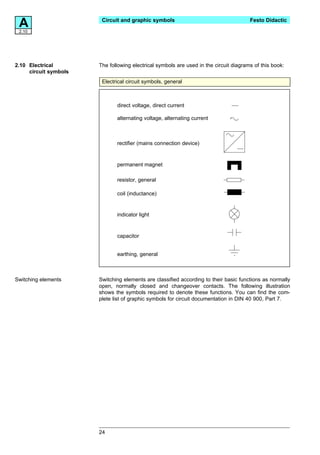
2.10 Electrical        The following electrical symbols are used in the circuit diagrams of this book:
     circuit symbols
                        Electrical circuit symbols, general


                              direct voltage, direct current

                              alternating voltage, alternating current


                              rectifier (mains connection device)


                              permanent magnet

                              resistor, general

                              coil (inductance)


                              indicator light


                              capacitor


                              earthing, general


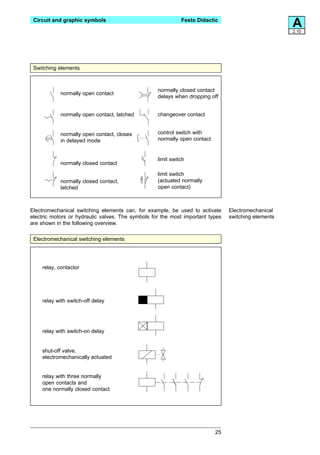
Switching elements     Switching elements are classified according to their basic functions as normally
                       open, normally closed and changeover contacts. The following illustration
                       shows the symbols required to denote these functions. You can find the com-
                       plete list of graphic symbols for circuit documentation in DIN 40 900, Part 7.


                       24
Circuit and graphic symbols                                 Festo Didactic
                                                                                                     A
                                                                                                     2.10


 Switching elements


                                                   normally closed contact
            normally open contact
                                                   delays when dropping off


            normally open contact, latched         changeover contact


            normally open contact, closes          control switch with
            in delayed mode                        normally open contact


                                                   limit switch
            normally closed contact

                                                   limit switch
            normally closed contact,               (actuated normally
            latched                                open contact)


Electromechanical switching elements can, for example, be used to activate      Electromechanical
electric motors or hydraulic valves. The symbols for the most important types   switching elements
are shown in the following overview.

 Electromechanical switching elements


    relay, contactor


    relay with switch-off delay


    relay with switch-on delay


    shut-off valve,
    electromechanically actuated


    relay with three normally
    open contacts and
    one normally closed contact


                                                                           25
A
 2.10
                    Circuit and graphic symbols                                 Festo Didactic


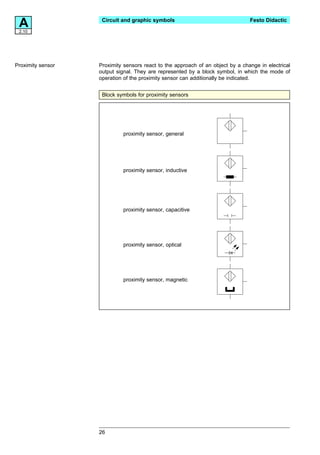
Proximity sensor   Proximity sensors react to the approach of an object by a change in electrical
                   output signal. They are represented by a block symbol, in which the mode of
                   operation of the proximity sensor can additionally be indicated.


                    Block symbols for proximity sensors


                            proximity sensor, general


                            proximity sensor, inductive


                            proximity sensor, capacitive


                            proximity sensor, optical


                            proximity sensor, magnetic


                   26
Electro-hydraulic control   Festo Didactic
                                             A
                                             3


Chapter 3

Electro-hydraulic control


                                        27
A3.1
                         Electro-hydraulic control                                        Festo Didactic


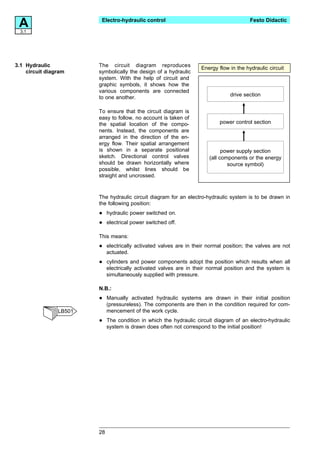
3.1 Hydraulic           The circuit diagram reproduces
                                                                     Energy flow in the hydraulic circuit
    circuit diagram     symbolically the design of a hydraulic
                        system. With the help of circuit and
                        graphic symbols, it shows how the
                        various components are connected
                                                                                 drive section
                        to one another.

                        To ensure that the circuit diagram is
                        easy to follow, no account is taken of
                        the spatial location of the compo-                   power control section
                        nents. Instead, the components are
                        arranged in the direction of the en-
                        ergy flow. Their spatial arrangement
                        is shown in a separate positional                     power supply section
                        sketch. Directional control valves              (all components or the energy
                        should be drawn horizontally where                      source symbol)
                        possible, whilst lines should be
                        straight and uncrossed.


                        The hydraulic circuit diagram for an electro-hydraulic system is to be drawn in
                        the following position:

                        •    hydraulic power switched on.

                        •    electrical power switched off.

                        This means:

                        •    electrically activated valves are in their normal position; the valves are not
                             actuated.

                        •    cylinders and power components adopt the position which results when all
                             electrically activated valves are in their normal position and the system is
                             simultaneously supplied with pressure.

                        N.B.:

                        •    Manually activated hydraulic systems are drawn in their initial position
                             (pressureless). The components are then in the condition required for com-
                LB501        mencement of the work cycle.

                        •    The condition in which the hydraulic circuit diagram of an electro-hydraulic
                             system is drawn does often not correspond to the initial position!


                        28
Electro-hydraulic control                                                                           Festo Didactic
                                                                                                                                                  A
                                                                                                                                                  3.1


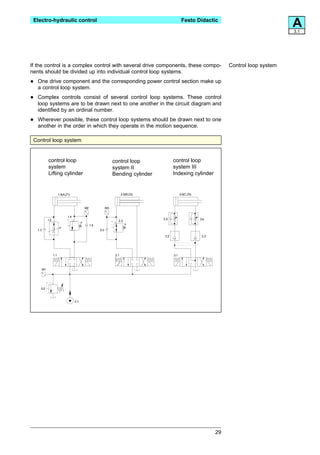
If the control is a complex control with several drive components, these compo-                                             Control loop system
nents should be divided up into individual control loop systems.

•   One drive component and the corresponding power control section make up
    a control loop system.

•   Complex controls consist of several control loop systems. These control
    loop systems are to be drawn next to one another in the circuit diagram and
    identified by an ordinal number.

•   Wherever possible, these control loop systems should be drawn next to one
    another in the order in which they operate in the motion sequence.

 Control loop system


               control loop                                         control loop              control loop
               system                                               system II                 system III
               Lifting cylinder                                     Bending cylinder          Indexing cylinder


                           1.0(A,Z1)                                       2.0(B,Z2)                3.0(C,Z3)


                                              M2               M3

                                  1.4
               1.2                                                                     3.5                      3.4
                                                                       2.2
                                                   1.5
    1.3                                                  2:3

                                                                                        3.2                      3.3


                     1.1                                             2.1                      3.1


          M1


      0.2


                                        0.1


                                                                                                                       29
A3.1
                                    Electro-hydraulic control                                       Festo Didactic


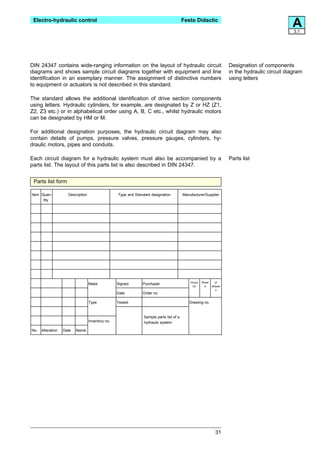
Designation of components          In this textbook, the components in hydraulic circuit diagrams are given num-
in the hydraulic circuit diagram   bers. The designation is made up of a group number and an equipment num-
using numbers                      ber.

                                   The various control loop systems are consecutively numbered using the ordinal
                                   numbers 1, 2, 3, etc. The power supply section is not assignable to any one
                                   control loop system as it is responsible for several control loop systems. For
                                   this reason, it is always designated by the ordinal number zero.


                                    Group assignment


                                        Group 0               all power supply elements
                                        Group 1, 2, 3 ...     designation of the individual control loop systems
                                                              (normally one group number per cylinder)


                                   Each component in a control loop system is to be identified by an equipment
                                   number made up of the ordinal number of the control loop system and a dis-
                                   tinctive number.

                                    Equipment numbering


                                        .0           drive component, e.g. 1.0, 2.0
                                        .1           final control elements, e.g. 1.1, 2.1
                                        .2, .4       even numbers: all elements influencing the
                                                     forward flow, e.g. 1.2, 2.4
                                        .3, .5       uneven numbers: all elements influencing the
                                                     return flow, e.g. 1.3, 2.3
                                        .01, .02     elements between final control element and drive component,
                                                     e.g. throttle valve, e.g. 1.01, 1.02


                                   In day-to-day operations, this designation system using group and equipment
                                   numbers has the advantage that maintenance personnel are able to recognise
                                   the effect of a signal by the number of the element in question. If, for example,
                                   a fault is ascertained in cylinder 2.0, it can be assumed that the cause is to be
                                   sought in the 2nd group and, therefore, in elements whose first number is 2.


                                   30
Electro-hydraulic control                                                                Festo Didactic
                                                                                                                                                  A3.1


DIN 24347 contains wide-ranging information on the layout of hydraulic circuit                                         Designation of components
diagrams and shows sample circuit diagrams together with equipment and line                                            in the hydraulic circuit diagram
identification in an exemplary manner. The assignment of distinctive numbers                                           using letters
to equipment or actuators is not described in this standard.

The standard allows the additional identification of drive section components
using letters. Hydraulic cylinders, for example, are designated by Z or HZ (Z1,
Z2, Z3 etc.) or in alphabetical order using A, B, C etc., whilst hydraulic motors
can be designated by HM or M.

For additional designation purposes, the hydraulic circuit diagram may also
contain details of pumps, pressure valves, pressure gauges, cylinders, hy-
draulic motors, pipes and conduits.

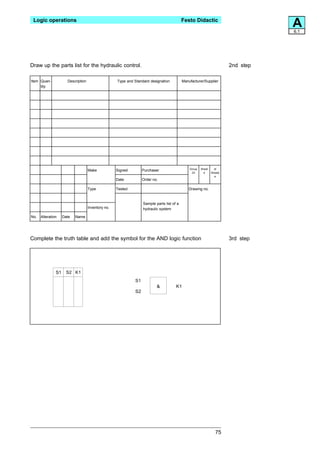
Each circuit diagram for a hydraulic system must also be accompanied by a                                              Parts list
parts list. The layout of this parts list is also described in DIN 24347.


 Parts list form

Item Quan-           Description                   Type and Standard designation          Manufacturer/Supplier
      tity


                                                                                              Group   Sheet     of
                                   Make            Signed       Purchaser
                                                                                               03       4     Sheets
                                                                                                                4
                                                   Date         Order no.

                                   Type            Tested                                     Drawing no.


                                                                 Sample parts list of a
                                   Inventory no.                 hydraulic system

No.   Alteration   Date   Name


                                                                                                                31
A3.2
                           Electro-hydraulic control                                                                            Festo Didactic


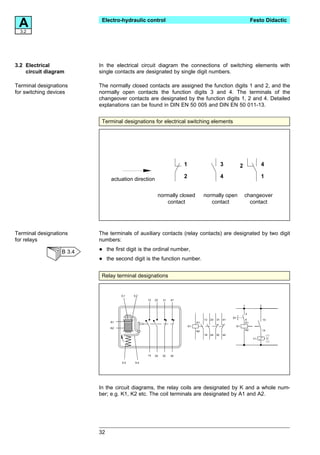
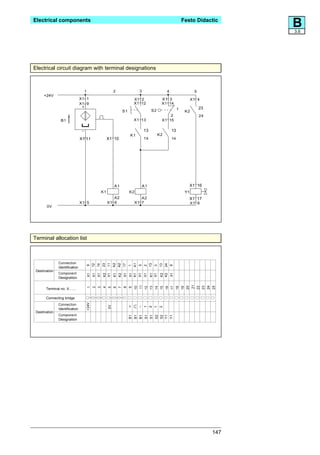
3.2 Electrical            In the electrical circuit diagram the connections of switching elements with
    circuit diagram       single contacts are designated by single digit numbers.

Terminal designations     The normally closed contacts are assigned the function digits 1 and 2, and the
for switching devices     normally open contacts the function digits 3 and 4. The terminals of the
                          changeover contacts are designated by the function digits 1, 2 and 4. Detailed
                          explanations can be found in DIN EN 50 005 and DIN EN 50 011-13.


                           Terminal designations for electrical switching elements


                                                                       1                            3              2                  4

                                 actuation direction                   2                            4                                 1


                                                         normally closed             normally open                     changeover
                                                             contact                    contact                          contact


Terminal designations     The terminals of auxiliary contacts (relay contacts) are designated by two digit
for relays                numbers:

                  B 3.4   •    the first digit is the ordinal number,

                          •    the second digit is the function number.


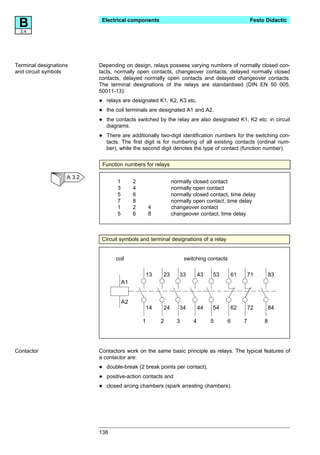
                           Relay terminal designations


                                     0.1    0.2
                                                   13   23   31   41

                                                                                                                       1              2


                                                                                                                           3
                                                                                                         S1
                                                                                     13   23   31   41                     4              13
                                A1                                              A1                                         A1
                                                                           K1                                 K1
                                A2
                                                                                A2                                         A2             14
                                                                                     14   24   32   42
                                                                                                                                 Y1


                                                   14   24   32   42

                                      0.3    0.4


                          In the circuit diagrams, the relay coils are designated by K and a whole num-
                          ber; e.g. K1, K2 etc. The coil terminals are designated by A1 and A2.


                          32
Electro-hydraulic control                                              Festo Didactic
                                                                                                                    A
                                                                                                                    3.2


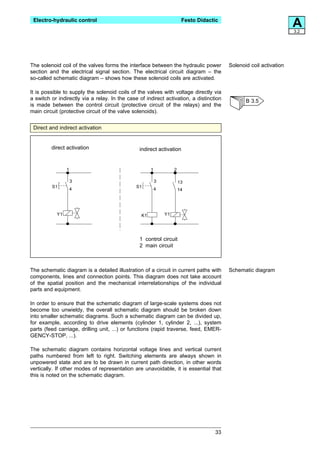
The solenoid coil of the valves forms the interface between the hydraulic power          Solenoid coil activation
section and the electrical signal section. The electrical circuit diagram – the
so-called schematic diagram – shows how these solenoid coils are activated.

It is possible to supply the solenoid coils of the valves with voltage directly via
a switch or indirectly via a relay. In the case of indirect activation, a distinction           B 3.5
is made between the control circuit (protective circuit of the relays) and the
main circuit (protective circuit of the valve solenoids).


 Direct and indirect activation


         direct activation                      indirect activation


                1                                     1            2

                    3                                     3            13
         S1                                    S1
                    4                                     4            14


           Y1                                    K1           Y1


                                                1 control circuit
                                                2 main circuit


The schematic diagram is a detailed illustration of a circuit in current paths with      Schematic diagram
components, lines and connection points. This diagram does not take account
of the spatial position and the mechanical interrelationships of the individual
parts and equipment.

In order to ensure that the schematic diagram of large-scale systems does not
become too unwieldy, the overall schematic diagram should be broken down
into smaller schematic diagrams. Such a schematic diagram can be divided up,
for example, according to drive elements (cylinder 1, cylinder 2, ...), system
parts (feed carriage, drilling unit, ...) or functions (rapid traverse, feed, EMER-
GENCY-STOP, ...).

The schematic diagram contains horizontal voltage lines and vertical current
paths numbered from left to right. Switching elements are always shown in
unpowered state and are to be drawn in current path direction, in other words
vertically. If other modes of representation are unavoidable, it is essential that
this is noted on the schematic diagram.


                                                                                    33
A
3.2
       Electro-hydraulic control                                                                                                Festo Didactic


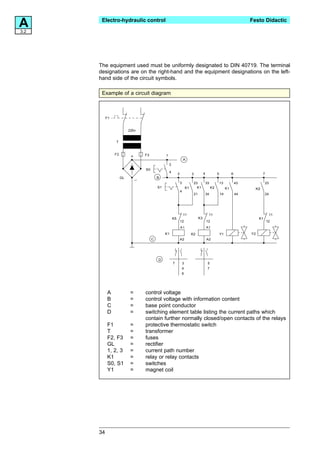
      The equipment used must be uniformly designated to DIN 40719. The terminal
      designations are on the right-hand and the equipment designations on the left-
      hand side of the circuit symbols.

       Example of a circuit diagram


           F1


                          220v


                T


                F2               F3            1
                                                                    A
                                                   3
                                 S0
                                                   4                                       4
                                                            2                3                           5             6               7
                     GL                   B
                                                                3                23            33            13            43              23
                                          S1                            K1         K1               K2            K1              K2
                                                                4
                                                                                 21            34            14            44              24


                                                                    11                          11                                          11
                                                       K5                             K3                                             K1
                                                                12                             12                                          12
                                                                A1                             A1
                                               K1                            K2                              Y1                 Y2
                                      C                         A2                             A2


                                          D
                                                       7            3                           5
                                                                    4                           7
                                                                    6


           A               =     control voltage
           B               =     control voltage with information content
           C               =     base point conductor
           D               =     switching element table listing the current paths which
                                 contain further normally closed/open contacts of the relays
           F1              =     protective thermostatic switch
           T               =     transformer
           F2, F3          =     fuses
           GL              =     rectifier
           1, 2, 3         =     current path number
           K1              =     relay or relay contacts
           S0, S1          =     switches
           Y1              =     magnet coil


      34
Electro-hydraulic control                                                 Festo Didactic
                                                                                                                            A
                                                                                                                            3.3


The electrical circuit diagram shows the contact assignment of a relay in a                        Contact symbol diagram
contact symbol diagram. The contact symbol diagram is located under the cur-
rent path in which the relay is situated. Break and make functions are identified
by a distinctive letter or by the corresponding circuit symbol. The numbers
under the contact symbol indicate the number of the current path in which the
contacts are connected.

 Types of contact symbols


                 simplified                                     detailed


                                                   7             3          4        6


                                                        11           23         33       43
                  7      3
  normally                                             12            24         34       44

  closed contact in      4
  current path 7         6 normally
                           open contact in
                           current path 4


The function sequences of mechanical, pneumatic, hydraulic and electrical con-                     3.3 Function diagram
trols are shown in diagrams.

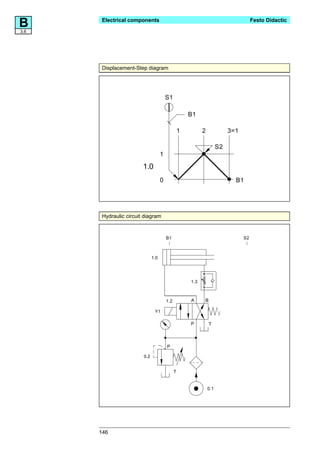
The Displacement-Step diagram shows the operating sequence of the drive                            Displacement-Step diagram
components. The traversed path is plotted against the respective steps. In this
connection, a step is the change in the state of a drive component. If several
working components are present in a control system, these components are
drawn in the same way and below one another. The coherence of the opera-
ting sequence is created by the steps.

 Displacement-Step diagram


                                    1    2     3            4        5=1
                      1 (advance)
    cylinder A
                      0 (retract)


                              displacement                      step


                                                                                              35
A3.3
                             Electro-hydraulic control                                        Festo Didactic


Displacement-Time diagram   In the Displacement-Time diagram, the path traversed by a component is
                            plotted against time. In contrast to the Displacement-Step diagram, the time t is
                            plotted in scale and creates the time-related connection between the individual
                            drive components. This means that the varying durations of the individual steps
                            can be read off directly from the diagram.


                             Displacement-Time diagram


                                                                1        2           3   4=1
                                                 1 (advance)
                                   cylinder A
                                                 0 (retract)


                                         displacement                         time


Control diagram             In the control diagram, the switching statuses of the signal input elements and
                            signal processing elements are plotted against the steps. The switching times
                            are considerably shorter than the traversing times of the drive components and
                            are therefore not taken into account in the diagram; in other words, the signal
                            edges are vertical. It is advisable to compile the control diagram in combination
                            with the Displacement-Step diagram.

                             Control diagram


                                                                    1     2      3       4      5    6=1
                                                     1 (open)
                              signal generator
                                                     0 (closed)


                                                                                             step
                                                   status


                            36
Electro-hydraulic control                                                    Festo Didactic
                                                                                                                       A
                                                                                                                       3.3


In the function diagram to VDI 3260                                                                 Function diagram

•   the control diagrams for all signal input and signal processing elements as
    well as

•   the Displacement-Time or Displacement-Step diagrams for all drive compo-
    nents

are drawn below one another. The function diagram therefore provides a good
illustration of the operating sequence of an overall electro-hydraulic system.

 Function diagram


                                                     Time in seconds
    Components
                                                     Step
                                 Identi-                1        2        3        4   5   6
     Description                            Status
                                 fication


                                    S3
    Start push-button


     Directional control valve      Y1        1


                                              0

                                                            >p
                                    A1        1
     Cylinder                                                        S2


                                              0
                                                                              S1


In addition, the function diagram contains details of

•   the points at which the signals from power controllers, push-buttons, limit
    switches, pressure switches etc. intervene in the operating sequence

•   and how the signal input, signal processing and drive333 components in-
    fluence one another.

The most important signalling elements and forms of signal logic for electro-
hydraulic systems are shown in the two following diagrams. A full list can be
found in the VDI 3260 guideline.


                                                                                               37
A
3.3
       Electro-hydraulic control                                         Festo Didactic


       Signalling elements

                                                                                  ON-
             manually operated              ON                 OFF                OFF


             hydraulically actuated                   mechanically actuated

              pressure                                    end position
              switch         p    5 bar                   switch


       Signal lines and signal logic operations


                          thin lines are drawn, with an arrow near the point
                          at which the change in status is initiated

              branch                   OR operation                  AND operation


                                               indication of signalling element
                                      S3       with NOT condition


      Reading of function diagrams is explained using the function diagram on the
      previous page.

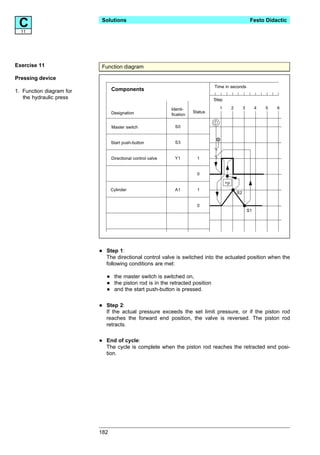
      •    As soon as the start button is pressed and the piston rod of the cylinder is
           in the retracted end position (position 0) (limit switch S1 actuated), the
           directional control valve is switched over.

      •    The piston rod of the cylinder advances.

      •    As soon as the piston rod has reached the forward end position (limit switch
           S2 actuated) or the pressure switch is actuated, the directional control valve
           is switched back to its original position.

      •    The piston rod of the cylinder retracts.

      •    If the start button is pressed again, the operating cycle is repeated.


      38
Electro-hydraulic control                                       Festo Didactic
                                                                                                         A3.4


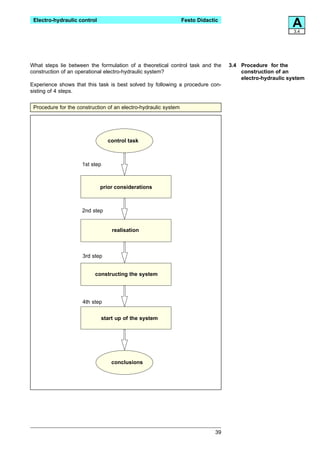
What steps lie between the formulation of a theoretical control task and the      3.4 Procedure for the
construction of an operational electro-hydraulic system?                              construction of an
                                                                                      electro-hydraulic system
Experience shows that this task is best solved by following a procedure con-
sisting of 4 steps.


 Procedure for the construction of an electro-hydraulic system


                                control task


                     1st step


                             prior considerations


                     2nd step


                                 realisation


                     3rd step


                          constructing the system


                     4th step


                             start up of the system


                                 conclusions


                                                                             39
A3.4
                             Electro-hydraulic control                                       Festo Didactic


Step 1:                     First, it must be ascertained which functions the control is to perform.
Prior considerations
                            An exact knowledge of the desired functions is necessary to ensure that the
                            control can be properly constructed and function-tested.

                            The type of motions required of the drive components are to be laid down in
                            the 1st step:

                            •    which type of motion is necessary – linear or rotating ?

                            •    how many different movements need to be effected – how many power
                                 components need to be used?

                            •    how do the movements interact?

                            Once it is clear which motions need to be generated, the parameters of the
                            system should be laid down. To calculate these parameters, we start at the
                            consumer (power component) and work back towards the power supply unit to
                            ascertain the required forces/moments, speeds, flow rates and pressures.

                            It is then possible to select the appropriate hydraulic and electrical components
                            for the control.


Step 2:                     In the 2nd step, the diagrams, circuit diagrams and parts lists are compiled.
Realisation
Drawing                     First, the graphic diagrams are drawn to provide a clear overview of the motion
of graphic diagrams         sequences.

                            •    The Displacement-Step diagram shows the sequence of the power compo-
                                 nents according to the respective steps.

                            •    The displacement of the power components over time is plotted on the Dis-
                                 placement-Time diagram.

                            •    The function diagram to VDI guideline 3260 shows the function sequences
                                 of controls.

Compilation                 The next job is to draw the electrical and hydraulic circuit diagrams. When
of the circuit diagrams     compiling these circuit diagrams, the symbols for the electrical and hydraulic
                            components described in Chapter A2 should be used and the notes on the
                            drawing of circuit diagrams contained in this chapter observed.
                       A2
                            When the electrical and hydraulic circuit diagrams have been completed, they
                            must be checked. It should be ensured that the control portrayed in the circuit
                            diagrams fulfils the functions required in the task description.


                            40
Electro-hydraulic control                                      Festo Didactic
                                                                                                                A
                                                                                                                3.4


Before the control can be constructed, measuring equipment (depending on the          Adding technical equipment
exercise), and technical data and numbering related to equipment, must be             data to circuit diagrams
added to the circuit diagrams. Then the equipment settings need to be entered
in the circuit diagrams.

Then the parts list is to be drawn up. This list contains all the equipment re-       Compilation
quired for construction along with the following details:                             of the parts list

•   item number

•   quantity

•   description

When constructing the system, you should adhere to a systematic procedure to          Step 3:
minimise faults and errors:                                                           Constructing the system

•   observe safety recommendations (see Chapter B4),
                                                                                              B4
•   make sure that circuit diagrams are to hand,

•   prepare the equipment as listed in the parts list,

•   adhere to the stipulated sequence during construction:
    in the signal control section from signal input via signal processing and
    control power supply to the power control section;
    in the hydraulic power section from the power supply section via the power
    control section to the drive section,

•   identify the equipment already installed on the system in the circuit diagram
    step by step,

•   designate all equipment as well as pipelines, conduits and cables,

•   observe the basic rules for the installation and connection of components.


                                                                                 41
A3.4
                          Electro-hydraulic control                                          Festo Didactic


Step 4:                  When construction of the system is complete, the practical function test can be
Start-up of the system   performed. If the test is to comprise the function of the system as well as the
                         recording of the operating conditions, the necessary documentation (value
                         tables, diagrams) is to be prepared.

                         The system should not be started until the layout and the component connec-
                         tions have been re-checked.

                         The best way to start up a system is as follows:

                         •    check the oil level; top up with the correct type of oil if necessary (maximum
                              level), using a filter to filter out any impurities,

                         •    vent the pump by filling it with oil,

                         •    check the direction of rotation of the electric drive motor,

                         •    set all valves to their initial positions,

                         •    set pressure valves and flow valves to the lowest possible setting – the
                              same applies to the pressure regulators of actuating pumps,

                         •    if necessary start the system using a flushing oil, then change the filter,

                         •    top up with fresh oil, vent the system once again,

                         •    check the fluid level,

                         •    check the electrical cables,

                         •    check the terminal assignment of the individual components,

                         •    perform the first function test at reduced pressure and flow rate,

                         •    set the operating values laid down in the circuit diagrams (pressure, flow
                              rate, voltage).

Function test            The function test and the measurements can now begin. During the tests, the
                         required data are to be recorded and entered in tables. After the test is com-
                         pleted, the results are to be evaluated and remarks formulated. It is advisable
                         to draw up a test certificate.


                         42
Actuation of a single-acting cylinder   Festo Didactic
                                                         A
                                                         4


Chapter 4

Actuation
of a single-acting cylinder


                                                    43
A4
                                Actuation of a single-acting cylinder                          Festo Didactic


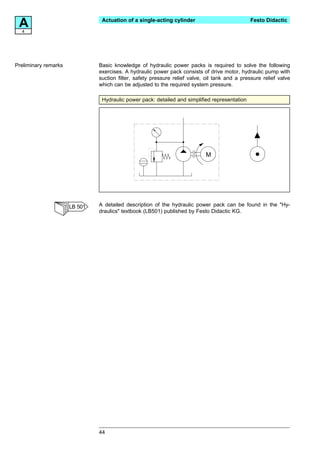
Preliminary remarks            Basic knowledge of hydraulic power packs is required to solve the following
                               exercises. A hydraulic power pack consists of drive motor, hydraulic pump with
                               suction filter, safety pressure relief valve, oil tank and a pressure relief valve
                               which can be adjusted to the required system pressure.

                                Hydraulic power pack: detailed and simplified representation


                                                                            M


                      LB 501   A detailed description of the hydraulic power pack can be found in the "Hy-
                               draulics" textbook (LB501) published by Festo Didactic KG.


                               44
Actuation of a single-acting cylinder                            Festo Didactic
                                                                                                            A
                                                                                                            4.1


Direct solenoid valve actuation                                                        4.1 Exercise 1

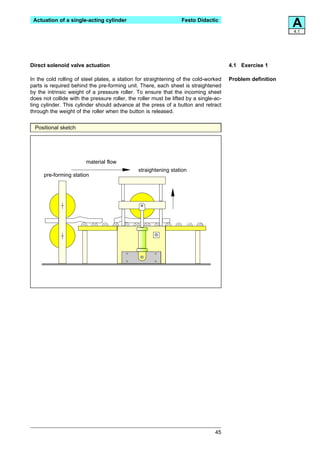
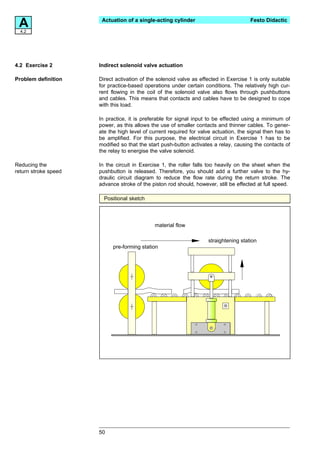
In the cold rolling of steel plates, a station for straightening of the cold-worked    Problem definition
parts is required behind the pre-forming unit. There, each sheet is straightened
by the intrinsic weight of a pressure roller. To ensure that the incoming sheet
does not collide with the pressure roller, the roller must be lifted by a single-ac-
ting cylinder. This cylinder should advance at the press of a button and retract
through the weight of the roller when the button is released.


  Positional sketch


                        material flow
                                               straightening station
      pre-forming station


                                                                                 45
A4.1
                              Actuation of a single-acting cylinder                           Festo Didactic


Conclusions                  Hydraulic control

                             A single-acting cylinder and a magnetically actuated 3/2-way valve (3/2-way
                             electromagnetic valve) are used in this exercise.

Single-acting cylinder       In single-acting cylinders only the piston side is supplied with pressure fluid.
                             This is why these cylinders can only work in one direction. The fluid flowing
                             into the piston chamber builds up a pressure at the piston surface against
                             external and internal resistances. The resulting force moves the piston into the
                             forward end position. The return stroke is effected by the external load of the
                             roller. The pressure fluid flows back from the cylinder into the tank.

Directional control valve    A 3/2-way valve with solenoid actuation and spring return is used to activate
                             the cylinder.

                             A 3/2-way valve has three ports:

                             •    pressure port (P)

                             •    tank port (T)

                             •    power port (A)

                             and two switching positions:

                             •    normal position:
                                  return flow from the piston chamber of the cylinder to the power port (A)
                                  and then to the tank; the pressure port 1(P) is blocked.

                             •    actuated position:
                                  flow from the pressure port (P) to the power port (A) and then to the piston
                                  chamber of the cylinder; the tank port (T) is blocked.


                             Electrical control

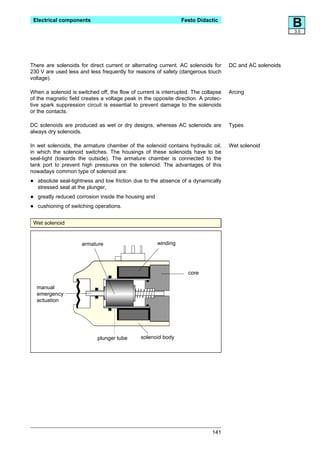
Solenoids                    The directional control valve is actuated via a solenoid. When the preset volt-
                             age is applied to the coil, a magnetic field is created. The resulting force at the
                             armature pushes the piston of the directional control valve against the return
                             spring, thereby actuating the valve. When the voltage is switched off, the mag-
                     B 3.5   netic field collapses and no forces are active. The return spring moves the
                             piston back into the normal position.
                             The most commonly used hydraulic valves have solenoids designed for 24 V
                             D.C.


                             46
Actuation of a single-acting cylinder                          Festo Didactic
                                                                                                         A
                                                                                                         4.1


Push-buttons are designed to actuate contacts. The contacts can close or open        Push-button
the current path or change between two current paths. When the push-button
is released, the contact is returned to its original position by the force of the
spring. Only when it is held down does the push-button revert to the desired
switching position.

In contrast to push-buttons, control switches possess a detent mechanism. The        Control switch
switched position remains the same until the switch is pressed once again
(signal storage).

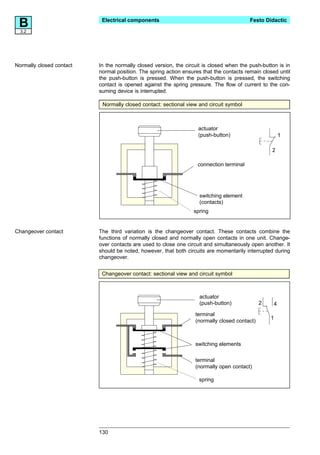
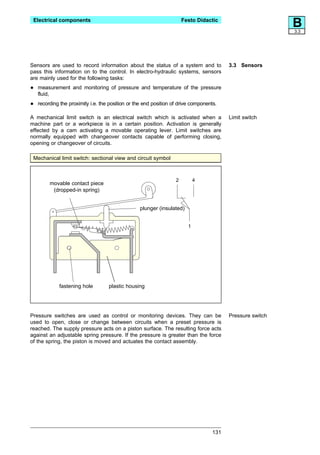
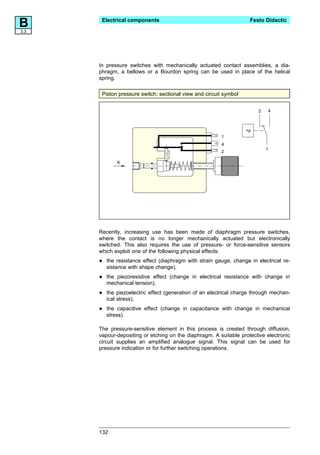
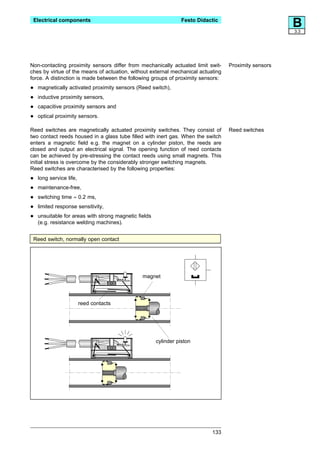
In the non-actuated state, a current circuit with normally open contacts is open.    Contacts
When the contact is actuated, the current circuit is closed.

When the normally closed contact is in the normal position, the current circuit
is closed. When it is actuated, the current circuit is interrupted.

In changeover contacts, the functions "closing" and "opening" are accommo-
dated in one housing. When the push-button is pressed, the contact of the
normally closed contact is released and the current circuit is interrupted. At the
same time, the current circuit is closed at the normally open contact.

The components of the signal control section normally operate via a 24 V D.C.        Power supply unit
supply. The alternating voltage of the mains supply therefore has to be trans-
formed into direct voltage using a power supply unit.

The symbol for a power supply unit is only shown in the circuit diagram in this
exercise. The subsequent exercises show only the 24 volt and 0 volt supply
bars.

Each machine (control) must be fitted with a master switch via which all the         Master switch
electrical equipment can be shut down, for example for the duration of clean-
ing, maintenance and repair work and for lengthy downtimes. This switch must
be hand-operated and may only possess an "On" and an "Off" position desig-                 B 4.3
nated by 0 and 1. The Off position must be lockable to prevent manual and
remote switch-on (VDE 0113). The S0 master switch is generally fitted to all
circuits described in this book. Operation of this switch is taken for granted and
is therefore not described beyond this point.


                                                                               47
A4.1
                             Actuation of a single-acting cylinder                      Festo Didactic


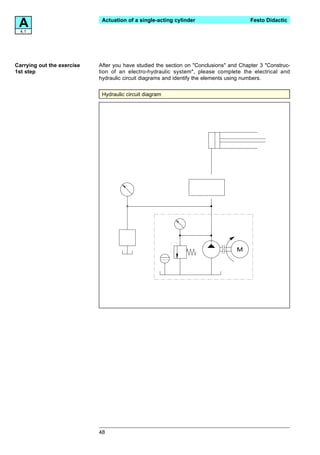
Carrying out the exercise   After you have studied the section on "Conclusions" and Chapter 3 "Construc-
1st step                    tion of an electro-hydraulic system", please complete the electrical and
                            hydraulic circuit diagrams and identify the elements using numbers.


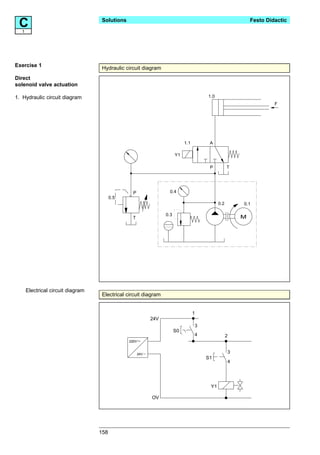
                             Hydraulic circuit diagram


                                                                                  M


                            48
Actuation of a single-acting cylinder                          Festo Didactic
                                                                                                  A
                                                                                                  4.1


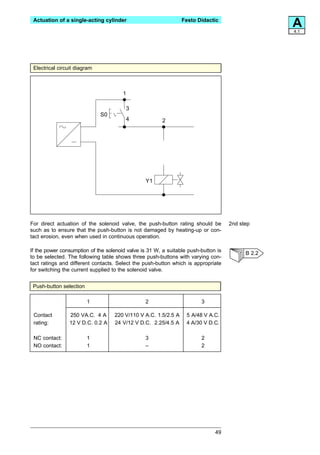
 Electrical circuit diagram


                                       1

                                        3
                              S0
                                        4              2


                                                Y1


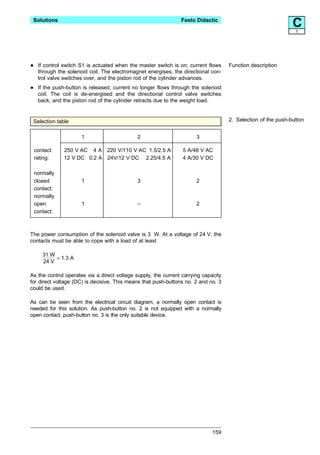
For direct actuation of the solenoid valve, the push-button rating should be        2nd step
such as to ensure that the push-button is not damaged by heating-up or con-
tact erosion, even when used in continuous operation.

If the power consumption of the solenoid valve is 31 W, a suitable push-button is
                                                                                          B 2.2
to be selected. The following table shows three push-buttons with varying con-
tact ratings and different contacts. Select the push-button which is appropriate
for switching the current supplied to the solenoid valve.


 Push-button selection

                         1                      2                       3

 Contact         250 VA.C. 4 A     220 V/110 V A.C. 1.5/2.5 A     5 A/48 V A.C.
 rating:         12 V D.C. 0.2 A   24 V/12 V D.C. 2.25/4.5 A      4 A/30 V D.C.

 NC contact:             1                      3                       2
 NO contact:             1                      –                       2


                                                                              49
A4.2
                       Actuation of a single-acting cylinder                          Festo Didactic


4.2 Exercise 2        Indirect solenoid valve actuation

Problem definition    Direct activation of the solenoid valve as effected in Exercise 1 is only suitable
                      for practice-based operations under certain conditions. The relatively high cur-
                      rent flowing in the coil of the solenoid valve also flows through pushbuttons
                      and cables. This means that contacts and cables have to be designed to cope
                      with this load.

                      In practice, it is preferable for signal input to be effected using a minimum of
                      power, as this allows the use of smaller contacts and thinner cables. To gener-
                      ate the high level of current required for valve actuation, the signal then has to
                      be amplified. For this purpose, the electrical circuit in Exercise 1 has to be
                      modified so that the start push-button activates a relay, causing the contacts of
                      the relay to energise the valve solenoid.

Reducing the          In the circuit in Exercise 1, the roller falls too heavily on the sheet when the
return stroke speed   pushbutton is released. Therefore, you should add a further valve to the hy-
                      draulic circuit diagram to reduce the flow rate during the return stroke. The
                      advance stroke of the piston rod should, however, still be effected at full speed.

                        Positional sketch


                                             material flow

                                                                    straightening station
                            pre-forming station


                      50
Actuation of a single-acting cylinder                            Festo Didactic
                                                                                                                  A 4.2


Hydraulic control                                                                      Conclusions

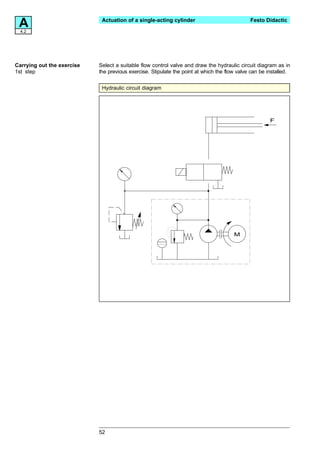
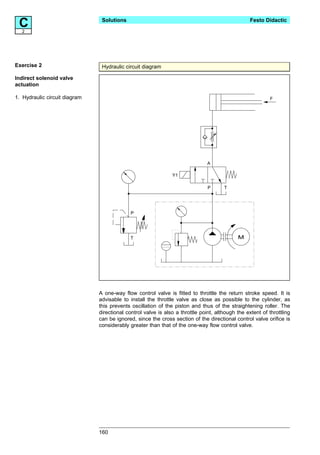
Hydraulic elements which influence the flow rate are called flow control valves.       One-way flow control valve
For this application a valve of simple design – a throttle valve – is sufficient. In
this exercise, only the return stroke should be throttled; the advance stroke
should remain unthrottled. The throttle point therefore has to be bypassed dur-
ing the advance stroke using a check valve. Throttle and check valve are avail-
able as a single unit. This unit is called a one-way flow control valve.

Electrical control

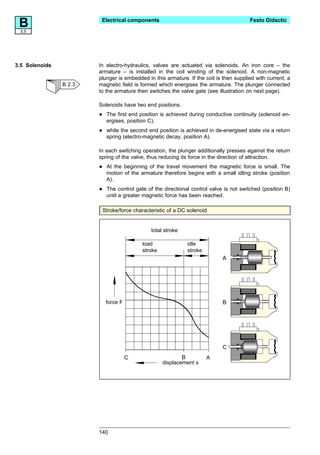
Electromagnetic switches consist of an electromagnet with a movable armature           Electromagnetic switches
which actuates a specific number of contacts (contact assembly), the number
of contacts actuated depending on the size of the armature. When current
flows through the coil a magnetic field is created which switches the armature.
If the flow of current is interrupted, the armature switches back to its original
position through the force of a spring. The contacts of the contact assembly
can take the form of normally open contacts, normally closed contacts or
changeover contacts.

There are two types of electromagnetic switch:

•   relays possess a clapper-type armature and are characterised by single
    contact separation.

•   contactors possess a lifting armature and are characterised by double con-
    tact separation. Extremely large outputs are generally switched using con-
    tactors.                                                                                  A 3.2

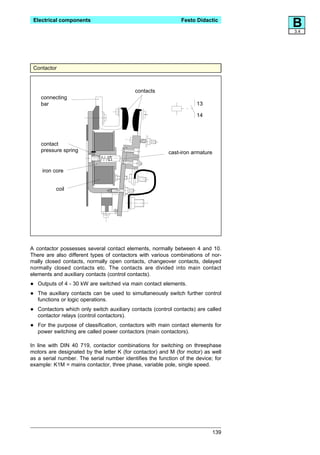
The contacts are identified by a function digit at input and output (DIN EN 50
005 and DIN EN 50 011-13). If there are several contacts, this digit is preceded
by an ordinal number (see Chapter 3.2).


                                                                                 51
A4.2
                             Actuation of a single-acting cylinder                            Festo Didactic


Carrying out the exercise   Select a suitable flow control valve and draw the hydraulic circuit diagram as in
1st step                    the previous exercise. Stipulate the point at which the flow valve can be installed.


                             Hydraulic circuit diagram


                                                                                                       F


                                                                                       M


                            52
Actuation of a single-acting cylinder                          Festo Didactic
                                                                                               A
                                                                                               4.2


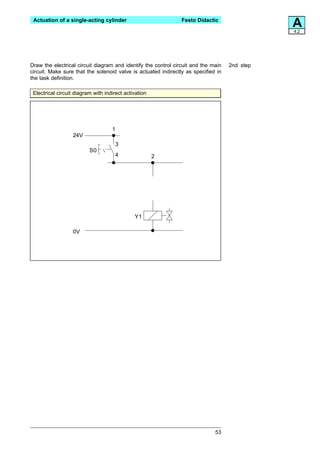
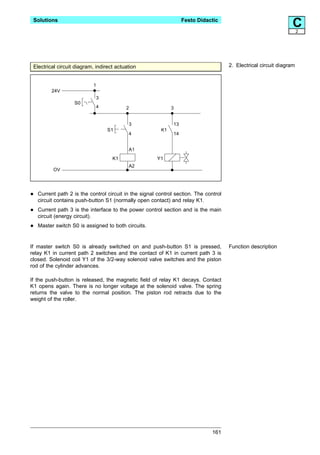
Draw the electrical circuit diagram and identify the control circuit and the main   2nd step
circuit. Make sure that the solenoid valve is actuated indirectly as specified in
the task definition.

 Electrical circuit diagram with indirect activation


                                    1
                  24V
                                     3
                          S0
                                     4                 2


                                              Y1

                  0V


                                                                              53
A4.3
                      Actuation of a single-acting cylinder                            Festo Didactic


4.3 Exercise 3       Boolean basic logic functions

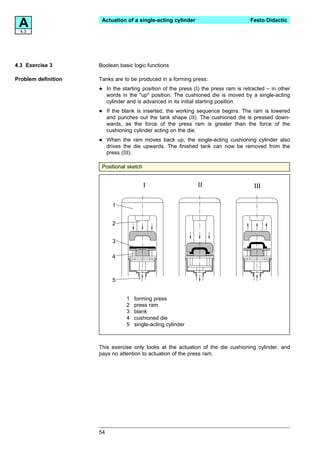
Problem definition   Tanks are to be produced in a forming press:

                     •    In the starting position of the press (Ι) the press ram is retracted – in other
                          words in the "up" position. The cushioned die is moved by a single-acting
                          cylinder and is advanced in its initial starting position.

                     •    If the blank is inserted, the working sequence begins. The ram is lowered
                          and punches out the tank shape (ΙΙ). The cushioned die is pressed down-
                          wards, as the force of the press ram is greater than the force of the
                          cushioning cylinder acting on the die.

                     •    When the ram moves back up, the single-acting cushioning cylinder also
                          drives the die upwards. The finished tank can now be removed from the
                          press (ΙΙΙ).

                      Positional sketch


                                          Ι                      ΙΙ                      ΙΙΙ

                            1


                            2


                            3

                            4


                            5


                                  1   forming press
                                  2   press ram
                                  3   blank
                                  4   cushioned die
                                  5   single-acting cylinder


                     This exercise only looks at the actuation of the die cushioning cylinder, and
                     pays no attention to actuation of the press ram.


                     54
Actuation of a single-acting cylinder                              Festo Didactic
                                                                                                                    A
                                                                                                                    4.3


To facilitate setting operations, it must be possible to retract the die cushioning      Actuation
cylinder – which is advanced in its initial position – by holding down a push-           of the die cushioning cylinder
button. The die cushioning cylinder (single-acting cylinder) is actuated using a
3/2-way solenoid valve. As the advanced piston rod retracts when a push-but-
ton is pressed, we speak of reversal or negation of the input signal.

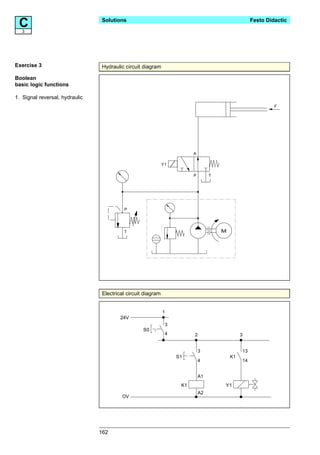
•   In the first part of the exercise the input signal in the hydraulic section of the
    control is to be reversed. The die should be advanced in its initial starting
    position. The normal position of the control valve must be selected accord-
    ingly.

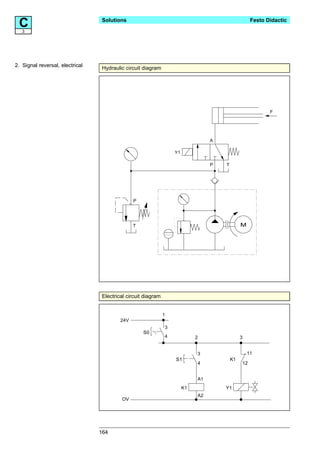
•   In the second part of the exercise, signal reversal is to be effected electri-
    cally. In this case, a 3/2-way solenoid valve is used with port P blocked and
    A to T open in the normal position.

Hydraulic control                                                                        Conclusions

The die cushioning cylinder can also be retracted without using the force of the
press ram by switching off the pressure. The weight of the die is then sufficient
to overcome the remaining friction force.

If – as required in this exercise – the drive component has to achieve a spe-
cific end position in the initial position of the system, valves with spring return
action are used. This ensures that the cylinder remains in (or drives to) the
desired position when the control is switched on. The normal position of the
valve must be selected in line with the task definition.

As the piston rod of the die cushioning cylinder is forced back by the press
during the forming process, the pump must be protected against the return oil
flow by a non-return valve. The oil then flows off via the pressure relief valve.
The pressure at the pressure relief valve should be set just high enough to
ensure that the die cushioning cylinder is pressed up and held in the "up"
position with the blank.


                                                                                   55
A4.3
                   Actuation of a single-acting cylinder                                  Festo Didactic


                  Electrical control

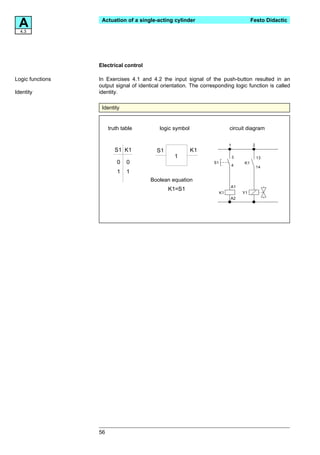
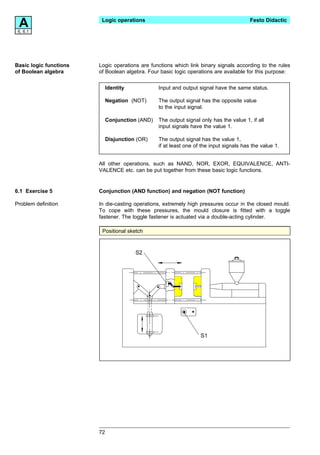
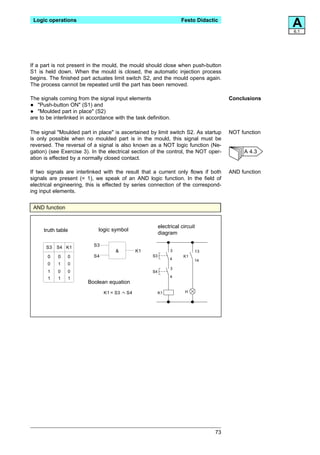
Logic functions   In Exercises 4.1 and 4.2 the input signal of the push-button resulted in an
                  output signal of identical orientation. The corresponding logic function is called
Identity          identity.

                   Identity


                       truth table          logic symbol                     circuit diagram


                                                                             1            2
                          S1 K1           S1               K1
                                                  1                              3            13
                           0   0                                   S1
                                                                                 4
                                                                                     K1
                                                                                              14
                           1   1
                                        Boolean equation
                                                                             A1
                                               K1=S1
                                                                        K1           Y1
                                                                             A2


                  56
Actuation of a single-acting cylinder                                    Festo Didactic
                                                                                                          A
                                                                                                          4.3


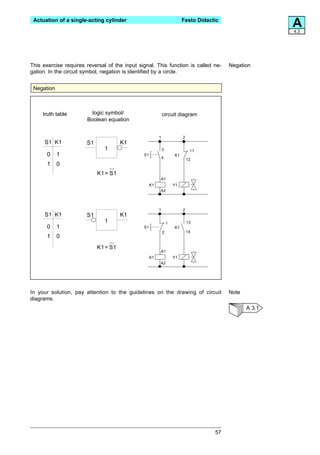
This exercise requires reversal of the input signal. This function is called ne-           Negation
gation. In the circuit symbol, negation is identified by a circle.


 Negation


     truth table         logic symbol/                       circuit diagram
                       Boolean equation


                                                         1                2
      S1 K1            S1             K1
                               1                             3                 11
       0    1                                  S1
                                                             4
                                                                     K1
                                                                              12
       1    0
                            K1 = S1
                                                         A1
                                                    K1               Y1
                                                         A2


                                                         1                2
      S1 K1            S1             K1
                               1                                 1            13
       0    1                                  S1                    K1
                                                             2                14
       1    0
                            K1 = S1
                                                         A1
                                                    K1               Y1
                                                         A2


In your solution, pay attention to the guidelines on the drawing of circuit                Note
diagrams.
                                                                                                  A 3.1


                                                                                      57
A4.3
                                Actuation of a single-acting cylinder                       Festo Didactic


Carrying out the exercise      Draw the hydraulic and electrical circuit diagrams with signal reversal in the
1st step                       hydraulic section of the control.

Circuit with signal reversal    Hydraulic circuit diagram
in the hydraulic section


                               58
Actuation of a single-acting cylinder   Festo Didactic
                                                         A
                                                         4.3


Electrical circuit diagram


                                                    59
A4.3
                                Actuation of a single-acting cylinder                           Festo Didactic


2nd step                       Draw the hydraulic and electrical circuit diagrams. Signal reversal should now
                               be effected in the signal control section, in other words in the electrical section
Circuit with signal reversal   of the control.
in the electrical section
                                Hydraulic circuit diagram


                               60
Actuation of a single-acting cylinder   Festo Didactic
                                                         A
                                                         4.3


Electrical circuit diagram


                                                    61
A
4
    Actuation of a single-acting cylinder   Festo Didactic


    62
Actuation of a double-acting cylinder   Festo Didactic
                                                         A
                                                         5


Chapter 5

Actuation of a
double-acting cylinder


                                                    63
A5.1
                      Actuation of a double-acting cylinder                             Festo Didactic


5.1 Exercise 4       Signal reversal

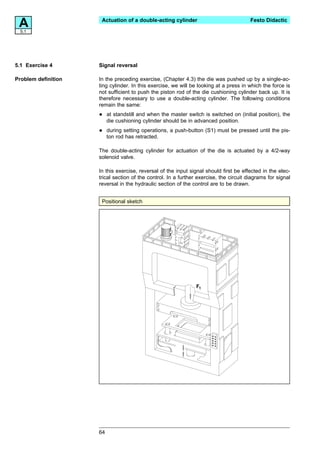
Problem definition   In the preceding exercise, (Chapter 4.3) the die was pushed up by a single-ac-
                     ting cylinder. In this exercise, we will be looking at a press in which the force is
                     not sufficient to push the piston rod of the die cushioning cylinder back up. It is
                     therefore necessary to use a double-acting cylinder. The following conditions
                     remain the same:

                     •    at standstill and when the master switch is switched on (initial position), the
                          die cushioning cylinder should be in advanced position.

                     •    during setting operations, a push-button (S1) must be pressed until the pis-
                          ton rod has retracted.

                     The double-acting cylinder for actuation of the die is actuated by a 4/2-way
                     solenoid valve.

                     In this exercise, reversal of the input signal should first be effected in the elec-
                     trical section of the control. In a further exercise, the circuit diagrams for signal
                     reversal in the hydraulic section of the control are to be drawn.


                      Positional sketch


                                                                F1


                     64
Actuation of a double-acting cylinder                                        Festo Didactic
                                                                                                                        A
                                                                                                                        5.1


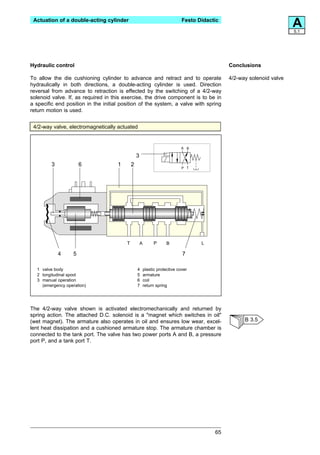
Hydraulic control                                                                              Conclusions

To allow the die cushioning cylinder to advance and retract and to operate                     4/2-way solenoid valve
hydraulically in both directions, a double-acting cylinder is used. Direction
reversal from advance to retraction is effected by the switching of a 4/2-way
solenoid valve. If, as required in this exercise, the drive component is to be in
a specific end position in the initial position of the system, a valve with spring
return motion is used.


 4/2-way valve, electromagnetically actuated


                                                                             A B

                                                 3
         3             6             1       2                                P T


                                         T           A        P      B               L

             4     5                                                          7

  1 valve body                                   4       plastic protective cover
  2 longitudinal spool                           5       armature
  3 manual operation                             6       coil
    (emergency operation)                        7       return spring


The 4/2-way valve shown is activated electromechanically and returned by
spring action. The attached D.C. solenoid is a "magnet which switches in oil"
(wet magnet). The armature also operates in oil and ensures low wear, excel-                         B 3.5
lent heat dissipation and a cushioned armature stop. The armature chamber is
connected to the tank port. The valve has two power ports A and B, a pressure
port P, and a tank port T.


                                                                                          65
A5.1
                             Actuation of a double-acting cylinder                         Festo Didactic


Carrying out the exercise   Complete the hydraulic circuit diagram and draw the electrical circuit diagram.
1st step                    Remember that in this part of the exercise signal reversal is to effected in the
                            signal control section.


                             Hydraulic circuit diagram


                                                                          A      B

                                                            Y1

                                                                          P      T


                                          P


                                          T                                            M


                            66
Actuation of a double-acting cylinder   Festo Didactic
                                                         A
                                                         5.1


Electrical circuit diagram


                                                    67
A5.1
                       Actuation of a double-acting cylinder                          Festo Didactic


2nd step              Signal reversal should now be effected hydraulically. Draw the hydraulic and
                      electrical circuit diagrams. As in the preceding problem, the directional control
Additional exercise   valve has the following starting position: flow from P to B and from A to T.

                       Hydraulic circuit diagram


                      68
Actuation of a double-acting cylinder                        Festo Didactic
                                                                                            A
                                                                                            5.1


 Electrical circuit diagram


What happens when the supply voltage to the signal control section fails:        3rd step

•   in the case of electrical signal reversal?

•   in the case of hydraulic signal reversal?


                                                                            69
A
5
    Actuation of a double-acting cylinder   Festo Didactic


    70
Logic operations   Festo Didactic
                                    A
                                    6


Chapter 6

Logic operations


                               71
A
 6, 6.1
                         Logic operations                                                Festo Didactic


Basic logic functions   Logic operations are functions which link binary signals according to the rules
of Boolean algebra      of Boolean algebra. Four basic logic operations are available for this purpose:


                             Identity            Input and output signal have the same status.

                             Negation (NOT)      The output signal has the opposite value
                                                 to the input signal.

                             Conjunction (AND)   The output signal only has the value 1, if all
                                                 input signals have the value 1.

                             Disjunction (OR)    The output signal has the value 1,
                                                 if at least one of the input signals has the value 1.


                        All other operations, such as NAND, NOR, EXOR, EQUIVALENCE, ANTI-
                        VALENCE etc. can be put together from these basic logic functions.


6.1 Exercise 5          Conjunction (AND function) and negation (NOT function)

Problem definition      In die-casting operations, extremely high pressures occur in the closed mould.
                        To cope with these pressures, the mould closure is fitted with a toggle
                        fastener. The toggle fastener is actuated via a double-acting cylinder.

                         Positional sketch


                                        S2


                                                                   S1


                        72
Logic operations                                                    Festo Didactic
                                                                                                     A
                                                                                                     6.1


If a part is not present in the mould, the mould should close when push-button
S1 is held down. When the mould is closed, the automatic injection process
begins. The finished part actuates limit switch S2, and the mould opens again.
The process cannot be repeated until the part has been removed.

The signals coming from the signal input elements                                     Conclusions
•  "Push-button ON" (S1) and
•  "Moulded part in place" (S2)
are to be interlinked in accordance with the task definition.

The signal "Moulded part in place" is ascertained by limit switch S2. As startup      NOT function
is only possible when no moulded part is in the mould, this signal must be
reversed. The reversal of a signal is also known as a NOT logic function (Ne-
gation) (see Exercise 3). In the electrical section of the control, the NOT oper-          A 4.3
ation is effected by a normally closed contact.

If two signals are interlinked with the result that a current only flows if both      AND function
signals are present (= 1), we speak of an AND logic function. In the field of
electrical engineering, this is effected by series connection of the correspond-
ing input elements.


 AND function


                                                          electrical circuit
     truth table             logic symbol
                                                          diagram

      S3   S4 K1           S3
                                     &         K1               3          13
       0    0   0          S4                        S3               K1
                                                               4           14
       0    1   0
                                                                3
       1    0   0                                    S4
       1    1   1                                              4
                         Boolean equation
                                K1 = S3   S4              K1           H


                                                                                 73
A6.1
                             Logic operations                                          Festo Didactic


Carrying out the exercise   Draw the hydraulic circuit diagram and identify the elements. Use a 4/2-way
1st step                    valve to actuate the cylinder.


                             Hydraulic circuit diagram


                            74
Logic operations                                                                          Festo Didactic
                                                                                                                                   A
                                                                                                                                   6.1


Draw up the parts list for the hydraulic control.                                                                       2nd step

Item Quan-            Description                   Type and Standard designation          Manufacturer/Supplier
     tity


                                                                                               Group   Sheet     of
                                    Make            Signed        Purchaser
                                                                                                03       4     Sheets
                                                                                                                 4
                                                    Date          Order no.

                                    Type            Tested                                     Drawing no.


                                                                  Sample parts list of a
                                    Inventory no.                 hydraulic system

No.   Alteration    Date   Name


Complete the truth table and add the symbol for the AND logic function                                                  3rd step


               S1     S2 K1
                                                             S1
                                                                          &           K1
                                                             S2


                                                                                                                  75
A6.1
            Logic operations                                                Festo Didactic


4th step   Please complete the electrical circuit diagram on the basis of logic interlinking
           of signals S1 and S2 and the cylinder control described above!


            Electrical circuit diagram


                                         1
                     24V
                                         3
                            S0
                                         4   2                          3


                                                 A1

                                     K1                         Y1
                                                 A2
                     0V


           76
Logic operations                                               Festo Didactic
                                                                                                        A
                                                                                                        6.2


Disjunction (OR function)                                                          6.2 Exercise 6

To insert or remove workpieces, the boiler door of a hardening furnace has to      Problem definition
be opened for a short time. The door is opened and closed by a double-acting
hydraulic cylinder. Actuation of the cylinder should be possible both by a hand-
operated push-button and a foot-operated button. After the appropriate push-
button is released, the cylinder should retract and close the boiler door.


 Positional sketch


                                               shock absorber


Hydraulic control                                                                  Conclusions

To ensure that the boiler door does not slam shut, it must be cushioned shortly
before final closure.

•   This braking function can be performed by a shock absorber (see positional
    sketch).

•   Alternatively, a cylinder with adjustable end position cushioning can be
    used.


                                                                             77
A6.2
               Logic operations                                                     Festo Didactic


               Cylinder with end position cushioning at both ends


                             flow control screw          cushioning pistons


               non-return valve                                  ports


              Electrical control

OR function   In line with the task definition, two signal input elements (hand-operated push-
              button S1 and foot-operated button S2) are to be interlinked in such a way that
              the cylinder advances when one of the two signal input elements or both push-
              buttons are actuated. This type of operation is carried out using an OR func-
              tion.

              For electrical realisation of the OR function, the two signal input elements are
              connected in parallel (see diagram). It can be seen from the value table that
              current flows through K1 if either one or both of the signal input elements are
              actuated.

               OR function


                   truth table            logic symbol            electrical circuit diagram


                    S1   S2 K1          S1
                                                   1        K1             3          3        13
                     0   0    0         S2                       S1            S2         K1
                                                                           4          4        14
                     0   1    1
                     1   0    1
                     1   1    1
                                         Boolean equation
                                             K1 = S1   S2             K1                  H


              78
Logic operations                                            Festo Didactic
                                                                                                         A
                                                                                                         6.2


Draw the hydraulic circuit diagram. The cylinder should be equipped with adju-   Carrying out the exercise
stable end position cushioning in the advanced position.                         1st step

 Hydraulic circuit diagram


                                                                           79
A
 6.2
            Logic operations                                               Festo Didactic


2nd step   There are two circuit options for an OR circuit. Complete the circuit diagrams in
           the illustrations accordingly!

           Allocate the designation S1 to the hand-operated push-button and the designa-
           tion S2 to the foot-operated button.


            Electrical circuit diagram


                                          circuit 1
                               1
                24V


                       S0
                                     2         3           4          5


                                                                 K1


                               H1        K1                      Y1

                 0V


                                          circuit 2
                               1
                24V


                       S0
                                     2         3           4          5          6


                                H1        K1          K2         Y1

                 0V


           80
Logic operations                                             Festo Didactic
                                                                                                       A
                                                                                                       6.3


Exclusive OR (EXOR function)                                                      6.3 Exercise 7

Two assembly lines travelling towards each other carry workpieces which are       Problem definition
to be alternately placed on a conveyor belt.

•   It should be possible to effect the swivel motion of the switchover mechan-
    ism from both workplaces via a control switch.

•   The switchover mechanism is moved back and forth by a double-acting cylin-
    der.


 Positional sketch


                                                                            81
A6.3
                   Logic operations                                                       Festo Didactic


Conclusions       Hydraulic control

                  A 4/2-way valve with spring return is used to actuate the double-acting cylin-
                  der. The switching signal must be stored to ensure that the piston rod of the
                  cylinder travels into the forward or retracted end position. The easiest way to
                  store the signal is to use a control switch.

                  To ensure that it does not travel into the respective end position at full speed,
                  the piston rod of the cylinder must be cushioned. This is effected using a
                  cylinder with end position cushioning at both ends.


                  Electrical control

Two-way circuit   It should be possible to activate the swivel motion from two different points; this
                  requires the use of a two-way circuit.

                  •    This two-way circuit can be realised using a switch with changeover con-
                       tacts at each of the two workplaces.

                  •    Another way to achieve the same result is to use a switch with normally
                       open and normally closed contact at each of the workplaces.

                  •    If the two-way circuit is equipped only with normally open contacts at the
                       signal input element, a relay circuit is additionally required.

                  The basic logic operation for each of these two-way circuits is an exclusive OR.


                   Exclusive OR


                         truth table            logic symbol                 electrical circuit diagram
                                                                             with changeover contacts

                          S1   S2 K1       S1
                                                      1          K1               1                13
                          0    0   0       S2                           S1                    K1
                                                                              2       4            14
                          0    1   1
                                                                              4       2
                          1    0   1                                    S2
                                           Boolean equation
                          1    1   0                                              1
                                          K1 = (S1   S2)   (S1    S2)
                                                                             K1                H


                  82
Logic operations                                                   Festo Didactic
                                                                                                             A
                                                                                                             6.3


To facilitate the drawing of the electrical circuit diagram, the operation must be
divided into the three basic logic functions: conjunction (AND), disjunction (OR)
and negation (NOT). The Boolean equation and the corresponding logic diag-
ram can be derived from the truth table:

•    first, the input signals are negated (NOT).

•    then, the input signals and the negation are interlinked via AND.

•    finally, these two expressions are interlinked using OR.

    Logic diagram Exclusive OR


                                       S1
            S1                 1                   S1   S2
                                             &
            S2

                                                                1      K1


                                      S2     &
                               1                   S1   S2


Draw the hydraulic circuit diagram first. In place of the hydraulic assembly,        Carrying out the exercise
draw only the symbol for the pressure source.                                        1st step

 Hydraulic circuit diagram


                                                                                83
A6.3
            Logic operations                                              Festo Didactic


2nd step   Initially draw the electrical circuit diagram with two control switches equipped
           with changeover contacts.

            Electrical circuit diagram, two switches with changeover contacts


3rd step   Now draw the electrical circuit diagram with two control switches equipped with
           only one normally open contact each.

            Electrical circuit diagram, two switches with normally open contacts


           84
Signal storage   Festo Didactic
                                  A
                                  7


Chapter 7

Signal storage


                             85
A
 7, 7.1
                      Signal storage                                                   Festo Didactic


                     A signal can be generated electrically, hydraulically or pneumatically. If the
                     signal is only present for a short time, it must be stored for further processing.
                     In electro-hydraulic systems, signal storage can be effected in two ways:

                     •    in the hydraulic power section using double solenoid valves which store the
                          respective position via notch or friction,

                     •    and in the electrical signal control section using control switches or latching
                          circuits.

7.1 Exercise 8       Signal storage in the hydraulic section

Problem definition   In production systems, workpieces are clamped with the help of hydraulic de-
                     vices. Easy operation and rapid workpiece change are the two chief require-
                     ments. The positional sketch shows a clamping device of the type used in, for
                     example, drilling and milling operations.

                     The workpieces are clamped using a double-acting cylinder. The operator
                     should control opening and closing of the clamping device via a push-button.
                     When the push-button is released, the piston rod should proceed to the se-
                     lected end position or on to the workpiece. For safety reasons the valve must
                     not change its switching position in the event of a power failure. If the close or
                     open push-button is pressed, the inverse signal must not become effective.
                     The push-buttons must therefore be interlocked.


                      Positional sketch


                     86
Signal storage                                                       Festo Didactic
                                                                                                                     A
                                                                                                                     7.1


Hydraulic control                                                                            Conclusions

If the piston rod of the cylinder is also to advance to the selected end position            Double solenoid valve
when the push-button is released, the switching signal must be stored. Signal
storage should be effected in the directional control valve in line with the task
definition. A 4/2-way double solenoid valve is used to activate the double-acting
cylinder.

 Graphic symbol 4/2-way double solenoid valve


                                        A          B


                                        P          T


Double solenoid valves require an electrical switchover pulse for each switch-
ing position. The switching position is stored via friction or notch. The valve
does not switch back until an electrical pulse acts on the opposing solenoid
coil. If the double solenoid valve is activated by both switching signals, the
signal applied first has priority. Double solenoid valves are used wherever it is
important that the valve position is retained in the event of control voltage
failure (e.g. in clamping devices).


Electrical control

To ensure that only one coil of the solenoid is actuated, the two input signals
must be interlocked. Interlocking can be effected via the pushbutton contacts or
via the relay contacts (contactor contacts).


 Latching via push-button contacts and relay contacts

          push-button contacts                              relay contacts


                11                 11                       3                  3
         S1                                   S1                     S2
               12                12                         4                  4
               23                23                             11                 11
         S2                                            K2                 K1
               24                24                         12                 12
          K2               K1                      K1                 K2


                                   disadvantage:
        interlocking is ineffective,         with simultaneous actuation
        if one contact                       of S1 and S2,
        sticks mechanically                  both relays can switch


                                                                                        87
A7.1
                             Signal storage                                               Festo Didactic


Carrying out the exercise   Draw the hydraulic circuit diagram with the additional condition that the speed
1st step                    of the closing motion can be altered. The opening speed remains unchanged.


                             Hydraulic circuit diagram


                            88
Signal storage                                                 Festo Didactic
                                                                                                A
                                                                                                7.1


Draw the electrical circuit diagram. Electrical activation should be effected in-    2nd step
directly. In addition, the input signals should be interlocked via the push-button
and relay contacts.

 Electrical circuit diagram


                                                                               89
A7.2
                      Signal storage                                                  Festo Didactic


7.2 Exercise 9       Signal storage in the electrical section

Problem definition   In the preceding exercises, we saw that the piston rod of a cylinder only moved
                     into the respective end position if the switching signal was stored. With the
                     double solenoid valve, the signal is stored in the valve. If, however, a spring-re-
                     turn 4/2-way solenoid valve is used and the switching signal is given via a
                     push-button, the signal must be stored in the signal control section. If the
                     clamping device is to open again, a second push-button is pressed which
                     deletes the stored data.

                     Using the clamping device from the preceding exercise, it is not possible to
                     adjust the clamping pressure to different values without altering the system
                     pressure. A reduction in system pressure can, however, mean that other con-
                     sumers in the system – e.g. machining stations – no longer operate reliably. To
                     adjust the clamping pressure to a level lower than the system pressure, a
                     pressure regulator is installed upstream of the clamping device.


                      Positional sketch


                     90
Signal storage                                                      Festo Didactic
                                                                                                             A
                                                                                                             7.2


Hydraulic control                                                                       Conclusions

Pressure regulators are used if different pressures are required in a system.           Pressure regulator

 Pressure regulator


                     system pressure                   reduced pressure


                        p                                             p
                         1                                                2


                                                      control line
                                 A

                                                  B         30 bar

               50 bar
                                                      control pressure is
              P                   T                   supplied via output B


Using a 2-way pressure regulator, the supply pressure is reduced to a lower
adjustable initial pressure.

•   The valve is open in normal position.

•   The control pressure (port B) acts via the control line to the valve piston.

•   If the force generated at the valve piston exceeds the set spring force, the
    valve starts to close. The pressure at port B decreases to the set value,
    whilst the system pressure at port A is unaffected.


                                                                                   91
A7.2
            Signal storage                                                     Festo Didactic


           Electrical control

           If a relay or a contactor is activated via a push-button, the coil receives current
           and the contacts are switched. When the push-button is released, the contacts
           immediately switch back to their initial position.

Latching   If the contacts are to be prevented from switching back when the push-button
           is released, the relay coil must be supplied with current until another signal
           interrupts the power supply. This condition is realised via the latching circuit
           (signal storage).


            Electrical latching, dominant setting


                truth table             logic diagram          electrical circuit diagram

                                   S1
                 S1    S2     K1
                                                                      3             13           23
                 0     0      K1                      1    K1 S1
                                                                               K1           K1
                  0    1      0    S2                                 4             14           24
                                            &
                  1    0      1                                                         1
                                                                          S2
                  1    1      1                                                     2


                                                                 K1                         H1


                dominant                Boolean equation
                  ON                     K1=S1 (S2 K1)


           If the ON push-button S1 is pressed, current flows to the relay coil. The con-
           tacts switch over and contact K1 closes. If push-button S1 is released, the
           relay coil is supplied with current via contact K1 and reverts to latching. The
           input signal is therefore stored. If push-button S2 is pressed, the flow of current
           to the coil is interrupted, and contacts K1 open. If push-button S2 is released
           once again, the relay remains without current. If, therefore, neither of the two
           push-buttons is pressed, the previous switching status of the relay is retained,
           depending on contact K1.

           If both push-buttons are pressed simultaneously in this circuit, coil K1 and its
           contacts are switched (K1 = 1). This circuit is therefore termed dominant set-
           ting.

           For safety reasons, circuits with the condition dominant resetting are used for
           clamping devices. This condition is fulfilled if the relay contacts are not
           switched when both push-buttons are pressed (K1 = 0).


           92
Signal storage                                             Festo Didactic
                                                                                                        A
                                                                                                        7.2


Draw the hydraulic circuit diagram. Stipulate the point at which the pressure   Carrying out the exercise
regulator is to be installed and give reasons for your decision.                1st step


 Hydraulic circuit diagram


                                                                          93
A7.2
            Signal storage                                             Festo Didactic


2nd step   Draw the electrical circuit diagram for actuation of the hydraulic system by
           developing a latching circuit with "dominant resetting" characteristics.


            Electrical circuit diagram


3rd step   Draw the logic diagram for this circuit.

            Logic diagram


           94
Signal storage                                                 Festo Didactic
                                                                                                            A
                                                                                                            7.3


The speed of the piston in a hydraulic cylinder increases together with the flow     7.3 Speed control
rate. The flow rate can be controlled in two ways:
•  with throttle control, the flow rate is regulated via valves, for example via
   flow control valves. If the constant flow rate delivered by the pump exceeds
                                                                                     Throttle control

   the required flow rate, part of the pressure fluid flows back into the tank via
   a pressure relief valve. This results in considerable power loss.

•   a far more favourable solution from the point of view of power consumption
    is control of the flow rate via a control pump which generates the flow rate
                                                                                     Displacement control

    required. This type of control is known as displacement control. One disad-
    vantage of this method is the inferior dynamic performance.

This book only deals with throttle control using flow valves.

Flow control                                                                         Exercise 10

Pre-drilled workpieces are finished using a reaming machine. The feed motion         Problem definition
is performed by a double-acting cylinder. The advance and return stroke are to
be effected at the same speed. Moreover, the speed should be adjustable. It
must also always be kept exactly constant regardless of the load. The return
stroke should be effected after a limit switch has been reached. A 4/2-way
solenoid valve with spring return is to be used for actuation of the cylinder.


 Positional sketch


                                                                               95
A
  7.3
                             Signal storage                                                 Festo Didactic


Conclusions                 Hydraulic control

Cylinder with               In a double-acting cylinder with single-ended piston rod, the surface area on
single-ended piston rod     the piston side is greater than that of the piston rod side. With a constant pump
                            delivery rate, therefore, the piston rod retracts faster than it advances.

Cylinder with through-rod   The following illustration shows a double-acting cylinder with two piston rods of
(Synchronous cylinder)      the same diameter. With this cylinder design, the two piston surfaces are the
                            same size. The advance and return stroke speeds are therefore also identical.
                            This cylinder is called a synchronous cylinder.


                             Synchronous cylinder


                                                        A1    =        A2


Differential circuit        If, due to lack of space, only a cylinder with one piston rod can be used, a
                            differential or bypass circuit should be used.

                             Bypass or differential circuit


                                    Qtot


                                                                  QR


                                                 QP


                            96
Signal storage                                                    Festo Didactic
                                                                                                         A
                                                                                                         7.3


This circuit increases the advance stroke speed of the piston rod. If, as re-
quired in this exercise, the advance and return strokes are to be performed at
the same speed, the surface ratio of piston surface to piston rod surface must
be 2:1.

Flow valves are used to reduce the flow rate to the drive component. Due to its      Speed control
relatively small orifice cross-section, the flow valve has a high flow resistance.   using flow valves
This results in a high pressure drop via the flow valve and thus also a high
pressure level in the hydraulic circuit. The pressure relief valve opens and the
constant flow rate of the pump (Q0) is divided into two branches. As a result,             A 2.4
the partial flow Q1 flows to the drive component.


 Influence of a flow valve


      a) without flow valve               b) with flow valve


                  A   B                               A    B


                  P       T                           P        T


                      Q1 = Q 0                             Q1 < Q 0
           Q2 = 0                                Q2 > 0

          P           Q0                        P         Q0


              T                                  T


The action of flow control valves is load-dependent; in other words, the travers-
ing speed changes with changes in the force acting on the piston rod.

Flow regulators operate on an almost load-independent basis. This means that
the traversing speed of the piston rod remains constant even if the force acting
on the piston rod changes.


                                                                               97
A7.3
                          Signal storage                                                   Festo Didactic


Counter-pressure valve   In this exercise the feed cylinder is arranged in such a way that the piston rod
                         advances vertically. Due to the hanging weight of the reaming tool, a tensile
                         load acts on the piston rod. The tensile load can generate a (partial) vacuum in
                         the upper chamber. Uniform feed is then no longer possible and the piston rod
                         is pulled jerkily out of the cylinder. To prevent this, a pressure relief valve is
                         installed in the return flow line and adjusted in line with this load. A pressure
                         relief valve installed in this manner is called a counter-pressure valve.


                         Electrical control

Limit switch             A mechanically actuated limit switch is required as a further electrical signal
                         input element. Limit switches are actuated by a cam or a guide plate. They are
                         mainly used to ascertain the position of cylinder pistons. Limit switches can be
                         used, for example, to ascertain when an end position or any other desired
                         position has been reached. Limit switches can be connected as normally
                         closed contacts, normally open contacts or changeover contacts.

                         The following should be noted for this problem definition.

                         •    The piston rod should advance if the ON push-button is pressed and the
                              piston is in the retracted end position. To this end, a limit switch is used to
                              monitor the retracted end position. The position of the limit switch is incor-
                              porated into the current path of the ON push-button as a start condition.

                         •    After having reached the forward end position, the piston rod should imme-
                              diately drive back into the starting position. For control of this motion, a
                              further limit switch is used to monitor the forward end position.


                         98
Signal storage                                                 Festo Didactic
                                                                                                             A
                                                                                                             7.3


Draw the hydraulic circuit diagram with a synchronous cylinder, taking into ac-      Carrying out the exercise
count the conditions laid out in the conclusions. Note that no flow can take         1st step
place against the counter-pressure valve (pressure relief valve). The position of
the limit switch (S1 retracted end position, S2 forward end position) is indicated
by a vertical line in the circuit diagram (|).

Hydraulic circuit diagram


                                                                               99
A
 7.3
            Signal storage                                                 Festo Didactic


2nd step   Draw the electrical circuit diagram with the starting condition that the retracted
           end position of the piston rod is monitored and the start button is not pressed.

            Electrical circuit diagram


           100
Sequence control system   Festo Didactic
                                           A
                                           8


Chapter 8

Sequence control system


                                     101
A
 8, 8.1
                           Sequence control system                                        Festo Didactic


                          A sequence control system is a control with forced step-by-step sequence.
                  LB501   Switching to the next step is achieved in the following exercises through po-
                          sition monitoring using limit switches.


8.1 Exercise 11           Pressure- and path-dependent                Positional sketch
                          sequence control

Problem definition        Hardened bearing rings are pressed
                          into grey cast iron blocks using a
                          hydraulic press.

                          •   As starting conditions, the master
                              switch must be switched on and
                              the retracted end position of the
                              piston rod monitored via a limit
                              switch. Pressing must take place
                              at low, adjustable speed.

                          •   If pressing is performed correctly,
                              the return stroke is effected when
                              a limit switch is reached. The re-
                              turn stroke should be unthrottled.

                          •   If the maximum admissible press-
                              ing force is exceeded (e.g. if a ring
                              is bent), the piston rod must re-
                              tract and an optical signal must be
                              given for safety reasons. The
                              cylinder cannot recommence its
                              operating cycle until an acknow-
                              ledgement button has been
                              pressed.


Safety note
                              Presses may not be operated without two-hand control or press safety con-
                              trol block. However, these safety devices are not dealt with here.


                          102
Sequence control system                                           Festo Didactic
                                                                                                     A
                                                                                                     8.1


Hydraulic control                                                                      Conclusions

This exercise does not require precise feed control. The use of a flow control
valve (e.g. a throttle valve) is sufficient to reduce the speed. A flow regulator is
not required. Throttle valves can be installed at the inflow or the outflow of the
cylinder. If the valve is installed at the outflow (outflow throttling), a counter-
pressure valve is no longer required.

In this circuit, the piston rod should advance slowly and return quickly. It is for
this reason that a one-way flow control valve is used.


 Example: outflow throttling


                                                 2:1


                                                                    120 bar
                                                               A


                                                               B

                                             A     B

                                    Y1

                                             P
                                                       T

                    60 bar


            P


                T


                                                           M


                                                                                103
A8.1
                             Sequence control system                                        Festo Didactic


                            To ensure that outflow throttling results in flow separation and therefore in a
                            reduction in speed, the throttle must be closed far enough to ensure that the
                            system pressure relief valve opens. In the present example, the pressure at the
                            system pressure relief valve is 60 bar. Due to the pressure transmission, the
                            pressure in front of the one-way flow control valve is increased in the ratio of
                            the piston surface to the piston rod surface. With a surface ratio of 2:1, the
                            pressure in front of the throttle is approx. 120 bar (not taking into account the
                            cylinder friction and the load). The cylinder, the pipes and the one-way flow
                            control valve in this circuit must be designed to withstand a pressure of 120
                            bar, even if the supply pressure is only 60 bar.

                            Electrical control

Pressure switch             Pressure switches switch electrical contacts when a set pressure is reached. A
                            pressure switch can be connected as a normally closed contact, a normally
                            open contact or a changeover contact. The switching point is set by prestress-
                  B 3.3     ing a spring.

Carrying out the exercise   Complete the function diagram. Pay attention to the starting conditions listed in
1st step                    the problem definition. Designate the limit switch which monitors the retracted
                            end position as S1, the switch for the forward end position as S2.

                             Function diagram


                                   Components                         Time in seconds


                                                  Identi-             Step
                                  Description                Status
                                                  fication                   1   2      3   4     5

                                  Master switch     S0

                                  Start
                                                    S1
                                  push-button
                                  Directional
                                                    Y1         1
                                  control valve

                                                               0

                                  Cylinder          A1         1

                                                               0


                            104
Sequence control system                                            Festo Didactic
                                                                                                    A
                                                                                                    8.1


Draw the hydraulic circuit diagram.                                                      2nd step

•   Use a spring return 4/2-way solenoid valve for actuation of the cylinder.

•   Speed reduction should not be effected via an outflow throttle but via an
    inflow throttle.

•   Note also that the weight of the press ram acts as a tensile load on the
    piston rod.

•   The position of the limit switch is indicated in the circuit diagram by a vertical
    line (|).

 Hydraulic circuit diagram


                                                                                 105
A8.1
            Sequence control system                                         Festo Didactic


3rd step   What maximum pressure occurs in the system with inflow throttling? Compare
           this pressure with the maximum pressure in the case of outflow throttling.

4th step   A differential cylinder with a piston diameter of 50 mm and a surface ratio of
           2:1 should be used. The maximum admissible pressing force is 6000 N. To
           what bar value must the pressure switch be set if a pressure of 20 bar is
           created in the piston rod chamber due to the counter-pressure?

           Note: the friction of the piston and piston rod gasket can be ignored.

5th step   Draw the electrical circuit diagram.


            Electrical circuit diagram


6th step   Explain the mode of operation of the electro-hydraulic system.


           106
Sequence control system                                          Festo Didactic
                                                                                                            A
                                                                                                            8.1


Sequence control with automatic operation                                              8.2 Exercise 12

Clamped workpieces are surface-milled on a milling machine.                            Problem definition

•   A hydraulic cylinder (A) with a piston rod coupled to the milling table per-
    forms the working motion.

•   The cylinder is activated by a 4/3-way solenoid valve with closed mid-posi-
    tion (spring-centred). If the valve is switched to mid-position during the ad-
    vance or return movement of the milling table, the table stops even if the
    end stop has not been reached.

•   The milling table should advance at an adjustable feed speed and return
    automatically in rapid motion after a limit switch (S2) has been reached.

•   The control can be switched off by actuating a switch (normally closed con-
    tact). The 4/3-way valve then switches to the mid-position and the piston
    rod stops moving.

•   If the milling machine is to be restarted after the control is switched off, the
    piston rod must first be driven into the starting position (S1). To achieve
    this, the piston rod must be brought into the end position manually, i.e. by
    holding down a push-button.


 Positional sketch


                                                      A


     S2                        S1


                                                                                107
A8.1
                    Sequence control system                                          Festo Didactic


Conclusions        Hydraulic control

                   In the no-load condition, the 4/3-way solenoid valve switches to the mid-posi-
                   tion. In this mid-position all ports are blocked. This valve possesses no storage
                   capability.

                    4/3-way soleniod valve


                                                                              A B


                                                                               P T


                                                  T   A   P   B          L


                   Electrical control

Manual operation   As the valve does not store the switching position, a latching circuit with relay
                   must be installed in the electrical section of the control. If the latching function
                   is switched off during the advance or return stroke, the piston rod stops in its
                   momentary position (EMERGENCY stop). In this event, the piston rod can no
                   longer be actuated, as the condition "Limit switch S1 actuated" is no longer
                   fulfilled. It is therefore necessary to develop a circuit which can drive the piston
                   rod back into its starting position after it has stopped. This return motion is
                   activated via a push-button which – when held down – switches on the 4/3-way
                   valve for the return stroke. However, this push-button must not take effect un-
                   less the switch "Automatic-Manual" was also pressed beforehand (interlock).
                   This interlock function can also be effected electrically via a push-button and a
                   further relay.


                   108
Sequence control system                                     Festo Didactic
                                                                                                         A
                                                                                                         8.2


Draw the hydraulic circuit diagram.                                              Carrying out the exercise
                                                                                 1st step

•   Note that tensile loads can also occur during milling.

•   Note also that in the opposite direction the flow regulator only acts as a
    throttle, and that some designs do not allow any flow at all.


Hydraulic circuit diagram


                                                                          109
A8.2
            Sequence control system                                    Festo Didactic


2nd step   Draw the electrical circuit diagram. The switchover from automatic to manual
           operation should be effected via a control switch.

            Electrical circuit diagram with control switch


3rd step   Draw the electrical circuit diagram. The switchover from automatic to manual
           operation should now be effected via a push-button and a relay.


            Electrical circuit diagram with push-button and relay


           110
Festo Didactic
                                B


Part B

Fundamentals


                          111
B         Festo Didactic


    112
Electro-hydraulic system   Festo Didactic
                                            B
                                            1


Chapter 1

Electro-hydraulic system


                                      113
B1.1
                        Electro-hydraulic system                                                    Festo Didactic


                       An electro-hydraulic system mainly consists of the two function groups signal
                       control section and power section.

1.1 Power section      The power section of an electro-hydraulic system comprises all the assemblies
                       which ensure the power supply, the power control and the working movements
                       of a system. In most cases, the power section hardly differs from the power
                       section of a "purely" hydraulic system, with the exception of the actuation mode
                       of the valves.

                        Power section of an electro-hydraulic system


                                  Drive section                    Flow valve


                                                                                A       P
                                                                Non-return
                                                                valve
                                                                                        T
                                                                                P                     pressure valve
                                      Power
                                      control
                                      section                                                   directional control valve

                                                                                    A   B
                                                                     signal
                                                  energy flow


                                                                     input
                                                                                    P       T


                                Power supply
                                                                                                         P
                                section

                                Energy
                                                                                                         T
                                conversion,
                                Pressure
                                medium                                                          M
                                preparation


Power supply section   The power supply section is divided up into energy conversion and preparation
                       of pressure medium. It is in this part of the system that the hydraulic energy is
                       generated and the pressure fluid correctly prepared. In the energy conversion
                       process – the electrical energy is converted first into hydraulic and then mech-
                       anical energy – the following components are normally used:

                       •   electric motor or combustion motor

                       •   coupling

                       •   pump

                       •   pressure gauge

                       •   protective devices


                       114
Electro-hydraulic system                                         Festo Didactic
                                                                                                                B
                                                                                                               1.2, 1.3


The pressure medium is prepared using the following components:
                                                                                              LB501
•   tank with fluid level indicator

•   filter

•   cooler

•   heater

•   temperature indicator

In electro-hydraulic systems, the task of power control is performed by valves.        Power control section
According to the tasks they perform within the system, these valves can be
divided into four groups:

•   directional control valves

•   non-return valves

•   pressure valves

•   flow valves

The working movements are performed in the drive section of the system. The            Drive section
hydraulic energy in the pressure medium is converted into mechanical energy
with the help of cylinders or motors. The power consumption of the drive com-
ponents in the drive section determines the requirements with regard to the
design of the components in the power supply section and the power control
section. All components must be designed for the pressures and flow rates
occurring in the operating section.

The signal control section of an electro-hydraulic system differs considerably         1.2 Signal control section
from the signal control section of a purely hydraulic system. In a hydraulic
system, the corresponding functions are chiefly performed by operating staff. In
electro-hydraulic systems, the signal control section is divided into two function
areas: signal input (sensor technology) and signal processing (processor tech-
nology).

With signal input, a general distinction should be made between signals given          Signal input
by the operator (via push-buttons, switches etc.) and signals transmitted within
the system (limit switches, proximity switches, temperature sensors, special in-
dicators, pressure switches etc.).

In electro-hydraulic systems, signal processing is effected either via electrical      Signal processing
circuits or PLCs. There are also purely pneumatic and, the less popular, hy-
draulic circuit options for the processing of signals. In this book, signal process-
ing is effected by electrical circuits (see exercises in Part A).

The valve solenoids form the interface between the signal control section and          1.3 Interface
the power section of an electro-hydraulic system. DC magnets with an opera-
ting voltage of 24 V are generally used to actuate the solenoid valves. AC                   B 3.6
solenoids are also used in the voltage range from 110 V - 220 V.


                                                                                115
B
1
    Electro-hydraulic system   Festo Didactic


    116
Fundamentals of electrical engineering   Festo Didactic
                                                          B
                                                          2


Chapter 2

Fundamentals of
electrical engineering


                                                    117
B2.1
                           Fundamentals of electrical engineering                                     Festo Didactic


2.1 Direct current and    A simple electrical circuit consists of a voltage source, a consuming device and
    alternating current   a connecting line (supply line and return line). In physical terms, what happens
                          is that negative charge carriers – the electrons – travel via the electrical con-
                          ductor from the negative terminal of the voltage source to the positive terminal.
                          This movement of charge carriers is called electric current. It should be noted
                          that an electric current can only flow in a closed conductor circuit.

                          A distinction is made between direct current and alternating current:

                          •   if the voltage in a circuit always acts in the same direction, a current flows
                              which also always has the same direction. We call this a direct current or
                              DC circuit.

                          •   in the case of alternating current or in an alternating current circuit, the
                              direction of the voltage changes with a certain frequency. As a result, the
                              current also changes its direction and strength continuously.


                           Current strength over time


                                                direct current                  alternating current
                                    current I


                                                                          current I


                                                                 time t                               time t


                          118
Fundamentals of electrical engineering                         Festo Didactic
                                                                                                                B2.2


The following illustration shows a simple DC circuit consisting of a voltage         2.2 DC circuit
source, electrical lines, a switch and a consumer (in this case a lamp).

 DC circuit


                                            I


                                                               3
                                                  S
         V=12V                                                 4

                                                         H


If the switch contact in the above circuit is closed, a current I flows via the      Technical direction of current
consumer. The electrons travel from the negative terminal to the positive termi-
nal of the voltage source. Before scientists became aware of the existence of
electrons, the current direction was described as from "plus" to "minus". This
definition is still valid today – it is termed the technical direction of current.

Electric current is the directional movement of charges. The charge carriers         Electrical conductor
can be electrons or ions. But current can only flow if the material used pos-
sesses a sufficient number of mobile charge carriers; we then speak of an
electrical conductor.

At the negative terminal of a voltage source there is an electron surplus, while     Source voltage
at the positive terminal there is a shortage of electrons. This results in a dif-
ference in electron assignment between the two terminals. This condition is
known as source voltage.

Every material puts up a certain level of resistance to electrical current. This     Electrical resistance
resistance depends on, among other things, the atomic density and the number
of free electrons. It is generated by the collision of the free mobile electrons
with the atoms of the conductor material and the restriction of movement of the
electrons caused by these collisions. In the field of control technology, copper
is the most frequently used conductor material. The electrical resistance of
copper is particularly low.


                                                                              119
B2.2
                    Fundamentals of electrical engineering                                Festo Didactic


Ohm‘s law          The relationship between voltage, current strength and resistance is described
                   by Ohm‘s law. Ohm‘s law states that in a circuit with constant resistance the
                   current strength changes in proportion to the change in voltage:

                   •   if the voltage increases, the current strength also increases.

                   •   if the voltage falls, the current strength also decreases.


                    Ohm‘s law


                                                         V = voltage;                 unit: volt (V)

                             V=R•I                       R = resistance;              unit: ohm (Ω)

                                                         I    = current strength;     unit: ampere (A)


Electrical power   In the field of mechanical engineering, power can be defined in terms of the
                   work performed. The faster a task is performed, the greater the required
                   power. Power therefore means work per unit of time.

                   In the case of a consuming device in a circuit, electrical energy is converted
                   into kinetic energy (e.g. electrical motor), light radiation (e.g. electrical lamp) or
                   thermal energy (e.g. electrical heater, electrical lamp). The faster the energy is
                   converted, the greater the electrical power. In this case, therefore, power
                   means converted energy per unit of time. It increases with increasing current
                   and increasing voltage.

                    Electrical power


                                                     P = power;                     unit: watt (W)

                             P=V•I                   V = voltage;                   unit: volt (V)

                                                     I       = current strength;    unit: ampere (A)


                   The electrical power of a consuming device is also called electrical power con-
                   sumption.


                   120
Fundamentals of electrical engineering                          Festo Didactic
                                                                                                                      B
                                                                                                                      2.2


A solenoid coil is supplied with a direct voltage of 24 volts. The resistance of      Example:
the coil is 19.9 Ω. How great is the electrical power consumption?                    calculation of the electrical
                                                                                      power of a coil

First, the current strength is calculated:

     V   24 V
I=     =      = 1.206 A
     R 19.9 Ω

This gives us the electrical power consumption:

P = V • I = 24 V • 1.206 A = 28.944 W

Electrical controls are generally supplied with a direct current of 24 V. The
alternating voltage from the power supply therefore has to be stepped down to
24 V and then rectified.

Rectification is performed by semiconductor diodes. They allow the current to         Diodes
flow in one direction and block it in the other. Their effect on electrical current
can be compared to the effect of a non-return valve on the pressure fluid in a
hydraulic system.

Various diode circuit arrangements can be used for rectification. The most im-        Rectifier
portant circuit is the bridge or Graetz circuit. For the supply of current to elec-
tronic controls (PLCs) or if sensors are used, the direct voltage supplied by the
rectifier must be smoothed using a charge capacitor and, if necessary, down-                   B 3.1
stream filters (chokes or filter resistors).


 Bridge rectifier circuit with charge capacitor


                                                                               121
B
 2.3
                        Fundamentals of electrical engineering                          Festo Didactic


2.3 Electromagnetism   The solenoid coils, relays and contactors used in electro-hydraulics work on
                       the principle of electromagnetism:

                       •   every conductor through which current flows builds up a magnetic field
                           around itself.
                       •   the direction of current in the conductor determines the direction of the field
                           lines.
                       •   the current strength in the conductor influences the strength of the magnetic
                           field.

                        Illustration of an electrical coil


                                   coil with air-core           coil with iron core and air gap


                       To increase the magnetic field, the conductor through which the current flows
                       is wound in the form of a coil. If the field lines are then superimposed on the
                       coil windings, the main direction of the magnetic field can be established. If the
                       coil possesses an iron core, the iron is also magnetised. This makes it possible
                       to generate considerably greater magnetic fields than can be achieved using
                       an air-core coil with the same amount of current.

Electromagnet          An electromagnet must meet two conflicting requirements:

                       •   minimum current input (low energy consumption) and

                       •   maximum power through a strong magnetic field.

                       To simultaneously meet both criteria, electromagnets are made up of a coil
                       with iron core.


                       122
Fundamentals of electrical engineering                         Festo Didactic
                                                                                                               B
                                                                                                               2.4


If an alternating voltage is applied to a coil, the current – and thus also the     Inductive resistance
magnetic field – is constantly increased and decreased. The change in the           with alternating voltage
magnetic field induces a current in the coil. The induced current counteracts
the current generated by the magnetic field. The coil therefore puts up a resist-
ance against the alternating current. This resistance is called inductive resist-
ance.

In the case of direct voltage, the voltage, the current and the magnetic field      Inductive resistance
only change upon switch-on. In this case, therefore, the inductive resistance is    with direct voltage
only active at the time of switch-on.

The unit of inductance is the "Henry" (H):

        Vs
1H=1       = 1 Ωs
        A

A capacitor consists of two metallic plates with an intermediate insulation layer   2.4 Capacitance
(dielectric). The greater the capacitance of a capacitor, the more electrical
charge carriers it stores at the same voltage.

 Schematic illustration of a capacitor


                    charging current

                                                    3

                                         S1
                                                    4

                                         + + + + + + + + +


                                         - - - - - - - - -


                                                  mA


If a capacitor is connected to a direct voltage source, a charging current flows
for a short time. The two plates are electrically charged in opposing mode. If
the connection to the voltage source is then interrupted, the charge remains
stored in the capacitor – until the charge is dissipated via a consuming device
(e.g. a resistor).

The unit of capacitance is the "Farad" (F):

       As
1F=1
       V


                                                                             123
B2.5
                         Fundamentals of electrical engineering                               Festo Didactic


2.5 Measurements in a   The term "measurement" means the comparison of an unknown quantity with a
    circuit             known quantity. Measuring instruments make it possible to perform this com-
                        parison with a greater or lesser degree of precision. The accuracy of a meas-
                        urement depends on the precision of the measuring instrument.

Rules for measuring     When taking measurements in electrical circuits, the following rules should al-
                        ways be observed:

                        •    never knock measuring instruments.

                        •    carry out a zero point check prior to measurement.

                        •    when measuring direct voltage or direct current, note the polarity of the
                             measuring instrument (terminal "+" of the measuring instrument to positive
                             terminal of the voltage supply).

                        •    select the largest measuring range before switching on the voltage.

                        •    observe the needle and gradually switch to smaller measuring ranges. Read
                             off the value at maximum needle deflection.

                        •    to avoid reading errors, always look at the needle vertically.

Example:                The indicating error of a voltmeter of class 1.5 is to be investigated by measur-
indicating error        ing a battery voltage (approx. 9 V). The measuring range is adjusted once to
                        10 V and once to 100 V.


                            Measuring range      Permissible indicating error Percentage error


                                                              1.5                 0.15 V
                                  10 V               10 V ⋅       = 0.15 V               ⋅ 100 = 1.66 %
                                                              100                   9V


                                                               1.5                 1.5 V
                                  100 V              100 V ⋅       = 1.5 V               ⋅ 100 = 16.6 %
                                                               100                  9V


                        The sample calculation shows clearly that the greater the deflection of the
                        needle, the more precise the measurement. In other words: the measuring
                        range selected on the measuring instrument should ensure that the indication
                        is in the latter third of the measuring scale.


                        124
Fundamentals of electrical engineering                            Festo Didactic
                                                                                                          B
                                                                                                          2.5


 Example of voltage measurement


           measuring range 0 V                  measuring range 100 V


                  9V                                   9V


                  50                                   50
                   5                                    5
             0          100                       0          100
             0           10                       0           10


            10V         100V                     10V        100V


If current flows through a measuring instrument, there is a voltage drop via the    Voltage measurement
measuring instrument. This affects all currents and voltages in the circuit. The
resulting measurement is therefore falsified not only by the indicating error but
also by the influence of the measuring instrument on the circuit.

To measure electrical voltage, a suitable measuring instrument must be con-
nected parallel to the consuming device. To ensure that measuring inaccu-
racies are kept to a minimum, only an extremely small current may flow
through the voltmeter. Otherwise, the current decreases due to the consuming
device, as does the voltage drop, and the measured voltage is too small. For
this reason, a voltmeter with a maximum possible resistance must be used.
This resistance is also called the internal resistance of the voltmeter.


                                                                              125
B
 2.5
                       Fundamentals of electrical engineering                         Festo Didactic


                       Voltage measurement


                                                              voltmeter

                                           V              V           H


Current measurement   If the current in a circuit is to be measured, the entire current must be able to
                      flow through the measuring instrument. For this purpose, the current measuring
                      instrument (ammeter) is connected in series with the consuming device. Every
                      current measuring instrument possesses a specific internal resistance. This ad-
                      ditional resistance reduces the flow of current. The measured current is there-
                      fore smaller than the current which flows in the circuit when no measuring
                      instrument is connected. To keep the measuring error as small as possible,
                      only current measuring instruments with an extremely low internal resistance
                      may be used.

                       Current measurement


                                                                ammeter
                                                          A


                                       V                              H


                      126
Electrical components   Festo Didactic
                                         B
                                         3


Chapter 3

Electrical components


                                   127
B
 3, 3.1
                         Electrical components                                          Festo Didactic


                        The signal control section in electro-hydraulic systems is made up of electrical
                        or electronic components. Depending on the task to be performed, the signal
                        control section can vary in design:

                        •   relatively simple controls use either electro-mechanical components with
                            contacts (e.g. relays) or a combination of components with contacts and
                            electronic components without contacts.

                        •   for complex tasks, on the other hand, stored-program controls (PLC’s) are
                            mostly used.

                        •   The circuit examples and explanations in this textbook are primarily based
                            on electro-mechanical components, but also describe certain contactless
                            components.

3.1 Power supply unit   Electro-hydraulic control systems are generally supplied with electricity not from
                        their own voltage sources (e.g. batteries) but from the mains supply via a
                        power supply unit.

Safety note
                            The components of the power supply unit form the power current system
                            (DIN VDE 0100) in an electrical circuit. The safety regulations for power
                            current systems must therefore, be observed!


                         Modules of a power supply unit


                                                               G      C


                            ~
                                          transformer     rectifier capacitor   regulator

                                                              Power supply unit


                        128
Electrical components                                            Festo Didactic
                                                                                                              B
                                                                                                              3.2


A power supply unit consists of the following modules:

•   the mains transformer which transforms the alternating voltage of the mains
    supply (e.g. 220 V) into the output voltage (mostly 24 V).

•   a smoothed direct voltage is generated by the rectifier G and the capacitor C.

•   the direct voltage is then stabilised by the in-phase regulator.

Switches are installed in a circuit to open or close the flow of current to the       3.2 Electrical
consuming device. These switches are divided into the two main groups "push-              input elements
button switches" (push-buttons) and "control switches". Both switch types are
available for operation with normally closed contacts, normally open contacts or
changeover contacts.

•   In control switches, the two switching positions are mechanically inter-
    locked. A switching position is maintained until the switch is activated once
                                                                                      Control switch

    again.

•   A push-button only opens or closes a current circuit for a short time. The
    selected switching position is only active while the push-button is pressed.
                                                                                      Push-button


In the normally open version, the circuit is open when the push-button is in the      Normally open contact
normal position; i.e. not pressed. The circuit is closed when the control stem is
actuated; current then flows to the consuming device. When the control stem is
released, the push-button is returned to its original position by spring pressure,
and the circuit is then interrupted.

 Normally open contact: sectional view and circuit symbol


                                           actuator
                                           (push-button)
                                                                           3

                                                                           4
                                          switching element
                                          (contacts)

                                          connection terminal


                                              spring


                                                                                129
B3.2
                           Electrical components                                         Festo Didactic


Normally closed contact   In the normally closed version, the circuit is closed when the push-button is in
                          normal position. The spring action ensures that the contacts remain closed until
                          the push-button is pressed. When the push-button is pressed, the switching
                          contact is opened against the spring pressure. The flow of current to the con-
                          suming device is interrupted.

                           Normally closed contact: sectional view and circuit symbol


                                                                   actuator
                                                                   (push-button)                       1

                                                                                                  2

                                                                   connection terminal


                                                                    switching element
                                                                    (contacts)
                                                                 spring


Changeover contact        The third variation is the changeover contact. These contacts combine the
                          functions of normally closed and normally open contacts in one unit. Change-
                          over contacts are used to close one circuit and simultaneously open another. It
                          should be noted, however, that both circuits are momentarily interrupted during
                          changeover.


                           Changeover contact: sectional view and circuit symbol


                                                                    actuator
                                                                    (push-button)             2    4
                                                                  terminal
                                                                                                  1
                                                                  (normally closed contact)


                                                                  switching elements

                                                                  terminal
                                                                  (normally open contact)

                                                                   spring


                          130
Electrical components                                                 Festo Didactic
                                                                                                            B
                                                                                                            3.3


Sensors are used to record information about the status of a system and to                3.3 Sensors
pass this information on to the control. In electro-hydraulic systems, sensors
are mainly used for the following tasks:

•   measurement and monitoring of pressure and temperature of the pressure
    fluid,

•   recording the proximity i.e. the position or the end position of drive components.

A mechanical limit switch is an electrical switch which is activated when a               Limit switch
machine part or a workpiece is in a certain position. Activation is generally
effected by a cam activating a movable operating lever. Limit switches are
normally equipped with changeover contacts capable of performing closing,
opening or changeover of circuits.

 Mechanical limit switch: sectional view and circuit symbol


                                                                   2         4
         movable contact piece
          (dropped-in spring)


                                                  plunger (insulated)


                                                                         1


             fastening hole         plastic housing


Pressure switches are used as control or monitoring devices. They can be                  Pressure switch
used to open, close or change between circuits when a preset pressure is
reached. The supply pressure acts on a piston surface. The resulting force acts
against an adjustable spring pressure. If the pressure is greater than the force
of the spring, the piston is moved and actuates the contact assembly.


                                                                                    131
B
3.3
       Electrical components                                         Festo Didactic


      In pressure switches with mechanically actuated contact assemblies, a dia-
      phragm, a bellows or a Bourdon spring can be used in place of the helical
      spring.

       Piston pressure switch: sectional view and circuit symbol


                                                                        2   4


                                                                   >p
                                                         1
                                                         4
                                                                            1
                                                         2

              X


      Recently, increasing use has been made of diaphragm pressure switches,
      where the contact is no longer mechanically actuated but electronically
      switched. This also requires the use of pressure- or force-sensitive sensors
      which exploit one of the following physical effects:

      •   the resistance effect (diaphragm with strain gauge, change in electrical re-
          sistance with shape change),

      •   the piezoresistive effect (change in electrical resistance with change in
          mechanical tension),

      •   the piezoelectric effect (generation of an electrical charge through mechan-
          ical stress),

      •   the capacitive effect (change in capacitance with change in mechanical
          stress).

      The pressure-sensitive element in this process is created through diffusion,
      vapour-depositing or etching on the diaphragm. A suitable protective electronic
      circuit supplies an amplified analogue signal. This signal can be used for
      pressure indication or for further switching operations.


      132
Electrical components                                            Festo Didactic
                                                                                                       B
                                                                                                       3.3


Non-contacting proximity sensors differ from mechanically actuated limit swit-     Proximity sensors
ches by virtue of the means of actuation, without external mechanical actuating
force. A distinction is made between the following groups of proximity sensors:

•   magnetically activated proximity sensors (Reed switch),

•   inductive proximity sensors,

•   capacitive proximity sensors and

•   optical proximity sensors.

Reed switches are magnetically actuated proximity switches. They consist of        Reed switches
two contact reeds housed in a glass tube filled with inert gas. When the switch
enters a magnetic field e.g. the magnet on a cylinder piston, the reeds are
closed and output an electrical signal. The opening function of reed contacts
can be achieved by pre-stressing the contact reeds using small magnets. This
initial stress is overcome by the considerably stronger switching magnets.
Reed switches are characterised by the following properties:

•   long service life,

•   maintenance-free,

•   switching time ≈ 0.2 ms,

•   limited response sensitivity,

•   unsuitable for areas with strong magnetic fields
    (e.g. resistance welding machines).


 Reed switch, normally open contact


                                                magnet


                         reed contacts


                                                       cylinder piston


                                                                             133
B3.3
                               Electrical components                                               Festo Didactic


Inductive proximity sensors    Inductive proximity sensor


                                               schematic illustration


                                                                                              graphic symbol

                                     sensor                             metallic object


                                                              function circuit diagram


                                                          1               2               3


                              An inductive proximity sensor consists of an oscillating circuit (1), a triggering
                              stage (2) and an amplifier (3). When a voltage is applied to the terminals, the
                              oscillating circuit generates a high-frequency electro-magnetic field which is
                              emitted from the end face of the proximity sensor. If a good electrical conduc-
                              tor is introduced into this oscillating magnetic field, the oscillating circuit is
                              dampened. The downstream triggering stage evaluates the oscillating circuit
                              signal and activates the switching output via the amplifier.

                              Inductive proximity sensors are characterised by the following properties:

                              •   all materials with good electrical conductivity are recognised by inductive
                                  proximity sensors. Their function is confined to neither magnetisable ma-
                                  terials nor metals; they also recognise graphite, for example.

                              •   objects can be detected either moving or stationary.

                              •   objects with large surface areas are recognised more readily than objects
                                  which are small compared to the sensor area (e.g. metal).

                              •   they are chiefly used as digital sensors.


                              134
Electrical components                                             Festo Didactic
                                                                                                                   B
                                                                                                                   3.3


Capacitive proximity sensors measure the change in capacitance in the electri-         Capacitive proximity sensors
cal field of a capacitor caused by the approach of an object. The proximity
sensor consists of an ohmic resistor, a capacitor (RC oscillating circuit) and an
electronic circuit. An electrostatic field is built up in the space between active
electrode and earth electrode. If an object is then introduced into this stray
field, the capacitance of the capacitor increases, thus detecting not only highly
conductive materials, but also all insulators which possess a high dielectric
constant. Materials such as plastics, glass, ceramics, liquids and wood, for
example.

    Capacitive proximity sensor

                             capacitive proximity sensor

          schematic illustration                           graphic symbol


                                         object


We distinguish between three types of optical proximity sensors:                       Optical proximity sensors

•    through-beam sensors

•    retro-reflective sensors

•    diffuse sensors

The through-beam sensor consists of spatially separated transmitter and re-            Through-beam sensor
ceiver units. The components are mounted in such a way that the transmitter is
aimed directly at the receiver. If the light beam is interrupted, the contacts open
or close.


 Through-beam sensor

                       schematic illustration                   graphic symbol


 transmitter           receiver    transmitter      receiver


                                                                                 135
B3.3
                           Electrical components                                           Festo Didactic


Retro-reflective sensor   In retro-reflective sensors, the transmitter and the receiver are mounted side by
                          side in a common housing. For the correct function of these sensors, a reflec-
                          tor must be mounted in such a way that the light beam emitted by the transmit-
                          ter is more or less totally reflected onto the receiver. Interruption of the light
                          beam causes the sensor to switch.

                           Retro-reflective sensor

                                         schematic illustration                         graphic symbol

                             receiver                       receiver


                           transmitter        reflector   transmitter       reflector


Diffuse sensor            The transmitter and receiver of the diffuse sensor are mounted in a similar way
                          to that of the retro-reflective sensor. If the transmitter is aimed at a reflecting
                          object, the reflected light is absorbed by the receiver and a switching signal is
                          generated. The greater the reflection properties of the object in question, the
                          more reliably the object can be detected.

                           Diffuse sensor

                                            schematic illustration                      graphic symbol


                            receiver                         receiver


                           transmitter                      transmitter


                          136
Electrical components                                              Festo Didactic
                                                                                                               B  3.4


The representation of relays and contactors in the electrical circuit diagram is        3.4 Relay and contactor
identical, as is their operating principle.

•    Relays are used to switch relatively small outputs and currents;

•    contactors to switch relatively large outputs and currents.

Relays are electromagnetically actuated switches. They consist of a housing             Relay
with electromagnet and movable contacts. An electromagnetic field is created
when a voltage is applied to the coil of the electromagnet. This results in at-
traction of the movable armature to the coil core. The armature actuates the
contact assembly. This contact assembly can open or close a specific number
of contacts by mechanical means. If the flow of current through the coil is
interrupted, a spring returns the armature to its original position.


    Relay: sectional view and circuit symbol


                                                                          2   4
                            return spring
                                                   coil


                                                                              1


                                                             insulation
            core                                             armature
                                                             contact


There are various types of relay; e.g. time-delay relays and counter relays.            Application examples
Relays can be used for various regulating, control and monitoring functions:

•    as interfaces between control circuits and load circuits,
•    for signal multiplication,
•    for separation of direct current and alternating current circuits,
•    for delaying, generating and converting signals and
•    for linking information.


                                                                                  137
B3.4
                             Electrical components                                                 Festo Didactic


Terminal designations       Depending on design, relays possess varying numbers of normally closed con-
and circuit symbols         tacts, normally open contacts, changeover contacts, delayed normally closed
                            contacts, delayed normally open contacts and delayed changeover contacts.
                            The terminal designations of the relays are standardised (DIN EN 50 005,
                            50011-13):

                            •   relays are designated K1, K2, K3 etc.

                            •   the coil terminals are designated A1 and A2.

                            •   the contacts switched by the relay are also designated K1, K2 etc. in circuit
                                diagrams.

                            •   There are additionally two-digit identification numbers for the switching con-
                                tacts. The first digit is for numbering of all existing contacts (ordinal num-
                                ber), while the second digit denotes the type of contact (function number).


                             Function numbers for relays

                    A 3.2
                                    1        2                 normally closed contact
                                    3        4                 normally open contact
                                    5        6                 normally closed contact, time delay
                                    7        8                 normally open contact, time delay
                                    1        2       4         changeover contact
                                    5        6       8         changeover contact, time delay


                             Circuit symbols and terminal designations of a relay


                                    coil                             switching contacts

                                                     13   23      33        43   53       61       71       83
                                        A1


                                        A2
                                                 14       24      34        44   54       62       72       84

                                                 1        2      3      4        5    6        7        8


Contactor                   Contactors work on the same basic principle as relays. The typical features of
                            a contactor are:

                            •   double-break (2 break points per contact),

                            •   positive-action contacts and

                            •   closed arcing chambers (spark arresting chambers).


                            138
Electrical components                                          Festo Didactic
                                                                                     B
                                                                                     3.4


 Contactor


                                            contacts
     connecting
     bar                                                              13

                                                                      14


     contact
     pressure spring                                      cast-iron armature


     iron core


           coil


A contactor possesses several contact elements, normally between 4 and 10.
There are also different types of contactors with various combinations of nor-
mally closed contacts, normally open contacts, changeover contacts, delayed
normally closed contacts etc. The contacts are divided into main contact
elements and auxiliary contacts (control contacts).

•   Outputs of 4 - 30 kW are switched via main contact elements.

•   The auxiliary contacts can be used to simultaneously switch further control
    functions or logic operations.

•   Contactors which only switch auxiliary contacts (control contacts) are called
    contactor relays (control contactors).

•   For the purpose of classification, contactors with main contact elements for
    power switching are called power contactors (main contactors).

In line with DIN 40 719, contactor combinations for switching on threephase
motors are designated by the letter K (for contactor) and M (for motor) as well
as a serial number. The serial number identifies the function of the device; for
example: K1M = mains contactor, three phase, variable pole, single speed.


                                                                               139
B
 3.5
                         Electrical components                                           Festo Didactic


3.5 Solenoids           In electro-hydraulics, valves are actuated via solenoids. An iron core – the
                        armature – is installed in the coil winding of the solenoid. A non-magnetic
                        plunger is embedded in this armature. If the coil is then supplied with current, a
                B 2.3   magnetic field is formed which energises the armature. The plunger connected
                        to the armature then switches the valve gate (see illustration on next page).

                        Solenoids have two end positions.

                        •    The first end position is achieved during conductive continuity (solenoid en-
                             ergises, position C),

                        •    while the second end position is achieved in de-energised state via a return
                             spring (electro-magnetic decay, position A).

                        In each switching operation, the plunger additionally presses against the return
                        spring of the valve, thus reducing its force in the direction of attraction.

                        •    At the beginning of the travel movement the magnetic force is small. The
                             motion of the armature therefore begins with a small idling stroke (position
                             A).

                        •    The control gate of the directional control valve is not switched (position B)
                             until a greater magnetic force has been reached.

                            Stroke/force characteristic of a DC solenoid


                                                total stroke

                                            load               idle
                                            stroke             stroke
                                                                              A


                             force F                                          B


                                                                              C
                                       C                     B          A
                                                     displacement s


                        140
Electrical components                                           Festo Didactic
                                                                                                          B
                                                                                                          3.5


There are solenoids for direct current or alternating current. AC solenoids for     DC and AC solenoids
230 V are used less and less frequently for reasons of safety (dangerous touch
voltage).

When a solenoid is switched off, the flow of current is interrupted. The collapse   Arcing
of the magnetic field creates a voltage peak in the opposite direction. A protec-
tive spark suppression circuit is essential to prevent damage to the solenoids
or the contacts.

DC solenoids are produced as wet or dry designs, whereas AC solenoids are           Types
always dry solenoids.

In wet solenoids, the armature chamber of the solenoid contains hydraulic oil,      Wet solenoid
in which the solenoid switches. The housings of these solenoids have to be
seal-tight (towards the outside). The armature chamber is connected to the
tank port to prevent high pressures on the solenoid. The advantages of this
nowadays common type of solenoid are:

•   absolute seal-tightness and low friction due to the absence of a dynamically
    stressed seal at the plunger,

•   greatly reduced corrosion inside the housing and

•   cushioning of switching operations.


 Wet solenoid


                      armature                         winding


                                                                   core

    manual
    emergency
    actuation


                            plunger tube      solenoid body


                                                                             141
B3.5
                       Electrical components                                           Festo Didactic


Dry solenoid          The term "dry solenoid" means that the solenoid is isolated from the oil. The
                      plunger is sealed off from the oil in the valve body by a seal. Therefore, in
                      addition to the spring force and the friction of the control gate, the solenoid has
                      to overcome the friction between plunger and seal.

                       Dry solenoid


                                            armature                         winding


                                                                                           core

                       manual
                       emergency
                       actuation
                                                                                         seal


                                                             solenoid body


Plug connector        When the valves are assem-           Solenoid with plug base
for solenoid valves   bled the solenoid is screwed di-
(line sockets)        rectly to the valve body. This
                      facilitates replacement in the
                      event of malfunction. Three
                      contacts (plug pins) protrude
                      from the solenoid and it is via
                      these contacts that the sole-
                      noid coil is supplied with cur-
                      rent. The spacing of the plug-in
                      contacts is laid down in DIN 43
                      650.


                      142
Electrical components                                          Festo Didactic
                                                                                                          B
                                                                                                          3.5


The line sockets are screwed onto these contacts using a captive cheese head
screw. A fitted seal between solenoid base and line socket serves as protec-
tion against dust and water spray (protection type IP 65 to DIN 40 050).

The housing dimensions of the line sockets vary from manufacturer to manu-
facturer.


 Line socket to DIN 43 650


        design A                                   design B
        (grey)                                     (black)


The inductivity of solenoid coils causes electro-magnetic energy to be stored        Spark suppression
when the circuit is switched on. The faster switch-off is effected, the faster the   in solenoid valves
energy is discharged and the higher the induced voltage peak. This can cause
insulation breakdown in the circuit or destroy the switching contact as a result
of an arc (contact-breaking spark).

To avoid damage to the contacts or the coil, the energy stored in the coil must
be discharged gradually after switch-off. A spark suppression circuit is required
for this purpose. Various kinds of spark suppression circuit are suitable for this
purpose. What is common to all spark suppression circuits, however, is that,
after switch-off, the change in the current strength is not sudden but slow and
regulated.

The two most common circuits are shown in the following illustrations:

•   circuit with one diode,

•   circuit with one capacitor and one resistor.


                                                                              143
B
3.5
       Electrical components                                             Festo Didactic


      When effecting spark suppression using a diode, care should be taken to en-
      sure that the diode is polarised in the direction of blocking when the contact is
      closed.

       Suppressor circuit using diode


            suppressor components                      suppressor components
            for plug/adapter                           fitted in circuit
            (with operational status display)


                                            24V


      In DC solenoids, the polarity of the supply voltage is fixed. This allows connec-
      tion of an LED parallel to the coil for switching status display. The most practi-
      cal solution is to install the protective circuit and the switching status display in
      an adapter which is plugged directly onto the solenoid coil below the connect-
      ing plug. They can also be directly incorporated into the connecting plug.

       Suppressor circuit using capacitor and resistor

              suppressor components
                                                       suppressor components
              for plug/adapter
                                                       fitted in circuit
              (with operational status display)


                                            24V


      144
Electrical components                                           Festo Didactic
                                                                                                            B
                                                                                                            3.6


In all electrically activated systems, the signal control section is installed in a   3.6 Control cabinet
control cabinet. Depending on their size and intended use, these control
cabinets are made of plastic or sheet metal. When constructing control
cabinets, the following standards must be observed:

•   DIN 41 488, Parts 1 to 3 stipulate panel widths for control cabinets and
    switchgear.

•   the mounting racks for relays, contactors, stored-program controls (PLC’s),
    plug-in cards etc. and the design of electronic devices, front panels and
    racks for 19" frames are governed by DIN 41 494, Part 2.

•   VDE 0113 contains guidelines concerning the type and structure of control
    cabinets, as well as regulations on the mounting height of the equipment,
    which has to be accessible for adjustment and maintenance work.

•   the standards DIN 40 050 and IEC 144 contain provisions on the protection
    (shock protection) of personnel against electrical equipment in the form of
    housings or cover panels and also lay down provisions on the protection of
    equipment against water and dust penetration as well as details of interna-
    tionally agreed protection types.

The signal-processing elements, such as relays and contactors, are plugged onto
a mounting rail (top-hat rail to DIN EN 50 022-27, 32 and 35) installed in the
control cabinet. The electrical connections to the sensors outside the control
cabinet are routed via a terminal strip. This is also plugged onto a mounting
rail.

The control cabinet is generally fitted with a distribution board via which all       Terminal allocation
input and output signals are routed. The electrical circuit diagrams and the
terminal allocation list are required for production, installation and maintenance
of the control cabinets.

•   The terminals (distribution boards DIN 43 880) are drawn on the electrical
    circuit diagrams.

•   In the terminal allocation list drawn up on the basis of the circuit diagram,
    the internal (inside the control cabinet) and external connections (on the
    system) are each allocated to one side of the terminal strip. Each terminal
    is designated by an X and a serial number.

A detailed description of circuit documentation can be found in DIN 40 719, with
details of terminal designations in DIN EN 50 011.

The following example shows how the electrical circuit diagram and the termi-         Example
nal allocation list for the control cabinet are drawn up on the basis of a task
definition. The piston rod of a cylinder (1.0) is to advance when a push-button
(S1) is pressed once. A further start condition is that the piston rod is in the
retracted position – with the proximity switch (B1) in the actuated state. The
speed can be varied via a one-way flow control valve. When it reaches the
forward end position, the piston rod is to be reversed by the electrical signal
from the limit switch (S2).


                                                                               145
B
3.6
      Electrical components                                                          Festo Didactic


      Displacement-Step diagram


                                       S1

                                                     B1

                                                 1         2              3=1

                                                                     S2
                                   1
                       1.0
                                   0                                        B1


      Hydraulic circuit diagram


                                       B1                                       S2


                             1.0


                                                     1.3


                                       1.2           A     B

                              Y1

                                                     P         T


                                       P

                       0.2


                                             T


                                                               0.1


      146
Electrical components                                                                                            Festo Didactic
                                                                                                                                       B
                                                                                                                                       3.6


Electrical circuit diagram with terminal designations


                                  1                             2                3                  4                   5
      +24V
                                X1 1                                           X1 2             X1 3                   X1 4
                                X1 9                                           X1 12            X1 14
                                 +                                                                                          23
                                                                                          S2                 1
                                                                     S1                                           K2
                                                                                                    2                       24
                 B1                                                            X1 13            X1 15

                                                                                     13                 13
                                                                          K1                   K2
                                X1 11                      X1 10                     14                 14


                                                                A1                   A1                               X1 16
                                                      K1                  K2                                      Y1
                                                              A2                  A2                                  X1 17
                                X1 5                       X1 6                X1 7                                    X1 8
       0V


Terminal allocation list


               Connection
                                                      A2
                                                      11
                                                      A2


                                                                          A1


                                                                                 13
                                                      23


                                                                                               24
                                      12
                                                 14


                                                                     17


                                                                                               13
                                       9


                                                                                 5


                                                                                               8
                                                                          1


                                                                                 2

                                                                                           3


               Identification
 Destination
               Component
                                                                                                        X1
                                                                X1
                                      X1
                                             X1
                                             X1
                                                      K2
                                                      X1
                                                                K1
                                                                K2


                                                                          X1
                                                                          K1
                                                                          X1
                                                                                     X1
                                                                                          K1
                                                                                          X1
                                                                                                K2
                                                                                                K2


               Designation
                                                                                                                       21
                                                                               11


                                                                                                                       24
                                                                                                                 20

                                                                                                                       22
                                                                                                                       23


                                                                                                                                 25
                                                                               10

                                                                                      12
                                                                                      13
                                                                                           14
                                                                                           15
                                                                                                    16
                                                                                                    17
                                                                                                    18
                                                                                                                 19
                                                 8
                                             2
                                      1


                                                 3
                                                 4
                                                 5
                                                 6
                                                 7

                                                 9


       Terminal no. X.......

       Connecting bridge
                                      +24V


               Connection
                                                           0V


                                                                                     1
                                                                                     2
                                                                                           1
                                                                                           2


               Identification
 Destination
               Component
                                                                          B1
                                                                               B1
                                                                               B1
                                                                                      S1
                                                                                      S1
                                                                                           S2
                                                                                           S2
                                                                                           Y1
                                                                                           Y1


               Designation


                                                                                                                                 147
B3.7
                                Electrical components                                             Festo Didactic


3.7 Voltage supply of an       A supply voltage of 24 V DC is required for the signal and power control sec-
    electro-hydraulic system   tions. The power supply section consisting of hydro pump and electric drive
                               motor requires either 220 V or 380 V AC. The example shown is the circuit of
                               the electrical drive motor for a hydraulic pump.


                               Voltage supply for an electric motor (3-phase)


                                          L1

                                          L2                                               380V 50Hz

                                          L3

                                          N

                                          PE

                                                    220V
                                                                       F1

                                               T

                                               F3          F3          K1


                                                                  F2


                                                                                   U1
                                                    0V     24V
                                                                                  V1         M
                                                                                  W1         3~

                                                                                           PE


                                  L1, L2, L3 = rotary current phases        F2   = motor protection relay
                                  N          = neutral conductor                   (thermal overcurrent relay)
                                  PE         = protective conductor         F3   = fuses
                                  F1         = motor fuses                  T    = transformer


                                Only suitably qualified electricians may perform work on electrical systems
                 B 4.3          with voltages exceeding 50 volts AC/120 volts DC. It is strictly forbidden for
                                others to perform work on such systems (danger to life and limb!).


Safety note                    The controls shown here all use a safe low voltage of 24 V DC. Safety voltages
                               are voltages rated up to 50 V AC or 120 V DC. The use of these voltages rules
                               out the possibility of coming into contact with dangerous voltages.


                               148
Safety recommendations   Festo Didactic
                                          B
                                          4


Chapter 4

Safety recommendations


                                    149
B
4.1, 4.2
                                 Safety recommendations                                            Festo Didactic


4.1 General                     High pressures, temperatures and forces occur in electro-hydraulic systems.
    safety recommendations      Energy is also stored, sometimes in large quantities. A whole series of safety
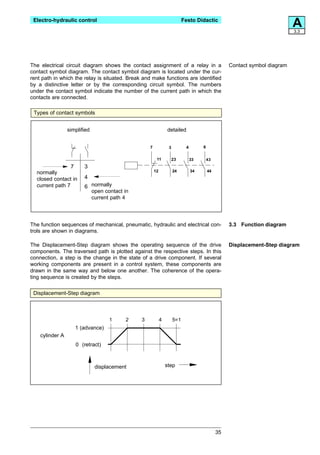
                                measures is necessary to rule out the possibility of danger to personnel and
                                equipment during the operation of electro-hydraulic systems. In particular, the
                                valid safety regulations for electro-hydraulic systems are to be observed!

Regulations and standards       The following safety regulations apply for the field of hydraulics:

                                •   accident prevention regulations, directives, safety rules and the testing gui-
                                    delines of the employers‘ liability insurance associations,

                                •   regulations on pressure vessels, pressurised gas vessels and filling systems
                                    (pressure vessel regulations),

                                •   DIN standards, VDI directives, VDMA standard sheets and technical rules
                                    for pressure vessels, containing in particular, notes and regulations on
                                    dimensions, design, calculations, materials and permissible loads as well as
                                    stipulations on functions and requirements.

                                Electro-hydraulic systems must comply not only with the regulations on hy-
                                draulic systems but also with the regulations on electrical systems and compo-
                                nents (e.g. DIN VDE 0100).


4.2 Safety
    recommendations for               Install the EMERGENCY STOP push-button in a place where it can be
    electro-hydraulic systems         easily reached.

Design of an                          Use standardised parts only.
electro-hydraulic system
                                      Enter all alterations in the circuit diagram immediately.

                                      The rated pressure must be clearly visible.

                                      Check whether the installed equipment can be used at the maximum
                                      operating pressure.

                                      The design of suction lines should ensure that no air can be drawn in.

                                      Check the oil temperature in the suction line to the pump.
                                      It must not exceed 60 ˚C.

                                      The piston rods of the cylinders must not be subjected to bending
                                      loads or lateral forces. Protect piston rods from dirt and damage.


                                150
Safety recommendations                                          Festo Didactic
                                                                                                                 B
                                                                                                                 4.2


                                                                                      Start-up of an
Do not operate systems or actuate switches if you are not totally sure what           electro-hydraulic system
function they perform.

All setting values must be known.

Do not switch on the power supply until all lines are connected.
Important: check that all return lines (leakage lines) lead to the tank.

When starting up the system for the first time, open the system pressure
relief valve almost completely and gradually set the system to the opera-
ting pressure. Pressure relief valves must be installed in such a way that
they cannot become ineffective.

Carefully clean the system prior to start-up, then change the filter cartridge.

Vent system and cylinders.

In particular, the hydraulic lines to the reservoir are to be carefully
vented. It is generally possible to effect venting at the safety and shut-off
block of the reservoir.

Special care is needed when handling hydraulic reservoirs.
Before the reservoirs are started up, the regulations stipulated by
the manufacturer are to be studied carefully.


                                                                                      Repair and maintenance of an
 Repair work may not be effected on hydraulic systems until the fluid                 electro-hydraulic system
 pressure of the reservoir has been vented. If possible, separate the
 reservoir from the system (using a valve). Never drain
 the reservoir unthrottled! Installation and operation are governed
 by the Technical Rules for Pressure Vessels (TRB).

 When repairs are completed effect a new start-up in line with the safety
 regulations listed above.

 All hydraulic reservoirs are subject to the provisions of the pressure
 vessel regulations and must be inspected at regular intervals.


                                                                                151
B4.3
                              Safety recommendations                                                                                                  Festo Didactic


4.3 Safety recommendations   VDE 0113 contains stipulations governing the electrical equipment of machin-
    for electrical systems   ing and processing machines with mains voltages up to 1000 V. These regula-
                             tions are wide-ranging and apply to the electrical equipment of all stationary
                             and mobile machines as well as machines in production lines and conveying
                             systems.

Effect of electric current   When live parts of an electrical system are touched, electric current flows through
on the human body            the human body. The effect of the current increases

                             •   with increasing current and

                             •   duration of contact

                             There are two threshold values:

                             •   if the electric current is lower than the perceptibility threshold, it has no
                                 effect on human beings.

                             •   up to the releasing threshold, an electric current is perceived, but the possi-
                                 bility of injury or danger is unlikely.

                             •   above the releasing threshold, the muscles contract and cardiac function is
                                 impaired.

                             •   values above the fibrillating threshold lead to ventricular fibrillation and car-
                                 diac arrest as well as cessation of breathing and consciousness; lengthy
                                 contact also causes serious burns. There is acute danger to life and limb!

                             The two following diagrams show that – compared to DC voltage lines – AC
                             power supply networks (50/60 Hz) with relatively small currents can endanger
                             human life.


                              Hazard zones with alternating current (50/60Hz)


                                                       10000
                                                                                                                                fibrillation
                                                       5000                                                                     threshold
                                                                                       percepti-
                                                       2000                            bility
                                                                                       threshold
                                                        1000

                                                         500
                                      © time t in ms


                                                                             1                   2
                                                                                                         release          3                    4
                                                         200
                                                                                                         threshold

                                                          100

                                                          50

                                                          20

                                                           10

                                                               0
                                                                   0.1 0.2       0.5    1    2       5   10   20     50       100 200    500   2000

                                                                                                 © current I in mA


                             152
Safety recommendations                                                                                               Festo Didactic
                                                                                                                                                             B
                                                                                                                                                             4.3


 Hazard zones with direct current


                         10000

                         5000
                                          percepti-                     release                     fibrillation
                         2000             bility                        threshold                   threshold
                                          threshold
                          1000

                           500
                                               1                            2               3                  4
        © time t in ms


                           200

                            100

                            50

                            20

                             10

                                 0
                                     0.1 0.2       0.5   1   2     5   10       20   50   100 200    500       2000

                                                                 © current I in mA


In line with Ohm‘s law, the flow of current and thus the risk to human safety is                                                       Internal resistance
greater:                                                                                                                               of the human body

•   the higher the voltage

•   and the lower the internal resistance of the person concerned.

When electrical current flows through the body to earth, 1300 Ω is given as an
approximate figure for the internal resistance of the body.

There is serious risk to life and limb from currents of 50 mA upwards. Taking
into account the internal resistance, this is equivalent to a contact voltage of

    50 mA ⋅ 1300 Ω = 65 V.

N.B. Under extremely unfavourable conditions (clothes damp with perspiration,
large contact area) even voltages under 65 V can be fatal!


                                                                                                                                 153
B4.3
                                 Safety recommendations                                        Festo Didactic


Protective measures             The supply voltage in the signal control section of electro-hydraulic systems is
in the signal control section   normally 24 V, and thus way below the critical contact voltage of 65 V. The
                                mains voltage is stepped down in the power supply unit by an isolating trans-
                                former.

                                 Isolating transformer


                                                         L1

                                                              PE

                                                   ~     N                              ~


Protection against              Protection against coming into contact with live parts is essential (and stipu-
direct contact                  lated) for both low and high voltages. This protection can take the form of

                                •   insulation,
                                •   covering devices or
                                •   keeping at a safe distance.


                                 Protection through insulation

                                                              additional insulation


                                                      basic insulation


                                154
Safety recommendations                                            Festo Didactic
                                                                                                               B4.3


 Protection through covers


                    L1


                          L2
                               L3
                                    PEN


In contrast to the signal control section, the hydraulic assembly is generally        Overload protection devices
operated at higher voltages. The measures for protection against direct contact
also apply here. In addition, components situated in areas where they may be
touched by personnel (e.g. housings) are earthed. If, for example, a housing
becomes live, this leads to a short circuit and the upstream overload protection
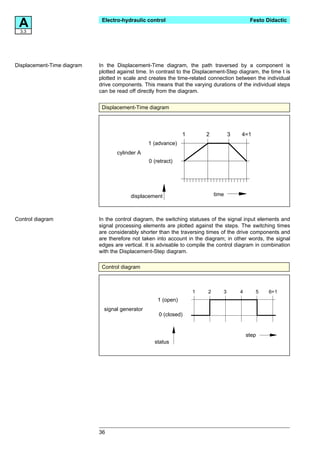
devices are activated. The layout of these circuits and the response charac-
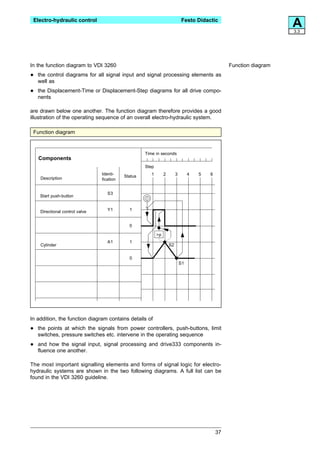
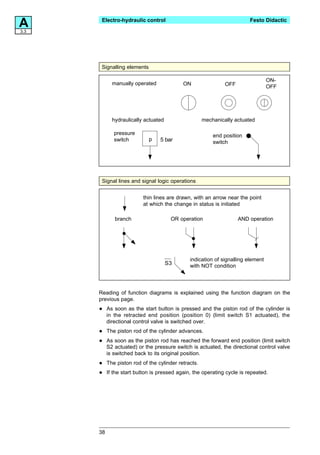
teristics of the overload protection devices can differ considerably. The following
devices are used:

•   fusible links,
•   circuit-breakers,
•   residual current operated circuit-breakers,
•   residual voltage operated circuit-breakers.


 Protection through keeping a safe distance
                                                          5m


            hand range limit
                                                        2.
                                                       R


                  0.75m
                                                               R
                                                               1.
                                                                 25
                                                                   m


                                                                               155
B4.3
                         Safety recommendations                                         Festo Didactic


EMERGENCY STOP switch   In the event of danger, it must be possible to shut down a machine immedi-
                        ately via an EMERGENCY STOP switch to separate all equipment from the
                        mains supply. The following regulations apply to the EMERGENCY STOP cir-
                        cuit:


                           1. Necessary lighting must not be switched off using the
                              EMERGENCY STOP function.

                           2. Clamped workpieces must not be released by actuation of
                              the EMERGENCY STOP function.

                           3. Auxiliary and braking devices designed to peform functions such as
                              rapid shutdown of the machine must not be rendered ineffective.

                           4. Return movements must be initiated by actuation of the
                              EMERGENCY STOP function if this is necessary. They may,
                              however, only be initiated if this does not pose a risk
                              to personnel.

                           5. The identification colour of the EMERGENCY STOP switch is bright
                              red; the area below the manual actuating element must be in the
                              contrasting colour yellow.


                        Further requirements for the EMERGENCY STOP circuit in electrical and hy-
                        draulic systems are contained in DIN 31000.

Master switch           In addition, each machine must be equipped with a master switch via which the
                        entire electrical equipment can be switched off for the duration of cleaning,
                        maintenance and repair work and during lengthy down-times.


                          1. The master switch must be manually operated and may have only one
                             Off and On position with stops identified by 0 and 1.

                          2. In the Off position it should be possible to lock the switch in such a
                             way that manual and remote switch-on are prevented.

                          3. If there are several feed sources, it must be possible to interlock the
                             master switches in such a way that there is no risk or danger.


                        156
Solutions   Festo Didactic
                             C


Part C

Solutions


                       157
C1
                                   Solutions                                                              Festo Didactic


Exercise 1
                                   Hydraulic circuit diagram
Direct
solenoid valve actuation

1. Hydraulic circuit diagram                                                          1.0
                                                                                                                   F


                                                                            1.1        A

                                                                       Y1

                                                                                       P          T


                                                 P                 0.4
                                         0.5
                                                                                            0.2       0.1

                                                                 0.3
                                                 T                                                    M


      Electrical circuit diagram
                                   Electrical circuit diagram


                                                                                  1
                                                           24V
                                                                                  3
                                                                       S0
                                                                                  4               2
                                               220V


                                                     24V                                          3
                                                                                      S1
                                                                                                  4


                                                                                       Y1

                                                           OV


                                   158
Solutions                                                      Festo Didactic
                                                                                                               C1


•    If control switch S1 is actuated when the master switch is on, current flows
     through the solenoid coil. The electromagnet energises, the directional con-
                                                                                     Function description

     trol valve switches over, and the piston rod of the cylinder advances.

•    If the push-button is released, current no longer flows through the solenoid
     coil. The coil is de-energised and the directional control valve switches
     back, and the piston rod of the cylinder retracts due to the weight load.


 Selection table                                                                     2. Selection of the push-button


                       1                      2                        3

    contact    250 V AC 4 A 220 V/110 V AC 1.5/2.5 A             5 A/48 V AC
    rating:    12 V DC 0.2 A 24V/12 V DC 2.25/4.5 A              4 A/30 V DC

    normally
    closed             1                      3                        2
    contact:
    normally
    open               1                      –                        2
    contact:


The power consumption of the solenoid valve is 3 W. At a voltage of 24 V, the
contacts must be able to cope with a load of at least

       31 W
            = 1.3 A
       24 V

As the control operates via a direct voltage supply, the current carrying capacity
for direct voltage (DC) is decisive. This means that push-buttons no. 2 and no. 3
could be used.

As can be seen from the electrical circuit diagram, a normally open contact is
needed for this solution. As push-button no. 2 is not equipped with a normally
open contact, push-button no. 3 is the only suitable device.


                                                                              159
C2
                                Solutions                                                         Festo Didactic


Exercise 2                      Hydraulic circuit diagram

Indirect solenoid valve
actuation

1. Hydraulic circuit diagram                                                                               F


                                                                               A

                                                               Y1

                                                                               P      T


                                             P


                                             T                                              M


                               A one-way flow control valve is fitted to throttle the return stroke speed. It is
                               advisable to install the throttle valve as close as possible to the cylinder, as
                               this prevents oscillation of the piston and thus of the straightening roller. The
                               directional control valve is also a throttle point, although the extent of throttling
                               can be ignored, since the cross section of the directional control valve orifice is
                               considerably greater than that of the one-way flow control valve.


                               160
Solutions                                                          Festo Didactic
                                                                                                                   C   2


 Electrical circuit diagram, indirect actuation                                        2. Electrical circuit diagram


                            1
          24V
                             3
                   S0
                             4            2                   3


                                           3                   13
                                  S1                     K1
                                           4                   14


                                           A1
                                    K1                  Y1
                                           A2
          OV


•   Current path 2 is the control circuit in the signal control section. The control
    circuit contains push-button S1 (normally open contact) and relay K1.

•   Current path 3 is the interface to the power control section and is the main
    circuit (energy circuit).

•   Master switch S0 is assigned to both circuits.


If master switch S0 is already switched on and push-button S1 is pressed,              Function description
relay K1 in current path 2 switches and the contact of K1 in current path 3 is
closed. Solenoid coil Y1 of the 3/2-way solenoid valve switches and the piston
rod of the cylinder advances.

If the push-button is released, the magnetic field of relay K1 decays. Contact
K1 opens again. There is no longer voltage at the solenoid valve. The spring
returns the valve to the normal position. The piston rod retracts due to the
weight of the roller.


                                                                                161
C 3
                                Solutions                                                          Festo Didactic


Exercise 3                      Hydraulic circuit diagram

Boolean
basic logic functions

1. Signal reversal, hydraulic
                                                                                                            F


                                                                        A

                                                             Y1

                                                                        P        T


                                         P


                                         T                                           M


                                Electrical circuit diagram


                                                             1
                                        24V
                                                              3
                                                  S0
                                                              4         2                     3


                                                                            3                 13
                                                                  S1                     K1
                                                                            4                 14


                                                                            A1
                                                                   K1                Y1
                                                                            A2
                                        OV


                                162
Solutions                                                      Festo Didactic
                                                                                                           C
                                                                                                           3


The hydraulic circuit diagram is to be drawn in a position where the hydraulic
assembly is switched on, but where the electrical power supply to the signal
control section is switched off. As signal reversal is to be performed hydrauli-
cally, a valve with throughflow in the normal position is to be selected. In this
position, this valve connects the cylinder chamber to the pressure circuit. The
piston rod of the cylinder is therefore to be drawn in the advanced position.


•   In this circuit an unactuated push-button means: the relay coil does not
    energise, the normally open contact in the main circuit remains open, and
                                                                                    Function description

    the valve is not actuated. Reversal of the signal is achieved using a valve
    with switching positions which are the exact opposite of those in the valve
    in the preceding task definition (throughflow in normal position instead of
    blocked in normal position). This means that the cylinder chamber is sup-
    plied with pressure when the valve is not actuated and that the piston rod
    advances when the hydraulic power supply is switched on.

•   When the push-button is pressed, the valve is supplied with current via the
    relay and switches over. The piston rod retracts.


                                                                             163
C 3
                                 Solutions                                                         Festo Didactic


2. Signal reversal, electrical
                                 Hydraulic circuit diagram


                                                                                                          F


                                                                                 A

                                                                  Y1

                                                                                 P   T


                                               P


                                               T                                              M


                                 Electrical circuit diagram


                                                              1
                                         24V
                                                              3
                                                   S0
                                                              4             2                 3


                                                                            3                     11
                                                                  S1                     K1
                                                                            4                 12


                                                                            A1
                                                                       K1            Y1
                                                                            A2
                                         OV


                                 164
Solutions                                                      Festo Didactic
                                                                                                           C
                                                                                                           3


As previously, the hydraulic circuit diagram is to be drawn in a position where
the electrical power supply is switched off. The valve is therefore not actuated.
The cylinder chamber is connected to the tank; as a result, there is no press-
ure and thus no force acting on the piston. Accordingly, the piston rod is
pushed back into the cylinder by external force. It must therefore be drawn in
the retracted position.


•   As long as push-button S1 is not actuated, no current flows through relay
    coil K1 in the control circuit. The normally closed contact in the control
                                                                                    Function description

    circuit is therefore closed. Current flows through the solenoid and the valve
    is in the actuated position. The piston rod advances or remains in the ad-
    vanced position.

•   If push-button S1 is pressed, relay K1 in the control circuit energises. The
    normally closed contact of K1 interrupts the main circuit. The signal in the
    main circuit is reversed compared to the signal in the control circuit. The
    solenoid coil is de-energised, the valve switches back to the non-actuated
    position, and the piston rod retracts.


                                                                             165
C 4
                                 Solutions                                                         Festo Didactic


Exercise 4                       Hydraulic circuit diagram

Signal reversal

1. Signal reversal, electrical


                                                                                 A   B

                                                                  Y1

                                                                                 P   T


                                               P


                                               T                                              M


                                 Electrical circuit diagram


                                                              1
                                         24V
                                                              3
                                                   S0
                                                              4             2                 3


                                                                            3                     11
                                                                  S1                     K1
                                                                            4                 12


                                                                            A1
                                                                       K1            Y1
                                                                            A2
                                         OV


                                 166
Solutions                                                       Festo Didactic
                                                                                           C
                                                                                           4


As the signal in the hydraulic circuit is not reversed, the valve should be con-
nected in such a way that the piston rod advances in the actuated position.

If the die cushioning cylinder of the press is pushed back, the oil in this circuit
also flows against the pumping direction in the circuit (see Exercise 3). If the
flow rate is too high, the oil cannot be directed away via the pressure relief
                                                                                      C3
valve. In this event, a check valve must be installed to protect the assembly, as
was the case in Exercise 3.

The signal control section fulfils the same functions as the section described in
Exercise 3 and is therefore of identical design.


                                                                               167
C 4
                                Solutions                                                  Festo Didactic


2. Signal reversal, hydraulic   Hydraulic circuit diagram


                                                                            A   B

                                                                 Y1

                                                                            P   T


                                              P


                                              T                                       M


                                Electrical circuit diagram


                                                             1
                                        24V
                                                             3
                                                  S0
                                                             4         2              3


                                                                       3              13
                                                                 S1              K1
                                                                       4              14


                                                                       A1
                                                                  K1            Y1
                                                                       A2
                                        OV


                                168
Solutions                                                        Festo Didactic
                                                                                                                C 4


As the signal in this circuit is hydraulically reversed, the valve should be con-
nected in such a way that the piston rod retracts when the valve is actuated.

For the remainder, the same remarks apply as for electrical signal reversal.


Although the two circuits react in the same way under normal circumstances,          3. Failure of the
they react in different ways to a failure of the supply voltage to the signal           supply voltage
control section:                                                                        to the signal control section

•   the piston rod retracts with electrical signal reversal,

•   and the piston rod advances with hydraulic signal reversal.


                                                                               169
C 5
                                Solutions                                                                                          Festo Didactic


Exercise 5                      Hydraulic circuit diagram

Conjunction
and negation

1. Hydraulic circuit diagram                                                    1.0


                                                                                         1.1         A            B

                                                                                   Y1

                                                                                                      P           T


                                                          P                    0.4
                                           0.5
                                                                                                            0.2           0.1

                                                                             0.3
                                                          T                                                            M


2. Parts list
                                Parts list

                               Item Quan-         Description                           Type and Standard designation              Manufacturer/Supplier
                                    tity

                               0.1     1    Electric motor

                               0.2     1    Hydraulic pump

                               0.3     1    Safety pressure relief valve

                               0.4     1    System pressure relief valve

                               0.5     1    Pressure gauge

                               1.0     1    Hydr. cylinder, double-acting

                               1.1     1    4/2-way solenoid valve


                                                                                                                                       Group   Sheet     of
                                                                     Make                Signed           Purchaser
                                                                                                                                        03       4     Sheets
                                                                                                                                                         4
                                                                                         Date             Order no.

                                                                     Type                Tested                                        Drawing no.


                                                                                                          Sample parts list of a
                                                                     Inventory no.                        hydraulic system

                               No.   Alteration    Date       Name


                               170
Solutions                                                                 Festo Didactic
                                                                                                                        C   5


 Logic function                                                                             3. Truth table and
                                                                                               logic circuit symbol


             truth table                               logic symbol


             S1   S2 K1

              0   0        0                      S1
              0   1        0                                 &             K1
                                                  S2
              1   0        0
              1   1        1


The mould may close only if push-button S1 is pressed and limit switch S2 is
not actuated. Signal K1 may therefore only be set under this condition.


 Electrical circuit diagram                                                                 4. Electrical circuit diagram


                               1
        24V
                               3
                      S0
                               4             2                     3


                                             3                        13
                                   S1                         K1
                                             4                        14
                                                 1
                                        S2
                                             2

                                             A1
                                    K1                       Y1
                                             A2
         OV


To ensure reversal of signal S2, limit switch S2 is to be connected as a
normally closed contact.


                                                                                      171
C6
                               Solutions                                    Festo Didactic


Exercise 6                     Hydraulic circuit diagram

Disjunction

1. Hydraulic circuit diagram


                                                                A   B

                                                           Y1

                                                                P   T


                                            P


                                            T                           M


                               172
Solutions                                                                                 Festo Didactic
                                                                                                                                          C 6


 Electrical circuit diagram                                                                                    2. Electrical circuit diagrams

                                                                                                               Circuit 1
                           1
       24V
                            3
                  S0
                            4              2                   3                  4


                                            3                  3                      13
                                 S1                  S2                      K1
                                            4                  4                      14


                                            A1
                                  K1                                     Y1
                                            A2
        OV


                                                                                                               Circuit 2
 Electrical circuit diagram


                       1
     24V
                       3
             S0
                       4              2                   3              4                      5


                                      3                   3               13                        13
                           S1              S2                       K1                     K1
                                      4                   4               14                        14


                                      A1                  A1
                            K1                  K2                 Y1
                                      A2                  A2
      OV


In both circuits the valve coil Y1 energises if either manual push-button S1,
foot-operated button S2 or both buttons are pressed.

The second circuit has the advantage that push-button S1 only acts on coil K1,
and push-button S2 only on coil K2. This makes it possible to realise additional
functions:

•   further contacts of K1 can be used to switch the current paths which are
    designed to react only to the manual push-button (e.g. warning light for
    manual push-button).

•   further contacts of K2, on the other hand, switch the current paths which are
    supposed to react only in dependence on S2 (e.g. warning light for foot-oper-
    ated button).


                                                                                                         173
C7
                               Solutions                                Festo Didactic


Exercise 7                     Hydraulic circuit diagram

Assembly line

1. Hydraulic circuit diagram


                                                                A   B

                                                           Y1

                                                                P   T


                                                P


                                               T


                               174
Solutions                                                                                                   Festo Didactic
                                                                                                                                                             C7


 Electrical circuit diagram, two control switches with changeover contacts                                                       2. Electrical circuit diagram,
                                                                                                                                    two-way circuit
                                                                                                                                    with changeover contacts
                                   1
         24V
                                    3
                       S0
                                    4                      2                                        3


                                                           1                                        13
                                              S1                                       K1
                                                       2            4                               14
                                                       4            2
                                              S2
                                                           1
                                                           A1
                                               K1                                     Y1
                                                           A2
         OV


 Electrical circuit diagram, two control switches with normally open contacts                                                    3. Electrical circuit diagram,
                                                                                                                                    two-way circuit
                                                                                                                                    with normally open contacts
               1
   24V
                   3
         S0
                   4          2                3                        4                       5                 6


                               3                   3                             11             23                    13
                   S1               S2                          K1                     K1                    K3
                               4                   4                        12                  24                    14
                                                                            13                          21
                                                                K2                         K2
                                                                            14                      22
                               A1                  A1                       A1
                        K1               K2                    K3                                        Y1
                               A2                  A2                       A2
    OV


                             4 5               5 4                          6


Solenoid valve coil Y1 may be installed in current path 4 in place of relay K3.
Relay K3 and current path 6 are then no longer necessary.


                                                                                                                           175
C8
                                Solutions                                                      Festo Didactic


Exercise 8                      Hydraulic circuit diagram

Clamping device

1. Hydraulic circuit diagram


                                                                              A     B


                                                               Y1                         Y2
                                                                              P     T


                                              P


                                              T                                           M


                               Speed throttling only takes place during advance of the piston rod. During re-
                               traction, the throttle is bridged by the non-return valve. The one-way flow con-
                               trol valve can be installed in two places:

                               •   either as shown in the above circuit diagram,

                               •   or in the line between valve port B and the cylinder chamber on the piston
                                   rod side.


                               176
Solutions                                                                         Festo Didactic
                                                                                                                               C   8


Electrical circuit diagram                                                                         2. Electrical circuit diagram


                   1
       24V
                       3
             S0
                       4           2              3                4          5


                                        11              11         23             23
                       S2                                     K1         K2
                                   12              12              24             24
                                   13              13
                       S1
                                    14             14
                                      11             11
                                 K2
                                    12             12
                                    A1             A1
                            K1               K2              Y1         Y2
                                    A2             A2
        OV


                                  3 4             2 5


•   Pressing push-button S1 energises relay K1. The piston rod advances.                           Function description

•   If push-button S2 is pressed, relay K2 energises. The piston rod retracts.

•   If both push-buttons are pressed one after the other, the relay which was
    switched first de-energises, but the other relay is not switched. Both relays
    are thus in the de-energised state, and the double solenoid valve remains in
    the switching position it adopted first.


                                                                                             177
C9
                                Solutions                                                       Festo Didactic


Exercise 9                      Hydraulic circuit diagram

Clamping device with
latching

1. Hydraulic circuit diagram


                                                                          A


                                                                          P

                                                                                    A      B

                                                                     Y1

                                                                                    P      T


                                                   P


                                                   T                                             M


                               The pressure relief valve can be installed either between directional control
                               valve and cylinder (see illustration) or between assembly and directional control
                               valve.

                               •   If the pressure regulator is between directional control valve and cylinder, a
                                   non-return valve must be parallel-connected to allow retraction of the piston
                                   rod. During the retraction motion, the annular piston surface is subjected to
                                   the full system pressure.

                               •   If the pressure regulator is between assembly and directional control valve,
                                   a non-return valve is not required. With this circuit design, it should be
                                   noted that the pressure is also reduced during the return stroke. The force
                                   of the retracting cylinder is therefore less than in the first circuit arrange-
                                   ment.


                               178
Solutions                                                         Festo Didactic
                                                                                                               C9


Electrical circuit diagram                                                         2. Electrical circuit diagram,
                                                                                      dominant resetting
                                                                                      latching circuit

                     1
       24V
                      3
             S0
                      4           2            3             4


                                  3            13            23
                          S1              K1            K1
                                  4            14            24


                          S2          1
                                  2
                                  A1
                             K1                      Y1
                                  A2
        OV


•   Latching is set by pressing push-button S1; the valve switches to the actu-
    ated position. The piston rod advances.
                                                                                   Function description


•   Pressing push-button S2 releases latching and the valve switches to the
    non-actuated position. The piston rod retracts.

•   If both push-buttons (S1 and S2) are pressed, the output receives no signal
    – and latching is not set.

Logic diagram                                                                      3. Logic diagram


             S1
                                      1
                                                    &                 K1
             S2


                                                                             179
C10
                                Solutions                                                           Festo Didactic


Exercise 10                     Hydraulic circuit diagram

Reaming device
                                                                                       S1            S2

1. Hydraulic circuit diagram                                                                F


                                                                             A     B

                                                                 Y1

                                                                             P     T


                                                    P


                                                   T                                            M


                               In this exercise, the machining speed is to be precisely maintained even under
                               varying loads. This requires the use of a flow regulator.

                               The flow regulator regulates the flow in one flow direction only. To render it
                               effective for both directions, it must be installed between directional control
                               valve and hydraulic assembly.
                               The back-pressure valve is bridged by a non-return valve during the return
                               stroke.


                               180
Solutions                                                            Festo Didactic
                                                                                                                   C
                                                                                                                   10


 Electrical circuit diagram                                                            2. Electrical circuit diagram


                     1
      24V
                      3
             S0
                      4              2                3          4


                                     3                13         23
                          S3                     K1         K1
                                     4                14         24
                                             1
                           S1
                                         2


                                             1
                                S2
                                     2
                                     A1
                           K1                              Y1
                                     A2
       OV


                                         3
                                         4


To allow generation of the latching function, limit switch S2 is connected as a
normally closed contact. Limit switch S1 is connected as a normally open con-
tact. An actuated normally open contact is shown in the circuit diagram as a
normally closed contact with an arrow. In addition, the contacts are identified
by numbers according to standard. This provides a further indication of how the
limit switch is connected.


                                                                                 181
C11
                          Solutions                                                                         Festo Didactic


Exercise 11               Function diagram

Pressing device
                                                                                  Time in seconds
1. Function diagram for           Components
   the hydraulic press                                                            Step

                                                              Identi-               1         2        3        4   5   6
                                  Designation                            Status
                                                              fication

                                  Master switch                 S0


                                  Start push-button             S3


                                  Directional control valve     Y1         1


                                                                           0

                                                                                         >p
                                  Cylinder                      A1         1
                                                                                                  S2


                                                                           0
                                                                                                           S1


                          •   Step 1:
                              The directional control valve is switched into the actuated position when the
                              following conditions are met:

                              •    the master switch is switched on,
                              •    the piston rod is in the retracted position
                              •    and the start push-button is pressed.


                          •   Step 2:
                              If the actual pressure exceeds the set limit pressure, or if the piston rod
                              reaches the forward end position, the valve is reversed. The piston rod
                              retracts.


                          •   End of cycle:
                              The cycle is complete when the piston rod reaches the retracted end posi-
                              tion.


                          182
Solutions                                                       Festo Didactic
                                                                                                            C11


 Hydraulic circuit diagram                                                        2. Hydraulic circuit diagram

                                                        S1         S2
                                        2:1


                  B1


      40bar                                         P

                                        A

                                                    T

                                                     20bar
                                        P


                                               A    B

                                   Y1


                                               P    T


                       P


         60bar
                       T                                     M


The pressure switch must be installed between throttle valve and cylinder.
Pressure gauges are to be installed for adjustment of the pressure switch and
the counter-pressure valve.

The maximum pressure is 60 bar, and thus far lower than with outflow throt-       3. Maximum pressure
tling. The hydraulic components need only be designed for operation with
pressures up to 60 bar.

If 20 bar is set at the counter-pressure valve, only 10 bar (not taking into      4. Adjustment of the
account the friction in the cylinder) are needed to overcome this resistance on      pressure switch
the piston side on account of the surface ratio.


                                                                            183
C11
                                 Solutions                                                                                                                             Festo Didactic


                                The following pressure is additionally required for pressing operations:

                                            FP   6000 N            N
                                               =           = 3.06     = 30.6 bar
                                            A π ⋅ (25 mm)2        mm2

                                The pressure switch should therefore be set to:

                                            10 bar + 30.6 bar = 40.6 bar ≅ 40 bar


5. Electrical circuit diagram    Electrical circuit diagram


                                                      1
                                      24V

                                                          3
                                            S0                                                                                                                                            10
                                                          4    2              3              4                  5              6             7              8              9


                                                                                                      B1
                                                                                  13              3                                13            33                            13              23
                                                 S3                                                   >p                                              S2              K4
                                                                         K1             S1                                K3            K3                                           K1
                                                                                  14             4                                 14            34                            14          24
                                                                   13
                                                          K2
                                                                   14
                                                                    21                                                21                                         31
                                                          K3                                               K4                                          K2
                                                                   22                                               22                                          32
                                                                    31                                                3
                                                          K4                                          S4
                                                                   32                                               4
                                                                   A1                            A1                 A1                                          A1
                                                  K1                                   K2              K3                                             K4                            Y1
                                                                   A2                            A2                 A2                                          A2
                                     0V


                                                                   3                         8 2                2 6                                        2 9
                                                                   10                                             7                                        5


                                             S0    =                    master switch                           S4 = acknowledgement push-button
                                             S1/S2 =                    limit switch                            B1 = pressure switch
                                             S3    =                    start push-button


                                Relay positions:

                                K1   energised:                     directional control valve is switched, piston rod advances
                                K2   energised:                     piston in retracted end position
                                K3   energised:                     overpressure
                                K4   energised:                     piston rod retracts


                                184
Solutions                                                      Festo Didactic
                                                                                                               C
                                                                                                               11


Normal movement:                                                                     6. Function description
when start push-button S3 is pressed, the piston rod advances up to limit
switch S2. K4 energises and reverts to latching. The normally closed contact of
K4 in current path 2 releases the latching of relay K1.


Malfunction:
if the pressure exceeds 40 bar when the piston rod advances, pressure switch
B1 switches relay K3 to latching. The first contact of K3 releases the latching
of relay K1 in current path 2. The piston rod retracts. The second contact
closes current path 7, and the optical indicator lights up. Acknowledgement
push-button S4 releases the latching of relay K3. The light goes out and start-
up can be effected.

The actual pressure should not exceed the maximum pressure during retrac-
tion of the piston rod. The pressure switch must therefore be rendered inopera-
tive during retraction. To this end, the contact of K4 blocks current path 5 until
the piston rod is in its starting position. Limit switch S1 is actuated and relay
K2 releases the latching of K4.

A further contact of K2 is located in current path 2. This means that the press-
ing process cannot begin until the piston rod is retracted – only then are the
start conditions fulfilled.


                                                                              185
C12
                               Solutions                                                 Festo Didactic


Exercise 12                    Hydraulic circuit diagram

Milling machine
                                                                            S1            S2

1. Hydraulic circuit diagram                                                     F


                                                                        P

                                                                A

                                                                        T


                                                                P


                                                                    A   B


                                                           Y1                            Y2
                                                                    P   T


                                                   P


                                                   T                                 M


                               186
Solutions                                                                                         Festo Didactic
                                                                                                                                            C12


 Electrical circuit diagram                                                                                         2. Switchover from automatic
                                                                                                                       to manual operation via
                                                                                                                       control switch
                  1
     24V
                      3
            S0        4                                                                  8

                                                                                             1           10
                                                                                 S4
                          2    3         4             5         6          7 AUTO-MAN   24        9

                                                                                                        S5
                         3    13             3          1        23         23                     33    3
                 S3      4 K1    S1               S2        K3         K1
                                                        2        24         24                   K3 34   4
                         13   14             4
                      K2 14                                                                          MAN


                          11                                21
                      K3 12                       K2
                                                        22

                  K1               K2            K3                   Y1                 Y2

      0V


                          3             5 2           2 6
                          7                             9


           S0    =        master switch                S4 = selector automatic/manual operation
           S1/S2 =        limit switch                 S5 = push-button for return stroke
           S3    =        start push-button


Automatic operation:

relay K1 energised: piston rod advances
relay K2 energised: piston rod in retracted end position
relay K3 energised: piston rod retracts

Manual operation:

after switchover of S4 to manual operation, the piston rod retracts as long as
push-button S5 is held down.


                                                                                                              187
C12
                                Solutions                                                                                                      Festo Didactic


3. Switchover from automatic    Electrical circuit diagram
   to manual operation via
   push-button                                       1
                                       24V

                                                         3
                                             S0          4 2             3     4                                                                               12

                                                  AUTO                             23
                                                               3          13
                                                                                                                                                          K1
                                                    S4
                                                               4       K1 14 K1 24
                                                                                         5        6          7             8         9    10        11

                                                                                                                           3         23 23                S6    3
                                                                                         3         13            1                                   33
                                                                              S3                        S1            S2        K4    K2
                                                                                         4    K2                 2                       24     K4 34    4
                                                                                                   14                      4         24
                                                                                                                                                     MAN
                                                                                         13
                                                                                    K3
                                                                                         14


                                              AUTO                 1                         11                                21
                                               AUS
                                                   S5                               K4                                K3
                                                               2                         12                                22

                                                     K1                         K2                    K3             K4              Y1        Y2

                                       0V


                                                             12 3                        6                 8 5            5 9
                                                                4                        10                                 11


                                              S0    =               master switch                          S4 = push-button automatic operation
                                              S1/S2 =               limit switch                           S5 = push-button manual operation
                                              S3    =               start push-button                      S6 = push-button for return stroke


                               Automatic operation:

                               relay   K1    energised:                automatic operation
                               relay   K2    energised:                piston rod advances
                               relay   K3    energised:                piston in retracted end position
                               relay   K4    energised:                piston rod retracts

                               Manual operation:

                               pressing push-button S5 releases the latching of relay K1. This causes nor-
                               mally closed contact K1 in current path 12 to close; the piston rod retracts as
                               long as push-button S6 is held down.


                               188
Appendix   Festo Didactic


Appendix


                      189
Appendix   Festo Didactic


190
Standards for electro-hydraulic systems   Festo Didactic


Standards for
electro-hydraulic systems


                                                     191
Standards for electro-hydraulic systems                         Festo Didactic


Standards for      ZH         1/74          Safety regulations for hydraulic lines
fluid technology

                   TRB        600           Installation of pressure vessels:
                                            Safety requirements

                   TRB        700           Operation of pressure vessels:
                                            Safety requirements

                   DIN ISO    1219          Fluid-power systems and equipment:
                                            Circuit symbols

                   VDI        3260          Function diagrams for machinery
                                            and production plant

                   DIN ISO    3320          Fluid power technology — Hydraulic:
                                            Cylinder bores and piston
                                            rod diameters

                   DIN ISO    3322          Fluid power technology — Hydraulic:
                                            Nominal pressures for cylinders

                   VDMA       24 317        Fluid power technology — Hydraulic:
                                            Slow-burning hydraulic fluids
                                            Guidelines

                   DIN        24 346        Fluid power technology — Hydraulic:
                                            Hydraulic systems
                                            Fundamentals of design

                   DIN        24 347        Fluid power technology — Hydraulic:
                                            Circuit diagrams

                   DIN        24 552        Hydraulic reservoirs:
                                            General requirements

                   DIN        51 524        Pressure fluids:
                                            Hydraulic oil

                   DIN        51 561        Testing of mineral oils, liquid fuels
                                            and allied fluids

                   DIN        51 562        Viscometers
                              Parts 1 - 3   Measurement of kinematic viscosity
                                            using the Ubbelohde viscometer


                   192
Standards for electro-hydraulic systems                       Festo Didactic


DIN VDE    0100          Installation of power systems up to 1000 V               Standards for electrical
                                                                                  engineering

EN         60204         Electrical equipment of
DIN VDE    0113          industrial machinery

IEC        144           Specification for the protection classes of enclosures for
                         switching and control equipment for voltages up to and
                         including 1000 V AC and 1200 V DC

DIN        2909          Round fasteners:
           Part 1        Summary

DIN        2909          Round fasteners:
           Part 2        Individual parts

DIN        19 226        Closed and open-loop control technology:
                         Terms and designations

DIN        19 237        Measuring, controlling, regulating:
                         Control technology, terms

DIN        19 250        Basic safety considerations for
                         measuring, controlling and regulating protective devices

DIN        31 000        General guidelines regarding safe
(VDE       1000)         construction of technical products

DIN        40 050        IP protection classes:
                         Protection against shock, foreign matter and water
                         for electrical equipment

DIN        40 713        Circuit symbols

DIN        40 719        Circuit documentation:
           Part 2        Designation of electrical equipment

DIN        40 719        Circuit documentation:
           Part 3        Rules for circuit diagrams in electro-technology

DIN        40 719        Circuit documentation:
           Part 9        Design of connection diagrams

DIN        40 900        Graphic symbols for circuit documentation
           Part 7        (Symbols for switching and protective equipment)


                                                                            193
Standards for electro-hydraulic systems                    Festo Didactic


DIN       41 488        Electro-technology
          Parts 1 - 3   Compartment measurements for control cabinets

DIN       41 494        Construction of electronic equipment
          Parts 1 - 8

DIN       43 650        Plug connectors, square design
          Part 1        Types, dimensions, designation system

DIN       43 650        Plug connectors, square design
          Part 2        Characteristics, requirements, testing

DIN       43 880        Installation equipment
                        Overall dimensions and related
                        installation dimensions

DIN EN    50 005        Industrial low-voltage switchgear
                        Terminal designations and code numbers,
                        General rules

DIN EN    50 011        Industrial low-voltage switchgear
                        Terminal designations, code numbers and
                        letters for specific auxiliary contactors

DIN EN    50 012        Industrial low-voltage switchgear
                        Terminal designations and code numbers for
                        auxiliary contacts of specific contactors

DIN EN    50 013        Industrial low-voltage switchgear
                        Terminal designations and code numbers
                        for specific control devices

DIN EN    50 022-35     Industrial low-voltage switchgear
                        Terminal designations and code numbers


194
Index   Festo Didactic


Index


                   195
Index                                                                                         Festo Didactic


A
AC solenoid . . . . . . . . . . . . . . . . . . . . . . . . . . . . . . . . . . . . . . . . . . . . . . . . . 141
Actuated position
    directional control valve . . . . . . . . . . . . . . . . . . . . . . . . . . . . . . . . . . . . . . . 46
Actuation modes, directional control valves . . . . . . . . . . . . . . . . . . . . . . . . . . 16
Air-core reactor . . . . . . . . . . . . . . . . . . . . . . . . . . . . . . . . . . . . . . . . . . . . . . . 122
Alternating current . . . . . . . . . . . . . . . . . . . . . . . . . . . . . . . . . . . . . . . . . . . . 118
Ammeter . . . . . . . . . . . . . . . . . . . . . . . . . . . . . . . . . . . . . . . . . . . . . . . . . . . . 126
    internal resistance . . . . . . . . . . . . . . . . . . . . . . . . . . . . . . . . . . . . . . . . . . 126
AND operation . . . . . . . . . . . . . . . . . . . . . . . . . . . . . . . . . . . . . . . . . . . . . . . . 73
Arcing . . . . . . . . . . . . . . . . . . . . . . . . . . . . . . . . . . . . . . . . . . . . . . . . . . . . . . 141
Auxiliary contacts . . . . . . . . . . . . . . . . . . . . . . . . . . . . . . . . . . . . . . . . . . . . . 139


B
Boolean basic logic functions . . . . . . . . . . . . . . . . . . . . . . . . . . . . . . . . . . 54, 72
Bridge circuit . . . . . . . . . . . . . . . . . . . . . . . . . . . . . . . . . . . . . . . . . . . . . . . . . 121
Bypass circuit . . . . . . . . . . . . . . . . . . . . . . . . . . . . . . . . . . . . . . . . . . . . . . . . . 96


C
Capacitance . . . . . . . . . . . . . . . . . . . . . . . . . . . . . . . . . . . . . . . . . . . . . . . . . 123
Capacitive effect . . . . . . . . . . . . . . . . . . . . . . . . . . . . . . . . . . . . . . . . . . . . . . 132
Capacitive proximity sensor . . . . . . . . . . . . . . . . . . . . . . . . . . . . . . . . . . . . . 135
Capacitor . . . . . . . . . . . . . . . . . . . . . . . . . . . . . . . . . . . . . . . . . . . . . . . 123, 144
Changeover contact . . . . . . . . . . . . . . . . . . . . . . . . . . . . . . . . . . . . . . . . 47, 130
Charge capacitor . . . . . . . . . . . . . . . . . . . . . . . . . . . . . . . . . . . . . . . . . . . . . 121
Charging current . . . . . . . . . . . . . . . . . . . . . . . . . . . . . . . . . . . . . . . . . . . . . . 123
Check valve . . . . . . . . . . . . . . . . . . . . . . . . . . . . . . . . . . . . . . . . . . . . . . . . . . 19
Circuit . . . . . . . . . . . . . . . . . . . . . . . . . . . . . . . . . . . . . . . . . . . . . . . . . . . . . . 144
Circuit diagram, electrical
   connection designations for switching elements . . . . . . . . . . . . . . . . . . . . 32
   current path direction . . . . . . . . . . . . . . . . . . . . . . . . . . . . . . . . . . . . . . . . 33
   function digit . . . . . . . . . . . . . . . . . . . . . . . . . . . . . . . . . . . . . . . . . . . . . . . 32
   ordinal number . . . . . . . . . . . . . . . . . . . . . . . . . . . . . . . . . . . . . . . . . . . . . 32
   relay terminal designations . . . . . . . . . . . . . . . . . . . . . . . . . . . . . . . . . . . . 32
   switching element table . . . . . . . . . . . . . . . . . . . . . . . . . . . . . . . . . . . . . . . 35
Circuit diagram, hydraulic . . . . . . . . . . . . . . . . . . . . . . . . . . . . . . . . . . . . . . . . 28
   designation of components . . . . . . . . . . . . . . . . . . . . . . . . . . . . . . . . . . . . 30
   distinctive number . . . . . . . . . . . . . . . . . . . . . . . . . . . . . . . . . . . . . . . . . . . 30
   energy flow . . . . . . . . . . . . . . . . . . . . . . . . . . . . . . . . . . . . . . . . . . . . . . . . 28
   equipment numbering . . . . . . . . . . . . . . . . . . . . . . . . . . . . . . . . . . . . . . . . 30
   group assignment . . . . . . . . . . . . . . . . . . . . . . . . . . . . . . . . . . . . . . . . . . . 30
   ordinal number . . . . . . . . . . . . . . . . . . . . . . . . . . . . . . . . . . . . . . . . . . . . . 30
Coil with iron core . . . . . . . . . . . . . . . . . . . . . . . . . . . . . . . . . . . . . . . . . . . . . 122
Conjunction . . . . . . . . . . . . . . . . . . . . . . . . . . . . . . . . . . . . . . . . . . . . . . . . . . . 72
Contact erosion . . . . . . . . . . . . . . . . . . . . . . . . . . . . . . . . . . . . . . . . . . . . . . . 49
Contactor . . . . . . . . . . . . . . . . . . . . . . . . . . . . . . . . . . . . . . . . . . . . . . 137 – 139
Contacts . . . . . . . . . . . . . . . . . . . . . . . . . . . . . . . . . . . . . . . . . . . . . . . . . . . . . 47


196
Index                                                                                         Festo Didactic


Control cabinet . . . . . . . . . . . . . . . . . . . . . . . . . . . . . . . . . . . . . . . . . . . . . . . . 145
Control diagram . . . . . . . . . . . . . . . . . . . . . . . . . . . . . . . . . . . . . . . . . . . . . . . . 36
Control loop system . . . . . . . . . . . . . . . . . . . . . . . . . . . . . . . . . . . . . . . . . . . . . 29
Control switch . . . . . . . . . . . . . . . . . . . . . . . . . . . . . . . . . . . . . . . . . . 47, 110, 129
Counter-pressure valve . . . . . . . . . . . . . . . . . . . . . . . . . . . . . . . . . . . . . . . . . . 98
Current measurement . . . . . . . . . . . . . . . . . . . . . . . . . . . . . . . . . . . . . . . . . . . 126
Current strength . . . . . . . . . . . . . . . . . . . . . . . . . . . . . . . . . . . . . . . . . . . 118, 120
Cylinder . . . . . . . . . . . . . . . . . . . . . . . . . . . . . . . . . . . . . . . . . . . . . . . . . . . . . . . 20
   differential . . . . . . . . . . . . . . . . . . . . . . . . . . . . . . . . . . . . . . . . . . . . . . . . . . 20
   double-acting . . . . . . . . . . . . . . . . . . . . . . . . . . . . . . . . . . . . . . . . . . . . . . . . 20
   end position cushioning . . . . . . . . . . . . . . . . . . . . . . . . . . . . . . . . . . . . . . . . 21
   single-acting . . . . . . . . . . . . . . . . . . . . . . . . . . . . . . . . . . . . . . . . . . . . . . 20, 46
   synchronous . . . . . . . . . . . . . . . . . . . . . . . . . . . . . . . . . . . . . . . . . . . . . 20, 96
   telescopic, double-acting . . . . . . . . . . . . . . . . . . . . . . . . . . . . . . . . . . . . . . . 21
   telescopic, single-acting . . . . . . . . . . . . . . . . . . . . . . . . . . . . . . . . . . . . . . . 20


D
DC current circuit . . . . . . . . . . . . . . . . . . . . . . . . . . . . . . . . . . . . . . . . . . . . . . 119
DC solenoid . . . . . . . . . . . . . . . . . . . . . . . . . . . . . . . . . . . . . . . . . . . . . . . . . . . 65
    stroke-force characteristic . . . . . . . . . . . . . . . . . . . . . . . . . . . . . . . . . . . . . 140
Differential circuit . . . . . . . . . . . . . . . . . . . . . . . . . . . . . . . . . . . . . . . . . . . . . . . 96
Diffuse sensor . . . . . . . . . . . . . . . . . . . . . . . . . . . . . . . . . . . . . . . . . . . . . . . . . 136
Diode . . . . . . . . . . . . . . . . . . . . . . . . . . . . . . . . . . . . . . . . . . . . . . . . . . . . 121, 144
Direct current . . . . . . . . . . . . . . . . . . . . . . . . . . . . . . . . . . . . . . . . . . . . . . . . . 118
Direction of flow . . . . . . . . . . . . . . . . . . . . . . . . . . . . . . . . . . . . . . . . . . . . 14 – 15
Directional control valve
    3/2-way valve . . . . . . . . . . . . . . . . . . . . . . . . . . . . . . . . . . . . . . . . . . . . . . . . 46
    4/2-way solenoid valve . . . . . . . . . . . . . . . . . . . . . . . . . . . . . . . . . . . . . . . . 65
    4/3-way solenoid valve . . . . . . . . . . . . . . . . . . . . . . . . . . . . . . . . . . . . . . . 108
    actuation . . . . . . . . . . . . . . . . . . . . . . . . . . . . . . . . . . . . . . . . . . . . . . . . . . . 16
    symbol . . . . . . . . . . . . . . . . . . . . . . . . . . . . . . . . . . . . . . . . . . . . . . . . . . . . . 15
Disjunction . . . . . . . . . . . . . . . . . . . . . . . . . . . . . . . . . . . . . . . . . . . . . . . . . 72, 77
Displacement control . . . . . . . . . . . . . . . . . . . . . . . . . . . . . . . . . . . . . . . . . . . . 95
Displacement-Step diagram . . . . . . . . . . . . . . . . . . . . . . . . . . . . . . . . . . . . . . . 35
Displacement-Time diagram . . . . . . . . . . . . . . . . . . . . . . . . . . . . . . . . . . . . . . . 36
Double non-return valve, symbol . . . . . . . . . . . . . . . . . . . . . . . . . . . . . . . . . . . 23
Double solenoid valve . . . . . . . . . . . . . . . . . . . . . . . . . . . . . . . . . . . . . . . . . . . 87
Drive section . . . . . . . . . . . . . . . . . . . . . . . . . . . . . . . . . . . . . . . . . . . . . . . . . . 115


                                                                                                                   197
Index                                                                                        Festo Didactic


E
Electrical conductor
   conductor material . . . . . . . . . . . . . . . . . . . . . . . . . . . . . . . . . . . . . . . . . . 119
Electric current
   effect on the human body . . . . . . . . . . . . . . . . . . . . . . . . . . . . . . . . . . . . 152
Electrical input elements . . . . . . . . . . . . . . . . . . . . . . . . . . . . . . . . . . . . . . . 129
Electrical resistance . . . . . . . . . . . . . . . . . . . . . . . . . . . . . . . . . . . . . . . . . . . 119
Electro-hydraulic system
   construction . . . . . . . . . . . . . . . . . . . . . . . . . . . . . . . . . . . . . . . . . . . . . 39, 41
   repair and maintenance . . . . . . . . . . . . . . . . . . . . . . . . . . . . . . . . . . . . . 151
   startup . . . . . . . . . . . . . . . . . . . . . . . . . . . . . . . . . . . . . . . . . . . . . . . . . . . 151
Electro-hydraulics
   advantages . . . . . . . . . . . . . . . . . . . . . . . . . . . . . . . . . . . . . . . . . . . . . . . . 10
   field of application . . . . . . . . . . . . . . . . . . . . . . . . . . . . . . . . . . . . . . . . . . . 10
Electromagnetic switches . . . . . . . . . . . . . . . . . . . . . . . . . . . . . . . . . . . . . . . . 51
Electromagnetism . . . . . . . . . . . . . . . . . . . . . . . . . . . . . . . . . . . . . . . . . . . . . 122
EMERGENCY STOP switch . . . . . . . . . . . . . . . . . . . . . . . . . . . . . . . . . . . . 156
End position cushioning
   adjustable . . . . . . . . . . . . . . . . . . . . . . . . . . . . . . . . . . . . . . . . . . . . . . 21, 77
   both ends . . . . . . . . . . . . . . . . . . . . . . . . . . . . . . . . . . . . . . . . . . . . 21, 78, 82
   one end . . . . . . . . . . . . . . . . . . . . . . . . . . . . . . . . . . . . . . . . . . . . . . . . . . . 21
Energy conversion . . . . . . . . . . . . . . . . . . . . . . . . . . . . . . . . . . . . . . . . . . . . 114
Energy transfer symbols . . . . . . . . . . . . . . . . . . . . . . . . . . . . . . . . . . . . . . . . . 22
Exclusive OR . . . . . . . . . . . . . . . . . . . . . . . . . . . . . . . . . . . . . . . . . . . . . 81 – 83


F
Flow control . . . . . . . . . . . . . . . . . . . . . . . . . . . . . . . . . . . . . . . . . . . . . . . . . . 95
Flow control valve . . . . . . . . . . . . . . . . . . . . . . . . . . . . . . . . . . . . . . . 18, 97, 103
Flow regulator . . . . . . . . . . . . . . . . . . . . . . . . . . . . . . . . . . . . . . . . . . . . . . 18, 97
Flow valve . . . . . . . . . . . . . . . . . . . . . . . . . . . . . . . . . . . . . . . . . . . . . . . . . . . . 18
   adjustable . . . . . . . . . . . . . . . . . . . . . . . . . . . . . . . . . . . . . . . . . . . . . . . . . 18
Function diagram . . . . . . . . . . . . . . . . . . . . . . . . . . . . . . . . . . . . . . . . . . . . . . 35


G
Graetz circuit . . . . . . . . . . . . . . . . . . . . . . . . . . . . . . . . . . . . . . . . . . . . . . . . 121


H
Hazard zones, AC and DC current . . . . . . . . . . . . . . . . . . . . . . . . . . . . . . . 152
Hydraulic power pack . . . . . . . . . . . . . . . . . . . . . . . . . . . . . . . . . . . . . . . . . . . 44
  symbol . . . . . . . . . . . . . . . . . . . . . . . . . . . . . . . . . . . . . . . . . . . . . . . . . . . . 23
Hydraulic motor, symbol . . . . . . . . . . . . . . . . . . . . . . . . . . . . . . . . . . . . . . . . . 14
Hydro pump, symbol . . . . . . . . . . . . . . . . . . . . . . . . . . . . . . . . . . . . . . . . . . . 14


198
Index                                                                                      Festo Didactic


I
Identity . . . . . . . . . . . . . . . . . . . . . . . . . . . . . . . . . . . . . . . . . . . . . . . . . . . . . . . 72
Inductive proximity sensor . . . . . . . . . . . . . . . . . . . . . . . . . . . . . . . . . . . . . . . 134
Insulation . . . . . . . . . . . . . . . . . . . . . . . . . . . . . . . . . . . . . . . . . . . . . . . . . . . . . 154
Interface . . . . . . . . . . . . . . . . . . . . . . . . . . . . . . . . . . . . . . . . . . . . . . . . . . 33, 115
Interlock, electrical . . . . . . . . . . . . . . . . . . . . . . . . . . . . . . . . . . . . . . . . . . 87, 108
Internal resistance
    ammeter . . . . . . . . . . . . . . . . . . . . . . . . . . . . . . . . . . . . . . . . . . . . . . . . . . . 153
    voltmeter . . . . . . . . . . . . . . . . . . . . . . . . . . . . . . . . . . . . . . . . . . . . . . . . . . 125
Internal resistance of the human body . . . . . . . . . . . . . . . . . . . . . . . . . . . . . . 153
Isolating transformer . . . . . . . . . . . . . . . . . . . . . . . . . . . . . . . . . . . . . . . . . . . . 154


L
Latching . . . . . . . . . . . . . . . . . . . . . . . . . . . . . . . . . . . . . . . . . . . . . . . . . . 92, 108
   dominant setting . . . . . . . . . . . . . . . . . . . . . . . . . . . . . . . . . . . . . . . . . . . . . 92
   domininant resetting . . . . . . . . . . . . . . . . . . . . . . . . . . . . . . . . . . . . . . . . . . 92
Limit switch . . . . . . . . . . . . . . . . . . . . . . . . . . . . . . . . . . . . . . . . . . . . . . . . 98, 131
Line sockets . . . . . . . . . . . . . . . . . . . . . . . . . . . . . . . . . . . . . . . . . . . . . 142 – 143
Logic operations/functions . . . . . . . . . . . . . . . . . . . . . . . . . . . . . . . . . . . . . . . . 72


M
Magnet field . . . . . . . . . . . . . . . . . . . . . . . . . . . . . . . . . . . . . . . . . . . . . . . . . . 122
Main contact elements . . . . . . . . . . . . . . . . . . . . . . . . . . . . . . . . . . . . . . . . . . 139
Maintenance . . . . . . . . . . . . . . . . . . . . . . . . . . . . . . . . . . . . . . . . . . . . . . . . . . 151
Master switch . . . . . . . . . . . . . . . . . . . . . . . . . . . . . . . . . . . . . . . . . . . . . . 47, 156
Measurements in a circuit . . . . . . . . . . . . . . . . . . . . . . . . . . . . . . . . . . . . . . . 124
Measuring instrument
  indicating error . . . . . . . . . . . . . . . . . . . . . . . . . . . . . . . . . . . . . . . . . . . . . . 124
  symbols . . . . . . . . . . . . . . . . . . . . . . . . . . . . . . . . . . . . . . . . . . . . . . . . . . . . 23
Measuring rules . . . . . . . . . . . . . . . . . . . . . . . . . . . . . . . . . . . . . . . . . . . . . . . 124
Motor, voltage supply . . . . . . . . . . . . . . . . . . . . . . . . . . . . . . . . . . . . . . . . . . . 148


N
Negation . . . . . . . . . . . . . . . . . . . . . . . . . . . . . . . . . . . . . . . . . . . .55, 57, 72 – 73
Non-return valve . . . . . . . . . . . . . . . . . . . . . . . . . . . . . . . . . . . . . . . . . . . . . . . . 19
Normal position . . . . . . . . . . . . . . . . . . . . . . . . . . . . . . . . . . . . . . . . . . . . . . . . . 15
  directional control valve . . . . . . . . . . . . . . . . . . . . . . . . . . . . . . . . . . . . . . . . 46
  pressure valve . . . . . . . . . . . . . . . . . . . . . . . . . . . . . . . . . . . . . . . . . . . . . . . 16
Normally closed contact . . . . . . . . . . . . . . . . . . . . . . . . . . . . . . . . . . . . . . 47, 130
Normally open contact . . . . . . . . . . . . . . . . . . . . . . . . . . . . . . . . . . . . . . . 47, 129
NOT function . . . . . . . . . . . . . . . . . . . . . . . . . . . . . . . . . . . . . . . . . . . . . . . . . . . 73


                                                                                                                   199
Index                                                                                         Festo Didactic


O
Ohm‘s law . . . . . . . . . . . . . . . . . . . . . . . . . . . . . . . . . . . . . . . . . . . . . . . . . . . 120
One-way flow control valve . . . . . . . . . . . . . . . . . . . . . . . . . . . . . . . . . . . . . . 51
Optical proximity sensor . . . . . . . . . . . . . . . . . . . . . . . . . . . . . . . . . . . . . . . . 135
OR function . . . . . . . . . . . . . . . . . . . . . . . . . . . . . . . . . . . . . . . . . . . . . . . 77 – 78
Outflow throttling . . . . . . . . . . . . . . . . . . . . . . . . . . . . . . . . . . . . . . . . . 103 – 104
Overload protection devices . . . . . . . . . . . . . . . . . . . . . . . . . . . . . . . . . . . . . 155


P
Parts list . . . . . . . . . . . . . . . . . . . . . . . . . . . . . . . . . . . . . . . . . . . . . . . . . . . . . 31
Piezoelectric effect . . . . . . . . . . . . . . . . . . . . . . . . . . . . . . . . . . . . . . . . . . . . 132
Piezoresistive effect . . . . . . . . . . . . . . . . . . . . . . . . . . . . . . . . . . . . . . . . . . . 132
Piloted non-return valve . . . . . . . . . . . . . . . . . . . . . . . . . . . . . . . . . . . . . . . . . 19
Power
    electrical . . . . . . . . . . . . . . . . . . . . . . . . . . . . . . . . . . . . . . . . . . . . . . . . . 120
Power consumption
    electrical . . . . . . . . . . . . . . . . . . . . . . . . . . . . . . . . . . . . . . . . . . . . . . . . . 121
Power control section . . . . . . . . . . . . . . . . . . . . . . . . . . . . . . . . . . . . . . . . . . 115
Power section . . . . . . . . . . . . . . . . . . . . . . . . . . . . . . . . . . . . . . . . . . . . . 11, 114
Power control supply section . . . . . . . . . . . . . . . . . . . . . . . . . . . . . . . . . . . . 114
Power supply unit . . . . . . . . . . . . . . . . . . . . . . . . . . . . . . . . . . . . . . . . . . 47, 128
    modules . . . . . . . . . . . . . . . . . . . . . . . . . . . . . . . . . . . . . . . . . . . . . . . . . . 129
Pressure medium preparation, symbols . . . . . . . . . . . . . . . . . . . . . . . . . . . . . 22
Pressure regulator . . . . . . . . . . . . . . . . . . . . . . . . . . . . . . . . . . . . . . . . . . 17, 91
Pressure relief valve . . . . . . . . . . . . . . . . . . . . . . . . . . . . . . . . . . . . . . . . . . . . 17
Pressure switch . . . . . . . . . . . . . . . . . . . . . . . . . . . . . . . . . . . . . . . . . . 104, 131
    diaphragm pressure switch . . . . . . . . . . . . . . . . . . . . . . . . . . . . . . . . . . . 132
    piston pressure switch . . . . . . . . . . . . . . . . . . . . . . . . . . . . . . . . . . . . . . . 132
Pressure valve . . . . . . . . . . . . . . . . . . . . . . . . . . . . . . . . . . . . . . . . . . . . 16 – 17
Protective cover . . . . . . . . . . . . . . . . . . . . . . . . . . . . . . . . . . . . . . . . . . . . . . 155
Protective measures . . . . . . . . . . . . . . . . . . . . . . . . . . . . . . . . . . . . . . . . . . . 154
Proximity sensors . . . . . . . . . . . . . . . . . . . . . . . . . . . . . . . . . . . . . . . . . . . . . 133
    block symbols . . . . . . . . . . . . . . . . . . . . . . . . . . . . . . . . . . . . . . . . . . . . . . 26
    capacitive . . . . . . . . . . . . . . . . . . . . . . . . . . . . . . . . . . . . . . . . . . . . . . . . . 135
    inductive . . . . . . . . . . . . . . . . . . . . . . . . . . . . . . . . . . . . . . . . . . . . . . . . . 134
    optical . . . . . . . . . . . . . . . . . . . . . . . . . . . . . . . . . . . . . . . . . . . . . . . . . . . 135
Push-button . . . . . . . . . . . . . . . . . . . . . . . . . . . . . . . . . . . . . . . . . . 47, 110, 129


200
Index                                                                                         Festo Didactic


R
Rectifier . . . . . . . . . . . . . . . . . . . . . . . . . . . . . . . . . . . . . . . . . . . . . . . . . . . . . . 121
Reducing the return stroke speed . . . . . . . . . . . . . . . . . . . . . . . . . . . . . . . . . . 50
Reed switches . . . . . . . . . . . . . . . . . . . . . . . . . . . . . . . . . . . . . . . . . . . . . . . . 133
Relay . . . . . . . . . . . . . . . . . . . . . . . . . . . . . . . . . . . . . . . . . . . . . . . . . . . . . . . . 137
   terminal designations . . . . . . . . . . . . . . . . . . . . . . . . . . . . . . . . . . . . . . . . . 138
Repair . . . . . . . . . . . . . . . . . . . . . . . . . . . . . . . . . . . . . . . . . . . . . . . . . . . . . . . 151
Resistance . . . . . . . . . . . . . . . . . . . . . . . . . . . . . . . . . . . . . . . . . . . . . . . . . . . 119
Resistance effect . . . . . . . . . . . . . . . . . . . . . . . . . . . . . . . . . . . . . . . . . . . . . . 132
Resistance, inductive
   with alternating voltage . . . . . . . . . . . . . . . . . . . . . . . . . . . . . . . . . . . . . . . 123
   with direct voltage . . . . . . . . . . . . . . . . . . . . . . . . . . . . . . . . . . . . . . . . . . . 123
Resistor . . . . . . . . . . . . . . . . . . . . . . . . . . . . . . . . . . . . . . . . . . . . . . . . . . . . . . 144
Retro-reflective sensor . . . . . . . . . . . . . . . . . . . . . . . . . . . . . . . . . . . . . . . . . . 136


S
Safe distance . . . . . . . . . . . . . . . . . . . . . . . . . . . . . . . . . . . . . . . . . . . . . . . . . 155
Safety voltage . . . . . . . . . . . . . . . . . . . . . . . . . . . . . . . . . . . . . . . . . . . . . . . . . 148
Safety recommendations
   electrical . . . . . . . . . . . . . . . . . . . . . . . . . . . . . . . . . . . . . . . . . . . . . . . . . . . 152
   hydraulics . . . . . . . . . . . . . . . . . . . . . . . . . . . . . . . . . . . . . . . . . . . . . . . . . . 150
Schematic diagram . . . . . . . . . . . . . . . . . . . . . . . . . . . . . . . . . . . . . . . . . . . . . . 33

Sensors . . . . . . . . . . . . . . . . . . . . . . . . . . . . . . . . . . . . . . . . . . . . . . . . . 131 – 135
   tasks . . . . . . . . . . . . . . . . . . . . . . . . . . . . . . . . . . . . . . . . . . . . . . . . . . . . . 131
Sequence control . . . . . . . . . . . . . . . . . . . . . . . . . . . . . . . . . . . . . . . . . . . . . . 107
Sequence control system . . . . . . . . . . . . . . . . . . . . . . . . . . . . . . . . . . . . . . . . 102
Shock protection . . . . . . . . . . . . . . . . . . . . . . . . . . . . . . . . . . . . . . . . . . . . . . . 145
Shut-off valve . . . . . . . . . . . . . . . . . . . . . . . . . . . . . . . . . . . . . . . . . . . . . . . . . . 19
Signal control section . . . . . . . . . . . . . . . . . . . . . . . . . . . . . . .11, 114 – 115, 128
Signal input . . . . . . . . . . . . . . . . . . . . . . . . . . . . . . . . . . . . . . . . . . . . . . . . . . . 115
Signal processing . . . . . . . . . . . . . . . . . . . . . . . . . . . . . . . . . . . . . . . . . . . . . . 115
Signal reversal . . . . . . . . . . . . . . . . . . . . . . . . . . . 55 – 56, 58 – 61, 64 – 67, 69
   electrical . . . . . . . . . . . . . . . . . . . . . . . . . . . . . . . . . . . . . . . . . . . . . . . . . . . . 57
   hydraulic . . . . . . . . . . . . . . . . . . . . . . . . . . . . . . . . . . . . . . . . . . . . . . . . 55, 68
Signal storage
   electrical . . . . . . . . . . . . . . . . . . . . . . . . . . . . . . . . . . . . . . . . . . . . . . . . . . . . 90
   hydraulic . . . . . . . . . . . . . . . . . . . . . . . . . . . . . . . . . . . . . . . . . . . . . . . . . . . 86
Solenoid . . . . . . . . . . . . . . . . . . . . . . . . . . . . . . . . . . . . . . . . . . . . . . . . 140 – 141
   dry . . . . . . . . . . . . . . . . . . . . . . . . . . . . . . . . . . . . . . . . . . . . . . . . . . . . . . . 142
   plug connector . . . . . . . . . . . . . . . . . . . . . . . . . . . . . . . . . . . . . . . . . . . . . . 142
   wet . . . . . . . . . . . . . . . . . . . . . . . . . . . . . . . . . . . . . . . . . . . . . . . . . . . . 65, 141
Solenoid valve . . . . . . . . . . . . . . . . . . . . . . . . . . . . . . . . . . . . . . . . . . . . . . . . . 16
Solenoid valve actuation
   direct . . . . . . . . . . . . . . . . . . . . . . . . . . . . . . . . . . . . . . . . . . . . . . . . . . . . . . 45
   indirect . . . . . . . . . . . . . . . . . . . . . . . . . . . . . . . . . . . . . . . . . . . . . . . . . . . . . 50


                                                                                                                   201
Index                                                                                       Festo Didactic


Source voltage . . . . . . . . . . . . . . . . . . . . . . . . . . . . . . . . . . . . . . . . . . . . . . . 119
Spark suppression . . . . . . . . . . . . . . . . . . . . . . . . . . . . . . . . . . . . . . . . . . . . 143
Speed control . . . . . . . . . . . . . . . . . . . . . . . . . . . . . . . . . . . . . . . . . . . 50, 95, 97
Start-up . . . . . . . . . . . . . . . . . . . . . . . . . . . . . . . . . . . . . . . . . . . . . . . . . . 42, 151
Suppressor circuit . . . . . . . . . . . . . . . . . . . . . . . . . . . . . . . . . . . . . . . . . . . . . 144
Switching elements . . . . . . . . . . . . . . . . . . . . . . . . . . . . . . . . . . . . . . . . . 24 – 25
   electromechanical . . . . . . . . . . . . . . . . . . . . . . . . . . . . . . . . . . . . . . . . . . . 25
Switching position . . . . . . . . . . . . . . . . . . . . . . . . . . . . . . . . . . . . . . . . . . . . . . 15
Symbols . . . . . . . . . . . . . . . . . . . . . . . . . . . . . . . . . . . . . . . . . . . . . . . . . . . . . 14
   electrical . . . . . . . . . . . . . . . . . . . . . . . . . . . . . . . . . . . . . . . . . . . . . . . . . . 24
   hydraulic . . . . . . . . . . . . . . . . . . . . . . . . . . . . . . . . . . . . . . . . . . . . . . . . . . 14
Synchronous cylinder . . . . . . . . . . . . . . . . . . . . . . . . . . . . . . . . . . . . . . . . 20, 96


T
Technical direction of current . . . . . . . . . . . . . . . . . . . . . . . . . . . . . . . . . . . . 119
Tensile load . . . . . . . . . . . . . . . . . . . . . . . . . . . . . . . . . . . . . . . . . . . . . . . . . . 98
Terminal allocation . . . . . . . . . . . . . . . . . . . . . . . . . . . . . . . . . . . . . . . . . . . . 145
Terminal allocation list . . . . . . . . . . . . . . . . . . . . . . . . . . . . . . . . . . . . . . . . . 145
Throttle control . . . . . . . . . . . . . . . . . . . . . . . . . . . . . . . . . . . . . . . . . . . . . . . . 95
Through-beam sensor . . . . . . . . . . . . . . . . . . . . . . . . . . . . . . . . . . . . . . . . . 135
Two-way circuit . . . . . . . . . . . . . . . . . . . . . . . . . . . . . . . . . . . . . . . . . . . . . . . . 82


V
Valve solenoid coil, actuation . . . . . . . . . . . . . . . . . . . . . . . . . . . . . . . . . . . . . 33
Valve ports . . . . . . . . . . . . . . . . . . . . . . . . . . . . . . . . . . . . . . . . . . . . . . . . . . . 15
Voltage measurement . . . . . . . . . . . . . . . . . . . . . . . . . . . . . . . . . . . . . . . . . 125
Voltage supply, electric motor . . . . . . . . . . . . . . . . . . . . . . . . . . . . . . . . . . . 148
Voltmeter . . . . . . . . . . . . . . . . . . . . . . . . . . . . . . . . . . . . . . . . . . . . . . . . . . . 125


202

Festo electro hydraulics basic levels-textbook

  • 1.
    Electro-hydraulics Basic level D. Merkle • K. Rupp • D. Scholz
  • 2.
    Order no.: 093611 Description: E.-HYDR.LEHRB. Designation: D.LB-TP601-GB Edition: 4/92 Graphics: A. Reulecke Layout: 16.6.93, C. Paproth, M. Schwarz Editor: A. Zimmermann Authors: D. Merkle, K. Rupp, D. Scholz Translator: T. Tranter © Copyright by Festo Didactic KG, D-73734 Esslingen, 1994 All rights reserved, including translation rights. No part of this publication may be reproduced or transmitted in any form or by any means, electronic, mechan- ical, photocopying, or otherwise, without the prior written permission of Festo Didactic KG. ISBN 3-8127-3611-X
  • 3.
    Table of contents Festo Didactic Conception of the book . . . . . . . . . . . . . . . . . . . . . . . . . . . . . . . . . . . . . . . . . . . . 6 Table of contents Part A: Course 1. Introduction 9 1.1 Advantages of electro-hydraulics . . . . . . . . . . . . . . . . . . . . . . . . . . . . . . 10 1.2 Fields of application of electro-hydraulics . . . . . . . . . . . . . . . . . . . . . . . 10 1.3 Design of an electro-hydraulic system . . . . . . . . . . . . . . . . . . . . . . . . . . 11 2. Circuit and graphic symbols . . . . . . . . . . . . . . . . . . . . . . . . . . . . . . . . . . 13 2.1 Pumps and motors . . . . . . . . . . . . . . . . . . . . . . . . . . . . . . . . . . . . . . . . . 14 2.2 Directional control valves . . . . . . . . . . . . . . . . . . . . . . . . . . . . . . . . . . . . 15 2.3 Pressure valves . . . . . . . . . . . . . . . . . . . . . . . . . . . . . . . . . . . . . . . . . . . 16 2.4 Flow valves . . . . . . . . . . . . . . . . . . . . . . . . . . . . . . . . . . . . . . . . . . . . . . 18 2.5 Non-return valves . . . . . . . . . . . . . . . . . . . . . . . . . . . . . . . . . . . . . . . . . . 19 2.6 Cylinders . . . . . . . . . . . . . . . . . . . . . . . . . . . . . . . . . . . . . . . . . . . . . . . . 20 2.7 Energy transfer and preparation . . . . . . . . . . . . . . . . . . . . . . . . . . . . . . 22 2.8 Measuring instruments . . . . . . . . . . . . . . . . . . . . . . . . . . . . . . . . . . . . . . 23 2.9 Equipment combinations . . . . . . . . . . . . . . . . . . . . . . . . . . . . . . . . . . . . 23 2.10 Electrical circuit symbols . . . . . . . . . . . . . . . . . . . . . . . . . . . . . . . . . . . . 24 3. Electro-hydraulic control . . . . . . . . . . . . . . . . . . . . . . . . . . . . . . . . . . . . . 27 3.1 Hydraulic circuit diagram . . . . . . . . . . . . . . . . . . . . . . . . . . . . . . . . . . . . 28 3.2 Electrical circuit diagram . . . . . . . . . . . . . . . . . . . . . . . . . . . . . . . . . . . . 32 3.3 Function diagram . . . . . . . . . . . . . . . . . . . . . . . . . . . . . . . . . . . . . . . . . . 35 3.4 Procedure for the construction of an electro-hydraulic system . . . . . . . . . . . . . . . . . . . . . . . . . . . . . . . . 39 4. Actuation of a single-acting cylinder . . . . . . . . . . . . . . . . . . . . . . . . . . . 43 4.1 Exercise 1: Direct solenoid valve actuation (example: pressure roller) . . . . . . . . . . . . . . . . . . . . . . . . . 45 4.2 Exercise 2: Indirect solenoid valve actuation (example: pressure roller) . . . . . . . . . . . . . . . . . . . . . . . . . 50 4.3 Exercise 3: Boolean basic logic functions (example: tank forming press) . . . . . . . . . . . . . . . . . . . . . . 54 5. Actuation of a double-acting cylinder . . . . . . . . . . . . . . . . . . . . . . . . . . . 63 5.1 Exercise 4: Signal reversal (example: tank forming press) . . . . . . . . . . . . . . . . . . . . . . 64 6 Logic operations . . . . . . . . . . . . . . . . . . . . . . . . . . . . . . . . . . . . . . . . . . . 71 6.1 Exercise 5: Conjunction (AND function) and negation (NOT function) (example: plastic injection moulding machine) . . . . . . . . . 72 6.2 Exercise 6: Disjunction (OR function) (example: boiler door) . . . . . . . . . . . . . . . . . . . . . . . . . . . . 77 6.3 Exercise 7: Exclusive OR (EXOR function) (example: assembly line) . . . . . . . . . . . . . . . . . . . . . . . . . . 81 3
  • 4.
    Table of contents Festo Didactic 7. Signal storage . . . . . . . . . . . . . . . . . . . . . . . . . . . . . . . . . . . . . . . . . . . . . 85 7.1 Exercise 8: Signal storage in the hydraulic section (example: clamping device with double solenoid valve) . . 86 7.2 Exercise 9: Signal storage in the electrical section (example: clamping device with latching) . . . . . . . . . . . . . 90 7.3 Speed control Exercise 10: Flow control (example: reaming machine) . . . . . . . . . . . . . . . . . . . . . . . 95 8. Sequence control system . . . . . . . . . . . . . . . . . . . . . . . . . . . . . . . . . . . 101 8.1 Exercise 11: Pressure- and path-dependent sequence control (example: pressing device) . . . . . . . . . . . . . . . . . . . . . . . 102 8.2 Exercise 12: Sequence control with automatic operation (example: milling machine) . . . . . . . . . . . . . . . . . . . . . . . 107 Part B: Fundamentals 1. Electro-hydraulic system . . . . . . . . . . . . . . . . . . . . . . . . . . . . . . . . . . . . 113 1.1 Power section . . . . . . . . . . . . . . . . . . . . . . . . . . . . . . . . . . . . . . . . . . . . 114 1.2 Signal control section . . . . . . . . . . . . . . . . . . . . . . . . . . . . . . . . . . . . . . 115 1.3 Interface . . . . . . . . . . . . . . . . . . . . . . . . . . . . . . . . . . . . . . . . . . . . . . . . 115 2. Fundamentals of electrical engineering . . . . . . . . . . . . . . . . . . . . . . . . 117 2.1 Direct current and alternating current . . . . . . . . . . . . . . . . . . . . . . . . . . 118 2.2 DC circuit . . . . . . . . . . . . . . . . . . . . . . . . . . . . . . . . . . . . . . . . . . . . . . . 119 2.3 Electromagnetism . . . . . . . . . . . . . . . . . . . . . . . . . . . . . . . . . . . . . . . . . 122 2.4 Capacitance . . . . . . . . . . . . . . . . . . . . . . . . . . . . . . . . . . . . . . . . . . . . . 123 2.5 Measurements in a circuit . . . . . . . . . . . . . . . . . . . . . . . . . . . . . . . . . . . 124 3. Electrical components . . . . . . . . . . . . . . . . . . . . . . . . . . . . . . . . . . . . . . 127 3.1 Power supply unit . . . . . . . . . . . . . . . . . . . . . . . . . . . . . . . . . . . . . . . . . 128 3.2 Electrical input elements . . . . . . . . . . . . . . . . . . . . . . . . . . . . . . . . . . . . 129 3.3 Sensors . . . . . . . . . . . . . . . . . . . . . . . . . . . . . . . . . . . . . . . . . . . . . . . . . 131 3.4 Relay and contactor . . . . . . . . . . . . . . . . . . . . . . . . . . . . . . . . . . . . . . . 137 3.5 Solenoids . . . . . . . . . . . . . . . . . . . . . . . . . . . . . . . . . . . . . . . . . . . . . . . 140 3.6 Control cabinet . . . . . . . . . . . . . . . . . . . . . . . . . . . . . . . . . . . . . . . . . . . 145 3.7 Voltage supply of an electro-hydraulic system . . . . . . . . . . . . . . . . . . . 148 4. Safety recommendations . . . . . . . . . . . . . . . . . . . . . . . . . . . . . . . . . . . . 149 4.1 General safety recommendations . . . . . . . . . . . . . . . . . . . . . . . . . . . . . 150 4.2 Safety recommendations for electro-hydraulic systems . . . . . . . . . . . . 150 4.3 Safety recommendations for electrical systems . . . . . . . . . . . . . . . . . . 152 4
  • 5.
    Table of contents Festo Didactic Part C: Solutions Exercise 1 . . . . . . . . . . . . . . . . . . . . . . . . . . . . . . . . . . . . . . . . . . . . . . . . . . . 158 Exercise 2 . . . . . . . . . . . . . . . . . . . . . . . . . . . . . . . . . . . . . . . . . . . . . . . . . . . 160 Exercise 3 . . . . . . . . . . . . . . . . . . . . . . . . . . . . . . . . . . . . . . . . . . . . . . . . . . . 162 Exercise 4 . . . . . . . . . . . . . . . . . . . . . . . . . . . . . . . . . . . . . . . . . . . . . . . . . . . 166 Exercise 5 . . . . . . . . . . . . . . . . . . . . . . . . . . . . . . . . . . . . . . . . . . . . . . . . . . . 170 Exercise 6 . . . . . . . . . . . . . . . . . . . . . . . . . . . . . . . . . . . . . . . . . . . . . . . . . . . 172 Exercise 7 . . . . . . . . . . . . . . . . . . . . . . . . . . . . . . . . . . . . . . . . . . . . . . . . . . . 174 Exercise 8 . . . . . . . . . . . . . . . . . . . . . . . . . . . . . . . . . . . . . . . . . . . . . . . . . . . 176 Exercise 9 . . . . . . . . . . . . . . . . . . . . . . . . . . . . . . . . . . . . . . . . . . . . . . . . . . . 178 Exercise 10 . . . . . . . . . . . . . . . . . . . . . . . . . . . . . . . . . . . . . . . . . . . . . . . . . . . 180 Exercise 11 . . . . . . . . . . . . . . . . . . . . . . . . . . . . . . . . . . . . . . . . . . . . . . . . . . . 182 Exercise 12 . . . . . . . . . . . . . . . . . . . . . . . . . . . . . . . . . . . . . . . . . . . . . . . . . . . 186 Appendix Standards for electro-hydraulic systems . . . . . . . . . . . . . . . . . . . . . . . . . . . . 191 Index . . . . . . . . . . . . . . . . . . . . . . . . . . . . . . . . . . . . . . . . . . . . . . . . . . . . . . . . 195 5
  • 6.
    Conception of thebook Festo Didactic Conception of the book This textbook forms part of the Training System for Automation and Communi- cations from Festo Didactic KG. It is designed for seminar teaching as well as for independent study. The book is divided into: • Course, Part A, • Fundamentals, Part B, • and Solutions, Part C. Part A: Course The reader gains subject knowledge through examples and exercises. The subject topics are coordinated in terms of content and supplement one another. References draw the reader‘s attention to more detailed information on specific topics in the Fundamentals section. Part B: Fundamentals This section contains basic theoretical information on the subject. Subject topics are arranged in logical order. In this textbook, the emphasis is on the field of electrical components. The Fundamentals section can be studied chap- ter by chapter or used as a reference source. Part C: Solutions This section contains the solutions to the problems set in the Course section. A list of the most important standards and a detailed index can be found in the appendix. When using the textbook, readers will benefit from previous knowledge gained on hydraulic fundamentals, equipment and accessories at the level attained in the "Hydraulics" textbook (LB501) from Festo Didactic. The textbook can be incorporated in existing training schedules. 6
  • 7.
    Festo Didactic A Part A Course 7
  • 8.
    A Festo Didactic 8
  • 9.
    Introduction Festo Didactic A 1 Chapter 1 Introduction 9
  • 10.
    A 1.1/1.2 Introduction Festo Didactic Hydraulic systems are used wherever high power concentration, good heat dissipation or extremely high forces are required. Electro-hydraulic systems are made up of hydraulic and electrical components: • The movements and forces are generated by hydraulic means (e.g. by cylinders). • Signal input and signal processing, on the other hand, are effected by elec- trical and electronic components (e.g. electromechanical switching elements or stored-program controls). 1.1 Advantages of The use of electrical and electronic components in the control of hydraulic electro-hydraulics systems is advantageous for the following reasons: • Electrical signals can be transmitted via cables quickly and easily and over great distances. Mechanical signal transmission (linkages, cable-pulls) or hydraulic signal transmission (tubes, pipes) are far more complex. This is the reason why electro-hydraulic systems are being used increasingly fre- quently in aeroplanes, for example. • In the field of automation, signal processing is generally effected by electri- cal means. This enhances the options for the use of electro-hydraulic sys- tems in automatic production operations (e.g. in a fully automatic pressing line for the manufacture of car wings). • Many machines require complex control procedures (e.g. plastics process- ing). In such cases, an electrical control is often less complex and more economical than a mechanical or hydraulic control system. 1.2 Fields of application Over the last 25 years, there has been rapid progress in the field of electrical of electro-hydraulics control technology. The use of electrical controls has opened up many new fields of application for hydraulics. Electro-hydraulics are used in a wide range of sectors, such as: • the machine construction sector (feed systems for machine tools, force gen- erators for presses and in the field of plastics processing), • automobile construction (drive systems for production machines), • aeroplane construction (landing flap operation, rudder operation), • in shipbuilding (rudder operation). 10
  • 11.
    Introduction Festo Didactic A1.3 The following schematic diagram shows the two principal subassemblies in an 1.3 Design of an electro-hydraulic system: electro-hydraulic system • signal control section with signal input, signal processing and control en- ergy supply • hydraulic power section with power supply section, power control section and drive section Schematic design of an electro-hydraulic system Signal control section Hydraulic power section Drive section Power E nergy fl ow Signal Signal control input processing section Power supply section Control energy supply Energy conversion Pressure medium preparation An electrical signal is generated in the signal control section, where it is pro- cessed and then transmitted to the power section via the interface. In the power section, this electrical energy is converted first into hydraulic and then mechanical energ 11
  • 12.
    A 1 Introduction Festo Didactic 12
  • 13.
    Circuit and graphicsymbols Festo Didactic A 2 Chapter 2 Circuit and graphic symbols 13
  • 14.
    A 2.1 Circuit and graphic symbols Festo Didactic To simplify the presentation of electro-hydraulic systems in circuit diagrams, we use simple symbols (also called graphic and circuit symbols) for the various components. A symbol is used to identify a component and its function, but tells us nothing about the design of the component. DIN ISO 1219 contains regulations on circuit symbols, while DIN 40900 (Part 7) lists the graphic sym- bols for circuit documentation, and DIN 40719 governs the letter symbols used for identification of the type of operating equipment. The most important graphic symbols are explained below. The functions of the components are described in the chapters in section B of this book. 2.1 Pumps and motors Hydro pumps and hydraulic motors are represented by a circle with sketched-in drive and output shafts. Triangles in the circles provide information on the direction of flow. The symbols for the hydraulic motors only differ from the symbols for the hydro pumps in that the flow triangles point in the opposite direction. Constant hydraulic motors and hydro pumps Fluids Hydro pumps with constant displacement volume with one direction of flow with two directions of flow Hydraulic motors with constant displacement volume with one direction of rotation with two directions of rotation 14
  • 15.
    Circuit and graphicsymbols Festo Didactic A 2.2 • Directional control valves are represented by a number of adjacent squares. 2.2 Directional control valves • The number of squares corresponds to the number of switching positions of a valve. • The arrows in the squares show the direction of flow. • The lines show how the ports are connected to one another in the various switching positions. • There are two ways of designating the ports: either using the letters P, T, A, B and L, or continuously using A, B, C, D, ..., the first method generally being preferred. • The designations of the ports always refer to the normal position of the valve. The normal position is the position to which the valve automatically reverts when the actuating force is removed. If the valve does not have a normal position, the designations are valid in the switching position which the valve adopts in the starting position of the system. • In the designation of the directional valves, the number of ports is listed and then the number of switching positions. Thus a 3/2-way valve has three ports and two switching positions. Further directional control valves and their circuit symbols are shown in the following diagram. Directional control valves: designation and circuit symbols Circuit symbols A A B P P T 2/2-way valve 4/2-way valve A A B P T P T 3/2-way valve 4/3-way valve number of switching positions number of ports Port designations preferred: alternative (seldom used): P supply port A supply port T return flow port B return flow port A power ports C B } D } power ports L leakage oil L leakage oil 15
  • 16.
    A 2.3 Circuit and graphic symbols Festo Didactic Actuation modes Directional control valves are switched between the various positions by actua- ting elements. As there are various modes of actuation , the circuit symbol sign for a directional control valve must be supplemented by the symbol for actua- tion. In electro-hydraulics the valves are actuated by an electric current. This current acts on a solenoid. The valves are either spring-returned, pulse-controlled or spring-centred. There follows a list of the symbols for the actuation modes used in this course; other possible actuation modes are listed in DIN ISO 1219. Actuation modes of directional control valves in electro-hydraulics Solenoid with one winding Solenoid with two opposing windings Solenoid with manual override Two-stage (pilot-actuated) valve; the piloted directional control valve is electromagnetically actuated 2.3 Pressure valves Pressure valves serve to keep the pressure as constant as possible regardless of the flow rate. Pressure valves are represented by a square. An arrow shows the direction of flow. The ports of the valves can be designated using P (press- ure port and T (tank port) or by A and B. The orientation of the arrow in the square shows whether the valve is open or closed in normal position. Pressure valves: normal position 2-way 3-way A P A B T P T open closed flow from P to A, T blocked 16
  • 17.
    Circuit and graphicsymbols Festo Didactic A 2.3 A further distinction is made between fixed and adjustable pressure valves. The latter are recognisable by an arrow running diagonally through the spring. Pressure valves: adjustability P P T T permanently fixed adjustable Pressure valves are divided into pressure relief valves and pressure regulators: • The pressure relief valve keeps the pressure at the port with the higher pressure (P(A)) almost constant. Pressure relief valve • The pressure regulator, on the other hand, ensures that the pressure at its A (B) port – in other words at the port with the lower pressure – remains Pressure regulator almost constant. Pressure relief valve and pressure regulator P(A) P(A) T(B) A(B) pressure relief valve pressure regulator 17
  • 18.
    A2.4 Circuit and graphic symbols Festo Didactic 2.4 Flow valves Flow valves serve to reduce the flow rate in a hydraulic system. This is ef- fected via flow resistors which are called restrictors (throttles) or orifices. With restrictors, the flow rate depends on the viscosity of the pressure fluid, whilst this is not the case with orifices. Flow control valve and Flow valves are divided into flow control valves and flow regulators. Whilst with flow regulator flow control valves the flow rate increases considerably with increasing press- ure, the flow rate through flow regulators is almost entirely unaffected by press- ure. 2-way flow control valve, restrictor 2-way flow control valve, orifice A B A B fixed fixed A B adjustable A B adjustable 2-way flow regulator with restrictor 2-way flow regulator with orifice A B A B fixed fixed A B A B adjustable adjustable Adjustable flow valve If it is possible to adjust the resistance – and thus the flow rate – of a flow control valve or flow regulator, this is indicated in the symbol by a diagonal arrow. 18
  • 19.
    Circuit and graphicsymbols Festo Didactic A 2.5 Non-return valves can interrupt the flow either in one direction or in both direc- 2.5 Non-return valves tions. The first type are called check valves, the second type shut-off valves. Check valves are symbolised by a ball pressed against a conical sealing seat. Check valve This seat is represented by an open triangle in which the ball rests. It should be noted, however, that the tip of the triangle does not indicate the direction of flow but the blocked direction. Check valve B B A A spring-loaded unloaded Piloted (de-lockable) non-return Piloted non-return valve valves are represented by a square containing the symbol for the non-re- turn valve. The pilot function of the valve is indicated by a pilot port B drawn with a dotted line. The control port is identified by the letter X. A X Shut-off valve Shut-off valves are symbolised in cir- Shut-off valve cuit diagrams by two opposing triangles. With these valves, the ori- fice cross-section can be infinitely ad- justed via a hand lever from com- pletely closed to fully open. As a re- sult, shut-off valves can also be used A B as adjustable flow control valves. 19
  • 20.
    A2.6 Circuit and graphic symbols Festo Didactic 2.6 Cylinders Cylinders are divided into single-acting cylinders and double-acting cylinders. Single-acting cylinder Single-acting cylinders have only one port, and only one piston surface is pressurised with pressure fluid. They can only work in one direction. With these cylinders, cylinder return is either through external force – this is symbolised by the open bearing cover – or by a spring. The spring is then drawn in the symbol. Single-acting cylinders single-acting cylinder, return by external force single-acting cylinder with spring return single-acting telescopic cylinder Double-acting cylinder Double-acting cylinders have two ports for supply of pressure fluid to the two cylinder chambers. • From the symbol for the double-acting cylinder with single-ended piston rod, it can be seen that the surface on the piston side is larger than that of the piston rode side. • In the differential cylinder, the ratio of piston surface to piston rod surface is 2 : 1. In the symbol, the differential cylinder is represented by two lines drawn on the end of the piston rod. • The symbol shows that in the cylinder with double-ended piston rod the two piston surfaces are of equal area (synchronous cylinder). 20
  • 21.
    Circuit and graphicsymbols Festo Didactic A 2.6 • Like the single-acting cylinders, double-acting telescopic cylinders are repre- sented by pistons located inside another. • For the double-acting cylinder with end position cushioning, the damping piston is shown by a rectangle. • The diagonal arrow pointing upwards in the symbol indicates that the damp- ing function is adjustable. Double-acting cylinders double-acting cylinder with single-ended piston rod differential cylinder double-acting cylinder with double-ended piston rod double-acting telescopic cylinder double acting cylinder with end position cushioning at one end double-acting cylinder with end position cushioning at both ends double-acting cylinder with adjustable end position cushioning at both ends 21
  • 22.
    A 2.7 Circuit and graphic symbols Festo Didactic 2.7 Energy transfer and The following symbols are used in circuit diagrams to represent the transfer of preparation energy and the preparation of the pressure medium: Energy transfer and pressure medium preparation pressure source, hydraulic electric motor M heat engine M pressure, power, return lines control line drain or leakage line flexible line line connection lines crossing vent quick coupling, connected to mech. opening non-return valves reservoir filter cooler heater 22
  • 23.
    Circuit and graphicsymbols Festo Didactic A 2.8/2.9 In the circuit diagrams measuring instruments are represented by the following 2.8 Measuring instruments symbols: Measuring devices pressure gauge thermometer flowmeter filling level indicator If several devices are grouped together in one housing, a dotted box is drawn 2.9 Equipment combinations around the symbols of the individual devices, and the connections are to be directed from this box. Hydraulic power pack Piloted double non-return valve B1 B2 M A1 A2 23
  • 24.
    A 2.10 Circuit and graphic symbols Festo Didactic 2.10 Electrical The following electrical symbols are used in the circuit diagrams of this book: circuit symbols Electrical circuit symbols, general direct voltage, direct current alternating voltage, alternating current rectifier (mains connection device) permanent magnet resistor, general coil (inductance) indicator light capacitor earthing, general Switching elements Switching elements are classified according to their basic functions as normally open, normally closed and changeover contacts. The following illustration shows the symbols required to denote these functions. You can find the com- plete list of graphic symbols for circuit documentation in DIN 40 900, Part 7. 24
  • 25.
    Circuit and graphicsymbols Festo Didactic A 2.10 Switching elements normally closed contact normally open contact delays when dropping off normally open contact, latched changeover contact normally open contact, closes control switch with in delayed mode normally open contact limit switch normally closed contact limit switch normally closed contact, (actuated normally latched open contact) Electromechanical switching elements can, for example, be used to activate Electromechanical electric motors or hydraulic valves. The symbols for the most important types switching elements are shown in the following overview. Electromechanical switching elements relay, contactor relay with switch-off delay relay with switch-on delay shut-off valve, electromechanically actuated relay with three normally open contacts and one normally closed contact 25
  • 26.
    A 2.10 Circuit and graphic symbols Festo Didactic Proximity sensor Proximity sensors react to the approach of an object by a change in electrical output signal. They are represented by a block symbol, in which the mode of operation of the proximity sensor can additionally be indicated. Block symbols for proximity sensors proximity sensor, general proximity sensor, inductive proximity sensor, capacitive proximity sensor, optical proximity sensor, magnetic 26
  • 27.
    Electro-hydraulic control Festo Didactic A 3 Chapter 3 Electro-hydraulic control 27
  • 28.
    A3.1 Electro-hydraulic control Festo Didactic 3.1 Hydraulic The circuit diagram reproduces Energy flow in the hydraulic circuit circuit diagram symbolically the design of a hydraulic system. With the help of circuit and graphic symbols, it shows how the various components are connected drive section to one another. To ensure that the circuit diagram is easy to follow, no account is taken of the spatial location of the compo- power control section nents. Instead, the components are arranged in the direction of the en- ergy flow. Their spatial arrangement is shown in a separate positional power supply section sketch. Directional control valves (all components or the energy should be drawn horizontally where source symbol) possible, whilst lines should be straight and uncrossed. The hydraulic circuit diagram for an electro-hydraulic system is to be drawn in the following position: • hydraulic power switched on. • electrical power switched off. This means: • electrically activated valves are in their normal position; the valves are not actuated. • cylinders and power components adopt the position which results when all electrically activated valves are in their normal position and the system is simultaneously supplied with pressure. N.B.: • Manually activated hydraulic systems are drawn in their initial position (pressureless). The components are then in the condition required for com- LB501 mencement of the work cycle. • The condition in which the hydraulic circuit diagram of an electro-hydraulic system is drawn does often not correspond to the initial position! 28
  • 29.
    Electro-hydraulic control Festo Didactic A 3.1 If the control is a complex control with several drive components, these compo- Control loop system nents should be divided up into individual control loop systems. • One drive component and the corresponding power control section make up a control loop system. • Complex controls consist of several control loop systems. These control loop systems are to be drawn next to one another in the circuit diagram and identified by an ordinal number. • Wherever possible, these control loop systems should be drawn next to one another in the order in which they operate in the motion sequence. Control loop system control loop control loop control loop system system II system III Lifting cylinder Bending cylinder Indexing cylinder 1.0(A,Z1) 2.0(B,Z2) 3.0(C,Z3) M2 M3 1.4 1.2 3.5 3.4 2.2 1.5 1.3 2:3 3.2 3.3 1.1 2.1 3.1 M1 0.2 0.1 29
  • 30.
    A3.1 Electro-hydraulic control Festo Didactic Designation of components In this textbook, the components in hydraulic circuit diagrams are given num- in the hydraulic circuit diagram bers. The designation is made up of a group number and an equipment num- using numbers ber. The various control loop systems are consecutively numbered using the ordinal numbers 1, 2, 3, etc. The power supply section is not assignable to any one control loop system as it is responsible for several control loop systems. For this reason, it is always designated by the ordinal number zero. Group assignment Group 0 all power supply elements Group 1, 2, 3 ... designation of the individual control loop systems (normally one group number per cylinder) Each component in a control loop system is to be identified by an equipment number made up of the ordinal number of the control loop system and a dis- tinctive number. Equipment numbering .0 drive component, e.g. 1.0, 2.0 .1 final control elements, e.g. 1.1, 2.1 .2, .4 even numbers: all elements influencing the forward flow, e.g. 1.2, 2.4 .3, .5 uneven numbers: all elements influencing the return flow, e.g. 1.3, 2.3 .01, .02 elements between final control element and drive component, e.g. throttle valve, e.g. 1.01, 1.02 In day-to-day operations, this designation system using group and equipment numbers has the advantage that maintenance personnel are able to recognise the effect of a signal by the number of the element in question. If, for example, a fault is ascertained in cylinder 2.0, it can be assumed that the cause is to be sought in the 2nd group and, therefore, in elements whose first number is 2. 30
  • 31.
    Electro-hydraulic control Festo Didactic A3.1 DIN 24347 contains wide-ranging information on the layout of hydraulic circuit Designation of components diagrams and shows sample circuit diagrams together with equipment and line in the hydraulic circuit diagram identification in an exemplary manner. The assignment of distinctive numbers using letters to equipment or actuators is not described in this standard. The standard allows the additional identification of drive section components using letters. Hydraulic cylinders, for example, are designated by Z or HZ (Z1, Z2, Z3 etc.) or in alphabetical order using A, B, C etc., whilst hydraulic motors can be designated by HM or M. For additional designation purposes, the hydraulic circuit diagram may also contain details of pumps, pressure valves, pressure gauges, cylinders, hy- draulic motors, pipes and conduits. Each circuit diagram for a hydraulic system must also be accompanied by a Parts list parts list. The layout of this parts list is also described in DIN 24347. Parts list form Item Quan- Description Type and Standard designation Manufacturer/Supplier tity Group Sheet of Make Signed Purchaser 03 4 Sheets 4 Date Order no. Type Tested Drawing no. Sample parts list of a Inventory no. hydraulic system No. Alteration Date Name 31
  • 32.
    A3.2 Electro-hydraulic control Festo Didactic 3.2 Electrical In the electrical circuit diagram the connections of switching elements with circuit diagram single contacts are designated by single digit numbers. Terminal designations The normally closed contacts are assigned the function digits 1 and 2, and the for switching devices normally open contacts the function digits 3 and 4. The terminals of the changeover contacts are designated by the function digits 1, 2 and 4. Detailed explanations can be found in DIN EN 50 005 and DIN EN 50 011-13. Terminal designations for electrical switching elements 1 3 2 4 actuation direction 2 4 1 normally closed normally open changeover contact contact contact Terminal designations The terminals of auxiliary contacts (relay contacts) are designated by two digit for relays numbers: B 3.4 • the first digit is the ordinal number, • the second digit is the function number. Relay terminal designations 0.1 0.2 13 23 31 41 1 2 3 S1 13 23 31 41 4 13 A1 A1 A1 K1 K1 A2 A2 A2 14 14 24 32 42 Y1 14 24 32 42 0.3 0.4 In the circuit diagrams, the relay coils are designated by K and a whole num- ber; e.g. K1, K2 etc. The coil terminals are designated by A1 and A2. 32
  • 33.
    Electro-hydraulic control Festo Didactic A 3.2 The solenoid coil of the valves forms the interface between the hydraulic power Solenoid coil activation section and the electrical signal section. The electrical circuit diagram – the so-called schematic diagram – shows how these solenoid coils are activated. It is possible to supply the solenoid coils of the valves with voltage directly via a switch or indirectly via a relay. In the case of indirect activation, a distinction B 3.5 is made between the control circuit (protective circuit of the relays) and the main circuit (protective circuit of the valve solenoids). Direct and indirect activation direct activation indirect activation 1 1 2 3 3 13 S1 S1 4 4 14 Y1 K1 Y1 1 control circuit 2 main circuit The schematic diagram is a detailed illustration of a circuit in current paths with Schematic diagram components, lines and connection points. This diagram does not take account of the spatial position and the mechanical interrelationships of the individual parts and equipment. In order to ensure that the schematic diagram of large-scale systems does not become too unwieldy, the overall schematic diagram should be broken down into smaller schematic diagrams. Such a schematic diagram can be divided up, for example, according to drive elements (cylinder 1, cylinder 2, ...), system parts (feed carriage, drilling unit, ...) or functions (rapid traverse, feed, EMER- GENCY-STOP, ...). The schematic diagram contains horizontal voltage lines and vertical current paths numbered from left to right. Switching elements are always shown in unpowered state and are to be drawn in current path direction, in other words vertically. If other modes of representation are unavoidable, it is essential that this is noted on the schematic diagram. 33
  • 34.
    A 3.2 Electro-hydraulic control Festo Didactic The equipment used must be uniformly designated to DIN 40719. The terminal designations are on the right-hand and the equipment designations on the left- hand side of the circuit symbols. Example of a circuit diagram F1 220v T F2 F3 1 A 3 S0 4 4 2 3 5 6 7 GL B 3 23 33 13 43 23 S1 K1 K1 K2 K1 K2 4 21 34 14 44 24 11 11 11 K5 K3 K1 12 12 12 A1 A1 K1 K2 Y1 Y2 C A2 A2 D 7 3 5 4 7 6 A = control voltage B = control voltage with information content C = base point conductor D = switching element table listing the current paths which contain further normally closed/open contacts of the relays F1 = protective thermostatic switch T = transformer F2, F3 = fuses GL = rectifier 1, 2, 3 = current path number K1 = relay or relay contacts S0, S1 = switches Y1 = magnet coil 34
  • 35.
    Electro-hydraulic control Festo Didactic A 3.3 The electrical circuit diagram shows the contact assignment of a relay in a Contact symbol diagram contact symbol diagram. The contact symbol diagram is located under the cur- rent path in which the relay is situated. Break and make functions are identified by a distinctive letter or by the corresponding circuit symbol. The numbers under the contact symbol indicate the number of the current path in which the contacts are connected. Types of contact symbols simplified detailed 7 3 4 6 11 23 33 43 7 3 normally 12 24 34 44 closed contact in 4 current path 7 6 normally open contact in current path 4 The function sequences of mechanical, pneumatic, hydraulic and electrical con- 3.3 Function diagram trols are shown in diagrams. The Displacement-Step diagram shows the operating sequence of the drive Displacement-Step diagram components. The traversed path is plotted against the respective steps. In this connection, a step is the change in the state of a drive component. If several working components are present in a control system, these components are drawn in the same way and below one another. The coherence of the opera- ting sequence is created by the steps. Displacement-Step diagram 1 2 3 4 5=1 1 (advance) cylinder A 0 (retract) displacement step 35
  • 36.
    A3.3 Electro-hydraulic control Festo Didactic Displacement-Time diagram In the Displacement-Time diagram, the path traversed by a component is plotted against time. In contrast to the Displacement-Step diagram, the time t is plotted in scale and creates the time-related connection between the individual drive components. This means that the varying durations of the individual steps can be read off directly from the diagram. Displacement-Time diagram 1 2 3 4=1 1 (advance) cylinder A 0 (retract) displacement time Control diagram In the control diagram, the switching statuses of the signal input elements and signal processing elements are plotted against the steps. The switching times are considerably shorter than the traversing times of the drive components and are therefore not taken into account in the diagram; in other words, the signal edges are vertical. It is advisable to compile the control diagram in combination with the Displacement-Step diagram. Control diagram 1 2 3 4 5 6=1 1 (open) signal generator 0 (closed) step status 36
  • 37.
    Electro-hydraulic control Festo Didactic A 3.3 In the function diagram to VDI 3260 Function diagram • the control diagrams for all signal input and signal processing elements as well as • the Displacement-Time or Displacement-Step diagrams for all drive compo- nents are drawn below one another. The function diagram therefore provides a good illustration of the operating sequence of an overall electro-hydraulic system. Function diagram Time in seconds Components Step Identi- 1 2 3 4 5 6 Description Status fication S3 Start push-button Directional control valve Y1 1 0 >p A1 1 Cylinder S2 0 S1 In addition, the function diagram contains details of • the points at which the signals from power controllers, push-buttons, limit switches, pressure switches etc. intervene in the operating sequence • and how the signal input, signal processing and drive333 components in- fluence one another. The most important signalling elements and forms of signal logic for electro- hydraulic systems are shown in the two following diagrams. A full list can be found in the VDI 3260 guideline. 37
  • 38.
    A 3.3 Electro-hydraulic control Festo Didactic Signalling elements ON- manually operated ON OFF OFF hydraulically actuated mechanically actuated pressure end position switch p 5 bar switch Signal lines and signal logic operations thin lines are drawn, with an arrow near the point at which the change in status is initiated branch OR operation AND operation indication of signalling element S3 with NOT condition Reading of function diagrams is explained using the function diagram on the previous page. • As soon as the start button is pressed and the piston rod of the cylinder is in the retracted end position (position 0) (limit switch S1 actuated), the directional control valve is switched over. • The piston rod of the cylinder advances. • As soon as the piston rod has reached the forward end position (limit switch S2 actuated) or the pressure switch is actuated, the directional control valve is switched back to its original position. • The piston rod of the cylinder retracts. • If the start button is pressed again, the operating cycle is repeated. 38
  • 39.
    Electro-hydraulic control Festo Didactic A3.4 What steps lie between the formulation of a theoretical control task and the 3.4 Procedure for the construction of an operational electro-hydraulic system? construction of an electro-hydraulic system Experience shows that this task is best solved by following a procedure con- sisting of 4 steps. Procedure for the construction of an electro-hydraulic system control task 1st step prior considerations 2nd step realisation 3rd step constructing the system 4th step start up of the system conclusions 39
  • 40.
    A3.4 Electro-hydraulic control Festo Didactic Step 1: First, it must be ascertained which functions the control is to perform. Prior considerations An exact knowledge of the desired functions is necessary to ensure that the control can be properly constructed and function-tested. The type of motions required of the drive components are to be laid down in the 1st step: • which type of motion is necessary – linear or rotating ? • how many different movements need to be effected – how many power components need to be used? • how do the movements interact? Once it is clear which motions need to be generated, the parameters of the system should be laid down. To calculate these parameters, we start at the consumer (power component) and work back towards the power supply unit to ascertain the required forces/moments, speeds, flow rates and pressures. It is then possible to select the appropriate hydraulic and electrical components for the control. Step 2: In the 2nd step, the diagrams, circuit diagrams and parts lists are compiled. Realisation Drawing First, the graphic diagrams are drawn to provide a clear overview of the motion of graphic diagrams sequences. • The Displacement-Step diagram shows the sequence of the power compo- nents according to the respective steps. • The displacement of the power components over time is plotted on the Dis- placement-Time diagram. • The function diagram to VDI guideline 3260 shows the function sequences of controls. Compilation The next job is to draw the electrical and hydraulic circuit diagrams. When of the circuit diagrams compiling these circuit diagrams, the symbols for the electrical and hydraulic components described in Chapter A2 should be used and the notes on the drawing of circuit diagrams contained in this chapter observed. A2 When the electrical and hydraulic circuit diagrams have been completed, they must be checked. It should be ensured that the control portrayed in the circuit diagrams fulfils the functions required in the task description. 40
  • 41.
    Electro-hydraulic control Festo Didactic A 3.4 Before the control can be constructed, measuring equipment (depending on the Adding technical equipment exercise), and technical data and numbering related to equipment, must be data to circuit diagrams added to the circuit diagrams. Then the equipment settings need to be entered in the circuit diagrams. Then the parts list is to be drawn up. This list contains all the equipment re- Compilation quired for construction along with the following details: of the parts list • item number • quantity • description When constructing the system, you should adhere to a systematic procedure to Step 3: minimise faults and errors: Constructing the system • observe safety recommendations (see Chapter B4), B4 • make sure that circuit diagrams are to hand, • prepare the equipment as listed in the parts list, • adhere to the stipulated sequence during construction: in the signal control section from signal input via signal processing and control power supply to the power control section; in the hydraulic power section from the power supply section via the power control section to the drive section, • identify the equipment already installed on the system in the circuit diagram step by step, • designate all equipment as well as pipelines, conduits and cables, • observe the basic rules for the installation and connection of components. 41
  • 42.
    A3.4 Electro-hydraulic control Festo Didactic Step 4: When construction of the system is complete, the practical function test can be Start-up of the system performed. If the test is to comprise the function of the system as well as the recording of the operating conditions, the necessary documentation (value tables, diagrams) is to be prepared. The system should not be started until the layout and the component connec- tions have been re-checked. The best way to start up a system is as follows: • check the oil level; top up with the correct type of oil if necessary (maximum level), using a filter to filter out any impurities, • vent the pump by filling it with oil, • check the direction of rotation of the electric drive motor, • set all valves to their initial positions, • set pressure valves and flow valves to the lowest possible setting – the same applies to the pressure regulators of actuating pumps, • if necessary start the system using a flushing oil, then change the filter, • top up with fresh oil, vent the system once again, • check the fluid level, • check the electrical cables, • check the terminal assignment of the individual components, • perform the first function test at reduced pressure and flow rate, • set the operating values laid down in the circuit diagrams (pressure, flow rate, voltage). Function test The function test and the measurements can now begin. During the tests, the required data are to be recorded and entered in tables. After the test is com- pleted, the results are to be evaluated and remarks formulated. It is advisable to draw up a test certificate. 42
  • 43.
    Actuation of asingle-acting cylinder Festo Didactic A 4 Chapter 4 Actuation of a single-acting cylinder 43
  • 44.
    A4 Actuation of a single-acting cylinder Festo Didactic Preliminary remarks Basic knowledge of hydraulic power packs is required to solve the following exercises. A hydraulic power pack consists of drive motor, hydraulic pump with suction filter, safety pressure relief valve, oil tank and a pressure relief valve which can be adjusted to the required system pressure. Hydraulic power pack: detailed and simplified representation M LB 501 A detailed description of the hydraulic power pack can be found in the "Hy- draulics" textbook (LB501) published by Festo Didactic KG. 44
  • 45.
    Actuation of asingle-acting cylinder Festo Didactic A 4.1 Direct solenoid valve actuation 4.1 Exercise 1 In the cold rolling of steel plates, a station for straightening of the cold-worked Problem definition parts is required behind the pre-forming unit. There, each sheet is straightened by the intrinsic weight of a pressure roller. To ensure that the incoming sheet does not collide with the pressure roller, the roller must be lifted by a single-ac- ting cylinder. This cylinder should advance at the press of a button and retract through the weight of the roller when the button is released. Positional sketch material flow straightening station pre-forming station 45
  • 46.
    A4.1 Actuation of a single-acting cylinder Festo Didactic Conclusions Hydraulic control A single-acting cylinder and a magnetically actuated 3/2-way valve (3/2-way electromagnetic valve) are used in this exercise. Single-acting cylinder In single-acting cylinders only the piston side is supplied with pressure fluid. This is why these cylinders can only work in one direction. The fluid flowing into the piston chamber builds up a pressure at the piston surface against external and internal resistances. The resulting force moves the piston into the forward end position. The return stroke is effected by the external load of the roller. The pressure fluid flows back from the cylinder into the tank. Directional control valve A 3/2-way valve with solenoid actuation and spring return is used to activate the cylinder. A 3/2-way valve has three ports: • pressure port (P) • tank port (T) • power port (A) and two switching positions: • normal position: return flow from the piston chamber of the cylinder to the power port (A) and then to the tank; the pressure port 1(P) is blocked. • actuated position: flow from the pressure port (P) to the power port (A) and then to the piston chamber of the cylinder; the tank port (T) is blocked. Electrical control Solenoids The directional control valve is actuated via a solenoid. When the preset volt- age is applied to the coil, a magnetic field is created. The resulting force at the armature pushes the piston of the directional control valve against the return spring, thereby actuating the valve. When the voltage is switched off, the mag- B 3.5 netic field collapses and no forces are active. The return spring moves the piston back into the normal position. The most commonly used hydraulic valves have solenoids designed for 24 V D.C. 46
  • 47.
    Actuation of asingle-acting cylinder Festo Didactic A 4.1 Push-buttons are designed to actuate contacts. The contacts can close or open Push-button the current path or change between two current paths. When the push-button is released, the contact is returned to its original position by the force of the spring. Only when it is held down does the push-button revert to the desired switching position. In contrast to push-buttons, control switches possess a detent mechanism. The Control switch switched position remains the same until the switch is pressed once again (signal storage). In the non-actuated state, a current circuit with normally open contacts is open. Contacts When the contact is actuated, the current circuit is closed. When the normally closed contact is in the normal position, the current circuit is closed. When it is actuated, the current circuit is interrupted. In changeover contacts, the functions "closing" and "opening" are accommo- dated in one housing. When the push-button is pressed, the contact of the normally closed contact is released and the current circuit is interrupted. At the same time, the current circuit is closed at the normally open contact. The components of the signal control section normally operate via a 24 V D.C. Power supply unit supply. The alternating voltage of the mains supply therefore has to be trans- formed into direct voltage using a power supply unit. The symbol for a power supply unit is only shown in the circuit diagram in this exercise. The subsequent exercises show only the 24 volt and 0 volt supply bars. Each machine (control) must be fitted with a master switch via which all the Master switch electrical equipment can be shut down, for example for the duration of clean- ing, maintenance and repair work and for lengthy downtimes. This switch must be hand-operated and may only possess an "On" and an "Off" position desig- B 4.3 nated by 0 and 1. The Off position must be lockable to prevent manual and remote switch-on (VDE 0113). The S0 master switch is generally fitted to all circuits described in this book. Operation of this switch is taken for granted and is therefore not described beyond this point. 47
  • 48.
    A4.1 Actuation of a single-acting cylinder Festo Didactic Carrying out the exercise After you have studied the section on "Conclusions" and Chapter 3 "Construc- 1st step tion of an electro-hydraulic system", please complete the electrical and hydraulic circuit diagrams and identify the elements using numbers. Hydraulic circuit diagram M 48
  • 49.
    Actuation of asingle-acting cylinder Festo Didactic A 4.1 Electrical circuit diagram 1 3 S0 4 2 Y1 For direct actuation of the solenoid valve, the push-button rating should be 2nd step such as to ensure that the push-button is not damaged by heating-up or con- tact erosion, even when used in continuous operation. If the power consumption of the solenoid valve is 31 W, a suitable push-button is B 2.2 to be selected. The following table shows three push-buttons with varying con- tact ratings and different contacts. Select the push-button which is appropriate for switching the current supplied to the solenoid valve. Push-button selection 1 2 3 Contact 250 VA.C. 4 A 220 V/110 V A.C. 1.5/2.5 A 5 A/48 V A.C. rating: 12 V D.C. 0.2 A 24 V/12 V D.C. 2.25/4.5 A 4 A/30 V D.C. NC contact: 1 3 2 NO contact: 1 – 2 49
  • 50.
    A4.2 Actuation of a single-acting cylinder Festo Didactic 4.2 Exercise 2 Indirect solenoid valve actuation Problem definition Direct activation of the solenoid valve as effected in Exercise 1 is only suitable for practice-based operations under certain conditions. The relatively high cur- rent flowing in the coil of the solenoid valve also flows through pushbuttons and cables. This means that contacts and cables have to be designed to cope with this load. In practice, it is preferable for signal input to be effected using a minimum of power, as this allows the use of smaller contacts and thinner cables. To gener- ate the high level of current required for valve actuation, the signal then has to be amplified. For this purpose, the electrical circuit in Exercise 1 has to be modified so that the start push-button activates a relay, causing the contacts of the relay to energise the valve solenoid. Reducing the In the circuit in Exercise 1, the roller falls too heavily on the sheet when the return stroke speed pushbutton is released. Therefore, you should add a further valve to the hy- draulic circuit diagram to reduce the flow rate during the return stroke. The advance stroke of the piston rod should, however, still be effected at full speed. Positional sketch material flow straightening station pre-forming station 50
  • 51.
    Actuation of asingle-acting cylinder Festo Didactic A 4.2 Hydraulic control Conclusions Hydraulic elements which influence the flow rate are called flow control valves. One-way flow control valve For this application a valve of simple design – a throttle valve – is sufficient. In this exercise, only the return stroke should be throttled; the advance stroke should remain unthrottled. The throttle point therefore has to be bypassed dur- ing the advance stroke using a check valve. Throttle and check valve are avail- able as a single unit. This unit is called a one-way flow control valve. Electrical control Electromagnetic switches consist of an electromagnet with a movable armature Electromagnetic switches which actuates a specific number of contacts (contact assembly), the number of contacts actuated depending on the size of the armature. When current flows through the coil a magnetic field is created which switches the armature. If the flow of current is interrupted, the armature switches back to its original position through the force of a spring. The contacts of the contact assembly can take the form of normally open contacts, normally closed contacts or changeover contacts. There are two types of electromagnetic switch: • relays possess a clapper-type armature and are characterised by single contact separation. • contactors possess a lifting armature and are characterised by double con- tact separation. Extremely large outputs are generally switched using con- tactors. A 3.2 The contacts are identified by a function digit at input and output (DIN EN 50 005 and DIN EN 50 011-13). If there are several contacts, this digit is preceded by an ordinal number (see Chapter 3.2). 51
  • 52.
    A4.2 Actuation of a single-acting cylinder Festo Didactic Carrying out the exercise Select a suitable flow control valve and draw the hydraulic circuit diagram as in 1st step the previous exercise. Stipulate the point at which the flow valve can be installed. Hydraulic circuit diagram F M 52
  • 53.
    Actuation of asingle-acting cylinder Festo Didactic A 4.2 Draw the electrical circuit diagram and identify the control circuit and the main 2nd step circuit. Make sure that the solenoid valve is actuated indirectly as specified in the task definition. Electrical circuit diagram with indirect activation 1 24V 3 S0 4 2 Y1 0V 53
  • 54.
    A4.3 Actuation of a single-acting cylinder Festo Didactic 4.3 Exercise 3 Boolean basic logic functions Problem definition Tanks are to be produced in a forming press: • In the starting position of the press (Ι) the press ram is retracted – in other words in the "up" position. The cushioned die is moved by a single-acting cylinder and is advanced in its initial starting position. • If the blank is inserted, the working sequence begins. The ram is lowered and punches out the tank shape (ΙΙ). The cushioned die is pressed down- wards, as the force of the press ram is greater than the force of the cushioning cylinder acting on the die. • When the ram moves back up, the single-acting cushioning cylinder also drives the die upwards. The finished tank can now be removed from the press (ΙΙΙ). Positional sketch Ι ΙΙ ΙΙΙ 1 2 3 4 5 1 forming press 2 press ram 3 blank 4 cushioned die 5 single-acting cylinder This exercise only looks at the actuation of the die cushioning cylinder, and pays no attention to actuation of the press ram. 54
  • 55.
    Actuation of asingle-acting cylinder Festo Didactic A 4.3 To facilitate setting operations, it must be possible to retract the die cushioning Actuation cylinder – which is advanced in its initial position – by holding down a push- of the die cushioning cylinder button. The die cushioning cylinder (single-acting cylinder) is actuated using a 3/2-way solenoid valve. As the advanced piston rod retracts when a push-but- ton is pressed, we speak of reversal or negation of the input signal. • In the first part of the exercise the input signal in the hydraulic section of the control is to be reversed. The die should be advanced in its initial starting position. The normal position of the control valve must be selected accord- ingly. • In the second part of the exercise, signal reversal is to be effected electri- cally. In this case, a 3/2-way solenoid valve is used with port P blocked and A to T open in the normal position. Hydraulic control Conclusions The die cushioning cylinder can also be retracted without using the force of the press ram by switching off the pressure. The weight of the die is then sufficient to overcome the remaining friction force. If – as required in this exercise – the drive component has to achieve a spe- cific end position in the initial position of the system, valves with spring return action are used. This ensures that the cylinder remains in (or drives to) the desired position when the control is switched on. The normal position of the valve must be selected in line with the task definition. As the piston rod of the die cushioning cylinder is forced back by the press during the forming process, the pump must be protected against the return oil flow by a non-return valve. The oil then flows off via the pressure relief valve. The pressure at the pressure relief valve should be set just high enough to ensure that the die cushioning cylinder is pressed up and held in the "up" position with the blank. 55
  • 56.
    A4.3 Actuation of a single-acting cylinder Festo Didactic Electrical control Logic functions In Exercises 4.1 and 4.2 the input signal of the push-button resulted in an output signal of identical orientation. The corresponding logic function is called Identity identity. Identity truth table logic symbol circuit diagram 1 2 S1 K1 S1 K1 1 3 13 0 0 S1 4 K1 14 1 1 Boolean equation A1 K1=S1 K1 Y1 A2 56
  • 57.
    Actuation of asingle-acting cylinder Festo Didactic A 4.3 This exercise requires reversal of the input signal. This function is called ne- Negation gation. In the circuit symbol, negation is identified by a circle. Negation truth table logic symbol/ circuit diagram Boolean equation 1 2 S1 K1 S1 K1 1 3 11 0 1 S1 4 K1 12 1 0 K1 = S1 A1 K1 Y1 A2 1 2 S1 K1 S1 K1 1 1 13 0 1 S1 K1 2 14 1 0 K1 = S1 A1 K1 Y1 A2 In your solution, pay attention to the guidelines on the drawing of circuit Note diagrams. A 3.1 57
  • 58.
    A4.3 Actuation of a single-acting cylinder Festo Didactic Carrying out the exercise Draw the hydraulic and electrical circuit diagrams with signal reversal in the 1st step hydraulic section of the control. Circuit with signal reversal Hydraulic circuit diagram in the hydraulic section 58
  • 59.
    Actuation of asingle-acting cylinder Festo Didactic A 4.3 Electrical circuit diagram 59
  • 60.
    A4.3 Actuation of a single-acting cylinder Festo Didactic 2nd step Draw the hydraulic and electrical circuit diagrams. Signal reversal should now be effected in the signal control section, in other words in the electrical section Circuit with signal reversal of the control. in the electrical section Hydraulic circuit diagram 60
  • 61.
    Actuation of asingle-acting cylinder Festo Didactic A 4.3 Electrical circuit diagram 61
  • 62.
    A 4 Actuation of a single-acting cylinder Festo Didactic 62
  • 63.
    Actuation of adouble-acting cylinder Festo Didactic A 5 Chapter 5 Actuation of a double-acting cylinder 63
  • 64.
    A5.1 Actuation of a double-acting cylinder Festo Didactic 5.1 Exercise 4 Signal reversal Problem definition In the preceding exercise, (Chapter 4.3) the die was pushed up by a single-ac- ting cylinder. In this exercise, we will be looking at a press in which the force is not sufficient to push the piston rod of the die cushioning cylinder back up. It is therefore necessary to use a double-acting cylinder. The following conditions remain the same: • at standstill and when the master switch is switched on (initial position), the die cushioning cylinder should be in advanced position. • during setting operations, a push-button (S1) must be pressed until the pis- ton rod has retracted. The double-acting cylinder for actuation of the die is actuated by a 4/2-way solenoid valve. In this exercise, reversal of the input signal should first be effected in the elec- trical section of the control. In a further exercise, the circuit diagrams for signal reversal in the hydraulic section of the control are to be drawn. Positional sketch F1 64
  • 65.
    Actuation of adouble-acting cylinder Festo Didactic A 5.1 Hydraulic control Conclusions To allow the die cushioning cylinder to advance and retract and to operate 4/2-way solenoid valve hydraulically in both directions, a double-acting cylinder is used. Direction reversal from advance to retraction is effected by the switching of a 4/2-way solenoid valve. If, as required in this exercise, the drive component is to be in a specific end position in the initial position of the system, a valve with spring return motion is used. 4/2-way valve, electromagnetically actuated A B 3 3 6 1 2 P T T A P B L 4 5 7 1 valve body 4 plastic protective cover 2 longitudinal spool 5 armature 3 manual operation 6 coil (emergency operation) 7 return spring The 4/2-way valve shown is activated electromechanically and returned by spring action. The attached D.C. solenoid is a "magnet which switches in oil" (wet magnet). The armature also operates in oil and ensures low wear, excel- B 3.5 lent heat dissipation and a cushioned armature stop. The armature chamber is connected to the tank port. The valve has two power ports A and B, a pressure port P, and a tank port T. 65
  • 66.
    A5.1 Actuation of a double-acting cylinder Festo Didactic Carrying out the exercise Complete the hydraulic circuit diagram and draw the electrical circuit diagram. 1st step Remember that in this part of the exercise signal reversal is to effected in the signal control section. Hydraulic circuit diagram A B Y1 P T P T M 66
  • 67.
    Actuation of adouble-acting cylinder Festo Didactic A 5.1 Electrical circuit diagram 67
  • 68.
    A5.1 Actuation of a double-acting cylinder Festo Didactic 2nd step Signal reversal should now be effected hydraulically. Draw the hydraulic and electrical circuit diagrams. As in the preceding problem, the directional control Additional exercise valve has the following starting position: flow from P to B and from A to T. Hydraulic circuit diagram 68
  • 69.
    Actuation of adouble-acting cylinder Festo Didactic A 5.1 Electrical circuit diagram What happens when the supply voltage to the signal control section fails: 3rd step • in the case of electrical signal reversal? • in the case of hydraulic signal reversal? 69
  • 70.
    A 5 Actuation of a double-acting cylinder Festo Didactic 70
  • 71.
    Logic operations Festo Didactic A 6 Chapter 6 Logic operations 71
  • 72.
    A 6, 6.1 Logic operations Festo Didactic Basic logic functions Logic operations are functions which link binary signals according to the rules of Boolean algebra of Boolean algebra. Four basic logic operations are available for this purpose: Identity Input and output signal have the same status. Negation (NOT) The output signal has the opposite value to the input signal. Conjunction (AND) The output signal only has the value 1, if all input signals have the value 1. Disjunction (OR) The output signal has the value 1, if at least one of the input signals has the value 1. All other operations, such as NAND, NOR, EXOR, EQUIVALENCE, ANTI- VALENCE etc. can be put together from these basic logic functions. 6.1 Exercise 5 Conjunction (AND function) and negation (NOT function) Problem definition In die-casting operations, extremely high pressures occur in the closed mould. To cope with these pressures, the mould closure is fitted with a toggle fastener. The toggle fastener is actuated via a double-acting cylinder. Positional sketch S2 S1 72
  • 73.
    Logic operations Festo Didactic A 6.1 If a part is not present in the mould, the mould should close when push-button S1 is held down. When the mould is closed, the automatic injection process begins. The finished part actuates limit switch S2, and the mould opens again. The process cannot be repeated until the part has been removed. The signals coming from the signal input elements Conclusions • "Push-button ON" (S1) and • "Moulded part in place" (S2) are to be interlinked in accordance with the task definition. The signal "Moulded part in place" is ascertained by limit switch S2. As startup NOT function is only possible when no moulded part is in the mould, this signal must be reversed. The reversal of a signal is also known as a NOT logic function (Ne- gation) (see Exercise 3). In the electrical section of the control, the NOT oper- A 4.3 ation is effected by a normally closed contact. If two signals are interlinked with the result that a current only flows if both AND function signals are present (= 1), we speak of an AND logic function. In the field of electrical engineering, this is effected by series connection of the correspond- ing input elements. AND function electrical circuit truth table logic symbol diagram S3 S4 K1 S3 & K1 3 13 0 0 0 S4 S3 K1 4 14 0 1 0 3 1 0 0 S4 1 1 1 4 Boolean equation K1 = S3 S4 K1 H 73
  • 74.
    A6.1 Logic operations Festo Didactic Carrying out the exercise Draw the hydraulic circuit diagram and identify the elements. Use a 4/2-way 1st step valve to actuate the cylinder. Hydraulic circuit diagram 74
  • 75.
    Logic operations Festo Didactic A 6.1 Draw up the parts list for the hydraulic control. 2nd step Item Quan- Description Type and Standard designation Manufacturer/Supplier tity Group Sheet of Make Signed Purchaser 03 4 Sheets 4 Date Order no. Type Tested Drawing no. Sample parts list of a Inventory no. hydraulic system No. Alteration Date Name Complete the truth table and add the symbol for the AND logic function 3rd step S1 S2 K1 S1 & K1 S2 75
  • 76.
    A6.1 Logic operations Festo Didactic 4th step Please complete the electrical circuit diagram on the basis of logic interlinking of signals S1 and S2 and the cylinder control described above! Electrical circuit diagram 1 24V 3 S0 4 2 3 A1 K1 Y1 A2 0V 76
  • 77.
    Logic operations Festo Didactic A 6.2 Disjunction (OR function) 6.2 Exercise 6 To insert or remove workpieces, the boiler door of a hardening furnace has to Problem definition be opened for a short time. The door is opened and closed by a double-acting hydraulic cylinder. Actuation of the cylinder should be possible both by a hand- operated push-button and a foot-operated button. After the appropriate push- button is released, the cylinder should retract and close the boiler door. Positional sketch shock absorber Hydraulic control Conclusions To ensure that the boiler door does not slam shut, it must be cushioned shortly before final closure. • This braking function can be performed by a shock absorber (see positional sketch). • Alternatively, a cylinder with adjustable end position cushioning can be used. 77
  • 78.
    A6.2 Logic operations Festo Didactic Cylinder with end position cushioning at both ends flow control screw cushioning pistons non-return valve ports Electrical control OR function In line with the task definition, two signal input elements (hand-operated push- button S1 and foot-operated button S2) are to be interlinked in such a way that the cylinder advances when one of the two signal input elements or both push- buttons are actuated. This type of operation is carried out using an OR func- tion. For electrical realisation of the OR function, the two signal input elements are connected in parallel (see diagram). It can be seen from the value table that current flows through K1 if either one or both of the signal input elements are actuated. OR function truth table logic symbol electrical circuit diagram S1 S2 K1 S1 1 K1 3 3 13 0 0 0 S2 S1 S2 K1 4 4 14 0 1 1 1 0 1 1 1 1 Boolean equation K1 = S1 S2 K1 H 78
  • 79.
    Logic operations Festo Didactic A 6.2 Draw the hydraulic circuit diagram. The cylinder should be equipped with adju- Carrying out the exercise stable end position cushioning in the advanced position. 1st step Hydraulic circuit diagram 79
  • 80.
    A 6.2 Logic operations Festo Didactic 2nd step There are two circuit options for an OR circuit. Complete the circuit diagrams in the illustrations accordingly! Allocate the designation S1 to the hand-operated push-button and the designa- tion S2 to the foot-operated button. Electrical circuit diagram circuit 1 1 24V S0 2 3 4 5 K1 H1 K1 Y1 0V circuit 2 1 24V S0 2 3 4 5 6 H1 K1 K2 Y1 0V 80
  • 81.
    Logic operations Festo Didactic A 6.3 Exclusive OR (EXOR function) 6.3 Exercise 7 Two assembly lines travelling towards each other carry workpieces which are Problem definition to be alternately placed on a conveyor belt. • It should be possible to effect the swivel motion of the switchover mechan- ism from both workplaces via a control switch. • The switchover mechanism is moved back and forth by a double-acting cylin- der. Positional sketch 81
  • 82.
    A6.3 Logic operations Festo Didactic Conclusions Hydraulic control A 4/2-way valve with spring return is used to actuate the double-acting cylin- der. The switching signal must be stored to ensure that the piston rod of the cylinder travels into the forward or retracted end position. The easiest way to store the signal is to use a control switch. To ensure that it does not travel into the respective end position at full speed, the piston rod of the cylinder must be cushioned. This is effected using a cylinder with end position cushioning at both ends. Electrical control Two-way circuit It should be possible to activate the swivel motion from two different points; this requires the use of a two-way circuit. • This two-way circuit can be realised using a switch with changeover con- tacts at each of the two workplaces. • Another way to achieve the same result is to use a switch with normally open and normally closed contact at each of the workplaces. • If the two-way circuit is equipped only with normally open contacts at the signal input element, a relay circuit is additionally required. The basic logic operation for each of these two-way circuits is an exclusive OR. Exclusive OR truth table logic symbol electrical circuit diagram with changeover contacts S1 S2 K1 S1 1 K1 1 13 0 0 0 S2 S1 K1 2 4 14 0 1 1 4 2 1 0 1 S2 Boolean equation 1 1 0 1 K1 = (S1 S2) (S1 S2) K1 H 82
  • 83.
    Logic operations Festo Didactic A 6.3 To facilitate the drawing of the electrical circuit diagram, the operation must be divided into the three basic logic functions: conjunction (AND), disjunction (OR) and negation (NOT). The Boolean equation and the corresponding logic diag- ram can be derived from the truth table: • first, the input signals are negated (NOT). • then, the input signals and the negation are interlinked via AND. • finally, these two expressions are interlinked using OR. Logic diagram Exclusive OR S1 S1 1 S1 S2 & S2 1 K1 S2 & 1 S1 S2 Draw the hydraulic circuit diagram first. In place of the hydraulic assembly, Carrying out the exercise draw only the symbol for the pressure source. 1st step Hydraulic circuit diagram 83
  • 84.
    A6.3 Logic operations Festo Didactic 2nd step Initially draw the electrical circuit diagram with two control switches equipped with changeover contacts. Electrical circuit diagram, two switches with changeover contacts 3rd step Now draw the electrical circuit diagram with two control switches equipped with only one normally open contact each. Electrical circuit diagram, two switches with normally open contacts 84
  • 85.
    Signal storage Festo Didactic A 7 Chapter 7 Signal storage 85
  • 86.
    A 7, 7.1 Signal storage Festo Didactic A signal can be generated electrically, hydraulically or pneumatically. If the signal is only present for a short time, it must be stored for further processing. In electro-hydraulic systems, signal storage can be effected in two ways: • in the hydraulic power section using double solenoid valves which store the respective position via notch or friction, • and in the electrical signal control section using control switches or latching circuits. 7.1 Exercise 8 Signal storage in the hydraulic section Problem definition In production systems, workpieces are clamped with the help of hydraulic de- vices. Easy operation and rapid workpiece change are the two chief require- ments. The positional sketch shows a clamping device of the type used in, for example, drilling and milling operations. The workpieces are clamped using a double-acting cylinder. The operator should control opening and closing of the clamping device via a push-button. When the push-button is released, the piston rod should proceed to the se- lected end position or on to the workpiece. For safety reasons the valve must not change its switching position in the event of a power failure. If the close or open push-button is pressed, the inverse signal must not become effective. The push-buttons must therefore be interlocked. Positional sketch 86
  • 87.
    Signal storage Festo Didactic A 7.1 Hydraulic control Conclusions If the piston rod of the cylinder is also to advance to the selected end position Double solenoid valve when the push-button is released, the switching signal must be stored. Signal storage should be effected in the directional control valve in line with the task definition. A 4/2-way double solenoid valve is used to activate the double-acting cylinder. Graphic symbol 4/2-way double solenoid valve A B P T Double solenoid valves require an electrical switchover pulse for each switch- ing position. The switching position is stored via friction or notch. The valve does not switch back until an electrical pulse acts on the opposing solenoid coil. If the double solenoid valve is activated by both switching signals, the signal applied first has priority. Double solenoid valves are used wherever it is important that the valve position is retained in the event of control voltage failure (e.g. in clamping devices). Electrical control To ensure that only one coil of the solenoid is actuated, the two input signals must be interlocked. Interlocking can be effected via the pushbutton contacts or via the relay contacts (contactor contacts). Latching via push-button contacts and relay contacts push-button contacts relay contacts 11 11 3 3 S1 S1 S2 12 12 4 4 23 23 11 11 S2 K2 K1 24 24 12 12 K2 K1 K1 K2 disadvantage: interlocking is ineffective, with simultaneous actuation if one contact of S1 and S2, sticks mechanically both relays can switch 87
  • 88.
    A7.1 Signal storage Festo Didactic Carrying out the exercise Draw the hydraulic circuit diagram with the additional condition that the speed 1st step of the closing motion can be altered. The opening speed remains unchanged. Hydraulic circuit diagram 88
  • 89.
    Signal storage Festo Didactic A 7.1 Draw the electrical circuit diagram. Electrical activation should be effected in- 2nd step directly. In addition, the input signals should be interlocked via the push-button and relay contacts. Electrical circuit diagram 89
  • 90.
    A7.2 Signal storage Festo Didactic 7.2 Exercise 9 Signal storage in the electrical section Problem definition In the preceding exercises, we saw that the piston rod of a cylinder only moved into the respective end position if the switching signal was stored. With the double solenoid valve, the signal is stored in the valve. If, however, a spring-re- turn 4/2-way solenoid valve is used and the switching signal is given via a push-button, the signal must be stored in the signal control section. If the clamping device is to open again, a second push-button is pressed which deletes the stored data. Using the clamping device from the preceding exercise, it is not possible to adjust the clamping pressure to different values without altering the system pressure. A reduction in system pressure can, however, mean that other con- sumers in the system – e.g. machining stations – no longer operate reliably. To adjust the clamping pressure to a level lower than the system pressure, a pressure regulator is installed upstream of the clamping device. Positional sketch 90
  • 91.
    Signal storage Festo Didactic A 7.2 Hydraulic control Conclusions Pressure regulators are used if different pressures are required in a system. Pressure regulator Pressure regulator system pressure reduced pressure p p 1 2 control line A B 30 bar 50 bar control pressure is P T supplied via output B Using a 2-way pressure regulator, the supply pressure is reduced to a lower adjustable initial pressure. • The valve is open in normal position. • The control pressure (port B) acts via the control line to the valve piston. • If the force generated at the valve piston exceeds the set spring force, the valve starts to close. The pressure at port B decreases to the set value, whilst the system pressure at port A is unaffected. 91
  • 92.
    A7.2 Signal storage Festo Didactic Electrical control If a relay or a contactor is activated via a push-button, the coil receives current and the contacts are switched. When the push-button is released, the contacts immediately switch back to their initial position. Latching If the contacts are to be prevented from switching back when the push-button is released, the relay coil must be supplied with current until another signal interrupts the power supply. This condition is realised via the latching circuit (signal storage). Electrical latching, dominant setting truth table logic diagram electrical circuit diagram S1 S1 S2 K1 3 13 23 0 0 K1 1 K1 S1 K1 K1 0 1 0 S2 4 14 24 & 1 0 1 1 S2 1 1 1 2 K1 H1 dominant Boolean equation ON K1=S1 (S2 K1) If the ON push-button S1 is pressed, current flows to the relay coil. The con- tacts switch over and contact K1 closes. If push-button S1 is released, the relay coil is supplied with current via contact K1 and reverts to latching. The input signal is therefore stored. If push-button S2 is pressed, the flow of current to the coil is interrupted, and contacts K1 open. If push-button S2 is released once again, the relay remains without current. If, therefore, neither of the two push-buttons is pressed, the previous switching status of the relay is retained, depending on contact K1. If both push-buttons are pressed simultaneously in this circuit, coil K1 and its contacts are switched (K1 = 1). This circuit is therefore termed dominant set- ting. For safety reasons, circuits with the condition dominant resetting are used for clamping devices. This condition is fulfilled if the relay contacts are not switched when both push-buttons are pressed (K1 = 0). 92
  • 93.
    Signal storage Festo Didactic A 7.2 Draw the hydraulic circuit diagram. Stipulate the point at which the pressure Carrying out the exercise regulator is to be installed and give reasons for your decision. 1st step Hydraulic circuit diagram 93
  • 94.
    A7.2 Signal storage Festo Didactic 2nd step Draw the electrical circuit diagram for actuation of the hydraulic system by developing a latching circuit with "dominant resetting" characteristics. Electrical circuit diagram 3rd step Draw the logic diagram for this circuit. Logic diagram 94
  • 95.
    Signal storage Festo Didactic A 7.3 The speed of the piston in a hydraulic cylinder increases together with the flow 7.3 Speed control rate. The flow rate can be controlled in two ways: • with throttle control, the flow rate is regulated via valves, for example via flow control valves. If the constant flow rate delivered by the pump exceeds Throttle control the required flow rate, part of the pressure fluid flows back into the tank via a pressure relief valve. This results in considerable power loss. • a far more favourable solution from the point of view of power consumption is control of the flow rate via a control pump which generates the flow rate Displacement control required. This type of control is known as displacement control. One disad- vantage of this method is the inferior dynamic performance. This book only deals with throttle control using flow valves. Flow control Exercise 10 Pre-drilled workpieces are finished using a reaming machine. The feed motion Problem definition is performed by a double-acting cylinder. The advance and return stroke are to be effected at the same speed. Moreover, the speed should be adjustable. It must also always be kept exactly constant regardless of the load. The return stroke should be effected after a limit switch has been reached. A 4/2-way solenoid valve with spring return is to be used for actuation of the cylinder. Positional sketch 95
  • 96.
    A 7.3 Signal storage Festo Didactic Conclusions Hydraulic control Cylinder with In a double-acting cylinder with single-ended piston rod, the surface area on single-ended piston rod the piston side is greater than that of the piston rod side. With a constant pump delivery rate, therefore, the piston rod retracts faster than it advances. Cylinder with through-rod The following illustration shows a double-acting cylinder with two piston rods of (Synchronous cylinder) the same diameter. With this cylinder design, the two piston surfaces are the same size. The advance and return stroke speeds are therefore also identical. This cylinder is called a synchronous cylinder. Synchronous cylinder A1 = A2 Differential circuit If, due to lack of space, only a cylinder with one piston rod can be used, a differential or bypass circuit should be used. Bypass or differential circuit Qtot QR QP 96
  • 97.
    Signal storage Festo Didactic A 7.3 This circuit increases the advance stroke speed of the piston rod. If, as re- quired in this exercise, the advance and return strokes are to be performed at the same speed, the surface ratio of piston surface to piston rod surface must be 2:1. Flow valves are used to reduce the flow rate to the drive component. Due to its Speed control relatively small orifice cross-section, the flow valve has a high flow resistance. using flow valves This results in a high pressure drop via the flow valve and thus also a high pressure level in the hydraulic circuit. The pressure relief valve opens and the constant flow rate of the pump (Q0) is divided into two branches. As a result, A 2.4 the partial flow Q1 flows to the drive component. Influence of a flow valve a) without flow valve b) with flow valve A B A B P T P T Q1 = Q 0 Q1 < Q 0 Q2 = 0 Q2 > 0 P Q0 P Q0 T T The action of flow control valves is load-dependent; in other words, the travers- ing speed changes with changes in the force acting on the piston rod. Flow regulators operate on an almost load-independent basis. This means that the traversing speed of the piston rod remains constant even if the force acting on the piston rod changes. 97
  • 98.
    A7.3 Signal storage Festo Didactic Counter-pressure valve In this exercise the feed cylinder is arranged in such a way that the piston rod advances vertically. Due to the hanging weight of the reaming tool, a tensile load acts on the piston rod. The tensile load can generate a (partial) vacuum in the upper chamber. Uniform feed is then no longer possible and the piston rod is pulled jerkily out of the cylinder. To prevent this, a pressure relief valve is installed in the return flow line and adjusted in line with this load. A pressure relief valve installed in this manner is called a counter-pressure valve. Electrical control Limit switch A mechanically actuated limit switch is required as a further electrical signal input element. Limit switches are actuated by a cam or a guide plate. They are mainly used to ascertain the position of cylinder pistons. Limit switches can be used, for example, to ascertain when an end position or any other desired position has been reached. Limit switches can be connected as normally closed contacts, normally open contacts or changeover contacts. The following should be noted for this problem definition. • The piston rod should advance if the ON push-button is pressed and the piston is in the retracted end position. To this end, a limit switch is used to monitor the retracted end position. The position of the limit switch is incor- porated into the current path of the ON push-button as a start condition. • After having reached the forward end position, the piston rod should imme- diately drive back into the starting position. For control of this motion, a further limit switch is used to monitor the forward end position. 98
  • 99.
    Signal storage Festo Didactic A 7.3 Draw the hydraulic circuit diagram with a synchronous cylinder, taking into ac- Carrying out the exercise count the conditions laid out in the conclusions. Note that no flow can take 1st step place against the counter-pressure valve (pressure relief valve). The position of the limit switch (S1 retracted end position, S2 forward end position) is indicated by a vertical line in the circuit diagram (|). Hydraulic circuit diagram 99
  • 100.
    A 7.3 Signal storage Festo Didactic 2nd step Draw the electrical circuit diagram with the starting condition that the retracted end position of the piston rod is monitored and the start button is not pressed. Electrical circuit diagram 100
  • 101.
    Sequence control system Festo Didactic A 8 Chapter 8 Sequence control system 101
  • 102.
    A 8, 8.1 Sequence control system Festo Didactic A sequence control system is a control with forced step-by-step sequence. LB501 Switching to the next step is achieved in the following exercises through po- sition monitoring using limit switches. 8.1 Exercise 11 Pressure- and path-dependent Positional sketch sequence control Problem definition Hardened bearing rings are pressed into grey cast iron blocks using a hydraulic press. • As starting conditions, the master switch must be switched on and the retracted end position of the piston rod monitored via a limit switch. Pressing must take place at low, adjustable speed. • If pressing is performed correctly, the return stroke is effected when a limit switch is reached. The re- turn stroke should be unthrottled. • If the maximum admissible press- ing force is exceeded (e.g. if a ring is bent), the piston rod must re- tract and an optical signal must be given for safety reasons. The cylinder cannot recommence its operating cycle until an acknow- ledgement button has been pressed. Safety note Presses may not be operated without two-hand control or press safety con- trol block. However, these safety devices are not dealt with here. 102
  • 103.
    Sequence control system Festo Didactic A 8.1 Hydraulic control Conclusions This exercise does not require precise feed control. The use of a flow control valve (e.g. a throttle valve) is sufficient to reduce the speed. A flow regulator is not required. Throttle valves can be installed at the inflow or the outflow of the cylinder. If the valve is installed at the outflow (outflow throttling), a counter- pressure valve is no longer required. In this circuit, the piston rod should advance slowly and return quickly. It is for this reason that a one-way flow control valve is used. Example: outflow throttling 2:1 120 bar A B A B Y1 P T 60 bar P T M 103
  • 104.
    A8.1 Sequence control system Festo Didactic To ensure that outflow throttling results in flow separation and therefore in a reduction in speed, the throttle must be closed far enough to ensure that the system pressure relief valve opens. In the present example, the pressure at the system pressure relief valve is 60 bar. Due to the pressure transmission, the pressure in front of the one-way flow control valve is increased in the ratio of the piston surface to the piston rod surface. With a surface ratio of 2:1, the pressure in front of the throttle is approx. 120 bar (not taking into account the cylinder friction and the load). The cylinder, the pipes and the one-way flow control valve in this circuit must be designed to withstand a pressure of 120 bar, even if the supply pressure is only 60 bar. Electrical control Pressure switch Pressure switches switch electrical contacts when a set pressure is reached. A pressure switch can be connected as a normally closed contact, a normally open contact or a changeover contact. The switching point is set by prestress- B 3.3 ing a spring. Carrying out the exercise Complete the function diagram. Pay attention to the starting conditions listed in 1st step the problem definition. Designate the limit switch which monitors the retracted end position as S1, the switch for the forward end position as S2. Function diagram Components Time in seconds Identi- Step Description Status fication 1 2 3 4 5 Master switch S0 Start S1 push-button Directional Y1 1 control valve 0 Cylinder A1 1 0 104
  • 105.
    Sequence control system Festo Didactic A 8.1 Draw the hydraulic circuit diagram. 2nd step • Use a spring return 4/2-way solenoid valve for actuation of the cylinder. • Speed reduction should not be effected via an outflow throttle but via an inflow throttle. • Note also that the weight of the press ram acts as a tensile load on the piston rod. • The position of the limit switch is indicated in the circuit diagram by a vertical line (|). Hydraulic circuit diagram 105
  • 106.
    A8.1 Sequence control system Festo Didactic 3rd step What maximum pressure occurs in the system with inflow throttling? Compare this pressure with the maximum pressure in the case of outflow throttling. 4th step A differential cylinder with a piston diameter of 50 mm and a surface ratio of 2:1 should be used. The maximum admissible pressing force is 6000 N. To what bar value must the pressure switch be set if a pressure of 20 bar is created in the piston rod chamber due to the counter-pressure? Note: the friction of the piston and piston rod gasket can be ignored. 5th step Draw the electrical circuit diagram. Electrical circuit diagram 6th step Explain the mode of operation of the electro-hydraulic system. 106
  • 107.
    Sequence control system Festo Didactic A 8.1 Sequence control with automatic operation 8.2 Exercise 12 Clamped workpieces are surface-milled on a milling machine. Problem definition • A hydraulic cylinder (A) with a piston rod coupled to the milling table per- forms the working motion. • The cylinder is activated by a 4/3-way solenoid valve with closed mid-posi- tion (spring-centred). If the valve is switched to mid-position during the ad- vance or return movement of the milling table, the table stops even if the end stop has not been reached. • The milling table should advance at an adjustable feed speed and return automatically in rapid motion after a limit switch (S2) has been reached. • The control can be switched off by actuating a switch (normally closed con- tact). The 4/3-way valve then switches to the mid-position and the piston rod stops moving. • If the milling machine is to be restarted after the control is switched off, the piston rod must first be driven into the starting position (S1). To achieve this, the piston rod must be brought into the end position manually, i.e. by holding down a push-button. Positional sketch A S2 S1 107
  • 108.
    A8.1 Sequence control system Festo Didactic Conclusions Hydraulic control In the no-load condition, the 4/3-way solenoid valve switches to the mid-posi- tion. In this mid-position all ports are blocked. This valve possesses no storage capability. 4/3-way soleniod valve A B P T T A P B L Electrical control Manual operation As the valve does not store the switching position, a latching circuit with relay must be installed in the electrical section of the control. If the latching function is switched off during the advance or return stroke, the piston rod stops in its momentary position (EMERGENCY stop). In this event, the piston rod can no longer be actuated, as the condition "Limit switch S1 actuated" is no longer fulfilled. It is therefore necessary to develop a circuit which can drive the piston rod back into its starting position after it has stopped. This return motion is activated via a push-button which – when held down – switches on the 4/3-way valve for the return stroke. However, this push-button must not take effect un- less the switch "Automatic-Manual" was also pressed beforehand (interlock). This interlock function can also be effected electrically via a push-button and a further relay. 108
  • 109.
    Sequence control system Festo Didactic A 8.2 Draw the hydraulic circuit diagram. Carrying out the exercise 1st step • Note that tensile loads can also occur during milling. • Note also that in the opposite direction the flow regulator only acts as a throttle, and that some designs do not allow any flow at all. Hydraulic circuit diagram 109
  • 110.
    A8.2 Sequence control system Festo Didactic 2nd step Draw the electrical circuit diagram. The switchover from automatic to manual operation should be effected via a control switch. Electrical circuit diagram with control switch 3rd step Draw the electrical circuit diagram. The switchover from automatic to manual operation should now be effected via a push-button and a relay. Electrical circuit diagram with push-button and relay 110
  • 111.
    Festo Didactic B Part B Fundamentals 111
  • 112.
    B Festo Didactic 112
  • 113.
    Electro-hydraulic system Festo Didactic B 1 Chapter 1 Electro-hydraulic system 113
  • 114.
    B1.1 Electro-hydraulic system Festo Didactic An electro-hydraulic system mainly consists of the two function groups signal control section and power section. 1.1 Power section The power section of an electro-hydraulic system comprises all the assemblies which ensure the power supply, the power control and the working movements of a system. In most cases, the power section hardly differs from the power section of a "purely" hydraulic system, with the exception of the actuation mode of the valves. Power section of an electro-hydraulic system Drive section Flow valve A P Non-return valve T P pressure valve Power control section directional control valve A B signal energy flow input P T Power supply P section Energy T conversion, Pressure medium M preparation Power supply section The power supply section is divided up into energy conversion and preparation of pressure medium. It is in this part of the system that the hydraulic energy is generated and the pressure fluid correctly prepared. In the energy conversion process – the electrical energy is converted first into hydraulic and then mech- anical energy – the following components are normally used: • electric motor or combustion motor • coupling • pump • pressure gauge • protective devices 114
  • 115.
    Electro-hydraulic system Festo Didactic B 1.2, 1.3 The pressure medium is prepared using the following components: LB501 • tank with fluid level indicator • filter • cooler • heater • temperature indicator In electro-hydraulic systems, the task of power control is performed by valves. Power control section According to the tasks they perform within the system, these valves can be divided into four groups: • directional control valves • non-return valves • pressure valves • flow valves The working movements are performed in the drive section of the system. The Drive section hydraulic energy in the pressure medium is converted into mechanical energy with the help of cylinders or motors. The power consumption of the drive com- ponents in the drive section determines the requirements with regard to the design of the components in the power supply section and the power control section. All components must be designed for the pressures and flow rates occurring in the operating section. The signal control section of an electro-hydraulic system differs considerably 1.2 Signal control section from the signal control section of a purely hydraulic system. In a hydraulic system, the corresponding functions are chiefly performed by operating staff. In electro-hydraulic systems, the signal control section is divided into two function areas: signal input (sensor technology) and signal processing (processor tech- nology). With signal input, a general distinction should be made between signals given Signal input by the operator (via push-buttons, switches etc.) and signals transmitted within the system (limit switches, proximity switches, temperature sensors, special in- dicators, pressure switches etc.). In electro-hydraulic systems, signal processing is effected either via electrical Signal processing circuits or PLCs. There are also purely pneumatic and, the less popular, hy- draulic circuit options for the processing of signals. In this book, signal process- ing is effected by electrical circuits (see exercises in Part A). The valve solenoids form the interface between the signal control section and 1.3 Interface the power section of an electro-hydraulic system. DC magnets with an opera- ting voltage of 24 V are generally used to actuate the solenoid valves. AC B 3.6 solenoids are also used in the voltage range from 110 V - 220 V. 115
  • 116.
    B 1 Electro-hydraulic system Festo Didactic 116
  • 117.
    Fundamentals of electricalengineering Festo Didactic B 2 Chapter 2 Fundamentals of electrical engineering 117
  • 118.
    B2.1 Fundamentals of electrical engineering Festo Didactic 2.1 Direct current and A simple electrical circuit consists of a voltage source, a consuming device and alternating current a connecting line (supply line and return line). In physical terms, what happens is that negative charge carriers – the electrons – travel via the electrical con- ductor from the negative terminal of the voltage source to the positive terminal. This movement of charge carriers is called electric current. It should be noted that an electric current can only flow in a closed conductor circuit. A distinction is made between direct current and alternating current: • if the voltage in a circuit always acts in the same direction, a current flows which also always has the same direction. We call this a direct current or DC circuit. • in the case of alternating current or in an alternating current circuit, the direction of the voltage changes with a certain frequency. As a result, the current also changes its direction and strength continuously. Current strength over time direct current alternating current current I current I time t time t 118
  • 119.
    Fundamentals of electricalengineering Festo Didactic B2.2 The following illustration shows a simple DC circuit consisting of a voltage 2.2 DC circuit source, electrical lines, a switch and a consumer (in this case a lamp). DC circuit I 3 S V=12V 4 H If the switch contact in the above circuit is closed, a current I flows via the Technical direction of current consumer. The electrons travel from the negative terminal to the positive termi- nal of the voltage source. Before scientists became aware of the existence of electrons, the current direction was described as from "plus" to "minus". This definition is still valid today – it is termed the technical direction of current. Electric current is the directional movement of charges. The charge carriers Electrical conductor can be electrons or ions. But current can only flow if the material used pos- sesses a sufficient number of mobile charge carriers; we then speak of an electrical conductor. At the negative terminal of a voltage source there is an electron surplus, while Source voltage at the positive terminal there is a shortage of electrons. This results in a dif- ference in electron assignment between the two terminals. This condition is known as source voltage. Every material puts up a certain level of resistance to electrical current. This Electrical resistance resistance depends on, among other things, the atomic density and the number of free electrons. It is generated by the collision of the free mobile electrons with the atoms of the conductor material and the restriction of movement of the electrons caused by these collisions. In the field of control technology, copper is the most frequently used conductor material. The electrical resistance of copper is particularly low. 119
  • 120.
    B2.2 Fundamentals of electrical engineering Festo Didactic Ohm‘s law The relationship between voltage, current strength and resistance is described by Ohm‘s law. Ohm‘s law states that in a circuit with constant resistance the current strength changes in proportion to the change in voltage: • if the voltage increases, the current strength also increases. • if the voltage falls, the current strength also decreases. Ohm‘s law V = voltage; unit: volt (V) V=R•I R = resistance; unit: ohm (Ω) I = current strength; unit: ampere (A) Electrical power In the field of mechanical engineering, power can be defined in terms of the work performed. The faster a task is performed, the greater the required power. Power therefore means work per unit of time. In the case of a consuming device in a circuit, electrical energy is converted into kinetic energy (e.g. electrical motor), light radiation (e.g. electrical lamp) or thermal energy (e.g. electrical heater, electrical lamp). The faster the energy is converted, the greater the electrical power. In this case, therefore, power means converted energy per unit of time. It increases with increasing current and increasing voltage. Electrical power P = power; unit: watt (W) P=V•I V = voltage; unit: volt (V) I = current strength; unit: ampere (A) The electrical power of a consuming device is also called electrical power con- sumption. 120
  • 121.
    Fundamentals of electricalengineering Festo Didactic B 2.2 A solenoid coil is supplied with a direct voltage of 24 volts. The resistance of Example: the coil is 19.9 Ω. How great is the electrical power consumption? calculation of the electrical power of a coil First, the current strength is calculated: V 24 V I= = = 1.206 A R 19.9 Ω This gives us the electrical power consumption: P = V • I = 24 V • 1.206 A = 28.944 W Electrical controls are generally supplied with a direct current of 24 V. The alternating voltage from the power supply therefore has to be stepped down to 24 V and then rectified. Rectification is performed by semiconductor diodes. They allow the current to Diodes flow in one direction and block it in the other. Their effect on electrical current can be compared to the effect of a non-return valve on the pressure fluid in a hydraulic system. Various diode circuit arrangements can be used for rectification. The most im- Rectifier portant circuit is the bridge or Graetz circuit. For the supply of current to elec- tronic controls (PLCs) or if sensors are used, the direct voltage supplied by the rectifier must be smoothed using a charge capacitor and, if necessary, down- B 3.1 stream filters (chokes or filter resistors). Bridge rectifier circuit with charge capacitor 121
  • 122.
    B 2.3 Fundamentals of electrical engineering Festo Didactic 2.3 Electromagnetism The solenoid coils, relays and contactors used in electro-hydraulics work on the principle of electromagnetism: • every conductor through which current flows builds up a magnetic field around itself. • the direction of current in the conductor determines the direction of the field lines. • the current strength in the conductor influences the strength of the magnetic field. Illustration of an electrical coil coil with air-core coil with iron core and air gap To increase the magnetic field, the conductor through which the current flows is wound in the form of a coil. If the field lines are then superimposed on the coil windings, the main direction of the magnetic field can be established. If the coil possesses an iron core, the iron is also magnetised. This makes it possible to generate considerably greater magnetic fields than can be achieved using an air-core coil with the same amount of current. Electromagnet An electromagnet must meet two conflicting requirements: • minimum current input (low energy consumption) and • maximum power through a strong magnetic field. To simultaneously meet both criteria, electromagnets are made up of a coil with iron core. 122
  • 123.
    Fundamentals of electricalengineering Festo Didactic B 2.4 If an alternating voltage is applied to a coil, the current – and thus also the Inductive resistance magnetic field – is constantly increased and decreased. The change in the with alternating voltage magnetic field induces a current in the coil. The induced current counteracts the current generated by the magnetic field. The coil therefore puts up a resist- ance against the alternating current. This resistance is called inductive resist- ance. In the case of direct voltage, the voltage, the current and the magnetic field Inductive resistance only change upon switch-on. In this case, therefore, the inductive resistance is with direct voltage only active at the time of switch-on. The unit of inductance is the "Henry" (H): Vs 1H=1 = 1 Ωs A A capacitor consists of two metallic plates with an intermediate insulation layer 2.4 Capacitance (dielectric). The greater the capacitance of a capacitor, the more electrical charge carriers it stores at the same voltage. Schematic illustration of a capacitor charging current 3 S1 4 + + + + + + + + + - - - - - - - - - mA If a capacitor is connected to a direct voltage source, a charging current flows for a short time. The two plates are electrically charged in opposing mode. If the connection to the voltage source is then interrupted, the charge remains stored in the capacitor – until the charge is dissipated via a consuming device (e.g. a resistor). The unit of capacitance is the "Farad" (F): As 1F=1 V 123
  • 124.
    B2.5 Fundamentals of electrical engineering Festo Didactic 2.5 Measurements in a The term "measurement" means the comparison of an unknown quantity with a circuit known quantity. Measuring instruments make it possible to perform this com- parison with a greater or lesser degree of precision. The accuracy of a meas- urement depends on the precision of the measuring instrument. Rules for measuring When taking measurements in electrical circuits, the following rules should al- ways be observed: • never knock measuring instruments. • carry out a zero point check prior to measurement. • when measuring direct voltage or direct current, note the polarity of the measuring instrument (terminal "+" of the measuring instrument to positive terminal of the voltage supply). • select the largest measuring range before switching on the voltage. • observe the needle and gradually switch to smaller measuring ranges. Read off the value at maximum needle deflection. • to avoid reading errors, always look at the needle vertically. Example: The indicating error of a voltmeter of class 1.5 is to be investigated by measur- indicating error ing a battery voltage (approx. 9 V). The measuring range is adjusted once to 10 V and once to 100 V. Measuring range Permissible indicating error Percentage error 1.5 0.15 V 10 V 10 V ⋅ = 0.15 V ⋅ 100 = 1.66 % 100 9V 1.5 1.5 V 100 V 100 V ⋅ = 1.5 V ⋅ 100 = 16.6 % 100 9V The sample calculation shows clearly that the greater the deflection of the needle, the more precise the measurement. In other words: the measuring range selected on the measuring instrument should ensure that the indication is in the latter third of the measuring scale. 124
  • 125.
    Fundamentals of electricalengineering Festo Didactic B 2.5 Example of voltage measurement measuring range 0 V measuring range 100 V 9V 9V 50 50 5 5 0 100 0 100 0 10 0 10 10V 100V 10V 100V If current flows through a measuring instrument, there is a voltage drop via the Voltage measurement measuring instrument. This affects all currents and voltages in the circuit. The resulting measurement is therefore falsified not only by the indicating error but also by the influence of the measuring instrument on the circuit. To measure electrical voltage, a suitable measuring instrument must be con- nected parallel to the consuming device. To ensure that measuring inaccu- racies are kept to a minimum, only an extremely small current may flow through the voltmeter. Otherwise, the current decreases due to the consuming device, as does the voltage drop, and the measured voltage is too small. For this reason, a voltmeter with a maximum possible resistance must be used. This resistance is also called the internal resistance of the voltmeter. 125
  • 126.
    B 2.5 Fundamentals of electrical engineering Festo Didactic Voltage measurement voltmeter V V H Current measurement If the current in a circuit is to be measured, the entire current must be able to flow through the measuring instrument. For this purpose, the current measuring instrument (ammeter) is connected in series with the consuming device. Every current measuring instrument possesses a specific internal resistance. This ad- ditional resistance reduces the flow of current. The measured current is there- fore smaller than the current which flows in the circuit when no measuring instrument is connected. To keep the measuring error as small as possible, only current measuring instruments with an extremely low internal resistance may be used. Current measurement ammeter A V H 126
  • 127.
    Electrical components Festo Didactic B 3 Chapter 3 Electrical components 127
  • 128.
    B 3, 3.1 Electrical components Festo Didactic The signal control section in electro-hydraulic systems is made up of electrical or electronic components. Depending on the task to be performed, the signal control section can vary in design: • relatively simple controls use either electro-mechanical components with contacts (e.g. relays) or a combination of components with contacts and electronic components without contacts. • for complex tasks, on the other hand, stored-program controls (PLC’s) are mostly used. • The circuit examples and explanations in this textbook are primarily based on electro-mechanical components, but also describe certain contactless components. 3.1 Power supply unit Electro-hydraulic control systems are generally supplied with electricity not from their own voltage sources (e.g. batteries) but from the mains supply via a power supply unit. Safety note The components of the power supply unit form the power current system (DIN VDE 0100) in an electrical circuit. The safety regulations for power current systems must therefore, be observed! Modules of a power supply unit G C ~ transformer rectifier capacitor regulator Power supply unit 128
  • 129.
    Electrical components Festo Didactic B 3.2 A power supply unit consists of the following modules: • the mains transformer which transforms the alternating voltage of the mains supply (e.g. 220 V) into the output voltage (mostly 24 V). • a smoothed direct voltage is generated by the rectifier G and the capacitor C. • the direct voltage is then stabilised by the in-phase regulator. Switches are installed in a circuit to open or close the flow of current to the 3.2 Electrical consuming device. These switches are divided into the two main groups "push- input elements button switches" (push-buttons) and "control switches". Both switch types are available for operation with normally closed contacts, normally open contacts or changeover contacts. • In control switches, the two switching positions are mechanically inter- locked. A switching position is maintained until the switch is activated once Control switch again. • A push-button only opens or closes a current circuit for a short time. The selected switching position is only active while the push-button is pressed. Push-button In the normally open version, the circuit is open when the push-button is in the Normally open contact normal position; i.e. not pressed. The circuit is closed when the control stem is actuated; current then flows to the consuming device. When the control stem is released, the push-button is returned to its original position by spring pressure, and the circuit is then interrupted. Normally open contact: sectional view and circuit symbol actuator (push-button) 3 4 switching element (contacts) connection terminal spring 129
  • 130.
    B3.2 Electrical components Festo Didactic Normally closed contact In the normally closed version, the circuit is closed when the push-button is in normal position. The spring action ensures that the contacts remain closed until the push-button is pressed. When the push-button is pressed, the switching contact is opened against the spring pressure. The flow of current to the con- suming device is interrupted. Normally closed contact: sectional view and circuit symbol actuator (push-button) 1 2 connection terminal switching element (contacts) spring Changeover contact The third variation is the changeover contact. These contacts combine the functions of normally closed and normally open contacts in one unit. Change- over contacts are used to close one circuit and simultaneously open another. It should be noted, however, that both circuits are momentarily interrupted during changeover. Changeover contact: sectional view and circuit symbol actuator (push-button) 2 4 terminal 1 (normally closed contact) switching elements terminal (normally open contact) spring 130
  • 131.
    Electrical components Festo Didactic B 3.3 Sensors are used to record information about the status of a system and to 3.3 Sensors pass this information on to the control. In electro-hydraulic systems, sensors are mainly used for the following tasks: • measurement and monitoring of pressure and temperature of the pressure fluid, • recording the proximity i.e. the position or the end position of drive components. A mechanical limit switch is an electrical switch which is activated when a Limit switch machine part or a workpiece is in a certain position. Activation is generally effected by a cam activating a movable operating lever. Limit switches are normally equipped with changeover contacts capable of performing closing, opening or changeover of circuits. Mechanical limit switch: sectional view and circuit symbol 2 4 movable contact piece (dropped-in spring) plunger (insulated) 1 fastening hole plastic housing Pressure switches are used as control or monitoring devices. They can be Pressure switch used to open, close or change between circuits when a preset pressure is reached. The supply pressure acts on a piston surface. The resulting force acts against an adjustable spring pressure. If the pressure is greater than the force of the spring, the piston is moved and actuates the contact assembly. 131
  • 132.
    B 3.3 Electrical components Festo Didactic In pressure switches with mechanically actuated contact assemblies, a dia- phragm, a bellows or a Bourdon spring can be used in place of the helical spring. Piston pressure switch: sectional view and circuit symbol 2 4 >p 1 4 1 2 X Recently, increasing use has been made of diaphragm pressure switches, where the contact is no longer mechanically actuated but electronically switched. This also requires the use of pressure- or force-sensitive sensors which exploit one of the following physical effects: • the resistance effect (diaphragm with strain gauge, change in electrical re- sistance with shape change), • the piezoresistive effect (change in electrical resistance with change in mechanical tension), • the piezoelectric effect (generation of an electrical charge through mechan- ical stress), • the capacitive effect (change in capacitance with change in mechanical stress). The pressure-sensitive element in this process is created through diffusion, vapour-depositing or etching on the diaphragm. A suitable protective electronic circuit supplies an amplified analogue signal. This signal can be used for pressure indication or for further switching operations. 132
  • 133.
    Electrical components Festo Didactic B 3.3 Non-contacting proximity sensors differ from mechanically actuated limit swit- Proximity sensors ches by virtue of the means of actuation, without external mechanical actuating force. A distinction is made between the following groups of proximity sensors: • magnetically activated proximity sensors (Reed switch), • inductive proximity sensors, • capacitive proximity sensors and • optical proximity sensors. Reed switches are magnetically actuated proximity switches. They consist of Reed switches two contact reeds housed in a glass tube filled with inert gas. When the switch enters a magnetic field e.g. the magnet on a cylinder piston, the reeds are closed and output an electrical signal. The opening function of reed contacts can be achieved by pre-stressing the contact reeds using small magnets. This initial stress is overcome by the considerably stronger switching magnets. Reed switches are characterised by the following properties: • long service life, • maintenance-free, • switching time ≈ 0.2 ms, • limited response sensitivity, • unsuitable for areas with strong magnetic fields (e.g. resistance welding machines). Reed switch, normally open contact magnet reed contacts cylinder piston 133
  • 134.
    B3.3 Electrical components Festo Didactic Inductive proximity sensors Inductive proximity sensor schematic illustration graphic symbol sensor metallic object function circuit diagram 1 2 3 An inductive proximity sensor consists of an oscillating circuit (1), a triggering stage (2) and an amplifier (3). When a voltage is applied to the terminals, the oscillating circuit generates a high-frequency electro-magnetic field which is emitted from the end face of the proximity sensor. If a good electrical conduc- tor is introduced into this oscillating magnetic field, the oscillating circuit is dampened. The downstream triggering stage evaluates the oscillating circuit signal and activates the switching output via the amplifier. Inductive proximity sensors are characterised by the following properties: • all materials with good electrical conductivity are recognised by inductive proximity sensors. Their function is confined to neither magnetisable ma- terials nor metals; they also recognise graphite, for example. • objects can be detected either moving or stationary. • objects with large surface areas are recognised more readily than objects which are small compared to the sensor area (e.g. metal). • they are chiefly used as digital sensors. 134
  • 135.
    Electrical components Festo Didactic B 3.3 Capacitive proximity sensors measure the change in capacitance in the electri- Capacitive proximity sensors cal field of a capacitor caused by the approach of an object. The proximity sensor consists of an ohmic resistor, a capacitor (RC oscillating circuit) and an electronic circuit. An electrostatic field is built up in the space between active electrode and earth electrode. If an object is then introduced into this stray field, the capacitance of the capacitor increases, thus detecting not only highly conductive materials, but also all insulators which possess a high dielectric constant. Materials such as plastics, glass, ceramics, liquids and wood, for example. Capacitive proximity sensor capacitive proximity sensor schematic illustration graphic symbol object We distinguish between three types of optical proximity sensors: Optical proximity sensors • through-beam sensors • retro-reflective sensors • diffuse sensors The through-beam sensor consists of spatially separated transmitter and re- Through-beam sensor ceiver units. The components are mounted in such a way that the transmitter is aimed directly at the receiver. If the light beam is interrupted, the contacts open or close. Through-beam sensor schematic illustration graphic symbol transmitter receiver transmitter receiver 135
  • 136.
    B3.3 Electrical components Festo Didactic Retro-reflective sensor In retro-reflective sensors, the transmitter and the receiver are mounted side by side in a common housing. For the correct function of these sensors, a reflec- tor must be mounted in such a way that the light beam emitted by the transmit- ter is more or less totally reflected onto the receiver. Interruption of the light beam causes the sensor to switch. Retro-reflective sensor schematic illustration graphic symbol receiver receiver transmitter reflector transmitter reflector Diffuse sensor The transmitter and receiver of the diffuse sensor are mounted in a similar way to that of the retro-reflective sensor. If the transmitter is aimed at a reflecting object, the reflected light is absorbed by the receiver and a switching signal is generated. The greater the reflection properties of the object in question, the more reliably the object can be detected. Diffuse sensor schematic illustration graphic symbol receiver receiver transmitter transmitter 136
  • 137.
    Electrical components Festo Didactic B 3.4 The representation of relays and contactors in the electrical circuit diagram is 3.4 Relay and contactor identical, as is their operating principle. • Relays are used to switch relatively small outputs and currents; • contactors to switch relatively large outputs and currents. Relays are electromagnetically actuated switches. They consist of a housing Relay with electromagnet and movable contacts. An electromagnetic field is created when a voltage is applied to the coil of the electromagnet. This results in at- traction of the movable armature to the coil core. The armature actuates the contact assembly. This contact assembly can open or close a specific number of contacts by mechanical means. If the flow of current through the coil is interrupted, a spring returns the armature to its original position. Relay: sectional view and circuit symbol 2 4 return spring coil 1 insulation core armature contact There are various types of relay; e.g. time-delay relays and counter relays. Application examples Relays can be used for various regulating, control and monitoring functions: • as interfaces between control circuits and load circuits, • for signal multiplication, • for separation of direct current and alternating current circuits, • for delaying, generating and converting signals and • for linking information. 137
  • 138.
    B3.4 Electrical components Festo Didactic Terminal designations Depending on design, relays possess varying numbers of normally closed con- and circuit symbols tacts, normally open contacts, changeover contacts, delayed normally closed contacts, delayed normally open contacts and delayed changeover contacts. The terminal designations of the relays are standardised (DIN EN 50 005, 50011-13): • relays are designated K1, K2, K3 etc. • the coil terminals are designated A1 and A2. • the contacts switched by the relay are also designated K1, K2 etc. in circuit diagrams. • There are additionally two-digit identification numbers for the switching con- tacts. The first digit is for numbering of all existing contacts (ordinal num- ber), while the second digit denotes the type of contact (function number). Function numbers for relays A 3.2 1 2 normally closed contact 3 4 normally open contact 5 6 normally closed contact, time delay 7 8 normally open contact, time delay 1 2 4 changeover contact 5 6 8 changeover contact, time delay Circuit symbols and terminal designations of a relay coil switching contacts 13 23 33 43 53 61 71 83 A1 A2 14 24 34 44 54 62 72 84 1 2 3 4 5 6 7 8 Contactor Contactors work on the same basic principle as relays. The typical features of a contactor are: • double-break (2 break points per contact), • positive-action contacts and • closed arcing chambers (spark arresting chambers). 138
  • 139.
    Electrical components Festo Didactic B 3.4 Contactor contacts connecting bar 13 14 contact pressure spring cast-iron armature iron core coil A contactor possesses several contact elements, normally between 4 and 10. There are also different types of contactors with various combinations of nor- mally closed contacts, normally open contacts, changeover contacts, delayed normally closed contacts etc. The contacts are divided into main contact elements and auxiliary contacts (control contacts). • Outputs of 4 - 30 kW are switched via main contact elements. • The auxiliary contacts can be used to simultaneously switch further control functions or logic operations. • Contactors which only switch auxiliary contacts (control contacts) are called contactor relays (control contactors). • For the purpose of classification, contactors with main contact elements for power switching are called power contactors (main contactors). In line with DIN 40 719, contactor combinations for switching on threephase motors are designated by the letter K (for contactor) and M (for motor) as well as a serial number. The serial number identifies the function of the device; for example: K1M = mains contactor, three phase, variable pole, single speed. 139
  • 140.
    B 3.5 Electrical components Festo Didactic 3.5 Solenoids In electro-hydraulics, valves are actuated via solenoids. An iron core – the armature – is installed in the coil winding of the solenoid. A non-magnetic plunger is embedded in this armature. If the coil is then supplied with current, a B 2.3 magnetic field is formed which energises the armature. The plunger connected to the armature then switches the valve gate (see illustration on next page). Solenoids have two end positions. • The first end position is achieved during conductive continuity (solenoid en- ergises, position C), • while the second end position is achieved in de-energised state via a return spring (electro-magnetic decay, position A). In each switching operation, the plunger additionally presses against the return spring of the valve, thus reducing its force in the direction of attraction. • At the beginning of the travel movement the magnetic force is small. The motion of the armature therefore begins with a small idling stroke (position A). • The control gate of the directional control valve is not switched (position B) until a greater magnetic force has been reached. Stroke/force characteristic of a DC solenoid total stroke load idle stroke stroke A force F B C C B A displacement s 140
  • 141.
    Electrical components Festo Didactic B 3.5 There are solenoids for direct current or alternating current. AC solenoids for DC and AC solenoids 230 V are used less and less frequently for reasons of safety (dangerous touch voltage). When a solenoid is switched off, the flow of current is interrupted. The collapse Arcing of the magnetic field creates a voltage peak in the opposite direction. A protec- tive spark suppression circuit is essential to prevent damage to the solenoids or the contacts. DC solenoids are produced as wet or dry designs, whereas AC solenoids are Types always dry solenoids. In wet solenoids, the armature chamber of the solenoid contains hydraulic oil, Wet solenoid in which the solenoid switches. The housings of these solenoids have to be seal-tight (towards the outside). The armature chamber is connected to the tank port to prevent high pressures on the solenoid. The advantages of this nowadays common type of solenoid are: • absolute seal-tightness and low friction due to the absence of a dynamically stressed seal at the plunger, • greatly reduced corrosion inside the housing and • cushioning of switching operations. Wet solenoid armature winding core manual emergency actuation plunger tube solenoid body 141
  • 142.
    B3.5 Electrical components Festo Didactic Dry solenoid The term "dry solenoid" means that the solenoid is isolated from the oil. The plunger is sealed off from the oil in the valve body by a seal. Therefore, in addition to the spring force and the friction of the control gate, the solenoid has to overcome the friction between plunger and seal. Dry solenoid armature winding core manual emergency actuation seal solenoid body Plug connector When the valves are assem- Solenoid with plug base for solenoid valves bled the solenoid is screwed di- (line sockets) rectly to the valve body. This facilitates replacement in the event of malfunction. Three contacts (plug pins) protrude from the solenoid and it is via these contacts that the sole- noid coil is supplied with cur- rent. The spacing of the plug-in contacts is laid down in DIN 43 650. 142
  • 143.
    Electrical components Festo Didactic B 3.5 The line sockets are screwed onto these contacts using a captive cheese head screw. A fitted seal between solenoid base and line socket serves as protec- tion against dust and water spray (protection type IP 65 to DIN 40 050). The housing dimensions of the line sockets vary from manufacturer to manu- facturer. Line socket to DIN 43 650 design A design B (grey) (black) The inductivity of solenoid coils causes electro-magnetic energy to be stored Spark suppression when the circuit is switched on. The faster switch-off is effected, the faster the in solenoid valves energy is discharged and the higher the induced voltage peak. This can cause insulation breakdown in the circuit or destroy the switching contact as a result of an arc (contact-breaking spark). To avoid damage to the contacts or the coil, the energy stored in the coil must be discharged gradually after switch-off. A spark suppression circuit is required for this purpose. Various kinds of spark suppression circuit are suitable for this purpose. What is common to all spark suppression circuits, however, is that, after switch-off, the change in the current strength is not sudden but slow and regulated. The two most common circuits are shown in the following illustrations: • circuit with one diode, • circuit with one capacitor and one resistor. 143
  • 144.
    B 3.5 Electrical components Festo Didactic When effecting spark suppression using a diode, care should be taken to en- sure that the diode is polarised in the direction of blocking when the contact is closed. Suppressor circuit using diode suppressor components suppressor components for plug/adapter fitted in circuit (with operational status display) 24V In DC solenoids, the polarity of the supply voltage is fixed. This allows connec- tion of an LED parallel to the coil for switching status display. The most practi- cal solution is to install the protective circuit and the switching status display in an adapter which is plugged directly onto the solenoid coil below the connect- ing plug. They can also be directly incorporated into the connecting plug. Suppressor circuit using capacitor and resistor suppressor components suppressor components for plug/adapter fitted in circuit (with operational status display) 24V 144
  • 145.
    Electrical components Festo Didactic B 3.6 In all electrically activated systems, the signal control section is installed in a 3.6 Control cabinet control cabinet. Depending on their size and intended use, these control cabinets are made of plastic or sheet metal. When constructing control cabinets, the following standards must be observed: • DIN 41 488, Parts 1 to 3 stipulate panel widths for control cabinets and switchgear. • the mounting racks for relays, contactors, stored-program controls (PLC’s), plug-in cards etc. and the design of electronic devices, front panels and racks for 19" frames are governed by DIN 41 494, Part 2. • VDE 0113 contains guidelines concerning the type and structure of control cabinets, as well as regulations on the mounting height of the equipment, which has to be accessible for adjustment and maintenance work. • the standards DIN 40 050 and IEC 144 contain provisions on the protection (shock protection) of personnel against electrical equipment in the form of housings or cover panels and also lay down provisions on the protection of equipment against water and dust penetration as well as details of interna- tionally agreed protection types. The signal-processing elements, such as relays and contactors, are plugged onto a mounting rail (top-hat rail to DIN EN 50 022-27, 32 and 35) installed in the control cabinet. The electrical connections to the sensors outside the control cabinet are routed via a terminal strip. This is also plugged onto a mounting rail. The control cabinet is generally fitted with a distribution board via which all Terminal allocation input and output signals are routed. The electrical circuit diagrams and the terminal allocation list are required for production, installation and maintenance of the control cabinets. • The terminals (distribution boards DIN 43 880) are drawn on the electrical circuit diagrams. • In the terminal allocation list drawn up on the basis of the circuit diagram, the internal (inside the control cabinet) and external connections (on the system) are each allocated to one side of the terminal strip. Each terminal is designated by an X and a serial number. A detailed description of circuit documentation can be found in DIN 40 719, with details of terminal designations in DIN EN 50 011. The following example shows how the electrical circuit diagram and the termi- Example nal allocation list for the control cabinet are drawn up on the basis of a task definition. The piston rod of a cylinder (1.0) is to advance when a push-button (S1) is pressed once. A further start condition is that the piston rod is in the retracted position – with the proximity switch (B1) in the actuated state. The speed can be varied via a one-way flow control valve. When it reaches the forward end position, the piston rod is to be reversed by the electrical signal from the limit switch (S2). 145
  • 146.
    B 3.6 Electrical components Festo Didactic Displacement-Step diagram S1 B1 1 2 3=1 S2 1 1.0 0 B1 Hydraulic circuit diagram B1 S2 1.0 1.3 1.2 A B Y1 P T P 0.2 T 0.1 146
  • 147.
    Electrical components Festo Didactic B 3.6 Electrical circuit diagram with terminal designations 1 2 3 4 5 +24V X1 1 X1 2 X1 3 X1 4 X1 9 X1 12 X1 14 + 23 S2 1 S1 K2 2 24 B1 X1 13 X1 15 13 13 K1 K2 X1 11 X1 10 14 14 A1 A1 X1 16 K1 K2 Y1 A2 A2 X1 17 X1 5 X1 6 X1 7 X1 8 0V Terminal allocation list Connection A2 11 A2 A1 13 23 24 12 14 17 13 9 5 8 1 2 3 Identification Destination Component X1 X1 X1 X1 X1 K2 X1 K1 K2 X1 K1 X1 X1 K1 X1 K2 K2 Designation 21 11 24 20 22 23 25 10 12 13 14 15 16 17 18 19 8 2 1 3 4 5 6 7 9 Terminal no. X....... Connecting bridge +24V Connection 0V 1 2 1 2 Identification Destination Component B1 B1 B1 S1 S1 S2 S2 Y1 Y1 Designation 147
  • 148.
    B3.7 Electrical components Festo Didactic 3.7 Voltage supply of an A supply voltage of 24 V DC is required for the signal and power control sec- electro-hydraulic system tions. The power supply section consisting of hydro pump and electric drive motor requires either 220 V or 380 V AC. The example shown is the circuit of the electrical drive motor for a hydraulic pump. Voltage supply for an electric motor (3-phase) L1 L2 380V 50Hz L3 N PE 220V F1 T F3 F3 K1 F2 U1 0V 24V V1 M W1 3~ PE L1, L2, L3 = rotary current phases F2 = motor protection relay N = neutral conductor (thermal overcurrent relay) PE = protective conductor F3 = fuses F1 = motor fuses T = transformer Only suitably qualified electricians may perform work on electrical systems B 4.3 with voltages exceeding 50 volts AC/120 volts DC. It is strictly forbidden for others to perform work on such systems (danger to life and limb!). Safety note The controls shown here all use a safe low voltage of 24 V DC. Safety voltages are voltages rated up to 50 V AC or 120 V DC. The use of these voltages rules out the possibility of coming into contact with dangerous voltages. 148
  • 149.
    Safety recommendations Festo Didactic B 4 Chapter 4 Safety recommendations 149
  • 150.
    B 4.1, 4.2 Safety recommendations Festo Didactic 4.1 General High pressures, temperatures and forces occur in electro-hydraulic systems. safety recommendations Energy is also stored, sometimes in large quantities. A whole series of safety measures is necessary to rule out the possibility of danger to personnel and equipment during the operation of electro-hydraulic systems. In particular, the valid safety regulations for electro-hydraulic systems are to be observed! Regulations and standards The following safety regulations apply for the field of hydraulics: • accident prevention regulations, directives, safety rules and the testing gui- delines of the employers‘ liability insurance associations, • regulations on pressure vessels, pressurised gas vessels and filling systems (pressure vessel regulations), • DIN standards, VDI directives, VDMA standard sheets and technical rules for pressure vessels, containing in particular, notes and regulations on dimensions, design, calculations, materials and permissible loads as well as stipulations on functions and requirements. Electro-hydraulic systems must comply not only with the regulations on hy- draulic systems but also with the regulations on electrical systems and compo- nents (e.g. DIN VDE 0100). 4.2 Safety recommendations for Install the EMERGENCY STOP push-button in a place where it can be electro-hydraulic systems easily reached. Design of an Use standardised parts only. electro-hydraulic system Enter all alterations in the circuit diagram immediately. The rated pressure must be clearly visible. Check whether the installed equipment can be used at the maximum operating pressure. The design of suction lines should ensure that no air can be drawn in. Check the oil temperature in the suction line to the pump. It must not exceed 60 ˚C. The piston rods of the cylinders must not be subjected to bending loads or lateral forces. Protect piston rods from dirt and damage. 150
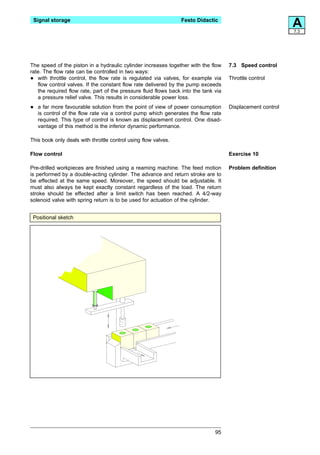
  • 151.
    Safety recommendations Festo Didactic B 4.2 Start-up of an Do not operate systems or actuate switches if you are not totally sure what electro-hydraulic system function they perform. All setting values must be known. Do not switch on the power supply until all lines are connected. Important: check that all return lines (leakage lines) lead to the tank. When starting up the system for the first time, open the system pressure relief valve almost completely and gradually set the system to the opera- ting pressure. Pressure relief valves must be installed in such a way that they cannot become ineffective. Carefully clean the system prior to start-up, then change the filter cartridge. Vent system and cylinders. In particular, the hydraulic lines to the reservoir are to be carefully vented. It is generally possible to effect venting at the safety and shut-off block of the reservoir. Special care is needed when handling hydraulic reservoirs. Before the reservoirs are started up, the regulations stipulated by the manufacturer are to be studied carefully. Repair and maintenance of an Repair work may not be effected on hydraulic systems until the fluid electro-hydraulic system pressure of the reservoir has been vented. If possible, separate the reservoir from the system (using a valve). Never drain the reservoir unthrottled! Installation and operation are governed by the Technical Rules for Pressure Vessels (TRB). When repairs are completed effect a new start-up in line with the safety regulations listed above. All hydraulic reservoirs are subject to the provisions of the pressure vessel regulations and must be inspected at regular intervals. 151
  • 152.
    B4.3 Safety recommendations Festo Didactic 4.3 Safety recommendations VDE 0113 contains stipulations governing the electrical equipment of machin- for electrical systems ing and processing machines with mains voltages up to 1000 V. These regula- tions are wide-ranging and apply to the electrical equipment of all stationary and mobile machines as well as machines in production lines and conveying systems. Effect of electric current When live parts of an electrical system are touched, electric current flows through on the human body the human body. The effect of the current increases • with increasing current and • duration of contact There are two threshold values: • if the electric current is lower than the perceptibility threshold, it has no effect on human beings. • up to the releasing threshold, an electric current is perceived, but the possi- bility of injury or danger is unlikely. • above the releasing threshold, the muscles contract and cardiac function is impaired. • values above the fibrillating threshold lead to ventricular fibrillation and car- diac arrest as well as cessation of breathing and consciousness; lengthy contact also causes serious burns. There is acute danger to life and limb! The two following diagrams show that – compared to DC voltage lines – AC power supply networks (50/60 Hz) with relatively small currents can endanger human life. Hazard zones with alternating current (50/60Hz) 10000 fibrillation 5000 threshold percepti- 2000 bility threshold 1000 500 © time t in ms 1 2 release 3 4 200 threshold 100 50 20 10 0 0.1 0.2 0.5 1 2 5 10 20 50 100 200 500 2000 © current I in mA 152
  • 153.
    Safety recommendations Festo Didactic B 4.3 Hazard zones with direct current 10000 5000 percepti- release fibrillation 2000 bility threshold threshold threshold 1000 500 1 2 3 4 © time t in ms 200 100 50 20 10 0 0.1 0.2 0.5 1 2 5 10 20 50 100 200 500 2000 © current I in mA In line with Ohm‘s law, the flow of current and thus the risk to human safety is Internal resistance greater: of the human body • the higher the voltage • and the lower the internal resistance of the person concerned. When electrical current flows through the body to earth, 1300 Ω is given as an approximate figure for the internal resistance of the body. There is serious risk to life and limb from currents of 50 mA upwards. Taking into account the internal resistance, this is equivalent to a contact voltage of 50 mA ⋅ 1300 Ω = 65 V. N.B. Under extremely unfavourable conditions (clothes damp with perspiration, large contact area) even voltages under 65 V can be fatal! 153
  • 154.
    B4.3 Safety recommendations Festo Didactic Protective measures The supply voltage in the signal control section of electro-hydraulic systems is in the signal control section normally 24 V, and thus way below the critical contact voltage of 65 V. The mains voltage is stepped down in the power supply unit by an isolating trans- former. Isolating transformer L1 PE ~ N ~ Protection against Protection against coming into contact with live parts is essential (and stipu- direct contact lated) for both low and high voltages. This protection can take the form of • insulation, • covering devices or • keeping at a safe distance. Protection through insulation additional insulation basic insulation 154
  • 155.
    Safety recommendations Festo Didactic B4.3 Protection through covers L1 L2 L3 PEN In contrast to the signal control section, the hydraulic assembly is generally Overload protection devices operated at higher voltages. The measures for protection against direct contact also apply here. In addition, components situated in areas where they may be touched by personnel (e.g. housings) are earthed. If, for example, a housing becomes live, this leads to a short circuit and the upstream overload protection devices are activated. The layout of these circuits and the response charac- teristics of the overload protection devices can differ considerably. The following devices are used: • fusible links, • circuit-breakers, • residual current operated circuit-breakers, • residual voltage operated circuit-breakers. Protection through keeping a safe distance 5m hand range limit 2. R 0.75m R 1. 25 m 155
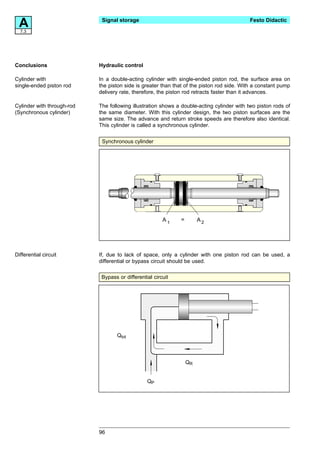
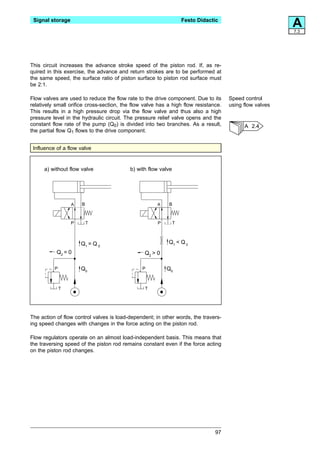
  • 156.
    B4.3 Safety recommendations Festo Didactic EMERGENCY STOP switch In the event of danger, it must be possible to shut down a machine immedi- ately via an EMERGENCY STOP switch to separate all equipment from the mains supply. The following regulations apply to the EMERGENCY STOP cir- cuit: 1. Necessary lighting must not be switched off using the EMERGENCY STOP function. 2. Clamped workpieces must not be released by actuation of the EMERGENCY STOP function. 3. Auxiliary and braking devices designed to peform functions such as rapid shutdown of the machine must not be rendered ineffective. 4. Return movements must be initiated by actuation of the EMERGENCY STOP function if this is necessary. They may, however, only be initiated if this does not pose a risk to personnel. 5. The identification colour of the EMERGENCY STOP switch is bright red; the area below the manual actuating element must be in the contrasting colour yellow. Further requirements for the EMERGENCY STOP circuit in electrical and hy- draulic systems are contained in DIN 31000. Master switch In addition, each machine must be equipped with a master switch via which the entire electrical equipment can be switched off for the duration of cleaning, maintenance and repair work and during lengthy down-times. 1. The master switch must be manually operated and may have only one Off and On position with stops identified by 0 and 1. 2. In the Off position it should be possible to lock the switch in such a way that manual and remote switch-on are prevented. 3. If there are several feed sources, it must be possible to interlock the master switches in such a way that there is no risk or danger. 156
  • 157.
    Solutions Festo Didactic C Part C Solutions 157
  • 158.
    C1 Solutions Festo Didactic Exercise 1 Hydraulic circuit diagram Direct solenoid valve actuation 1. Hydraulic circuit diagram 1.0 F 1.1 A Y1 P T P 0.4 0.5 0.2 0.1 0.3 T M Electrical circuit diagram Electrical circuit diagram 1 24V 3 S0 4 2 220V 24V 3 S1 4 Y1 OV 158
  • 159.
    Solutions Festo Didactic C1 • If control switch S1 is actuated when the master switch is on, current flows through the solenoid coil. The electromagnet energises, the directional con- Function description trol valve switches over, and the piston rod of the cylinder advances. • If the push-button is released, current no longer flows through the solenoid coil. The coil is de-energised and the directional control valve switches back, and the piston rod of the cylinder retracts due to the weight load. Selection table 2. Selection of the push-button 1 2 3 contact 250 V AC 4 A 220 V/110 V AC 1.5/2.5 A 5 A/48 V AC rating: 12 V DC 0.2 A 24V/12 V DC 2.25/4.5 A 4 A/30 V DC normally closed 1 3 2 contact: normally open 1 – 2 contact: The power consumption of the solenoid valve is 3 W. At a voltage of 24 V, the contacts must be able to cope with a load of at least 31 W = 1.3 A 24 V As the control operates via a direct voltage supply, the current carrying capacity for direct voltage (DC) is decisive. This means that push-buttons no. 2 and no. 3 could be used. As can be seen from the electrical circuit diagram, a normally open contact is needed for this solution. As push-button no. 2 is not equipped with a normally open contact, push-button no. 3 is the only suitable device. 159
  • 160.
    C2 Solutions Festo Didactic Exercise 2 Hydraulic circuit diagram Indirect solenoid valve actuation 1. Hydraulic circuit diagram F A Y1 P T P T M A one-way flow control valve is fitted to throttle the return stroke speed. It is advisable to install the throttle valve as close as possible to the cylinder, as this prevents oscillation of the piston and thus of the straightening roller. The directional control valve is also a throttle point, although the extent of throttling can be ignored, since the cross section of the directional control valve orifice is considerably greater than that of the one-way flow control valve. 160
  • 161.
    Solutions Festo Didactic C 2 Electrical circuit diagram, indirect actuation 2. Electrical circuit diagram 1 24V 3 S0 4 2 3 3 13 S1 K1 4 14 A1 K1 Y1 A2 OV • Current path 2 is the control circuit in the signal control section. The control circuit contains push-button S1 (normally open contact) and relay K1. • Current path 3 is the interface to the power control section and is the main circuit (energy circuit). • Master switch S0 is assigned to both circuits. If master switch S0 is already switched on and push-button S1 is pressed, Function description relay K1 in current path 2 switches and the contact of K1 in current path 3 is closed. Solenoid coil Y1 of the 3/2-way solenoid valve switches and the piston rod of the cylinder advances. If the push-button is released, the magnetic field of relay K1 decays. Contact K1 opens again. There is no longer voltage at the solenoid valve. The spring returns the valve to the normal position. The piston rod retracts due to the weight of the roller. 161
  • 162.
    C 3 Solutions Festo Didactic Exercise 3 Hydraulic circuit diagram Boolean basic logic functions 1. Signal reversal, hydraulic F A Y1 P T P T M Electrical circuit diagram 1 24V 3 S0 4 2 3 3 13 S1 K1 4 14 A1 K1 Y1 A2 OV 162
  • 163.
    Solutions Festo Didactic C 3 The hydraulic circuit diagram is to be drawn in a position where the hydraulic assembly is switched on, but where the electrical power supply to the signal control section is switched off. As signal reversal is to be performed hydrauli- cally, a valve with throughflow in the normal position is to be selected. In this position, this valve connects the cylinder chamber to the pressure circuit. The piston rod of the cylinder is therefore to be drawn in the advanced position. • In this circuit an unactuated push-button means: the relay coil does not energise, the normally open contact in the main circuit remains open, and Function description the valve is not actuated. Reversal of the signal is achieved using a valve with switching positions which are the exact opposite of those in the valve in the preceding task definition (throughflow in normal position instead of blocked in normal position). This means that the cylinder chamber is sup- plied with pressure when the valve is not actuated and that the piston rod advances when the hydraulic power supply is switched on. • When the push-button is pressed, the valve is supplied with current via the relay and switches over. The piston rod retracts. 163
  • 164.
    C 3 Solutions Festo Didactic 2. Signal reversal, electrical Hydraulic circuit diagram F A Y1 P T P T M Electrical circuit diagram 1 24V 3 S0 4 2 3 3 11 S1 K1 4 12 A1 K1 Y1 A2 OV 164
  • 165.
    Solutions Festo Didactic C 3 As previously, the hydraulic circuit diagram is to be drawn in a position where the electrical power supply is switched off. The valve is therefore not actuated. The cylinder chamber is connected to the tank; as a result, there is no press- ure and thus no force acting on the piston. Accordingly, the piston rod is pushed back into the cylinder by external force. It must therefore be drawn in the retracted position. • As long as push-button S1 is not actuated, no current flows through relay coil K1 in the control circuit. The normally closed contact in the control Function description circuit is therefore closed. Current flows through the solenoid and the valve is in the actuated position. The piston rod advances or remains in the ad- vanced position. • If push-button S1 is pressed, relay K1 in the control circuit energises. The normally closed contact of K1 interrupts the main circuit. The signal in the main circuit is reversed compared to the signal in the control circuit. The solenoid coil is de-energised, the valve switches back to the non-actuated position, and the piston rod retracts. 165
  • 166.
    C 4 Solutions Festo Didactic Exercise 4 Hydraulic circuit diagram Signal reversal 1. Signal reversal, electrical A B Y1 P T P T M Electrical circuit diagram 1 24V 3 S0 4 2 3 3 11 S1 K1 4 12 A1 K1 Y1 A2 OV 166
  • 167.
    Solutions Festo Didactic C 4 As the signal in the hydraulic circuit is not reversed, the valve should be con- nected in such a way that the piston rod advances in the actuated position. If the die cushioning cylinder of the press is pushed back, the oil in this circuit also flows against the pumping direction in the circuit (see Exercise 3). If the flow rate is too high, the oil cannot be directed away via the pressure relief C3 valve. In this event, a check valve must be installed to protect the assembly, as was the case in Exercise 3. The signal control section fulfils the same functions as the section described in Exercise 3 and is therefore of identical design. 167
  • 168.
    C 4 Solutions Festo Didactic 2. Signal reversal, hydraulic Hydraulic circuit diagram A B Y1 P T P T M Electrical circuit diagram 1 24V 3 S0 4 2 3 3 13 S1 K1 4 14 A1 K1 Y1 A2 OV 168
  • 169.
    Solutions Festo Didactic C 4 As the signal in this circuit is hydraulically reversed, the valve should be con- nected in such a way that the piston rod retracts when the valve is actuated. For the remainder, the same remarks apply as for electrical signal reversal. Although the two circuits react in the same way under normal circumstances, 3. Failure of the they react in different ways to a failure of the supply voltage to the signal supply voltage control section: to the signal control section • the piston rod retracts with electrical signal reversal, • and the piston rod advances with hydraulic signal reversal. 169
  • 170.
    C 5 Solutions Festo Didactic Exercise 5 Hydraulic circuit diagram Conjunction and negation 1. Hydraulic circuit diagram 1.0 1.1 A B Y1 P T P 0.4 0.5 0.2 0.1 0.3 T M 2. Parts list Parts list Item Quan- Description Type and Standard designation Manufacturer/Supplier tity 0.1 1 Electric motor 0.2 1 Hydraulic pump 0.3 1 Safety pressure relief valve 0.4 1 System pressure relief valve 0.5 1 Pressure gauge 1.0 1 Hydr. cylinder, double-acting 1.1 1 4/2-way solenoid valve Group Sheet of Make Signed Purchaser 03 4 Sheets 4 Date Order no. Type Tested Drawing no. Sample parts list of a Inventory no. hydraulic system No. Alteration Date Name 170
  • 171.
    Solutions Festo Didactic C 5 Logic function 3. Truth table and logic circuit symbol truth table logic symbol S1 S2 K1 0 0 0 S1 0 1 0 & K1 S2 1 0 0 1 1 1 The mould may close only if push-button S1 is pressed and limit switch S2 is not actuated. Signal K1 may therefore only be set under this condition. Electrical circuit diagram 4. Electrical circuit diagram 1 24V 3 S0 4 2 3 3 13 S1 K1 4 14 1 S2 2 A1 K1 Y1 A2 OV To ensure reversal of signal S2, limit switch S2 is to be connected as a normally closed contact. 171
  • 172.
    C6 Solutions Festo Didactic Exercise 6 Hydraulic circuit diagram Disjunction 1. Hydraulic circuit diagram A B Y1 P T P T M 172
  • 173.
    Solutions Festo Didactic C 6 Electrical circuit diagram 2. Electrical circuit diagrams Circuit 1 1 24V 3 S0 4 2 3 4 3 3 13 S1 S2 K1 4 4 14 A1 K1 Y1 A2 OV Circuit 2 Electrical circuit diagram 1 24V 3 S0 4 2 3 4 5 3 3 13 13 S1 S2 K1 K1 4 4 14 14 A1 A1 K1 K2 Y1 A2 A2 OV In both circuits the valve coil Y1 energises if either manual push-button S1, foot-operated button S2 or both buttons are pressed. The second circuit has the advantage that push-button S1 only acts on coil K1, and push-button S2 only on coil K2. This makes it possible to realise additional functions: • further contacts of K1 can be used to switch the current paths which are designed to react only to the manual push-button (e.g. warning light for manual push-button). • further contacts of K2, on the other hand, switch the current paths which are supposed to react only in dependence on S2 (e.g. warning light for foot-oper- ated button). 173
  • 174.
    C7 Solutions Festo Didactic Exercise 7 Hydraulic circuit diagram Assembly line 1. Hydraulic circuit diagram A B Y1 P T P T 174
  • 175.
    Solutions Festo Didactic C7 Electrical circuit diagram, two control switches with changeover contacts 2. Electrical circuit diagram, two-way circuit with changeover contacts 1 24V 3 S0 4 2 3 1 13 S1 K1 2 4 14 4 2 S2 1 A1 K1 Y1 A2 OV Electrical circuit diagram, two control switches with normally open contacts 3. Electrical circuit diagram, two-way circuit with normally open contacts 1 24V 3 S0 4 2 3 4 5 6 3 3 11 23 13 S1 S2 K1 K1 K3 4 4 12 24 14 13 21 K2 K2 14 22 A1 A1 A1 K1 K2 K3 Y1 A2 A2 A2 OV 4 5 5 4 6 Solenoid valve coil Y1 may be installed in current path 4 in place of relay K3. Relay K3 and current path 6 are then no longer necessary. 175
  • 176.
    C8 Solutions Festo Didactic Exercise 8 Hydraulic circuit diagram Clamping device 1. Hydraulic circuit diagram A B Y1 Y2 P T P T M Speed throttling only takes place during advance of the piston rod. During re- traction, the throttle is bridged by the non-return valve. The one-way flow con- trol valve can be installed in two places: • either as shown in the above circuit diagram, • or in the line between valve port B and the cylinder chamber on the piston rod side. 176
  • 177.
    Solutions Festo Didactic C 8 Electrical circuit diagram 2. Electrical circuit diagram 1 24V 3 S0 4 2 3 4 5 11 11 23 23 S2 K1 K2 12 12 24 24 13 13 S1 14 14 11 11 K2 12 12 A1 A1 K1 K2 Y1 Y2 A2 A2 OV 3 4 2 5 • Pressing push-button S1 energises relay K1. The piston rod advances. Function description • If push-button S2 is pressed, relay K2 energises. The piston rod retracts. • If both push-buttons are pressed one after the other, the relay which was switched first de-energises, but the other relay is not switched. Both relays are thus in the de-energised state, and the double solenoid valve remains in the switching position it adopted first. 177
  • 178.
    C9 Solutions Festo Didactic Exercise 9 Hydraulic circuit diagram Clamping device with latching 1. Hydraulic circuit diagram A P A B Y1 P T P T M The pressure relief valve can be installed either between directional control valve and cylinder (see illustration) or between assembly and directional control valve. • If the pressure regulator is between directional control valve and cylinder, a non-return valve must be parallel-connected to allow retraction of the piston rod. During the retraction motion, the annular piston surface is subjected to the full system pressure. • If the pressure regulator is between assembly and directional control valve, a non-return valve is not required. With this circuit design, it should be noted that the pressure is also reduced during the return stroke. The force of the retracting cylinder is therefore less than in the first circuit arrange- ment. 178
  • 179.
    Solutions Festo Didactic C9 Electrical circuit diagram 2. Electrical circuit diagram, dominant resetting latching circuit 1 24V 3 S0 4 2 3 4 3 13 23 S1 K1 K1 4 14 24 S2 1 2 A1 K1 Y1 A2 OV • Latching is set by pressing push-button S1; the valve switches to the actu- ated position. The piston rod advances. Function description • Pressing push-button S2 releases latching and the valve switches to the non-actuated position. The piston rod retracts. • If both push-buttons (S1 and S2) are pressed, the output receives no signal – and latching is not set. Logic diagram 3. Logic diagram S1 1 & K1 S2 179
  • 180.
    C10 Solutions Festo Didactic Exercise 10 Hydraulic circuit diagram Reaming device S1 S2 1. Hydraulic circuit diagram F A B Y1 P T P T M In this exercise, the machining speed is to be precisely maintained even under varying loads. This requires the use of a flow regulator. The flow regulator regulates the flow in one flow direction only. To render it effective for both directions, it must be installed between directional control valve and hydraulic assembly. The back-pressure valve is bridged by a non-return valve during the return stroke. 180
  • 181.
    Solutions Festo Didactic C 10 Electrical circuit diagram 2. Electrical circuit diagram 1 24V 3 S0 4 2 3 4 3 13 23 S3 K1 K1 4 14 24 1 S1 2 1 S2 2 A1 K1 Y1 A2 OV 3 4 To allow generation of the latching function, limit switch S2 is connected as a normally closed contact. Limit switch S1 is connected as a normally open con- tact. An actuated normally open contact is shown in the circuit diagram as a normally closed contact with an arrow. In addition, the contacts are identified by numbers according to standard. This provides a further indication of how the limit switch is connected. 181
  • 182.
    C11 Solutions Festo Didactic Exercise 11 Function diagram Pressing device Time in seconds 1. Function diagram for Components the hydraulic press Step Identi- 1 2 3 4 5 6 Designation Status fication Master switch S0 Start push-button S3 Directional control valve Y1 1 0 >p Cylinder A1 1 S2 0 S1 • Step 1: The directional control valve is switched into the actuated position when the following conditions are met: • the master switch is switched on, • the piston rod is in the retracted position • and the start push-button is pressed. • Step 2: If the actual pressure exceeds the set limit pressure, or if the piston rod reaches the forward end position, the valve is reversed. The piston rod retracts. • End of cycle: The cycle is complete when the piston rod reaches the retracted end posi- tion. 182
  • 183.
    Solutions Festo Didactic C11 Hydraulic circuit diagram 2. Hydraulic circuit diagram S1 S2 2:1 B1 40bar P A T 20bar P A B Y1 P T P 60bar T M The pressure switch must be installed between throttle valve and cylinder. Pressure gauges are to be installed for adjustment of the pressure switch and the counter-pressure valve. The maximum pressure is 60 bar, and thus far lower than with outflow throt- 3. Maximum pressure tling. The hydraulic components need only be designed for operation with pressures up to 60 bar. If 20 bar is set at the counter-pressure valve, only 10 bar (not taking into 4. Adjustment of the account the friction in the cylinder) are needed to overcome this resistance on pressure switch the piston side on account of the surface ratio. 183
  • 184.
    C11 Solutions Festo Didactic The following pressure is additionally required for pressing operations: FP 6000 N N = = 3.06 = 30.6 bar A π ⋅ (25 mm)2 mm2 The pressure switch should therefore be set to: 10 bar + 30.6 bar = 40.6 bar ≅ 40 bar 5. Electrical circuit diagram Electrical circuit diagram 1 24V 3 S0 10 4 2 3 4 5 6 7 8 9 B1 13 3 13 33 13 23 S3 >p S2 K4 K1 S1 K3 K3 K1 14 4 14 34 14 24 13 K2 14 21 21 31 K3 K4 K2 22 22 32 31 3 K4 S4 32 4 A1 A1 A1 A1 K1 K2 K3 K4 Y1 A2 A2 A2 A2 0V 3 8 2 2 6 2 9 10 7 5 S0 = master switch S4 = acknowledgement push-button S1/S2 = limit switch B1 = pressure switch S3 = start push-button Relay positions: K1 energised: directional control valve is switched, piston rod advances K2 energised: piston in retracted end position K3 energised: overpressure K4 energised: piston rod retracts 184
  • 185.
    Solutions Festo Didactic C 11 Normal movement: 6. Function description when start push-button S3 is pressed, the piston rod advances up to limit switch S2. K4 energises and reverts to latching. The normally closed contact of K4 in current path 2 releases the latching of relay K1. Malfunction: if the pressure exceeds 40 bar when the piston rod advances, pressure switch B1 switches relay K3 to latching. The first contact of K3 releases the latching of relay K1 in current path 2. The piston rod retracts. The second contact closes current path 7, and the optical indicator lights up. Acknowledgement push-button S4 releases the latching of relay K3. The light goes out and start- up can be effected. The actual pressure should not exceed the maximum pressure during retrac- tion of the piston rod. The pressure switch must therefore be rendered inopera- tive during retraction. To this end, the contact of K4 blocks current path 5 until the piston rod is in its starting position. Limit switch S1 is actuated and relay K2 releases the latching of K4. A further contact of K2 is located in current path 2. This means that the press- ing process cannot begin until the piston rod is retracted – only then are the start conditions fulfilled. 185
  • 186.
    C12 Solutions Festo Didactic Exercise 12 Hydraulic circuit diagram Milling machine S1 S2 1. Hydraulic circuit diagram F P A T P A B Y1 Y2 P T P T M 186
  • 187.
    Solutions Festo Didactic C12 Electrical circuit diagram 2. Switchover from automatic to manual operation via control switch 1 24V 3 S0 4 8 1 10 S4 2 3 4 5 6 7 AUTO-MAN 24 9 S5 3 13 3 1 23 23 33 3 S3 4 K1 S1 S2 K3 K1 2 24 24 K3 34 4 13 14 4 K2 14 MAN 11 21 K3 12 K2 22 K1 K2 K3 Y1 Y2 0V 3 5 2 2 6 7 9 S0 = master switch S4 = selector automatic/manual operation S1/S2 = limit switch S5 = push-button for return stroke S3 = start push-button Automatic operation: relay K1 energised: piston rod advances relay K2 energised: piston rod in retracted end position relay K3 energised: piston rod retracts Manual operation: after switchover of S4 to manual operation, the piston rod retracts as long as push-button S5 is held down. 187
  • 188.
    C12 Solutions Festo Didactic 3. Switchover from automatic Electrical circuit diagram to manual operation via push-button 1 24V 3 S0 4 2 3 4 12 AUTO 23 3 13 K1 S4 4 K1 14 K1 24 5 6 7 8 9 10 11 3 23 23 S6 3 3 13 1 33 S3 S1 S2 K4 K2 4 K2 2 24 K4 34 4 14 4 24 MAN 13 K3 14 AUTO 1 11 21 AUS S5 K4 K3 2 12 22 K1 K2 K3 K4 Y1 Y2 0V 12 3 6 8 5 5 9 4 10 11 S0 = master switch S4 = push-button automatic operation S1/S2 = limit switch S5 = push-button manual operation S3 = start push-button S6 = push-button for return stroke Automatic operation: relay K1 energised: automatic operation relay K2 energised: piston rod advances relay K3 energised: piston in retracted end position relay K4 energised: piston rod retracts Manual operation: pressing push-button S5 releases the latching of relay K1. This causes nor- mally closed contact K1 in current path 12 to close; the piston rod retracts as long as push-button S6 is held down. 188
  • 189.
    Appendix Festo Didactic Appendix 189
  • 190.
    Appendix Festo Didactic 190
  • 191.
    Standards for electro-hydraulicsystems Festo Didactic Standards for electro-hydraulic systems 191
  • 192.
    Standards for electro-hydraulicsystems Festo Didactic Standards for ZH 1/74 Safety regulations for hydraulic lines fluid technology TRB 600 Installation of pressure vessels: Safety requirements TRB 700 Operation of pressure vessels: Safety requirements DIN ISO 1219 Fluid-power systems and equipment: Circuit symbols VDI 3260 Function diagrams for machinery and production plant DIN ISO 3320 Fluid power technology — Hydraulic: Cylinder bores and piston rod diameters DIN ISO 3322 Fluid power technology — Hydraulic: Nominal pressures for cylinders VDMA 24 317 Fluid power technology — Hydraulic: Slow-burning hydraulic fluids Guidelines DIN 24 346 Fluid power technology — Hydraulic: Hydraulic systems Fundamentals of design DIN 24 347 Fluid power technology — Hydraulic: Circuit diagrams DIN 24 552 Hydraulic reservoirs: General requirements DIN 51 524 Pressure fluids: Hydraulic oil DIN 51 561 Testing of mineral oils, liquid fuels and allied fluids DIN 51 562 Viscometers Parts 1 - 3 Measurement of kinematic viscosity using the Ubbelohde viscometer 192
  • 193.
    Standards for electro-hydraulicsystems Festo Didactic DIN VDE 0100 Installation of power systems up to 1000 V Standards for electrical engineering EN 60204 Electrical equipment of DIN VDE 0113 industrial machinery IEC 144 Specification for the protection classes of enclosures for switching and control equipment for voltages up to and including 1000 V AC and 1200 V DC DIN 2909 Round fasteners: Part 1 Summary DIN 2909 Round fasteners: Part 2 Individual parts DIN 19 226 Closed and open-loop control technology: Terms and designations DIN 19 237 Measuring, controlling, regulating: Control technology, terms DIN 19 250 Basic safety considerations for measuring, controlling and regulating protective devices DIN 31 000 General guidelines regarding safe (VDE 1000) construction of technical products DIN 40 050 IP protection classes: Protection against shock, foreign matter and water for electrical equipment DIN 40 713 Circuit symbols DIN 40 719 Circuit documentation: Part 2 Designation of electrical equipment DIN 40 719 Circuit documentation: Part 3 Rules for circuit diagrams in electro-technology DIN 40 719 Circuit documentation: Part 9 Design of connection diagrams DIN 40 900 Graphic symbols for circuit documentation Part 7 (Symbols for switching and protective equipment) 193
  • 194.
    Standards for electro-hydraulicsystems Festo Didactic DIN 41 488 Electro-technology Parts 1 - 3 Compartment measurements for control cabinets DIN 41 494 Construction of electronic equipment Parts 1 - 8 DIN 43 650 Plug connectors, square design Part 1 Types, dimensions, designation system DIN 43 650 Plug connectors, square design Part 2 Characteristics, requirements, testing DIN 43 880 Installation equipment Overall dimensions and related installation dimensions DIN EN 50 005 Industrial low-voltage switchgear Terminal designations and code numbers, General rules DIN EN 50 011 Industrial low-voltage switchgear Terminal designations, code numbers and letters for specific auxiliary contactors DIN EN 50 012 Industrial low-voltage switchgear Terminal designations and code numbers for auxiliary contacts of specific contactors DIN EN 50 013 Industrial low-voltage switchgear Terminal designations and code numbers for specific control devices DIN EN 50 022-35 Industrial low-voltage switchgear Terminal designations and code numbers 194
  • 195.
    Index Festo Didactic Index 195
  • 196.
    Index Festo Didactic A AC solenoid . . . . . . . . . . . . . . . . . . . . . . . . . . . . . . . . . . . . . . . . . . . . . . . . . 141 Actuated position directional control valve . . . . . . . . . . . . . . . . . . . . . . . . . . . . . . . . . . . . . . . 46 Actuation modes, directional control valves . . . . . . . . . . . . . . . . . . . . . . . . . . 16 Air-core reactor . . . . . . . . . . . . . . . . . . . . . . . . . . . . . . . . . . . . . . . . . . . . . . . 122 Alternating current . . . . . . . . . . . . . . . . . . . . . . . . . . . . . . . . . . . . . . . . . . . . 118 Ammeter . . . . . . . . . . . . . . . . . . . . . . . . . . . . . . . . . . . . . . . . . . . . . . . . . . . . 126 internal resistance . . . . . . . . . . . . . . . . . . . . . . . . . . . . . . . . . . . . . . . . . . 126 AND operation . . . . . . . . . . . . . . . . . . . . . . . . . . . . . . . . . . . . . . . . . . . . . . . . 73 Arcing . . . . . . . . . . . . . . . . . . . . . . . . . . . . . . . . . . . . . . . . . . . . . . . . . . . . . . 141 Auxiliary contacts . . . . . . . . . . . . . . . . . . . . . . . . . . . . . . . . . . . . . . . . . . . . . 139 B Boolean basic logic functions . . . . . . . . . . . . . . . . . . . . . . . . . . . . . . . . . . 54, 72 Bridge circuit . . . . . . . . . . . . . . . . . . . . . . . . . . . . . . . . . . . . . . . . . . . . . . . . . 121 Bypass circuit . . . . . . . . . . . . . . . . . . . . . . . . . . . . . . . . . . . . . . . . . . . . . . . . . 96 C Capacitance . . . . . . . . . . . . . . . . . . . . . . . . . . . . . . . . . . . . . . . . . . . . . . . . . 123 Capacitive effect . . . . . . . . . . . . . . . . . . . . . . . . . . . . . . . . . . . . . . . . . . . . . . 132 Capacitive proximity sensor . . . . . . . . . . . . . . . . . . . . . . . . . . . . . . . . . . . . . 135 Capacitor . . . . . . . . . . . . . . . . . . . . . . . . . . . . . . . . . . . . . . . . . . . . . . . 123, 144 Changeover contact . . . . . . . . . . . . . . . . . . . . . . . . . . . . . . . . . . . . . . . . 47, 130 Charge capacitor . . . . . . . . . . . . . . . . . . . . . . . . . . . . . . . . . . . . . . . . . . . . . 121 Charging current . . . . . . . . . . . . . . . . . . . . . . . . . . . . . . . . . . . . . . . . . . . . . . 123 Check valve . . . . . . . . . . . . . . . . . . . . . . . . . . . . . . . . . . . . . . . . . . . . . . . . . . 19 Circuit . . . . . . . . . . . . . . . . . . . . . . . . . . . . . . . . . . . . . . . . . . . . . . . . . . . . . . 144 Circuit diagram, electrical connection designations for switching elements . . . . . . . . . . . . . . . . . . . . 32 current path direction . . . . . . . . . . . . . . . . . . . . . . . . . . . . . . . . . . . . . . . . 33 function digit . . . . . . . . . . . . . . . . . . . . . . . . . . . . . . . . . . . . . . . . . . . . . . . 32 ordinal number . . . . . . . . . . . . . . . . . . . . . . . . . . . . . . . . . . . . . . . . . . . . . 32 relay terminal designations . . . . . . . . . . . . . . . . . . . . . . . . . . . . . . . . . . . . 32 switching element table . . . . . . . . . . . . . . . . . . . . . . . . . . . . . . . . . . . . . . . 35 Circuit diagram, hydraulic . . . . . . . . . . . . . . . . . . . . . . . . . . . . . . . . . . . . . . . . 28 designation of components . . . . . . . . . . . . . . . . . . . . . . . . . . . . . . . . . . . . 30 distinctive number . . . . . . . . . . . . . . . . . . . . . . . . . . . . . . . . . . . . . . . . . . . 30 energy flow . . . . . . . . . . . . . . . . . . . . . . . . . . . . . . . . . . . . . . . . . . . . . . . . 28 equipment numbering . . . . . . . . . . . . . . . . . . . . . . . . . . . . . . . . . . . . . . . . 30 group assignment . . . . . . . . . . . . . . . . . . . . . . . . . . . . . . . . . . . . . . . . . . . 30 ordinal number . . . . . . . . . . . . . . . . . . . . . . . . . . . . . . . . . . . . . . . . . . . . . 30 Coil with iron core . . . . . . . . . . . . . . . . . . . . . . . . . . . . . . . . . . . . . . . . . . . . . 122 Conjunction . . . . . . . . . . . . . . . . . . . . . . . . . . . . . . . . . . . . . . . . . . . . . . . . . . . 72 Contact erosion . . . . . . . . . . . . . . . . . . . . . . . . . . . . . . . . . . . . . . . . . . . . . . . 49 Contactor . . . . . . . . . . . . . . . . . . . . . . . . . . . . . . . . . . . . . . . . . . . . . . 137 – 139 Contacts . . . . . . . . . . . . . . . . . . . . . . . . . . . . . . . . . . . . . . . . . . . . . . . . . . . . . 47 196
  • 197.
    Index Festo Didactic Control cabinet . . . . . . . . . . . . . . . . . . . . . . . . . . . . . . . . . . . . . . . . . . . . . . . . 145 Control diagram . . . . . . . . . . . . . . . . . . . . . . . . . . . . . . . . . . . . . . . . . . . . . . . . 36 Control loop system . . . . . . . . . . . . . . . . . . . . . . . . . . . . . . . . . . . . . . . . . . . . . 29 Control switch . . . . . . . . . . . . . . . . . . . . . . . . . . . . . . . . . . . . . . . . . . 47, 110, 129 Counter-pressure valve . . . . . . . . . . . . . . . . . . . . . . . . . . . . . . . . . . . . . . . . . . 98 Current measurement . . . . . . . . . . . . . . . . . . . . . . . . . . . . . . . . . . . . . . . . . . . 126 Current strength . . . . . . . . . . . . . . . . . . . . . . . . . . . . . . . . . . . . . . . . . . . 118, 120 Cylinder . . . . . . . . . . . . . . . . . . . . . . . . . . . . . . . . . . . . . . . . . . . . . . . . . . . . . . . 20 differential . . . . . . . . . . . . . . . . . . . . . . . . . . . . . . . . . . . . . . . . . . . . . . . . . . 20 double-acting . . . . . . . . . . . . . . . . . . . . . . . . . . . . . . . . . . . . . . . . . . . . . . . . 20 end position cushioning . . . . . . . . . . . . . . . . . . . . . . . . . . . . . . . . . . . . . . . . 21 single-acting . . . . . . . . . . . . . . . . . . . . . . . . . . . . . . . . . . . . . . . . . . . . . . 20, 46 synchronous . . . . . . . . . . . . . . . . . . . . . . . . . . . . . . . . . . . . . . . . . . . . . 20, 96 telescopic, double-acting . . . . . . . . . . . . . . . . . . . . . . . . . . . . . . . . . . . . . . . 21 telescopic, single-acting . . . . . . . . . . . . . . . . . . . . . . . . . . . . . . . . . . . . . . . 20 D DC current circuit . . . . . . . . . . . . . . . . . . . . . . . . . . . . . . . . . . . . . . . . . . . . . . 119 DC solenoid . . . . . . . . . . . . . . . . . . . . . . . . . . . . . . . . . . . . . . . . . . . . . . . . . . . 65 stroke-force characteristic . . . . . . . . . . . . . . . . . . . . . . . . . . . . . . . . . . . . . 140 Differential circuit . . . . . . . . . . . . . . . . . . . . . . . . . . . . . . . . . . . . . . . . . . . . . . . 96 Diffuse sensor . . . . . . . . . . . . . . . . . . . . . . . . . . . . . . . . . . . . . . . . . . . . . . . . . 136 Diode . . . . . . . . . . . . . . . . . . . . . . . . . . . . . . . . . . . . . . . . . . . . . . . . . . . . 121, 144 Direct current . . . . . . . . . . . . . . . . . . . . . . . . . . . . . . . . . . . . . . . . . . . . . . . . . 118 Direction of flow . . . . . . . . . . . . . . . . . . . . . . . . . . . . . . . . . . . . . . . . . . . . 14 – 15 Directional control valve 3/2-way valve . . . . . . . . . . . . . . . . . . . . . . . . . . . . . . . . . . . . . . . . . . . . . . . . 46 4/2-way solenoid valve . . . . . . . . . . . . . . . . . . . . . . . . . . . . . . . . . . . . . . . . 65 4/3-way solenoid valve . . . . . . . . . . . . . . . . . . . . . . . . . . . . . . . . . . . . . . . 108 actuation . . . . . . . . . . . . . . . . . . . . . . . . . . . . . . . . . . . . . . . . . . . . . . . . . . . 16 symbol . . . . . . . . . . . . . . . . . . . . . . . . . . . . . . . . . . . . . . . . . . . . . . . . . . . . . 15 Disjunction . . . . . . . . . . . . . . . . . . . . . . . . . . . . . . . . . . . . . . . . . . . . . . . . . 72, 77 Displacement control . . . . . . . . . . . . . . . . . . . . . . . . . . . . . . . . . . . . . . . . . . . . 95 Displacement-Step diagram . . . . . . . . . . . . . . . . . . . . . . . . . . . . . . . . . . . . . . . 35 Displacement-Time diagram . . . . . . . . . . . . . . . . . . . . . . . . . . . . . . . . . . . . . . . 36 Double non-return valve, symbol . . . . . . . . . . . . . . . . . . . . . . . . . . . . . . . . . . . 23 Double solenoid valve . . . . . . . . . . . . . . . . . . . . . . . . . . . . . . . . . . . . . . . . . . . 87 Drive section . . . . . . . . . . . . . . . . . . . . . . . . . . . . . . . . . . . . . . . . . . . . . . . . . . 115 197
  • 198.
    Index Festo Didactic E Electrical conductor conductor material . . . . . . . . . . . . . . . . . . . . . . . . . . . . . . . . . . . . . . . . . . 119 Electric current effect on the human body . . . . . . . . . . . . . . . . . . . . . . . . . . . . . . . . . . . . 152 Electrical input elements . . . . . . . . . . . . . . . . . . . . . . . . . . . . . . . . . . . . . . . 129 Electrical resistance . . . . . . . . . . . . . . . . . . . . . . . . . . . . . . . . . . . . . . . . . . . 119 Electro-hydraulic system construction . . . . . . . . . . . . . . . . . . . . . . . . . . . . . . . . . . . . . . . . . . . . . 39, 41 repair and maintenance . . . . . . . . . . . . . . . . . . . . . . . . . . . . . . . . . . . . . 151 startup . . . . . . . . . . . . . . . . . . . . . . . . . . . . . . . . . . . . . . . . . . . . . . . . . . . 151 Electro-hydraulics advantages . . . . . . . . . . . . . . . . . . . . . . . . . . . . . . . . . . . . . . . . . . . . . . . . 10 field of application . . . . . . . . . . . . . . . . . . . . . . . . . . . . . . . . . . . . . . . . . . . 10 Electromagnetic switches . . . . . . . . . . . . . . . . . . . . . . . . . . . . . . . . . . . . . . . . 51 Electromagnetism . . . . . . . . . . . . . . . . . . . . . . . . . . . . . . . . . . . . . . . . . . . . . 122 EMERGENCY STOP switch . . . . . . . . . . . . . . . . . . . . . . . . . . . . . . . . . . . . 156 End position cushioning adjustable . . . . . . . . . . . . . . . . . . . . . . . . . . . . . . . . . . . . . . . . . . . . . . 21, 77 both ends . . . . . . . . . . . . . . . . . . . . . . . . . . . . . . . . . . . . . . . . . . . . 21, 78, 82 one end . . . . . . . . . . . . . . . . . . . . . . . . . . . . . . . . . . . . . . . . . . . . . . . . . . . 21 Energy conversion . . . . . . . . . . . . . . . . . . . . . . . . . . . . . . . . . . . . . . . . . . . . 114 Energy transfer symbols . . . . . . . . . . . . . . . . . . . . . . . . . . . . . . . . . . . . . . . . . 22 Exclusive OR . . . . . . . . . . . . . . . . . . . . . . . . . . . . . . . . . . . . . . . . . . . . . 81 – 83 F Flow control . . . . . . . . . . . . . . . . . . . . . . . . . . . . . . . . . . . . . . . . . . . . . . . . . . 95 Flow control valve . . . . . . . . . . . . . . . . . . . . . . . . . . . . . . . . . . . . . . . 18, 97, 103 Flow regulator . . . . . . . . . . . . . . . . . . . . . . . . . . . . . . . . . . . . . . . . . . . . . . 18, 97 Flow valve . . . . . . . . . . . . . . . . . . . . . . . . . . . . . . . . . . . . . . . . . . . . . . . . . . . . 18 adjustable . . . . . . . . . . . . . . . . . . . . . . . . . . . . . . . . . . . . . . . . . . . . . . . . . 18 Function diagram . . . . . . . . . . . . . . . . . . . . . . . . . . . . . . . . . . . . . . . . . . . . . . 35 G Graetz circuit . . . . . . . . . . . . . . . . . . . . . . . . . . . . . . . . . . . . . . . . . . . . . . . . 121 H Hazard zones, AC and DC current . . . . . . . . . . . . . . . . . . . . . . . . . . . . . . . 152 Hydraulic power pack . . . . . . . . . . . . . . . . . . . . . . . . . . . . . . . . . . . . . . . . . . . 44 symbol . . . . . . . . . . . . . . . . . . . . . . . . . . . . . . . . . . . . . . . . . . . . . . . . . . . . 23 Hydraulic motor, symbol . . . . . . . . . . . . . . . . . . . . . . . . . . . . . . . . . . . . . . . . . 14 Hydro pump, symbol . . . . . . . . . . . . . . . . . . . . . . . . . . . . . . . . . . . . . . . . . . . 14 198
  • 199.
    Index Festo Didactic I Identity . . . . . . . . . . . . . . . . . . . . . . . . . . . . . . . . . . . . . . . . . . . . . . . . . . . . . . . 72 Inductive proximity sensor . . . . . . . . . . . . . . . . . . . . . . . . . . . . . . . . . . . . . . . 134 Insulation . . . . . . . . . . . . . . . . . . . . . . . . . . . . . . . . . . . . . . . . . . . . . . . . . . . . . 154 Interface . . . . . . . . . . . . . . . . . . . . . . . . . . . . . . . . . . . . . . . . . . . . . . . . . . 33, 115 Interlock, electrical . . . . . . . . . . . . . . . . . . . . . . . . . . . . . . . . . . . . . . . . . . 87, 108 Internal resistance ammeter . . . . . . . . . . . . . . . . . . . . . . . . . . . . . . . . . . . . . . . . . . . . . . . . . . . 153 voltmeter . . . . . . . . . . . . . . . . . . . . . . . . . . . . . . . . . . . . . . . . . . . . . . . . . . 125 Internal resistance of the human body . . . . . . . . . . . . . . . . . . . . . . . . . . . . . . 153 Isolating transformer . . . . . . . . . . . . . . . . . . . . . . . . . . . . . . . . . . . . . . . . . . . . 154 L Latching . . . . . . . . . . . . . . . . . . . . . . . . . . . . . . . . . . . . . . . . . . . . . . . . . . 92, 108 dominant setting . . . . . . . . . . . . . . . . . . . . . . . . . . . . . . . . . . . . . . . . . . . . . 92 domininant resetting . . . . . . . . . . . . . . . . . . . . . . . . . . . . . . . . . . . . . . . . . . 92 Limit switch . . . . . . . . . . . . . . . . . . . . . . . . . . . . . . . . . . . . . . . . . . . . . . . . 98, 131 Line sockets . . . . . . . . . . . . . . . . . . . . . . . . . . . . . . . . . . . . . . . . . . . . . 142 – 143 Logic operations/functions . . . . . . . . . . . . . . . . . . . . . . . . . . . . . . . . . . . . . . . . 72 M Magnet field . . . . . . . . . . . . . . . . . . . . . . . . . . . . . . . . . . . . . . . . . . . . . . . . . . 122 Main contact elements . . . . . . . . . . . . . . . . . . . . . . . . . . . . . . . . . . . . . . . . . . 139 Maintenance . . . . . . . . . . . . . . . . . . . . . . . . . . . . . . . . . . . . . . . . . . . . . . . . . . 151 Master switch . . . . . . . . . . . . . . . . . . . . . . . . . . . . . . . . . . . . . . . . . . . . . . 47, 156 Measurements in a circuit . . . . . . . . . . . . . . . . . . . . . . . . . . . . . . . . . . . . . . . 124 Measuring instrument indicating error . . . . . . . . . . . . . . . . . . . . . . . . . . . . . . . . . . . . . . . . . . . . . . 124 symbols . . . . . . . . . . . . . . . . . . . . . . . . . . . . . . . . . . . . . . . . . . . . . . . . . . . . 23 Measuring rules . . . . . . . . . . . . . . . . . . . . . . . . . . . . . . . . . . . . . . . . . . . . . . . 124 Motor, voltage supply . . . . . . . . . . . . . . . . . . . . . . . . . . . . . . . . . . . . . . . . . . . 148 N Negation . . . . . . . . . . . . . . . . . . . . . . . . . . . . . . . . . . . . . . . . . . . .55, 57, 72 – 73 Non-return valve . . . . . . . . . . . . . . . . . . . . . . . . . . . . . . . . . . . . . . . . . . . . . . . . 19 Normal position . . . . . . . . . . . . . . . . . . . . . . . . . . . . . . . . . . . . . . . . . . . . . . . . . 15 directional control valve . . . . . . . . . . . . . . . . . . . . . . . . . . . . . . . . . . . . . . . . 46 pressure valve . . . . . . . . . . . . . . . . . . . . . . . . . . . . . . . . . . . . . . . . . . . . . . . 16 Normally closed contact . . . . . . . . . . . . . . . . . . . . . . . . . . . . . . . . . . . . . . 47, 130 Normally open contact . . . . . . . . . . . . . . . . . . . . . . . . . . . . . . . . . . . . . . . 47, 129 NOT function . . . . . . . . . . . . . . . . . . . . . . . . . . . . . . . . . . . . . . . . . . . . . . . . . . . 73 199
  • 200.
    Index Festo Didactic O Ohm‘s law . . . . . . . . . . . . . . . . . . . . . . . . . . . . . . . . . . . . . . . . . . . . . . . . . . . 120 One-way flow control valve . . . . . . . . . . . . . . . . . . . . . . . . . . . . . . . . . . . . . . 51 Optical proximity sensor . . . . . . . . . . . . . . . . . . . . . . . . . . . . . . . . . . . . . . . . 135 OR function . . . . . . . . . . . . . . . . . . . . . . . . . . . . . . . . . . . . . . . . . . . . . . . 77 – 78 Outflow throttling . . . . . . . . . . . . . . . . . . . . . . . . . . . . . . . . . . . . . . . . . 103 – 104 Overload protection devices . . . . . . . . . . . . . . . . . . . . . . . . . . . . . . . . . . . . . 155 P Parts list . . . . . . . . . . . . . . . . . . . . . . . . . . . . . . . . . . . . . . . . . . . . . . . . . . . . . 31 Piezoelectric effect . . . . . . . . . . . . . . . . . . . . . . . . . . . . . . . . . . . . . . . . . . . . 132 Piezoresistive effect . . . . . . . . . . . . . . . . . . . . . . . . . . . . . . . . . . . . . . . . . . . 132 Piloted non-return valve . . . . . . . . . . . . . . . . . . . . . . . . . . . . . . . . . . . . . . . . . 19 Power electrical . . . . . . . . . . . . . . . . . . . . . . . . . . . . . . . . . . . . . . . . . . . . . . . . . 120 Power consumption electrical . . . . . . . . . . . . . . . . . . . . . . . . . . . . . . . . . . . . . . . . . . . . . . . . . 121 Power control section . . . . . . . . . . . . . . . . . . . . . . . . . . . . . . . . . . . . . . . . . . 115 Power section . . . . . . . . . . . . . . . . . . . . . . . . . . . . . . . . . . . . . . . . . . . . . 11, 114 Power control supply section . . . . . . . . . . . . . . . . . . . . . . . . . . . . . . . . . . . . 114 Power supply unit . . . . . . . . . . . . . . . . . . . . . . . . . . . . . . . . . . . . . . . . . . 47, 128 modules . . . . . . . . . . . . . . . . . . . . . . . . . . . . . . . . . . . . . . . . . . . . . . . . . . 129 Pressure medium preparation, symbols . . . . . . . . . . . . . . . . . . . . . . . . . . . . . 22 Pressure regulator . . . . . . . . . . . . . . . . . . . . . . . . . . . . . . . . . . . . . . . . . . 17, 91 Pressure relief valve . . . . . . . . . . . . . . . . . . . . . . . . . . . . . . . . . . . . . . . . . . . . 17 Pressure switch . . . . . . . . . . . . . . . . . . . . . . . . . . . . . . . . . . . . . . . . . . 104, 131 diaphragm pressure switch . . . . . . . . . . . . . . . . . . . . . . . . . . . . . . . . . . . 132 piston pressure switch . . . . . . . . . . . . . . . . . . . . . . . . . . . . . . . . . . . . . . . 132 Pressure valve . . . . . . . . . . . . . . . . . . . . . . . . . . . . . . . . . . . . . . . . . . . . 16 – 17 Protective cover . . . . . . . . . . . . . . . . . . . . . . . . . . . . . . . . . . . . . . . . . . . . . . 155 Protective measures . . . . . . . . . . . . . . . . . . . . . . . . . . . . . . . . . . . . . . . . . . . 154 Proximity sensors . . . . . . . . . . . . . . . . . . . . . . . . . . . . . . . . . . . . . . . . . . . . . 133 block symbols . . . . . . . . . . . . . . . . . . . . . . . . . . . . . . . . . . . . . . . . . . . . . . 26 capacitive . . . . . . . . . . . . . . . . . . . . . . . . . . . . . . . . . . . . . . . . . . . . . . . . . 135 inductive . . . . . . . . . . . . . . . . . . . . . . . . . . . . . . . . . . . . . . . . . . . . . . . . . 134 optical . . . . . . . . . . . . . . . . . . . . . . . . . . . . . . . . . . . . . . . . . . . . . . . . . . . 135 Push-button . . . . . . . . . . . . . . . . . . . . . . . . . . . . . . . . . . . . . . . . . . 47, 110, 129 200
  • 201.
    Index Festo Didactic R Rectifier . . . . . . . . . . . . . . . . . . . . . . . . . . . . . . . . . . . . . . . . . . . . . . . . . . . . . . 121 Reducing the return stroke speed . . . . . . . . . . . . . . . . . . . . . . . . . . . . . . . . . . 50 Reed switches . . . . . . . . . . . . . . . . . . . . . . . . . . . . . . . . . . . . . . . . . . . . . . . . 133 Relay . . . . . . . . . . . . . . . . . . . . . . . . . . . . . . . . . . . . . . . . . . . . . . . . . . . . . . . . 137 terminal designations . . . . . . . . . . . . . . . . . . . . . . . . . . . . . . . . . . . . . . . . . 138 Repair . . . . . . . . . . . . . . . . . . . . . . . . . . . . . . . . . . . . . . . . . . . . . . . . . . . . . . . 151 Resistance . . . . . . . . . . . . . . . . . . . . . . . . . . . . . . . . . . . . . . . . . . . . . . . . . . . 119 Resistance effect . . . . . . . . . . . . . . . . . . . . . . . . . . . . . . . . . . . . . . . . . . . . . . 132 Resistance, inductive with alternating voltage . . . . . . . . . . . . . . . . . . . . . . . . . . . . . . . . . . . . . . . 123 with direct voltage . . . . . . . . . . . . . . . . . . . . . . . . . . . . . . . . . . . . . . . . . . . 123 Resistor . . . . . . . . . . . . . . . . . . . . . . . . . . . . . . . . . . . . . . . . . . . . . . . . . . . . . . 144 Retro-reflective sensor . . . . . . . . . . . . . . . . . . . . . . . . . . . . . . . . . . . . . . . . . . 136 S Safe distance . . . . . . . . . . . . . . . . . . . . . . . . . . . . . . . . . . . . . . . . . . . . . . . . . 155 Safety voltage . . . . . . . . . . . . . . . . . . . . . . . . . . . . . . . . . . . . . . . . . . . . . . . . . 148 Safety recommendations electrical . . . . . . . . . . . . . . . . . . . . . . . . . . . . . . . . . . . . . . . . . . . . . . . . . . . 152 hydraulics . . . . . . . . . . . . . . . . . . . . . . . . . . . . . . . . . . . . . . . . . . . . . . . . . . 150 Schematic diagram . . . . . . . . . . . . . . . . . . . . . . . . . . . . . . . . . . . . . . . . . . . . . . 33 Sensors . . . . . . . . . . . . . . . . . . . . . . . . . . . . . . . . . . . . . . . . . . . . . . . . . 131 – 135 tasks . . . . . . . . . . . . . . . . . . . . . . . . . . . . . . . . . . . . . . . . . . . . . . . . . . . . . 131 Sequence control . . . . . . . . . . . . . . . . . . . . . . . . . . . . . . . . . . . . . . . . . . . . . . 107 Sequence control system . . . . . . . . . . . . . . . . . . . . . . . . . . . . . . . . . . . . . . . . 102 Shock protection . . . . . . . . . . . . . . . . . . . . . . . . . . . . . . . . . . . . . . . . . . . . . . . 145 Shut-off valve . . . . . . . . . . . . . . . . . . . . . . . . . . . . . . . . . . . . . . . . . . . . . . . . . . 19 Signal control section . . . . . . . . . . . . . . . . . . . . . . . . . . . . . . .11, 114 – 115, 128 Signal input . . . . . . . . . . . . . . . . . . . . . . . . . . . . . . . . . . . . . . . . . . . . . . . . . . . 115 Signal processing . . . . . . . . . . . . . . . . . . . . . . . . . . . . . . . . . . . . . . . . . . . . . . 115 Signal reversal . . . . . . . . . . . . . . . . . . . . . . . . . . . 55 – 56, 58 – 61, 64 – 67, 69 electrical . . . . . . . . . . . . . . . . . . . . . . . . . . . . . . . . . . . . . . . . . . . . . . . . . . . . 57 hydraulic . . . . . . . . . . . . . . . . . . . . . . . . . . . . . . . . . . . . . . . . . . . . . . . . 55, 68 Signal storage electrical . . . . . . . . . . . . . . . . . . . . . . . . . . . . . . . . . . . . . . . . . . . . . . . . . . . . 90 hydraulic . . . . . . . . . . . . . . . . . . . . . . . . . . . . . . . . . . . . . . . . . . . . . . . . . . . 86 Solenoid . . . . . . . . . . . . . . . . . . . . . . . . . . . . . . . . . . . . . . . . . . . . . . . . 140 – 141 dry . . . . . . . . . . . . . . . . . . . . . . . . . . . . . . . . . . . . . . . . . . . . . . . . . . . . . . . 142 plug connector . . . . . . . . . . . . . . . . . . . . . . . . . . . . . . . . . . . . . . . . . . . . . . 142 wet . . . . . . . . . . . . . . . . . . . . . . . . . . . . . . . . . . . . . . . . . . . . . . . . . . . . 65, 141 Solenoid valve . . . . . . . . . . . . . . . . . . . . . . . . . . . . . . . . . . . . . . . . . . . . . . . . . 16 Solenoid valve actuation direct . . . . . . . . . . . . . . . . . . . . . . . . . . . . . . . . . . . . . . . . . . . . . . . . . . . . . . 45 indirect . . . . . . . . . . . . . . . . . . . . . . . . . . . . . . . . . . . . . . . . . . . . . . . . . . . . . 50 201
  • 202.
    Index Festo Didactic Source voltage . . . . . . . . . . . . . . . . . . . . . . . . . . . . . . . . . . . . . . . . . . . . . . . 119 Spark suppression . . . . . . . . . . . . . . . . . . . . . . . . . . . . . . . . . . . . . . . . . . . . 143 Speed control . . . . . . . . . . . . . . . . . . . . . . . . . . . . . . . . . . . . . . . . . . . 50, 95, 97 Start-up . . . . . . . . . . . . . . . . . . . . . . . . . . . . . . . . . . . . . . . . . . . . . . . . . . 42, 151 Suppressor circuit . . . . . . . . . . . . . . . . . . . . . . . . . . . . . . . . . . . . . . . . . . . . . 144 Switching elements . . . . . . . . . . . . . . . . . . . . . . . . . . . . . . . . . . . . . . . . . 24 – 25 electromechanical . . . . . . . . . . . . . . . . . . . . . . . . . . . . . . . . . . . . . . . . . . . 25 Switching position . . . . . . . . . . . . . . . . . . . . . . . . . . . . . . . . . . . . . . . . . . . . . . 15 Symbols . . . . . . . . . . . . . . . . . . . . . . . . . . . . . . . . . . . . . . . . . . . . . . . . . . . . . 14 electrical . . . . . . . . . . . . . . . . . . . . . . . . . . . . . . . . . . . . . . . . . . . . . . . . . . 24 hydraulic . . . . . . . . . . . . . . . . . . . . . . . . . . . . . . . . . . . . . . . . . . . . . . . . . . 14 Synchronous cylinder . . . . . . . . . . . . . . . . . . . . . . . . . . . . . . . . . . . . . . . . 20, 96 T Technical direction of current . . . . . . . . . . . . . . . . . . . . . . . . . . . . . . . . . . . . 119 Tensile load . . . . . . . . . . . . . . . . . . . . . . . . . . . . . . . . . . . . . . . . . . . . . . . . . . 98 Terminal allocation . . . . . . . . . . . . . . . . . . . . . . . . . . . . . . . . . . . . . . . . . . . . 145 Terminal allocation list . . . . . . . . . . . . . . . . . . . . . . . . . . . . . . . . . . . . . . . . . 145 Throttle control . . . . . . . . . . . . . . . . . . . . . . . . . . . . . . . . . . . . . . . . . . . . . . . . 95 Through-beam sensor . . . . . . . . . . . . . . . . . . . . . . . . . . . . . . . . . . . . . . . . . 135 Two-way circuit . . . . . . . . . . . . . . . . . . . . . . . . . . . . . . . . . . . . . . . . . . . . . . . . 82 V Valve solenoid coil, actuation . . . . . . . . . . . . . . . . . . . . . . . . . . . . . . . . . . . . . 33 Valve ports . . . . . . . . . . . . . . . . . . . . . . . . . . . . . . . . . . . . . . . . . . . . . . . . . . . 15 Voltage measurement . . . . . . . . . . . . . . . . . . . . . . . . . . . . . . . . . . . . . . . . . 125 Voltage supply, electric motor . . . . . . . . . . . . . . . . . . . . . . . . . . . . . . . . . . . 148 Voltmeter . . . . . . . . . . . . . . . . . . . . . . . . . . . . . . . . . . . . . . . . . . . . . . . . . . . 125 202