 A culture is a way of life of a group of people
-the behaviours, beliefs, values, and symbols
that they accept, generally without thinking
about them, and that are passed along by
communication and imitation from one
generation to the next.
 Culture is the totality of a person's learned,
accumulated experience which is socially
transmitted…simply put…
 Behaviour through social learning.
BEHAVIOUR (Disorder)
THOUGHTEMOTION ATTITUDE
BELIEF SYSTEMS (Insecurity,
social anxiety and fear)
IDENTITY
LIFESTYLE
UNDERSTANDING OF ADDICTION IN TERMS OF BEHAVIOUR
 Addiction and recovery are more than something
that happens inside someone. Each involves deep
human needs in interaction with a social
environment.
 For addicts, addiction meets a multiplicity of
needs and the culture of addiction provides a
valued platform where these needs can be met.
 No treatment can be successful if it doesn’t offer
a pathway to meet those same needs and provide
an alternative social world that has perceived
value and meaning.
 The culture of addiction is an informal social
network in which group norms (prescribed
patterns of perceiving, thinking, feeling and
behaving) promote and protect excessive drug
use.
 The culture of addiction is a way of life, a means
of organising ones daily existence, and a way of
viewing people and events in the outside world.
 The culture of addiction plays a role in both
initiating and sustaining substance abuse
disorders.
DAGGA
Johnny's circle
of friends
Ecstasy
Cocaine/
CAT
Chrystal
Meth
Crack
Heroin
VISUAL REPRESENTATION OF THE
CULTURE OF ADDICTION
All tribes are interlinked
through individual members
who belong to other tribes
and ultimately are joined
creating a bigger culture of
shared group norms.
Drug users seek out
other drug users which
mirror their use to form
a tribe.
BENONI
DRUG
CULTURE
Each tribe has it’s own
patterns of behaviours,
beliefs, thinking patterns
etc
They have their own
symbols, dress code,
music preference and
preferred lifestyle.
Benoni
Alberton
Boksburg
Randburg
Sandton
Pretoria
GAUTENG
DRUG
CULTURE
Gauteng
Cape
Town
Kwazulu
Natal
Bloem
Limpopo
Mpumalanga
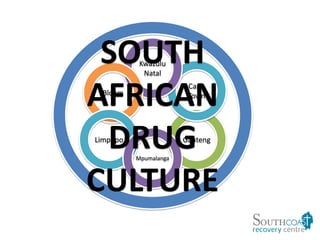
SOUTH
AFRICAN
DRUG
CULTURE
(South)
Africa
United
Kingdom
Europe
Asia
Australia
America
CULTURE
OF
ADDICTION
 As we progress from tribe to tribe, drug to
drug, social group to social group, we learn
more about the ways of life as outlined by the
culture of addiction.
 The longer we stay, and the deeper we go,
the more ingrained the culture becomes in
us.
 The more we learn the more we change.
 The culture of addiction is a context for
human needs to be met. Some of these needs
include:
 IDENTITY AND SELF ESTEEM – Addiction is
often rooted in insecurities, low self-esteem
and social anxieties (a feeling of not quite
fitting in).
 The culture provides a platform off of which
to find acceptance and to develop a new
identity through providing a set of values
morals and beliefs.
 Probably the biggest draw card of the culture
of addiction to the addict is the instant
acceptance into the culture just through the
use of a substance.
 Suddenly the addict has friends, has respect
and has found a sense of belonging.
 Drug taking is your entrance card into a world
that most addicts long for way before picking
up their first substance.
 Transforming stigma (looser, reject, no good)
to status.
 Adolescent needs:
 Many of us start to engage in the culture of
addiction in our teens which has it’s own
specific needs such as the need to:
 - develop a personal identity separate both
physically and emotionally from our family.
 - chart a path to ones adult role or career
amongst many others.
 The culture of addiction cleverly provides for
those needs.
 The Culture of addiction also provides:
knowledge on how and what to use, skills in
sustaining addiction and avoiding detection etc.
 There are specific milestones in the culture of
addiction. Joining the culture being the first.
 Contrary to popular belief almost all initial
drug consumption is characterized by the
following:
 Initial drug use takes place in a social context
with ones peers, the new addict very seldom
paying for the substance – drugs are provided
as a token of friendship.
 Initial use is sought after by the addict more
often than forced upon by others.
 Due to the social context the decision to use
seems natural and of no great consequence.
 In this stage the first regular drug purchases
are made by the addict.
 Preoccupation with drug supply begins and...
 ..the addict begins to desire the drug during
designated social activities.
 The addict begins to learn from more
experienced users, basic etiquette
surrounding rituals of use and learning
desirable precautions.
 Justifying usage through changing ideological
beliefs (belief structure – rooting in denial).
 The change in identity.
 Letting go of the outside world.
 Developing status and reputation within the
culture.
 Learning to hustle.
 Escaping and reframing consequences.
 Getting busted and “doing time”.
 “Doing treatment”, incarceration or death.
 The culture of addiction and the culture of
recovery are like twins who, while mirroring
each other in may ways pursue opposite paths –
one nurturing life and the other ultimately
embracing death.
 Like the culture of addiction the culture of
recovery is a way of life, a means of organising
ones daily existence. It is a way of talking,
dressing, gesturing, believing, working, playing,
thinking and seeing that separates those in
recovery from those who are not.
THE MIRROR IMAGE
CULTURE
OF
ADDICTION
CULTURE
OF
RECOVERYSOCIETY
 The physical
 The psychological
 The spiritual
 Relationships
 Lifestyle
 These are overlapping areas which need
to be addressed and recreated bringing
them from the effects of addiction into
recovery.
 Developmental tasks in this zone revolve
around three major areas:
 1. The adjustment of the body to the absence
of the drug.
 2. The treatment of acute and chronic health
problems.
 3. The construction of a health-enhancing
lifestyle.
 This is a complex process of reconstructing
the personality by eliminating the cognitive
defence structures that supported addiction
and replacing them with sobriety based
defence structures.
 Basically challenging thought patterns, the
management strategies of emotions and
attitudes, and recreating the belief structure
that underpins all of the above.
 The spiritual aspect of recovery is often the
initiating and driving force of the recovery
process.
 Redefining ones spiritual beliefs ultimately
guides you in the reconstruction of your
values, morals and ultimately behaviour.
 The spiritual aspects of recovery also open
new social networks that contribute to the
culture of recovery as a whole.
 This involves the reconstruction of intimate,
family and social relationships.
 As addicts we need to rebuild healthy, family
orientated relationships, we need to get rid of
our old relationships within our social
networks and create new ones.
 If addiction and recovery is a way of life then
defining and developing your lifestyle is a crucial
factor in recovery.
 This involves a systematic reconstruction of daily
life with a large amount of focus on routine and
balance.
 Remembering that the two cultures mirror each
other – your focus in recovery needs to be the
opposite to that of addiction with one similarity…
 The energy, drive and determination you put into
your addiction should now be put into your
recovery.
 There are some specific areas that need to be
worked on and upheld in order to encourage
continued development in the culture of
recovery.
 There needs to be a shift in these areas that
should be clear and visible enough to
separate you, as part of the recovery culture,
from those that are not.
 As addicts we cannot afford to leave traces of
the culture of addiction and must root out
them out.
 We focus on words we use (no swearing,
slang)
 We focus on conversation themes (no drug
talk, romanticizing, coarse jokes)
 We start talking recovery (terminology,
principles)
 We watch our tone (aggression, manipulative,
intimidating)
 We watch our body language (the way we
walk, our posture).
 We get rid of things like “secret” handshakes.
 Culturally enmeshed addicts surround
themselves with symbols identifying them to
the culture – drug paraphernalia, jewellery,
tattoos, clothes, hairstyles etc.
 We need to shed all symbolic items that we
associate to the culture of addiction weather
they have sentimental value or not. In holding
onto these items we are in a way holding onto
out identity rooted in the culture of addiction.
 Culturally enmeshed addicts entering
treatment must do two things.
 They must do alternative, recovery orientated
things to fill the void during times of drug
taking and …
 …they must develop a range of new rituals
that promote physical, spiritual and
emotional health, that build self-esteem and
enhance personal identity.
 Music – we have to change the music we listen to
(quite a controversial topic).
 Dress and appearance – this can easily keep us tied
into the culture.
 Social relationships and how and when those are
developed and nurtured (watching out for the new
modern age of facebook, BBM, whatsapp etc)
 Time orientation – most addicts live at night and
sleep during the day – this has to change. Friday
and Saturday nights become dangerous times etc.
 We will cover a lot of this in tomorrows
presentation.
FROMING A CULTURE OF RECOVERY
THROUGH SOCIAL NETWORKS
SCRC
HEAL/ NA/
AA
CHURCH
WORK
FAMILY
NEW
FRIENDS
JOHNNY’S
CULTURE
OF
RECOVERY
As recovering
addicts develop
their lifestyle they
are exposed to new
social networks.
These social
networks all have
their own values
and belief systems.
They have
prescribed patterns
of behaviours that
should obviously
promote a recovery
lifestyle.
Their affiliation to
each one of these
networks will help
in defining their
new identity and in
building self
esteem.
Johnny's first new
social network
 I hope you found this informative.
 I know there was a lot to take in.
 We will address some of these principles in
tomorrows relapse prevention planning
lecture.
 The impact of the family group held by Didi
will be after tea – this is for family members
only.
 See you at the talent show.

Fes culture

  • 2.
     A cultureis a way of life of a group of people -the behaviours, beliefs, values, and symbols that they accept, generally without thinking about them, and that are passed along by communication and imitation from one generation to the next.  Culture is the totality of a person's learned, accumulated experience which is socially transmitted…simply put…  Behaviour through social learning.
  • 3.
    BEHAVIOUR (Disorder) THOUGHTEMOTION ATTITUDE BELIEFSYSTEMS (Insecurity, social anxiety and fear) IDENTITY LIFESTYLE UNDERSTANDING OF ADDICTION IN TERMS OF BEHAVIOUR
  • 4.
     Addiction andrecovery are more than something that happens inside someone. Each involves deep human needs in interaction with a social environment.  For addicts, addiction meets a multiplicity of needs and the culture of addiction provides a valued platform where these needs can be met.  No treatment can be successful if it doesn’t offer a pathway to meet those same needs and provide an alternative social world that has perceived value and meaning.
  • 5.
     The cultureof addiction is an informal social network in which group norms (prescribed patterns of perceiving, thinking, feeling and behaving) promote and protect excessive drug use.  The culture of addiction is a way of life, a means of organising ones daily existence, and a way of viewing people and events in the outside world.  The culture of addiction plays a role in both initiating and sustaining substance abuse disorders.
  • 6.
    DAGGA Johnny's circle of friends Ecstasy Cocaine/ CAT Chrystal Meth Crack Heroin VISUALREPRESENTATION OF THE CULTURE OF ADDICTION All tribes are interlinked through individual members who belong to other tribes and ultimately are joined creating a bigger culture of shared group norms. Drug users seek out other drug users which mirror their use to form a tribe. BENONI DRUG CULTURE Each tribe has it’s own patterns of behaviours, beliefs, thinking patterns etc They have their own symbols, dress code, music preference and preferred lifestyle.
  • 7.
  • 8.
  • 9.
  • 10.
     As weprogress from tribe to tribe, drug to drug, social group to social group, we learn more about the ways of life as outlined by the culture of addiction.  The longer we stay, and the deeper we go, the more ingrained the culture becomes in us.  The more we learn the more we change.
  • 11.
     The cultureof addiction is a context for human needs to be met. Some of these needs include:  IDENTITY AND SELF ESTEEM – Addiction is often rooted in insecurities, low self-esteem and social anxieties (a feeling of not quite fitting in).  The culture provides a platform off of which to find acceptance and to develop a new identity through providing a set of values morals and beliefs.
  • 12.
     Probably thebiggest draw card of the culture of addiction to the addict is the instant acceptance into the culture just through the use of a substance.  Suddenly the addict has friends, has respect and has found a sense of belonging.  Drug taking is your entrance card into a world that most addicts long for way before picking up their first substance.  Transforming stigma (looser, reject, no good) to status.
  • 13.
     Adolescent needs: Many of us start to engage in the culture of addiction in our teens which has it’s own specific needs such as the need to:  - develop a personal identity separate both physically and emotionally from our family.  - chart a path to ones adult role or career amongst many others.  The culture of addiction cleverly provides for those needs.  The Culture of addiction also provides: knowledge on how and what to use, skills in sustaining addiction and avoiding detection etc.
  • 14.
     There arespecific milestones in the culture of addiction. Joining the culture being the first.  Contrary to popular belief almost all initial drug consumption is characterized by the following:  Initial drug use takes place in a social context with ones peers, the new addict very seldom paying for the substance – drugs are provided as a token of friendship.  Initial use is sought after by the addict more often than forced upon by others.  Due to the social context the decision to use seems natural and of no great consequence.
  • 15.
     In thisstage the first regular drug purchases are made by the addict.  Preoccupation with drug supply begins and...  ..the addict begins to desire the drug during designated social activities.  The addict begins to learn from more experienced users, basic etiquette surrounding rituals of use and learning desirable precautions.
  • 16.
     Justifying usagethrough changing ideological beliefs (belief structure – rooting in denial).  The change in identity.  Letting go of the outside world.  Developing status and reputation within the culture.  Learning to hustle.  Escaping and reframing consequences.  Getting busted and “doing time”.  “Doing treatment”, incarceration or death.
  • 17.
     The cultureof addiction and the culture of recovery are like twins who, while mirroring each other in may ways pursue opposite paths – one nurturing life and the other ultimately embracing death.  Like the culture of addiction the culture of recovery is a way of life, a means of organising ones daily existence. It is a way of talking, dressing, gesturing, believing, working, playing, thinking and seeing that separates those in recovery from those who are not.
  • 18.
  • 19.
     The physical The psychological  The spiritual  Relationships  Lifestyle  These are overlapping areas which need to be addressed and recreated bringing them from the effects of addiction into recovery.
  • 20.
     Developmental tasksin this zone revolve around three major areas:  1. The adjustment of the body to the absence of the drug.  2. The treatment of acute and chronic health problems.  3. The construction of a health-enhancing lifestyle.
  • 21.
     This isa complex process of reconstructing the personality by eliminating the cognitive defence structures that supported addiction and replacing them with sobriety based defence structures.  Basically challenging thought patterns, the management strategies of emotions and attitudes, and recreating the belief structure that underpins all of the above.
  • 22.
     The spiritualaspect of recovery is often the initiating and driving force of the recovery process.  Redefining ones spiritual beliefs ultimately guides you in the reconstruction of your values, morals and ultimately behaviour.  The spiritual aspects of recovery also open new social networks that contribute to the culture of recovery as a whole.
  • 23.
     This involvesthe reconstruction of intimate, family and social relationships.  As addicts we need to rebuild healthy, family orientated relationships, we need to get rid of our old relationships within our social networks and create new ones.
  • 24.
     If addictionand recovery is a way of life then defining and developing your lifestyle is a crucial factor in recovery.  This involves a systematic reconstruction of daily life with a large amount of focus on routine and balance.  Remembering that the two cultures mirror each other – your focus in recovery needs to be the opposite to that of addiction with one similarity…  The energy, drive and determination you put into your addiction should now be put into your recovery.
  • 25.
     There aresome specific areas that need to be worked on and upheld in order to encourage continued development in the culture of recovery.  There needs to be a shift in these areas that should be clear and visible enough to separate you, as part of the recovery culture, from those that are not.  As addicts we cannot afford to leave traces of the culture of addiction and must root out them out.
  • 26.
     We focuson words we use (no swearing, slang)  We focus on conversation themes (no drug talk, romanticizing, coarse jokes)  We start talking recovery (terminology, principles)  We watch our tone (aggression, manipulative, intimidating)  We watch our body language (the way we walk, our posture).  We get rid of things like “secret” handshakes.
  • 27.
     Culturally enmeshedaddicts surround themselves with symbols identifying them to the culture – drug paraphernalia, jewellery, tattoos, clothes, hairstyles etc.  We need to shed all symbolic items that we associate to the culture of addiction weather they have sentimental value or not. In holding onto these items we are in a way holding onto out identity rooted in the culture of addiction.
  • 28.
     Culturally enmeshedaddicts entering treatment must do two things.  They must do alternative, recovery orientated things to fill the void during times of drug taking and …  …they must develop a range of new rituals that promote physical, spiritual and emotional health, that build self-esteem and enhance personal identity.
  • 29.
     Music –we have to change the music we listen to (quite a controversial topic).  Dress and appearance – this can easily keep us tied into the culture.  Social relationships and how and when those are developed and nurtured (watching out for the new modern age of facebook, BBM, whatsapp etc)  Time orientation – most addicts live at night and sleep during the day – this has to change. Friday and Saturday nights become dangerous times etc.  We will cover a lot of this in tomorrows presentation.
  • 30.
    FROMING A CULTUREOF RECOVERY THROUGH SOCIAL NETWORKS SCRC HEAL/ NA/ AA CHURCH WORK FAMILY NEW FRIENDS JOHNNY’S CULTURE OF RECOVERY As recovering addicts develop their lifestyle they are exposed to new social networks. These social networks all have their own values and belief systems. They have prescribed patterns of behaviours that should obviously promote a recovery lifestyle. Their affiliation to each one of these networks will help in defining their new identity and in building self esteem. Johnny's first new social network
  • 31.
     I hopeyou found this informative.  I know there was a lot to take in.  We will address some of these principles in tomorrows relapse prevention planning lecture.  The impact of the family group held by Didi will be after tea – this is for family members only.  See you at the talent show.