SUBMITTED BY: AKSHAY SASIKUMAR
“Canyouhearmenow?”
〉 This is often the case in homes and buildings where coverage decreases considerably
as soon as you go indoors
〉 People are ditching their landlines in favor of mobile phones
〉 It has become necessary to work on new technology that will facilitate calling
coverage both indoor and outdoor
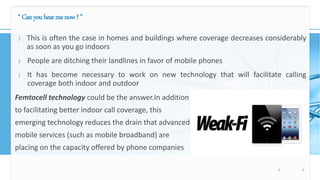
Femtocell technology could be the answer.In addition
to facilitating better indoor call coverage, this
emerging technology reduces the drain that advanced
mobile services (such as mobile broadband) are
placing on the capacity offered by phone companies
FEMTOCELL
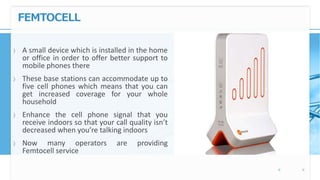
〉 A small device which is installed in the home
or office in order to offer better support to
mobile phones there
〉 These base stations can accommodate up to
five cell phones which means that you can
get increased coverage for your whole
household
〉 Enhance the cell phone signal that you
receive indoors so that your call quality isn’t
decreased when you’re talking indoors
〉 Now many operators are providing
Femtocell service
WHY IS FEMTOCELL IMPORTANT?
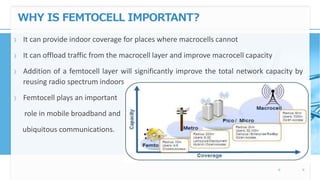
〉 It can provide indoor coverage for places where macrocells cannot
〉 It can offload traffic from the macrocell layer and improve macrocell capacity
〉 Addition of a femtocell layer will significantly improve the total network capacity by
reusing radio spectrum indoors
〉 Femtocell plays an important
role in mobile broadband and
ubiquitous communications.
FEMTOCELL : FEMTOFORUM
〉 Femtocells are low-power wireless access points
that operate in licensed spectrum to connect
standard mobile devices to a mobile operator’s
network using residential DSL or cable broadband
connections. [Femto forum]
〉 By 2013, 204 million users on 60 million access
points worldwide. [ABI Research]
〉 Femtocell base station is also known as home
basestation, home access point, or home Node B.
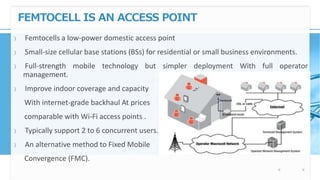
FEMTOCELL IS AN ACCESS POINT
〉 Femtocells a low-power domestic access point
〉 Small-size cellular base stations (BSs) for residential or small business environments.
〉 Full-strength mobile technology but simpler deployment With full operator
management.
〉 Improve indoor coverage and capacity
With internet-grade backhaul At prices
comparable with Wi-Fi access points .
〉 Typically support 2 to 6 concurrent users.
〉 An alternative method to Fixed Mobile
Convergence (FMC).
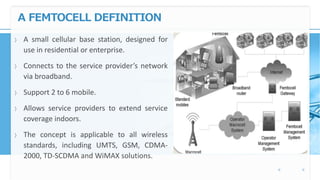
A FEMTOCELL DEFINITION
〉 A small cellular base station, designed for
use in residential or enterprise.
〉 Connects to the service provider’s network
via broadband.
〉 Support 2 to 6 mobile.
〉 Allows service providers to extend service
coverage indoors.
〉 The concept is applicable to all wireless
standards, including UMTS, GSM, CDMA-
2000, TD-SCDMA and WiMAX solutions.
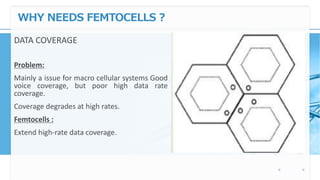
WHY NEEDS FEMTOCELLS ?
DATA COVERAGE
Problem:
Mainly a issue for macro cellular systems Good
voice coverage, but poor high data rate
coverage.
Coverage degrades at high rates.
Femtocells :
Extend high-rate data coverage.
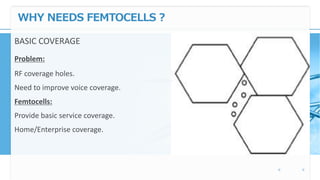
WHY NEEDS FEMTOCELLS ?
BASIC COVERAGE
Problem:
RF coverage holes.
Need to improve voice coverage.
Femtocells:
Provide basic service coverage.
Home/Enterprise coverage.
WHY NEEDS FEMTOCELLS ?
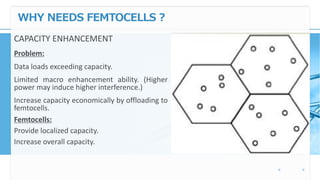
CAPACITY ENHANCEMENT
Problem:
Data loads exceeding capacity.
Limited macro enhancement ability. (Higher
power may induce higher interference.)
Increase capacity economically by offloading to
femtocells.
Femtocells:
Provide localized capacity.
Increase overall capacity.
BENEFITS OF FEMTOCELL NETWORKS : FOR
OPERATORS
〉 Low cost solution.
〉 Improve reliability.
〉 Increases both coverage and capacity.
〉 Reduce coverage holes and create new converged services.
〉 Reduce macrocell backhaul capacity requirements.
〉 Works with all existing handsets; no need for expensive subsidizes on dual-mode
(3G + Wi-Fi).
〉 Increases 3G adoption.
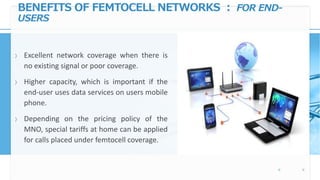
BENEFITS OF FEMTOCELL NETWORKS : FOR END-
USERS
〉 Excellent network coverage when there is
no existing signal or poor coverage.
〉 Higher capacity, which is important if the
end-user uses data services on users mobile
phone.
〉 Depending on the pricing policy of the
MNO, special tariffs at home can be applied
for calls placed under femtocell coverage.
FEATURES OF FEMTOCELL
〉 Operates in the licensed spectrum
〉 Uses fixed broadband connection for backhaul
〉 Principally intended for home
〉 Lower cost
〉 Smaller coverage
〉 Smaller number of subscriber
〉 Higher density
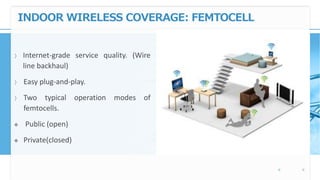
INDOOR WIRELESS COVERAGE: FEMTOCELL
〉 Internet-grade service quality. (Wire
line backhaul)
〉 Easy plug-and-play.
〉 Two typical operation modes of
femtocells.
 Public (open)
 Private(closed)
FEMTO USAGE MODEL
Public (Open):
〉 No restrictions on subscriber to use
the femtocell.
〉 All customers of a cellular service
providers can access publicly
accessible Femto-AP.
〉 Hotspot type scenario: coffee shop
or airport.
Private (Closed):
〉 Only authorized users are
allowed to connect to a privately
accessible Femto-AP.
〉 Access Control List.
〉 Home or enterprise
environments.
FEMTO CHARACTERISTICS
Physique
Physically small for limited space in some households/offices
Silent in operation while generating low levels of heat output
RF Power
T x RF power is between 10-100mW (lower than 1W by Wi-Fi)
3G handset is able to transmit at lower power levels when being close to the
femtocell
Coverage
Dedicated 3G coverage within a household (10-200m)
Designed for a capacity of 2 to 6 end-users
FEMTO CHARACTERISTICS
Backhaul
〉 Utilize Internet Protocol (IP) with a flat BS architecture
〉 Link to operator networks via wired broadband connections
Interference
〉 Macrocells vs. Femtocells
〉 Femtocells vs. Femtocells
Security
〉 Security risks due to broadband internet (open access)
〉 Network security is managed by the IPsec protocol
FEMTO CHARACTERISTICS
Operation
〉 Compatible with existing 2G/3G handsets and devices
〉 Operates in licensed spectrum owned by operators
〉 Remote configuration and monitoring system similar to that used by the macro
networks
〉 Remote management to enable QoS at the edge of the network
〉 Includes provision for a services environment on which applications may be added
Worldwide Standard Support
〉 Developed to support both 3GPP (UMTS) and 3GPP2 (CDMA)
〉 Also supports emerging technologies such as WiMAX and LTE
KEY ATTRIBUTES OF FEMTOCELLS
Mature mobile technology:
〉 Femtocells use fully standard wireless protocols over the air to communicate with
standard mobile devices, including mobile phones and a wide range of other mobile-
enabled devices.
Operating in licensed spectrum:
〉 By operating in licensed spectrum licensed to the service provider, femtocells allow
operators to provide assured quality of service to customers over the air, free from
harmful interference but making efficient use of their spectrum.
Generating coverage and capacity:
〉 As well as improving coverage within the home, femtocells also create extra network
capacity, serving a greater number of users with high data-rate services.
KEY ATTRIBUTES OF FEMTOCELLS
Using internet-grade backhaul:
Femtocells backhaul their data over standard residential broadband connections, including
DSL and cable, using standard internet protocols. This may be over a specific internet
service provider’s network, over the internet itself or over a dedicated link.
At competitive prices:
The large volumes envisaged for femtocells will allow substantial economies of scale,
driving efficiencies in manufacturing and distribution in a manner similar to the consumer
electronics industry and with pricing projected to be comparable with access points for
other wireless technologies.
Fully managed by licensed operators:
Femtocells only operate within parameters set by the licensed operator.The operator is
always able to create or deny service to individual femtocells or users. This control is
maintained whether the femtocell itself is owned by the operator or the end user.
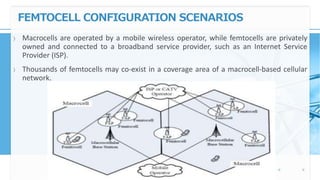
FEMTOCELL CONFIGURATION SCENARIOS
〉 Macrocells are operated by a mobile wireless operator, while femtocells are privately
owned and connected to a broadband service provider, such as an Internet Service
Provider (ISP).
〉 Thousands of femtocells may co-exist in a coverage area of a macrocell-based cellular
network.
FEMTOCELL NETWORK CONFIGURATION
〉 There are three possible types of femtocell network configurations based on the
availability of a broadband connection (e.g., ISP) and on the coverage of the macro
cellular network:
〉 Type A :a single stand-alone femtocell
〉 Type B : a network of stand-alone femtocells
〉 Type C : a femtocell network integrated with a macro cellular infrastructure
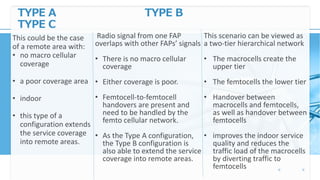
TYPE A TYPE B
TYPE C
This could be the case
of a remote area with:
• no macro cellular
coverage
• a poor coverage area
• indoor
• this type of a
configuration extends
the service coverage
into remote areas.
Radio signal from one FAP
overlaps with other FAPs’ signals
• There is no macro cellular
coverage
• Either coverage is poor.
• Femtocell-to-femtocell
handovers are present and
need to be handled by the
femto cellular network.
• As the Type A configuration,
the Type B configuration is
also able to extend the service
coverage into remote areas.
This scenario can be viewed as
a two-tier hierarchical network
• The macrocells create the
upper tier
• The femtocells the lower tier
• Handover between
macrocells and femtocells,
as well as handover between
femtocells
• improves the indoor service
quality and reduces the
traffic load of the macrocells
by diverting traffic to
femtocells
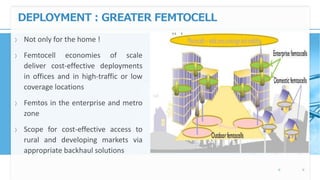
DEPLOYMENT : GREATER FEMTOCELL
〉 Not only for the home !
〉 Femtocell economies of scale
deliver cost-effective deployments
in offices and in high-traffic or low
coverage locations
〉 Femtos in the enterprise and metro
zone
〉 Scope for cost-effective access to
rural and developing markets via
appropriate backhaul solutions
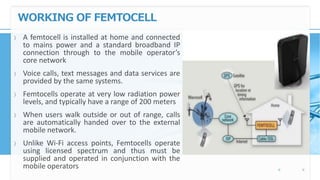
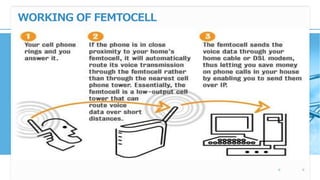
WORKING OF FEMTOCELL
〉 A femtocell is installed at home and connected
to mains power and a standard broadband IP
connection through to the mobile operator’s
core network
〉 Voice calls, text messages and data services are
provided by the same systems.
〉 Femtocells operate at very low radiation power
levels, and typically have a range of 200 meters
〉 When users walk outside or out of range, calls
are automatically handed over to the external
mobile network.
〉 Unlike Wi-Fi access points, Femtocells operate
using licensed spectrum and thus must be
supplied and operated in conjunction with the
mobile operators
WORKING OF FEMTOCELL
ISSUES
〉 INTERFERENCE
〉 EQUIPMENT LOCATION
〉 QUALITY OF SERVICE
〉 CONTROVERSY ON CONSUMER PROPOSITION
THANK YOU

Femtocell ppt

  • 1.
  • 2.
    “Canyouhearmenow?” 〉 This isoften the case in homes and buildings where coverage decreases considerably as soon as you go indoors 〉 People are ditching their landlines in favor of mobile phones 〉 It has become necessary to work on new technology that will facilitate calling coverage both indoor and outdoor Femtocell technology could be the answer.In addition to facilitating better indoor call coverage, this emerging technology reduces the drain that advanced mobile services (such as mobile broadband) are placing on the capacity offered by phone companies
  • 3.
    FEMTOCELL 〉 A smalldevice which is installed in the home or office in order to offer better support to mobile phones there 〉 These base stations can accommodate up to five cell phones which means that you can get increased coverage for your whole household 〉 Enhance the cell phone signal that you receive indoors so that your call quality isn’t decreased when you’re talking indoors 〉 Now many operators are providing Femtocell service
  • 4.
    WHY IS FEMTOCELLIMPORTANT? 〉 It can provide indoor coverage for places where macrocells cannot 〉 It can offload traffic from the macrocell layer and improve macrocell capacity 〉 Addition of a femtocell layer will significantly improve the total network capacity by reusing radio spectrum indoors 〉 Femtocell plays an important role in mobile broadband and ubiquitous communications.
  • 5.
    FEMTOCELL : FEMTOFORUM 〉Femtocells are low-power wireless access points that operate in licensed spectrum to connect standard mobile devices to a mobile operator’s network using residential DSL or cable broadband connections. [Femto forum] 〉 By 2013, 204 million users on 60 million access points worldwide. [ABI Research] 〉 Femtocell base station is also known as home basestation, home access point, or home Node B.
  • 6.
    FEMTOCELL IS ANACCESS POINT 〉 Femtocells a low-power domestic access point 〉 Small-size cellular base stations (BSs) for residential or small business environments. 〉 Full-strength mobile technology but simpler deployment With full operator management. 〉 Improve indoor coverage and capacity With internet-grade backhaul At prices comparable with Wi-Fi access points . 〉 Typically support 2 to 6 concurrent users. 〉 An alternative method to Fixed Mobile Convergence (FMC).
  • 7.
    A FEMTOCELL DEFINITION 〉A small cellular base station, designed for use in residential or enterprise. 〉 Connects to the service provider’s network via broadband. 〉 Support 2 to 6 mobile. 〉 Allows service providers to extend service coverage indoors. 〉 The concept is applicable to all wireless standards, including UMTS, GSM, CDMA- 2000, TD-SCDMA and WiMAX solutions.
  • 8.
    WHY NEEDS FEMTOCELLS? DATA COVERAGE Problem: Mainly a issue for macro cellular systems Good voice coverage, but poor high data rate coverage. Coverage degrades at high rates. Femtocells : Extend high-rate data coverage.
  • 9.
    WHY NEEDS FEMTOCELLS? BASIC COVERAGE Problem: RF coverage holes. Need to improve voice coverage. Femtocells: Provide basic service coverage. Home/Enterprise coverage.
  • 10.
    WHY NEEDS FEMTOCELLS? CAPACITY ENHANCEMENT Problem: Data loads exceeding capacity. Limited macro enhancement ability. (Higher power may induce higher interference.) Increase capacity economically by offloading to femtocells. Femtocells: Provide localized capacity. Increase overall capacity.
  • 11.
    BENEFITS OF FEMTOCELLNETWORKS : FOR OPERATORS 〉 Low cost solution. 〉 Improve reliability. 〉 Increases both coverage and capacity. 〉 Reduce coverage holes and create new converged services. 〉 Reduce macrocell backhaul capacity requirements. 〉 Works with all existing handsets; no need for expensive subsidizes on dual-mode (3G + Wi-Fi). 〉 Increases 3G adoption.
  • 12.
    BENEFITS OF FEMTOCELLNETWORKS : FOR END- USERS 〉 Excellent network coverage when there is no existing signal or poor coverage. 〉 Higher capacity, which is important if the end-user uses data services on users mobile phone. 〉 Depending on the pricing policy of the MNO, special tariffs at home can be applied for calls placed under femtocell coverage.
  • 13.
    FEATURES OF FEMTOCELL 〉Operates in the licensed spectrum 〉 Uses fixed broadband connection for backhaul 〉 Principally intended for home 〉 Lower cost 〉 Smaller coverage 〉 Smaller number of subscriber 〉 Higher density
  • 14.
    INDOOR WIRELESS COVERAGE:FEMTOCELL 〉 Internet-grade service quality. (Wire line backhaul) 〉 Easy plug-and-play. 〉 Two typical operation modes of femtocells.  Public (open)  Private(closed)
  • 15.
    FEMTO USAGE MODEL Public(Open): 〉 No restrictions on subscriber to use the femtocell. 〉 All customers of a cellular service providers can access publicly accessible Femto-AP. 〉 Hotspot type scenario: coffee shop or airport. Private (Closed): 〉 Only authorized users are allowed to connect to a privately accessible Femto-AP. 〉 Access Control List. 〉 Home or enterprise environments.
  • 16.
    FEMTO CHARACTERISTICS Physique Physically smallfor limited space in some households/offices Silent in operation while generating low levels of heat output RF Power T x RF power is between 10-100mW (lower than 1W by Wi-Fi) 3G handset is able to transmit at lower power levels when being close to the femtocell Coverage Dedicated 3G coverage within a household (10-200m) Designed for a capacity of 2 to 6 end-users
  • 17.
    FEMTO CHARACTERISTICS Backhaul 〉 UtilizeInternet Protocol (IP) with a flat BS architecture 〉 Link to operator networks via wired broadband connections Interference 〉 Macrocells vs. Femtocells 〉 Femtocells vs. Femtocells Security 〉 Security risks due to broadband internet (open access) 〉 Network security is managed by the IPsec protocol
  • 18.
    FEMTO CHARACTERISTICS Operation 〉 Compatiblewith existing 2G/3G handsets and devices 〉 Operates in licensed spectrum owned by operators 〉 Remote configuration and monitoring system similar to that used by the macro networks 〉 Remote management to enable QoS at the edge of the network 〉 Includes provision for a services environment on which applications may be added Worldwide Standard Support 〉 Developed to support both 3GPP (UMTS) and 3GPP2 (CDMA) 〉 Also supports emerging technologies such as WiMAX and LTE
  • 19.
    KEY ATTRIBUTES OFFEMTOCELLS Mature mobile technology: 〉 Femtocells use fully standard wireless protocols over the air to communicate with standard mobile devices, including mobile phones and a wide range of other mobile- enabled devices. Operating in licensed spectrum: 〉 By operating in licensed spectrum licensed to the service provider, femtocells allow operators to provide assured quality of service to customers over the air, free from harmful interference but making efficient use of their spectrum. Generating coverage and capacity: 〉 As well as improving coverage within the home, femtocells also create extra network capacity, serving a greater number of users with high data-rate services.
  • 20.
    KEY ATTRIBUTES OFFEMTOCELLS Using internet-grade backhaul: Femtocells backhaul their data over standard residential broadband connections, including DSL and cable, using standard internet protocols. This may be over a specific internet service provider’s network, over the internet itself or over a dedicated link. At competitive prices: The large volumes envisaged for femtocells will allow substantial economies of scale, driving efficiencies in manufacturing and distribution in a manner similar to the consumer electronics industry and with pricing projected to be comparable with access points for other wireless technologies. Fully managed by licensed operators: Femtocells only operate within parameters set by the licensed operator.The operator is always able to create or deny service to individual femtocells or users. This control is maintained whether the femtocell itself is owned by the operator or the end user.
  • 21.
    FEMTOCELL CONFIGURATION SCENARIOS 〉Macrocells are operated by a mobile wireless operator, while femtocells are privately owned and connected to a broadband service provider, such as an Internet Service Provider (ISP). 〉 Thousands of femtocells may co-exist in a coverage area of a macrocell-based cellular network.
  • 22.
    FEMTOCELL NETWORK CONFIGURATION 〉There are three possible types of femtocell network configurations based on the availability of a broadband connection (e.g., ISP) and on the coverage of the macro cellular network: 〉 Type A :a single stand-alone femtocell 〉 Type B : a network of stand-alone femtocells 〉 Type C : a femtocell network integrated with a macro cellular infrastructure
  • 23.
    TYPE A TYPEB TYPE C This could be the case of a remote area with: • no macro cellular coverage • a poor coverage area • indoor • this type of a configuration extends the service coverage into remote areas. Radio signal from one FAP overlaps with other FAPs’ signals • There is no macro cellular coverage • Either coverage is poor. • Femtocell-to-femtocell handovers are present and need to be handled by the femto cellular network. • As the Type A configuration, the Type B configuration is also able to extend the service coverage into remote areas. This scenario can be viewed as a two-tier hierarchical network • The macrocells create the upper tier • The femtocells the lower tier • Handover between macrocells and femtocells, as well as handover between femtocells • improves the indoor service quality and reduces the traffic load of the macrocells by diverting traffic to femtocells
  • 24.
    DEPLOYMENT : GREATERFEMTOCELL 〉 Not only for the home ! 〉 Femtocell economies of scale deliver cost-effective deployments in offices and in high-traffic or low coverage locations 〉 Femtos in the enterprise and metro zone 〉 Scope for cost-effective access to rural and developing markets via appropriate backhaul solutions
  • 25.
    WORKING OF FEMTOCELL 〉A femtocell is installed at home and connected to mains power and a standard broadband IP connection through to the mobile operator’s core network 〉 Voice calls, text messages and data services are provided by the same systems. 〉 Femtocells operate at very low radiation power levels, and typically have a range of 200 meters 〉 When users walk outside or out of range, calls are automatically handed over to the external mobile network. 〉 Unlike Wi-Fi access points, Femtocells operate using licensed spectrum and thus must be supplied and operated in conjunction with the mobile operators
  • 26.
  • 27.
    ISSUES 〉 INTERFERENCE 〉 EQUIPMENTLOCATION 〉 QUALITY OF SERVICE 〉 CONTROVERSY ON CONSUMER PROPOSITION
  • 28.