October 16 – 17, 2013
Hosted By:

North Carolina Military Business Center
Senator Richard Burr

Thank you to all FEDCON sponsors and
government, military & business participants
in the 2013 FEDCON Summit!
Ruth King, - McGill Premium Composts
Greg Russell - GARCO
- Fort Bragg DPW (Environmental)
- Camp Lejeune Public Works or MCIEast
Compost
&

the US Military

The US Military
“ Striving to become Sustainable”

Ruth King
McGill Premium Compost
October 17, 2013
Executive Orders
• President Bush signed an Executive Order
in January 2007 mandating “green
purchasing” requirements for federal
agencies.
• President Obama signed an Executive
Order in October 2009 focused on
Federal Leadership in
Environmental, Energy, and Economic
Performance.
Why compost?

Compost can help reach these
goals by offering solutions for
green purchasing
mandates, reducing residual
waste, and amending poor
soils.
Premium Compost
Utilizing premium compost will help
Federal & State Agencies achieve
their sustainability goals:
• Landscaping Applications
• Storm Water Management
• Erosion Control
• Athletic Fields
• Golf Courses
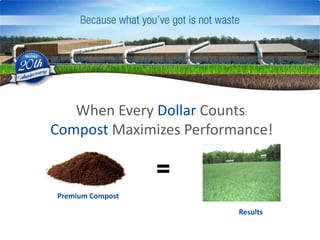
When Every Dollar Counts:
Compost Maximizes Performance!

=
Premium Compost
Results
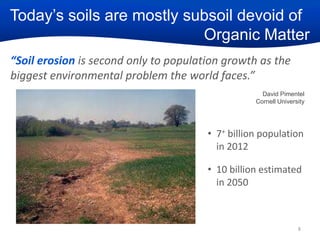
Today’s soils are mostly subsoil devoid of
Organic Matter
“Soil erosion is second only to population growth as the
biggest environmental problem the world faces.”
David Pimentel
Cornell University

• 7+ billion population
in 2012
• 10 billion estimated
in 2050

8
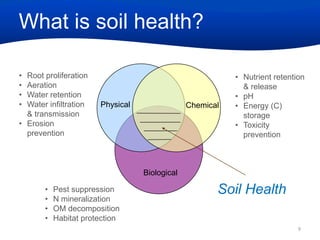
What is soil health?
•
•
•
•

Root proliferation
Aeration
Water retention
Water infiltration
& transmission
• Erosion
prevention

Physical

Chemical

• Nutrient retention
& release
• pH
• Energy (C)
storage
• Toxicity
prevention

Biological
•
•
•
•

Pest suppression
N mineralization
OM decomposition
Habitat protection

Soil Health
9
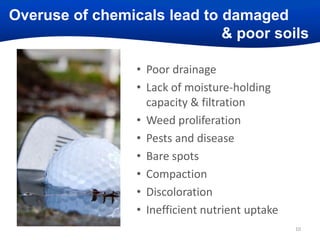
Overuse of chemicals lead to damaged
& poor soils

OM

Topsoil
Subsoil

• Poor drainage
• Lack of moisture-holding
capacity & filtration
• Weed proliferation
• Pests and disease
• Bare spots
• Compaction
• Discoloration
• Inefficient nutrient uptake
10
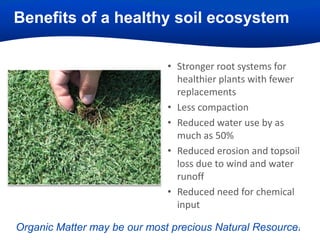
Benefits of a healthy soil ecosystem

OM

Topsoil
Subsoil

• Stronger root systems for
healthier plants with fewer
replacements
• Less compaction
• Reduced water use by as
much as 50%
• Reduced erosion and topsoil
loss due to wind and water
runoff
• Reduced need for chemical
input

11
Organic Matter may be our most precious Natural Resource.
Organics Recycling & Compost Use –
A Sustainable System
Premium Compost
• Improves nutrient uptake
• Holds more applied
nutrients at the root zone to
reduce leaching and runoff
• Reduces chemical input
• Improves resistance to pests
and disease
• Saves water increases pore
spaces for better filtration of
water

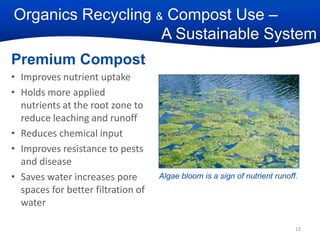
Algae bloom is a sign of nutrient runoff.

12
Organics Recycling & Compost Use =
A Sustainable System
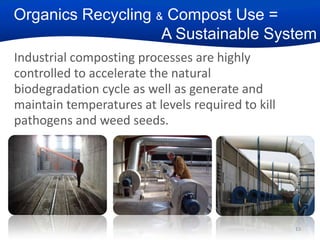
Industrial composting processes are highly
controlled to accelerate the natural
biodegradation cycle as well as generate and
maintain temperatures at levels required to kill
pathogens and weed seeds.

13
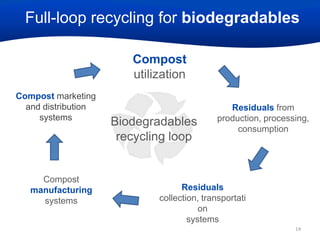
Full-loop recycling for biodegradables
Compost
utilization
Compost marketing
and distribution
systems

Compost
manufacturing
systems

Biodegradables
recycling loop

Residuals from
production, processing,
consumption

Residuals
collection, transportati
on
systems
14
Full-loop recycling for biodegradables
Companies and communities that practice full-loop recycling
deserve special recognition and that calls for compost production
on an industrial scale.
We invite each of you to join McGill to help “Lock the Loop.”

15
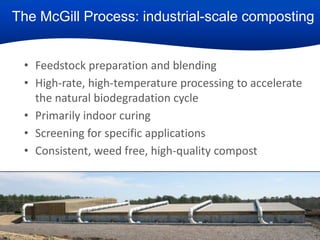
The McGill Process: industrial-scale composting
• Feedstock preparation and blending
• High-rate, high-temperature processing to accelerate
the natural biodegradation cycle
• Primarily indoor curing
• Screening for specific applications
• Consistent, weed free, high-quality compost

16
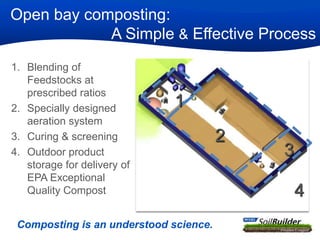
Open bay composting:
A Simple & Effective Process
1. Blending of
Feedstocks at
prescribed ratios
2. Specially designed
aeration system
3. Curing & screening
4. Outdoor product
storage for delivery of
EPA Exceptional
Quality Compost

1

Composting is an understood science.

2

3

4
17
Local feedstocks = Local Products
• Yard waste and land clearing debris
•
•
•
•
•

Food waste and cooking grease
Biosolids and water treatment sludge
Paper, pallets, & waxed/un-waxed cardboard
Industrial by-products
Sawdust, wood chips, other woody materials

18
Feedstock Variety = Premium Compost
• The correlation between feedstock selection
and the composting process results in a
Premium “Nutrient Rich” Compost.
• Yard waste compost is a low nutrient compost
that can rob the plant of needed carbon.
• The addition of food waste and biosolids
results in a richer, more complete quality
compost product.
• Proprietary Blend: 2/3 green waste & 1/3
biosolids and pre/post consumer food waste
19
• Opened first facility in 1991
• 6 facilities located in the United States & Ireland with
a new facility slated to open in SC by end of 2014
• Indoor operations control process & compost quality
• Operating 365/24/7
• ~100 employees
• Recycled 4 million+ tons of raw materials since 1991
• Manufactured 3.5 million+ cubic yards of product
20
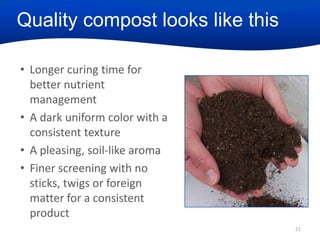
Quality compost looks like this
• Longer curing time for
better nutrient
management
• A dark uniform color with a
consistent texture
• A pleasing, soil-like aroma
• Finer screening with no
sticks, twigs or foreign
matter for a consistent
product
21
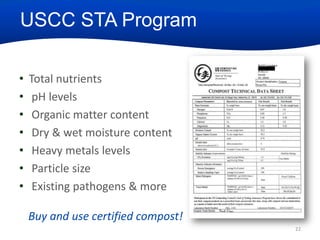
USCC STA Program
•
•
•
•
•
•
•

Total nutrients
pH levels
Organic matter content
Dry & wet moisture content
Heavy metals levels
Particle size
Existing pathogens & more
Buy and use certified compost!
22
Benefits lead to values
Compost
• Excels at slope stabilization and vegetation in
difficult locations
• Produces better results than erosion control
matting
• Is approved for use by NC, SC, VA DOTs
• Increases turf establishment
• Is eligible for LEED points
23
LEED, Sustainable Sites credits

Compost BMPs can contribute credits in 5 categories
24
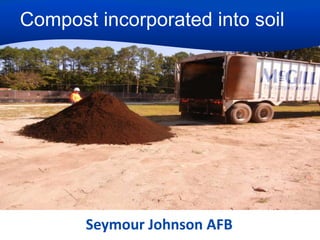
Compost incorporated into soil

Seymour Johnson AFB
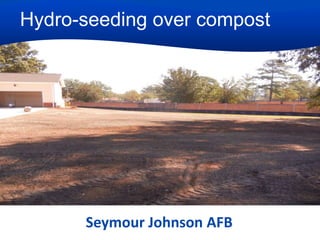
Hydro-seeding over compost

Seymour Johnson AFB
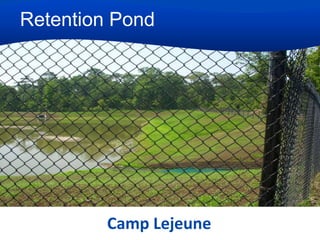
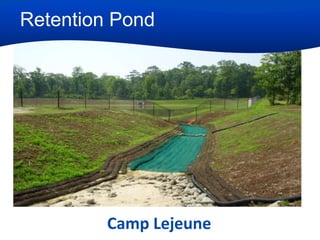
Retention Pond

Camp Lejeune
Retention Pond

Camp Lejeune
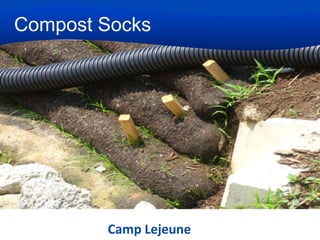
Compost Socks

Camp Lejeune
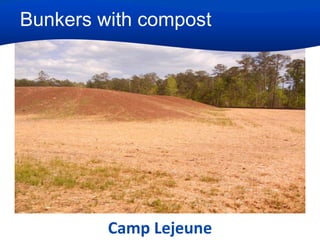
Bunkers with compost

Camp Lejeune
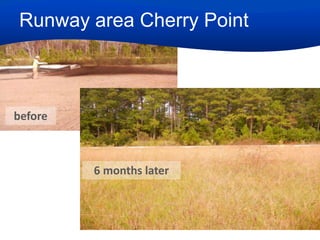
Runway area Cherry Point

before

6 months later
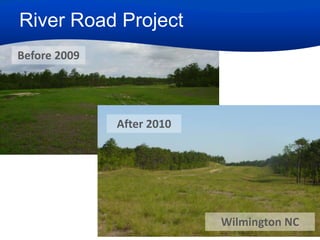
River Road Project
Before 2009

After 2010

Wilmington NC
Questions?

Ruth King
Account Sales Rep
McGill Compost sales

rking@mcgillcompost.com
(M) 910-604-4111

www.mcgillsoilbuilder.com
33
October 16 – 17, 2013
Hosted By:

North Carolina Military Business Center
Senator Richard Burr

Thank you to all FEDCON sponsors and
government, military & business participants
in the 2013 FEDCON Summit!

FEDCON Summit: Waste and Pollution Reduction Programs, Projects & Industry Experience

  • 1.
    October 16 –17, 2013 Hosted By: North Carolina Military Business Center Senator Richard Burr Thank you to all FEDCON sponsors and government, military & business participants in the 2013 FEDCON Summit!
  • 2.
    Ruth King, -McGill Premium Composts Greg Russell - GARCO - Fort Bragg DPW (Environmental) - Camp Lejeune Public Works or MCIEast
  • 3.
    Compost & the US Military TheUS Military “ Striving to become Sustainable” Ruth King McGill Premium Compost October 17, 2013
  • 4.
    Executive Orders • PresidentBush signed an Executive Order in January 2007 mandating “green purchasing” requirements for federal agencies. • President Obama signed an Executive Order in October 2009 focused on Federal Leadership in Environmental, Energy, and Economic Performance.
  • 5.
    Why compost? Compost canhelp reach these goals by offering solutions for green purchasing mandates, reducing residual waste, and amending poor soils.
  • 6.
    Premium Compost Utilizing premiumcompost will help Federal & State Agencies achieve their sustainability goals: • Landscaping Applications • Storm Water Management • Erosion Control • Athletic Fields • Golf Courses
  • 7.
    When Every DollarCounts: Compost Maximizes Performance! = Premium Compost Results
  • 8.
    Today’s soils aremostly subsoil devoid of Organic Matter “Soil erosion is second only to population growth as the biggest environmental problem the world faces.” David Pimentel Cornell University • 7+ billion population in 2012 • 10 billion estimated in 2050 8
  • 9.
    What is soilhealth? • • • • Root proliferation Aeration Water retention Water infiltration & transmission • Erosion prevention Physical Chemical • Nutrient retention & release • pH • Energy (C) storage • Toxicity prevention Biological • • • • Pest suppression N mineralization OM decomposition Habitat protection Soil Health 9
  • 10.
    Overuse of chemicalslead to damaged & poor soils OM Topsoil Subsoil • Poor drainage • Lack of moisture-holding capacity & filtration • Weed proliferation • Pests and disease • Bare spots • Compaction • Discoloration • Inefficient nutrient uptake 10
  • 11.
    Benefits of ahealthy soil ecosystem OM Topsoil Subsoil • Stronger root systems for healthier plants with fewer replacements • Less compaction • Reduced water use by as much as 50% • Reduced erosion and topsoil loss due to wind and water runoff • Reduced need for chemical input 11 Organic Matter may be our most precious Natural Resource.
  • 12.
    Organics Recycling &Compost Use – A Sustainable System Premium Compost • Improves nutrient uptake • Holds more applied nutrients at the root zone to reduce leaching and runoff • Reduces chemical input • Improves resistance to pests and disease • Saves water increases pore spaces for better filtration of water Algae bloom is a sign of nutrient runoff. 12
  • 13.
    Organics Recycling &Compost Use = A Sustainable System Industrial composting processes are highly controlled to accelerate the natural biodegradation cycle as well as generate and maintain temperatures at levels required to kill pathogens and weed seeds. 13
  • 14.
    Full-loop recycling forbiodegradables Compost utilization Compost marketing and distribution systems Compost manufacturing systems Biodegradables recycling loop Residuals from production, processing, consumption Residuals collection, transportati on systems 14
  • 15.
    Full-loop recycling forbiodegradables Companies and communities that practice full-loop recycling deserve special recognition and that calls for compost production on an industrial scale. We invite each of you to join McGill to help “Lock the Loop.” 15
  • 16.
    The McGill Process:industrial-scale composting • Feedstock preparation and blending • High-rate, high-temperature processing to accelerate the natural biodegradation cycle • Primarily indoor curing • Screening for specific applications • Consistent, weed free, high-quality compost 16
  • 17.
    Open bay composting: ASimple & Effective Process 1. Blending of Feedstocks at prescribed ratios 2. Specially designed aeration system 3. Curing & screening 4. Outdoor product storage for delivery of EPA Exceptional Quality Compost 1 Composting is an understood science. 2 3 4 17
  • 18.
    Local feedstocks =Local Products • Yard waste and land clearing debris • • • • • Food waste and cooking grease Biosolids and water treatment sludge Paper, pallets, & waxed/un-waxed cardboard Industrial by-products Sawdust, wood chips, other woody materials 18
  • 19.
    Feedstock Variety =Premium Compost • The correlation between feedstock selection and the composting process results in a Premium “Nutrient Rich” Compost. • Yard waste compost is a low nutrient compost that can rob the plant of needed carbon. • The addition of food waste and biosolids results in a richer, more complete quality compost product. • Proprietary Blend: 2/3 green waste & 1/3 biosolids and pre/post consumer food waste 19
  • 20.
    • Opened firstfacility in 1991 • 6 facilities located in the United States & Ireland with a new facility slated to open in SC by end of 2014 • Indoor operations control process & compost quality • Operating 365/24/7 • ~100 employees • Recycled 4 million+ tons of raw materials since 1991 • Manufactured 3.5 million+ cubic yards of product 20
  • 21.
    Quality compost lookslike this • Longer curing time for better nutrient management • A dark uniform color with a consistent texture • A pleasing, soil-like aroma • Finer screening with no sticks, twigs or foreign matter for a consistent product 21
  • 22.
    USCC STA Program • • • • • • • Totalnutrients pH levels Organic matter content Dry & wet moisture content Heavy metals levels Particle size Existing pathogens & more Buy and use certified compost! 22
  • 23.
    Benefits lead tovalues Compost • Excels at slope stabilization and vegetation in difficult locations • Produces better results than erosion control matting • Is approved for use by NC, SC, VA DOTs • Increases turf establishment • Is eligible for LEED points 23
  • 24.
    LEED, Sustainable Sitescredits Compost BMPs can contribute credits in 5 categories 24
  • 25.
    Compost incorporated intosoil Seymour Johnson AFB
  • 26.
  • 27.
  • 28.
  • 29.
  • 30.
  • 31.
    Runway area CherryPoint before 6 months later
  • 32.
    River Road Project Before2009 After 2010 Wilmington NC
  • 33.
    Questions? Ruth King Account SalesRep McGill Compost sales rking@mcgillcompost.com (M) 910-604-4111 www.mcgillsoilbuilder.com 33
  • 34.
    October 16 –17, 2013 Hosted By: North Carolina Military Business Center Senator Richard Burr Thank you to all FEDCON sponsors and government, military & business participants in the 2013 FEDCON Summit!

Editor's Notes

  • #9 Reversing the toll human development and food production have taken on our soils, requires establishing BMPs for your Turfgrass programs to help alleviate the loss of organic matter in ourtopsoil, by establishing more sustainable practices to protect the environment and satisfy new storm water regulations. What most of us think of as soil is really subsoil, incapable of sustaining plant life or the microbial populations responsible for soil functions, the problem is so acute, it is now threatening global food supplies & increasing the challenges of growing and sustaining Turfgrass & plant life. Utilizing compost will help fix these challenges – WE believe it is the only soil amendment that can – but compost use is still just one component of a sustainable system. We need a commitment by everyone to return organics back into the soil for an increase of healthy soils.
  • #11 We see this loss of soil productivity every day as contemporary horticulture and agriculture struggle to keep soils at acceptable performance levels, mostly, through commercialchemical input. Billions of dollars are spent each year trying to fix or mitigate these problems without long-term success, because these so-called solutions only address symptoms and are not attacking the underlying cause – depleted soil.There’s only one lasting remedy for a dead or damaged soil ecosystem -- and that’s compost.Billions of dollars are spent each year trying to fix or mitigate these problems without long-term success, because these so-called solutions only address symptoms and are not attacking the underlying cause – depleted soil.There’s only one lasting remedy for a dead or damaged soil ecosystem -- and that’s compost.
  • #12 Compost delivers these benefits through adjustments to the physical, chemical, and biological properties of the soil.
  • #13 Compost helps to create healthy soils: supporting healthy plant growth, adds nutrients, protects plants from disease, possesses good soil structure. Healthily soil resists compaction, provides storm water infiltration, prevents erosion, reduces summer watering requirements, improves water holding capacity, filters out pollutants (oil, metals, pesticides, excess nutrients), & reduces need for chemical inputs.
  • #14 Industrial composting processes are highly controlled to accelerate the natural biodegradation cycle, as well as generate and maintain temperatures at levels required to kill pathogens and weed seeds.
  • #15 When compost is used to grow raw materials, the first stop on the sustainability loop is residuals generated from the production, processing and consumption of those materials. Because, once collected, all of these residuals become another type of raw material, one used in the manufacture of compost products, and that’s where companies like McGill make their contribution to the organics recycling loop.
  • #16 Our new “Lock the Loop” program has been developed to recognize customers that practice full-circle sustainability and help our retailers promote products within participating communities. Companies and communities that practice full-loop recycling deserve special recognition, because they not only send food waste and other organics off to be recycled, but also use the compost manufactured from their own residuals and by-products.  If you are interested in participating in the L-the-L program let us know and we can provide you with our new logo to incorporate into your marketing materials.
  • #17 Industrial composting processes are highly controlled to accelerate the natural biodegradation cycle, as well as generate and maintain temperatures at levels required to kill pathogens and weed seeds.
  • #18 The basics of the McGill composting process are quite simple:Raw materials are blended according to prescribed ratios to meet process goals.The blended admixture is placed on a specially designed aeration floor which delivers air to the composting mass. This serves two functions – it delivers oxygen and removes excess heat – and thereby maintains ideal conditions for the aerobic microbial populations responsible for biodegradation.When processing is complete, the compost is transferred to active or passive curing, and at this point, the product has met all requirements for an EPA Exceptional Quality compost, suitable for unrestricted end use.
  • #19 Food waste and food processing by-products come to us from many sources. Almost all of our food waste business is pre-consumer. Post-consumer makes up less than one percent of our annual food-related intake.
  • #20 At McGill, we believe the best compost is formulated from a variety of materials, not just one or two. In fact, food waste & Biosolids should be blended with other materials – most commonly, yard waste, chipped wood, and/or sawdust for a finished product ratio of about 2/3rd ‘Green Waste’ & 1/3rd Biosolids & pre & post consumer food waste creating our proprietary blend. This helps to create a high nutrient product for ultimate results, as shown by TxDOT, a pioneer in compost application with 50% of its total compost use made from a Biosoilds/yard trimming blend.
  • #21 Read slide
  • #22 Read slide
  • #23 McGill participates in the U.S. Composting Council’s Seal of Testing Assurance program. It is a testing and reporting program developed to help specifiers and end users to get the compost product that they require for their particular program. This program was developed to provide quality standards to help consumers evaluate the many types of compost products on the market.An explanation of the significance of each parameter, along with recommended ranges, is included with every STA report.