FEATURE                Satellite Transmission Technology


         H-8PSK
         Hierarchical                                                                                                       •	backwards compatible to regular DVB-S2


         Modulation
                                                                                                                            •	useful to pack SD and HD version of a tv
                                                                                                                            program into one transponder
                                                                                                                            •	very sensitive to misalignment
                                                                                                                            •	may remain a niche technology


134 TELE-satellite International — The World‘s Largest Digital TV Trade Magazine — 06-07-08/2012 — www.TELE-satellite.com      www.TELE-satellite.com — 06-07-08/2012 — TELE-satellite International — 全球发行量最大的数字电视杂志   135
FEATURE                Satellite Transmission Technology


Hide the SD inside the HD
Jacek Pawlowski


  If you examine satellite charts, you
                                                                                                                            ■ Figure 1.
will see that DVB-S2 transponders                                                              Unmodulated carrier
usually use 8PSK or QPSK modula-
tion. However these two modulations
are not the only possibilities the DVB-
S2 standard specifies. Except for
the four basic modulation schemes:
QPSK, 8PSK, 16APSK, 32APSK, the
norm gives you other interesting op-
tions. In another Feature story in
TELE-satellite we report on the Vari-
able & Adaptive Coding and Modula-
                                                                                                                            ■ Figure 2.
tion (VCM/ACM). In this article, we                                                         QPSK modulated carrier
would like to discuss yet another pos-
sibility. It is called H-8PSK and it is a
form of a hierarchical modulation.

  In the classical DVB-S, one tran-
sponder is able to transmit just one
transport stream. Of course, there
can be a number of TV and radio pro-
grams multiplexed in one transport
stream. However, everything in this                                                                                         ■ Figure 3.
                                                                                            QPSK phase shift [deg]
transport stream is transmitted with
one modulation and one forward er-
ror correction (FEC) setting, for ex-
ample: QPSK 3/4.

  H-8PSK is a method to transmit
two transport streams in one trans-
mission channel and thus by one
transponder. These two transport
streams are modulated in different
ways onto the radio frequency car-                                               Bit stream after QPSK demodulation         ■ Figure 4.
rier and may have quite different
FEC values. The transport streams
are designated as the high priority
(HP) stream and the low priority (LP)
stream. H-8PSK is a rather unique
concept in digital TV as it provides                    A symbol in QPSK is simply 2 suc-
backward compatibility what is not                      cessive bits in a bit stream. So we                                 ■ Figure 5.
so common in digital world. Namely,                     have just four possibilities – as men-
every DVB-S receiver should be able                     tioned above. For each symbol value,
to receive a HP stream. Only the re-                    one specific phase shift is assigned.
ception of the LP stream requires a                     These are respectively: 45, 135, 225
H8-PSK compatible DVB-S2 receiver.                      and 315 degrees. Figure 3 shows
How does it work?                                       the phase shift corresponding to the
                                                        modulation shown in the example in
  Let’s start with a reminder of a                      Figure 2.
classical QPSK modulation. Figure
1 shows an unmodulated RF carrier                         Your receiver converts the received
and in Figure 2 this carrier is QPSK                    phase shift and converts each phase
modulated with all possible combina-                    shift to a pair of a bit. So the output
tions of a symbol: 00, 10, 11 and 01.                   of a QPSK demodulator supplied with


136 TELE-satellite International — The World‘s Largest Digital TV Trade Magazine — 06-07-08/2012 — www.TELE-satellite.com
in eight possible phase shifts in H-                                                                                                 we have N bit streams, in the N+1 peri-
                                                                                              ■ Figure 6.         8PSK instead of four in QPSK - see                                                                                 ■ Figure 11.      od of time, the first bit stream appears
                                                                                                                  Figure 7. In practice, θ should be                                                                                                   again and so on. At any given moment,
                                                                                                                  something between 7-12°.                                                                                                             only one bit stream is transmitted. It is
                                                                                                                                                                                                                                                       called “time multiplexing”. In H-8PSK,
                                                                                                                    3 bits are assigned to every possi-                                                                                                there are exactly two bit streams and
                                                                                                                  ble phase shift in a H-8PSK constella-                                                                                               both are transmitted simultaneously.
                                                                                                                  tion. Except for the 2 bits that create                                                                                              They can differ in FEC.
                                                                                                                  a 2-bit symbol like in QPSK, there is
                                                                                                                  one additional bit shown in blue ink                                                                                                   There are already receivers (or tun-
                                                                                                                  in Figure 7. The HP stream is still                                                                                                  ers in the form of PC cards) available
                                                                                                                  coded like in a QPSK modulation. For                                                                                                 on the market that can demodulate
                                                                                                                  example, if we need to send a sym-                                                                                                   H-8PSK. But what about real trans-
                                                                                                                  bol 00 we use 45° but we additionally                                                                                                missions? One of the satellite charts
                                                                                                                  take into account one bit from the LP                                                                                                available on the Internet denoted
                                                                                                                  stream and depending on its value,                                                                                                   three transponders on HOTBIRD 13°
                                                                                                                  we either increase or decrease 45°                                                                                                   East as using H-8PSK modulation.
                                                                                                                  by θ°. As you can see, for every 2                                                                                                   The other charts did not confirm this
                                                                                                                  bits of the HP stream, we send one                                                                                                   information. So, we connected 3 dif-
                                                                                                                  bit of the LP stream.                                                                                                                ferent signal analyzers that we had in
                                                                                                                                                                                                                                                       our lab to an antenna aimed at HOT-
                                                                                                                    Let’s examine an example in which                                                                                                  BIRD to check how the constellation
                                                                                                                  our original QPSK stream is enhanced                                                                                                 of those signals look. We have to say,
                                                                                                                  with LP stream. In our example, we                                                                                                   that those signals were NOT H-8PSK
                                                                                                                  increased the QPSK shifts by θ° for                                                                                                  modulated. We checked later a few
                                                                                                                  the first 2 symbols and decreased it                                                                                                 more European satellites to see if
                                                                                                                  by θ° for the successive 2 symbols.                                                                                                  anybody transmitted with H-8PSK but
                                                                                                                  The result is shown in Figure 8. Fig-                                                                                                did not find any transponder. If you
                                                                                                                  ure 9 and 10 show the HP and LP bit                                                                                                  have a satellite signal analyzer capa-
                                                                                                                  streams resulting from demodula-                                                                                                     ble of showing signal constellation, it
                                                                                                                  tion.                                                                                                                                should be able to lock to H-8PSK as to
the signal as in Figure 2 would look                    new values: greater by θ° and less                                                                  stellation diagrams, it would look like     an LP stream available, will try to lock       normal QPSK with symbol rate equal
like the picture in Figure 4.                           by θ°. For example instead of 45°, we                      Should we wanted to present our          Figure 11.                                  to the H-8PSK phase shifts instead of          to that of the HP stream. If the symbol
                                                        get 45°- θ° and 45°- θ°. This results                     H-8PSK example with a series of con-                                                  QPSK and it will extract both streams.         rate is not known and your analyzer
  Almost always, the QPSK modula-                                                                                                                             Now, a regular QPSK receiver                                                             has no blind scan feature it might be
tion is explained with a constellation                                                                                                                      should recognize the 8-PSK modula-            It is important to note that H-8PSK          time consuming for you to guess the
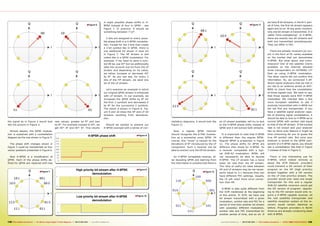
                                                                                               H-8PSK phase shift                             ■ Figure 8.
diagram as the one shown in Figure 5.                                                                                                                       tion as a somewhat noisy QPSK. Of           is different than the regular 8PSK.            true HP symbol rate. But once your
                                                                                                                                                            course, this “noise” is caused by the       Regular 8PSK is presented in Figure            analyzer is locked to the QPSK com-
  The phase shift changes shown in                                                                                                                          deviations of θ° introduced by the LP       12. The phase shifts for 8PSK are              ponent of a H-8PSK signal, you should
Figure 3 could be represented as four                                                                                                                       component. Such a receiver will be          different than those for H-8PSK. So            see a constellation like that in Figure
vector positions presented in Figure 6.                                                                                                                     able to extract only the HP bit stream.     a receiver compatible with a typi-             7 instead of that in Figure 5.
                                                                                                                                                                                                        cal DVB-S2 modulation: 8PSK, will
   Now H-8PSK is a modification of                                                                                                                            An H-8PSK compatible receiver, af-        not necessarily be able to decode                There is one interesting use for
QPSK. Each of the phase shifts de-                                                                                                                          ter decoding QPSK and learning from         H-8PSK. The LP stream has a twice              H-8PSK, which indeed reminds us
fined for QPSK are replaced with two                                                                                                                        the information it contains that there is   lower bit rate than the HP stream.             about the VCM feature: providers
                                                                                                                                                                                                        The ratio of useful bit rates between          could transmit a SD version of their
                                                                                 High priority bit stream after H-8PSK                        ■ Figure 9.                                               HP and LP streams may be not neces-            program on the HP (high priority)
                                      ■ Figure 7.                                                                                                                                       ■ Figure 12.    sarily equal to 2:1 because they can           stream together with a HD version
                                                                                             demodulation
                                                                                                                                                                                                        have different FEC settings. Usually,          on the LP (low pirority) stream. The
                                                                                                                                                                                                        the LP will need more error correc-            provider would only need one single
                                                                                                                                                                                                        tion than HP.                                  transponder for this and a regular
                                                                                                                                                                                                                                                       DVB-S2 satellite receivers would get
                                                                                                                                                                                                          H-8PSK is also quite different from          the SD version of program. Upgrad-
                                                                                                                                                                                                        the VCM mentioned at the beginning             ing to the HD version would only re-
                                                                                                                                             ■ Figure 10.                                               of this article. In VCM, we have one           quire a H-8PSK capable receiver, all
                                                                                 Low priority bit stream after H-8PSK
                                                                                                                                                                                                        bit stream transmitted with a given            the rest (satellite transponder and
                                                                                            demodulation                                                                                                modulation, symbol rate and FEC for a          satellite reception system at the re-
                                                                                                                                                                                                        period of time then another bit stream         ceiver) would remain identical as
                                                                                                                                                                                                        with (possibly) different modulation,          before. Program providers in North
                                                                                                                                                                                                        symbol rate and FEC transmitted for            America are already conducting tests
                                                                                                                                                                                                        another period of time, and so on. If          with 8-8PSK.


138 TELE-satellite International — The World‘s Largest Digital TV Trade Magazine — 06-07-08/2012 — www.TELE-satellite.com                                                                                www.TELE-satellite.com — 06-07-08/2012 — TELE-satellite International — 全球发行量最大的数字电视杂志   139

Feature 8psk

  • 1.
    FEATURE Satellite Transmission Technology H-8PSK Hierarchical • backwards compatible to regular DVB-S2 Modulation • useful to pack SD and HD version of a tv program into one transponder • very sensitive to misalignment • may remain a niche technology 134 TELE-satellite International — The World‘s Largest Digital TV Trade Magazine — 06-07-08/2012 — www.TELE-satellite.com www.TELE-satellite.com — 06-07-08/2012 — TELE-satellite International — 全球发行量最大的数字电视杂志 135
  • 2.
    FEATURE Satellite Transmission Technology Hide the SD inside the HD Jacek Pawlowski If you examine satellite charts, you ■ Figure 1. will see that DVB-S2 transponders Unmodulated carrier usually use 8PSK or QPSK modula- tion. However these two modulations are not the only possibilities the DVB- S2 standard specifies. Except for the four basic modulation schemes: QPSK, 8PSK, 16APSK, 32APSK, the norm gives you other interesting op- tions. In another Feature story in TELE-satellite we report on the Vari- able & Adaptive Coding and Modula- ■ Figure 2. tion (VCM/ACM). In this article, we QPSK modulated carrier would like to discuss yet another pos- sibility. It is called H-8PSK and it is a form of a hierarchical modulation. In the classical DVB-S, one tran- sponder is able to transmit just one transport stream. Of course, there can be a number of TV and radio pro- grams multiplexed in one transport stream. However, everything in this ■ Figure 3. QPSK phase shift [deg] transport stream is transmitted with one modulation and one forward er- ror correction (FEC) setting, for ex- ample: QPSK 3/4. H-8PSK is a method to transmit two transport streams in one trans- mission channel and thus by one transponder. These two transport streams are modulated in different ways onto the radio frequency car- Bit stream after QPSK demodulation ■ Figure 4. rier and may have quite different FEC values. The transport streams are designated as the high priority (HP) stream and the low priority (LP) stream. H-8PSK is a rather unique concept in digital TV as it provides A symbol in QPSK is simply 2 suc- backward compatibility what is not cessive bits in a bit stream. So we ■ Figure 5. so common in digital world. Namely, have just four possibilities – as men- every DVB-S receiver should be able tioned above. For each symbol value, to receive a HP stream. Only the re- one specific phase shift is assigned. ception of the LP stream requires a These are respectively: 45, 135, 225 H8-PSK compatible DVB-S2 receiver. and 315 degrees. Figure 3 shows How does it work? the phase shift corresponding to the modulation shown in the example in Let’s start with a reminder of a Figure 2. classical QPSK modulation. Figure 1 shows an unmodulated RF carrier Your receiver converts the received and in Figure 2 this carrier is QPSK phase shift and converts each phase modulated with all possible combina- shift to a pair of a bit. So the output tions of a symbol: 00, 10, 11 and 01. of a QPSK demodulator supplied with 136 TELE-satellite International — The World‘s Largest Digital TV Trade Magazine — 06-07-08/2012 — www.TELE-satellite.com
  • 3.
    in eight possiblephase shifts in H- we have N bit streams, in the N+1 peri- ■ Figure 6. 8PSK instead of four in QPSK - see ■ Figure 11. od of time, the first bit stream appears Figure 7. In practice, θ should be again and so on. At any given moment, something between 7-12°. only one bit stream is transmitted. It is called “time multiplexing”. In H-8PSK, 3 bits are assigned to every possi- there are exactly two bit streams and ble phase shift in a H-8PSK constella- both are transmitted simultaneously. tion. Except for the 2 bits that create They can differ in FEC. a 2-bit symbol like in QPSK, there is one additional bit shown in blue ink There are already receivers (or tun- in Figure 7. The HP stream is still ers in the form of PC cards) available coded like in a QPSK modulation. For on the market that can demodulate example, if we need to send a sym- H-8PSK. But what about real trans- bol 00 we use 45° but we additionally missions? One of the satellite charts take into account one bit from the LP available on the Internet denoted stream and depending on its value, three transponders on HOTBIRD 13° we either increase or decrease 45° East as using H-8PSK modulation. by θ°. As you can see, for every 2 The other charts did not confirm this bits of the HP stream, we send one information. So, we connected 3 dif- bit of the LP stream. ferent signal analyzers that we had in our lab to an antenna aimed at HOT- Let’s examine an example in which BIRD to check how the constellation our original QPSK stream is enhanced of those signals look. We have to say, with LP stream. In our example, we that those signals were NOT H-8PSK increased the QPSK shifts by θ° for modulated. We checked later a few the first 2 symbols and decreased it more European satellites to see if by θ° for the successive 2 symbols. anybody transmitted with H-8PSK but The result is shown in Figure 8. Fig- did not find any transponder. If you ure 9 and 10 show the HP and LP bit have a satellite signal analyzer capa- streams resulting from demodula- ble of showing signal constellation, it tion. should be able to lock to H-8PSK as to the signal as in Figure 2 would look new values: greater by θ° and less stellation diagrams, it would look like an LP stream available, will try to lock normal QPSK with symbol rate equal like the picture in Figure 4. by θ°. For example instead of 45°, we Should we wanted to present our Figure 11. to the H-8PSK phase shifts instead of to that of the HP stream. If the symbol get 45°- θ° and 45°- θ°. This results H-8PSK example with a series of con- QPSK and it will extract both streams. rate is not known and your analyzer Almost always, the QPSK modula- Now, a regular QPSK receiver has no blind scan feature it might be tion is explained with a constellation should recognize the 8-PSK modula- It is important to note that H-8PSK time consuming for you to guess the H-8PSK phase shift ■ Figure 8. diagram as the one shown in Figure 5. tion as a somewhat noisy QPSK. Of is different than the regular 8PSK. true HP symbol rate. But once your course, this “noise” is caused by the Regular 8PSK is presented in Figure analyzer is locked to the QPSK com- The phase shift changes shown in deviations of θ° introduced by the LP 12. The phase shifts for 8PSK are ponent of a H-8PSK signal, you should Figure 3 could be represented as four component. Such a receiver will be different than those for H-8PSK. So see a constellation like that in Figure vector positions presented in Figure 6. able to extract only the HP bit stream. a receiver compatible with a typi- 7 instead of that in Figure 5. cal DVB-S2 modulation: 8PSK, will Now H-8PSK is a modification of An H-8PSK compatible receiver, af- not necessarily be able to decode There is one interesting use for QPSK. Each of the phase shifts de- ter decoding QPSK and learning from H-8PSK. The LP stream has a twice H-8PSK, which indeed reminds us fined for QPSK are replaced with two the information it contains that there is lower bit rate than the HP stream. about the VCM feature: providers The ratio of useful bit rates between could transmit a SD version of their High priority bit stream after H-8PSK ■ Figure 9. HP and LP streams may be not neces- program on the HP (high priority) ■ Figure 7. ■ Figure 12. sarily equal to 2:1 because they can stream together with a HD version demodulation have different FEC settings. Usually, on the LP (low pirority) stream. The the LP will need more error correc- provider would only need one single tion than HP. transponder for this and a regular DVB-S2 satellite receivers would get H-8PSK is also quite different from the SD version of program. Upgrad- the VCM mentioned at the beginning ing to the HD version would only re- ■ Figure 10. of this article. In VCM, we have one quire a H-8PSK capable receiver, all Low priority bit stream after H-8PSK bit stream transmitted with a given the rest (satellite transponder and demodulation modulation, symbol rate and FEC for a satellite reception system at the re- period of time then another bit stream ceiver) would remain identical as with (possibly) different modulation, before. Program providers in North symbol rate and FEC transmitted for America are already conducting tests another period of time, and so on. If with 8-8PSK. 138 TELE-satellite International — The World‘s Largest Digital TV Trade Magazine — 06-07-08/2012 — www.TELE-satellite.com www.TELE-satellite.com — 06-07-08/2012 — TELE-satellite International — 全球发行量最大的数字电视杂志 139