COMPONENTS OF BUILDING
DEFINITION OF BUILDING:
DEFINITION OF BUILDING: (
(AS PER NBC-SP7-1970)
AS PER NBC-SP7-1970)
ANY STRUCTURE FOR WHATSOEVER PURPOSE AND OF
WHATSOEVER MATERIALS CONSTRUCTED AND EVERY PART
THEREOF WHETHER USED AS HUMN HABITATION OR NOT
AND INCLUDES FOUNDATION, PLINTH, WALLS, FLOORS,
ROOFS, CHIMNEYS, PLUMBING AND BUILDING SERVICES
FIXED PLATFORMS, VERANDAH, BALCONY, CORNICE OR
PROJECTION, PART OF A BUILDING OR ANYTHING
AFFIXED THERETO OR ANY WALL ENCLOSING OR
INTENDED TO ENCLOSE ANY LAND OR SPACE AND SIGNS
AND OUTDOOR DISPLAY STRUCTURES. TENTS , SHAMIANAS
AND TARPAULIN SHELTERS ARE NOT CONSIDERED AS
BUILDING
BUILDING.
.
BASIC COMPONENTS OF BUILDING
SUB – STRUCTURE:
SUB – STRUCTURE:
The part of the structure which is
The part of the structure which is
below the ground level.
For building structure the part of the
For building structure the part of the
structure below the plinth level is call
sub-structure.
sub-structure.
SUPER – STRUCTURE:
SUPER – STRUCTURE:
The part of the structure which is
The part of the structure which is
above the ground leve.
COMPONENTS OF
COMPONENTS OF
SUB-STRUCTURE
SUB-STRUCTURE
FOUNDATION (footing)
FOUNDATION (footing)
PCC
PCC
PLINTH
PLINTH
DPC (DAMP PROOF COURSE)
DPC (DAMP PROOF COURSE)
WALLS
WALLS
PILLARS AND COLUMNS
PILLARS AND COLUMNS
DOORS
DOORS
WINDOWS
WINDOWS
WINDOW SILLS
WINDOW SILLS
LINTELS AND ARCHES
LINTELS AND ARCHES
WEATHER SHADES, CHAJJAS AND
WEATHER SHADES, CHAJJAS AND
SUNBREAKERS
SUNBREAKERS
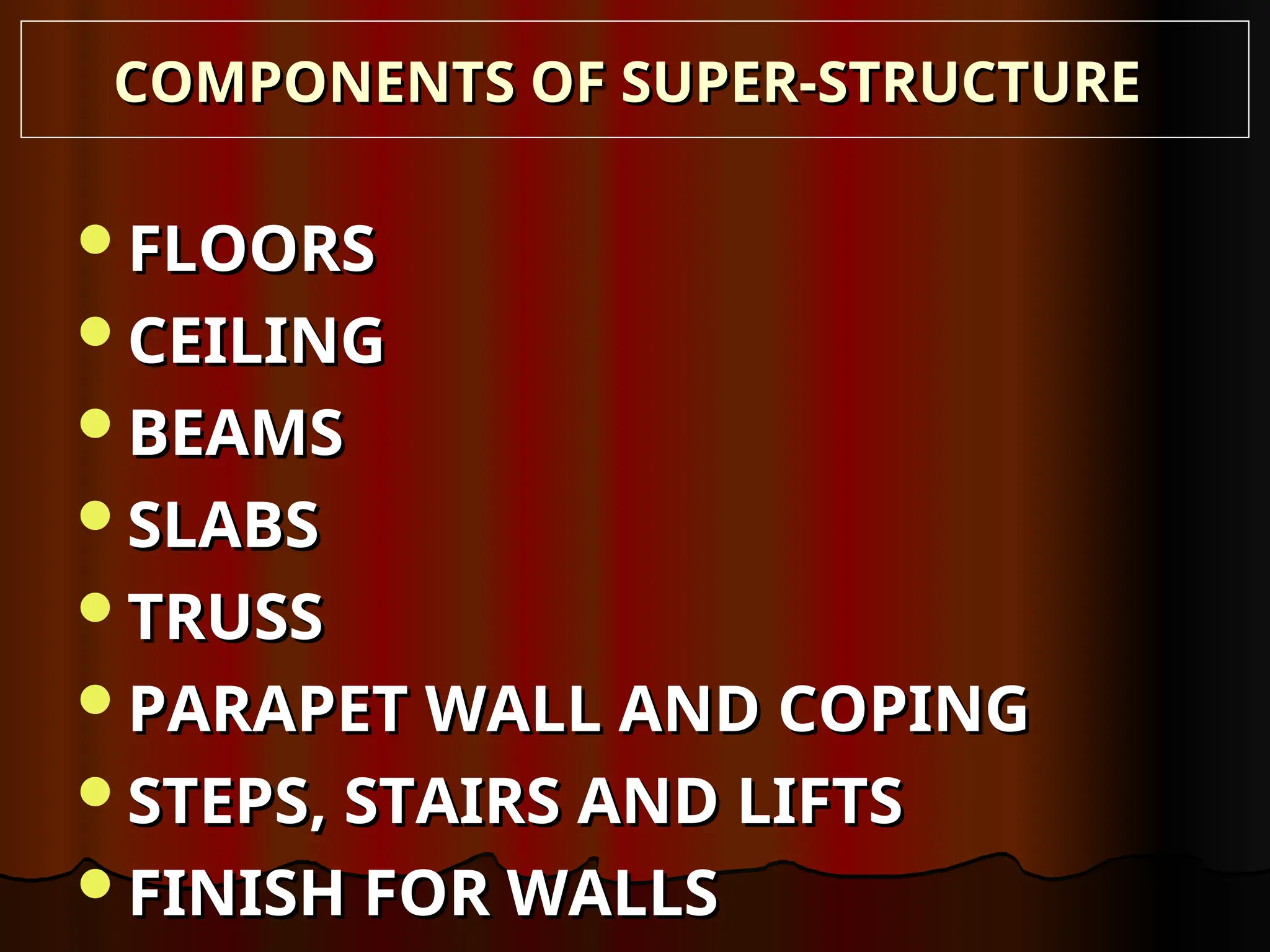
COMPONENTS OF SUPER-STRUCTURE
FLOORS
FLOORS
CEILING
CEILING
BEAMS
BEAMS
SLABS
SLABS
TRUSS
TRUSS
PARAPET WALL AND COPING
PARAPET WALL AND COPING
STEPS, STAIRS AND LIFTS
STEPS, STAIRS AND LIFTS
FINISH FOR WALLS
FINISH FOR WALLS
COMPONENTS OF SUPER-STRUCTURE
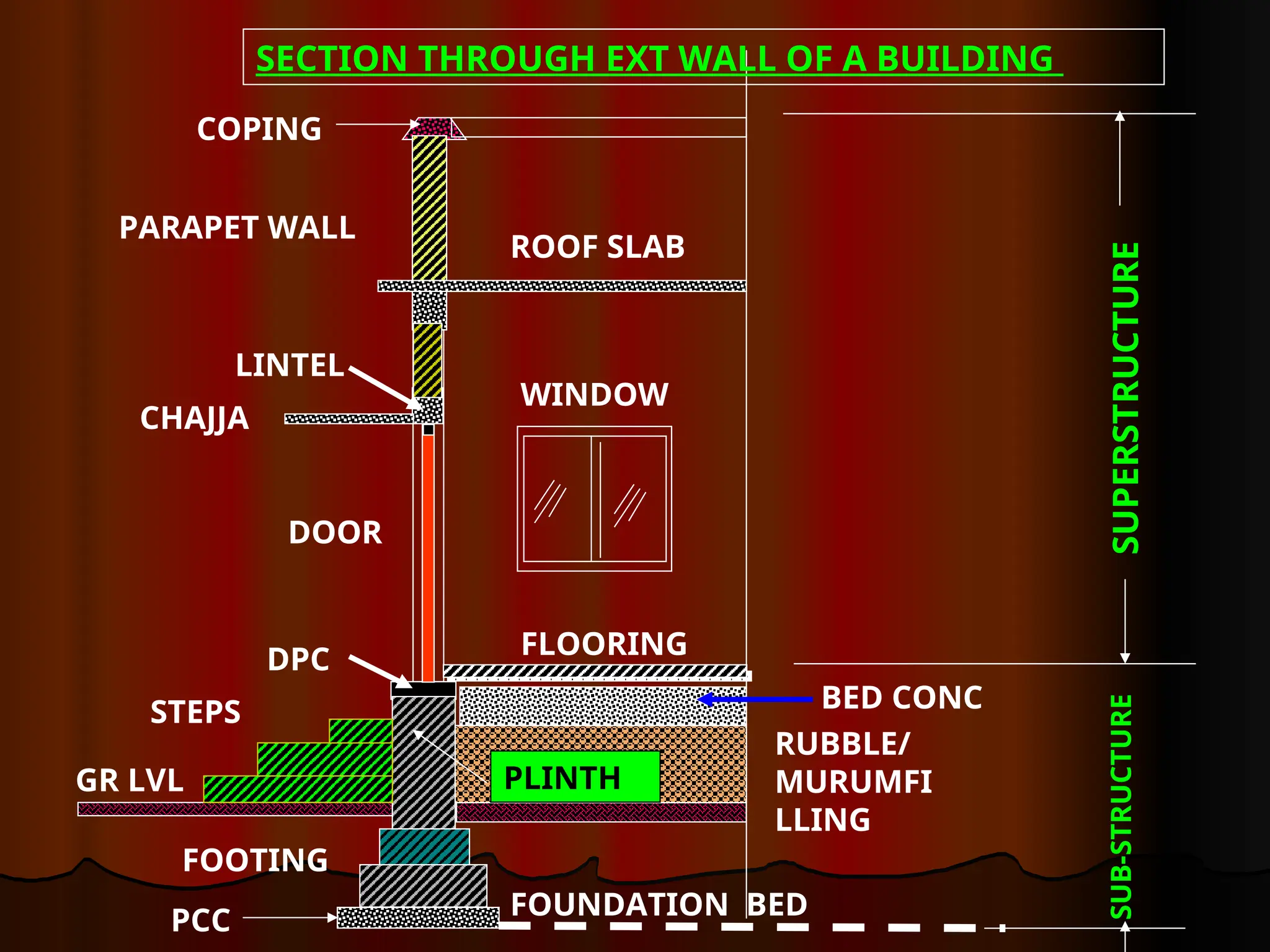
FOUNDATION BED
PCC
FOOTING
STEPS
GR LVL
WINDOW
CHAJJA
LINTEL
DOOR
PARAPET WALL
COPING
ROOF SLAB
FLOORING
BED CONC
DPC
RUBBLE/
MURUMFI
LLING
SUPERSTRUCTURE
SUB-STRUCTURE
SECTION THROUGH EXT WALL OF A BUILDING
PLINTH
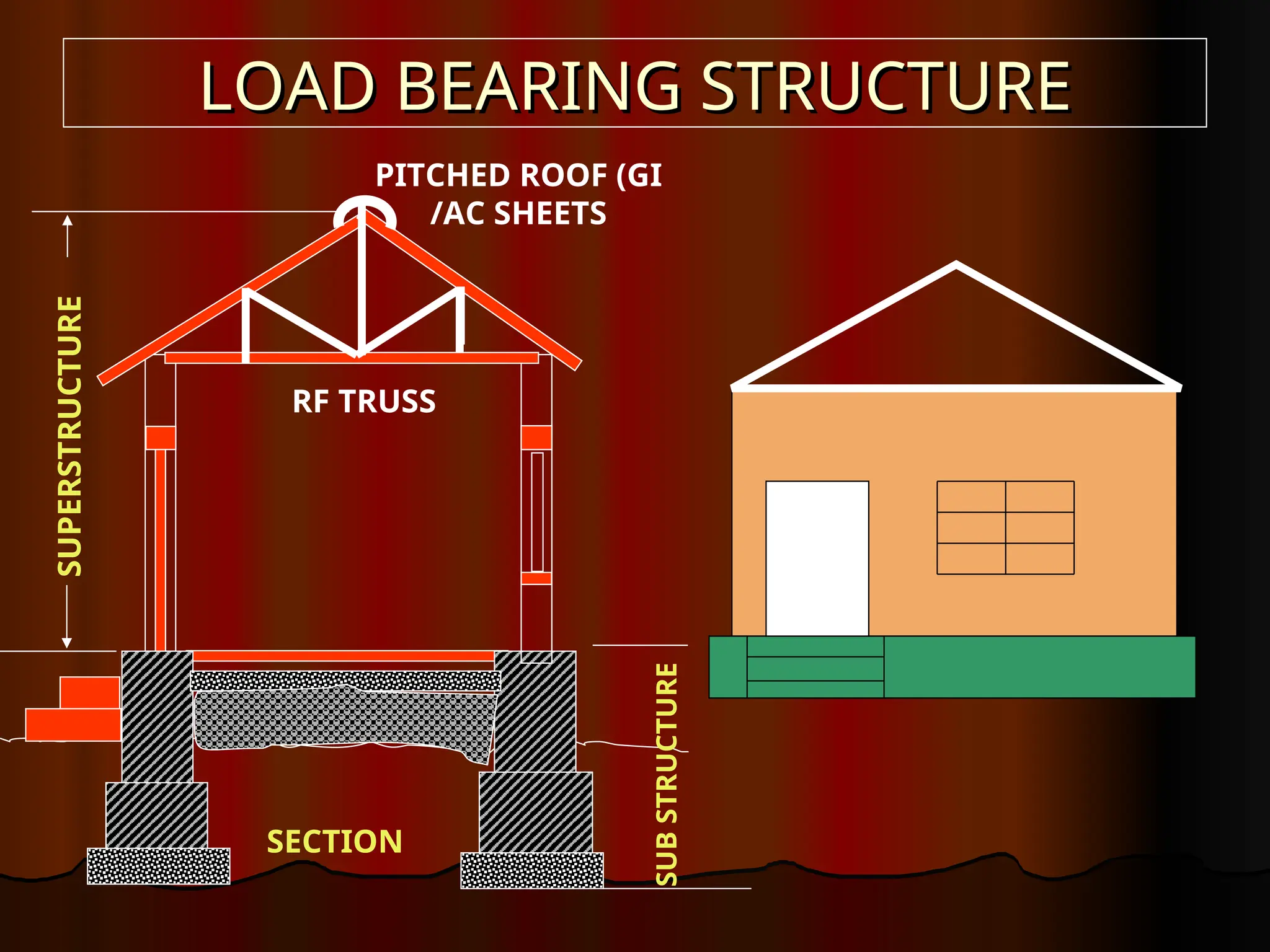
LOAD BEARING STRUCTURE
SUB
STRUCTURE
SUPERSTRUCTURE
SECTION
PITCHED ROOF (GI
/AC SHEETS
RF TRUSS
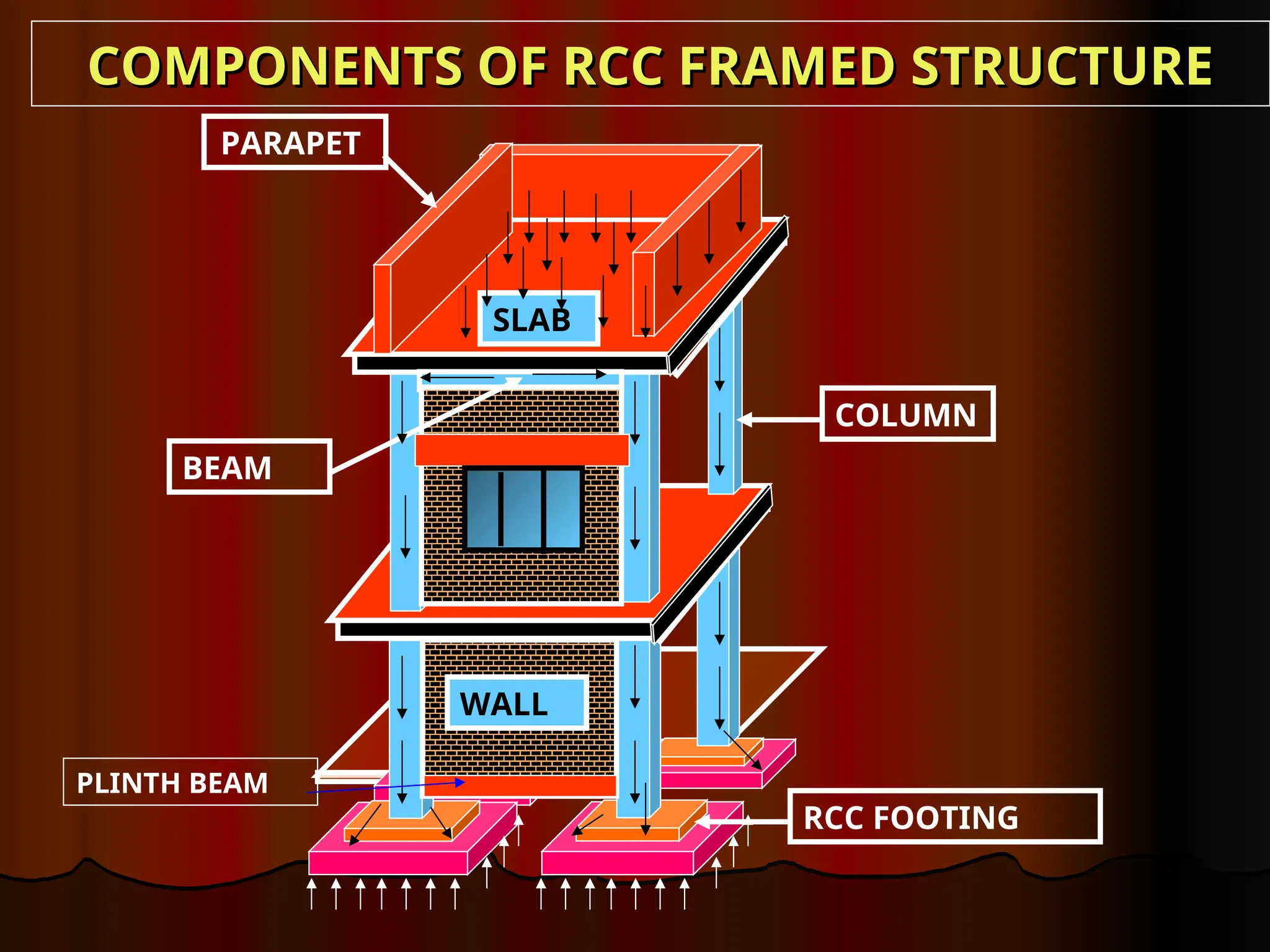
COMPONENTS OF RCC FRAMED STRUCTURE
COLUMN
PARAPET
BEAM
RCC FOOTING
SLAB
WALL
PLINTH BEAM
FUNCTIONS OF COMPONENTS
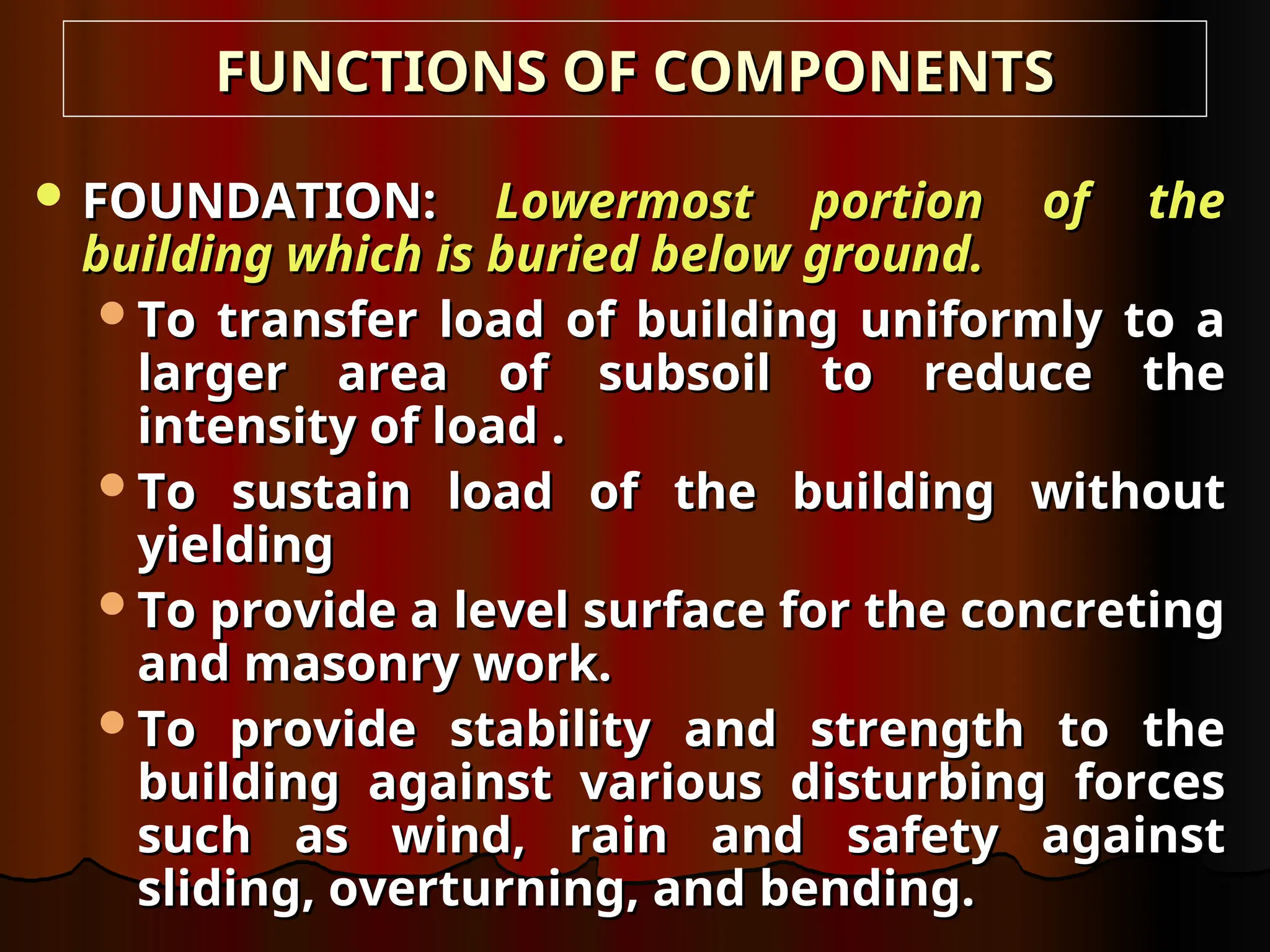
 FOUNDATION:
FOUNDATION: Lowermost portion of the
Lowermost portion of the
building which is buried below ground.
To transfer load of building uniformly to a
To transfer load of building uniformly to a
larger area of subsoil to reduce the
intensity of load .
intensity of load .
To sustain load of the building without
To sustain load of the building without
yielding
yielding
To provide a level surface for the concreting
To provide a level surface for the concreting
and masonry work.
and masonry work.
To provide stability and strength to the
To provide stability and strength to the
building against various disturbing forces
such as wind, rain and safety against
sliding, overturning, and bending.
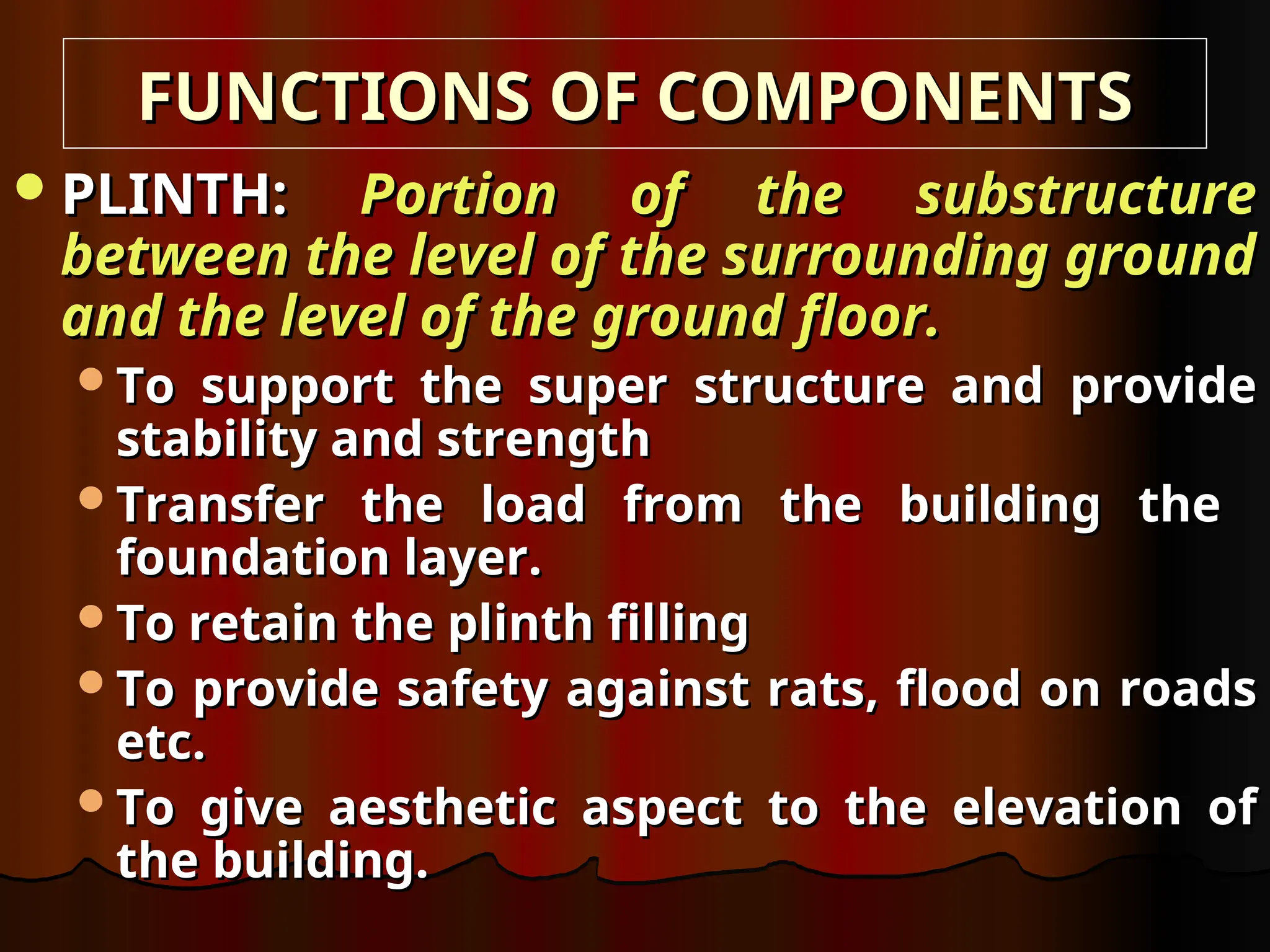
PLINTH:
PLINTH: Portion of the substructure
Portion of the substructure
between the level of the surrounding ground
and the level of the ground floor.
To support the super structure and provide
To support the super structure and provide
stability and strength
Transfer the load from the building the
Transfer the load from the building the
foundation layer.
foundation layer.
To retain the plinth filling
To retain the plinth filling
To provide safety against rats, flood on roads
To provide safety against rats, flood on roads
etc.
etc.
To give aesthetic aspect to the elevation of
To give aesthetic aspect to the elevation of
the building.
the building.
FUNCTIONS OF COMPONENTS
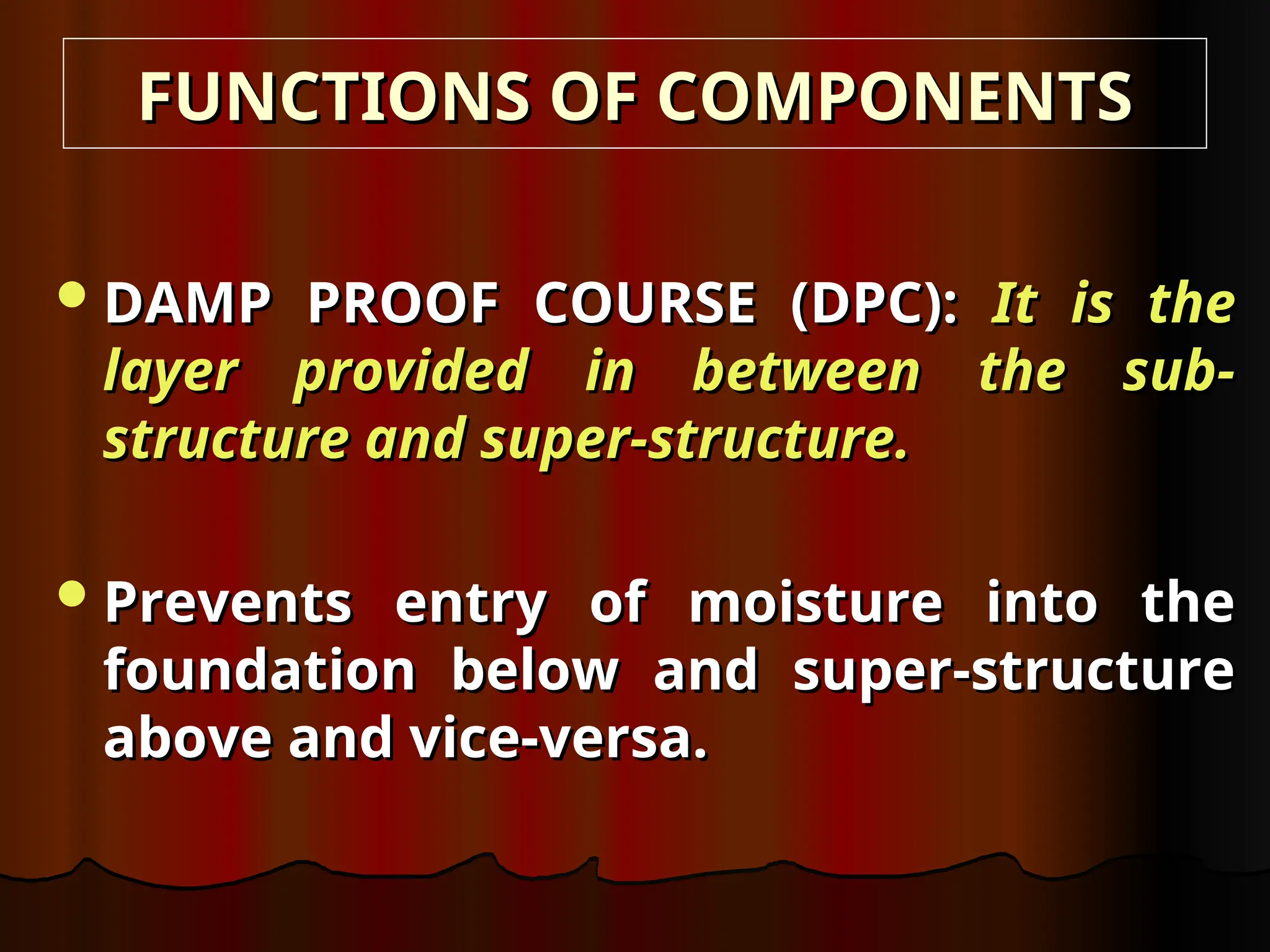
DAMP PROOF COURSE (DPC):
DAMP PROOF COURSE (DPC): It is the
It is the
layer provided in between the sub-
structure and super-structure.
Prevents entry of moisture into the
Prevents entry of moisture into the
foundation below and super-structure
above and vice-versa.
FUNCTIONS OF COMPONENTS
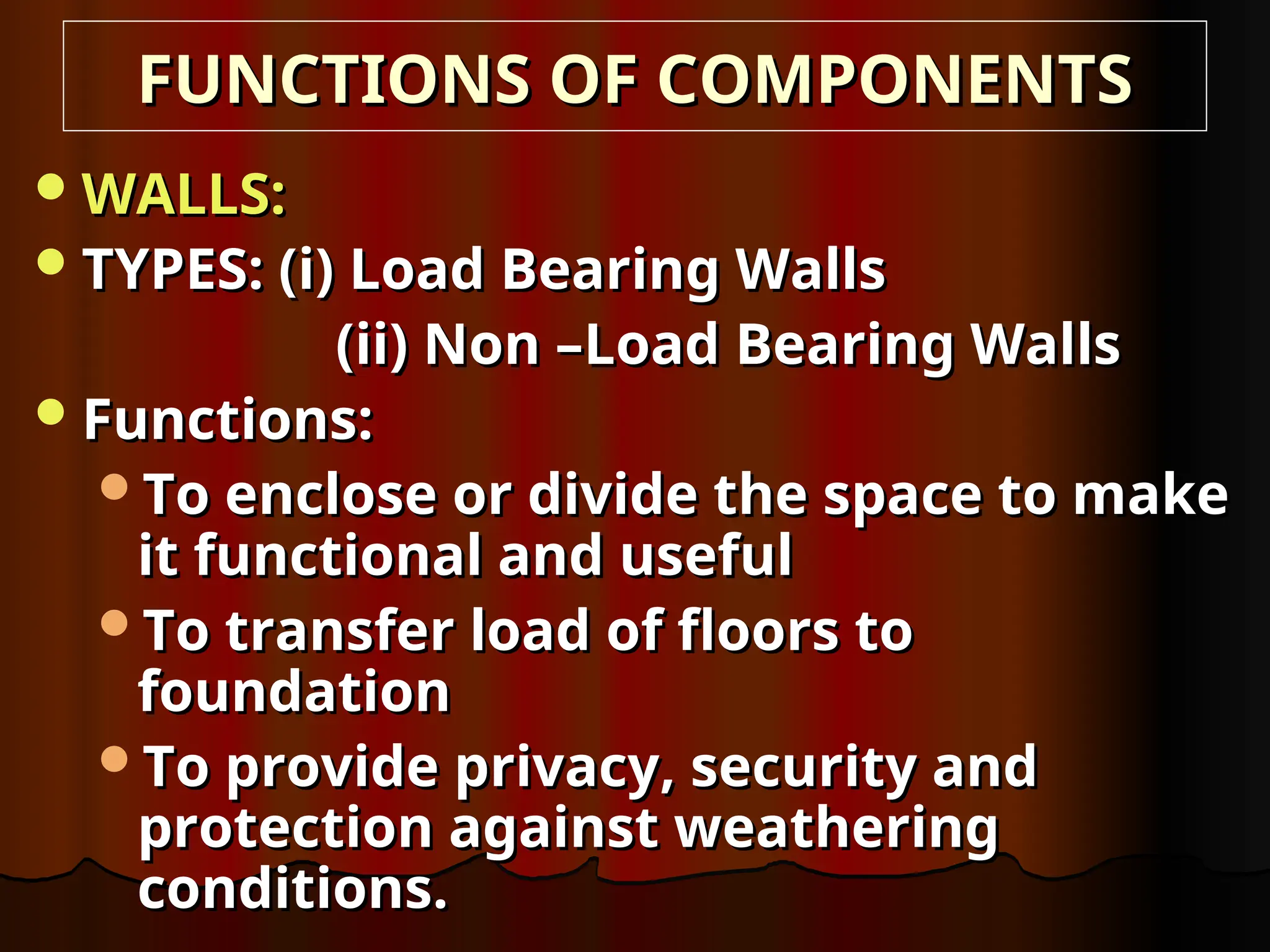
WALLS:
WALLS:
TYPES: (i) Load Bearing Walls
TYPES: (i) Load Bearing Walls
(ii) Non –Load Bearing Walls
Functions:
Functions:
To enclose or divide the space to make
To enclose or divide the space to make
it functional and useful
To transfer load of floors to
To transfer load of floors to
foundation
foundation
To provide privacy, security and
To provide privacy, security and
protection against weathering
conditions.
conditions.
FUNCTIONS OF COMPONENTS
 PILLARS AND COLUMNS:
PILLARS AND COLUMNS:
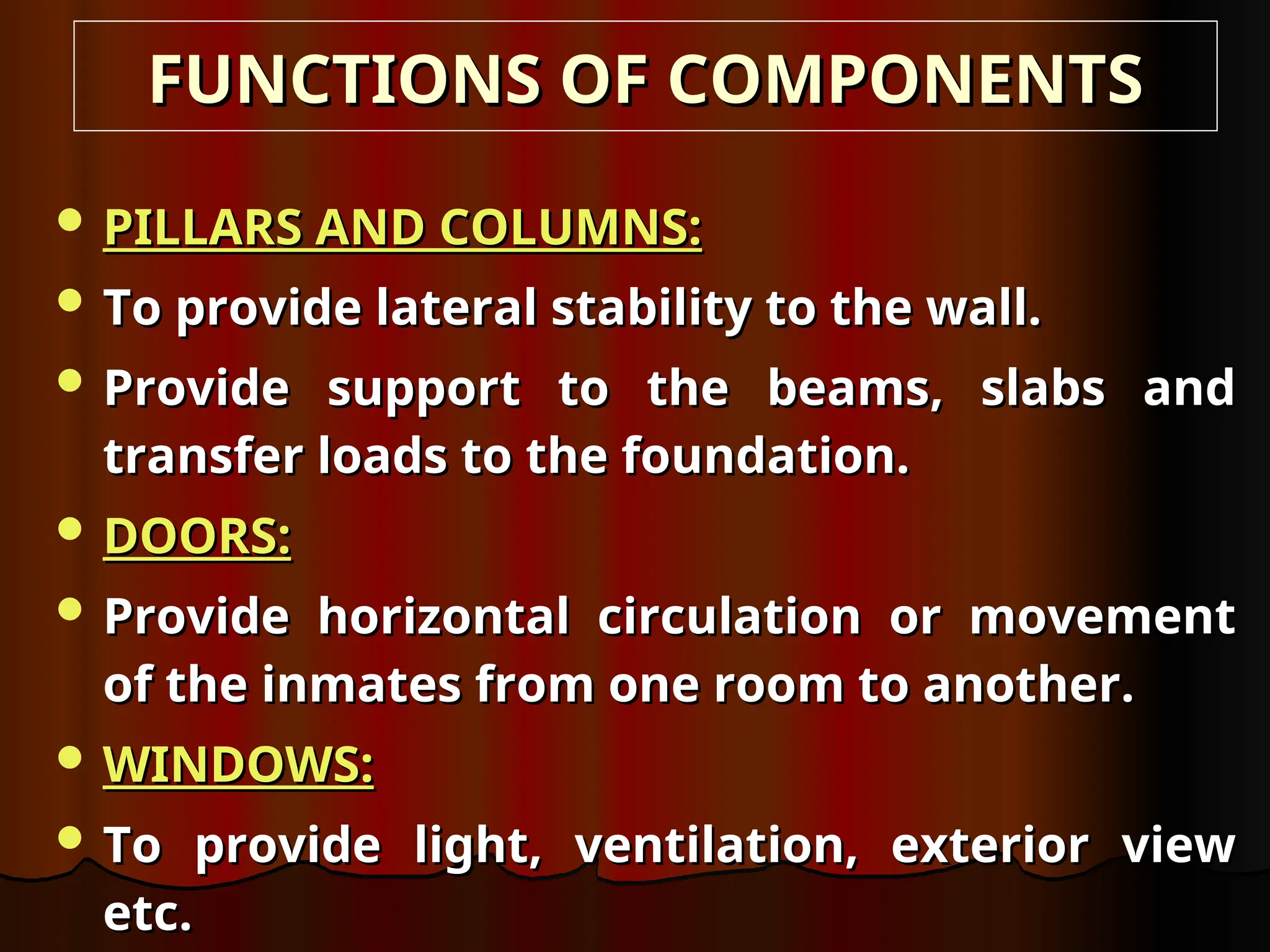
 To provide lateral stability to the wall.
To provide lateral stability to the wall.
 Provide support to the beams, slabs and
Provide support to the beams, slabs and
transfer loads to the foundation.
 DOORS:
DOORS:
 Provide horizontal circulation or movement
Provide horizontal circulation or movement
of the inmates from one room to another.
 WINDOWS:
WINDOWS:
 To provide light, ventilation, exterior view
To provide light, ventilation, exterior view
etc.
etc.
FUNCTIONS OF COMPONENTS
LINTEL AND ARCHES:
LINTEL AND ARCHES:
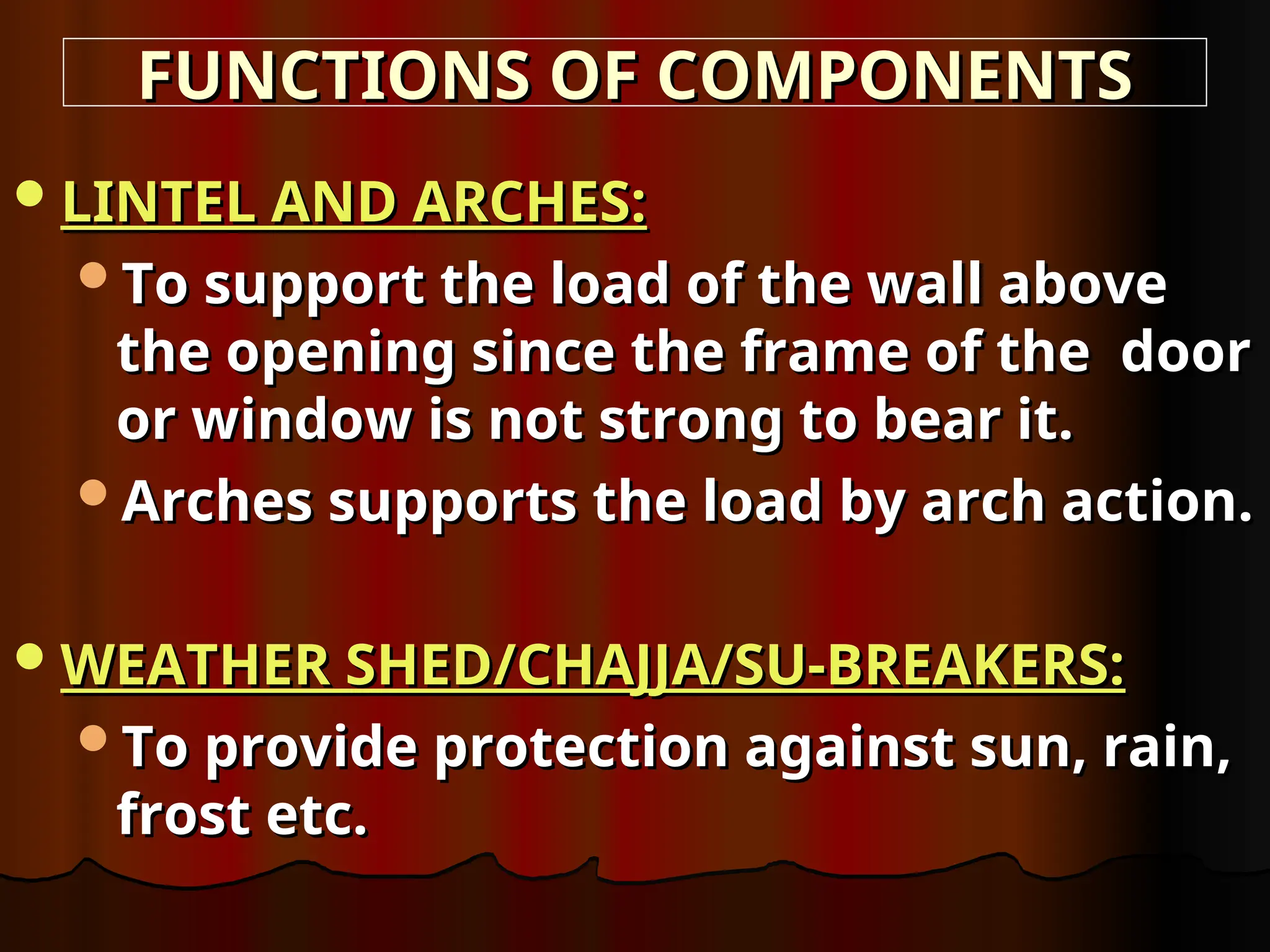
To support the load of the wall above
To support the load of the wall above
the opening since the frame of the door
or window is not strong to bear it.
Arches supports the load by arch action.
Arches supports the load by arch action.
WEATHER SHED/CHAJJA/SU-BREAKERS:
WEATHER SHED/CHAJJA/SU-BREAKERS:
To provide protection against sun, rain,
To provide protection against sun, rain,
frost etc.
frost etc.
FUNCTIONS OF COMPONENTS
 FLOORS:
FLOORS:
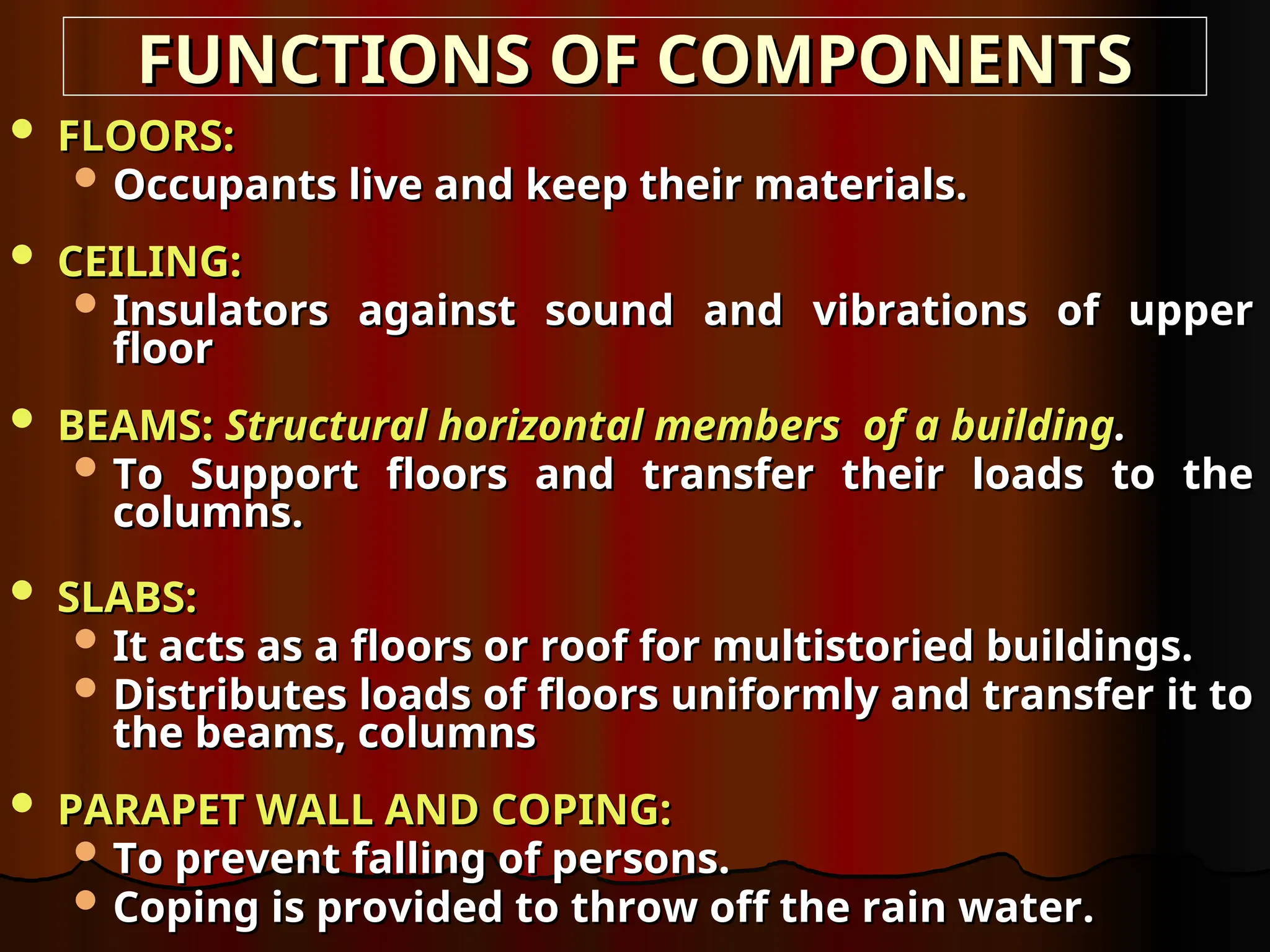
 Occupants live and keep their materials.
Occupants live and keep their materials.
 CEILING:
CEILING:
 Insulators against sound and vibrations of upper
Insulators against sound and vibrations of upper
floor
floor
 BEAMS:
BEAMS: Structural horizontal members of a building
Structural horizontal members of a building.
.
 To Support floors and transfer their loads to the
To Support floors and transfer their loads to the
columns.
columns.
 SLABS:
SLABS:
 It acts as a floors or roof for multistoried buildings.
It acts as a floors or roof for multistoried buildings.
 Distributes loads of floors uniformly and transfer it to
Distributes loads of floors uniformly and transfer it to
the beams, columns
the beams, columns
 PARAPET WALL AND COPING:
PARAPET WALL AND COPING:
 To prevent falling of persons.
To prevent falling of persons.
 Coping is provided to throw off the rain water.
Coping is provided to throw off the rain water.
FUNCTIONS OF COMPONENTS
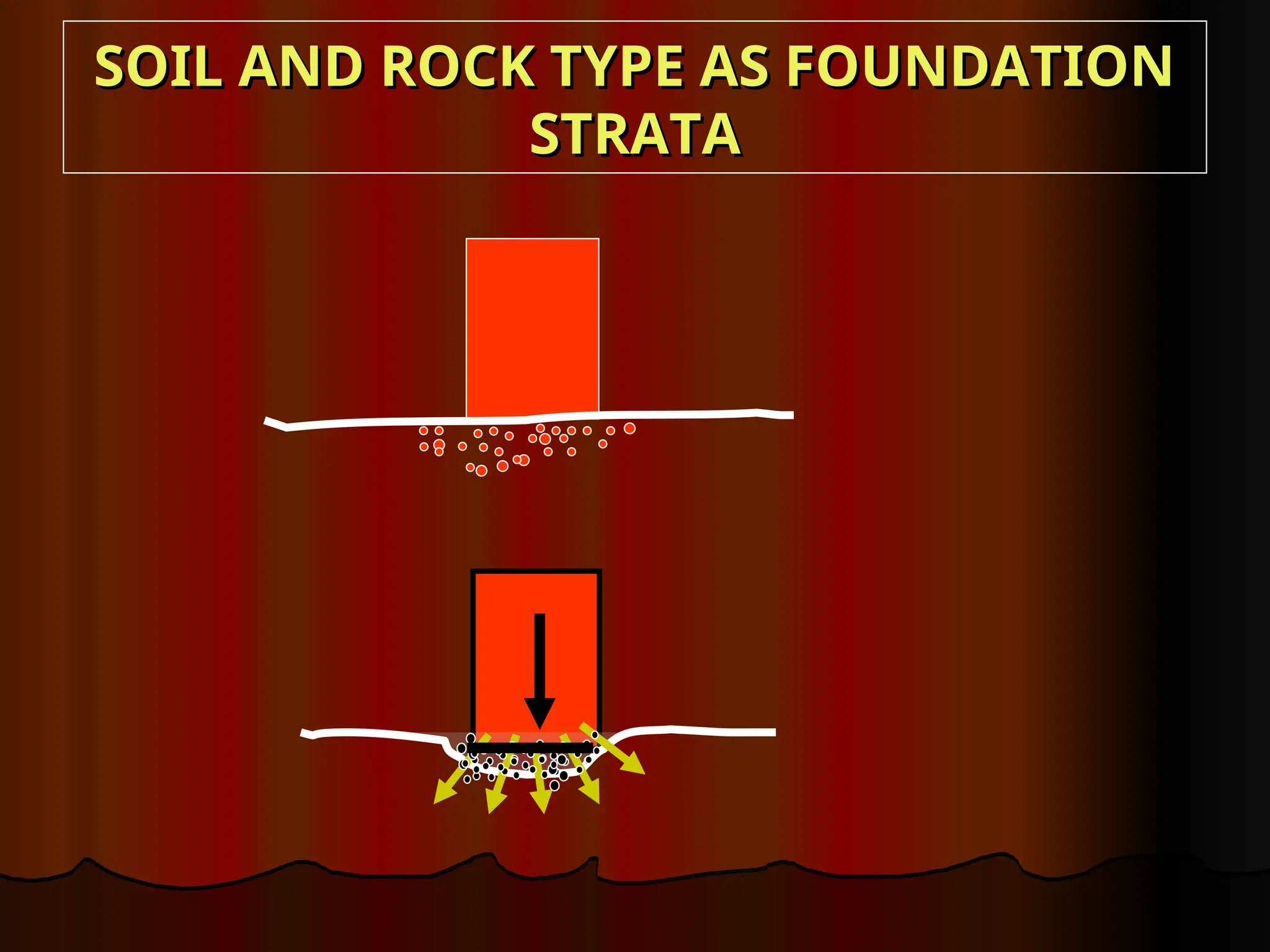
SOIL AND ROCK TYPE AS
FOUNDATION STRATA
FOUNDATION STRATA
SOIL:
SOIL:
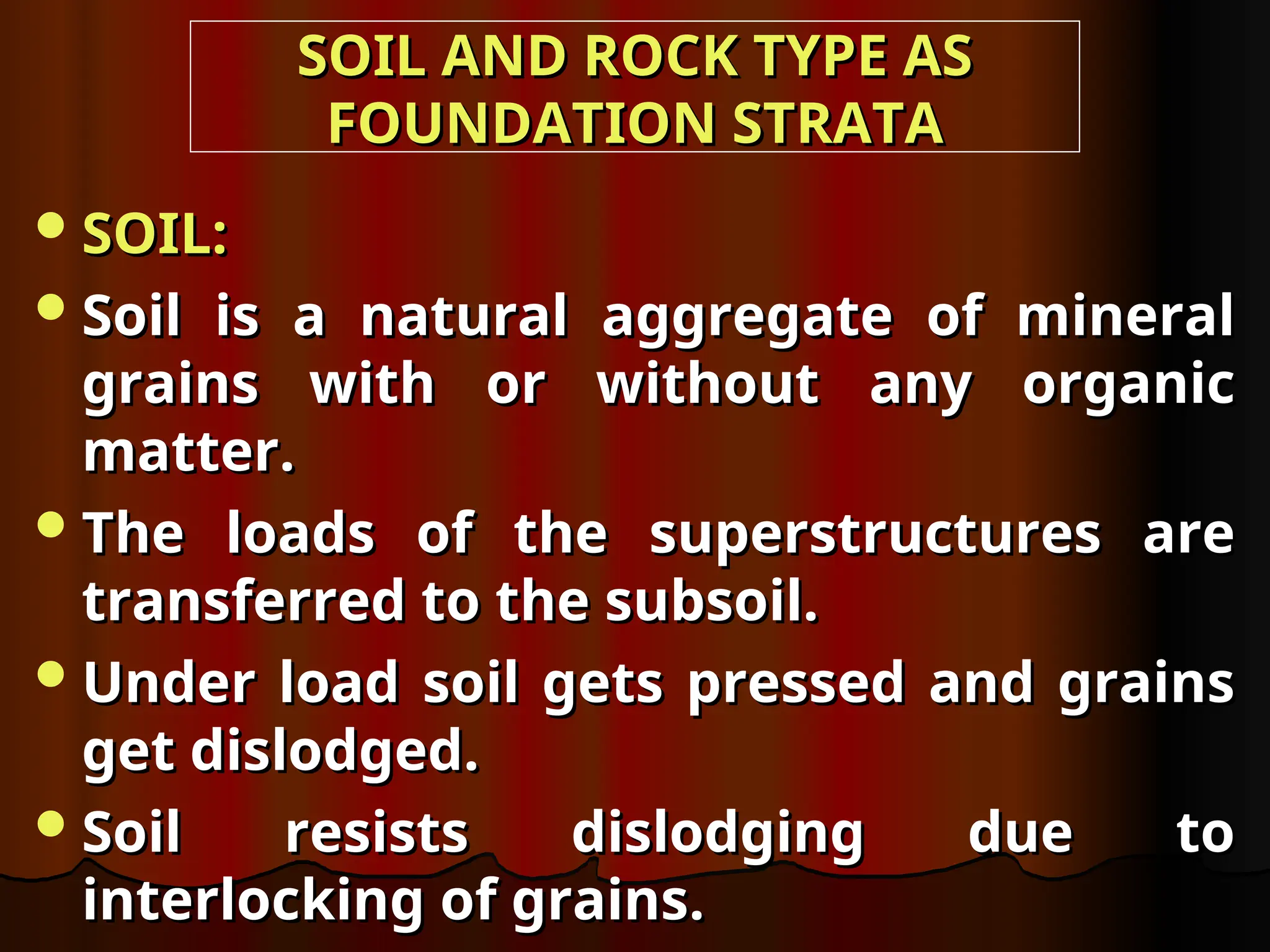
Soil is a natural aggregate of mineral
Soil is a natural aggregate of mineral
grains with or without any organic
matter.
matter.
The loads of the superstructures are
The loads of the superstructures are
transferred to the subsoil.
Under load soil gets pressed and grains
Under load soil gets pressed and grains
get dislodged.
get dislodged.
Soil resists dislodging due to
Soil resists dislodging due to
interlocking of grains.
SOIL AND ROCK TYPE AS FOUNDATION
STRATA
STRATA
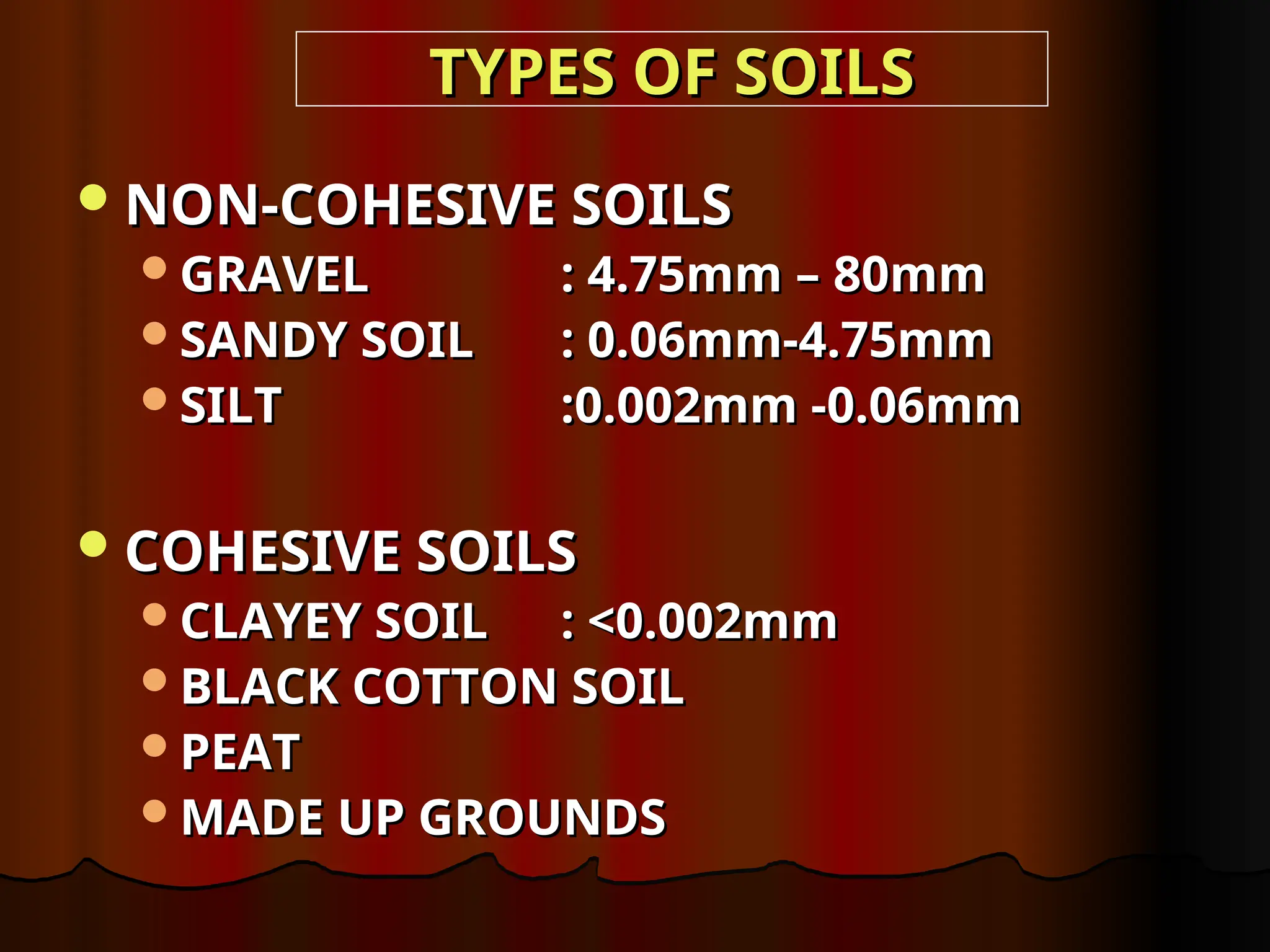
TYPES OF SOILS
TYPES OF SOILS
NON-COHESIVE SOILS
NON-COHESIVE SOILS
GRAVEL
GRAVEL : 4.75mm – 80mm
: 4.75mm – 80mm
SANDY SOIL
SANDY SOIL : 0.06mm-4.75mm
: 0.06mm-4.75mm
SILT
SILT :0.002mm -0.06mm
:0.002mm -0.06mm
COHESIVE SOILS
COHESIVE SOILS
CLAYEY SOIL
CLAYEY SOIL : <0.002mm
: <0.002mm
BLACK COTTON SOIL
BLACK COTTON SOIL
PEAT
PEAT
MADE UP GROUNDS
MADE UP GROUNDS
SOIL AND ROCK AS FOUNDATION STRATA
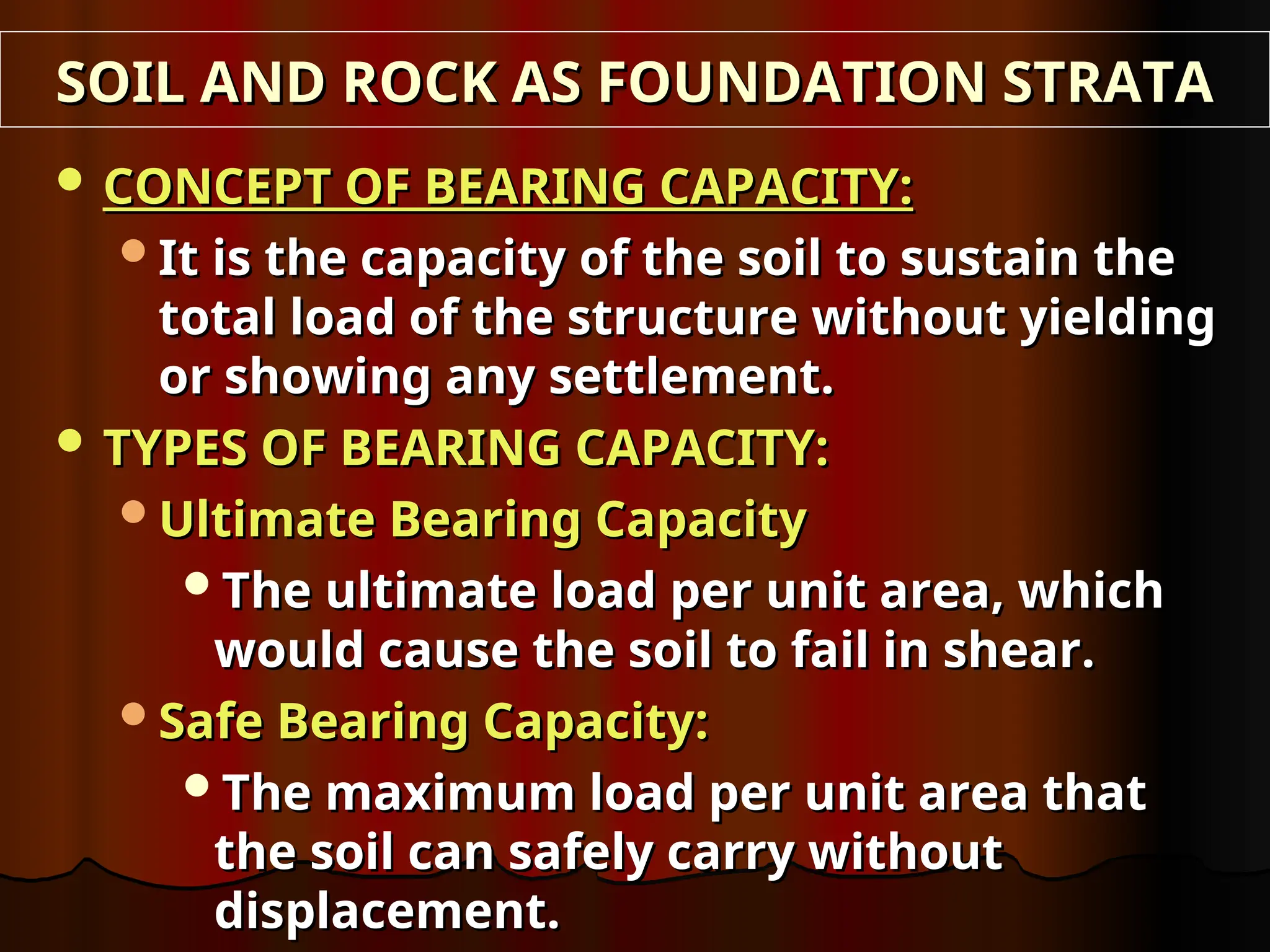
 CONCEPT OF BEARING CAPACITY:
CONCEPT OF BEARING CAPACITY:
It is the capacity of the soil to sustain the
It is the capacity of the soil to sustain the
total load of the structure without yielding
or showing any settlement.
 TYPES OF BEARING CAPACITY:
TYPES OF BEARING CAPACITY:
Ultimate Bearing Capacity
Ultimate Bearing Capacity
The ultimate load per unit area, which
The ultimate load per unit area, which
would cause the soil to fail in shear.
Safe Bearing Capacity:
Safe Bearing Capacity:
The maximum load per unit area that
The maximum load per unit area that
the soil can safely carry without
displacement.
displacement.
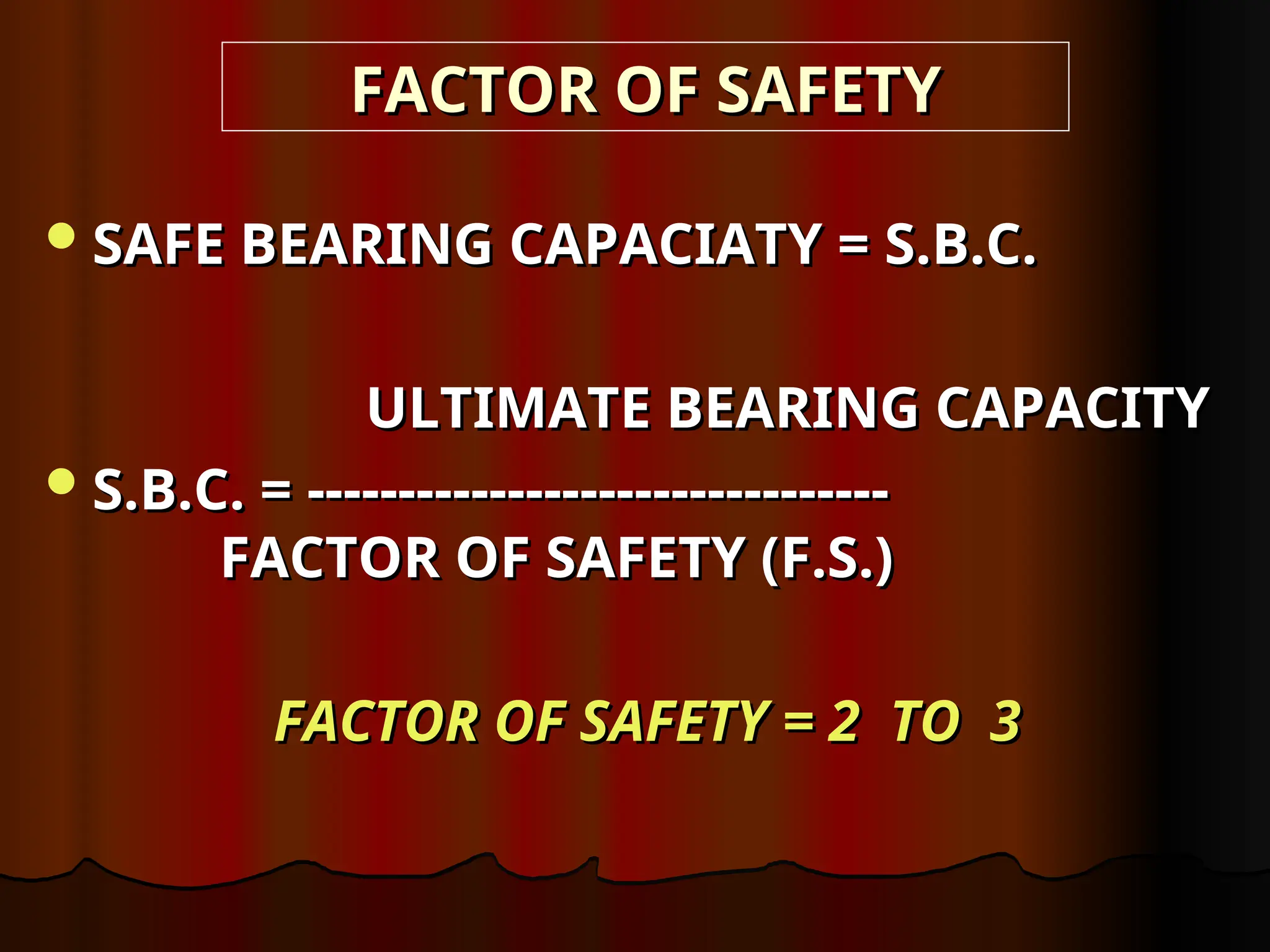
FACTOR OF SAFETY
FACTOR OF SAFETY
SAFE BEARING CAPACIATY = S.B.C.
SAFE BEARING CAPACIATY = S.B.C.
ULTIMATE BEARING CAPACITY
S.B.C. = --------------------------------
S.B.C. = --------------------------------
FACTOR OF SAFETY (F.S.)
FACTOR OF SAFETY = 2 TO 3
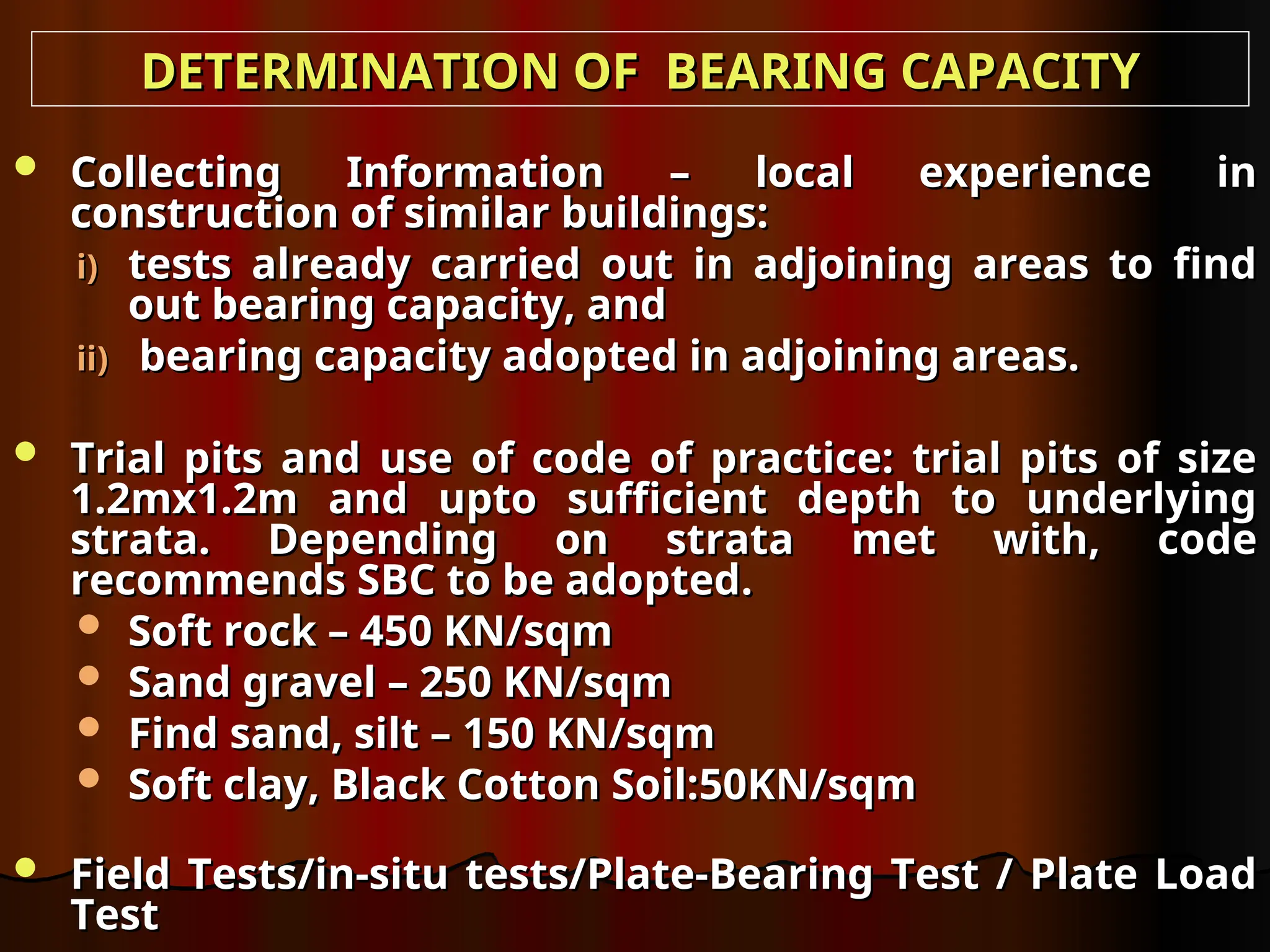
DETERMINATION OF BEARING CAPACITY
 Collecting Information – local experience in
Collecting Information – local experience in
construction of similar buildings:
i)
i) tests already carried out in adjoining areas to find
tests already carried out in adjoining areas to find
out bearing capacity, and
ii)
ii) bearing capacity adopted in adjoining areas.
bearing capacity adopted in adjoining areas.
 Trial pits and use of code of practice: trial pits of size
Trial pits and use of code of practice: trial pits of size
1.2mx1.2m and upto sufficient depth to underlying
strata. Depending on strata met with, code
recommends SBC to be adopted.
 Soft rock – 450 KN/sqm
Soft rock – 450 KN/sqm
 Sand gravel – 250 KN/sqm
Sand gravel – 250 KN/sqm
 Find sand, silt – 150 KN/sqm
Find sand, silt – 150 KN/sqm
 Soft clay, Black Cotton Soil:50KN/sqm
Soft clay, Black Cotton Soil:50KN/sqm
 Field Tests/in-situ tests/Plate-Bearing Test / Plate Load
Field Tests/in-situ tests/Plate-Bearing Test / Plate Load
Test
Test
 For multi-storied buildings. Simplest type of test.
For multi-storied buildings. Simplest type of test.
 Method consists essentially in loading a rigid plate at
Method consists essentially in loading a rigid plate at
the foundation level observing the settlement for each
increment of load after intervals.
 Plotting the load-settlement curve and then
Plotting the load-settlement curve and then
determining the UBC which is taken as the load at
which the plate starts sinking at a rapid rate.
 Method consists essentially in loading a rigid plate at
Method consists essentially in loading a rigid plate at
the foundation level observing the settlement for each
increment of load after intervals.
 Plotting the load-settlement curve and then
Plotting the load-settlement curve and then
determining the UBC which is taken as the load at
which the plate starts sinking at a rapid rate.
FIELD TEST: IN-SITU/PLATE BEARING TEST
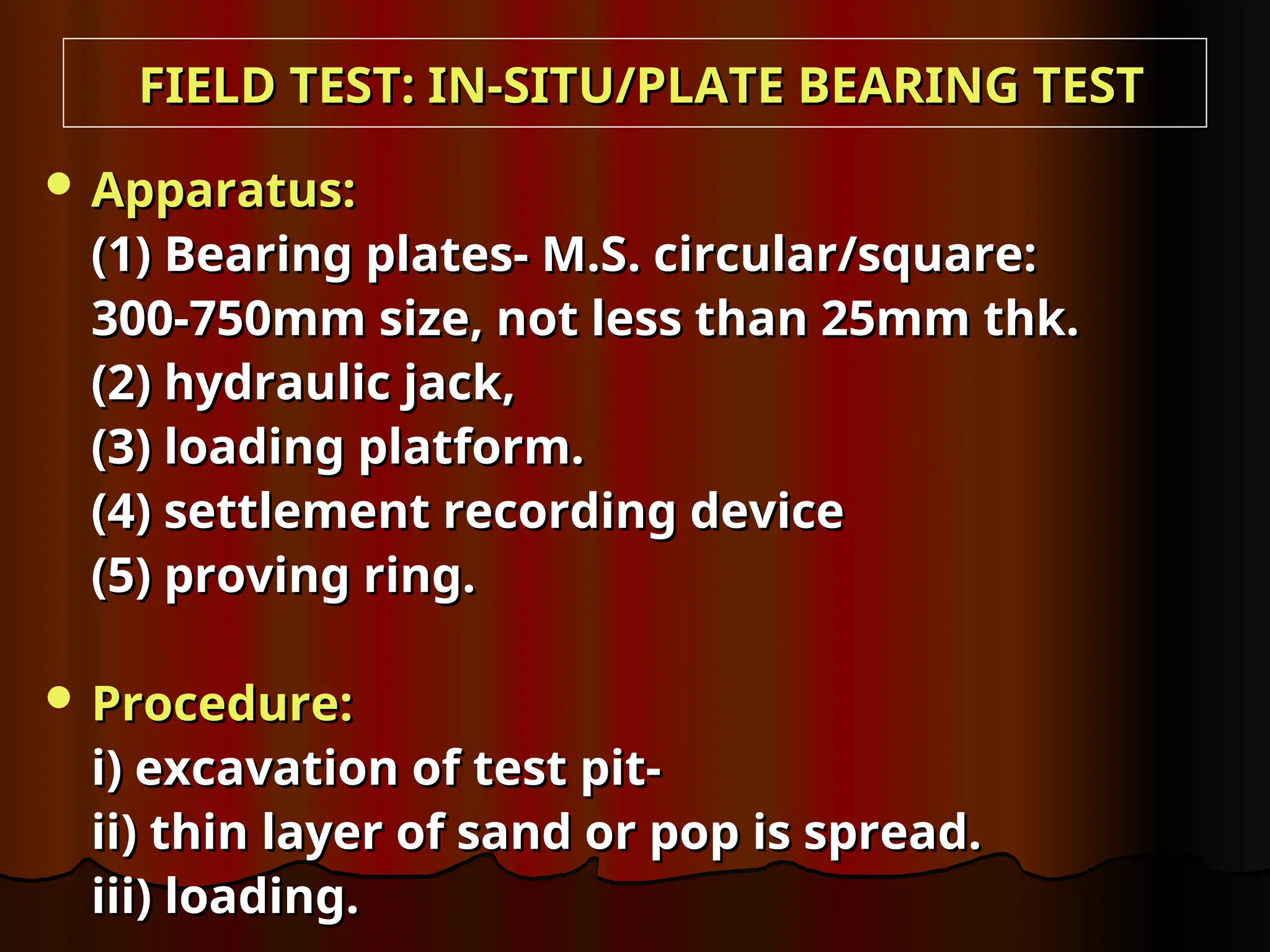
 Apparatus:
Apparatus:
(1) Bearing plates- M.S. circular/square:
300-750mm size, not less than 25mm thk.
(2) hydraulic jack,
(2) hydraulic jack,
(3) loading platform.
(4) settlement recording device
(5) proving ring.
(5) proving ring.
 Procedure:
Procedure:
i) excavation of test pit-
ii) thin layer of sand or pop is spread.
iii) loading.
iii) loading.
FIELD TEST: IN-SITU/PLATE BEARING TEST
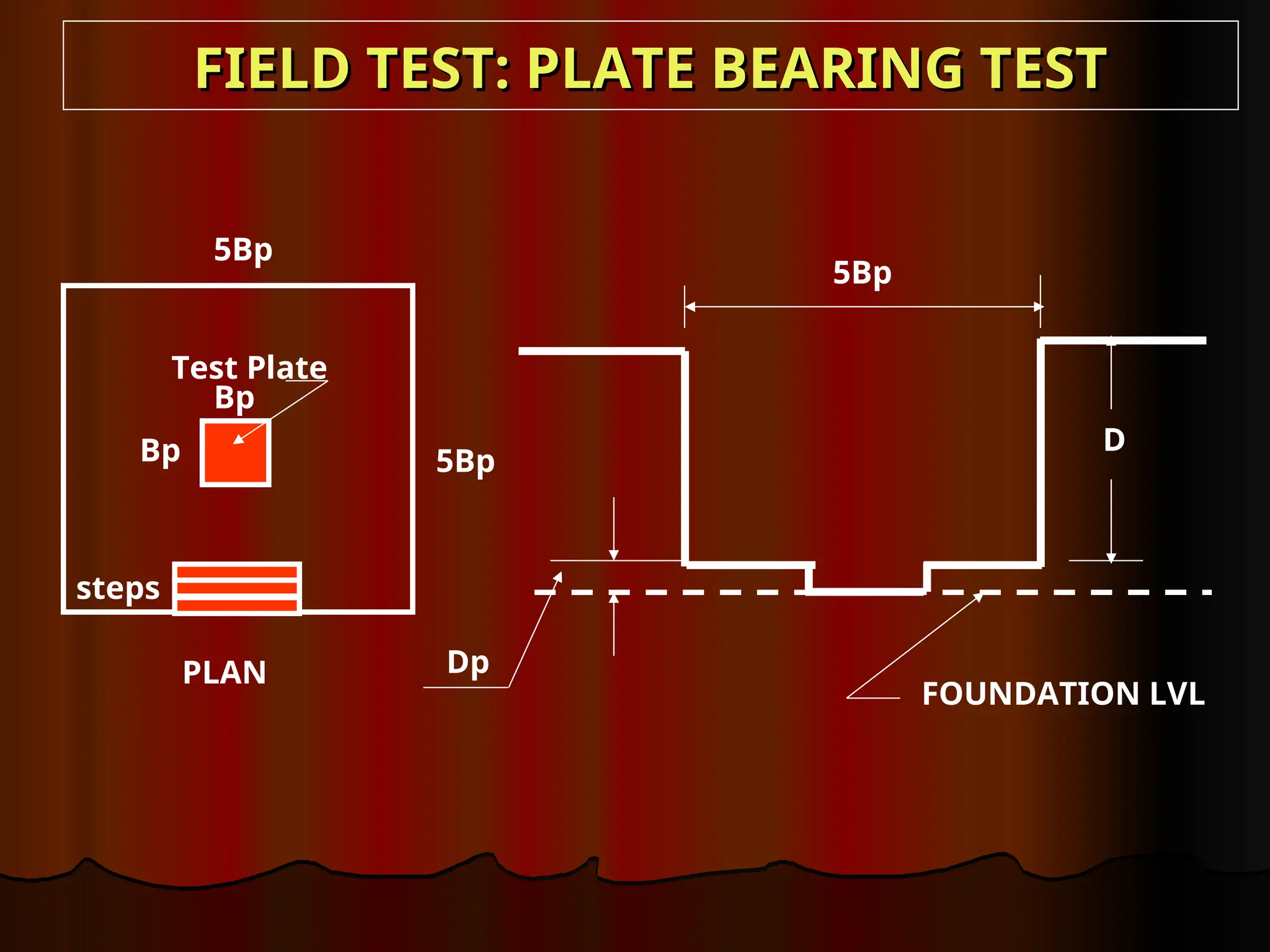
FIELD TEST: PLATE BEARING TEST
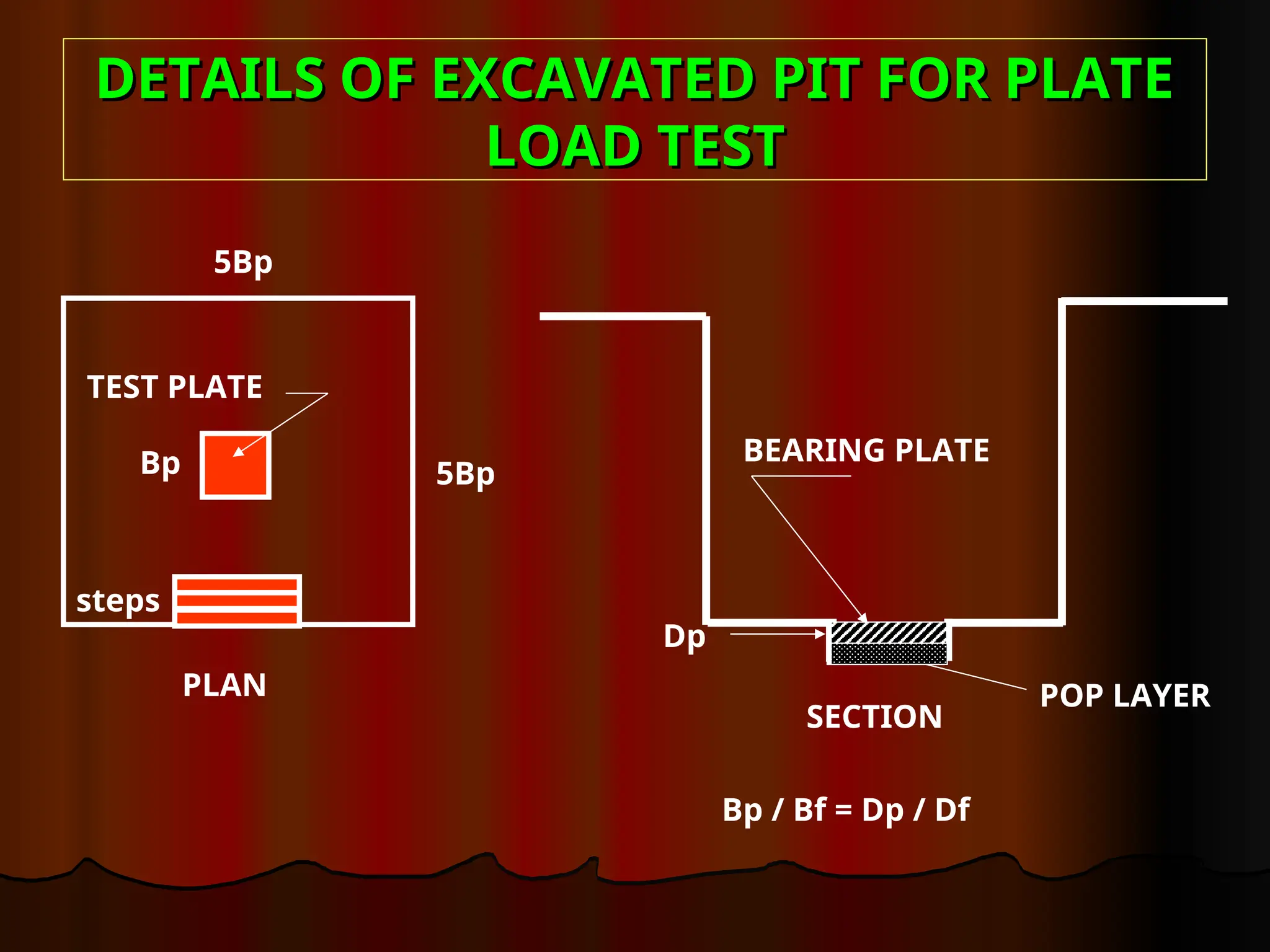
PLAN Dp
Test Plate
Bp
5Bp
5Bp
steps
Bp
5Bp
D
FOUNDATION LVL
DETAILS OF EXCAVATED PIT FOR PLATE
LOAD TEST
LOAD TEST
Bp / Bf = Dp / Df
PLAN
SECTION
POP LAYER
Dp
BEARING PLATE
Bp
5Bp
5Bp
steps
TEST PLATE
FIELD TEST: PLATE BEARING TEST
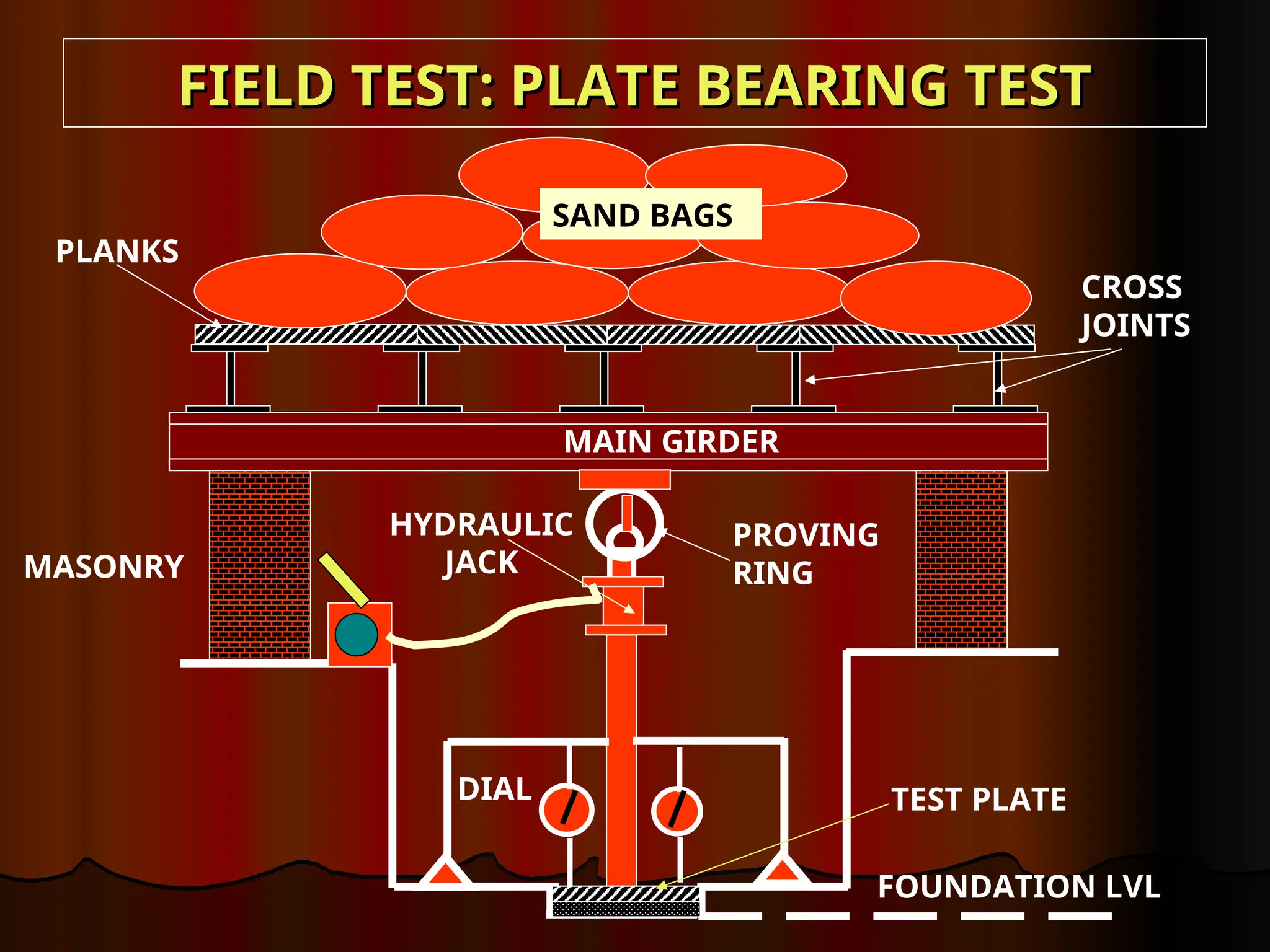
DIAL
MASONRY
PROVING
RING
HYDRAULIC
JACK
SAND BAGS
PLANKS
CROSS
JOINTS
MAIN GIRDER
TEST PLATE
FOUNDATION LVL
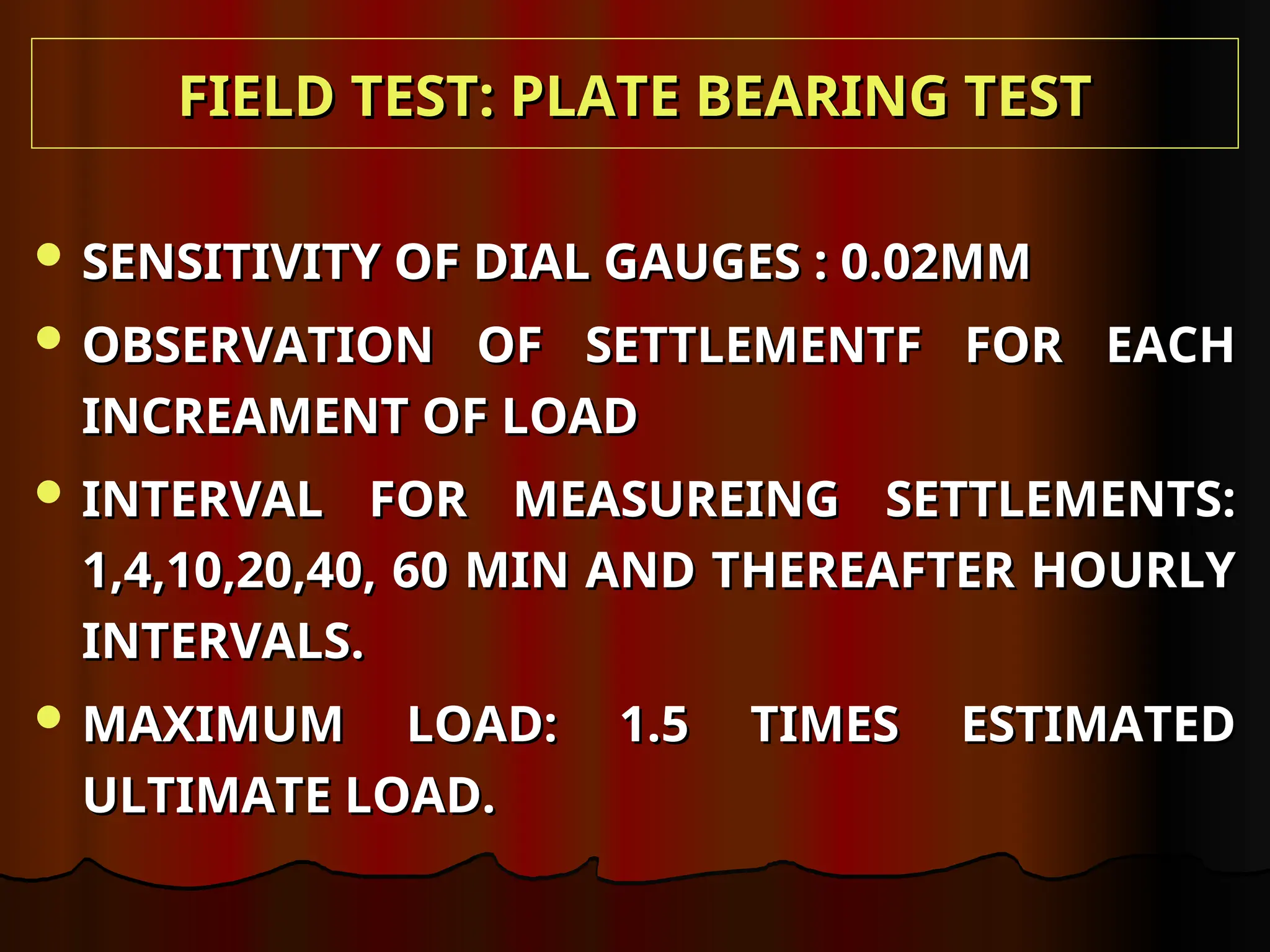
 SENSITIVITY OF DIAL GAUGES : 0.02MM
SENSITIVITY OF DIAL GAUGES : 0.02MM
 OBSERVATION OF SETTLEMENTF FOR EACH
OBSERVATION OF SETTLEMENTF FOR EACH
INCREAMENT OF LOAD
INCREAMENT OF LOAD
 INTERVAL FOR MEASUREING SETTLEMENTS:
INTERVAL FOR MEASUREING SETTLEMENTS:
1,4,10,20,40, 60 MIN AND THEREAFTER HOURLY
INTERVALS.
INTERVALS.
 MAXIMUM LOAD: 1.5 TIMES ESTIMATED
MAXIMUM LOAD: 1.5 TIMES ESTIMATED
ULTIMATE LOAD.
ULTIMATE LOAD.
FIELD TEST: PLATE BEARING TEST
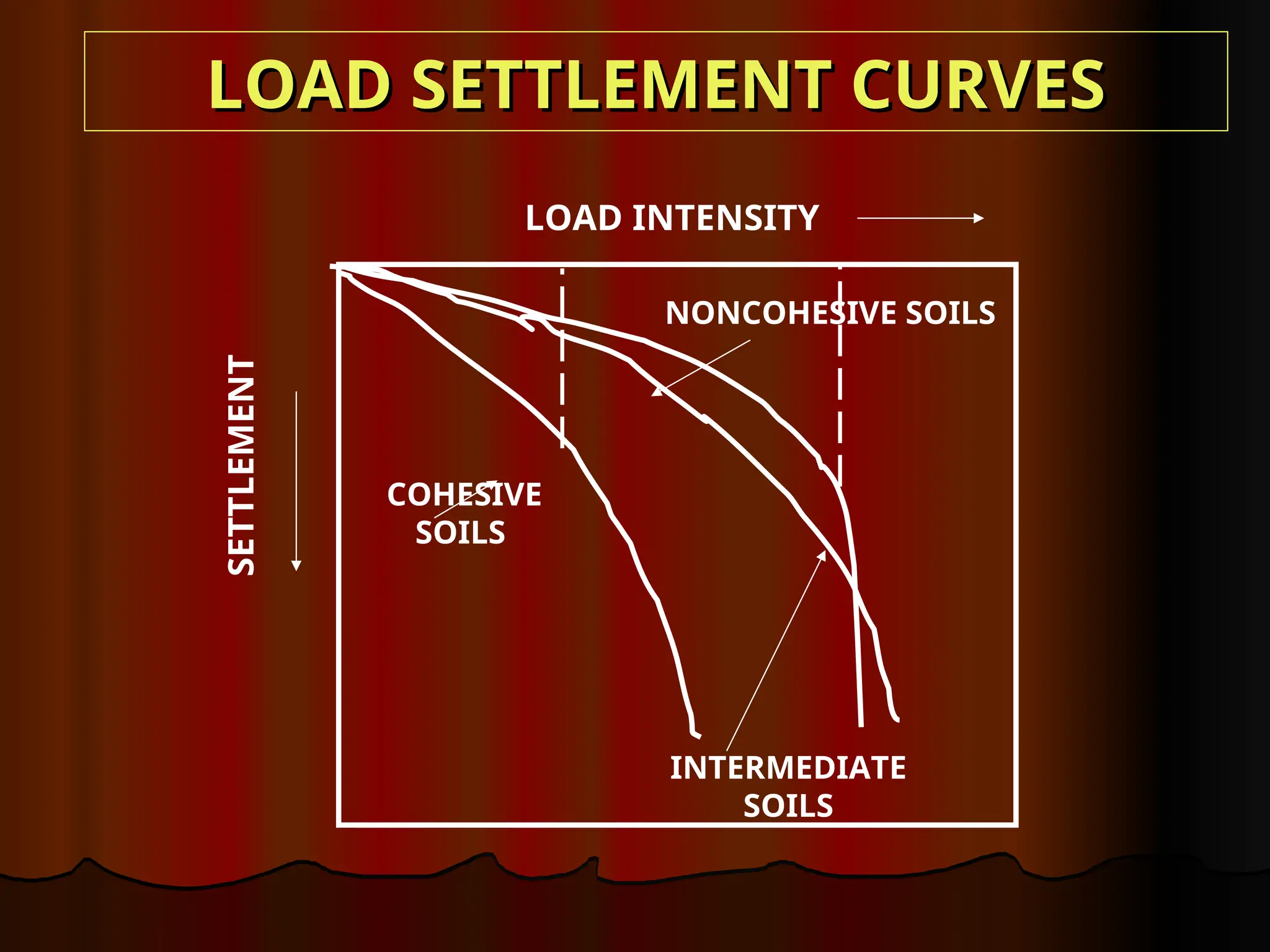
LOAD SETTLEMENT CURVES
LOAD INTENSITY
SETTLEMENT
INTERMEDIATE
SOILS
NONCOHESIVE SOILS
COHESIVE
SOILS
 The test is carried out on a small area and the
The test is carried out on a small area and the
results are used for larger area.
 Bearing capacity in respect of clayey strata,
Bearing capacity in respect of clayey strata,
remains unaffected, whether the test is carried
on small or large area. However, in case of
cohesion less soils, bearing capacity increases
with size of footing.
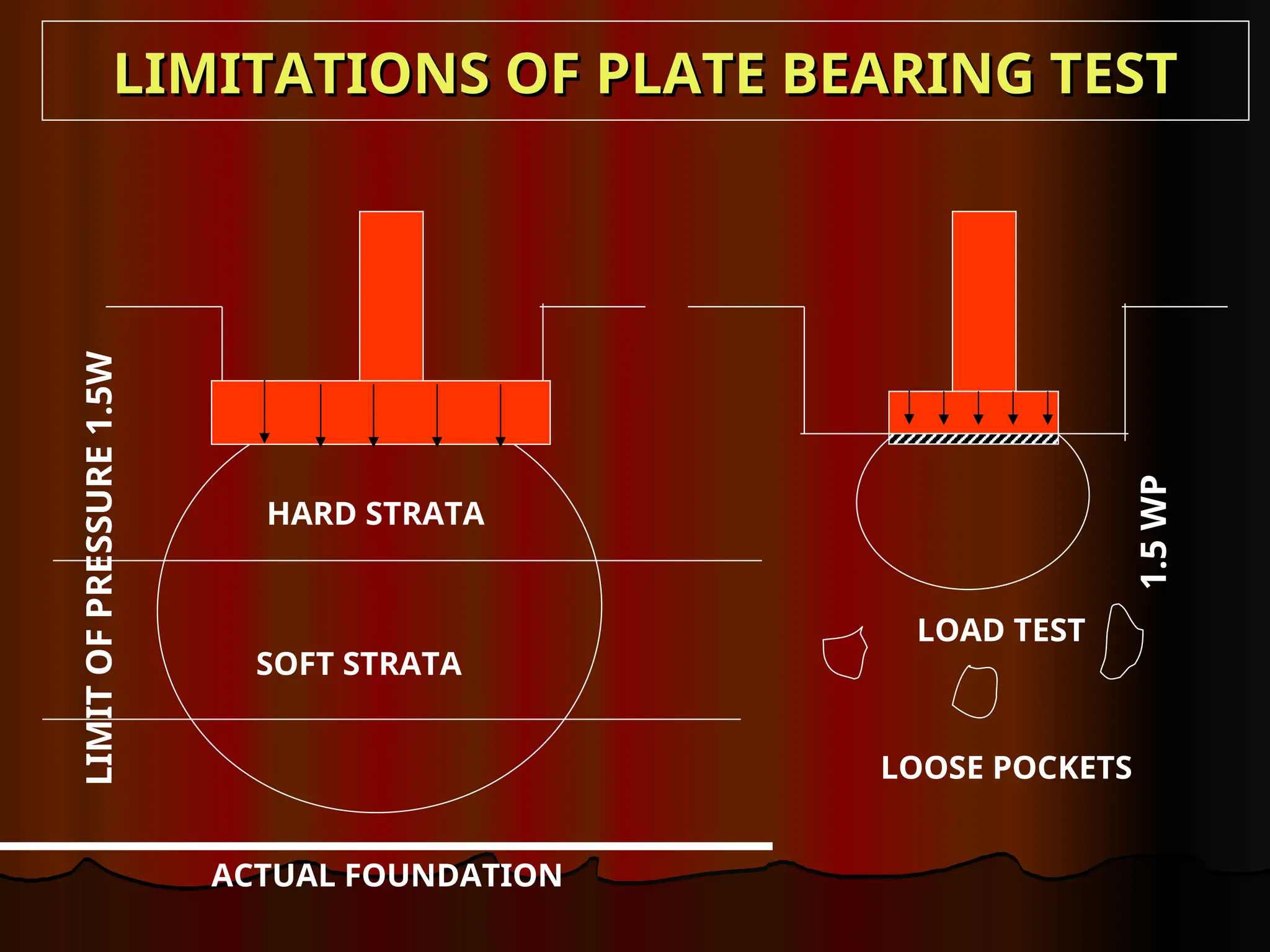
 Thus with this test, soil upto a depth twice the
Thus with this test, soil upto a depth twice the
width of steel plate is tested. But in practice Bf
the width of footing is far more than Bp. Hence,
if loose weak soil pockets are present within a
depth of 2Bp then results obtained from the
plate bearing test will not hold good.
LIMITATIONS OF PLATE BEARING TEST
HARD STRATA
SOFT STRATA
ACTUAL FOUNDATION
LOAD TEST
LIMIT
OF
PRESSURE
1.5W
1.5
WP
LOOSE POCKETS
 With rise in water table, bearing capacity
With rise in water table, bearing capacity
reduces. This aspect needs consideration
while finalizing B.C., especially of non-
cohesive soils.
cohesive soils.
 It is difficult to carry out tests at greater
It is difficult to carry out tests at greater
depths.
depths.
 The results of test carried on small square
The results of test carried on small square
plate cannot be used for continuous footing.
 Settlements in respect of cohesive soils take
Settlements in respect of cohesive soils take
lot of time, as such, ultimate settlement of
cohesive soils cannot be determined in short
period.
period.
LIMITATIONS OF PLATE BEARING TEST
FACTORS AFFECTING BEARING
CAPACITY OF SOIL
CAPACITY OF SOIL
 TYPE & NATURE OF SOIL (COARSE/FINE GRAINED)
TYPE & NATURE OF SOIL (COARSE/FINE GRAINED)
 ENVIRONMENTAL CONDITIONS:
ENVIRONMENTAL CONDITIONS:
 DRAINAGE, SEEPAGE, ACCUMULATIO OF WATER
DRAINAGE, SEEPAGE, ACCUMULATIO OF WATER
 EXTENT OF SOIL COMPACTION
EXTENT OF SOIL COMPACTION
 PHYSICAL PROPERTIES: DENSITY, STRENGTH ETC
PHYSICAL PROPERTIES: DENSITY, STRENGTH ETC
 MOISTURE CONTENT
MOISTURE CONTENT
 DIFFERENTIAL SETTLEMENT
DIFFERENTIAL SETTLEMENT
 TYPES OF FOUNDATIONS
TYPES OF FOUNDATIONS
 DEPTH OF FOUNDATION
DEPTH OF FOUNDATION
 PROXIMITY OF GROUND WATER TABLE
PROXIMITY OF GROUND WATER TABLE
METHODS OF IMPROVING B.C.
OF SOIL
OF SOIL
INCREASING DEPTH OF FOUNDATION
INCREASING DEPTH OF FOUNDATION
DRAINING NON-COHESIVE SOILS
DRAINING NON-COHESIVE SOILS
REDUCING VOIDS BY COMPACTION
REDUCING VOIDS BY COMPACTION
DRIVING SAND PILES
DRIVING SAND PILES
GROUTING BY CEMENT OR CHEMICALS
GROUTING BY CEMENT OR CHEMICALS
FAILURE OF FOUNDATION
 SETTLEMENT OF SUB-SOIL AND MASONRY.
SETTLEMENT OF SUB-SOIL AND MASONRY.
 LATERAL M OVEMENT OF SOIL ADJOINING THE
LATERAL M OVEMENT OF SOIL ADJOINING THE
STRUCTURE
STRUCTURE
 SHRINKAGE AND SWELLING OF SOIL DUE TO
SHRINKAGE AND SWELLING OF SOIL DUE TO
WEATHER CHANGES
WEATHER CHANGES
 LATERAL PRESSURE CAUSING OVERTURNING OF
LATERAL PRESSURE CAUSING OVERTURNING OF
STRUCTURE
STRUCTURE
 CRACKS IN FOUNDATION MASONRY DUE TO
CRACKS IN FOUNDATION MASONRY DUE TO
GROWTH OF TREES NEAR FOUNDATION
SETTLEMENT OF FOUNDATION
THE VERTICAL DOWNWARD MOVE-MENT OF
THE VERTICAL DOWNWARD MOVE-MENT OF
THE BASE OF THE BUILDING IS CALLED
SETTLEMENT
SETTLEMENT
CAUSESES OF SETTLEMENT
CAUSESES OF SETTLEMENT
STATIC LOAD
STATIC LOAD
DYNAMIC LOAD
DYNAMIC LOAD
LOWERING OF WATER TABLE
LOWERING OF WATER TABLE
EXCAVATION NEAR CONSTRUCTION
EXCAVATION NEAR CONSTRUCTION
OTHERS –
OTHERS –
SUBSOIL ERROSION, VIBRATIONS DUE TO
SUBSOIL ERROSION, VIBRATIONS DUE TO
BLASTING, FLOODS.
BLASTING, FLOODS.
TYPES OF SETTLEMENT
TYPES OF SETTLEMENT
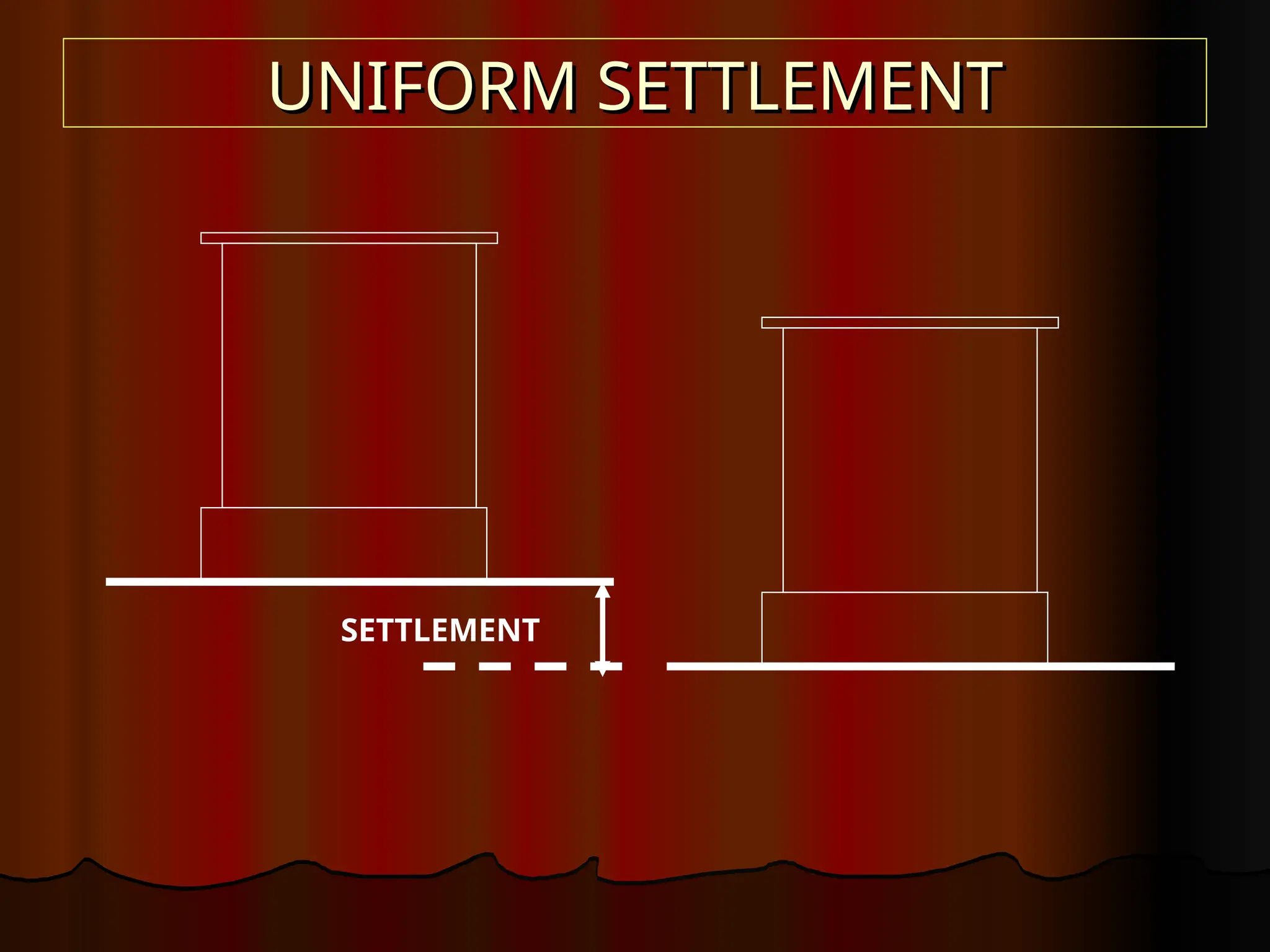
 UNIFORM SETTLEMENTS
UNIFORM SETTLEMENTS
 CAUSES:
CAUSES:
 SOIL WITH UNIFORM PROPERTIES
SOIL WITH UNIFORM PROPERTIES
 INTENSITY OF LOADING IS UNIFORM
INTENSITY OF LOADING IS UNIFORM
 NO SERIOUS DAMAGE
NO SERIOUS DAMAGE
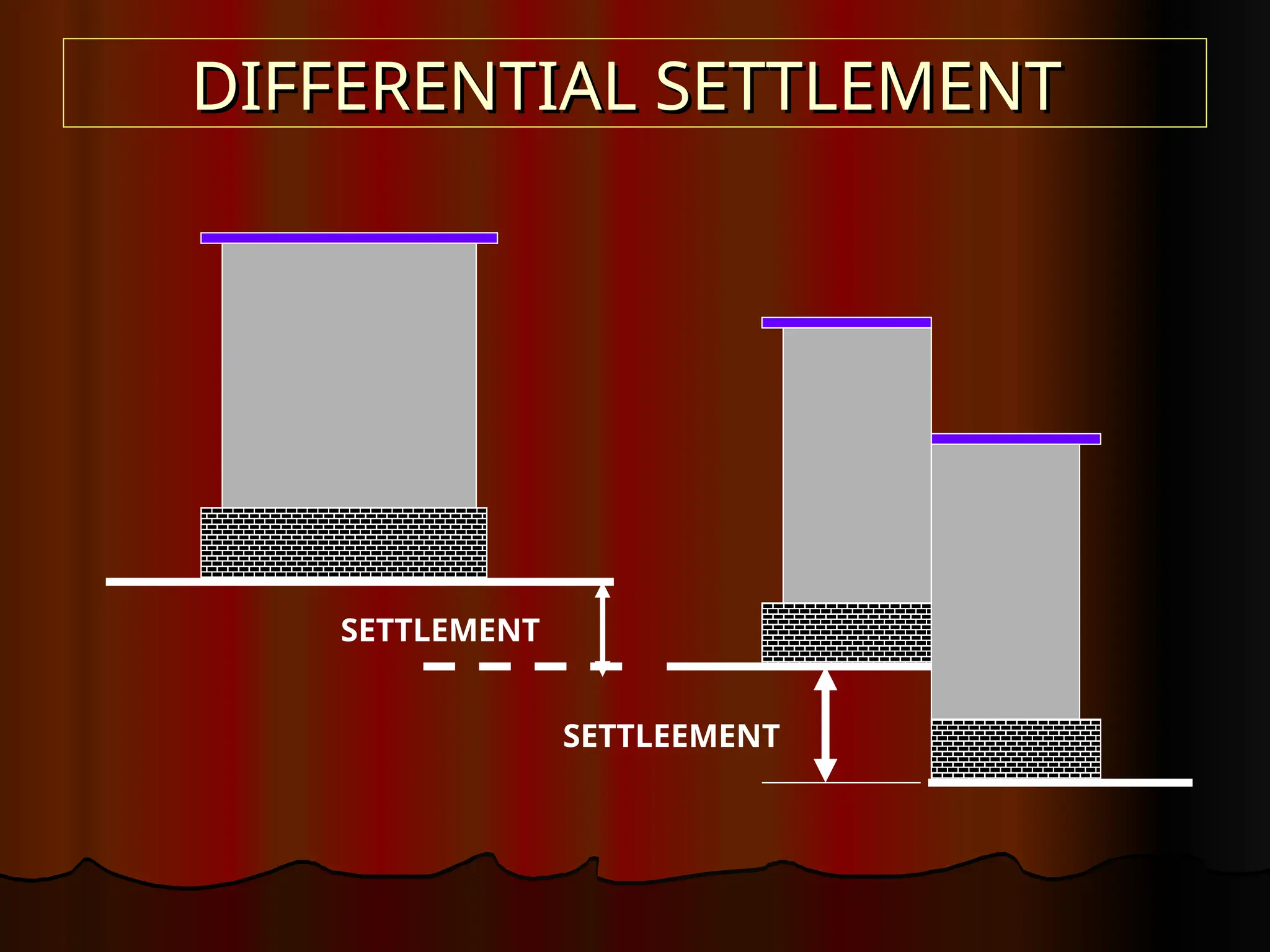
 DIFFERENTIAL SETTLEMENT
DIFFERENTIAL SETTLEMENT
 NON-UNIFORM, UN-EQUAL, UNEVEN SETTLEMENT
NON-UNIFORM, UN-EQUAL, UNEVEN SETTLEMENT
OF SOME PART OF THE BASE OF THE STRUCTURE.
 MORE DANGEROUS
MORE DANGEROUS
 CAUSES:
CAUSES:
 NON-UNIFORM SOIL STRATA
NON-UNIFORM SOIL STRATA
 NON-UNIFORM LOADING
NON-UNIFORM LOADING
 OVERLOADING OF SOILS
OVERLOADING OF SOILS
 UNEQUAL EXAPANSION OF SOILS
UNEQUAL EXAPANSION OF SOILS
UNIFORM SETTLEMENT
UNIFORM SETTLEMENT
SETTLEMENT
DIFFERENTIAL SETTLEMENT
SETTLEMENT
SETTLEEMENT
TYPES OF FOUNDATION
TYPES OF FOUNDATION
 TERZAGHI – FATHER OF SOIL OF MECH
TERZAGHI – FATHER OF SOIL OF MECH
 SHALLOW FOUNDATIONS
SHALLOW FOUNDATIONS
 DEPTH
DEPTH ≤
≤ WIDTH
WIDTH
 OPEN FOUNDATIONS
OPEN FOUNDATIONS
 FOOTING IS USED IN RELATION TO SHALLOW
FOOTING IS USED IN RELATION TO SHALLOW
FOUNDATIONS
FOUNDATIONS
 FOOTING IS A FOUNDATIO UNIT CONSTRUCTED IN
FOOTING IS A FOUNDATIO UNIT CONSTRUCTED IN
BRICKWORK MASONRY OR CONCRETE UNDER THE BASE
OF A WALL OR COLUMN FOR THE PURPOSE OF
DISTRIBUTING THE LOAD OVER A LARGER AREA.
 DEEP FOUNDATIONS
DEEP FOUNDATIONS
DEPTH IS VERY LARGE IN COMPARISON TO ITS
DEPTH IS VERY LARGE IN COMPARISON TO ITS
WIDTH (i. e. D > W)
WIDTH (i. e. D > W)
TYPES OF SHALLOW
TYPES OF SHALLOW
FOUNDATIONS
FOUNDATIONS
 SPREAD FOOTING
SPREAD FOOTING
 STRIP FOOTING
STRIP FOOTING
SIMPLE STRIP FOOTING
SIMPLE STRIP FOOTING
STEPPED FOOTING
STEPPED FOOTING
 PAD FOOTING (ISOLATED FOOTING)
PAD FOOTING (ISOLATED FOOTING)
 SIMPLE PAD FOOTING
SIMPLE PAD FOOTING
 STEPPED PAD FOOTING
STEPPED PAD FOOTING
 ISOLATED FOOTING FOR RCC COLUMNS
ISOLATED FOOTING FOR RCC COLUMNS
 GRILLAGE FOUNDATION (SP. TYPE OF ISOLATED C.F.)
GRILLAGE FOUNDATION (SP. TYPE OF ISOLATED C.F.)
 COMBINED FOOTING
COMBINED FOOTING
 COMBINED RECTANGULAR FOOTING
COMBINED RECTANGULAR FOOTING
 COMBINED TRAPEZOIDAL FOOTING
COMBINED TRAPEZOIDAL FOOTING
 CONTINUOUS FOOTING
CONTINUOUS FOOTING
TYPES OF SHALLOW FOOTINGS
 STRAP FOOTING OR CANTILEVER FOOTING
STRAP FOOTING OR CANTILEVER FOOTING
 MAT OR RAFT FOOTING
MAT OR RAFT FOOTING
COMMON TYPES-
COMMON TYPES-
FLAT PLATE TYPE
FLAT PLATE TYPE
FLAT PLATE THICKENED UNDER COLUMN
FLAT PLATE THICKENED UNDER COLUMN
FLAT PLATE WITH PEDASTALS
FLAT PLATE WITH PEDASTALS
TWO WAY BEAM AND SLAB
TWO WAY BEAM AND SLAB
CELLULAR CONSTRUCTION
CELLULAR CONSTRUCTION
BASEMENT WALLS AS RIGID FRAME
BASEMENT WALLS AS RIGID FRAME
TYPES OF SHALLOW
TYPES OF SHALLOW
FOUNDATIONS
FOUNDATIONS

FE-COMP OF BUILDING -FOUND-LECT hytredgk

  • 1.
    COMPONENTS OF BUILDING COMPONENTSOF BUILDING DEFINITION OF BUILDING: DEFINITION OF BUILDING: ( (AS PER NBC-SP7-1970) AS PER NBC-SP7-1970) ANY STRUCTURE FOR WHATSOEVER PURPOSE AND OF ANY STRUCTURE FOR WHATSOEVER PURPOSE AND OF WHATSOEVER MATERIALS CONSTRUCTED AND EVERY PART WHATSOEVER MATERIALS CONSTRUCTED AND EVERY PART THEREOF WHETHER USED AS HUMN HABITATION OR NOT THEREOF WHETHER USED AS HUMN HABITATION OR NOT AND INCLUDES FOUNDATION, PLINTH, WALLS, FLOORS, AND INCLUDES FOUNDATION, PLINTH, WALLS, FLOORS, ROOFS, CHIMNEYS, PLUMBING AND BUILDING SERVICES ROOFS, CHIMNEYS, PLUMBING AND BUILDING SERVICES FIXED PLATFORMS, VERANDAH, BALCONY, CORNICE OR FIXED PLATFORMS, VERANDAH, BALCONY, CORNICE OR PROJECTION, PART OF A BUILDING OR ANYTHING PROJECTION, PART OF A BUILDING OR ANYTHING AFFIXED THERETO OR ANY WALL ENCLOSING OR AFFIXED THERETO OR ANY WALL ENCLOSING OR INTENDED TO ENCLOSE ANY LAND OR SPACE AND SIGNS INTENDED TO ENCLOSE ANY LAND OR SPACE AND SIGNS AND OUTDOOR DISPLAY STRUCTURES. TENTS , SHAMIANAS AND OUTDOOR DISPLAY STRUCTURES. TENTS , SHAMIANAS AND TARPAULIN SHELTERS ARE NOT CONSIDERED AS AND TARPAULIN SHELTERS ARE NOT CONSIDERED AS BUILDING BUILDING. .
  • 2.
    BASIC COMPONENTS OFBUILDING BASIC COMPONENTS OF BUILDING SUB – STRUCTURE: SUB – STRUCTURE: The part of the structure which is The part of the structure which is below the ground level. below the ground level. For building structure the part of the For building structure the part of the structure below the plinth level is call structure below the plinth level is call sub-structure. sub-structure. SUPER – STRUCTURE: SUPER – STRUCTURE: The part of the structure which is The part of the structure which is above the ground leve. above the ground leve.
  • 3.
    COMPONENTS OF COMPONENTS OF SUB-STRUCTURE SUB-STRUCTURE FOUNDATION(footing) FOUNDATION (footing) PCC PCC PLINTH PLINTH DPC (DAMP PROOF COURSE) DPC (DAMP PROOF COURSE)
  • 4.
    WALLS WALLS PILLARS AND COLUMNS PILLARSAND COLUMNS DOORS DOORS WINDOWS WINDOWS WINDOW SILLS WINDOW SILLS LINTELS AND ARCHES LINTELS AND ARCHES WEATHER SHADES, CHAJJAS AND WEATHER SHADES, CHAJJAS AND SUNBREAKERS SUNBREAKERS COMPONENTS OF SUPER-STRUCTURE COMPONENTS OF SUPER-STRUCTURE
  • 5.
    FLOORS FLOORS CEILING CEILING BEAMS BEAMS SLABS SLABS TRUSS TRUSS PARAPET WALL ANDCOPING PARAPET WALL AND COPING STEPS, STAIRS AND LIFTS STEPS, STAIRS AND LIFTS FINISH FOR WALLS FINISH FOR WALLS COMPONENTS OF SUPER-STRUCTURE COMPONENTS OF SUPER-STRUCTURE
  • 6.
    FOUNDATION BED PCC FOOTING STEPS GR LVL WINDOW CHAJJA LINTEL DOOR PARAPETWALL COPING ROOF SLAB FLOORING BED CONC DPC RUBBLE/ MURUMFI LLING SUPERSTRUCTURE SUB-STRUCTURE SECTION THROUGH EXT WALL OF A BUILDING PLINTH
  • 7.
    LOAD BEARING STRUCTURE LOADBEARING STRUCTURE SUB STRUCTURE SUPERSTRUCTURE SECTION PITCHED ROOF (GI /AC SHEETS RF TRUSS
  • 8.
    COMPONENTS OF RCCFRAMED STRUCTURE COMPONENTS OF RCC FRAMED STRUCTURE COLUMN PARAPET BEAM RCC FOOTING SLAB WALL PLINTH BEAM
  • 9.
    FUNCTIONS OF COMPONENTS FUNCTIONSOF COMPONENTS  FOUNDATION: FOUNDATION: Lowermost portion of the Lowermost portion of the building which is buried below ground. building which is buried below ground. To transfer load of building uniformly to a To transfer load of building uniformly to a larger area of subsoil to reduce the larger area of subsoil to reduce the intensity of load . intensity of load . To sustain load of the building without To sustain load of the building without yielding yielding To provide a level surface for the concreting To provide a level surface for the concreting and masonry work. and masonry work. To provide stability and strength to the To provide stability and strength to the building against various disturbing forces building against various disturbing forces such as wind, rain and safety against such as wind, rain and safety against sliding, overturning, and bending. sliding, overturning, and bending.
  • 10.
    PLINTH: PLINTH: Portion ofthe substructure Portion of the substructure between the level of the surrounding ground between the level of the surrounding ground and the level of the ground floor. and the level of the ground floor. To support the super structure and provide To support the super structure and provide stability and strength stability and strength Transfer the load from the building the Transfer the load from the building the foundation layer. foundation layer. To retain the plinth filling To retain the plinth filling To provide safety against rats, flood on roads To provide safety against rats, flood on roads etc. etc. To give aesthetic aspect to the elevation of To give aesthetic aspect to the elevation of the building. the building. FUNCTIONS OF COMPONENTS FUNCTIONS OF COMPONENTS
  • 11.
    DAMP PROOF COURSE(DPC): DAMP PROOF COURSE (DPC): It is the It is the layer provided in between the sub- layer provided in between the sub- structure and super-structure. structure and super-structure. Prevents entry of moisture into the Prevents entry of moisture into the foundation below and super-structure foundation below and super-structure above and vice-versa. above and vice-versa. FUNCTIONS OF COMPONENTS FUNCTIONS OF COMPONENTS
  • 12.
    WALLS: WALLS: TYPES: (i) LoadBearing Walls TYPES: (i) Load Bearing Walls (ii) Non –Load Bearing Walls (ii) Non –Load Bearing Walls Functions: Functions: To enclose or divide the space to make To enclose or divide the space to make it functional and useful it functional and useful To transfer load of floors to To transfer load of floors to foundation foundation To provide privacy, security and To provide privacy, security and protection against weathering protection against weathering conditions. conditions. FUNCTIONS OF COMPONENTS FUNCTIONS OF COMPONENTS
  • 13.
     PILLARS ANDCOLUMNS: PILLARS AND COLUMNS:  To provide lateral stability to the wall. To provide lateral stability to the wall.  Provide support to the beams, slabs and Provide support to the beams, slabs and transfer loads to the foundation. transfer loads to the foundation.  DOORS: DOORS:  Provide horizontal circulation or movement Provide horizontal circulation or movement of the inmates from one room to another. of the inmates from one room to another.  WINDOWS: WINDOWS:  To provide light, ventilation, exterior view To provide light, ventilation, exterior view etc. etc. FUNCTIONS OF COMPONENTS FUNCTIONS OF COMPONENTS
  • 14.
    LINTEL AND ARCHES: LINTELAND ARCHES: To support the load of the wall above To support the load of the wall above the opening since the frame of the door the opening since the frame of the door or window is not strong to bear it. or window is not strong to bear it. Arches supports the load by arch action. Arches supports the load by arch action. WEATHER SHED/CHAJJA/SU-BREAKERS: WEATHER SHED/CHAJJA/SU-BREAKERS: To provide protection against sun, rain, To provide protection against sun, rain, frost etc. frost etc. FUNCTIONS OF COMPONENTS FUNCTIONS OF COMPONENTS
  • 15.
     FLOORS: FLOORS:  Occupantslive and keep their materials. Occupants live and keep their materials.  CEILING: CEILING:  Insulators against sound and vibrations of upper Insulators against sound and vibrations of upper floor floor  BEAMS: BEAMS: Structural horizontal members of a building Structural horizontal members of a building. .  To Support floors and transfer their loads to the To Support floors and transfer their loads to the columns. columns.  SLABS: SLABS:  It acts as a floors or roof for multistoried buildings. It acts as a floors or roof for multistoried buildings.  Distributes loads of floors uniformly and transfer it to Distributes loads of floors uniformly and transfer it to the beams, columns the beams, columns  PARAPET WALL AND COPING: PARAPET WALL AND COPING:  To prevent falling of persons. To prevent falling of persons.  Coping is provided to throw off the rain water. Coping is provided to throw off the rain water. FUNCTIONS OF COMPONENTS FUNCTIONS OF COMPONENTS
  • 16.
    SOIL AND ROCKTYPE AS SOIL AND ROCK TYPE AS FOUNDATION STRATA FOUNDATION STRATA SOIL: SOIL: Soil is a natural aggregate of mineral Soil is a natural aggregate of mineral grains with or without any organic grains with or without any organic matter. matter. The loads of the superstructures are The loads of the superstructures are transferred to the subsoil. transferred to the subsoil. Under load soil gets pressed and grains Under load soil gets pressed and grains get dislodged. get dislodged. Soil resists dislodging due to Soil resists dislodging due to interlocking of grains. interlocking of grains.
  • 17.
    SOIL AND ROCKTYPE AS FOUNDATION SOIL AND ROCK TYPE AS FOUNDATION STRATA STRATA
  • 18.
    TYPES OF SOILS TYPESOF SOILS NON-COHESIVE SOILS NON-COHESIVE SOILS GRAVEL GRAVEL : 4.75mm – 80mm : 4.75mm – 80mm SANDY SOIL SANDY SOIL : 0.06mm-4.75mm : 0.06mm-4.75mm SILT SILT :0.002mm -0.06mm :0.002mm -0.06mm COHESIVE SOILS COHESIVE SOILS CLAYEY SOIL CLAYEY SOIL : <0.002mm : <0.002mm BLACK COTTON SOIL BLACK COTTON SOIL PEAT PEAT MADE UP GROUNDS MADE UP GROUNDS
  • 19.
    SOIL AND ROCKAS FOUNDATION STRATA SOIL AND ROCK AS FOUNDATION STRATA  CONCEPT OF BEARING CAPACITY: CONCEPT OF BEARING CAPACITY: It is the capacity of the soil to sustain the It is the capacity of the soil to sustain the total load of the structure without yielding total load of the structure without yielding or showing any settlement. or showing any settlement.  TYPES OF BEARING CAPACITY: TYPES OF BEARING CAPACITY: Ultimate Bearing Capacity Ultimate Bearing Capacity The ultimate load per unit area, which The ultimate load per unit area, which would cause the soil to fail in shear. would cause the soil to fail in shear. Safe Bearing Capacity: Safe Bearing Capacity: The maximum load per unit area that The maximum load per unit area that the soil can safely carry without the soil can safely carry without displacement. displacement.
  • 20.
    FACTOR OF SAFETY FACTOROF SAFETY SAFE BEARING CAPACIATY = S.B.C. SAFE BEARING CAPACIATY = S.B.C. ULTIMATE BEARING CAPACITY ULTIMATE BEARING CAPACITY S.B.C. = -------------------------------- S.B.C. = -------------------------------- FACTOR OF SAFETY (F.S.) FACTOR OF SAFETY (F.S.) FACTOR OF SAFETY = 2 TO 3 FACTOR OF SAFETY = 2 TO 3
  • 21.
    DETERMINATION OF BEARINGCAPACITY DETERMINATION OF BEARING CAPACITY  Collecting Information – local experience in Collecting Information – local experience in construction of similar buildings: construction of similar buildings: i) i) tests already carried out in adjoining areas to find tests already carried out in adjoining areas to find out bearing capacity, and out bearing capacity, and ii) ii) bearing capacity adopted in adjoining areas. bearing capacity adopted in adjoining areas.  Trial pits and use of code of practice: trial pits of size Trial pits and use of code of practice: trial pits of size 1.2mx1.2m and upto sufficient depth to underlying 1.2mx1.2m and upto sufficient depth to underlying strata. Depending on strata met with, code strata. Depending on strata met with, code recommends SBC to be adopted. recommends SBC to be adopted.  Soft rock – 450 KN/sqm Soft rock – 450 KN/sqm  Sand gravel – 250 KN/sqm Sand gravel – 250 KN/sqm  Find sand, silt – 150 KN/sqm Find sand, silt – 150 KN/sqm  Soft clay, Black Cotton Soil:50KN/sqm Soft clay, Black Cotton Soil:50KN/sqm  Field Tests/in-situ tests/Plate-Bearing Test / Plate Load Field Tests/in-situ tests/Plate-Bearing Test / Plate Load Test Test
  • 22.
     For multi-storiedbuildings. Simplest type of test. For multi-storied buildings. Simplest type of test.  Method consists essentially in loading a rigid plate at Method consists essentially in loading a rigid plate at the foundation level observing the settlement for each the foundation level observing the settlement for each increment of load after intervals. increment of load after intervals.  Plotting the load-settlement curve and then Plotting the load-settlement curve and then determining the UBC which is taken as the load at determining the UBC which is taken as the load at which the plate starts sinking at a rapid rate. which the plate starts sinking at a rapid rate.  Method consists essentially in loading a rigid plate at Method consists essentially in loading a rigid plate at the foundation level observing the settlement for each the foundation level observing the settlement for each increment of load after intervals. increment of load after intervals.  Plotting the load-settlement curve and then Plotting the load-settlement curve and then determining the UBC which is taken as the load at determining the UBC which is taken as the load at which the plate starts sinking at a rapid rate. which the plate starts sinking at a rapid rate. FIELD TEST: IN-SITU/PLATE BEARING TEST FIELD TEST: IN-SITU/PLATE BEARING TEST
  • 23.
     Apparatus: Apparatus: (1) Bearingplates- M.S. circular/square: (1) Bearing plates- M.S. circular/square: 300-750mm size, not less than 25mm thk. 300-750mm size, not less than 25mm thk. (2) hydraulic jack, (2) hydraulic jack, (3) loading platform. (3) loading platform. (4) settlement recording device (4) settlement recording device (5) proving ring. (5) proving ring.  Procedure: Procedure: i) excavation of test pit- i) excavation of test pit- ii) thin layer of sand or pop is spread. ii) thin layer of sand or pop is spread. iii) loading. iii) loading. FIELD TEST: IN-SITU/PLATE BEARING TEST FIELD TEST: IN-SITU/PLATE BEARING TEST
  • 24.
    FIELD TEST: PLATEBEARING TEST FIELD TEST: PLATE BEARING TEST PLAN Dp Test Plate Bp 5Bp 5Bp steps Bp 5Bp D FOUNDATION LVL
  • 25.
    DETAILS OF EXCAVATEDPIT FOR PLATE DETAILS OF EXCAVATED PIT FOR PLATE LOAD TEST LOAD TEST Bp / Bf = Dp / Df PLAN SECTION POP LAYER Dp BEARING PLATE Bp 5Bp 5Bp steps TEST PLATE
  • 26.
    FIELD TEST: PLATEBEARING TEST FIELD TEST: PLATE BEARING TEST DIAL MASONRY PROVING RING HYDRAULIC JACK SAND BAGS PLANKS CROSS JOINTS MAIN GIRDER TEST PLATE FOUNDATION LVL
  • 27.
     SENSITIVITY OFDIAL GAUGES : 0.02MM SENSITIVITY OF DIAL GAUGES : 0.02MM  OBSERVATION OF SETTLEMENTF FOR EACH OBSERVATION OF SETTLEMENTF FOR EACH INCREAMENT OF LOAD INCREAMENT OF LOAD  INTERVAL FOR MEASUREING SETTLEMENTS: INTERVAL FOR MEASUREING SETTLEMENTS: 1,4,10,20,40, 60 MIN AND THEREAFTER HOURLY 1,4,10,20,40, 60 MIN AND THEREAFTER HOURLY INTERVALS. INTERVALS.  MAXIMUM LOAD: 1.5 TIMES ESTIMATED MAXIMUM LOAD: 1.5 TIMES ESTIMATED ULTIMATE LOAD. ULTIMATE LOAD. FIELD TEST: PLATE BEARING TEST FIELD TEST: PLATE BEARING TEST
  • 28.
    LOAD SETTLEMENT CURVES LOADSETTLEMENT CURVES LOAD INTENSITY SETTLEMENT INTERMEDIATE SOILS NONCOHESIVE SOILS COHESIVE SOILS
  • 29.
     The testis carried out on a small area and the The test is carried out on a small area and the results are used for larger area. results are used for larger area.  Bearing capacity in respect of clayey strata, Bearing capacity in respect of clayey strata, remains unaffected, whether the test is carried remains unaffected, whether the test is carried on small or large area. However, in case of on small or large area. However, in case of cohesion less soils, bearing capacity increases cohesion less soils, bearing capacity increases with size of footing. with size of footing.  Thus with this test, soil upto a depth twice the Thus with this test, soil upto a depth twice the width of steel plate is tested. But in practice Bf width of steel plate is tested. But in practice Bf the width of footing is far more than Bp. Hence, the width of footing is far more than Bp. Hence, if loose weak soil pockets are present within a if loose weak soil pockets are present within a depth of 2Bp then results obtained from the depth of 2Bp then results obtained from the plate bearing test will not hold good. plate bearing test will not hold good. LIMITATIONS OF PLATE BEARING TEST LIMITATIONS OF PLATE BEARING TEST
  • 30.
    LIMITATIONS OF PLATEBEARING TEST LIMITATIONS OF PLATE BEARING TEST HARD STRATA SOFT STRATA ACTUAL FOUNDATION LOAD TEST LIMIT OF PRESSURE 1.5W 1.5 WP LOOSE POCKETS
  • 31.
     With risein water table, bearing capacity With rise in water table, bearing capacity reduces. This aspect needs consideration reduces. This aspect needs consideration while finalizing B.C., especially of non- while finalizing B.C., especially of non- cohesive soils. cohesive soils.  It is difficult to carry out tests at greater It is difficult to carry out tests at greater depths. depths.  The results of test carried on small square The results of test carried on small square plate cannot be used for continuous footing. plate cannot be used for continuous footing.  Settlements in respect of cohesive soils take Settlements in respect of cohesive soils take lot of time, as such, ultimate settlement of lot of time, as such, ultimate settlement of cohesive soils cannot be determined in short cohesive soils cannot be determined in short period. period. LIMITATIONS OF PLATE BEARING TEST LIMITATIONS OF PLATE BEARING TEST
  • 32.
    FACTORS AFFECTING BEARING FACTORSAFFECTING BEARING CAPACITY OF SOIL CAPACITY OF SOIL  TYPE & NATURE OF SOIL (COARSE/FINE GRAINED) TYPE & NATURE OF SOIL (COARSE/FINE GRAINED)  ENVIRONMENTAL CONDITIONS: ENVIRONMENTAL CONDITIONS:  DRAINAGE, SEEPAGE, ACCUMULATIO OF WATER DRAINAGE, SEEPAGE, ACCUMULATIO OF WATER  EXTENT OF SOIL COMPACTION EXTENT OF SOIL COMPACTION  PHYSICAL PROPERTIES: DENSITY, STRENGTH ETC PHYSICAL PROPERTIES: DENSITY, STRENGTH ETC  MOISTURE CONTENT MOISTURE CONTENT  DIFFERENTIAL SETTLEMENT DIFFERENTIAL SETTLEMENT  TYPES OF FOUNDATIONS TYPES OF FOUNDATIONS  DEPTH OF FOUNDATION DEPTH OF FOUNDATION  PROXIMITY OF GROUND WATER TABLE PROXIMITY OF GROUND WATER TABLE
  • 33.
    METHODS OF IMPROVINGB.C. METHODS OF IMPROVING B.C. OF SOIL OF SOIL INCREASING DEPTH OF FOUNDATION INCREASING DEPTH OF FOUNDATION DRAINING NON-COHESIVE SOILS DRAINING NON-COHESIVE SOILS REDUCING VOIDS BY COMPACTION REDUCING VOIDS BY COMPACTION DRIVING SAND PILES DRIVING SAND PILES GROUTING BY CEMENT OR CHEMICALS GROUTING BY CEMENT OR CHEMICALS
  • 34.
    FAILURE OF FOUNDATION FAILUREOF FOUNDATION  SETTLEMENT OF SUB-SOIL AND MASONRY. SETTLEMENT OF SUB-SOIL AND MASONRY.  LATERAL M OVEMENT OF SOIL ADJOINING THE LATERAL M OVEMENT OF SOIL ADJOINING THE STRUCTURE STRUCTURE  SHRINKAGE AND SWELLING OF SOIL DUE TO SHRINKAGE AND SWELLING OF SOIL DUE TO WEATHER CHANGES WEATHER CHANGES  LATERAL PRESSURE CAUSING OVERTURNING OF LATERAL PRESSURE CAUSING OVERTURNING OF STRUCTURE STRUCTURE  CRACKS IN FOUNDATION MASONRY DUE TO CRACKS IN FOUNDATION MASONRY DUE TO GROWTH OF TREES NEAR FOUNDATION GROWTH OF TREES NEAR FOUNDATION
  • 35.
    SETTLEMENT OF FOUNDATION SETTLEMENTOF FOUNDATION THE VERTICAL DOWNWARD MOVE-MENT OF THE VERTICAL DOWNWARD MOVE-MENT OF THE BASE OF THE BUILDING IS CALLED THE BASE OF THE BUILDING IS CALLED SETTLEMENT SETTLEMENT CAUSESES OF SETTLEMENT CAUSESES OF SETTLEMENT STATIC LOAD STATIC LOAD DYNAMIC LOAD DYNAMIC LOAD LOWERING OF WATER TABLE LOWERING OF WATER TABLE EXCAVATION NEAR CONSTRUCTION EXCAVATION NEAR CONSTRUCTION OTHERS – OTHERS – SUBSOIL ERROSION, VIBRATIONS DUE TO SUBSOIL ERROSION, VIBRATIONS DUE TO BLASTING, FLOODS. BLASTING, FLOODS.
  • 36.
    TYPES OF SETTLEMENT TYPESOF SETTLEMENT  UNIFORM SETTLEMENTS UNIFORM SETTLEMENTS  CAUSES: CAUSES:  SOIL WITH UNIFORM PROPERTIES SOIL WITH UNIFORM PROPERTIES  INTENSITY OF LOADING IS UNIFORM INTENSITY OF LOADING IS UNIFORM  NO SERIOUS DAMAGE NO SERIOUS DAMAGE  DIFFERENTIAL SETTLEMENT DIFFERENTIAL SETTLEMENT  NON-UNIFORM, UN-EQUAL, UNEVEN SETTLEMENT NON-UNIFORM, UN-EQUAL, UNEVEN SETTLEMENT OF SOME PART OF THE BASE OF THE STRUCTURE. OF SOME PART OF THE BASE OF THE STRUCTURE.  MORE DANGEROUS MORE DANGEROUS  CAUSES: CAUSES:  NON-UNIFORM SOIL STRATA NON-UNIFORM SOIL STRATA  NON-UNIFORM LOADING NON-UNIFORM LOADING  OVERLOADING OF SOILS OVERLOADING OF SOILS  UNEQUAL EXAPANSION OF SOILS UNEQUAL EXAPANSION OF SOILS
  • 37.
  • 38.
  • 39.
    TYPES OF FOUNDATION TYPESOF FOUNDATION  TERZAGHI – FATHER OF SOIL OF MECH TERZAGHI – FATHER OF SOIL OF MECH  SHALLOW FOUNDATIONS SHALLOW FOUNDATIONS  DEPTH DEPTH ≤ ≤ WIDTH WIDTH  OPEN FOUNDATIONS OPEN FOUNDATIONS  FOOTING IS USED IN RELATION TO SHALLOW FOOTING IS USED IN RELATION TO SHALLOW FOUNDATIONS FOUNDATIONS  FOOTING IS A FOUNDATIO UNIT CONSTRUCTED IN FOOTING IS A FOUNDATIO UNIT CONSTRUCTED IN BRICKWORK MASONRY OR CONCRETE UNDER THE BASE BRICKWORK MASONRY OR CONCRETE UNDER THE BASE OF A WALL OR COLUMN FOR THE PURPOSE OF OF A WALL OR COLUMN FOR THE PURPOSE OF DISTRIBUTING THE LOAD OVER A LARGER AREA. DISTRIBUTING THE LOAD OVER A LARGER AREA.  DEEP FOUNDATIONS DEEP FOUNDATIONS DEPTH IS VERY LARGE IN COMPARISON TO ITS DEPTH IS VERY LARGE IN COMPARISON TO ITS WIDTH (i. e. D > W) WIDTH (i. e. D > W)
  • 40.
    TYPES OF SHALLOW TYPESOF SHALLOW FOUNDATIONS FOUNDATIONS  SPREAD FOOTING SPREAD FOOTING  STRIP FOOTING STRIP FOOTING SIMPLE STRIP FOOTING SIMPLE STRIP FOOTING STEPPED FOOTING STEPPED FOOTING  PAD FOOTING (ISOLATED FOOTING) PAD FOOTING (ISOLATED FOOTING)  SIMPLE PAD FOOTING SIMPLE PAD FOOTING  STEPPED PAD FOOTING STEPPED PAD FOOTING  ISOLATED FOOTING FOR RCC COLUMNS ISOLATED FOOTING FOR RCC COLUMNS  GRILLAGE FOUNDATION (SP. TYPE OF ISOLATED C.F.) GRILLAGE FOUNDATION (SP. TYPE OF ISOLATED C.F.)  COMBINED FOOTING COMBINED FOOTING  COMBINED RECTANGULAR FOOTING COMBINED RECTANGULAR FOOTING  COMBINED TRAPEZOIDAL FOOTING COMBINED TRAPEZOIDAL FOOTING  CONTINUOUS FOOTING CONTINUOUS FOOTING
  • 41.
    TYPES OF SHALLOWFOOTINGS TYPES OF SHALLOW FOOTINGS
  • 42.
     STRAP FOOTINGOR CANTILEVER FOOTING STRAP FOOTING OR CANTILEVER FOOTING  MAT OR RAFT FOOTING MAT OR RAFT FOOTING COMMON TYPES- COMMON TYPES- FLAT PLATE TYPE FLAT PLATE TYPE FLAT PLATE THICKENED UNDER COLUMN FLAT PLATE THICKENED UNDER COLUMN FLAT PLATE WITH PEDASTALS FLAT PLATE WITH PEDASTALS TWO WAY BEAM AND SLAB TWO WAY BEAM AND SLAB CELLULAR CONSTRUCTION CELLULAR CONSTRUCTION BASEMENT WALLS AS RIGID FRAME BASEMENT WALLS AS RIGID FRAME TYPES OF SHALLOW TYPES OF SHALLOW FOUNDATIONS FOUNDATIONS