Introduction to
Antenna
Theory
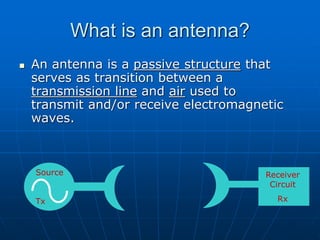
What is an antenna?
 An antenna is a passive structure that
serves as transition between a
transmission line and air used to
transmit and/or receive electromagnetic
waves.
Source
Tx
Receiver
Circuit
Rx
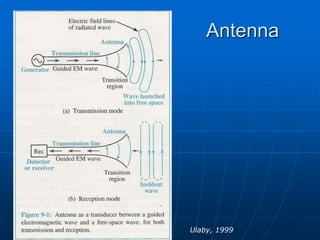
Antenna
Ulaby, 1999
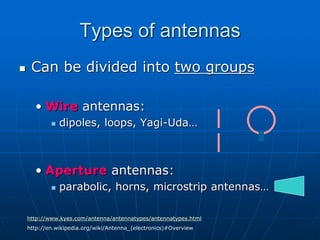
Types of antennas
 Can be divided into two groups
• Wire antennas:
 dipoles, loops, Yagi-Uda…
• Aperture antennas:
 parabolic, horns, microstrip antennas…
http://www.kyes.com/antenna/antennatypes/antennatypes.html
http://en.wikipedia.org/wiki/Antenna_(electronics)#Overview
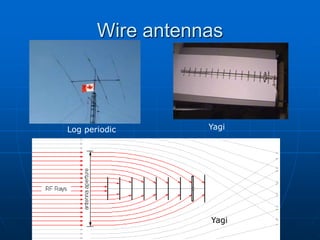
Wire antennas
Yagi
Log periodic
Yagi
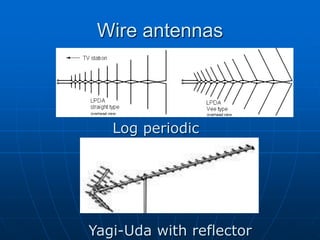
Wire antennas
Log periodic
Yagi-Uda with reflector
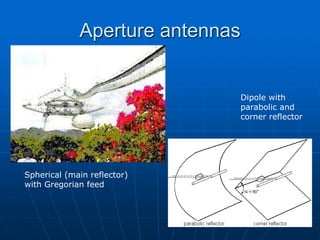
Aperture antennas
Spherical (main reflector)
with Gregorian feed
Dipole with
parabolic and
corner reflector
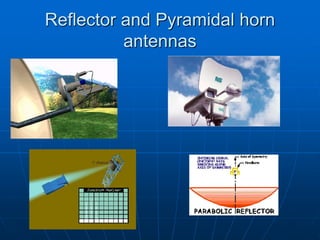
Reflector and Pyramidal horn
antennas
Related parameters
 Solid angle, WA and Radiation intensity, U
 Radiation pattern, Pn, sidelobes, HPBW
 Far field zone, rff
 Directivity, D or Gain, G
 Antenna radiation impedance, Rrad
 Effective Area, Ae
All of these parameters are expressed in terms of a
transmission antenna, but are identically
applicable to a receiving antenna. We’ll also
study:
 Friis Transmission Equation
 Radar Equation
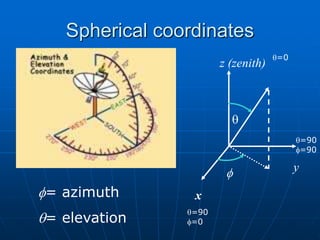
Spherical coordinates
z (zenith)
x
y
q
f
f= azimuth
q= elevation
q=90
f=0
q=0
q=90
f=90
Solid Angle
s1 = r dq s2 = r sin q dø
s = qr = arc dA = s1 s2
dA = r2 sin q dø dq
= r2 dΩ
q = Plan angle dΩ = Element of solid angle
•The arc of a complete cirlce: • Area of a complete sphere:
= 2pr = 4pr2
•Total angle: = 2p [radianes] •Total solid angle: =4p [rad2]
=4p [sr]
1 steradian (sr) = (1 radian)2
Radiation Intensity
 Is the power density per solid angle:
vector.
Poynting
as
known
also
density
power
the
is
]
[W/m
ˆ
Re 2
r
2
r
H*}
{E
½
where
r
U
r 


P
P [W/sr]
Total radiated power by antenna
 Can be calculated as;
[W]
[W]




W


dS
P
or
d
U
P
r
rad
rad
P
Radiation Pattern
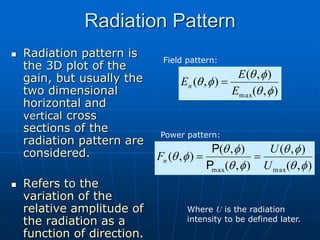
 Radiation pattern is
the 3D plot of the
gain, but usually the
two dimensional
horizontal and
vertical cross
sections of the
radiation pattern are
considered.
 Refers to the
variation of the
relative amplitude of
the radiation as a
function of direction.
)
,
(
)
,
(
)
,
(
)
,
(
)
,
(
max
max f
q
f
q
f
q
f
q
f
q
U
U
Fn 

P
P
Field pattern:
Where U is the radiation
intensity to be defined later.
)
,
(
)
,
(
)
,
(
max f
q
f
q
f
q
E
E
En 
Power pattern:
Total Solid Angle of an antenna
z
y
x
žA
Patrón
|P |
n
[sr]
)
,
(
4
A W

W  d
Fn
p
f
q WA
Is as if you changed the
radiation pattern
beam of an antenna
into a pencil beam
shape and find out
what’s the equivalent
solid angle occupied by
this pattern.
Isotropic antenna
 It’s an hypothetic antenna,
i.e., it does not exist in real
life, yet it’s used as a
measuring bar for real
antenna characteristics.
 It’s a point source that
occupies a negligible space.
Has no directional
preference.
 Its pattern is simply a sphere
so it has WA= Wisotropic= 4p
[steradians].
p
f
q
q
p
q
p
f
p
4
sin
)
1
(
)
1
(
0
2
0
4
isotropic

W

W
 

 
d
d
d
Radiation Pattern
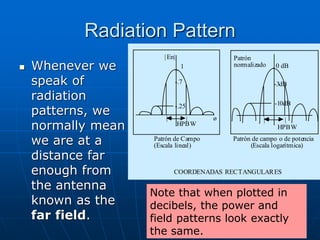
 Whenever we
speak of
radiation
patterns, we
normally mean
we are at a
distance far
enough from
the antenna
known as the
far field.
_ 1
HPBW
ø
-.25
-.7
|En|
- 0 dB
-3dB
-10dB
| | | |
HPBW
Patrón de campo o de potencia
(Escala logarítmica)
Patrón de Campo
(Escala lineal)
COORDENADAS RECTANGULARES
Patrón
normalizado
Note that when plotted in
decibels, the power and
field patterns look exactly
the same.
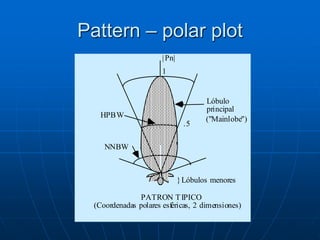
Pattern – polar plot
Lóbulo
principal
.5
1
HPBW
Lóbulos menores
NNBW
("Mainlobe")
|Pn|
}
PATRON TIPICO
(Coordenadas polares esféricas, 2 dimensiones)
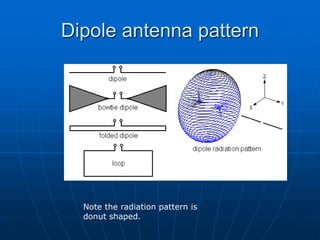
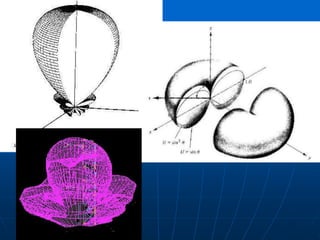
Dipole antenna pattern
Note the radiation pattern is
donut shaped.
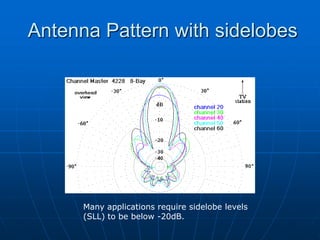
Sidelobes
 Antennas sometimes show side lobes in
the radiation pattern.
 Side lobes are peaks in gain other than
the main lobe (the "beam").
 Side lobes have bad impact to the
antenna quality whenever the system is
being used to determine the direction of a
signal, for example in RADAR systems.
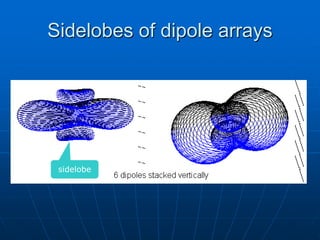
Sidelobes of dipole arrays
sidelobe
Antenna Pattern with sidelobes
Many applications require sidelobe levels
(SLL) to be below -20dB.
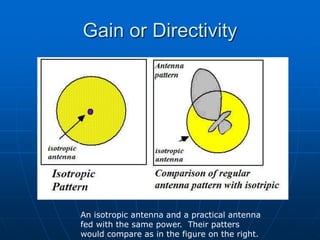
Gain or Directivity
An isotropic antenna and a practical antenna
fed with the same power. Their patters
would compare as in the figure on the right.
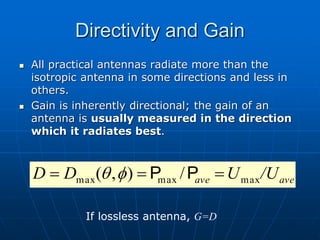
Directivity and Gain
 All practical antennas radiate more than the
isotropic antenna in some directions and less in
others.
 Gain is inherently directional; the gain of an
antenna is usually measured in the direction
which it radiates best.
ave
ave /U
U
D
D max
max
max /
)
,
( 

 P
P
f
q
If lossless antenna, G=D
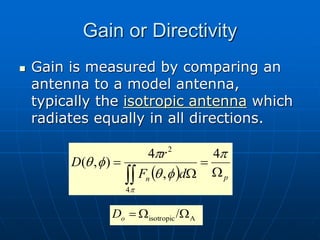
Gain or Directivity
 Gain is measured by comparing an
antenna to a model antenna,
typically the isotropic antenna which
radiates equally in all directions.
  p
n d
F
r
D
W

W


p
f
q
p
f
q
p
4
,
4
)
,
(
4
2
/ A
isotropic W
W

o
D
Directivity
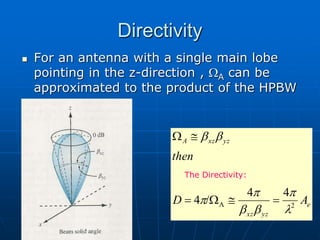
 For an antenna with a single main lobe
pointing in the z-direction , WA can be
approximated to the product of the HPBW
e
yz
xz
yz
xz
A
A
D
then
2
A
4
4
/
4

p


p
p




W


W
The Directivity:
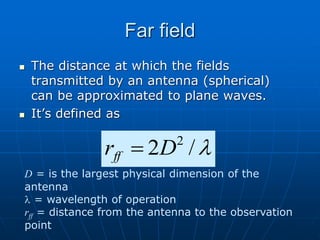
Far field
 The distance at which the fields
transmitted by an antenna (spherical)
can be approximated to plane waves.
 It’s defined as

/
2 2
D
rff 
D = is the largest physical dimension of the
antenna
 = wavelength of operation
rff = distance from the antenna to the observation
point
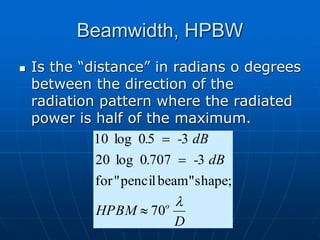
Beamwidth, HPBW
 Is the “distance” in radians o degrees
between the direction of the
radiation pattern where the radiated
power is half of the maximum.
D
HPBM
dB
-
.
dB
-
.
o 
70
shape;
beam"
pencil
"
for
3
707
0
log
20
3
5
0
log
10



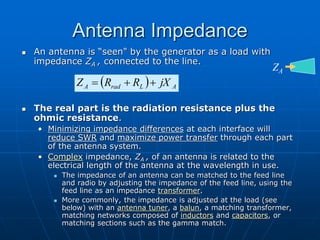
Antenna Impedance
 An antenna is “seen" by the generator as a load with
impedance ZA , connected to the line.
 The real part is the radiation resistance plus the
ohmic resistance.
• Minimizing impedance differences at each interface will
reduce SWR and maximize power transfer through each part
of the antenna system.
• Complex impedance, ZA , of an antenna is related to the
electrical length of the antenna at the wavelength in use.
 The impedance of an antenna can be matched to the feed line
and radio by adjusting the impedance of the feed line, using the
feed line as an impedance transformer.
 More commonly, the impedance is adjusted at the load (see
below) with an antenna tuner, a balun, a matching transformer,
matching networks composed of inductors and capacitors, or
matching sections such as the gamma match.
  A
L
rad
A jX
R
R
Z 


ZA
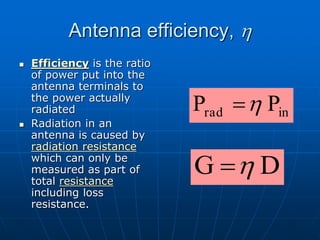
Antenna efficiency, h
 Efficiency is the ratio
of power put into the
antenna terminals to
the power actually
radiated
 Radiation in an
antenna is caused by
radiation resistance
which can only be
measured as part of
total resistance
including loss
resistance.
in
rad P
P h

D
G h

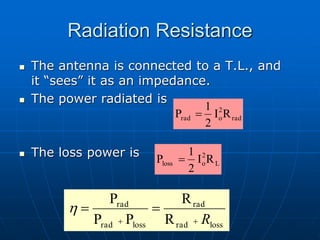
Radiation Resistance
 The antenna is connected to a T.L., and
it “sees” it as an impedance.
 The power radiated is
 The loss power is
loss
rad
rad
loss
rad
rad
R
R
P
P
P
R




h
rad
2
o
rad R
I
2
1
P 
L
2
o
loss R
I
2
1
P 
Radar equation
 What is a radar?
 Received power by a radar from a single
target is
 Where s is the backscattering coefficient of
the target [m2]
 

s
p
 2
4
3
2
2
4

 e
R
G
P
P o
o
t
r
Antenna polarization
 The polarization of an antenna is the
polarization of the signals it emits.
• The ionosphere changes the polarization of
signals unpredictably, so for signals which
will be reflected by the ionosphere,
polarization is not crucial.
• However, for line-of-sight communications, it
can make a tremendous difference in signal
quality to have the transmitter and receiver
using the same polarization.
• Polarizations commonly considered are
vertical, horizontal, and circular.
Antenna Bandwidth
 The bandwidth of an antenna is the range of
frequencies over which it is effective, usually
centered around the operating or resonant
frequency.
• The bandwidth of an antenna may be increased by
several techniques, including using thicker wires,
replacing wires with cages to simulate a thicker wire,
tapering antenna components (like in a feed horn), and
combining multiple antennas into a single assembly and
allowing the natural impedance to select the correct
antenna.
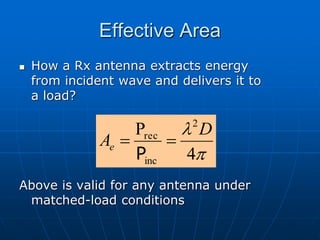
Effective Area
 How a Rx antenna extracts energy
from incident wave and delivers it to
a load?
Above is valid for any antenna under
matched-load conditions
p

4
P 2
inc
rec D
Ae 

P
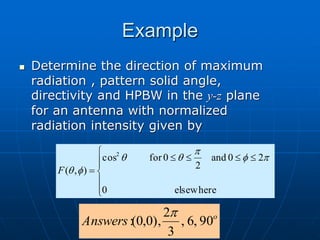
Example
 Determine the direction of maximum
radiation , pattern solid angle,
directivity and HPBW in the y-z plane
for an antenna with normalized
radiation intensity given by
elsewhere
0
2
0
and
2
0
for
cos
)
,
(
2












p
f
p
q
q
f
q
F
o
Answers 90
,
6
,
3
2
),
0
,
0
(
:
p
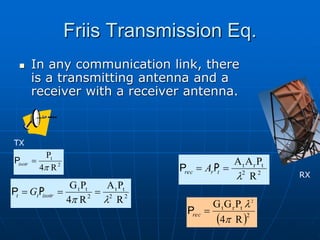
Friis Transmission Eq.
 In any communication link, there
is a transmitting antenna and a
receiver with a receiver antenna.
2
t
R
4
P
p

isotr
P
2
2
t
t
2
t
t
R
P
A
R
4
P
G

p


 isotr
t
t G P
P
2
2
t
r
t
R
P
A
A


 t
r
rec A P
P
 2
t
r
t
R
4
P
G
G 2
p


rec
P
TX
RX
Antenna Arrays
 Uses many antennas synchronized
with each other to increase
 Pattern multiplication, AF
[ ]
Factor
Array
Pattern
Antenna
Individual
)
( 






r
E













2
sin
2
sin


N
N
AFN
1
-1 1
x
|T (x)|
4
-R
x
0
°
Uniform illumination Tschebyscheff Illumination
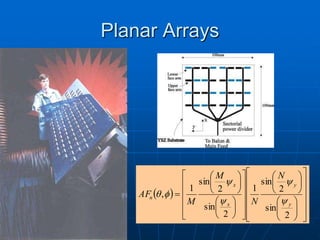
Planar Arrays
 



















































2
sin
2
sin
1
2
sin
2
sin
1
,
y
y
x
x
n
N
N
M
M
AF




f
q

fdocuments.net_introduction-to-antenna-theory.ppt

  • 1.
  • 2.
    What is anantenna?  An antenna is a passive structure that serves as transition between a transmission line and air used to transmit and/or receive electromagnetic waves. Source Tx Receiver Circuit Rx
  • 3.
  • 4.
    Types of antennas Can be divided into two groups • Wire antennas:  dipoles, loops, Yagi-Uda… • Aperture antennas:  parabolic, horns, microstrip antennas… http://www.kyes.com/antenna/antennatypes/antennatypes.html http://en.wikipedia.org/wiki/Antenna_(electronics)#Overview
  • 5.
  • 6.
  • 7.
    Aperture antennas Spherical (mainreflector) with Gregorian feed Dipole with parabolic and corner reflector
  • 8.
  • 9.
    Related parameters  Solidangle, WA and Radiation intensity, U  Radiation pattern, Pn, sidelobes, HPBW  Far field zone, rff  Directivity, D or Gain, G  Antenna radiation impedance, Rrad  Effective Area, Ae All of these parameters are expressed in terms of a transmission antenna, but are identically applicable to a receiving antenna. We’ll also study:  Friis Transmission Equation  Radar Equation
  • 10.
    Spherical coordinates z (zenith) x y q f f=azimuth q= elevation q=90 f=0 q=0 q=90 f=90
  • 11.
    Solid Angle s1 =r dq s2 = r sin q dø s = qr = arc dA = s1 s2 dA = r2 sin q dø dq = r2 dΩ q = Plan angle dΩ = Element of solid angle •The arc of a complete cirlce: • Area of a complete sphere: = 2pr = 4pr2 •Total angle: = 2p [radianes] •Total solid angle: =4p [rad2] =4p [sr] 1 steradian (sr) = (1 radian)2
  • 12.
    Radiation Intensity  Isthe power density per solid angle: vector. Poynting as known also density power the is ] [W/m ˆ Re 2 r 2 r H*} {E ½ where r U r    P P [W/sr]
  • 13.
    Total radiated powerby antenna  Can be calculated as; [W] [W]     W   dS P or d U P r rad rad P
  • 14.
    Radiation Pattern  Radiationpattern is the 3D plot of the gain, but usually the two dimensional horizontal and vertical cross sections of the radiation pattern are considered.  Refers to the variation of the relative amplitude of the radiation as a function of direction. ) , ( ) , ( ) , ( ) , ( ) , ( max max f q f q f q f q f q U U Fn   P P Field pattern: Where U is the radiation intensity to be defined later. ) , ( ) , ( ) , ( max f q f q f q E E En  Power pattern:
  • 15.
    Total Solid Angleof an antenna z y x žA Patrón |P | n [sr] ) , ( 4 A W  W  d Fn p f q WA Is as if you changed the radiation pattern beam of an antenna into a pencil beam shape and find out what’s the equivalent solid angle occupied by this pattern.
  • 16.
    Isotropic antenna  It’san hypothetic antenna, i.e., it does not exist in real life, yet it’s used as a measuring bar for real antenna characteristics.  It’s a point source that occupies a negligible space. Has no directional preference.  Its pattern is simply a sphere so it has WA= Wisotropic= 4p [steradians]. p f q q p q p f p 4 sin ) 1 ( ) 1 ( 0 2 0 4 isotropic  W  W      d d d
  • 17.
    Radiation Pattern  Wheneverwe speak of radiation patterns, we normally mean we are at a distance far enough from the antenna known as the far field. _ 1 HPBW ø -.25 -.7 |En| - 0 dB -3dB -10dB | | | | HPBW Patrón de campo o de potencia (Escala logarítmica) Patrón de Campo (Escala lineal) COORDENADAS RECTANGULARES Patrón normalizado Note that when plotted in decibels, the power and field patterns look exactly the same.
  • 18.
    Pattern – polarplot Lóbulo principal .5 1 HPBW Lóbulos menores NNBW ("Mainlobe") |Pn| } PATRON TIPICO (Coordenadas polares esféricas, 2 dimensiones)
  • 19.
    Dipole antenna pattern Notethe radiation pattern is donut shaped.
  • 20.
    Sidelobes  Antennas sometimesshow side lobes in the radiation pattern.  Side lobes are peaks in gain other than the main lobe (the "beam").  Side lobes have bad impact to the antenna quality whenever the system is being used to determine the direction of a signal, for example in RADAR systems.
  • 21.
    Sidelobes of dipolearrays sidelobe
  • 22.
    Antenna Pattern withsidelobes Many applications require sidelobe levels (SLL) to be below -20dB.
  • 23.
    Gain or Directivity Anisotropic antenna and a practical antenna fed with the same power. Their patters would compare as in the figure on the right.
  • 24.
    Directivity and Gain All practical antennas radiate more than the isotropic antenna in some directions and less in others.  Gain is inherently directional; the gain of an antenna is usually measured in the direction which it radiates best. ave ave /U U D D max max max / ) , (    P P f q If lossless antenna, G=D
  • 25.
    Gain or Directivity Gain is measured by comparing an antenna to a model antenna, typically the isotropic antenna which radiates equally in all directions.   p n d F r D W  W   p f q p f q p 4 , 4 ) , ( 4 2 / A isotropic W W  o D
  • 26.
    Directivity  For anantenna with a single main lobe pointing in the z-direction , WA can be approximated to the product of the HPBW e yz xz yz xz A A D then 2 A 4 4 / 4  p   p p     W   W The Directivity:
  • 27.
    Far field  Thedistance at which the fields transmitted by an antenna (spherical) can be approximated to plane waves.  It’s defined as  / 2 2 D rff  D = is the largest physical dimension of the antenna  = wavelength of operation rff = distance from the antenna to the observation point
  • 28.
    Beamwidth, HPBW  Isthe “distance” in radians o degrees between the direction of the radiation pattern where the radiated power is half of the maximum. D HPBM dB - . dB - . o  70 shape; beam" pencil " for 3 707 0 log 20 3 5 0 log 10   
  • 29.
    Antenna Impedance  Anantenna is “seen" by the generator as a load with impedance ZA , connected to the line.  The real part is the radiation resistance plus the ohmic resistance. • Minimizing impedance differences at each interface will reduce SWR and maximize power transfer through each part of the antenna system. • Complex impedance, ZA , of an antenna is related to the electrical length of the antenna at the wavelength in use.  The impedance of an antenna can be matched to the feed line and radio by adjusting the impedance of the feed line, using the feed line as an impedance transformer.  More commonly, the impedance is adjusted at the load (see below) with an antenna tuner, a balun, a matching transformer, matching networks composed of inductors and capacitors, or matching sections such as the gamma match.   A L rad A jX R R Z    ZA
  • 30.
    Antenna efficiency, h Efficiency is the ratio of power put into the antenna terminals to the power actually radiated  Radiation in an antenna is caused by radiation resistance which can only be measured as part of total resistance including loss resistance. in rad P P h  D G h 
  • 31.
    Radiation Resistance  Theantenna is connected to a T.L., and it “sees” it as an impedance.  The power radiated is  The loss power is loss rad rad loss rad rad R R P P P R     h rad 2 o rad R I 2 1 P  L 2 o loss R I 2 1 P 
  • 32.
    Radar equation  Whatis a radar?  Received power by a radar from a single target is  Where s is the backscattering coefficient of the target [m2]    s p  2 4 3 2 2 4   e R G P P o o t r
  • 33.
    Antenna polarization  Thepolarization of an antenna is the polarization of the signals it emits. • The ionosphere changes the polarization of signals unpredictably, so for signals which will be reflected by the ionosphere, polarization is not crucial. • However, for line-of-sight communications, it can make a tremendous difference in signal quality to have the transmitter and receiver using the same polarization. • Polarizations commonly considered are vertical, horizontal, and circular.
  • 34.
    Antenna Bandwidth  Thebandwidth of an antenna is the range of frequencies over which it is effective, usually centered around the operating or resonant frequency. • The bandwidth of an antenna may be increased by several techniques, including using thicker wires, replacing wires with cages to simulate a thicker wire, tapering antenna components (like in a feed horn), and combining multiple antennas into a single assembly and allowing the natural impedance to select the correct antenna.
  • 35.
    Effective Area  Howa Rx antenna extracts energy from incident wave and delivers it to a load? Above is valid for any antenna under matched-load conditions p  4 P 2 inc rec D Ae   P
  • 36.
    Example  Determine thedirection of maximum radiation , pattern solid angle, directivity and HPBW in the y-z plane for an antenna with normalized radiation intensity given by elsewhere 0 2 0 and 2 0 for cos ) , ( 2             p f p q q f q F o Answers 90 , 6 , 3 2 ), 0 , 0 ( : p
  • 38.
    Friis Transmission Eq. In any communication link, there is a transmitting antenna and a receiver with a receiver antenna. 2 t R 4 P p  isotr P 2 2 t t 2 t t R P A R 4 P G  p    isotr t t G P P 2 2 t r t R P A A    t r rec A P P  2 t r t R 4 P G G 2 p   rec P TX RX
  • 39.
    Antenna Arrays  Usesmany antennas synchronized with each other to increase  Pattern multiplication, AF [ ] Factor Array Pattern Antenna Individual ) (        r E              2 sin 2 sin   N N AFN 1 -1 1 x |T (x)| 4 -R x 0 ° Uniform illumination Tschebyscheff Illumination
  • 40.