A Brief Guide to the
FDA Drug
Approval Process
1 Pre-Clinical
Drug
Approval
DRUG DEVELOPED
A sponsor develops a new drug
compound and seeks to have it
approved by the FDA for sale in the
United States.
ANIMALS TESTED
A sponsor must test a new drug on
animals for toxicity. Multiple species are
used to gather basic information on the
safety and efficacy of the compound
being investigated and researched.
INVESTIGATIONAL NEW DRUG (IND)
APPLICATION
The sponsor submits an IND application
to the FDA based on the results from the
initial testing. The IND also includes a
plan for testing the drug on humans. The
FDA reviews the IND to assure that the
proposed studies/clinical trials do not
place human subjects at unreasonable
risk of harm. The FDA also verifies that
there are adequate informed consent
and human subject protection.
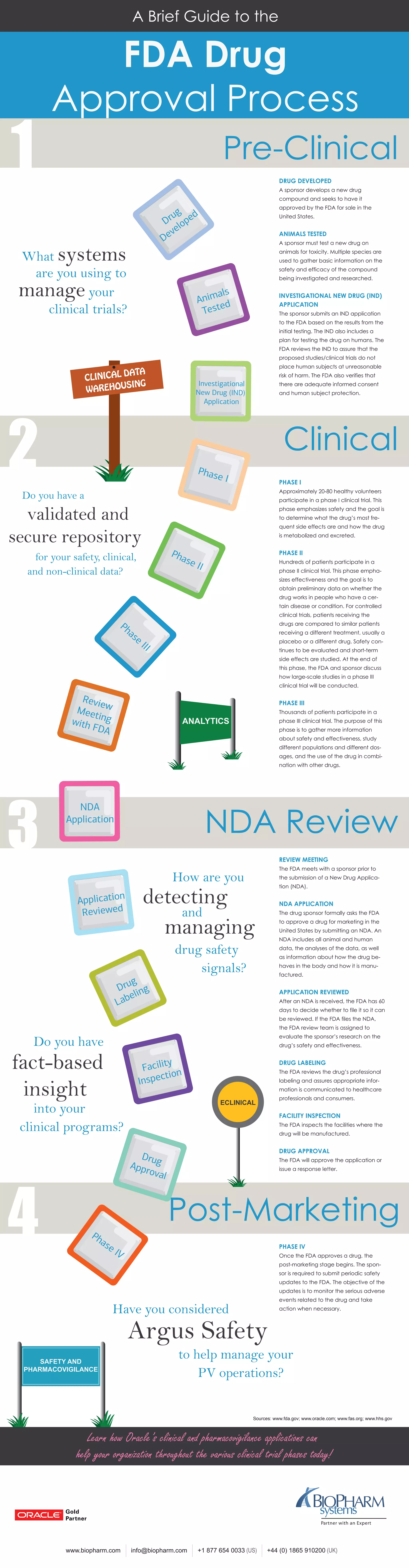
PHASE I
Approximately 20-80 healthy volunteers
participate in a phase I clinical trial. This
phase emphasizes safety and the goal is
to determine what the drug’s most fre-
quent side effects are and how the drug
is metabolized and excreted.
PHASE II
Hundreds of patients participate in a
phase II clinical trial. This phase empha-
sizes effectiveness and the goal is to
obtain preliminary data on whether the
drug works in people who have a cer-
tain disease or condition. For controlled
clinical trials, patients receiving the
drugs are compared to similar patients
receiving a different treatment, usually a
placebo or a different drug. Safety con-
tinues to be evaluated and short-term
side effects are studied. At the end of
this phase, the FDA and sponsor discuss
how large-scale studies in a phase III
clinical trial will be conducted.
PHASE III
Thousands of patients participate in a
phase III clinical trial. The purpose of this
phase is to gather more information
about safety and effectiveness, study
different populations and different dos-
ages, and the use of the drug in combi-
nation with other drugs.
2 Clinical
Facility
Inspection
Phase IV
Application
Reviewed
Drug
Labeling
3 NDA Review
REVIEW MEETING
The FDA meets with a sponsor prior to
the submission of a New Drug Applica-
tion (NDA).
NDA APPLICATION
The drug sponsor formally asks the FDA
to approve a drug for marketing in the
United States by submitting an NDA. An
NDA includes all animal and human
data, the analyses of the data, as well
as information about how the drug be-
haves in the body and how it is manu-
factured.
APPLICATION REVIEWED
After an NDA is received, the FDA has 60
days to decide whether to file it so it can
be reviewed. If the FDA files the NDA,
the FDA review team is assigned to
evaluate the sponsor’s research on the
drug’s safety and effectiveness.
DRUG LABELING
The FDA reviews the drug’s professional
labeling and assures appropriate infor-
mation is communicated to healthcare
professionals and consumers.
FACILITY INSPECTION
The FDA inspects the facilities where the
drug will be manufactured.
DRUG APPROVAL
The FDA will approve the application or
issue a response letter.
NDA
Application
Drug
Developed
Animals
Tested
Investigational
New Drug (IND)
Application
Phase I
Phase II
Phase
III
4 Post-Marketing
PHASE IV
Once the FDA approves a drug, the
post-marketing stage begins. The spon-
sor is required to submit periodic safety
updates to the FDA. The objective of the
updates is to monitor the serious adverse
events related to the drug and take
action when necessary.
Review
Meeting
with FDA
CLINICAL DATA
WAREHOUSING
Do you have a
validated and
secure repository
for your safety, clinical,
and non-clinical data?
What systems
are you using to
clinical trials?
How are you
detecting
managing
drug safety
signals?
and
Have you considered
Argus Safety
to help manage your
PV operations?
ANALYTICS
ECLINICAL
SAFETY AND
PHARMACOVIGILANCE
Learn how Oracle’s clinical and pharmacovigilance applications can
help your organization throughout the various clinical trial phases today!
manage your
Sources: www.fda.gov; www.oracle.com; www.fas.org; www.hhs.gov
Do you have
fact-based
insight
into your
clinical programs?

A Brief Guide to the FDA Drug Approval Process

  • 1.
    A Brief Guideto the FDA Drug Approval Process 1 Pre-Clinical Drug Approval DRUG DEVELOPED A sponsor develops a new drug compound and seeks to have it approved by the FDA for sale in the United States. ANIMALS TESTED A sponsor must test a new drug on animals for toxicity. Multiple species are used to gather basic information on the safety and efficacy of the compound being investigated and researched. INVESTIGATIONAL NEW DRUG (IND) APPLICATION The sponsor submits an IND application to the FDA based on the results from the initial testing. The IND also includes a plan for testing the drug on humans. The FDA reviews the IND to assure that the proposed studies/clinical trials do not place human subjects at unreasonable risk of harm. The FDA also verifies that there are adequate informed consent and human subject protection. PHASE I Approximately 20-80 healthy volunteers participate in a phase I clinical trial. This phase emphasizes safety and the goal is to determine what the drug’s most fre- quent side effects are and how the drug is metabolized and excreted. PHASE II Hundreds of patients participate in a phase II clinical trial. This phase empha- sizes effectiveness and the goal is to obtain preliminary data on whether the drug works in people who have a cer- tain disease or condition. For controlled clinical trials, patients receiving the drugs are compared to similar patients receiving a different treatment, usually a placebo or a different drug. Safety con- tinues to be evaluated and short-term side effects are studied. At the end of this phase, the FDA and sponsor discuss how large-scale studies in a phase III clinical trial will be conducted. PHASE III Thousands of patients participate in a phase III clinical trial. The purpose of this phase is to gather more information about safety and effectiveness, study different populations and different dos- ages, and the use of the drug in combi- nation with other drugs. 2 Clinical Facility Inspection Phase IV Application Reviewed Drug Labeling 3 NDA Review REVIEW MEETING The FDA meets with a sponsor prior to the submission of a New Drug Applica- tion (NDA). NDA APPLICATION The drug sponsor formally asks the FDA to approve a drug for marketing in the United States by submitting an NDA. An NDA includes all animal and human data, the analyses of the data, as well as information about how the drug be- haves in the body and how it is manu- factured. APPLICATION REVIEWED After an NDA is received, the FDA has 60 days to decide whether to file it so it can be reviewed. If the FDA files the NDA, the FDA review team is assigned to evaluate the sponsor’s research on the drug’s safety and effectiveness. DRUG LABELING The FDA reviews the drug’s professional labeling and assures appropriate infor- mation is communicated to healthcare professionals and consumers. FACILITY INSPECTION The FDA inspects the facilities where the drug will be manufactured. DRUG APPROVAL The FDA will approve the application or issue a response letter. NDA Application Drug Developed Animals Tested Investigational New Drug (IND) Application Phase I Phase II Phase III 4 Post-Marketing PHASE IV Once the FDA approves a drug, the post-marketing stage begins. The spon- sor is required to submit periodic safety updates to the FDA. The objective of the updates is to monitor the serious adverse events related to the drug and take action when necessary. Review Meeting with FDA CLINICAL DATA WAREHOUSING Do you have a validated and secure repository for your safety, clinical, and non-clinical data? What systems are you using to clinical trials? How are you detecting managing drug safety signals? and Have you considered Argus Safety to help manage your PV operations? ANALYTICS ECLINICAL SAFETY AND PHARMACOVIGILANCE Learn how Oracle’s clinical and pharmacovigilance applications can help your organization throughout the various clinical trial phases today! manage your Sources: www.fda.gov; www.oracle.com; www.fas.org; www.hhs.gov Do you have fact-based insight into your clinical programs?