Fasting in Islam
Muslim’s fast in the month of
Ramadan. Ramadan is a time of
spiritual reflection and worship.
Muslims are expected to put more
effort into following the teachings of
Islam and to avoid obscene and
irreligious sights and sounds. During
fasting, intercourse is prohibited as
well as eating and drinking, and
 During   fasting, intercourse is
  prohibited as well as eating and
  drinking, and resistance of all
  temptations is encouraged.
 The act of fasting is said to redirect
  the heart away from worldly
  activities, and its purpose being to
  cleanse the inner soul and free it
  from harm.
WHO MUST FAST ?
Fasting Ramadan is compulsory upon every
Muslim, male or female, who has these
qualifications:

 To be mentally and physically fit, ( sane and able
  ).
 To be of full age, (the age of puberty - normally
  about fourteen).
 To be present at one's permanent settlement, your
  home town, one's farm, and one's business
  premises, etc. This means not to be on a journey
  of about fifty miles or more.
EXCEMPTION FROM FASTING
 Children under   the age of puberty.
 Insane people who are unaccountable for their
  deeds.
 Men and women who are too old to fast and
  bear its hardships. Such people are exempted
  from this duty, but they must offer, at least,
  one needy poor Muslim an average full meal
  or its value per person per day.
 Sick people whose health is likely to be
  severely affected fasting. They may postpone
 Travelers may break the fast temporarily
  during their travel only and make up for it in
  later days, a day for a day.
 Pregnant women and women breast-feeding
  their children may also break the fast, if its
  observance is likely to endanger their own
  health or that of their infants. But they must
  make up for the fast at a delayed time, a day
  for a day.
 Women in the -period of menstruation. They
  must postpone the fast till recovery and then
GENERAL RECOMMENDATIONS
   This practices are strongly recommended by Prophet
    Muhammad SAW especially during Ramadan:
   To have a light meal before the break of the dawn,
    known as Sahur.
   To eat a few dates or start breaking the fast by plain
    water right after sunset.
   To make your meals as light as possible.
   To perform the prayer known as Tarawih after
    breaking fast.
   To increase the study and recitation of the Qur'an.
   Practice patience and humbleness.
Prayer and the reading of
Qur’an to fasting, Muslims are encouraged to read the
 In addition
    entire Qur'an. Some Muslims perform the recitation of the
    entire Qur'an by means of special prayers, called Tarawih,
    which are held in the mosques every night of the month,
    during which a whole section of the Qur'an (Juz', which is
    1/30 of the Qur'an) is recited. Therefore the entire Qur'an
    would be completed at the end of the month.

   Ramadan is also a time when Muslims are to slow down from
    worldly affairs and focus on spiritual cleansing and this is to
    establish a link between themselves and God through prayer,
    supplication, charity, good deeds, kindness and helping others.
    Since it is a festival of giving and sharing, Muslims prepare
    special foods and buy gifts for their family and friends and for
Iftar
 Muslims all around the world will abstain from
  food and drink, through fasting, from dawn to
  sunset.
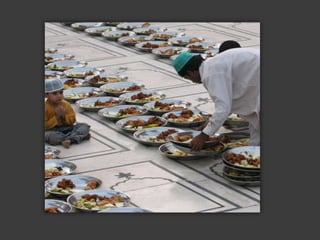
 At sunset, the family will gather the fast-
  breaking meal known as Iftar. The meal starts
  with the eating of three dates — just as
  Muhammad used to do. Then it's time for the
  Maghrib prayer, which is the fourth of the five
  daily prayers, after which the main meal is
  served.
 Over time, Iftar has grown into banquet festivals.
Reasons behind fasting
   Fasting is a means that makes us appreciate and
    give thanks for pleasures.
   Fasting is a means of giving up haraam things, so
    fasting is a means of avoiding the things that Allah
    has forbidden.
   Fasting enables us to control our desires, because
    when a person is full his desires grow, but if he is
    hungry then his desire becomes weak.
   Fasting makes us feel compassion and empathy
    towards the poor, because when the fasting person
    tastes the pain of hunger for a while.
   Fasting humiliates and weakens the Satan; it
    weakens the effects of his whispers (waswaas) on a
    person and reduces his sins.
Fasting in Islam ( COMPARATIVE RELIGION )

Fasting in Islam ( COMPARATIVE RELIGION )

  • 2.
    Fasting in Islam Muslim’sfast in the month of Ramadan. Ramadan is a time of spiritual reflection and worship. Muslims are expected to put more effort into following the teachings of Islam and to avoid obscene and irreligious sights and sounds. During fasting, intercourse is prohibited as well as eating and drinking, and
  • 3.
     During fasting, intercourse is prohibited as well as eating and drinking, and resistance of all temptations is encouraged.  The act of fasting is said to redirect the heart away from worldly activities, and its purpose being to cleanse the inner soul and free it from harm.
  • 4.
    WHO MUST FAST? Fasting Ramadan is compulsory upon every Muslim, male or female, who has these qualifications:  To be mentally and physically fit, ( sane and able ).  To be of full age, (the age of puberty - normally about fourteen).  To be present at one's permanent settlement, your home town, one's farm, and one's business premises, etc. This means not to be on a journey of about fifty miles or more.
  • 5.
    EXCEMPTION FROM FASTING Children under the age of puberty.  Insane people who are unaccountable for their deeds.  Men and women who are too old to fast and bear its hardships. Such people are exempted from this duty, but they must offer, at least, one needy poor Muslim an average full meal or its value per person per day.  Sick people whose health is likely to be severely affected fasting. They may postpone
  • 6.
     Travelers maybreak the fast temporarily during their travel only and make up for it in later days, a day for a day.  Pregnant women and women breast-feeding their children may also break the fast, if its observance is likely to endanger their own health or that of their infants. But they must make up for the fast at a delayed time, a day for a day.  Women in the -period of menstruation. They must postpone the fast till recovery and then
  • 7.
    GENERAL RECOMMENDATIONS  This practices are strongly recommended by Prophet Muhammad SAW especially during Ramadan:  To have a light meal before the break of the dawn, known as Sahur.  To eat a few dates or start breaking the fast by plain water right after sunset.  To make your meals as light as possible.  To perform the prayer known as Tarawih after breaking fast.  To increase the study and recitation of the Qur'an.  Practice patience and humbleness.
  • 9.
    Prayer and thereading of Qur’an to fasting, Muslims are encouraged to read the  In addition entire Qur'an. Some Muslims perform the recitation of the entire Qur'an by means of special prayers, called Tarawih, which are held in the mosques every night of the month, during which a whole section of the Qur'an (Juz', which is 1/30 of the Qur'an) is recited. Therefore the entire Qur'an would be completed at the end of the month.  Ramadan is also a time when Muslims are to slow down from worldly affairs and focus on spiritual cleansing and this is to establish a link between themselves and God through prayer, supplication, charity, good deeds, kindness and helping others. Since it is a festival of giving and sharing, Muslims prepare special foods and buy gifts for their family and friends and for
  • 11.
    Iftar  Muslims allaround the world will abstain from food and drink, through fasting, from dawn to sunset.  At sunset, the family will gather the fast- breaking meal known as Iftar. The meal starts with the eating of three dates — just as Muhammad used to do. Then it's time for the Maghrib prayer, which is the fourth of the five daily prayers, after which the main meal is served.  Over time, Iftar has grown into banquet festivals.
  • 13.
    Reasons behind fasting  Fasting is a means that makes us appreciate and give thanks for pleasures.  Fasting is a means of giving up haraam things, so fasting is a means of avoiding the things that Allah has forbidden.  Fasting enables us to control our desires, because when a person is full his desires grow, but if he is hungry then his desire becomes weak.  Fasting makes us feel compassion and empathy towards the poor, because when the fasting person tastes the pain of hunger for a while.  Fasting humiliates and weakens the Satan; it weakens the effects of his whispers (waswaas) on a person and reduces his sins.