Software Project Management
Jing Zhang Ph.D.
 Jing ZHANG (张静) Ph. D.
 Teach
 Software Project Management
 Compliers (next semester)
 Personal web page
 http://jz81.github.com
 Email: jzhang@njust.edu.cn
 Office: Room 2020, Computer Hall
 Office Time: Every Tuesday and Thursday
About Me
http://jz81.github.io/course/spm/spm.html
Course Information
About the course
 32 instruction hours + 16 experimental hours
 3 Credits
 Audience:
 Software Engineering
 Computer Science Technology
 Information Management
 Previous Courses:
 Software Engineering
 Principle of Management
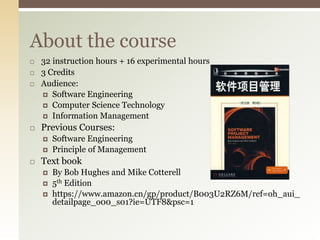
 Text book
 By Bob Hughes and Mike Cotterell
 5th Edition
 https://www.amazon.cn/gp/product/B003U2RZ6M/ref=oh_aui_
detailpage_o00_s01?ie=UTF8&psc=1
https://www.amazon.cn/gp/product/B003U2RZ6M/ref=oh_aui_d
etailpage_o00_s01?ie=UTF8&psc=1
 Final Examination (70%)
 Essay Writing (Project, 10%)
 Homework (10%)
 Presence in Class(10%)
Final score
 Find a topic related to software project
management
 Every one must write his/her own paper.
Plagiarizing (copying) others cannot get score.
 The minimum number of words must reach 3000.
 A paper should at least includes
 Introduction
 Methods
 Discussion (Your opinions on the methods)
 Conclusion
 Due date: Dec. 31, 2016.
Project (Paper Writing)
Main Scopes of SPM
Objectives:
 Define the scopes of SPM
 Understand what project managers worry about
 Define the phases of a software project
 Explain the factors of management
 Be conscious of that a project needs elaborative planning,
supervision and control
 Identify stakeholders and their objectives
 Define the criteria of success
Introduction to SPM
 Unfortunately, projects are not always
successful.
 Standish Group in the U.S. analyzed 13,522
projects and concluded that only a third of them
were successful; 82 percent were late and 43
percent exceeded their budget.
 The reason for these project shortcomings is
often the management of projects.
Why is SPM important?
 In dictionary definition, it emphases on
-----Being planned activity
 Routine: one knows exactly what to do
 Exploratory: full of uncertainties and risks
What is a project?
Routine
Uncertainty of
Outcome
Jobs Exploration
Projects
Most likely to benefit from prj
management
 The characteristics distinguish projects:
 non-routine tasks are involved;
 planning is required;
 specific objectives are to be met or a specified product is to be
created;
 the project has a predetermined time span;
 work is carried out for someone other than yourself;
 work involves several specialism;
 people are formed into a temporary work group to carry out the
task ;
 work is carried out in several phases;
 the resources that are available for use on the project are
constrained;
 the project is large or complex.
What is a project?
The more any of these factors apply to a task, the more difficult that task will be.
 Scope:
 What work will be done as part of the project
 What unique product, service, or result does the
customer or sponsor expect from the project
 Time
 How long should it take to complete the project
 Who can approve changes to the schedule
 Cost
 What is the project’s budget
 Who can authorize changes to the budget
Project Constraints
 Invisibility: With software, progress is not
immediately visible
 Complexity: Per dollar, software products
contain more complexity than other
engineered artefacts
 Conformity: Software developers have to
conform to the requirements of human clients
 Flexibility: Software systems are particularly
subject to change
Software prj vs. other types of prj
ICT Project – Information and Communication Technology Project
 A software project is not only concerned with the actual writing
of software. In fact, where a software application is bought in “of
the shelf”, there may be no software writing as such, but this is
still fundamentally a software project because so many of the
other activities associated with software will still be present.
Activities covered by SPM
Feasibility study
Plan
Is it worth
doing?
Project excution
How do we
do it?
Do it!
Three successive processes
 1. The feasibility study: assesses whether a project is
worth starting – that it has a valid business case.
 2. Planning: If the feasibility study indicates that the
prospective project appears viable, then project
planning can start.
 3. Project execution: The execution of a project often
contains design and implementation sub-phases.
 Design is making decisions about the form of the
products to be created.
 Planning details the activities to be carried out to create
these products.
 E.g., Activities recommended in the international standard
ISO 12207
Activities covered by SPM
 Activity: test a component
 Methods: Real activates:
 A plan takes the method and convert it to real
activities, identifying for each activity
 Groups of methods or techniques are often
grouped into methodologies such as object-
oriented design
Plans, methods and methodologies
 Analyze the requirements
 Devise and write test cases
 Create test scripts and
expected results
 Compare the actual results
and the expected ones
a plan
 Its start and end dates
 Who will carry it out
 What tools and materials
 Compulsory vs. voluntary users
 Supermarket transaction system vs. computer
game
 Information systems vs. embedded systems
 Office system vs. machine control system
 Objectives vs. products
 to meet certain objectives vs. to produce a
product (course management system vs. anti-
virus system)
Some ways of categorizing
software projects
The people who have a stake or interest in the
project
 Internal to the project team
 External to the project team but within the
same organization
 External to both the project team and the
organization
Identify them early for setting up better
communication channels
Stakeholders
 Objectives focus on the desired outcomes of the
project rather than the task within it.
 SMART principles
 Specific: Effective objectives are concrete and well
defined
 Measurable: measures of effectiveness which tell us
how successful the project has been
 Achievable: within the power of the individual or
group
 Relevant: must be relevant to the true purpose of the
project
 Time constrained: should be a defined point in time
by which the objective should have been achieved
Setting objectives
 The project plan should be designed to ensure
project success
 Project success can usually be summarized
and delivering:
 the agreed functionality
 To the required level of quality
 on time
 within budget
 Project success vs. business success
Project success and failure
 Management involves the following activities:
 planning – deciding what is to be done;
 organizing – making arrangement;
 staffing – selecting the right people for the job;
 directing – giving instructions;
 monitoring – checking on progress;
 controlling – taking action to remedy hold-ups;
 innovating – coming up with new solutions;
 representing- liaising with clients, users,
developer, suppliers and other stakeholders.
What is management
 Management, in general, involves setting objectives for a system
and then monitoring the performance of the system.
Management control
 Using project management techniques provides
advantages, such as
 Better control of financial, physical, and human
resources
 Improved customer relations
 Shorter development times
 Lower costs and improved productivity
 Higher quality and increased reliability
 Higher profit margins
 Better internal coordination
 Positive impact on meeting strategic goal
 Higher worker morale
Advantages
 Projects are by definition non-routine and therefore more
uncertain than normal undertakings
 Software projects are similar to other projects but have some
attributes that present particular difficulties, e.g. the relative
invisibility of many of their products.
 A key factor in project success is having clear objectives.
Different stakeholders in a project, however, are likely to
have different objectives. This points to the need for a
recognized overall project authority.
 For objectives to the effective there must be practical ways of
testing that the objectives have been met.
 Where projects involve many different people, effective
channels of information have to be established. Having
objective measures of success helps unambiguous
communication between the various parties to a project.
Conclusion
 Section 1.16 Further exercises
 Exercises 3
A public library is considering the implementation
of a computer-based system to help administer
book loans at libraries. Identify the stakeholders in
such a project. What might be the objectives of
such a project and how might the success of the
project be measured in practical terms?
Homework

(Fall2016)Lecture1.pptx

  • 1.
  • 2.
     Jing ZHANG(张静) Ph. D.  Teach  Software Project Management  Compliers (next semester)  Personal web page  http://jz81.github.com  Email: jzhang@njust.edu.cn  Office: Room 2020, Computer Hall  Office Time: Every Tuesday and Thursday About Me
  • 3.
  • 4.
    About the course 32 instruction hours + 16 experimental hours  3 Credits  Audience:  Software Engineering  Computer Science Technology  Information Management  Previous Courses:  Software Engineering  Principle of Management  Text book  By Bob Hughes and Mike Cotterell  5th Edition  https://www.amazon.cn/gp/product/B003U2RZ6M/ref=oh_aui_ detailpage_o00_s01?ie=UTF8&psc=1
  • 5.
  • 6.
     Final Examination(70%)  Essay Writing (Project, 10%)  Homework (10%)  Presence in Class(10%) Final score
  • 7.
     Find atopic related to software project management  Every one must write his/her own paper. Plagiarizing (copying) others cannot get score.  The minimum number of words must reach 3000.  A paper should at least includes  Introduction  Methods  Discussion (Your opinions on the methods)  Conclusion  Due date: Dec. 31, 2016. Project (Paper Writing)
  • 8.
  • 9.
    Objectives:  Define thescopes of SPM  Understand what project managers worry about  Define the phases of a software project  Explain the factors of management  Be conscious of that a project needs elaborative planning, supervision and control  Identify stakeholders and their objectives  Define the criteria of success Introduction to SPM
  • 10.
     Unfortunately, projectsare not always successful.  Standish Group in the U.S. analyzed 13,522 projects and concluded that only a third of them were successful; 82 percent were late and 43 percent exceeded their budget.  The reason for these project shortcomings is often the management of projects. Why is SPM important?
  • 11.
     In dictionarydefinition, it emphases on -----Being planned activity  Routine: one knows exactly what to do  Exploratory: full of uncertainties and risks What is a project? Routine Uncertainty of Outcome Jobs Exploration Projects Most likely to benefit from prj management
  • 12.
     The characteristicsdistinguish projects:  non-routine tasks are involved;  planning is required;  specific objectives are to be met or a specified product is to be created;  the project has a predetermined time span;  work is carried out for someone other than yourself;  work involves several specialism;  people are formed into a temporary work group to carry out the task ;  work is carried out in several phases;  the resources that are available for use on the project are constrained;  the project is large or complex. What is a project? The more any of these factors apply to a task, the more difficult that task will be.
  • 13.
     Scope:  Whatwork will be done as part of the project  What unique product, service, or result does the customer or sponsor expect from the project  Time  How long should it take to complete the project  Who can approve changes to the schedule  Cost  What is the project’s budget  Who can authorize changes to the budget Project Constraints
  • 14.
     Invisibility: Withsoftware, progress is not immediately visible  Complexity: Per dollar, software products contain more complexity than other engineered artefacts  Conformity: Software developers have to conform to the requirements of human clients  Flexibility: Software systems are particularly subject to change Software prj vs. other types of prj ICT Project – Information and Communication Technology Project
  • 15.
     A softwareproject is not only concerned with the actual writing of software. In fact, where a software application is bought in “of the shelf”, there may be no software writing as such, but this is still fundamentally a software project because so many of the other activities associated with software will still be present. Activities covered by SPM Feasibility study Plan Is it worth doing? Project excution How do we do it? Do it! Three successive processes
  • 16.
     1. Thefeasibility study: assesses whether a project is worth starting – that it has a valid business case.  2. Planning: If the feasibility study indicates that the prospective project appears viable, then project planning can start.  3. Project execution: The execution of a project often contains design and implementation sub-phases.  Design is making decisions about the form of the products to be created.  Planning details the activities to be carried out to create these products.  E.g., Activities recommended in the international standard ISO 12207 Activities covered by SPM
  • 17.
     Activity: testa component  Methods: Real activates:  A plan takes the method and convert it to real activities, identifying for each activity  Groups of methods or techniques are often grouped into methodologies such as object- oriented design Plans, methods and methodologies  Analyze the requirements  Devise and write test cases  Create test scripts and expected results  Compare the actual results and the expected ones a plan  Its start and end dates  Who will carry it out  What tools and materials
  • 18.
     Compulsory vs.voluntary users  Supermarket transaction system vs. computer game  Information systems vs. embedded systems  Office system vs. machine control system  Objectives vs. products  to meet certain objectives vs. to produce a product (course management system vs. anti- virus system) Some ways of categorizing software projects
  • 19.
    The people whohave a stake or interest in the project  Internal to the project team  External to the project team but within the same organization  External to both the project team and the organization Identify them early for setting up better communication channels Stakeholders
  • 20.
     Objectives focuson the desired outcomes of the project rather than the task within it.  SMART principles  Specific: Effective objectives are concrete and well defined  Measurable: measures of effectiveness which tell us how successful the project has been  Achievable: within the power of the individual or group  Relevant: must be relevant to the true purpose of the project  Time constrained: should be a defined point in time by which the objective should have been achieved Setting objectives
  • 21.
     The projectplan should be designed to ensure project success  Project success can usually be summarized and delivering:  the agreed functionality  To the required level of quality  on time  within budget  Project success vs. business success Project success and failure
  • 22.
     Management involvesthe following activities:  planning – deciding what is to be done;  organizing – making arrangement;  staffing – selecting the right people for the job;  directing – giving instructions;  monitoring – checking on progress;  controlling – taking action to remedy hold-ups;  innovating – coming up with new solutions;  representing- liaising with clients, users, developer, suppliers and other stakeholders. What is management
  • 23.
     Management, ingeneral, involves setting objectives for a system and then monitoring the performance of the system. Management control
  • 24.
     Using projectmanagement techniques provides advantages, such as  Better control of financial, physical, and human resources  Improved customer relations  Shorter development times  Lower costs and improved productivity  Higher quality and increased reliability  Higher profit margins  Better internal coordination  Positive impact on meeting strategic goal  Higher worker morale Advantages
  • 25.
     Projects areby definition non-routine and therefore more uncertain than normal undertakings  Software projects are similar to other projects but have some attributes that present particular difficulties, e.g. the relative invisibility of many of their products.  A key factor in project success is having clear objectives. Different stakeholders in a project, however, are likely to have different objectives. This points to the need for a recognized overall project authority.  For objectives to the effective there must be practical ways of testing that the objectives have been met.  Where projects involve many different people, effective channels of information have to be established. Having objective measures of success helps unambiguous communication between the various parties to a project. Conclusion
  • 26.
     Section 1.16Further exercises  Exercises 3 A public library is considering the implementation of a computer-based system to help administer book loans at libraries. Identify the stakeholders in such a project. What might be the objectives of such a project and how might the success of the project be measured in practical terms? Homework