Understanding
Fair Use
Used under a Creative Commons BY license from the Copyright
Advisory Office of Columbia University, Kenneth D. Crews, director.
Introduction
Section 107 of the United States Copyright Act describes the concept of fair use,
which allows for you to copy copyrighted material without the owner’s permission
for “fair” uses, such as criticism, parody, comment, news reporting, or certain
educational purposes. Whether or not your work is within the boundaries of fair use
depends on the facts of the particular situation. What exactly are you using? How
widely are your materials shared? Is your work confined to the nonprofit
environment of your university?
This lesson will cover the four key factors of fair use to help you determine
whether or not your work is covered under the fair use doctrine.
Guiding Questions:
• What is fair use?
• How is fair use determined?
• What factors contribute to fair use?
Determining Fair Use
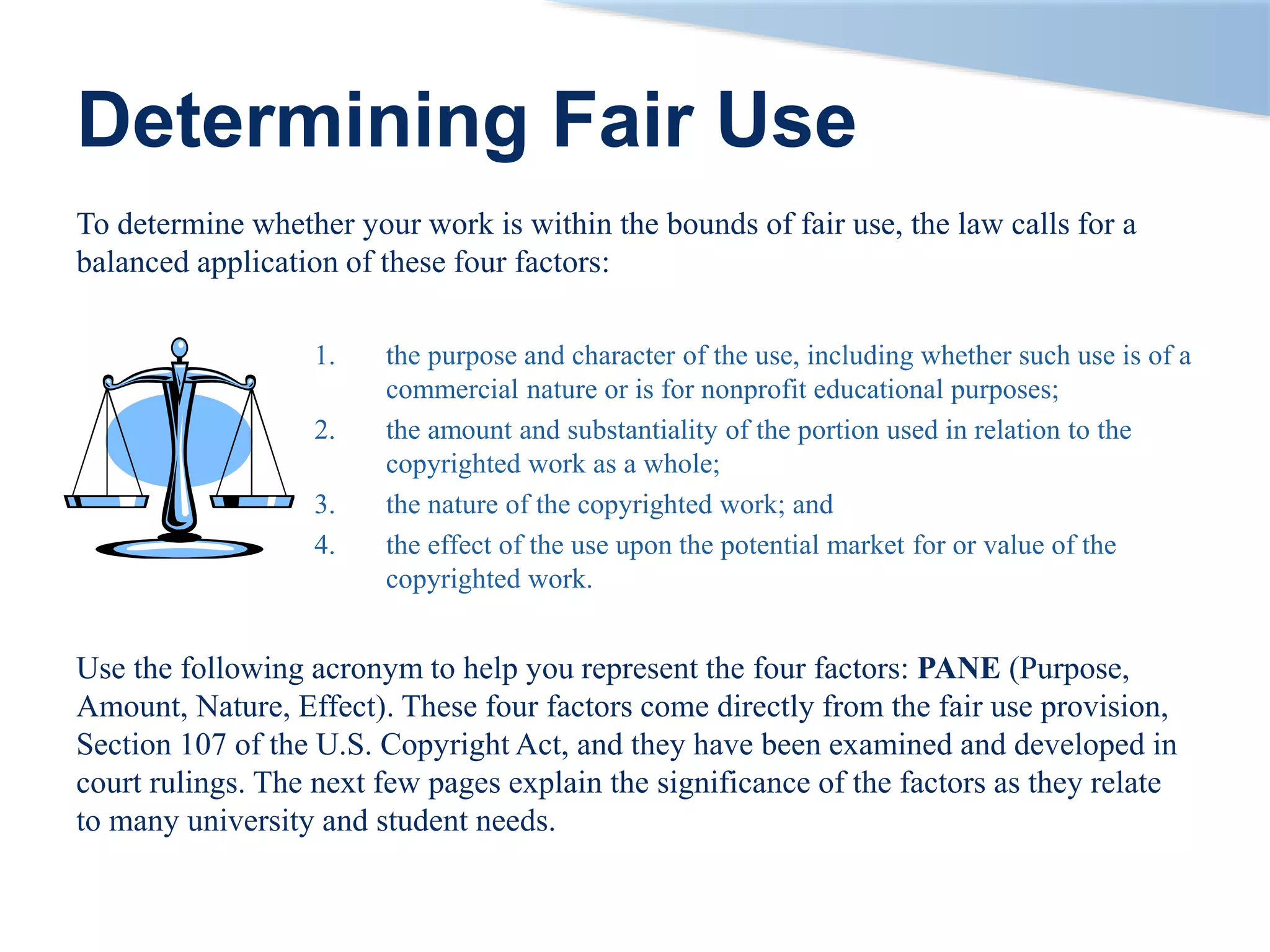
To determine whether your work is within the bounds of fair use, the law calls for a
balanced application of these four factors:
1. the purpose and character of the use, including whether such use is of a
commercial nature or is for nonprofit educational purposes;
2. the amount and substantiality of the portion used in relation to the
copyrighted work as a whole;
3. the nature of the copyrighted work; and
4. the effect of the use upon the potential market for or value of the
copyrighted work.
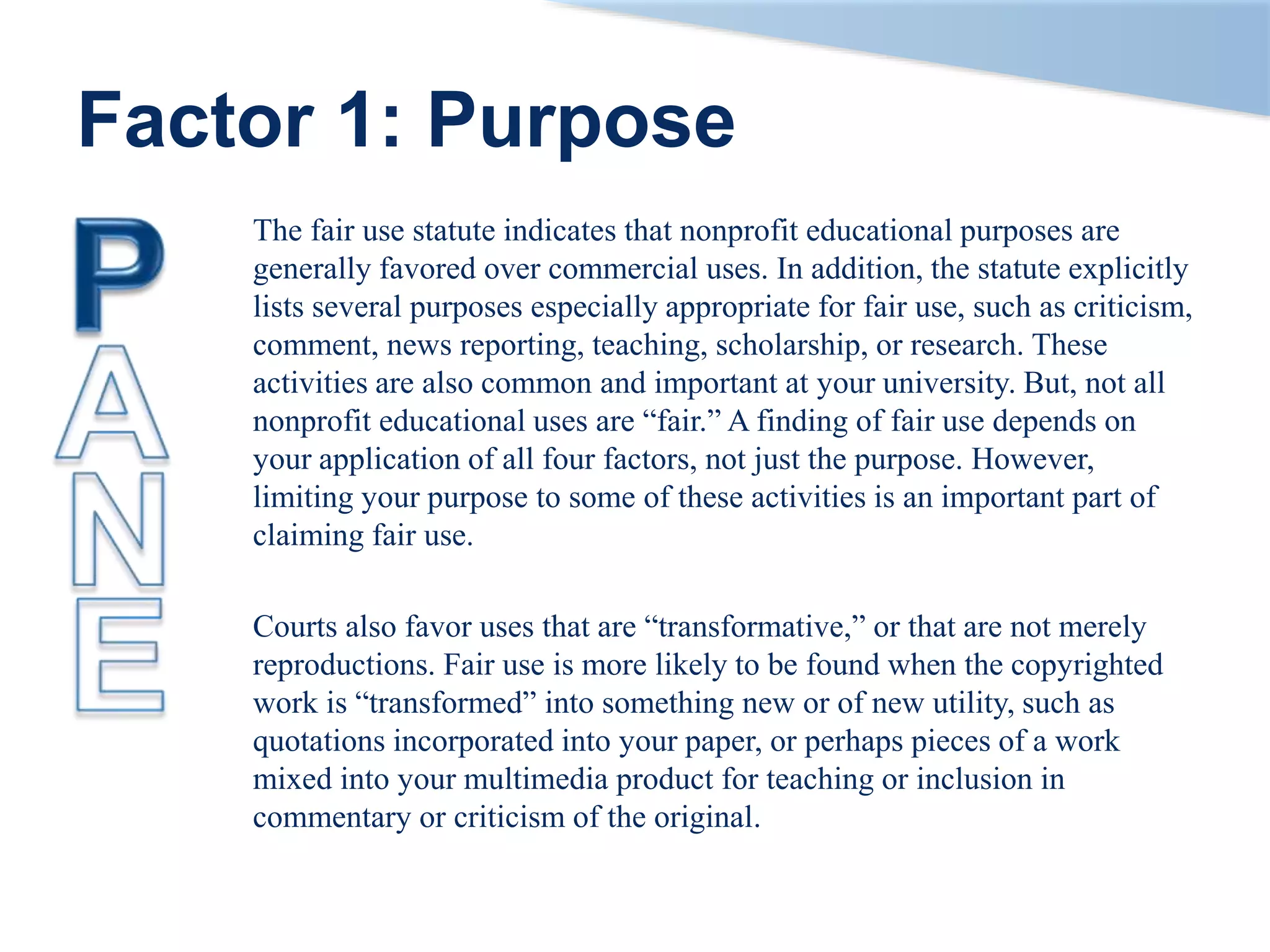
Use the following acronym to help you represent the four factors: PANE (Purpose,
Amount, Nature, Effect). These four factors come directly from the fair use provision,
Section 107 of the U.S. Copyright Act, and they have been examined and developed in
court rulings. The next few pages explain the significance of the factors as they relate
to many university and student needs.
Factor 1: Purpose
The fair use statute indicates that nonprofit educational purposes are
generally favored over commercial uses. In addition, the statute explicitly
lists several purposes especially appropriate for fair use, such as criticism,
comment, news reporting, teaching, scholarship, or research. These
activities are also common and important at your university. But, not all
nonprofit educational uses are “fair.” A finding of fair use depends on
your application of all four factors, not just the purpose. However,
limiting your purpose to some of these activities is an important part of
claiming fair use.
Courts also favor uses that are “transformative,” or that are not merely
reproductions. Fair use is more likely to be found when the copyrighted
work is “transformed” into something new or of new utility, such as
quotations incorporated into your paper, or perhaps pieces of a work
mixed into your multimedia product for teaching or inclusion in
commentary or criticism of the original.
Factor 2: Amount Used
Although the law does not set exact quantity limits, generally the more content you use, the
less likely you are within fair use. The “amount” used is usually evaluated relative to the
length of the entire original and in light of the amount you need to serve a proper objective.
However, sometimes the exact “original” is not always obvious. A book chapter might be a
small portion of the book, but the same content published elsewhere as an article or essay
could be considered the entire work in that context.
The “amount” of a work is also measured in qualitative terms. Courts have ruled that even
uses of small amounts may be excessive if you take the “heart of the work.” For example, a
short clip from a movie may usually be acceptable, but not if it encompasses the most
extraordinary or creative elements of the film. Similarly, it might be acceptable to quote a
small portion of a magazine article, but not if what you quote is the journalistic “scoop.” On
the other hand, in some contexts, such as critical comment or parody, copying an entire work
may be acceptable, depending on how much you need to achieve your purpose. Photographs
and artwork often generate controversies because you usually need the full image, and this
may not be a fair use. However, a court has ruled that a “thumbnail” or low-resolution version
of an image is a lesser “amount.” Such a version of an image might adequately serve your
educational or research purposes.
Factor 3: Nature of Work
This factor centers on the work you’re using, and the law allows for a
wider or narrower scope of fair use, depending on the characteristics or
attributes of the work. For example, the unpublished “nature” of a work,
such as private letters or a manuscript, can weigh against your finding of
fair use. The courts reason that copyright owners should have the right to
determine the circumstances of “first publication.”
Use of a work that is available for purchase specifically for the
educational market is unlikely to be considered a fair use. Additionally,
courts tend to give greater protection to creative works; consequently, fair
use applies more broadly to nonfiction, rather than fiction. Courts are
usually more protective of art, music, poetry, feature films, and other
creative works than they might be of nonfiction works.
Factor 4: Effect on the Market
Effect on the market is perhaps more complicated than the other three
factors. Fundamentally, this factor means that if you could have
realistically purchased or licensed the copyrighted work, that fact weighs
against a finding of fair use. To evaluate this factor, you may need to
investigate the market to determine if the work is reasonably available for
purchase or licensing. For example, a work may be reasonably available
when using a large portion of a book that is for sale at a typical market
price.
“Effect” is also closely linked to “purpose.” If your purpose is research or
scholarship, market effect may be difficult to prove. If your purpose is
commercial, then adverse market effect may be easier to prove.
Occasional quotations or photocopies may have no adverse market
effects, but reproductions of entire software works and videos can make
direct inroads on the potential markets for those works.
Fair Use Balancing Act
To determine whether your use is or is not a fair use, apply all
four factors and avoid “PANE” of copyright infringement. For
example, conclusions cannot be based simply on whether your
use is educational or commercial. You still needs to evaluate,
apply, and weigh in the balance the nature of the copyrighted
work, the amount or substantiality of the portion used, and the
potential impact of your use on the market or value of the work.
This flexible approach to fair use is critical in order for the law to adapt to changing
technologies and to meet innovative needs of higher education. Not all factors need
to weigh either for or against fair use, but overall the factors will usually lean one
direction or the other. Also, the relative importance of the factors is not always the
same. Your thoughtful analysis should guide these conclusions.
Check Your Understanding
Read the two scenarios on the following pages. Then, determine
if the use described is likely to be fair use. Consider how each
scenario relates to the four dimensions of fair use.
Check Your Understanding
Jasmine is designing her e-portfolio website, and she
includes a short poem at the top of the homepage, with
author attribution. Is this fair use?
Check Your Understanding
Jasmine is designing her e-portfolio website, and she includes a short poem
at the top of the homepage, with author attribution. Is this fair use?
Jasmine’s use is not likely to be determined
fair use.
• Purpose: Reproduction, not an
educational purpose, and doesn’t fit other
approved purposes.
• Amount: Entire work.
• Nature of Work: Creative work; more
likely to be covered by copyright.
• Effect: Piece could have been purchased,
or use permission requested.
For Fair
Use
Against Fair
Use
Check Your Understanding
Students working on a group project in anatomy class create a
video that will be shown to peers and the teacher in class. They
decide to rewrite the words to a popular song to help people learn
the names of the bones in the human body. Is this fair use?
Check Your Understanding
Students working on a group project in anatomy class create a video that will be shown
to peers and the teacher in class. They decide to rewrite the words to a popular song to
help people learn the names of the bones in the human body. Is this fair use?
This student use is likely to be determined fair use.
• Purpose: Educational.
• Amount: Uses background music, but not
lyrics. The music is still covered under
copyright, but it helps that students adapted the
work and are only using part of it.
• Nature of Work: Creative piece; tends to count
against fair use.
• Effect: Because the work is not widely
distributed, the use of the music will have
limited effect on the market.
For Fair
Use
Against Fair
Use
Conclusion
This concludes the unit on fair use.
Proceed to the posttest.

Fair Use 2

  • 1.
    Understanding Fair Use Used undera Creative Commons BY license from the Copyright Advisory Office of Columbia University, Kenneth D. Crews, director.
  • 2.
    Introduction Section 107 ofthe United States Copyright Act describes the concept of fair use, which allows for you to copy copyrighted material without the owner’s permission for “fair” uses, such as criticism, parody, comment, news reporting, or certain educational purposes. Whether or not your work is within the boundaries of fair use depends on the facts of the particular situation. What exactly are you using? How widely are your materials shared? Is your work confined to the nonprofit environment of your university? This lesson will cover the four key factors of fair use to help you determine whether or not your work is covered under the fair use doctrine. Guiding Questions: • What is fair use? • How is fair use determined? • What factors contribute to fair use?
  • 3.
    Determining Fair Use Todetermine whether your work is within the bounds of fair use, the law calls for a balanced application of these four factors: 1. the purpose and character of the use, including whether such use is of a commercial nature or is for nonprofit educational purposes; 2. the amount and substantiality of the portion used in relation to the copyrighted work as a whole; 3. the nature of the copyrighted work; and 4. the effect of the use upon the potential market for or value of the copyrighted work. Use the following acronym to help you represent the four factors: PANE (Purpose, Amount, Nature, Effect). These four factors come directly from the fair use provision, Section 107 of the U.S. Copyright Act, and they have been examined and developed in court rulings. The next few pages explain the significance of the factors as they relate to many university and student needs.
  • 4.
    Factor 1: Purpose Thefair use statute indicates that nonprofit educational purposes are generally favored over commercial uses. In addition, the statute explicitly lists several purposes especially appropriate for fair use, such as criticism, comment, news reporting, teaching, scholarship, or research. These activities are also common and important at your university. But, not all nonprofit educational uses are “fair.” A finding of fair use depends on your application of all four factors, not just the purpose. However, limiting your purpose to some of these activities is an important part of claiming fair use. Courts also favor uses that are “transformative,” or that are not merely reproductions. Fair use is more likely to be found when the copyrighted work is “transformed” into something new or of new utility, such as quotations incorporated into your paper, or perhaps pieces of a work mixed into your multimedia product for teaching or inclusion in commentary or criticism of the original.
  • 5.
    Factor 2: AmountUsed Although the law does not set exact quantity limits, generally the more content you use, the less likely you are within fair use. The “amount” used is usually evaluated relative to the length of the entire original and in light of the amount you need to serve a proper objective. However, sometimes the exact “original” is not always obvious. A book chapter might be a small portion of the book, but the same content published elsewhere as an article or essay could be considered the entire work in that context. The “amount” of a work is also measured in qualitative terms. Courts have ruled that even uses of small amounts may be excessive if you take the “heart of the work.” For example, a short clip from a movie may usually be acceptable, but not if it encompasses the most extraordinary or creative elements of the film. Similarly, it might be acceptable to quote a small portion of a magazine article, but not if what you quote is the journalistic “scoop.” On the other hand, in some contexts, such as critical comment or parody, copying an entire work may be acceptable, depending on how much you need to achieve your purpose. Photographs and artwork often generate controversies because you usually need the full image, and this may not be a fair use. However, a court has ruled that a “thumbnail” or low-resolution version of an image is a lesser “amount.” Such a version of an image might adequately serve your educational or research purposes.
  • 6.
    Factor 3: Natureof Work This factor centers on the work you’re using, and the law allows for a wider or narrower scope of fair use, depending on the characteristics or attributes of the work. For example, the unpublished “nature” of a work, such as private letters or a manuscript, can weigh against your finding of fair use. The courts reason that copyright owners should have the right to determine the circumstances of “first publication.” Use of a work that is available for purchase specifically for the educational market is unlikely to be considered a fair use. Additionally, courts tend to give greater protection to creative works; consequently, fair use applies more broadly to nonfiction, rather than fiction. Courts are usually more protective of art, music, poetry, feature films, and other creative works than they might be of nonfiction works.
  • 7.
    Factor 4: Effecton the Market Effect on the market is perhaps more complicated than the other three factors. Fundamentally, this factor means that if you could have realistically purchased or licensed the copyrighted work, that fact weighs against a finding of fair use. To evaluate this factor, you may need to investigate the market to determine if the work is reasonably available for purchase or licensing. For example, a work may be reasonably available when using a large portion of a book that is for sale at a typical market price. “Effect” is also closely linked to “purpose.” If your purpose is research or scholarship, market effect may be difficult to prove. If your purpose is commercial, then adverse market effect may be easier to prove. Occasional quotations or photocopies may have no adverse market effects, but reproductions of entire software works and videos can make direct inroads on the potential markets for those works.
  • 8.
    Fair Use BalancingAct To determine whether your use is or is not a fair use, apply all four factors and avoid “PANE” of copyright infringement. For example, conclusions cannot be based simply on whether your use is educational or commercial. You still needs to evaluate, apply, and weigh in the balance the nature of the copyrighted work, the amount or substantiality of the portion used, and the potential impact of your use on the market or value of the work. This flexible approach to fair use is critical in order for the law to adapt to changing technologies and to meet innovative needs of higher education. Not all factors need to weigh either for or against fair use, but overall the factors will usually lean one direction or the other. Also, the relative importance of the factors is not always the same. Your thoughtful analysis should guide these conclusions.
  • 9.
    Check Your Understanding Readthe two scenarios on the following pages. Then, determine if the use described is likely to be fair use. Consider how each scenario relates to the four dimensions of fair use.
  • 10.
    Check Your Understanding Jasmineis designing her e-portfolio website, and she includes a short poem at the top of the homepage, with author attribution. Is this fair use?
  • 11.
    Check Your Understanding Jasmineis designing her e-portfolio website, and she includes a short poem at the top of the homepage, with author attribution. Is this fair use? Jasmine’s use is not likely to be determined fair use. • Purpose: Reproduction, not an educational purpose, and doesn’t fit other approved purposes. • Amount: Entire work. • Nature of Work: Creative work; more likely to be covered by copyright. • Effect: Piece could have been purchased, or use permission requested. For Fair Use Against Fair Use
  • 12.
    Check Your Understanding Studentsworking on a group project in anatomy class create a video that will be shown to peers and the teacher in class. They decide to rewrite the words to a popular song to help people learn the names of the bones in the human body. Is this fair use?
  • 13.
    Check Your Understanding Studentsworking on a group project in anatomy class create a video that will be shown to peers and the teacher in class. They decide to rewrite the words to a popular song to help people learn the names of the bones in the human body. Is this fair use? This student use is likely to be determined fair use. • Purpose: Educational. • Amount: Uses background music, but not lyrics. The music is still covered under copyright, but it helps that students adapted the work and are only using part of it. • Nature of Work: Creative piece; tends to count against fair use. • Effect: Because the work is not widely distributed, the use of the music will have limited effect on the market. For Fair Use Against Fair Use
  • 14.
    Conclusion This concludes theunit on fair use. Proceed to the posttest.