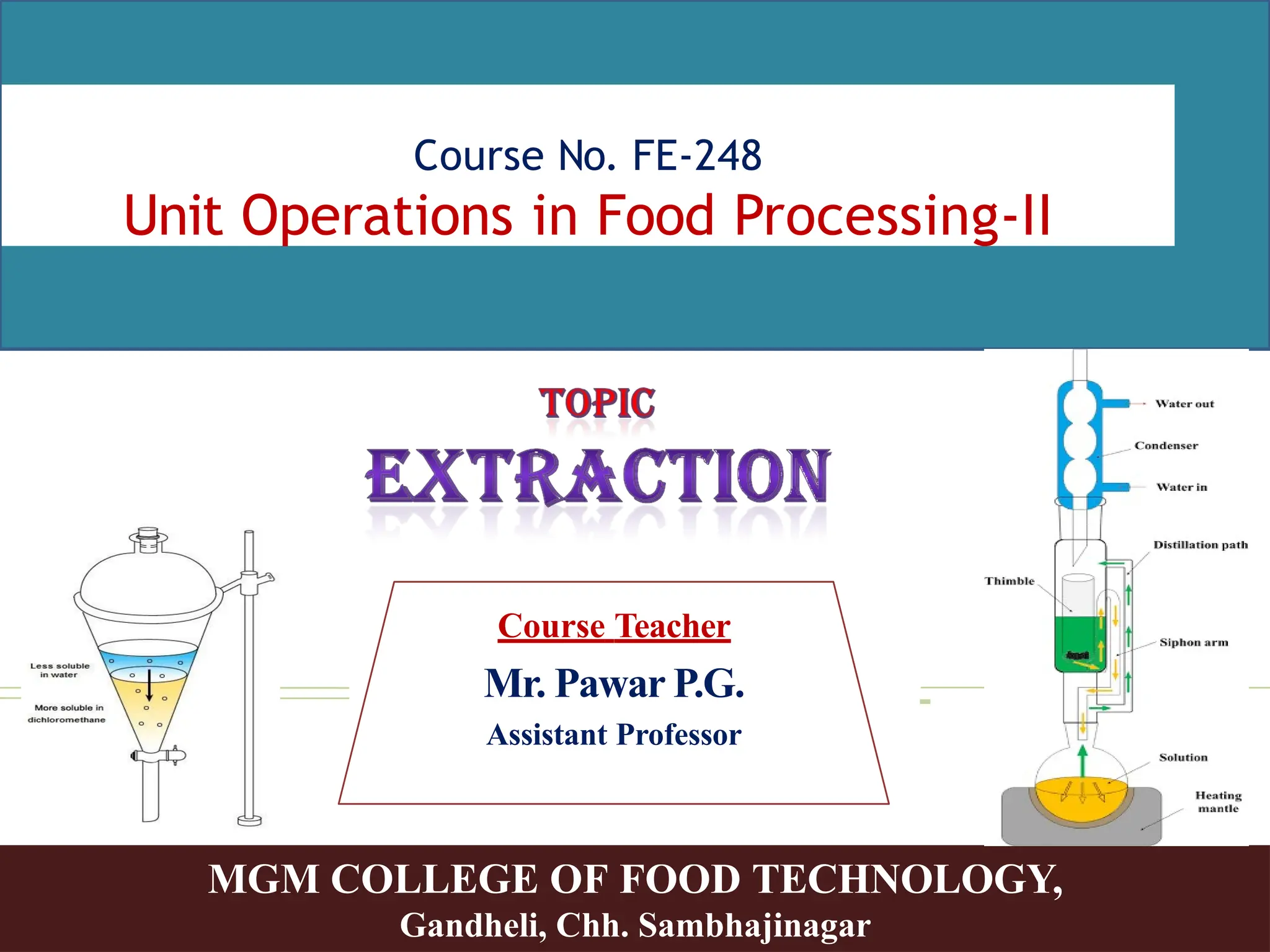
Course No. FE-248
Unit Operations in Food Processing-II
Course Teacher
Mr. Pawar P.G.
Assistant Professor
MGM COLLEGE OF FOOD TECHNOLOGY,
Gandheli, Chh. Sambhajinagar
What is Extraction?
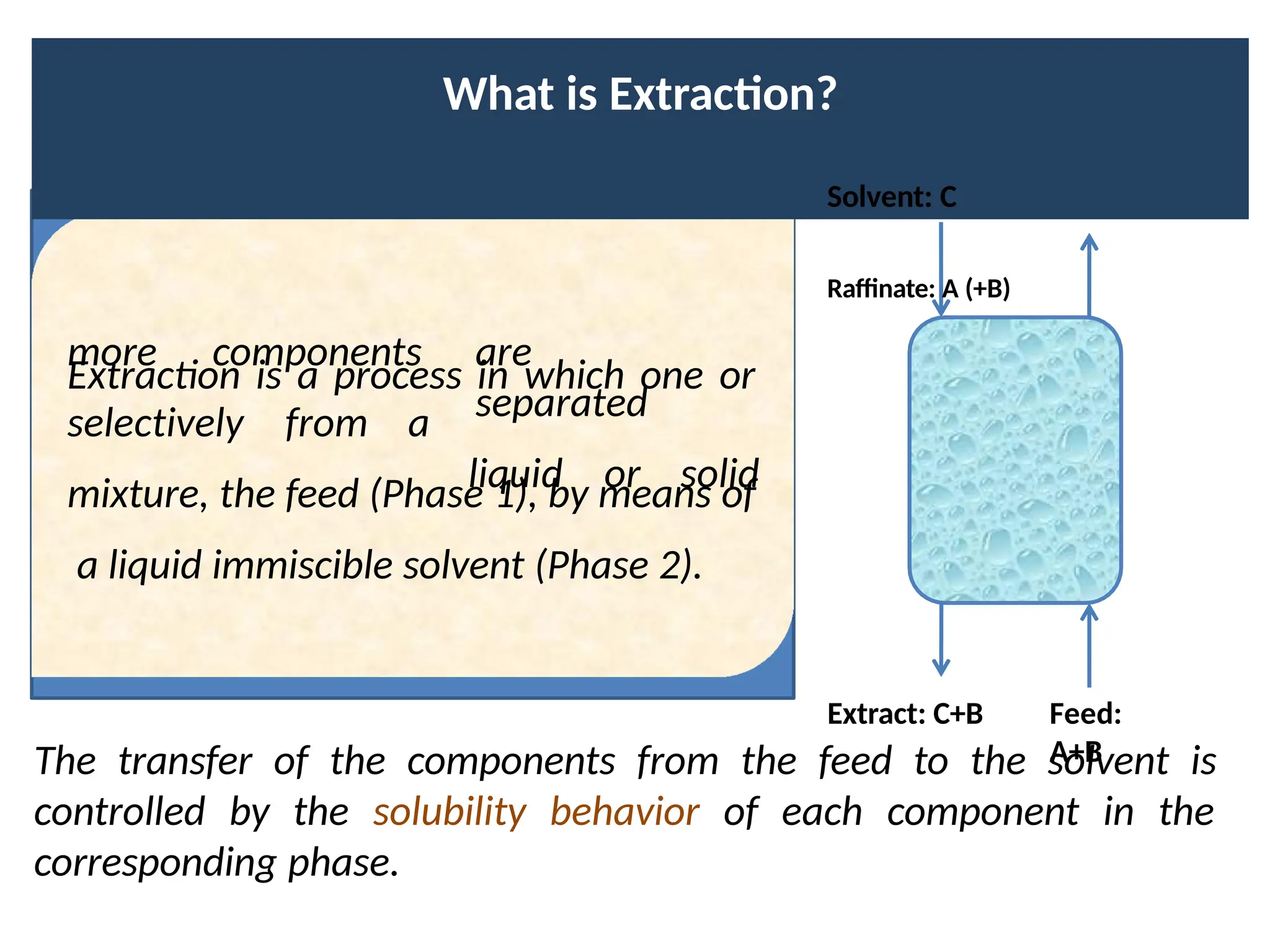
more components
selectively from a
are
separated
liquid or solid
mixture, the feed (Phase 1), by means of
a liquid immiscible solvent (Phase 2).
The transfer of the components from the feed to the solvent is
controlled by the solubility behavior of each component in the
corresponding phase.
Solvent: C
Raffinate: A (+B)
Extraction is a process in which one or
Extract: C+B Feed:
A+B
Definition
• Extraction is the process of separating a
component substance (the solute) from a
solid or liquid mixture by dissolving it in a
liquid solvent.
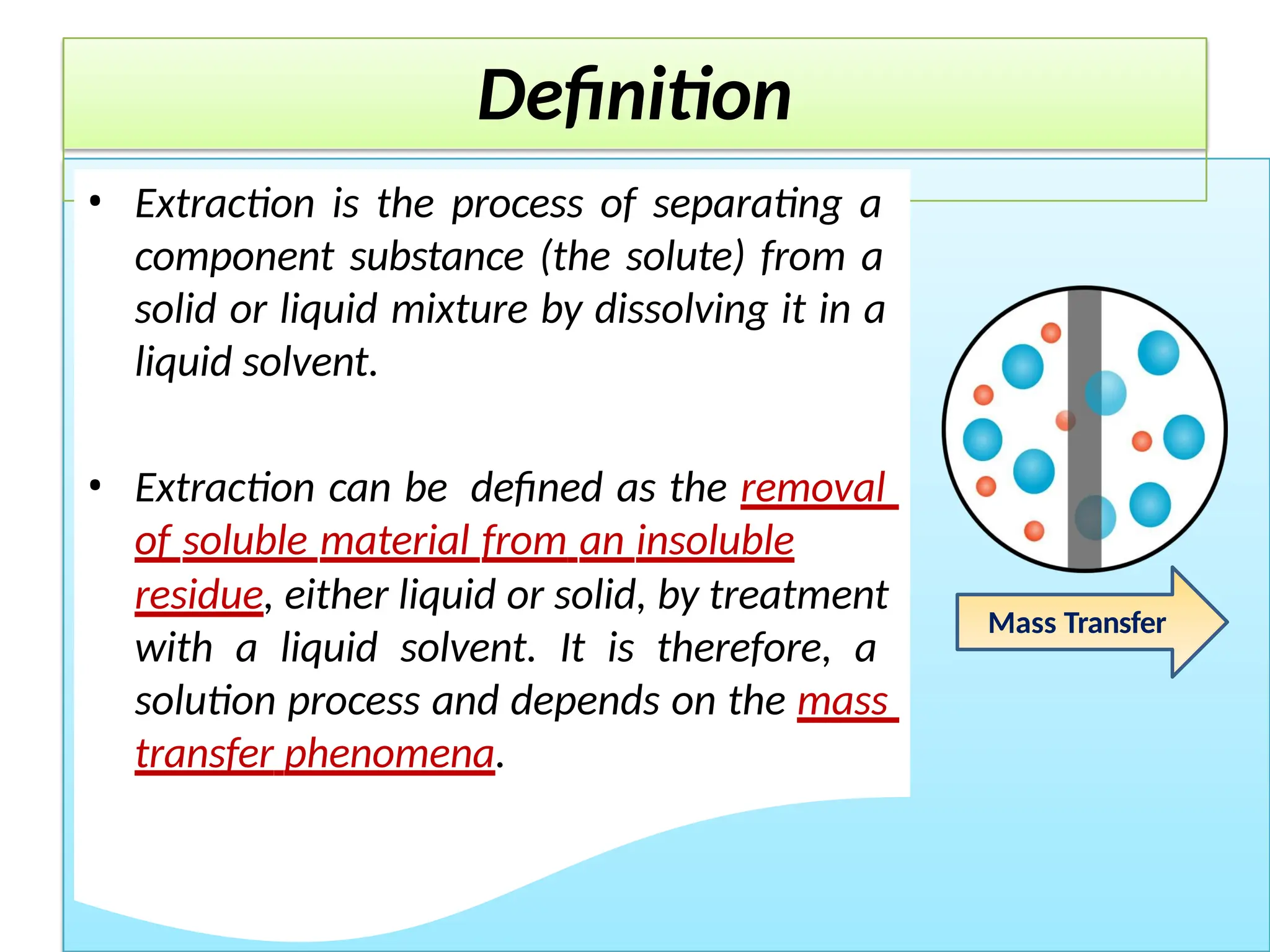
• Extraction can be defined as the removal
of soluble material from an insoluble
residue, either liquid or solid, by treatment
with a liquid solvent. It is therefore, a
solution process and depends on the mass
transfer phenomena.
Mass Transfer
Definition
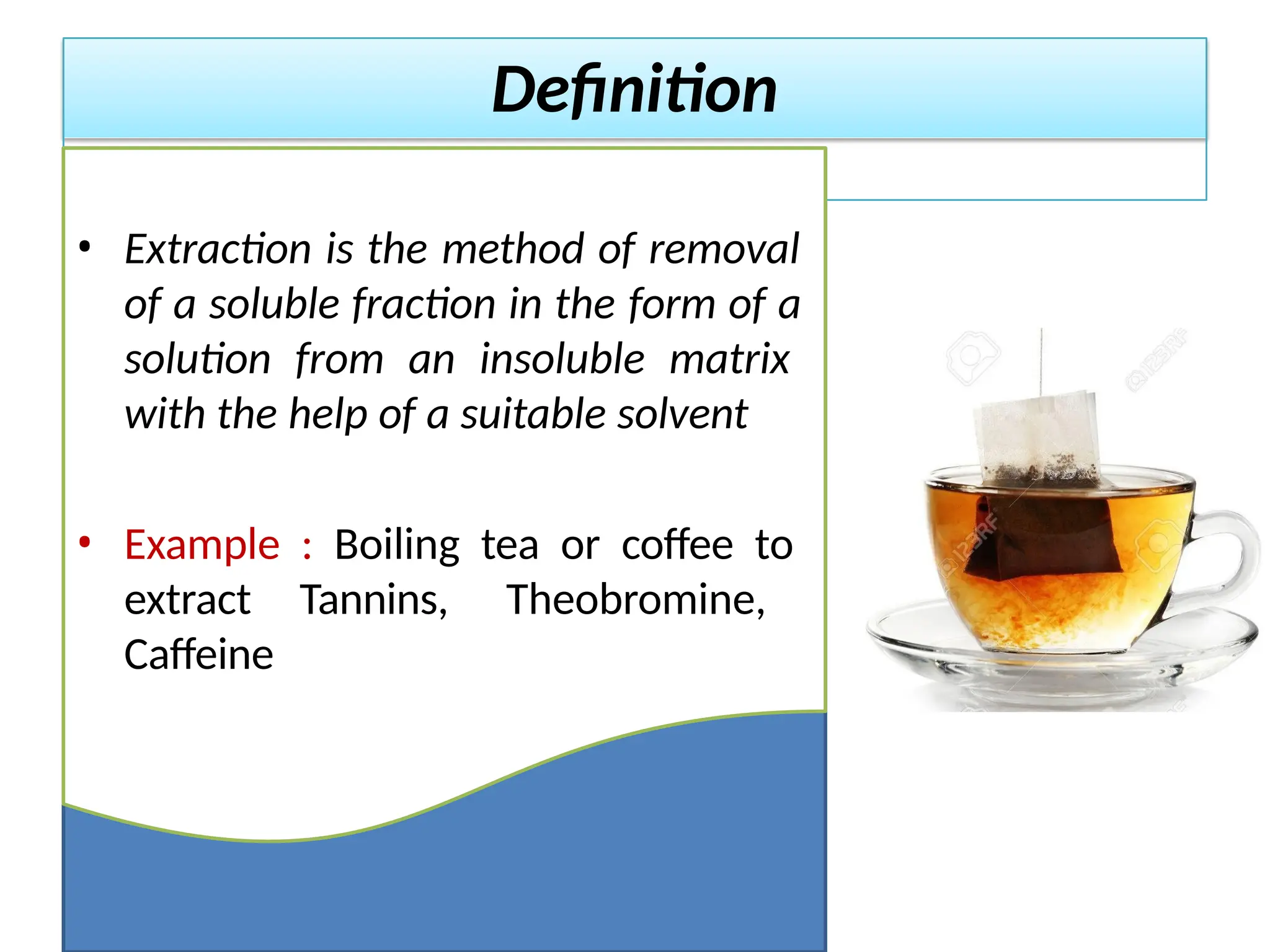
• Extraction is the method of removal
of a soluble fraction in the form of a
solution from an insoluble matrix
with the help of a suitable solvent
• Example : Boiling tea or coffee to
extract Tannins, Theobromine,
Caffeine
Types of extraction
• Depending on
the
extraction agent, extraction can be
phase of the mixture
divided
and
the into
the
following types:
1. liquid -liquid extraction, where a solvent
extracts a solute from a liquid phase
2. solid -liquid extraction, or leaching, where a
solvent extracts a solute from a solid phase
3. supercritical extraction, where a fluid
under supercritical conditions is used as the solvent
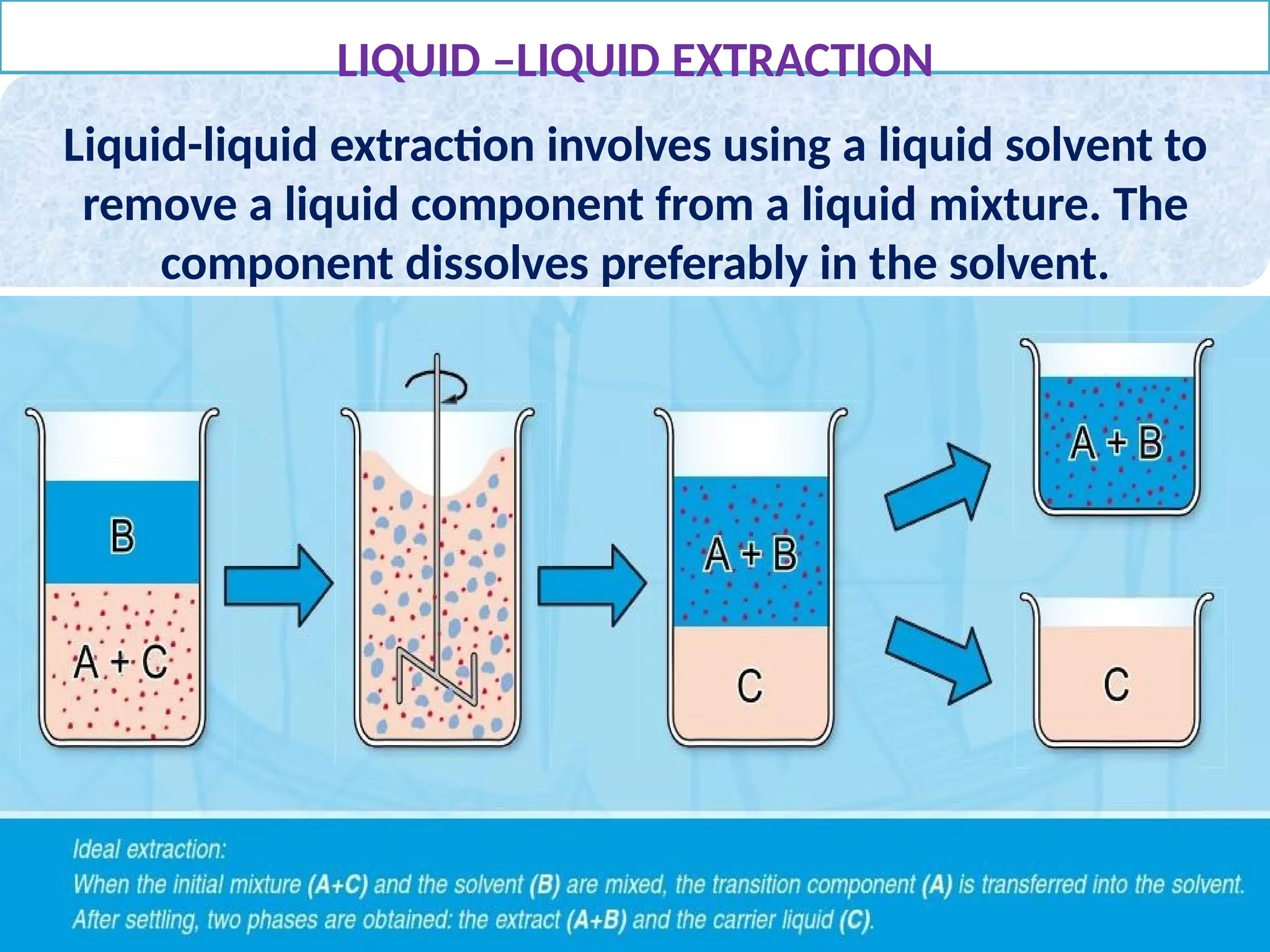
LIQUID –LIQUID EXTRACTION
Liquid-liquid extraction involves using a liquid solvent to
remove a liquid component from a liquid mixture. The
component dissolves preferably in the solvent.
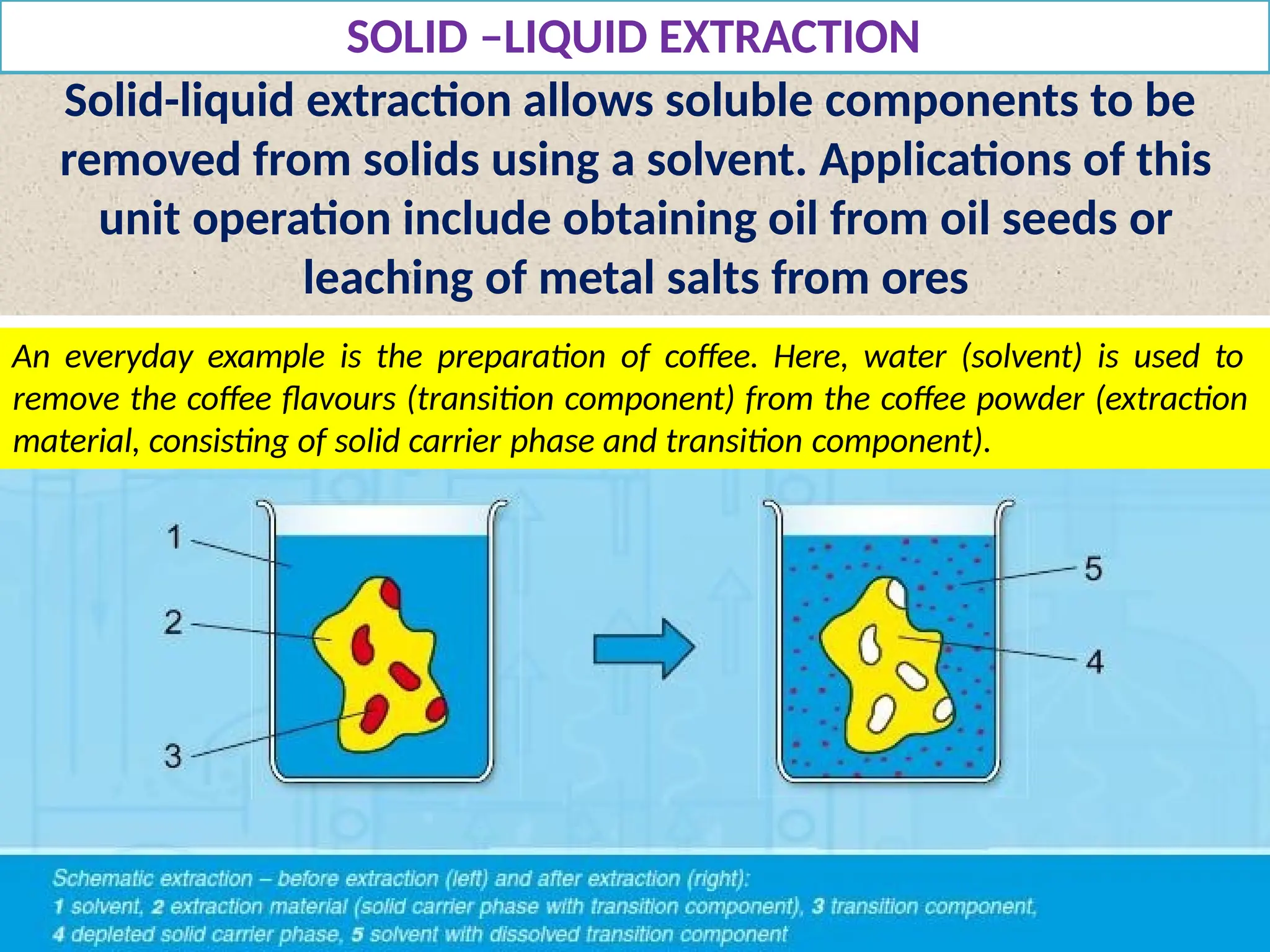
Solid-liquid extraction allows soluble components to be
removed from solids using a solvent. Applications of this
unit operation include obtaining oil from oil seeds or
leaching of metal salts from ores
An everyday example is the preparation of coffee. Here, water (solvent) is used to
remove the coffee flavours (transition component) from the coffee powder (extraction
material, consisting of solid carrier phase and transition component).
SOLID –LIQUID EXTRACTION
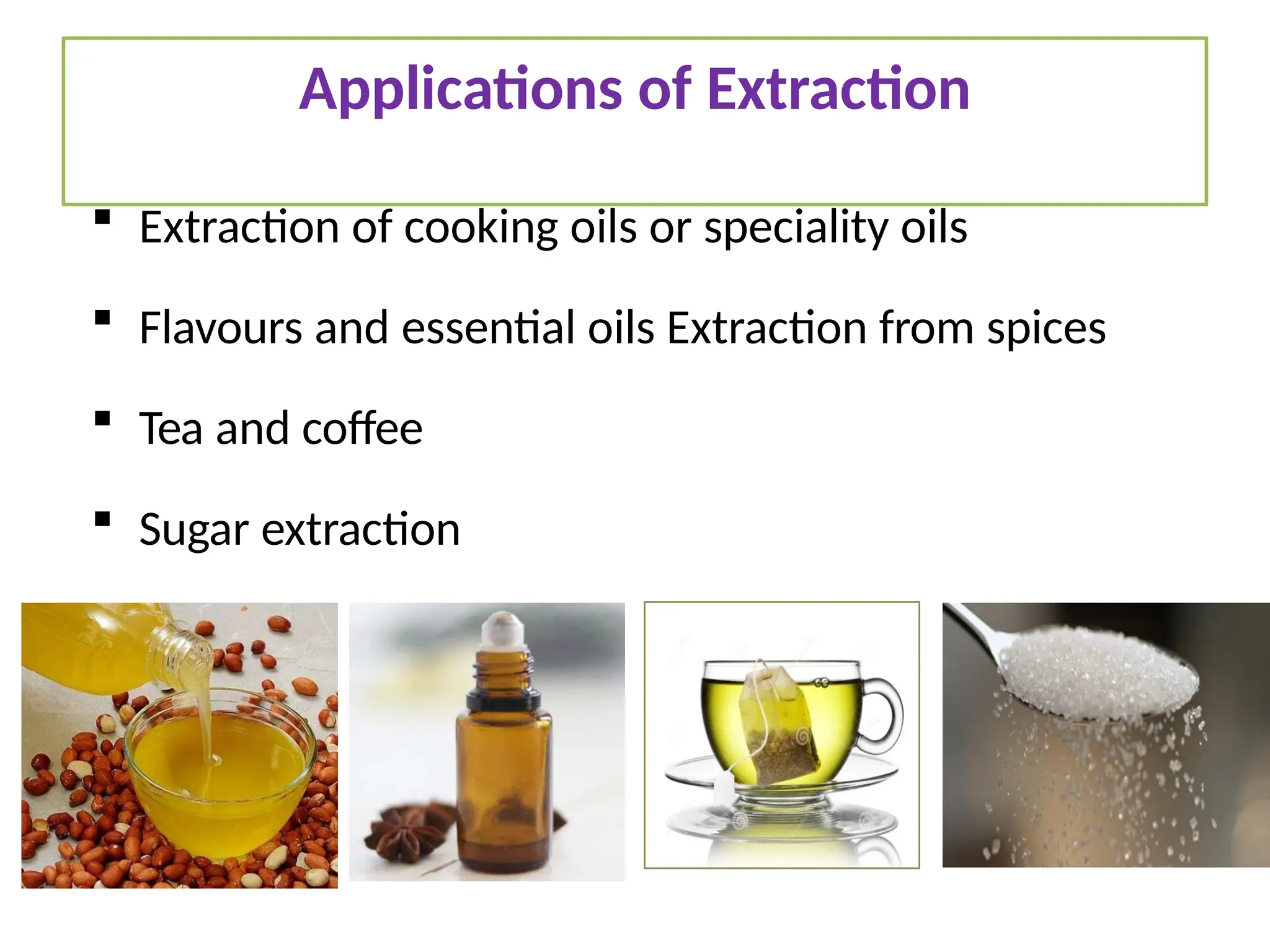
Applications of Extraction
 Extraction of cooking oils or speciality oils
 Flavours and essential oils Extraction from spices
 Tea and coffee
 Sugar extraction
Introduction
• During the holding period there is mass transfer of solutes from the
food material to the solvent, which occurs in three stages:
1. the solute dissolves in the solvent
2. the solution moves through the particle of food to its surface
3. the solution becomes dispersed in the bulk of the solvent.
• During extraction, the holding time should therefore be sufficient
for the solvent to dissolve sufficient solute and for the changes in
composition to approach an equilibrium.
• Compared to distillation, extraction processes have the
disadvantage that a new component is added to the system.
• This leads to additional impurities as complete immiscibility does
only exist in theory. Furthermore a subsequent separation process is
required to regenerate the solvent
Factor affecting extraction
1. The temperature of extraction: Higher temperatures increase
both the rate at which solutes dissolve in the solvent and the rate
of diffusion into the bulk of the solvent.
2. The surface area of solids exposed to the solvent: The rate of
mass transfer is directly proportional to the surface area, so
reductions in particle size (giving an increase in surface area)
increase the rate of extraction up to certain limits.
3. The viscosity of the solvent: This should be sufficiently low to
enable the solvent to penetrate easily the bed of solid particles.
4. The flow rate of the solvent: Higher flow rates reduce the
boundary layer of concentrated solute at the surface of particles
and thus increase the rate of extraction
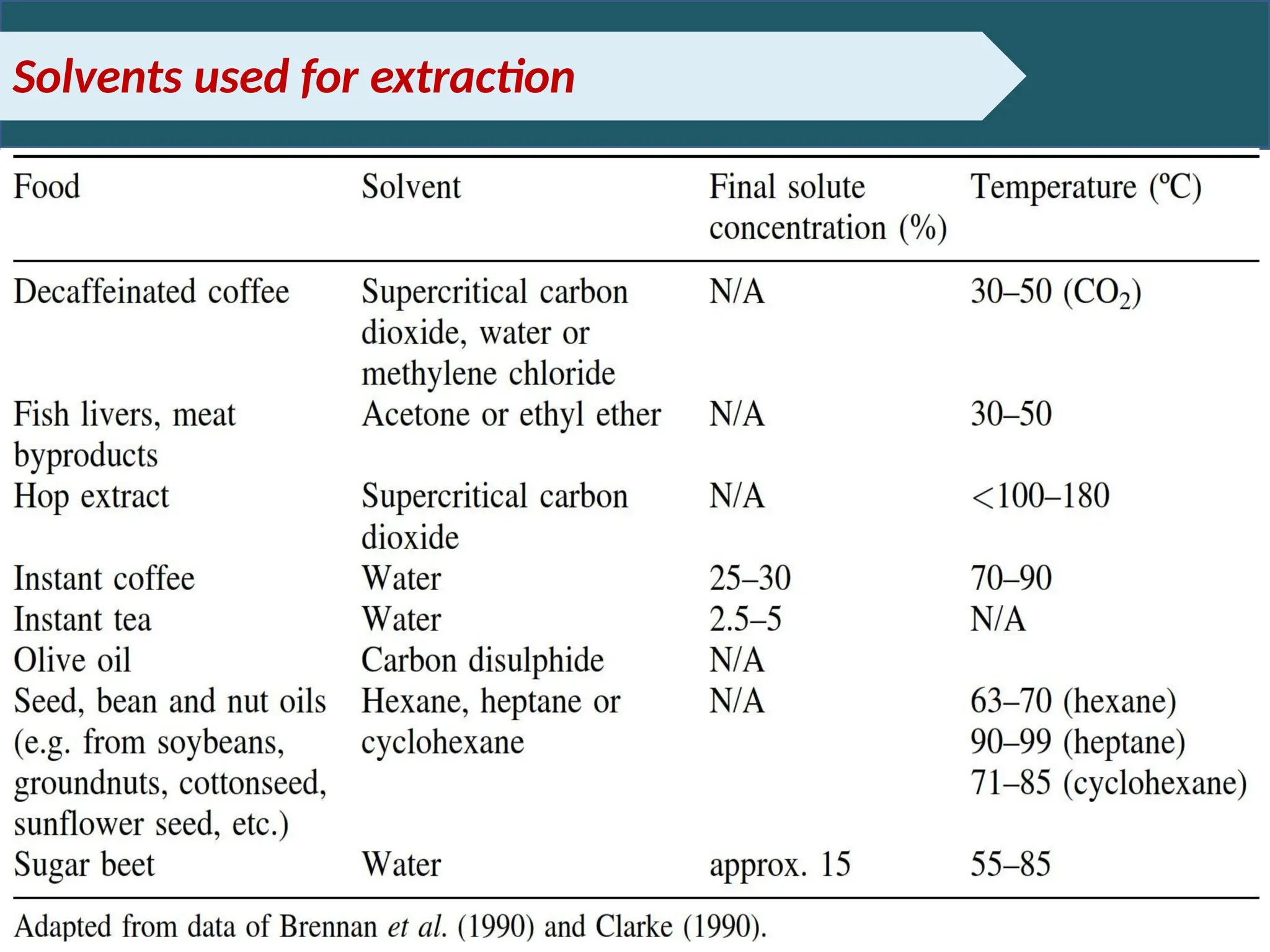
Solvents used for extraction
General Principles of extraction
1. Diffusion:
• Diffusion is the transport of molecules of a compound
though a continuum in one phase, or through an
interface between phases.
2. Solubility
• The highest possible solute concentration in the final
extract leaving an extraction system is the saturation
concentration.
• Thus, solvent to solids ratio must be high enough such
solids, the
below the
that, when fresh solvent contacts fresh
resulting solution on equilibrium, will be
saturation concentration of solute.
3. Equilibrium
• Equilibrium is a condition where the solute concentration
in both the solid and the solvent phases are equal. In
order for equilibrium to occur, enough contact time must
be allowed for the solid and solvent phases.
• The extent to which the equilibrium concentration of
solute in the solvent phase is reached in an extraction
stage is expressed as a stage efficiency.
• If equilibrium is reached in an extraction stage, the stage
is 100% efficient and is designated an “ideal stage”
General Principles of extraction
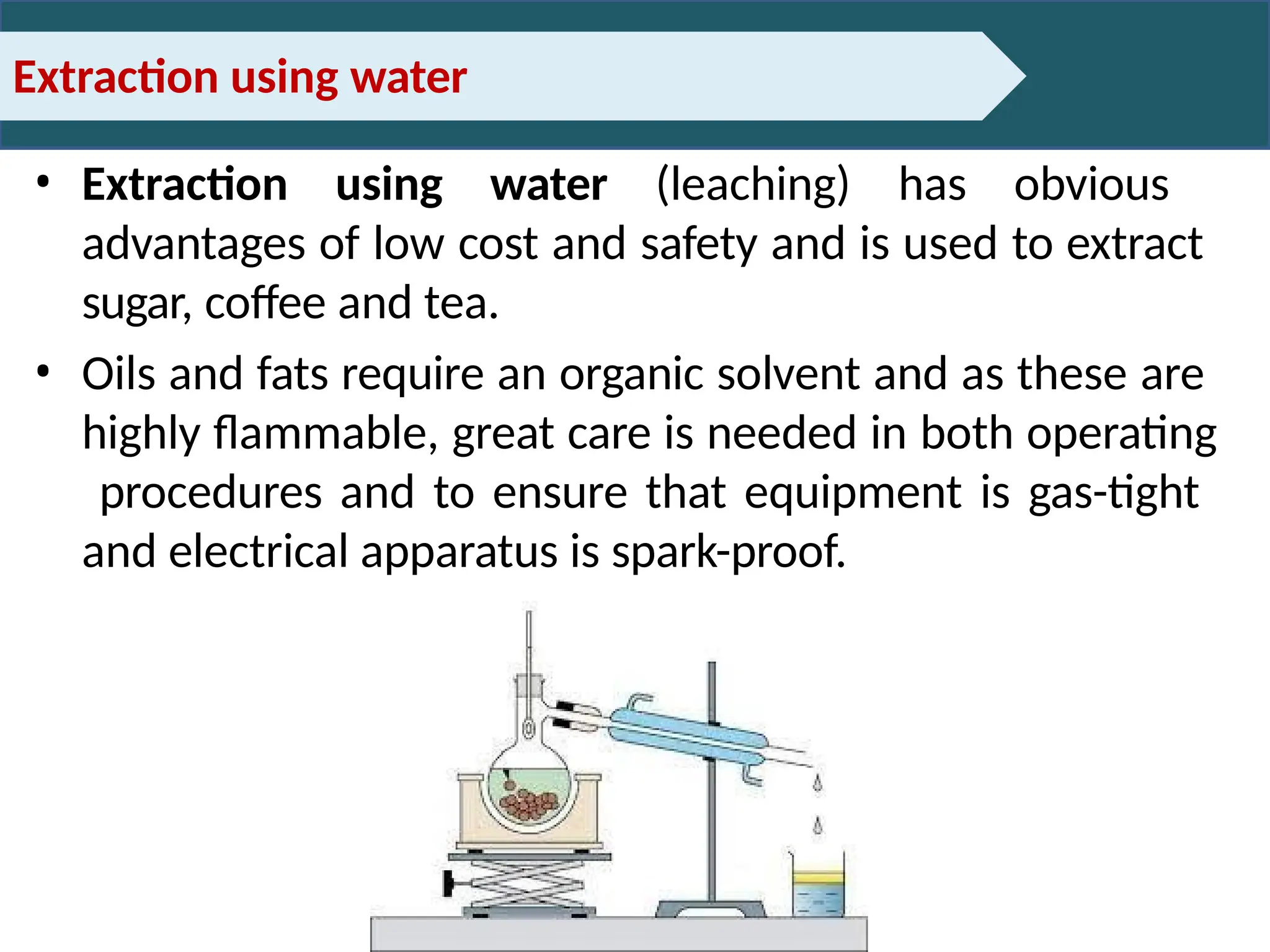
Extraction using water
• Extraction using water (leaching) has obvious
advantages of low cost and safety and is used to extract
sugar, coffee and tea.
• Oils and fats require an organic solvent and as these are
highly flammable, great care is needed in both operating
procedures and to ensure that equipment is gas-tight
and electrical apparatus is spark-proof.
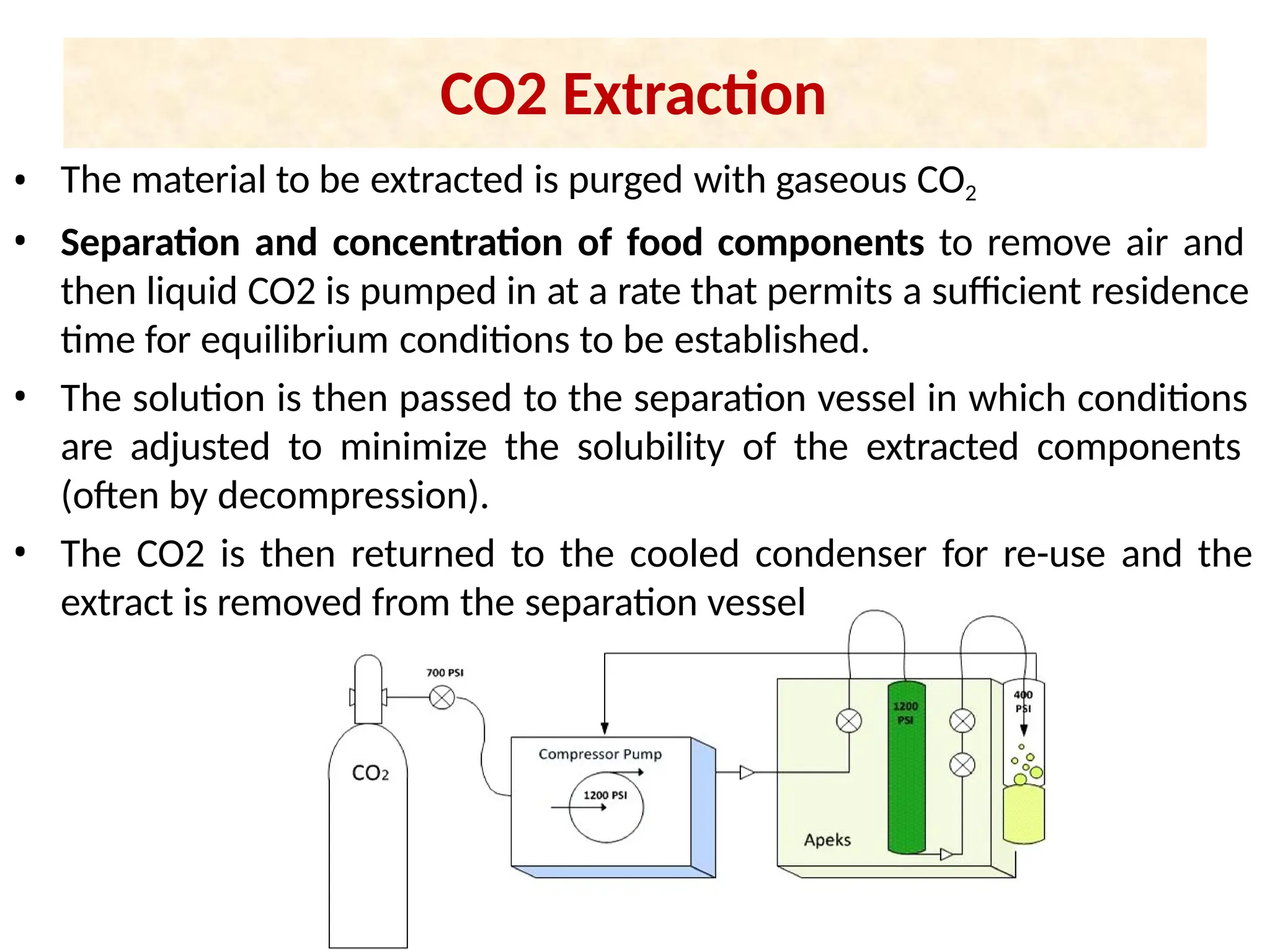
CO2 Extraction
• The material to be extracted is purged with gaseous CO2
• Separation and concentration of food components to remove air and
then liquid CO2 is pumped in at a rate that permits a sufficient residence
time for equilibrium conditions to be established.
• The solution is then passed to the separation vessel in which conditions
are adjusted to minimize the solubility of the extracted components
(often by decompression).
• The CO2 is then returned to the cooled condenser for re-use and the
extract is removed from the separation vessel
Supercritical Fluid (CO2) extraction
• Supercritical carbon dioxide has found increasingly
widespread application for removing caffeine from coffee
or tea and for producing hop extracts for brewing.
• It has also been used to extract and concentrate flavour
compounds from fruits and spices (including pepper,
marjoram, nutmeg, cardamom, cloves and ginger), and
speciality oils from citrus and a variety of nuts and seeds.
• The combination of supercritical CO2 and extrusion to
produce a new range of breakfast cereals, pasta products
and confectionery
Cont..
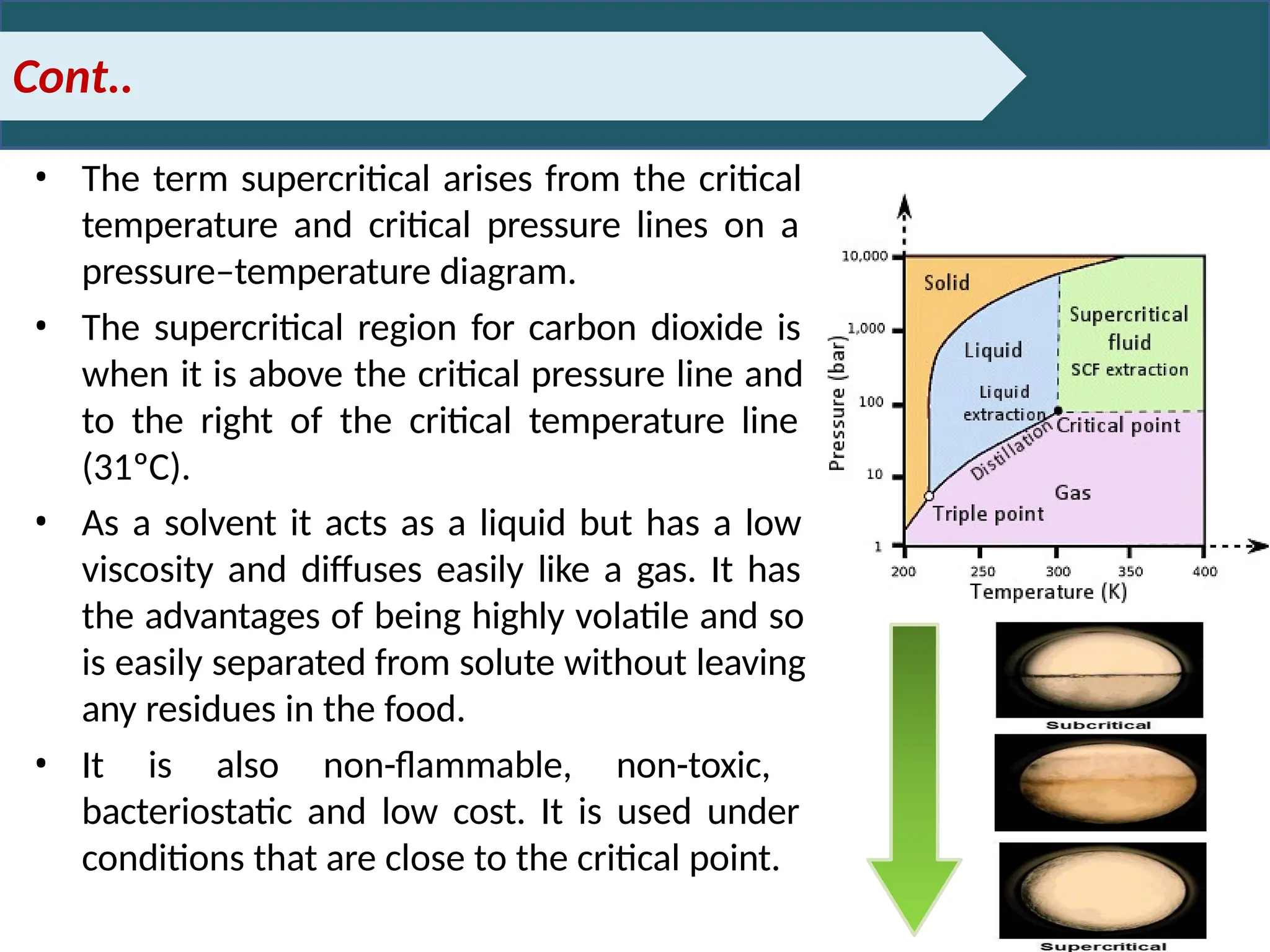
• The term supercritical arises from the critical
temperature and critical pressure lines on a
pressure–temperature diagram.
• The supercritical region for carbon dioxide is
when it is above the critical pressure line and
to the right of the critical temperature line
(31ºC).
• As a solvent it acts as a liquid but has a low
viscosity and diffuses easily like a gas. It has
the advantages of being highly volatile and so
is easily separated from solute without leaving
any residues in the food.
• It is also non-flammable, non-toxic,
bacteriostatic and low cost. It is used under
conditions that are close to the critical point.
CO2 Extraction Equipment
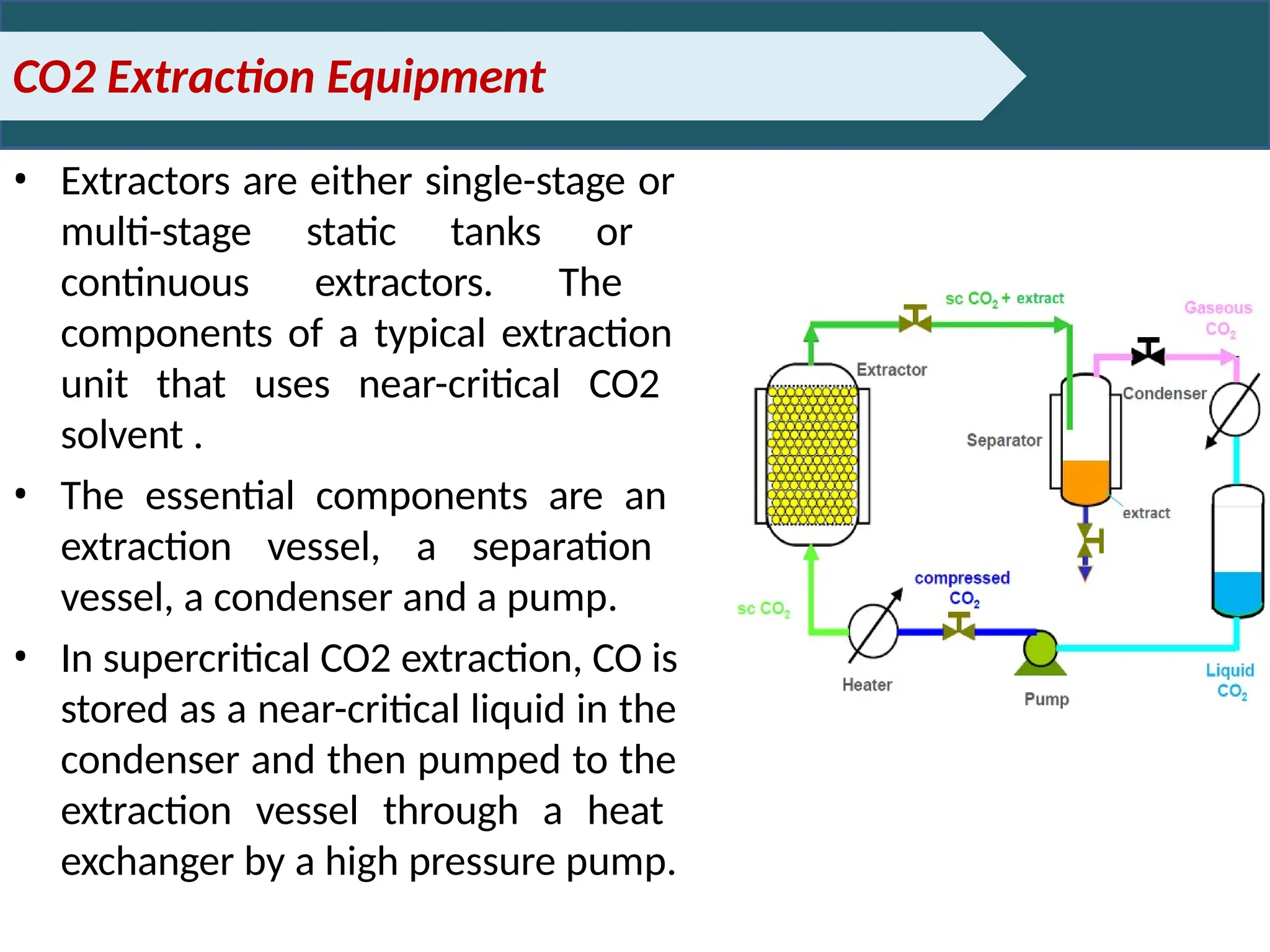
• Extractors are either single-stage or
multi-stage static tanks or
continuous extractors. The
components of a typical extraction
unit that uses near-critical CO2
solvent .
• The essential components are an
extraction vessel, a separation
vessel, a condenser and a pump.
• In supercritical CO2 extraction, CO is
stored as a near-critical liquid in the
condenser and then pumped to the
extraction vessel through a heat
exchanger by a high pressure pump.
The concept of extraction: the one stage extractor
• The simplest form of an extractor apparatus has only one
stage and the process is performed in two steps.
• In the first step, the feed is mixed with the solvent to create a
high surface area allowing to achieve high mass transfer
rates.
• The mass transfer stops when thermodynamic equilibrium
between the two phases is reached. Equilibrium is
characterized by an equal temperature, equal pressure and
equal chemical potentials in both phases.
• In the second step the two phases are allowed to separate
(settling process). Finally, after decanting one receives the
ranate and the extract.
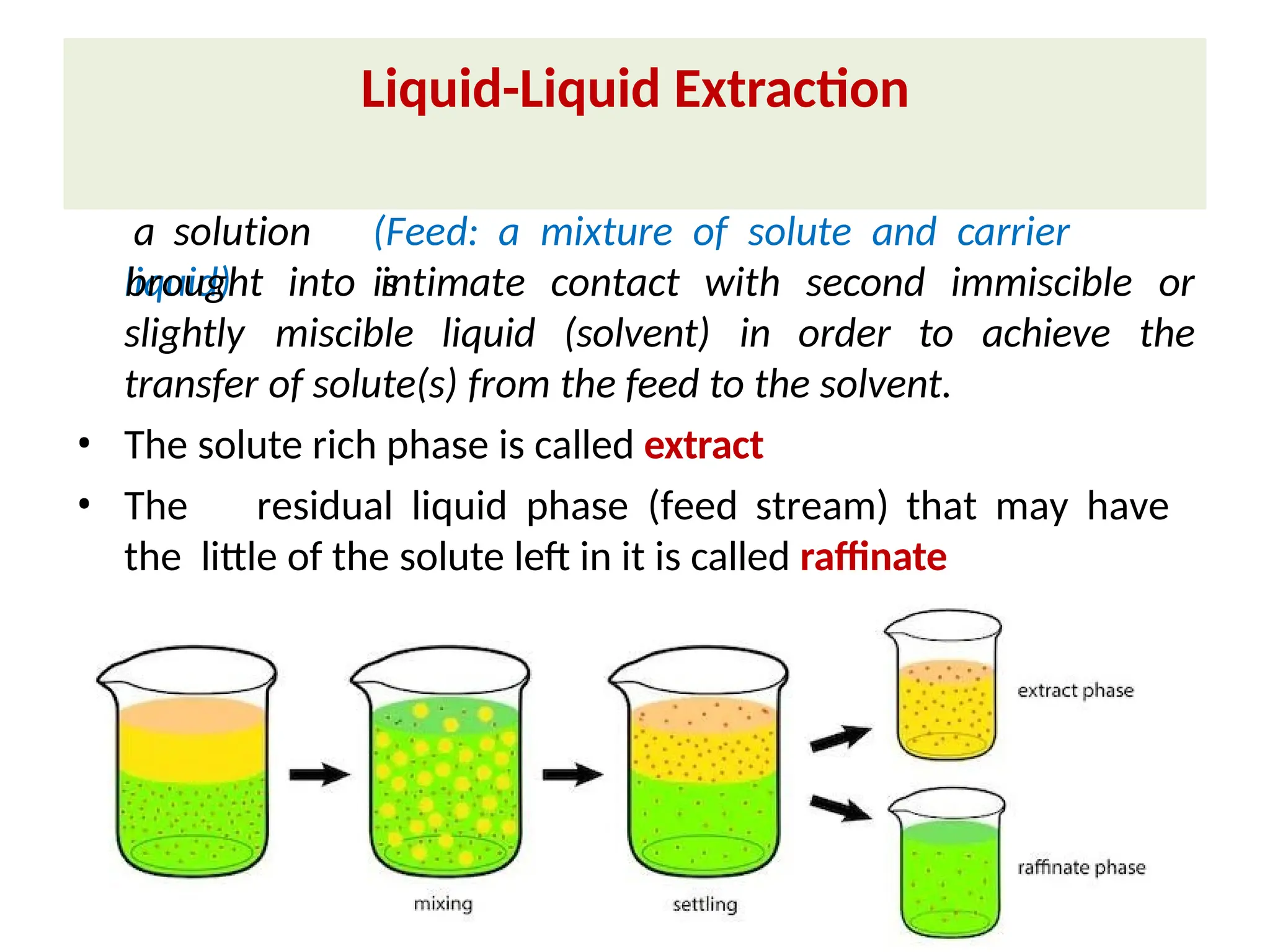
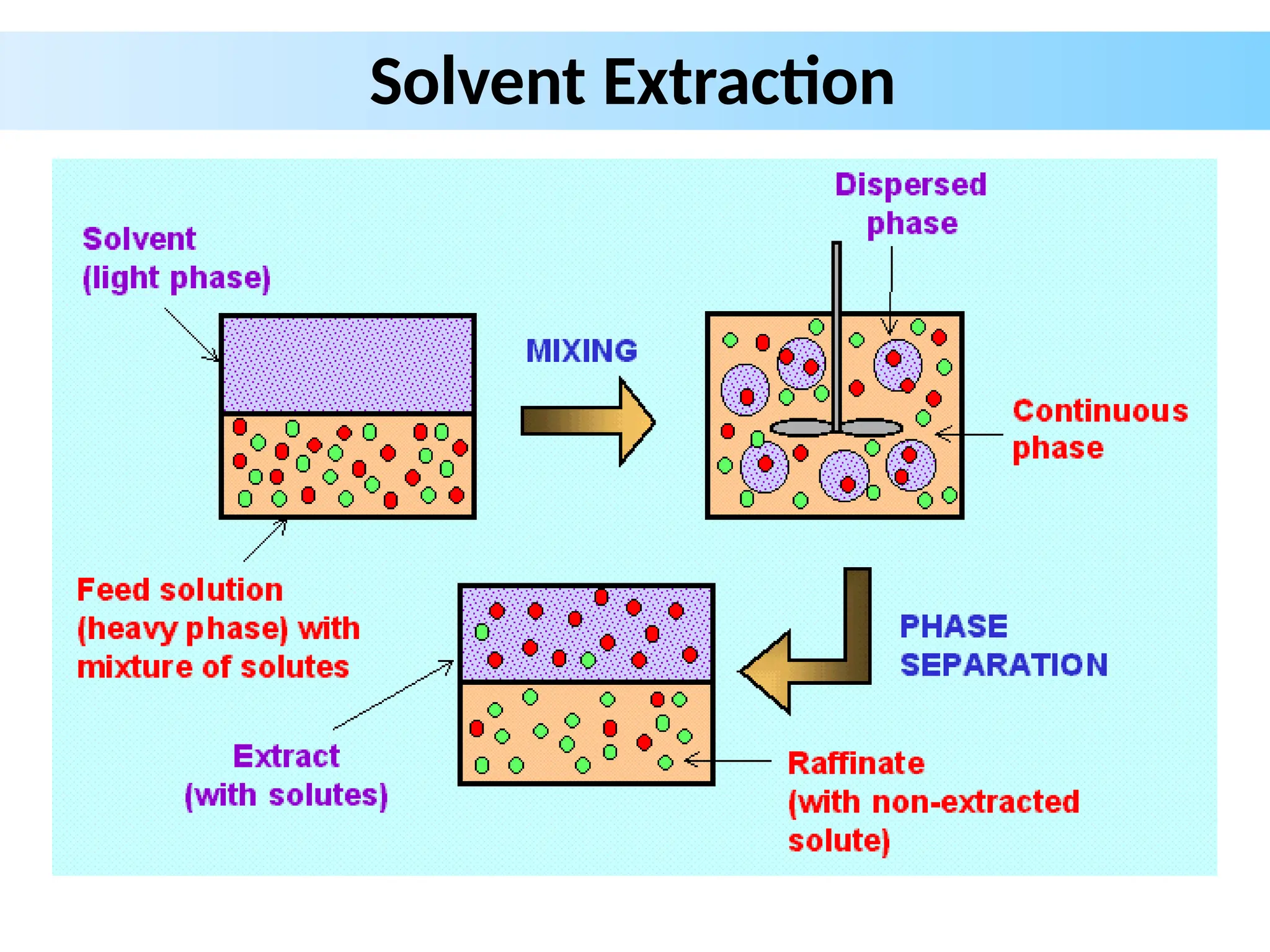
• Liquid-Liquid extraction is a mass transfer operation in which
a solution (Feed: a mixture of solute and carrier
liquid) is
slightly miscible liquid (solvent) in order to achieve
brought into intimate contact with second immiscible or
the
transfer of solute(s) from the feed to the solvent.
• The solute rich phase is called extract
• The residual liquid phase (feed stream) that may have
the little of the solute left in it is called raffinate
Liquid-Liquid Extraction
Liquid-liquid extraction
• Liquid-liquid extraction (also known as solvent extraction)
involves the separation of the constituents (solutes) of a liquid
solution by contact with another insoluble liquid.
• Liquid-liquid (or solvent) extraction is a countercurrent
separation process for isolating the constituents of a liquid
mixture.
• In its simplest form, this involves the extraction of a solute
from a binary solution by bringing it into contact with a
second immiscible solvent in which the solute is soluble.
• Solutes are separated based on their different solubilities in
different liquids.
• Separation is achieved when the substances constituting the
original solution is transferred from the original solution to
the other liquid solution
• Liquid-liquid extraction is a process for separating
components in solution by their distribution between
two immiscible liquid phases Such a process is also
referred to as liquid extraction or solvent extraction 3
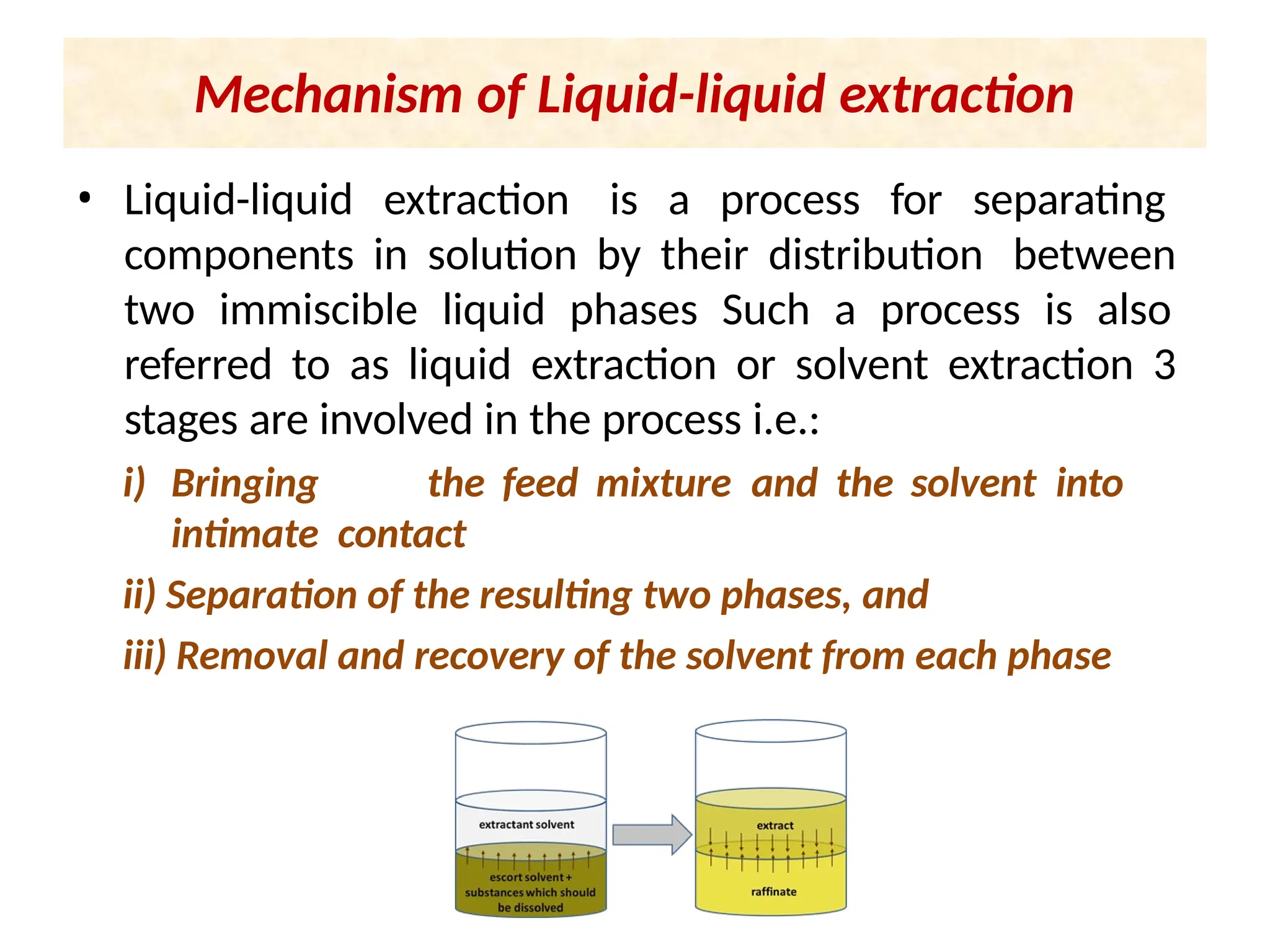
stages are involved in the process i.e.:
i) Bringing the feed mixture and the solvent into
intimate contact
ii) Separation of the resulting two phases, and
iii) Removal and recovery of the solvent from each phase
Mechanism of Liquid-liquid extraction
Principles of Liquid–Liquid Extraction
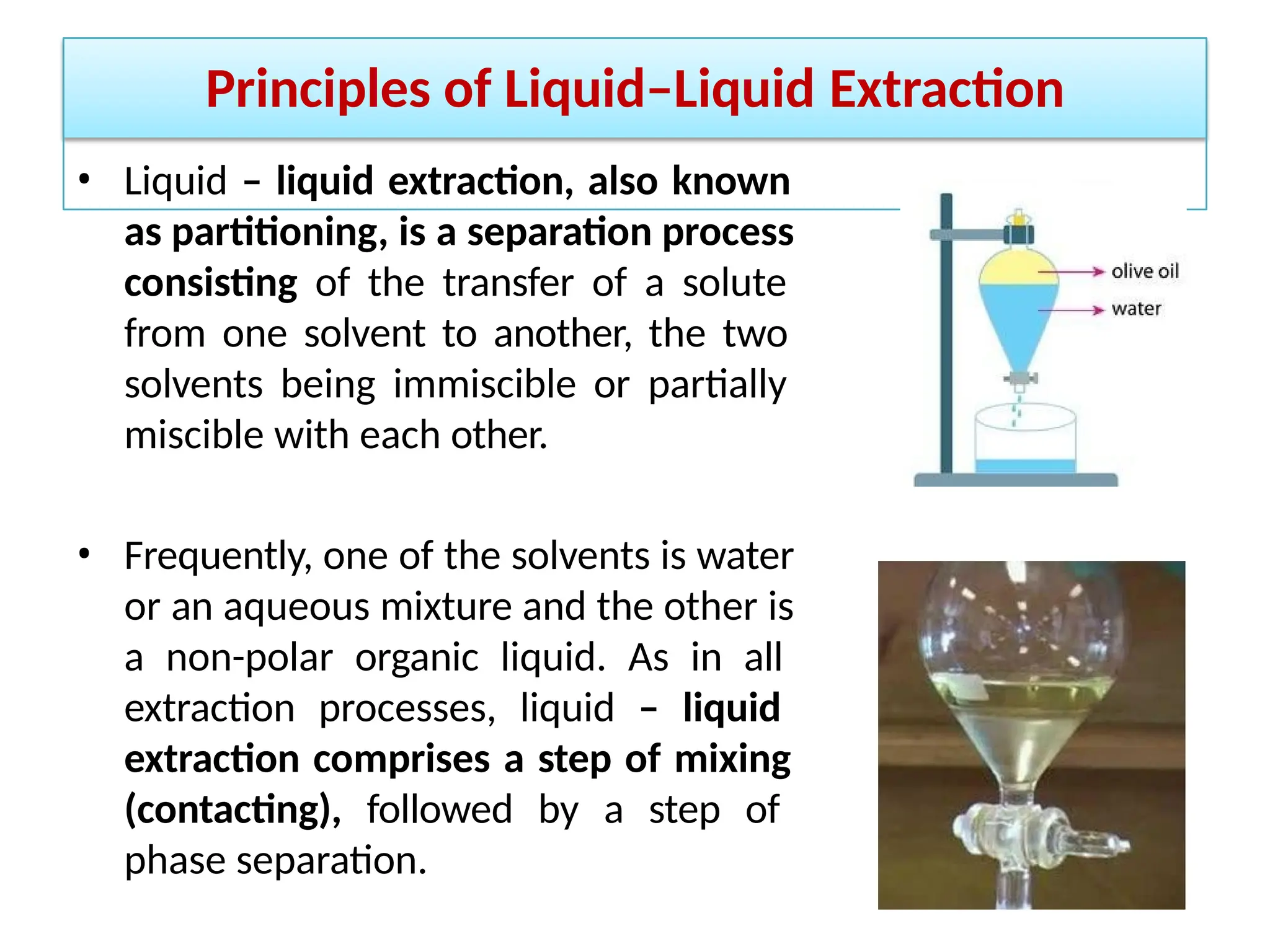
• Liquid – liquid extraction, also known
as partitioning, is a separation process
consisting of the transfer of a solute
from one solvent to another, the two
solvents being immiscible or partially
miscible with each other.
• Frequently, one of the solvents is water
or an aqueous mixture and the other is
a non-polar organic liquid. As in all
extraction processes, liquid – liquid
extraction comprises a step of mixing
(contacting), followed by a step of
phase separation.
Principles of Liquid–Liquid Extraction
• It is important to consider both steps in the selection of
solvents and modes of operation.
• Thus, while vigorous mixing is favorable to the transfer of the
extractable from one solvent to the other, it may also impair
the ease of phase separation by forming emulsions.
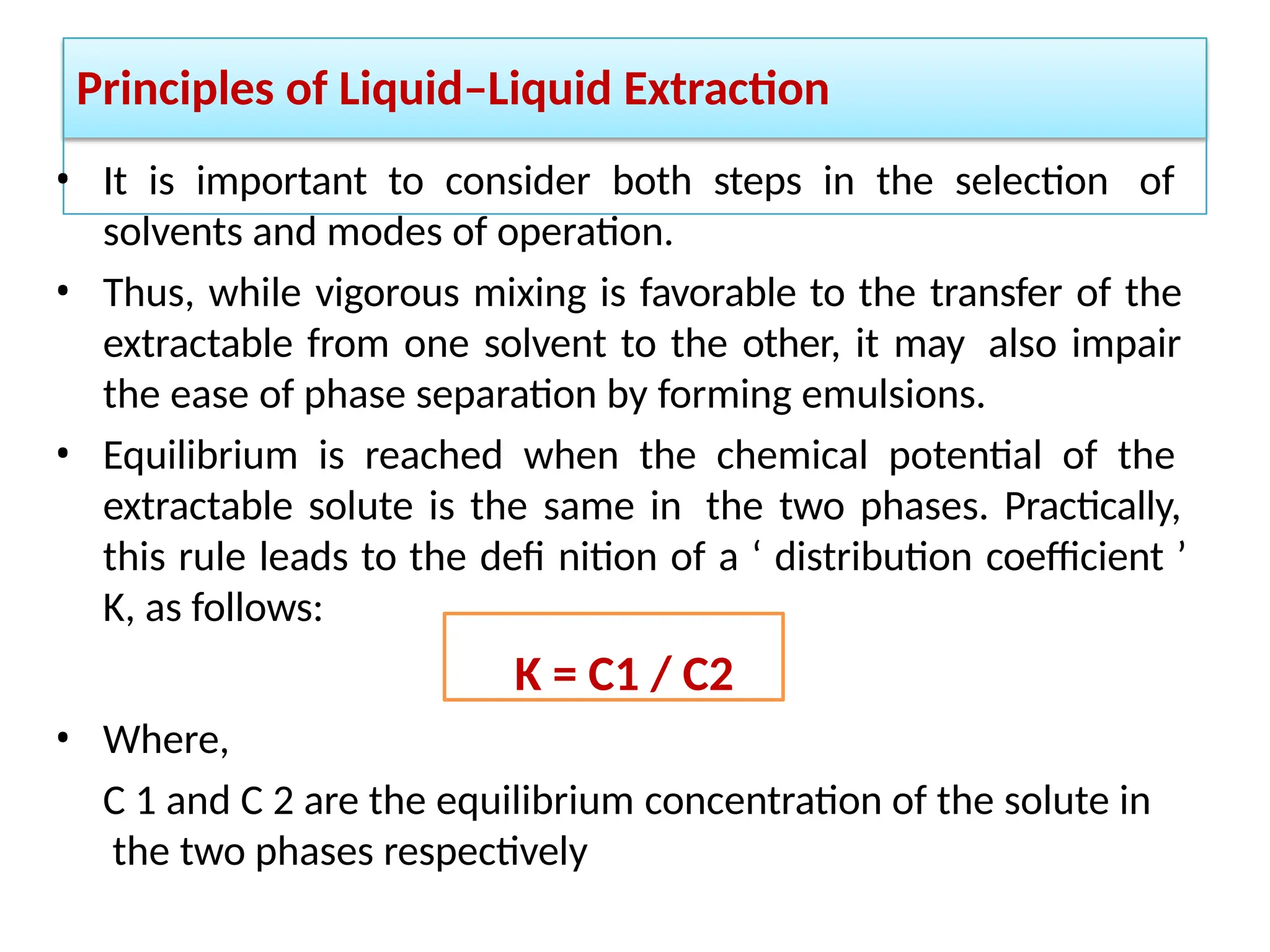
• Equilibrium is reached when the chemical potential of the
extractable solute is the same in the two phases. Practically,
this rule leads to the defi nition of a ‘ distribution coefficient ’
K, as follows:
K = C1 / C2
• Where,
C 1 and C 2 are the equilibrium concentration of the solute in
the two phases respectively
Principles of Liquid-Liquid Extraction
• The distribution coefficient is an expression of the relative
preference of the solute for the solvents.
• In ideal solutions (i.e. where the chemical potential may be
assumed to be proportional to the concentration), the
distribution coefficient at a given temperature is practically
constant, i.e. independent of the concentration.
• In some cases, the efficiency of a liquid – liquid extraction
process can be strongly improved by modifying the
distribution coefficient.
• Thus, an organic acid would prefer the non-polar solvent
when not dissociated (i.e. at low pH) and the aqueous
solvent when dissociated (i.e. at high pH).
Solvent Extraction
Multi-stage extractors
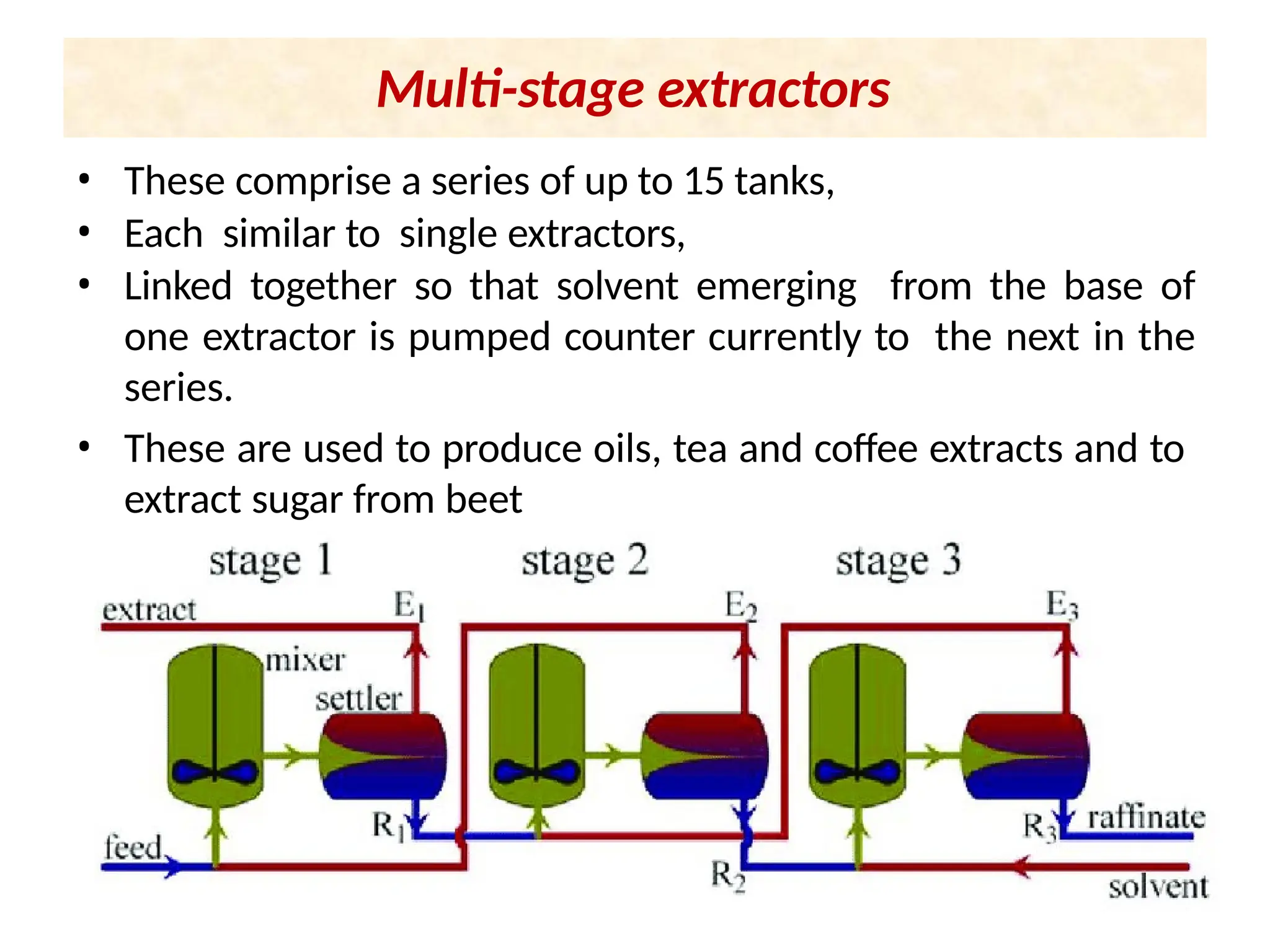
• These comprise a series of up to 15 tanks,
• Each similar to single extractors,
• Linked together so that solvent emerging from the base of
one extractor is pumped counter currently to the next in the
series.
• These are used to produce oils, tea and coffee extracts and to
extract sugar from beet
Continuous extractors
• There are a large number of designs of extractor, each of which
may operate counter currently and/or co-currently.
• For example, one design is an enclosed tank containing two vertical
bucket elevators made from perforated buckets and linked to form a
continuous ring.
• Fresh material is loaded into the descending buckets of one
elevator and solvent is pumped in at the top to extract solutes co-
currently.
• As the buckets then move upwards, fresh solvent is introduced at
the top of the second elevator to extract solutes counter-currently.
• The solution collects at the base and is pumped to the top of the
first elevator to extract more solute, or it is separated for further
processing.
• Other designs of equipment employ perforated screw conveyors
instead of bucket elevators
Cont…
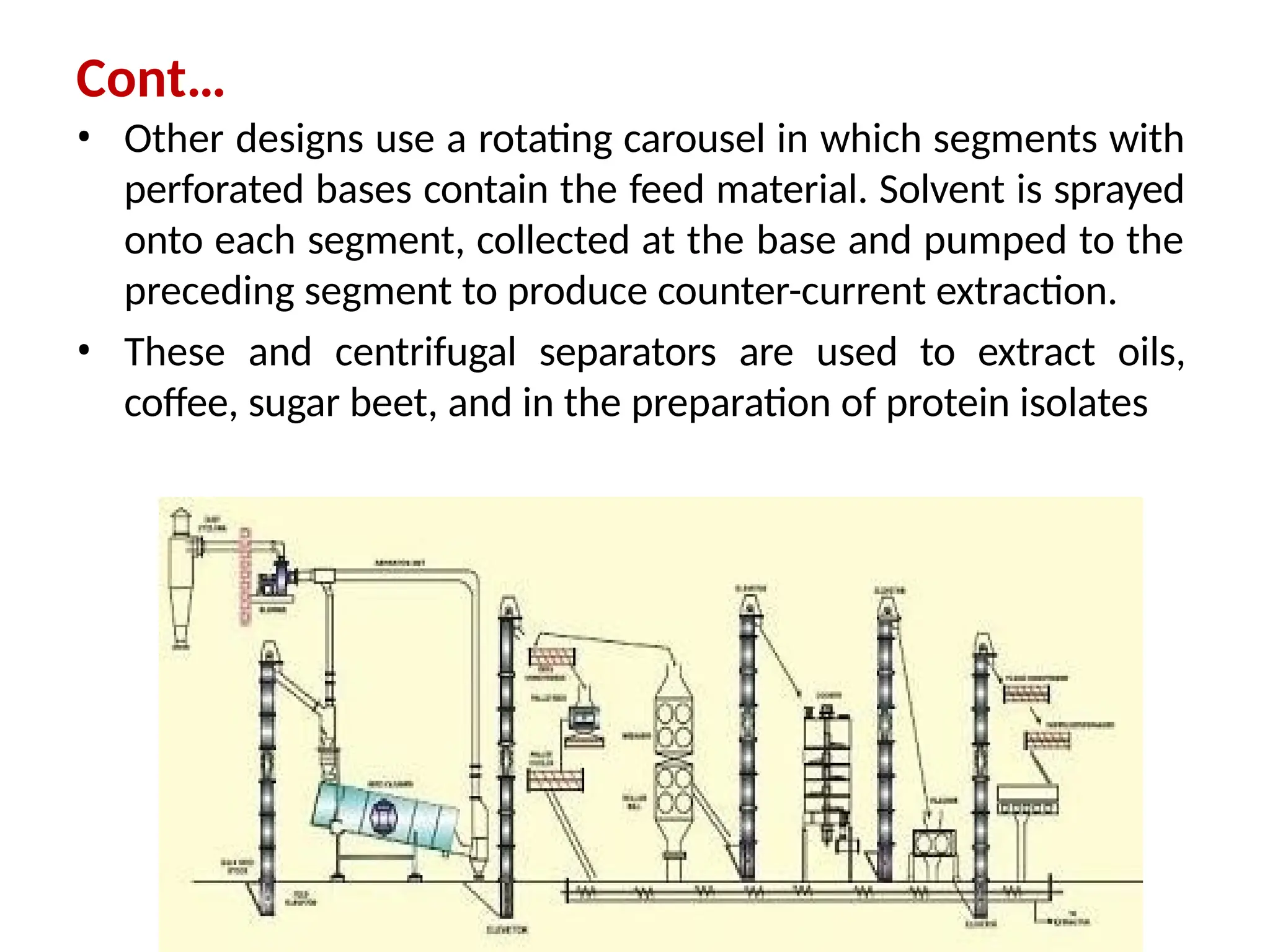
• Other designs use a rotating carousel in which segments with
perforated bases contain the feed material. Solvent is sprayed
onto each segment, collected at the base and pumped to the
preceding segment to produce counter-current extraction.
• These and centrifugal separators are used to extract oils,
coffee, sugar beet, and in the preparation of protein isolates
Counter current extraction
Counter-Current Extraction
• A liquid-liquid extraction process in which the solvent and
the process stream in contact with each other flow in
opposite directions.
• Counter current extraction is a method of multiple liquid-
liquid extraction. Separation of components having variable
solubility in two immiscible liquid phases is achieved.
• In the counter current extraction two immiscible solvents
flow in an opposite direction in multiple stages, (after
several stages pure A and B solvents can be obtained)
• Screw extractors and carousel extractors are the two
type of equipments used for Counter-Current Extraction.
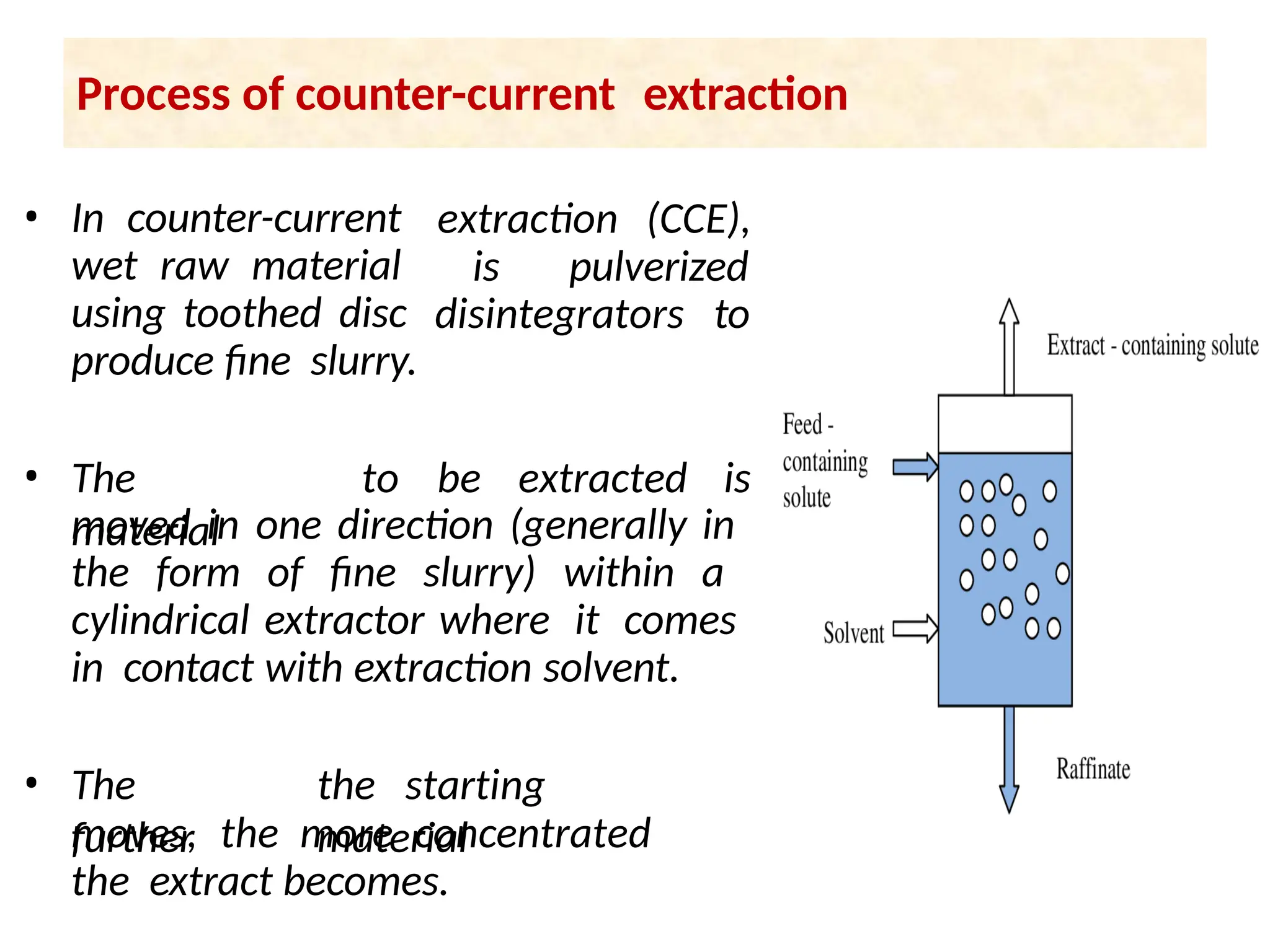
Process of counter-current extraction
• In counter-current
wet raw material
using toothed disc
produce fine slurry.
extraction (CCE),
is pulverized
disintegrators to
• The
material
to be extracted is
moved in one direction (generally in
the form of fine slurry) within a
cylindrical extractor where it comes
in contact with extraction solvent.
• The
further
the starting
material
moves, the more concentrated
the extract becomes.
Advantages
• A unit quantity of the plant material can be extracted
with much smaller volume of solvent as compared to
other methods like maceration, decoction, and
percolation.
• CCE
is
commonly done at room temperature,
which spares the thermo labile constituents from
exposure to heat which is employed in most other
techniques.
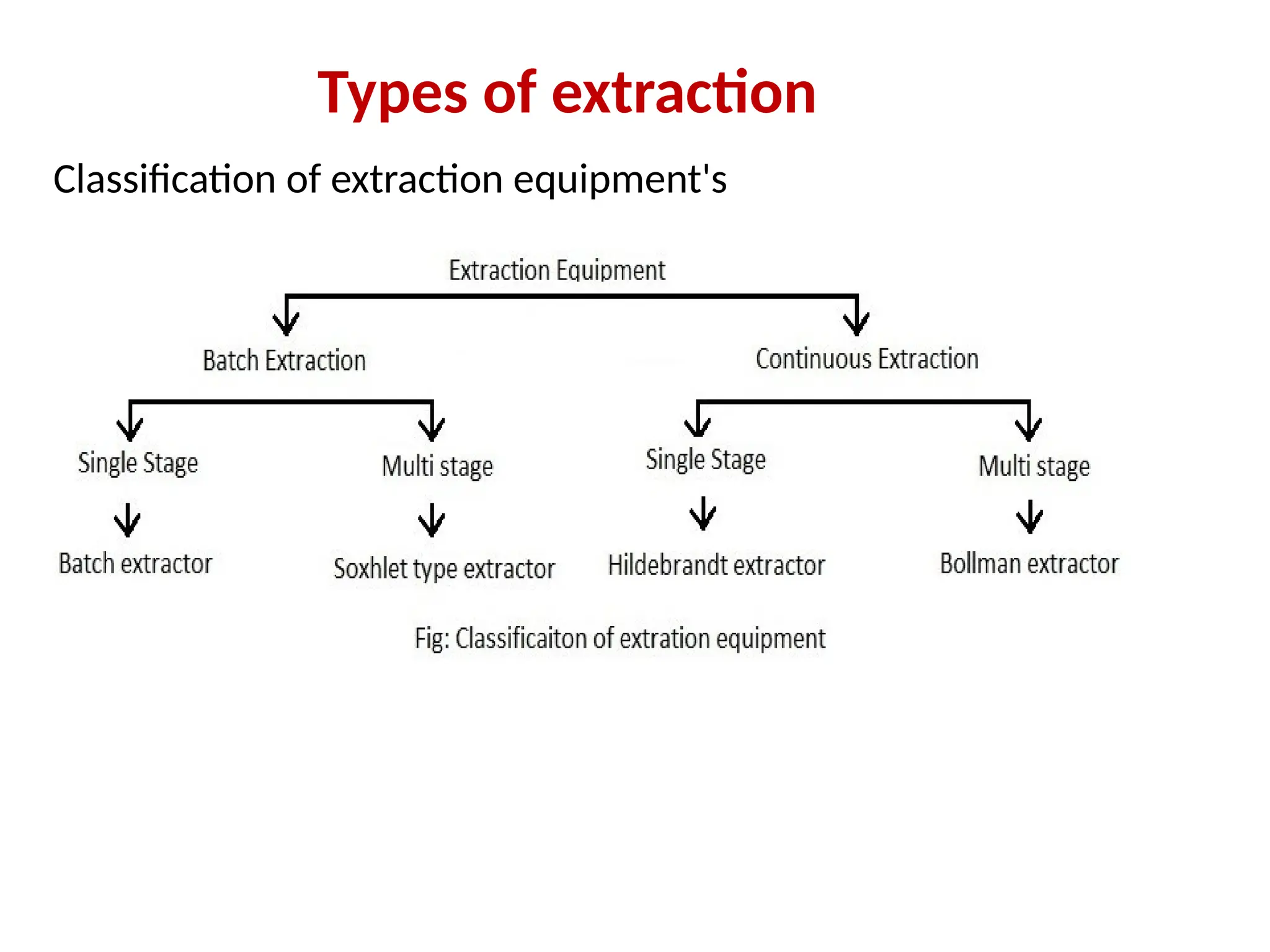
Types of extraction
Classification of extraction equipment's
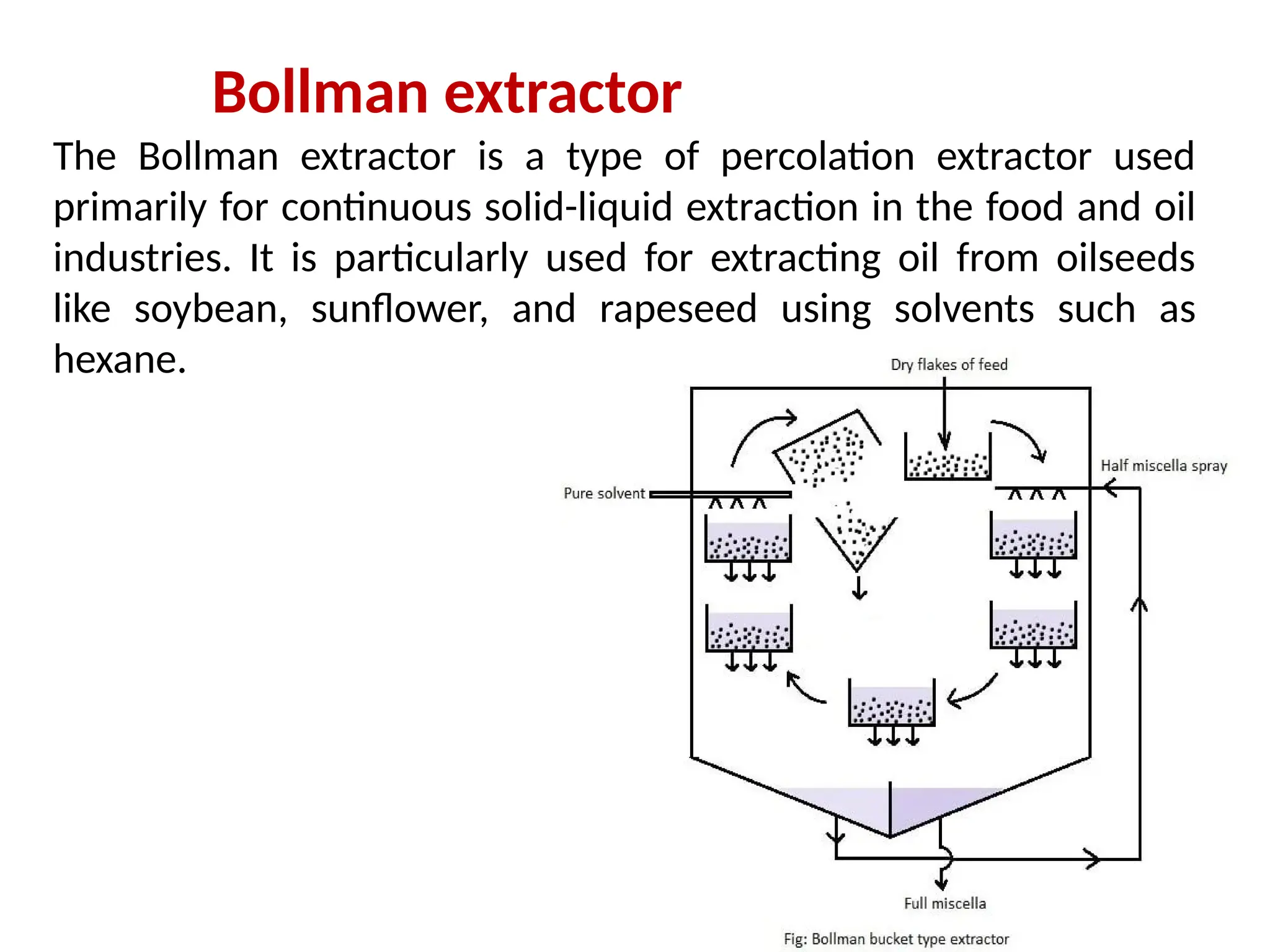
Bollman extractor
The Bollman extractor is a type of percolation extractor used
primarily for continuous solid-liquid extraction in the food and oil
industries. It is particularly used for extracting oil from oilseeds
like soybean, sunflower, and rapeseed using solvents such as
hexane.
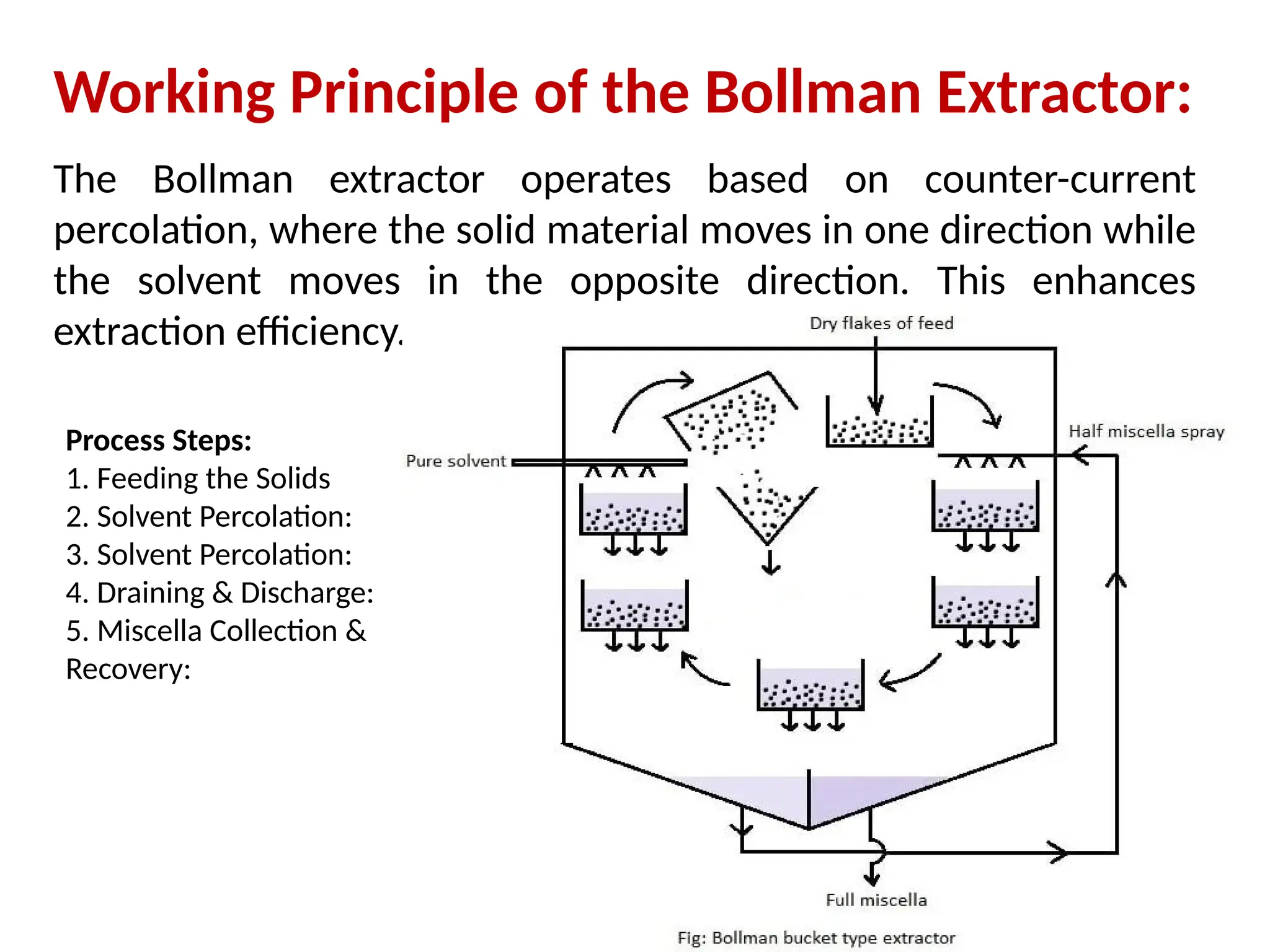
Working Principle of the Bollman Extractor:
The Bollman extractor operates based on counter-current
percolation, where the solid material moves in one direction while
the solvent moves in the opposite direction. This enhances
extraction efficiency.
Process Steps:
1. Feeding the Solids
2. Solvent Percolation:
3. Solvent Percolation:
4. Draining & Discharge:
5. Miscella Collection &
Recovery:
Advantages of the Bollman Extractor:
• Efficient Solvent Use: Counter-current flow maximizes oil
extraction.
• Low Solvent Loss: Continuous operation allows solvent
recovery.
• Gentle Handling of Solids: The conveyor-based movement
prevents excessive breakage of materials.
• High Yield: Provides better oil recovery compared to batch
extractors.
Applications:
• Oilseed processing (soybean, sunflower, rapeseed, etc.).
• Herbal and pharmaceutical extraction
• Food processing where solvent extraction is required.

Extraction.pptx Extraction.pptx Extracti
  • 1.
    Course No. FE-248 UnitOperations in Food Processing-II Course Teacher Mr. Pawar P.G. Assistant Professor MGM COLLEGE OF FOOD TECHNOLOGY, Gandheli, Chh. Sambhajinagar
  • 2.
    What is Extraction? morecomponents selectively from a are separated liquid or solid mixture, the feed (Phase 1), by means of a liquid immiscible solvent (Phase 2). The transfer of the components from the feed to the solvent is controlled by the solubility behavior of each component in the corresponding phase. Solvent: C Raffinate: A (+B) Extraction is a process in which one or Extract: C+B Feed: A+B
  • 3.
    Definition • Extraction isthe process of separating a component substance (the solute) from a solid or liquid mixture by dissolving it in a liquid solvent. • Extraction can be defined as the removal of soluble material from an insoluble residue, either liquid or solid, by treatment with a liquid solvent. It is therefore, a solution process and depends on the mass transfer phenomena. Mass Transfer
  • 4.
    Definition • Extraction isthe method of removal of a soluble fraction in the form of a solution from an insoluble matrix with the help of a suitable solvent • Example : Boiling tea or coffee to extract Tannins, Theobromine, Caffeine
  • 5.
    Types of extraction •Depending on the extraction agent, extraction can be phase of the mixture divided and the into the following types: 1. liquid -liquid extraction, where a solvent extracts a solute from a liquid phase 2. solid -liquid extraction, or leaching, where a solvent extracts a solute from a solid phase 3. supercritical extraction, where a fluid under supercritical conditions is used as the solvent
  • 6.
    LIQUID –LIQUID EXTRACTION Liquid-liquidextraction involves using a liquid solvent to remove a liquid component from a liquid mixture. The component dissolves preferably in the solvent.
  • 7.
    Solid-liquid extraction allowssoluble components to be removed from solids using a solvent. Applications of this unit operation include obtaining oil from oil seeds or leaching of metal salts from ores An everyday example is the preparation of coffee. Here, water (solvent) is used to remove the coffee flavours (transition component) from the coffee powder (extraction material, consisting of solid carrier phase and transition component). SOLID –LIQUID EXTRACTION
  • 8.
    Applications of Extraction Extraction of cooking oils or speciality oils  Flavours and essential oils Extraction from spices  Tea and coffee  Sugar extraction
  • 9.
    Introduction • During theholding period there is mass transfer of solutes from the food material to the solvent, which occurs in three stages: 1. the solute dissolves in the solvent 2. the solution moves through the particle of food to its surface 3. the solution becomes dispersed in the bulk of the solvent. • During extraction, the holding time should therefore be sufficient for the solvent to dissolve sufficient solute and for the changes in composition to approach an equilibrium. • Compared to distillation, extraction processes have the disadvantage that a new component is added to the system. • This leads to additional impurities as complete immiscibility does only exist in theory. Furthermore a subsequent separation process is required to regenerate the solvent
  • 10.
    Factor affecting extraction 1.The temperature of extraction: Higher temperatures increase both the rate at which solutes dissolve in the solvent and the rate of diffusion into the bulk of the solvent. 2. The surface area of solids exposed to the solvent: The rate of mass transfer is directly proportional to the surface area, so reductions in particle size (giving an increase in surface area) increase the rate of extraction up to certain limits. 3. The viscosity of the solvent: This should be sufficiently low to enable the solvent to penetrate easily the bed of solid particles. 4. The flow rate of the solvent: Higher flow rates reduce the boundary layer of concentrated solute at the surface of particles and thus increase the rate of extraction
  • 11.
  • 12.
    General Principles ofextraction 1. Diffusion: • Diffusion is the transport of molecules of a compound though a continuum in one phase, or through an interface between phases. 2. Solubility • The highest possible solute concentration in the final extract leaving an extraction system is the saturation concentration. • Thus, solvent to solids ratio must be high enough such solids, the below the that, when fresh solvent contacts fresh resulting solution on equilibrium, will be saturation concentration of solute.
  • 13.
    3. Equilibrium • Equilibriumis a condition where the solute concentration in both the solid and the solvent phases are equal. In order for equilibrium to occur, enough contact time must be allowed for the solid and solvent phases. • The extent to which the equilibrium concentration of solute in the solvent phase is reached in an extraction stage is expressed as a stage efficiency. • If equilibrium is reached in an extraction stage, the stage is 100% efficient and is designated an “ideal stage” General Principles of extraction
  • 14.
    Extraction using water •Extraction using water (leaching) has obvious advantages of low cost and safety and is used to extract sugar, coffee and tea. • Oils and fats require an organic solvent and as these are highly flammable, great care is needed in both operating procedures and to ensure that equipment is gas-tight and electrical apparatus is spark-proof.
  • 15.
    CO2 Extraction • Thematerial to be extracted is purged with gaseous CO2 • Separation and concentration of food components to remove air and then liquid CO2 is pumped in at a rate that permits a sufficient residence time for equilibrium conditions to be established. • The solution is then passed to the separation vessel in which conditions are adjusted to minimize the solubility of the extracted components (often by decompression). • The CO2 is then returned to the cooled condenser for re-use and the extract is removed from the separation vessel
  • 16.
    Supercritical Fluid (CO2)extraction • Supercritical carbon dioxide has found increasingly widespread application for removing caffeine from coffee or tea and for producing hop extracts for brewing. • It has also been used to extract and concentrate flavour compounds from fruits and spices (including pepper, marjoram, nutmeg, cardamom, cloves and ginger), and speciality oils from citrus and a variety of nuts and seeds. • The combination of supercritical CO2 and extrusion to produce a new range of breakfast cereals, pasta products and confectionery
  • 17.
    Cont.. • The termsupercritical arises from the critical temperature and critical pressure lines on a pressure–temperature diagram. • The supercritical region for carbon dioxide is when it is above the critical pressure line and to the right of the critical temperature line (31ºC). • As a solvent it acts as a liquid but has a low viscosity and diffuses easily like a gas. It has the advantages of being highly volatile and so is easily separated from solute without leaving any residues in the food. • It is also non-flammable, non-toxic, bacteriostatic and low cost. It is used under conditions that are close to the critical point.
  • 18.
    CO2 Extraction Equipment •Extractors are either single-stage or multi-stage static tanks or continuous extractors. The components of a typical extraction unit that uses near-critical CO2 solvent . • The essential components are an extraction vessel, a separation vessel, a condenser and a pump. • In supercritical CO2 extraction, CO is stored as a near-critical liquid in the condenser and then pumped to the extraction vessel through a heat exchanger by a high pressure pump.
  • 19.
    The concept ofextraction: the one stage extractor • The simplest form of an extractor apparatus has only one stage and the process is performed in two steps. • In the first step, the feed is mixed with the solvent to create a high surface area allowing to achieve high mass transfer rates. • The mass transfer stops when thermodynamic equilibrium between the two phases is reached. Equilibrium is characterized by an equal temperature, equal pressure and equal chemical potentials in both phases. • In the second step the two phases are allowed to separate (settling process). Finally, after decanting one receives the ranate and the extract.
  • 20.
    • Liquid-Liquid extractionis a mass transfer operation in which a solution (Feed: a mixture of solute and carrier liquid) is slightly miscible liquid (solvent) in order to achieve brought into intimate contact with second immiscible or the transfer of solute(s) from the feed to the solvent. • The solute rich phase is called extract • The residual liquid phase (feed stream) that may have the little of the solute left in it is called raffinate Liquid-Liquid Extraction
  • 21.
    Liquid-liquid extraction • Liquid-liquidextraction (also known as solvent extraction) involves the separation of the constituents (solutes) of a liquid solution by contact with another insoluble liquid. • Liquid-liquid (or solvent) extraction is a countercurrent separation process for isolating the constituents of a liquid mixture. • In its simplest form, this involves the extraction of a solute from a binary solution by bringing it into contact with a second immiscible solvent in which the solute is soluble. • Solutes are separated based on their different solubilities in different liquids. • Separation is achieved when the substances constituting the original solution is transferred from the original solution to the other liquid solution
  • 22.
    • Liquid-liquid extractionis a process for separating components in solution by their distribution between two immiscible liquid phases Such a process is also referred to as liquid extraction or solvent extraction 3 stages are involved in the process i.e.: i) Bringing the feed mixture and the solvent into intimate contact ii) Separation of the resulting two phases, and iii) Removal and recovery of the solvent from each phase Mechanism of Liquid-liquid extraction
  • 23.
    Principles of Liquid–LiquidExtraction • Liquid – liquid extraction, also known as partitioning, is a separation process consisting of the transfer of a solute from one solvent to another, the two solvents being immiscible or partially miscible with each other. • Frequently, one of the solvents is water or an aqueous mixture and the other is a non-polar organic liquid. As in all extraction processes, liquid – liquid extraction comprises a step of mixing (contacting), followed by a step of phase separation.
  • 24.
    Principles of Liquid–LiquidExtraction • It is important to consider both steps in the selection of solvents and modes of operation. • Thus, while vigorous mixing is favorable to the transfer of the extractable from one solvent to the other, it may also impair the ease of phase separation by forming emulsions. • Equilibrium is reached when the chemical potential of the extractable solute is the same in the two phases. Practically, this rule leads to the defi nition of a ‘ distribution coefficient ’ K, as follows: K = C1 / C2 • Where, C 1 and C 2 are the equilibrium concentration of the solute in the two phases respectively
  • 25.
    Principles of Liquid-LiquidExtraction • The distribution coefficient is an expression of the relative preference of the solute for the solvents. • In ideal solutions (i.e. where the chemical potential may be assumed to be proportional to the concentration), the distribution coefficient at a given temperature is practically constant, i.e. independent of the concentration. • In some cases, the efficiency of a liquid – liquid extraction process can be strongly improved by modifying the distribution coefficient. • Thus, an organic acid would prefer the non-polar solvent when not dissociated (i.e. at low pH) and the aqueous solvent when dissociated (i.e. at high pH).
  • 27.
  • 28.
    Multi-stage extractors • Thesecomprise a series of up to 15 tanks, • Each similar to single extractors, • Linked together so that solvent emerging from the base of one extractor is pumped counter currently to the next in the series. • These are used to produce oils, tea and coffee extracts and to extract sugar from beet
  • 29.
    Continuous extractors • Thereare a large number of designs of extractor, each of which may operate counter currently and/or co-currently. • For example, one design is an enclosed tank containing two vertical bucket elevators made from perforated buckets and linked to form a continuous ring. • Fresh material is loaded into the descending buckets of one elevator and solvent is pumped in at the top to extract solutes co- currently. • As the buckets then move upwards, fresh solvent is introduced at the top of the second elevator to extract solutes counter-currently. • The solution collects at the base and is pumped to the top of the first elevator to extract more solute, or it is separated for further processing. • Other designs of equipment employ perforated screw conveyors instead of bucket elevators
  • 30.
    Cont… • Other designsuse a rotating carousel in which segments with perforated bases contain the feed material. Solvent is sprayed onto each segment, collected at the base and pumped to the preceding segment to produce counter-current extraction. • These and centrifugal separators are used to extract oils, coffee, sugar beet, and in the preparation of protein isolates
  • 31.
  • 32.
    Counter-Current Extraction • Aliquid-liquid extraction process in which the solvent and the process stream in contact with each other flow in opposite directions. • Counter current extraction is a method of multiple liquid- liquid extraction. Separation of components having variable solubility in two immiscible liquid phases is achieved. • In the counter current extraction two immiscible solvents flow in an opposite direction in multiple stages, (after several stages pure A and B solvents can be obtained) • Screw extractors and carousel extractors are the two type of equipments used for Counter-Current Extraction.
  • 33.
    Process of counter-currentextraction • In counter-current wet raw material using toothed disc produce fine slurry. extraction (CCE), is pulverized disintegrators to • The material to be extracted is moved in one direction (generally in the form of fine slurry) within a cylindrical extractor where it comes in contact with extraction solvent. • The further the starting material moves, the more concentrated the extract becomes.
  • 34.
    Advantages • A unitquantity of the plant material can be extracted with much smaller volume of solvent as compared to other methods like maceration, decoction, and percolation. • CCE is commonly done at room temperature, which spares the thermo labile constituents from exposure to heat which is employed in most other techniques.
  • 35.
    Types of extraction Classificationof extraction equipment's
  • 36.
    Bollman extractor The Bollmanextractor is a type of percolation extractor used primarily for continuous solid-liquid extraction in the food and oil industries. It is particularly used for extracting oil from oilseeds like soybean, sunflower, and rapeseed using solvents such as hexane.
  • 37.
    Working Principle ofthe Bollman Extractor: The Bollman extractor operates based on counter-current percolation, where the solid material moves in one direction while the solvent moves in the opposite direction. This enhances extraction efficiency. Process Steps: 1. Feeding the Solids 2. Solvent Percolation: 3. Solvent Percolation: 4. Draining & Discharge: 5. Miscella Collection & Recovery:
  • 38.
    Advantages of theBollman Extractor: • Efficient Solvent Use: Counter-current flow maximizes oil extraction. • Low Solvent Loss: Continuous operation allows solvent recovery. • Gentle Handling of Solids: The conveyor-based movement prevents excessive breakage of materials. • High Yield: Provides better oil recovery compared to batch extractors.
  • 39.
    Applications: • Oilseed processing(soybean, sunflower, rapeseed, etc.). • Herbal and pharmaceutical extraction • Food processing where solvent extraction is required.