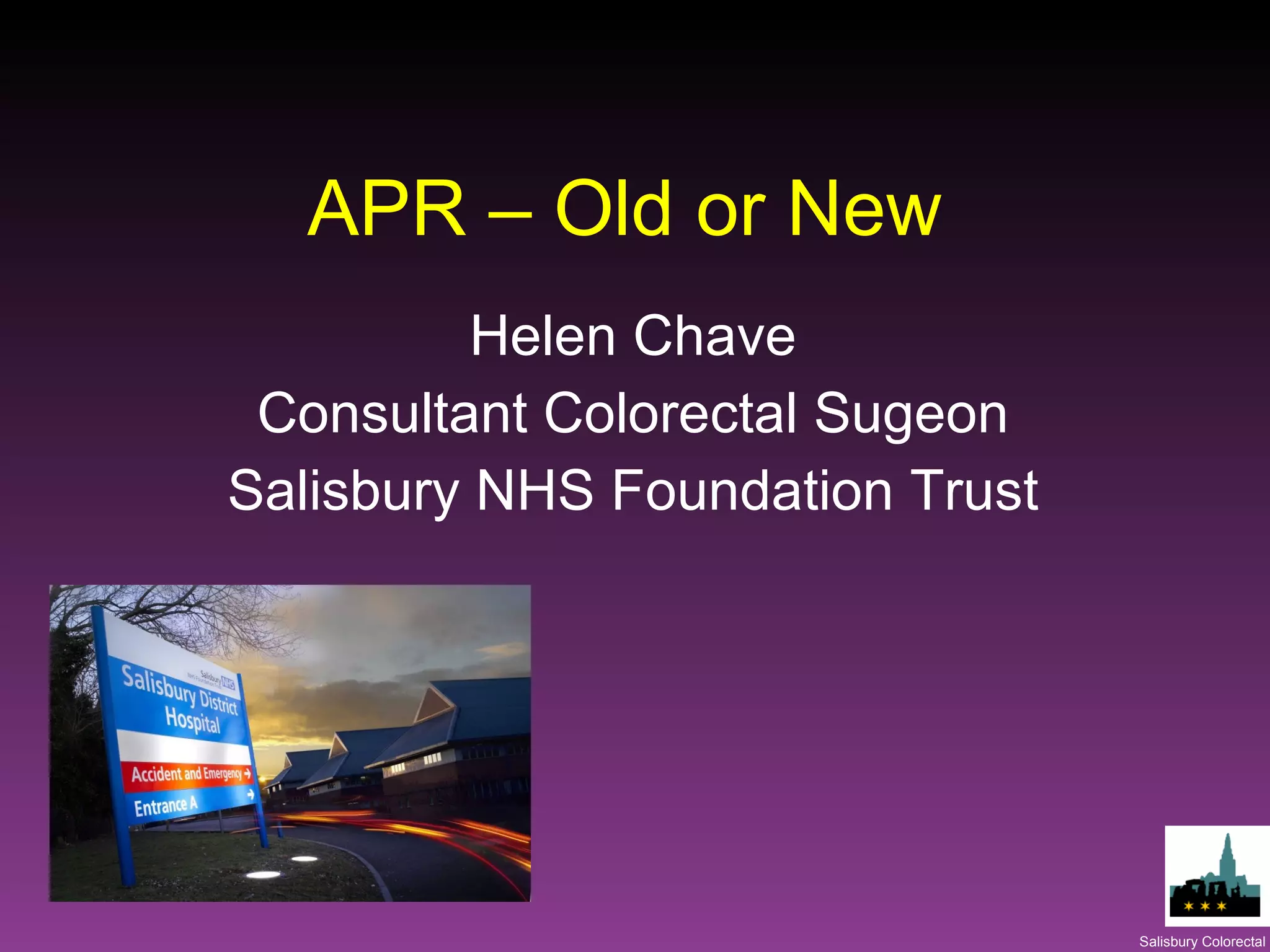
APR – Old or New Helen Chave Consultant Colorectal Sugeon Salisbury NHS Foundation Trust
APER - the challenges poorer oncological results high morbidity unhealed perineum training Dukes' club, April 2011
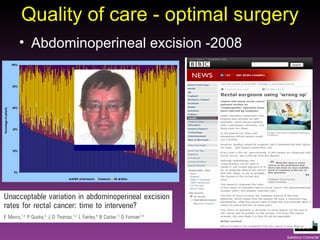
Quality of care - optimal surgery Abdominoperineal excision -2008
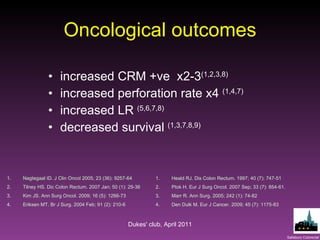
Oncological outcomes increased CRM +ve  x2-3 (1,2,3,8) increased perforation rate x4  (1,4,7) increased LR  (5,6,7,8) decreased survival  (1,3,7,8,9) Dukes' club, April 2011 Nagtegaal ID. J Clin Oncol 2005; 23 (36): 9257-64 Tilney HS. Dic Colon Rectum. 2007 Jan; 50 (1): 29-36 Kim JS. Ann Surg Oncol. 2009; 16 (5): 1266-73 Eriksen MT. Br J Surg. 2004 Feb; 91 (2): 210-6 Heald RJ. Dis Colon Rectum. 1997; 40 (7): 747-51 Ptok H. Eur J Surg Oncol. 2007 Sep; 33 (7): 854-61. Marr R. Ann Surg. 2005; 242 (1): 74-82 Den Dulk M. Eur J Cancer. 2009; 45 (7): 1175-83
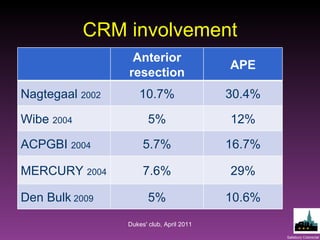
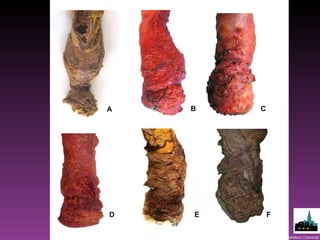
CRM involvement Dukes' club, April 2011 Anterior resection APE Nagtegaal  2002 10.7% 30.4% Wibe  2004 5% 12% ACPGBI  2004 5.7% 16.7% MERCURY  2004 7.6% 29% Den Bulk  2009 5% 10.6%
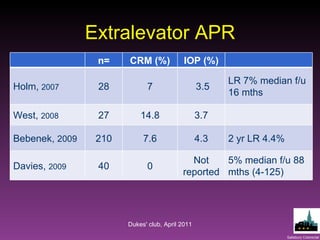
Extralevator APR Dukes' club, April 2011 n= CRM (%) IOP (%) Holm,  2007 28 7 3.5 LR 7% median f/u 16 mths West,  2008 27 14.8 3.7 Bebenek,  2009 210 7.6 4.3 2 yr LR 4.4% Davies,  2009 40 0 Not reported 5% median f/u 88 mths (4-125)
Dukes' club, April 2011
 
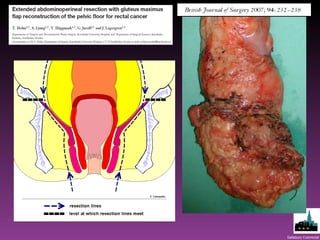
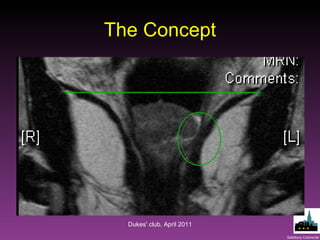
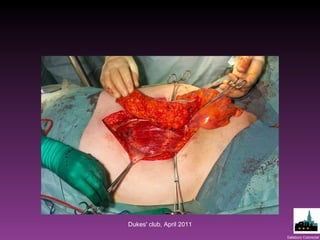
The Concept Dukes' club, April 2011
Dukes' club, April 2011
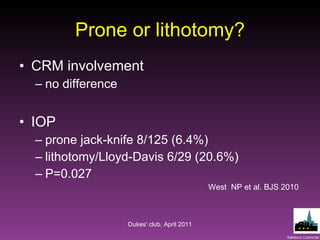
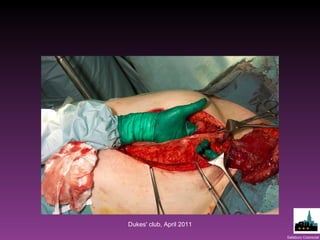
Prone or lithotomy? CRM involvement no difference IOP prone jack-knife 8/125 (6.4%) lithotomy/Lloyd-Davis 6/29 (20.6%) P=0.027 West  NP et al. BJS 2010  Dukes' club, April 2011
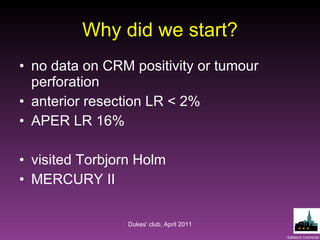
Why did we start? no data on CRM positivity or tumour perforation anterior resection LR < 2% APER LR 16% visited Torbjorn Holm MERCURY II Dukes' club, April 2011
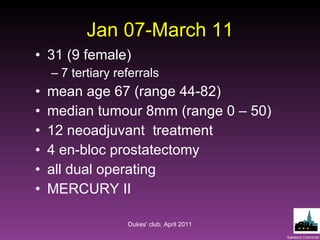
Jan 07-March 11 31 (9 female) 7 tertiary referrals mean age 67 (range 44-82) median tumour 8mm (range 0 – 50) 12 neoadjuvant  treatment 4 en-bloc prostatectomy all dual operating MERCURY II Dukes' club, April 2011
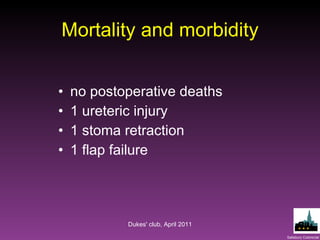
Mortality and morbidity no postoperative deaths 1 ureteric injury 1 stoma retraction 1 flap failure Dukes' club, April 2011
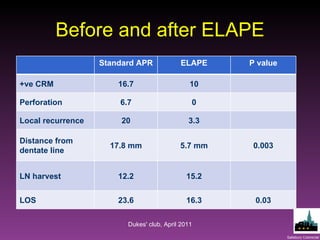
Before and after ELAPE Dukes' club, April 2011 Standard APR ELAPE P value +ve CRM 16.7 10 Perforation 6.7 0 Local recurrence 20 3.3 Distance from dentate line 17.8 mm 5.7 mm 0.003 LN harvest 12.2 15.2 LOS 23.6 16.3 0.03
Dukes' club, April 2011
Perineal wound failure Common 1-3 Long term problems 2,4 Bullard et al. Dis C olon Rectum 2005.  Chadwick et al. Colorectal Dis 2006.  Kim et al. Int J Radiat Oncol Biol Phys 1997. Kapoor et al. Am Surg 2005. Dukes' club, April 2011
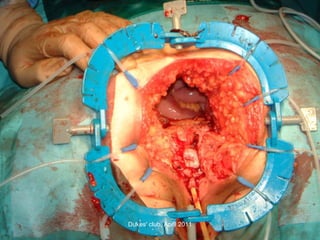
Current trends Increasing use of radiotherapy Single most important risk factor 3 ElAPE removes significantly more tissue than conventional procedure 5 3. Chadwick et al.  Colorectal Dis. 2006.   5. West et al. J Clin Oncol 2008 .   Dukes' club, April 2011
Dukes' club, April 2011
Options Omentoplasty Biological mesh Myocutaneous flaps Dukes' club, April 2011
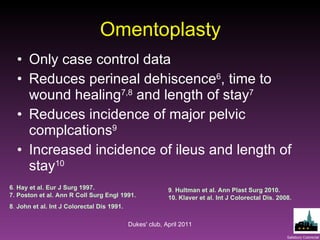
Omentoplasty Only case control data Reduces perineal dehiscence 6 , time to wound healing 7,8  and length of stay 7 Reduces incidence of major pelvic complcations 9 Increased incidence of ileus and length of stay 10 6 .  Hay et al. Eur J Surg 1997. 7. Poston et al. Ann R Coll Surg Engl 1991.   8 .  John et al. Int J Colorectal Dis 1991.   9 .  Hultman et al. Ann Plast Surg 2010.   10. Klaver et al. Int J Colorectal Dis. 2008.   Dukes' club, April 2011
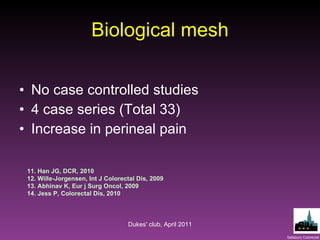
Biological mesh No case controlled studies 4 case series (Total 33) Increase in perineal pain 11. Han JG, DCR, 2010 12. Wille-Jorgensen, Int J Colorectal Dis, 2009 13. Abhinav K, Eur j Surg Oncol, 2009 14. Jess P, Colorectal Dis, 2010 Dukes' club, April 2011
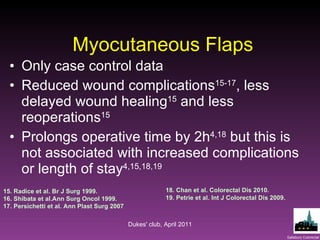
Myocutaneous Flaps Only case control data Reduced wound complications 15-17 , less delayed wound healing 15  and less reoperations 15 Prolongs operative time by 2h 4,18  but this is not associated with increased complications or length of stay 4,15,18,19 15. Radice et al. Br J Surg 1999. 16. Shibata et al.Ann Surg Oncol 1999. 17. Persichetti et al. Ann Plast Surg 2007 18. Chan et al. Colorectal Dis 2010. 19. Petrie et al. Int J Colorectal Dis 2009.   Dukes' club, April 2011
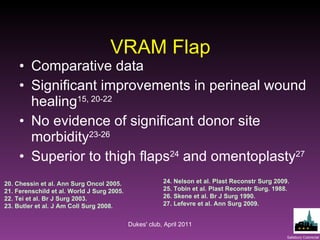
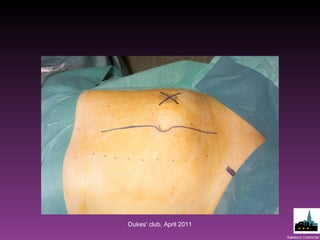
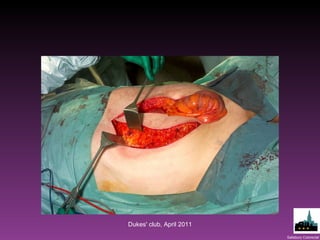
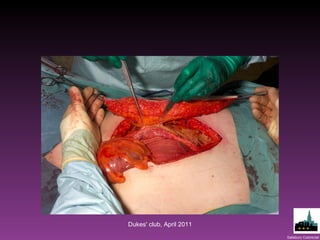
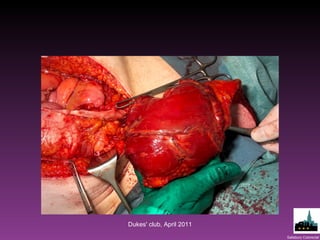
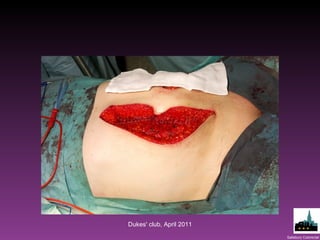
VRAM Flap Comparative data Significant improvements in perineal wound healing 15, 20-22 No evidence of significant donor site morbidity 23-26 Superior to thigh flaps 24  and omentoplasty 27   20. Chessin et al. Ann Surg Oncol 2005. 21. Ferenschild et al. World J Surg 2005. 22. Tei et al. Br J Surg 2003. 23. Butler et al.  J Am Coll Surg 2008. 24. Nelson et al. Plast Reconstr Surg 2009.   25. Tobin et al. Plast Reconstr Surg. 1988. 26. Skene et al. Br J Surg 1990. 27. Lefevre et al. Ann Surg 2009. Dukes' club, April 2011
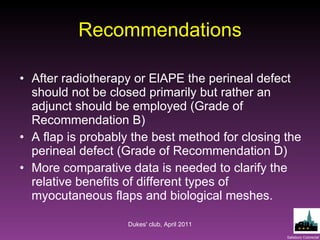
Recommendations After radiotherapy or ElAPE the perineal defect should not be closed primarily but rather an adjunct should be employed (Grade of Recommendation B) A flap is probably the best method for closing the perineal defect (Grade of Recommendation D) More comparative data is needed to clarify the relative benefits of different types of myocutaneous flaps and biological meshes. Dukes' club, April 2011
Dukes' club, April 2011
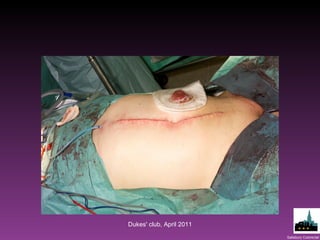
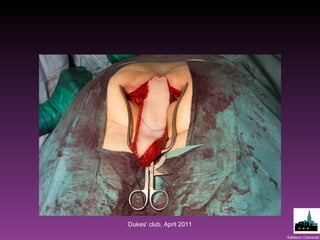
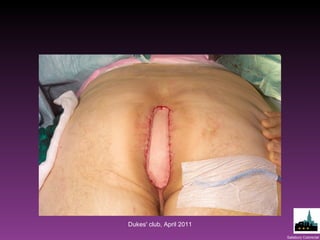
Salisbury experience  November 2000 – Feb 2011 54 patients (22 female, av. age 66) Rectal 37 ElAPE 31 Traditional APE 6 Anal 17 Laparoscopic top end 15 (one converted) VRAM 48 Dukes' club, April 2011
Morbidity Recipient: Flap loss 2 (4%) Infected pelvic haematoma 2 (4%) Flap tip necrosis 1 (2%) Perineal hernia 1 (2%) Donor site Infected biological mesh 2 (4%) Incisional hernia 1 (2%) Dukes' club, April 2011
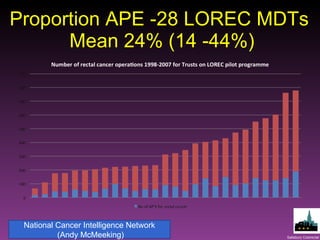
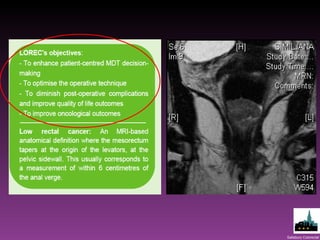
Where did LOREC come from?  Variation in APE rates High CRM involvement Poor outcomes in APE
Proportion APE -28 LOREC MDTs  Mean 24% (14 -44%) National Cancer Intelligence Network (Andy McMeeking)
 
Summary Oncology Morbidity Training Dukes' club, April 2011

Extended APER- An Update

  • 1.
    APR – Oldor New Helen Chave Consultant Colorectal Sugeon Salisbury NHS Foundation Trust
  • 2.
    APER - thechallenges poorer oncological results high morbidity unhealed perineum training Dukes' club, April 2011
  • 3.
    Quality of care- optimal surgery Abdominoperineal excision -2008
  • 4.
    Oncological outcomes increasedCRM +ve x2-3 (1,2,3,8) increased perforation rate x4 (1,4,7) increased LR (5,6,7,8) decreased survival (1,3,7,8,9) Dukes' club, April 2011 Nagtegaal ID. J Clin Oncol 2005; 23 (36): 9257-64 Tilney HS. Dic Colon Rectum. 2007 Jan; 50 (1): 29-36 Kim JS. Ann Surg Oncol. 2009; 16 (5): 1266-73 Eriksen MT. Br J Surg. 2004 Feb; 91 (2): 210-6 Heald RJ. Dis Colon Rectum. 1997; 40 (7): 747-51 Ptok H. Eur J Surg Oncol. 2007 Sep; 33 (7): 854-61. Marr R. Ann Surg. 2005; 242 (1): 74-82 Den Dulk M. Eur J Cancer. 2009; 45 (7): 1175-83
  • 5.
    CRM involvement Dukes'club, April 2011 Anterior resection APE Nagtegaal 2002 10.7% 30.4% Wibe 2004 5% 12% ACPGBI 2004 5.7% 16.7% MERCURY 2004 7.6% 29% Den Bulk 2009 5% 10.6%
  • 6.
    Extralevator APR Dukes'club, April 2011 n= CRM (%) IOP (%) Holm, 2007 28 7 3.5 LR 7% median f/u 16 mths West, 2008 27 14.8 3.7 Bebenek, 2009 210 7.6 4.3 2 yr LR 4.4% Davies, 2009 40 0 Not reported 5% median f/u 88 mths (4-125)
  • 7.
  • 8.
  • 9.
    The Concept Dukes'club, April 2011
  • 10.
  • 11.
    Prone or lithotomy?CRM involvement no difference IOP prone jack-knife 8/125 (6.4%) lithotomy/Lloyd-Davis 6/29 (20.6%) P=0.027 West NP et al. BJS 2010 Dukes' club, April 2011
  • 12.
    Why did westart? no data on CRM positivity or tumour perforation anterior resection LR < 2% APER LR 16% visited Torbjorn Holm MERCURY II Dukes' club, April 2011
  • 13.
    Jan 07-March 1131 (9 female) 7 tertiary referrals mean age 67 (range 44-82) median tumour 8mm (range 0 – 50) 12 neoadjuvant treatment 4 en-bloc prostatectomy all dual operating MERCURY II Dukes' club, April 2011
  • 14.
    Mortality and morbidityno postoperative deaths 1 ureteric injury 1 stoma retraction 1 flap failure Dukes' club, April 2011
  • 15.
    Before and afterELAPE Dukes' club, April 2011 Standard APR ELAPE P value +ve CRM 16.7 10 Perforation 6.7 0 Local recurrence 20 3.3 Distance from dentate line 17.8 mm 5.7 mm 0.003 LN harvest 12.2 15.2 LOS 23.6 16.3 0.03
  • 16.
  • 17.
    Perineal wound failureCommon 1-3 Long term problems 2,4 Bullard et al. Dis C olon Rectum 2005. Chadwick et al. Colorectal Dis 2006. Kim et al. Int J Radiat Oncol Biol Phys 1997. Kapoor et al. Am Surg 2005. Dukes' club, April 2011
  • 18.
    Current trends Increasinguse of radiotherapy Single most important risk factor 3 ElAPE removes significantly more tissue than conventional procedure 5 3. Chadwick et al. Colorectal Dis. 2006. 5. West et al. J Clin Oncol 2008 . Dukes' club, April 2011
  • 19.
  • 20.
    Options Omentoplasty Biologicalmesh Myocutaneous flaps Dukes' club, April 2011
  • 21.
    Omentoplasty Only casecontrol data Reduces perineal dehiscence 6 , time to wound healing 7,8 and length of stay 7 Reduces incidence of major pelvic complcations 9 Increased incidence of ileus and length of stay 10 6 . Hay et al. Eur J Surg 1997. 7. Poston et al. Ann R Coll Surg Engl 1991. 8 . John et al. Int J Colorectal Dis 1991. 9 . Hultman et al. Ann Plast Surg 2010. 10. Klaver et al. Int J Colorectal Dis. 2008. Dukes' club, April 2011
  • 22.
    Biological mesh Nocase controlled studies 4 case series (Total 33) Increase in perineal pain 11. Han JG, DCR, 2010 12. Wille-Jorgensen, Int J Colorectal Dis, 2009 13. Abhinav K, Eur j Surg Oncol, 2009 14. Jess P, Colorectal Dis, 2010 Dukes' club, April 2011
  • 23.
    Myocutaneous Flaps Onlycase control data Reduced wound complications 15-17 , less delayed wound healing 15 and less reoperations 15 Prolongs operative time by 2h 4,18 but this is not associated with increased complications or length of stay 4,15,18,19 15. Radice et al. Br J Surg 1999. 16. Shibata et al.Ann Surg Oncol 1999. 17. Persichetti et al. Ann Plast Surg 2007 18. Chan et al. Colorectal Dis 2010. 19. Petrie et al. Int J Colorectal Dis 2009. Dukes' club, April 2011
  • 24.
    VRAM Flap Comparativedata Significant improvements in perineal wound healing 15, 20-22 No evidence of significant donor site morbidity 23-26 Superior to thigh flaps 24 and omentoplasty 27 20. Chessin et al. Ann Surg Oncol 2005. 21. Ferenschild et al. World J Surg 2005. 22. Tei et al. Br J Surg 2003. 23. Butler et al. J Am Coll Surg 2008. 24. Nelson et al. Plast Reconstr Surg 2009. 25. Tobin et al. Plast Reconstr Surg. 1988. 26. Skene et al. Br J Surg 1990. 27. Lefevre et al. Ann Surg 2009. Dukes' club, April 2011
  • 25.
    Recommendations After radiotherapyor ElAPE the perineal defect should not be closed primarily but rather an adjunct should be employed (Grade of Recommendation B) A flap is probably the best method for closing the perineal defect (Grade of Recommendation D) More comparative data is needed to clarify the relative benefits of different types of myocutaneous flaps and biological meshes. Dukes' club, April 2011
  • 26.
  • 27.
  • 28.
  • 29.
  • 30.
  • 31.
  • 32.
  • 33.
  • 34.
  • 35.
  • 36.
  • 37.
    Salisbury experience November 2000 – Feb 2011 54 patients (22 female, av. age 66) Rectal 37 ElAPE 31 Traditional APE 6 Anal 17 Laparoscopic top end 15 (one converted) VRAM 48 Dukes' club, April 2011
  • 38.
    Morbidity Recipient: Flaploss 2 (4%) Infected pelvic haematoma 2 (4%) Flap tip necrosis 1 (2%) Perineal hernia 1 (2%) Donor site Infected biological mesh 2 (4%) Incisional hernia 1 (2%) Dukes' club, April 2011
  • 39.
    Where did LORECcome from? Variation in APE rates High CRM involvement Poor outcomes in APE
  • 40.
    Proportion APE -28LOREC MDTs Mean 24% (14 -44%) National Cancer Intelligence Network (Andy McMeeking)
  • 41.
  • 42.
    Summary Oncology MorbidityTraining Dukes' club, April 2011

Editor's Notes